
Copyright Seminar 2015
Welcome & Introduction
Nick Poole, CEO, Collections Trust
#ctcopyright
The Collections Trust is...
...the professional association
for people who work in
Collections Management
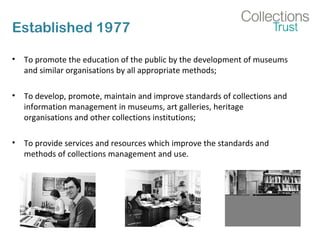
Established 1977
• To promote the education of the public by the development of museums
and similar organisations by all appropriate methods;
• To develop, promote, maintain and improve standards of collections and
information management in museums, art galleries, heritage
organisations and other collections institutions;
• To provide services and resources which improve the standards and
methods of collections management and use.
UK-based Charity
• As a professional association, our work encompasses:
– Promoting professional standards in Collections Management
– Developing the Collections Management workforce
– Advocating for the value and impact of Collections
Special programmes
• We develop programmes addressing key issues and opportunities in
collections management & digitisation:
– Security www.collectionstrust.org.uk/security
– Energy efficiency www.collectionstrust.org.uk/energy-efficiency
– Pests! www.collectionstrust.org.uk/pest-management
– Insurance www.collectionstrust.org.uk/insurance
– Participation www.collectionstrust.org.uk/participation
– Going Digital www.collectionstrust.org.uk/going-digital
– Copyright & licensing www.collectionstrust.org.uk/copyright-and-licensing
Copyright and licensing
We provide free resources to help museums with copyright issues and we’re
addressing how recent legal reforms to copyright affect museums.
•Free resources at www.collectionstrust.org.uk/copyright-and-licensing
•Today’s seminar! (18 February 2015, London)
www.collectionstrust.org.uk/copyright-seminar
•Copyright: A Practical Guide – updated 2nd edition available to order today:
www.collectionstrust.org.uk/shop (Print version £24.99, ebook version
£20.00)
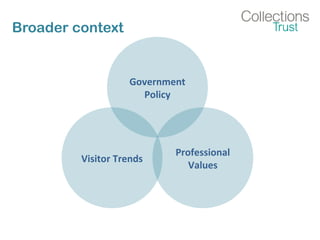
Visitor Trends
Government
Policy
Professional
Values
Broader context
Government Policy
• IP management & legislation as a tool for innovation & economic growth
• A ‘knowledge-intensive, creative economy’ (BIS, 2014)
• Austerity policy resulting in an estimated 37% net reduction in public
spending (excluding policing, schools & housing) since 2010-11*
• Real-terms increases in costs and demands creating additional pressure on
discretionary budgets
• Greater emphasis on self-generated revenue and enterprise
* http://www.nao.org.uk/wp-content/uploads/2014/11/Impact-of-funding-reductions-on-local-authorities.pdf
“It matters that our businesses, as well as other creators, can
protect their ideas, can spot and seize new opportunities, and
can exploit them both at home and abroad. IP is, quite simply,
vital to the economic well-being of the UK.”
Baroness Neville-Rolfe, Minister for Intellectual Property
“The UK’s trailblazing orphan works licensing scheme enables
access to a wider range of our culturally important works. The
scheme has been designed to protect right holders and give
them a proper return if they reappear, while ensuring that
citizens and consumers will be able to access more of our
country’s great creations, more easily.”
Baroness Neville-Rolfe, Minister for Intellectual Property
Visitor Trends
Visitor Trends
• “New figures published today [12th February 2015] reveal 49 million visits
were made to the 16 museums and galleries directly funded by the DCMS last
year, a four per cent increase on 2012/13 (47 million) and a record high since
the first data was published in 2002/03.” (DCMS)
• Heritage tourism contributes £20.6 billion to the UK GDP, more than the
advertising or film industries. It supports a total of 466,000 jobs. Heritage is
the main motivation for 30% of all international visits, while 14% of domestic-
tourism day trips are motivated by heritage. (HLF & VisitBritain)
• Visitors to independent museums (estimated to be over 9 million) are said to
deliver £364m of gross impacts from visitor spending. (Museums Association)
Professional values
• Protecting the integrity of collections
• Maintaining services
• Promoting public access to and engagement with heritage
• Delivering educational benefit & impact
• Maintaining public trust
• Maximising sustainability & competitiveness
Outcomes
• Increased pressure on budgets
• Emphasis on realising financial value of IP in and associated with collections
• Tension between:
– Promoting commercial re-use of content
– Promoting open access to and use of heritage material
• Different risk appetite
• Investment & capacity gap in both directions
Case Studies on Open
Content Licensing
Defining terms: open
• “A piece of content or data is open if anyone is free to use, reuse, and
redistribute it — subject only, at most, to the requirement to attribute and/or
share-alike.”
www.opendefinition.org
• This means that something is useable by all without the need to ask permission
by the (rights) owner of a work.
• Open Culture or Open GLAM (Galleries, Libraries, Archives, Museums) is a
movement that tries to help cultural institution to open up their collections: to
make them available to all for reuse without the need to asking permission.
(Source: ‘Open Data for #GLAMS’, P2P University)
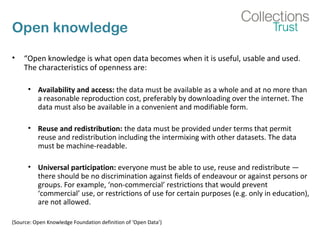
Open knowledge
• “Open knowledge is what open data becomes when it is useful, usable and used.
The characteristics of openness are:
• Availability and access: the data must be available as a whole and at no more than
a reasonable reproduction cost, preferably by downloading over the internet. The
data must also be available in a convenient and modifiable form.
• Reuse and redistribution: the data must be provided under terms that permit
reuse and redistribution including the intermixing with other datasets. The data
must be machine-readable.
• Universal participation: everyone must be able to use, reuse and redistribute —
there should be no discrimination against fields of endeavour or against persons or
groups. For example, ‘non-commercial’ restrictions that would prevent
‘commercial’ use, or restrictions of use for certain purposes (e.g. only in education),
are not allowed.
(Source: Open Knowledge Foundation definition of ‘Open Data’)
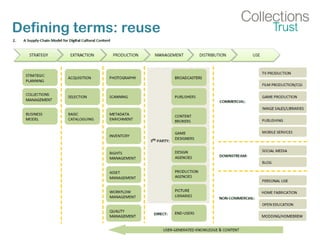
Defining terms: reuse
• Describes a wide spectrum of activities and applications of digital cultural
content undertaken by 3rd
parties
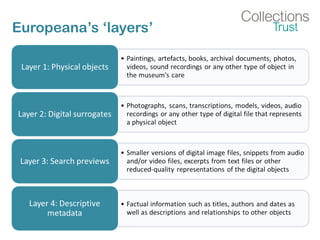
Europeana’s ‘layers’
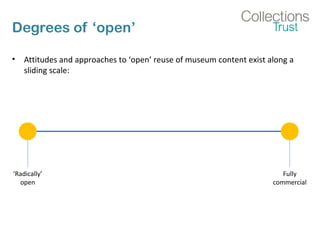
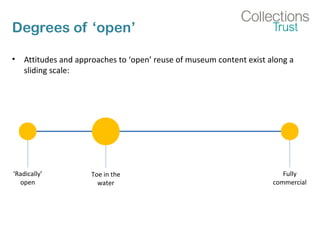
Degrees of ‘open’
• Attitudes and approaches to ‘open’ reuse of museum content exist along a
sliding scale:
‘Radically’
open
Fully
commercial
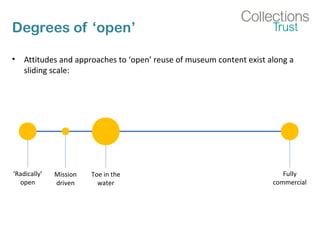
Degrees of ‘open’
• Attitudes and approaches to ‘open’ reuse of museum content exist along a
sliding scale:
‘Radically’
open
Fully
commercial
Toe in the
water
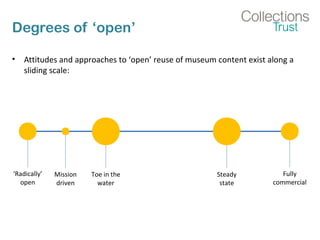
Degrees of ‘open’
• Attitudes and approaches to ‘open’ reuse of museum content exist along a
sliding scale:
‘Radically’
open
Fully
commercial
Toe in the
water
Mission
driven
Degrees of ‘open’
• Attitudes and approaches to ‘open’ reuse of museum content exist along a
sliding scale:
‘Radically’
open
Fully
commercial
Toe in the
water
Mission
driven
Steady
state
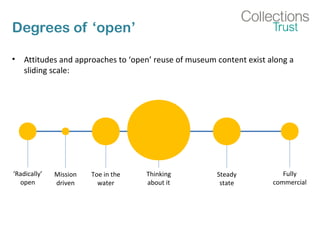
Degrees of ‘open’
• Attitudes and approaches to ‘open’ reuse of museum content exist along a
sliding scale:
‘Radically’
open
Fully
commercial
Thinking
about it
Toe in the
water
Mission
driven
Steady
state
Open is a business model
If you are not trading on your
brand or the uniqueness of
your collection, the chances
are an open strategy will drive
additional value to your
traditional revenue model
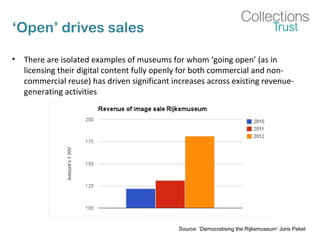
‘Open’ drives sales
• There are isolated examples of museums for whom ‘going open’ (as in
licensing their digital content fully openly for both commercial and non-
commercial reuse) has driven significant increases across existing revenue-
generating activities
Source: ‘Democratising the Rijksmuseum’ Joris Pekel
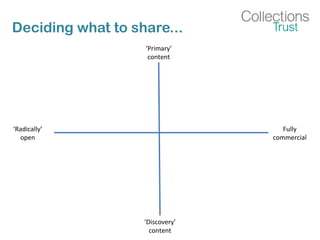
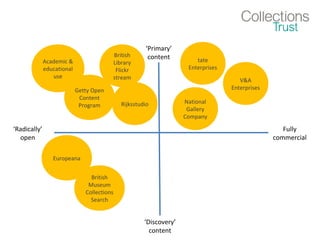
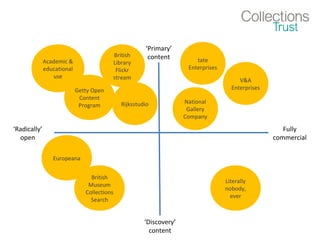
Deciding what to share...
‘Radically’
open
Fully
commercial
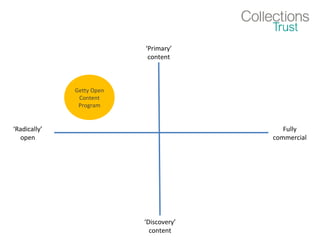
‘Primary’
content
‘Discovery’
content
‘Radically’
open
Fully
commercial
‘Primary’
content
‘Discovery’
content
Getty Open
Content
Program
‘Radically’
open
Fully
commercial
‘Primary’
content
‘Discovery’
content
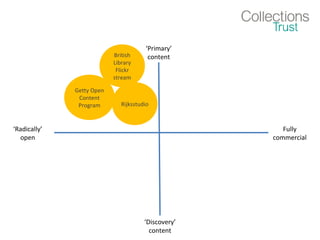
Getty Open
Content
Program Rijksstudio
British
Library
Flickr
stream
‘Radically’
open
Fully
commercial
‘Primary’
content
‘Discovery’
content
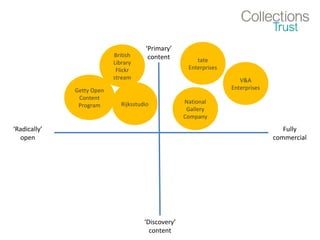
Getty Open
Content
Program Rijksstudio
tate
Enterprises
V&A
Enterprises
National
Gallery
Company
British
Library
Flickr
stream
‘Radically’
open
Fully
commercial
‘Primary’
content
‘Discovery’
content
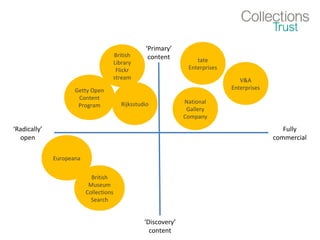
Getty Open
Content
Program
British
Museum
Collections
Search
Rijksstudio
tate
Enterprises
V&A
Enterprises
National
Gallery
Company
British
Library
Flickr
stream
Europeana
‘Radically’
open
Fully
commercial
‘Primary’
content
‘Discovery’
content
Getty Open
Content
Program Rijksstudio
Academic &
educational
use
tate
Enterprises
V&A
Enterprises
National
Gallery
Company
British
Library
Flickr
stream
British
Museum
Collections
Search
Europeana
‘Radically’
open
Fully
commercial
‘Primary’
content
‘Discovery’
content
Getty Open
Content
Program Rijksstudio
Academic &
educational
use
tate
Enterprises
V&A
Enterprises
National
Gallery
Company
Literally
nobody,
ever
British
Library
Flickr
stream
British
Museum
Collections
Search
Europeana
Case Study 1. Sharing
collections online at York
Museums Trust
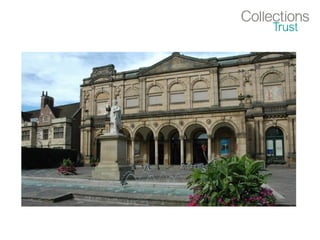
York Museums Trust
• Formed in 2002 as an independent Trust
• Managing a range of venues and sites across York
• Funded since 2012 as a Major Partner Museum
• Early investment in documentation & information systems
• Digitisation providing high-quality content to reinforce offline offer
Key developments…
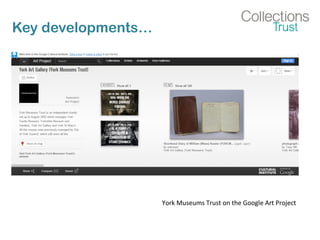
York Museums Trust on the Google Art Project
Key developments…
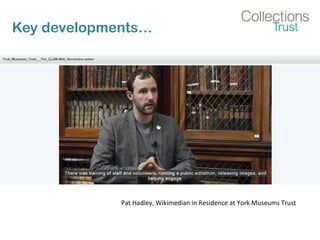
Pat Hadley, Wikimedian in Residence at York Museums Trust
Key developments…
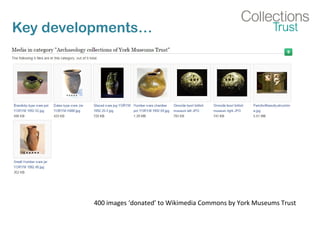
400 images ‘donated’ to Wikimedia Commons by York Museums Trust
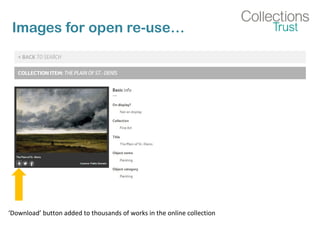
Images for open re-use…
‘Download’ button added to thousands of works in the online collection
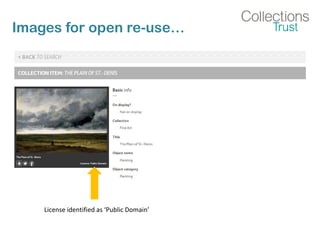
Images for open re-use…
License identified as ‘Public Domain’
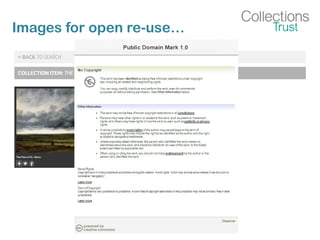
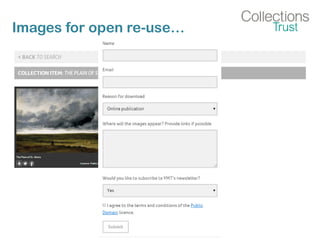
Images for open re-use…
Conditions
• Conditions associated with re-use:
• All images currently published in the online collection are free from known
third-party copyright restrictions
• All images in the online collection are free to download
• All images in the online collection are licensed CC BY-SA 4.0 or Public
Domain
• York Museums Trust expects to be attributed whenever an online
collection image is used
Constraints
• “We have not yet released any images that have (or we suspect have)
copyright restrictions – like pictures of modern art, images of magazine covers
or photos of chocolate boxes. To use an image of a copyrighted work we
would have to seek permission from the person or persons who hold the
copyright. We would also have to negotiate terms of use.”
• Public Domain and CC BY-SA 4.0 materials are subject to a request for
attribution, eg:
“Image courtesy of York Museum Trust :: http://yorkmuseumtrust.org.uk/ ::
CC BY-SA 4.0”
Outcomes
• Outcomes of Wikimedian in Residence and GLAM-WIKI collaboration reported
as very positive
• Content relating to the Middleham Hoard incorporated into front-page article
generating some 6,000 views
• Positive outcomes in terms of profile, coverage and reputation
• “What actually surprised me most was the personal knowledge I gained about
the history of our collections. This in turn sparked my thinking that this is a
strong platform on which to spread knowledge of our collections to the
world.”
Mike Linstead, Digital Marketing Officer
““It is the core mission of the Trust
to maximise access to the collection.
If you can do it for free, and give it to
as many people as possible, that’s
compatible with our mission. There’s
no marginal cost to sharing content
in this way, and it is ultimately what
we are there for.”
- Mike Woodward, YMT
Case Study 2. Sharing
collections images from
Derby Museum and Art
Gallery
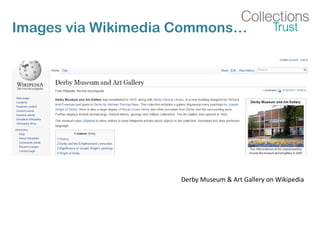
Images via Wikimedia Commons…
Derby Museum & Art Gallery on Wikipedia
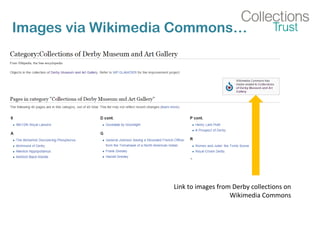
Images via Wikimedia Commons…
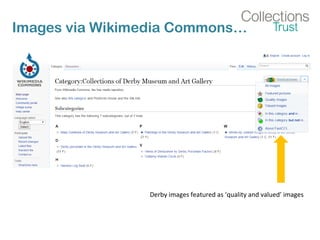
Link to images from Derby collections on
Wikimedia Commons
Images via Wikimedia Commons…
Derby images featured as ‘quality and valued’ images
Images via Wikimedia Commons…
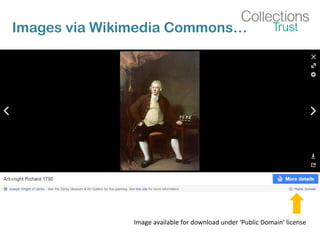
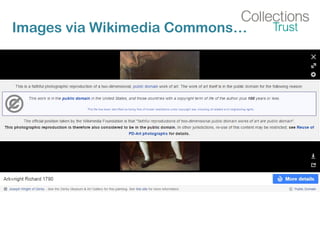
Image available for download under ‘Public Domain’ license
Images via Wikimedia Commons…
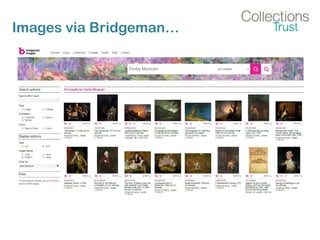
Images via Bridgeman…
Outcomes
• 1,250 new articles on Wikipedia
• Over 100 articles in Russian, French, Czech, Catalan, Belorussion & others
• New articles in more than 28 languages & innovative QR code project
Decision-making process
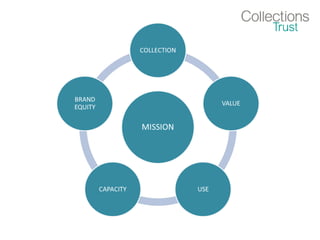
• Start with your Mission (which should articulate how you will deliver value for
your audiences)
• Quantify your goals, whether in terms of engagement, revenue or other value
• Quantify your business drivers, including your costs and anticipated gains
• Review the value in your collection & associated brand equity
• Develop an Action Plan with key stages for monitoring and review
• Iterate, evaluate & iterate again
Doing nothing is not an
option
“At the moment, [sharing our
digital content for open re-
use] is an opportunity. But it’s
an opportunity that pretty
soon is going to turn into a
threat.”
Keep in touch!
LinkedIn community (8,000+ members)
www.twitter.com/collectiontrust
www.facebook.com/collectionstrust
www.slideshare.net/collectionstrust
Nick Poole
@NickPoole1
nick@collectionstrust.org.uk
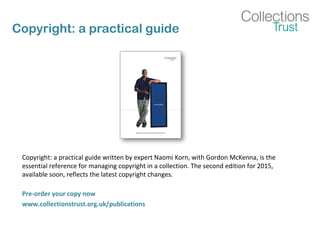
Copyright: a practical guide
Copyright: a practical guide written by expert Naomi Korn, with Gordon McKenna, is the
essential reference for managing copyright in a collection. The second edition for 2015,
available soon, reflects the latest copyright changes.
Pre-order your copy now
www.collectionstrust.org.uk/publications

Copyright Seminar - February 2015

  • 1.
    Copyright Seminar 2015 Welcome& Introduction Nick Poole, CEO, Collections Trust #ctcopyright
  • 2.
    The Collections Trustis... ...the professional association for people who work in Collections Management
  • 3.
    Established 1977 • Topromote the education of the public by the development of museums and similar organisations by all appropriate methods; • To develop, promote, maintain and improve standards of collections and information management in museums, art galleries, heritage organisations and other collections institutions; • To provide services and resources which improve the standards and methods of collections management and use.
  • 4.
    UK-based Charity • Asa professional association, our work encompasses: – Promoting professional standards in Collections Management – Developing the Collections Management workforce – Advocating for the value and impact of Collections
  • 5.
    Special programmes • Wedevelop programmes addressing key issues and opportunities in collections management & digitisation: – Security www.collectionstrust.org.uk/security – Energy efficiency www.collectionstrust.org.uk/energy-efficiency – Pests! www.collectionstrust.org.uk/pest-management – Insurance www.collectionstrust.org.uk/insurance – Participation www.collectionstrust.org.uk/participation – Going Digital www.collectionstrust.org.uk/going-digital – Copyright & licensing www.collectionstrust.org.uk/copyright-and-licensing
  • 6.
    Copyright and licensing Weprovide free resources to help museums with copyright issues and we’re addressing how recent legal reforms to copyright affect museums. •Free resources at www.collectionstrust.org.uk/copyright-and-licensing •Today’s seminar! (18 February 2015, London) www.collectionstrust.org.uk/copyright-seminar •Copyright: A Practical Guide – updated 2nd edition available to order today: www.collectionstrust.org.uk/shop (Print version £24.99, ebook version £20.00)
  • 8.
  • 9.
    Government Policy • IPmanagement & legislation as a tool for innovation & economic growth • A ‘knowledge-intensive, creative economy’ (BIS, 2014) • Austerity policy resulting in an estimated 37% net reduction in public spending (excluding policing, schools & housing) since 2010-11* • Real-terms increases in costs and demands creating additional pressure on discretionary budgets • Greater emphasis on self-generated revenue and enterprise * http://www.nao.org.uk/wp-content/uploads/2014/11/Impact-of-funding-reductions-on-local-authorities.pdf
  • 10.
    “It matters thatour businesses, as well as other creators, can protect their ideas, can spot and seize new opportunities, and can exploit them both at home and abroad. IP is, quite simply, vital to the economic well-being of the UK.” Baroness Neville-Rolfe, Minister for Intellectual Property
  • 11.
    “The UK’s trailblazingorphan works licensing scheme enables access to a wider range of our culturally important works. The scheme has been designed to protect right holders and give them a proper return if they reappear, while ensuring that citizens and consumers will be able to access more of our country’s great creations, more easily.” Baroness Neville-Rolfe, Minister for Intellectual Property
  • 12.
  • 13.
    Visitor Trends • “Newfigures published today [12th February 2015] reveal 49 million visits were made to the 16 museums and galleries directly funded by the DCMS last year, a four per cent increase on 2012/13 (47 million) and a record high since the first data was published in 2002/03.” (DCMS) • Heritage tourism contributes £20.6 billion to the UK GDP, more than the advertising or film industries. It supports a total of 466,000 jobs. Heritage is the main motivation for 30% of all international visits, while 14% of domestic- tourism day trips are motivated by heritage. (HLF & VisitBritain) • Visitors to independent museums (estimated to be over 9 million) are said to deliver £364m of gross impacts from visitor spending. (Museums Association)
  • 14.
    Professional values • Protectingthe integrity of collections • Maintaining services • Promoting public access to and engagement with heritage • Delivering educational benefit & impact • Maintaining public trust • Maximising sustainability & competitiveness
  • 15.
    Outcomes • Increased pressureon budgets • Emphasis on realising financial value of IP in and associated with collections • Tension between: – Promoting commercial re-use of content – Promoting open access to and use of heritage material • Different risk appetite • Investment & capacity gap in both directions
  • 16.
    Case Studies onOpen Content Licensing
  • 17.
    Defining terms: open •“A piece of content or data is open if anyone is free to use, reuse, and redistribute it — subject only, at most, to the requirement to attribute and/or share-alike.” www.opendefinition.org • This means that something is useable by all without the need to ask permission by the (rights) owner of a work. • Open Culture or Open GLAM (Galleries, Libraries, Archives, Museums) is a movement that tries to help cultural institution to open up their collections: to make them available to all for reuse without the need to asking permission. (Source: ‘Open Data for #GLAMS’, P2P University)
  • 18.
    Open knowledge • “Openknowledge is what open data becomes when it is useful, usable and used. The characteristics of openness are: • Availability and access: the data must be available as a whole and at no more than a reasonable reproduction cost, preferably by downloading over the internet. The data must also be available in a convenient and modifiable form. • Reuse and redistribution: the data must be provided under terms that permit reuse and redistribution including the intermixing with other datasets. The data must be machine-readable. • Universal participation: everyone must be able to use, reuse and redistribute — there should be no discrimination against fields of endeavour or against persons or groups. For example, ‘non-commercial’ restrictions that would prevent ‘commercial’ use, or restrictions of use for certain purposes (e.g. only in education), are not allowed. (Source: Open Knowledge Foundation definition of ‘Open Data’)
  • 19.
    Defining terms: reuse •Describes a wide spectrum of activities and applications of digital cultural content undertaken by 3rd parties
  • 20.
  • 21.
    Degrees of ‘open’ •Attitudes and approaches to ‘open’ reuse of museum content exist along a sliding scale: ‘Radically’ open Fully commercial
  • 22.
    Degrees of ‘open’ •Attitudes and approaches to ‘open’ reuse of museum content exist along a sliding scale: ‘Radically’ open Fully commercial Toe in the water
  • 23.
    Degrees of ‘open’ •Attitudes and approaches to ‘open’ reuse of museum content exist along a sliding scale: ‘Radically’ open Fully commercial Toe in the water Mission driven
  • 24.
    Degrees of ‘open’ •Attitudes and approaches to ‘open’ reuse of museum content exist along a sliding scale: ‘Radically’ open Fully commercial Toe in the water Mission driven Steady state
  • 25.
    Degrees of ‘open’ •Attitudes and approaches to ‘open’ reuse of museum content exist along a sliding scale: ‘Radically’ open Fully commercial Thinking about it Toe in the water Mission driven Steady state
  • 27.
    Open is abusiness model If you are not trading on your brand or the uniqueness of your collection, the chances are an open strategy will drive additional value to your traditional revenue model
  • 28.
    ‘Open’ drives sales •There are isolated examples of museums for whom ‘going open’ (as in licensing their digital content fully openly for both commercial and non- commercial reuse) has driven significant increases across existing revenue- generating activities Source: ‘Democratising the Rijksmuseum’ Joris Pekel
  • 29.
    Deciding what toshare... ‘Radically’ open Fully commercial ‘Primary’ content ‘Discovery’ content
  • 30.
  • 31.
  • 32.
  • 33.
  • 34.
    ‘Radically’ open Fully commercial ‘Primary’ content ‘Discovery’ content Getty Open Content Program Rijksstudio Academic& educational use tate Enterprises V&A Enterprises National Gallery Company British Library Flickr stream British Museum Collections Search Europeana
  • 35.
    ‘Radically’ open Fully commercial ‘Primary’ content ‘Discovery’ content Getty Open Content Program Rijksstudio Academic& educational use tate Enterprises V&A Enterprises National Gallery Company Literally nobody, ever British Library Flickr stream British Museum Collections Search Europeana
  • 36.
    Case Study 1.Sharing collections online at York Museums Trust
  • 38.
    York Museums Trust •Formed in 2002 as an independent Trust • Managing a range of venues and sites across York • Funded since 2012 as a Major Partner Museum • Early investment in documentation & information systems • Digitisation providing high-quality content to reinforce offline offer
  • 39.
    Key developments… York MuseumsTrust on the Google Art Project
  • 40.
    Key developments… Pat Hadley,Wikimedian in Residence at York Museums Trust
  • 41.
    Key developments… 400 images‘donated’ to Wikimedia Commons by York Museums Trust
  • 42.
    Images for openre-use… ‘Download’ button added to thousands of works in the online collection
  • 43.
    Images for openre-use… License identified as ‘Public Domain’
  • 44.
    Images for openre-use…
  • 45.
    Images for openre-use…
  • 46.
    Conditions • Conditions associatedwith re-use: • All images currently published in the online collection are free from known third-party copyright restrictions • All images in the online collection are free to download • All images in the online collection are licensed CC BY-SA 4.0 or Public Domain • York Museums Trust expects to be attributed whenever an online collection image is used
  • 47.
    Constraints • “We havenot yet released any images that have (or we suspect have) copyright restrictions – like pictures of modern art, images of magazine covers or photos of chocolate boxes. To use an image of a copyrighted work we would have to seek permission from the person or persons who hold the copyright. We would also have to negotiate terms of use.” • Public Domain and CC BY-SA 4.0 materials are subject to a request for attribution, eg: “Image courtesy of York Museum Trust :: http://yorkmuseumtrust.org.uk/ :: CC BY-SA 4.0”
  • 48.
    Outcomes • Outcomes ofWikimedian in Residence and GLAM-WIKI collaboration reported as very positive • Content relating to the Middleham Hoard incorporated into front-page article generating some 6,000 views • Positive outcomes in terms of profile, coverage and reputation • “What actually surprised me most was the personal knowledge I gained about the history of our collections. This in turn sparked my thinking that this is a strong platform on which to spread knowledge of our collections to the world.” Mike Linstead, Digital Marketing Officer
  • 49.
    ““It is thecore mission of the Trust to maximise access to the collection. If you can do it for free, and give it to as many people as possible, that’s compatible with our mission. There’s no marginal cost to sharing content in this way, and it is ultimately what we are there for.” - Mike Woodward, YMT
  • 50.
    Case Study 2.Sharing collections images from Derby Museum and Art Gallery
  • 51.
    Images via WikimediaCommons… Derby Museum & Art Gallery on Wikipedia
  • 52.
    Images via WikimediaCommons… Link to images from Derby collections on Wikimedia Commons
  • 53.
    Images via WikimediaCommons… Derby images featured as ‘quality and valued’ images
  • 54.
    Images via WikimediaCommons… Image available for download under ‘Public Domain’ license
  • 55.
  • 56.
  • 57.
    Outcomes • 1,250 newarticles on Wikipedia • Over 100 articles in Russian, French, Czech, Catalan, Belorussion & others • New articles in more than 28 languages & innovative QR code project
  • 58.
    Decision-making process • Startwith your Mission (which should articulate how you will deliver value for your audiences) • Quantify your goals, whether in terms of engagement, revenue or other value • Quantify your business drivers, including your costs and anticipated gains • Review the value in your collection & associated brand equity • Develop an Action Plan with key stages for monitoring and review • Iterate, evaluate & iterate again
  • 59.
    Doing nothing isnot an option “At the moment, [sharing our digital content for open re- use] is an opportunity. But it’s an opportunity that pretty soon is going to turn into a threat.”
  • 60.
    Keep in touch! LinkedIncommunity (8,000+ members) www.twitter.com/collectiontrust www.facebook.com/collectionstrust www.slideshare.net/collectionstrust Nick Poole @NickPoole1 nick@collectionstrust.org.uk
  • 61.
    Copyright: a practicalguide Copyright: a practical guide written by expert Naomi Korn, with Gordon McKenna, is the essential reference for managing copyright in a collection. The second edition for 2015, available soon, reflects the latest copyright changes. Pre-order your copy now www.collectionstrust.org.uk/publications