The Funny Current
Dr. Yogesh Shilimkar
Introduction
• The funny current:
– discovered nearly 30 years ago,
– underlies generation of the diastolic
depolarisation phase of the action potential, and
– is ultimately responsible for generation of
repetitive activity.
– Also responsible for modulation of the slope of
diastolic depolarisation, and hence of cardiac rate
• The ‘funny’ (pacemaker, If) current,
– is a mixed sodium/potassium inward current,
– activated on hyperpolarisation in the diastolic range of
voltages.
• ‘Funny’ (f) channels are activated by intracellular
cyclic adenosine monophosphate (cAMP).
• Structural subunits of native f-channels are the
hyperpolarisation-activated cyclic nucleotide-
gated (HCN) channels;
– of the four HCN isoforms known, HCN4 is the most
highly expressed in SAN tissue.
Role of the If Current in Heart Rate Modulation
• f stands for ‘funny’ because of the unusual
properties of If relative to other systems, like:
– mixed permeability to sodium and potassium ions,
– activation by hyperpolarisation, and
– slow activation and deactivation kinetics.
• Within the heart, f-channels were originally
described in the SAN, but they are also
functionally expressed in the AV node and in
conduction tissue.
• During action potential, while the outward K+ current
(IK) driving repolarisation rapidly decays during the
early diastolic phase,
– the pacemaker If current turns on, during repolarisation
when the membrane voltage enters the range of f-channel
activation (about –45mV) and
– eventually determines the slope of diastolic depolarisation
in its early phase.
• The maximum diastolic potential corresponds to the
time when IK and If equal each other.
• Along with this , the contribution from other inward
currents such as T-type and L-type calcium currents
become significant during late phase of diastolic
depolarisation.
• As If is carried by both Na+ and K+ ions,
– it reverses at approximately -10/-20 mV and
– is therefore an inward current at voltages in the diastolic
range.
• If is activated on hyperpolarization at threshold of about
-45 mV and is fully activated at around -100/-110 mV.
• Thus , in pacemker range of voltages, If is slowly activating
inward current.
• These properties are well suited for generation of
diastolic depolarization phase of action potential.
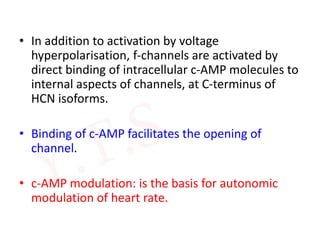
• In addition to activation by voltage
hyperpolarisation, f-channels are activated by
direct binding of intracellular c-AMP molecules to
internal aspects of channels, at C-terminus of
HCN isoforms.
• Binding of c-AMP facilitates the opening of
channel.
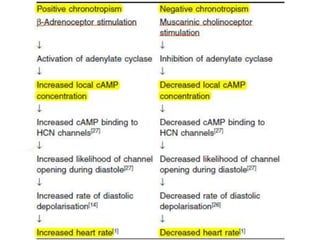
• c-AMP modulation: is the basis for autonomic
modulation of heart rate.
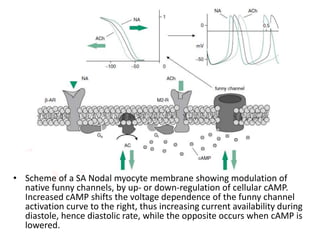
• Scheme of a SA Nodal myocyte membrane showing modulation of
native funny channels, by up- or down-regulation of cellular cAMP.
Increased cAMP shifts the voltage dependence of the funny channel
activation curve to the right, thus increasing current availability during
diastole, hence diastolic rate, while the opposite occurs when cAMP is
lowered.
Clinical Rationale for If Current Inhibition
and Heart Rate Reduction
• Resting heart is directly related to
cardiovascular and all cause mortality.
• Lowering the heart rate can contribute to
reduced myocardial ischemia and improved LV
function in CAD.
• Beta blockers reduce intracellular levels of cAMP,
which, via reduced protein kinase A mediated
phosphorylation of key proteins, leads to
– reduced uptake or reduced intracellular release of Ca,
– reduced myofilament sensitivity to Ca and
– reduced myocardial contractility.
• cAMP increases the probability of HCN channel
opening
– therefore directly involved in f-channel gating,
– beta blockers exert inhibitory action on HCN4 channel
opening and therefore reduce If current and heart
rate.
If Current Inhibitors
• Alinidine:
– First compound studied for its bradycardiac activity
– Found to cause QT prolongation
• Zatebradine:
– First If current inhibitor evaluated clinically as an
antianginal agent
– Caused reduction in resting and exercise heart rate
– Lacked benefit regarding improved exercise tolerance
– Associated with visual disturbances and prolongation
of QTc interval by up to 30% from pretreatment value
Ivabradine
• Binds with high degree of specificity to f channels
and blocks them in concentration and voltage
dependant way.
• Drug molecules are ‘open f-channel’ blockers and
need to enter the from intracellular side to reach
their binding site.
• Unusual feature: steep voltage dependance:
block is strong on depolarization and weak on
hyperpolarization.
• Since at physiological pH, ivabradine bears a
positive charge,
– drug molecules are ‘kicked in’ their binding site by
a mechanism involving electrostatic interactions
with permeating ions during depolarisation, when
the current flow is outward and
– Are kicked out during hyperpolarisation when
current is inward.
• USE-dependant block:
– The property according to which block
accumulates during repetitive channel
opening/closing cycles.
– Use-dependence of block is clinically useful:
• the observation that f-channel blockade accumulates in
small increments during repeated application of
activating/deactivating cycles and
• that extent of blockade is greater when channels are
more frequently cycled through open/closed states
• Suggests that ivabradine is effective at faster heart
rates.
• Ivabradine at moderate concentrations,
– inhibits the If current selectively and
– slows heart rate by decreasing the If current-
dependent slope of diastolic depolarisation in SAN
myocytes
– Thereby increase the diastolic duration without
substantially altering action potential duration.
Concerns related to adverse events:
• Atrial fibrillation: Use increases the risk of atrial
fibrillation; monitor cardiac rhythm. Discontinue if atrial
fibrillation develops
• Bradycardia and conduction disturbances:
– Bradycardia, sinus arrest, and heart block may occur; monitor
heart rate prior to initiation and with any dosage adjustment.
– Bradycardia may increase the risk of QT prolongation, which
may lead to severe ventricular arrhythmias, including torsade
de pointes.
– Avoid use in patients with second-degree AV block (unless a
functioning demand pacemaker is present).
– Use is contraindicated in patients with sick sinus syndrome,
sinoatrial block, third-degree AV block (unless a functioning
demand pacemaker is present), or pacemaker dependence.
– Decrease dose or discontinue use if heart rate <50 bpm
persists during therapy or signs and symptoms of bradycardia
occur.
• Visual function:
– Phosphenes (described as transient enhanced
brightness in a limited area of the visual field,
halos, image decomposition, colored bright lights,
or multiple images) may occur with use.
– Onset is generally within the first 2 months of
therapy and is reported to be of mild to moderate
intensity;
– most cases resolve during or after treatment
discontinuation.

The funny current

  • 1.
    The Funny Current Dr.Yogesh Shilimkar
  • 2.
    Introduction • The funnycurrent: – discovered nearly 30 years ago, – underlies generation of the diastolic depolarisation phase of the action potential, and – is ultimately responsible for generation of repetitive activity. – Also responsible for modulation of the slope of diastolic depolarisation, and hence of cardiac rate
  • 3.
    • The ‘funny’(pacemaker, If) current, – is a mixed sodium/potassium inward current, – activated on hyperpolarisation in the diastolic range of voltages. • ‘Funny’ (f) channels are activated by intracellular cyclic adenosine monophosphate (cAMP). • Structural subunits of native f-channels are the hyperpolarisation-activated cyclic nucleotide- gated (HCN) channels; – of the four HCN isoforms known, HCN4 is the most highly expressed in SAN tissue.
  • 4.
    Role of theIf Current in Heart Rate Modulation • f stands for ‘funny’ because of the unusual properties of If relative to other systems, like: – mixed permeability to sodium and potassium ions, – activation by hyperpolarisation, and – slow activation and deactivation kinetics. • Within the heart, f-channels were originally described in the SAN, but they are also functionally expressed in the AV node and in conduction tissue.
  • 5.
    • During actionpotential, while the outward K+ current (IK) driving repolarisation rapidly decays during the early diastolic phase, – the pacemaker If current turns on, during repolarisation when the membrane voltage enters the range of f-channel activation (about –45mV) and – eventually determines the slope of diastolic depolarisation in its early phase. • The maximum diastolic potential corresponds to the time when IK and If equal each other. • Along with this , the contribution from other inward currents such as T-type and L-type calcium currents become significant during late phase of diastolic depolarisation.
  • 6.
    • As Ifis carried by both Na+ and K+ ions, – it reverses at approximately -10/-20 mV and – is therefore an inward current at voltages in the diastolic range. • If is activated on hyperpolarization at threshold of about -45 mV and is fully activated at around -100/-110 mV. • Thus , in pacemker range of voltages, If is slowly activating inward current. • These properties are well suited for generation of diastolic depolarization phase of action potential.
  • 7.
    • In additionto activation by voltage hyperpolarisation, f-channels are activated by direct binding of intracellular c-AMP molecules to internal aspects of channels, at C-terminus of HCN isoforms. • Binding of c-AMP facilitates the opening of channel. • c-AMP modulation: is the basis for autonomic modulation of heart rate.
  • 9.
    • Scheme ofa SA Nodal myocyte membrane showing modulation of native funny channels, by up- or down-regulation of cellular cAMP. Increased cAMP shifts the voltage dependence of the funny channel activation curve to the right, thus increasing current availability during diastole, hence diastolic rate, while the opposite occurs when cAMP is lowered.
  • 10.
    Clinical Rationale forIf Current Inhibition and Heart Rate Reduction • Resting heart is directly related to cardiovascular and all cause mortality. • Lowering the heart rate can contribute to reduced myocardial ischemia and improved LV function in CAD.
  • 11.
    • Beta blockersreduce intracellular levels of cAMP, which, via reduced protein kinase A mediated phosphorylation of key proteins, leads to – reduced uptake or reduced intracellular release of Ca, – reduced myofilament sensitivity to Ca and – reduced myocardial contractility. • cAMP increases the probability of HCN channel opening – therefore directly involved in f-channel gating, – beta blockers exert inhibitory action on HCN4 channel opening and therefore reduce If current and heart rate.
  • 12.
    If Current Inhibitors •Alinidine: – First compound studied for its bradycardiac activity – Found to cause QT prolongation • Zatebradine: – First If current inhibitor evaluated clinically as an antianginal agent – Caused reduction in resting and exercise heart rate – Lacked benefit regarding improved exercise tolerance – Associated with visual disturbances and prolongation of QTc interval by up to 30% from pretreatment value
  • 13.
    Ivabradine • Binds withhigh degree of specificity to f channels and blocks them in concentration and voltage dependant way. • Drug molecules are ‘open f-channel’ blockers and need to enter the from intracellular side to reach their binding site. • Unusual feature: steep voltage dependance: block is strong on depolarization and weak on hyperpolarization.
  • 14.
    • Since atphysiological pH, ivabradine bears a positive charge, – drug molecules are ‘kicked in’ their binding site by a mechanism involving electrostatic interactions with permeating ions during depolarisation, when the current flow is outward and – Are kicked out during hyperpolarisation when current is inward.
  • 15.
    • USE-dependant block: –The property according to which block accumulates during repetitive channel opening/closing cycles. – Use-dependence of block is clinically useful: • the observation that f-channel blockade accumulates in small increments during repeated application of activating/deactivating cycles and • that extent of blockade is greater when channels are more frequently cycled through open/closed states • Suggests that ivabradine is effective at faster heart rates.
  • 16.
    • Ivabradine atmoderate concentrations, – inhibits the If current selectively and – slows heart rate by decreasing the If current- dependent slope of diastolic depolarisation in SAN myocytes – Thereby increase the diastolic duration without substantially altering action potential duration.
  • 17.
    Concerns related toadverse events: • Atrial fibrillation: Use increases the risk of atrial fibrillation; monitor cardiac rhythm. Discontinue if atrial fibrillation develops • Bradycardia and conduction disturbances: – Bradycardia, sinus arrest, and heart block may occur; monitor heart rate prior to initiation and with any dosage adjustment. – Bradycardia may increase the risk of QT prolongation, which may lead to severe ventricular arrhythmias, including torsade de pointes. – Avoid use in patients with second-degree AV block (unless a functioning demand pacemaker is present). – Use is contraindicated in patients with sick sinus syndrome, sinoatrial block, third-degree AV block (unless a functioning demand pacemaker is present), or pacemaker dependence. – Decrease dose or discontinue use if heart rate <50 bpm persists during therapy or signs and symptoms of bradycardia occur.
  • 18.
    • Visual function: –Phosphenes (described as transient enhanced brightness in a limited area of the visual field, halos, image decomposition, colored bright lights, or multiple images) may occur with use. – Onset is generally within the first 2 months of therapy and is reported to be of mild to moderate intensity; – most cases resolve during or after treatment discontinuation.