THE
Forward-Forward Algorithm:
Some Preliminary Investigations
이미지 처리팀
김병현, 김현진, 류채은, 안종식, 이주영, 최승준, 현청천(발표자)
목차
1 Abstract
2 HowFFrelatestocontrastivelearning..
3 Whatiswrongwithbackpropagation
4 TheForward-ForwardAlgorithm
5 SomeexperimentswithFF
6 Learningfastandslow
7 MortalComputation
8 Futurework
Part 1,
Abstract
Author
Part 1,
https://www.youtube.com/watch?v=l9RWTMNnvi4
Abstract
Part 1,
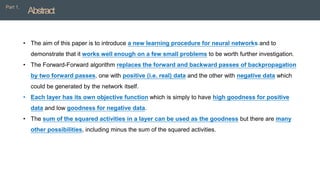
• The aim of this paper is to introduce a new learning procedure for neural networks and to
demonstrate that it works well enough on a few small problems to be worth further investigation.
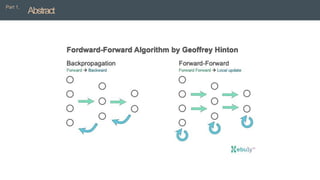
• The Forward-Forward algorithm replaces the forward and backward passes of backpropagation
by two forward passes, one with positive (i.e. real) data and the other with negative data which
could be generated by the network itself.
• Each layer has its own objective function which is simply to have high goodness for positive
data and low goodness for negative data.
• The sum of the squared activities in a layer can be used as the goodness but there are many
other possibilities, including minus the sum of the squared activities.
Abstract
Part 1,
Part 2,
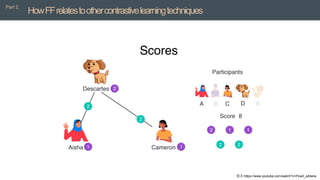
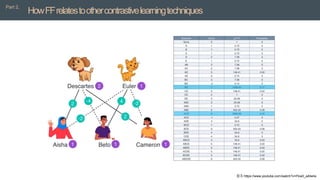
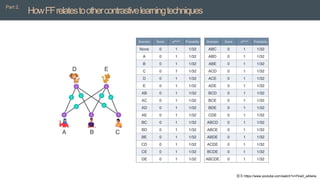
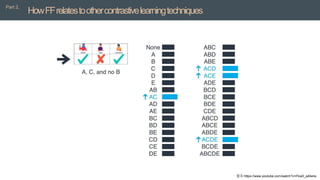
HowFFrelatestoothercontrastivelearningtechniques
Part 2,
참조:https://www.youtube.com/watch?v=Fkw0_aAtwIw
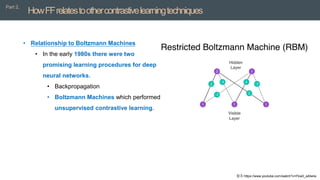
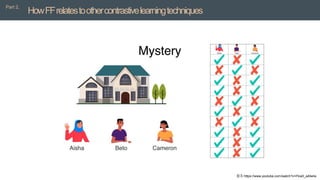
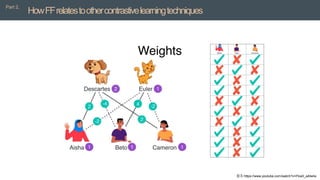
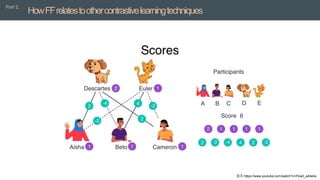
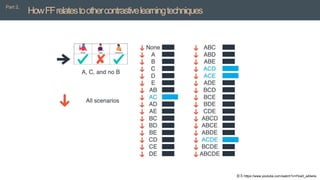
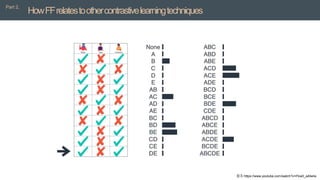
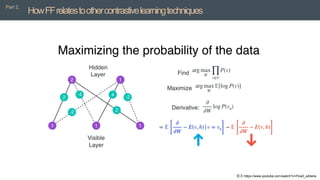
• Relationship to Boltzmann Machines
• In the early 1980s there were two
promising learning procedures for deep
neural networks.
• Backpropagation
• Boltzmann Machines which performed
unsupervised contrastive learning.
HowFFrelatestoothercontrastivelearningtechniques
Part 2,
참조:https://www.youtube.com/watch?v=Fkw0_aAtwIw
HowFFrelatestoothercontrastivelearningtechniques
Part 2,
참조:https://www.youtube.com/watch?v=Fkw0_aAtwIw
HowFFrelatestoothercontrastivelearningtechniques
Part 2,
참조:https://www.youtube.com/watch?v=Fkw0_aAtwIw
HowFFrelatestoothercontrastivelearningtechniques
Part 2,
참조:https://www.youtube.com/watch?v=Fkw0_aAtwIw
HowFFrelatestoothercontrastivelearningtechniques
Part 2,
참조:https://www.youtube.com/watch?v=Fkw0_aAtwIw
HowFFrelatestoothercontrastivelearningtechniques
Part 2,
참조:https://www.youtube.com/watch?v=Fkw0_aAtwIw
HowFFrelatestoothercontrastivelearningtechniques
Part 2,
HowFFrelatestoothercontrastivelearningtechniques
Part 2,
참조:https://www.youtube.com/watch?v=Fkw0_aAtwIw
HowFFrelatestoothercontrastivelearningtechniques
Part 2,
참조:https://www.youtube.com/watch?v=Fkw0_aAtwIw
HowFFrelatestoothercontrastivelearningtechniques
Part 2,
참조:https://www.youtube.com/watch?v=Fkw0_aAtwIw
HowFFrelatestoothercontrastivelearningtechniques
Part 2,
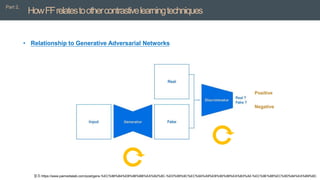
• Relationship to Generative Adversarial Networks
참조:https://www.paimedialab.com/post/gans-%EC%96%B4%EB%96%BB%EA%B2%8C-%ED%99%9C%EC%9A%A9%EB%90%98%EA%B3%A0-%EC%9E%88%EC%9D%84%EA%B9%8C
Positive
Negative
HowFFrelatestoothercontrastivelearningtechniques
Part 2,
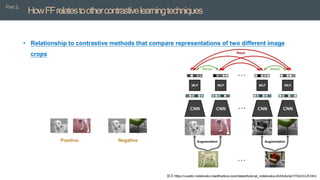
• Relationship to contrastive methods that compare representations of two different image
crops
참조:https://uvadlc-notebooks.readthedocs.io/en/latest/tutorial_notebooks/JAX/tutorial17/SimCLR.html
Positive Negative
HowFFrelatestoothercontrastivelearningtechniques
Part 2,
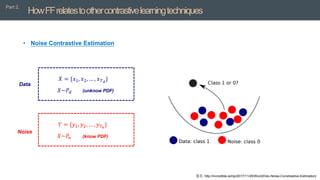
• Noise Contrastive Estimation
참조: http://incredible.ai/nlp/2017/11/25/Word2Vec-Noise-Constrastive-Estimation/
𝑋 = {𝑥1, 𝑥2, … , 𝑥𝑇𝑑
}
𝑋~𝑃𝑑 (unknow PDF)
𝑌 = {𝑦1, 𝑦2, … , 𝑦𝑇𝑛
}
𝑋~𝑃𝑛 (know PDF)
Noise
Data
Part 3,
What is wrong with backpropagation
Whatiswrongwithbackpropagation
Part 3,
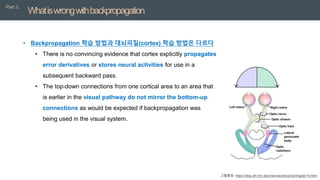
• Backpropagation 학습 방법과 대뇌피질(cortex) 학습 방법은 다르다
• There is no convincing evidence that cortex explicitly propagates
error derivatives or stores neural activities for use in a
subsequent backward pass.
• The top-down connections from one cortical area to an area that
is earlier in the visual pathway do not mirror the bottom-up
connections as would be expected if backpropagation was
being used in the visual system.
그림참조: https://nba.uth.tmc.edu/neuroscience/s2/chapter15.html
Whatiswrongwithbackpropagation
Part 3,
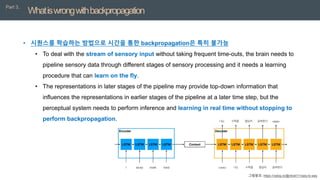
• 시퀀스를 학습하는 방법으로 시간을 통한 backpropagation은 특히 불가능
• To deal with the stream of sensory input without taking frequent time-outs, the brain needs to
pipeline sensory data through different stages of sensory processing and it needs a learning
procedure that can learn on the fly.
• The representations in later stages of the pipeline may provide top-down information that
influences the representations in earlier stages of the pipeline at a later time step, but the
perceptual system needs to perform inference and learning in real time without stopping to
perform backpropagation.
그림참조: https://velog.io/@nkw011/seq-to-seq
Whatiswrongwithbackpropagation
Part 3,
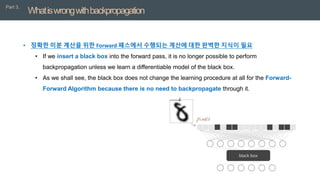
• 정확한 미분 계산을 위한 Forward 패스에서 수행되는 계산에 대한 완벽한 지식이 필요
• If we insert a black box into the forward pass, it is no longer possible to perform
backpropagation unless we learn a differentiable model of the black box.
• As we shall see, the black box does not change the learning procedure at all for the Forward-
Forward Algorithm because there is no need to backpropagate through it.
Whatiswrongwithbackpropagation
Part 3,
• FF 알고리즘 장단점
• FF는 forward computation의 정확한 세부 사항을 알 수 없을 때도 사용가능
• Pipelining sequential data를 activity를 저장하거나 오류를 전파하기 위해 멈추지 않고 학습가능
• FF는 backpropagation에 비해서 다소 느리고 몇 가지 toy 문제에 대해 일반화가 잘 되지 않음
• 전력이 문제가 되지 않는 애플리케이션에 대한 backpropagation을 대체할 가능성은 낮음
• FF 알고리즘이 우수할 수 있는 두 가지 영역
• a model of learning in cortex
• a way of making use of very low-power analog hardware
Part 4,
The Forward-ForwardAlgorithm
TheForward-ForwardAlgorithm
Part 4,
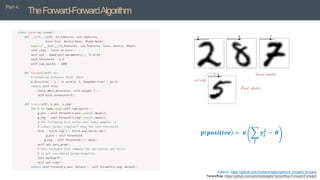
• The Forward-Forward algorithm
• Greedy multi-layer learning procedure inspired by Boltzmann machines (Hinton and
Sejnowski, 1986)
• Noise Contrastive Estimation (Gutmann and Hyvärinen, 2010).
TheForward-ForwardAlgorithm
Part 4,
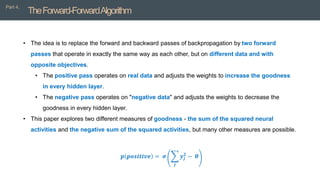
• The idea is to replace the forward and backward passes of backpropagation by two forward
passes that operate in exactly the same way as each other, but on different data and with
opposite objectives.
• The positive pass operates on real data and adjusts the weights to increase the goodness
in every hidden layer.
• The negative pass operates on "negative data" and adjusts the weights to decrease the
goodness in every hidden layer.
• This paper explores two different measures of goodness - the sum of the squared neural
activities and the negative sum of the squared activities, but many other measures are possible.
𝒑 𝒑𝒐𝒔𝒊𝒕𝒊𝒗𝒆 = 𝝈 ෍
𝒋
𝒚𝒋
𝟐
− 𝜽
TheForward-ForwardAlgorithm
Part 4,
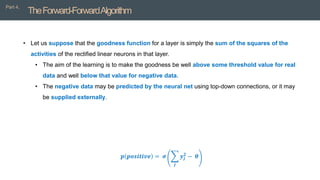
• Let us suppose that the goodness function for a layer is simply the sum of the squares of the
activities of the rectified linear neurons in that layer.
• The aim of the learning is to make the goodness be well above some threshold value for real
data and well below that value for negative data.
• The negative data may be predicted by the neural net using top-down connections, or it may
be supplied externally.
𝒑 𝒑𝒐𝒔𝒊𝒕𝒊𝒗𝒆 = 𝝈 ෍
𝒋
𝒚𝒋
𝟐
− 𝜽
TheForward-ForwardAlgorithm
Part 4,
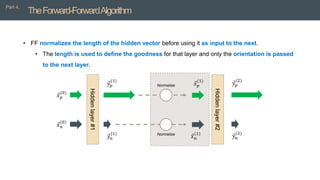
• FF normalizes the length of the hidden vector before using it as input to the next.
• The length is used to define the goodness for that layer and only the orientation is passed
to the next layer.
Hidden
layer
#1
Ԧ
𝑥𝑝
(0)
Ԧ
𝑥𝑛
(0)
Ԧ
𝑦𝑛
(1)
Ԧ
𝑦𝑝
(1)
Hidden
layer
#2
Normalize
Normalize
Ԧ
𝑥𝑛
(1)
Ԧ
𝑥𝑝
(1)
Ԧ
𝑦𝑛
(2)
Ԧ
𝑦𝑝
(2)
TheForward-ForwardAlgorithm
Part 4,
Pytorch: https://github.com/mohammadpz/pytorch_forward_forward
Tensorflow: https://github.com/amirrezarajabi/Tensorflow-Forward-Forward
𝒑 𝒑𝒐𝒔𝒊𝒕𝒊𝒗𝒆 = 𝝈 ෍
𝒋
𝒚𝒋
𝟐
− 𝜽
Q&A
Part 5,
Some experiments with FF
SomeexperimentswithFF
Part 5,
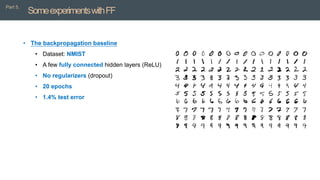
• The backpropagation baseline
• Dataset: NMIST
• A few fully connected hidden layers (ReLU)
• No regularizers (dropout)
• 20 epochs
• 1.4% test error
SomeexperimentswithFF
Part 5,
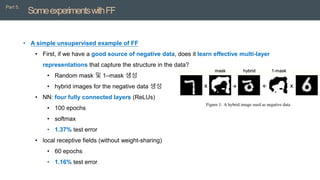
• A simple unsupervised example of FF
• First, if we have a good source of negative data, does it learn effective multi-layer
representations that capture the structure in the data?
• Random mask 및 1–mask 생성
• hybrid images for the negative data 생성
• NN: four fully connected layers (ReLUs)
• 100 epochs
• softmax
• 1.37% test error
• local receptive fields (without weight-sharing)
• 60 epochs
• 1.16% test error
SomeexperimentswithFF
Part 5,
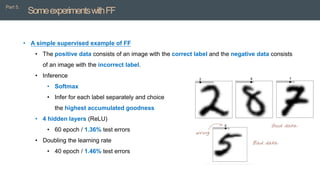
• A simple supervised example of FF
• The positive data consists of an image with the correct label and the negative data consists
of an image with the incorrect label.
• Inference
• Softmax
• Infer for each label separately and choice
the highest accumulated goodness
• 4 hidden layers (ReLU)
• 60 epoch / 1.36% test errors
• Doubling the learning rate
• 40 epoch / 1.46% test errors
SomeexperimentswithFF
Part 5,
• A simple supervised example of FF
• train batch = 60000
• test error: 0.06850004196166992
• train batch = 1000
• test error: 0.0755000114440918
• train batch = 100
• test error: 0.9020000025629997
• Batch size 크기가 줄어들수록 오류가 늘어나는 현상이 발생 함
(이미지 처리팀 최승준님 테스트)
SomeexperimentswithFF
Part 5,
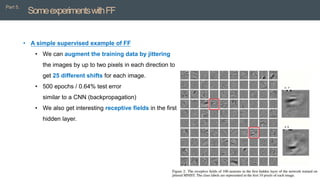
• A simple supervised example of FF
• We can augment the training data by jittering
the images by up to two pixels in each direction to
get 25 different shifts for each image.
• 500 epochs / 0.64% test error
similar to a CNN (backpropagation)
• We also get interesting receptive fields in the first
hidden layer.
SomeexperimentswithFF
Part 5,
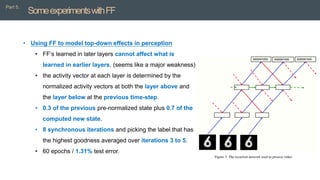
• Using FF to model top-down effects in perception
• FF’s learned in later layers cannot affect what is
learned in earlier layers. (seems like a major weakness)
• the activity vector at each layer is determined by the
normalized activity vectors at both the layer above and
the layer below at the previous time-step.
• 0.3 of the previous pre-normalized state plus 0.7 of the
computed new state.
• 8 synchronous iterations and picking the label that has
the highest goodness averaged over iterations 3 to 5.
• 60 epochs / 1.31% test error.
ExperimentswithCIFAR-10
Part 5,
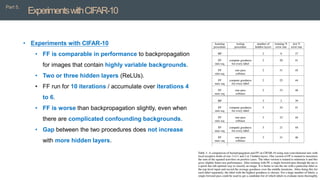
• Experiments with CIFAR-10
• FF is comparable in performance to backpropagation
for images that contain highly variable backgrounds.
• Two or three hidden layers (ReLUs).
• FF run for 10 iterations / accumulate over iterations 4
to 6.
• FF is worse than backpropagation slightly, even when
there are complicated confounding backgrounds.
• Gap between the two procedures does not increase
with more hidden layers.
Part 6,
Learning fast and slow
Learningfastandslow
Part 6,
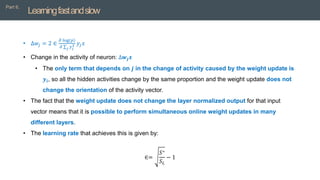
• ∆𝑤𝑗 = 2 ∈
𝜕 log 𝑝
𝜕 σ𝑗 𝑦𝑗
2 𝑦𝑗𝑥
• Change in the activity of neuron: ∆𝒘𝒋𝒙
• The only term that depends on 𝒋 in the change of activity caused by the weight update is
𝒚𝒊, so all the hidden activities change by the same proportion and the weight update does not
change the orientation of the activity vector.
• The fact that the weight update does not change the layer normalized output for that input
vector means that it is possible to perform simultaneous online weight updates in many
different layers.
• The learning rate that achieves this is given by:
∈=
𝑆∗
𝑆𝐿
− 1
Learningfastandslow
Part 6,
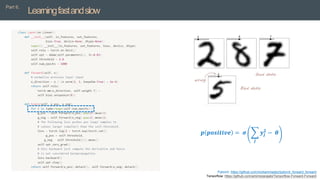
Pytorch: https://github.com/mohammadpz/pytorch_forward_forward
Tensorflow: https://github.com/amirrezarajabi/Tensorflow-Forward-Forward
𝒑 𝒑𝒐𝒔𝒊𝒕𝒊𝒗𝒆 = 𝝈 ෍
𝒋
𝒚𝒋
𝟐
− 𝜽
Part 7,
Mortal Computation
MortalComputation
Part 7,
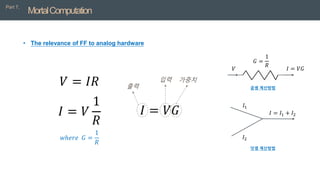
• The relevance of FF to analog hardware
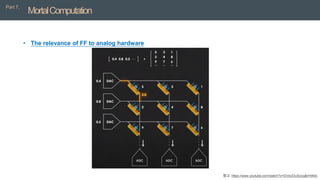
• An energy efficient way to multiply an activity vector by a weight matrix is to implement
activities as voltages and weights as conductances.
• Unfortunately, it is difficult to implement the backpropagation procedure in an equally efficient
way, so people have resorted to using A-to-D converters and digital computations for
computing gradients.
• FF should make these A-to-D converters unnecessary.
MortalComputation
Part 7,
• The relevance of FF to analog hardware
𝑉 = 𝐼𝑅
𝐼 = 𝑉
1
𝑅
𝑤ℎ𝑒𝑟𝑒 𝐺 =
1
𝑅
𝐼 = 𝑉𝐺
출력
입력 가중치
𝑉
𝐺 =
1
𝑅
𝐼 = 𝑉𝐺
곱셈 계산방법
𝐼 = 𝐼1 + 𝐼2
𝐼2
𝐼1
덧셈 계산방법
MortalComputation
Part 7,
• The relevance of FF to analog hardware
참고: https://www.youtube.com/watch?v=GVsUOuSjvcg&t=940s
MortalComputation
Part 7,
• Immortal: The knowledge does not die when the hardware dies.
• The software should be separable from the hardware so that the same program or the same
set of weights can be run on a different physical copy of the hardware.
• Mortal: It should be possible to achieve huge savings in the energy required to perform a
computation and in the cost of fabricating the hardware that executes the computation.
• These parameter values are only useful for that specific hardware instance, so the
computation they perform is mortal: it dies with the hardware.
• The function itself can be transferred (approximately) to a different piece of hardware by using
distillation.
참고: https://www.youtube.com/watch?v=sghvwkXV3VU
Part 8,
Future work
Futurework
Part 8,
• FF produce a generative model of images or video?
• What is the best goodness function to use?
• What is the best activation function to use?
• For spatial data, can FF benefit from having lots of local goodness functions for different
regions of the image?
• For sequential data, is it possible to use fast weights to mimic a simplified transformer?
• Can FF benefit from having a set of feature detectors that try to maximize their squared activity
and a set of constraint violation detectors that try to minimize their squared activity?

Q&A

The Forward-Forward Algorithm

  • 1.
    THE Forward-Forward Algorithm: Some PreliminaryInvestigations 이미지 처리팀 김병현, 김현진, 류채은, 안종식, 이주영, 최승준, 현청천(발표자)
  • 2.
    목차 1 Abstract 2 HowFFrelatestocontrastivelearning.. 3Whatiswrongwithbackpropagation 4 TheForward-ForwardAlgorithm 5 SomeexperimentswithFF 6 Learningfastandslow 7 MortalComputation 8 Futurework
  • 3.
  • 4.
  • 5.
    Abstract Part 1, • Theaim of this paper is to introduce a new learning procedure for neural networks and to demonstrate that it works well enough on a few small problems to be worth further investigation. • The Forward-Forward algorithm replaces the forward and backward passes of backpropagation by two forward passes, one with positive (i.e. real) data and the other with negative data which could be generated by the network itself. • Each layer has its own objective function which is simply to have high goodness for positive data and low goodness for negative data. • The sum of the squared activities in a layer can be used as the goodness but there are many other possibilities, including minus the sum of the squared activities.
  • 6.
  • 7.
  • 8.
    HowFFrelatestoothercontrastivelearningtechniques Part 2, 참조:https://www.youtube.com/watch?v=Fkw0_aAtwIw • Relationshipto Boltzmann Machines • In the early 1980s there were two promising learning procedures for deep neural networks. • Backpropagation • Boltzmann Machines which performed unsupervised contrastive learning.
  • 9.
  • 10.
  • 11.
  • 12.
  • 13.
  • 14.
  • 15.
  • 16.
  • 17.
  • 18.
  • 19.
    HowFFrelatestoothercontrastivelearningtechniques Part 2, • Relationshipto Generative Adversarial Networks 참조:https://www.paimedialab.com/post/gans-%EC%96%B4%EB%96%BB%EA%B2%8C-%ED%99%9C%EC%9A%A9%EB%90%98%EA%B3%A0-%EC%9E%88%EC%9D%84%EA%B9%8C Positive Negative
  • 20.
    HowFFrelatestoothercontrastivelearningtechniques Part 2, • Relationshipto contrastive methods that compare representations of two different image crops 참조:https://uvadlc-notebooks.readthedocs.io/en/latest/tutorial_notebooks/JAX/tutorial17/SimCLR.html Positive Negative
  • 21.
    HowFFrelatestoothercontrastivelearningtechniques Part 2, • NoiseContrastive Estimation 참조: http://incredible.ai/nlp/2017/11/25/Word2Vec-Noise-Constrastive-Estimation/ 𝑋 = {𝑥1, 𝑥2, … , 𝑥𝑇𝑑 } 𝑋~𝑃𝑑 (unknow PDF) 𝑌 = {𝑦1, 𝑦2, … , 𝑦𝑇𝑛 } 𝑋~𝑃𝑛 (know PDF) Noise Data
  • 22.
    Part 3, What iswrong with backpropagation
  • 23.
    Whatiswrongwithbackpropagation Part 3, • Backpropagation학습 방법과 대뇌피질(cortex) 학습 방법은 다르다 • There is no convincing evidence that cortex explicitly propagates error derivatives or stores neural activities for use in a subsequent backward pass. • The top-down connections from one cortical area to an area that is earlier in the visual pathway do not mirror the bottom-up connections as would be expected if backpropagation was being used in the visual system. 그림참조: https://nba.uth.tmc.edu/neuroscience/s2/chapter15.html
  • 24.
    Whatiswrongwithbackpropagation Part 3, • 시퀀스를학습하는 방법으로 시간을 통한 backpropagation은 특히 불가능 • To deal with the stream of sensory input without taking frequent time-outs, the brain needs to pipeline sensory data through different stages of sensory processing and it needs a learning procedure that can learn on the fly. • The representations in later stages of the pipeline may provide top-down information that influences the representations in earlier stages of the pipeline at a later time step, but the perceptual system needs to perform inference and learning in real time without stopping to perform backpropagation. 그림참조: https://velog.io/@nkw011/seq-to-seq
  • 25.
    Whatiswrongwithbackpropagation Part 3, • 정확한미분 계산을 위한 Forward 패스에서 수행되는 계산에 대한 완벽한 지식이 필요 • If we insert a black box into the forward pass, it is no longer possible to perform backpropagation unless we learn a differentiable model of the black box. • As we shall see, the black box does not change the learning procedure at all for the Forward- Forward Algorithm because there is no need to backpropagate through it.
  • 26.
    Whatiswrongwithbackpropagation Part 3, • FF알고리즘 장단점 • FF는 forward computation의 정확한 세부 사항을 알 수 없을 때도 사용가능 • Pipelining sequential data를 activity를 저장하거나 오류를 전파하기 위해 멈추지 않고 학습가능 • FF는 backpropagation에 비해서 다소 느리고 몇 가지 toy 문제에 대해 일반화가 잘 되지 않음 • 전력이 문제가 되지 않는 애플리케이션에 대한 backpropagation을 대체할 가능성은 낮음 • FF 알고리즘이 우수할 수 있는 두 가지 영역 • a model of learning in cortex • a way of making use of very low-power analog hardware
  • 27.
  • 28.
    TheForward-ForwardAlgorithm Part 4, • TheForward-Forward algorithm • Greedy multi-layer learning procedure inspired by Boltzmann machines (Hinton and Sejnowski, 1986) • Noise Contrastive Estimation (Gutmann and Hyvärinen, 2010).
  • 29.
    TheForward-ForwardAlgorithm Part 4, • Theidea is to replace the forward and backward passes of backpropagation by two forward passes that operate in exactly the same way as each other, but on different data and with opposite objectives. • The positive pass operates on real data and adjusts the weights to increase the goodness in every hidden layer. • The negative pass operates on "negative data" and adjusts the weights to decrease the goodness in every hidden layer. • This paper explores two different measures of goodness - the sum of the squared neural activities and the negative sum of the squared activities, but many other measures are possible. 𝒑 𝒑𝒐𝒔𝒊𝒕𝒊𝒗𝒆 = 𝝈 ෍ 𝒋 𝒚𝒋 𝟐 − 𝜽
  • 30.
    TheForward-ForwardAlgorithm Part 4, • Letus suppose that the goodness function for a layer is simply the sum of the squares of the activities of the rectified linear neurons in that layer. • The aim of the learning is to make the goodness be well above some threshold value for real data and well below that value for negative data. • The negative data may be predicted by the neural net using top-down connections, or it may be supplied externally. 𝒑 𝒑𝒐𝒔𝒊𝒕𝒊𝒗𝒆 = 𝝈 ෍ 𝒋 𝒚𝒋 𝟐 − 𝜽
  • 31.
    TheForward-ForwardAlgorithm Part 4, • FFnormalizes the length of the hidden vector before using it as input to the next. • The length is used to define the goodness for that layer and only the orientation is passed to the next layer. Hidden layer #1 Ԧ 𝑥𝑝 (0) Ԧ 𝑥𝑛 (0) Ԧ 𝑦𝑛 (1) Ԧ 𝑦𝑝 (1) Hidden layer #2 Normalize Normalize Ԧ 𝑥𝑛 (1) Ԧ 𝑥𝑝 (1) Ԧ 𝑦𝑛 (2) Ԧ 𝑦𝑝 (2)
  • 32.
    TheForward-ForwardAlgorithm Part 4, Pytorch: https://github.com/mohammadpz/pytorch_forward_forward Tensorflow:https://github.com/amirrezarajabi/Tensorflow-Forward-Forward 𝒑 𝒑𝒐𝒔𝒊𝒕𝒊𝒗𝒆 = 𝝈 ෍ 𝒋 𝒚𝒋 𝟐 − 𝜽
  • 33.
  • 34.
  • 35.
    SomeexperimentswithFF Part 5, • Thebackpropagation baseline • Dataset: NMIST • A few fully connected hidden layers (ReLU) • No regularizers (dropout) • 20 epochs • 1.4% test error
  • 36.
    SomeexperimentswithFF Part 5, • Asimple unsupervised example of FF • First, if we have a good source of negative data, does it learn effective multi-layer representations that capture the structure in the data? • Random mask 및 1–mask 생성 • hybrid images for the negative data 생성 • NN: four fully connected layers (ReLUs) • 100 epochs • softmax • 1.37% test error • local receptive fields (without weight-sharing) • 60 epochs • 1.16% test error
  • 37.
    SomeexperimentswithFF Part 5, • Asimple supervised example of FF • The positive data consists of an image with the correct label and the negative data consists of an image with the incorrect label. • Inference • Softmax • Infer for each label separately and choice the highest accumulated goodness • 4 hidden layers (ReLU) • 60 epoch / 1.36% test errors • Doubling the learning rate • 40 epoch / 1.46% test errors
  • 38.
    SomeexperimentswithFF Part 5, • Asimple supervised example of FF • train batch = 60000 • test error: 0.06850004196166992 • train batch = 1000 • test error: 0.0755000114440918 • train batch = 100 • test error: 0.9020000025629997 • Batch size 크기가 줄어들수록 오류가 늘어나는 현상이 발생 함 (이미지 처리팀 최승준님 테스트)
  • 39.
    SomeexperimentswithFF Part 5, • Asimple supervised example of FF • We can augment the training data by jittering the images by up to two pixels in each direction to get 25 different shifts for each image. • 500 epochs / 0.64% test error similar to a CNN (backpropagation) • We also get interesting receptive fields in the first hidden layer.
  • 40.
    SomeexperimentswithFF Part 5, • UsingFF to model top-down effects in perception • FF’s learned in later layers cannot affect what is learned in earlier layers. (seems like a major weakness) • the activity vector at each layer is determined by the normalized activity vectors at both the layer above and the layer below at the previous time-step. • 0.3 of the previous pre-normalized state plus 0.7 of the computed new state. • 8 synchronous iterations and picking the label that has the highest goodness averaged over iterations 3 to 5. • 60 epochs / 1.31% test error.
  • 41.
    ExperimentswithCIFAR-10 Part 5, • Experimentswith CIFAR-10 • FF is comparable in performance to backpropagation for images that contain highly variable backgrounds. • Two or three hidden layers (ReLUs). • FF run for 10 iterations / accumulate over iterations 4 to 6. • FF is worse than backpropagation slightly, even when there are complicated confounding backgrounds. • Gap between the two procedures does not increase with more hidden layers.
  • 42.
  • 43.
    Learningfastandslow Part 6, • ∆𝑤𝑗= 2 ∈ 𝜕 log 𝑝 𝜕 σ𝑗 𝑦𝑗 2 𝑦𝑗𝑥 • Change in the activity of neuron: ∆𝒘𝒋𝒙 • The only term that depends on 𝒋 in the change of activity caused by the weight update is 𝒚𝒊, so all the hidden activities change by the same proportion and the weight update does not change the orientation of the activity vector. • The fact that the weight update does not change the layer normalized output for that input vector means that it is possible to perform simultaneous online weight updates in many different layers. • The learning rate that achieves this is given by: ∈= 𝑆∗ 𝑆𝐿 − 1
  • 44.
    Learningfastandslow Part 6, Pytorch: https://github.com/mohammadpz/pytorch_forward_forward Tensorflow:https://github.com/amirrezarajabi/Tensorflow-Forward-Forward 𝒑 𝒑𝒐𝒔𝒊𝒕𝒊𝒗𝒆 = 𝝈 ෍ 𝒋 𝒚𝒋 𝟐 − 𝜽
  • 45.
  • 46.
    MortalComputation Part 7, • Therelevance of FF to analog hardware • An energy efficient way to multiply an activity vector by a weight matrix is to implement activities as voltages and weights as conductances. • Unfortunately, it is difficult to implement the backpropagation procedure in an equally efficient way, so people have resorted to using A-to-D converters and digital computations for computing gradients. • FF should make these A-to-D converters unnecessary.
  • 47.
    MortalComputation Part 7, • Therelevance of FF to analog hardware 𝑉 = 𝐼𝑅 𝐼 = 𝑉 1 𝑅 𝑤ℎ𝑒𝑟𝑒 𝐺 = 1 𝑅 𝐼 = 𝑉𝐺 출력 입력 가중치 𝑉 𝐺 = 1 𝑅 𝐼 = 𝑉𝐺 곱셈 계산방법 𝐼 = 𝐼1 + 𝐼2 𝐼2 𝐼1 덧셈 계산방법
  • 48.
    MortalComputation Part 7, • Therelevance of FF to analog hardware 참고: https://www.youtube.com/watch?v=GVsUOuSjvcg&t=940s
  • 49.
    MortalComputation Part 7, • Immortal:The knowledge does not die when the hardware dies. • The software should be separable from the hardware so that the same program or the same set of weights can be run on a different physical copy of the hardware. • Mortal: It should be possible to achieve huge savings in the energy required to perform a computation and in the cost of fabricating the hardware that executes the computation. • These parameter values are only useful for that specific hardware instance, so the computation they perform is mortal: it dies with the hardware. • The function itself can be transferred (approximately) to a different piece of hardware by using distillation. 참고: https://www.youtube.com/watch?v=sghvwkXV3VU
  • 50.
  • 51.
    Futurework Part 8, • FFproduce a generative model of images or video? • What is the best goodness function to use? • What is the best activation function to use? • For spatial data, can FF benefit from having lots of local goodness functions for different regions of the image? • For sequential data, is it possible to use fast weights to mimic a simplified transformer? • Can FF benefit from having a set of feature detectors that try to maximize their squared activity and a set of constraint violation detectors that try to minimize their squared activity?
  • 52.