LLaMa:
Open and Efficient Foundation
Language Models
허정원 조해창 이기성 황지현 정강민
Touvron, Hugo, et al. arXiv preprint arXiv:2302.13971 (2023).
Contents
• Introduction
• Approach
• Main Results
• Instruction Finetuning
• Conclusion
1. Introduction
• Large Languages Models focus on further scaling
• The best performances are not achieved by the largest models
- Hoffmann et al. (2022)
1. Introduction
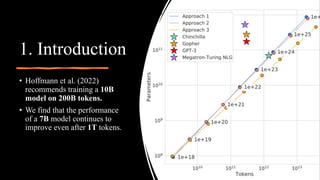
• Hoffmann et al. (2022)
recommends training a 10B
model on 200B tokens.
• We find that the performance
of a 7B model continues to
improve even after 1T tokens.
1. Introduction
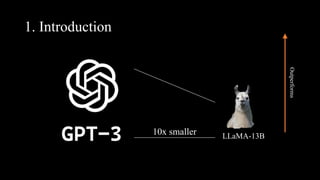
10x smaller LLaMA-13B
Outperforms
1. Introduction
• Only use publicly available data, making our work compatible with
open-sourcing
• There exist some exceptions, notably OPT(Zhang et al.), GPT-
NeoX(Black et al.), BLOOM(Scaoet et all.) and GLM(Zeng et al.) ,
but none that are competitive with PaLM-62B or Chinchilla.
• An overview of the modifications we made to the transformer
architecture
• Compare with others LLMs on a set of standard benchmarks
2. Approach
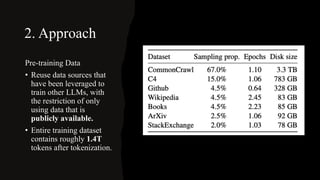
Pre-training Data
• Reuse data sources that
have been leveraged to
train other LLMs, with
the restriction of only
using data that is
publicly available.
• Entire training dataset
contains roughly 1.4T
tokens after tokenization.
2. Approach
Architecture
• Training approach is similar to the methods described in
previous work (Brown et al., 2020; Chowdhery et al., 2022)
• Pre-normalization [GPT3]
• SwiGLU activation function [PaLM]
• Rotary Embeddings [GPTNeo]
• AdamW optimizer, with the following hyper-parameters:
β1 = 0.9, β2 = 0.95
2. Approach
Pre-normalization [GPT3] Zhang and Sennrich (2019).
• LayerNorm forces the norm of neurons to be decoupled from the
inputs and weight matrix.(internal covariate shift issue)
• RMSNorm which only focuses on re-scaling invariance and
regularizes the summed inputs simply according to the root mean
square (RMS) statistic:
=> improve the training stability
2. Approach
SwiGLU activation function [PaLM] Shazeer (2020)
• Replace the ReLU non-linearity by the SwiGLU
activation function.
• Use a dimension of
!
"
4𝑑 instead of 4d as in
PaLM
SwiGLU = xW·sigmoid(βxW) @ xV
=> improve the performance
2. Approach
Rotary Embeddings [GPTNeo] Su et al. (2021)
• Remove the absolute positional embeddings, and instead, add rotary positional
embeddings (RoPE)
PE(pos,2i) = sin(pos/100002i/d_model)
PE(pos,2i+1) = cos(pos/100002i/d_model)
2. Approach
Efficient implementation
• Efficient implementation of the causal multi-head attention to reduce memory
usage and runtime
• Reduced the amount of activations that are recomputed during the backward pass
with checkpointing.
• Reduce the memory usage of the model by using model and sequence parallelism
3. Main Results
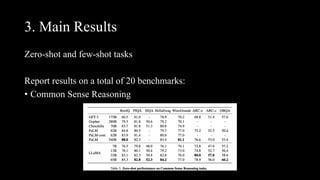
Zero-shot and few-shot tasks
Report results on a total of 20 benchmarks:
• Common Sense Reasoning
3. Main Results
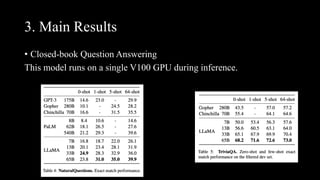
• Closed-book Question Answering
This model runs on a single V100 GPU during inference.
3. Main Results
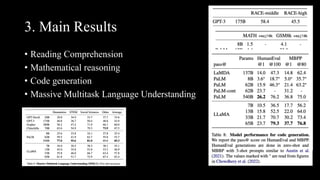
• Reading Comprehension
• Mathematical reasoning
• Code generation
• Massive Multitask Language Understanding
3. Results
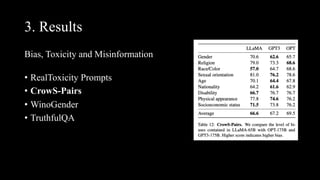
Bias, Toxicity and Misinformation
• RealToxicity Prompts
• CrowS-Pairs
• WinoGender
• TruthfulQA
3. Results
Carbon footprint wu et al. (2022)
• Estimate that we used 2048 A100-80GB for a period of approximately
5 months to develop our models.
• Wh = GPU-h×(GPU power consumption)×PUE
• tCO2eq = MWh × 0.385.
• 2,638 MWh -> 1,015 tCO2eq.
4. Conclusion
• Show that it is possible to achieve state-of-the-art performance by
training exclusively on publicly available data.
• Accelerate the development of large language models.
• Help efforts to improve their robustness.
• Mitigate known issues such as toxicity and bias.
• We believe that this model will help democratize the access and study
of LLMs, since it can be run on a single GPU.
4. Conclusion
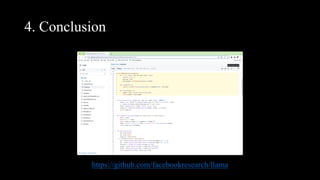
https://github.com/facebookresearch/llama
Q & A

LLaMA Open and Efficient Foundation Language Models - 230528.pdf

  • 1.
    LLaMa: Open and EfficientFoundation Language Models 허정원 조해창 이기성 황지현 정강민 Touvron, Hugo, et al. arXiv preprint arXiv:2302.13971 (2023).
  • 2.
    Contents • Introduction • Approach •Main Results • Instruction Finetuning • Conclusion
  • 3.
    1. Introduction • LargeLanguages Models focus on further scaling • The best performances are not achieved by the largest models - Hoffmann et al. (2022)
  • 4.
    1. Introduction • Hoffmannet al. (2022) recommends training a 10B model on 200B tokens. • We find that the performance of a 7B model continues to improve even after 1T tokens.
  • 5.
    1. Introduction 10x smallerLLaMA-13B Outperforms
  • 6.
    1. Introduction • Onlyuse publicly available data, making our work compatible with open-sourcing • There exist some exceptions, notably OPT(Zhang et al.), GPT- NeoX(Black et al.), BLOOM(Scaoet et all.) and GLM(Zeng et al.) , but none that are competitive with PaLM-62B or Chinchilla. • An overview of the modifications we made to the transformer architecture • Compare with others LLMs on a set of standard benchmarks
  • 7.
    2. Approach Pre-training Data •Reuse data sources that have been leveraged to train other LLMs, with the restriction of only using data that is publicly available. • Entire training dataset contains roughly 1.4T tokens after tokenization.
  • 8.
    2. Approach Architecture • Trainingapproach is similar to the methods described in previous work (Brown et al., 2020; Chowdhery et al., 2022) • Pre-normalization [GPT3] • SwiGLU activation function [PaLM] • Rotary Embeddings [GPTNeo] • AdamW optimizer, with the following hyper-parameters: β1 = 0.9, β2 = 0.95
  • 9.
    2. Approach Pre-normalization [GPT3]Zhang and Sennrich (2019). • LayerNorm forces the norm of neurons to be decoupled from the inputs and weight matrix.(internal covariate shift issue) • RMSNorm which only focuses on re-scaling invariance and regularizes the summed inputs simply according to the root mean square (RMS) statistic: => improve the training stability
  • 10.
    2. Approach SwiGLU activationfunction [PaLM] Shazeer (2020) • Replace the ReLU non-linearity by the SwiGLU activation function. • Use a dimension of ! " 4𝑑 instead of 4d as in PaLM SwiGLU = xW·sigmoid(βxW) @ xV => improve the performance
  • 11.
    2. Approach Rotary Embeddings[GPTNeo] Su et al. (2021) • Remove the absolute positional embeddings, and instead, add rotary positional embeddings (RoPE) PE(pos,2i) = sin(pos/100002i/d_model) PE(pos,2i+1) = cos(pos/100002i/d_model)
  • 12.
    2. Approach Efficient implementation •Efficient implementation of the causal multi-head attention to reduce memory usage and runtime • Reduced the amount of activations that are recomputed during the backward pass with checkpointing. • Reduce the memory usage of the model by using model and sequence parallelism
  • 13.
    3. Main Results Zero-shotand few-shot tasks Report results on a total of 20 benchmarks: • Common Sense Reasoning
  • 14.
    3. Main Results •Closed-book Question Answering This model runs on a single V100 GPU during inference.
  • 15.
    3. Main Results •Reading Comprehension • Mathematical reasoning • Code generation • Massive Multitask Language Understanding
  • 16.
    3. Results Bias, Toxicityand Misinformation • RealToxicity Prompts • CrowS-Pairs • WinoGender • TruthfulQA
  • 17.
    3. Results Carbon footprintwu et al. (2022) • Estimate that we used 2048 A100-80GB for a period of approximately 5 months to develop our models. • Wh = GPU-h×(GPU power consumption)×PUE • tCO2eq = MWh × 0.385. • 2,638 MWh -> 1,015 tCO2eq.
  • 18.
    4. Conclusion • Showthat it is possible to achieve state-of-the-art performance by training exclusively on publicly available data. • Accelerate the development of large language models. • Help efforts to improve their robustness. • Mitigate known issues such as toxicity and bias. • We believe that this model will help democratize the access and study of LLMs, since it can be run on a single GPU.
  • 19.
  • 20.