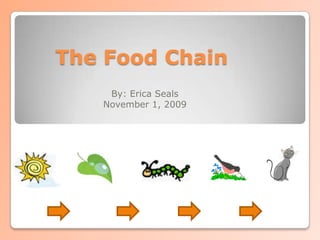
The Food ChainBy: Erica SealsNovember 1, 2009
Standard: 6.4.10Describe how life on earth depends on energy from the sun.Taken from: http://dc.doe.in.gov/Standards/AcademicStandards/StandardSearch.aspxLink to Activity: http://www.mysciencebox.org/foodchain/lesson
DefinitionsFood Chain: a succession of organisms in an ecological 	community that constitutes a continuation of food 	energy from one organism to another as each 	consumes a lower member and in turn is preyed 	upon by a higher member.Food Energy: the amount of energy in food that is available 	through digestion.Organism: an individual form of life, such as a plant or 	animal.Producer: makes own food, includes green plants.
Consumer: every organism that eats something else.Decomposer: bacteria and fungi that convert dead matter 	into gases such as carbon and nitrogen to be 	released back into the air, soil, or water.Process: a series of actions, changes, or functions 	bringing about a result.Photosynthesis: the process of converting light energy to 	chemical energy and storing it in the bonds of sugar.Definitions Continued
Background Information:Energy is one of the basic requirements for all living things. Indeed, much of what we call “living” centers around obtaining food. We use food as an energy source as well as a source of materials with which to make and repair our bodies. Even plants need energy. Green plants convert and store energy from the sun in the process of photosynthesis.
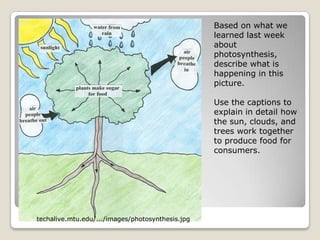
Based on what we learned last week about photosynthesis, describe what is happening in this picture. Use the captions to explain in detail how the sun, clouds, and trees work together to produce food for consumers.techalive.mtu.edu/.../images/photosynthesis.jpg
Test your knowledge2. Which animals are affected by an animal becoming extinct?A. All animals are affected	B. No animals are affected	C. Mammals are affected	D. Fish are affected
Answer2. Which animals are affected by an animal becoming extinct?A. All animals are affected	B. No animals are affected	C. Mammals are affected	D. Fish are affected
MaterialsCut-outs:	Sun	Producers 	Consumers	DecomposersPaperGlue Crayons/Pencils(All of these items are available in the food chain kit which is provided by your teacher.)
ActivityUse the provided cut-outs and materials to create two food chains. There may be extra cut outs.Paste the cut-outs onto the blank piece of paper.Always start with the sun.Identify each cut-out. Label each as the sun, producer, consumer, or decomposer.Explain each step in your food chain.	(grass is eaten by grasshoppers...which are eaten by a lizard…which is eaten by a fox…which dies…and is consumed by insects and bacteria)
Extension ActivityUsing a blank piece of paper, create your own food chain. See how long you can make it.You may need to research different plants and animals in order to make a very long and accurate food chain. Describe what would happen if one plant or animal became extinct. How would the food chain be affected?
http://www.kidport.com/grade4/science/foodchain.htmhttp://www.mysciencebox.org/foodchain/lessonhttp://dc.doe.in.gov/Standards/AcademicStandards/StandardSearch.aspxhttp://biology.clc.uc.edu/Courses/bio104/photosyn.htmhttp://www.techalive.mtu.edu/.../images/photosynthesis.jpgResources

The Food Chain

  • 1.
    The Food ChainBy:Erica SealsNovember 1, 2009
  • 2.
    Standard: 6.4.10Describe howlife on earth depends on energy from the sun.Taken from: http://dc.doe.in.gov/Standards/AcademicStandards/StandardSearch.aspxLink to Activity: http://www.mysciencebox.org/foodchain/lesson
  • 3.
    DefinitionsFood Chain: asuccession of organisms in an ecological community that constitutes a continuation of food energy from one organism to another as each consumes a lower member and in turn is preyed upon by a higher member.Food Energy: the amount of energy in food that is available through digestion.Organism: an individual form of life, such as a plant or animal.Producer: makes own food, includes green plants.
  • 4.
    Consumer: every organismthat eats something else.Decomposer: bacteria and fungi that convert dead matter into gases such as carbon and nitrogen to be released back into the air, soil, or water.Process: a series of actions, changes, or functions bringing about a result.Photosynthesis: the process of converting light energy to chemical energy and storing it in the bonds of sugar.Definitions Continued
  • 5.
    Background Information:Energy isone of the basic requirements for all living things. Indeed, much of what we call “living” centers around obtaining food. We use food as an energy source as well as a source of materials with which to make and repair our bodies. Even plants need energy. Green plants convert and store energy from the sun in the process of photosynthesis.
  • 6.
    Based on whatwe learned last week about photosynthesis, describe what is happening in this picture. Use the captions to explain in detail how the sun, clouds, and trees work together to produce food for consumers.techalive.mtu.edu/.../images/photosynthesis.jpg
  • 7.
    Test your knowledge2.Which animals are affected by an animal becoming extinct?A. All animals are affected B. No animals are affected C. Mammals are affected D. Fish are affected
  • 8.
    Answer2. Which animalsare affected by an animal becoming extinct?A. All animals are affected B. No animals are affected C. Mammals are affected D. Fish are affected
  • 9.
    MaterialsCut-outs: Sun Producers Consumers DecomposersPaperGlue Crayons/Pencils(Allof these items are available in the food chain kit which is provided by your teacher.)
  • 10.
    ActivityUse the providedcut-outs and materials to create two food chains. There may be extra cut outs.Paste the cut-outs onto the blank piece of paper.Always start with the sun.Identify each cut-out. Label each as the sun, producer, consumer, or decomposer.Explain each step in your food chain. (grass is eaten by grasshoppers...which are eaten by a lizard…which is eaten by a fox…which dies…and is consumed by insects and bacteria)
  • 11.
    Extension ActivityUsing ablank piece of paper, create your own food chain. See how long you can make it.You may need to research different plants and animals in order to make a very long and accurate food chain. Describe what would happen if one plant or animal became extinct. How would the food chain be affected?
  • 12.