







THE FIRST AMENDMENT Five Freedoms that Make Us American
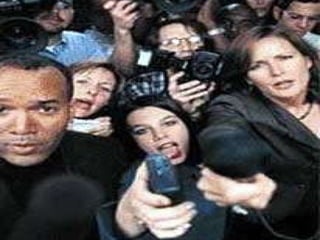
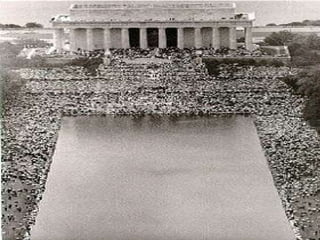
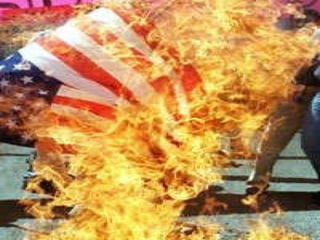
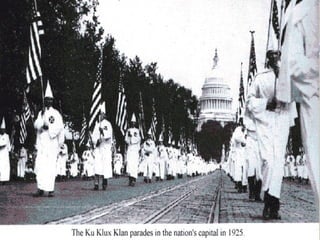
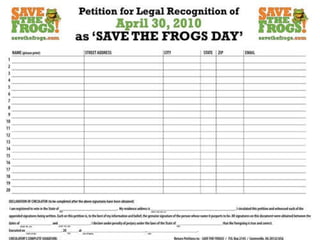
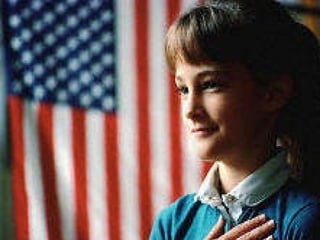
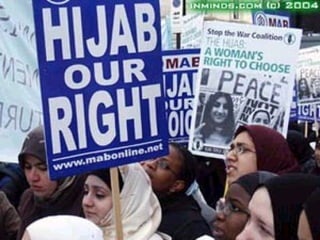
Find the Freedoms: Warm Up  Observe the images on the following slides and choose which of the freedoms are evident in the image. Remember, the first amendment contains: Religion Speech Assembly Press Petition


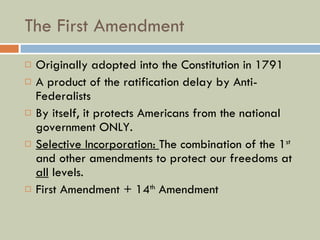
The First Amendment Originally adopted into the Constitution in 1791 A product of the ratification delay by Anti-Federalists By itself, it protects Americans from the national government ONLY. Selective Incorporation:  The combination of the 1 st  and other amendments to protect our freedoms at  all  levels. First Amendment + 14 th  Amendment
First Amendment Congress shall make no law respecting an establishment of religion, or prohibiting the free exercise thereof;  or abridging the freedom of speech,  or of the press;  or the right of the people peaceably to assemble,  and to petition the Government for a redress of grievances.
14 th  Amendment No State shall make or enforce any law which shall abridge the privileges or immunities of citizens of the United States;  nor shall any State deprive any person of life, liberty, or property, without due process of law; nor deny to any person within its jurisdiction the equal protection of the laws.
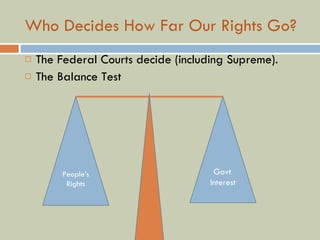
Who Decides How Far Our Rights Go? The Federal Courts decide (including Supreme). The Balance Test People’s Rights Govt .  Interest
Common Misconceptions Our freedoms are NOT UNLIMITED. Limits usually arise when safety, order, or others’ rights are jeopardized. Rule of Thumb : You have the right to express yourself in many ways unless others are offended or put in harm’s way.
Freedom of Speech Congress shall make no law  respecting an establishment of religion, or prohibiting the free exercise thereof; or  abridging the freedom of speech,  or of the press; or the right of the people peaceably to assemble, and to petition the Government for a redress of grievances. The freedom of speech does not limit expression to only verbal communication. Non verbal expression is also protected and restricted.
5 Restrictions to Free Speech The freedom of speech is very broad, but has 5 restrictions on the content expressed. Defamation of Character Obscenity Fighting Words Subversive Speech Commercial Speech
Restrictions to Free Speech:  Defamation of Character Defamation:  An act of communication that causes someone to be shamed, ridiculed, held in contempt, lowered in the estimation of the community, or to lose employment status or earnings or otherwise suffer a damaged reputation.  Think of the consequences of someone spreading lies about you at your age. at 25. at 35. at 45… Defamation is found in two forms: Slander : spoken lies Libel : written lies (pertains to press)
Restrictions to Free Speech:  Obscenity For something to be " obscene " it must be shown that the average person, applying contemporary community standards and viewing the material as a whole, would find  (1)  that the work appeals predominantly to "prurient" interest (in the interest of sex);  (2)  that it depicts or describes sexual conduct in a patently offensive way; and  (3)  that it lacks serious literary, artistic, political or scientific value. The main problem with obscenity is the VAGUE nature of its criteria.
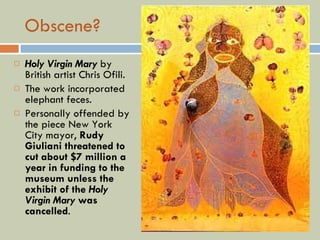
Obscene? Holy Virgin Mary  by British artist Chris Ofili. The work incorporated elephant feces.   Personally offended by the piece New York City mayor,  Rudy Giuliani threatened to cut about $7 million a year in funding to the museum unless the exhibit of the  Holy Virgin Mary  was cancelled .
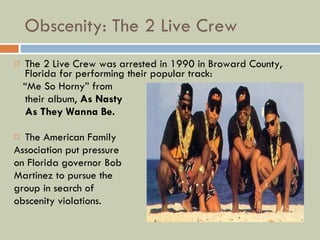
Obscenity: The 2 Live Crew The 2 Live Crew was arrested in 1990 in Broward County, Florida for performing their popular track: “ Me So Horny” from  their album,  As Nasty  As They Wanna Be. The American Family Association put pressure on Florida governor Bob Martinez to pursue the group in search of  obscenity violations.
Restrictions to Free Speech:  Fighting Words  Fighting Words: words intentionally directed toward another person which are so venomous and full of malice as to cause the hearer to suffer emotional distress or  incite him/her to immediately retaliate physically. The use of fighting words is not protected by the free speech protections of the First Amendment of the U.S. Constitution. “ Come and hit me, you jerk!”
Restrictions to Free Speech: Subversive Speech Subversive :  Expression that threatens the security of the United States Examples: resisting the draft during wartime, threatening public officials, and joining political organizations aimed at overthrowing the U.S. government. “ If they ever make me carry a rifle, the first man I want in my sights is L.B.J."  Watts v. United States The Court ruled that the government could not punish an anti-war protester who yelled, “We'll take the f***ing street later," because such speech "amounted to nothing more than advocacy of illegal action at some indefinite future time"  Hess v. Indiana
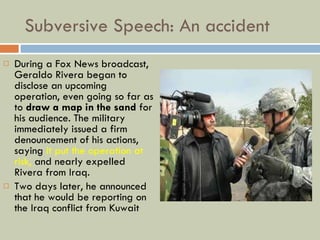
Subversive Speech: An accident During a Fox News broadcast, Geraldo Rivera began to disclose an upcoming operation, even going so far as to  draw a map in the sand  for his audience. The military immediately issued a firm denouncement of his actions, saying  it put the operation at risk,  and nearly expelled Rivera from Iraq.  Two days later, he announced that he would be reporting on the Iraq conflict from Kuwait
Restrictions to Free Speech:  Commercial Speech Advertising deserves more protection than other types of speech because of the consumer's interest in trustworthy information about products. We depend on information regarding the quality, quantity, and price of various goods and services. Courts must decide:  Is it puffing or false advertising? Puffing: making your product look better than it is False advertising: lying to the consumer to sell more products
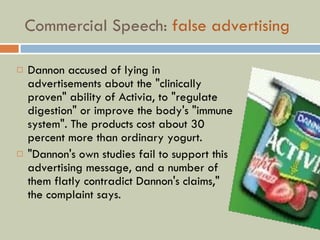
Commercial Speech:  false advertising Dannon accused of lying in advertisements about the "clinically proven" ability of Activia, to "regulate digestion" or improve the body's "immune system". The products cost about 30 percent more than ordinary yogurt.  "Dannon's own studies fail to support this advertising message, and a number of them flatly contradict Dannon's claims," the complaint says .
Other Types of Speech: Expression can be in a non-verbal form. Symbolic Speech: Expression that may use actions, symbols, signs, or inaction. Examples: Texas v Johnson (1989) Flag burning to protest Ronald Reagan in 1984 Tinker v Des Moines (1969) Armbands in school to protest the Vietnam War
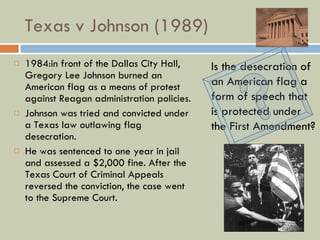
Texas v Johnson (1989) 1984:in front of the Dallas City Hall, Gregory Lee Johnson burned an American flag as a means of protest against Reagan administration policies.  Johnson was tried and convicted under a Texas law outlawing flag desecration.  He was sentenced to one year in jail and assessed a $2,000 fine. After the Texas Court of Criminal Appeals reversed the conviction, the case went to the Supreme Court. Is the desecration of an American flag a form of speech that is protected under the First Amendment?
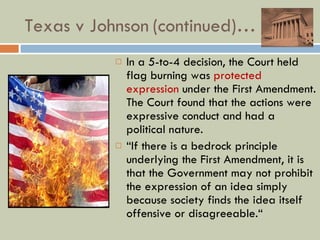
Texas v Johnson (continued)… In a 5-to-4 decision, the Court held flag burning was  protected expression  under the First Amendment. The Court found that the actions were expressive conduct and had a political nature.  “ If there is a bedrock principle underlying the First Amendment, it is that the Government may not prohibit the expression of an idea simply because society finds the idea itself offensive or disagreeable.“
Tinker vs. Des Moines  What is the case about? Who is involved? What was the action that caused a problem? What did the Supreme Court say about the actions of the school? What term, empowering schools, comes out of the decision ? Symbolic Speech The Tinkers and their schools The school suspended the Tinkers for wearing armbands to show opposition to the Vietnam War. The school acted BEFORE any disruption was evident. “ substantial disruption”
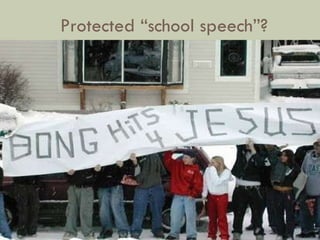
Protected “school speech”?
Morse v Frederick (2007) In 2002, high school principal Deborah Morse suspended 18-year-old Joseph Frederick after he displayed a banner reading " BONG HITS 4 JESUS ” across the street from the school during the 2002 Olympic Torch Relay. Frederick sued, claiming his constitutional rights to free speech were violated Ruling: the school did  not  violate Frederick’s freedom of speech “ School speech" doctrine should apply because Frederick's speech occurred "at a school event"; second, that the speech was "reasonably viewed as promoting illegal drug use";  and third, that a principal may legally restrict that speech
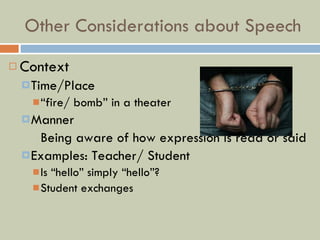
Other Considerations about Speech Context Time/Place “ fire/ bomb” in a theater Manner Being aware of how expression is read or said Examples: Teacher/ Student Is “hello” simply “hello”? Student exchanges
Freedom of Press Freedom of Press:  the right to publish newspapers, magazines, books, etc. without government interference or prior censorship 33% of the world’s countries do not have free press A close relative of free speech Similar restrictions: Defamation (Libel) Obscenity Sedition (against the government)
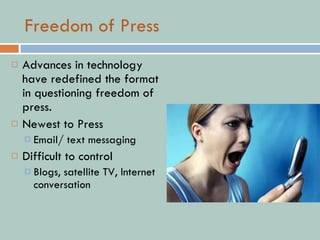
Freedom of Press Advances in technology have redefined the format in questioning freedom of press. Newest to Press Email/ text messaging Difficult to control Blogs, satellite TV, Internet conversation
Freedom of the Press:  Hazelwood v Kuhlmeier The principal at Hazelwood School District deleted 2 pages of edition of the school newspaper before publishing. He felt as though the articles on teen pregnancy and divorce: Did not keep the students' identity secret Should not have discussed girls’ use or non-use of birth control based on younger student audiences.  Did not fairly represent a father in a divorce
Freedom of Press: Hazelwood v Kuhlmeier In a split 5-3 decision, the Court ruled that the  principal did have the constitutional grounds to censor the school newspaper  The paper itself was not a "forum for public expression" but was rather a "regular classroom activity."  Schools can censor material that is: "ungrammatical, poorly written, inadequately researched, biased or prejudiced, vulgar or profane, or unsuitable for immature audiences."
Freedom of Religion Congress shall make no law   respecting an  establishment  of religion, or prohibiting the  free exercise  thereof;  or abridging the freedom of speech, or of the press; or the right of the people peaceably to assemble, and to petition the Government for a redress of grievances.  Two clauses: Establishment Clause Free Exercise Clause
Freedom of Religion ESTABLISHMENT CLAUSE The government cannot establish a national religion nor promote any one religion over another. FREE EXERCISE CLAUSE The government cannot restrict someone from worshipping any religion they choose.
Freedom of Religion: Establishment The establishment clause is referred to as “ the wall of separation between church and state” . (Thomas Jefferson) DESPITE the following: Religious sects are tax exempt Chaplains serve in all military branches Oaths of office “under God” Congress opens with prayer Pledge of Allegiance  Currency
Freedom of Religion: Education Most establishment clause cases involve schools, because  public schools  are funded by taxes and occasionally restrict/encourage  religious activities .  ( state / church ) Controversy: Prayer in School Student Religious Groups Teaching Evolution Aid to parochial schools Seasonal displays
Freedom of Religion:  Religion and Education Engel v. Vitale,   (1962) - Court finds NY school prayer unconstitutional. Abington School District , PA v. Schempp,   (1963) - Court finds Bible reading over school intercom unconstitutional  Stone v. Graham,   (1980) - Court finds posting of the Ten Commandments in schools unconstitutional Wallace v Jaffree,  ( 1985)   “ moment of silence” law ruled unconstitutional a one-minute period of silence for “meditation ro prayer” every day Lee v. Weisman,   (1992) - Court finds prayer at public school graduation ceremonies violates the establishment clause and is therefore unconstitutional. Santa Fe Independent School District v. Doe,   (2000) - Court rules that student-led prayers at public school football games violate the Establishment Clause of the First Amendment.
Deciding Freedom of Religion: Lemon Test Based on the case ( Lemon v Kurtzman, 1971 ) involving public money provided to parochial schools for teacher’s salaries and materials,  a test was provided by the courts.  The  Lemon Test  says public aid must: be secular, or non-religious not promote nor hinder religion not create an excessive entanglement between government and religion.
Freedom of Religion: Free Exercise No law and no government action can violate this absolute constitutional right. Examples A state can not force Amish to attend school beyond the 8 th  grade. A religious official can not be refused the right to run for public office. A school can not force a student to pledge the flag if it conflicts with their religious beliefs.
Freedom of Religion:  The Pledge Original version: Francis Bellamy (1892) I pledge allegiance to my flag and the republic for which it stands: one nation indivisible with liberty and justice for all. Cold War version:  Eisenhower authorized (1954) I pledge allegiance to the flag of the United States of America and to the republic for which it stands: one nation  under God,  indivisible, with liberty and justice for all.
Freedom of Assembly Congress shall make no law respecting an establishment of religion, or prohibiting the free exercise thereof; or abridging the freedom of speech, or of the press;  or the right of the people peaceably to assemble , and to petition the Government for a redress of grievances.
Freedom of Assembly Assembly, like the other five freedoms, was intended for unpopular expression. The right to show power in numbers can be an effective tactic to creating change.


The First Amendment CP

  • 1.
    THE FIRST AMENDMENTFive Freedoms that Make Us American
  • 2.
    Find the Freedoms:Warm Up Observe the images on the following slides and choose which of the freedoms are evident in the image. Remember, the first amendment contains: Religion Speech Assembly Press Petition
  • 3.
  • 4.
  • 5.
  • 6.
  • 7.
  • 8.
  • 9.
  • 10.
  • 11.
  • 12.
  • 13.
    The First AmendmentOriginally adopted into the Constitution in 1791 A product of the ratification delay by Anti-Federalists By itself, it protects Americans from the national government ONLY. Selective Incorporation: The combination of the 1 st and other amendments to protect our freedoms at all levels. First Amendment + 14 th Amendment
  • 14.
    First Amendment Congressshall make no law respecting an establishment of religion, or prohibiting the free exercise thereof; or abridging the freedom of speech, or of the press; or the right of the people peaceably to assemble, and to petition the Government for a redress of grievances.
  • 15.
    14 th Amendment No State shall make or enforce any law which shall abridge the privileges or immunities of citizens of the United States; nor shall any State deprive any person of life, liberty, or property, without due process of law; nor deny to any person within its jurisdiction the equal protection of the laws.
  • 16.
    Who Decides HowFar Our Rights Go? The Federal Courts decide (including Supreme). The Balance Test People’s Rights Govt . Interest
  • 17.
    Common Misconceptions Ourfreedoms are NOT UNLIMITED. Limits usually arise when safety, order, or others’ rights are jeopardized. Rule of Thumb : You have the right to express yourself in many ways unless others are offended or put in harm’s way.
  • 18.
    Freedom of SpeechCongress shall make no law respecting an establishment of religion, or prohibiting the free exercise thereof; or abridging the freedom of speech, or of the press; or the right of the people peaceably to assemble, and to petition the Government for a redress of grievances. The freedom of speech does not limit expression to only verbal communication. Non verbal expression is also protected and restricted.
  • 19.
    5 Restrictions toFree Speech The freedom of speech is very broad, but has 5 restrictions on the content expressed. Defamation of Character Obscenity Fighting Words Subversive Speech Commercial Speech
  • 20.
    Restrictions to FreeSpeech: Defamation of Character Defamation: An act of communication that causes someone to be shamed, ridiculed, held in contempt, lowered in the estimation of the community, or to lose employment status or earnings or otherwise suffer a damaged reputation. Think of the consequences of someone spreading lies about you at your age. at 25. at 35. at 45… Defamation is found in two forms: Slander : spoken lies Libel : written lies (pertains to press)
  • 21.
    Restrictions to FreeSpeech: Obscenity For something to be " obscene " it must be shown that the average person, applying contemporary community standards and viewing the material as a whole, would find (1) that the work appeals predominantly to "prurient" interest (in the interest of sex); (2) that it depicts or describes sexual conduct in a patently offensive way; and (3) that it lacks serious literary, artistic, political or scientific value. The main problem with obscenity is the VAGUE nature of its criteria.
  • 22.
    Obscene? Holy VirginMary  by British artist Chris Ofili. The work incorporated elephant feces.  Personally offended by the piece New York City mayor, Rudy Giuliani threatened to cut about $7 million a year in funding to the museum unless the exhibit of the Holy Virgin Mary was cancelled .
  • 23.
    Obscenity: The 2Live Crew The 2 Live Crew was arrested in 1990 in Broward County, Florida for performing their popular track: “ Me So Horny” from their album, As Nasty As They Wanna Be. The American Family Association put pressure on Florida governor Bob Martinez to pursue the group in search of obscenity violations.
  • 24.
    Restrictions to FreeSpeech: Fighting Words Fighting Words: words intentionally directed toward another person which are so venomous and full of malice as to cause the hearer to suffer emotional distress or incite him/her to immediately retaliate physically. The use of fighting words is not protected by the free speech protections of the First Amendment of the U.S. Constitution. “ Come and hit me, you jerk!”
  • 25.
    Restrictions to FreeSpeech: Subversive Speech Subversive : Expression that threatens the security of the United States Examples: resisting the draft during wartime, threatening public officials, and joining political organizations aimed at overthrowing the U.S. government. “ If they ever make me carry a rifle, the first man I want in my sights is L.B.J." Watts v. United States The Court ruled that the government could not punish an anti-war protester who yelled, “We'll take the f***ing street later," because such speech "amounted to nothing more than advocacy of illegal action at some indefinite future time" Hess v. Indiana
  • 26.
    Subversive Speech: Anaccident During a Fox News broadcast, Geraldo Rivera began to disclose an upcoming operation, even going so far as to draw a map in the sand for his audience. The military immediately issued a firm denouncement of his actions, saying it put the operation at risk, and nearly expelled Rivera from Iraq. Two days later, he announced that he would be reporting on the Iraq conflict from Kuwait
  • 27.
    Restrictions to FreeSpeech: Commercial Speech Advertising deserves more protection than other types of speech because of the consumer's interest in trustworthy information about products. We depend on information regarding the quality, quantity, and price of various goods and services. Courts must decide: Is it puffing or false advertising? Puffing: making your product look better than it is False advertising: lying to the consumer to sell more products
  • 28.
    Commercial Speech: false advertising Dannon accused of lying in advertisements about the "clinically proven" ability of Activia, to "regulate digestion" or improve the body's "immune system". The products cost about 30 percent more than ordinary yogurt. "Dannon's own studies fail to support this advertising message, and a number of them flatly contradict Dannon's claims," the complaint says .
  • 29.
    Other Types ofSpeech: Expression can be in a non-verbal form. Symbolic Speech: Expression that may use actions, symbols, signs, or inaction. Examples: Texas v Johnson (1989) Flag burning to protest Ronald Reagan in 1984 Tinker v Des Moines (1969) Armbands in school to protest the Vietnam War
  • 30.
    Texas v Johnson(1989) 1984:in front of the Dallas City Hall, Gregory Lee Johnson burned an American flag as a means of protest against Reagan administration policies. Johnson was tried and convicted under a Texas law outlawing flag desecration. He was sentenced to one year in jail and assessed a $2,000 fine. After the Texas Court of Criminal Appeals reversed the conviction, the case went to the Supreme Court. Is the desecration of an American flag a form of speech that is protected under the First Amendment?
  • 31.
    Texas v Johnson(continued)… In a 5-to-4 decision, the Court held flag burning was protected expression under the First Amendment. The Court found that the actions were expressive conduct and had a political nature. “ If there is a bedrock principle underlying the First Amendment, it is that the Government may not prohibit the expression of an idea simply because society finds the idea itself offensive or disagreeable.“
  • 32.
    Tinker vs. DesMoines What is the case about? Who is involved? What was the action that caused a problem? What did the Supreme Court say about the actions of the school? What term, empowering schools, comes out of the decision ? Symbolic Speech The Tinkers and their schools The school suspended the Tinkers for wearing armbands to show opposition to the Vietnam War. The school acted BEFORE any disruption was evident. “ substantial disruption”
  • 33.
  • 34.
    Morse v Frederick(2007) In 2002, high school principal Deborah Morse suspended 18-year-old Joseph Frederick after he displayed a banner reading " BONG HITS 4 JESUS ” across the street from the school during the 2002 Olympic Torch Relay. Frederick sued, claiming his constitutional rights to free speech were violated Ruling: the school did not violate Frederick’s freedom of speech “ School speech" doctrine should apply because Frederick's speech occurred "at a school event"; second, that the speech was "reasonably viewed as promoting illegal drug use"; and third, that a principal may legally restrict that speech
  • 35.
    Other Considerations aboutSpeech Context Time/Place “ fire/ bomb” in a theater Manner Being aware of how expression is read or said Examples: Teacher/ Student Is “hello” simply “hello”? Student exchanges
  • 36.
    Freedom of PressFreedom of Press: the right to publish newspapers, magazines, books, etc. without government interference or prior censorship 33% of the world’s countries do not have free press A close relative of free speech Similar restrictions: Defamation (Libel) Obscenity Sedition (against the government)
  • 37.
    Freedom of PressAdvances in technology have redefined the format in questioning freedom of press. Newest to Press Email/ text messaging Difficult to control Blogs, satellite TV, Internet conversation
  • 38.
    Freedom of thePress: Hazelwood v Kuhlmeier The principal at Hazelwood School District deleted 2 pages of edition of the school newspaper before publishing. He felt as though the articles on teen pregnancy and divorce: Did not keep the students' identity secret Should not have discussed girls’ use or non-use of birth control based on younger student audiences. Did not fairly represent a father in a divorce
  • 39.
    Freedom of Press:Hazelwood v Kuhlmeier In a split 5-3 decision, the Court ruled that the principal did have the constitutional grounds to censor the school newspaper The paper itself was not a "forum for public expression" but was rather a "regular classroom activity." Schools can censor material that is: "ungrammatical, poorly written, inadequately researched, biased or prejudiced, vulgar or profane, or unsuitable for immature audiences."
  • 40.
    Freedom of ReligionCongress shall make no law respecting an establishment of religion, or prohibiting the free exercise thereof; or abridging the freedom of speech, or of the press; or the right of the people peaceably to assemble, and to petition the Government for a redress of grievances. Two clauses: Establishment Clause Free Exercise Clause
  • 41.
    Freedom of ReligionESTABLISHMENT CLAUSE The government cannot establish a national religion nor promote any one religion over another. FREE EXERCISE CLAUSE The government cannot restrict someone from worshipping any religion they choose.
  • 42.
    Freedom of Religion:Establishment The establishment clause is referred to as “ the wall of separation between church and state” . (Thomas Jefferson) DESPITE the following: Religious sects are tax exempt Chaplains serve in all military branches Oaths of office “under God” Congress opens with prayer Pledge of Allegiance Currency
  • 43.
    Freedom of Religion:Education Most establishment clause cases involve schools, because public schools are funded by taxes and occasionally restrict/encourage religious activities . ( state / church ) Controversy: Prayer in School Student Religious Groups Teaching Evolution Aid to parochial schools Seasonal displays
  • 44.
    Freedom of Religion: Religion and Education Engel v. Vitale, (1962) - Court finds NY school prayer unconstitutional. Abington School District , PA v. Schempp, (1963) - Court finds Bible reading over school intercom unconstitutional Stone v. Graham, (1980) - Court finds posting of the Ten Commandments in schools unconstitutional Wallace v Jaffree, ( 1985) “ moment of silence” law ruled unconstitutional a one-minute period of silence for “meditation ro prayer” every day Lee v. Weisman, (1992) - Court finds prayer at public school graduation ceremonies violates the establishment clause and is therefore unconstitutional. Santa Fe Independent School District v. Doe, (2000) - Court rules that student-led prayers at public school football games violate the Establishment Clause of the First Amendment.
  • 45.
    Deciding Freedom ofReligion: Lemon Test Based on the case ( Lemon v Kurtzman, 1971 ) involving public money provided to parochial schools for teacher’s salaries and materials, a test was provided by the courts. The Lemon Test says public aid must: be secular, or non-religious not promote nor hinder religion not create an excessive entanglement between government and religion.
  • 46.
    Freedom of Religion:Free Exercise No law and no government action can violate this absolute constitutional right. Examples A state can not force Amish to attend school beyond the 8 th grade. A religious official can not be refused the right to run for public office. A school can not force a student to pledge the flag if it conflicts with their religious beliefs.
  • 47.
    Freedom of Religion: The Pledge Original version: Francis Bellamy (1892) I pledge allegiance to my flag and the republic for which it stands: one nation indivisible with liberty and justice for all. Cold War version: Eisenhower authorized (1954) I pledge allegiance to the flag of the United States of America and to the republic for which it stands: one nation under God, indivisible, with liberty and justice for all.
  • 48.
    Freedom of AssemblyCongress shall make no law respecting an establishment of religion, or prohibiting the free exercise thereof; or abridging the freedom of speech, or of the press; or the right of the people peaceably to assemble , and to petition the Government for a redress of grievances.
  • 49.
    Freedom of AssemblyAssembly, like the other five freedoms, was intended for unpopular expression. The right to show power in numbers can be an effective tactic to creating change.
  • 50.
  • 51.
  • 52.
  • 53.
  • 54.
  • 55.
  • 56.