It is by the goodness of God that in our
country we have those three unspeakably
precious things: freedom of speech, freedom
of conscience, and the prudence never to
practice either of them.
--Mark Twain, 1897
How are we compared to
everywhere else?
Out of 195 countries
70 countries have “free press”
41 % of the countries have “partly free” press
42 % of the countries have “not free” press
First Amendment
Congress shall make no law respecting an
establishment of religion, or prohibiting the free
exercise thereof; or abridging the freedom of
speech, or of the press; or the right of the people
peaceably to assemble, and to petition the
Government for a redress of grievances.
1st
Amendment (Break Down)
Religion – You can believe what you want, belong to
any religion or no religion
Speech – You can voice your opinion using words,
symbols or actions
Press – The government cannot censor information
in newspapers, online news sources, TV news
broadcasts, etc.
Assembly – You can gather in a group
Petition – You can criticize the government, and you
can complain about policies that affect you negatively
and ask for change
 1. The First Amendment affirms the freedom of the individual.
American government is based upon the concept that all
human beings are born with certain rights or freedoms. The
First Amendment guards these rights by prohibiting the
government from denying citizens their rights.
The first amendment must balance every ones freedoms
Freedom of Expression
Spoken or written words
Art & music
Messages in buttons ,t-shirts & the Internet
How you dress
Protests and rallies
Joining clubs and organizations
Refusing to salute the flag
Symbolic speech like wearing an armband
Three Types of Speech
Pure Speech - Verbal expression
Speech Plus- involves actions such as marching
Symbolic speech - expression by conduct
Students have the right to express
their opinion, but they cant do so in
any way that:
Interferes with the educational process
Threatens immediate harm to the school
community
Encourages unlawful activity
Interferes with another individuals rights
Students must also:
Follow libel & obscenity codes
Be aware of the full meaning of their expression &
the feelings and opinions of others
 have to put their names on posted or distributed
materials
Have to get approval before posting or distributing
materials
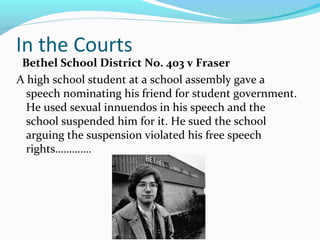
In the Courts
Bethel School District No. 403 v Fraser
A high school student at a school assembly gave a
speech nominating his friend for student government.
He used sexual innuendos in his speech and the
school suspended him for it. He sued the school
arguing the suspension violated his free speech
rights………….
The U.S. Supreme Court said…..
It was o.k. for the school to punish the student . A
school can prohibit lewd and vulgar student
speech as part of its job of teaching students “the
boundaries of socially appropriate behavior”
Clear and Present Danger
Will this act of speech create a dangerous situation?
The First Amendment does not protect statements that
are uttered to provoke violence or incite illegal
action.Justice Holmes, speaking for the unanimous
Supreme Court, stated, “The question in every case is
whether the words used are used in such
circumstances and are of such a nature as to create a
clear and present danger that they will bring about the
substantive evils that Congress has a right to prevent.”
Fighting Words
Was something said face-to-face that would incite
immediate violence?
Facts of the Case
Chaplinsky, a Jehovah's Witness, called a city
marshal a "God-damned racketeer" and "a damned
fascist" in a public place. He was arrested and
convicted under a state law for violating a breach
of the peace.
Question Presented
Does the application of the statute violate Chaplinsky's
freedom of speech protected by the First Amendment?
Conclusion
No. Some forms of expression--among them obscenity
and fighting words--do not convey ideas and thus are
not subject to First Amendment protection. In this
case, Chaplinsky uttered fighting words, i.e., words
that "inflict injury or tend to incite an immediate
breach of the peace."
Libel and Slander
Was the statement false, or put in a context that
makes true statements misleading?
You do not have a constitutional right to tell lies
that damage or defame the reputation of a person
or organization
Time, Place, and Manner
Where, when, and how the free speech occurred can
make a difference
These regulations of expression are content-
neutral. A question to ask: Did the expression
occur at a time or place, or did the speaker use a
method of communicating, that interferes with a
legitimate government interest? For example,
distribution of information should not impede the
flow of traffic or create excessive noise levels at
certain times and in certain places.
The Free Exercise Clause prohibits governmental
interference with religious belief and, within limits,
religious practice. The Supreme Court traditionally has
required governmental bodies to demonstrate a
compelling interest of the "highest order" before they
may interfere with religious conduct. Government
must demonstrate that the means by which it seeks to
address its compelling interest are the least restrictive
possible of religious conduct
How do you know if government is
establishing a religion?
Apply the Lemon test! The Supreme court
designed a three part test decide if government
was acting in a way that promotes religion
To pass the the lemon test a government act or
policy must;
Not have a religious purpose
Not end up promoting or favoring any set of
religious beliefs;and
Not get the government closely involved with
religion.
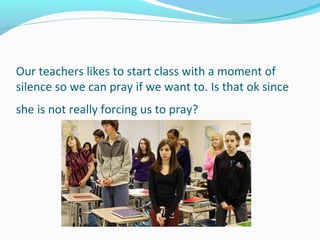
Our teachers likes to start class with a moment of
silence so we can pray if we want to. Is that ok since
she is not really forcing us to pray?
No. It is unconstitutional for schools to require a
moment of silence for meditation or voluntary
prayer. It may be ok if a teacher can show a non-
religious reason for it.
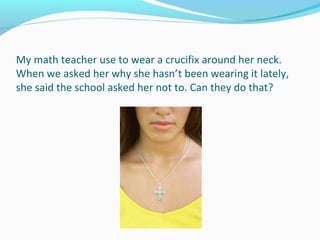
My math teacher use to wear a crucifix around her neck.
When we asked her why she hasn’t been wearing it lately,
she said the school asked her not to. Can they do that?
Yes. PA. law says that that public school staff cant
wear religious clothing or accessories. It prevents
teachers form promoting a particular religion.
1. First Amendment rights do have limits. In the
case of the right to exercise one's religious
beliefs, this is particularly true when it comes to
actions based on religious beliefs as opposed to
the beliefs themselves. how far outside the
mainstream can religious groups venture and
still be protected by the First Amendment.
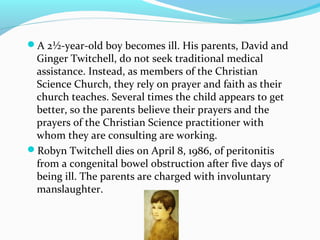
A 2½-year-old boy becomes ill. His parents, David and
Ginger Twitchell, do not seek traditional medical
assistance. Instead, as members of the Christian
Science Church, they rely on prayer and faith as their
church teaches. Several times the child appears to get
better, so the parents believe their prayers and the
prayers of the Christian Science practitioner with
whom they are consulting are working.
Robyn Twitchell dies on April 8, 1986, of peritonitis
from a congenital bowel obstruction after five days of
being ill. The parents are charged with involuntary
manslaughter.
They felt that it was within their first amendment
right to treat their son with prayer
The state of Massachusetts found that child
neglect over ruled their first amendment rights
Sentenced to 10 years probation for involuntary
manslaughter
“the law is now clear: parents cannot sacrifice the
lives of their children in the name of religious
freedom.”
Are religions that worship multiple gods legally permitted?
(Yes.)
What about religious worship that involves handling
poisonous snakes by both adults and children?
(Children should not be subjected to the risk of death; adults
make up their own minds)
What about a religion that holds that each man should have
more than one wife?
 (No, polygamy is illegal everywhere in the United States.)
I think you should defend to the death their
right to march, and then go down and meet
them with baseball bats.
--Woody Allen, on the KKK

New first amendment

  • 1.
    It is bythe goodness of God that in our country we have those three unspeakably precious things: freedom of speech, freedom of conscience, and the prudence never to practice either of them. --Mark Twain, 1897
  • 2.
    How are wecompared to everywhere else? Out of 195 countries 70 countries have “free press” 41 % of the countries have “partly free” press 42 % of the countries have “not free” press
  • 3.
    First Amendment Congress shallmake no law respecting an establishment of religion, or prohibiting the free exercise thereof; or abridging the freedom of speech, or of the press; or the right of the people peaceably to assemble, and to petition the Government for a redress of grievances.
  • 4.
    1st Amendment (Break Down) Religion– You can believe what you want, belong to any religion or no religion Speech – You can voice your opinion using words, symbols or actions Press – The government cannot censor information in newspapers, online news sources, TV news broadcasts, etc. Assembly – You can gather in a group Petition – You can criticize the government, and you can complain about policies that affect you negatively and ask for change
  • 5.
     1. TheFirst Amendment affirms the freedom of the individual. American government is based upon the concept that all human beings are born with certain rights or freedoms. The First Amendment guards these rights by prohibiting the government from denying citizens their rights. The first amendment must balance every ones freedoms
  • 6.
    Freedom of Expression Spokenor written words Art & music Messages in buttons ,t-shirts & the Internet How you dress Protests and rallies Joining clubs and organizations Refusing to salute the flag Symbolic speech like wearing an armband
  • 7.
    Three Types ofSpeech Pure Speech - Verbal expression Speech Plus- involves actions such as marching Symbolic speech - expression by conduct
  • 9.
    Students have theright to express their opinion, but they cant do so in any way that: Interferes with the educational process Threatens immediate harm to the school community Encourages unlawful activity Interferes with another individuals rights
  • 10.
    Students must also: Followlibel & obscenity codes Be aware of the full meaning of their expression & the feelings and opinions of others  have to put their names on posted or distributed materials Have to get approval before posting or distributing materials
  • 11.
    In the Courts BethelSchool District No. 403 v Fraser A high school student at a school assembly gave a speech nominating his friend for student government. He used sexual innuendos in his speech and the school suspended him for it. He sued the school arguing the suspension violated his free speech rights………….
  • 12.
    The U.S. SupremeCourt said….. It was o.k. for the school to punish the student . A school can prohibit lewd and vulgar student speech as part of its job of teaching students “the boundaries of socially appropriate behavior”
  • 14.
    Clear and PresentDanger Will this act of speech create a dangerous situation? The First Amendment does not protect statements that are uttered to provoke violence or incite illegal action.Justice Holmes, speaking for the unanimous Supreme Court, stated, “The question in every case is whether the words used are used in such circumstances and are of such a nature as to create a clear and present danger that they will bring about the substantive evils that Congress has a right to prevent.”
  • 15.
    Fighting Words Was somethingsaid face-to-face that would incite immediate violence? Facts of the Case Chaplinsky, a Jehovah's Witness, called a city marshal a "God-damned racketeer" and "a damned fascist" in a public place. He was arrested and convicted under a state law for violating a breach of the peace.
  • 16.
    Question Presented Does theapplication of the statute violate Chaplinsky's freedom of speech protected by the First Amendment? Conclusion No. Some forms of expression--among them obscenity and fighting words--do not convey ideas and thus are not subject to First Amendment protection. In this case, Chaplinsky uttered fighting words, i.e., words that "inflict injury or tend to incite an immediate breach of the peace."
  • 17.
    Libel and Slander Wasthe statement false, or put in a context that makes true statements misleading? You do not have a constitutional right to tell lies that damage or defame the reputation of a person or organization
  • 18.
    Time, Place, andManner Where, when, and how the free speech occurred can make a difference These regulations of expression are content- neutral. A question to ask: Did the expression occur at a time or place, or did the speaker use a method of communicating, that interferes with a legitimate government interest? For example, distribution of information should not impede the flow of traffic or create excessive noise levels at certain times and in certain places.
  • 20.
    The Free ExerciseClause prohibits governmental interference with religious belief and, within limits, religious practice. The Supreme Court traditionally has required governmental bodies to demonstrate a compelling interest of the "highest order" before they may interfere with religious conduct. Government must demonstrate that the means by which it seeks to address its compelling interest are the least restrictive possible of religious conduct
  • 21.
    How do youknow if government is establishing a religion? Apply the Lemon test! The Supreme court designed a three part test decide if government was acting in a way that promotes religion
  • 22.
    To pass thethe lemon test a government act or policy must; Not have a religious purpose Not end up promoting or favoring any set of religious beliefs;and Not get the government closely involved with religion.
  • 23.
    Our teachers likesto start class with a moment of silence so we can pray if we want to. Is that ok since she is not really forcing us to pray?
  • 24.
    No. It isunconstitutional for schools to require a moment of silence for meditation or voluntary prayer. It may be ok if a teacher can show a non- religious reason for it.
  • 25.
    My math teacheruse to wear a crucifix around her neck. When we asked her why she hasn’t been wearing it lately, she said the school asked her not to. Can they do that?
  • 26.
    Yes. PA. lawsays that that public school staff cant wear religious clothing or accessories. It prevents teachers form promoting a particular religion.
  • 27.
    1. First Amendmentrights do have limits. In the case of the right to exercise one's religious beliefs, this is particularly true when it comes to actions based on religious beliefs as opposed to the beliefs themselves. how far outside the mainstream can religious groups venture and still be protected by the First Amendment.
  • 28.
    A 2½-year-old boybecomes ill. His parents, David and Ginger Twitchell, do not seek traditional medical assistance. Instead, as members of the Christian Science Church, they rely on prayer and faith as their church teaches. Several times the child appears to get better, so the parents believe their prayers and the prayers of the Christian Science practitioner with whom they are consulting are working. Robyn Twitchell dies on April 8, 1986, of peritonitis from a congenital bowel obstruction after five days of being ill. The parents are charged with involuntary manslaughter.
  • 29.
    They felt thatit was within their first amendment right to treat their son with prayer The state of Massachusetts found that child neglect over ruled their first amendment rights Sentenced to 10 years probation for involuntary manslaughter “the law is now clear: parents cannot sacrifice the lives of their children in the name of religious freedom.”
  • 30.
    Are religions thatworship multiple gods legally permitted? (Yes.) What about religious worship that involves handling poisonous snakes by both adults and children? (Children should not be subjected to the risk of death; adults make up their own minds) What about a religion that holds that each man should have more than one wife?  (No, polygamy is illegal everywhere in the United States.)
  • 31.
    I think youshould defend to the death their right to march, and then go down and meet them with baseball bats. --Woody Allen, on the KKK