The 1920’s Chapter 22 : The 1920’s
Historical Themes Contributions of People and Groups Primary Source Documents Conflict and Cooperation Continuity and Change
conflict Conflict is a main theme of American events shortly after WWI.
Immigration “ Causing”  Conflict ___________________ - For xenophobia there are two main objects of the phobia. The  first is a population group present within a society, which is not considered part of that society . Often they are recent immigrants, but xenophobia may be directed against a group which has been present for centuries.  This form of xenophobia can elicit or facilitate hostile and violent reactions, such as mass expulsion of immigrants, or in the worst case, genocide. The second form of xenophobia is primarily cultural, and the object of the phobia is cultural elements which are considered alien. All cultures are subject to external influences, but cultural xenophobia is often narrowly directed, for instance at foreign loan words in a national language.   XENOPHOBIA Fear of a population group  present within a society,  which is not considered  part of that society
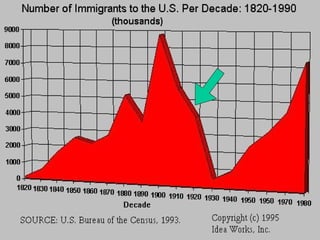
On the Homefront Xenophobia was a major problem after  World War I  when returning soldiers found themselves competing for jobs and housing with foreigners. This lead to riots, racial tensions, etc..
 
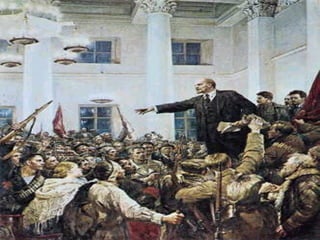
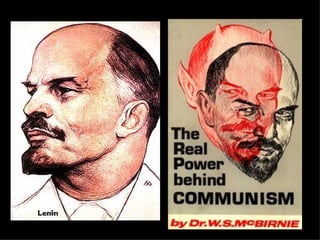
Bolshevik Revolution A. Vladimir Lenin leads overthrow of Czar  Nicholas II B. Replaces provisional government with  communist government C. Communism- a system in which goods are  owned in common and are available to all as needed D. Allies stay in Russia after the war to try to  maintain previous government E. Allies stay in Europe to protect countries from  Bolsheviks F. Russia becomes Union of Soviet Socialist  Republic G.  Suspicion begins in America (fear)


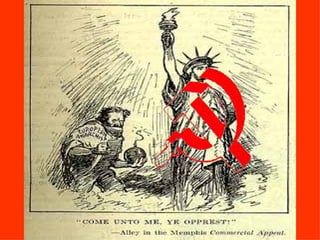
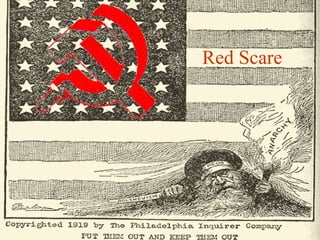
Red Scare
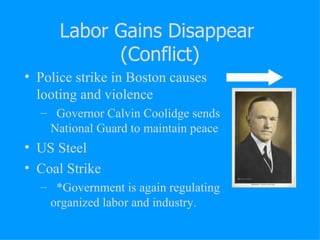
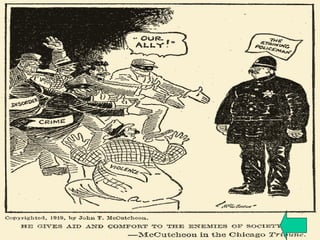
Labor Gains Disappear  (Conflict) Police strike in Boston causes looting and violence Governor Calvin Coolidge sends National Guard to maintain peace US Steel Coal Strike *Government is again regulating organized labor and industry.
 
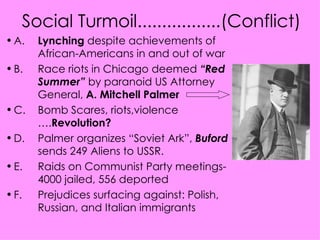
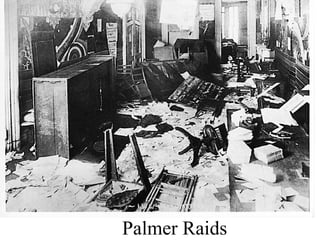
Social Turmoil.................(Conflict) A.  Lynching  despite achievements of  African-Americans in and out of war B. Race riots in Chicago deemed  “Red  Summer”  by paranoid US Attorney  General,  A. Mitchell Palmer C. Bomb Scares, riots,violence  …. Revolution? D. Palmer organizes “Soviet Ark”,  Buford   sends 249 Aliens to USSR. E. Raids on Communist Party meetings- 4000 jailed, 556 deported F. Prejudices surfacing against: Polish,  Russian, and Italian immigrants
Palmer Raids
Superiority v. Inferiority (Conflict) National Origins Act of 1924 reduced quotas on immigrants and barred Japanese, Chinese, and other Asians from entrance into America. “ Pulling up the ladder” again!
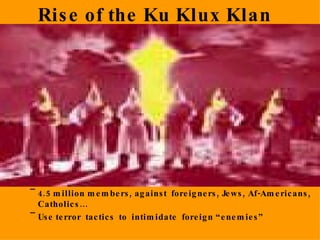
Rise of the Ku Klux Klan 4.5 million members, against  foreigners, Jews, Af-Americans, Catholics… Use terror  tactics  to  intimidate  foreign “enemies”
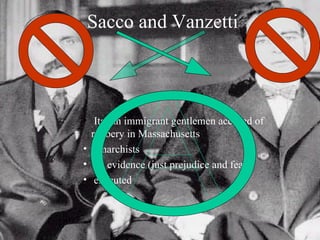
Italian immigrant gentlemen accused of robbery in Massachusetts Anarchists no evidence (just prejudice and fear) executed Sacco and Vanzetti
Criticism Authors and Journalists begin to criticize the principles and actions of American government
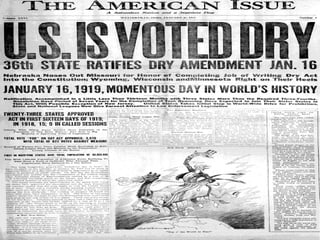
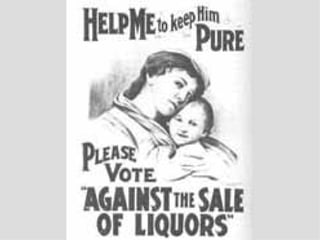
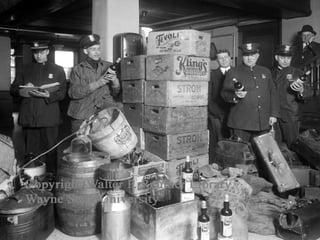
Not A Drop A. Temperance movement from 1830’s had picked up more support up to the war. B. By WWI, ½ of the States are DRY C. Prohibition = more grain for troops, strike against German-Americans who brew beer, and ensure sobriety D. January 1919,  18 th  Amendment E. In under-staffing the enforcement of Prohibition, (1520 agents) the “booze” trade becomes controlled by mafia, and made thousands of Americans into Criminals


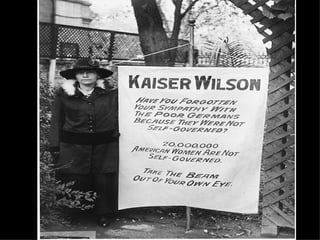
Women’s Suffrage   From their efforts in the war and on the homefront, women prove themselves finally as FIRST class citizens. “ Depriving half the nation the right to vote…”…Wilson*** 19 th  Amendment passes in 1920
 
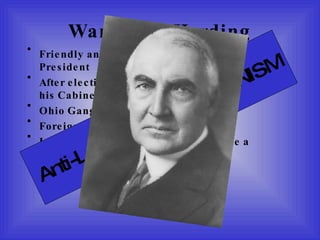
Warren G. Harding Friendly and likable, but under-qualified to be President After election victory, appoints many friends to his Cabinet. Ohio Gang Foreign Policy was Anti-League Ignored Treaty of Versailles and made a separate peace with Germany Anti-League = ISOLATIONISM
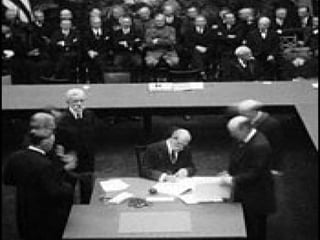
Washington Conference A. Largest Disarmament in history  i. Five Power Treaty -US, GB, JP, FR, IT reduce number of ships, not build any more forts/ bases on possessions in Pacific ii. Nine Power Treaty - (Open Door countries) respect China’s integrity and not seek land there iii. Four Power Treaty - US, GB, JP, and FR respect other countries possession in Pacific iv. Washington treaty allowed Japan to prosper, and US relations not great w/ JP because of Immigration Act of 1924 Peace Conference 5 9 4
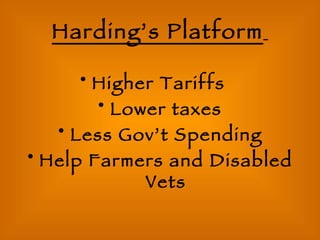
Harding’s Platform   Higher Tariffs Lower taxes Less Gov’t Spending Help Farmers and Disabled Vets
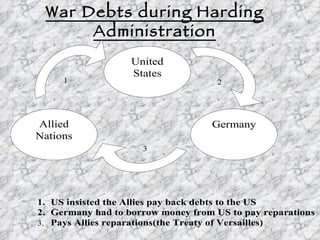
War Debts during Harding Administration
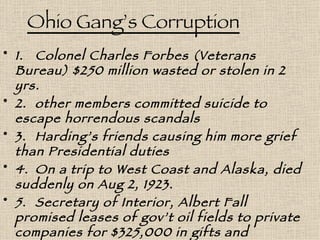
Ohio Gang’s Corruption 1. Colonel Charles Forbes (Veterans Bureau) $250 million wasted or stolen in 2 yrs. 2. other members committed suicide to escape horrendous scandals  3. Harding’s friends causing him more grief than Presidential duties 4. On a trip to West Coast and Alaska, died suddenly on Aug 2, 1923. 5. Secretary of Interior, Albert Fall promised leases of gov’t oil fields to private companies for $325,000 in gifts and loans……………………….and a year in   prison.
Let’s Review 1.  What president was likeable, but severely unqualified ? 2.  What mistake did he make in appointing his Cabinet? 3.  Describe the cyclical payment arrangement of war debts after WWI? 4.  What two amendments were passed at the beginning of the 1920’s?
“ The business of America is  business” -Calvin Coolidge
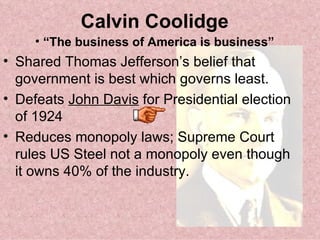
Calvin Coolidge “ The business of America is business” Shared Thomas Jefferson’s belief that government is best which governs least. Defeats  John Davis  for Presidential election of 1924 Reduces monopoly laws; Supreme Court rules US Steel not a monopoly even though it owns 40% of the industry.
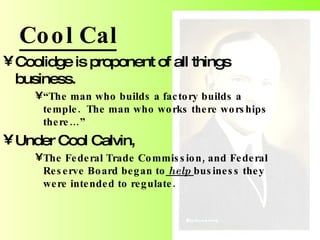
Cool Cal Coolidge is proponent of all things business. “ The man who builds a factory builds a temple.  The man who works there worships there…” Under Cool Calvin,  The Federal Trade Commission, and Federal Reserve Board began to  help  business they were intended to regulate.
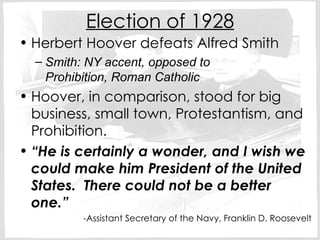
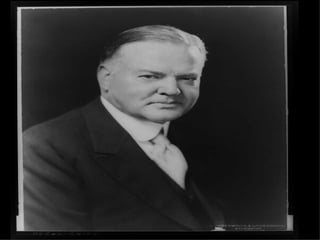
Election of 1928 Herbert Hoover defeats Alfred Smith Smith: NY accent, opposed to  Prohibition, Roman Catholic Hoover, in comparison, stood for big business, small town, Protestantism, and Prohibition. “ He is certainly a wonder, and I wish we could make him President of the United States.  There could not be a better one.” -Assistant Secretary of the Navy, Franklin D. Roosevelt
 
 
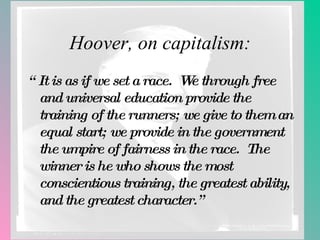
Hoover, on capitalism: “  It is as if we set a race.  We through free and universal education provide the training of the runners; we give to them an equal start; we provide in the government the umpire of fairness in the race.  The winner is he who shows the most conscientious training, the greatest ability, and the greatest character.”

1920s

  • 1.
    The 1920’s Chapter22 : The 1920’s
  • 2.
    Historical Themes Contributionsof People and Groups Primary Source Documents Conflict and Cooperation Continuity and Change
  • 3.
    conflict Conflict isa main theme of American events shortly after WWI.
  • 4.
    Immigration “ Causing” Conflict ___________________ - For xenophobia there are two main objects of the phobia. The first is a population group present within a society, which is not considered part of that society . Often they are recent immigrants, but xenophobia may be directed against a group which has been present for centuries. This form of xenophobia can elicit or facilitate hostile and violent reactions, such as mass expulsion of immigrants, or in the worst case, genocide. The second form of xenophobia is primarily cultural, and the object of the phobia is cultural elements which are considered alien. All cultures are subject to external influences, but cultural xenophobia is often narrowly directed, for instance at foreign loan words in a national language. XENOPHOBIA Fear of a population group present within a society, which is not considered part of that society
  • 5.
    On the HomefrontXenophobia was a major problem after World War I when returning soldiers found themselves competing for jobs and housing with foreigners. This lead to riots, racial tensions, etc..
  • 6.
  • 7.
    Bolshevik Revolution A.Vladimir Lenin leads overthrow of Czar Nicholas II B. Replaces provisional government with communist government C. Communism- a system in which goods are owned in common and are available to all as needed D. Allies stay in Russia after the war to try to maintain previous government E. Allies stay in Europe to protect countries from Bolsheviks F. Russia becomes Union of Soviet Socialist Republic G. Suspicion begins in America (fear)
  • 8.
  • 9.
  • 10.
  • 11.
  • 12.
    Labor Gains Disappear (Conflict) Police strike in Boston causes looting and violence Governor Calvin Coolidge sends National Guard to maintain peace US Steel Coal Strike *Government is again regulating organized labor and industry.
  • 13.
  • 14.
    Social Turmoil.................(Conflict) A. Lynching despite achievements of African-Americans in and out of war B. Race riots in Chicago deemed “Red Summer” by paranoid US Attorney General, A. Mitchell Palmer C. Bomb Scares, riots,violence …. Revolution? D. Palmer organizes “Soviet Ark”, Buford sends 249 Aliens to USSR. E. Raids on Communist Party meetings- 4000 jailed, 556 deported F. Prejudices surfacing against: Polish, Russian, and Italian immigrants
  • 15.
  • 16.
    Superiority v. Inferiority(Conflict) National Origins Act of 1924 reduced quotas on immigrants and barred Japanese, Chinese, and other Asians from entrance into America. “ Pulling up the ladder” again!
  • 17.
    Rise of theKu Klux Klan 4.5 million members, against foreigners, Jews, Af-Americans, Catholics… Use terror tactics to intimidate foreign “enemies”
  • 18.
    Italian immigrant gentlemenaccused of robbery in Massachusetts Anarchists no evidence (just prejudice and fear) executed Sacco and Vanzetti
  • 19.
    Criticism Authors andJournalists begin to criticize the principles and actions of American government
  • 20.
    Not A DropA. Temperance movement from 1830’s had picked up more support up to the war. B. By WWI, ½ of the States are DRY C. Prohibition = more grain for troops, strike against German-Americans who brew beer, and ensure sobriety D. January 1919, 18 th Amendment E. In under-staffing the enforcement of Prohibition, (1520 agents) the “booze” trade becomes controlled by mafia, and made thousands of Americans into Criminals
  • 21.
  • 22.
  • 23.
  • 24.
    Women’s Suffrage From their efforts in the war and on the homefront, women prove themselves finally as FIRST class citizens. “ Depriving half the nation the right to vote…”…Wilson*** 19 th Amendment passes in 1920
  • 25.
  • 26.
    Warren G. HardingFriendly and likable, but under-qualified to be President After election victory, appoints many friends to his Cabinet. Ohio Gang Foreign Policy was Anti-League Ignored Treaty of Versailles and made a separate peace with Germany Anti-League = ISOLATIONISM
  • 27.
    Washington Conference A.Largest Disarmament in history i. Five Power Treaty -US, GB, JP, FR, IT reduce number of ships, not build any more forts/ bases on possessions in Pacific ii. Nine Power Treaty - (Open Door countries) respect China’s integrity and not seek land there iii. Four Power Treaty - US, GB, JP, and FR respect other countries possession in Pacific iv. Washington treaty allowed Japan to prosper, and US relations not great w/ JP because of Immigration Act of 1924 Peace Conference 5 9 4
  • 28.
    Harding’s Platform Higher Tariffs Lower taxes Less Gov’t Spending Help Farmers and Disabled Vets
  • 29.
    War Debts duringHarding Administration
  • 30.
    Ohio Gang’s Corruption1. Colonel Charles Forbes (Veterans Bureau) $250 million wasted or stolen in 2 yrs. 2. other members committed suicide to escape horrendous scandals 3. Harding’s friends causing him more grief than Presidential duties 4. On a trip to West Coast and Alaska, died suddenly on Aug 2, 1923. 5. Secretary of Interior, Albert Fall promised leases of gov’t oil fields to private companies for $325,000 in gifts and loans……………………….and a year in prison.
  • 31.
    Let’s Review 1. What president was likeable, but severely unqualified ? 2. What mistake did he make in appointing his Cabinet? 3. Describe the cyclical payment arrangement of war debts after WWI? 4. What two amendments were passed at the beginning of the 1920’s?
  • 32.
    “ The businessof America is business” -Calvin Coolidge
  • 33.
    Calvin Coolidge “The business of America is business” Shared Thomas Jefferson’s belief that government is best which governs least. Defeats John Davis for Presidential election of 1924 Reduces monopoly laws; Supreme Court rules US Steel not a monopoly even though it owns 40% of the industry.
  • 34.
    Cool Cal Coolidgeis proponent of all things business. “ The man who builds a factory builds a temple. The man who works there worships there…” Under Cool Calvin, The Federal Trade Commission, and Federal Reserve Board began to help business they were intended to regulate.
  • 35.
    Election of 1928Herbert Hoover defeats Alfred Smith Smith: NY accent, opposed to Prohibition, Roman Catholic Hoover, in comparison, stood for big business, small town, Protestantism, and Prohibition. “ He is certainly a wonder, and I wish we could make him President of the United States. There could not be a better one.” -Assistant Secretary of the Navy, Franklin D. Roosevelt
  • 36.
  • 37.
  • 38.
    Hoover, on capitalism:“ It is as if we set a race. We through free and universal education provide the training of the runners; we give to them an equal start; we provide in the government the umpire of fairness in the race. The winner is he who shows the most conscientious training, the greatest ability, and the greatest character.”