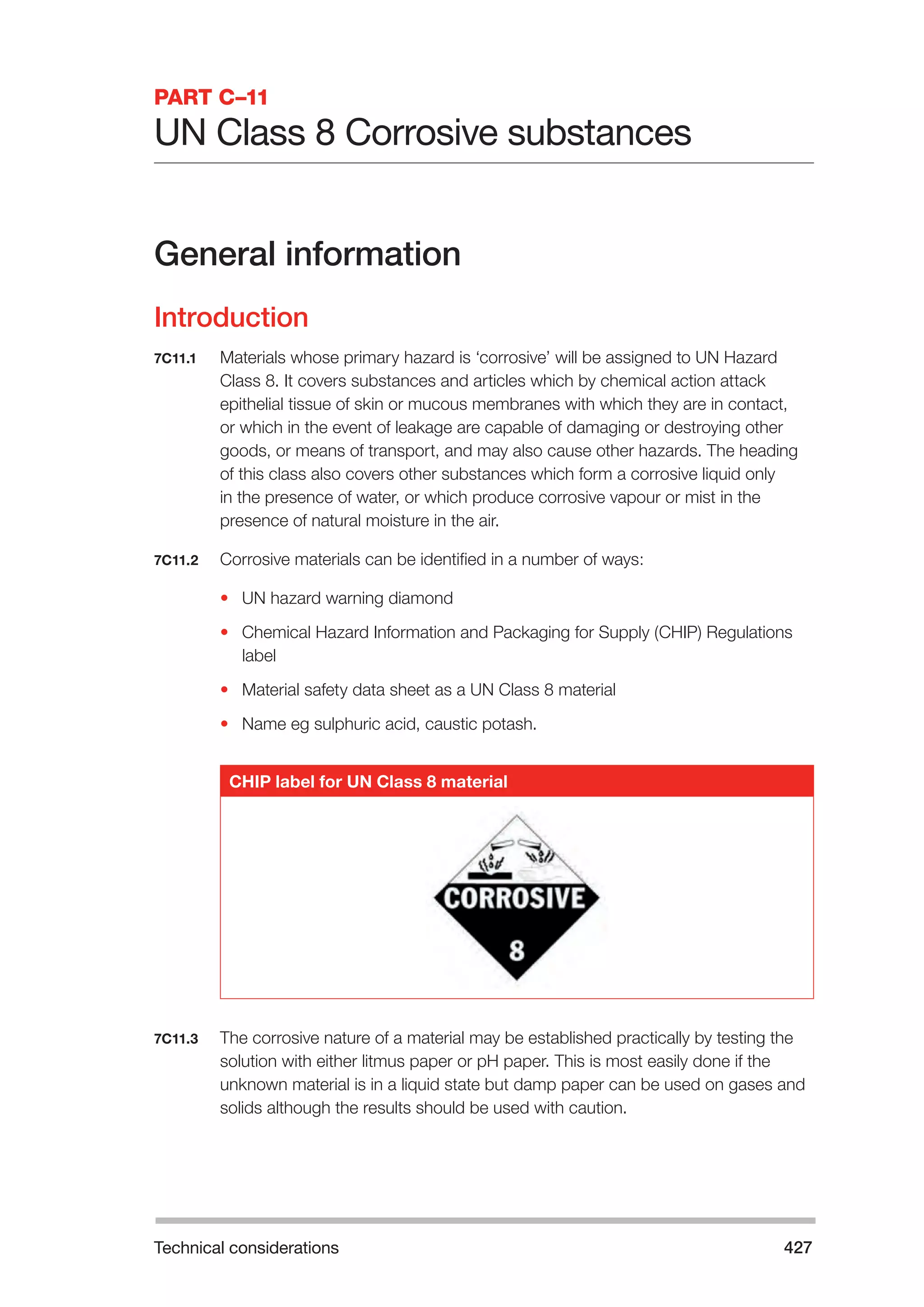






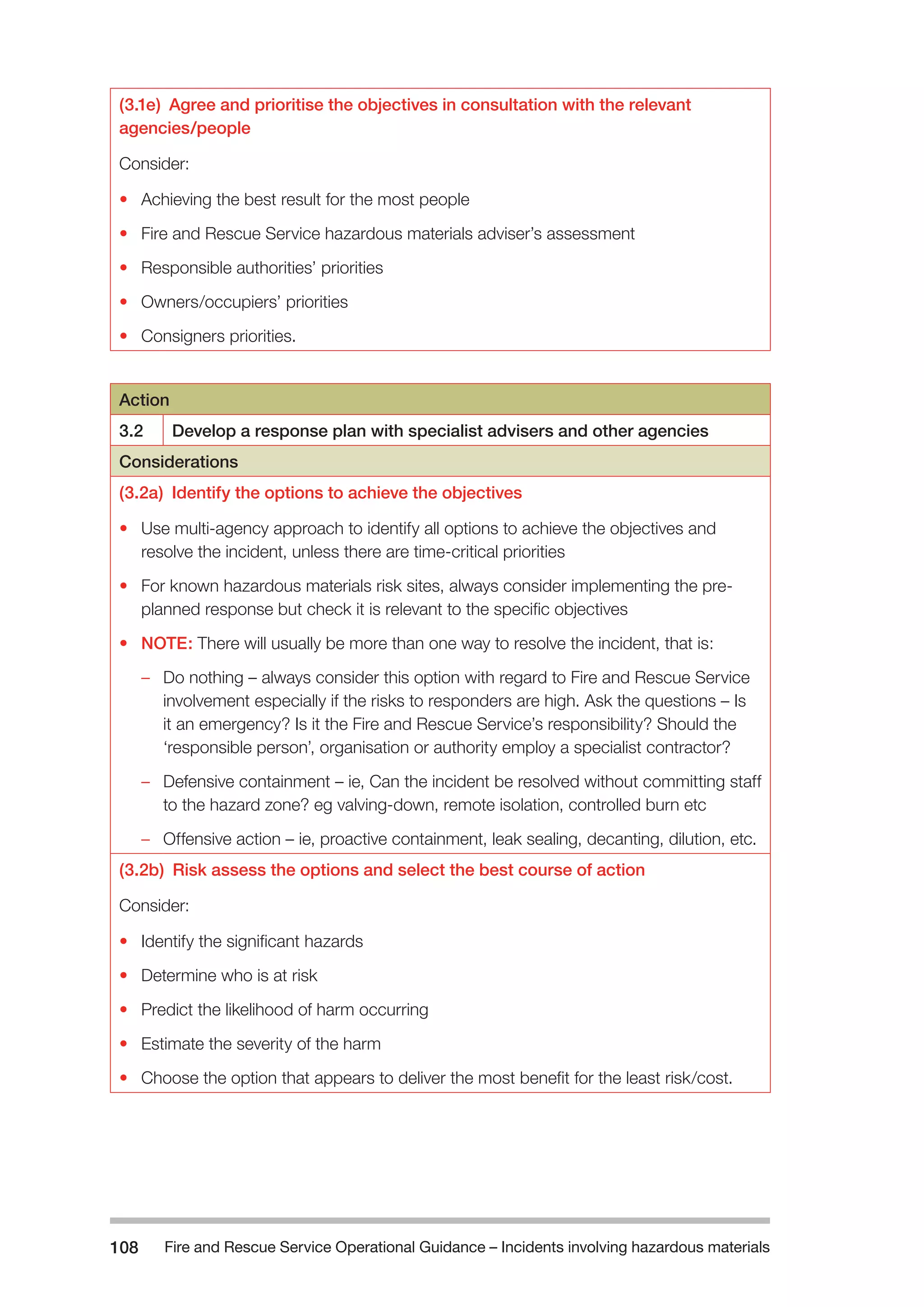
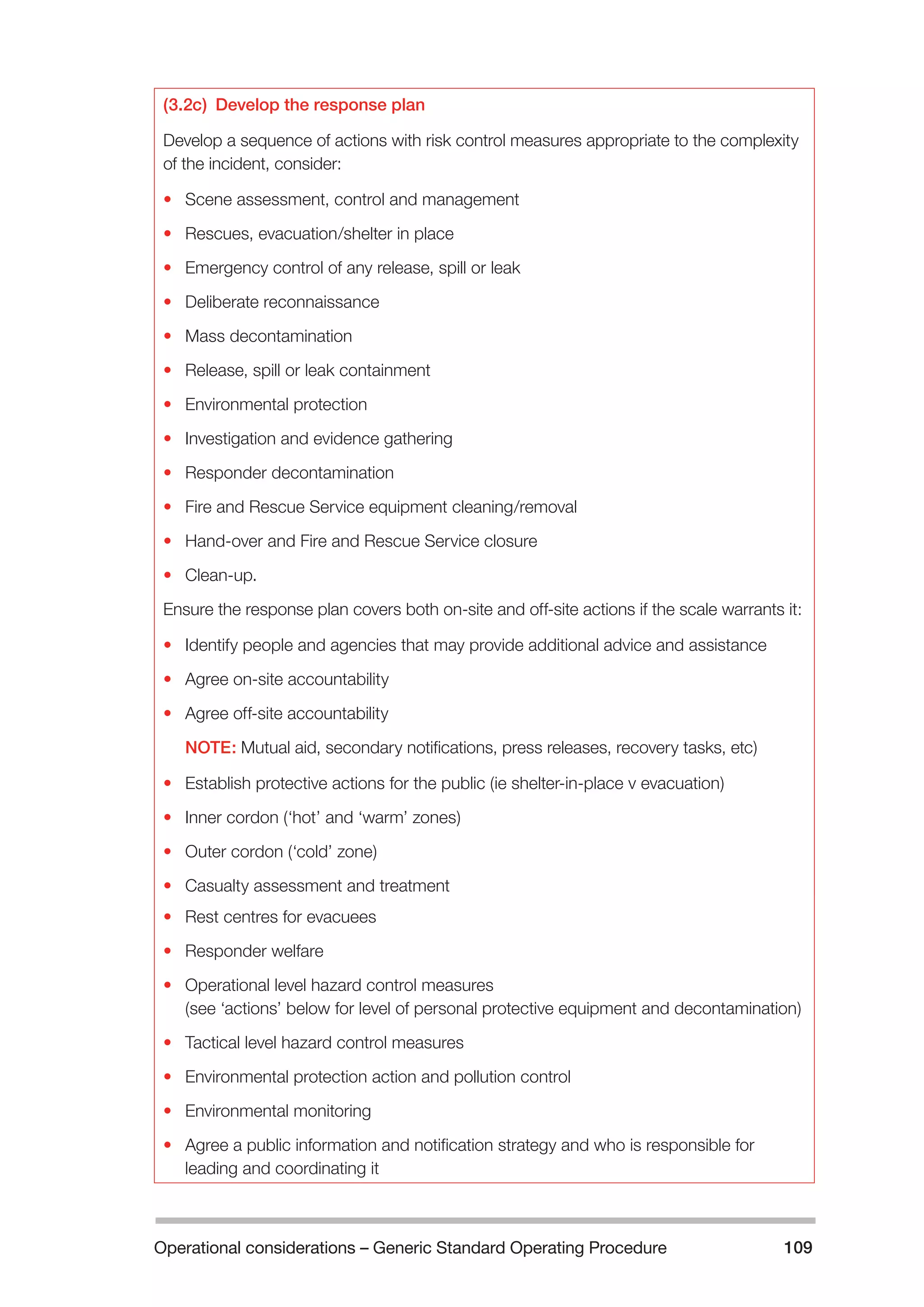
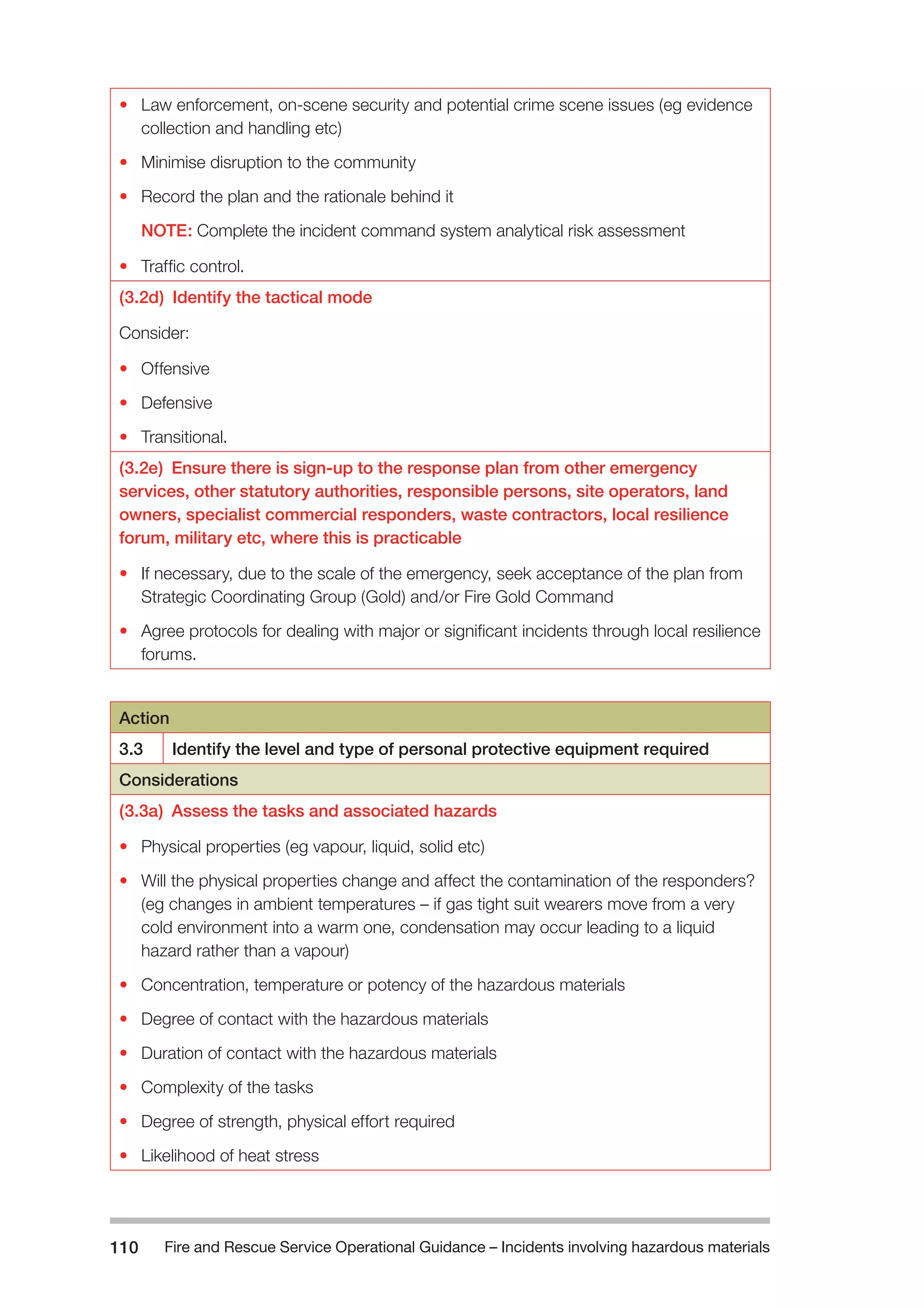
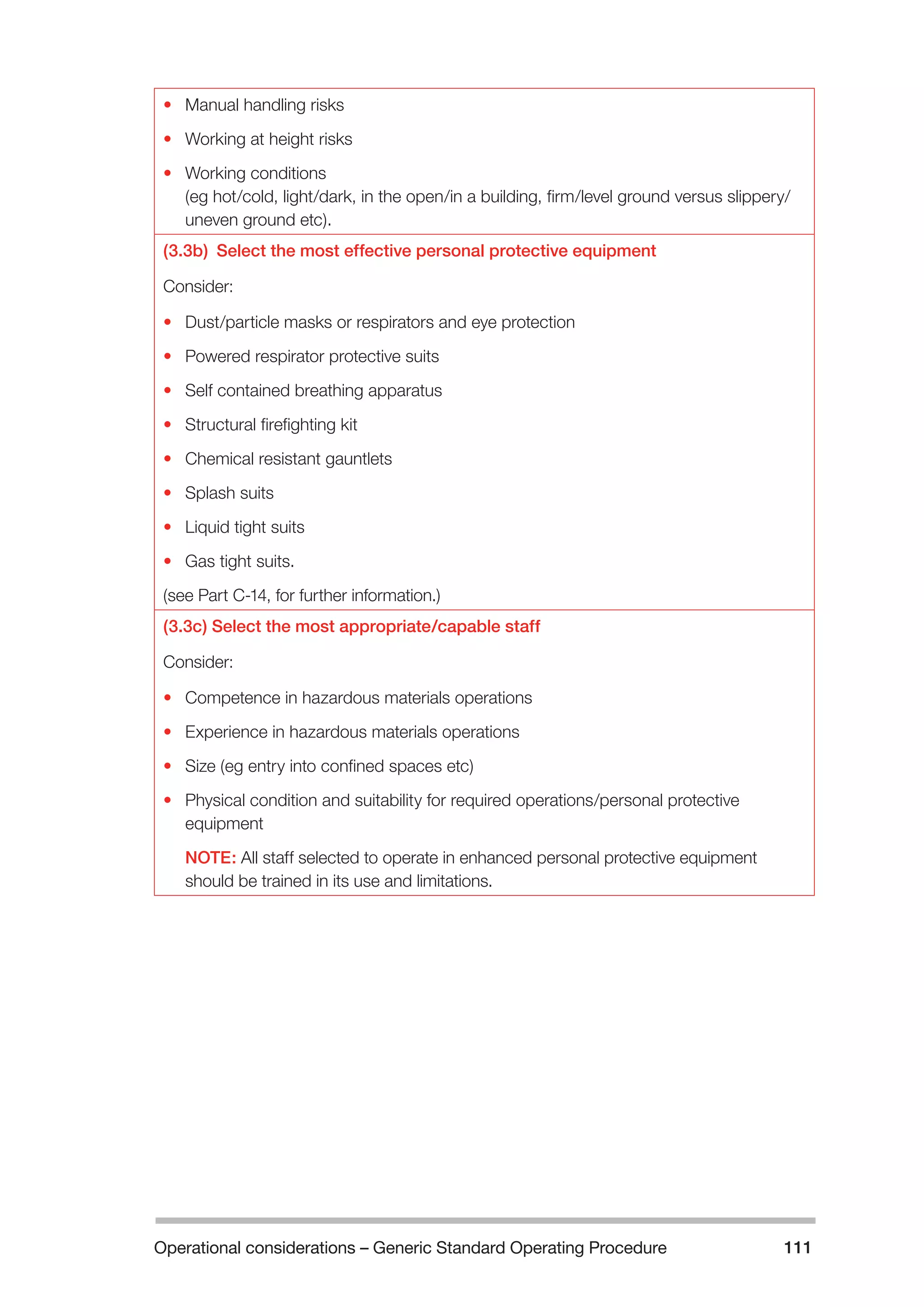

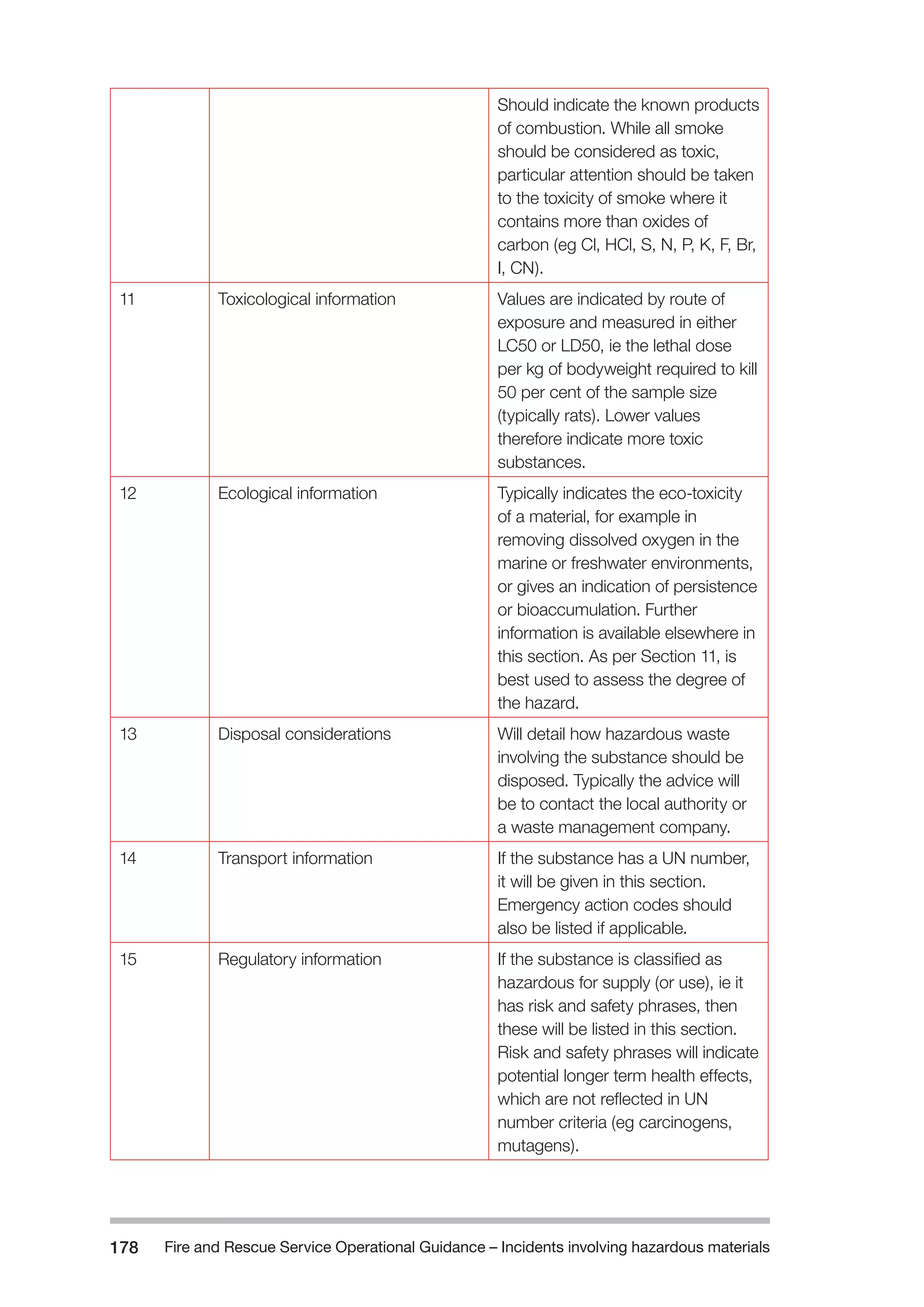
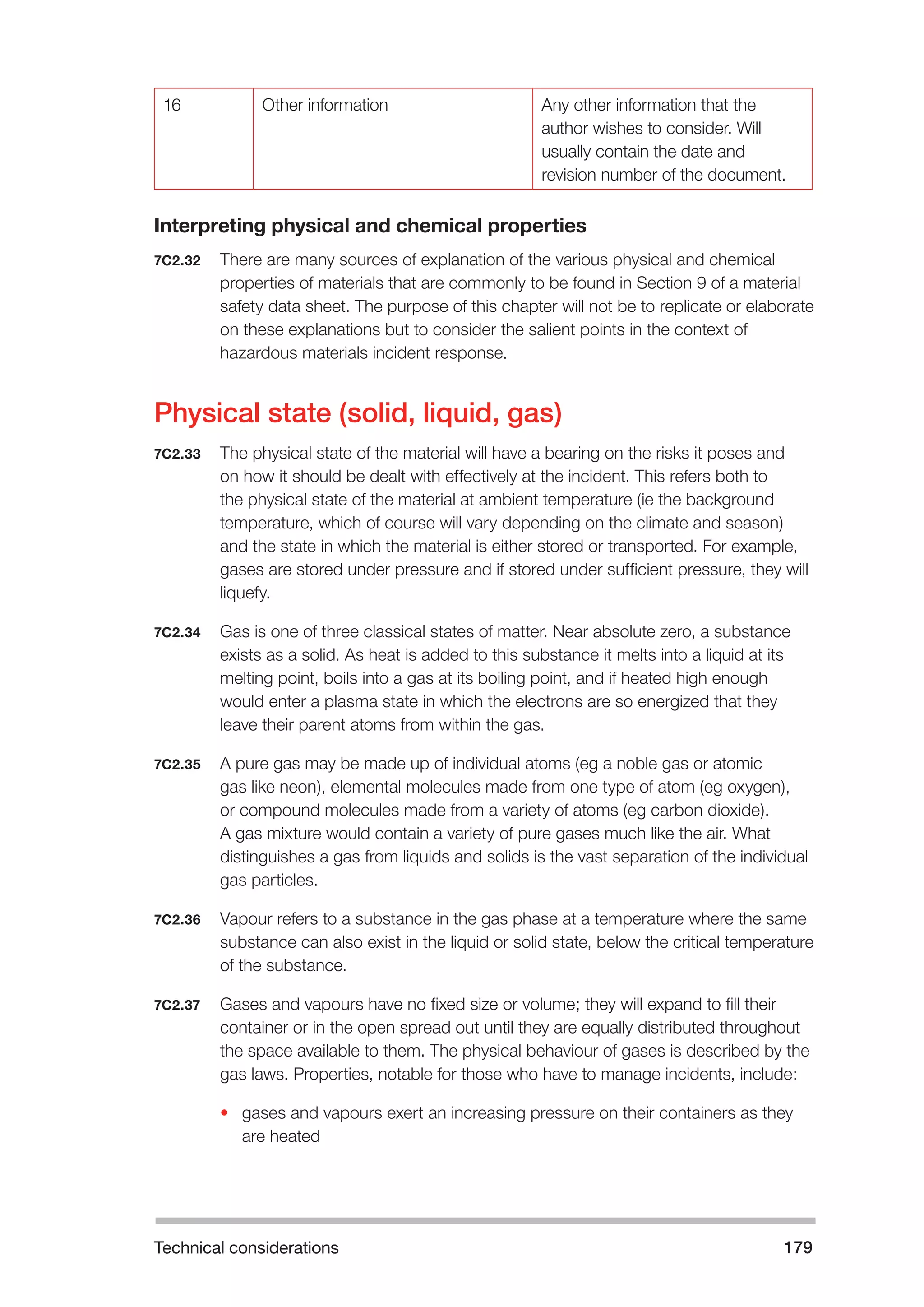
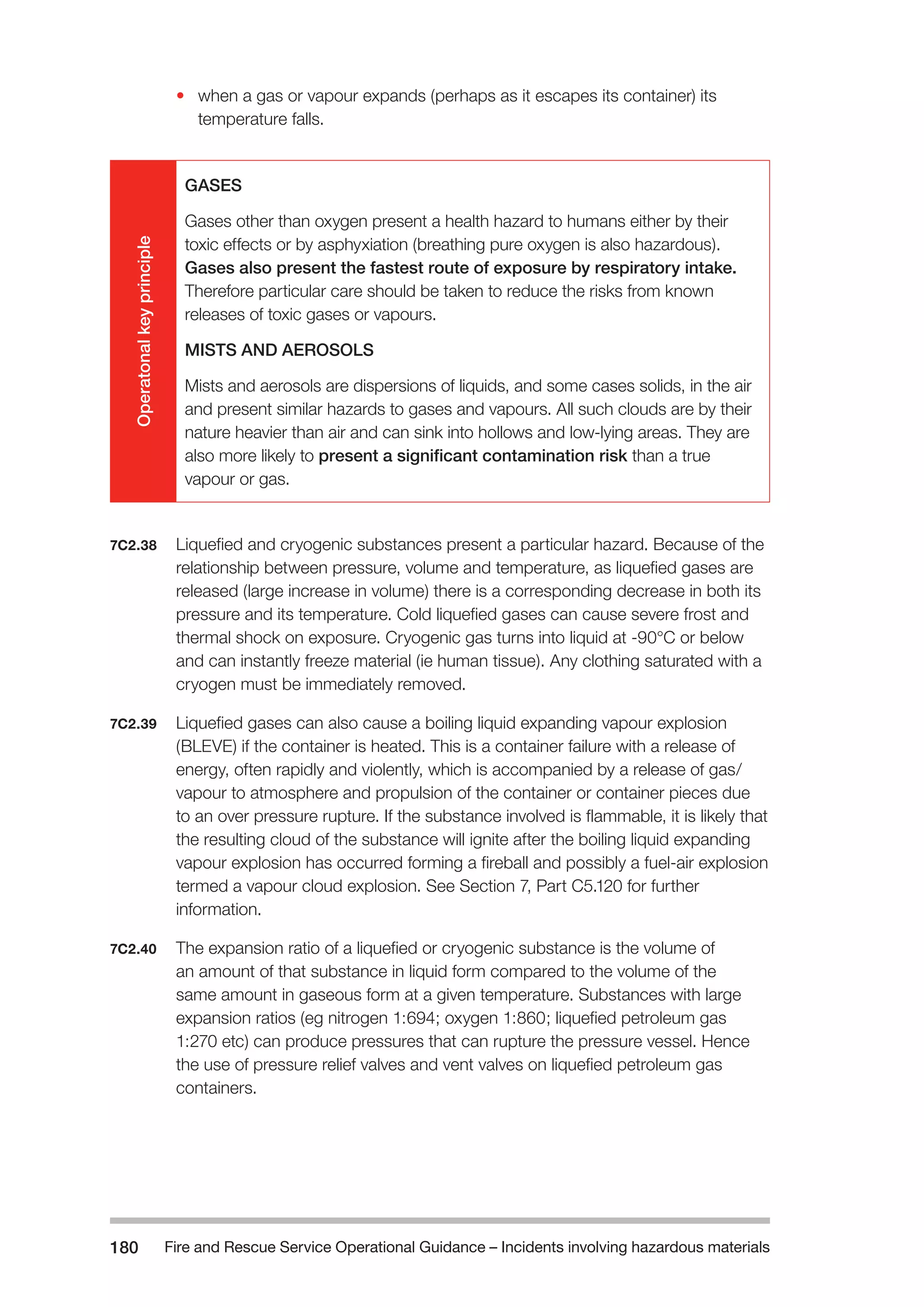
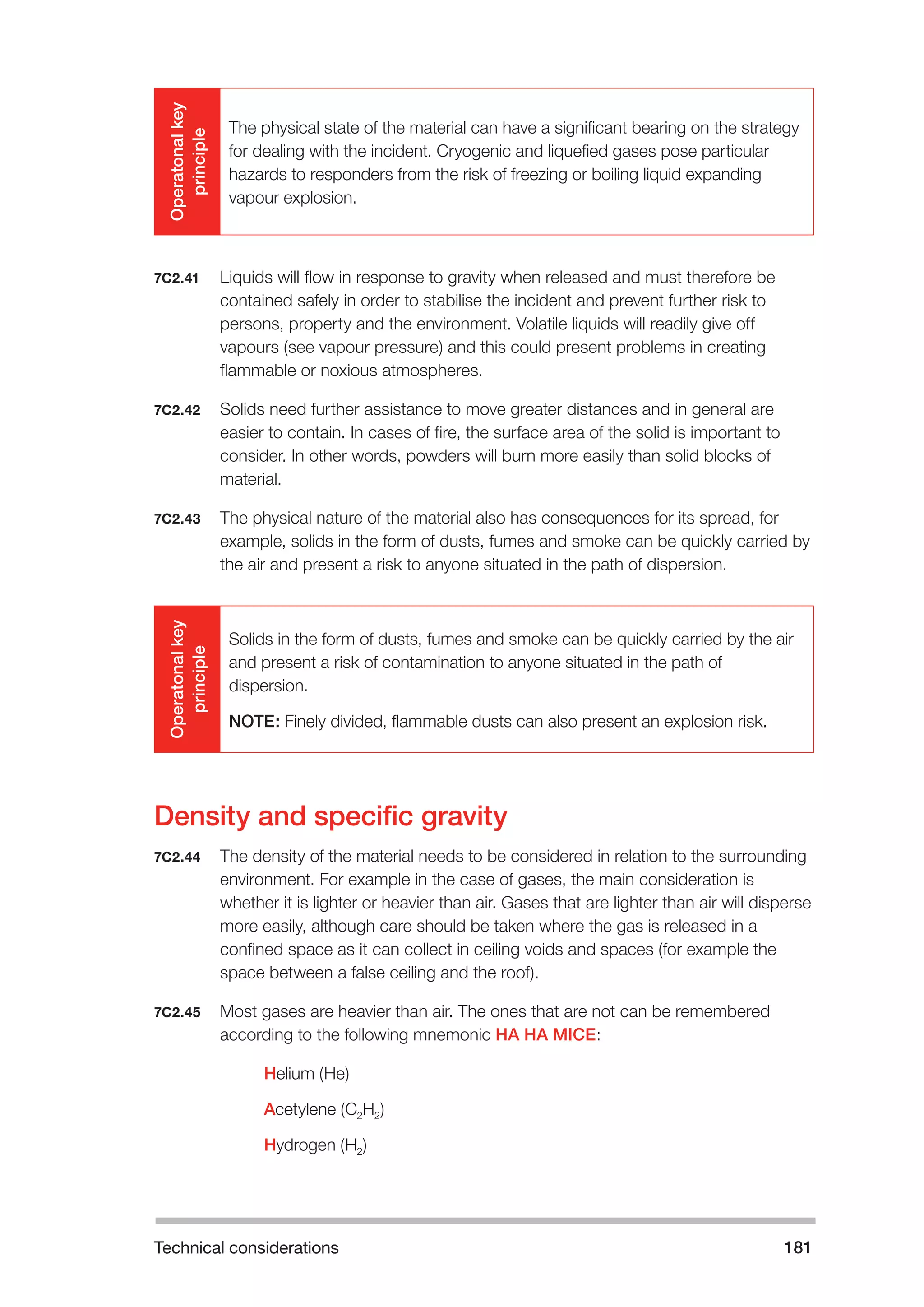
Operational guidance Incidents involving hazardous materials
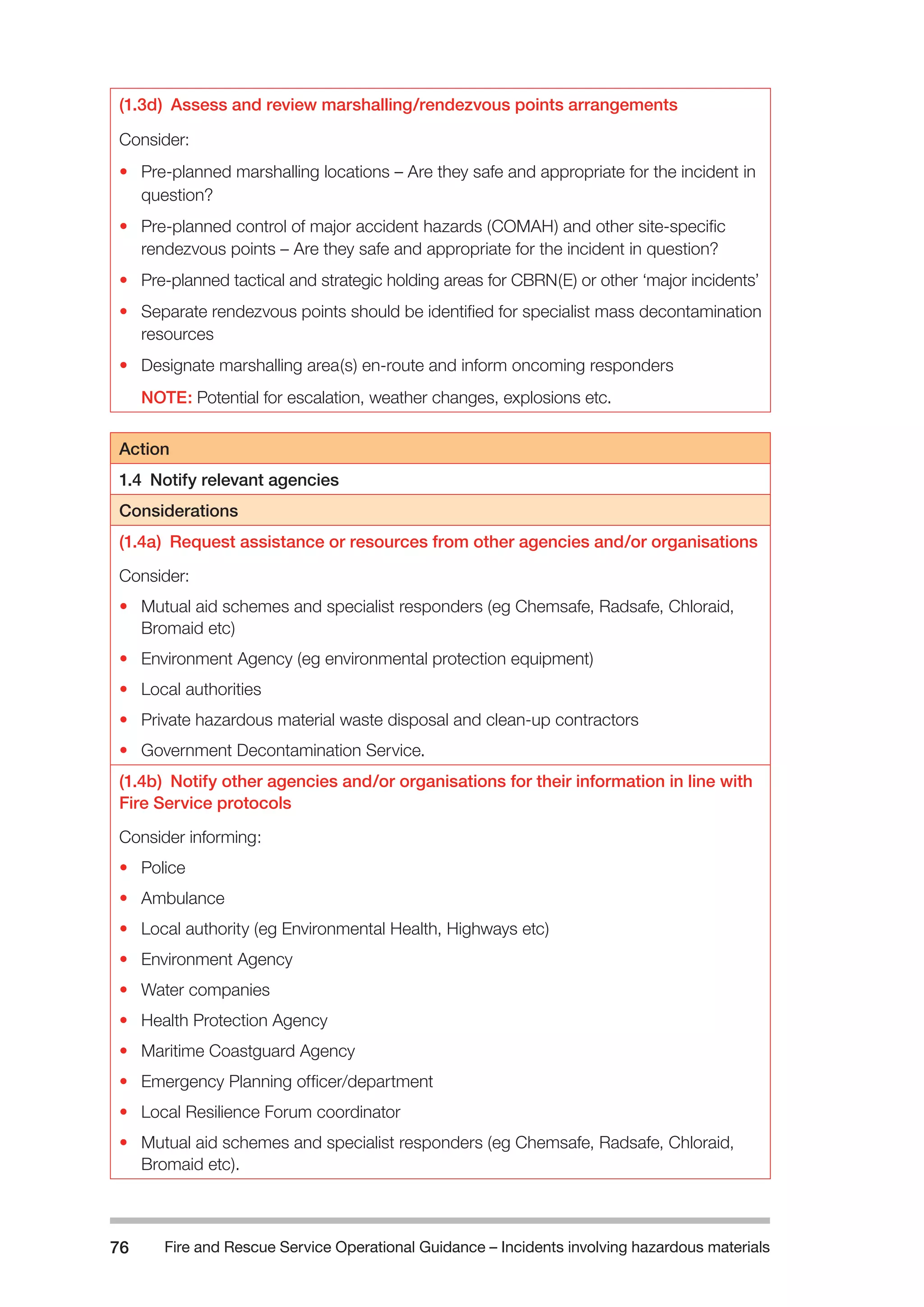
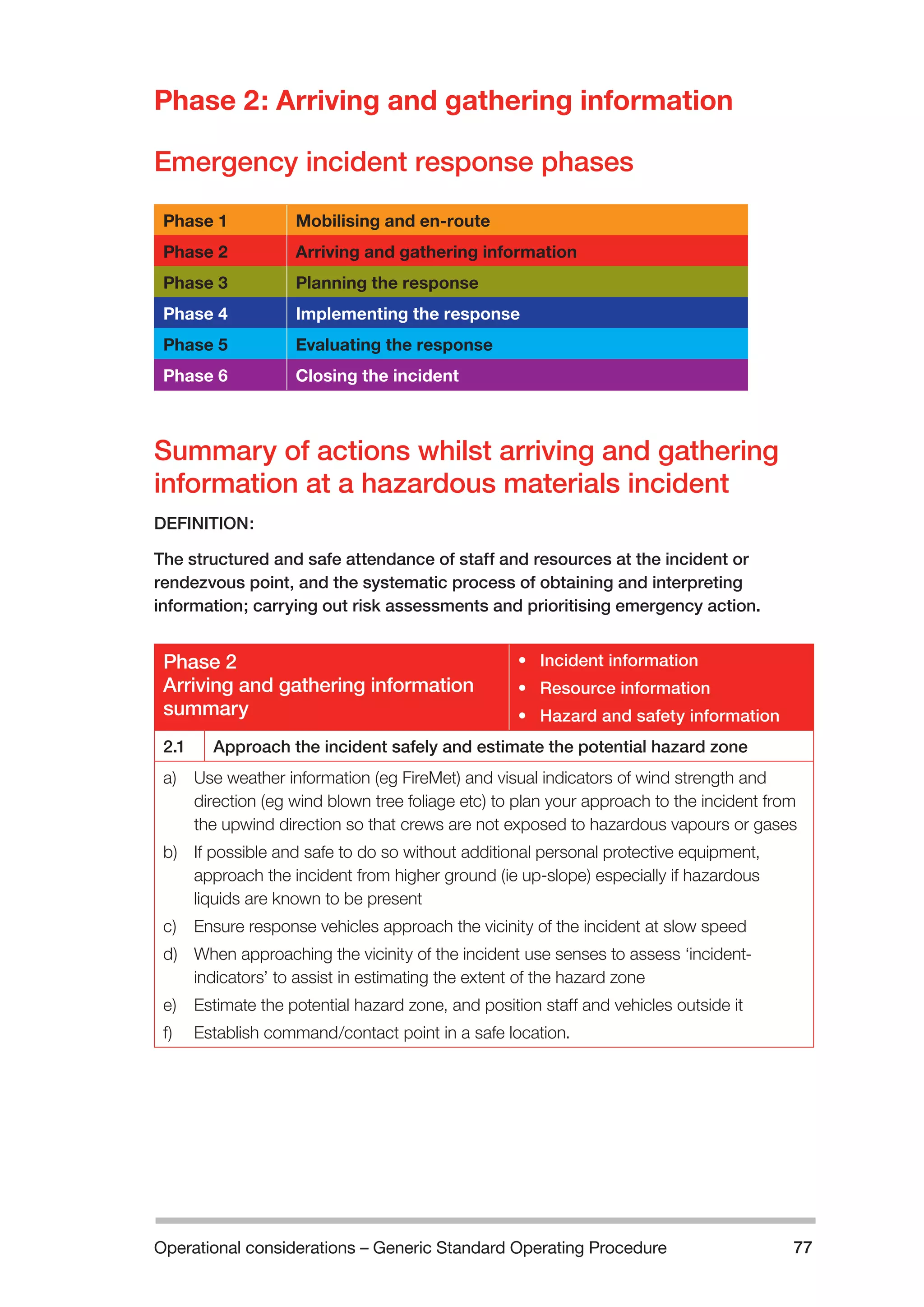
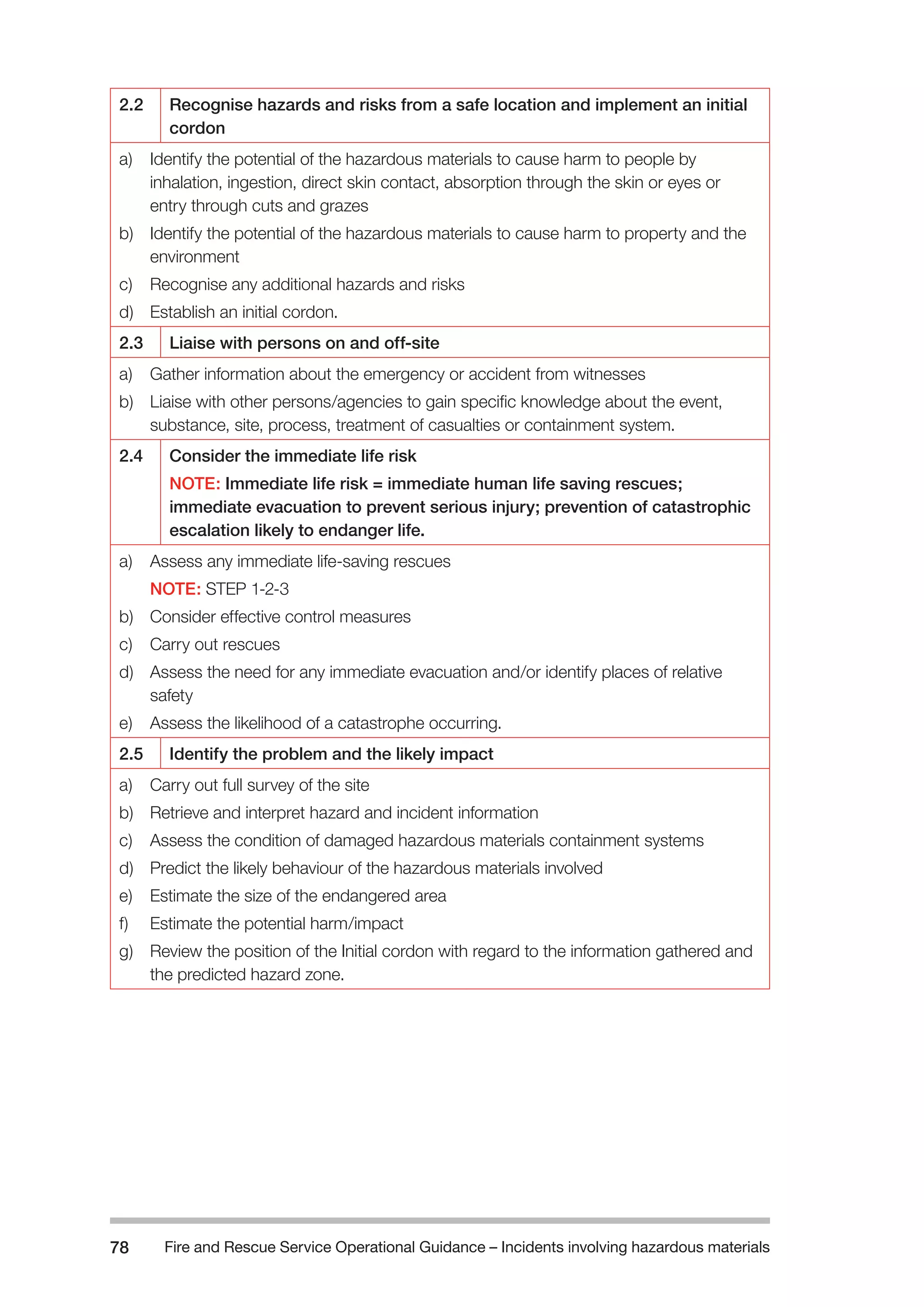
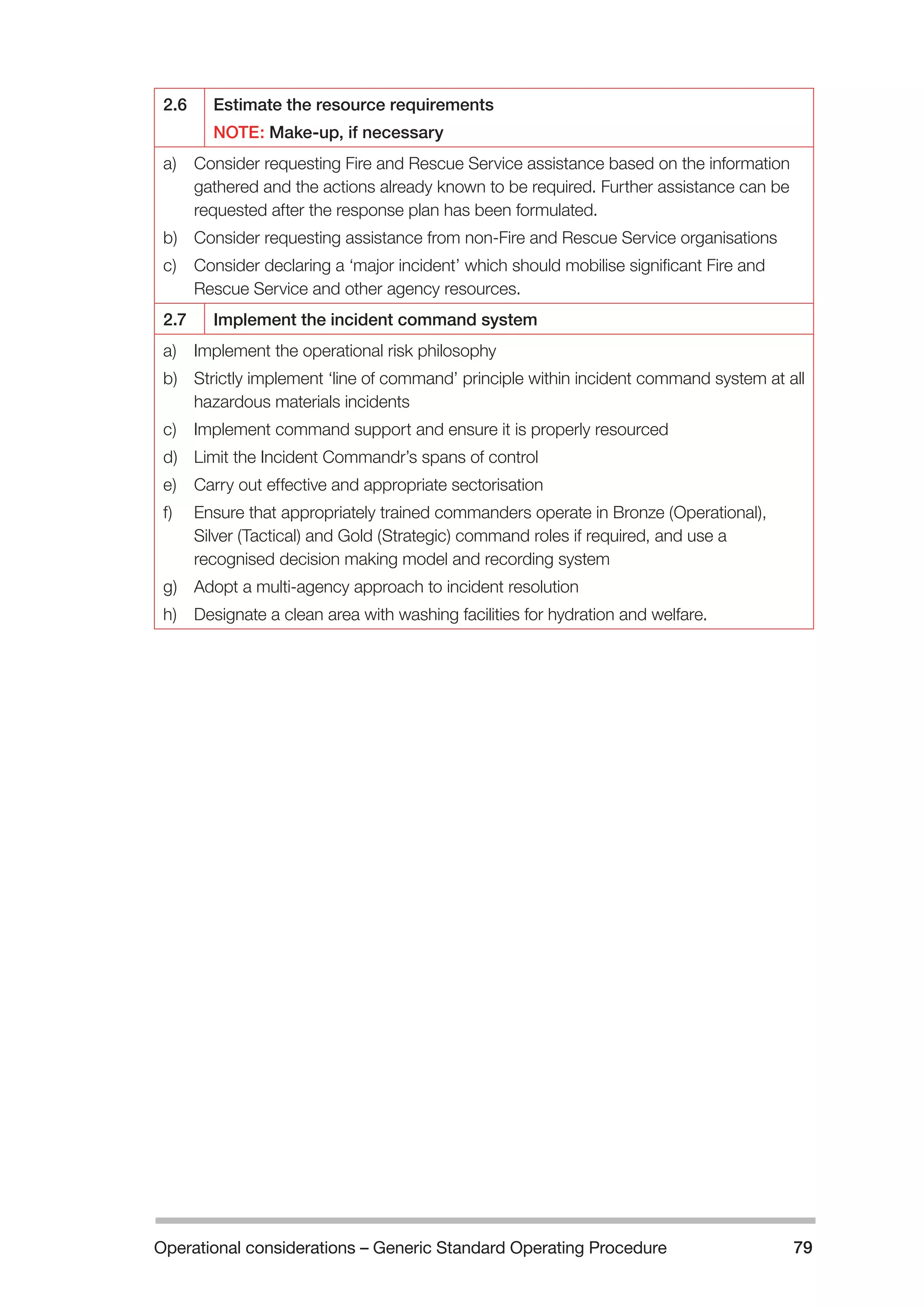
Published by TSO (The Stationery Office) and available from: 
Online 
www.tsoshop.co.uk 
Mail, Telephone, Fax & E-mail 
TSO 
PO Box 29, Norwich, NR3 1GN 
Telephone orders/General enquiries: 0870 600 5522 
Fax orders: 0870 600 5533 
E-mail: customer.services@tso.co.uk 
Textphone 0870 240 3701 
TSO@Blackwell and other Accredited Agents 
Published with the permission of the Department for Communities and Local Government on 
behalf of Her Majesty’s Stationery Office. 
© Crown copyright 2012 
ISBN: 9780117541092 
Copyright in the typographical arrangement and design rests with the Crown. 
This is a value added publication which falls outside the scope of the HMSO Class Licence. 
Applications for reproduction should be made to The Information Policy Team, The National Archives, Kew, Richmond, Surrey, TW9 4DU or e-mail: psi@nationalarchives.gsi.gov.uk. 
Printed in the UK for The Stationery Office Limited 
ID2511951 C5 11/12 
Printed on paper containing 75% recycled fibre content minimum
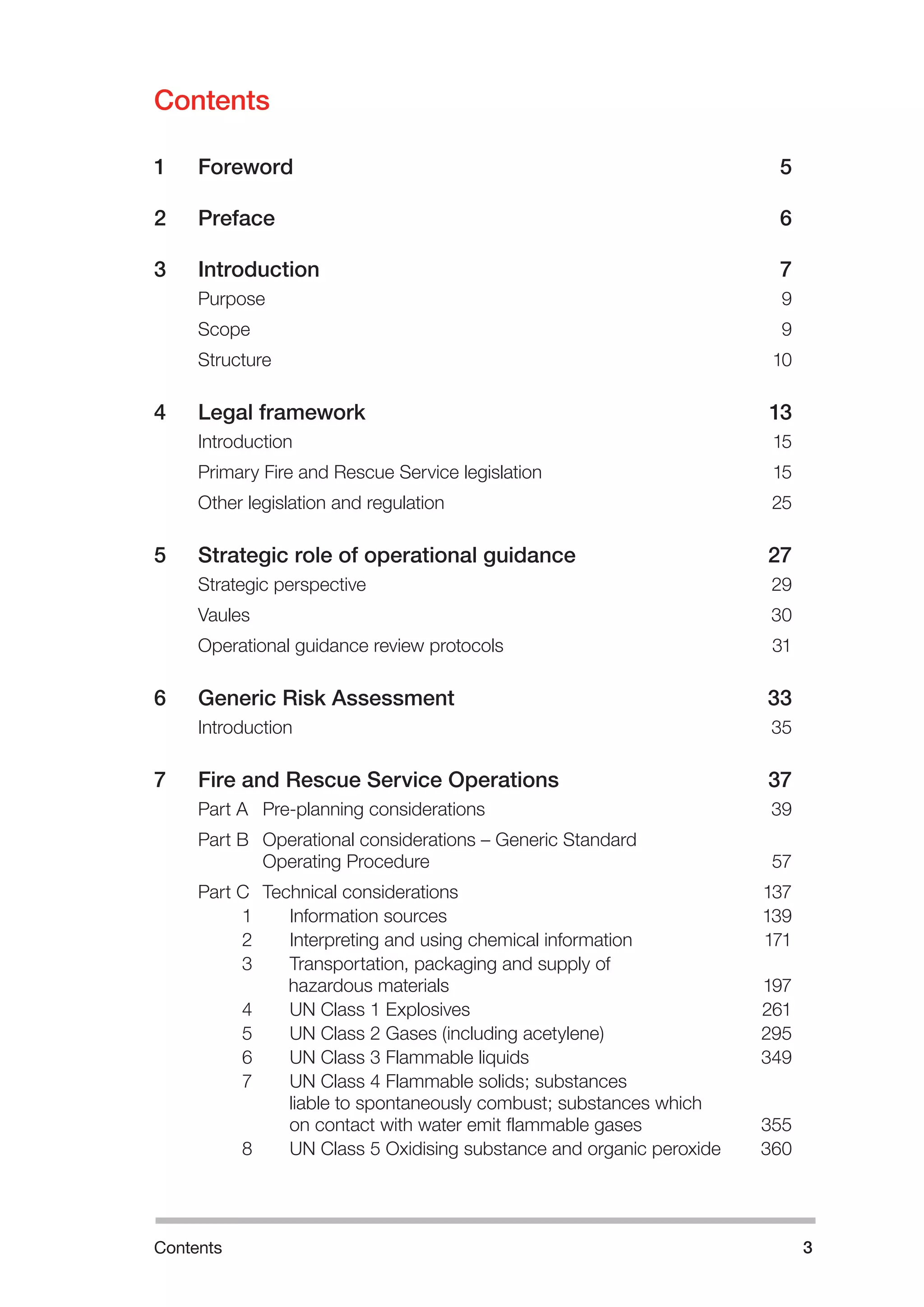
Contents 
1 Foreword 5 
2 Preface 6 
3 Introduction 7 
Purpose 9 
Scope 9 
Structure 10 
4 Legal framework 13 
Introduction 15 
Primary Fire and Rescue Service legislation 15 
Other legislation and regulation 25 
5 Strategic role of operational guidance 27 
Strategic perspective 29 
Vaules 30 
Operational guidance review protocols 31 
6 Generic Risk Assessment 33 
Introduction 35 
7 Fire and Rescue Service Operations 37 
Part A Pre-planning considerations 39 
Part B Operational considerations – Generic Standard 
Operating Procedure 57 
Part C Technical considerations 137 
1 Information sources 139 
2 Interpreting and using chemical information 171 
3 Transportation, packaging and supply of 
h 
azardous materials 197 
4 UN Class 1 Explosives 261 
5 UN Class 2 Gases (including acetylene) 295 
6 UN Class 3 Flammable liquids 349 
7 UN Class 4 Flammable solids; substances 
liable to spontaneously combust; substances which 
on contact with water emit flammable gases 355 
8 UN Class 5 Oxidising substance and organic peroxide 360 
 
Contents 
3
Fire and Rescue Service Operational Guidance – Incidents 4 involving hazardous materials 
9 UN Class 6 Toxic and infectious substances 365 
10 UN Class 7 Radioactive materials 385 
11 UN Class 8 Corrosive substances 427 
12 UN Class 9 Miscellaneous dangerous substances 
and articles 436 
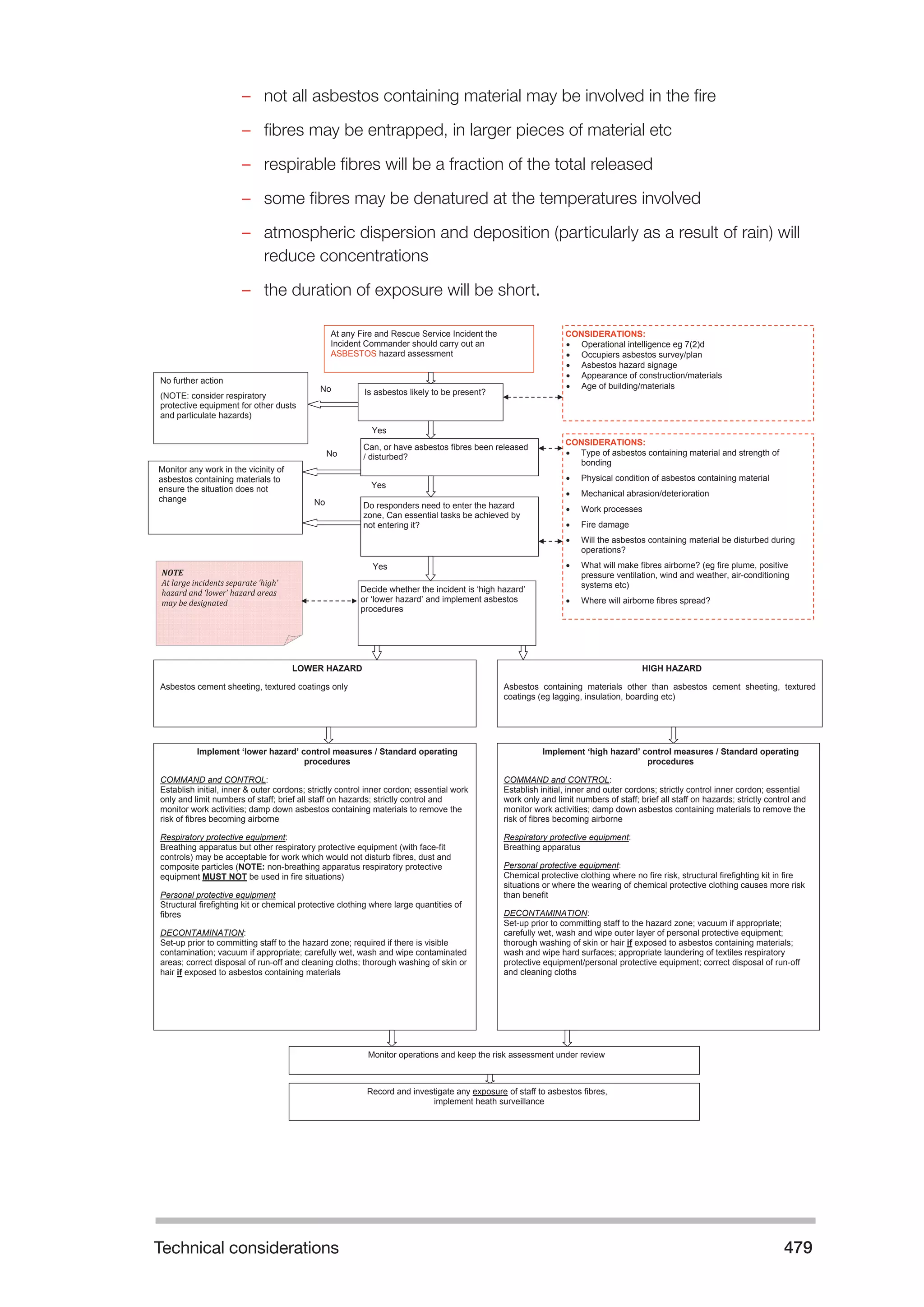
13 Asbestos containing materials 457 
14 Personal protective equipment for hazardous 
materials incidents 481 
15 Decontamination 512 
16 Environmental protection 551 
17 Additional chemical, biological, radiological, nuclear and 
explosives (CBRN(E)) considerations 569 
8 Appendices 579 
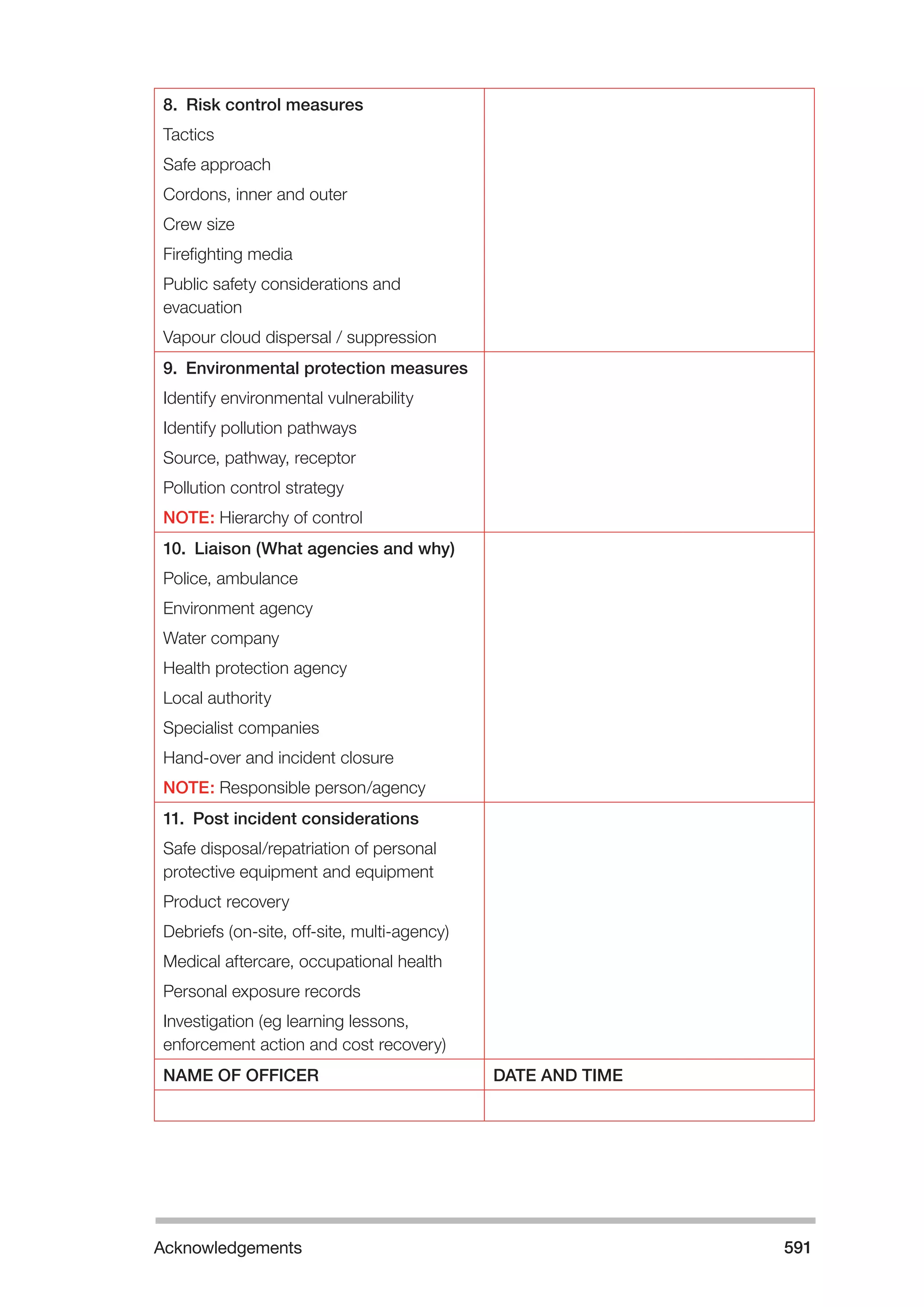
A Generic Standard Operating Procedure Summary 581 
B Hazardous materials incident information record and 
Fire and Rescue Service Risk assessment template 589 
9 Acknowledgements 593 
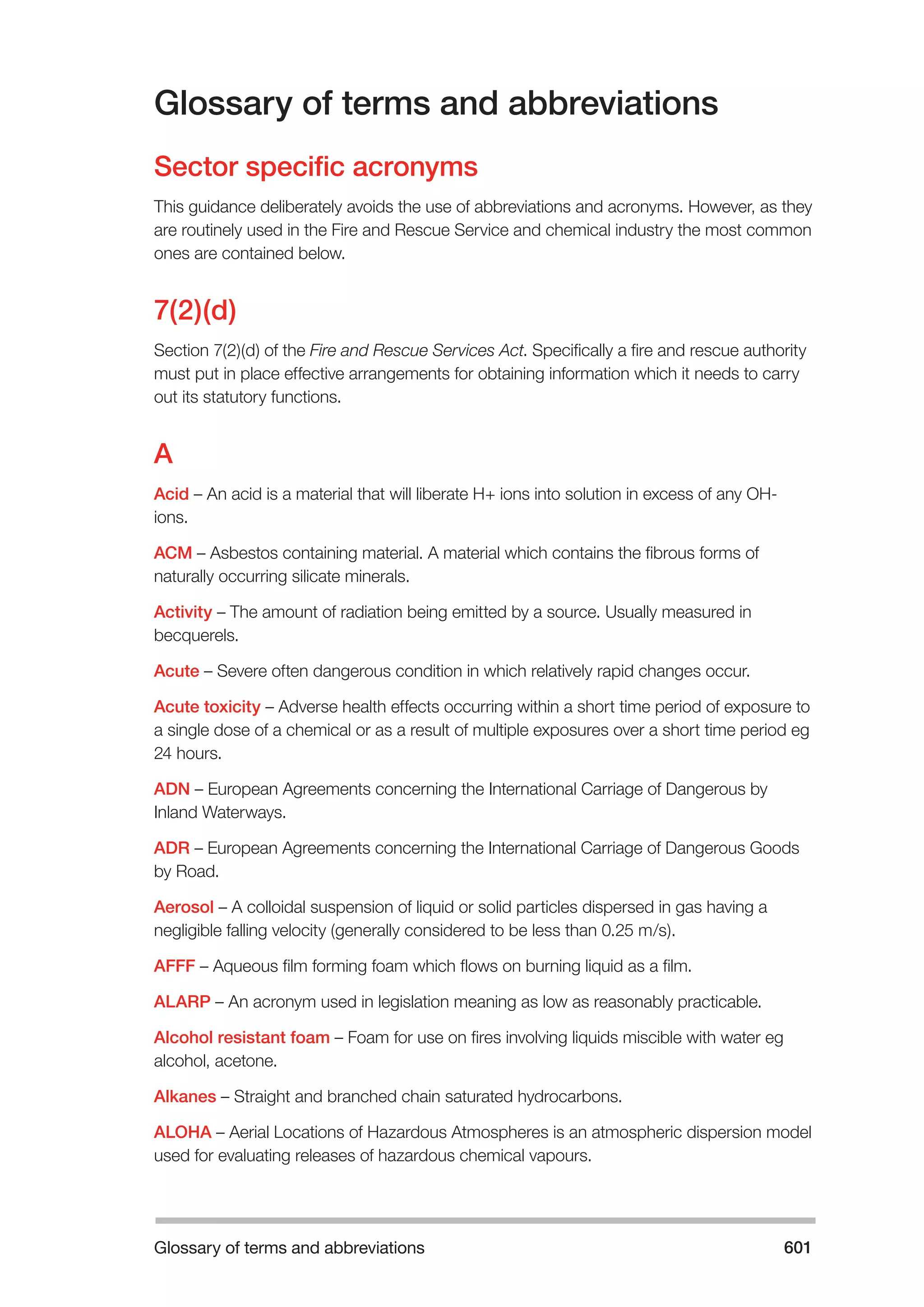
10 Glossary of terms and abbreviations 599 
11 References and bibliography 621 
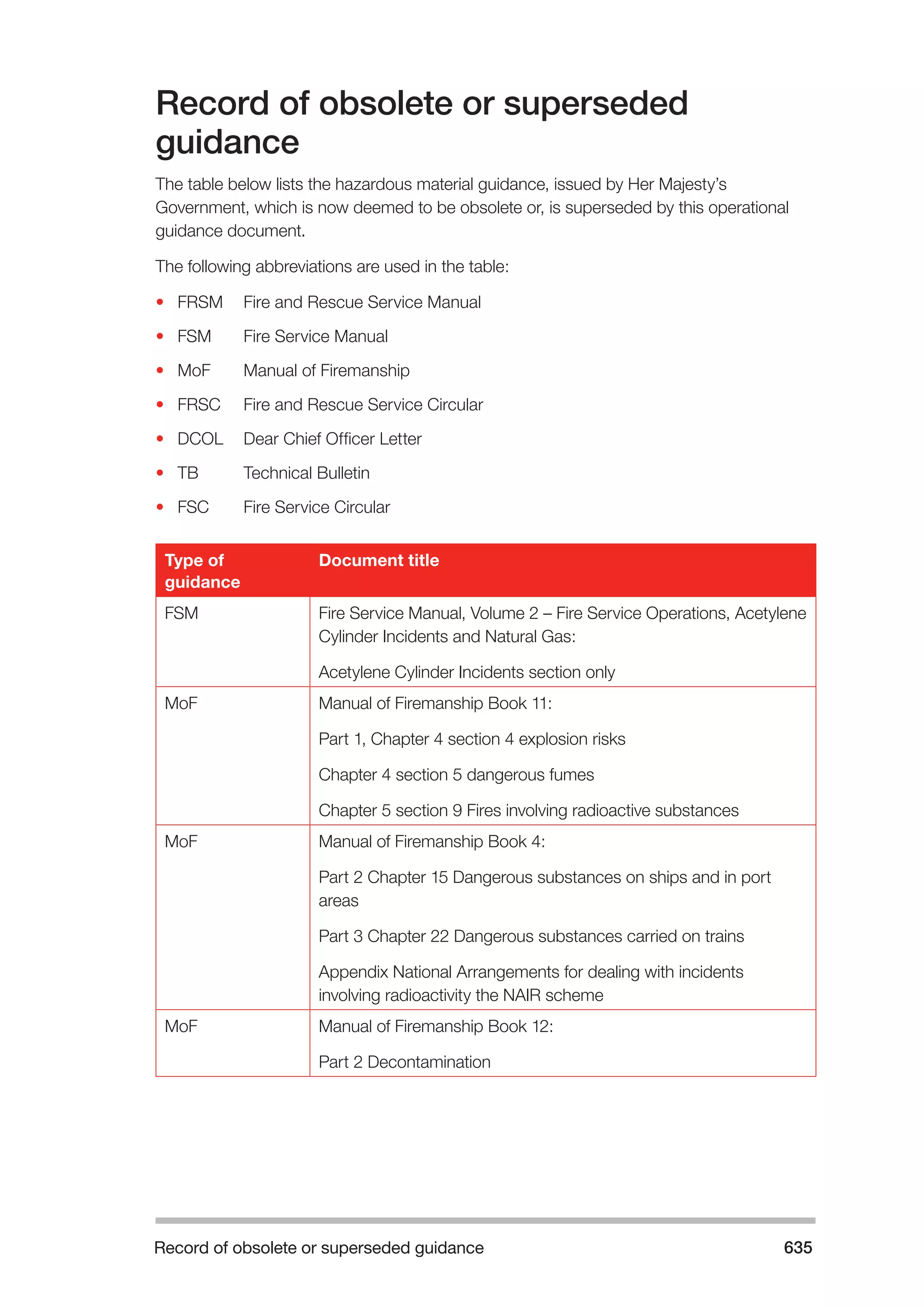
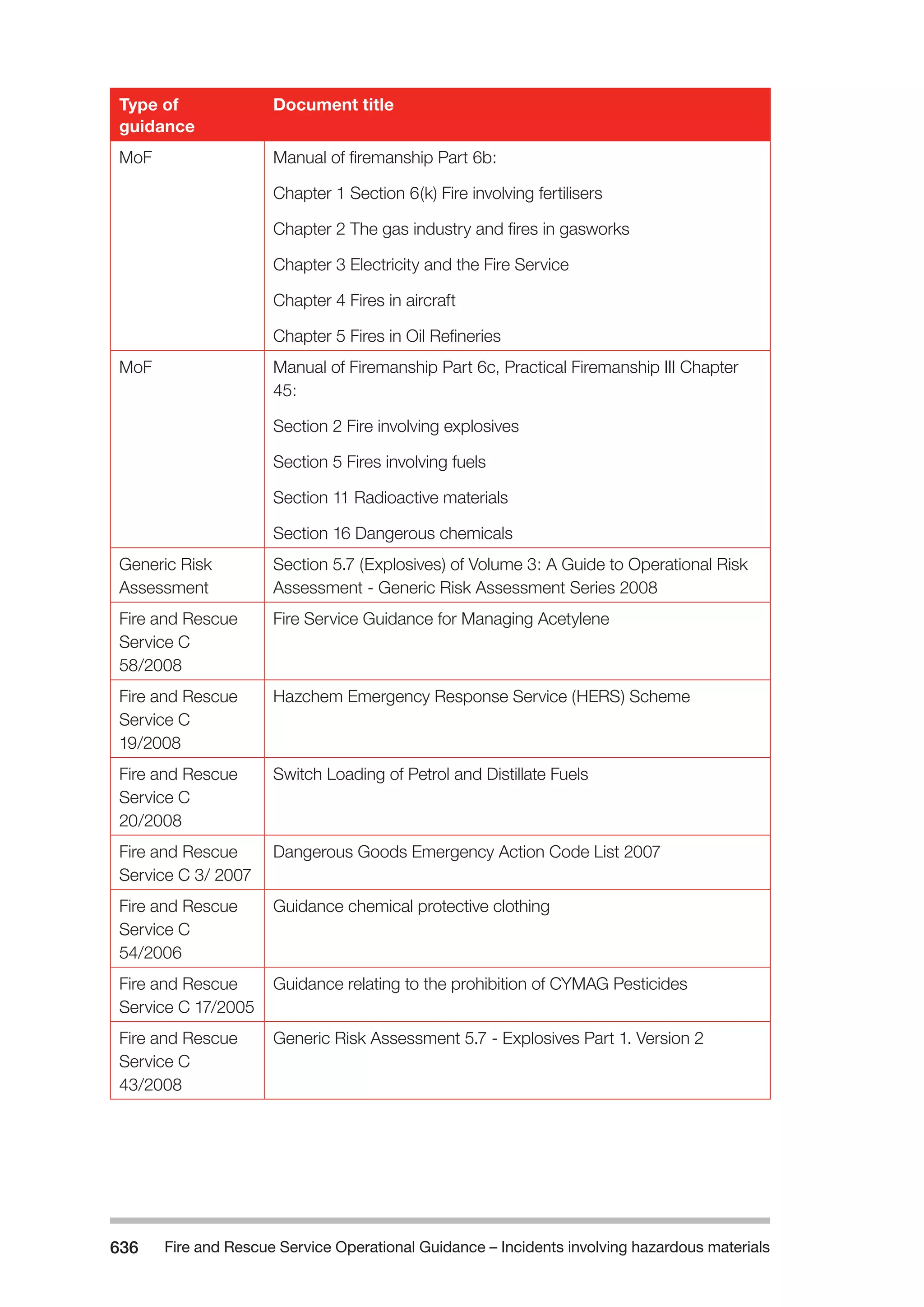
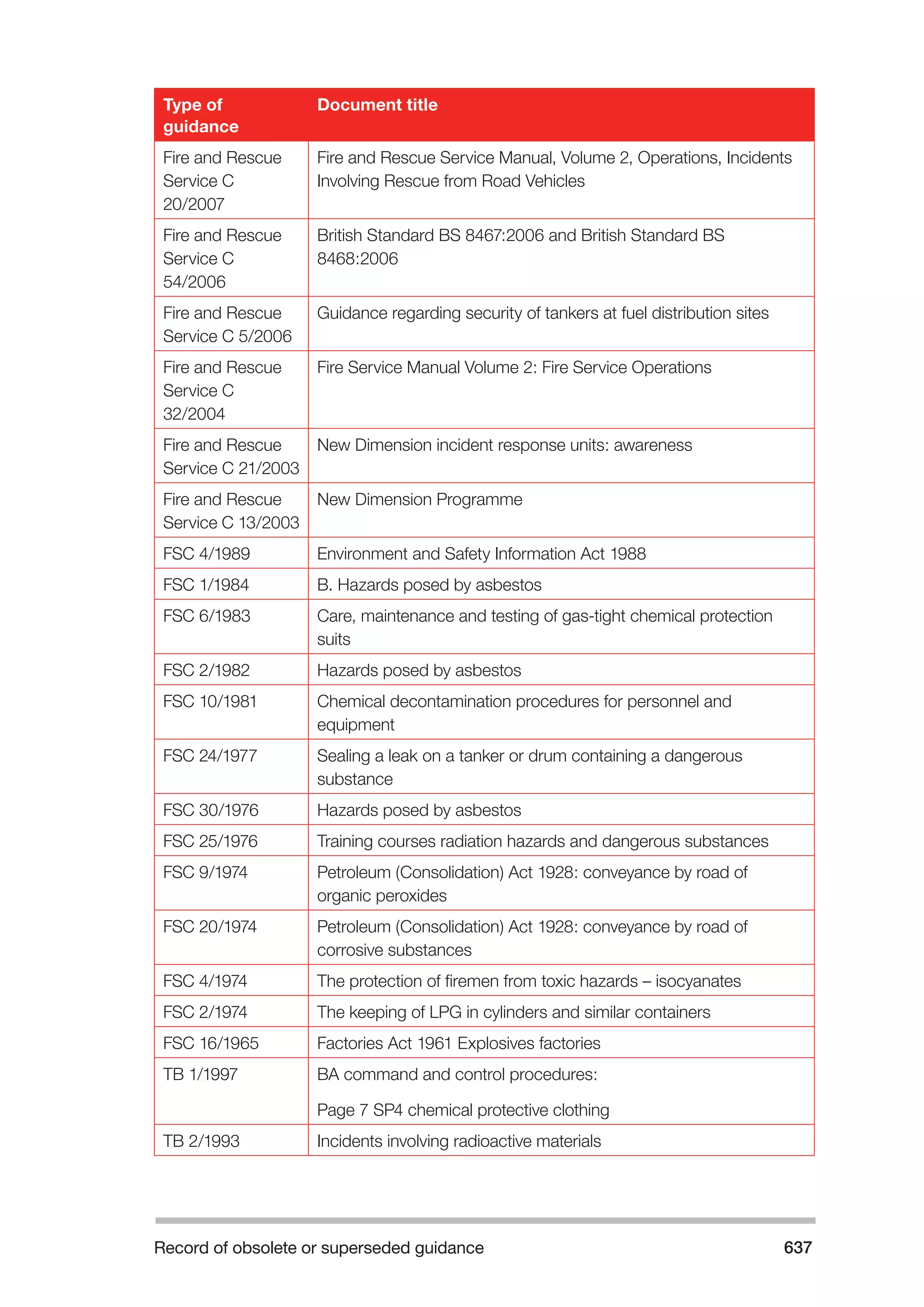
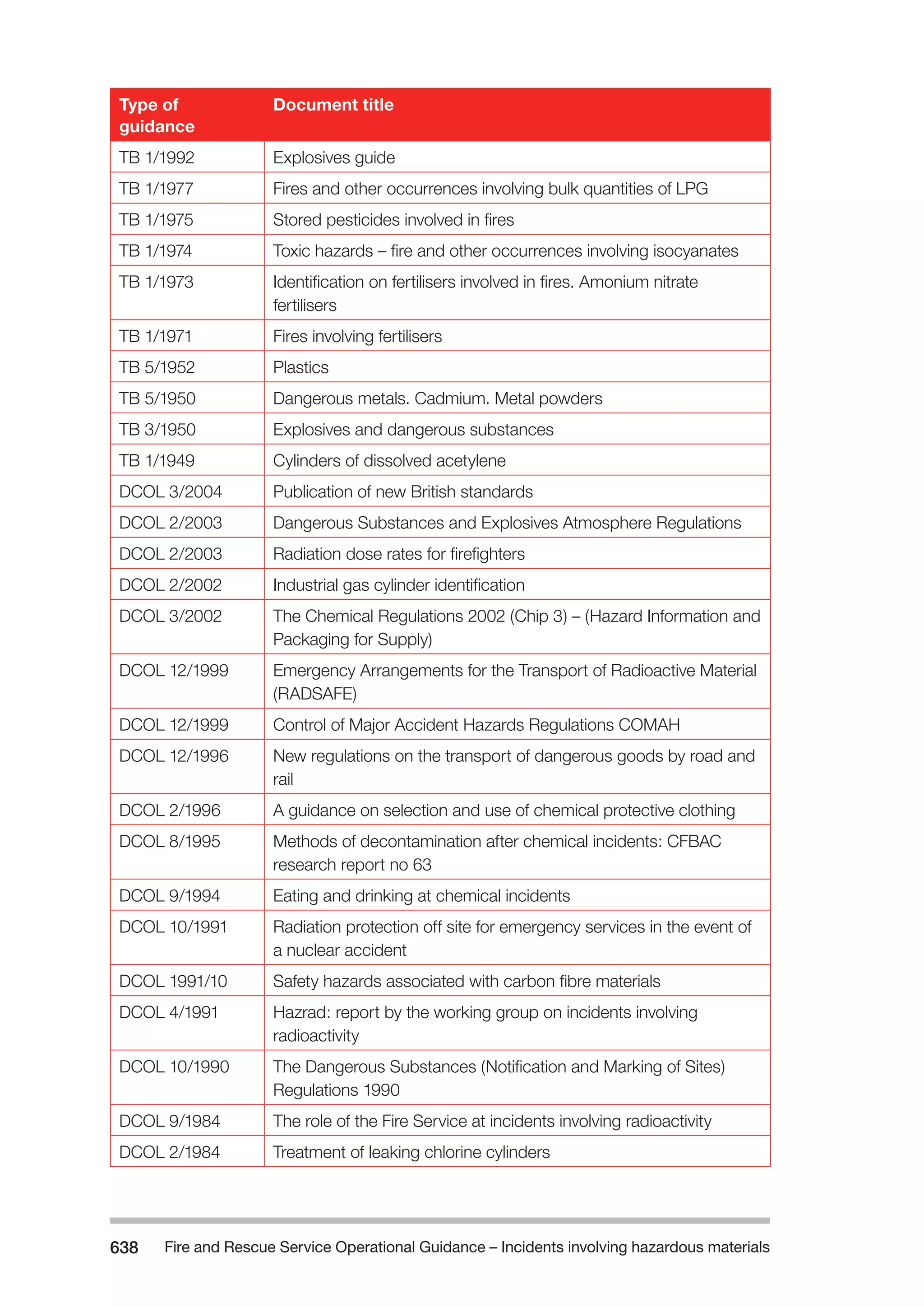
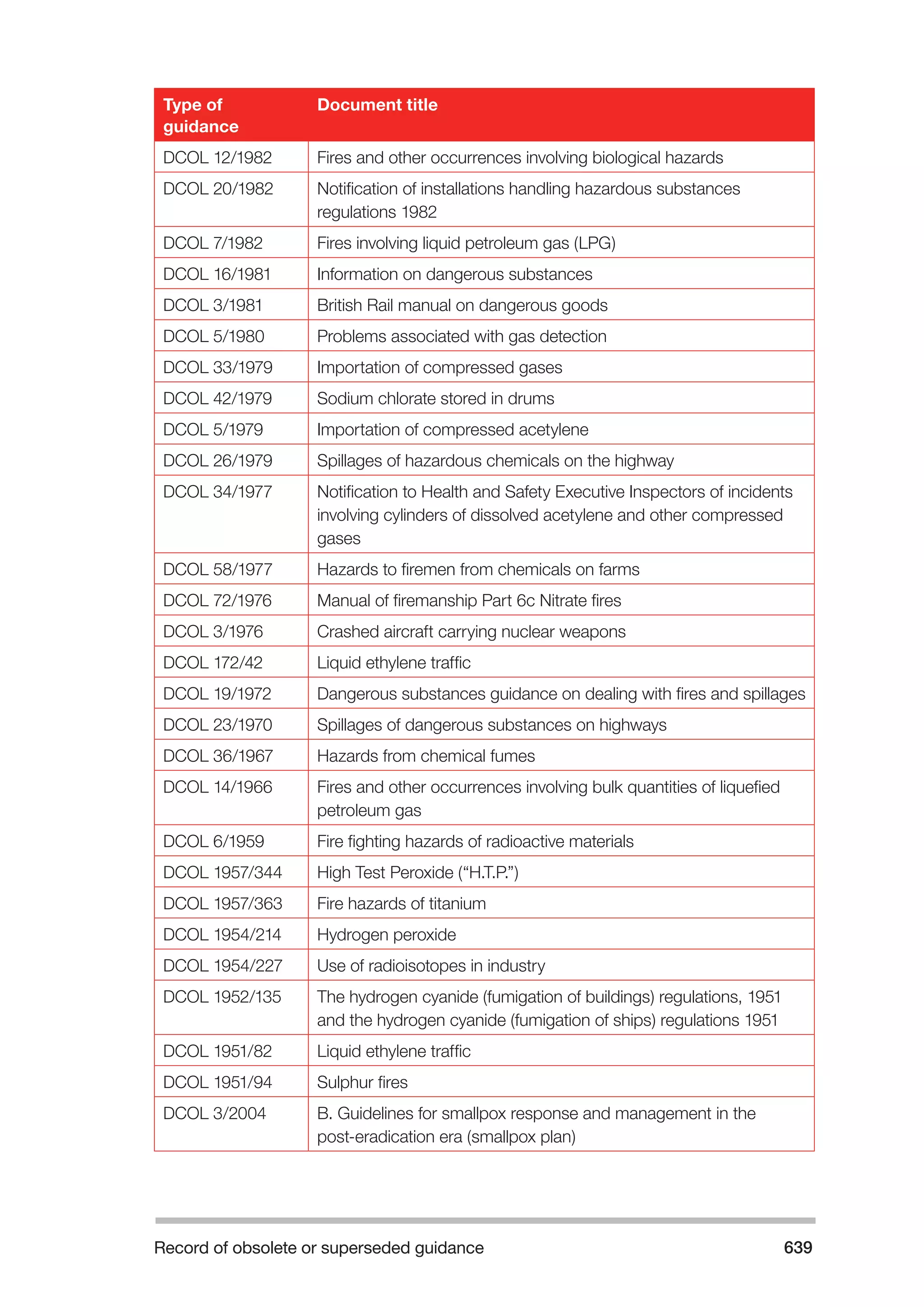
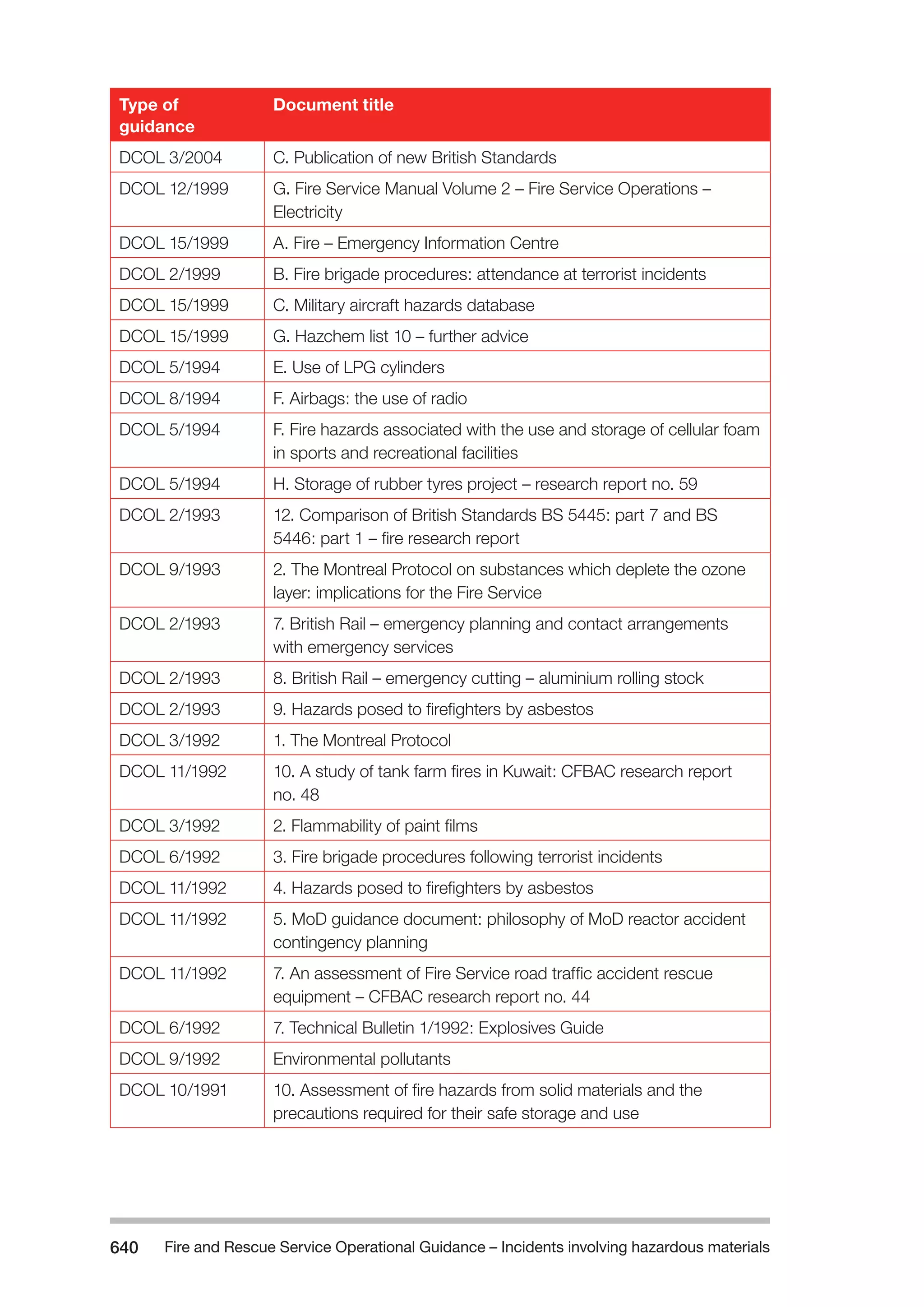
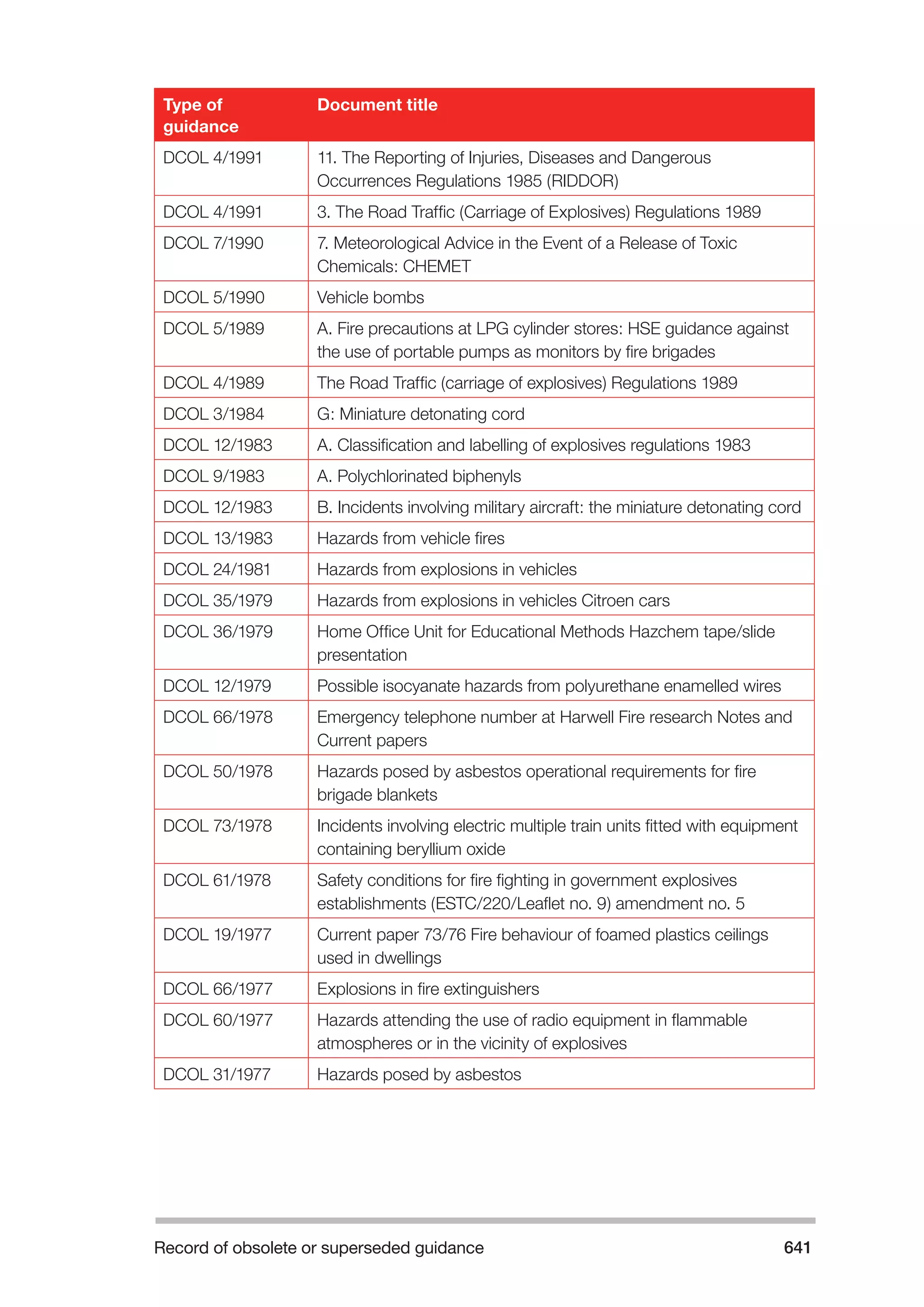
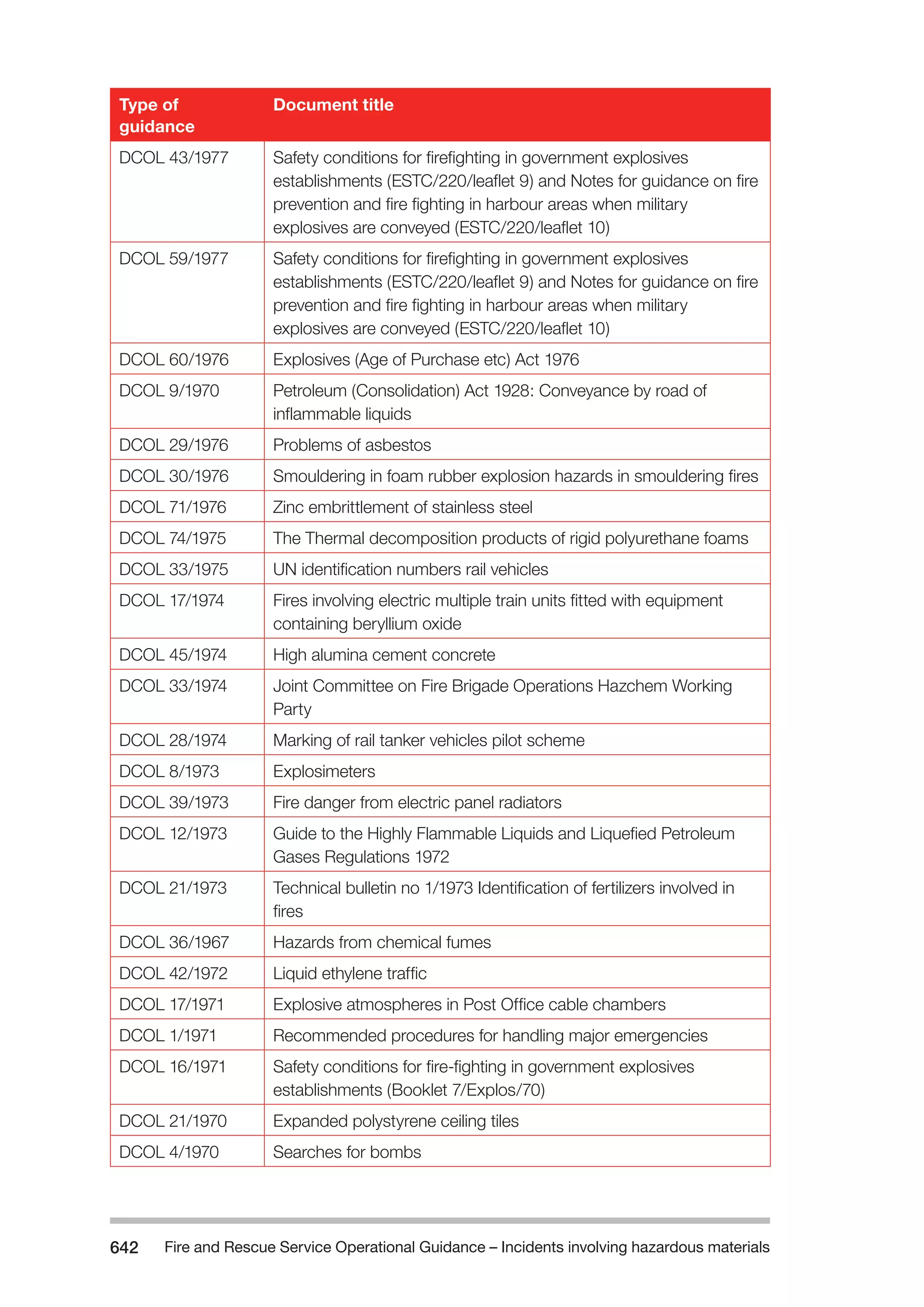
12 Record of obsolete or superseded guidance 633
Foreword 5 
SECTION 1 
Foreword 
Major incidents involving hazardous materials in the United Kingdom are rare. Such 
incidents place significant demands on local fire and rescue services and often require 
resources and support from other fire and rescue services and emergency responders. 
However smaller scale incidents involving hazardous materials are more prevalent and 
these may require a response from any fire and rescue service in England. 
The Fire and Rescue Service Operational Guidance – Incidents involving hazardous 
materials provides robust yet flexible guidance that can be adapted to the nature, scale 
and requirements of the incident. 
The Chief Fire and Rescue Adviser is grateful for the assistance in the development in this 
guidance from a wide range of sources, including the fire and rescue service and a range 
of experts from a wide range of industries and other organisations. 
It is anticipated that this guidance will promote common principles, practices and 
procedures that will support the fire and rescue service to resolve incidents involving 
hazardous materials safely and efficiently.
Fire and Rescue Service Operational Guidance – Incidents 6 involving hazardous materials 
SECTION 2 
Preface 
The objective of the Fire and Rescue Service Operational Guidance – Incidents involving 
hazardous materials is to provide a consistency of approach that forms the basis for 
common operational practices, supporting interoperability between fire and rescue 
services, other emergency responders, industry experts and other relevant groups. These 
common principles, practices and procedures are intended to support the development of 
safe systems of work on the incident ground and to enhance national resilience. 
Operational Guidance issued by the Department of Communities and Local Government 
promotes and develops good practice within the Fire and Rescue Service and is offered as 
a current industry standard. It is envisaged that this will help establish high standards of 
efficiency and safety in the interests of employers, employees and the general public. 
The Guidance, which is compiled using the best sources of information known at the date 
of issue, is intended for use by competent persons. The application of the guidance does 
not remove the need for appropriate technical and managerial judgement in practical 
situations with due regard to local circumstances, nor does it confer any immunity or 
exemption from relevant legal requirements, including by-laws.Those investigating 
compliance with the law may refer to this guidance as illustrating an industry standard. 
It is a matter for each individual fire and rescue service whether to adopt and follow this 
Operational Guidance. The onus of responsibility for application of guidance lies with the 
user. Department of Communities and Local Government accept no legal liability or 
responsibility whatsoever, howsoever arising, for the consequences of the use or misuse of 
the guidance.
Introduction 7 
Introduction 
SECTION 3
Introduction 
9 
Purpose 
3.1 
This operational guidance is set out in the form of a procedural and technical framework. Fire and Rescue Services should consider it when developing or reviewing their policy and procedures to safely and efficiently resolve emergency incidents involving hazardous materials, including CBRN(E) materials.1 
3.2 
In everyday language the term hazardous materials, also referred to as dangerous/hazardous substances or goods, means solids, liquids, or gases that can harm people, other living organisms, property, or the environment. They not only include materials that are toxic, radioactive, flammable, explosive, corrosive, oxidizers, asphyxiates, biohazards, pathogen or allergen substances and organisms, but also materials with physical conditions or other characteristics that render them hazardous in specific circumstances, such as compressed gases and liquids, or hot/cold materials. 
3.3 
Non-Fire and Rescue Service organisations and agencies may use more technical and specific definitions because of their own requirements but the above definition is the most appropriate one for Fire and Rescue Services to base their risk assessments and planning assumptions on. 
3.4 
A Fire and Rescue Service may respond to a wide range of incidents involving hazardous materials that have the potential to cause harm to firefighters, the community and the environment. They may be called to deal specifically with emergency spillages or releases, or they may encounter hazardous materials at fires and other emergency incidents. The purpose of this guidance is to assist emergency responders to make safe, risk assessed, efficient and proportionate responses whenever hazardous materials are encountered in the operational arena. 
Scope 
3.5 
The scope of this guidance is wide ranging due to the extensive nature of hazardous materials incidents encountered by the Fire and Rescue Service. It is applicable to any event, regardless of scale, from small incidents, such as the careless use of domestic cleaning products, to large scale chemical spillages on the highway and industrial accidents. 
3.6 
It is focused on the tactical and technical aspects of hazardous materials incidents to assist Fire and Rescue Services with: 
• 
the development and implementation of safe systems of work 
• 
inter-operability at large or cross-border incidents where more than one Fire and Rescue Service is in attendance. 
1 CBRN(E) materials terrorism entails the assumption or knowledge, based on intelligence or actual evidence, of actual or threatened dispersal of chemical, biological, radiological or nuclear material (either on their own or in combination with each other or with explosives), with deliberate criminal, malicious or murderous intent, targeted at a given population or economic/symbolic points.
Fire and Rescue Service Operational Guidance – Incidents 10 involving hazardous materials 
3.7 The guidance covers the time period from the receipt of the emergency call to the 
closure of the incident by the Fire and Rescue Service Incident Commander. 
‘Closure’ in terms of Fire and Rescue Service involvement may mean the handing 
over of responsibility to another agency or ‘responsible person’. 
3.8 In addition to detailed tactical and technical information, this guidance also outlines 
the key operational and strategic roles, responsibilities and considerations that 
need to be taken into account to enable the Fire and Rescue Service to plan, train, 
test and respond effectively to any hazardous materials incident or event. 
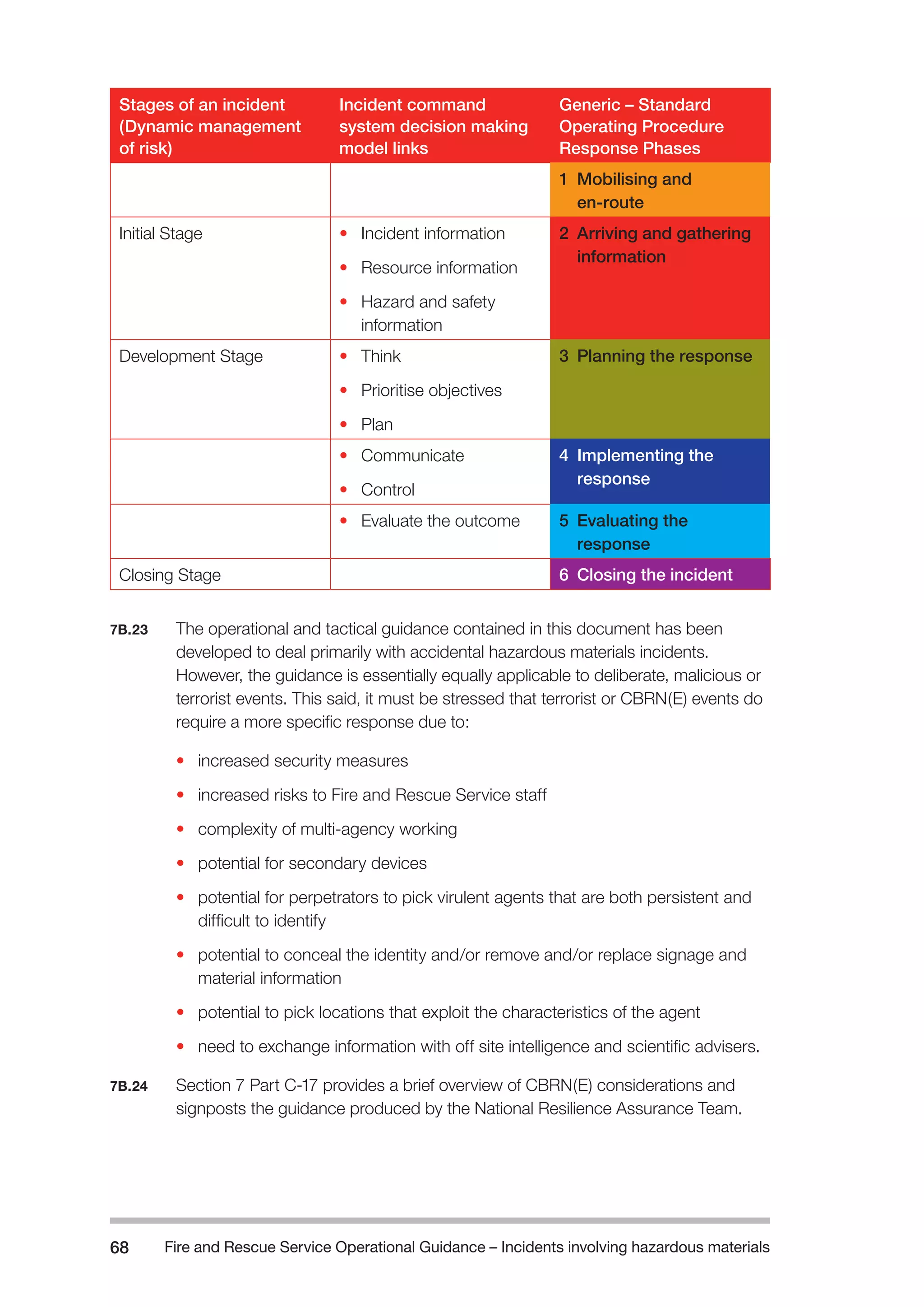
3.9 This operational guidance has been developed to deal primarily with accidental 
hazardous materials incidents. However, the operational principles are essentially 
equally applicable to deliberate, malicious or terrorist events although it is 
acknowledged that incidents involving chemical,biological,radiological, nuclear and 
explosive (CBRN(E)) materials events will require a more specific response due to: 
• increased security measures 
• increased risks to Fire and Rescue Service staff 
• complexity of multi-agency working 
• potential for secondary devices 
• potential for perpetrators to pick virulent agents that are both persistent and 
difficult to identify 
• potential to conceal the identity and/or remove and/or replace signage and 
material information 
• potential to pick locations that exploit the characteristics of the agent 
• need to exchange information with off-site intelligence and scientific advisers. 
Structure 
3.10 This operational guidance is based on nationally accepted good practice. It is 
written as an enabling guide based around risk-critical operational principles 
rather than a strict set of rules and procedures. This is done to recognise local 
differences across the United Kingdom in terms of risk profiles and levels of 
resources. 
3.11 Section 7 contains the bulk of the guidance and it is divided into three parts: 
Part A – Pre-planning considerations 
Part B – Operational considerations – Generic standard operating procedure 
Part C – Technical considerations
Part A: Pre-planning considerations 
Provides guidance and information to assist Fire and Rescue Services in the 
preparation of emergency response plans for hazardous materials incidents 
and risks. 
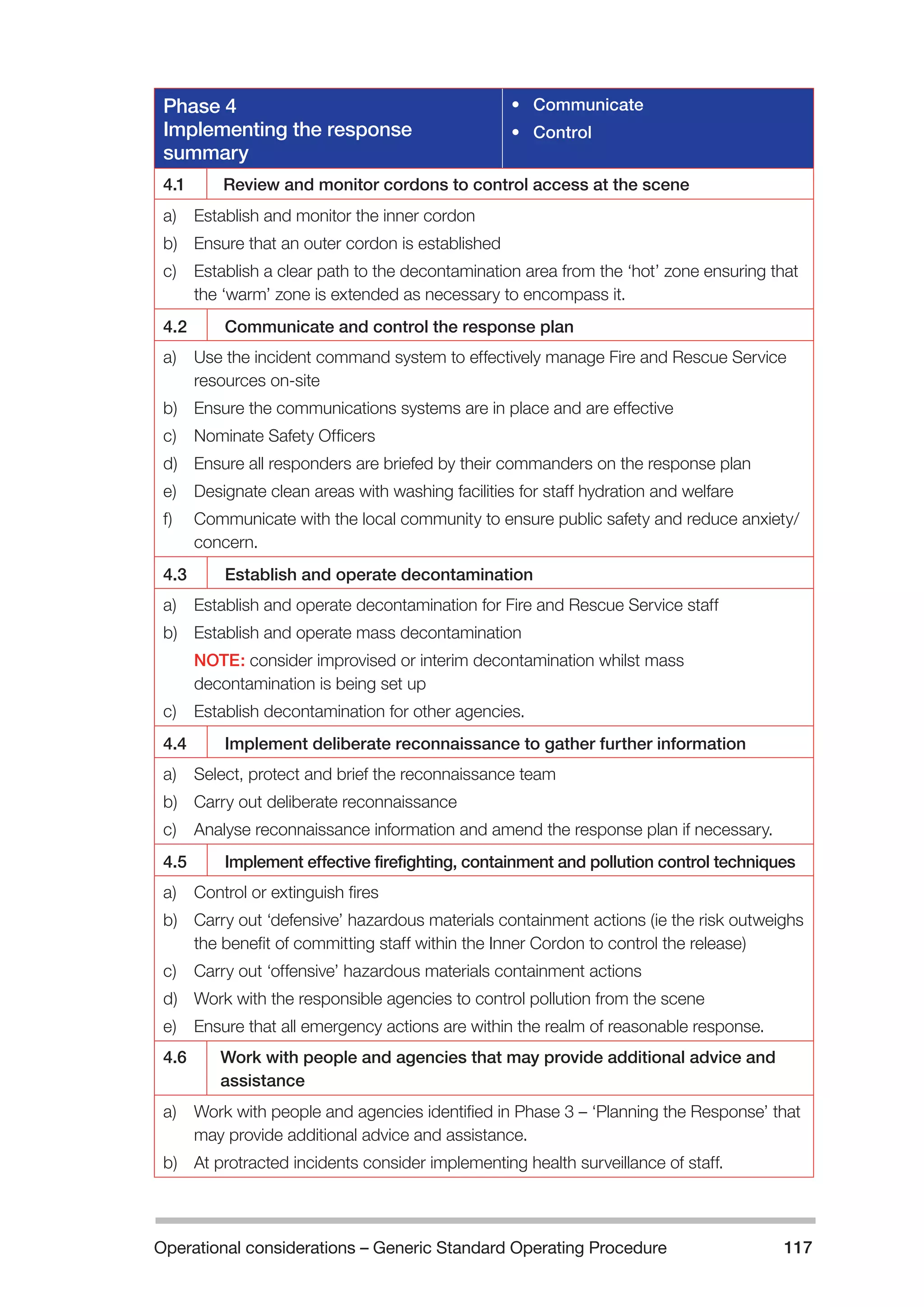
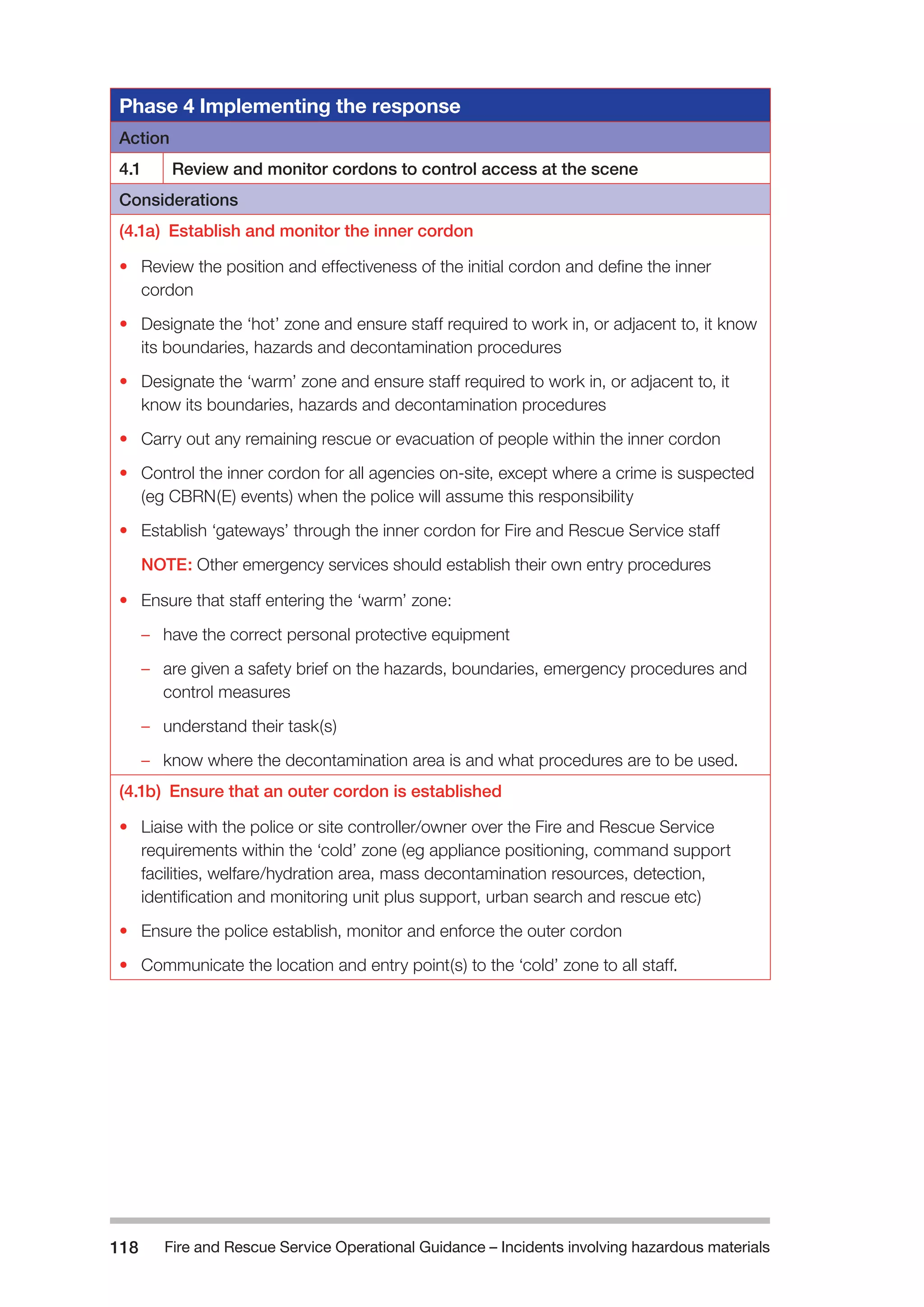
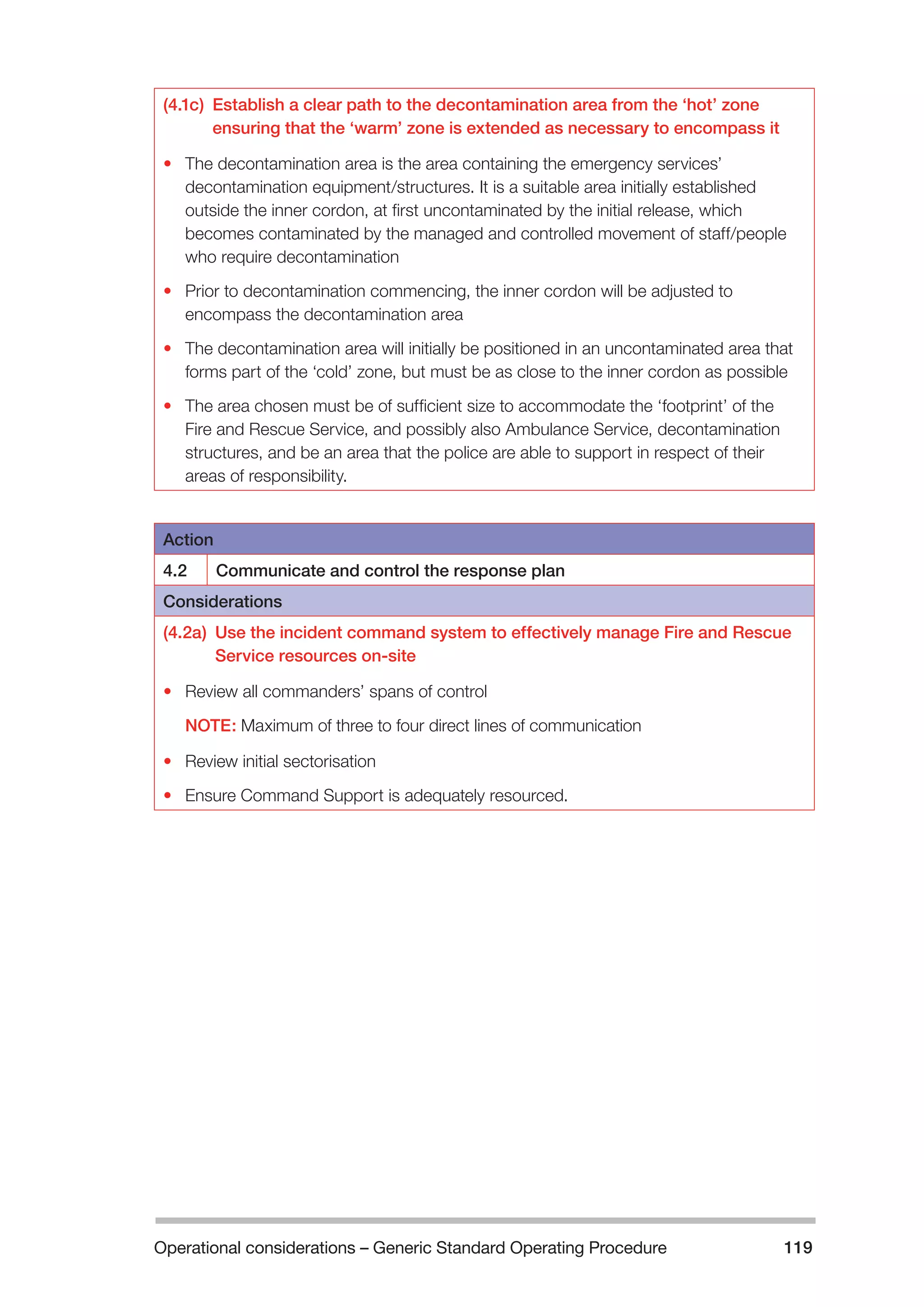
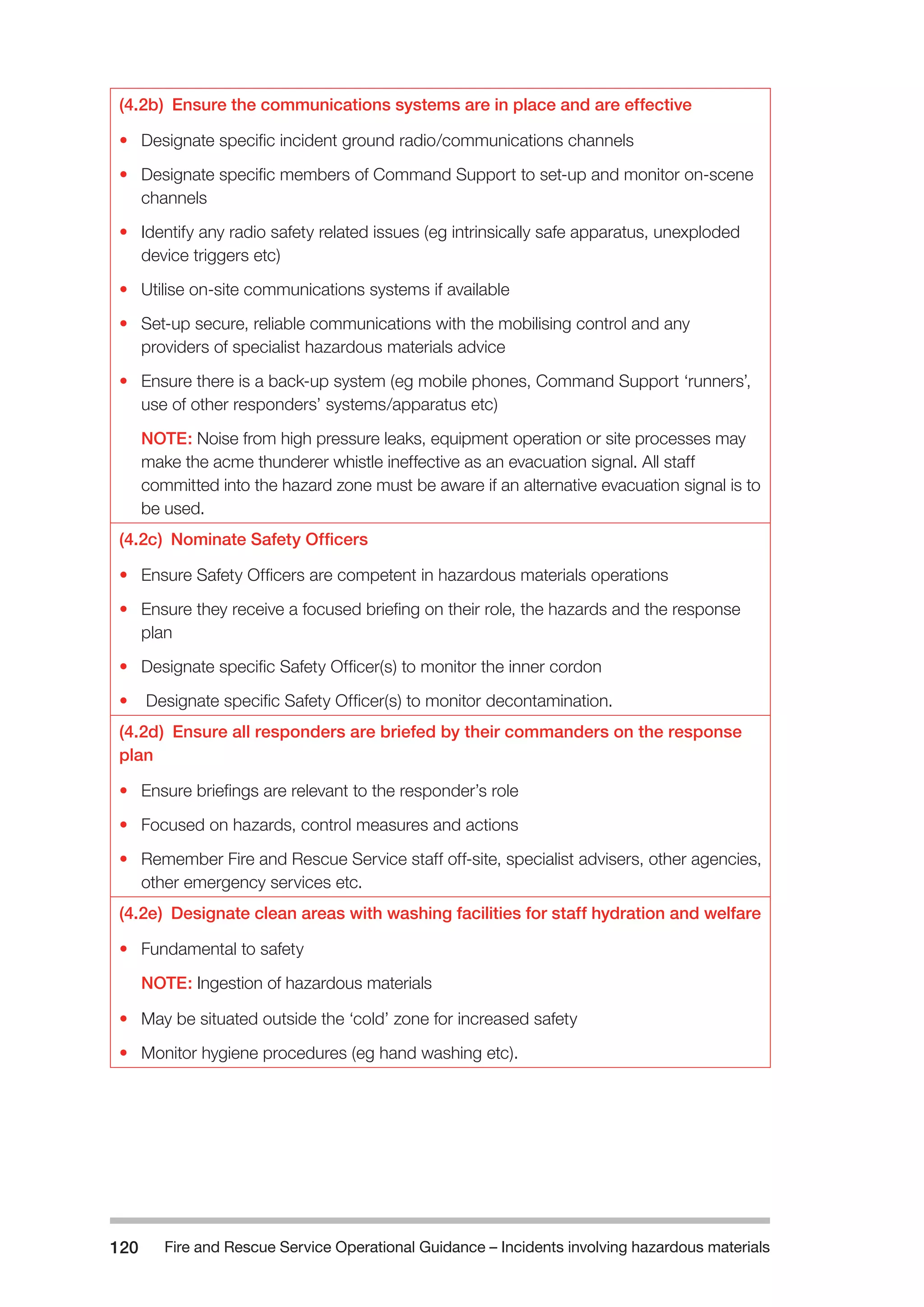
Part B: Operational considerations – GSOP 
Provides guidance to Fire and Rescue Service staff on responding to and 
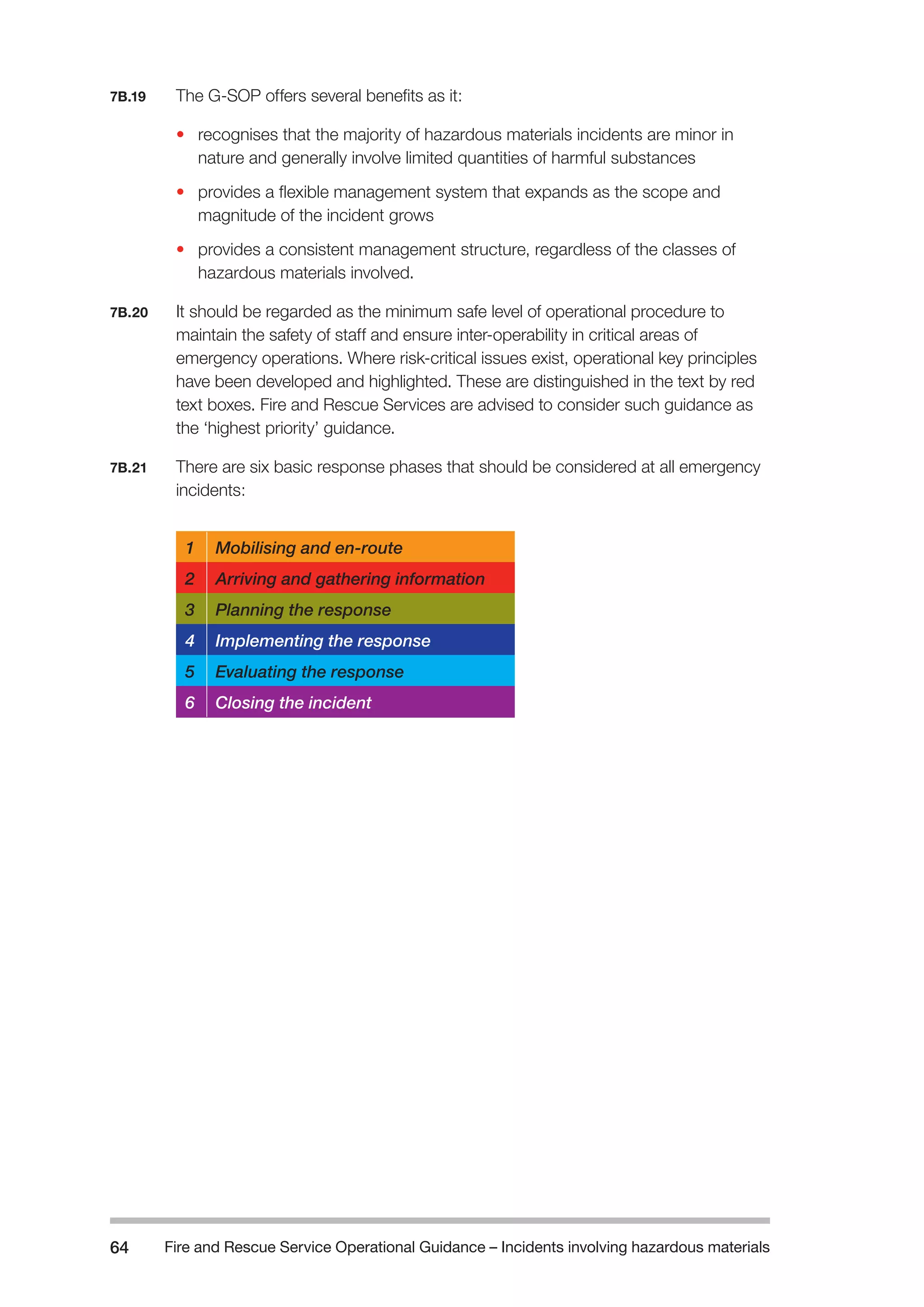
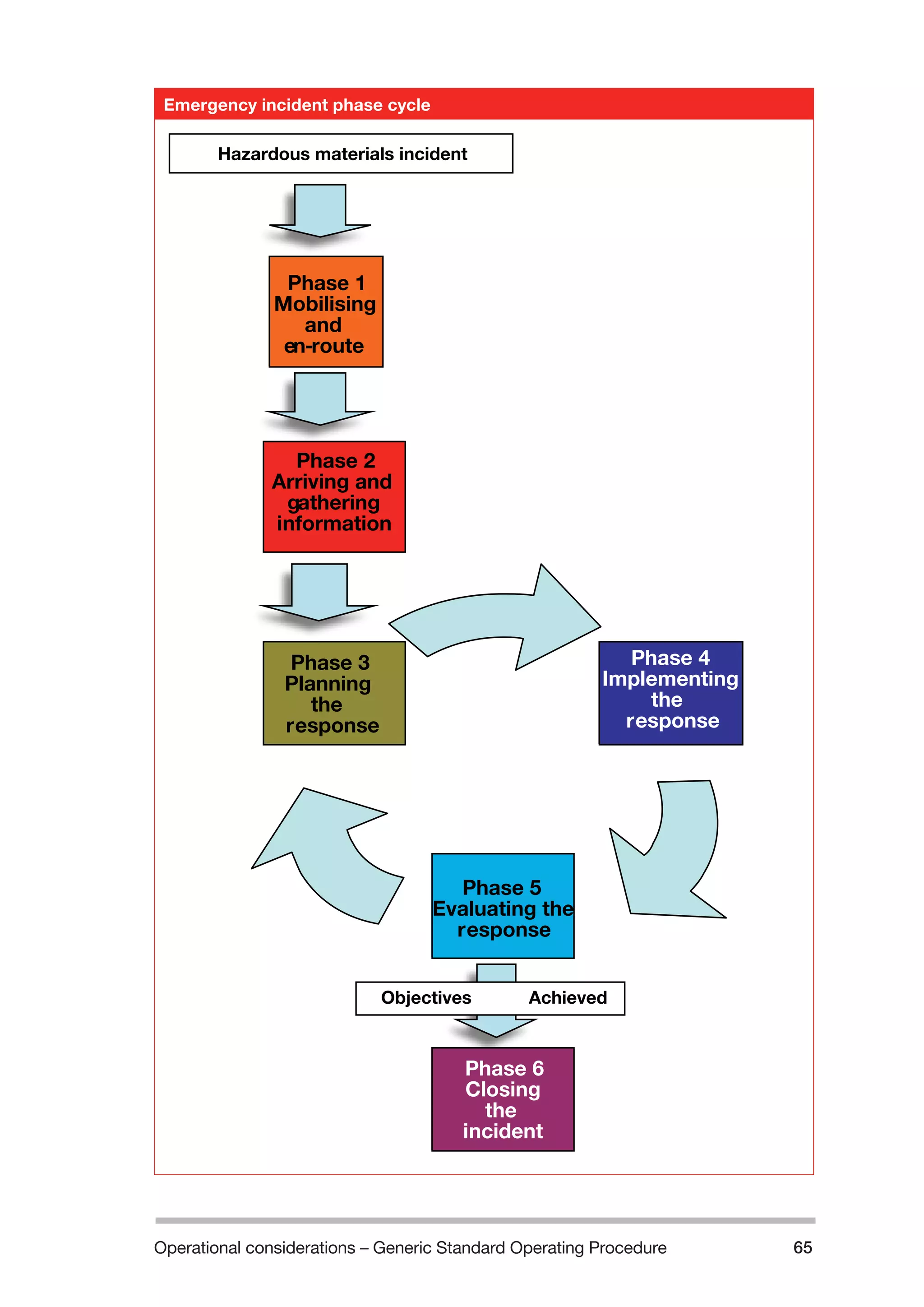
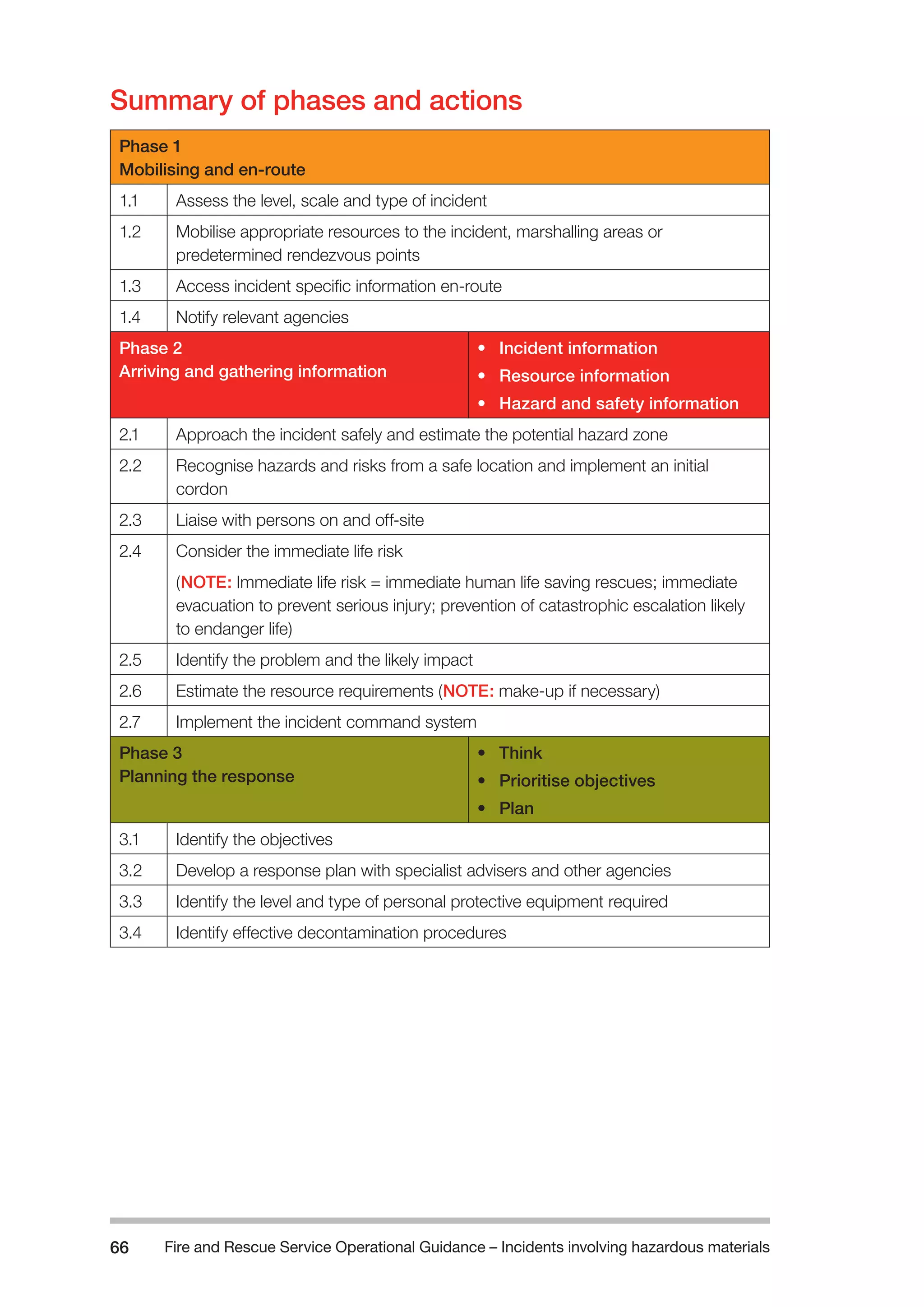
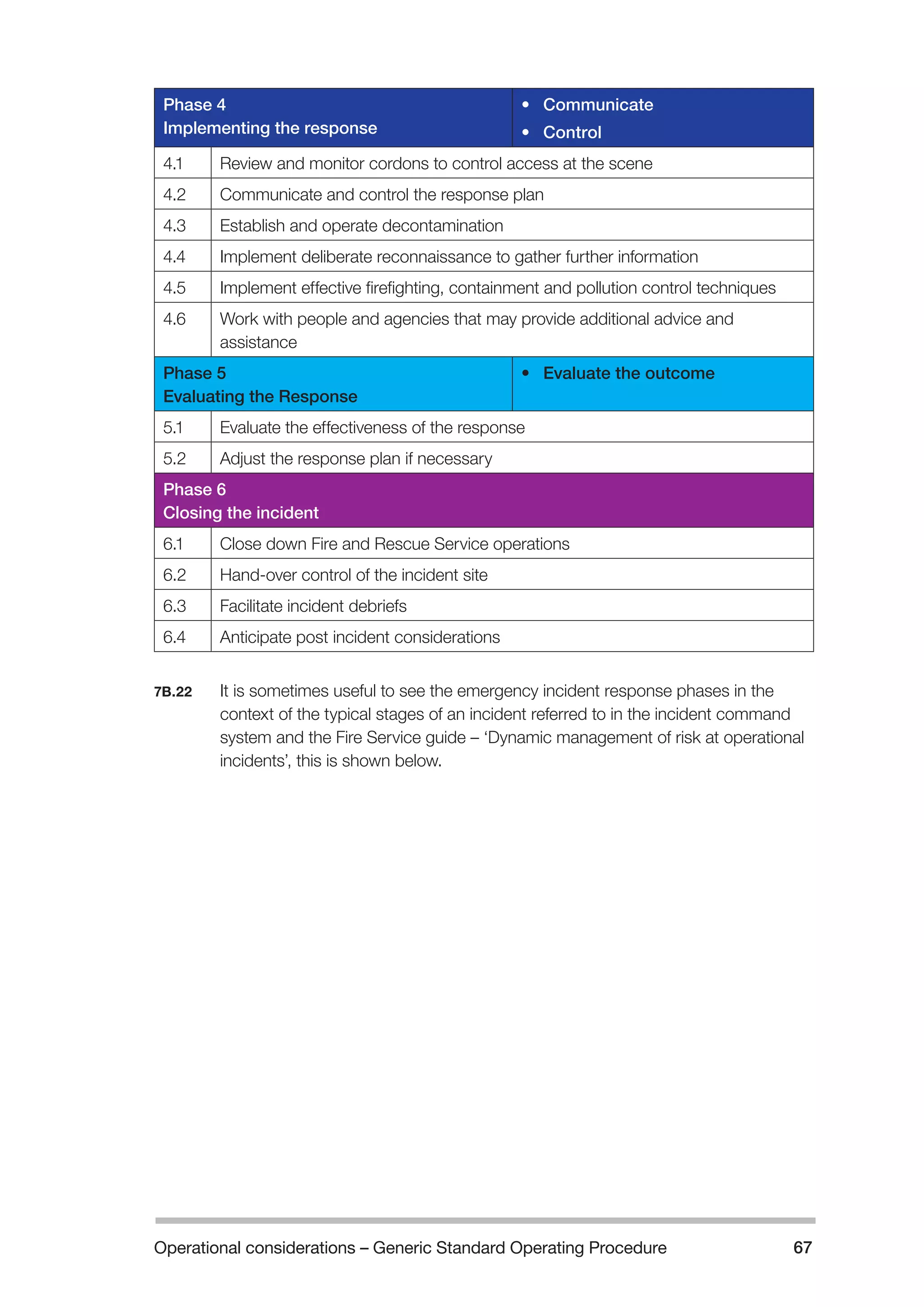
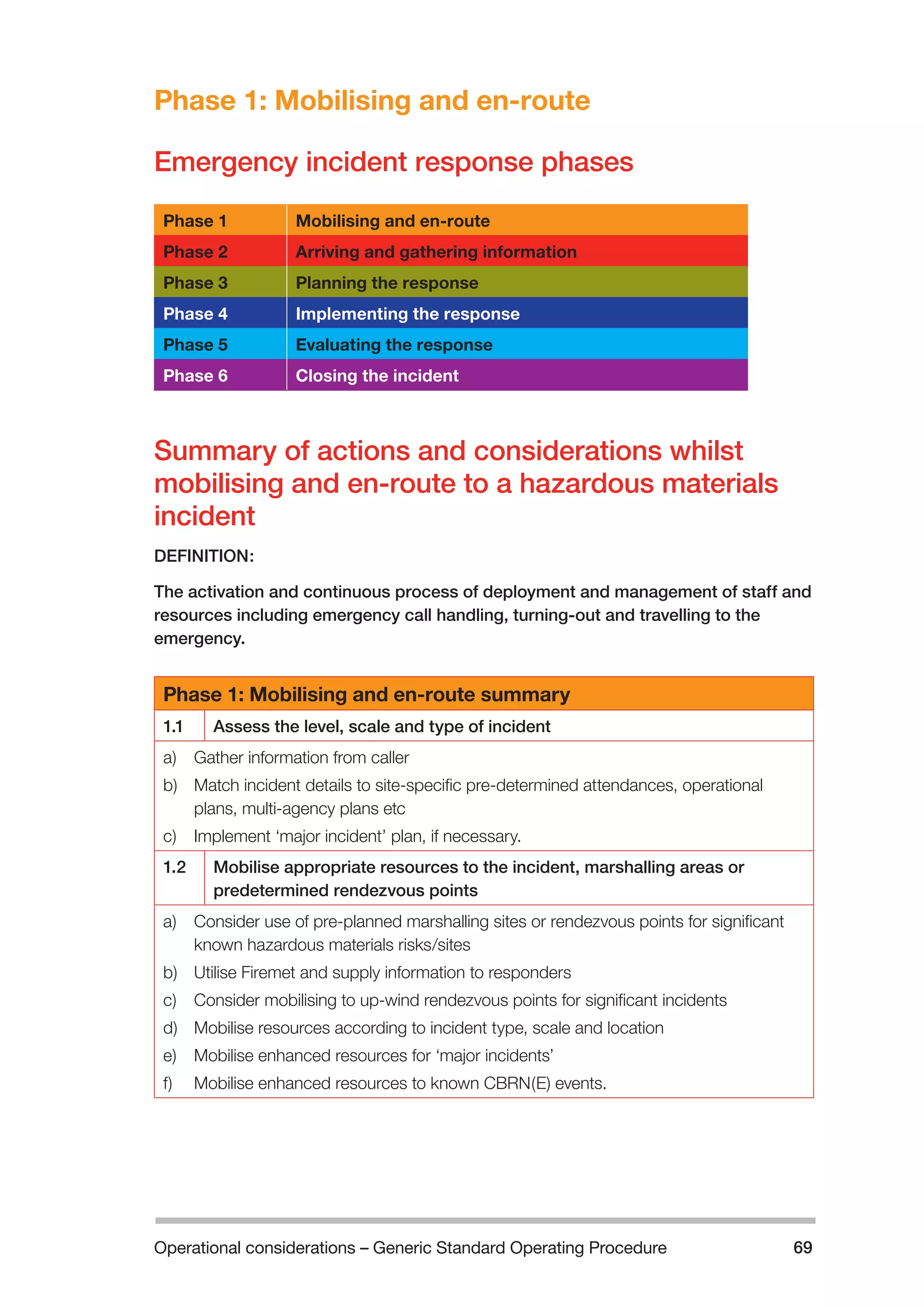
resolving typical hazardous materials incidents. It is structured around six 
emergency response phases common to all operational incidents. 
The procedure detailed in this part of the guidance uses the Incident 
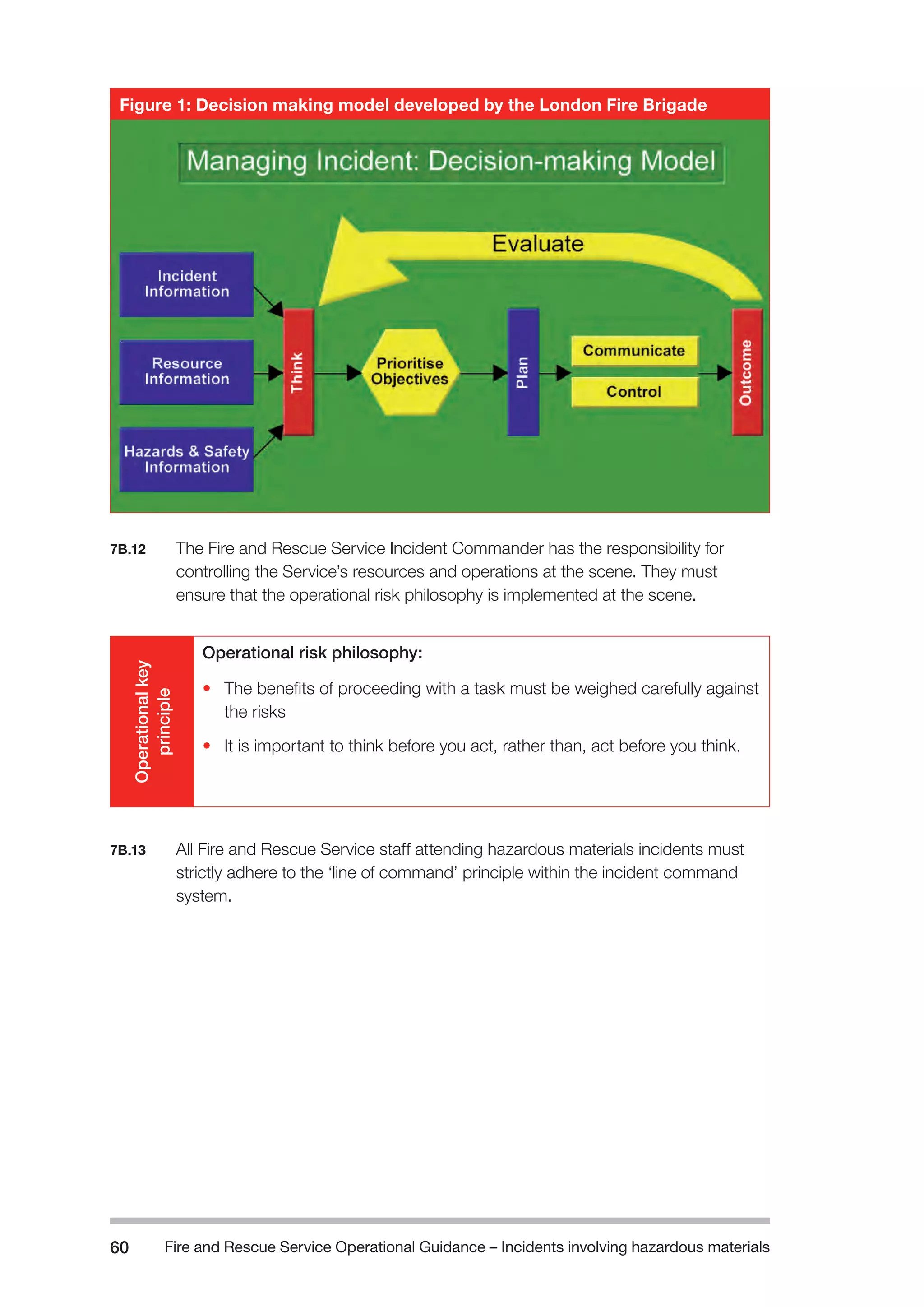
Command System decision making model as its foundation. It is a Generic – 
Standard Operating Procedure for dealing with hazardous materials incidents 
that Fire and Rescue Services can adopt or adapt depending on their 
individual risk assessments and resources. 
Each section of the Generic Standard Operating Procedure details extensive 
lists divided into: 
• Possible actions 
• Further considerations. 
It should be stressed that these are not mandatory procedures. They are a 
‘tool box’ of suggestions or ‘enabling guide’ appropriate to emergency 
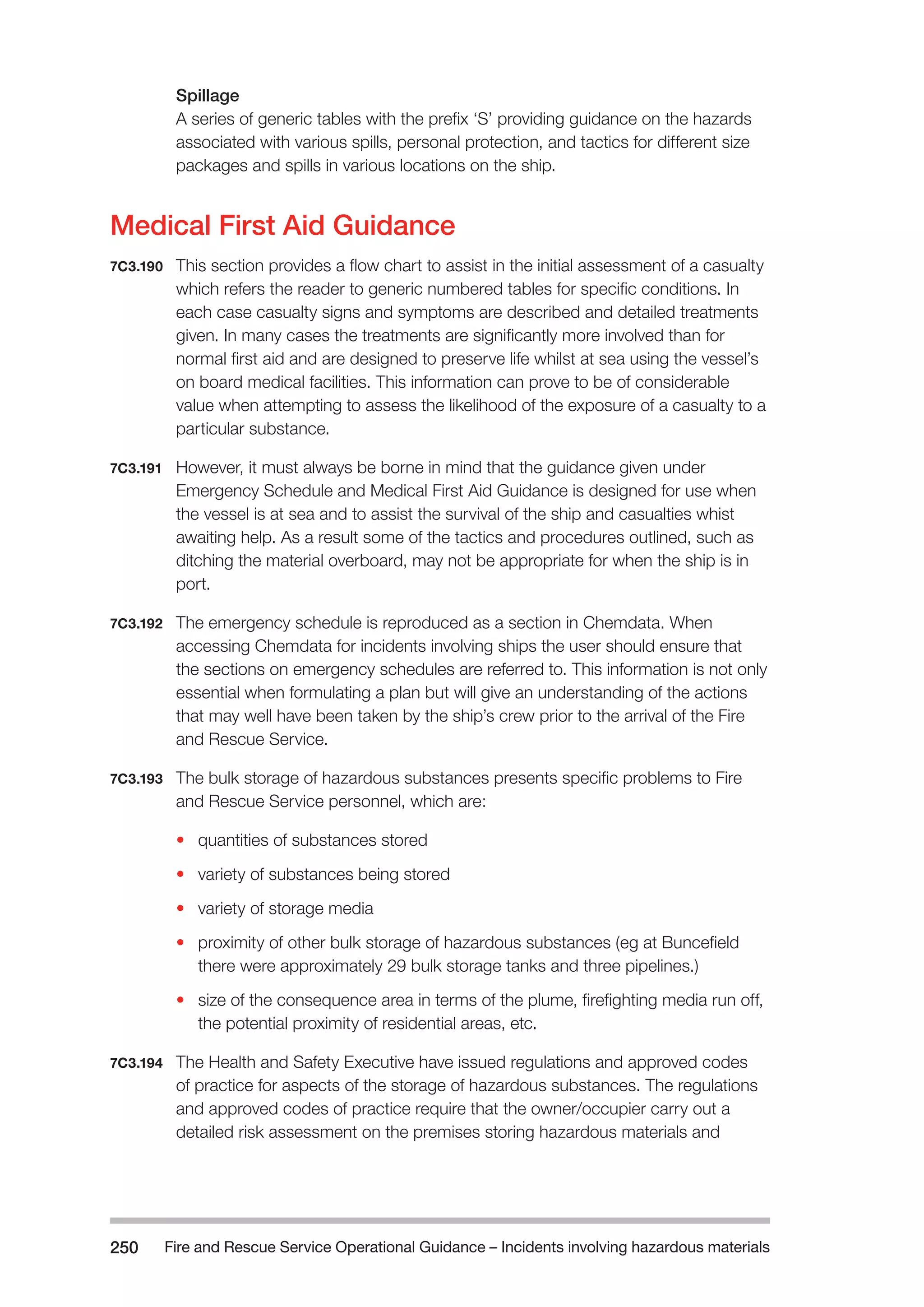
hazardous materials operations. 
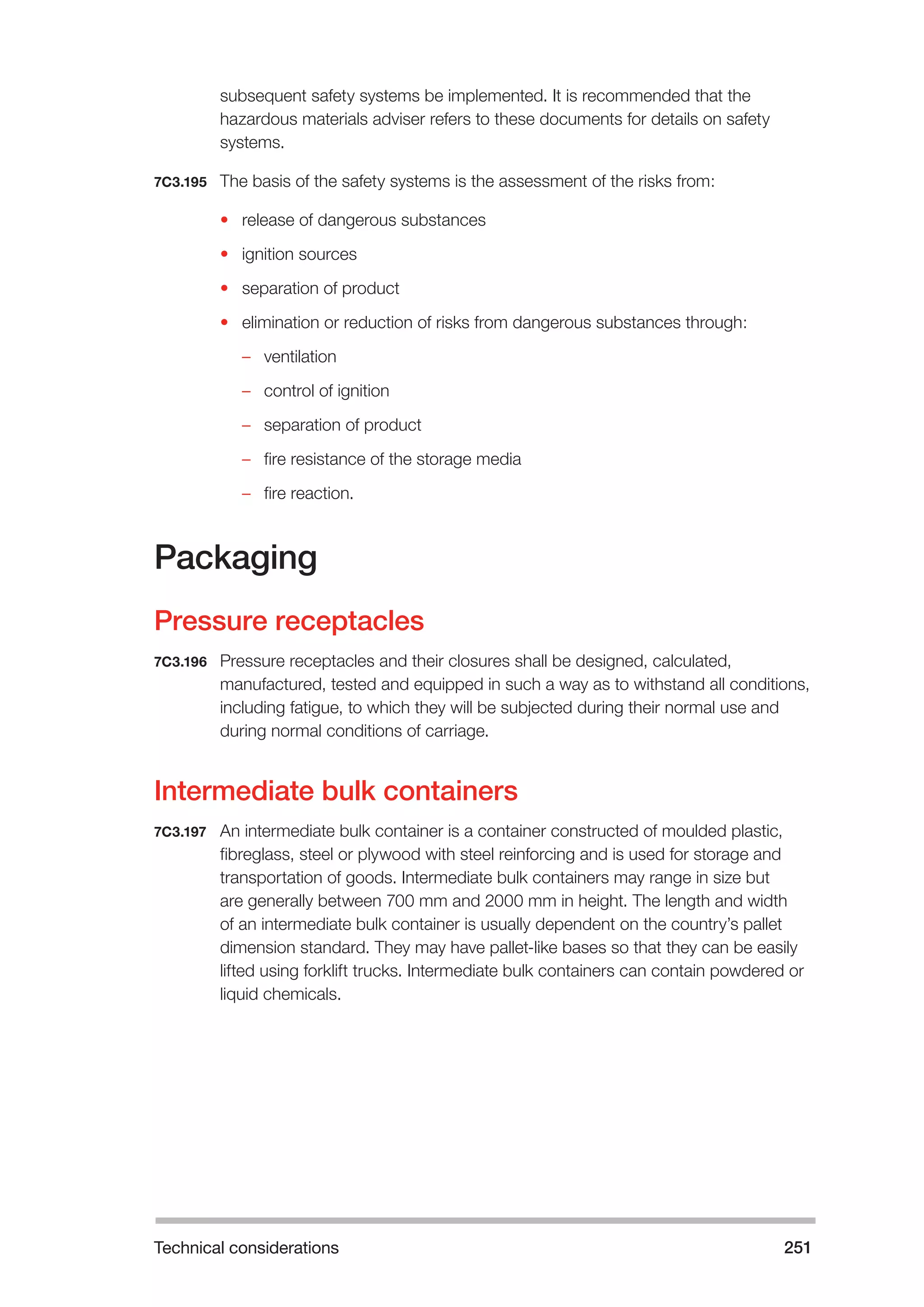
The Generic – Standard Operating Procedure reflects the hazards and control 
measures of the national generic risk assessments relevant to hazardous 
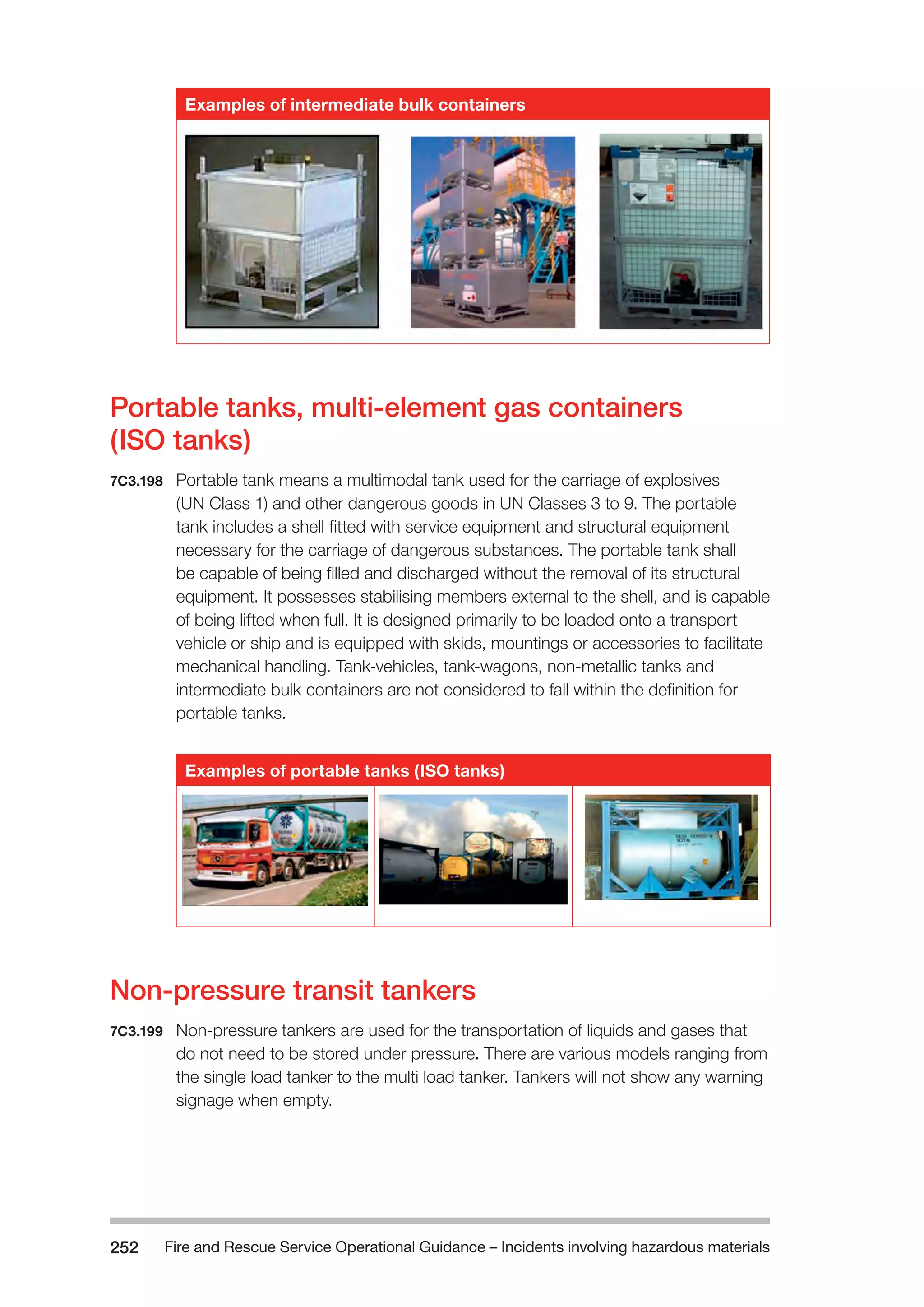
materials incidents. 
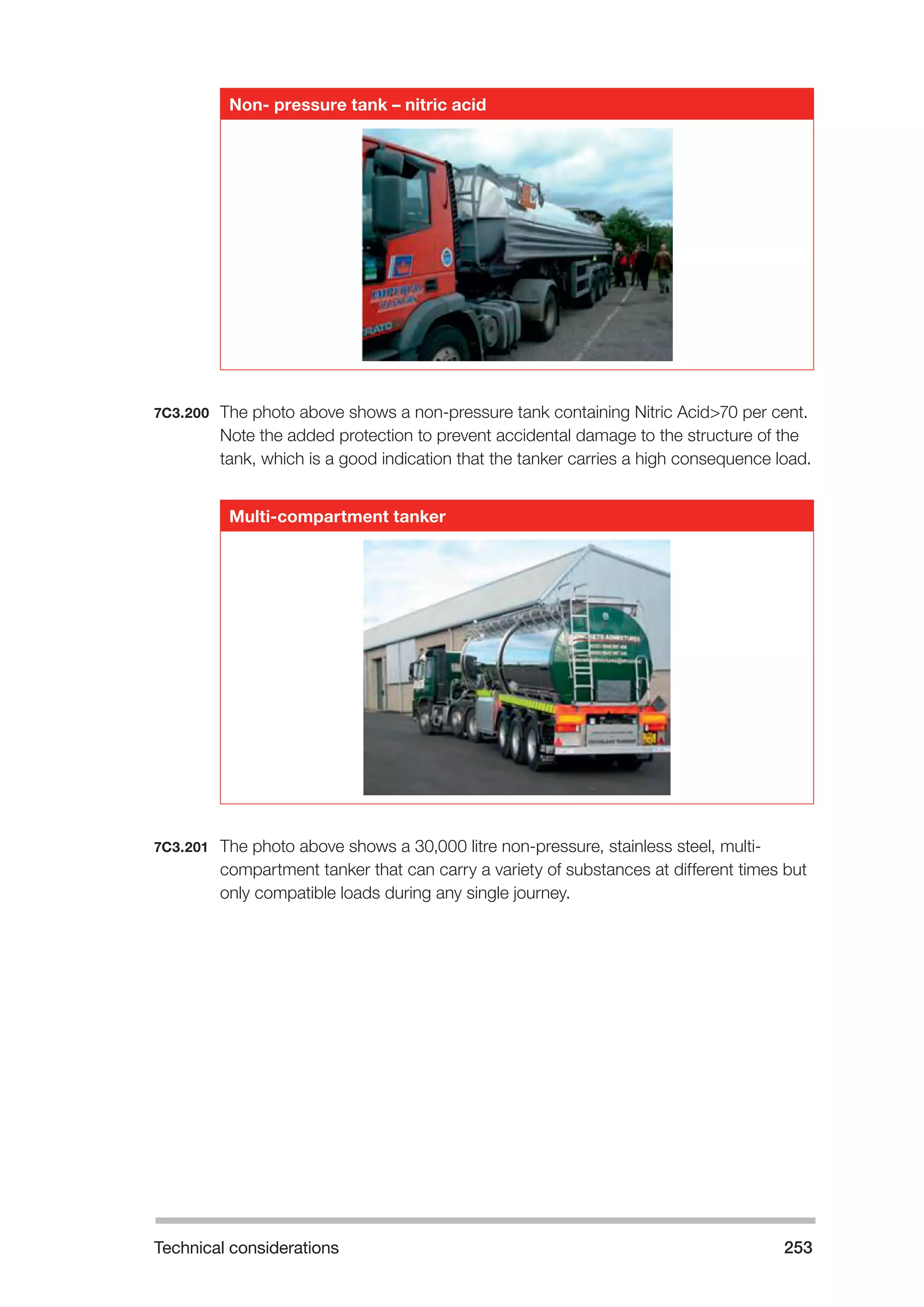
Part C – Technical considerations 
Contains technical and scientific information appropriate to the Fire and 
Rescue Service functions being performed at hazardous materials incidents. It 
summarises risk-critical operational guidance and information required by 
firefighters, commanders and hazardous materials advisers. It also references 
more detailed guidance that may be of interest to Fire and Rescue Services. 
This part only contains technical information with operational 
implications and is not intended to be a source of scientific theory. 
Introduction 11
Legal frameworkLegal framework 13 
Legal framework 
SECTION 4
Legal framework 15 
Introduction 
4.1 This section does not contain detailed legal advice about legislation. It is simply a 
summary of the most relevant legislation to Fire and Rescue Authorities when 
considering hazardous materials incidents. 
4.2 When considering this legal framework it is essential to recognise that any definitive 
interpretation of the legal roles and responsibilities imposed by legislation can only 
be given by a court of law. 
4.3 For a full understanding of the responsibilities imposed by the legislation, and by the 
Fire and Rescue Service National Framework, reference should be made to the 
relevant legislation or the current National Framework. The range of legislation and 
guidance that could impact on the operational responsibilities of the Fire and 
Rescue Authority is extensive and each Authority should seek guidance from their 
own legal advisors. 
Primary Fire and Rescue Service legislation 
Fire and Rescue Services Act 2004 
4.4 Section 7 Fires – places a statutory duty for a Fire and Rescue Authority to plan 
and provide arrangements for fighting fires and protecting life and property from 
fires within its area. A Fire and Rescue Authority is required to secure the 
provision of sufficient personnel, services and equipment to deal with all normal 
circumstances, as well as adequate training. A Fire and Rescue Authority must 
also put in place effective arrangements for receiving and responding to calls for 
help and for obtaining information which it needs to carry out its functions (s7(2) 
(d)); the latter might include, for example, information about the nature and 
characteristics of buildings within the authority’s area or availability of and access 
to water supplies. 
4.5 Section 8 Road Traffic Accidents – places a duty on Fire and Rescue 
Authorities to make provision for rescuing persons from road traffic accidents and 
for dealing with the aftermath of such accidents. Historically, the risk of fire was 
the trigger for attendance at such an incident. While advances in vehicle design 
have seen the incidence of fire following an accident decrease, calls to assist with 
the rescue of people from wreckage and protect them from harm from spillage of 
hazardous substances have increased dramatically. A Fire and Rescue Authority 
is required, therefore, to secure sufficient resources and training to deal with all 
normal circumstances. A Fire and Rescue Authority must also put in place 
effective arrangements for receiving and responding to calls for help and for 
obtaining information to exercise its functions (for example, knowledge of local 
road and trunk road network). 
4.6 The Secretary of State can also, by order following consultation, direct Fire and 
Rescue Authorities as to how they should plan, equip for and respond to such 
emergencies. This may include, for example, directions as to the deployments of
Fire and Rescue Service Operational Guidance – Incidents 16 involving hazardous materials 
mass decontamination equipment for civil resilience purposes. The intention is to 
ensure consistency of approach towards emergencies, particularly in response to 
terrorist incidents. 
4.7 Section 9 also allows the order to require an authority to respond to an 
emergency that has arisen outside its own area if, for example, it has more 
appropriate equipment and training than the authority in whose area the 
emergency has occurred. 
4.8 The term “emergency” in this Act means an event or situation that causes or is 
likely to cause: 
(a) one or more individuals to die, be seriously injured or become 
seriously ill, or 
(b) serious harm to the environment (including the life and health of 
plants and animals). 
4.9 Sections 11 and 12: Power to respond to other eventualities and other services – 
replaced section 3(1)(e) of the Fire Services Act 1947, and provides Fire and 
Rescue Authorities with discretion to equip and respond to events beyond its core 
functions provided for elsewhere in the Act. A Fire and Rescue Authority is free to 
act where it believes there is a risk to life or the environment. 
4.10 Section 44 Powers of fire-fighters etc in an emergency etc 
– 44(1) An employee of a fire and rescue authority who is authorised 
in writing by the authority for the purposes of this section may do 
anything he reasonably believes to be necessary. 
(a) if he reasonably believes a fire to have broken out or to be about to 
break out, for the purpose of extinguishing or preventing the fire or 
protecting life or property; 
(b) if he reasonably believes a road traffic accident to have occurred, 
for the purpose of rescuing people or protecting them from serious 
harm; 
(c) if he reasonably believes an emergency of another kind to have 
occurred, for the purpose of discharging any function conferred on 
the fire and rescue authority in relation to the emergency; 
(d) for the purpose of preventing or limiting damage to property 
resulting from action taken as mentioned in paragraph (a), (b) or (c). 
– 44(2) In particular, an employee of a fire and rescue authority who is 
authorised as mentioned in subsection (1) may under that 
subsection: 
(a) enter premises or a place, by force if necessary, without the 
consent of the owner or occupier of the premises or place; 
(b) move or break into a vehicle without the consent of its owner;
Legal framework 17 
(c) close a highway; 
(d) stop and regulate traffic; 
(e) restrict the access of persons to premises or a place. 
– 44(3) A person commits an offence if without reasonable excuse he 
obstructs or interferes with an employee of a fire and rescue 
authority taking action authorised under this section. 
– 44(4) A person guilty of an offence under subsection (3) is liable on 
summary conviction to a fine not exceeding level 3 on the standard 
scale. 
4.11 Section 58 defines the meaning of “emergency”. It means an event or situation 
that causes or is likely to cause: 
(a) one or more individuals to die, be seriously injured or become 
seriously ill, or 
(b) serious harm to the environment (including the life and health of 
plants and animals). 
4.12 Further information can be found at: 
www.opsi.gov.uk/acts/acts2004/en/ukpgaen_20040021_en_1.htm 
The Fire and Rescue Services (Emergencies) (England) Order 2007 
4.13 The Order gives Fire and Rescue Authorities mandatory functions in connection 
with key types of emergencies: chemical, biological, radiological or nuclear 
emergences (‘CBRN emergencies’) and emergencies requiring the freeing of 
people from collapsed structures or non-road transport wreckages (urban search 
and rescue, or ‘USAR emergencies’). 
4.14 It makes it mandatory for Fire and Rescue Authorities to: 
(a) make provision for decontaminating people following the release of 
CBRN(E) substances; 
(b) make provision for freeing people from collapsed structures and 
non-road transport wreckages; 
(c) use, on request from an affected Fire and Rescue Authority, 
specialist CBRN(E) or USAR resources outside their own areas to 
an extent reasonable for dealing with the CBRN(E) or USAR 
emergency. 
4.15 Giving Fire and Rescue Authorities mandatory functions by order sends a clear 
signal that making provision for dealing with CBRN(E) and USAR emergencies is 
a core activity in the same way as it already is for firefighting and road traffic 
accidents. This further improves national resilience to such disruptive incidents. 
4.16 Further information can be found at: 
http://www.opsi.gov.uk/si/si2007/uksi_20070735_en_1
Fire and Rescue Service Operational Guidance – Incidents 18 involving hazardous materials 
Civil Contingencies Act 2004 
4.17 Previous legislation relating to civil protection at the local level (the Civil Defence 
Act 1948 and its Northern Ireland counterpart, the Civil Defence Act (Northern 
Ireland) 1950) related solely to civil defence. “Civil defence” was defined as 
measures, other than actual combat, for affording defence against a hostile attack 
by a foreign power. The focus on civil defence reflected the concerns which were 
current when the legislation was enacted. The previous legislation also relates to 
local authorities, police authorities and certain fire authorities only. 
4.18 This Act repeals in their entirety the Civil Defence Act 1948 and the Civil Defence 
Act (Northern Ireland) 1950. Part 1 of the Act creates a new concept of an 
‘emergency’. This term is broadly defined. It includes events which would have 
engaged the existing civil defence legislation (war or attack by a foreign power). It 
also includes terrorism which poses a threat of serious damage to the security of 
the United Kingdom and events which threaten serious damage to human welfare 
in a place in the United Kingdom or to the environment of a place in the United 
Kingdom. 
4.19 The Act imposes a series of duties on local bodies in England and Wales, 
Scotland and Northern Ireland (to be known as “Category 1 responders”). These 
duties include the duty to assess the risk of an emergency occurring and to 
maintain plans for the purposes of responding to an emergency. The Fire and 
Rescue Service is a Category 1 responder, the range of Category 1 responders is 
broader than the range of local bodies which were subject to the previous 
legislation. It includes certain bodies with functions which relate to health, the 
Environment Agency and the Secretary of State, in so far as his functions relate to 
responding to maritime and coastal emergencies. 
4.20 More detailed information is contained in Section 7 Part A, Pre-planning 
considerations and at: 
www.opsi.gov.uk/acts/acts2004/en/ukpgaen_20040036_en_1 
Water Resources Act 1991 
4.21 In England and Wales, The Water Resources Act applies to surface, ground and 
coastal waters (up to three miles). 
4.22 Sections 85-89 of the Act which used to cover offences relating to polluting 
controlled waters have been repealed and replaced by the Environmental 
Permitting Regulations. 
4.23 The Environment Agency’s cost recovery powers are still primarily covered by the 
Water Resources Act. 
The Environmental Permitting (England and Wales) Regulations 2010 
4.24 Regulation 12 – Requirement for environmental permit:
Legal framework 19 
(1) A person must not, except under and to the extent authorised by 
an environmental permit: 
(a) operate a regulated facility; or 
(b) cause or knowingly permit a water discharge activity or 
groundwater activity. 
4.25 Regulation 38 – Offences: 
(1) It is an offence for a person to: 
(a) contravene regulation 12(1); or 
(b) knowingly cause or knowingly permit the contravention of 
regulation 12(1)(a). 
(2) It is an offence for a person to fail to comply with or to contravene 
an environmental permit condition. 
(3) It is an offence for a person to fail to comply with the requirements 
of an enforcement notice or of a prohibition notice, suspension 
notice, landfill closure notice or mining waste facility closure notice. 
4.26 Regulation 40 – Defences 
(1) It is a defence for a person charged with an offence under 
regulation 38(1), (2) or (3) to prove that the acts alleged to constitute 
the contravention were done in an emergency in order to avoid 
danger to human health in a case where: 
(a) the person took all such steps as were reasonably practicable 
in the circumstances for minimising pollution; and 
(b) particulars of the acts were furnished to the regulator as soon 
as reasonably practicable after they were done. 
4.27 NOTE: Regulations 38 and 40 are of particular interest to the Fire and Rescue 
Service as they are potentially issues that could arise, for example, at a fire where 
contaminated firefighting water run-off enters a water system. In theory the 
enforcing authority could prosecute the Fire and Rescue Service for causing or 
knowingly permitting a water discharge activity or groundwater activity without a 
permit. In such circumstances the Fire and Rescue Service defence would need 
to ensure that, during the emergency, it took all reasonable steps to minimise the 
pollution and that the Environment Agency was informed when the discharge 
occurred. 
4.28 Further information can be found at: 
http://www.opsi.gov.uk/si/si2010/draft/ukdsi_9780111491423_en_1 
Environmental Protection Act 1990 
4.29 The Act deals with a number of environmental issues that may affect Fire and 
Rescue Authority operations.
Fire and Rescue Service Operational Guidance – Incidents 20 involving hazardous materials 
4.30 Part 1 – Integrated Pollution Control. This part of the act provides a system 
whereby a license or authorisation is required if a prescribed process is being 
carried out. 
4.31 Part 2 – Waste on Land. This part of the act introduced a new system of covering 
the management and disposal of waste. Under Section 33 of the Act, it is an 
offence to dispose of, treat or store controlled waste without a waste 
management license. Part 2 also places a duty of care on anyone who produces, 
imports, keeps, carries, disposes of or acts as a broker of controlled waste. 
4.32 Part 3 – Statutory Nuisance. This part of the Act defines the following statutory 
nuisances: 
• smoke emitting from premises 
• fumes or gases emitted from domestic premises 
• noise emitted from premises 
• noise that is prejudicial to health and is emitted from or caused by a vehicle 
• machinery or equipment in a street 
• any dust, steam, smell or other effluvia arising on industrial, trade or business 
premises 
• any other matter declared by any enactment to be a statutory nuisance. 
4.33 Further information can be found at: 
http://www.opsi.gov.uk/acts/acts1990/Ukpga_19900043_en_1.htm 
The Environmental Damage (Prevention and Remediation) 
Regulations 2009 
4.34 The Environmental Damage (Prevention and Remediation) Regulations 2009 
came into force on 1st March 2009 in England and on 6 May 2009 in Wales and 
implement the Environmental Liability Directive 2004/35/EC. The regulations 
ensure that the polluter pays for the most serious types of environmental damage, 
supplementing any existing legislation, such as the Water Resources Act 1991. 
4.35 The regulations apply only to ‘environmental damage’ which is defined as follows: 
(i) protected species or natural habitats, or a site of special scientific 
interest (SSSI) This is also referred to as ‘biodiversity damage’. At a 
SSSI, the damage must be such that it has an adverse effect on the 
integrity of the site. Outside SSSIs, the damage must be such that it 
has a significant adverse effect on the conservation status of the 
protected species or natural habitat. 
(ii) surface water or groundwater damage to a waterbody that is 
sufficient to lower its status under the Water Framework Directive 
(whether or not the waterbody is re-classified). This refers to serious
Legal framework 21 
damage only, not short term effects, or effects that are limited in 
geographical extent land. 
(iii) Contamination of land by substances, preparations, organisms or 
micro-organisms that results in a significant risk of adverse effects 
on human health. 
4.36 NOTE: Releases to air that cause deterioration in air quality are not covered by 
the regulations unless damage to water, land or biodiversity occurs. For example 
a deposition of airborne pollutants that contaminate land, so that the land itself 
presents a significant risk of adverse effects on human health would be covered. 
4.37 The regulations apply to operators of all economic activities, whether public or 
private and whether carried out for profit or not. This includes Fire and Rescue 
Services and other public bodies. 
4.38 If environmental damage is caused by an activity listed in Schedule 2 of the 
regulations, the operator is liable under the regulations regardless of whether they 
have been at fault or negligent. This is known as “strict liability”, although some 
defences do apply (see below). Schedule 2 activities relevant to the Fire and 
Rescue Service include discharges of pollutants into surface or groundwater that 
require authorisation and the use/release into the environment of dangerous 
substances. 
4.39 If biodiversity damage is caused by any activity, operators are also liable if they 
have caused the damage intentionally or negligently. 
EXEMPTIONS 
4.40 The regulations are not retrospective and do not apply to damage before the 
regulations came into force. There are other exemptions which include: 
• acts of terrorism 
• damage caused by an exceptional natural phenomenon if the operator took 
all reasonable precautions to prevent it 
• activities which have the sole purpose of protecting against natural disasters 
and activities which have the main purpose of serving national defence or 
international security. 
4.41 NOTE: The regulations contain no ‘emergency’ defence for the protection of life 
and health, as there is in under Regulation 40 of the Environmental Permitting 
Regulations 2010. However we would hope that Fire and Rescue Service training, 
equipment, policies and procedures already in place and recognised in our 
partnership will go a good way towards ensuring that the Fire and Rescue Service 
have taken all practicable steps to prevent damage (see below). 
4.42 To comply with the regulations the Fire and Rescue Service must: 
(i) Take all practicable steps to prevent environmental damage 
occurring as a result of their activities – The Fire and Rescue 
Service must take all practicable steps to prevent damage where
Fire and Rescue Service Operational Guidance – Incidents 22 involving hazardous materials 
there is an imminent threat of damage occurring from their activities 
(Regulation 13) or where some damage has already occurred and 
there is a threat of further damage (Regulation 14) 
(ii) Notify all relevant details to the enforcing authority – Regulations 10 
and 11 specify different enforcing authorities, according to the type 
of activity and damage. Operators must report threats of damage 
or actual damage to the authority that appears to be the 
appropriate one. 
4.43 Failure to comply with the above duties is an offence. The Environment Agency 
will expect Fire and Rescue Services to take action to mitigate the impact of any 
of their activities that may cause or contribute to environmental damage. This is 
little different to the current requirements placed upon Fire and Rescue Services 
by the Environmental Permitting Regulation 2010. Such action could include 
blocking drains and/or modifying firefighting activities, providing it does not 
compromise public safety. The Environment Agency will also expect Fire and 
Rescue Service to notify them of threats of damage or actual damage where the 
Environment is the enforcing authority. Current notification procedures set out in 
the Fire and Rescue Manual – Environmental Protection. 
(iii) Remediate, where environmental damage has been caused. 
4.44 If the activities of the Fire and Rescue Service cause environmental damage and 
the regulations apply (ie if the activity is listed in Schedule 2 or if there is 
biodiversity damage that has been caused intentionally or negligently) the 
enforcing authority has a duty to serve a notification of liability. If this happens, 
the Fire and Rescue Service would be invited to submit proposals for the 
remediation of the damage. The enforcing authority would consider any 
proposals, consult members of the public if relevant, and would then serve a 
remediation notice, detailing the measures that Fire and Rescue Service would 
have to take within a specified time scale. It is important to note that: 
• For water and biodiversity damage, the regulations set high thresholds and 
therefore remediation under the regulations will only be required in the most 
serious cases. Thresholds for land damage are lower however so incidents of 
land contamination may be covered 
• If environmental damage does occur, it is possible that Fire and Rescue 
Service may themselves be liable on the basis that their own activity caused 
the damage. However, depending on the circumstances, the cause may be 
viewed as the activity of the site/vehicle owner whose property caught fire. 
Enforcing authorities may serve the notification of liability on any person they 
consider to be legally liable 
• Although the enforcing body has a duty to serve a liability notice, it also has 
the power to withdraw the notice if it is satisfied that the notice should not 
have been served, or an appeal is likely to succeed.
Legal framework 23 
4.45 NOTE: There are no defences to the duty to prevent environmental damage. 
There are some defences to a notification of liability to remediate damage. 
These include: 
• compliance with one of the permits or consents listed in Schedule 3 of 
the regulations (for example, permits under the Environmental Permitting 
Regulations, water discharge consents, groundwater authorisations) 
• damage caused by a third party where the operator took all appropriate 
safety measures 
• damage resulting from compliance with an instruction from a public authority 
(except where it relates to an emission or incident caused by the operator’s 
own activities). 
4.46 The Environment Agency is responsible for: 
• all types of environmental damage (water, biodiversity and land) from activities 
we authorise under the Environmental Permitting Regulations 2007 (EPR) 
• all water damage 
• biodiversity damage in inland waters 
• biodiversity damage in the sea caused by activities we authorise. 
4.47 Local authorities are mainly responsible for land damage. 
4.48 Further information can be found at: 
http://www.legislation.gov.uk/uksi/2009/153/contents/made 
Health and Safety 
4.49 Health and Safety at Work Act 1974: requires employers have to take reasonable 
steps to ensure the health, safety and welfare of their employees at work. 
4.50 Management of Health and Safety at Work Regulations 1999: require employers 
to carry out risk assessments, make arrangements to implement necessary 
measures, appoint competent people and arrange for appropriate information 
and training. 
4.51 Personal Protective Equipment at Work Regulations 1992: require employers to 
provide appropriate protective clothing and equipment for their employees. 
4.52 Provision and Use of Work Equipment Regulations 1998: require that equipment 
provided for use at work, including machinery, is safe. 
4.53 Control of Substances Hazardous to Health Regulations 2002 (COSHH): require 
employers to assess the risks from hazardous substances and take appropriate 
precautions. 
4.54 Further information can be found at:
Fire and Rescue Service Operational Guidance – Incidents 24 involving hazardous materials 
http://www.hse.gov.uk/legislation/index.htm 
Planning 
4.55 Notification and marking of sites regulations 1990 (NAMOS) – More detailed 
information is contained in Section 7 Part A, Pre-planning considerations. 
4.56 Notification of Installations Handling Hazardous Substances Regulations 1982 
(NIHHS) – More detailed information is contained in Section 7 Part A, Pre-planning 
considerations. 
4.57 The Control of Major Accident Hazards Regulations 1999 (as amended) (COMAH) 
– More detailed information is contained in Section 7 Part A, Pre-planning 
considerations. 
Radiation 
4.58 Ionising Radiation Regulations 1999 (IRR99) – apply to a large range of 
workplaces where radioactive substances and electrical equipment emitting 
ionising radiation are used. They also apply to work with natural radiation, 
including work in which people are exposed to naturally occurring radon gas and 
its decay products. Any employer who undertakes work with ionising radiation 
must comply with IRR99. It requires employers to keep exposure to ionising 
radiations as low as reasonably practicable. Exposures must not exceed specified 
dose limits. Restriction of exposure should be achieved first by means of 
engineering control and design features. Where this is not reasonably practicable 
employers should introduce safe systems of work and only rely on the provision of 
personal protective equipment as a last resort. Further information can be found 
in Section 7 Part C-10, Radioactive materials and at: 
http://www.hse.gov.uk/radiation/ionising/legalbase.htm 
4.59 Radiation (Emergency Preparedness and Public Information) Regulations 2001 
(REPPIR) – REPPIR establishes a framework of emergency preparedness 
measures to ensure that members of the public are properly informed and 
prepared, in advance, about what to do in the unlikely event of a radiation 
emergency occurring, and provided with information if a radiation emergency 
actually occurs. A ‘radiation emergency’ is an event that is likely to result in a 
member of the public receiving an effective dose of 5 mSv during the year 
immediately following the emergency. 
4.60 REPPIR do not replace existing nuclear site licence conditions but operators of 
licensed sites who comply with those conditions will satisfy equivalent provisions 
in REPPIR. REPPIR place legal duties on: 
(a) operators of premises where work with ionising radiation is carried 
out eg licensed nuclear sites, hospitals, universities, ports, airports, 
factories,
Legal framework 25 
(b) people who transport radioactive substances through a public 
place (but not those using standard forms of transport such as 
road, rail, inland waterway, sea, air, or through a pipeline), 
(c) all local authorities, not just those who have REPPIR operators 
within their boundaries, and 
(d) the employers of people who intervene in a radiation emergency, 
such as the Fire and Rescue Services. 
4.61 Further information can be found in Section 7 Part C-10, Radioactive materials, 
and at: 
http://www.hse.gov.uk/radiation/ionising/reppir.htm 
Control of Asbestos Regulations 
4.62 The Regulations include requirements on: 
• managing asbestos in non-domestic premises 
• prevention or reduction of the spread of asbestos 
• identification of the presence of asbestos 
• assessment of work which exposes employees to asbestos 
• prevention or reduction of exposure to asbestos 
• plans for working with asbestos 
• information, instruction and training 
• use and maintenance of control measures etc 
• provision and cleaning of protective clothing 
• air monitoring 
• health records and medical surveillance 
• licensing and notification of work with asbestos. 
4.63 Further information can be found in Section 7 Part C-13, Asbestos containing 
materials and at: 
http://www.hse.gov.uk/asbestos/ 
Other legislation and regulation 
4.64 Other legislation and regulatory guidance relevant to the Fire and Rescue Service 
for dealing with hazardous materials incidents is contained in: 
• ADR (European Agreement Concerning the International Carriage of 
Dangerous Goods by Road)
Fire and Rescue Service Operational Guidance – Incidents 26 involving hazardous materials 
• RID (Regulations Concerning the International Carriage of Dangerous Goods 
by Rail) 
• ADN 2007 (European Agreement Concerning the International Carriage of 
Dangerous Goods by Inland Waterways) 
• Dangerous Goods Regulations 2008 - International Air Transport Association 
(IATA) 
• International Maritime Dangerous Goods (IMDG) Code 
• The Chemical (Hazard Information and Packaging for Supply) Regulations 
• Dangerous Substances and Explosive Atmospheres Regulations (DSEAR) 
• The Water Industry Act 1999 – Applies to sewerage systems in England and 
Wales 
• The Groundwater Regulations 1998 – Applies to groundwater and the 
associated land or soil 
• The Hazardous Waste Regulations 1996 (as amended) 
• Fire and Rescue Service National Framework 2008-11 (DCLG) 
• The Carriage of Dangerous Goods and Use of Transportable Pressure 
Equipment Regulations 2009 SI 2009 No 1348 (known as CDG 2009) 
• The Chemicals (Hazard Information and Packaging for Supply) Regulations 
2008 
• The Air Navigation Order 2005 
• The Air Navigation (Dangerous Goods) (Amended) Regulations 2006 
• Radioactive Material (Road Transport) (Great Britain) Regulations (RAMRoad) 
• Packaging Labelling and Carriage of Radioactive Materials by Rail Regulations 
• Manufacture and Storage of Explosives Regulations 2005 (MSER).
Strategic role of operational guidance 
SECTION 5
Strategic role of operational guidance 29 
Strategic perspective 
5.1 Fire and Rescue Authorities and strategic managers within the Fire and Rescue 
Service are responsible for ensuring their organisation and staff operate safely 
when dealing with incidents involving hazardous materials. Their legal duties and 
responsibilities are contained in Section 4 of this guidance. 
5.2 Fire and Rescue Services should continually assess the risk, in terms of the 
foreseeable likelihood and severity, of incidents involving Hazardous materials 
occurring within their areas. This assessment should form part of their integrated 
risk management plan. The findings will help them ensure they have appropriate 
organisation, policy and procedures in place for dealing with these types of 
incidents. 
5.3 The following principles may assist Strategic Managers when determining the 
level of acceptable service and whether they are meeting their duty of care: 
• operations must be legal and within the requirements of regulations 
• actions and decisions should be consistent with voluntary consensus 
standards, and nationally recommended practices and procedures 
• actions and decisions to control a problem should have a technical foundation 
and be based on an appropriate risk assessment 
• actions and decisions must be ethical. 
At the incident 
5.4 ‘Response’ can be defined as the actions taken to deal with the immediate 
effects of an emergency. It encompasses the resources and effort to deal not only 
with the direct effects of the emergency itself (eg fighting fires, rescuing 
individuals, mitigating the effects of hazardous materials) but also the indirect 
effects (eg disruption, media interest). The duration of the response phase will be 
proportionate to the scale and complexity of the incident. 
5.5 The generic key roles of the Fire and Rescue Services at hazardous materials 
incidents are: 
• save life and carry out rescues 
• fight and prevent fires 
• manage hazardous materials and protect the environment 
• mitigate the effects of the incident 
• ensure the health and safety of Fire Service staff, other category 1 & 2 
responders and the public 
• safety management within the inner cordon.
Fire and Rescue Service Operational Guidance – Incidents 30 involving hazardous materials 
5.6 When responding to incidents involving hazardous materials the Fire and Rescue 
Service has strategic multi-agency responsibilities. These are additional, and in 
the main complimentary, to the specific fire and rescue functions that the Fire and 
Rescue Service performs at the scene. The strategic objective is to co-ordinate 
effective multi-agency activity in order to: 
• preserve and protect lives 
• mitigate and minimise the impact of an incident 
• inform the public and maintain public confidence 
• prevent, deter and detect crime 
• assist an early return to normality (or as near to it as can be reasonably 
achieved). 
5.7 Other important common strategic objectives flowing from these responsibilities 
are to: 
• participate in judicial, public, technical or other inquiries 
• evaluate the response and identify lessons to be learnt 
• participate in the restoration and recovery phases of a major incident. 
Values 
5.8 The Fire and Rescue Service expresses its values and vision of leadership in the 
form of a simple model. The model has been named Aspire and is fully described 
in the Fire and Rescue Manual (volume 2 Operations) – Incident Command. It has 
at its heart, the core values of the service; which are: 
• diversity 
• our people 
• improvement 
• service to the community. 
5.9 These values are intrinsic to everything Fire and Rescue Services strive to achieve 
at an operational incident, where they routinely serve all communities equally and 
professionally, with the safety and well being of their crews at the forefront of their 
procedures and reflecting on how well they performed in order to be better next 
time. It is important that core values are recognised and promoted by all strategic 
managers and fire and rescue authority members. 
5.10 This guidance has been drafted to ensure that equality and diversity issues are 
considered and developed and has undergone full equality impact assessment in 
line with priority one of the Equality and Diversity Strategy.
Strategic role of operational guidance 31 
Operational guidance review protocols 
5.11 This operational guidance will be reviewed for its currency and accuracy three 
years from date of publication. The Operational Guidance Programme Board will 
be responsible for commissioning the review and any decision for revision or 
amendment. 
5.12 The Operational Guidance Programme Board may decide that a full or partial 
review is required within this period.
Generic Risk Assessment 33 
Generic Risk Assessment 
SECTION 6
Generic Risk Assessment 35 
Introduction 
6.1 Owing to the size and nature of the Fire and Rescue Service and the wide range 
of activities in which it becomes involved, there is the potential for the risk 
assessment process to become a time consuming activity. To minimise this and 
avoid having inconsistencies of approach and outcome, DCLG have produced a 
series of generic risk assessments.2 These risk assessments have been produced 
as a tool to assist Fire and Rescue Services in drawing up their own assessments 
to meet the requirements of the Management of Health and Safety at Work 
Regulations, 1999. 
6.2 There are a number of generic risk assessments that Fire and Rescue Services 
should consider when developing their policy and procedures for dealing with 
emergency hazardous materials incidents. They have been used as the 
foundations of the information and guidance contained in this operational 
guidance. 
6.3 Generic risk assessments relevant to hazardous materials incidents: 
• 1.1 Emergency response and arrival at the scene 
(Section 3 – Arriving and getting to work) 
• 5.2 Acetylene 
• 5.3 Chemical 
• 5.4 Biological 
• 5.5 Radiation 
• 5.7 Explosives 
• 5.9 Asbestos. 
6.4 Fire and Rescue Services should use these generic risk assessments as part of 
their own risk assessment strategy not as an alternative or substitute for it. They 
are designed to help Fire and Rescue Services assess their specific risks, and 
should be considered as part of the Services’ normal planning process. It is 
suggested that competent assessors: 
• check the validity of the information contained in the generic risk assessment 
against their Fire and Rescue Service’s current practices and identify any 
additional or alternative hazards, risks and control measures 
• evaluate the severity and likelihood of hazards causing harm, and the 
effectiveness of current controls, for example, operational procedures, training 
and personal protective equipment etc, by using the Service’s methodology 
• consider other regulatory requirements 
• identify additional measures which will be needed to reduce the risk, so far as 
is reasonably practicable 
2 Generic risk assessments are available from TSO Bookshops: www.tsoshop.co.uk/GRA
Fire and Rescue Service Operational Guidance – Incidents 36 involving hazardous materials 
• put those additional measures and arrangements in place. 
6.5 Generic risk assessments provide a guide to the type of information, 
arrangements and training that should be given to the Incident Commander, 
firefighters and any other staff likely to be affected. 
6.6 Full guidance on the generic risk assessments is contained in Occupational 
health, safety and welfare: Guidance for fire services: Generic Risk Assessments, 
Introduction.
Fire and Rescue Service Operations 37 
Fire and Rescue Service 
Operations 
SECTION 7
Pre-planning considerations
Fire and Rescue Service Operational Guidance – Incidents 40 involving hazardous materials 
Introduction 
7A.1 Major catastrophes occurring in the UK and overseas have helped shape the 
legislative framework for emergency preparedness. Events such as the terrorist 
attacks of 11 September 2001 in the United States of America, the bombing of 
the London transport system in July 2005 and lessons learned from other major 
hazardous materials accidents have brought about a change in our thinking in 
terms of the perceived threat and the associated planning regimes needed to 
support our resilience capability and preparedness for incidents of a new 
dimension or previously unseen scale. 
7A.2 The change in our frame of reference for emergency preparedness has been 
underpinned by an amendment to the existing EC Seveso II Directive (96/82/EC) 
and by the introduction of the principles of long term resilience capability into the 
Fire and Rescue Service National Framework document and the introduction of 
emergency planning legislation to cover civil contingencies. 
7A.3 Pre-planning for operational incidents is a safety-critical part of Fire and Rescue 
Service work. Services must ensure they have suitable and sufficient emergency 
response plans in place to cover the following hazardous materials risks within 
their authority’s area: 
• buildings and/or establishments subject to the Control of Major Accident 
Hazard Regulations (COMAH) 
• buildings and/or establishments known to manufacture, store or use 
significant quantities of hazardous materials but not subject to COMAH 
regulations 
• buildings or establishments known to have asbestos containing materials 
• leaking and/or heated cylinders 
• road transportation accidents, spillages or releases of hazardous materials 
• rail transportation accidents, spillages or releases of hazardous materials 
• waterborne transportation accidents, spillages or releases of hazardous 
materials 
• air transportation accidents, spillages or releases of hazardous materials 
• military accidents, spillages or releases of hazardous materials 
• deliberate, criminal, malicious or terrorist events resulting in the release of 
hazardous materials.
Pre-planning considerations 41 
7A.4 The extent of pre-planning that individual Fire and Rescue Services carry out is 
dependent on the likelihood and severity of foreseeable hazardous materials and/ 
or CBRN/CBRN(E)3 emergencies within their areas. The starting point for pre-planning 
should be the generic risk assessment process and guidance. 
7A.5 Part A of this operational guidance sets out the United Kingdom’s legislative 
framework covering the key principles of hazardous materials emergency 
preparedness: 
• Gathering and use of risk information 
• Notification and Marking of Sites Regulations 1990 (NAMOS) 
• Notification of Installations Handling Hazardous Substances Regulations 1982 
(NIHHS) 
• The Control of Major Accident Hazards Regulations 1999 (as amended) 
(COMAH) 
• The Civil Contingencies Act 2004 (CCA). 
Gathering and use of risk information 
7A.6 The Fire and Rescue Services Act 2004, states that a Fire and Rescue Authority 
must make provision for the purpose of: 
(a) extinguishing fires in its area, and 
(b) protecting life and property in the event of fires in its area. 
7A.7 Section 7(2)d of the Act places a responsibility on the Fire and Rescue Authority 
to make arrangements for obtaining information needed for that purpose. 
Sections 8(2)d, and 9(3)d place a similar responsibility on the Authority in respect 
of road accidents and other emergencies. 
7A.8 In support of the above legislative responsibilities, The Fire and Rescue Service 
National Framework document places a requirement on all Fire and Rescue 
Authorities to have in place effective arrangements for gathering risk information 
and making it readily available to operational crews. These arrangements should 
include an effective audit and review system to ensure that the information is 
current and in the required format. 
7A.9 Identifying and managing risk is at the heart of the role and responsibility of the 
Fire and Rescue Service and must be considered within a holistic approach to 
integrated risk management, whether that be through the pre-planning and 
management of emergencies, fire safety, crime and disorder initiatives, training or 
undertaking other day-to-day activities. 
3 CBRN/CBRN(E) (chemical, biological, radiological and nuclear/chemical, biological, radiological, nuclear and 
explosive) terrorism entails the assumption or knowledge, based on intelligence or actual evidence, of actual or 
threatened dispersal of chemical, biological, radiological or nuclear material (either on their own or in combination with 
each other or with explosives), with deliberate criminal, malicious or murderous intent, targeted at a given population or 
economic or symbolic points.
Fire and Rescue Service Operational Guidance – Incidents 42 involving hazardous materials 
7A.10 The importance of multi-agency pre-planning in respect of significant known or 
foreseeable hazardous materials risks cannot be stressed highly enough. Local 
resilience forums, set up under the Civil Contingencies Act 2004, are comprised 
of the key stakeholders in the local community. They should hold details of all 
significant risks within their area in the form of a community risk register. 
7A.11 The gathering and use of ‘risk information’ forms part of the Fire and Rescue 
Operational Assessment Toolkit. The toolkit uses briefing sheets to support each 
key line of enquiry and assists the assessment team in focusing on key areas for 
assessment. 
7A.12 Each Fire and Rescue Service should assess the hazards and risks in its area 
relating to hazardous materials and site-specific plans should be considered for 
locations where these are significant. This assessment should include other Fire 
and Rescue Service areas where ‘cross border’ arrangements make this 
appropriate. Such contingency plans should include: 
• levels of response 
• relevant standard operating procedures 
• tactical considerations including rendezvous points, appliance marshalling 
areas and access points. 
7A.13 Information should also be gathered and used to review safe systems of work, 
from sources both within and outside the Fire and Rescue Service, including: 
• fire safety audits 
• incident de-briefs 
• health and safety events 
• local authorities 
• local resilience forums. 
7A.14 Involving others in pre-planning is also an effective way to build good working 
relations with partner agencies and other interested parties, such as site owners. 
Fire and Rescue Services should ensure systems are in place to record and 
regularly review risk information and to ensure that new risks are identified and 
recorded as soon as practicable. 
7A.15 Fire and Rescue Services must ensure that the information gathered is treated as 
confidential, unless disclosure is is required for legal reasons. 
7A.16 Fire and Rescue Services should consider the benefits of using consistent 
systems and formats to record information from all sources. Consideration should 
also be given to when access will be provided to information to support 
operational decision-making. Information needs and the capacity of Fire and
Pre-planning considerations 43 
Rescue Service staff to assimilate information will vary in proportion to the nature 
and size of the incident and what stage the operational response has reached. 
Arrangements need to be flexible and may be based on more than one system. 
7A.17 It is essential that all plans and relevant supporting information are available to 
emergency responders. Information retrieval systems should be easy and quick to 
operate, and should have some back-up facility were the main system to fail or 
become unavailable 
7A.18 Specific pre-planning for hazardous materials incidents includes the requirement 
for a written policy which outlines: 
• how the Fire and Rescue Service will deal with hazardous materials incidents 
by using good practice for reducing the risk of contamination based on the 
principals of hierarchical control 
• how the Fire and Rescue Service is going to train their staff to raise 
awareness, reduce the risk of exposure and to protect themselves, the public 
and the environment 
• effective Fire and Rescue Service decontamination procedures. 
Notification and marking of sites regulations 1990 
(NAMOS) 
7A.19 NAMOS regulations came into force on 1 September 1990 and are designed to 
complement the Notification of Installations Handling Hazardous Substances 
Regulations 1982 (NIHHS) (as amended). 
7A.20 Under the regulations, if there is present on site a total of 25 tonnes or more of 
dangerous substances at any time, the site controller must notify in writing the 
Fire and Rescue Authority and the enforcing authority. For the purpose of the 
regulations, ‘dangerous substances’ means any substance that falls within the 
definition of current edition of the Carriage of Dangerous Goods and Use of 
Transportable Pressure Equipment Regulations. 
7A.21 7A.21 The enforcing authority for these regulations is the Fire and Rescue 
Authority except that: 
• under Regulation 4 Notification, the enforcing authority will be either the 
Health and Safety Executive or the local authority 
• under Regulation 5 Access Marking, 6 Location Marking and 7 Signs to be 
Kept Clean, etc, the enforcing authority will be the local Fire and Rescue 
Authority with the exception of: 
– local authority, fire, police premises 
– crown property (except Health and Safety Executive) 
– United Kingdom Atomic Energy Authority property
Fire and Rescue Service Operational Guidance – Incidents 44 involving hazardous materials 
– armed forces (UK or visiting). 
7A.22 In these cases the Health and Safety Executive will be the enforcing authority. 
Particulars to be notified 
7A.23 The following particulars should be notified: 
• name and address of person making the notification 
• full postal address of the site 
• a general description of the nature of the business carried on or intended to 
be carried on at the site 
• a list of the classifications of any dangerous substances which are, or are 
liable to be, present 
• the date on which it is anticipated that a total quantity of 25 tonnes or more of 
dangerous substances will be present, or, if they are already present, a 
statement to that effect. 
Changes to be notified 
7A.24 The following changes should be notified: 
• the cessation of the presence of dangerous substances at the site, other than 
a temporary cessation 
• the reduction of the total quantity of dangerous substances present at the site 
to below 25 tonnes, other than a temporary reduction 
• any change in the list of classifications notified to the authorities. 
7A.25 Although the person in control of a site does not have to notify the total quantities 
on site, they will be required to assess total quantities to know whether they are 
required to notify under the regulations. They should therefore take into account 
any quantities present in: 
• vehicles or vessels used for storage purposes – tanks, containers, drums – 
after unloading 
• vehicles used for on-site transportation 
• materials used for cleaning, etc 
• process, manufacture, storage.
Pre-planning considerations 45 
Access marking 
7A.26 If there are more than 25 tonnes of dangerous substances on site at any one 
time, the person in control of the site should ensure that safety signs are displayed 
sufficiently clearly to give adequate warning of them to firefighters in an 
emergency. The safety sign for access marking is shown below. 
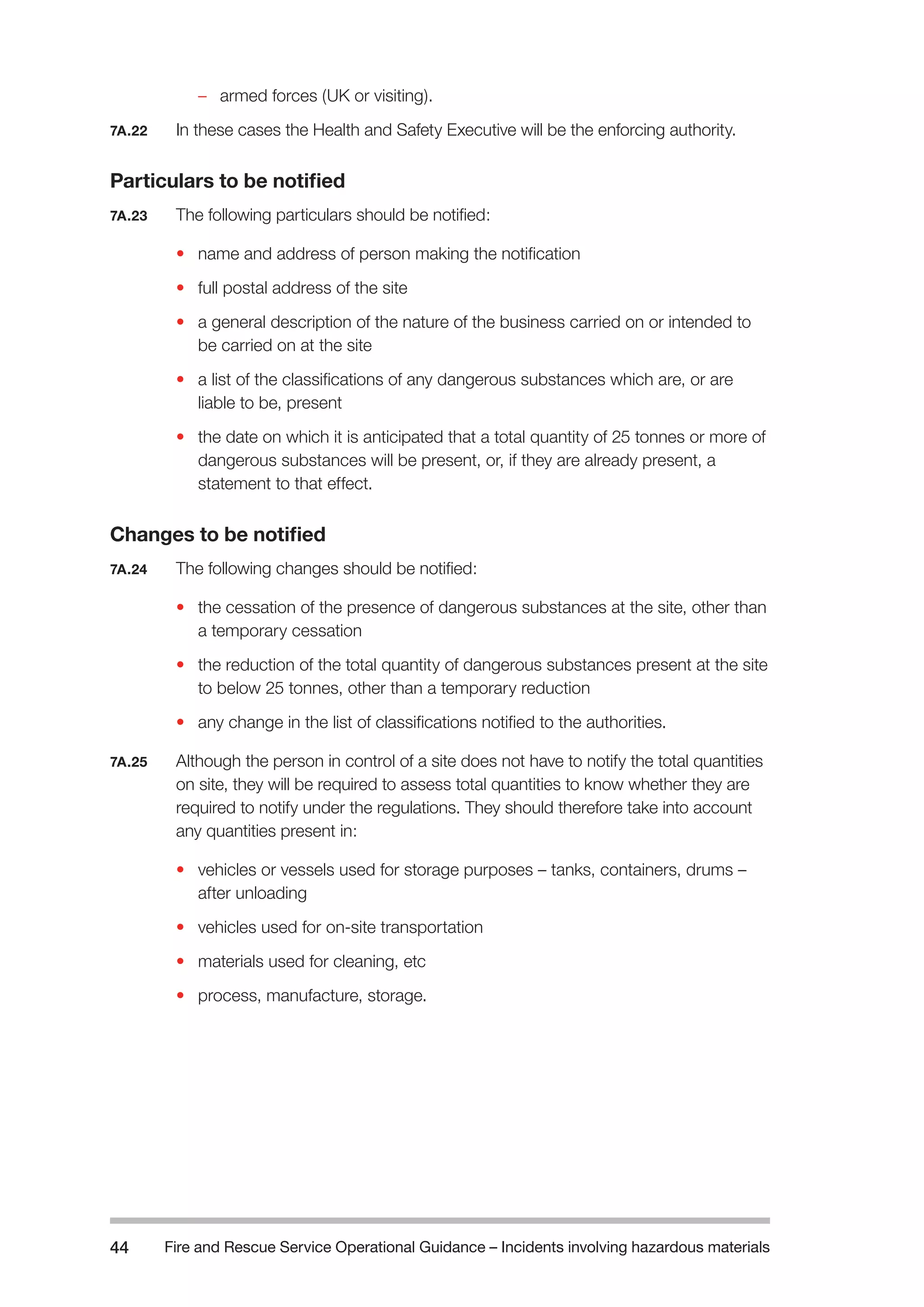
7A.27 Signs should be placed in conspicuous positions close to site entrances that 
could reasonably be expected to be used by firefighters. They may be free-standing 
or fixed to fences, railings, faces of buildings, etc. 
Location marking 
7A.28 At a site storing a total of 25 tonnes or more of dangerous substances, an 
inspector may give directions to the person in control of the site to display safety 
signs at specified locations. These directions will only be given where the 
inspector is satisfied on reasonable grounds that: 
• twenty-five tonnes or more of dangerous substance are, or are liable to be, 
present 
• the display of signs is necessary to warn firefighters in an emergency of the 
presence of dangerous substances at these locations 
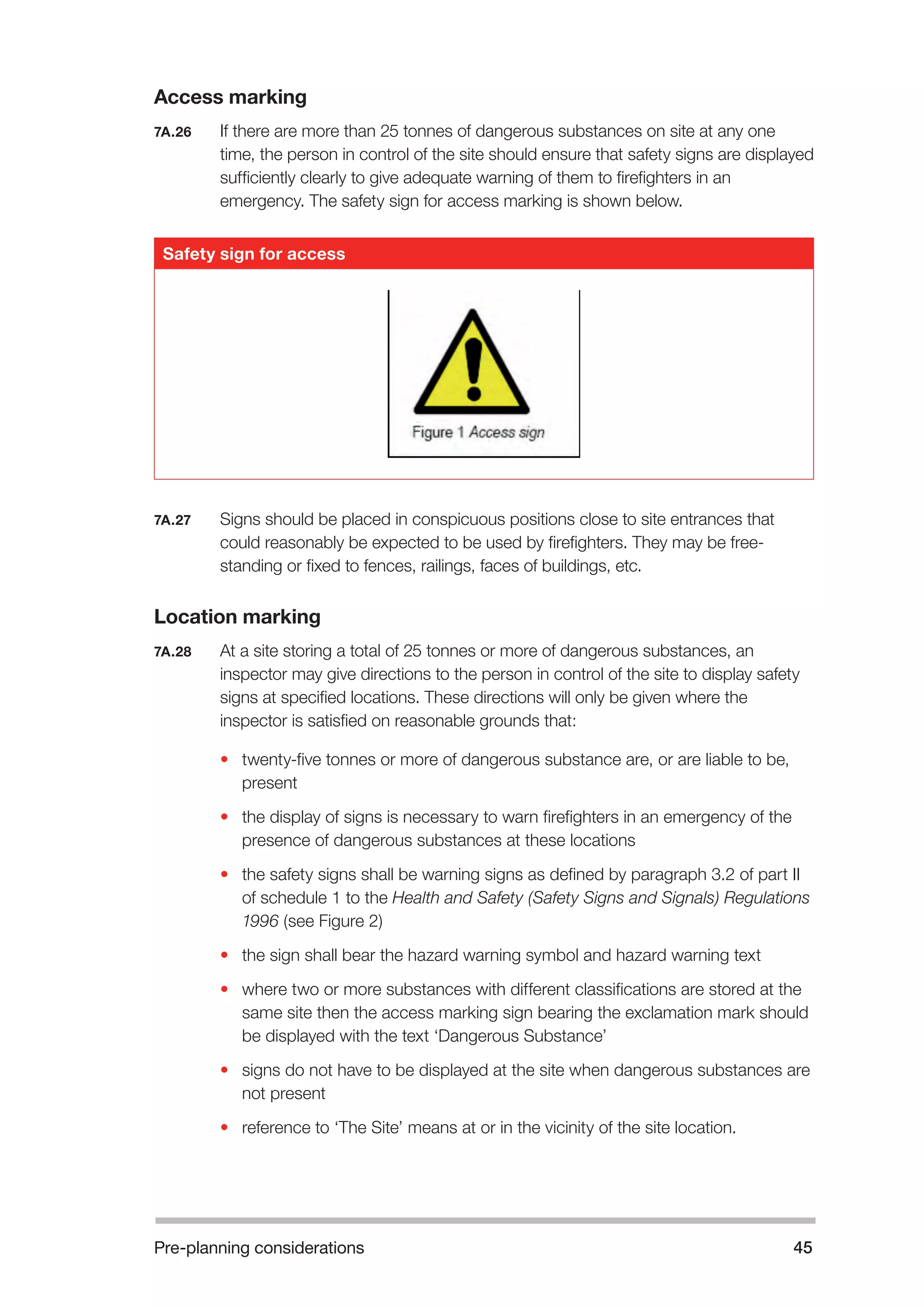
• the safety signs shall be warning signs as defined by paragraph 3.2 of part II 
of schedule 1 to the Health and Safety (Safety Signs and Signals) Regulations 
1996 (see Figure 2) 
• the sign shall bear the hazard warning symbol and hazard warning text 
• where two or more substances with different classifications are stored at the 
same site then the access marking sign bearing the exclamation mark should 
be displayed with the text ‘Dangerous Substance’ 
• signs do not have to be displayed at the site when dangerous substances are 
not present 
• reference to ‘The Site’ means at or in the vicinity of the site location. 
Safety sign for access
Fire and Rescue Service Operational Guidance – Incidents 46 involving hazardous materials 
7A.29 The person in control of the site shall, as far as is reasonably practicable, ensure 
that any safety signs displayed at the site (to provide access and location 
marking) are kept clean and free from obstruction. 
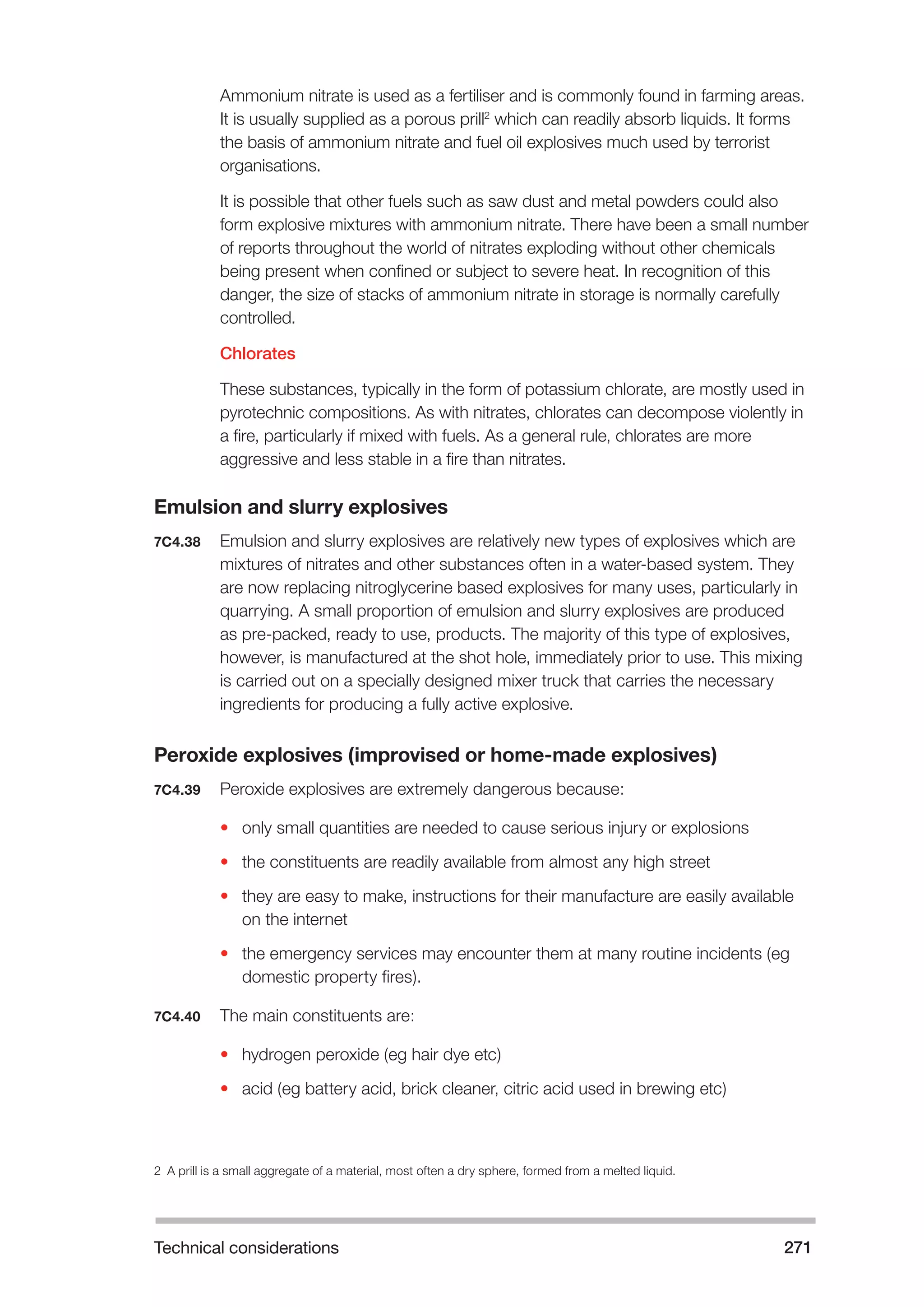
7A.30 These regulations shall not apply to nor bear relation to: 
• dangerous substances buried or deposited in the ground as waste 
• radioactive substances (only hazard) 
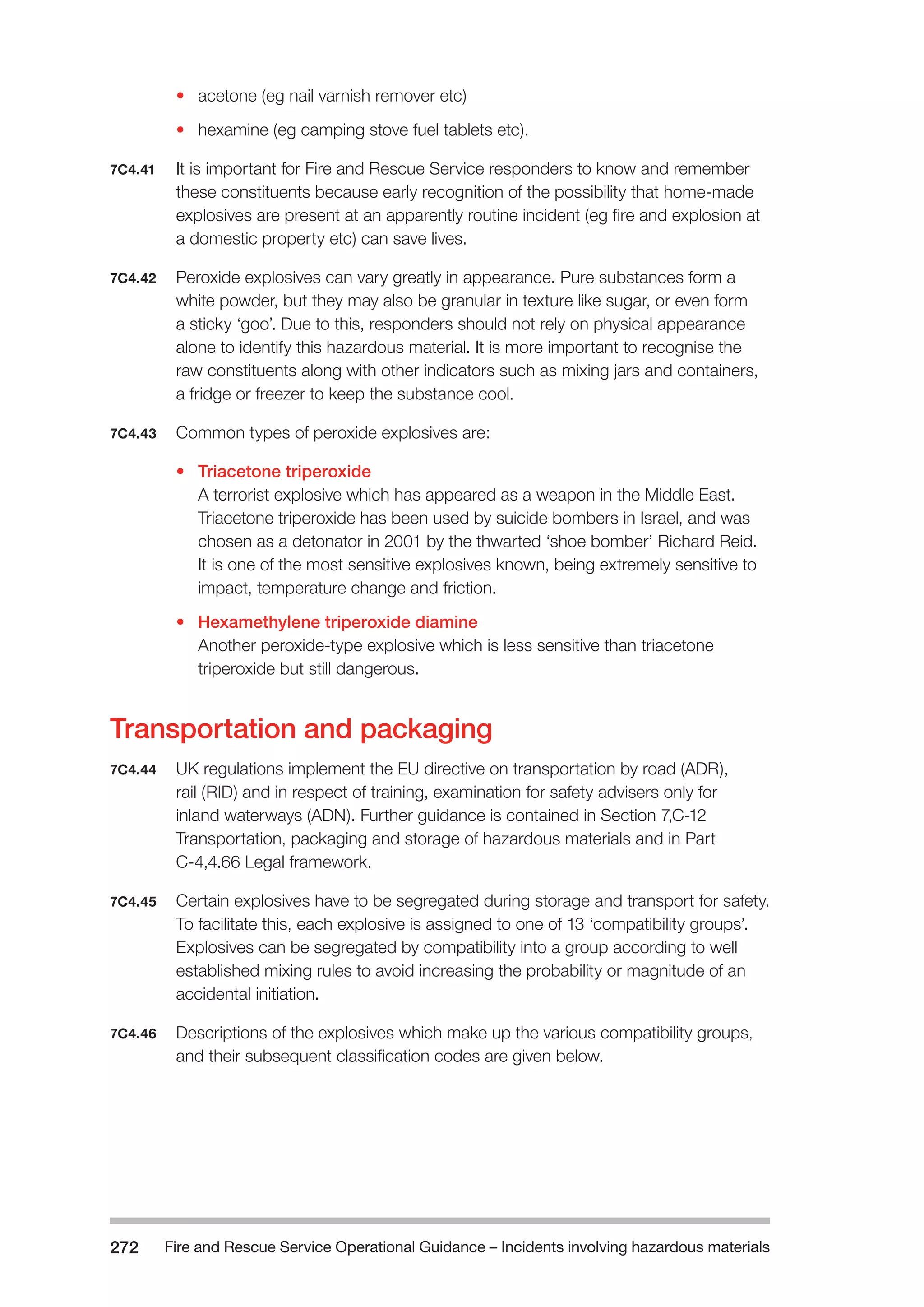
• substances, which, under the Classification and Labelling of Explosives 
Regulations 1983, are classified as Class 1 goods within the meaning of: 
– The Carriage of Dangerous Goods and Use of Transportable Pressure 
Equipment regulations 
– The International Maritime Dangerous Goods Code; or 
– The Technical instructions for the Safe Transport of Dangerous Goods by 
Air. 
• aerosol dispensers unless labelled in accordance with the Carriage of 
Dangerous Goods and Use of Transportable Pressure Equipment 
Regulations. 
7A.31 Notification shall not apply to: 
• sites that are notifiable to the executive under the Notification of Installations 
Handling Hazardous Substances Regulation 1982 (NIHHS) 
• Control of Major Accident Hazards sites 
• licensed sites under the Petroleum Consolidation Act 1928 (as amended) 
Location signs
Pre-planning considerations 47 
• sites within the area of a harbour authority if Regulation 27 of the Dangerous 
Substances in Harbour Regulation 1987 (as amended) applies 
• sites that have a disposal licence in force under the Control of Pollution Act 
1974 (as amended) 
• nuclear sites licensed under the Nuclear Installations Act 1969 ( as amended). 
7A.32 NOTE: Access and location marking regulations shall not apply to petroleum 
filling stations. 
7A.33 The Health and Safety Executive has the power to grant general or special 
exemptions and to impose conditions and time limits on them. Before granting 
any exemption, the Executive would have to consider the circumstances of the 
case and consult any bodies likely to be affected. 
Notification of Installations Handling Hazardous 
Substances Regulations 1982 (NIHHS) 
7A.34 These regulations came into force on 1 January 1983 and were introduced to 
identify sites that handled certain quantities of hazardous materials not covered 
by the Control of Major Accident Hazards Regulations (COMAH). 
7A.35 The definition of ‘site’ means: 
• the whole area of land under control of a person and includes a jetty, pier or 
similar structure, whether floating or not; or 
• any structure, floating or otherwise, which is within the inland waters of Great 
Britain and is controlled by a person. 
7A.36 Before any activity commences at a site deemed to be covered by these 
regulations, the occupier must notify the Health and Safety Executive at least 
three months before operations begin. In the case of ammonium nitrate this has 
been set in the 2002 amendment regulations at four weeks. 
7A.37 Information to be supplied: 
• name and full postal address of the site 
• name and address of person making the application 
• the area of the site and any site within 500 metres 
• the date the activity commences 
• a general description of the activities carried out 
• name and address of the planning authority covering the site address 
• name and quantity of each hazardous substance to be stored on site.
Fire and Rescue Service Operational Guidance – Incidents 48 involving hazardous materials 
7A.38 To determine the exact quantity of a hazardous material held on a site the 
following must be taken into account: 
• quantity held in any pipeline which is within 500 metres of, and connected to, 
the site 
• quantity held in any other site within 500 metres of the original site 
• any vessel, vehicle or aircraft used for storage at, or within 500 metres of, the 
site. 
7A.39 The only exceptions are waste sites licensed under Section 5 of the Control of 
Pollution Act 1974 (as amended). Should the quantity of any hazardous material 
stored be either increased to an amount three or more times of the original 
declaration, or reduced by any amount or cease to be used altogether, the Health 
and Safety Executive must be informed. 
7A.40 The regulations contain schedules that list the hazardous substances and 
quantities that require notification to the Health and Safety Executive. 
The Control of Major Accident Hazards Regulations 
1999 (as amended) (COMAH) 
7A.41 The Control of Major Accident Hazard Regulations (COMAH) implemented the 
Seveso II Directive (96/82/EC) in Great Britain, except for land-use planning 
requirements which are to be implemented by changes to planning legislation. 
They replace the Control of Industrial Major Accident Hazards Regulations 1984 
(CIMAH) which implemented the original Seveso Directive (82/501/EEC). They 
came into force on 1st April 1999 and are amended by the Control of Major 
Accident Hazards (Amendment) Regulations 2005. 
7A.42 Their purpose is to prevent major accidents involving dangerous substances and 
limit the consequences to people and the environment of any which do occur. 
COMAH applies mainly to the chemical industry, but also to some storage 
activities, explosives and nuclear sites, and other industries where threshold 
quantities of dangerous substances identified in the Regulations are kept or used. 
7A.43 A key feature of the COMAH Regulations is that they will be enforced by a 
competent authority comprising the Health and Safety Executive and the 
Environment Agency in England and Wales, and the Health and Safety Executive 
and the Scottish Environment Protection Agency in Scotland. Operators will 
generally receive a single response from the competent authority on all matters to 
do with COMAH. 
7A.44 The mechanism for determining whether COMAH applies has been simplified. 
Basically, an establishment having any substance specified in Schedule 1 present 
above the qualifying quantity is subject to the Regulations. There are two
Pre-planning considerations 49 
thresholds, known as lower-tier and top-tier. Further details can be found in the 
guidance to Schedule 1 which lists 39 substances by name in Part 2 and 10 
generic categories in Part 3. 
7A.45 Even if there are no threshold quantities of substances present at an 
establishment, it may still be subject to the Regulations if specified dangerous 
substances could be produced in threshold quantities as a result of loss of control 
of an industrial chemical process. 
7A.46 The Major Accident Control Regulations for the Ministry of Defence are intended 
to discharge the requirement from the Secretary of State for Defence to have in 
place arrangements which are at least as good as those required by statute 
where the Secretary of State holds an exemption, with respect to COMAH. 
7A.47 More information on the Regulations and how to comply with them can be found 
on the Health and Safety Executive’s website: 
www.hse.gov.uk/comah/index.htm. 
Lower-tier duties 
7A.48 If the lower-tier threshold is equalled or exceeded, operators must notify the 
competent authority. Notification should be to the local Health and Safety 
Executive office which will pass the details to the relevant Environment Agency 
office. 
7A.49 Operators of all establishments subject to the Regulations must notify certain 
basic details to the competent authority. The key points which have to be included 
in the notification are given below but full details are given in Schedule 3 to the 
Regulations: 
• name and address of operator 
• address of establishment 
• name or position of person in charge 
• details of dangerous substances on site (a breakdown is required for 
petroleum products) 
• site activities 
• environmental details. 
SITE OPERATORS MUST MAKE ALL MEASURES NECESSARY TO 
PREVENT MAJOR ACCIDENTS AND LIMIT THEIR CONSEQUENCES TO 
PEOPLE AND THE ENVIRONMENT 
7A.50 This is the general duty on all operators and underpins all the regulations. It is a 
high standard and applies to all establishments within scope. By requiring 
measures both for prevention and mitigation there is a recognition that all risks 
cannot be completely eliminated. This in turn implies that proportionality must 
remain a key element in the enforcement policy of the Health and Safety
Fire and Rescue Service Operational Guidance – Incidents 50 involving hazardous materials 
Executive and the Environment Agency. Thus, the phrase ‘all measures 
necessary’ will be interpreted to include this principle and a judgment will be 
made about the measures in place. Where hazards are high then high standards 
will be required to ensure risks are acceptably low, in line with the Health and 
Safety Executive’s and Environment Agency’s policy that enforcement should be 
proportionate. Prevention should be based on the principle of reducing risk to a 
level as low as is reasonably practicable for human risks and using the best 
available technology not entailing excessive cost for environmental risks. The ideal 
should always be, wherever possible, to avoid a hazard altogether. 
SITE OPERATORS MUST PREPARE A MAJOR ACCIDENT PREVENTION 
POLICY 
7A.51 Regulation 5 requires lower-tier operators to prepare a document setting out their 
policy for preventing major accidents, this is known as a major accident 
prevention policy or MAPP. 
7A.52 The MAPP will usually be a short and simple document setting down what is to 
be achieved but it should also include a summary and further references to the 
safety management system that will be used to put the policy into action. The 
detail will be contained in other documentation relating to the establishment eg 
plant operating procedures, training records, job descriptions, audit reports, to 
which the MAPP can refer. 
7A.53 The MAPP also has to address issues relating to the safety management system. 
The details are given in Schedule 2 of the Regulations but the key areas are: 
• organisation and personnel 
• identification and evaluation of major hazards 
• operational control 
• planning for emergencies 
• monitoring, audit and review. 
Top-tier duties 
7A.54 If any top-tier threshold is equalled or exceeded, the operator must also comply 
with regulations 7 to 14. 
SITE OPERATORS MUST PREPARE A SAFETY REPORT 
7A.55 A safety report is a document that provides information to demonstrate to the 
competent authority that all measures necessary for the prevention and mitigation 
of major accidents have been taken. 
7A.56 The safety report must include: 
• a policy on how to prevent and mitigate major accidents 
• a management system for implementing that policy
Pre-planning considerations 51 
• an effective method for identifying any major accidents that might occur 
• measures (such as safe plant and safe operating procedures) to prevent and 
mitigate major accidents 
• information on the safety precautions built into the plant and equipment when 
it was designed and constructed 
• details of measures (such as fire-fighting, relief systems and filters) to limit the 
consequences of any major accident that might occur; and 
• information about the emergency plan for the site, which is also used by the 
local authority in drawing up an off-site emergency plan. 
7A.57 Safety reports will be available to the public via the competent authority registers, 
subject to safeguards for national security, commercial and personal 
confidentiality. 
SITE OPERATORS MUST UPDATE THE SAFETY REPORT AFTER 
SIGNIFICANT CHANGES OR NEW KNOWLEDGE ABOUT SAFETY 
MATTERS OR EVERY FIVE YEARS 
7A.58 The safety report needs to be kept up to date. If there are any modifications to the 
plant or the way it is operated or if new facts or information become available, the 
safety report must be reviewed and, if necessary, revised at the time. It must be 
reviewed after five years even if there have not been any changes. The operator 
must notify the competent authority of any revision, and also if the five-year review 
does not lead to a revision. 
SITE OPERATORS MUST PREPARE AND TEST AN ON-SITE EMERGENCY 
PLAN 
7A.59 Top-tier operators must prepare an emergency plan to deal with the on-site 
consequences of a major accident. 
SITE OPERATORS MUST SUPPLY INFORMATION TO LOCAL AUTHORITIES 
FOR OFF-SITE EMERGENCY PLANNING PURPOSES 
7A.60 Local authorities (this means the Fire and Rescue Service in London and other 
metropolitan areas) play a key role by preparing, reviewing, revising and testing 
off-site emergency plans for dealing with the off-site consequences of major 
accidents at top-tier sites. In order to fulfil this role they need information from 
operators. Operators will need to hold discussions with their local authorities to 
determine their exact needs. 
SITE OPERATORS MUST PROVIDE CERTAIN INFORMATION TO THE 
PUBLIC ABOUT THEIR ACTIVITIES 
7A.61 People who could be affected by an accident at a COMAH establishment must 
be given information without having to request it. Also safety reports must be 
made available to the public via public registers.
Fire and Rescue Service Operational Guidance – Incidents 52 involving hazardous materials 
7A.62 Operators planning to build new top-tier establishments must submit information 
in advance of construction and wait for the competent authority’s response before 
starting to build safety-critical parts of the establishment. This is to ensure that 
safety is considered fully at the design stage. 
7A.63 The COMAH regulations specifically require operators to consult their employees 
or employees’ representatives about the preparation of the on-site emergency 
plan. Consultation with those doing the work is crucial in raising awareness of the 
importance of health and safety and environmental protection. It can make a 
significant contribution to creating and maintaining a safe and healthy working 
environment and an effective health and safety culture. In turn, this can benefit the 
business, making it more efficient by reducing the number of accidents and the 
number of work-related ill-health incidents. 
7A.64 Upon receipt of the safety report the competent authority should inform employee 
representatives and provide the name of the assessment manager. If the 
competent authority finds serious deficiencies in the safety report, it will copy to 
employee representatives any correspondence it has with operators in respect of 
this. Similarly, the competent authority will copy the letter informing the operator of 
its conclusions of the assessment of the safety report, to employee 
representatives. 
7A.65 The Environment Agency has been pro-active in working alongside the European 
Commission’s activities related to the implementation of the Seveso II Directive. 
This work reflects the following arrangements introduced by the Seveso II 
Directive and the Amending Directive (2003/105/EC): 
• The Directive 2003/105/EC introduces more explicit requirements on the 
environment. One of the generic categories of substances is ‘dangerous 
for the environment’ – designed to bring establishments which pose an 
environmental threat within scope. Also, clean-up and restoration of the 
environment is a new objective of emergency plans 
• The environment now has a higher public profile to be sure that high levels of 
protection are achieved for the environment as well as for people 
• The Environment Agency was created in 1996 and it brings together, in single 
regulatory authority, a wide range of responsibilities for, and expertise on, all 
aspects of environmental protection. This, and the move towards integrated 
pollution control, makes it easier to co-ordinate environmental inputs to the 
regulation of major hazards 
• There has been a trend within industry, and particularly the chemicals sector, 
to integrate health, safety and environment policies and practices and adopt a 
more holistic approach to hazard identification and risk control.
Pre-planning considerations 53 
7A.66 There is other environmental legislation which, to some extent, overlaps with 
Seveso II. In particular, the Directive on Integrated Pollution Prevention and 
Control (IPPC, Directive 96/61/EC) establishes a permitting process by the 
competent authority which covers, amongst many other things, accidental 
pollution. 
7A.67 The Health and Safety Executive and the Environment Agency will work together 
as the competent authority for the COMAH regime. In considering how this 
should be done, the objective was to achieve high levels of protection from major 
accidents for both people and the environment. The arrangements will ensure 
that: 
• appropriate expertise on health and safety and the environment is brought to 
bear on the regulation of major hazards 
• the activities of Health and Safety Executive and the Environment Agency, 
in relation to duties under the Regulations, are co-ordinated, consistent, 
transparent, targeted and proportionate 
• the possibility of conflicting requirements being placed on operators is 
eliminated; and 
• the Health and Safety Executive and the Environment Agency will collaborate 
on issues of joint interest, so avoiding duplicating activity for themselves and 
for operators. 
7A.68 The working arrangements are set out in a memorandum of understanding, 
copies of which are available on request from the competent authority. 
7A.69 There are many aspects of an operator’s activities which do not relate exclusively 
to protection of either people or the environment. Co-ordinating the operational 
implementation of COMAH by the Health and Safety Executive and the 
Environment Agency is, therefore, crucial. For key regulatory activities which 
require action by the competent authority, such as: 
• assessing safety reports 
• applying derogation procedures; and 
• designating domino effects establishments, the operator will make a 
submission or application and receive a single response agreed between the 
Health and Safety Executive and the Environment Agency. 
7A.70 The Health and Safety Executive and the Environment Agency will discuss and 
exchange inspection programmes for establishments subject to COMAH. 
Inspections relating to COMAH will be coordinated to avoid duplication of effort. 
The Civil Contingencies Act 2004 (CCA) 
7A.71 The Civil Contingencies Act 2004 delivers a single framework for civil protection in 
the United Kingdom capable of meeting the challenges of the twenty-first century.
Fire and Rescue Service Operational Guidance – Incidents 54 involving hazardous materials 
7A.72 The Act is separated into two parts: 
• Part 1: local arrangements for civil protection, establishing a statutory 
framework of roles and responsibilities for local responders. 
• Part 2: emergency powers, establishing a modern framework for the use of 
special legislative measures that might be necessary to deal with the effects 
of the most serious emergencies. 
7A.73 The definition of emergency in the Act covers the consequences of emergencies. 
It defines an emergency as: 
• an event or situation which threatens serious damage to human welfare 
• an event or situation which threatens serious damage to the environment 
• war, or terrorism, which threatens serious damage to security. 
7A.74 For Part 1 of the Act the definition sets out the range of possible incidents for 
which local responders must prepare when fulfilling their civil protection duties. 
7A.75 For Part 2 it sets out the situations in which it may be possible to use emergency 
powers if the appropriate safeguards are met. 
7A.76 This does not mean that the definition of ’emergency‘ is the same in both parts. In 
Part 1, the threat must pose a threat of serious damage to human welfare or the 
environment of a ‘place’ in the United Kingdom. This reflects the fact that Part 1 is 
designed to deal with preparations by local responders for localised emergencies. 
7A.77 In Part 2, the threat must pose a threat of serious damage to human welfare or 
the environment of one of the English regions, or one of the other constituent 
parts of the UK (Scotland, Wales or Northern Ireland). This higher threshold 
reflects the fact that Part 2 is designed for use in very serious emergencies which 
affect a larger geographical area. 
Part 1: Local arrangements for civil protection 
7A.78 The purpose of Part 1 of the Act is to establish a new statutory framework for civil 
protection at the local level. Local responders are the building block of resilience 
in the UK, and the Act will enhance existing arrangements by: 
• establishing a clear set of roles and responsibilities for local responders 
• giving greater structure and consistency to local civil protection activity; and 
• establishing a sound basis for performance management at a local level. 
7A.79 The Act divides local responders into two categories depending on the extent of 
their involvement in civil protection work, and places a proportionate set of duties 
on each.
Pre-planning considerations 55 
7A.80 Category 1 responders are those organisations at the core of emergency 
response (eg emergency services, local authorities). Category 1 responders are 
subject to the full set of civil protection duties. They are required to: 
• assess the risk of emergencies occurring and use this to inform contingency 
planning 
• put in place emergency plans 
• put in place business continuity management arrangements 
• put in place arrangements to make information available to the public about 
civil protection matters and maintain arrangements to warn, inform and advise 
the public in the event of an emergency 
• share information with other local responders to enhance co-ordination 
• co-operate with other local responders to enhance co-ordination and 
efficiency; and 
• provide advice and assistance to businesses and voluntary organisations 
about business continuity management (local authorities only). 
7A.81 The definition of emergency in the Act defines the sorts of events or situations 
that Category 1 responders should be preparing for. 
7A.82 Part 2 of the Act additionally establishes a threshold that events or situations 
would need to meet to constitute an emergency, and thus to trigger the duties in 
Part 1 of the Act. This provides that Category 1 responders’ duties under the Act 
only apply to events or situations which require the use of assets beyond the 
scope of normal operations and require a special deployment. 
7A.83 Category 2 organisations (eg the Health and Safety Executive, transport and utility 
companies) are ‘co-operating bodies’ who, while less likely to be involved in the 
heart of planning work, will be heavily involved in incidents that affect their sector. 
Category 2 responders have a lesser set of duties – co-operating and sharing 
relevant information with other Category 1 and 2 responders. The detail of what 
this means in practical terms is contained in the Contingency Planning 
Regulations 2005 and statutory guidance on emergency preparedness that can 
be found at: 
http://www.cabinetoffice.gov.uk/ukresilience 
7A.84 Category 1 and 2 responders are also required to come together to form ‘local 
resilience forums’ (based on police force areas outside London) which will help 
co-ordination and co-operation between responders at the local level. 
Part 2: Emergency powers 
7A.85 In the UK emergency powers allow the making of special temporary legislation to 
deal with the most serious of emergencies. They are not a means for instigating 
martial law, for undermining Parliament, banning political parties or anything else
Fire and Rescue Service Operational Guidance – Incidents 56 involving hazardous materials 
of that nature. An essential point to note is that emergency powers legislation is a 
mechanism for dealing with only the most serious of emergencies that require an 
urgent response, an instrument of last resort. The previous emergency powers 
legislation (the Emergency Powers Act 1920) was used twelve times in its eighty-four 
year history, the last time being in 1974. In the years since, a considerable 
amount of sector specific emergency legislation has been introduced. This 
reduced the need to resort to emergency powers, in part because of recognition 
that emergency powers legislation was inadequate. Nevertheless, there is still a 
need for a latent capacity to rapidly make new temporary statutory provision 
where this is the most effective way of enabling the resolution of an emergency 
situation.
Operational considerations – Generic Standard Operating Procedure
Fire and Rescue Service Operational Guidance – Incidents 58 involving hazardous materials 
Background 
7B.1 Part B Operational considerations provides good practice advice to assist Fire 
and Rescue Services to carry out emergency operations at incidents involving 
hazardous materials. It is structured around the: 
• response phases of an emergency incident, common to all Fire and Rescue 
Service operations 
• operational key principles, the critical ‘must do’s’ or ‘should do’s’ for the Fire 
and Rescue Service to ensure firefighter safety and inter-operability. 
7B.2 This operational guidance follows a chronological timeline through a typical 
hazardous materials incident and builds into a generic standard operating 
procedure (G-SOP) comprising: 
• Actions 
• Considerations. 
7B.3 The G-SOP is intentionally generic in nature because it is intended as a series of 
check-lists of considerations, rather than a set of rules that must be strictly 
adhered to. 
7B.4 This approach has been taken to recognise local differences across the Fire and 
Rescue Service in terms of risk profiles and levels of resources. Services with 
limited capability for research and development may choose to adopt the 
procedures with few amendments. Whilst larger organisations with greater 
resources and a more complex risk profile may simply use them as foundation 
stones to ensure inter-operability at cross border or large scale incidents. 
However, it must be stressed that both approaches should be supported by full 
local risk assessments. 
7B.5 The G-SOP has been formulated by bringing together existing ‘good practice’ 
from Fire and Rescue Services throughout the United Kingdom. This ‘good 
practice’ has been heavily influenced over the years by the hazardous materials 
training courses provided by the Fire Service College in Moreton-in-Marsh, and 
the Scottish Fire Services College, Gullane. International operational guidance has 
also been considered, particularly that used in the United States of America, 
Canada and Mexico (eg National Fire Protection Association’s standard 472 for 
Professional Competence of Responders to Hazardous Materials Incidents, 
Hazardous Waste Operations and Emergency Response regulations etc). 
7B.6 The G-SOP also reflects the hazards and control measures detailed within the 
relevant Fire and Rescue Service generic risk assessments.
Operational considerations – Generic Standard Operating Procedure 59 
7B.7 It is deliberately written concisely and in an easy to navigate, colour coded format 
so that it can be used as a quick reference guide for operational staff, an aide 
memoir containing the most critical information is contained in Section 8, 
Appendix A. Where further more detailed explanations or technical information is 
needed it will be found in Part C, Technical considerations. 
7B.8 Each phase of operations is broken down into more detailed hazardous materials 
– specific guidance grouped together under ‘actions’. These are not meant to be 
compulsory steps at every incident, but rather a check-list that should be 
considered by staff, particularly those with command responsibilities. 
7B.9 ‘Actions’ are subdivided into ‘Considerations’. Again, these form a toolbox of good 
practice options rather than mandatory procedures. 
Emergency 
Response 
Phase 
Actions 
Considerations 
Command and control at hazardous materials 
incidents 
7B.10 Guidance on command and control at incidents is contained within the Fire and 
Rescue Manual, Volume 2 Fire Service Operations, Incident Command. The 
incident command system described in the manual should be used at all 
hazardous material incidents. 
7B.11 The processes associated with the command and control of serious operational 
incidents are complex and detailed. A great deal of work has been done to assist 
Incident Commanders, and others charged with operational responsibilities, to 
understand the cognitive and emotional processes that occur at such times. 
However, such processes are not a tool. In the search for a device to practically 
assist commanders in the discharge of their responsibilities, experienced officers 
have reported the value they have derived from the Decision Making Model 
developed by the London Fire Brigade. This is a cyclical process control model 
which may assist commanders in achieving their operational objectives at 
hazardous materials incidents. The full explanatory note can be found in Appendix 
4, of the Fire and Rescue Manual, Volume 2, Fire Service Operations, Incident 
Command.
Fire and Rescue Service Operational Guidance – Incidents 60 involving hazardous materials 
Figure 1: Decision making model developed by the London Fire Brigade 
7B.12 The Fire and Rescue Service Incident Commander has the responsibility for 
controlling the Service’s resources and operations at the scene. They must 
ensure that the operational risk philosophy is implemented at the scene. 
Operational key 
principle 
Operational risk philosophy: 
• The benefits of proceeding with a task must be weighed carefully against 
the risks 
• It is important to think before you act, rather than, act before you think. 
7B.13 All Fire and Rescue Service staff attending hazardous materials incidents must 
strictly adhere to the ‘line of command’ principle within the incident command 
system.
Operational considerations – Generic Standard Operating Procedure 61 
Operational key principle 
Line of command principle: 
• All commanders must know who they are responsible for 
• All staff must know who they report to 
• All staff must know what their operational brief is. 
The incident command system relies upon a single unified command line. 
With the exception of urgent safety related issues staff should not take 
control of operations outside their assigned responsibility and should ensure 
all information and instruction is passed via the relevant command line 
officers. 
This will enhance scene safety by ensuring that staff and crews do not, 
under any circumstances, ‘self-deploy’ to hazardous areas at hazardous 
materials incidents. 
Fire and Rescue Service hazardous materials 
responders – Key levels 
7B.14 The three key levels of Fire and Rescue Service hazardous materials responder 
are: 
Firefighter 
As defined in the Emergency Fire Service Rolemaps. The skills, knowledge and 
understanding referred to in the generic standard operating procedure (G-SOP) 
relate to a ‘competent’ firefighter. 
Commander 
Generic term for all ‘Operational’ (Bronze) and ’Tactical’ (Silver) Fire and Rescue 
Service command roles designated within the incident command system. 
‘Strategic’ (Gold) command issues are not detailed within the G-SOP as it is an 
on-site operational and tactical guide. 
Hazardous Materials Adviser 
Generic term for any person, with enhanced knowledge of hazardous materials 
operations, used by a Fire and Rescue Service to provide specialist advice to the 
Incident Commander at emergency incidents involving hazardous materials. This 
level of responder includes such roles as the Hazardous Materials Officer, 
Hazardous Material and Environmental Protection Officer, Scientific Adviser, 
Chemical, Biological, Radiological, Nuclear and Explosive Subject Matter Advisor 
etc. Their primary functions are to: 
• gather, filter and interpret technical information on hazardous materials for the 
Incident Commander
Fire and Rescue Service Operational Guidance – Incidents 62 involving hazardous materials 
• assess the risks posed by emergency hazardous materials incidents 
• advise the Incident Commander on the development of a hazardous materials 
tactical response plan 
NOTE: At an incident where National Resilience DIM (detection, identification and 
monitoring) teams are deployed the Hazardous Materials Adviser will act as the 
link from the DIM team to the Incident Commander. It should also be noted that at 
a CBRN(E) event, a CBRN(E) Subject Matter Advisor, when mobilised, will be 
responsible for advising the Incident Commander on the development of the 
tactical response plan. 
Generic standard operating procedure (G-SOP) – 
Overview 
Operational key principle 
Operations risk management 
On-site Fire and Rescue Service emergency operations should always be 
based on structured, standardised and risk assessed safe systems of work. 
These are commonly known as standard operating procedures. All good 
standard operating procedures allow flexibility, within defined boundaries, so 
that competent staff can use professional judgement to choose the most 
appropriate procedures and tactics when faced with unique, or rapidly 
developing, emergency situations. This controlled but dynamic management 
of risk must always have firefighter safety at its core, whilst acknowledging 
that a professional, highly trained emergency service will be exposed to 
some controlled risk to achieve the community’s expectations. Any residual 
risk at emergency incidents must be kept as low as reasonably practicable. 
7B.15 The critical success factors in the first hour of a hazardous materials incident will 
typically be the ability of responders to: 
• identify hazards in order to effectively carry out a risk assessment, possibly 
under considerable pressure and with limited and/or incomplete information 
• recognise that the incident involves hazardous materials, especially if they 
have not been mobilised specifically to a hazardous materials incident 
NOTE: 
Responders should also be aware that what may appear to be a hazardous 
materials incident initially, maybe a CBRN(E) event 
• gain control of the incident ground, identify the problem and separate 
responders and the public from it 
• establish command and control 
• stabilise the situation.
Operational considerations – Generic Standard Operating Procedure 63 
7B.16 The G-SOP described in the following paragraphs details the operational and 
tactical functions to be evaluated and possibly implemented at incidents involving 
hazardous materials to achieve these success factors and then go on to resolve 
the incident in the most safe, effective and efficient manner. 
7B.17 This G-SOP should be viewed as a flexible guide and not a set of rigid rules. 
Individual Fire and Rescue Services should decide what works best for them in 
terms of the level of detail their organisation requires. They should then design 
training and development programmes that incorporate their specific equipment, 
risks and resources. 
7B.18 Assumptions behind the G-SOP: 
• All staff attending the incident are competent to do so, or are properly 
supervised 
• Predetermined attendances are suitable and sufficient for the safe operation 
of the G-SOP 
• The G-SOP consists of ‘actions’ and ‘considerations’, not all actions must be 
followed at every incident, but they should be considered 
• Emergency response phases are generic and do not equate to strict time-lines. 
In particular Phases 3 (Planning), 4 (Implementing) and 5 (Evaluating) 
should be cyclical at complex incidents. Evaluation should be a continual 
process when circumstances or risks are changing. This is shown in the 
Emergency Incident Phase Cycle diagram 
• Actions and considerations are not necessarily sequential, or indeed 
mandatory 
• Actions will often occur simultaneously or in a different order to the G-SOP 
depending on the incident dynamics 
• G-SOP should be used as an ‘enabling guide’ or ‘toolbox’ of possible 
approaches rather than a prescriptive list of ‘should-do’s’ 
• The Incident Commander will decide which actions and considerations are 
appropriate for the incident and also their priority 
• Local risk assessment by the Fire and Rescue Service as the ‘employer’ is still 
required 
• G-SOP covers all of the control measures raised in the relevant national 
generic risk assessments.
Fire and Rescue Service Operational Guidance – Incidents 64 involving hazardous materials 
7B.19 The G-SOP offers several benefits as it: 
• recognises that the majority of hazardous materials incidents are minor in 
nature and generally involve limited quantities of harmful substances 
• provides a flexible management system that expands as the scope and 
magnitude of the incident grows 
• provides a consistent management structure, regardless of the classes of 
hazardous materials involved. 
7B.20 It should be regarded as the minimum safe level of operational procedure to 
maintain the safety of staff and ensure inter-operability in critical areas of 
emergency operations. Where risk-critical issues exist, operational key principles 
have been developed and highlighted. These are distinguished in the text by red 
text boxes. Fire and Rescue Services are advised to consider such guidance as 
the ‘highest priority’ guidance. 
7B.21 There are six basic response phases that should be considered at all emergency 
incidents: 
1 Mobilising and en-route 
2 Arriving and gathering information 
3 Planning the response 
4 Implementing the response 
5 Evaluating the response 
6 Closing the incident
Operational considerations – Generic Standard Operating Procedure 65 
Emergency incident phase cycle 
Phase 4 
Implementing 
the 
response 
Phase 5 
Evaluating the 
response 
Phase 3 
Planning 
the 
response 
Hazardous materials inciden t 
Phase 1 
Mobilising 
and 
en-route 
Phase 2 
Arriving and 
gathering 
information 
Phase 6 
Closing 
the 
incident 
Objectives A chieved
Fire and Rescue Service Operational Guidance – Incidents 66 involving hazardous materials 
Summary of phases and actions 
Phase 1 
Mobilising and en-route 
1.1 Assess the level, scale and type of incident 
1.2 Mobilise appropriate resources to the incident, marshalling areas or 
predetermined rendezvous points 
1.3 Access incident specific information en-route 
1.4 Notify relevant agencies 
Phase 2 
Arriving and gathering information 
• Incident information 
• Resource information 
• Hazard and safety information 
2.1 Approach the incident safely and estimate the potential hazard zone 
2.2 Recognise hazards and risks from a safe location and implement an initial 
cordon 
2.3 Liaise with persons on and off-site 
2.4 Consider the immediate life risk 
(NOTE: Immediate life risk = immediate human life saving rescues; immediate 
evacuation to prevent serious injury; prevention of catastrophic escalation likely 
to endanger life) 
2.5 Identify the problem and the likely impact 
2.6 Estimate the resource requirements (NOTE: make-up if necessary) 
2.7 Implement the incident command system 
Phase 3 
Planning the response 
• Think 
• Prioritise objectives 
• Plan 
3.1 Identify the objectives 
3.2 Develop a response plan with specialist advisers and other agencies 
3.3 Identify the level and type of personal protective equipment required 
3.4 Identify effective decontamination procedures
Operational considerations – Generic Standard Operating Procedure 67 
Phase 4 
Implementing the response 
• Communicate 
• Control 
4.1 Review and monitor cordons to control access at the scene 
4.2 Communicate and control the response plan 
4.3 Establish and operate decontamination 
4.4 Implement deliberate reconnaissance to gather further information 
4.5 Implement effective firefighting, containment and pollution control techniques 
4.6 Work with people and agencies that may provide additional advice and 
assistance 
Phase 5 
Evaluating the Response 
• Evaluate the outcome 
5.1 Evaluate the effectiveness of the response 
5.2 Adjust the response plan if necessary 
Phase 6 
Closing the incident 
6.1 Close down Fire and Rescue Service operations 
6.2 Hand-over control of the incident site 
6.3 Facilitate incident debriefs 
6.4 Anticipate post incident considerations 
7B.22 It is sometimes useful to see the emergency incident response phases in the 
context of the typical stages of an incident referred to in the incident command 
system and the Fire Service guide – ‘Dynamic management of risk at operational 
incidents’, this is shown below.
Fire and Rescue Service Operational Guidance – Incidents 68 involving hazardous materials 
Stages of an incident 
(Dynamic management 
of risk) 
Incident command 
system decision making 
model links 
Generic – Standard 
Operating Procedure 
Response Phases 
1 Mobilising and 
en-route 
Initial Stage • Incident information 
• Resource information 
• Hazard and safety 
information 
2 Arriving and gathering 
information 
Development Stage • Think 
• Prioritise objectives 
• Plan 
3 Planning the response 
• Communicate 
• Control 
4 Implementing the 
response 
• Evaluate the outcome 5 Evaluating the 
response 
Closing Stage 6 Closing the incident 
7B.23 The operational and tactical guidance contained in this document has been 
developed to deal primarily with accidental hazardous materials incidents. 
However, the guidance is essentially equally applicable to deliberate, malicious or 
terrorist events. This said, it must be stressed that terrorist or CBRN(E) events do 
require a more specific response due to: 
• increased security measures 
• increased risks to Fire and Rescue Service staff 
• complexity of multi-agency working 
• potential for secondary devices 
• potential for perpetrators to pick virulent agents that are both persistent and 
difficult to identify 
• potential to conceal the identity and/or remove and/or replace signage and 
material information 
• potential to pick locations that exploit the characteristics of the agent 
• need to exchange information with off site intelligence and scientific advisers. 
7B.24 Section 7 Part C-17 provides a brief overview of CBRN(E) considerations and 
signposts the guidance produced by the National Resilience Assurance Team.
Operational considerations – Generic Standard Operating Procedure 69 
Phase 1: Mobilising and en-route 
Emergency incident response phases 
Phase 1 Mobilising and en-route 
Phase 2 Arriving and gathering information 
Phase 3 Planning the response 
Phase 4 Implementing the response 
Phase 5 Evaluating the response 
Phase 6 Closing the incident 
Summary of actions and considerations whilst 
mobilising and en-route to a hazardous materials 
incident 
DEFINITION: 
The activation and continuous process of deployment and management of staff and 
resources including emergency call handling, turning-out and travelling to the 
emergency. 
Phase 1: Mobilising and en-route summary 
1.1 Assess the level, scale and type of incident 
a) Gather information from caller 
b) Match incident details to site-specific pre-determined attendances, operational 
plans, multi-agency plans etc 
c) Implement ‘major incident’ plan, if necessary. 
1.2 Mobilise appropriate resources to the incident, marshalling areas or 
predetermined rendezvous points 
a) Consider use of pre-planned marshalling sites or rendezvous points for significant 
known hazardous materials risks/sites 
b) Utilise Firemet and supply information to responders 
c) Consider mobilising to up-wind rendezvous points for significant incidents 
d) Mobilise resources according to incident type, scale and location 
e) Mobilise enhanced resources for ‘major incidents’ 
f) Mobilise enhanced resources to known CBRN(E) events.
Fire and Rescue Service Operational Guidance – Incidents 70 involving hazardous materials 
1.3 Access Incident specific information en-route 
a) Responders should request information on, and begin to think about, the likely 
hazards and control measures when mobilised to known substances and 
hazardous materials sites 
b) Access site specific risk inspection information 
c) Request and use weather information (eg FireMet) 
d) Assess and review marshalling/rendezvous point arrangements. 
1.4 Notify relevant agencies 
a) Request assistance or resources from other agencies and/or organisations 
b) Notify other agencies and/or organisations for their information in line with Fire 
Service protocols. 
Phase 1 Mobilising and en-route 
Action 
1.1 Assess the level, scale and type of incident 
Considerations 
(1.1a) Gather information from caller 
• Where is the incident? Is it at a known risk or target/sensitive site/occupancy? 
• Is there a site-specific plan for the location? 
• Are hazardous materials involved? If unsure, are hazardous materials found or used 
at the location? 
• What quantity is involved? 
• Are there reports of any unusual odours, explosions or other unusual reactions? 
• Are there any injuries or casualties? Are the causes/reasons known? 
NOTE: STEP 1-2-3 
• Are other emergency services in attendance/involved?
Operational considerations – Generic Standard Operating Procedure 71 
STEP 1 – 2 – 3 
‘STEP 1-2-3’ – Safety Triggers for Emergency Personnel: 
• STEP 1 – Single casualty, no logical explanation or cause – deploy as for 
normal collapsed casualty 
• STEP 2 – Two casualties, no logical explanation or cause – tell crews to 
approach with caution and send full informative and CHALETS information 
ASAP 
• STEP 3 – Three or more casualties, no logical explanation – should trigger 
crews not to go to scene 
NOTE: Unless there is identified saveable life and a dynamic risk 
assessment has been undertaken, designate/ascertain a safe rendezvous 
point for further resources and Command and Control, CHALETS 
information must be provided. 
NOTE: An additional flow chart explaining STEP 1-2-3 and CHALETS is 
explained in Arriving and gathering information 2.1d 
(1.1b) Match incident details to site specific predetermined attendances, 
operational plans, multi-agency plans etc 
• Mobilising control staff and systems should be able to quickly and accurately 
match the information given by callers to site specific predetermined attendances, 
hazardous materials specific operational plans and hazardous materials related 
multi-agency plans 
• The weight and scale of attendance should reflect the foreseeable risks posed by (a) 
the type of incident and (b) the site/location of the incident 
• Develop a range of generic predetermined attendances for different types of 
hazardous materials incidents (eg small release in the open; large release in the 
open; small release within buildings; large release within buildings etc) 
• Sites known to contain significant hazardous materials risks should have specific 
predetermined attendances based on, for example, the risk to human life; quantity 
and type of hazardous materials; processes carried out; risk of escalation; location 
in relation to inhabited areas and critical infrastructure etc. 
(1.1c) Implement ‘major incident’ plan, if necessary 
Fire and Rescue Services should have plans in place to deal with ‘major incidents’. 
These should include guidance to all staff, including those responsible for mobilising, on 
the triggers for implementing the plans.
Fire and Rescue Service Operational Guidance – Incidents 72 involving hazardous materials 
Action 
1.2 Mobilise appropriate resources to the incident, marshalling areas or 
predetermined rendezvous points 
Considerations 
(1.2a) Consider use of pre-planned marshalling sites or rendezvous points for 
significant known hazardous materials risks/sites 
Fire and Rescue Services should develop pre-planned marshalling sites or rendezvous 
points for their significant hazardous materials risks. This should form part of their overall 
integrated risk management planning process. Where rendezvous points are designated 
within the possible initial cordoning distances for the substances that could be involved 
in an accident or release, responders must be made aware of this and a number of 
alternative rendezvous points should be planned so that an up wind one can be used. 
NOTE: At CBRN(E) events Services should be alert to the possibility of secondary 
terrorist devices being planted at known rendezvous points. 
(1.2b) Utilise weather information (eg Firemet) and supply information to 
responders 
Mobilising controls should have protocols in place so that they can quickly access 
Firemet information. Basic information such as wind speed and direction should be used 
when mobilising the Fire and Rescue Service response. Possible uses: 
• Selection of up wind rendezvous points 
• Selection of up wind access routes 
• Adding weather information to turn-out instructions 
• Responding quickly to requests for weather information from Fire and Rescue 
Service staff. 
(1.2c) Consider mobilising to up wind rendezvous points for significant incidents 
Pre-planned rendezvous points are usually in ‘safe’ areas a considerable distance away 
from any potential accident sites. However, this may not always be the case especially in 
highly built-up or industrialised areas. In such cases pre-planning may have identified a 
number of rendezvous points to take account of differing wind directions. If mobilising 
control staff believe, from the information given by the caller, that the incident may be of 
significant severity they should always mobilise resources to the up wind rendezvous 
points. Information on the wind direction can be gained through Firemet or by asking the 
caller.
Operational considerations – Generic Standard Operating Procedure 73 
(1.2d) Mobilise resources according to incident type, scale and location 
Consider: 
• ‘Foreseeable risks’ when mobilising, not ‘imaginable risks’ but react to a rapidly 
escalating incident (eg multiple calls, multiple casualties etc) 
• Enhance predetermined attendances where known site-specific hazardous materials 
risks exist 
NOTE: Decontamination equipment, environmental protection equipment, 
competence of responders etc 
• Early notification of hazardous materials advisers and other specialists. These may 
be needed at the mobilising centre as well as on-site 
• Media/press officer or department for significant incidents or high profile sites 
• Equipment/incident support department (eg specialist decontamination equipment). 
(1.2e) Mobilise enhanced resources for ‘major incidents’ 
Fire and Rescue Services should have triggers in place for implementing a ‘major 
incident’ procedure. This will involve additional mobilisations of Fire and Rescue 
Service’s resources and resources from other agencies. 
(1.2f) Mobilise enhanced resources to known CBRN(E) events 
CBRN(E) events are by their nature extremely complex incidents. The National 
Resilience resources that Fire and Rescue Services need to deal with them are 
strategically located across the UK. CBRN(E) mobilising procedures should be based 
upon the Mass Decontamination Mobilising Model Guidance Document, developed and 
issued by the National Resilience CBRN(E) Capability in National Resilience Information 
Note 14/2011 (6 May 2011).
Fire and Rescue Service Operational Guidance – Incidents 74 involving hazardous materials 
Action 
1.3 Access incident specific information en-route 
Considerations 
(1.3a) Responders should request information on, and begin to think about, the 
likely hazards and control measures when mobilised to known substances and 
hazardous materials sites 
Consider: 
• Potential life risk, need for evacuation or other protective measures 
• Likelihood of explosion and fire-risk 
• Substance and hazard information provided by the mobilising centre or mobile data 
terminal 
• Communication with hazardous materials specialists 
• Geographical location and topography 
NOTE: Containment, water courses etc 
• Potential quantities involved 
• Physical properties (eg liquid, gas, vapour, dust/particulate, explosive limits etc) 
• Initial cordon distance. 
(1.3b) Access site-specific risk inspection information 
Consider information from: 
• 7(2)(d) inspections 
• Fire Safety assessments 
NOTE: Health and Safety Executive reports, DESEAR, MSER, enforcement notices, 
prohibition notices etc 
• Notification and marking of sites (NAMOS) inspections and information 
• Notification of installations handling hazardous substances (NIHHS) information 
• British agrochemical standards inspection scheme (BASIS) inspections and pre-plans 
• Asbestos register 
• Significant control of substances hazardous to health (COSHH) assessments 
• Control of major accident hazards (COMAH) plans and information 
• CBRN(E) site-specific plans 
• Local resilience forum plans 
NOTE: Community Risk Register information 
• Partner agencies (eg Environment Agency hold site-specific information through the 
issuing of their permits etc.)
Operational considerations – Generic Standard Operating Procedure 75 
(1.3c) Request and use weather information (eg FireMet) 
Consider: 
• Approach from UPWIND direction 
Operational key principle 
Approaching hazardous materials incidents: 
• Hazardous materials incidents should always be approached from 
the upwind direction. This reduces the risk of unprotected crews 
being exposed to airborne hazardous materials (eg gases, vapours, 
particulates etc) 
• If possible the incident should also be approached from a higher 
ground level or up-slope. This is particularly important if the hazardous 
are in a liquid state. 
• Wind strength and its effect on the initial cordon 
• Ambient temperature and its effect on the physical properties of substances 
• Downwind, dilution, obstacle, oscillation and retention (DDOOR) guidance on vapour 
cloud behaviour in urban areas 
• Limitations of FireMet data. Always check the wind direction when approaching the 
incident location. 
DDOOR 
Acronym: DDOOR – stands for downwind, dilution, obstacle, oscillation 
and retention. It serves to highlight key factors to remember when dealing 
with a hazardous release in an urban environment1. In particular the effect 
that the built environment and the wind can have on a dispersion plume. 
Operational commanders and hazardous materials advisers should 
consider these factors when developing their risk assessment and response 
plan for dealing with a hazardous material incident within an urban area. 
• Downwind – the largest part of the plume moves downwind, and 
becomes wider and higher 
• Dilution – the gas/vapour dilutes as it mixes with the air around it: the 
concentrations decrease downwind and at the sides and top of the plume 
• Obstacles – the movement of the plume is strongly influenced by 
obstacles such as buildings and other structures. Some parts of the 
plume go up and over the buildings; some parts zigzag along the streets 
in the downwind direction. The plume may quickly fill street ‘canyons’ 
NOTE: Some parts of the plume spread upwind. 
• Oscillation – the plume will oscillate; its position and course will not 
remain constant but will vary over time. It will follow different routes 
downwind often in response to minor changes in environmental factors 
• Retention – some parts of the plume can be retained, and gradually 
released later, even after the source has been dealt with. 
1 For further information see the DDOOR DVD (Rex Britter, Home Office, 2007).
Fire and Rescue Service Operational Guidance – Incidents 76 involving hazardous materials 
(1.3d) Assess and review marshalling/rendezvous points arrangements 
Consider: 
• Pre-planned marshalling locations – Are they safe and appropriate for the incident in 
question? 
• Pre-planned control of major accident hazards (COMAH) and other site-specific 
rendezvous points – Are they safe and appropriate for the incident in question? 
• Pre-planned tactical and strategic holding areas for CBRN(E) or other ‘major incidents’ 
• Separate rendezvous points should be identified for specialist mass decontamination 
resources 
• Designate marshalling area(s) en-route and inform oncoming responders 
NOTE: Potential for escalation, weather changes, explosions etc. 
Action 
1.4 Notify relevant agencies 
Considerations 
(1.4a) Request assistance or resources from other agencies and/or organisations 
Consider: 
• Mutual aid schemes and specialist responders (eg Chemsafe, Radsafe, Chloraid, 
Bromaid etc) 
• Environment Agency (eg environmental protection equipment) 
• Local authorities 
• Private hazardous material waste disposal and clean-up contractors 
• Government Decontamination Service. 
(1.4b) Notify other agencies and/or organisations for their information in line with 
Fire Service protocols 
Consider informing: 
• Police 
• Ambulance 
• Local authority (eg Environmental Health, Highways etc) 
• Environment Agency 
• Water companies 
• Health Protection Agency 
• Maritime Coastguard Agency 
• Emergency Planning officer/department 
• Local Resilience Forum coordinator 
• Mutual aid schemes and specialist responders (eg Chemsafe, Radsafe, Chloraid, 
Bromaid etc).
Operational considerations – Generic Standard Operating Procedure 77 
Phase 2: Arriving and gathering information 
Emergency incident response phases 
Phase 1 Mobilising and en-route 
Phase 2 Arriving and gathering information 
Phase 3 Planning the response 
Phase 4 Implementing the response 
Phase 5 Evaluating the response 
Phase 6 Closing the incident 
Summary of actions whilst arriving and gathering 
information at a hazardous materials incident 
DEFINITION: 
The structured and safe attendance of staff and resources at the incident or 
rendezvous point, and the systematic process of obtaining and interpreting 
information; carrying out risk assessments and prioritising emergency action. 
Phase 2 
Arriving and gathering information 
summary 
• Incident information 
• Resource information 
• Hazard and safety information 
2.1 Approach the incident safely and estimate the potential hazard zone 
a) Use weather information (eg FireMet) and visual indicators of wind strength and 
direction (eg wind blown tree foliage etc) to plan your approach to the incident from 
the upwind direction so that crews are not exposed to hazardous vapours or gases 
b) If possible and safe to do so without additional personal protective equipment, 
approach the incident from higher ground (ie up-slope) especially if hazardous 
liquids are known to be present 
c) Ensure response vehicles approach the vicinity of the incident at slow speed 
d) When approaching the vicinity of the incident use senses to assess ‘incident-indicators’ 
to assist in estimating the extent of the hazard zone 
e) Estimate the potential hazard zone, and position staff and vehicles outside it 
f) Establish command/contact point in a safe location.
Fire and Rescue Service Operational Guidance – Incidents 78 involving hazardous materials 
2.2 Recognise hazards and risks from a safe location and implement an initial 
cordon 
a) Identify the potential of the hazardous materials to cause harm to people by 
inhalation, ingestion, direct skin contact, absorption through the skin or eyes or 
entry through cuts and grazes 
b) Identify the potential of the hazardous materials to cause harm to property and the 
environment 
c) Recognise any additional hazards and risks 
d) Establish an initial cordon. 
2.3 Liaise with persons on and off-site 
a) Gather information about the emergency or accident from witnesses 
b) Liaise with other persons/agencies to gain specific knowledge about the event, 
substance, site, process, treatment of casualties or containment system. 
2.4 Consider the immediate life risk 
NOTE: Immediate life risk = immediate human life saving rescues; 
immediate evacuation to prevent serious injury; prevention of catastrophic 
escalation likely to endanger life. 
a) Assess any immediate life-saving rescues 
NOTE: STEP 1-2-3 
b) Consider effective control measures 
c) Carry out rescues 
d) Assess the need for any immediate evacuation and/or identify places of relative 
safety 
e) Assess the likelihood of a catastrophe occurring. 
2.5 Identify the problem and the likely impact 
a) Carry out full survey of the site 
b) Retrieve and interpret hazard and incident information 
c) Assess the condition of damaged hazardous materials containment systems 
d) Predict the likely behaviour of the hazardous materials involved 
e) Estimate the size of the endangered area 
f) Estimate the potential harm/impact 
g) Review the position of the Initial cordon with regard to the information gathered and 
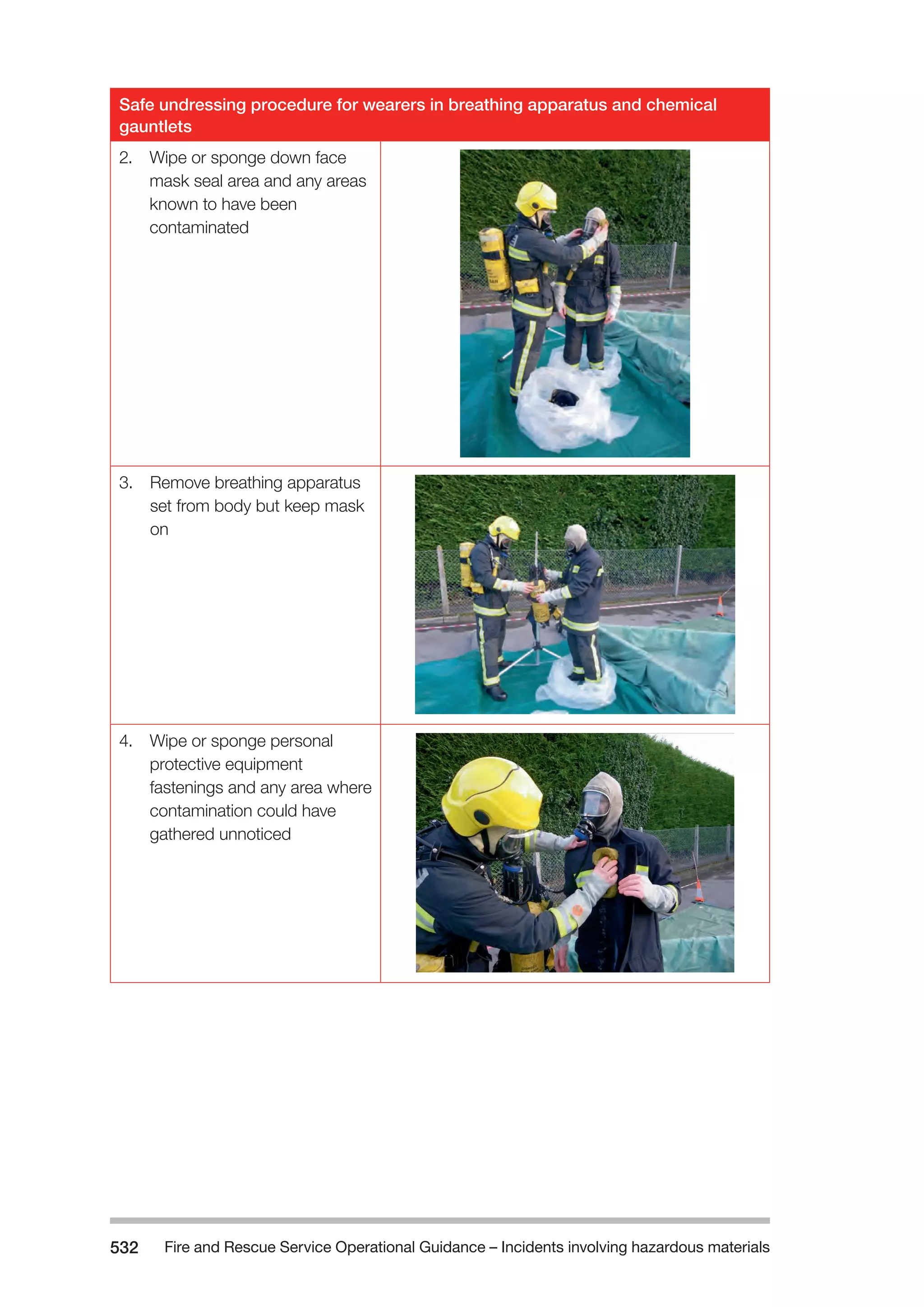
the predicted hazard zone.
Operational considerations – Generic Standard Operating Procedure 79 
2.6 Estimate the resource requirements 
NOTE: Make-up, if necessary 
a) Consider requesting Fire and Rescue Service assistance based on the information 
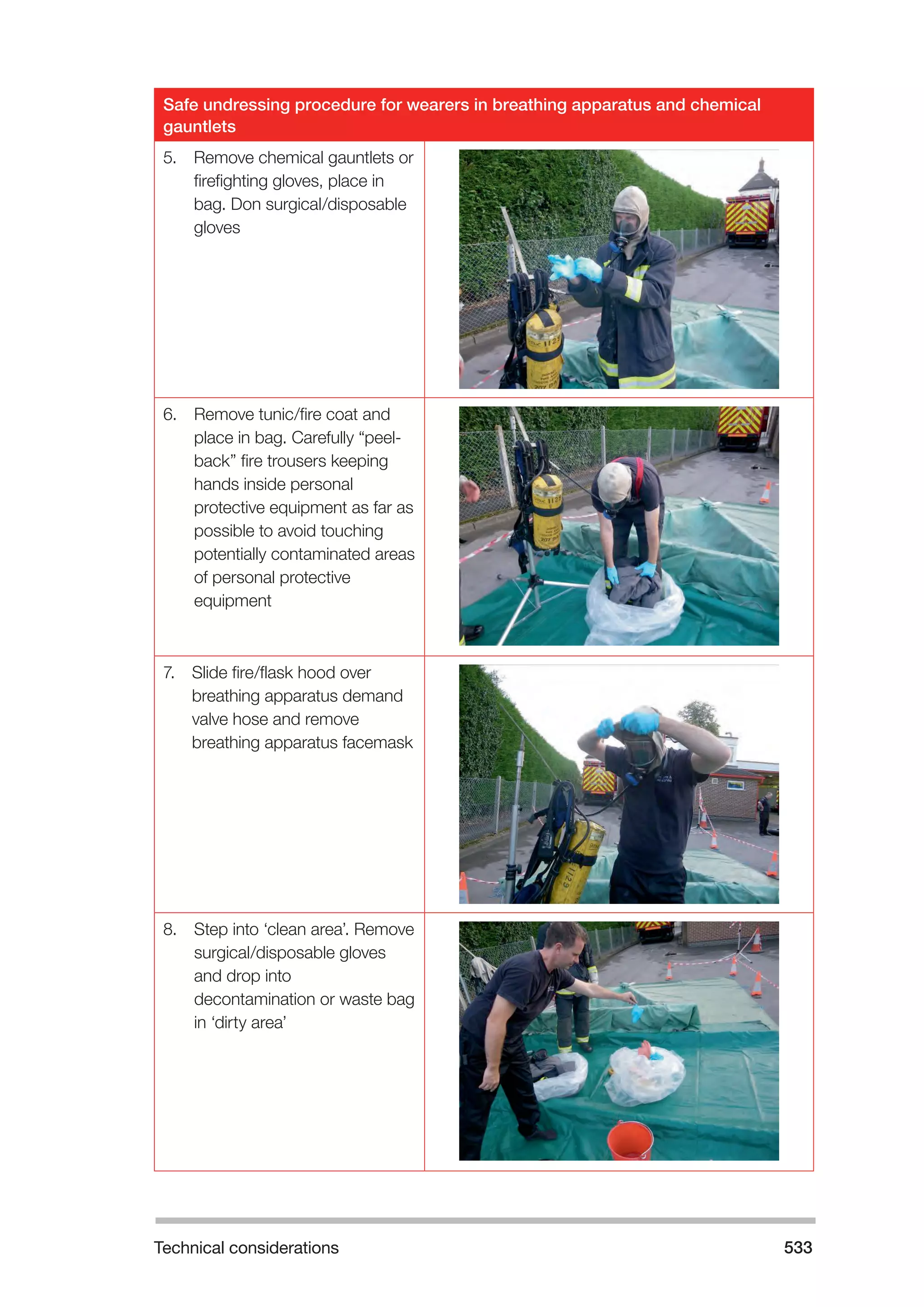
gathered and the actions already known to be required. Further assistance can be 
requested after the response plan has been formulated. 
b) Consider requesting assistance from non-Fire and Rescue Service organisations 
c) Consider declaring a ‘major incident’ which should mobilise significant Fire and 
Rescue Service and other agency resources. 
2.7 Implement the incident command system 
a) Implement the operational risk philosophy 
b) Strictly implement ‘line of command’ principle within incident command system at all 
hazardous materials incidents 
c) Implement command support and ensure it is properly resourced 
d) Limit the Incident Commandr’s spans of control 
e) Carry out effective and appropriate sectorisation 
f) Ensure that appropriately trained commanders operate in Bronze (Operational), 
Silver (Tactical) and Gold (Strategic) command roles if required, and use a 
recognised decision making model and recording system 
g) Adopt a multi-agency approach to incident resolution 
h) Designate a clean area with washing facilities for hydration and welfare.
Fire and Rescue Service Operational Guidance – Incidents 80 involving hazardous materials 
Phase 2 
Arriving and gathering information 
Action 
2.1 Approach the incident safely and establish the potential hazard zone 
Considerations 
(2.1a) Use weather information (eg Firemet) and visual indicators of wind strength 
and direction (eg wind blown tree foliage etc) to plan your approach to the 
incident from the UPWIND direction so that crews are not exposed to hazardous 
vapours, gases or particulates 
• Use local knowledge of topography and mapping systems to choose the safest 
approach road 
• Be aware of the limitations of Firemet and cross-check the information using visual 
indicators at the site 
• Always bear in mind that wind strength and direction can change. So ensure staff 
and vehicles have clear, immediately available means of egress 
• Remember built up urban environments may have the following gas cloud/plume 
dispersion characteristics (Acronym: DDOOR) 
• Deploy improvised wind monitoring devices (eg tie a number of 1-2m lengths of 
traffic/fire tape to vertical objects or suitable portable Fire and Rescue Service’ 
equipment such as lighting tripods) 
• Remember, just because you cannot see it or smell it does not mean that it is not 
there.
Operational considerations – Generic Standard Operating Procedure 81 
DDOOR 
Acronym: DDOOR – stands for downwind, dilution, obstacle, oscillation 
and retention. It serves to highlight key factors to remember when dealing 
with a hazardous release in an urban environment2. In particular the effect 
that the built environment and the wind can have on a dispersion plume. 
Operational commanders and hazardous materials advisers should 
consider these factors when developing their risk assessment and 
response plan for dealing with a hazardous material incident within an 
urban area. 
• Downwind – the largest part of the plume moves downwind, and 
becomes wider and higher 
• Dilution – the gas/vapour dilutes as it mixes with the air around it: the 
concentrations decrease downwind and at the sides and top of the 
plume 
• Obstacles – the movement of the plume is strongly influenced by 
obstacles such as buildings and other structures. Some parts of the 
plume go up and over the buildings; some parts zigzag along the 
streets in the downwind direction. The plume may quickly fill street 
‘canyons’ 
NOTE: some parts of the plume spread upwind 
• Oscillation – the plume will oscillate; its position and course will not 
remain constant but will vary over time. It will follow different routes 
downwind often in response to minor changes in environmental factors 
• Retention – some parts of the plume can be retained, and gradually 
released later, even after the source has been dealt with. 
(2.1b) If possible and safe to do so without additional personal protective 
equipment, approach the incident from higher ground (ie up-slope) especially if 
hazardous liquids are known to be present 
• It will not always be possible to approach a hazardous materials incident from higher 
ground and the upwind direction. Where it is not possible the safest approach route 
should be chosen based on the physical properties of the hazardous substance (eg 
liquids not vaporising or gassing-off – slope may be the most important factor; toxic 
gas release in windy conditions – wind direction will be the most important factor). 
(2.1c) Ensure response vehicles approach the vicinity of the incident at slow speed 
This will: 
• Enable visual assessment of scene 
NOTE: plumes, liquid spills etc 
• Reduce the probability of driving into a hazardous area 
• Avoid collisions with casualties, people escaping the release and other members of 
the public who may be attracted to the incident. 
2 For further information see the DDOOR DVD (Rex Britter, Home Office, 2007).
Fire and Rescue Service Operational Guidance – Incidents 82 involving hazardous materials 
HAZARD ZONE 
Hazard zone 
• This is an area that contains hazards to which a risk assessment 
should be applied in order to determine a suitable inner cordon 
• A hazard zone is not necessarily an ‘exclusion zone’ and would 
encompass both the ‘hot’ and ‘warm’ zones if they exist 
• An exclusion zone is an area containing hazards that have been risk 
assessed as so dangerous to health that nobody, including Fire and 
Rescue Service staff, should be allowed to enter (eg blast area around 
explosives involved in fire) 
• The hazard zone is sometimes referred to as the ‘evacuation zone’ by 
other agencies and generally means the area where they would seek 
to encourage all members of the public to leave or possibly shelter-in-place. 
(2.1d) When approaching the vicinity of the incident use senses to assess the 
‘incident-indicators’ to assist in estimating the extent of the hazard zone 
Examples of ‘incident-indicators’: 
• Gas and vapour clouds or plumes 
• Visible smoke and other signs of fire 
• Liquid spills, wet areas, patches, puddles, pools and streams/flowing liquids 
• Unexplained noise (eg explosions, venting cylinders, site specific audible warnings 
etc) may indicate a more cautious approach and lager hazard zone 
• Distinct odours (eg bleach, garlic, rotten cabbage, bad eggs etc.) If you can smell 
something out of place then you are probably too close 
• Damaged containers and packages 
• Biological indicators such as dead birds, animals, fish, insects, trees and vegetation 
• Casualties and other ‘involved people’ may physically mark the hazard zone or they 
may be able to describe it based on their experience 
• Remember the primary response protocol STEP 1-2-3 – Safety triggers for 
emergency personnel when the cause of harm to the casualties is unknown and 
there is no immediately apparent reason for their incapacity.
Operational considerations – Generic Standard Operating Procedure 83 
STEP 1 – 2 – 3 
‘STEP 1-2-3’ – Safety trigger for emergency personnel 
• STEP 1 – Single casualty, no logical explanation or cause – deploy as 
for normal collapsed casualty 
• STEP 2 – Two casualties, no logical explanation or cause – tell crews 
to approach with caution and send full informative and CHALETS 
information ASAP 
• STEP 3 – Three or more casualties, no logical explanation – should 
trigger crews not to proceed, designate a safe rendezvous point for 
further resources and Command and Control. Park at a safe distance, 
following a risk assessment by the Incident Commander. Assess the 
scene and gather more information. Do not approach the casualties 
unless their lives are at risk and effective personal protective equipment 
is worn. CHALETS information must be provided. 
NOTE: See flow chart below. 
• Complete CHALETS assessment as soon as possible. 
CHALETS 
‘CHALETS’ Assessment 
• Casualties – Approximate number of casualties dead, injured, 
uninjured, number trapped 
• Hazards – Present and potential 
• Access – Best access routes for emergency services and suitable 
provisional rendezvous point 
• Location – The exact location of the incident using map references if 
possible 
• Emergency – Emergency services present and required, consider 
attendance of hospital medical teams, specialist equipment and 
specialist services 
• Type – The type of incident with brief details of types and numbers of 
vehicles, trains, buildings, aircraft involved 
• Safety – What personal protective clothing is required and ensure you 
are in a safe area.
Fire and Rescue Service Operational Guidance – Incidents 84 involving hazardous materials 
Step 1-2-3 flow chart 
Apply STEP 123 
Are there 3 or more 
casualties with no 
apparent cause? 
No Follow 
STEP 
1 or 2 
Yes 
No 
Undertake 
Dynamic Risk 
Assessmen t 
Risks 
outweigh 
benefits 
Benefits 
outweigh 
risks 
Identify Hazards 
Control scene 
Safe arrival routes & rendezvous 
points 
Additional resource s 
CHALETS 
Disrobe 
Decontamination 
Immediate medical 
advice 
Report arrival and 
location to Contro l 
Direct ambulant 
casualties to 
place of relative 
safety 
Undertake rescu es 
Minimum staff 
Highest appropriate level 
of PPE / RPE 
Introduce 
Control 
Measures 
Communicate with public and Multi Agency respon ders 
Hazard Assessment Risk Assessment 
Yes 
Are there non-ambulant 
casualties requiring 
rescue from hazard 
area? 
Step 1-2-3 flow chart
Operational considerations – Generic Standard Operating Procedure 85 
(2.1e) Estimate the potential hazard zone, and position staff and vehicles outside it 
• Incident Commanders should work to their standard operating procedures but 
when estimating the potential hazard zone, in relation to attending and parking at 
a ‘no-notice’ incident scene, they should consider the ‘worst case foreseeable’ not 
‘worst case imaginable’ 
NOTE: This is not the initial cordoning assessment but more about establishing a 
safe parking/marshalling point. 
• At known hazardous materials risk sites 72(d) risk inspections and other pre-planning 
should have identified initial rendezvous points and/or marshalling sites. 
(2.1f) Establish command/contact point in safe location 
• Position command point vehicle in a safe area well outside the potential hazard zone 
to avoid re-positioning it during the incident 
• Maintain contact with mobilising control 
• Establish and maintain incident ground communications 
• Begin recording incident and hazard information (eg staff and appliance details, 
substance information, analytical risk assessment etc).
Fire and Rescue Service Operational Guidance – Incidents 86 involving hazardous materials 
Action 
2.2 Recognise hazards and risks from a safe location and implement an initial cordon 
WIND DIRECTION GRADIENT 
VISIBLE VAPOUR CLOUD 
PRODUCT SPILL 
INVISIBLE VAPOUR 
Wind and gradient in opposite directions 
WIND DIRECTION & GRADIENT THE SAME 
VISIBLE VAPOUR CLOUD INVISIBLE VAPOUR CLOUD 
PRODUCT SPILL
Operational considerations – Generic Standard Operating Procedure 87 
Considerations 
CORDON CONTROL 
Cordon control 
• Cordons are employed as an effective method of controlling resources 
and maintaining safety on the incident ground. They must be 
continuously monitored and adapted to reflect changes in hazards, 
weather etc 
• Cordons may be defined by a series of markers (eg cones, traffic tape, 
police, members of staff, etc) or a notional boundary (eg agreed line on 
a map, existing boundary lines or fences etc), where the boundary is 
not obvious it must be communicated to all responders 
• The Incident Commander must consider the safety of Fire and Rescue 
Service staff, the public, members of other emergency services and 
voluntary agencies attending incidents. However, it must be noted that 
overall responsibility for the health and safety of personnel working 
within cordons remains with the individual agencies. Such agencies 
should ensure that staff arriving at the site have effective personal 
protective equipment and are adequately trained and briefed for the 
work they are to undertake within the cordon. Where this is not the 
case the matter must be referred to the command level 
• At hazardous materials incidents strict cordon control is essential to 
manage the release and associated contamination issues. After the 
initial cordon has been established to secure and stabilise the site, the 
incident should be divided into two types of cordon – the inner and 
outer cordon. 
Initial cordon 
• It provides an initial means of controlling, safeguarding and 
coordinating the immediate response and adds an element of control 
to the incident. It must be flexible and be able to be moved if necessary. 
Inner cordon 
• The inner cordon surrounds the area where potentially hazardous 
activity may be conducted and encompasses both the ‘hot’ and 
‘warm’ zones. It is used to control access to the immediate scene of 
operations. Access to the area controlled by an inner cordon, which 
by definition is the hazard zone, should be restricted to the minimum 
numbers required for work to be undertaken safely and effectively. 
Outer cordon 
• The outer cordon designates the controlled area into which 
unauthorised access is not permitted. It encompasses the inner 
cordon and the ‘hot’, ‘warm’ and ‘cold’ zones. It should be established 
and maintained by the police.
Fire and Rescue Service Operational Guidance – Incidents 88 involving hazardous materials 
(2.2a) Identify the potential of the hazardous materials to cause harm to people 
by inhalation, ingestion, direct skin contact, absorption through the skin or eyes 
or entry through cuts and grazes 
• Line before identify the hazards posed by the substance (eg toxic, corrosive, 
explosive etc) 
• Identify how the substance could cause harm to people (eg inhalation, ingestion, 
direct skin contact, absorption through the skin or eyes or entry through cuts and 
grazes) 
• Determine who is at risk 
• Predict the likelihood of harm occurring 
• Estimate the severity of the harm 
• Identify or classify the hazardous materials by its hazards 
NOTE: This will be easier to do and more accurate with known substances rather 
than unknown or mixtures of substances 
• Estimate the quantities involved and quantities present at the scene 
• Recognise the hazardous material’s physical properties 
NOTE: be aware of the limitations of using the senses to determine the presence of 
hazardous materials 
• Identify the potential for chemical reactions (eg release of energy, heat, light, 
explosion etc) 
• Identify the location of substance (eg inside or outside buildings, degree of 
packaging/containment, proximity to populated buildings etc) 
• Ascertain the likelihood of containers rupturing if heated or subjected to an internal 
reaction 
• Review the available pre-planning information, operational intelligence and ‘incident-indicator’ 
information to identify other significant hazards 
• Identify typical occupancies and locations at the incident where hazardous materials 
are manufactured, transported, stored, used or disposed of 
• Identify the primary hazards associated with the United Nations’ hazard class and 
division of the hazardous materials present 
• Identify and use transportation documents and material safety data sheets 
• Recognise typical containers, and their hazards, generally used to store/transport 
hazardous materials (see Part C for further information – Transportation and storage 
section if necessary) 
• Recognise typical hazardous materials packages by type (see Part C for further 
information)
Operational considerations – Generic Standard Operating Procedure 89 
• Identify site and transportation markings that indicate hazardous materials, including 
the markings, labels and placards provided under: 
–– United Nations systems (United Nations hazard warning diamonds and United 
Nations numbers) 
–– United Kingdom Hazard Identification System (UKHIS) 
–– Registration, evaluation, authorisation and restriction of chemicals (REACH) 
–– Globally harmonised system (GHS) 
–– European Agreements concerning the International Carriage of Dangerous 
Goods by Road, by Rail and by Inland Waterways (ADR, RID or ADN) 
–– International Maritime Dangerous Goods (IMDG) code 
–– Air transport container markings 
–– Biohazard package markings 
–– Chemicals (Hazard Information and Packaging for Supply) Regulations (CHIP) 
–– Classification, Labelling and Packaging of Substances and Mixtures (CLP) 
Regulations 
–– Dangerous Substances (Notification and Marking of Sites) Regulations (NAMOS) 
–– Military hazardous materials systems 
–– Pipeline regulations 
NOTE: The Incident Commander and hazardous materials adviser should always 
consider the possibility of incorrect, inaccurate, missing or misleading information 
being gathered on the hazardous materials. Where ever possible ‘triangulation of 
information’ should be gained, this means trying to ensure that at least three sources 
are used to verify critical assumptions/decisions. 
(2.2b) Identify the potential of the hazardous materials to cause harm to property 
and the environment 
Consider: 
• The proximity of drains and sewers and the presence/absence of any pollution 
control facilities 
• Proximity and sensitivity of groundwater aquifers, rivers, reservoirs and other water 
sources used for drinking water and other uses 
• Proximity to flora and fauna (eg environmental protected sites such as sites of 
special scientific interest) 
• Fire and cooling run-off water, including fire fighting foam use. Are there firewater 
containment facilities available 
• Soil contamination (eg Is there unmade ground?) 
• Non-hazardous substances to humans which can damage specific environments 
(eg milk spillage running into fisheries etc).
Fire and Rescue Service Operational Guidance – Incidents 90 involving hazardous materials 
(2.2c) Recognise any additional hazards 
Consider: 
• Fire, including actual and potential ignition sources 
• Working at height 
• Manual handling 
• Heat exhaustion for staff wearing enhanced personal protective equipment 
• Effects of fire, heating, cooling, water sprays etc on specialised hazardous materials 
containment systems 
• Criminal or terrorist activity, including secondary devices. 
Wind direction 
Hot zone 
Warm zone 
Cold zone 
Inner cordon 
Outer cordon
Operational considerations – Generic Standard Operating Procedure 91 
HOT, WARM AND COLD ZONES 
Hot zone 
• This is the contaminated area(s) where the initial release occurs or 
disperses to. It will be the area likely to pose an immediate threat to the 
health and safety of all those located within it and is the area of greatest 
risk 
• It is located within the inner cordon and is part of the hazard zone 
• Effective personal protective equipment is required when working within 
the ‘hot’ zone. Each emergency service has differing specifications for 
personal protective equipment and will decide on the appropriateness of 
their own personal protective equipment. The effectiveness of each type 
of personal protective equipment for the ‘hot’ zone depends on the type 
and concentration of the contaminant. Any decisions made should be 
based on a hazard assessment 
• There may be more than one area of release and therefore more than 
one ‘hot’ zone. Where possible all ‘hot’ zones should be encompassed 
within a single inner cordon. Where this is not possible for reasons such 
as scale, location, topography etc the establishment of two or more 
inner cordons should be considered. This may necessitate treating the 
cordoned areas as separate incidents with distinct command structures. 
This is potentially more likely at CBRN(E) events rather than hazardous 
materials incidents. 
Warm zone 
• This is the area uncontaminated by the initial release of a substance, 
which may become contaminated by the movement of people or vehicles 
• It is surrounded by the inner cordon and is part of the hazard zone but 
usually contains lower risks than the ‘hot’ zone 
• In the initial stages of an incident, the movement of contamination from the 
‘hot’ zone to the warm zone will be uncontrolled. As soon as practicable, 
the warm zone will be managed and controlled by emergency responders 
wearing appropriate personal protective equipment 
• The ‘warm’ zone will later be extended to include the managed area 
encompassing decontamination. This extended section of the ‘warm’ 
zone will be termed the decontamination area 
• At small scale, low risk, low complexity hazardous materials incidents 
‘warm’ zones may not exist. Responders should not designate them if 
there is no benefit from doing so. 
Cold zone 
• This is the uncontaminated area between the inner cordon and the outer 
cordon. It is the area within which key operational command positions and 
other essential activities will be set up. 
• The Police Service, in liaison with the Fire and Rescue Service and the 
Ambulance Service, should decide whether members of the public need 
to be evacuated from the ‘cold’ zone. (See diagram opposite)
Fire and Rescue Service Operational Guidance – Incidents 92 involving hazardous materials 
(2.2d) Establish an initial cordon 
• The initial cordon is temporarily established by the first wave of unprotected 
emergency responders, before any detailed scene assessment or any other 
scientific analysis has been conducted. It provides an initial means of facilitating 
(controlling, safeguarding and coordinating) the immediate response and adds an 
element of control to the incident 
• The initial cordon must be flexible and be able to be moved if necessary 
• The initial cordon is an immediate precautionary measure and must be formed in a 
position of safety. Unprotected responders must never be deliberately deployed to 
a position where ‘contamination’ is suspected. However, it should be considered as 
enclosing a ‘potential hazard’ zone rather than an ‘exclusion’ zone. Only responders 
who have been briefed and equipped to deal with the hazards should be allowed to 
operate within it. Certain extremely high-risk incidents will require the establishment of 
an ‘exclusion’ zone in addition to the initial cordon (eg explosives involved in fire etc) 
• Given the limited number of resources available in the early stages, it may 
be impracticable to position cordon staff around the entire 360º of the event. 
Commanders should initially aim, as far as practicable, to create an arc of 
containment of 90º either side of the upwind meridian. This is essential to protect 
responders and to prevent decontamination areas from being compromised by 
either the release or contaminated casualties 
• Where the hazardous materials involved are toxic by inhalation it may be necessary 
to extend the initial cordon in the downwind direction to protect people from 
vapours, gases or dusts (NOTE: solids/liquids which produce toxic gases upon 
contact with water). The initial cordon should enclose the area in which persons 
may become incapacitated and unable to take protective action and/or incur serious 
or irreversible acute health effects. Areas where non-acute or possibly longer-term 
health risks may be present should be designated and dealt with by the Health 
Protection Agency. 
• The initial cordon must be communicated to all first responders especially on-coming 
response vehicle drivers 
• Use generic initial cordon distances as a basis for further risk assessment (eg 
Chemdata initial isolation distances, Emergency Response Guidebook, IAEA Manual 
for first responders to a Radiological Emergency, Manufacture and Storage of 
Explosives Regs. etc) 
• Public Safety Hazard – An ‘E’ following the first two characters of an emergency 
action code (EAC) indicates that there may be an public safety hazard outside the 
immediate area of the incident, and that the following actions should be considered: 
–– People should be warned to stay indoors with all doors and windows closed, 
preferable in upstairs rooms facing away from the incident. They should eliminate 
all ignition sources and stop any ventilation 
–– Effects may spread beyond the immediate vicinity. All non-essential staff should 
be instructed to move at least 250m away from the incident 
–– Police and Fire and Rescue Service Incident Commanders should consult with 
each other and with a product expert or a source of product expertise 
–– The possible need for subsequent public evacuation should be considered, but it 
should be remembered in most cases it will be safer to remain in a building 
than to evacuate.
Operational considerations – Generic Standard Operating Procedure 93 
GENERIC INITIAL CORDON DISTANCES 
NOTE: Continuous risk assessment should be carried out to ensure that the 
cordon remains appropriate and proportionate to the risks identified by the 
Incident Commander. 
Incident type (if known) Initial cordon distance (metres radius) 
Explosives – manufacture, 
storage, transport 
(NOTE: Pre-planning for 
known sites should include 
rendezvous points at safe 
distances) 
(see Part C-4) 
100m for transport incident HD 1.4 
200m for transport incident HD 1.3 
600m transport HD 1.1, HD 1.2 and HD 1.5 (or 
when HD is not known) 
100m for registered premises (fireworks only) 
200m for incidents at other registered premises 
600m for incidents involving licensed storage 
(under 2000kg) 
1000m for incidents involving licensed storage 
(more than 2000kg) 
Explosives – CBRN(E), terrorist 
(*Consider no Fire and Rescue 
Service attendance or treat as 
EXCLUSION distances for Fire 
and Rescue Service staff, take 
guidance from police and 
explosive ordnance specialists) 
100m for an activated device 
Unexploded devices:* 
100m for a suitcase size device 
200m for a car size device 
400m for a lorry (or when size of device is not 
known) 
Cylinders involved in fire 
NOTE: shielding may reduce 
distances 
(see Part C-5) 
Fireball up to 25m 
Cylinder may be thrown up to 150m 
Flying fragments up to 200m 
Chemical or biological Due to the diverse range of incidents likely to be 
encountered it is not possible to set a single 
initial cordon distance. 
Radiation 
(see Part C-10) 
Outside buildings 
45m – unshielded or damaged potentially 
dangerous source 
100m – Major spill from a potentially dangerous 
source 
300m – fire, explosion or fumes involving a 
potentially dangerous source 
400m or more to protect against an explosion 
– Suspected bomb (exploded or unexploded) 
Inside buildings 
Affected and adjacent areas (including the floor 
above and below) – Damage, loss of shielding or 
spill of a potentially dangerous source 
Entire building and outside distances detailed 
above – fire or other event that can spread a 
potentially dangerous source materials 
throughout the building (eg through the 
ventilation system).
Fire and Rescue Service Operational Guidance – Incidents 94 involving hazardous materials 
Operational key 
principle 
Explosives known to be involved in fire 
If explosives are known to be involved in fire then Initial Cordon distances 
should be treated as exclusion zones (ie nobody, including Fire and Rescue 
Service staff, allowed within the cordon). 
Action 
2.3 Liaise with persons on and off site 
Considerations 
(2.3a) Gather information about the emergency or accident from witnesses 
Consider: 
• Site staff 
• Driver 
• Eye witnesses (members of public) 
• Document/record information gained from witnesses. 
(2.3b) Liaise with other persons/agencies to gain specific knowledge about the 
event, substance, site, process, treatment of casualties or containment system 
Consider: 
• Fire and Rescue Service hazardous materials adviser 
• Detection, identification and monitoring (DIM) advisers 
• Fire and Rescue Service CBRN(E) subject matter advisors 
• Independent scientific advisers 
• Site experts or technical advisers 
• National Chemical Emergency Centre 
• Chemical industry emergency responders and mutual aid schemes (eg Chemsafe, 
Radsafe, Chloraid, Bromaid etc) 
• Environment Agency staff 
• Water undertakers representatives 
• Health Protection Agency officers 
• Port or harbour authorities 
• Other emergency services and specialist military assets (eg EOD etc) 
• Site and company experts/technical advisers 
• Local authority emergency planning departments and local resilience forums 
NOTE: Ascertain information on any relevant history of problems, failures, releases, 
similar events etc.
Operational considerations – Generic Standard Operating Procedure 95 
Action 
2.4 Consider the immediate life risk 
NOTE: ‘Immediate life risk’ means – immediate human life saving rescues; 
immediate evacuation to prevent serious injury; prevention of catastrophic 
escalation likely to endanger life. 
Considerations 
(2.4a) Assess any immediate life-saving rescues (NOTE: STEP 1-2-3) 
Consider: 
• Number, location and degree of entrapment of casualties 
• Whether conscious, unconscious, obviously dead 
• Likelihood/degree of contamination of casualties 
• Ability to survive if not rescued immediately 
• Known or apparent hazards from the emergency/accident 
• Known or apparent physical properties of the hazardous materials 
• Apparent fire/explosion risk 
• Additional hazards (eg mechanical processes, manual handling, working at height 
etc) 
NOTE: STEP 1-2-3. 
(2.4b) Consider effective control measures 
• Incident Commander should survey the area around the casualties and take regard 
of any emergency action codes and additional personal protection codes (see 
Part C-3, Transportation, packaging and supply of hazardous materials, for further 
information) 
• Structural firefighting kit, gloves, fire-hood and self-contained breathing apparatus 
should be the minimum level of personal protective equipment 
• Use higher levels of chemical personal protective equipment if substance is 
obviously hazardous, the likelihood of contamination is high; and/or the time taken 
to rig is proportionate to the casualty’s condition/survivability 
• Approach from up-wind and up-slope whenever possible 
• Avoid or minimise contact with hazardous materials 
• Minimise exposure time in the hazard zone 
• Designate the safest access route to minimise the probability of contaminating the 
rescuers 
• Effective decontamination and safe undressing procedures for the rescuers (see 
Part C-15, Decontamination, for further information)
Fire and Rescue Service Operational Guidance – Incidents 96 involving hazardous materials 
• Improvised, interim or clinical decontamination for the casualties (see Part C-15, 
Decontamination, for further information) 
• Use minimum number of rescuers, if possible limit the number of rescuers directly 
contacting any hazardous materials or casualties 
• Incident Commander must give a specific safety brief to the rescuers detailing the: 
–– likely hazards 
–– actions to be taken 
–– safe access and egress routes 
–– time limit of deployment 
–– team leader and lead rescuer 
–– location of inner cordon and casualty hand-over area 
–– decontamination/safe undressing procedure. 
• If there are unacceptable risks, delay rescues until the hazards are controlled 
possibly by increased level of personal protective equipment. 
(2.4c) Carry out rescues 
Immediate life-saving rescues should be carried out if benefits outweigh the risk of harm 
to the rescuers. 
(2.4d) Assess the need for any immediate evacuation 
• Identify the inner cordon and the numbers of people (a) already exposed (b) 
potentially at risk 
• Consider the realistic potential for the hazardous materials to spread whilst the 
response plan is being implemented 
NOTE: Dangers from the hazardous materials; weather conditions; physical 
properties; rates of dispersion; potential risk of escalation/explosion etc 
• Assess ‘sheltering in place’ as an alternative to evacuation, factors: 
–– health risks posed by the hazardous materials 
–– size of the affected area 
–– construction of buildings 
–– time of day 
–– number/condition/age of occupants 
–– weather conditions 
–– availability of safe and suitable accommodation 
–– availability of responders 
–– numbers of staff and other agencies required to carry out the evacuation
Operational considerations – Generic Standard Operating Procedure 97 
–– risk to responders carrying out the evacuation 
NOTE: Respiratory personal equipment and personal protective equipment 
–– communicating the evacuation (eg fixed alarm system, responders with 
megaphones, door knocking, avoiding panic, radio and TV announcements etc) 
–– safe holding area required for members of the public being evacuated or 
dispersal plan. 
(2.4e) Assess the likelihood of a catastrophe occurring 
Consider: 
• Multiple casualties or fatalities on arrival 
• Large scale fire or explosion(s) threatening populated areas, or, safety critical 
systems, storage or processing units 
• Imminent large scale explosion, fire or hazardous materials release into a populated 
area 
• Imminent large scale release into sensitive environments (eg drinking water 
sources, etc) 
• Declare ‘major incident’ if necessary. 
Action 
2.5 Identify the problem and the likely impact 
Considerations 
(2.5a) Carry out full survey of the incident ground 
• Joint survey with the ‘responsible person’ 
• Access, or carry out, a full hazardous materials inventory of the incident ground (ie 
find out what hazardous materials are there and what’s actually involved or likely to 
be involved) 
• Locate where the release(s) is coming from 
• Identify site containment information (eg drainage, sewerage, interceptors etc) 
• Draw up/acquire a site layout plan and annotate with all relevant information 
• Identify if deliberate reconnaissance within the inner cordon is necessary, if it is it will 
need to feature in the response plan. 
(2.5b) Retrieve and interpret hazard and incident information 
Possible sources include: 
• Emergency Response Guidebook 
• Placarding and signage eg: 
–– United Nations hazard warning labels
Fire and Rescue Service Operational Guidance – Incidents 98 involving hazardous materials 
–– United Kingdom Hazard Information System 
–– European Agreement concerning the International Carriage of Dangerous Goods 
by Road (ADR) 
–– European Agreement concerning the International Carriage of Dangerous Goods 
by Inland Waterways (ADN) 
–– The European Agreement concerning the International Carriage of Dangerous 
Goods by Road and by Rail (ADR/RID) 
–– Chemicals (Hazard Information and Packaging for Supply) Regulations 2009 
(CHIP) 
–– Classification Labelling Pancaking (CLP) 
–– Notification and Marking of Sites (NAMOS) 
–– International Maritime Dangerous Goods code, etc 
• Dangerous Goods Emergency Action Code 
• Technical reference databases, manuals, hazardous materials lists and other 
sources (eg Chemdata, Cirus etc) 
• Scientific support and technical information specialists (eg Scientific advisers, DSTL, 
County Chemists, Bureau Veritas etc) 
• Specific emergency response agencies (eg Chemsafe, Radsafe, Chloraid, Bromaid, 
NAIR, Health Protection Agency-poisons) 
• Fire and Rescue Service Detection, Identification and Monitoring teams 
• Material safety data sheets (MSDS) 
• EH40 Workplace Exposure Limits 
• Transportation documents 
• Hazchem Emergency Response Service (HERS). 
(2.5c) Assess the condition of damaged hazardous materials containment systems 
Consider: 
• Construction and operation of road, rail and other transport containers 
• Construction and use of fixed storage tanks 
• Construction and operation of intermediate bulk containers 
• Pressurised containers are inherently higher risk than non-pressurised 
• Type of stressors involved (eg direct flame impingement, heat, cold, chemical, 
mechanical, shock, friction etc) 
• Ability of the container to tolerate the stresses upon it 
• Identify if deliberate reconnaissance within the inner cordon is necessary, if it is it will 
need to feature in the response plan.
Operational considerations – Generic Standard Operating Procedure 99 
(2.5d) Predict the likely behaviour of the hazardous materials involved 
• The more complex the incident, the higher the level of knowledge required to 
perform this task 
• Consult product and process specialists 
Consider: 
• Physical and chemical properties 
• Quantity, concentration, release rate and surface area 
• Weather/ambient conditions 
• Fire/explosion risk 
• Topography and site layout (eg slopes, spacing of tanks) 
• Method of containment 
• Will containment system cope? 
• Beware mixtures of hazardous materials 
• Combinations of additional hazards. 
(2.5e) Estimate the size of the endangered area 
• The more complex the incident, the higher the level of knowledge required to 
perform this task 
• Consult product and process specialists 
• Predict dispersal pattern 
NOTE: Downwind, dilution, obstacle, oscillation and retention (DDOOR) guidance in 
urban areas; Chemet plume predictions; high risk sites may have fixed or 
transportable monitoring equipment; Environment Agency provide a mobile air 
monitoring response service etc 
• Quantity, concentration, release rate and surface area 
• Weather, likelihood of change 
• Fire/explosion risk 
• Emergency Response Guidebook and Chemdata guidance 
NOTE: Isolation distances for significant releases 
• Identify the hazard zone. 
(2.5f) Estimate the potential harm/impact 
• The more complex the incident, the higher the level of knowledge required to 
perform this task 
• Consult product and process specialists 
• Worst case foreseeable not worst case imaginable
Fire and Rescue Service Operational Guidance – Incidents 100 involving hazardous materials 
• Determine: 
–– Who will be affected and what will happen to them? 
–– What property will be damaged or lost and how will this affect production, 
services and transportation? 
–– How will the land and air be affected? 
–– How will the water resources be affected? 
NOTE: Consider both drinking water/other abstractions and impact on fisheries/ 
aquatic and fauna and flora 
–– How long will the emergency last? 
–– How long will it take to recover from the incident? 
–– Can the financial cost be estimated? 
• Explosion hazards 
• Fire/flammable hazards 
• Cryogenic hazards 
• Water reactive hazards 
• Other chemical reactive hazards (eg oxidisation, toxicity, corrosivity) 
• Biological hazards 
• Radiological hazards 
NOTE: Contamination and irradiation risks 
• Asphyxiant hazards 
• Carcinogenic hazards 
• Mechanical hazards 
• Electrical hazards 
• Physical and ergonomical hazards 
• Contamination – casualties, responders, property and the environment 
• Secondary contamination 
• Acute and chronic effects of substances 
• Environmental toxicity/persistence. 
(2.5g) Review the position of the initial cordon with regard to the information 
gathered and the predicted hazard zone 
• Is the cordon too close due to changing weather conditions, escalation of the 
emergency/accident and/or greater knowledge of the hazards? 
• Is the cordon too far away? This may be because; the initial cordon was ‘precautionary’ 
and further information has been gathered; the call was a false alarm; the ‘responsible 
persons’ or other agencies have dealt with the emergency/accident etc 
• Only move the cordon at this stage if safety is compromised.
Operational considerations – Generic Standard Operating Procedure 101 
Action 
2.6 Estimate the resource requirements 
Considerations 
(2.6a) Consider requesting Fire and Rescue Service assistance based on the 
information gathered and the actions already known to be required. Further 
assistance can be requested after the response plan has been formulated. 
Consider: 
• Numbers of casualties/rescues 
NOTE: Mass decontamination 
• Scene safety and safety officers 
• Cordoning and possible evacuation 
• Need for specialist hazardous materials advice 
• Future need for deliberate reconnaissance. 
Estimate: 
• Number of firefighters required 
• Number and level of command roles required 
• Number and level of hazardous materials specialists 
• Additional personal protective equipment requirements 
• Type and amount of decontamination equipment and competent staff 
NOTE: NRAT Mass Decontamination Mobilising Model Guidance document 
• Amount of firefighting foam 
• Type and amount of neutralising agent, absorbent, over-size containers, drain seals 
and other pollution control equipment held by Fire and Rescue Services 
• Detection, identification and monitoring units required? 
(2.6b) Consider requesting assistance from non Fire and Rescue Service 
organisations 
Consider: 
• Police for outer cordoning requirements 
NOTE: Inner cordon at CBRN(E) events 
• Specialist hazardous materials, scientific or process advice 
• Environment Agency and Water / Sewerage Undertakers 
• Risk to public health (eg local authority environmental health department, Health 
Protection Agency etc)
Fire and Rescue Service Operational Guidance – Incidents 102 involving hazardous materials 
• Industry led response/advice schemes (eg Chemsafe, Radsafe, Chloraid, NAIR etc) 
• Specialist waste disposal assistance 
NOTE: Ensure this is requested through the consigner/owner/occupier or responsible 
authority so that the Fire and Rescue Service does not become liable for the costs 
• Type and amount of neutralising agent, absorbent, chemical containers, other 
pollution control equipment. 
(2.6c) Consider declaring a ‘major incident’ which should mobilise significant Fire 
and Rescue Service and other agency resources 
Individual Fire and Rescue Services should assess their local risks in conjunction with 
their local resilience forum partners to develop appropriate and proportionate ‘major 
incident’ triggers and procedures. 
Action 
2.7 Implement the incident command system 
Considerations 
(2.7a) Implement the operational risk philosophy 
Operational key 
principle 
Operational risk philosophy 
• The benefits of proceeding with a task must be weighed carefully 
against the risks 
• It is important to think before you act, rather than, act before you 
think. 
(2.7b) Strictly implement ‘line of command’ principle within incident command 
system at all hazardous materials incidents 
Operational key principle 
Line of command principle 
• All commanders must know who they are responsible for 
• All staff must know who they report to 
• All staff must know what their operational brief is. 
The incident command system relies upon a single unified command line. 
With the exception of urgent safety related issues staff should not take 
control of operations outside their assigned responsibility and should 
ensure all information and instruction is passed via the relevant command 
line officers.
Operational considerations – Generic Standard Operating Procedure 103 
(2.7c) Implement command support and ensure it is properly resourced 
• Accurate information exchange and communication is required between command 
support and the mobilising centre 
• Good incident ground communications are essential 
NOTE: Multi-agency communications (eg Airwave interoperable channels etc) 
• Maintain accurate records of all staff in the ‘cold’, ‘warm’ and ‘hot’ zones as well as 
any exposure to hazardous materials. 
(2.7d) Limit the Incident Commander’s spans of control 
• The span of control for tactical command roles should be as narrow as possible 
• Limit to a maximum of five lines of direct communications 
• Reduce lines of direct communication to three or four in high-risk, complex, 
significant or developing situations. 
(2.7e) Carry out effective and appropriate sectorisation 
• Ensure the degree of sectorisation is appropriate to the size and complexity of the 
incident 
• Incidents are best managed if they are kept as simple as possible 
• Beware of over complicating simple hazardous materials incidents or under 
sectorising complex incidents 
• Limiting spans of control to ensure the close monitoring of staff and safety, is the key 
to effective sectorisation and delegation of responsibility 
• Significant hazardous materials incidents are more likely to require the following 
functional or support sectors: 
Marshalling 
NOTE: Must be pre-planned for known risks – level 3 
Hazardous materials information 
NOTE: Designate responsibility for collating and interpreting information to a 
dedicated competent person possibly supported by a team, remember it may be 
necessary to have an off-scene hazardous materials specialist as well as on-scene 
Decontamination 
NOTE: Mass decontamination sector(s) 
Logistics 
NOTE: Chemical protective clothing requirements, high turn-over and fatigue of 
breathing apparatus wearers, decontamination resources 
Welfare 
NOTE: Operating in chemical protective clothing will increase fatigue and dehydration
Fire and Rescue Service Operational Guidance – Incidents 104 involving hazardous materials 
Press liaison 
NOTE: Evacuation/shelter-in-place warnings, increased need for public reassurance 
Safety 
NOTE: Ensure each working sector has a nominated safety officer with the 
necessary level of hazardous materials competence, at a large incident these may be 
coordinated through a safety sector. 
(2.7f) Ensure that appropriately trained commanders operate in Bronze 
(Operational), Silver (Tactical) and Gold (Strategic) command roles if required, 
and use a recognised decision making model 
Further comprehensive guidance on the Fire and Rescue Service incident command 
system is contained in the Fire and Rescue Manual, Volume 2 – Fire Service Operations, 
Incident Command, 3rd edition 2008. 
(2.7g) Adopt a multi-agency approach to incident resolution 
Fire and Rescue Services should work with their local resilience forum partners to 
develop, test and exercise multi-agency protocols. 
(2.7h) Designate a clean area with washing facilities for hydration and welfare 
• Ensure there is clear separation from operational areas/sectors 
• Designate a welfare officer supported by a team where necessary 
• Designate staff to monitor hand-washing and other basic hygiene requirements 
• Consider multi-agency collaboration 
• If no clean area can be established then no eating, drinking etc should be allowed 
on-site as a precaution against the risk of accidentally ingesting hazardous 
materials.
Operational considerations – Generic Standard Operating Procedure 105 
Phase 3: Planning the response 
Emergency incident response phases 
Phase 1 Mobilising and en-route 
Phase 2 Arriving and gathering information 
Phase 3 Planning the response 
Phase 4 Implementing the response 
Phase 5 Evaluating the response 
Phase 6 Closing the incident 
Summary of actions and considerations whilst 
planning the response to a hazardous materials 
incident 
DEFINITION: 
The systematic process of agreeing response objectives, risk assessing options 
and developing a sequence of actions, based on a safe system of work, to 
favourably change the situation. 
Phase 3 
Planning the response 
summary 
• Think 
• Prioritise objectives 
• Plan 
3.1 Identify the objectives 
a) Identify any on-going risks to people from the hazardous materials following the 
initial assessment (ie those not controlled during the reactive period of the incident) 
Set any human rescues as a critical-priority objective 
b) Identify any fires or fire risks. Set firefighting as a high-priority objective due to the 
Fire and Rescue Service’s responsibilities under the Fire and Rescue Services Act 
2004 
c) Identify property that can be saved and also property that is already lost 
d) Identify the extent of environmental harm and the potential for intervention 
e) Agree and prioritise the objectives in consultation with the relevant agencies/people.
Fire and Rescue Service Operational Guidance – Incidents 106 involving hazardous materials 
3.2 Develop a response plan with specialist advisers and other agencies 
a) Identify the options to achieve the objectives 
b) Risk assess the options and select the best course of action 
c) Develop the response plan 
d) Identify the tactical mode 
e) Ensure there is sign-up to the response plan from other emergency services, other 
statutory authorities, responsible persons, site operators, land owners, specialist 
commercial responders, waste contractors, local resilience forum, military etc where 
this practicable. 
3.3 Identify the level and type of personal protective equipment required 
a) Assess the tasks and associated hazards 
b) Select the most effective personal protective equipment 
c Select the most appropriate/capable staff. 
3.4 Identify effective decontamination procedures 
a) Establish the responsibilities of the Fire and Rescue Service for decontamination 
b) Assess the hazards posed by the hazardous materials, the site and the tasks being 
carried out, then select the most effective type of decontamination 
c) Identify the resources and procedures required for decontamination 
d) Identify procedures and precautions to deal with any decontamination run-off to 
prevent or minimise environmental pollution. 
Phase 3 Planning the response 
Action 
3.1 Identify the objectives 
Considerations 
(3.1a) Identify any on-going risks to people from the hazardous materials 
following the initial assessment (ie those not controlled during the reactive period 
of the incident). Set any human rescues as a critical priority objective 
• Are all persons accounted for? 
• Are Initial cordons in place and effective? 
• Has everyone been evacuated within the hot and warm zones? 
• Review any decision to ask people to shelter in place 
• What can be achieved with current levels of Fire and Rescue Service resources 
• What can be achieved with additional Fire and Rescue Service and specialist 
resources.
Operational considerations – Generic Standard Operating Procedure 107 
(3.1b) Identify any fires or fire risks. Set firefighting as a high-priority objective 
due to the Fire and Rescue Service’s responsibilities under the Fire and Rescue 
Services Act 2004 
Consider: 
• Extinguish fire if safe to do so 
• Cool and protect exposure risks 
• Protect un-ignited fire risks and control ignition sources 
• Control water run-off 
• Current levels of Fire and Rescue Service resources 
• Additional Fire and Rescue Service and specialist resources. 
(3.1c) Identify property that can be saved and also property that is already lost 
Consider: 
• Current levels of Fire and Rescue Service resources 
• Additional Fire and Rescue Service and specialist resources 
• Cost of interventions. 
(3.1d) Identify the extent of environmental harm and the potential for intervention 
Consider: 
• Proximity of drains and sewers and the presence/absence of any pollution control 
facilities 
• Proximity and sensitivity of groundwater aquifer, rivers, reservoirs and other water 
sources used for drinking water and other uses 
• Proximity to flora and fauna 
• Proximity of national parks, sites of special scientific interest, conservation areas and 
other protected sites 
• Soil contamination and recovery periods 
• Hierarchy of pollution control (Part C-16) 
• Costs of interventions 
NOTE: Liaise with Environment Agency, water company and site operator if 
cooperative over cost recovery from the polluter.
Fire and Rescue Service Operational Guidance – Incidents 108 involving hazardous materials 
(3.1e) Agree and prioritise the objectives in consultation with the relevant 
agencies/people 
Consider: 
• Achieving the best result for the most people 
• Fire and Rescue Service hazardous materials adviser’s assessment 
• Responsible authorities’ priorities 
• Owners/occupiers’ priorities 
• Consigners priorities. 
Action 
3.2 Develop a response plan with specialist advisers and other agencies 
Considerations 
(3.2a) Identify the options to achieve the objectives 
• Use multi-agency approach to identify all options to achieve the objectives and 
resolve the incident, unless there are time-critical priorities 
• For known hazardous materials risk sites, always consider implementing the pre-planned 
response but check it is relevant to the specific objectives 
• NOTE: There will usually be more than one way to resolve the incident, that is: 
–– Do nothing – always consider this option with regard to Fire and Rescue Service 
involvement especially if the risks to responders are high. Ask the questions – Is 
it an emergency? Is it the Fire and Rescue Service’s responsibility? Should the 
‘responsible person’, organisation or authority employ a specialist contractor? 
–– Defensive containment – ie, Can the incident be resolved without committing staff 
to the hazard zone? eg valving-down, remote isolation, controlled burn etc 
–– Offensive action – ie, proactive containment, leak sealing, decanting, dilution, etc. 
(3.2b) Risk assess the options and select the best course of action 
Consider: 
• Identify the significant hazards 
• Determine who is at risk 
• Predict the likelihood of harm occurring 
• Estimate the severity of the harm 
• Choose the option that appears to deliver the most benefit for the least risk/cost.
Operational considerations – Generic Standard Operating Procedure 109 
(3.2c) Develop the response plan 
Develop a sequence of actions with risk control measures appropriate to the complexity 
of the incident, consider: 
• Scene assessment, control and management 
• Rescues, evacuation/shelter in place 
• Emergency control of any release, spill or leak 
• Deliberate reconnaissance 
• Mass decontamination 
• Release, spill or leak containment 
• Environmental protection 
• Investigation and evidence gathering 
• Responder decontamination 
• Fire and Rescue Service equipment cleaning/removal 
• Hand-over and Fire and Rescue Service closure 
• Clean-up. 
Ensure the response plan covers both on-site and off-site actions if the scale warrants it: 
• Identify people and agencies that may provide additional advice and assistance 
• Agree on-site accountability 
• Agree off-site accountability 
NOTE: Mutual aid, secondary notifications, press releases, recovery tasks, etc) 
• Establish protective actions for the public (ie shelter-in-place v evacuation) 
• Inner cordon (‘hot’ and ‘warm’ zones) 
• Outer cordon (‘cold’ zone) 
• Casualty assessment and treatment 
• Rest centres for evacuees 
• Responder welfare 
• Operational level hazard control measures 
(see ‘actions’ below for level of personal protective equipment and decontamination) 
• Tactical level hazard control measures 
• Environmental protection action and pollution control 
• Environmental monitoring 
• Agree a public information and notification strategy and who is responsible for 
leading and coordinating it
Fire and Rescue Service Operational Guidance – Incidents 110 involving hazardous materials 
• Law enforcement, on-scene security and potential crime scene issues (eg evidence 
collection and handling etc) 
• Minimise disruption to the community 
• Record the plan and the rationale behind it 
NOTE: Complete the incident command system analytical risk assessment 
• Traffic control. 
(3.2d) Identify the tactical mode 
Consider: 
• Offensive 
• Defensive 
• Transitional. 
(3.2e) Ensure there is sign-up to the response plan from other emergency 
services, other statutory authorities, responsible persons, site operators, land 
owners, specialist commercial responders, waste contractors, local resilience 
forum, military etc, where this is practicable 
• If necessary, due to the scale of the emergency, seek acceptance of the plan from 
Strategic Coordinating Group (Gold) and/or Fire Gold Command 
• Agree protocols for dealing with major or significant incidents through local resilience 
forums. 
Action 
3.3 Identify the level and type of personal protective equipment required 
Considerations 
(3.3a) Assess the tasks and associated hazards 
• Physical properties (eg vapour, liquid, solid etc) 
• Will the physical properties change and affect the contamination of the responders? 
(eg changes in ambient temperatures – if gas tight suit wearers move from a very 
cold environment into a warm one, condensation may occur leading to a liquid 
hazard rather than a vapour) 
• Concentration, temperature or potency of the hazardous materials 
• Degree of contact with the hazardous materials 
• Duration of contact with the hazardous materials 
• Complexity of the tasks 
• Degree of strength, physical effort required 
• Likelihood of heat stress
Operational considerations – Generic Standard Operating Procedure 111 
• Manual handling risks 
• Working at height risks 
• Working conditions 
(eg hot/cold, light/dark, in the open/in a building, firm/level ground versus slippery/ 
uneven ground etc). 
(3.3b) Select the most effective personal protective equipment 
Consider: 
• Dust/particle masks or respirators and eye protection 
• Powered respirator protective suits 
• Self contained breathing apparatus 
• Structural firefighting kit 
• Chemical resistant gauntlets 
• Splash suits 
• Liquid tight suits 
• Gas tight suits. 
(see Part C-14, for further information.) 
(3.3c) Select the most appropriate/capable staff 
Consider: 
• Competence in hazardous materials operations 
• Experience in hazardous materials operations 
• Size (eg entry into confined spaces etc) 
• Physical condition and suitability for required operations/personal protective 
equipment 
NOTE: All staff selected to operate in enhanced personal protective equipment 
should be trained in its use and limitations.
Fire and Rescue Service Operational Guidance – Incidents 112 involving hazardous materials 
Action 
3.4 Identify effective decontamination procedures 
Considerations 
DECONTAMINATION 
Contamination 
• Contamination occurs when a substance adheres or is deposited 
on people, equipment or the environment, thereby, creating a risk of 
exposure and possible injury or harm. NOTE: Contamination does not 
automatically lead to exposure but may do 
• Alpha, beta and gamma emissions in themselves cannot cause 
contamination, although the actual source materials may be able to 
depending on their physical properties and their containment. 
Decontamination 
• Decontamination is the physical and/or chemical process of reducing 
contamination to minimise the risk of further harm occurring and to 
minimise the risk of cross contamination to a level as low as reasonably 
practicable. (NOTE: It can be started by the disrobing of clothing.) 
Exposure 
Exposure occurs when a harmful substance: 
• Enters the body through a route, for example, inhalation, ingestion, 
absorption or injection, or 
• When the body is irradiated (NOTE: Radioactive exposure does not 
automatically mean you are contaminated). 
Firefighter decontamination 
• Is the use of decontamination equipment in a planned and structured 
manner to minimise the risk of further harm occurring and cross 
contamination to a level as low as reasonably practicable. Firefighter 
decontamination may be divided into two categories, ‘initial’ and ‘full’. 
These procedures usually involve two processes. Firstly, ‘contamination 
reduction’ and then ‘safe undressing’. 
Mass decontamination 
• Is the planned and structured procedure delivered by the Fire and 
Rescue Service using purpose designed decontamination equipment 
where there are large numbers of contaminated casualties. 
Improvised decontamination 
• Is the use of an immediately available method of decontamination prior 
to the use of specialist resources.
Operational considerations – Generic Standard Operating Procedure 113 
DECONTAMINATION 
Interim decontamination 
• Is the use of standard equipment to provide a planned and structured 
decontamination process prior to the availability of purpose designed 
decontamination equipment. 
Clinical decontamination 
• Is the process where contaminated casualties are treated individually 
by trained healthcare professionals using purpose designed 
decontamination equipment. 
(3.4a) Establish the responsibilities of the Fire and Rescue Service for 
decontamination 
• Firefighter decontamination is always a requirement for the Incident Commander 
where contamination is reasonably believed to have occurred 
• Decontamination of the general public is a Health Service responsibility, usually 
carried out by the ambulance service at emergency incidents. When the ambulance 
services’ resources are unable to cope with the number of casualties, mass 
decontamination should be carried out by the Fire and Rescue Service 
NOTE: Improvised or interim decontamination in the initial stages whilst mass 
decontamination is being established may produce a more positive patient outcome 
• Clinical decontamination is the process where contaminated casualties are 
treated individually by trained healthcare professionals using purpose designed 
decontamination equipment 
• Non-firefighter responder decontamination (ie ambulance service, police, military 
etc) should be the responsibility of the respective employer, however, in certain 
emergency situations the Fire and Rescue Service may carry out this function. 
Operational key 
principle 
Availability of decontamination 
• Fire and Rescue Service staff must never be committed to ‘hot’ or 
‘warm’ zones without decontamination being available 
• The scale, level and complexity of the decontamination set-up will 
depend on the Incident Commander’s risk assessment but must be 
based on standard operating procedures. 
(3.4b) Assess the hazards posed by the hazardous materials, the scene and the 
tasks being carried out, then select the most effective type of decontamination 
Consider: 
• Physical properties 
• Risk (likelihood and severity) of potential harm to affected staff 
• Degree of contamination of staff (eg the team leader may need less decontamination 
if he/she supervised the work and did not come into contact with the substance)
Fire and Rescue Service Operational Guidance – Incidents 114 involving hazardous materials 
• Initial firefighter decontamination as opposed to full firefighter decontamination 
NOTE: 
Review the advantages and the limitations 
• Topography of scene 
• Drainage or the natural containment of the scene (eg Where will run-off drain too, or 
can/should run-off be contained on scene?) 
• Decontamination methods: 
–– physical 
–– chemical. 
• Firefighter decontamination (primary decontamination) initial or full depending on risk 
and scale of incident 
• For CBRN(E) events, the Ambulance Service must be consulted on the most 
effective form of decontamination. 
Operational key 
principle 
Decontamination 
• The outcome of decontamination is, as a minimum, to lower risk of 
harm/cross-contamination to an acceptable level, that is, as low as 
reasonably practicable 
• It is not always possible to totally remove the contaminant or clean the 
personal protective equipment on-site. 
(3.4c) Identify the resources and procedures required for decontamination 
• Cordoning and location of decontamination zone in relation to the ‘hot’ and ‘warm’ 
zones 
• Control of staff waiting to be decontaminated and the location of the holding area 
• Communication with staff in the decontamination zone 
• Resource management: 
–– staff 
–– supervision/accountability (Decontamination Officer/Sector Commander; 
Assistant Decontamination Officer; Decontamination BAECO etc) 
–– personal protective equipment 
–– respiratory protective equipment 
–– ancillary equipment 
–– water and cleaning agents 
–– maintenance of equipment 
–– management of personal effects 
NOTE: The police will be responsible for personal effects at a CBRN(E) event.
Operational considerations – Generic Standard Operating Procedure 115 
(3.4d) Identify procedures and precautions to deal with any decontamination 
run-off to prevent or minimise environmental pollution 
Further information on environmental protection is contained in Part C-16 Environmental 
protection and the Fire and Rescue Manual – Environmental Protection. 
Further detail can also be found in the Contaminated Water Protocol V2.0 developed by 
the Environment Agency, Water UK and CFOA.
Fire and Rescue Service Operational Guidance – Incidents 116 involving hazardous materials 
Phase 4: Implementing the response 
Emergency incident response phases 
Phase 1 Mobilising and en-route 
Phase 2 Arriving and gathering information 
Phase 3 Planning the response 
Phase 4 Implementing the response 
Phase 5 Evaluating the response 
Phase 6 Closing the incident 
Summary of actions and considerations whilst 
implementing the response to a hazardous 
materials incident 
DEFINITION: 
Taking action to improve the situation and achieve the objectives consistent with the 
response plan and standard operating procedures.
Operational considerations – Generic Standard Operating Procedure 117 
Phase 4 
Implementing the response 
summary 
• Communicate 
• Control 
4.1 Review and monitor cordons to control access at the scene 
a) Establish and monitor the inner cordon 
b) Ensure that an outer cordon is established 
c) Establish a clear path to the decontamination area from the ‘hot’ zone ensuring that 
the ‘warm’ zone is extended as necessary to encompass it. 
4.2 Communicate and control the response plan 
a) Use the incident command system to effectively manage Fire and Rescue Service 
resources on-site 
b) Ensure the communications systems are in place and are effective 
c) Nominate Safety Officers 
d) Ensure all responders are briefed by their commanders on the response plan 
e) Designate clean areas with washing facilities for staff hydration and welfare 
f) Communicate with the local community to ensure public safety and reduce anxiety/ 
concern. 
4.3 Establish and operate decontamination 
a) Establish and operate decontamination for Fire and Rescue Service staff 
b) Establish and operate mass decontamination 
NOTE: consider improvised or interim decontamination whilst mass 
decontamination is being set up 
c) Establish decontamination for other agencies. 
4.4 Implement deliberate reconnaissance to gather further information 
a) Select, protect and brief the reconnaissance team 
b) Carry out deliberate reconnaissance 
c) Analyse reconnaissance information and amend the response plan if necessary. 
4.5 Implement effective firefighting, containment and pollution control techniques 
a) Control or extinguish fires 
b) Carry out ‘defensive’ hazardous materials containment actions (ie the risk outweighs 
the benefit of committing staff within the Inner Cordon to control the release) 
c) Carry out ‘offensive’ hazardous materials containment actions 
d) Work with the responsible agencies to control pollution from the scene 
e) Ensure that all emergency actions are within the realm of reasonable response. 
4.6 Work with people and agencies that may provide additional advice and 
assistance 
a) Work with people and agencies identified in Phase 3 – ‘Planning the Response’ that 
may provide additional advice and assistance. 
b) At protracted incidents consider implementing health surveillance of staff.
Fire and Rescue Service Operational Guidance – Incidents 118 involving hazardous materials 
Phase 4 Implementing the response 
Action 
4.1 Review and monitor cordons to control access at the scene 
Considerations 
(4.1a) Establish and monitor the inner cordon 
• Review the position and effectiveness of the initial cordon and define the inner 
cordon 
• Designate the ‘hot’ zone and ensure staff required to work in, or adjacent to, it know 
its boundaries, hazards and decontamination procedures 
• Designate the ‘warm’ zone and ensure staff required to work in, or adjacent to, it 
know its boundaries, hazards and decontamination procedures 
• Carry out any remaining rescue or evacuation of people within the inner cordon 
• Control the inner cordon for all agencies on-site, except where a crime is suspected 
(eg CBRN(E) events) when the police will assume this responsibility 
• Establish ‘gateways’ through the inner cordon for Fire and Rescue Service staff 
NOTE: Other emergency services should establish their own entry procedures 
• Ensure that staff entering the ‘warm’ zone: 
–– have the correct personal protective equipment 
–– are given a safety brief on the hazards, boundaries, emergency procedures and 
control measures 
–– understand their task(s) 
–– know where the decontamination area is and what procedures are to be used. 
(4.1b) Ensure that an outer cordon is established 
• Liaise with the police or site controller/owner over the Fire and Rescue Service 
requirements within the ‘cold’ zone (eg appliance positioning, command support 
facilities, welfare/hydration area, mass decontamination resources, detection, 
identification and monitoring unit plus support, urban search and rescue etc) 
• Ensure the police establish, monitor and enforce the outer cordon 
• Communicate the location and entry point(s) to the ‘cold’ zone to all staff.
Operational considerations – Generic Standard Operating Procedure 119 
(4.1c) Establish a clear path to the decontamination area from the ‘hot’ zone 
ensuring that the ‘warm’ zone is extended as necessary to encompass it 
• The decontamination area is the area containing the emergency services’ 
decontamination equipment/structures. It is a suitable area initially established 
outside the inner cordon, at first uncontaminated by the initial release, which 
becomes contaminated by the managed and controlled movement of staff/people 
who require decontamination 
• Prior to decontamination commencing, the inner cordon will be adjusted to 
encompass the decontamination area 
• The decontamination area will initially be positioned in an uncontaminated area that 
forms part of the ‘cold’ zone, but must be as close to the inner cordon as possible 
• The area chosen must be of sufficient size to accommodate the ‘footprint’ of the 
Fire and Rescue Service, and possibly also Ambulance Service, decontamination 
structures, and be an area that the police are able to support in respect of their 
areas of responsibility. 
Action 
4.2 Communicate and control the response plan 
Considerations 
(4.2a) Use the incident command system to effectively manage Fire and Rescue 
Service resources on-site 
• Review all commanders’ spans of control 
NOTE: Maximum of three to four direct lines of communication 
• Review initial sectorisation 
• Ensure Command Support is adequately resourced.
Fire and Rescue Service Operational Guidance – Incidents 120 involving hazardous materials 
(4.2b) Ensure the communications systems are in place and are effective 
• Designate specific incident ground radio/communications channels 
• Designate specific members of Command Support to set-up and monitor on-scene 
channels 
• Identify any radio safety related issues (eg intrinsically safe apparatus, unexploded 
device triggers etc) 
• Utilise on-site communications systems if available 
• Set-up secure, reliable communications with the mobilising control and any 
providers of specialist hazardous materials advice 
• Ensure there is a back-up system (eg mobile phones, Command Support ‘runners’, 
use of other responders’ systems/apparatus etc) 
NOTE: Noise from high pressure leaks, equipment operation or site processes may 
make the acme thunderer whistle ineffective as an evacuation signal. All staff 
committed into the hazard zone must be aware if an alternative evacuation signal is to 
be used. 
(4.2c) Nominate Safety Officers 
• Ensure Safety Officers are competent in hazardous materials operations 
• Ensure they receive a focused briefing on their role, the hazards and the response 
plan 
• Designate specific Safety Officer(s) to monitor the inner cordon 
• Designate specific Safety Officer(s) to monitor decontamination. 
(4.2d) Ensure all responders are briefed by their commanders on the response 
plan 
• Ensure briefings are relevant to the responder’s role 
• Focused on hazards, control measures and actions 
• Remember Fire and Rescue Service staff off-site, specialist advisers, other agencies, 
other emergency services etc. 
(4.2e) Designate clean areas with washing facilities for staff hydration and welfare 
• Fundamental to safety 
NOTE: Ingestion of hazardous materials 
• May be situated outside the ‘cold’ zone for increased safety 
• Monitor hygiene procedures (eg hand washing etc).
Operational considerations – Generic Standard Operating Procedure 121 
(4.2f) Communicate with the local community to ensure public safety and reduce 
anxiety/concern 
• Multi-agency approach and spokes-persons 
• Generally led by the police 
• Evacuation/shelter in place broadcasts at significant incidents 
• General safety advice (eg shelter in place, close doors and windows etc) 
• Health Protection Agency should advise and lead on the health risk to the general 
public 
• Control of major accidents hazards (COMAH) off-site plans should indicate the 
extent of the Public Information Zone 
• Avoid scare tactics or misleading information. 
Action 
4.3 Establish and operate decontamination 
NOTE: Consider improvised or interim decontamination whilst mass 
decontamination is being set up. 
Considerations 
(4.3a) Establish and operate decontamination for Fire and Rescue Service staff 
• Decontamination methods: 
–– physical 
–– chemical. 
• Firefighter decontamination (primary decontamination) initial or full depending on risk 
and scale of incident 
• Generic decontamination system, stages: 
–– position and set-out decontamination zone 
–– brief wearers 
–– drop tools 
–– remove/reduce contamination 
–– undress safely 
–– check for exposure 
–– wash hands, face and any areas of exposure 
–– re-robe and welfare 
–– record any exposure (maintain records and document any exposure to 
hazardous materials through faulty/inadequate personal protective equipment or 
procedures)
Fire and Rescue Service Operational Guidance – Incidents 122 involving hazardous materials 
–– manage contaminated personal protective equipment and other equipment 
–– arrange secondary decontamination (ie further off-site cleaning/treating of 
personal protective equipment and other equipment to ensure it is safe to be 
brought back into operational use). 
• Use of MD4 Firefighters’ decontamination unit 
• Contain decontamination run-off where ever possible unless agreement has been 
reached with the land owner and the Environment Agency regarding safe dilution/ 
disposal 
• Maintain records and document any exposure to hazardous materials through 
faulty/inadequate personal protective equipment or procedures 
• See Part C-15, Decontamination, for further information of the methods of 
decontamination. 
Operational key principle 
Decontamination 
• The outcome of decontamination is, as a minimum, to lower risk of 
harm/cross-contamination to an acceptable level, that is, as low as 
reasonably practicable 
• It is not always possible to totally remove the contaminant or clean the 
personal protective equipment on-site 
• The decontamination area is the area containing the Fire and Rescue 
Service (and possibly other emergency services’) decontamination 
staff, equipment and structures 
• Decontamination is initially established outside the inner cordon, 
in an area uncontaminated by the initial release, which becomes 
contaminated by the managed and controlled movement of people 
who require decontamination 
• Prior to decontamination commencing, the inner cordon will be 
adjusted to encompass the decontamination area 
• The decontamination area should always be divided into ‘clean’ and 
‘dirty’ areas to minimise cross-contamination. Additionally disrobing 
and re-robing areas may be designated. 
(4.3b) Establish and operate mass decontamination 
• Mass decontamination is a National Health Service responsibility that the Fire 
and Rescue Service carries out when requested to do so by them or their 
representatives the Ambulance Service 
• Further information on operational mass decontamination is contained in Part C-15, 
Decontamination.
Operational considerations – Generic Standard Operating Procedure 123 
(4.3c) Establish decontamination for other agencies 
• Other emergency services and the military have their own decontamination 
procedures, although may require provision of water from the Fire and Rescue 
Service 
• Fire and Rescue Service should only carry out decontamination of other services in 
emergency situations. 
Action 
4.4 Implement deliberate reconnaissance to gather further information 
Considerations 
(4.4a) Select, protect and brief the reconnaissance team 
• Staff must be competent in hazardous materials operations 
NOTE: Complex tasks may require detection, identification and monitoring 
operatives or advisers 
• Use personal protective equipment assessed as effective in Phase 3 – Planning the 
response 
• Ensure the reconnaissance team is given a specific task and safety brief 
• Select operating procedures to limit contamination of wearers. 
(4.4b) Carry out deliberate reconnaissance 
• Avoid or minimise contact with the hazardous materials to reduce contamination: 
–– use the minimum number of wearers 
–– limit the time of entry into the hazard zone 
–– limit physical contact with the hazardous materials 
–– if the task only requires one wearer to have contact with the hazardous materials 
then ensure this happens and avoid cross contamination between wearers. 
• Decontamination must be established before crews are committed, and an agreed 
withdrawal strategy must be in place and understood by crews 
• Ensure there is a swift procedure in place to accept and analyse the findings from 
the team. 
(4.4c) Analyse reconnaissance information and amend the response plan if 
necessary 
Fire and Rescue Service should have in place appropriate resources and procedures to 
analyse information gained by reconnaissance. Incident Commanders should liaise with 
hazardous materials advisers and other scientific advisers before amending the 
response plan.
Fire and Rescue Service Operational Guidance – Incidents 124 involving hazardous materials 
Action 
4.5 Implement effective firefighting, containment and pollution control 
techniques 
Considerations 
(4.5a) Control or extinguish fires 
• Duties under the Fire and Rescue Services Act 2004 
• Effects of heat on personal protective equipment 
NOTE: Inability to use most chemical protective clothing whilst carrying out 
aggressive firefighting tactics 
• Additional physical or chemical reactions with the hazardous materials (eg 
production of steam, rate of vaporisation etc) 
• Fire run-off water – quantity and degree of contamination 
• Fire-water recirculation 
• Flame bending techniques using hand held spray branches 
• Isolation and/or protection of structural exposures using water curtain branches 
• Cylinder cooling using water spray 
• Manual valve closure under the protection of water spray branches 
• Foam attack on a pool of flammable liquid 
• Foam attack on a running flammable liquid fire 
• Dry agents 
• Bulk carbon dioxide 
• Protect surrounding risks and allow to burn out 
NOTE: Environmental considerations. 
(4.5b) Carry out ‘defensive’ hazardous materials containment actions (ie the risk 
outweighs the benefit of committing staff within the inner cordon to control 
the release) 
• Very close liaison with the site occupier/owner, Environment Agency and statutory 
water undertakers 
• Remote isolation of the release 
• Site drainage shut-down 
• Interceptor systems 
NOTE: operational intelligence and pre-planning.
Operational considerations – Generic Standard Operating Procedure 125 
(4.5c) Carry out ‘offensive’ hazardous materials containment actions 
• Spill control: 
–– absorption 
–– covering 
–– damming 
–– diking 
–– dilution 
–– diversion 
–– dispersion 
–– retention 
–– vapour dispersion 
–– vapour suppression. 
• Leak control: 
–– neutralising 
–– over-packing 
–– patching 
–– plugging 
–– pressure isolation 
–– solidification 
–– vacuuming 
–– water bottoming.
Fire and Rescue Service Operational Guidance – Incidents 126 involving hazardous materials 
(4.5d) Work with the responsible agencies to control pollution from the site 
• Work with the Environment Agency (See Part B, Section 16 – Environmental 
protection, for further information) 
• Contaminants entering the drainage system are the statutory water undertaker’s 
responsibility (or possibly the Highways Agency or private owner) not the 
Environment Agency 
• Hierarchy of control: 
1. Stem or reduce the leak at source (eg close valves, clay sealing putty, over-pack 
drums, leak sealing devices etc) 
2. Contain the release close to the source (eg absorbents, pop-up pool etc.) 
3. Prevent the release entering the drains (eg clay drain mats, polyboom, 
peristaltic pumps etc) 
4. Control the pollutant in the drainage system (eg pipe blockers, sewerage 
control systems etc) 
5. Boom water courses (eg Environment Agency ‘Grab-Packs’, booms, dams etc) 
(4.5e) Ensure that all emergency actions are within the realm of ‘reasonable’ 
response 
• Incident Commander must have a rationale or justification for their actions 
NOTE: Legal duties under Fire and Rescue Service Act 2004, environmental 
legislation etc See Section 4, Legal framework 
• Implement the operational risk philosophy (“The benefits of proceeding with a task 
must be weighed carefully against the risks, it is important to think before you act 
rather than act before you think.”) 
• Act in the best interest of the community 
• Assess and control the risks facing staff 
• Use safe systems of work. 
NOTE: The term ‘reasonable’ is a generic and relative one that applies to that which is 
appropriate, usual in the circumstances and justifiable for a particular situation. In the law 
of negligence, the reasonable person standard is the standard of care that a reasonably 
prudent person would observe under a given set of circumstances. An individual who 
subscribes to such standards can avoid liability for negligence.
Operational considerations – Generic Standard Operating Procedure 127 
Action 
4.6 Work with people and agencies that may provide additional advice and 
assistance 
Considerations 
(4.6a) Work with people and agencies identified in Phase 3 – ‘Planning the 
response’ that may provide additional advice and assistance 
• Use the expertise of the Fire and Rescue Service hazardous materials adviser to 
interpret and understand technical information and guidance 
• Beware conflicting and uncertain information and advice, try to verify by gaining 
three sources of advice 
• Ensure you understand any conflicting or competing interests of particular agencies 
(eg avoidance of prosecution possibly by a site operator; avoidance of litigation by a 
trade association adviser etc) 
• If joint working is agreed in hazard zones ensure systems of work and emergency 
procedures are understood by all parties prior to entry 
• Record joint and/or agreed actions. 
(4.6b) At protracted incidents consider implementing environmental monitoring 
and/or health surveillance of staff 
• At major risks such as top tier control of major accidents hazards sites 
environmental monitoring and/or health surveillance systems may be made available 
to emergency responders by the operators 
• The Health and Safety Laboratory, Buxton, may be able to offer advice on 
appropriate environmental monitoring and health surveillance and screening 
• Health Surveillance should be conducted when a disease or health effect may be 
related to exposure or where there is a likelihood that the disease or health effect 
may occur. It also be carried as a precaution to reduce anxiety amongst responders 
• Further information on radiation incident monitoring is contained in Part C-10, 
Radiation.
Fire and Rescue Service Operational Guidance – Incidents 128 involving hazardous materials 
Phase 5: Evaluating the response 
Emergency incident response phases 
Phase 1 Mobilising and en-route 
Phase 2 Arriving and gathering information 
Phase 3 Planning the response 
Phase 4 Implementing the response 
Phase 5 Evaluating the response 
Phase 6 Closing the incident 
Summary of actions and considerations whilst 
evaluating the response to a hazardous materials 
incident 
DEFINITION: 
Assess the progress of the response plan to ensure the response objectives are 
being met safely, effectively, and efficiently. Review the effectiveness of the control 
measures and adjust the plan accordingly. Evaluation is not a one-off action but 
should be carried out continually throughout the incident as circumstances change 
or new information becomes available. 
Phase 5 
Evaluating the response 
summary 
• Evaluate the outcome 
5.1 Evaluate the effectiveness of the response 
a) Select competent staff to carry out evaluation 
b) Evaluate the effectiveness of ‘reactive’ stage actions 
c) Continually evaluate progress of the response plan 
d) Evaluate the effectiveness of decontamination 
e) Evaluate the effectiveness of the specialist hazardous materials advice 
f) Record significant findings. 
5.2 Adjust the response plan if necessary 
a) Adjust the response plan, implement additional control measures and communicate 
the changes.
Operational considerations – Generic Standard Operating Procedure 129 
Phase 5: Evaluating the response 
Action 
5.1 Evaluate the effectiveness of the response 
Considerations 
(5.1a) Select competent staff to carry out evaluation 
• NOTE: For most small scale incidents this function will be carried out by the Incident 
Commander as part of the operational and tactical risk assessment and decision 
making processes 
• At large or complex incidents allocate dedicated staff with the incident command 
system, hazardous materials operations and evaluation skills. 
(5.1b) Evaluate the effectiveness of ‘reactive’ stage actions 
• Was initial hazard recognition and risk assessment carried out effectively? 
• Was there a safe approach? 
• Was initial cordoning safe and effective? 
• Were immediate rescues and evacuation/shelter in place actions taken? 
• Were critical incident stabilisation actions taken/considered? 
(5.1c) Continually evaluate progress of the response plan 
• Are tasks being carried out safely? 
• Are safety briefing arrangements effective? 
• Are tasks on schedule? 
• Have the hazards and risks changed? 
• Are sufficient resources available? 
• Are the objectives being achieved? 
• Is the plan on schedule? 
• Is command and control operating effectively? (eg risk assessment, tactical mode, 
inner/outer cordons, spans of control, sectorisation, multi-agency working etc). 
(5.1d) Evaluate the effectiveness of decontamination 
• Are hazard control zones being effectively managed? 
• Are staff being effectively decontaminated? 
• Is any cross-contamination occurring? 
• Are sufficient resources available? 
• Are the objectives being achieved?
Fire and Rescue Service Operational Guidance – Incidents 130 involving hazardous materials 
(5.1e) Evaluate the effectiveness of the specialist hazardous materials advice 
• NOTE: For most small scale incidents this function will be carried out by the Fire and 
Rescue Service hazardous materials adviser 
• Consider any new information (eg results of deliberate reconnaissance etc) 
• Review existing information, evidence and any assumptions 
• Are conditions changing? (eg weather, quantity being released etc). 
(5.1f) Record significant findings 
• Contemporaneous notes 
• Debrief templates/forms 
• Staff performance and/or competence assessments. 
Action 
5.2 Adjust the response plan if necessary 
Considerations 
(5.2a) Adjust the response plan, implement additional control measures and 
communicate the changes 
• Incident command system decision making model 
• Completion of analytical risk assessment 
• Detection, Identification and Monitoring Deployment Plan and Risk Control form 
• Effective lines of command and communication 
NOTE: Multi-agency approach, on and off-site.
Operational considerations – Generic Standard Operating Procedure 131 
Phase 6: Closing the incidents 
Emergency incident response phases 
Phase 1 Mobilising and en-route 
Phase 2 Arriving and gathering information 
Phase 3 Planning the response 
Phase 4 Implementing the response 
Phase 5 Evaluating the response 
Phase 6 Closing the incident 
Summary of actions and considerations when 
closing a hazardous materials incident 
DEFINITION: 
Safely and efficiently end Fire and Rescue Service involvement at an emergency 
hazardous materials incident, and communicate this to the appropriate responsible 
person, organisation or agency. 
Phase 6: Closing the incident summary 
6.1 Close down Fire and Rescue Service operations 
a) Minimise the impact to the community by the Fire and Rescue Service leaving the 
incident 
b) Return equipment and other resources to the correct place and ensure they are 
secure and ready for re-deployment 
c Extract and clean equipment from the ‘hot’ and ‘warm’ zones 
d) Ensure that correct action has been taken if staff have been exposed to hazardous 
materials. 
6.2 Hand-over control of the incident site 
a) Identify the responsible person, organisation or agency 
b) Document the hand-over. 
6.3 Facilitate incident debriefs 
a) Carry out on-site debriefs 
b) Prepare for off-site debriefs. 
6.4 Anticipate post incident considerations 
a) Ensure that arrangements are put in place for any post incident issues.
Fire and Rescue Service Operational Guidance – Incidents 132 involving hazardous materials 
Phase 6: Closing the incident 
Action 
6.1 Close down Fire and Rescue Service operations 
Considerations 
(6.1a) Minimise the impact to the community by the Fire and Rescue Service 
leaving 
• Action should be appropriate to the scale and risk of the incident 
• Assess the residual hazards and risks to the community 
• Fire and Rescue Service has no duty or responsibility for the ‘clean up’ of pollution/ 
hazards/wastes caused by others, but is responsible for wastes produced by itself 
• Any general ‘duty of care’ to the general public concerning an incident that the Fire 
and Rescue Service did not create, on a site that the Fire and Rescue Service does 
not control or own, is only based on ‘reasonableness’ not specific legislation 
• Ensure there is effective multi-agency/community liaison and engagement 
• Support the police in terms of scene and evidence preservation 
• Proactive media and communications 
NOTE: Protect the reputation of the Fire and Rescue Service. 
(6.1b) Return uncontaminated equipment and other resources to the correct 
place and ensure they are secure and ready for re-deployment 
• Fire and Rescue Services should have procedures in place for the repatriation of 
equipment and other resources 
• After-use inspections and, if required, functional tests 
• Repatriation procedures should be integrated into operational training 
• At Hazardous materials incidents it is essential that these procedures include 
assessment of contamination by a competent person 
• Report any faults or low levels of supplies. 
(6.1c) Extract and clean contaminated equipment from the ‘hot’ and ‘warm’ zones 
• Liaise with hazardous materials adviser, specialist and/or contractors over 
procedures and processes 
• Determine financial liability for clean-up costs 
NOTE: Generally, the polluter pays and the Environment Agency can recover certain 
costs.
Operational considerations – Generic Standard Operating Procedure 133 
(6.1d) Ensure that correct action has been taken if staff have been exposed to 
hazardous materials 
• Record and investigate any hazardous materials exposure to staff 
• Exposure should only occur through: 
–– staff being unaware hazardous materials were present 
–– incorrectly positioned initial/inner cordons 
–– incorrect level or type of respiratory personal equipment/personal protective 
equipment 
–– failure of personal protective equipment (eg ripped gas tight suits etc) 
–– ineffective decontamination. 
• Differentiate between exposure to hazardous materials; working in the ‘hot’ or 
‘warm’ zones in effective personal protective equipment/respiratory protective 
equipment and general attendance at the incident 
• Notify others as appropriate (eg next of kin, Health and Safety Executive,3 mobilising 
control, line manager, occupational health provider etc) 
• Agree health monitoring if appropriate and communicate with and reassure the staff 
involved 
• Assess any benefit from hazardous materials/air sampling to confirm exposure (eg 
suspected asbestos etc). 
Action 
6.2 Hand-over control of the incident site 
Considerations 
(6.2a) Identify the responsible person, organisation or agency 
• Owner/occupier if the incident is at a private site 
• Consigner, supplier, manufacturer etc if a transportation incident 
• Land owner, local authority, Highways Agency, Police Service etc if a ‘dumping’ or 
fly-tipping incident 
• Police and Health Protection Agency if considered to be a public health issue 
• Environment Agency if involving land or water pollution 
• Statutory water undertaker if involving contamination of sewers or drains. 
3 RIDDOR – Reporting of Injuries, Diseases and Dangerous Occurrences Regulations 1995.
Fire and Rescue Service Operational Guidance – Incidents 134 involving hazardous materials 
(6.2b) Document the hand-over 
• Develop a standard procedure and form 
• Record name, job/position and contact details of person accepting the site 
• Supply relevant information: 
–– time of arrival and departure 
–– known residual hazards 
–– fire and rescue service hazardous materials adviser’s contact details 
–– fire and rescue service action taken 
–– other agency details if known. 
Action 
6.3 Facilitate incident debriefs 
Considerations 
(6.3a) Carry out on-site debriefs 
• Hot debrief of first responders (ie what went well, what could be improved, what 
‘lessons learned’ need to be shared with other parts of the organisation etc.) 
• Provide command/competence assessment feedback for key individuals 
• Multi-agency debrief if there are immediate important or safety issues that need to 
be addressed 
• Identify and record ‘lessons learned’ or risk assessment findings from the incident 
• De-briefs will range in complexity and formality, proportionate to the scale of the 
incident and in line with individual Fire and Rescue Service procedures 
• Feed significant outcomes into reviews of policy and procedures. 
(6.3b) Prepare for off-site debriefs 
• May not be required dependent on the scale of the incident 
• Off-site incident debriefs should include all relevant agencies. Fire and Rescue 
Services may wish to hold internal Fire and Rescue Service-only command debriefs 
prior to multi-agency incident debriefs 
• Arrange for staff to make a contemporaneous written record of their actions. 
This information may be used to assist in any internal or external investigations or 
enquiries that follow any incident eg Coroner’s Court, public enquiry, etc 
• Major incidents may be subject to criminal, coroners or other public investigations 
or enquiries. Where this is the case, the Fire and Rescue Service debrief or 
investigation manager should take advice from the Fire and Rescue Service’s 
principal management before progressing with the investigation.
Operational considerations – Generic Standard Operating Procedure 135 
Action 
6.4 Anticipate post incident considerations 
Considerations 
(6.4a) Ensure that arrangements are put in place for any post incident issues 
• Any safety events; personal injuries, exposure to hazardous substances or near-misses 
should be recorded, investigated and reported in line with legislative 
requirements such as Reporting of Injuries Diseases and Dangerous Occurrence 
Regulations 1995, etc 
• Staff health monitoring/surveillance where exposure has occurred 
NOTE: Liaison/notification of occupational health provider 
• Implementation of procedures to detect and deal with delayed health effects where 
this is foreseeable 
• Arrangements should be in place to either remove all contamination from personal 
protective equipment or to ensure it’s safe and appropriate disposal and to check 
that the equipment maintains the agreed levels of integrity and protection for the 
wearer throughout it’s lifecycle 
• Repatriation of impounded and/or contaminated equipment 
• Trauma incident management – Staff should be supported and monitored to identify 
whether they are experiencing any adverse affects and to check whether they would 
benefit from accessing counselling and support services (eg reassurance briefings 
for potentially contaminated crews etc) 
• Liaison with enforcing authorities where legislation/regulation may have been 
contravened 
• Assess and report any post incident financial liability (eg negligent actions, asbestos 
contamination etc) 
• Are changes required to safe systems of work, appliances or equipment in the light 
of any ‘lessons learned’ from debriefs or from safety events? 
• Review existing information held on a premises or location, or the need to add a 
new premises or location into future preplanning (eg by adding to visit or inspection 
programme).
Technical considerations
Fire and Rescue Service Operational Guidance – Incidents 138 involving hazardous materials 
Contents 
SECTION 7 
PART C-1 Information sources 139 
PART C-2 Interpreting and using chemical information 171 
PART C-3 Transportation, packaging and supply of hazardous 
materials 197 
PART C-4 UN Class 1 Explosives 261 
PART C-5 UN Class 2 Gases (including acetylene) 295 
PART C- 6 UN Class 3 Flammable liquids 349 
PART C- 7 UN Class 4 Flammable solids; substances liable 
to spontaneously combust; substances which on contact with 
water emit flammable gases 355 
PART C-8 UN Class 5 Oxidising substance and organic peroxide 360 
PART C-9 UN Class 6 Toxic and infectious substances 365 
PART C-10 UN Class 7 Radioactive materials 385 
PART C-11 UN Class 8 Corrosive substances 427 
PART C-12 UN Class 9 Miscellaneous dangerous substances 
and articles 436 
PART C-13 Asbestos containing materials 457 
PART C-14 Personal protective equipment for hazardous 
materials incidents 481 
PART C-15 Decontamination 512 
PART C-16 Environmental protection 551 
PART C-17 Additional chemical, biological, radiological, nuclear and 
explosives (CBRN(E)) considerations 569
Technical considerations 139 
PART C-1 
Information sources 
Introduction 
7C1.1 The initial response to an incident often dictates the success of the outcome. 
A risk assessment based on poor information is a poor risk assessment. So 
clearly access to clear and accurate information at the beginning of the incident 
is crucial. There can be many sources of information and it is therefore important 
to choose the ones most appropriate to the incident in hand. This section aims 
to make this process more efficient by outlining what information is available and 
where to obtain it. 
7C1.2 This section outlines some of the key sources of information available to 
contribute to the successful management of a hazardous materials incident. 
7C1.3 It is not an exhaustive list of such sources, neither will the available information 
be replicated here. The use and interpretation of this information is discussed in 
the following section. 
7C1.4 The role of the hazardous materials adviser is to gather the relevant data to 
enable the appropriate decisions to be made by the Incident Commander. It is 
difficult to define exactly what ‘relevant’ information is, as this is the decision of 
the hazardous materials adviser. Nevertheless, there are some guiding points, 
namely: 
• Different sources of information will be available during incidents on a site-based 
incident (eg chemical manufacturing, distribution or storage site) versus 
an off-site incident (eg on a highway or at a port) 
• Common information can typically be obtained from written or electronic 
sources such as the material safety data sheet, databases or books. This 
type of information may require further interpretation 
• Information obtained from either a product expert or scientific adviser will not 
usually require further interpretation 
• Each has their advantages and disadvantages but the choice of information 
sources is the responsibility of the hazardous materials adviser based on the 
scale and nature of the incident 
• Wherever possible advice from more than one source should be gained to 
corroborate the information, ideally the “rule of three”, or “triangulation” of 
information sources should be used 
• Sufficient information has been obtained at the point that a clear strategy 
begins to emerge in planning the response
Fire and Rescue Service Operational Guidance – Incidents 140 involving hazardous materials 
• Do not underestimate the importance of safe direct observations. 
7C1.5 In the case of trade name preparations (or mixtures), the starting point may need 
to be the material safety data sheet or the product expert as most common 
databases and printed information sources do not contain information on this 
type of product. There are however some exceptions, with Chemdata® and 
CIRUS being the most common ones. 
Generic information resources 
7C1.6 There are times when information may have already been collected, for example 
on the known risks at a site, which can be utilised in the all important initial 
phase of the incident. Another variable to consider is the location of the incident. 
Clearly, it is much more difficult to plan for an incident during the transport and 
distribution of a chemical, rather than on the site at which it is manufactured. 
7C1.7 When considering where firefighters can gain generic information, hazardous 
materials incidents have been broadly categorised into ‘on-site’ and ‘off-site’ (or 
transport) incidents. The exact definition of these categories is less important 
than the intended purpose of offering guidance as to the information sources 
available for each as the incident progresses. While certain information sources 
may be common to all incidents, other sources will depend on the type of 
incident.
Technical considerations 141 
Incident Phase On-site based incidents Off-site or transport 
based incidents 
Phase 1 – Mobilising and 
en-route 
Control of Major Accident 
Hazard (COMAH) Plans* 
7(2)(d) risk assessments* 
Firemet** 
Notification call or report 
(eg 999 log) 
Firemet** 
Phase 2 – Arriving and 
gathering information 
Phase 3 – Planning the 
Response 
Phase 4 – Implementing the 
Response 
AT THE INCIDENT GROUND 
Observation 
Material safety data sheet 
Product experts 
Chemical databases 
Portable reference material, 
eg Emergency response 
guidebook 
Mobile Data Terminal based 
systems (eg Chemdata®, 
CIRUS etc) 
Level 2 and level 3 
Scientific Adviser (eg 
CHEMSAFE etc) 
CHEMET** 
Detection, Identification and 
Monitoring (DIM) equipment 
Observation 
Driver* 
Vehicle markings* 
Emergency action code 
list* 
Dangerous goods 
documentation* 
Portable reference 
material, eg Emergency 
response guidebook 
MDT based systems (eg 
Chemdata®, CIRUS etc) 
DIM equipment 
Level 2 and level 3 
Scientific adviser/Team 
(eg CHEMSAFE, 
RADSAFE etc) 
Product specific aid 
schemes 
CHEMET** 
AWAY FROM THE INCIDENT 
GROUND 
Manufacturer or supplier 
Level 1 Scientific Adviser 
(eg CHEMSAFE, RADSAFE 
etc) 
Material safety data sheet 
Chemical databases 
CHEMSAFE 
Scientific advisers 
Internet sources 
Chemical/scientific 
reference books 
Manufacturer or supplier 
Level 1 Scientific adviser 
(eg CHEMSAFE, 
RADSAFE etc) 
Material data safety 
sheet 
Chemical databases 
CHEMSAFE 
Scientific advisers 
Internet sources 
Chemical/scientific 
reference books 
*where applicable to the incident 
**Firemet and Chemical Meteorology (CHEMET) are accessed via the Met Office’s Hazard 
Manager
Fire and Rescue Service Operational Guidance – Incidents 142 involving hazardous materials 
Site emergency plans 
7C1.8 Larger hazardous installations will be subject to the Control of Major Accident 
Hazard (COMAH) Regulations. They are applicable to any establishment 
producing, storing or otherwise handling large quantities of hazardous materials. 
Examples of these types of installations include chemical manufacturing, 
warehousing and distribution sites. 
7C1.9 The regulations operate on two levels, ‘lower’ and ‘upper’ tier, with the site 
designated into the relevant category based on the inventory of materials. 
7C1.10 Lower tier sites are required to document a ‘major accident prevention policy’. 
An upper tier control of major accident hazard site is required to produce a full 
safety report which demonstrates that all necessary measures have been taken 
to minimise risks posed by the site with regard to the environment and the local 
population. In addition, upper tier sites have an off-site plan which is prepared by 
the local authority, or in metropolitan authorities by the Fire and Rescue Service 
and tested every three years. 
7C1.11 These plans can therefore be a useful reference source for: 
• obtaining an inventory of the types and quantities of hazardous materials held 
on site 
• a map showing the location of the materials 
• an assessment of the known risks and remedial strategies 
• the location of equipment used to fight fires or prevent the release of materials 
from the site. 
7C1.12 Further information is contained in Section 7, A42. 
Risk assessments 
7C1.13 Another source of information on smaller installations may have been obtained 
during the assessment of risks carried out as required by law. 7(2)(d) risk 
inspections, so-called as they are referred to in this section of the Fire and 
Rescue Services Act 2004, can also be a useful source of information on the 
nature and quantities of hazardous materials situated on the site as well as the 
known risks posed by the nature of the operation on the site. 
Met Office Hazard Manager 
7C1.14 The Met Office provides a range of services that help authorities prepare for and 
respond to emergencies that are caused or influenced by the weather. Linked 
to these services is advice, available from teams of Met Office forecasters, 
specialist scientists and advisors, on the interpretation and impact of the weather
Technical considerations 143 
during an emergency. This service is coordinated through the Met Office’s team 
of regionally-based Public Weather Service Advisors who can be called upon to 
provide advice at a strategic command and control centre. 
7C1.15 Hazard Manager is intended to be a one-stop information source for the 
emergency response community, allowing access to all services in one location, 
using a single username and password. 
7C1.16 The services currently available on Hazard Manager are: 
• Flood Forecasting Centre with Extreme Rainfall Alert updates (England and 
Wales only) 
• Interactive Map Viewer with weather information 
• National Severe Weather Warning Service 
• Emergency support 
• FireMet and Chemical Meteorology (CHEMET) services. 
7C1.17 Hazard Manager is designed to supplement the role of the Pubic Weather 
Service Advisors in providing consistent weather-related information and 
interpretation for the UK emergency response community. 
Accessing Hazard Manager 
7C1.18 Anyone who works for a Category 1 or Category 2 organisation (as defined in 
the Civil Contingencies Act 2004) can access Hazard Manager. However, some 
of the services available through this portal are restricted to approved users. For 
example, Flood Forecasting Centre products are only available for England and 
Wales, and FireMet and CHEMET are only available for subscribed users. 
7C1.19 Users need to register to access the services required. This is confirmed by an 
email with an activation link. The Hazard Manager site can be found at: 
www.metoffice.gov.uk/publicsector/hazardmanager 
FireMet 
7C1.20 FireMet is a weather system designed by the UK’s Met Office in collaboration 
with the Department for Communities and Local Government (DCLG) to provide 
Fire and Rescue Service responders with the latest weather information to help 
them identify a safe approach when dealing with a major incident. FireMet is a 
password-protected, web-based system available to all Fire and Rescue Service 
Incident Command Units, mobilising controls and detection, identification and 
monitoring units, as well as the National Coordination Centre. It is not available to 
the general public or other users.
Fire and Rescue Service Operational Guidance – Incidents 144 involving hazardous materials 
7C1.21 The aim is to provide immediate access to forecast conditions, while they are 
waiting for a more detailed Chemical Meteorology (CHEMET) report. It also 
provides three hours of hindcast data, as well as three hours of forecast data. 
7C1.22 Users log in to the site using a previously obtained username and password. 
They are then required to enter location information based on postcode, GB or 
NI OS grid reference or numerical grid reference. The outcome indicates the 
direction of the wind and sectors most likely to contain any wind-borne hazard 
which are coloured red. This can be overlaid on a map to indicate the routes of 
approach offering the least risk to the Fire and Rescue Service responders (see 
figure below). 
© Met Office 
CHEMET 
7C1.23 In the event of an incident involving hazardous chemicals, local Fire and Rescue 
and Police services can contact the Met Office Environment Monitoring and 
Response Centre. Typical scenarios could be a chemical spillage, a fire at a 
chemical plant or oil refinery, or a road traffic collision in which a hazardous
Technical considerations 145 
substance has been released. For small-scale events, the Environment 
Monitoring and Response Centre produces meteorological guidance and a 
plume prediction as a chemical meteorology (CHEMET) report. For larger 
release events, such as the Buncefield Oil Depot fire, more-sophisticated plume 
modelling techniques are utilised. 
7C1.24 A chemical meteorology report is made of two parts. 
7C1.25 CHEMET Form A contains the input data, which consists of the incident details 
including grid reference of the location, time of the event and any additional 
information on the chemicals involved. If available it can also include details of 
the current weather at the site. The Form As are completed by the emergency 
services and forwarded to the Met Office Environment Monitoring and Response 
Centre. 
7C1.26 CHEMET Form B contains the weather forecast information along with an area 
at risk map. The figure below gives one example of a risk map. 
© Met office 
7C1.27 The advantages of using CHEMET: 
• quick response – typically within 20 minutes of the provision of part A 
information
Fire and Rescue Service Operational Guidance – Incidents 146 involving hazardous materials 
• can be delivered by fax or email 
• easily identifiable area of risk 
• sufficient for most short lived incidents. 
7C1.28 The limitations of CHEMET: 
• will not give information on chemical concentrations and therefore dilution 
down-wind 
• does not take into account extreme heat 
• does not take into account topography of the area (eg where the land 
down-wind is raised and thus has the potential to divert the plume from the 
predicted area 
• no information is given on deposition 
• provides short period information, the wind direction or weather can change 
suddenly. 
‘NAME’ dispersion model 
7C1.29 Numerical Atmospheric-dispersion Modelling Environment (NAME) is the title of 
an atmospheric pollution dispersal model which is a much more sophisticated 
tool than CHEMET for pollution forecasting. It has the capability to: 
• simulate the effect of fires 
• forecast air quality up to 36/48 hours ahead 
• take into account the chemical involved 
• show deposition, air concentration and height of the plume 
• predict long-standing air pollution problems such as acid rain 
• forecast international movement of pollutants. 
7C1.30 It would generally be used for the more prolonged incidents as it takes longer to 
produce than CHEMET. It is ideally suited for incidents involving extreme heat, 
explosive releases where the contaminant is forced above the boundary layer (eg 
Buncefield) and nuclear incidents. 
7C1.31 Further information on NAME can be found on the following web site: 
www.metoffice.gov.uk/research/modelling-systems/dispersion-model
Technical considerations 147 
PACRAM (Procedures and communications in the 
event of a release of radioactive material) 
7C1.32 As part of the procedures and communications in the event of a release of 
radioactive material (PACRAM) a weather forecast is prepared by the Met Office 
and sent to the site in question or to an off-site emergency room. The response 
is similar to that for a chemical incident using CHEMET. 
7C1.33 The PACRAM form is similar to that used for CHEMET and provides details of the 
incident and may be sent, upon completion, to the Met Office when an incident 
occurs. The Met Office will then complete Part 2, which provides forecast 
meteorology and an area at risk map like those used for CHEMET. 
7C1.34 Further information on PACRAM can be found on the following web site: 
www.metoffice.gov.uk/publicsector/radiation 
Environment Agency Air Quality Cell 
7C1.35 The Environment Agency co-ordinate air quality data during a major incident in 
England or Wales, to assist the Health Protection Agency in providing fast and 
effective public health advice. 
7C1.36 The Health Protection Agency will provide public health advice directly to an 
incident’s tactical coordinating group (Silver) or via the Science and Technical 
Advice Cell (STAC) if there is a strategic coordinating group (Gold). The Air 
Quality Cell therefore requires a Silver or Gold multi-agency group to be 
operating in order to provide an appropriate communications route for their 
advice. 
7C1.37 To do this the Air Quality Cell will: 
• Form a virtual Air Quality Cell with key partners during the emergency phase 
of a major incident to provide specialist technical expertise (Emergency 
phase – From start of an incident until the Air Quality Cell hands control to 
the Recovery Co-Ordination Group. The Air Quality Cell is operational for a 
maximum period of five days or until the release has ceased or stabilised) 
• Provide a new air quality data co-ordination service during the emergency 
phase of a major incident 
• Develop and implement a dynamic air monitoring and air dispersion modelling 
plan 
• Co-ordinate all available resources to deliver monitoring and modelling 
• Provide a new air monitoring service to enhance existing arrangements 
• Provide a coordinated air dispersion modelling service using new and existing 
arrangements
Fire and Rescue Service Operational Guidance – Incidents 148 involving hazardous materials 
• Set response times for various elements of the new service to meet the needs 
of the emergency services and the Health Protection Agency 
• Provide clear explanation of differences and assumptions for both modelling 
and monitoring outputs 
• Provide timely and plain English briefings to support Silver Command or the 
Science and Technical Advice Cell 
• Handover to the lead agency responsible for the recovery once the 
emergency phase is over. 
7C1.38 The Air Quality Cell will not respond to: 
• unidentified chemicals or chemical warfare agents, which we are unable to 
monitor 
• hostile chemical, biological, radiological or nuclear events 
• radioactive / nuclear incidents (except in a secondary capacity eg hydrogen 
fluoride release from enriched uranium source or fire involving manufactured 
products (smoke detectors etc) 
• accidental biological release. 
7C1.39 How to contact the Air Quality Cell 
• Air Quality Cell operates 24/7 and can be contacted through the normal 
Environment Agency incident route 
• Telephone the Environment Agency’s Incident Communication Service or the 
Regional Communication Service (Wales) 
Incident Communication Service : 0800 163 300 
Regional Communication Service Wales – 0292 0466 422 
• Air Quality Cell can also be contacted through the Centre for Radiation, 
Chemicals and Environmental Hazards. 
The 24/7 national hotline number : 0844 892 0555 
• The call will be passed to a competent officer who will assess the information 
against the triggering criteria: 
– Is it a major incident? 
– Does it involve a fire, explosion or chemical release? 
– Is there likely to be a significant risk to public health? 
7C1.40 The key members of Air Quality Cell 
• Environment Agency 
• Met Office 
• Health Protection Agency
Technical considerations 149 
• Food Standards Agency. 
7C1.41 Other organisations may be invited to join Air Quality Cell depending upon the 
nature of the incident (eg local authority, Defence Science and Technology 
Laboratory). 
7C1.42 The Air Quality Cell will develop and implement a monitoring and modelling 
strategy to support the Health Protection Agency in providing fast and effective 
public health advice. The strategies are dynamic and allow the Air Quality Cell to 
respond efficiently to questions from Silver Command or from the Science and 
Technical Advice Cell. 
7C1.43 Working arrangements 
• The Air Quality Cell is a virtual group communicating by Atlas Incident 
Management System and British Telecom’s MeetMe 
• Atlas Incident Management System is accredited to restricted level and allows 
the Air Quality Cell to share information security marked to this level. Everyone 
with a license can share/update information, log actions, decisions and 
communicate using this system. Operational instructions and protocols are 
provided 
• The Air Quality Cell will provide air quality advice and information to the Food 
Standards Agency so that the implications for the safety of foods can be 
considered 
• Gold/Silver are responsible for communicating Air Quality Cell air quality data 
to any regional or national strategic co-ordination centres 
• No member of the Air Quality Cell will communicate directly with the media – 
communication will be through Silver or Gold Group. 
Response times 
7C1.44 The Air Quality Cell is functional: 
• within two hours of notification of an incident (Mon-Fri 9-5 except public 
holidays) 
• within four hours of notification (at all other times). 
7C1.45 The Met Office will supply current and forecast meteorological data to suppliers 
of air modelling services within 30 minutes of notification of incident. 
7C1.46 The two nearest monitoring teams will reach the incident rendezvous point : 
• within three hours (Mon-Fri 9-5 except public holidays) 
• within four hours (at all other times).
Fire and Rescue Service Operational Guidance – Incidents 150 involving hazardous materials 
Enhanced air monitoring capability 
7C1.47 Eight monitoring teams are available on 24/7 stand-by, and based across 
England and Wales. Each team has a vehicle containing hand-held kit for 
downloading real-time data. 
7C1.48 In addition, there are two mobile monitoring labs, which contain more 
sophisticated equipment. 
Close down 
7C1.49 The Air Quality Cell will stand-down when the release to air has ceased or been 
stabilised. The Air Quality Cell will operate for a maximum of five days or until the 
release has ceased or stabilised (whichever is the soonest). 
7C1.50 Co-ordination of air quality data, including monitoring and modelling during the 
recovery phase is managed and delivered by the recovery co-ordination group, 
usually lead by the local authority. 
7C1.51 The Air Quality Cell review and agree all data before releasing them to the 
recovery co-ordination group. 
Information available at the incident scene 
7C1.52 After arriving at the incident, it is important to quickly survey the site to establish 
the circumstances and nature of the incident, depending on whether the incident 
is occurring on the site of a chemical manufacturer, storage facility or distributor 
(on-site) or while goods are being distributed (off-site or transport incident). The 
methods of ascertaining all of the relevant information will depend on the context 
and nature of the incident, but will typically include: 
• direct observation from a distance judged to be safe, perhaps using 
binoculars 
• interviewing other parties such as the driver of the vehicle involved or the site 
operator 
• other responders such as police 
• obtaining information from vehicle and/or product markings (eg Hazchem 
placard (used to indicate that the vehicle is carrying hazardous substances)) 
• product experts 
• material safety data sheets or other information in writing. 
7C1.53 Ascertaining whether dangerous goods are involved in transport incidents should 
be straightforward providing the consignor and transporter have complied with 
the relevant legislation. Where dangerous goods are being carried by road 
vehicle, for example, plain orange plates are displayed at the front and rear of
Technical considerations 151 
the vehicle or a Hazchem placard is displayed on the side and rear of the vehicle 
(see Part B, Section 3, Transportation). There are other similar marking schemes 
in place for dangerous goods being transported by rail, air or sea. 
7C1.54 However, some initial caution should always be shown where there is some 
doubt as to the nature of the good being transported or if it is unlikely that the 
relevant legislation has been complied with. Examples include illicit drug or bomb 
making facilities or the illegal transporting of diesel fuel in unmarked intermediate 
bulk containers in unmarked vehicles. Inter-modal containers or ISO containers 
used to transport goods by container ship can also pose dangers where 
dangerous goods are not declared on the manifest. Due to their very nature, it is 
impossible to state how common these practices are. However, the likelihood of 
illegal practices should always be considered in the context of the incident. 
7C1.55 It is also not the case that an absence of UN markings indicates that the goods 
do not pose any risk to the responders or to the environment. It merely indicates 
that the goods do not satisfy the criteria for labeling under the UN regulations 
(more information is available in Part B, Section 3, Transportation, packaging and 
storage of hazardous materials). 
7C1.56 For transport based incidents, the driver (if available and able to do so) may be 
a valuable source of information on the goods being carried. For example in 
detailing where the vehicle has come from and where it is going to as well as 
information on what is being carried and any known hazards. Drivers of vehicles 
carrying dangerous goods are required to undergo relevant training. 
7C1.57 The Dangerous Goods Note should be present where the vehicle indicates 
that it is carrying hazardous goods. Since July 2009, the driver of the vehicle 
no longer has to carry product specific instructions in writing on what action to 
take in the event of an incident. These instructions in writing were commonly 
referred to as “Tremcards®” and were also used by emergency responders as a 
means of identifying the load. Instead, the driver now has to carry only a generic 
instructions in writing, which cannot be used to identify the load on the vehicle. 
Drivers can still carry product specific information but this must be in addition to 
and not attached to the generic information. 
Product specialists 
7C1.58 Product specialists can be a useful source of advice, particularly where the 
product is a proprietary preparation (trade name product) or where the expert 
has particular knowledge of the site processes and can make suggestions for 
dealing with the incident. 
7C1.59 However, a degree of caution should be used when involving product specialists 
who have a vested interest in minimising the disruption caused by the incident, 
perhaps at the expense of the emergency responders. It can also be the case 
that over familiarity with the product may cause the expert to become blasé to 
the risks it poses. If there is any doubt as to the probity or suitability of the advice
Fire and Rescue Service Operational Guidance – Incidents 152 involving hazardous materials 
being offered by a product expert, seek alternative advice such as from an 
independent scientific adviser. It is in any case prudent to seek alternative views 
to those of a product specialist, even if you are so inclined to follow their advice. 
Material safety data sheets 
7C1.60 A material safety data sheet or safety data sheet is a document intended to 
provide occupational workers and emergency personnel with information on the 
material and procedures for handling or working with that substance in a safe 
manner. However it is worth remembering that the safety data sheet is primarily 
aimed at the occupational worker who will have potentially repeated and long-term 
exposure to the material or substance. 
7C1.61 Safety data sheets are particularly important in the case of proprietary 
preparations where more than one product has been mixed or reacted, as 
other than the manufacturers or product expert, this will be the only source 
of information on the product (though note that some chemical databases 
such as Chemdata® and CIRUS do contain emergency response information 
on proprietary preparations that has been included based on the information 
provided by the manufacturer). This is because the act of mixing or reacting 
the constituent ingredients can have a marked effect on the final properties of 
the material. For example, both an acid and a base are corrosive but if mixed, 
the resulting product may have been neutralised and is no longer corrosive. 
Therefore it can be unreliable to assess the hazards of the product based on the 
individual ingredients. 
7C1.62 The format of safety data sheets in the European Union is of a set format laid 
down by EC directive. The information is listed in the 16 standard headings given 
below. 
Standard 
heading No. 
Standard heading 
1 Identification of the substance/preparation and company 
2 Composition/information on ingredients 
3 Hazards identification 
4 First-aid measures 
5 Fire-fighting measures 
6 Accidental release measures 
7 Handling and storage 
8 Exposure controls / Personal protection 
9 Physical and chemical properties 
10 Stability and reactivity 
11 Toxicological information
Technical considerations 153 
12 Ecological information 
13 Disposal considerations 
14 Transport information 
15 Regulatory information 
16 Other information 
7C1.63 It is the responsibility of the person supplying the material (substance or 
preparation) to supply the information specified under these headings. The safety 
data sheet needs to be dated and any revisions marked. 
Scientific advisers 
General 
7C1.64 Scientific advisers can be a useful resource particularly in instances where either 
the incident is complex or where other information cannot easily be sourced. 
Scientific advisers can also be used to obtain product information or to provide 
corroboration of other information sources. Other reasons for involving scientific 
advisers include providing reassurance or as a ‘check’ for the response plan that 
the hazardous materials adviser or Incident Commander has developed. 
7C1.65 Scientific advisers can be situated remotely and accessed by telephone, fax 
or email or at the incident site. There are some common features that scientific 
advisers should offer: 
• ability to understand the nature of the products and how this affects the 
actions taken 
• assessment of the potential for reactions. 
7C1.66 Scientific advisers may have expertise in the products involved in the incident, for 
example being representatives of the manufacturers, or they may have a more 
general chemical knowledge. There are several suppliers of general scientific 
advice on a commercial basis such as Bureau Veritas (who act as the primary 
scientific advisers to London Fire Brigade) as well as the 24-hour Chemsafe help-line 
operated by the National Chemical Emergency Centre (NCEC) and staffed 
by qualified chemists, which is free at the point of use to all UK Fire and Rescue 
Services. 
7C1.67 When contacting scientific advisers it is advisable to obtain as much information 
on the chemicals and the incident as possible before calling. This may include 
names, part names, company names and product markings. Where this 
information is not available, supply the information that you have and call back 
with any subsequent information. The quality of the advice received is dependent 
on the information that you are able to provide to the scientific adviser.
Fire and Rescue Service Operational Guidance – Incidents 154 involving hazardous materials 
Chemsafe 
7C1.68 Chemsafe is a voluntary scheme run by the Chemical Industries Association 
and is an integral part of the chemical industry’s Responsible Care initiative. It is 
also consistent with the objectives of Cefic’s International Chemical Environment 
Programme. 
7C1.69 Chemsafe has been developed to provide a rapid and co-ordinated response to 
minimise adverse affects to the public, property and the environment following a 
chemical distribution incident. Chemsafe sets down performance standards for 
responding to emergencies, based upon the following response levels: 
• Level 1 – Provision of information 
• Level 2 – Provision of advice at the incident scene 
• Level 3 – Provision of practical assistance at the incident scene. 
Chemsafe and the National Chemical Emergency Centre (NCEC) 
7C1.70 As part of Level 1, participating companies are required to provide the National 
Chemical Emergency Centre with the details of all the chemicals they transport 
(all chemicals, not just those classified as hazardous). This means that if the 
emergency services cannot during an incident contact the company whose 
name appears on the label or placard for the chemical, they can call on the 
National Chemical Emergency Centre, via its Chemsafe Longstop service, to 
provide the necessary information – 24 hours a day. 
7C1.71 The chemical information is normally provided as safety data sheets. The 
National Chemical Emergency Centre has over 400,000 safety data sheets and 
maintains a database of both current products and those that are no longer 
manufactured. 
7C1.72 The National Chemical Emergency Centre is the Chemsafe Longstop centre. 
The Chemsafe Longstop centre provides expert advice and information in the 
event of chemical incidents. Although Chemsafe is primarily intended to cover 
distribution incidents, the National Chemical Emergency Centre’s Emergency 
Responders provide advice to the emergency services on any incident involving 
chemicals, from minor spillages in homes and workplaces to major disasters. 
7C1.73 Further information for emergency responders and the Chemsafe User Guide (in 
portable document format (PDF) can accessed at: 
http://the-ncec.com/emergencyresponders/ 
Additional resources available through Chemsafe 
7C1.74 CHEMSAFE RESPONSE NETWORK 
A number of Chemsafe member companies have undertaken to operate a 
“Chemsafe Response Network” which will provide Level 2 assistance to the
Technical considerations 155 
Emergency Services on behalf of another Chemsafe member company who is 
remote from the scene. This assistance is available normally only in the event 
of a road transport incident and where the owner/supplier of the goods is a 
Chemsafe member company. The scheme can be activated directly between 
companies or by the Chemsafe Longstop centre. 
7C1.75 PRODUCT SPECIFIC MUTUAL AID SCHEMES 
For certain chemicals which may pose particular problems or for which special 
equipment may be required in the event of an incident, there are a number of 
product specific mutual aid schemes. These schemes may be activated by the 
owner/supplier of the goods, or by the Chemsafe Longstop centre. For more 
information on products covered by these schemes, contact the Chemsafe 
Longstop centre. 
7C1.76 INTERNATIONAL CHEMICAL ENVIRONMENT 
Information and advice on products originating outside the UK can be obtained 
by the National Chemical Emergency Centre Chemsafe Longstop centre via 
the International Chemical Environment Scheme, which includes a network of 
chemical emergency response centres across Europe. 
7C1.77 Chemsafe emergency number : 0870 1906800 
Detection, identification and monitoring equipment 
7C1.78 The National Resilience Assurance Team have provided strategically positioned 
Fire and Rescue Services with a range of detection, identification and monitoring 
equipment. The use of this equipment should be considered in circumstances 
where it is appropriate, such as: 
• Where there is a need for example to quickly ascertain the possibility of a 
chemical, biological, radiological or nuclear incident 
• Where there are few other clues to the identity of the material, eg an unknown 
substance such as a ‘white powder’ is found 
• To eliminate unlikely but serious consequence substances (eg the carrier for 
anthrax) and enable the incident to be quickly down-scaled 
• Where it is thought likely that a positive identification can be made 
• Where for known substances, equipment is available to monitor the levels of a 
particular hazard. This can support the correct establishment of safety 
cordons or identify when safe levels have returned to a location. 
7C1.79 Where the use of detection identification and monitoring equipment would 
merely add delay without affecting the outcome of the incident, ie where the 
identity of the substance is already known or strongly suspected and there is a 
plan to deal with it, then the use of the equipment should be avoided.
Fire and Rescue Service Operational Guidance – Incidents 156 involving hazardous materials 
7C1.80 Where the results obtained from detection identification and monitoring 
equipment are inconclusive or contradictory, further advice on their interpretation 
can be sought from some scientific advisers. 
Electronic information sources 
7C1.81 There are many electronic and database systems available, each with its 
advantages and disadvantages. The merits of each source is not discussed in 
detail here but the following table is intended as a signposting guide as to the 
type of information available from each reference source. 
Key (note that this is not a ranking order) 
Electronic source 
1 Chemdata® 
2 CIRUS 
3 Emergency Response Guide Electronic Version 
4 Wireless Information System for Emergency Responders (WISER) 
5 Computer-Aided Management of Emergency Operations (CAMEO) 
6 HAZMASTER G3 
7 Emergency Response Intervention Cards (ERICards) 
8 Chem-Exper 
9 ChemIDplus 
10 Pesticide Register of UK approved products 
11 European Chemical Substances Information System (ESIS) 
12 Sigma Aldrich MSDS 
13 International Chemical Safety Cards 
Electronic sources 1 2 3 4 5 6 7 8 9 10 11 12 13 
General hazardous 
materials response 
✓ ✓ ✓ ✓ ✓ ✓ ✓ ✓ 
Chemical identification ✓ ✓ ✓ ✓ ✓ ✓ ✓ ✓ ✓ ✓ ✓ ✓ ✓ 
Chemical properties ✓ ✓ ✓ ✓ ✓ ✓ ✓ ✓ ✓ ✓ 
Reactivity data and 
guidance 
✓ ✓ ✓ ✓ ✓ ✓ ✓ ✓ ✓ 
Toxicological and 
exposure data 
✓ ✓ ✓ ✓ ✓ ✓ ✓ ✓ ✓ ✓ ✓ 
First aid ✓ ✓ ✓ ✓ ✓ ✓ ✓ ✓ 
Environmental data ✓ ✓ ✓ ✓ ✓ ✓ ✓ ✓ ✓ ✓
Technical considerations 157 
7C1.82 A short summary of each reference source is provided below: 
1. Chemdata® is a chemical hazards and identification database developed 
by the National Chemical Emergency Centre specifically with Fire and 
Rescue Service users in mind. It is the most widely used chemical 
database within the UK Fire and Rescue Service. It is searchable by name, 
part name, UN number etc It contains information on both hazardous (UN 
no) and non-hazardous products and trade name products (mixtures) 
as well as pure chemicals. Designed around the emergency action code 
approach, it gives clear advice as well as information on the associated 
chemical hazards and required personal protective clothing, adverse 
chemical reactions and hazardous combustion by-products, exposure 
guidelines and first aid advice. Protective action distance information from 
the Emergency Response Guidebook (see below) is also included. The 
software is available as a standalone personal computer application, as 
part of a networked system or as an application for most Fire and Rescue 
Service mobile data terminals. Chemdata® is also available on palm-top 
personal organisers (Pocket Chemdata®) and is licenced to users on an 
annual subscription. 
For further information: 
www.the-ncec.com/chemdata 
2. CIRUS (Chemical Information Retrieval Update System) is a risk and 
hazard information database that was designed and built by London Fire 
Brigade for use by its firefighters, although it is now more widely used. 
Because it was specifically developed for use by firefighters rather than 
for wider use throughout chemical industry, it focuses on the actions to 
be taken when dealing with a particular material rather than the properties 
of the material and requires no interpretation of instructions. It lists an 
emergency action code and decontamination code for almost every 
entry, the exceptions being the majority of the explosive and radioactive 
material entries. The Chemical Information Retrieval Update System also 
gives storage emergency action codes to support London by-laws. These 
are considered useful for downgrading incidents when smaller amounts 
than the transport threshold for emergency action codes (3000 litres) are 
encountered. 
The Chemical Information Retrieval Update System is available on a licence 
subscription from London Fire Brigade. 
3. Emergency Response Guide is a database based on the Emergency 
Response Guidebook, designed to provide emergency responders with an 
interactive version of the book. The information contained in the personal 
computer version is the same as in the book. The program enables users 
to search by UN hazard symbol (warning diamond), UN number, class 
or by named substance. Information is provided in the form of numbered 
guides which are designed to apply to substances with similar hazards
Fire and Rescue Service Operational Guidance – Incidents 158 involving hazardous materials 
and properties. One key feature is the additional tables showing suggested 
protective action distances (note not ‘evacuation’ distances as they are 
commonly referred to). 
Download and installation instructions for the current version can be found at: 
www.tc.gc.ca/eng/canutec/guide-ergo-221.htm 
4. Wireless Information System for Emergency Responders (WISER) is a 
system designed to assist first responders in hazardous material incidents. 
WISER provides a wide range of information on hazardous substances, 
including substance identification support, physical characteristics, 
human health information, and containment and suppression advice. 
WISER displays the appropriate advice based on designated role (eg 1st 
Responder, hazardous materials adviser). WISER also includes some 
information from the Emergency Response Guidebook. It is available 
as a free download for personal computers or for some personal digital 
assistants. Where an internet connection is available, WebWISER allows 
the user to utilise their web browser to access the same functionality as 
the standalone applications. WebWISER includes support for personal 
digital assistant’s browsers including BlackBerry, pocket personal 
computers, palm and some telephones. 
Further information and to download: 
www.wiser.nlm.nih.gov/ 
5. Computer-Aided Management of Emergency Operations (CAMEO) is 
a suite of programs freely provided through the United State Environmental 
Protection Agency, which includes: 
a. CAMEO, which contains response recommendations for over 6,000 
chemicals. The database also contains over 100,000 American 
chemical synonyms and identification numbers, which aid emergency 
responders to identify substances during an incident. The search 
engine gives access to datasheets on each chemical providing physical 
properties, health hazards, information about air and water hazards, 
and recommendations for firefighting, first aid, and spill response. 
b. The CAMEO Chemicals Database includes information about the 
intrinsic hazards of each chemical and about whether a chemical 
reacts with air, water, or other materials. It also includes case histories 
on specific chemical incidents, with references. This free resource can 
be downloaded and installed on a desktop or laptop computer. The 
CAMEO Chemicals Database uses the same chemical database as 
Computer-Aided Management of Emergency database. 
c. A reactivity worksheet database of reactivity information for more than 
6,000 common hazardous chemicals, which details the dangers from 
accidental mixing.
Technical considerations 159 
d. ALOHA – Aerial Locations of Hazardous Atmospheres is an 
atmospheric dispersion model used for evaluating releases of 
hazardous chemical vapours. ALOHA allows the user to estimate the 
downwind dispersion of a chemical cloud based on the characteristics 
of the released chemical, atmospheric conditions, and specific 
circumstances of the release. 
e. MARPLOT – is a mapping program and was developed jointly 
by National Oceanic and Atmospheric Administration and the 
Environmental Protection Agency, and it runs on both Windows and 
Macintosh computer operating systems. 
f. CAMEO – Companion, developed by the Arizona Emergency 
Response Commission, is designed to provide a written help resource 
for all CAMEO suite users, particularly those who utilize the software on 
an occasional basis. The CAMEO-Companion provides explanations 
and step-by-step instructions to help CAMEO users perform emergency 
response and planning activities learned in CAMEO training classes. 
For further information and download: 
www.epa.gov/OEM/content/cameo/index.htm 
www.cameochemicals.noaa.gov/ 
6. HAZMASTER G3 is a commercial software that incorporates its own 
graphical user interface to provide a common search and ‘look’ to access 
a number of other, mainly free, databases packages available. Hazmaster 
includes not just information on chemical hazards but also information on 
specific radioactive nuclides. Users are able to select material attributes 
observed on-scene, which the system uses to instantly identify hazardous 
materials from its database of over 625,000 material attributes. 
For further information, visit: 
www.hazmatlink.com/hazmasterG3.html 
7. Emergency Response Intervention Cards (ERICards) is a database of 
initial actions for the first responders when they arrive at the scene of a 
chemical transport accident. They were developed to be based on the 
UK emergency action codes and on the Accord européen relative au 
transport international des marchandises Dangereuses par Route (ADR) 
Hazard Identification Number. ERICards are therefore intended to deal with 
chemical accidents involving a substantial amount of product, occurring 
during land transport only and may therefore not be appropriate for other 
incidents. They are also not available for every UN number. Searches 
can be made by searches relating to substance name, UN Number, ADR 
label, the hazard identification number or the ERICard reference if known. 
ERICards is available as a free download for both personal computers and 
as a personal digital assistant version. For further information: 
www.ericards.net
Fire and Rescue Service Operational Guidance – Incidents 160 involving hazardous materials 
8. Chem-Exper – The aim of this website is to compile a freely accessible 
online database of chemicals. It is an open site that invites participation 
from chemical manufacturers and laboratories to register their products 
and supply material safety data sheets. The website provides links to 
the organisation that registered the product should further information 
wished to be sourced directly by the user. The website currently contains 
information on over 200,000 chemicals and formulations, with 10,000 
MSDS and 10,000 infra-red spectra. The directory can be searched by 
chemical name or synonyms (in different languages), registry number 
(Chemical Abstracts Service or European Commission numbers) and by 
physical or chemical characteristics. For further information: 
www.chemexper.com/ 
9. ChemIDplus Advanced is produced by the US National Library of 
Medicine. It is a search engine for databases of chemical physical and 
toxicological properties. Further information can be found at: 
www.chem.sis.nlm.nih.gov/chemidplus/ 
10. Pesticides Register of UK Approved Products is produced by the 
Health and Safety Executive. This online application allows the user 
to search for information on plant protection products with on-label 
approvals. Searches of the application can be made by specific approval 
features, changes in the Pesticide Register and by searches relating to 
products subject to phased revocation. For further information visit: 
www.pesticides.gov.uk/databases.asp 
Banned pesticides: 
www.pesticides.gov.uk/approvals.asp?id=55 
11. European Chemical Substances Information System (ESIS) is 
produced by the European Union Joint Research Centre. This free online 
application is a database of chemical substances registered by the 
European Union. The information presented includes chemical names (in 
English, French, German and Spanish), and for “annexed” materials, the 
risk (R) and safety (S) phrases will be displayed. Searches can be made by 
substance name, CAS Registry Numbers and EINICs Registry Numbers. 
It should be noted that this database focuses on pure chemicals and not 
commercial formulations. Further information can be found by visiting: 
http://ecb.jrc.ec.europa.eu/esis/ 
12. Sigma Aldrich provides an accessible material data safety sheet search 
engine through its website. It should be noted that a log-in user name may 
be required for repetitive searches. For more information visit: 
www.sigmaaldrich.com/sigma-aldrich/home.html
Technical considerations 161 
13. International Chemical Safety Cards (ICSC) are short summaries of 
health and safety information about chemical substances designed to be 
used by workers handling these chemicals. They are produced by the 
International Programme on Chemical Safety in collaboration with the 
European Commission and various national bodies. An ICSC is designed 
to complement a material safety data sheet, and to be used by individual 
workers rather than safety specialists. The cards are produced in a 
standard format, which eases translation between languages. The cards 
are currently available in web enabled format or portable document format 
(PDF) in sixteen languages, and in paper format in other languages. As of 
April 2005, 1491 cards are available in English. For further information visit: 
www.ilo.org/legacy/english/protection/safework/cis/products/icsc/ 
dtasht/index.htm 
More internet links 
Databases on toxicology, hazardous chemicals, environmental health, and toxic 
releases: 
http://toxnet.nlm.nih.gov/ 
Profiles of some very common hazardous materials: 
www.ccohs.ca/oshanswers/chemicals/chem_profiles/ 
Health Protection Agency Compendium of Chemical Hazards: 
www.hpa.org.uk/webw/HPAweb&Page&HPAwebAutoListDate/Page/11538 
46673455?p=1153846673455 
The Control of Substances Hazardous to Health (COSHH) and exposure limits: 
www.hse.gov.uk/coshh/index.htm 
Chemicals (Hazard Information and Packaging for Supply) Regulations 2008 
(CHIP Regulations) and a handy list of symbols, abbreviations, risk and safety 
phrases: 
www.hse.gov.uk/chip/index.htm 
Health and Safety Executive asbestos information: 
www.hse.gov.uk/asbestos/ 
Health and Safety Executive radiation information: 
www.hse.gov.uk/radiation/ionising/index.htm
Fire and Rescue Service Operational Guidance – Incidents 162 involving hazardous materials 
National Chemical Emergency Centre (NCEC): 
www.the-ncec.com/ 
NIOSH database: 
www.cdc.gov/niosh/database.html 
Documentation for Immediately Dangerous to Life or Health Concentrations 
(IDLH): 
www.cdc.gov/niosh/idlh/intridl4.html 
Chemical Safety Information from Intergovernmental Organisations: 
www.inchem.org/ 
Materials Safety Data Sheets Links: 
www.ilpi.com/msds 
Printed information sources 
7C1.83 The following table is intended as a signposting guide to the type of information 
available from each reference source. 
Key (note that this is not a ranking order) 
Printed sources 
1 The Dangerous Goods Emergency Action Code (EAC) List 
2 Emergency Response Guide (ERG) 
3 EH40 Exposure Limits 
4 The UN Modal Regulations 
5 Physics and Chemistry for Firefighters – Fire Service Manual 
6 Petrochemical Incidents – Fire Service Manual 
7 Hazardous Chemicals Handbook (2nd Edition) 
8 Bretherick’s Handbook of Reactive Chemical Hazards (Volumes 1 & 2, 7th 
Edition) 
9 Wiley Guide to Chemical Incompatibilities 
10 Hazardous Materials Incidents, guidance for fire services 
11 Sax’s Dangerous Properties of Industrial Materials (11th Edition) 
12 The UK Pesticide Guide 
13 Emergency Handling of Hazardous Materials in Surface Transport 
14 Emergency Response Guidance for Aircraft Incidents Involving Dangerous Goods 
15 Hazardous Materials Chemistry for Emergency Responders
Technical considerations 163 
Printed 
sources 
1 2 3 4 5 6 7 8 9 10 11 12 13 14 15 
General 
Hazardous 
Materials 
Response 
✓ ✓ ✓ ✓ ✓ ✓ ✓ 
Chemical 
Identification 
✓ ✓ ✓ ✓ ✓ ✓ ✓ ✓ ✓ 
Chemical 
Properties 
✓ ✓ ✓ ✓ ✓ ✓ ✓ ✓ ✓ ✓ 
Reactivity ✓ ✓ ✓ ✓ ✓ ✓ 
Toxicological 
and Exposure 
Data 
✓ ✓ ✓ ✓ ✓ ✓ 
First Aid ✓ ✓ 
Environmental 
Data 
✓ ✓ ✓ ✓ 
1. The Dangerous Goods Emergency Action Code (EAC) List 
Provider: NCEC. Published by TSO 
The book is revised every two years to be in line with any changes 
made to the Transport of Dangerous Goods Regulations (RID and 
ADR Agreements). The purpose of the publication is to provide the first 
responder with rapid advice when confronted with a bulk transport 
incident involving hazardous materials. Duty holders are required to use 
the publication for the application of emergency action codes to ‘bulk’ 
loads containing dangerous goods. This is required under the Carriage 
of Dangerous Goods and Use of Transportable Pressure Equipment 
Regulations 2009 (CDG 2009). 
2. Emergency action codes are a valuable tool for the first responder 
as the code provides immediate initial information. The document also 
supplies information on the additional personal protection codes that may 
be assigned to a hazardous material. The assignment of emergency action 
and additional personal protection codes is based upon the physical and 
chemical properties of a given material. 
2. Emergency Response Guidebook (ERG) 
Provider: US Department of Transportation (DOT), Transport Canada and 
the Secretariat of Communications and Transportation of Mexico (SCT), 
(New edition every four years)
Fire and Rescue Service Operational Guidance – Incidents 164 involving hazardous materials 
This publication is written for first responders, firefighters, police and 
ambulance crews when responding to a transport emergency involving 
hazardous materials. It is updated and re-issued every four years. The 
book is divided into five-colour-coded sections and has been written to 
be used during the first thirty minutes of an emergency situation by those 
agencies that may be the first to arrive at an incident. After identifying 
the substance, the relevant guide number to follow is selected. The book 
also contains details of initial isolation and protective action distances, 
commonly but erroneously referred to as ‘evacuation distances’. 
3. EH40 Workplace Exposure Limits and Amendments 
Provider: The Health and Safety Executive 
This is the hard copy of the list of workplace exposure limits for use with 
the Control of Substances Hazardous to Health Regulations 2002 (as 
amended). The exposure limits contained therein are therefore legally 
binding. 
The 2005 edition of these regulations detailed a departure from the old 
system for the setting of occupational exposure limits. The old system 
utilised occupational exposure limits set as maximum exposure limits and 
occupational exposure standards. The new format now utilises a single 
occupational exposure limit which are workplace exposure limits. 
It should be noted that until 2005 it had been standard practice for 
the Health and Safety Executive to publish a new edition of the EH 40 
document, or an amendment, each year. However, with the increased 
use of the internet the Health and Safety Executive no longer publishes a 
revised hard copy. Hence, there was an amendment to the document in 
2006 and again in 2007. These revisions should have been sent out to the 
recipients of the hard copy published in 2005. However, the emergency 
responder can source the updated tables from the following web link: 
www.hse.gov.uk/coshh/table1.pdf 
4. The U.N. Modal Regulations for the Transport of Dangerous Goods 
Provider: UN 
The regulations can be utilised by the emergency responder to identify 
materials at an incident that have been classified as hazardous for 
transport. From the UN Number identification, further information can be 
determined regarding the product’s possible toxicity, reactivity, flammability 
and environmental impact from additional information such as the packing 
group.
Technical considerations 165 
5. Physics and Chemistry for Fire-Fighters – Fire Service Manual 
Provider: HM Fire Service Inspectorate. Published by The Stationery Office 
(TSO). 
The purpose of this publication is to provide an introduction to the basic 
science required for an understanding of the way in which fires behave 
and how they can be extinguished. The book is divided into three parts: In 
Part 1 some of the physical properties of materials are discussed as these 
greatly affect the way that materials behave when involved in fire. Any 
combustion process essentially involves a chemical change and in Part 
2 the burning process is described in some detail for different materials 
together with an indication of the hazards involved. Finally in Part 3 (the 
shortest part) the various modes of fire extinction are described. 
The language used in the book is straightforward to read and the 
terminology defined as it is encountered in the text. The text itself is never 
too long and broken down into readily digestible paragraphs. Together 
with clear, coloured photographs, diagrams and an occasional sprinkling 
of simple exemplar calculations, the result is a good quality ‘first reader’ in 
this subject area. 
6. Petrochemical Incidents – Fire Service Manual 
Provider: HM Fire Service Inspectorate. Published by The Stationery Office 
(TSO). 
Although this manual is entitled Petrochemical Incidents it contains more 
than procedures for fighting petrochemical fires. There is a useful amount 
of fundamental information about the refining processes, layout and typical 
storage arrangements to be found on sites. References are made to 
potential incidents which might occur (eg boiling liquid expanding vapour 
explosions (BLEVEs), boil-overs, tank fires etc), although there are no 
specific references to actual incidents which have occurred in the past. 
7. Hazardous Chemicals Handbook (2nd Edition) 
Provider: Phillip Carson and C.J. Mumford, Published by: Elsevier 
This publication aims to raise awareness and to help users identify, assess 
and control the hazards of chemicals to permit optimum exploitation 
whilst minimizing the dangers. The publication provides look-up data, and 
concise, clear explanations of general chemical principles, physiochemical 
and reactive properties, toxicities and exposure limits, flammability 
characteristics, monitoring techniques, personal protection and other 
parameters and requirements relating to compliance with safe practice, 
control of risks to public health and limitation of environmental impact.
Fire and Rescue Service Operational Guidance – Incidents 166 involving hazardous materials 
As a handbook it is particularly useful to emergency responders as a 
reference source either to supplement their existing knowledge or as 
a data source. Users must be aware that changes in the legislation 
impacting on hazardous materials frequently affect not only quantities (eg 
occupational exposure limits) but the listings as well. 
8. Bretherick’s Handbook of Reactive Chemical Hazards – Volumes 1 & 2 
Provider: Peter Urben, Published by Elsevier 
This publication is designed to provide information which relates to 
chemical risks, either alone or in combination, that result from chemical 
reaction. The toxicological information cited is for hazardous chemical 
reaction by-products. 
There is extensive referencing to the primary literature. It is designed to 
improve safety in laboratories that perform chemical synthesis and general 
research, as well as chemical manufacturing plants. Entries are ordered by 
empirical formula and indexed under both name(s) and Chemical Abstract 
Service registry numbers. 
This publication references chemical incidents where an accident or 
adverse chemical reaction may have occurred. 
9. Wiley Guide to Chemical Incompatibilities 
Provider: Wiley Interscience. 
This publication contains nearly 9,000 chemical incompatibility profiles 
with nearly 250 new entries. These entries cover flammability, violent and 
explosive binary reactions, chemical incompatibilities, and reactions that 
may result from physical changes. 
10. Hazardous Materials Incidents, guidance for the fire service 
Provider: HM Government. Published by The Stationery Office (TSO). 
This is this publication. It provides a generic standard operating procedure 
for the Fire Service emergency response. It also gives more detailed 
technical operational guidance on the 9 UN classes of hazardous materials 
as well specific sections on; information sources; interpreting and using 
chemical information; and transportation, packaging and storage of 
hazardous materials. 
11. Sax’s Dangerous Properties of Industrial Materials (11th Edition, 
Volumes 1-3) 
Provider: Richard J. Lewis Sr. Published by Wiley Interscience
Technical considerations 167 
This publication provides information on the dangerous properties of 
industrial materials, with references to 26,000 substances and associated 
toxicological information. Also included in the publication is information 
relating to industrial hygiene, safety, emergency response, law, and 
policymaking. 
12. The UK Pesticide Guide 2010 
Provider: CABI & BCPC. 
This publication provide a pesticide index and profiles, other registered 
products, adjuvant information, supplier listing and further information for 
pesticide users. 
13. Emergency Handling of Hazardous Materials in Surface Transport 
(2010 Edition) 
Provider: The North American Bureau of Explosives 
This publication contains information on over 3,600 regulated chemicals 
and is designed for use by first responders. Sections include information 
on the basic properties of the chemicals, recommended methods for 
dealing with hazardous materials in the early stages of an emergency, 
a listing of emergency environmental mitigation procedures and first-aid 
information. Information regarding chemical personal protective equipment 
compatibilities is also included. It should be noted however, that the 
publication is written to be inline with the U.S. and Canadian regulations. 
14. Emergency Response Guidance for Aircraft Incidents Involving 
Dangerous Goods (2009/2010 Edition) 
Provider: International Civil Aviation Organization. Published by The 
Stationery Office (TSO). 
Designed to for use with the International Air Transport Association 
air transport regulations, this publication provides information on UN 
numbers, basic response procedures and drill codes. 
15. Hazardous Materials Chemistry for Emergency Responders (2nd 
Edition) 
Provider: Robert Burke. Published by CRC Press. 
The second edition of this publication includes chapters that are organized 
by the nine U.S. Department of Transportation’s hazard classes. Within 
each class, the publication discusses individual chemicals that are 
commonly involved in emergency situations along with their physical and 
chemical characteristics. Additionally, each chapter addresses the multiple 
perils of hazardous materials, including “hidden” hazards. The “top fifty”
Fire and Rescue Service Operational Guidance – Incidents 168 involving hazardous materials 
hazardous industrial chemicals are considered throughout the book. The 
publication also provides incident reports and statistics to underscore the 
effects that specific chemicals can have on incident outcomes. 
The publication also addresses potential chemical and biological terrorist 
agents. This resource is written to be appropriate for response personnel 
without a strong chemistry background by conveying the information in 
understandable terms. 
Product specific aid schemes 
7C1.84 There are a number of industry led schemes in operation for specific chemical 
products where, due to the nature of the hazards of the material or the specific 
expertise needed to effect a response, the manufacturers cooperate to provide 
emergency assistance to the emergency services. The schemes known to be 
operating in the UK are detailed below. 
7C1.85 It is emphasised that in the case of the specialist aid schemes listed, generalist 
scientific advisors may have neither the expertise nor the experience to handle 
them in the quantities likely to be involved in an incident. Immediate contact with 
the specialist organisation is essential as a major incident could easily result from 
incorrect actions 
NOTE: In the event of needing to invoke a response from one of these schemes, 
use the contact details where provided or where these are not available contact 
the NCEC Chemsafe line (0870 1906800). Further information on Chemsafe is 
contained in Chapter 4, Scientific advisers. 
Acrylonitrile/medical 
7C1.86 For acrylonitrile/medical, an Emergency Response Manual and a Mutual Aid 
Scheme of the European acrylonitrile/medical producers exists. All Acrylonitrile/ 
medical producers involved in transporting acrylonitrile/medical in Europe should 
have an established procedure for receiving transport incident reports and for 
being able to give expert advice on how to minimize any danger arising from an 
incident on road, rail or waterway/sea. 
7C1.87 The underlying features of this scheme are that the firm delivering the 
acrylonitrile/medical (the supplying company) is under an obligation to take 
action when notified of any transport incident. Another firm (the assisting 
company) can be requested by the supplying company to take action, for 
example if the assisting company is closer to the scene of the incident. 
7C1.88 The assisting company takes the place of the supplying company on its behalf 
until the representatives of the supplying company reaching the scene of the 
incident.
Technical considerations 169 
Bromine (Bromaid) 
7C1.89 Bromaid is a pan-European organisation of the three main bromine suppliers to 
provide mutual emergency response support to the emergency services on a 
geographic basis, regardless of whose bromine equipment may be involved in 
an incident. 
7C1.90 In the UK, the response is provided by Chemtura and its agents, who have 
received bromine specific training and have the appropriate equipment to provide 
support to the emergency services at the scene of an incident. The target is to 
attend the scene within four hours and for the equipment (based at Droitwich, 
West Midlands) to be at the scene within eight hours. For further details, visit: 
www.bromaid.org 
7C1.91 The 24-hour emergency number for Chemtura in the UK is: 0208 762 8322 
Chlorine (ChlorAid) 
7C1.92 ChlorAid is a product specific scheme for providing mutual assistance for 
incidents involving chlorine. The scheme provides three levels of emergency 
support: 
• Level 1 – Telephone advice 
• Level 2 – Incident attendance by a product specialist 
• Level 3 – Incident attendance by an emergency response team. INEOS 
ChlorVinyls will provide the response to the incident. 
7C1.93 INEOS ChlorVinyls provides an External Chemical Emergency Service (ECES), 
primarily for all products manufactured at its sites in the UK. This response capability 
consists of a specially equipped vehicle and safety equipment for attendance at 
the scene of an incident involving chemicals. INEOS ChlorVinyls personnel are 
specifically trained in assisting with such emergencies and can be made available at 
the request of customers, local authorities and the emergency services. 
7C1.94 In case of a UK distribution or chemical emergency involving exposure, leaks or 
spills, the contact details are: 
ChlorAid (INEOS ChlorVinyls External Chemical Emergency Service) 
01928 572000 
INEOS ChlorVinyls Runcorn Site Emergency Services Department: 
01928 512222 
Further information is available at: 
www.chloraid.srst.co.uk 
www.ineoschlor.com
Fire and Rescue Service Operational Guidance – Incidents 170 involving hazardous materials 
Ethylene oxide 
7C1.95 Shell Chemicals Europe transports ethylene oxide from the supply point at 
Wilton, and occasionally from the Netherlands, to a number of customer sites 
across the United Kingdom. In the event of a distribution emergency involving 
ethylene oxide, Shell Chemicals Europe will initiate their emergency procedures 
and provide assistance. 
7C1.96 In the event of an incident involving ethylene oxide, the requirement is to ensure 
a competent responder can be at the scene as quickly as possible. With 
that objective, in the UK ethylene oxide customers participate in a mutual aid 
scheme for ethylene oxide distribution emergencies. This facilitates a more rapid 
response when the incident is remote from the location of the response team. 
7C1.97 Shell Chemicals Europe accepts the general obligation to respond to the 
Ethylene Oxide distribution emergency and remains in charge of the overall 
incident response and co ordination. The mutual aid company acts on behalf of 
Shell Chemicals Europe until a nominated responder reaches the scene. 
Isocyanates (ISOPA) 
7C1.98 ISOPA represents the manufacturers in Europe of aromatic diisocyanates and 
polyols, the main raw materials for polyurethanes. The European isocyanate 
and polyol producers who are members of ISOPA have established a system of 
mutual aid to deal with potential emergencies arising during the transportation 
of toluene diisocyanate, diphenylmethane diisocyanate or their derivatives in 
Europe. 
7C1.99 In the event of any difficulty occurring during transportation of a shipment of 
either toluene diisocyanate (UN- Number 2078) or diphenylmethane diisocyanate 
or their derivatives forwarded by one of the participating companies, then the 
said company may request another company closer to the scene of the incident 
to intervene on their behalf. 
7C1.100 In this context, “transportation” is taken to mean all of the activities associated 
with the transport unit, including unloading. 
7C1.101 Each of the companies may be requested to provide assistance from an 
appropriate emergency response centre. 
www.isopa.org/isopa/ 
Titanium tetrachloride 
7C1.102 Assistance in the event of incidents involving titanium tetrachloride, TiCl4 or 
“tickle” is organised by the Titanium Dioxide Manufacturers Association (TDMA). 
The main UK member is Huntsman Pigments (Grimsby and Teesside). The 
scheme can be invoked by contacting the NCEC Chemsafe number.
Technical considerations 171 
PART C–2 
Interpreting and using chemical 
information 
General information 
Introduction 
7C2.1 For the purpose of this operational guidance the information included in this 
section is based on what a hazardous materials adviser needs to know to assist 
him/her to develop the incident response plan with the Incident Commander. It 
assumes that the reader is already familiar with the basic scientific information 
contained in the Fire Service Manual (Volume 1 – Fire Service Technology, 
Equipment and Media) Physics and Chemistry for Firefighters. 
The importance of information in managing the 
incident 
7C2.2 The successful management of an incident is dependent on sufficient 
information being collected to determine the risks involved to the emergency 
responders and to other persons in the vicinity, and the appropriate actions 
being taken to mitigate those risks. 
7C2.3 The type of information needed, in addition to the circumstances of the incident, 
will be the identification of the materials involved and understanding their 
behaviour. 
7C2.4 Answers to questions such as: 
• What are the names of the materials and quantities involved? 
• What are the hazards? 
• What is the physical form and is it likely to change during the incident? 
• Will there be a reaction? 
• Is a vapour cloud likely or toxic products of combustion? 
• Will the product float, sink, be dissolved in or react with water? 
7C2.5 Will then translate into the initial actions relating to: 
• selection of personal protective equipment to prevent casualties 
• first-aid measures to treat any casualties
Fire and Rescue Service Operational Guidance – Incidents 172 involving hazardous materials 
• firefighting measures (eg foam or water spray) 
• spillage control and accidental release measures – how to protect the 
environment. 
7C2.6 As the incident develops there may be a requirement to involve a scientific 
adviser or a product specialist to provide specific advice. The company whose 
products are involved may need to be notified to activate emergency plans and 
after the incident is stabilised to arrange clean-up. 
7C2.7 Many of these specific actions may be determined by the information gathered 
about the incident and the substances involved and each person involved in 
the process will require a full and accurate briefing of the situation. Therefore 
understanding the nature of the hazardous materials involved is key information. 
7C2.8 Where people have been exposed to hazardous materials the ‘risk assessment’ 
is not only important in terms of the ‘quality of the information’ but its timeliness 
is also crucial to its usefulness. This is because of the high toxicity of some 
hazardous substances, more precisely, the high speed in which intoxication 
in humans develops. Risk assessment must show results within the shortest 
possible time frame. Numerous toxic agents can cause irreversible effects in 
humans within minutes after inhalation or contamination of the skin. It is therefore 
essential that the crucial information that has to serve as the basis for proper and 
adequate countermeasures is available as soon as possible. 
Chemical names (nomenclature) and numbers 
7C2.9 The first step in obtaining information on the nature of the hazardous materials 
involved in the incident is their correct identification. 
7C2.10 Identification can be more difficult in the case of chemical substances, not least 
because of the range of names, numbers and symbols used to identify them. 
There are various types of chemical name used to describe both pure chemical 
substances (ie not containing a mixture) and preparations (which are usually a 
mixture of other chemical substances). 
7C2.11 This section provides a broad overview of the range of chemical names 
(chemical nomenclature) in common use. 
Key operational 
principle 
Emergency responders should always use the phonetic alphabet to spell any 
chemical or product name as the misspelling of a single letter can have 
significant safety implications.
Technical considerations 173 
Systematic or International Union of Pure and 
Applied Chemistry (IUPAC) 
7C2.12 These names are designed to give the fullest possible information about the 
molecular structure of a substance. Systematic naming of an organic compound 
generally requires the identification and naming of a parent structure. This name 
may then be modified by prefixes, infixes, and suffixes, which convey precisely 
the structural changes required to generate the actual compound from the 
parent structure. 
7C2.13 Systematic names for complicated molecules can themselves be very 
complicated and many attempts have been made in the past to tackle the 
problem. The most important system of systematic names currently in use is that 
devised by the International Union of Pure and Applied Chemistry (IUPAC). 
7C2.14 For example, the name 1,1,1 – trichloroethane tells us that the substance is a 
chloroalkane (chloro – means it contains chlorine and the – ane ending means 
it is an alkane) with two carbon atoms (-eth-, short for ethyl) and three chlorine 
atoms (trichloro-), all situated on the first of the two carbon atoms (1,1,1-) 
denoting their position. 
7C2.15 The exact spelling of systematic names may be important when retrieving 
chemical information from electronic databases, although some databases are 
able to cope with, for example, missing numbers or similar spellings as well as 
trivial name alternatives. 
Trivial 
7C2.16 These are names given to a substance that may be in common use but do not 
usually describe the chemical structure of the substance. Trivial names are used 
because they are simpler to remember and/or are shorter. 
7C2.17 Examples (with their systematic names) include: 
Trival name Systematic name 
Formic acid methanoic acid 
Common salt sodium chloride 
Formaldehyde methanal 
Toluene methyl benzene 
MEK or methyl ethyl ketone 2-butanone 
Commercial and trade names 
7C2.18 These are names that have been designated by a chemical manufacturer usually 
to describe a proprietary preparation, although sometimes they can be used to 
describe a pure chemical substance – some of which enter into common usage
Fire and Rescue Service Operational Guidance – Incidents 174 involving hazardous materials 
(nylon, aspirin and Teflon® being famous examples). These names have the 
advantage of being unique and usually more memorable than systematic or even 
trivial names. 
7C2.19 Other examples of trade names include: 
• Roundup 
• Jeyes Fluid 
• Castrol GTX. 
7C2.20 Usually the only sources of information on trade name products is a material 
safety data sheet completed by the manufacturer or a product expert. However 
the two main chemical databases used in the UK – Chemdata and CIRUS – both 
contain information on a number of trade named products. 
Synonyms 
7C2.21 Stated simply, a synonym is an alternative name for a substance. Synonyms can 
be a combination of systematic, trivial or even trade names. A possible difficulty 
encountered when seeking information about a substance lies in the fact that the 
substance may have many synonyms and some reference sources may list the 
information under a different synonym with no cross-referencing given. Better 
reference sources list the various synonyms and offer cross-referencing. 
Chemical formulae 
7C2.22 Chemical formulae list the proportions of the constituent elements within 
a compound. There are several ways in which chemical formulae can be 
displayed. The usual way is to subscript the ratio numbers, eg CO2. Another 
option is not to subscript the ratio number, eg CO2. This method is computer 
compatible and allows electronic searches by formula for databases that have 
this feature (eg Sigma Aldrich). However, several different substances may share 
the same computer compatible formula (eg C2H6O). 
7C2.23 Other ways of presenting the chemical formula can convey some structural 
information and uniquely identify the material (eg CH=CH symbolising a carbon-carbon 
double bond). The Sigma Aldrich material safety data sheets Library 
provides this information. 
7C2.24 The use of chemical formulae to identify the properties of a material is limited. 
Chemical Abstracts Service (CAS) registry numbers 
7C2.25 Chemical Abstracts Service registry numbers are unique numerical identifiers for 
chemical elements, compounds, polymers, biological sequences, mixtures and 
alloys. They are commonly referred to as CAS numbers. The Chemical Abstracts
Technical considerations 175 
Service, a division of the American Chemical Society, assigns these identifiers 
to every chemical that has been described in the literature. The intention is 
to make database searches more convenient, as chemicals often have many 
names. A Chemical Abstracts Service registry number is separated by hyphens 
into three parts, the first consisting of up to seven digits, the second consisting 
of two digits, and the third consisting of a single digit serving as a check digit. 
The numbers are assigned in increasing order and do not have any inherent 
meaning. 
United Nations (UN) numbers 
7C2.26 UN numbers are discussed in 7C3-23. However, these four digit numbers can be 
a means to identify either a specific substance or a group of substances sharing 
the same characteristics (eg flammable liquids that are not listed individually). 
These numbers can then be used to access emergency response advice from 
reference sources such as Chemdata, CIRUS or Emergency Response Guide. 
EC numbers 
7C2.27 The European Commission number, or EC number, also known as EC-No and 
EC#, is the seven-digit code that is assigned to chemical substances that are 
commercially available within the European Union. 
7C2.28 The EC number is made up of seven digits according to the pattern xxx-xxx-x, 
with the single digit operating as a check digit as in the Chemical Abstract 
Service system (but using a different check algorithm). 
Interpreting material safety data sheets 
7C2.29 Material safety data sheets or safety data sheet can be a key document for 
providing emergency responders with information on the hazardous material. 
However, it is worth remembering that the safety data sheet is primarily aimed at 
the occupational worker. 
7C2.30 Safety data sheets are important sources of information particularly in the case 
of proprietary preparations where more than one product has been mixed or 
reacted other than by the manufacturer or product expert. The safety data 
sheets will be the only source of information on the product (though note that 
some chemical databases such as Chemdata and CIRUS do contain emergency 
response information on proprietary preparations that has been included based 
on the information provided by the manufacturer). This is because the act of 
mixing or reacting the constituent ingredients can have a marked effect on 
the final properties of the material. For example, both an acid and a base are 
corrosive but if mixed, the resulting product may be neutralised and no longer be
Fire and Rescue Service Operational Guidance – Incidents 176 involving hazardous materials 
corrosive. Or a flammable liquid that mixes with water may be diluted sufficiently 
to no longer possess flammable properties. It can, therefore, be unreliable to 
assess hazards based on the individual ingredients. 
7C2.31 The format of safety data sheets can vary according to the region where the 
product is produced, but in the European Union a set format is laid down. 
The information in the safety data sheet has to be provided in the 16 standard 
headings given below. The type of information included in each section is shown 
below: 
Section 
number 
Heading Useful information 
1 Identification of the substance/ 
preparation and company 
Name of the product 
Name and contact details of the 
manufacturer or distributor 
Contact details and possibly an 
emergency telephone number. 
2 Composition/information on 
ingredients 
May help to understand the nature 
of preparations. However, should 
be used cautiously as the final 
properties of the material may 
significantly differ from its 
constituent ingredients. 
3 Hazards identification Summarises the main hazards of 
the product – or indicating it does 
not pose a significant hazard. A 
good starting point when referring 
to the safety data sheet. 
4 First-aid measures Should offer advice on exposure to 
eyes, by inhalation or ingestion. Pay 
particular attention to when medical 
intervention or assistance is 
recommended. 
5 Fire-fighting measures The writer is unlikely to be aware of 
the equipment and procedures 
adopted by the Fire Service, so 
treat this section with some caution. 
May give an indication of whether 
foam or water should be used to 
fight the fire. If unsure, also check 
physical properties such as density 
in Emergency Action Code.
Technical considerations 177 
6 Accidental release measures This section should usually be 
considered in the context that is 
aimed at dealing with a smaller 
occupational spill or release, so the 
advice may not apply to the 
incident. 
7 Handling and storage Typically conditions to avoid and 
how best to store the material. May 
indicate conditions under which a 
reaction may occur, for example 
due to heat, impurities or 
degradation. Other phrases to look 
out for include “Fumes/vapour/ 
powder can form explosive 
mixtures with air”. 
8 Exposure controls / personal 
protection 
Exposure limits, if these apply to the 
substance, are shown. These are 
based on repeated occupational 
exposure usually on a timed 
average period. The levels of 
personal protective equipment 
recommended are unlikely to be 
considered in the Fire and Rescue 
Service context. Therefore treat the 
advice in this section with caution. 
May be more useful when 
downgrading levels of protection 
from chemical protective clothing. 
9 Physical and chemical properties Potentially a useful source of 
information in planning the 
response, but does require 
interpretation of the information 
provided. Further information is 
given in this chapter on interpreting 
physical and chemical properties. 
10 Stability and reactivity Will detail any known reactions, 
particularly if likely to be violent or 
producing toxic or flammable 
gases. Most safety data sheets 
contain phrases in this section such 
as “avoid contact with strong acids, 
bases or oxidisers”. However most 
materials will react with these 
substances.
Fire and Rescue Service Operational Guidance – Incidents 178 involving hazardous materials 
Should indicate the known products 
of combustion. While all smoke 
should be considered as toxic, 
particular attention should be taken 
to the toxicity of smoke where it 
contains more than oxides of 
carbon (eg Cl, HCl, S, N, P, K, F, Br, 
I, CN). 
11 Toxicological information Values are indicated by route of 
exposure and measured in either 
LC50 or LD50, ie the lethal dose 
per kg of bodyweight required to kill 
50 per cent of the sample size 
(typically rats). Lower values 
therefore indicate more toxic 
substances. 
12 Ecological information Typically indicates the eco-toxicity 
of a material, for example in 
removing dissolved oxygen in the 
marine or freshwater environments, 
or gives an indication of persistence 
or bioaccumulation. Further 
information is available elsewhere in 
this section. As per Section 11, is 
best used to assess the degree of 
the hazard. 
13 Disposal considerations Will detail how hazardous waste 
involving the substance should be 
disposed. Typically the advice will 
be to contact the local authority or 
a waste management company. 
14 Transport information If the substance has a UN number, 
it will be given in this section. 
Emergency action codes should 
also be listed if applicable. 
15 Regulatory information If the substance is classified as 
hazardous for supply (or use), ie it 
has risk and safety phrases, then 
these will be listed in this section. 
Risk and safety phrases will indicate 
potential longer term health effects, 
which are not reflected in UN 
number criteria (eg carcinogens, 
mutagens).
Technical considerations 179 
16 Other information Any other information that the 
author wishes to consider. Will 
usually contain the date and 
revision number of the document. 
Interpreting physical and chemical properties 
7C2.32 There are many sources of explanation of the various physical and chemical 
properties of materials that are commonly to be found in Section 9 of a material 
safety data sheet. The purpose of this chapter will not be to replicate or elaborate 
on these explanations but to consider the salient points in the context of 
hazardous materials incident response. 
Physical state (solid, liquid, gas) 
7C2.33 The physical state of the material will have a bearing on the risks it poses and 
on how it should be dealt with effectively at the incident. This refers both to 
the physical state of the material at ambient temperature (ie the background 
temperature, which of course will vary depending on the climate and season) 
and the state in which the material is either stored or transported. For example, 
gases are stored under pressure and if stored under sufficient pressure, they will 
liquefy. 
7C2.34 Gas is one of three classical states of matter. Near absolute zero, a substance 
exists as a solid. As heat is added to this substance it melts into a liquid at its 
melting point, boils into a gas at its boiling point, and if heated high enough 
would enter a plasma state in which the electrons are so energized that they 
leave their parent atoms from within the gas. 
7C2.35 A pure gas may be made up of individual atoms (eg a noble gas or atomic 
gas like neon), elemental molecules made from one type of atom (eg oxygen), 
or compound molecules made from a variety of atoms (eg carbon dioxide). 
A gas mixture would contain a variety of pure gases much like the air. What 
distinguishes a gas from liquids and solids is the vast separation of the individual 
gas particles. 
7C2.36 Vapour refers to a substance in the gas phase at a temperature where the same 
substance can also exist in the liquid or solid state, below the critical temperature 
of the substance. 
7C2.37 Gases and vapours have no fixed size or volume; they will expand to fill their 
container or in the open spread out until they are equally distributed throughout 
the space available to them. The physical behaviour of gases is described by the 
gas laws. Properties, notable for those who have to manage incidents, include: 
• gases and vapours exert an increasing pressure on their containers as they 
are heated
Fire and Rescue Service Operational Guidance – Incidents 180 involving hazardous materials 
• when a gas or vapour expands (perhaps as it escapes its container) its 
temperature falls. 
Operatonal key principle 
GASES 
Gases other than oxygen present a health hazard to humans either by their 
toxic effects or by asphyxiation (breathing pure oxygen is also hazardous). 
Gases also present the fastest route of exposure by respiratory intake. 
Therefore particular care should be taken to reduce the risks from known 
releases of toxic gases or vapours. 
MISTS AND AEROSOLS 
Mists and aerosols are dispersions of liquids, and some cases solids, in the air 
and present similar hazards to gases and vapours. All such clouds are by their 
nature heavier than air and can sink into hollows and low-lying areas. They are 
also more likely to present a significant contamination risk than a true 
vapour or gas. 
7C2.38 Liquefied and cryogenic substances present a particular hazard. Because of the 
relationship between pressure, volume and temperature, as liquefied gases are 
released (large increase in volume) there is a corresponding decrease in both its 
pressure and its temperature. Cold liquefied gases can cause severe frost and 
thermal shock on exposure. Cryogenic gas turns into liquid at -90°C or below 
and can instantly freeze material (ie human tissue). Any clothing saturated with a 
cryogen must be immediately removed. 
7C2.39 Liquefied gases can also cause a boiling liquid expanding vapour explosion 
(BLEVE) if the container is heated. This is a container failure with a release of 
energy, often rapidly and violently, which is accompanied by a release of gas/ 
vapour to atmosphere and propulsion of the container or container pieces due 
to an over pressure rupture. If the substance involved is flammable, it is likely that 
the resulting cloud of the substance will ignite after the boiling liquid expanding 
vapour explosion has occurred forming a fireball and possibly a fuel-air explosion 
termed a vapour cloud explosion. See Section 7, Part C5.120 for further 
information. 
7C2.40 The expansion ratio of a liquefied or cryogenic substance is the volume of 
an amount of that substance in liquid form compared to the volume of the 
same amount in gaseous form at a given temperature. Substances with large 
expansion ratios (eg nitrogen 1:694; oxygen 1:860; liquefied petroleum gas 
1:270 etc) can produce pressures that can rupture the pressure vessel. Hence 
the use of pressure relief valves and vent valves on liquefied petroleum gas 
containers.
Technical considerations 181 
Operatonal key 
principle 
The physical state of the material can have a significant bearing on the strategy 
for dealing with the incident. Cryogenic and liquefied gases pose particular 
hazards to responders from the risk of freezing or boiling liquid expanding 
vapour explosion. 
7C2.41 Liquids will flow in response to gravity when released and must therefore be 
contained safely in order to stabilise the incident and prevent further risk to 
persons, property and the environment. Volatile liquids will readily give off 
vapours (see vapour pressure) and this could present problems in creating 
flammable or noxious atmospheres. 
7C2.42 Solids need further assistance to move greater distances and in general are 
easier to contain. In cases of fire, the surface area of the solid is important to 
consider. In other words, powders will burn more easily than solid blocks of 
material. 
7C2.43 The physical nature of the material also has consequences for its spread, for 
example, solids in the form of dusts, fumes and smoke can be quickly carried by 
the air and present a risk to anyone situated in the path of dispersion. 
Operatonal key 
principle 
Solids in the form of dusts, fumes and smoke can be quickly carried by the air 
and present a risk of contamination to anyone situated in the path of 
dispersion. 
NOTE: Finely divided, flammable dusts can also present an explosion risk. 
Density and specific gravity 
7C2.44 The density of the material needs to be considered in relation to the surrounding 
environment. For example in the case of gases, the main consideration is 
whether it is lighter or heavier than air. Gases that are lighter than air will disperse 
more easily, although care should be taken where the gas is released in a 
confined space as it can collect in ceiling voids and spaces (for example the 
space between a false ceiling and the roof). 
7C2.45 Most gases are heavier than air. The ones that are not can be remembered 
according to the following mnemonic HA HA MICE: 
Helium (He) 
Acetylene (C2H2) 
Hydrogen (H2)
Fire and Rescue Service Operational Guidance – Incidents 182 involving hazardous materials 
Ammonia (NH3) 
Methane (CH4) 
Illuminating gases (eg neon Ne) 
Carbon monoxide (CO) 
Ethane and ethylene (C2H6 and C2H4) 
7C2.46 Gases that are heavier than air can collect in low-lying spaces (such as cellars or 
the holds of ships) and present an asphyxiation hazard. Therefore it is important 
to wear adequate respiratory protection (breathing apparatus) when entering 
confined spaces where it is suspected there has been a build up of a gas. 
7C2.47 For liquids, the relative density to water (as well as solubility) will determine the 
fate of the material in drains and watercourses. 
7C2.48 The specific gravity of a liquid is determined by comparing the weight of an equal 
amount of water (Water = 1.0). If the specific gravity is less than 1.0 then it will 
float, if greater than 1.0 it will sink. 
7C2.49 Liquids that float on water (such as oil) can be recovered using booms, whereas 
materials that sink or dissolve cannot. 
Water solubility 
7C2.50 The ability of a material (gas, liquid or solid) to dissolve in water. Solubility is 
expressed in a figure of g/100ml water. Materials can be insoluble, sparingly 
soluble or soluble. This has implications for the nature and management of the 
incident in terms of containing pollution, fighting fires and the subsequent clean-up. 
7C2.51 Soluble materials (such as acids) may be more easily dispersed in the marine 
and aquatic environments, but this solubility can pose threats to aquatic life such 
as fish. The release of quantities of soluble contaminant materials into the water 
course is very likely to have an adverse effect (eg fish kill). 
7C2.52 Sparingly soluble or insoluble materials (eg petrol) on the other hand may be 
spread by flowing water. This could result in vapours or fumes being transported 
some distance away from the incident. However, as explained above insoluble 
materials that float on water can be contained by using booms. 
7C2.53 Decontaminating people and equipment of soluble materials can be carried out 
with water alone, otherwise detergents and/or physical removal will be required.
Technical considerations 183 
Operatonal key 
principle 
Solubility and density will determine if a material will float, sink or dissolve in 
water, which will in turn determine the risks of it spreading and deciding 
whether the material can easily be contained. 
Behaviour due to solubility and specific gravity 
Chemical Soluble in water Specific gravity Behaviour in water 
Petrol No 0.7 Floats 
Trichloroethane No 1.3 Sinks 
Sulphuric acid Yes 1.8 Dissolves 
Partition constant or partial coefficient (octanol/ 
water) 
7C2.54 This gives an indication of relative solubility of a material (compound) in water 
and in octanol. These two liquids do not mix (are immiscible) and materials or 
compounds that are more likely to dissolve in octanol means the compound also 
will not mix with water and is said to be hydrophobic (literally, “fear of water”). 
7C2.55 The value is expressed as a logarithmic value (eg log Pow). Negative values 
indicate that the compound is hydrophilic (likes water). Higher positive values 
indicate the substance is hydrophobic. 
7C2.56 The hydrophobicity of a compound can give scientists an indication of how easily 
a compound might be taken up in groundwater to pollute waterways and its 
toxicity to animals and aquatic life. 
7C2.57 Materials that are hydrophobic are more difficult to clean-up and 
decontamination cannot be carried out with water alone, as water itself will not 
remove the material from chemical protective suits or equipment. 
Operatonal key 
principle 
Decontamination is more difficult for hydrophobic compounds.
Fire and Rescue Service Operational Guidance – Incidents 184 involving hazardous materials 
Corrosivity and pH 
7C2.58 The pH of an acid or base is not an indication of its strength as, for example, 
weak acids can still show low value pH values. Therefore it is important to 
consider the strength of acids and bases as well as the pH value. 
7C2.59 The terms “strength” and “concentration” are frequently confused when used in 
the context of acids / bases or alkalis that dissociate into ions to a limited extent 
when dissolved in water. The confusion is caused by the fact that in common 
usage “strength” and “concentration” are interchangeable terms. 
7C2.60 However, when referring to acids or bases (also called alkalis), the terms 
“strong” or “weak” refer to the relative amount of substance present in ionic form 
compared to the amount of the same substance present in (non-ionic) molecular 
form. An acid or base is “strong” if it is entirely or almost entirely present in 
solution in ionic form cations (+) and anions (-). Hydrochloric acid (HCl) is a 
“strong” acid because in water, it dissociates almost entirely as H+ and Cl- ions. 
Acetic acid (vinegar) on the other hand, is only slightly dissociated into ions when 
dissolved in water. Most of the acetic acid dissolved in water is present in the 
non-ionic molecular form. 
7C2.61 This distinction matters as stronger acids or bases are more reactive and 
corrosive and therefore pose more of a hazard to the responders, requiring 
measures to be taken to reduce the risks posed. 
Examples of strong acids Examples of weak acids 
Hydrochloric acid (HCl) 
Hydrobromic acid (HBr) 
Nitric acid (HNO3) 
Sulphuric or sulfuric acid (H2SO4) 
Perchloric acid (HClO4) 
Organic acids such as carboxylic acids 
(R-COOH) of which acetic acid or vinegar 
(CH3COOH) is a very common example 
Hydrofluoric acid (HF) – note that although 
HF is a weak acid, it still poses very 
serious hazards 
Hydrocyanic acid (HCN) 
Carbonic acid (H2CO3) 
Sulphurous or sulfurous acid (H2SO3) 
Nitrous acid (HNO2)
Technical considerations 185 
Examples of strong bases Examples of weak bases 
Potassium hydroxide (KOH) 
Barium hydroxide (Ba(OH)2) 
Sodium hydroxide (NaOH) 
Calcium hydroxide (Ca(OH)2) 
Lithium hydroxide (LiOH) 
Magnesium hydroxide (Mg(OH)2) 
Aniline, C5H5NH2 
Ammonia, NH3 
Methylamine, CH3NH2 
Pyridine, C5H5N 
Sodium carbonate NaCO3 
Operatonal key 
principle 
The strength of an acid or base is linked to its corrosivity, but strength is not the 
same thing as concentration for acids and bases. 
The pH scale 
Acidic 
Alkaline 
Neutral 
0 1 2 3 4 5 6 7 8 9 10 11 12 13 14 
Hydrochloric acid Coffee Orange 
juice 
Beer Urine Pure 
water 
Blood Baking 
soda 
Milk of magnesia Caustic 
soda 
Chemical reactivity 
7C2.62 Whether two (or more) chemicals will react when they come into contact will 
depend on the properties of the chemicals concerned as well as some other 
factors such as: 
• Temperature – an increase in temperature increases the rate of reaction 
• Concentration or pressure – the higher the concentration or pressure, the 
faster the rate of reaction 
• Surface area – gases and liquids (having the greater area for reaction) react 
more readily than solids 
• The energy or heat content (enthalpy) needed to initiate the reaction – with 
reference to the above 
• Whether the net result of the reaction is to give out more heat than it 
consumes (exothermic) or to absorb more heat than is given out (endothermic) 
– exothermic reactions are more hazardous and more likely to occur.
Fire and Rescue Service Operational Guidance – Incidents 186 involving hazardous materials 
7C2.63 Chemical reactivity is therefore usually predictable, based on the chemicals 
involved and the circumstances of them mixing. 
7C2.64 Common reactions include: 
Acid + Base = Salt (soluble) + Water 
eg HCl + NaOH = NaCl + H2O 
Acid + Insoluble Carbonate = Salt + Water + Carbon Dioxide 
eg 2HNO3 + CaCO3 = Ca(NO3) 2 + H2O + CO2 
Oxidizer + Organic compound = Fire + Water + Carbon Dioxide + Other 
Products 
Concentrated Acid + Organic compound = Dehydrated Organic + Water + 
Concentrated Acid 
Base + Organic compound = Soapy Salt + Water 
eg Caustic Soda (NaOH) + Stearic Acid = Sodium Stearate + water 
7C2.65 There are other specific types of reaction that pose particular hazards. These are 
discussed below. 
Polymerisation reactions 
7C2.66 Polymerisation reactions involve the linking of molecules (monomers) together 
chemically. In controlled conditions polymerisation is safe, in uncontrolled 
conditions it can lead to a runaway reaction resulting in an increase in volume 
and pressure with the risk that containers of these materials can suddenly 
burst releasing the material and/or toxic gases. Examples include vinyl chloride, 
toluene diisocyanate and epichlorohydrin. 
7C2.67 The reaction can be triggered by heat, pressure or the presence of 
contamination or a catalyst (a substance that initiates a chemical reaction 
without being changed itself). 
Reactions with water 
7C2.68 Water reactive substances react with water to produce secondary products that 
are hazardous. Possible reactions include the production of flammable gas, toxic 
gas or a large amount of energy. 
7C2.69 Examples include sodium which when reacting with water produces hydrogen 
gas and calcium carbide which when reacting with water gives acetylene gas: 
CaC2 + 2H2O = C2H2 + Ca(OH)2.
Technical considerations 187 
Water reactive materials 
Material Hazard of reaction 
Sulphuric acid Heat 
Potassium, sodium Flammable hydrogen gas 
Calcium carbide Corrosive and flammable products 
Aluminium chloride Hydrochloric acid burns 
Sodium peroxide Oxygen and heat 
Reactions with air (pyrophoric substances) 
7C2.70 Pyrophoric substances ignite spontaneously in air often liberating vast amounts 
of energy and causing combustion which can also lead to noxious products 
of combustion. They are sometimes also water reactive. Examples of pyrophic 
substances include white or yellow phosphorus and iron sulphide. 
Operatonal key 
principle 
The likelihood of reaction can usually be predicted based on the properties of 
the reactants and the environmental conditions. Beware materials that can 
undergo spontaneous reactions such as polymerisation or react with air or 
water. 
Neutralisation reactions 
7C2.71 The most common example of neutralisation is reacting an acid with a weak 
base (alkali) such as soda ash (sodium carbonate). 
7C2.72 The advantage of neutralisation is the reduction in corrosivity of the material 
that is being neutralised, making the material (and the waste products) easier to 
handle. 
7C2.73 However there are distinct disadvantages of neutralisation reactions that usually 
outweigh the advantages. 
7C2.74 For instance, to neutralise a strong acid requires either a strong base or a 
very large quantity of a weak base such as soda ash. Adding soda ash to 
acid creates carbon dioxide and is therefore a ‘frothy’ reaction. This increases 
the quantity of waste materials that must be disposed of as well as incurring 
the costs and trouble of sourcing the neutralising agents, for seemingly little 
advantage.
Fire and Rescue Service Operational Guidance – Incidents 188 involving hazardous materials 
7C2.75 There should never be an attempt to neutralise concentrated acids or bases 
(>30%). These can react violently with any neutralising agent added, with the 
reaction getting increasingly more violent as the concentration increases. This 
can be very dangerous and should be avoided. 
7C2.76 In dealing with small residues of acid once other measures (such as pumping 
into a separate container or absorbing in an inert material) have been taken to 
remove the bulk of the acid spill neutralisation can be considered. 
Operatonal key 
principle 
Neutralisation of an acid (or alkali) spill usually carries more disadvantages than 
advantages. It is better instead to look at the neutralisation of residues. You 
should never look to neutralise concentrated acids or bases and if in doubt 
don’t do it! 
Concentration 
7C2.77 The concentration of solutions is expressed as Molarity (M) or moles (measured 
in mols it is a unit used to express the amount of a substance) per litre of 
solution. 
7C2.78 Concentrations are always percentage ratios of solute (the solid substance) to 
the solvent (usually water). The most commonly used chemistry concentration 
unit is Molarity. 
• Molarity = mols of solute/litres of solvent (water). 
7C2.79 The concentration of a solution greatly influences the rate of chemical reaction. 
Higher concentrations mean faster reactions. More concentrated solutions (eg 
acids or bases) are therefore more reactive and more hazardous. 
7C2.80 There may be the temptation to ‘reduce the hazard’ by either diluting 
concentrated acids or bases with water or by neutralising an acid with a base or 
vice versa. Dilution of concentrated (>30%) acids or bases with water should be 
avoided if possible. This is because the concentrated acid or base will react with 
the water added producing heat which will in turn speed up further reactions. 
Dilution of concentrated acids or bases can be safely carried out by adding the 
acid or base to water and not the other way around. Clearly in the event of a spill 
of an acid or base, this is not practicable.
Technical considerations 189 
Operatonal key 
principle 
Concentrated (>30%) acids or alkalis (bases) should not be diluted or attempts 
made at neutralisation. 
Flash point 
7C2.81 Flash-point refers to the lowest temperature at which a liquid or solid gives 
off vapour to a degree that a flammable mixture is formed when the vapour 
combines with air near the surface of the liquid or solid. Hence, the lower the 
flash-point, the more flammable the material. Flash-points are determined by 
experiment with two main methods used – open cup and closed cup. Closed 
cup flash-points are typically a few degrees lower than open cup flash-points for 
the same material. 
7C2.82 Flammable liquids are defined by possessing a flash point of 60°C or lower. 
Liquids that have a flash point above 60°C are termed combustible. Highly 
flammable or extremely flammable liquids have flash points lower than 23°C, 
which is close to normal ambient temperatures. This means that an ignition 
source (electrical spark, static electricity, naked flame etc) can trigger a fire 
where there are flammable liquids present. However this likelihood also depends 
on the flammable limit range of the flammable liquid. 
Flammable limit range 
7C2.83 The flammable limit range of a substance is the range of concentrations of the 
substance in air that are flammable. Flammable limits are also called flammability 
limits or explosive limits. The lower flammable limit or lower explosive limit 
describes the leanest mixture that is still flammable, while the upper flammable 
limit or upper explosive limit gives the richest flammable mixture. increasing 
the fraction of inert gases in a mixture raises the lower flammable limit and 
decreases the upper flammable limit. Vapour monitoring at an incident scene 
can determine if the vapour cloud is within the flammable range. If the values 
found are above the upper flammable limit, then there will be a risk of ignition 
when the vapour has further dispersed so that the concentration falls below the 
upper flammable limit. 
7C2.84 An analogy can be given with a petrol-engine powered car. A carburettor or fuel-injection 
system in the engine ensures the correct mixture of fuel to air. If the fuel 
mixture is too rich (too much petrol) or too lean (too little petrol) then the mixture 
will not burn and the car doesn’t work.
Fire and Rescue Service Operational Guidance – Incidents 190 involving hazardous materials 
7C2.85 Substances with wider flammable ranges are more hazardous than those with 
narrow ranges. Isopropyl alcohol for example, has a flammable range of 2–12 per 
cent in air whereas acetylene has a flammable range of 2.5–80 per cent, making 
vapour clouds of acetylene much more likely to be flammable in air. 
Operatonal key 
principle 
Be wary of materials with a wide flammable limit range. Vapour concentrations 
above the upper flammable limit / upper explosive limit pose a risk of ignition as 
the vapour disperses. 
Ignition (auto-ignition) temperature 
7C2.86 The auto-ignition temperature (sometimes called the kindling point) refers to 
the temperature at which the substance will ignite in the absence of a source of 
ignition such as a spark or flame. Auto-ignition temperature decreases as the 
pressure increases or where oxygen concentration increases. An analogy can 
be given of a diesel-engine powered vehicle where the mixture of fuel and air is 
compressed sufficiently for the diesel to self-ignite and power the vehicle. 
7C2.87 Pyrophoric substances such as silanes and phosphorus have low auto-ignition 
temperatures. 
Vapour density 
7C2.88 This refers to the relative weight of a gas or vapour compared to air (or 
sometimes it can be compared to hydrogen gas). Air is assigned an arbitrary 
value of 1 and if a gas has a vapour density of <1 it will generally rise in air. If 
the vapour density is >1 the gas will generally sink in air. All vapours tend to be 
heavier than air. 
Vapour pressure 
7C2.89 Vapour pressure is a measure of how easily a liquid evaporates or gives off 
vapours. It is displayed using the units of pressure such as Pascals (or kPa) or 
sometimes mm Hg or in reference to atmospheric pressure (bar). The higher 
the vapour pressure the more vapour will be produced. Vapour pressure is also 
temperature dependent with more vapours being produced as temperature 
rises. Where the vapours being given off by a liquid pose a hazard (eg flammable 
vapours), these can be suppressed by covering the surface. Sheets, beads and 
fire-fighting foam are examples of materials that can be used for this purpose.
Technical considerations 191 
7C2.90 The figure above illustrates that for any pool of liquid, there is always a small 
amount of vapour being given off at the surface. There is an equilibrium between 
the vapour coming off (arrows up) and the vapour being re-absorbed into the 
liquid (arrows down). Vapours can be suppressed by covering the surface with a 
suitable material. 
Operatonal key 
principle 
Materials with high vapour pressure may require suppression of the vapours 
produced by applying foam or fixed materials (eg sheeting etc) to the surface of 
the liquid. Minimising surface area will minimise vapour production. Therefore, 
avoid the use adsorbents (eg sand etc) as this will increase the production of 
vapours through increased surface area. 
Boiling point 
7C2.91 Boiling point is the temperature at which a liquid’s vapour pressure equals 
atmospheric pressure and the liquid starts to turn to vapour. Low boiling 
point substances tend to be either gases or very volatile liquids at ambient 
temperature. Ethers, most alcohols and atmospheric gases such as nitrogen and 
oxygen are examples of this.
Fire and Rescue Service Operational Guidance – Incidents 192 involving hazardous materials 
Toxic products of combustion 
7C2.92 When a material burns (combusts) it undergoes a chemical reaction that usually 
involves atmospheric oxygen. This results in products of combustion, some of 
which may pose particular hazards to health. Hydrocarbons and many common 
materials such as paper, wood and plastic contain carbon. When burned they 
produce oxides of carbon – carbon dioxide and carbon monoxide. If smoke 
is produced in a fire, it will contain particulates – usually of carbon. As carbon 
monoxide is a toxic gas it can be assumed that all smoke is toxic and products 
of combustion will either be toxic or asphyxiant. 
7C2.93 Particular concern needs to taken when the products of combustion are 
corrosive or acutely toxic. These tend to be produced when the chemical 
products undergoing combustion contain certain elements such as halogens (F, 
Cl, Br, I), metals and particularly alkali metals (Li, K, Na) or certain non-metallic 
elements (specifically N, S, P, As) in their compound structure. Compounds 
containing these elements are to be found commonly in products such as 
detergents, fertilisers and pesticides. If in any doubt as to whether fumes are 
likely to contain these species, consult the safety data sheet or seek further 
advice from the manufacturer or from a scientific adviser. 
7C2.94 Chlorinated hydrocarbons, for example, produce hydrogen chloride fumes when 
they decompose at high temperatures (when exposed to a fire or hot surfaces). 
If the hydrogen chloride fumes are inhaled by responders, it will lead to the 
formation of acid in the lungs which will then affect the working of the lungs and 
could lead to more serious health effects such as pulmonary oedema which can
Technical considerations 193 
occur up to 48 hours after exposure and can result in death. Therefore anyone 
who is suspected of having breathed in toxic or corrosive fumes should seek 
immediate medical attention. 
Toxicity 
7C2.95 Toxicity is the intrinsic capacity of a chemical agent to affect an organism 
adversely. 
7C2.96 Toxicity rating is an arbitrary grading of doses or exposure levels causing toxic 
effects. The grading can be “highly toxic,” “toxic”, “harmful” and so on, based on 
the lethal dose. The most common ratings concern acute toxicity (ie a short-term 
but potentially high exposure). Substances can also have chronically toxic effects 
(ie from repeat and cumulative exposure over time). The differences between 
acute and chronic toxicity are reflected in the criteria for classifying products for 
transport and supply. For example, cancer is much more likely to develop from 
repeated occupational exposure to a carcinogen than a one-off acute exposure. 
7C2.97 The dose-effect relationship is the relationship between dose and effect on the 
individual level. An increase in dose may increase the intensity of an effect, or a 
more severe effect may result. A dose-effect curve may be obtained at the level 
of the whole organism, the cell or the target molecule. Some toxic effects, such 
as death or cancer, are not graded but are “all or none” effects. 
7C2.98 A dose is often expressed as the amount of a substance entering an organism 
(such as a person) and is expressed in units such as mg/kg body weight. A dose 
threshold is a dose level below which no observable effect occurs. Thresholds 
are thought to exist for certain effects, like acute toxic effects; but not for others, 
like carcinogenic effects or exposure to radiation. The lethal dose (LD50 or LC50) 
is the dose causing 50 per cent death in an animal population. LD50 is given as 
a measure of the acute toxicity of the chemical substance. The lower the LD50 
the higher is the acute toxicity. There is no necessary correlation between acute 
and chronic toxicity. 
Operatonal key 
principle 
Note the difference between acute and chronic toxicity. Toxicity is indicated by 
the lethal dose, which is measured in relation to body weight. The adverse 
effects are therefore minimised by eliminating or reducing the possible dose.
Fire and Rescue Service Operational Guidance – Incidents 194 involving hazardous materials 
Eco-toxicity 
7C2.99 Further information on eco-toxicity and how to interpret the various values such 
as chemical oxygen demand, biological oxygen demand, bioaccumulation and 
persistence can be found in Fire and Rescue Manual (Volume 2: Fire Service 
Operations), Environmental Protection. 
Dispersal of chemicals in water 
Predicting dispersal of chemicals in water 
Boiling point Vapour 
pressure 
Specific 
gravity 
Solubility Expected behaviour in water 
Below ambient Very high Any Insoluble All liquid will rapidly boil from 
surface of water 
Below ambient Very high Below 
that of 
water 
Low or 
partial 
Most liquid will rapidly boil off 
but some will dissolve. Some of 
the dissolved liquid will 
evaporate 
Below ambient Very high Any High At least 50 per cent will rapidly 
boil off; the rest will dissolve. 
Some of the dissolved liquid will 
evaporate later. 
Above ambient Any Below 
that of 
water 
Insoluble Liquid will float, forming a slick. 
Those with significant vapour 
pressure will evaporate over 
time. 
Above ambient Any Below 
that of 
water 
Low or 
partial 
Liquid will float but will dissolve 
over time. Those with significant 
vapour pressure may 
simultaneously evaporate. 
Above ambient Any Below 
that of 
water 
High Liquids will rapidly dissolve in 
water up to the limit (if any) of 
their solubility. Some 
evaporation may take place 
over time if vapour pressure is 
significant. 
Above ambient Any Near that 
of water 
Insoluble Difficult to assess. May float on 
or beneath surface or disperse 
through the water column. 
Some evaporation may occur 
from surface over time if vapour 
pressure is significant.
Technical considerations 195 
Predicting dispersal of chemicals in water 
Above ambient Any Near that 
of water 
Low or 
partial 
Will behave as above at first 
and eventually dissolve. Some 
evaporation may take place 
over time. 
Above ambient Any Any High Will rapidly dissolve up to the 
limit (if any) of their solubility. 
Some evaporation may take 
place over time. 
Above ambient Any Above 
that of 
water 
Insoluble Will sink to the bottom and stay 
there. May collect in deep water 
pockets. 
Above ambient Any Above 
that of 
water 
Low or 
partial 
Will sink to the bottom and then 
dissolve over time. 
Above ambient Any Above 
that of 
water 
High Will rapidly dissolve up to the 
limit (if any) of their solubility. 
Some evaporation may take 
place from the surface over 
time if vapour pressure is 
significant.
Technical considerations 197 
PART C–3 
Transportation, packaging and supply of 
hazardous materials 
Introduction 
7C3.1 This section provides a summary of the information that emergency responders 
will need to know regarding the storage, packaging, transportation and supply of 
hazardous substances (mostly commonly referred to as dangerous goods in the 
regulations that apply to their transportation). It is not intended to be a detailed 
guidance document on these regulations. 
7C3.2 The section is intended to enable the reader to: 
• recognise typical container shapes that would indicate the presence of 
hazardous materials whether in storage, packaging or being transported 
• recognise containers for specific hazardous materials whether in storage, 
packaging or being transported 
• identify the basic design and construction features, including closures for 
storage, packaging and transportation systems 
• obtain an overview of the storage, packaging and transportation systems 
• retrieve and interpret information retrieved from markings and information for 
storage, packaging, transportation and supply (or use). 
7C3.3 Throughout the note, reference is made to other publications; these should be 
read in conjunction with this note to ensure a full understanding of the subject. 
Operational considerations for transport incidents 
7C3.4 The generic standard operating procedure detailed in Part A of this operational 
guidance should be considered when responding to any transport related 
emergency incident. 
7C3.5 The types of stress that will affect packaging and the transport method are: 
• accidental damage 
• major stress of a road traffic collision, train crash or air crash 
• direct involvement in fire 
• heat transfer 
• mechanical failure
Fire and Rescue Service Operational Guidance – Incidents 198 involving hazardous materials 
• human error. 
7C3.6 All of these stressors may well result in one or more of the following: 
• damage to the structure of the packaging 
• damage to the transport media 
• a loss of product 
• a fire/explosion 
• casualties trapped in the immediate vicinity of the hazardous substance 
• damage to the environment 
• damage to the surrounding area 
• damage to the local infrastructure. 
7C3.7 As a transport-related incident implies, being away from a base site, there will be 
no operational plan to fall back on. Therefore the Incident Commander and the 
hazardous materials adviser will need to carry out a risk assessment and create 
a response plan suitable and sufficient in the circumstances. 
Transportation of dangerous goods 
Regulatory background 
7C3.8 The regulatory framework for the global transport of dangerous goods is agreed 
by the UN Sub-Committee of Experts for the Transport of Dangerous Goods. 
Its provisions are set out in the UN Model Regulations (Recommendations on 
the Transport of Dangerous Goods, commonly known as the ‘orange book’) 
which are revised and republished every two years and form the basis of the 
internationally agreed mode-specific requirements. 
7C3.9 Detailed rules for the international transport of dangerous goods by road are 
set out in the United Nations Economic Commission for Europe (UNECE) 
publication known, from its French title, as ADR (Accord dangereux routier). The 
text for each edition of ADR (re-issued every two years) is agreed by a UNECE 
committee which usually meets bi-annually in Geneva and the UK is represented 
at these meetings by the Department for Transport (DfT), which consults key 
dangerous goods interest groups before the UK position on the various agenda 
items is decided. Currently, including the UK, there are 46 ‘contracting parties’ 
to ADR. This Agreement between States has no overall enforcing authority; 
in practice checks are carried out by contracting parties and non-compliance 
is dealt with by national authorities against offenders in accordance with their 
domestic legislation.
Technical considerations 199 
7C3.10 Detailed provisions for the international transport of dangerous goods by rail 
are published under the OTIF (Organisation intergouvernementale pour les 
Transports Internationaux Ferroviaires) convention in a document known from 
its French title, as RID (Reglement International concernant le transport de 
marchandises Dangereuses par chemin de fer). OTIF is an intergovernmental 
organisation with a mainly European membership that includes the UK. The RID 
Committee usually meets annually, at different locations, and the UK is again 
represented by DfT. The text of RID is almost identical to that of ADR, varying 
only to reflect modal differences. 
7C3.11 The EU has adopted the UNECE / OTIF rules in a series of Directives, which 
extend the scope of ADR and RID to apply to national as well as intra- 
Community transport. A combined Directive for the inland transport of 
dangerous goods (covering road, rail and inland waterways) – 2008/68/EC – is 
transcribed into GB domestic legislation via The Carriage of Dangerous Goods 
and Use of Transportable Pressure Equipment Regulations 2009. 
7C3.12 The modal regulations lay out the requirements for the carriage of dangerous 
goods for the specific mode of transport. In summary they are: 
• The European Agreement concerning the International Carriage of Dangerous 
Goods by Road (ADR) 
• The EU Regulation concerning the Carriage of Dangerous Goods by Rail (RID) 
• The European Agreement concerning the International Carriage of Dangerous 
Goods by Inland Waterways (ADN) 
• The International Maritime Dangerous Goods Code, published by the 
International Maritime Organisation 
• Restricted Articles Regulations published by the International Air Transport 
Association 
• International Civil Aviation Organisation Regulations. 
The UN system 
7C3.13 The UN ‘orange book’ establishes a basic system for the safe transport of 
dangerous goods. The system is designed to reduce the risk of serious incidents 
involving dangerous goods and the impact of such incidents when they do 
occur. 
7C3.14 Dangerous goods are substances which meet the criteria for one or more 
classes. 
7C3.15 The regulations stipulate that dangerous goods are: 
• classified (identified) according to their hazard(s) 
• packaged to the required standards
Fire and Rescue Service Operational Guidance – Incidents 200 involving hazardous materials 
• marked 
• labelled 
• documented. 
7C3.16 The regulations also state that relevant personnel should be properly trained. 
Classification 
7C3.17 To accommodate the large number of dangerous goods and the consistent, 
rapid development of new substances, the unusual chemical names used to 
describe them and the different emergency response for them, the United 
Nations Economic and Social Council’s Sub-Committee of Experts on the 
Transport of Dangerous Goods (UNSCETDG) devised tests and criteria to be 
used to determine which substances could be identified as dangerous goods 
in transport. This sub-committee then devised a system of nine classes for 
substances, based on the hazard or the most predominant of the hazards 
they pose in transport, with the objective of dividing all current and future 
dangerous goods into these classes. The system of classes was established 
keeping in mind the type of containment to be used, the chemical and physical 
characteristics of the substances and response procedures that would be most 
appropriate in the event of an accidental release. 
7C3.18 Classification is a fundamental part of the UN system incorporating: 
• UN class 
• UN packing group 
• UN number 
• Proper shipping name. 
7C3.19 Dangerous goods are firstly assigned to one of nine hazard classes, known 
as UN classes, according to their primary hazard. Secondly, an assessment 
is made of the relative hazard of a substance within the same class and the 
substance is assigned to one of three packing groups. Each substance is 
then allocated a substance identification number which is designed to allow 
identification of the substance in transit. These code numbers are commonly 
known as ‘UN numbers’. The UN recommends that UN numbers appear on all 
transport documents and are displayed on packages, containers, vehicles, along 
with a description of the substance called the proper shipping name. 
7C3.20 The nine UN hazard classes are numbered 1 to 9 and sub-divided into divisions 
The Regulations also contain rules on identifying the hazards and danger of the 
substances. Each class (and sometimes division) is therefore assigned a hazard 
symbol.
Technical considerations 201 
7C3.21 The nine classes are: 
Class 
1 Explosives 
2 Gases 
3 Flammable liquids 
4 Flammable solids; substances liable to spontaneous combustion; substances 
which, on contact with water emit flammable gases 
5 Oxidizing substances and organic peroxides 
6 Toxic and infectious substances 
7 Radioactive material 
8 Corrosive substances 
9 Miscellaneous dangerous substances and articles 
7C3.22 The classification of substances by type of hazard was developed to meet 
technical conditions while at the same time minimising interference with existing 
regulations. It should be noted that the numerical order of the classes does not 
indicate the degree of danger. The objective of the definitions is to establish 
which substances are dangerous and in which class, according to their specific 
characteristics, they should be included. 
United Nations class, division and hazard symbol 
Class 1 Explosives 
(Divisions – 1.1, 1.2, 1.3, 1.4, 1.5, 1.6 (1.6 not used in the UK)) 
Class 2 Gases 
Division 2.1 Flammable gases
Fire and Rescue Service Operational Guidance – Incidents 202 involving hazardous materials 
Division 2.2 Non-Flammable, compressed gases 
Division 2.3 Toxic gas 
Class 3 Flammable Liquids 
Class 4 Flammable Solids 
Division 4.1 Flammable solids, self reactive substances and solid desensitized 
explosives 
Division 4.2 Substances liable to spontaneous combustion 
Division 4.3 Substances which in contact with water emit flammable gases.
Technical considerations 203 
Class 5 Oxidising substances 
Division 5.1 Oxidising substances other than organic peroxides 
Division 5.2 Organic peroxides (used until 2009) 
Class 6 Toxic and infectious substances 
Division 6.1 Toxic substances 
Division 6.2 Infectious substances 
Class 7 Radioactive material 
Category I, Category II, Category III and Fissile material (capable of nuclear 
explosion)
Fire and Rescue Service Operational Guidance – Incidents 204 involving hazardous materials 
Class 8 Corrosive substances 
Class 9 Miscellaneous dangerous substances and articles 
United Nations packing group 
7C3.23 The UN developed a system to identify substances in a particular class or 
division according to the “degree of danger”. This is known as the ‘packing 
group’, of which there are three levels 
• Packing Group I: Very dangerous 
• Packing Group II: Medium danger 
• Packing Group III: Minor danger. 
7C3.24 Goods are assigned to one of these groups based on the criteria. Packing group 
does not apply to explosives (Class 1), gases (Class 2), organic peroxides (Class 
5.2), infectious substances (Class 6.2), radioactive material (Class 7) or self-reacting 
substances found in Class 4.1. Instead there are special packaging and 
transport provisions for these materials. 
7C3.25 The international agreements for the carriage of dangerous goods require 
packaging to be of a design type certified by a national competent authority. This 
involves testing the packaging to ensure its suitability for the carriage of certain 
dangerous goods. Such packaging is often referred to as a ‘type-approved’ or 
‘UN Certified’. Such packaging is marked in particular ways, prefixed by the UN 
logo and followed by a set of codes which detail the standard of packaging. 
UN number 
7C3.26 Once a product has been assigned to an appropriate hazard class and packing 
group, a UN number can be selected. The UN number is a means of identifying 
a chemical substance or an article containing a chemical. A list of UN numbers 
can be found in the current version of the dangerous goods emergency action 
code list at: 
http://the-ncec.com/resources/
Technical considerations 205 
7C3.27 In addition, several other organisations publish lists of additional numbers for use 
in their countries, or by a particular mode of transport: 
• UK ‘7000 series’, which included numbers for wastes, hot liquids, and several 
chemicals are not included specifically in the UN list and have not been used 
for some time 
• 8000 series, published by International Air Transport Association includes 
entries for some additional substances and articles which are to be 
transported by air 
• North American 9000 series also contains many additional numbers for 
substances and articles not otherwise classified for transport. 
7C3.28 UN numbers also divide into two types: 
1. Single substance numbers for pure chemicals – for use when 
transporting a chemical substance in its pure form, or for solutions or 
mixtures including those substance where the principal hazards of, and 
emergency response actions to, such a mixture do not differ significantly 
from those of the pure substance. 
2. Generic or not otherwise specified numbers – for use in the transport 
of pure substances not specifically mentioned in the UN list and for 
mixtures of substances which meet the criteria of that number. 
Proper shipping name 
7C3.29 The name immediately following the UN number is the ‘proper shipping name’ 
and is the one that should be quoted on packages, tanks and in documentation. 
Even when the substance is known by more than one name it is the proper 
shipping nme that should always be used. Examples include UN 1035 Ethane 
and UN 1993 Flammable liquid, not otherwise specified. 
Segregation 
7C3.30 There are rules on segregation as a means keeping incompatible goods apart 
from one another, using a barrier or intervening space. Chemicals must be 
segregated when either stored or transported to reduce the likelihood of them 
mixing if an accident occurs. This is an essential element of the safe system of 
work designed to prevent fires, explosions and the release of harmful gases etc. 
The rules for sea transport (ie international maritime dangerous goods code) are 
stricter than for road or rail. 
7C3.31 The regulations contain segregation tables that can be referenced to see if 
two materials can be transported together or if conditions apply if they are 
transported in the same shipment. These tables can be a useful guide for 
establishing some common incompatibilities or where additional hazards will 
result from chemicals mixing, eg a flammable material and an oxidising agent, 
which could result in a fire if mixed.
Fire and Rescue Service Operational Guidance – Incidents 206 involving hazardous materials 
Documentation 
7C3.32 There are slightly different rules for each mode of transport on the 
documentation that must accompany consignments of dangerous goods that 
describes the load. However, they are all based on the same principles. These 
documents are a very valuable means of identifying the load and hence obtaining 
hazard information that can be used to develop the incident response plan. 
7C3.33 The documentation should contain the following information for each dangerous 
substance, material or article being carried: 
• United Nations number preceded by the letters ‘UN’ 
• Proper shipping name supplemented, when applicable with the technical 
name in brackets 
• Packing group for the substance preceded by the letters ‘PG’ (eg PG II), or 
the initials corresponding to the words ‘packing group’ for other languages 
• Total quantity of dangerous goods for different UN number, proper 
shipping name or, packing group (shown as by volume or mass (weight) as 
appropriate) 
• Number and a description of the packages when applicable 
• For dangerous goods in machinery or equipment, the total quantity of 
dangerous goods contained therein 
• Name and address of the consignor (ie where it was sent from) 
• Name and address of the consignee(s) (ie where it is going to). If this is not 
possible (eg multi-drop) then the words ‘delivery sale’ may be shown instead. 
7C3.34 There are special provisions for explosives (Class 1) and radioactive material 
(Class 7). 
7C3.35 The most common form of transport document likely to be encountered is the 
dangerous goods note accompanying the movement of dangerous goods by 
road. Since the removal of product specific instructions in writing for the driver 
(commonly known and referred to as Tremcards ®) from July 2009, which 
were used as a means of identifying the load by emergency responders, the 
dangerous goods note is the main means of identifying the contents of a vehicle 
carrying packaged dangerous goods. 
Road transportation 
Packaged goods transport labelling 
7C3.36 There are different regimes used to placard and label dangerous goods 
transported in ‘packages’.
Technical considerations 207 
7C3.37 Following classification, the manufacturer or importer will be able to produce 
an appropriate label for the substance. For transport purposes, this label will 
include: 
• the designation of the product or proper shipping name 
• the UN number 
• and appropriate hazard warning symbols. 
7C3.38 The designation of the goods is the proper shipping name for the goods. This is 
the official description listed in the regulations for a particular UN number. 
7C3.39 If a product is not specifically listed in the Regulations, or the hazardous 
properties and emergency response procedures for a solution or mixture do 
differ significantly from those of the pure substance, then one of the generic not 
otherwise specified entries must be used. In such cases, the proper shipping 
name must be supplemented with the technical name of the goods. The 
technical name should be a recognised chemical name for the substance or 
substances which caused the product to be classified as hazardous. Normally 
not more than two ingredients are named, eg, UN 1992 Flammable liquid, toxic, 
not otherwise specified (gasoline and carbon tetrachloride mixture) or UN 2003 
Metal alkyl, not otherwise specified (trimethyl gallium). 
Example transport label 
7C3.40 There are different requirements for the labelling of products for supply and use, 
which are covered later in this chapter. However, for some containers the labels 
for transport and supply can be combined.
Fire and Rescue Service Operational Guidance – Incidents 208 involving hazardous materials 
A combined label for transport and supply 
Combination packages 
7C3.41 Packaged goods are usually transported in a combination package, consisting 
of inner packages of a size intended for supply (usage), packed into an outer box 
convenient for transport. 
7C3.42 Packages for transport of hazardous goods are required to be fit for purpose, 
and be tested and marked with a UN symbol to show this. 
For example: 4G/Y25/S/03/GB/PRL271 
7C3.43 The inner package will be labelled for supply purposes, while the outer package 
will be labelled for carriage. Because the regulations for transport and supply of 
hazardous goods cover different hazards, the labels that have to be provided on 
each layer of the package can be different for each purpose. 
7C3.44 This can cause some confusion, particularly where the inner containers of a 
package may be labelled as toxic, because of their potential to cause adverse 
effects on long-term exposure, while the outer containers may not be labelled at 
all, because the product does not cause effects on short term exposure. 
7C3.45 Further details of the labelling systems for supply (usage) of chemicals are given 
later in this part.
Technical considerations 209 
Combination package 
Road transport regulations 
7C3.46 The regulations concerning the carriage of dangerous goods by road apply from 
when the goods are being loaded on to a vehicle until they are removed, or in 
some cases, until any receptacle containing dangerous goods and/or the vehicle 
itself has been cleaned to a set standard so that there is no risk from the original 
product. 
7C3.47 Duties are placed on different people; those consigning dangerous goods 
for carriage, vehicle operators, drivers and others such as those involved 
in the design and construction of vehicles. Many of the requirements in the 
regulations are placed on the operator of the vehicle, ie the person who has the 
management of the vehicle (has the vehicle operator’s licence). 
7C3.48 The requirements of the legislation only apply above certain quantity thresholds. 
These depend on whether the dangerous goods are being carried in packages, 
tanks or in bulk. The consignor of a load has the duty of classifying the 
dangerous goods in accordance with strict guidance and correctly packaging 
and labelling them. 
7C3.49 Before responsibility for the safe carriage of these goods passes to the operator 
of the vehicle, there are further important requirements the consignor needs to 
fulfil: 
• provide the operator with information 
• ensure that the rest of the ‘transport chain’ – from the operator to the vehicle 
carrying the goods to the driver and the person who finally receives the 
consignment (the consignee) – has the necessary information to enable them 
to: 
–– identify what is being carried and the hazards the goods pose
Fire and Rescue Service Operational Guidance – Incidents 210 involving hazardous materials 
–– ensure appropriate precautions are taken to prevent, as far as possible, 
any risk to the health and safety of anyone who might be affected by the 
carriage of the goods 
–– respond quickly and effectively in the event of an accident involving the 
carriage of dangerous goods and, in particular, provide the information to 
the emergency services so that they can act appropriately. 
Marking of packaged goods vehicles 
7C3.50 Vehicles that are used to transport dangerous goods in packages and which are 
within the scope of the regulations are required to display plain orange placards 
at both the front and rear. While this is an indication that the vehicle is carrying 
dangerous goods, it gives no indication of the nature of those goods. Further 
information regarding the load would need to be found on the driver’s delivery 
schedule, dangerous goods note or on the packages themselves. 
Vehicle carrying packaged dangerous goods 
Voluntary marking of packaged goods vehicles 
7C3.51 There are currently two examples of voluntary vehicle marking schemes in 
the UK set up by transport carriers of dangerous goods, with the agreement 
of the Health and Safety Executive, the Police Carriage of Dangerous Goods 
Practitioners Forum and the Department for Transport. 
Hazchem Emergency Response Service (HERS) 
7C3.52 The Hazchem Network is a group of member carriers that use a central hub 
depot and satellite depots to transport packaged dangerous goods on pallets. 
An initiative was started in 2007 called the Hazchem Emergency Response 
Service to put a decal on the rear of its member vehicles displaying the name of 
the scheme and a contact emergency telephone number. The telephone number 
can be used to access emergency advice, to potentially access details of what 
the vehicle is carrying (if the registration number is known) and to access clean-up 
arrangements already put in place.
Technical considerations 211 
Hazchem Emergency Response Service (HERS) Decal used by the 
Hazchem Network palletised dangerous goods carriers in the UK 
DHL Hazchem Emergency Response Service 
7C3.53 This HERS scheme was then adapted for use by DHL, another carrier of 
packaged dangerous goods, in May 2010. A similar decal was developed that 
would be displayed on the back and sides of the vehicles used to transport 
dangerous goods, initially for two vehicles but with the plan to extend it to further 
vehicles in the DHL fleet. The decal would be used on two ‘transit’ style vehicles. 
These vehicles are sometimes used to carry radioactive materials but the HERS 
decals are used when the vehicles are carrying packaged dangerous goods but 
not radioactive materials. 
7C3.54 These decals will only be displayed if the vehicle is carrying dangerous goods of 
sufficient quantities that the vehicle is subjected to the requirements of the ADR 
Regulations. In other words, if the vehicle is carrying goods that fall under the 
Limited Quantity Exemptions to ADR, or the vehicle is not carrying dangerous 
goods at all, then the decals will not be displayed. 
Hazchem Emergency Response Service (HERS) Decal used by some 
DHL vehicles while carrying dangerous goods in the UK
Fire and Rescue Service Operational Guidance – Incidents 212 involving hazardous materials 
Type of vehicle used by DHL to transport packaged dangerous goods 
in the UK. The Class 7 and Radsafe labels would be replaced by the 
above Decal (the packaged goods will not be Class 7) 
The placarding of road tankers and tank containers 
7C3.55 Although the UK is a signatory to the international agreements on road transport 
movements (ADR) there are different requirements for the placarding of tankers 
and tank containers for purely domestic journeys (UK Hazchem). These do 
not apply to international movements of dangerous goods either starting or 
completing their journey in the UK. 
7C3.56 While each system is described in more detail in this chapter, the table below 
summarises the differences between the two systems. 
Road tankers placards 
UK Hazchem placard ADR placard
Technical considerations 213 
Tankers and tank container placarding 
Information UK Hazchem ADR 
UN number Yes Yes 
Hazard symbol Yes Yes 
Emergency action code Yes 
Emergency telephone number Yes 
Hazard identification number Yes 
UK Hazchem hazard warning panel 
7C3.57 UK Hazchem hazard warning panel or placard used in the United Kingdom 
contains information on the hazardous substance being carried by the vehicle. 
7C3.58 UK Hazchem is not the ADR hazard identification number, also known as the 
Kemler Code, this is a different warning placard. The main difference is the ADR 
hazard identification number details the nature of the hazard presented by the 
goods as opposed to the actions to be taken when dealing with them. 
7C3.59 The top-left section of the Hazchem panel gives the emergency action code, 
which advises the Fire and Rescue Service, what actions to take if there is an 
accident. The middle-left section gives the UN substance identification number. 
The lower-left section gives the telephone number that should be called if special 
advice is needed. The warning symbol at top-right indicates what UN hazard 
class the load presents. The bottom-right of the plate carries a company logo. 
Hazchem panel
Fire and Rescue Service Operational Guidance – Incidents 214 involving hazardous materials 
Emergency action code 
7C3.60 On arrival at an incident, emergency responders have to make very quick 
decisions, the consequences of which will determine the success or otherwise 
of the operations carried out. However, information gathering is time consuming 
and it is therefore often necessary for responders to act only on the information 
immediately available. 
7C3.61 The emergency action code (also known as the Hazchem code) is designed to 
cover the first vital step and gives an immediate indication of any actions that 
could be taken should it be necessary without the use of reference materials or 
expert advice. 
7C3.62 Once any immediate action has been taken to save life, protect the environment 
and prevent the incident escalating, the next phase can be taken which will 
involve more detailed information from the operator or driver, the company, 
paperwork from the vehicle cab and various data sources. 
7C3.63 There is more information on emergency action codes in the latest version of 
the Dangerous Goods Emergency Action Code List book. But the code can be 
explained as follows: 
Emergency action codes 
7C3.64 The firefighting extinguishing medium is determined by reference to the first 
character of the emergency action code as follows: 
1. denotes coarse water spray 
2. denotes fine water spray 
3. denotes normal foam ie protein based foam that is not alcohol resistant
Technical considerations 215 
4. denotes dry agent – water MUST NOT be allowed to come into contact 
with substance. 
7C3.65 Where the second character of the emergency action code is S, T, Y or Z 
normal firefighting clothing is appropriate, ie self-contained open circuit positive 
pressure compressed air breathing apparatus conforming to BS EN 137 
worn in combination with fire kit conforming to BS EN 469, firefighters’ gloves 
conforming to BS EN 659 and firefighters’ boots. 
7C3.66 Where the second character of the emergency action code is P, R, W or X 
liquid-tight chemical protective clothing conforming to BS 8428, in combination 
with breathing apparatus specified in paragraph shall be used. 
7C3.67 An ‘E’ following the first two characters of an emergency action code indicates 
that there may be a public safety hazard outside the immediate area of the 
incident and that the following actions should be considered: 
• People should be warned to stay indoors with all doors and windows closed, 
preferably in rooms upstairs and facing away from the incident 
• Ignition sources should be eliminated and any ventilation stopped 
• Effects may spread beyond the immediate vicinity. All non-essential personnel 
should be instructed to move at least 250 metres away from the incident 
• Police and Fire and Rescue Service incident commanders should consult 
each other and with a product expert, or with a source of product expertise 
• The possible need for subsequent evacuation should be considered, but it 
should be remembered that in most cases it will be safer to remain in a 
building than to evacuate. 
7C3.68 Where the emergency action code contains a P, S, W or Y there is a danger that 
the substance can be violently or explosively reactive or: there could be 
• a violent or explosive decomposition of the material involved, including ignition 
or friction 
• the ignition of a flammable gas or vapour cloud (this danger exists for all 
flammable gases and liquids with a flash point below 60°C) 
• the rapid acceleration of combustion due to the involvement of an oxidiser 
• a reaction with water which is itself violent, and may also evolve flammable 
gases. 
7C3.69 In some cases, a higher level of personal protection is required than the one 
indicated on the emergency action code displayed on a vehicle or tank. In the 
list of emergency action codes, this is indicated by the presence of an additional 
personal protection code of A or B in Column 4 of the emergency action code 
list. This information also appears on the Chemdata and CIRRUS database 
entries for the material.
Fire and Rescue Service Operational Guidance – Incidents 216 involving hazardous materials 
7C3.70 Code letter A: Indicates that fire kit (to the specified standards as indicated 
in the emergency action code list) should be worn in combination with gas-tight 
chemical protective clothing (again as specified). The fire kit is intended 
to protect against one or more of the following additional hazards which are 
indicated in the emergency action code list by the appropriate character(s) in 
brackets, following the ‘A’, as shown below: 
(c) Liquefied gas with a boiling point below -20°C 
(fg) Flammable gas 
(fl) Flammable liquid 
(cf) Liquefied flammable gas with a boiling point below -20°C 
(h) The substance may be carried above 100°C 
(co) Oxidising gas with a boiling point below -20°C 
(!) The substance may have a particularly deleterious effect on chemical 
protective clothing 
7C3.71 An additional personal protection code letter B indicates that the chemical 
protective clothing should be gas-tight conforming to BS EN 943 part 2 in 
combination with the breathing apparatus (as specified in the EAC list). 
ADR Hazard identification numbers (HIN) or Kemler 
Code 
7C3.72 The hazard identification number consists of two or three figures indicating the 
following hazards: 
No. Hazard 
2 Emission of gas due to pressure or chemical reaction 
3 Flammability of liquids (vapours) and gases or self-heating liquid 
4 Flammability of solids or self-heating solid 
5 Oxidizing (fire-intensifying) effect 
6 Toxicity 
7 Radioactivity 
8 Corrosivity 
9 Risk of spontaneous violent reaction 
7C3.73 Duplicating of a figure (eg 55) indicates an intensification of that particular 
hazard.
Technical considerations 217 
7C3.74 Where the hazard associated with a substance can be adequately indicated by a 
single figure, this is followed by a zero. 
7C3.75 If a hazard identification number is prefixed by letter ‘X’, this indicates that the 
substance will react dangerously with water. 
7C3.76 The hazard identification number combinations have following meanings: 
(* Water not to be used except by approval of experts) 
Hazard identification numbers 
Number Meaning 
20 Asphyxiant gas or gas with no subsidiary risk 
22 Refrigerated liquefied gas, asphyxiant 
223 Refrigerated liquefied gas, flammable 
225 Refrigerated liquefied gas, oxidising (fire intensifying) 
23 Flammable gas 
238 Gas, flammable corrosive 
239 Flammable gas, which can spontaneously lead to violent reaction 
25 Oxidising (fire-intensifying) gas 
26 Toxic gas 
263 Toxic gas, flammable 
265 Toxic gas, oxidising (fire-intensifying) 
268 Toxic gas, corrosive 
28 Gas, corrosive 
285 Gas, corrosive, oxidizing 
30 Flammable liquid (flash-point between 23°C and 60°C inclusive) 
or flammable liquid or solid in the molten state with a flash point 
above 60°C, heated to a temperature equal to or above its flash 
point, or self-heating liquid 
323 Flammable liquid which reacts with water, emitting flammable 
gases 
X323 Flammable liquid which reacts dangerously with water, emitting 
flammable gases 
33 Highly flammable liquid (flash-point below 23°C) 
333 Pyrophoric liquid 
X333 Pyrophoric liquid, which reacts dangerously with water* 
336 Highly flammable liquid, toxic 
338 Highly flammable liquid, corrosive
Fire and Rescue Service Operational Guidance – Incidents 218 involving hazardous materials 
Hazard identification numbers 
Number Meaning 
X338 Highly flammable liquid, corrosive, which reacts dangerously with 
water* 
339 Highly flammable liquid which can spontaneously lead to violent 
reaction 
36 Flammable liquid (flash-point between 23°C and 60°C inclusive), 
slightly toxic or self-heating liquid toxic 
362 Flammable liquid, toxic, which reacts with water, emitting 
flammable gases 
X362 Flammable liquid, toxic, which reacts dangerously with water, 
emitting flammable gases* 
368 Flammable liquid, toxic, corrosive 
38 Flammable liquid (flash-point between 23°C and 60°C inclusive), 
slightly corrosive or self-heating liquid, corrosive 
382 Flammable liquid, corrosive, which reacts with water, emitting 
flammable gases 
X382 Flammable liquid, corrosive, which reacts dangerously with water, 
emitting flammable gases* 
39 Flammable liquid, which can spontaneously lead to violent 
reaction 
40 Flammable solid, or self-reactive substance, or self-heating 
substance 
423 Solid which reacts with water, emitting flammable gas, or 
flammable solid which reacts with water, emitting flammable 
gases or self-heating solid which reacts with water, emitting 
flammable gases* 
X423 Solid which reacts dangerously with water, emitting flammable 
gases, or flammable solid which reacts dangerously with water, 
emitting flammable gases, or self-heating solid which reacts 
dangerously with water, emitting flammable gases* 
43 Spontaneously flammable (pyrophoric) solid 
X432 Spontaneously flammable (pyrophoric) solid which reacts 
dangerously with water, emitting flammable gases* 
44 Flammable solid, in the molten state at an elevated temperature 
446 Flammable solid, toxic in the molten state, at an elevated 
temperature 
46 Flammable or self-heating solid, toxic 
462 Toxic solid which reacts with water, emitting flammable gases
Technical considerations 219 
Hazard identification numbers 
Number Meaning 
X462 Solid which reacts dangerously with water, emitting toxic gases* 
48 Flammable or self-heating solid, corrosive 
482 Corrosive solid which reacts with water, emitting corrosive gases 
X482 Solid which reacts dangerously with water, emitting corrosive 
gases* 
50 Oxidising (fire-intensifying) substance 
539 Flammable organic peroxide 
55 Strongly oxidising (fire-intensifying) substance 
556 Strongly oxidising (fire-intensifying) substance, toxic 
558 Strongly oxidising (fire-intensifying) substance, corrosive 
559 Strongly oxidising (fire-intensifying) substance, which can 
spontaneously lead to violent reaction 
56 Oxidising substance (fire-intensifying), toxic 
568 Oxidising substance (fire-intensifying), toxic, corrosive 
58 Oxidising substance (fire-intensifying), corrosive 
59 Oxidising substance (fire-intensifying) which can spontaneously 
lead to violent reaction 
60 Toxic or slightly toxic substance 
606 Infectious substance 
623 Toxic liquid, which reacts with water, emitting flammable gases 
63 Toxic substance, flammable (flash-point between 23°C and 60°C 
inclusive) 
638 Toxic substance, flammable (flash-point between 23°C and 60°C 
inclusive), corrosive 
639 Toxic substance, flammable (flash-point not above 60°C inclusive), 
which can spontaneously lead to violent reaction 
64 Toxic solid, flammable or self-heating 
642 Toxic solid, which reacts with water, emitting flammable gases 
65 Toxic substance, oxidising (fire-intensifying) 
66 Highly toxic substance 
663 Highly toxic substance, flammable (flash-point not above 60°C 
inclusive) 
664 Highly Toxic substance, flammable or self-heating 
665 Highly toxic substance, oxidising (fire-intensifying)
Fire and Rescue Service Operational Guidance – Incidents 220 involving hazardous materials 
Hazard identification numbers 
Number Meaning 
668 Highly toxic substance, corrosive 
669 Highly toxic substance which can spontaneously lead to a violent 
reaction 
68 Toxic substance, corrosive 
69 Toxic or slightly toxic substance, which can spontaneously lead to 
a violent reaction 
70 Radioactive material 
78 Radioactive material, corrosive 
80 Corrosive or slightly corrosive substance 
X80 Corrosive or slightly corrosive substance, which reacts 
dangerously with water* 
823 Corrosive liquid which reacts with water, emitting flammable gases 
83 Corrosive or slightly corrosive substance, flammable (flash-point 
between 23°C and 60°C inclusive) 
X83 Corrosive or slightly corrosive substance, flammable (flash-point 
between 23°C and 60°C inclusive), which reacts dangerously with 
water* 
839 Corrosive or slightly corrosive substance, flammable (flash-point 
between 23°C and 60°C inclusive), which can spontaneously lead 
to violent reaction 
X839 Corrosive or slightly corrosive substance, flammable (flash-point 
between 23°C and 60°C inclusive), which can spontaneously lead 
to violent reaction and which reacts dangerously with water* 
84 Corrosive solid, flammable or self-heating 
842 Corrosive solid which reacts with water, emitting flammable gases 
85 Corrosive or slightly corrosive substance, oxidising (fire-intensifying) 
856 Corrosive or slightly corrosive substance, oxidising (fire-intensifying) 
and toxic 
86 Corrosive or slightly corrosive substance, toxic 
88 Highly corrosive substance 
X88 Highly corrosive substance, which reacts dangerously with water* 
883 Highly corrosive substance, flammable (flash-point between 23°C 
and 60°C inclusive) 
884 Highly corrosive solid, flammable or self-heating 
885 Highly corrosive substance, oxidising (fire-intensifying)
Technical considerations 221 
Hazard identification numbers 
Number Meaning 
886 Highly corrosive substance, toxic 
X886 Highly corrosive substance, toxic which reacts dangerously with 
water* 
89 Corrosive or slightly corrosive substance, which can 
spontaneously lead to a violent reaction 
90 Environmentally hazardous substance; miscellaneous dangerous 
substances 
99 Miscellaneous dangerous substance carried at an elevated 
temperature 
UK ‘bulk’ vehicle placarding 
Single bulk load 
7C3.77 The above figure shows the signage for a bulk single load (in excess of three 
cubic metres). The detailed signage will be on the sides and rear of the vehicle. 
Single load in packages
Fire and Rescue Service Operational Guidance – Incidents 222 involving hazardous materials 
7C3.78 The above figure shows signage for a vehicle carrying single load dangerous 
goods in packages. The side of the vehicle will have the standard warning 
symbols, according to the hazards posed by the load. The primary hazard is 
always the first symbol sign on the left. 
UK tank and tank container placarding 
Single load tanker 
7C3.79 The above figure shows a single load tanker. Note the variations in showing the 
key information. 
Multi load tanker 
7C3.80 The above figure shows the signage for a multi load tanker. The main placard 
will state multi load but the hazard symbol(s) will show the hazard(s) of the load. 
Each individual compartment to the tanker will have its own sign giving the UN 
number for the substance and the hazard symbol denoting its specific hazard.
Technical considerations 223 
European ADR vehicle ‘bulk’ placarding 
Single bulk load showing ADR markings for a bulk single load 
European ADR tanker or tank placarding 
Single load tanker 
7C3.81 For tank vehicles carrying only one substance, as shown above the identification 
numbers can be shown on the orange plates at the front and rear of the vehicle. 
Hazard warning symbols are located on each side of the vehicle and at the rear 
(as indicated).
Fire and Rescue Service Operational Guidance – Incidents 224 involving hazardous materials 
Bulk load tanker 
7C3.82 Tank vehicles carrying a multi load will display signage as shown above. 
Tank container 
7C3.83 Vehicles carrying tank containers must display orange plates on each side of 
the tank, or tank compartments, giving hazard and substance identification 
numbers. A blank plate is displayed at the front and rear. Hazard warning 
symbols are located on each side of the compartment adjacent to each ADR 
placard. 
7C3.84 Tank containers must have the identification numbers on the tank itself, to remain 
in sight when the tank is offloaded from the vehicle.
Technical considerations 225 
Elevated temperature marking 
7C3.85 Tank-vehicles, tank-containers, portable tanks, special vehicles or containers 
or especially equipped vehicles or containers carrying elevated temperature 
substances are required under ADR to display an elevated temperature mark 
(shown below) on both sides and at the rear for vehicles, and on both sides and 
at each end for containers, tank-containers and portable tanks. 
Mark for elevated temperature substances 
Environmentally hazardous substances marking 
7C3.86 When required to be displayed in accordance with the provisions of ADR 
– containers, tank-containers, portable tanks and vehicles containing 
environmentally hazardous substances meeting the specific criteria shall be 
marked with the environmentally hazardous substance mark shown below. 
Mark for environmentally hazardous substances 
Switch loading of petrol and distillate fuels 
7C3.87 Switch loading is the terminology used to describe the practice of loading a 
distillate fuel eg diesel or gas oil, into a tank compartment which has previously 
contained petrol. Switch loading can also be practiced between petrol and 
kerosene but this practice is normally discouraged because of the risk of residual 
petrol (liquid or vapour) lowering the flash point of the kerosene. 
7C3.88 In the UK the practice of switch loading road tankers is very common with 
perhaps as many as 95 per cent of petrol/distillate fuel tankers undertaking 
it in order to minimise unnecessary journeys eg by discharging one load and 
returning without another. Compartments of tankers which have been switch 
loaded will not only contain the liquid distillate product but also an amount of 
petrol vapour remaining from the previous load/loads.
Fire and Rescue Service Operational Guidance – Incidents 226 involving hazardous materials 
7C3.89 Road tankers that transport petrol are designed and constructed for bottom 
loading with vapour recovery and in addition to the compartment ullage spaces, 
petrol vapour will be retained in the associated vapour manifold and pipework, 
together with small amounts of petrol in other associated pieces of equipment. 
7C3.90 Distillate fuels have a greater density than petrol and in many cases a nominal 
‘full load’ of distillate will require a tanker to run with an empty or partially 
filled compartment, to ensure that the vehicle does not exceed its maximum 
authorised mass on the road. 
7C3.91 Large volumes of petrol vapour will be retained in the empty and/or partially filled 
compartments of a tanker carrying distillates in which petrol has been previously 
loaded. Even in compartments not previously loaded with petrol there is a risk 
that vapour will be present, due to the inter-compartment connection afforded by 
the vapour manifold and the vapour transfer valves, all of which are open during 
the bottom loading process. It is possible that a tanker may arrive at a site with a 
full load of diesel and leave with a full load of petrol vapour. 
7C3.92 Where a mixed load of liquid products comprises petrol, diesel, kerosene or 
aviation fuels the tanker will be marked with the UN number of the product with 
the greatest hazard ie the lowest flashpoint. In the case of empty uncleaned 
tanks, the tanker is marked as if it still contained the original product. However, 
there are no specific provisions for marking where the transport of a single 
substance with the residual vapour of a product with a greater hazard (lower 
flashpoint) is undertaken even though this may present a similar hazard to that of 
an empty uncleaned tanker. 
7C3.93 Under the current regulations, a compartment that was previously filled with 
petrol and then refilled with diesel and subsequently emptied of the diesel would 
have to be marked UN 1202 (diesel) to reflect the last load in the uncleaned tank, 
but in fact could be filled with petrol vapour. 
7C3.94 These hazards are recognised by the petroleum industry and as a result it has 
become widespread practice in the UK for road tanker operators to retain the 
petrol marking (UN 1203) on tankers for a number of full loads of diesel or gas 
oil (UN 1202) after carrying petrol in order to reflect the presence of the retained 
petrol vapour and the greater danger this may pose. 
7C3.95 Fire and Rescue Services should be aware that, when dealing with incidents 
involving petrol/distillate tankers, any of the tank compartments may contain 
mixtures of distillate and petrol vapour. Therefore, all the tanks should be treated 
as if they contained petrol vapour until information to the contrary is obtained. 
7C3.96 This also means that tanks may contain diesel/gas oil as the main load but still 
marked as petrol to better reflect the greater danger from any residual petrol 
vapours.
Technical considerations 227 
7C3.97 The emergency action code for all such tankers should therefore be taken to be 
3YE (indicating a possible public safety hazard beyond the immediate area of the 
incident) even though the emergency action code for the distillates will be 3Y and 
some tankers may still be marked as such. 
7C3.98 As there are no movements of petrol/distillate tankers to and from Europe this 
will not be an issue for non UK registered tankers ie those marked with ADR 
hazard identification numbers. 
Supply labelling of chemicals 
7C3.99 Chemicals (Hazard Information and Packaging for Supply) Regulations 2009 
is the law that applies to suppliers of dangerous chemicals. Its purpose is to 
protect people and the environment from the effects of those chemicals by 
requiring suppliers to provide information about the dangers and to package 
them safely. 
7C3.100 The Chemicals (Hazard Information and Packaging for Supply) Regulations 2009 
requires the supplier of a dangerous chemical to: 
• identify the hazards (dangers) of the chemical. This is known as 
‘classification’; 
• give information about the hazards to their customers. Suppliers usually 
provide this information on the package itself (eg a label); and 
• package the chemical safely. 
7C3.101 NOTE: Safety data sheets are no longer covered by the Chemicals (Hazard 
Information and Packaging for Supply) Regulations 2009. The laws that require a 
Safety Data Sheet to be provided have been transferred to the European REACH 
Regulation. 
7C3.102 ‘Supply’ means making a chemical available to another person. Manufacturers, 
importers, distributors, wholesalers and retailers are all examples of suppliers. 
7C3.103 The Chemicals (Hazard Information and Packaging for Supply) Regulations 2009 
applies to most chemicals but not all. The details of the scope are set out in the 
regulations. Some chemicals, such as cosmetics and medicines, are outside the 
scope and have their own specific laws. 
7C3.104 The Chemicals (Hazard Information and Packaging for Supply) Regulations 2009 
will gradually be replaced by the European Regulation on Classification, Labelling 
and Packaging of Substances and Mixtures. 
7C3.105 Supply labelling differs from transport labelling in that different danger symbols 
are used and different criteria are used to assign the risks. Therefore, something 
classified as ‘toxic’ (Class 6.1) for transport may only be classified as ‘harmful’ for 
supply. Equally, something classed as ‘toxic’ (skull and cross-bones) for supply, 
such as a carcinogenic substance, may not be classified as hazardous for
Fire and Rescue Service Operational Guidance – Incidents 228 involving hazardous materials 
transport at all. Equally, a particular substance may have different classifications 
for each system. Solvents may be classed as ‘flammable’ (Class 3) for transport, 
but ‘harmful’ or ‘toxic’ (equating to class 6.1) for supply. 
7C3.106 The reasons for this are the different types of risk exhibited in different situations. 
The end user, dealing with small quantities on a frequent basis over long time-periods, 
is at greater risk from any harmful/toxic effects due to contact with 
the product than from its flammable characteristics. The emergency services, 
however, will be dealing with a “one-off” situation which is not supposed 
to happen, potentially involving large quantities of the product, where the 
flammability hazard far outweighs the longer-term effects of contact with the 
product. 
Supply labels 
7C3.107 Supply labels may also provide advice for the consumer for the safe use of the 
product. Such information might include (UK/EU Example): 
• Name, address and telephone number of person responsible for supplying 
the substance or preparation 
• Name of the substance or preparation 
• Indication(s) of danger and warning symbol(s) 
• Risk and safety phrases 
• EC number (for substances) 
• Chemical Abstract Service number (for pure chemicals). 
Typical package with transport labels
Technical considerations 229 
REACH – registration, evaluation, authorisation and 
restriction of chemicals regulations 
7C3.108 The registration, evaluation, authorisation and restriction of chemicals regulations 
(REACH); an EU regulatory framework for chemicals came into force on 1 June 
2007. The aim of REACH is to improve the protection of human health and the 
environment. REACH puts greater responsibility onto industry to manage the 
risks from chemicals and to provide safety information that will be passed down 
the supply chain. 
7C3.109 REACH will require a registration, over a period of 11 years, of some 30,000 
chemical substances. The registration process requires anyone manufacturing 
in, or importing into the EU, more than one tonne per year of these substances 
to generate data for all chemicals produced or imported, whether on their own 
or in one or more preparations. This information must be registered with the 
European Chemicals Agency. The registrants must also identify appropriate risk 
management measures and communicate them to the users. 
7C3.110 In addition, REACH will allow the further evaluation of substances where there 
are grounds for concern and foresees an authorisation system for the use 
of substances of very high concern. This applies to substances that cause 
cancer, infertility, genetic mutations or birth defects, and to those which are 
persistent and accumulate in the environment. The authorisation system will 
require companies to switch progressively to safer alternatives where a suitable 
alternative exists. All applications for an authorisation need to include an analysis 
of alternatives and a substitution plan where a suitable alternative exists. Current 
use restrictions will remain under the REACH system. 
Globally Harmonised System 
7C3.111 The REACH Regulation is currently written around the current classification and 
labelling system which is set out in 67/548/EEC and implemented in the UK 
through the Chemicals Hazard Information and Packaging for Supply Regulations 
2009. However, the EU is committed to introducing the Globally Harmonised 
System of classification and labelling of chemicals. 
7C3.112 The Globally Harmonised System is being progressively implemented worldwide. 
In the EU, a timetable for implementation has been issued and the deadline for 
substance reclassification was 1 December 2010 and for mixtures 1 June 2015. 
7C3.113 The Classification Labelling and Packaging Regulation No 1272/2008 that 
implements the Globally Harmonised System for classification in Europe will 
result in a major overhaul of hazard communication for safety data sheets and 
labelling for supply. Therefore, over the next few years, we will be faced with a 
dual system as some labels and safety data sheets change and others do not 
and the key message for this confusing transition period is that those supplying 
chemicals attempt to make the communication of hazards and risk management 
as clear as possible to users and to emergency responders.
Fire and Rescue Service Operational Guidance – Incidents 230 involving hazardous materials 
7C3.114 To ensure that hazard classifications (and consequent labelling) of all substances 
manufactured in or imported into the EU are transparent, industry are required 
to submit a notification of the hazard classification to the European Chemicals 
Agency at the latest by 1 December 2010 unless already submitted as part of a 
registration. The Agency will then include this information in a classification and 
labelling inventory in the form of a database accessible via the internet. 
7C3.115 The Globally Harmonised System introduces a set of harmonised criteria for the 
classification of chemicals. Many of these criteria are familiar to those working 
under the current EU system, although in many cases the actual values used 
to define the hazard category will differ. There are also a number of additional 
hazard categories for some criteria that indicate a lower degree of hazard. These 
may be implemented on an optional basis and it is expected that some countries 
will include them in their new regulations while others will not. 
7C3.116 The system for classifying mixtures (preparations) will also change, and this is 
expected to result in a significant increase in the number of mixtures that are 
classified as hazardous. 
7C3.117 The content of labels will also change significantly. Under the Globally 
Harmonised System, the familiar rectangular orange symbols are replaced by 
a set of pictograms which are diamond shaped like the transport symbols, but 
with the symbols in black on a white background with a red border. The EU 
Indications of Danger is replaced with signal words, while R & S phrases are 
replaced with hazard statements and precautionary statements. 
7C3.118 The tables below compare the Globally Harmonised System and the existing 
labelling systems. Examples of Globally Harmonised System compliant labels are 
also given. 
Physio-chemical hazard markings under the Globally Harmonised 
System and the existing Chemicals Hazard Information and Packaging 
for Supply Regulations 2009 (CHIP) system 
Globally 
Harmonised 
System 
symbol 
Existing 
symbol 
Hazards 
Explosive 
Self reactive 
Organic peroxide
Technical considerations 231 
Physio-chemical hazard markings under the Globally Harmonised 
System and the existing Chemicals Hazard Information and Packaging 
for Supply Regulations 2009 (CHIP) system 
Globally 
Harmonised 
System 
symbol 
Existing 
symbol 
Hazards 
Flammable gases self-reactive 
Flammable liquids pyrophoric 
Flammable solids self-heating 
Flammable aerosols 
Contact with water, emits organic 
peroxides flammable gas 
Oxidizing gases 
Oxidizing liquids 
Oxidizing solids 
Gases under pressure 
Corrosive to metals 
Acute toxicity 
Very toxic (fatal) 
Toxic 
Corrosive (causes severe skin burns and 
eye damage) 
Serious eye damage
Fire and Rescue Service Operational Guidance – Incidents 232 involving hazardous materials 
Physio-chemical hazard markings under the Globally Harmonised 
System and the existing Chemicals Hazard Information and Packaging 
for Supply Regulations 2009 (CHIP) system 
Globally 
Harmonised 
System 
symbol 
Existing 
symbol 
Hazards 
Respiratory sensitiser 
Mutagen 
Carcinogen 
Reproductive toxicity 
Systemic target organ toxicity 
Aspiration hazard 
Acute toxicity 
Harmful 
Skin irritation, serious eye irritation, 
respiratory irritant 
Skin sensitiser 
Narcotic 
Acute / chronic environmental hazard
Technical considerations 233 
Comparison of Globally Harmonised System and Chemicals Hazard 
Information and Packaging for Supply Regulations 2009 (CHIP) 
labeling advice 
Existing Chemicals Hazard 
Information and Packaging for 
Supply Regulations 2009 (CHIP) 
labelling system 
Globally Harmonised System 
labelling 
Risk phrases 
Highly flammable 
Very toxic by inhalation 
Causes burns 
Hazard statements 
Highly flammable liquid and vapour 
Fatal if inhaled 
Causes severe skin burns and eye 
damage 
Safety phrases 
Keep container tightly closed 
Avoid contact with skin and eyes 
Wear suitable protective clothing 
Precautionary statements 
Keep container tightly closed 
Do not get in eyes, on skin or on 
clothing 
Wear protective clothing 
[manufacturer/supplier to specify] 
Example of Globally Harmonised System compliant supply labels on 
chemical products
Fire and Rescue Service Operational Guidance – Incidents 234 involving hazardous materials 
Example of Globally Harmonised System compliant combined 
transport and supply label 
Rail transportation 
7C3.119 All of the classes of hazardous substances are carried on the UK rail network. 
The carriage of dangerous goods regulations apply to rail transport, with detailed 
guidance coming from HS (G) 163 Guidance for Rail Operators and Others 
Involved in the Carriage of Dangerous Goods by Rail. 
7C3.120 The only exceptions to the application of the regulations are: 
• all substances carried with the sole purpose of being used on or by the train, 
eg fuel 
• radioactive materials; these have their own regulations, RAMRail.1 
7C3.121 The regulations require that sufficient information is supplied with the load to 
ensure that all involved with the transportation process can: 
• identify what is being carried 
• be aware of the potential hazards 
• in the case of the Fire and Rescue Service, respond quickly and efficiently. 
7C3.122 The information is supplied to the train operator and the rail infrastructure 
controller, therefore if there is an incident and the information cannot be obtained 
from the train driver, it can be obtained from the operator. The information given 
includes: 
1 Packaging Labelling and Carriage of Radioactive Material by Rail Regulations HSE.gov.uk
Technical considerations 235 
• designation and classification of the dangerous goods 
• UN number 
• packaging group 
• compatibility and division for explosives 
• consignor and consignee details 
• specialist advice 
• mass and volume for: 
–– the package 
–– the tank, tank container, or tank wagon 
–– bulk load in container or wagon 
–– the total consignment. 
7C3.123 The containers, tank container tank wagons and wagons must display relevant 
signage as to its contents using the UK Hazchem system for UK only journeys or 
the RID marking provisions for international journeys (which mirror those of ADR 
for road vehicles), as shown above. 
Total Operations Processing System 
7C3.124 The Total Operations Processing System (TOPS) is a computerised system 
which enables Network Rail to keep a constant check on the position and 
availability of every rail vehicle on the Network Rail system and provide specific 
information of the various loads that are being hauled. 
7C3.125 It consists of a central computer system connected to regional control offices, 
marshalling yards and depots throughout the country. The system is based on 
a main computer at Blandford House, Marylebone in London, which is linked to 
input points at area freight offices throughout Network Rail. 
7C3.126 From these control centres, details are fed into the computer with all the wagon 
and freight details, loaded or unloaded, freight train movements and type of 
traffic conveyed. On request from an Incident Commander via Fire Service 
Control a Network Rail control office can obtain any specific information from the 
system, on any wagon or freight train and its cargo. 
7C3.127 Each wagon is clearly marked with an individual identification number on the side 
of each wagon. This number will be recorded on the TOPS computer to enable 
information on the load to be readily made available for operational staff in the 
event of an incident.
Fire and Rescue Service Operational Guidance – Incidents 236 involving hazardous materials 
Location of identification numbers and hazard warning plates on 
wagon 
Additional tank wagon identification schemes 
7C3.128 Tank wagons carrying certain classes of dangerous goods can be identified by 
specific colour schemes. For example, tank wagons carrying liquefied petroleum 
gas will have a white barrel with a horizontal orange stripe round the barrel at 
mid height. Tank wagons carrying flammable liquids are painted dove grey and 
the sole bars are painted signal red. (Sole bars are the two horizontal metal bars 
upon which the bottom of the tank rests.) 
7C3.129 In addition to the labelling, all wagons containing dangerous goods will have a 
‘Network Rail Dangerous Wagon Label’ displayed on each side of the wagon. 
This label indicates the class of substance being carried and the principal hazard 
encountered. Containers that are hauled by rail are exempt from being labelled in 
this manner. 
7C3.130 The emergency code for the label consists of a six digit number. The first four 
numbers are the substance identification number for the substance carried 
or the class, division and compatibility group in the case of explosives. The 
remaining two letters are referred to as the ‘Alpha Code’. This code has been 
allocated to firms and enables Network Rail to ascertain the telephone number 
from which specialist assistance can be requested in the event of an emergency.
Technical considerations 237 
Example of tank wagon designed to carry liquefied petroleum gas 
Information available from the rail vehicle crew 
7C3.131 Information on the specific details of each wagon and the details of their 
individual loads is held by the rail vehicle crew. This information sheet is known 
as the ‘consist’. Information found on the ‘consist’ will contain the following 
information: 
• position of every wagon from front to rear 
• train identity number 
• locomotive identity number 
• wagon numbers 
• dangerous goods emergency codes 
• UN number plus specialist advice contact code. 
7C3.132 It would be advisable for the Incident Commander, to obtain the consist as 
this will provide immediate information on the type of loads being carried and 
provide interim guidance on a course of action to follow until further information 
is secured either from TOPS or from a designated specialist advisor. 
Guidance manual for accepted and regulated 
materials to be transported 
7C3.133 Network Rail has established conditions under which they are prepared 
to accept dangerous goods detailed in their List of Dangerous Goods and 
Conditions of Acceptance. This is a working manual for all Network Rail staff 
commonly known as the ‘pink pages’ which sets out the specific instructions to 
staff on the handling of dangerous materials.
Fire and Rescue Service Operational Guidance – Incidents 238 involving hazardous materials 
7C3.134 It contains guidance on the action necessary in emergencies, explains how 
to obtain specialist assistance, and requires staff to summon emergency 
assistance when an incident occurs. It also includes illustrations of the labels 
used on packages of dangerous substances and on the wagons containing 
them. 
7C3.135 All train crews should be aware of all goods carried, especially those of a 
hazardous nature and should ensure that compliance with the regulations is 
made, in respect to the quantity, labelling and method of transportation and to 
initiate emergency measures if required. 
Conveyance of explosives by rail 
Wagon labelling 
7C3.136 The wagon label for explosives (both commercially and military) replace the 
individual UN hazardous substance number with a set of four characters 
identifying the category of the explosive. Thus a wagon label whose emergency 
code begins with the characters 1.1D would indicate an explosive of Hazard 
Division 1.1, compatibility group D, (ie an explosive presenting a mass explosion 
hazard). 
Wagon label – explosives 
Weight limitations 
7C3.137 Only commercial explosives are covered by GO/RT3422, (Railway Group 
Standard which identifies the requirements for the acceptance and carriage by 
rail of explosives on Network Rail) and the total amount to be conveyed on any 
one train is limited to 36.25 tonnes. 
7C3.138 Military explosives are covered by the Conveyance by Rail of Military Explosives 
Regulations 1977. The weight limits for military explosives, and for mixed 
commercial and military loads are given in GO/RT3053. 
7C3.139 To summarise no more than 20 tonnes of explosives per wagon or container can 
be carried with a net amount of the same explosives. It is permissible to convey 
several groups of explosives on the same train but subject to a separation 
distance of 80 metres and a limitation of 40 tonnes per group. This is applicable
Technical considerations 239 
to groups within Hazard Division 1.1 and combined with 1.3 and/or 1.5. For 
groups within 1.3 and 1.5 either separately or together the separation distance 
reduces to 40 metres and the limit per group increases to 120 tonnes. 
Tank wagons held in sidings 
7C3.140 Railway wagons laden with explosives in transit are occasionally parked 
overnight in railway sidings and to this effect the working manual for rail staff 
is quite specific in detailing the responsibilities to staff where explosives are 
concerned. The manual places personal responsibility upon the supervisor 
for ensuring that any wagon of explosives standing in the sidings, goods or 
marshalling yards are under surveillance by railway staff and for keeping a tally of 
each wagon with its location whilst in their responsibility. 
7C3.141 If through exceptional circumstances it becomes necessary to hold explosives in 
an ‘unsupervised location’ the Chief Operating Officer of Network Rail has made 
arrangements to ensure that Network Rail staff responsible for the handling and 
conveyance of dangerous goods will inform the British Transport Police and the 
Fire and Rescue Service whenever it is known that wagons containing explosives 
are likely to be held in unsupervised goods yards or sidings. 
7C3.142 On receipt of this information the Fire and Rescue Service concerned should 
instruct a Fire Safety Officer to visit the site and if conditions warrant it, arrange 
with their Service Control for an appropriate special attendance to be made to 
the sidings in the event of any fire or special service call being received. 
Irradiated fuel flasks 
Irradiated fuel flask 
7C3.143 If an incident occurs involving an irradiated fuel flask, National Arrangements for 
Incidents involving Radioactivity (NAIR) will be activated immediately. However, 
there will be some operational priorities to be considered whilst the NAIR 
scheme is instigated.
Fire and Rescue Service Operational Guidance – Incidents 240 involving hazardous materials 
7C3.144 If there is evidence of damage to an irradiated transport flask, all staff should 
keep at least 50m away upwind of the incident. If this area has to be entered for 
rescues, firefighters should wear breathing apparatus; protective clothing and 
dosimeters, and radiation procedures should be carried out. 
7C3.145 Under severe damage to a flask there could be an immediate danger of a release 
of radioactivity and the approach to the incident and the immediate area around 
the incident should be treated with great caution and cordoned off to create safe 
areas. 
7C3.146 If water leaks from the flask always treat as if radioactive and avoid if possible, 
especially any contact with the eyes or skin. In the event of the flask being 
involved in fire, it should be cooled by water spray. The nuclear physicist will 
monitor the run off and inform the local water authority of the slight chance of 
radioactive contamination in water courses. 
7C3.147 The risk of contamination is not limited to water sources as there is a high 
possibility contamination can occur through airborne radioactive particles. 
Monitoring of the wind speed and direction is vital to continue to stay upwind 
and avoid further contamination risks. 
Air transportation 
Introduction 
7C3.148 Unlike road and rail transportation of hazardous materials, air transport is 
international, and therefore is governed by international regulations and 
agreements. 
7C3.149 The world-wide system used to control the transportation of dangerous goods 
by air is based on the same United Nation’s ‘Orange Book’ requirements placed 
on all other modes of transport. International requirements for the safe air 
transportation of radioactive material also relate to UN standards. Because of the 
particular nature of air transportation, restrictions on the type and quantities of 
dangerous goods transported are strictly enforced. 
Worldwide harmonization 
7C3.150 Worldwide harmonization of the transportation of dangerous goods by 
air is overseen by an agency of the UN. The principles of the international 
requirements are detailed in the International Civil Aviation Organisation Technical 
Instructions and include: 
• classification 
• identification (marking, labelling and documentation) 
• acceptability for air transport
Technical considerations 241 
• packaging and packing 
• loading and stowage 
• information 
• training 
• reporting of incidents and accidents 
• inspection and investigation. 
International agreement 
7C3.151 The Convention on International Civil Aviation (Chicago convention) and its 
annexes set out the international standards and principles for air transportation 
throughout the world. Annex 18 to the convention contains the principles applied 
to dangerous goods. These principles include requirements that: 
• states must ensure compliance with the technical instructions 
• there must be inspection surveillance and enforcement procedures 
• dangerous goods accidents and incidents must be reported 
• dangerous goods accidents and incidents must be investigated. 
International Civil Aviation Organisation Technical 
Instructions and International Aviation Transport 
Association dangerous goods regulations 
7C3.152 The International Civil Aviation Organisation (ICAO) Technical Instructions are 
produced in English and are the source of the legal rules. 
7C3.153 The International Aviation Transportation Association (IATA), the aviation trade 
organization, publishes a set of Dangerous Goods Regulations that incorporate 
the ICAO Technical Instructions. The only real difference between the two 
documents is the order of the information, although the IATA document is more 
restrictive than the Technical Instructions. The IATA document is a field document 
and is more commonly referred to in aviation circles. 
UK law 
7C3.154 The UK’s legal obligations under the Chicago Convention are fulfilled by the 
following: 
• The Air Navigation Order 2005 – which permits the making of regulations to 
control the carriage of dangerous goods by air
Fire and Rescue Service Operational Guidance – Incidents 242 involving hazardous materials 
• The Air Navigation (Dangerous Goods) (Amended) Regulations 2006 – which 
contain detailed requirements and refer to the need for airlines to comply with 
the latest edition of the ICAO Technical Instructions. 
7C3.155 The Air Navigation (Dangerous Goods) Regulations apply to the following: 
• Shippers 
• Freight agents 
• Handling agents 
• Couriers 
• The Post Office 
• Passengers 
• Operators. 
7C3.156 The regulations require compliance with the technical instructions and require 
that the operators listed above have permission to carry dangerous goods from 
the Civil Aviation Authority. 
Cargo aircraft 
7C3.157 These aircraft are designed or modified for the carriage of cargo only, both in 
the under-floor hold and on the main deck. Aircraft specifically designed to 
carry cargo may have nose-opening or tail-opening cargo doors to facilitate the 
loading of large or specialist cargoes. Other cargo aircraft have large main-cabin 
freight doors, usually positioned aft of the nose area on the port side. 
7C3.158 Dangerous goods are carried on cargo aircraft either in the under-floor holds or 
on the main deck. Those in the under-floor holds will be in passenger aircraft 
quantities, whereas those on the main deck will usually be cargo aircraft only 
items. 
Passenger aircraft with under-floor holds (only) 
7C3.159 These aircraft are designed primarily for carrying passengers. Cargo (and 
baggage) will be carried in holds that are below the main deck (under-floor). 
Examples of this type of aircraft are Boeing 737, 747 and Airbus 3 series. The 
introduction of wide-bodied passenger-carrying aircraft has meant that there is 
a great deal of capacity in the under-floor holds for carrying cargo. Dangerous 
goods may be carried in the under-floor holds in passenger aircraft in limited 
quantities.
Technical considerations 243 
Passenger aircraft with holds on the same deck as 
passengers (combi-aircraft) 
7C3.160 These aircraft have also been designed primarily for carrying passengers. There 
are two types: 
1. The holds are on the same deck as the passengers. 
2. The holds are on the same deck as the passengers and there are also 
under-floor holds. 
7C3.161 In aircraft with holds on the same deck as the passengers, the holds may be 
little more than areas of the cabin separated from the passengers by curtaining. 
In others they may be surrounded by sealed bulkheads with access from outside 
the aircraft only or through doors in the cabin that are kept locked in flight. 
Aircraft with holds on the same deck as passengers have come to be known as 
combi-aircraft. 
7C3.162 Dangerous goods in passenger aircraft quantities may be carried on combi-aircraft 
in under-floor holds and on the main deck holds. When dangerous 
goods are carried, the hold must be totally separated from passengers by a 
bulkhead. Some low hazard dangerous goods (ie those which would not lead to 
the occurrence of a serious safety or health problem in the event of a leakage) 
may be carried in the main deck cargo hold on other types of combi-aircraft with 
approval from the Civil Aviation Authority. 
Convertible aircraft (quick-change) 
7C3.163 A number of aircraft are designed to be converted quickly so that during the 
day they can carry passengers and at night carry cargo. Dangerous goods are 
carried on quick-change aircraft as permitted for passenger or cargo aircraft, 
depending on the configuration at the time. 
Principles of safe transportation of dangerous 
goods by air 
7C3.164 The principles applied for the safe transportation of dangerous goods by air are 
that according to the hazard posed by the substance, they can be: 
• carried on passenger and or cargo aircraft 
• restricted to cargo aircraft only 
• forbidden on both passenger and cargo aircraft (but exemption to carry may 
be possible) 
• totally forbidden in all circumstances 
• packaged – no bulk transportation 
• limited quantities per package for passengers and cargo.
Fire and Rescue Service Operational Guidance – Incidents 244 involving hazardous materials 
Dangerous goods integral to the aircraft 
7C3.165 There are many systems and items of equipment on board an aircraft that are 
deemed to be hazardous materials, these include: 
• aircraft equipment: 
–– life rafts, aerosols 
–– fire extinguishers, dry ice 
–– batteries, alcohol 
–– oxygen generators, perfumes and colognes 
–– fuel, matches and lighters. 
• passenger’s baggage. 
Packaging for transport by air 
7C3.166 The requirements for packaging are similar to those required by ADR and the 
Chemicals Hazard Information and Packaging for Supply Regulations (CHIP), 
except that packages must also take into account: 
• temperature variations 
• pressure differences 
• vibration. 
7C3.167 Packages are therefore required to undergo the following tests: 
• drop test 
• stacking test 
• leak-proof test (drums only) 
• hydraulic (pressure) test (drums only). 
Marking and labelling 
7C3.168 Packaged goods are marked and labelled in accordance with UN 
recommendations. Both primary and secondary hazard symbols are displayed if 
appropriate. 
7C3.169 Where goods are designated as being excluded from passenger aircraft, an 
aircraft-specific ‘cargo aircraft only’ orange label must be displayed.
Technical considerations 245 
Cargo aircraft-only label 
Shipper’s declaration 
7C3.170 All dangerous goods must be accompanied by a shipper’s declaration. The 
shipper’s declaration for dangerous goods can be distinguished from other flight 
documents by the red and white hatching on each side of the document. The 
declaration should contain the following information: 
• Proper shipping name 
• UN number 
• UN class, division and subsidiary risk(s) 
• Packing group (if applicable) 
• Packing instructions and type of packaging 
• Net quantity and number of packages. 
7C3.171 For radioactive materials, additionally: 
• name or symbol of radionuclide 
• activity 
• package category and transport index. 
7C3.172 The ‘shipper’s declaration’ is produced by the shipper. There should be one 
copy at the originating point with one other travelling with the dangerous goods.
Fire and Rescue Service Operational Guidance – Incidents 246 involving hazardous materials 
Shipper’s declaration 
Notification to the commander 
7C3.173 A ‘special load form’ must be given to the commander of the aircraft, identifying 
what dangerous goods have been placed on board in the cargo and where they 
have been loaded. This form is known as a ‘notification to the commander’ and 
must be on the aircraft in the possession of the commander. There should 
also be a copy of the notification to the commander at the airport of loading 
although, unlike the commander’s copy, this is not a legal requirement. 
Loading of dangerous goods 
7C3.174 Packaged dangerous goods might be loaded into aircraft: 
• as individual packages 
• on pallets 
• within transport loading units (known as ‘unit load devices’).
Technical considerations 247 
Unit load device 
7C3.175 The above figure illustrates a typical unit load device. This refers to any type of 
container with an integral pallet, or aircraft pallet whether or not owned by an 
IATA member, and whether or not considered to be aircraft equipped. These 
units interface directly with an aircraft loading and restraint system. Such units 
become an integral part of the aircraft structure when loaded. 
7C3.176 If the labels on packages are not visible when they are on pallets or in unit load 
devices, a red hatched tag showing which hazard classes are present must be 
displayed on the outside of the pallet or unit load device. The cargo aircraft only 
label must also be displayed or be visible where appropriate. 
Loading restrictions 
7C3.177 Packaged dangerous goods: 
• must not be stowed in the passenger cabin or on the flight deck 
• must not be on passenger aircraft if ‘cargo aircraft only’ 
• ‘cargo aircraft only’ packages must be accessible in flight 
• packages of liquids with orientation arrows must be upright 
• packages must be secured to prevent movement 
• damaged packages must not be loaded 
• incompatible dangerous goods must not be stowed to allow interaction 
• most explosives must be segregated from other dangerous goods 
• some types of radioactive materials must be separated from persons 
• magnetized material must be loaded so that the compass cannot be 
affected.
Fire and Rescue Service Operational Guidance – Incidents 248 involving hazardous materials 
Incidents 
7C3.178 Incidents can be categorized into those: 
• on the ground 
• occurring during flight. 
7C3.179 During the flight, if an incident occurs involving dangerous goods, the 
commander of the aircraft will refer to an ICAO document known as the ‘Red 
Book’. This publication provides emergency response details including an in-flight 
checklist for each dangerous substance category hazard. For incidents on 
the ground, the airport fire service will usually deal with the incident supported by 
the Fire and Rescue Service local to the airport. 
7C3.180 All incidents must be investigated as this is a requirement of Annex 18 to the 
Chicago Convention. 
Operational considerations 
7C3.181 When dealing with an aircraft incident, the Incident Commander should take 
into consideration all of the hazards discussed previously (eg man made mineral 
fibres etc) as well as the biohazards from body fluids from casualties. The 
Incident Commander should also take into account the fact that until declared 
otherwise, the scene of an air crash is a crime scene. 
Sea transportation 
Introduction 
7C3.182 Much of the cargo transported by sea may be classed as dangerous. Incidents 
involving dangerous substances at sea can be divided into two main areas: 
• incidents offshore 
• incidents in harbour. 
7C3.183 The main difference between these two types of incident is that for an incident 
located in a harbour, the hazardous materials adviser must liaise with the 
Harbour Master when advising on the operational plan. 
International Maritime Dangerous Goods code 
7C3.184 By its very nature, transport of goods by sea is an international industry and as 
such is governed by an international standard, ie: The International Maritime 
Dangerous Goods code.
Technical considerations 249 
7C3.185 The International Maritime Dangerous Goods code is used by all areas of the 
shipping industry that carries dangerous goods, and covers all aspects of 
their transportation from the construction of the vessels to limiting quantities of 
substances carried. 
7C3.186 The International Maritime Dangerous Goods code is in three volumes: 
Volume 1: General provisions eg definitions, training requirements, etc 
Volume 2: The dangerous goods list and limited quantities exceptions. 
Supplement: The emergency schedules and medical first aid guidance. 
7C3.187 The supplement also contains two sections that are of specific interest to the 
hazardous materials adviser. 
Marine pollutants 
7C3.188 A number of dangerous substances in the various classes have also been 
identified as substances harmful to the marine environment these are known 
as marine pollutants. Substances classified as such are carried in packages or 
transport containers identified with a ‘marine pollutant’ symbol. Amendment 23 
of the International Maritime Dangerous Goods code introduced a new marine 
pollutant symbol of a dead fish and a tree that replaced the previous triangle 
containing a dead fish and crossed lines. 
New (left) and previously used (right) marine pollutant symbols 
Emergency schedule 
7C3.189 This is the emergency schedule for dealing with incidents involving dangerous 
goods on fire or spilt. 
Fire 
A series of generic tables with the prefix ‘F’ providing guidance on specific 
hazards of a substance when involved in fire and the firefighting tactics to be 
employed in various locations on the ship.
Fire and Rescue Service Operational Guidance – Incidents 250 involving hazardous materials 
Spillage 
A series of generic tables with the prefix ‘S’ providing guidance on the hazards 
associated with various spills, personal protection, and tactics for different size 
packages and spills in various locations on the ship. 
Medical First Aid Guidance 
7C3.190 This section provides a flow chart to assist in the initial assessment of a casualty 
which refers the reader to generic numbered tables for specific conditions. In 
each case casualty signs and symptoms are described and detailed treatments 
given. In many cases the treatments are significantly more involved than for 
normal first aid and are designed to preserve life whilst at sea using the vessel’s 
on board medical facilities. This information can prove to be of considerable 
value when attempting to assess the likelihood of the exposure of a casualty to a 
particular substance. 
7C3.191 However, it must always be borne in mind that the guidance given under 
Emergency Schedule and Medical First Aid Guidance is designed for use when 
the vessel is at sea and to assist the survival of the ship and casualties whist 
awaiting help. As a result some of the tactics and procedures outlined, such as 
ditching the material overboard, may not be appropriate for when the ship is in 
port. 
7C3.192 The emergency schedule is reproduced as a section in Chemdata. When 
accessing Chemdata for incidents involving ships the user should ensure that 
the sections on emergency schedules are referred to. This information is not only 
essential when formulating a plan but will give an understanding of the actions 
that may well have been taken by the ship’s crew prior to the arrival of the Fire 
and Rescue Service. 
7C3.193 The bulk storage of hazardous substances presents specific problems to Fire 
and Rescue Service personnel, which are: 
• quantities of substances stored 
• variety of substances being stored 
• variety of storage media 
• proximity of other bulk storage of hazardous substances (eg at Buncefield 
there were approximately 29 bulk storage tanks and three pipelines.) 
• size of the consequence area in terms of the plume, firefighting media run off, 
the potential proximity of residential areas, etc. 
7C3.194 The Health and Safety Executive have issued regulations and approved codes 
of practice for aspects of the storage of hazardous substances. The regulations 
and approved codes of practice require that the owner/occupier carry out a 
detailed risk assessment on the premises storing hazardous materials and
Technical considerations 251 
subsequent safety systems be implemented. It is recommended that the 
hazardous materials adviser refers to these documents for details on safety 
systems. 
7C3.195 The basis of the safety systems is the assessment of the risks from: 
• release of dangerous substances 
• ignition sources 
• separation of product 
• elimination or reduction of risks from dangerous substances through: 
–– ventilation 
–– control of ignition 
–– separation of product 
–– fire resistance of the storage media 
–– fire reaction. 
Packaging 
Pressure receptacles 
7C3.196 Pressure receptacles and their closures shall be designed, calculated, 
manufactured, tested and equipped in such a way as to withstand all conditions, 
including fatigue, to which they will be subjected during their normal use and 
during normal conditions of carriage. 
Intermediate bulk containers 
7C3.197 An intermediate bulk container is a container constructed of moulded plastic, 
fibreglass, steel or plywood with steel reinforcing and is used for storage and 
transportation of goods. Intermediate bulk containers may range in size but 
are generally between 700 mm and 2000 mm in height. The length and width 
of an intermediate bulk container is usually dependent on the country’s pallet 
dimension standard. They may have pallet-like bases so that they can be easily 
lifted using forklift trucks. Intermediate bulk containers can contain powdered or 
liquid chemicals.
Fire and Rescue Service Operational Guidance – Incidents 252 involving hazardous materials 
Examples of intermediate bulk containers 
Portable tanks, multi-element gas containers 
(ISO tanks) 
7C3.198 Portable tank means a multimodal tank used for the carriage of explosives 
(UN Class 1) and other dangerous goods in UN Classes 3 to 9. The portable 
tank includes a shell fitted with service equipment and structural equipment 
necessary for the carriage of dangerous substances. The portable tank shall 
be capable of being filled and discharged without the removal of its structural 
equipment. It possesses stabilising members external to the shell, and is capable 
of being lifted when full. It is designed primarily to be loaded onto a transport 
vehicle or ship and is equipped with skids, mountings or accessories to facilitate 
mechanical handling. Tank-vehicles, tank-wagons, non-metallic tanks and 
intermediate bulk containers are not considered to fall within the definition for 
portable tanks. 
Examples of portable tanks (ISO tanks) 
Non-pressure transit tankers 
7C3.199 Non-pressure tankers are used for the transportation of liquids and gases that 
do not need to be stored under pressure. There are various models ranging from 
the single load tanker to the multi load tanker. Tankers will not show any warning 
signage when empty.
Technical considerations 253 
Non- pressure tank – nitric acid 
7C3.200 The photo above shows a non-pressure tank containing Nitric Acid>70 per cent. 
Note the added protection to prevent accidental damage to the structure of the 
tank, which is a good indication that the tanker carries a high consequence load. 
Multi-compartment tanker 
7C3.201 The photo above shows a 30,000 litre non-pressure, stainless steel, multi-compartment 
tanker that can carry a variety of substances at different times but 
only compatible loads during any single journey.
Fire and Rescue Service Operational Guidance – Incidents 254 involving hazardous materials 
Vacuum-operated waste tanks 
Vacuum-operated waste tank 
7C3.202 The photo above shows a vacuum-operated tank; notice should be taken of 
the external strengthening ribs which are to prevent the tank collapsing when 
the vacuum is applied. Details of the specifications regarding vacuum operated 
waste tanks can be found in Chapter 6.10 of ADR Volume II. 
Pressure tanks 
Pressure tank 
7C3.203 The above photo shows a typical pressure tank designed for carrying liquid 
petroleum gas.
Technical considerations 255 
Cryogenic liquid tanks 
7C3.204 Cryogenic receptacle relates to transportable thermally insulated pressure 
receptacles for refrigerated liquefied gases of a water capacity of not more than 
1000 litres. 
Cryogenics liquid tanker 
Bags 
7C3.205 These are a flexible packaging made of paper, plastics film, textiles, woven 
materials or other suitable materials. 
7C3.206 The type of hazardous substances typically to be found in these bags include 
agrochemicals of a quantity of up to 1 tonne. 
Carboys 
7C3.207 These are large glass or plastic containers usually encased in a protective basket 
or crate and often used to hold corrosive liquids.
Fire and Rescue Service Operational Guidance – Incidents 256 involving hazardous materials 
Bulk containers 
7C3.208 Typically the term applies to containers designed for use on road vehicles 
and in shipping, such as ISO-containers. The term container does not cover 
conventional packaging, intermediate bulk containers, tank-containers or 
vehicles. 
Bulk container 
7C3.209 The photo above shows a shipping container stacked on the dockside. There 
can be issues with containers being used to transport dangerous goods that are 
not declared on the manifest, so care should be taken when opening containers. 
Drums 
7C3.210 A drum is a flat-ended or convex-ended cylindrical packaging made out of 
metal, fibreboard, plastics, plywood or other suitable materials. This definition 
also includes packaging of other shapes, eg, round, taper-necked packaging or 
pail-shaped packaging. Wooden barrels and jerry-cans are not covered by this 
definition. 
Drums
Technical considerations 257 
7C3.211 One example of where non-UN approved packaging is used to transport 
dangerous goods is the use of oak barrels to transport alcoholic beverages such 
as Scotch whisky. 
Bulk tanks 
7C3.212 The various tanks in use are designed to store different types of substances. The 
list below shows the design criteria for hydrocarbon oils. 
• Floating roof tanks; containing: 
–– Class ‘A’ (flash point below 228°C) hydrocarbon fuels, 
–– Class ‘B’ (flash point between 228 and 656°C) 
• Non-pressure; containing: 
–– Class ‘A’ (flash point below 228°C) 
–– Class ‘B’ (flash point between 228 and 656°C) 
–– Class ‘C’ (flash point above 656°C) 
• Fixed roof tanks containing: 
–– Class ‘A’ (flash point below 228°C) 
–– Class ‘B’ (flash point between 228 and 656°C) 
–– Class ‘C’ (flash point above 656°C) 
• Pressure fixed roof tank 
–– Class ‘A’ (flash point below 228°C) hydrocarbon fuels 
• Spherical pressurised tank 
–– Liquefied petroleum gas, liquefied natural gas 
• Horizontal pressure tank 
–– Liquefied petroleum gas, liquefied natural gas 
• Refrigerated storage tank 
–– Liquefied petroleum gas, ethylene, liquefied natural gas, similar 
hydrocarbons, and also ammonia. 
7C3.213 Detailed information on the various methods of bulk storage in the petrochemical 
industry including bulk storage systems for liquefied petroleum gas and 
liquefied natural gas can be found in Fire Service Manual (volume 2 Fire Service 
Operations) Petrochemical Incidents.
Fire and Rescue Service Operational Guidance – Incidents 258 involving hazardous materials 
Overview of tank farm 
Labelling and signage 
7C3.214 Storage facilities for hazardous materials will be required to apply signage to the 
premises in accordance with the Notification and Marking of Sites Regulations 
1990 (NAMOS) (7A.19). 
Pipelines 
Introduction 
7C3.215 Onshore and offshore pipelines are an economic way of transporting large 
volumes of hazardous and non-hazardous substances across, into and out of 
the UK. Pipelines have long been used for transporting crude oil to refineries and 
to shipping terminals, and petroleum and its derivatives are still the main fluids 
moved by pipeline. Pipelines are being increasingly used for transporting various 
industrial materials and products, in particular those of the chemical industry. 
Progress has also been made with the transportation of solid materials as 
slurries in water or other fluids. 
7C3.216 The advantages of pipeline transport include the reduction of costs, the 
easing of congestion on roads, the maintenance of delivery ‘round the clock’ 
irrespective of season or weather conditions, the elimination of contamination 
during transport, the removal of dangerous fuels cargoes from the roads and 
the reduction of stocks being held in crowded areas. Pipelines are classified as 
‘cross-country’ or ‘local’, and in law a cross-country pipeline is one whose length 
exceeds 16 km.
Technical considerations 259 
Safety considerations 
7C3.217 The Gas and Pipelines Unit, part of the Health and Safety Executive, oversee the 
safety of pipelines. The unit is the enforcing authority for: 
• upstream natural gas transmission and distribution networks 
• gas storage facilities 
• onshore major hazard pipelines 
• offshore pipelines; and 
• other associated high hazard sites. 
7C3.218 The Health and Safety Executive have issued guidance on the safety of pipelines 
in the form of L82 A Guide to the Pipelines Regulations. These regulations cover 
all pipelines but in particular and of more interest to the firefighter, major accident 
hazard pipeline. 
7C3.219 This is defined as a pipeline which conveys a dangerous fluid which has the 
potential to cause a major accident. 
7C3.220 The regulations and guidance note give best practice advice on: 
• the requirement for emergency shut-down valves 
• the major accident prevention document 
• arrangements for emergency plans. 
7C3.221 It is advised that the fire officer contacts their local emergency planning officer 
for details of any emergency plan in operation within their area. 
Marking of pipelines 
7C3.222 Details of the types of markers used to indicate the location of pipelines can be 
found at: 
www.linewatch.co.uk/pdf/A4_PplnMrkrs.pdf 
Operational considerations for pipeline incidents 
7C3.223 The Health and Safety Executive has issued a document that includes 
information on: 
• hazards and effects of pipeline failures 
• fire and explosion 
• toxic effects 
• blast effects and projectiles
Fire and Rescue Service Operational Guidance – Incidents 260 involving hazardous materials 
• cryogenic effects 
• asphyxiation 
• noise. 
7C3.224 The Incident Commander and hazardous materials adviser as a contributory part 
of the risk assessment process will consider all of the above.
Technical considerations 261 
PART C–4 
UN Class 1 Explosives 
General information 
Introduction 
7C4.1 Of all the commonly encountered hazardous materials which may be involved in 
fire, it is likely that explosives pose the greatest and most immediate danger to 
life and property. 
7C4.2 The highest degree of care and precaution is exercised by those responsible for 
manufacturing, handling and transporting explosives and a very substantial and 
complex system of legal safeguards is in place to control them. For this reason, 
it is very rare for large fires to occur in explosives installations. It is important 
that Fire and Rescue Service staff seek guidance from those responsible at an 
explosives installation whenever they are engaged in firefighting at such premises 
in order to avoid being exposed to any unforeseen risk from the hazardous 
materials present. However, it is also essential to have a general understanding 
of explosives and the key operational principles for firefighting in the vicinity of 
explosives. This is because the ‘responsible person’ or ‘duty-holder’ may not 
always be available (eg transportation accidents etc) or may not share all of 
the safety-critical information with the Fire and Rescue Service (eg unlicensed 
storage site, criminal activity etc). 
7C4.3 Duty-holders who are engaged in specific activities such as selling fireworks 
and other pyrotechnic articles, storing explosives, firework display operators 
and explosives manufacturers, are required to have in place robust systems to 
counter foreseeable eventualities in worse case scenarios. 
7C4.4 It is important that ‘fireworks’ are not considered to be anything other than 
explosives. Important factors to be considered are the type and quantity of 
firework, this may not be initially determinable or known by the Fire and Rescue 
Service on-arrival at an emergency.
Fire and Rescue Service Operational Guidance – Incidents 262 involving hazardous materials 
Characteristics and classification 
7C4.5 Explosives are generally divided between those which: 
Deflagrate 
A technical term describing subsonic combustion that usually propagates 
through thermal conductivity (hot burning material heats the next layer of 
cold material and ignites it). 
Deflagrations are usually less destructive than detonations; however, 
these events still present a serious risk as they will generate an 
overpressure which has the potential to harm individuals. 
Detonate 
A process of supersonic reaction in which a shock wave is propagated 
forward due to energy release in a reaction zone behind it. In a detonation, 
the shock compresses the material thus increasing the temperature to the 
point of ignition. The ignited material reacts behind the shock and releases 
energy that supports the shock propagation. 
Because detonations generate high pressures, they are very 
destructive. 
7C4.6 Explosives, irrespective of whether they deflagrate or detonate produce large 
quantities of hot gases and proceed without consuming oxygen from the 
surroundings. Ignited explosives can therefore function, for example, under 
water. Once initiated the application of water will not extinguish a fire involving 
explosives. 
7C4.7 The types of energetic stimuli that can, in principle, bring about initiations of 
explosives are: 
• impact / friction 
• fire / heat 
• fragment attack / overpressure 
• electrostatic discharge 
• electromagnetic radiation (in the case of electro-explosive devices) 
• chemical attack. 
7C4.8 The United Nations Committee of Experts on the Transport of Dangerous 
Goods (UNCOE) classifies dangerous goods in the form in which they are to be 
transported according to the hazard they present during transport, and defines 
explosives as follows:
Technical considerations 263 
Explosives substances 
An explosives substance is a solid or liquid substance (or a mixture of 
substances) which is in itself capable by chemical reaction of producing 
gas at such a temperature and pressure and at such a speed as could 
cause damage to surroundings. Trinitrotoluene and dynamite are well-known 
examples of explosives substances. 
Pyrotechnic substances 
A pyrotechnic substance is a substance or a mixture of substances 
designed to produce an effect by heat, light, sound, gas or smoke or a 
combination of these as a result of non-detonative self- sustaining 
exothermic chemical reactions. Pyrotechnic substances are commonly 
found in fireworks. 
Explosives articles 
An explosives article is an article containing one or more explosive 
substances. Thus, for example, all items of ammunition are classified as 
explosive articles. 
7C4.9 In accordance with the UN Recommendations on the Transport of Dangerous 
Goods (Orange Book) for transport purposes, explosives (in their packaging) are 
classified into ‘hazard divisions’ (HD). 
7C4.10 Licences issued under the regulations on the manufacture and storage of 
explosives refers to ‘hazard type’(HT).1 
7C4.11 With explosives that are packaged for transport, the hazard division and hazard 
type will be the same, however, in some cases (eg detonators) unpackaged 
explosives may present a higher hazard. 
7C4.12 Both the UN scheme of classification and the Manufacture and Storage of 
Explosives Regulations 2005 (MSER) recognise that many substances and 
articles classified as explosives do not present the same degree of hazard and 
subdivide them according to their potential for harm. 
1 Manufacture and Storage of Explosives Regulations 2005 (MSER)
Fire and Rescue Service Operational Guidance – Incidents 264 involving hazardous materials 
United Nations Committee of Experts on Transport of Dangerous 
Goods and Manufacture and Storage of Explosives Regulation 2005 
HD 1.1 or Hazard Type 1 
Substances and articles which have a mass explosion hazard. A mass 
explosion hazard is an explosion which affects almost the entire load 
virtually instantaneously. If involved in fire, major structural damage can be 
expected (eg high explosive shells, bombs etc). 
HD 1.2 or Hazard Type 2 
Substances and articles which have a projection hazard but not a mass 
explosion hazard. eg mortar bombs, rocket propelled grenades etc). 
HD 1.3 or Hazard Type 3 
Substances and articles which have a fire hazard and blast hazard or a 
minor projection hazard or both, but not a mass explosion hazard 
combustion of which gives rise to considerable radiant heat or which burn 
one after another, producing minor blast or projection effects or both (eg 
flares etc). 
HD 1.4 or Hazard Type 4 
Substances, and articles which present only a slight risk of explosion in the 
event of ignition, or initiation during carriage, storage or manufacture. The 
effects are local, largely confined to the package and no projection of 
fragments of appreciable size or range is to be expected. An external fire 
shall not cause virtually instantaneous explosion of almost the entire 
contents of the package (eg small arms ammunition etc). 
HD 1.5 (HD 1.5) 
Very insensitive substances that have a mass explosion hazard. This 
division comprises substances which have a mass explosion hazard but 
are so insensitive that there is very little probability of initiation or of a 
transition from burning to detonation under conditions of normal transport 
(eg ammonium nitrate fuel oil – a preparation for blasting). 
7C4.13 The UN has defined a further division based on risk rather than hazard, Division 
1.6. However, it has not been possible to find evidence of articles of HD1.6 
having been imported or exported through UK ports so they are included for 
information only: 
Division 1.6 (HD 1.6) 
Extremely insensitive articles which do not have a mass explosion hazard. 
This division comprises articles which contain only extremely insensitive 
detonating substances and that demonstrate a negligible probability of 
accidental initiation or propagation. 
UNCOE classifications
Technical considerations 265 
7C4.14 Throughout the rest of this document the term Hazard Division (HD) is 
used, to mean all aspects of explosives, whether in manufacture, storage or 
transportation. 
Hazards 
Blast exposure 
7C4.15 Multi-level injury from blast exposure, referred to as ‘blast injury’, may result in 
impairments to groups of body organs and systems. A phenomenon called 
“blast overpressure” forms from the compression of air in front of a blast wave 
which heats and accelerates the movement of air molecules. This overpressure 
phenomenon is considered to be the positive phase of the blast wave. The 
negative phase of the blast wave occurs later, as a result of sub-atmospheric 
pressure/under-pressurisation. The amount of damage from the pressure wave 
depends on the peak pressure, duration, medium in which the explosion occurs 
(open air, confined space, or water), and distance from the explosion. 
7C4.16 The type of explosive will have an impact on the nature and severity of the 
resulting blast injury. Explosives are categorised as either “high-order” or “low-order.” 
• High-order explosives are chemicals which have a high rate of reaction-including 
nitroglycerine, dynamite, C-4, and a mixture of ammonium nitrate 
and fuel oil. When a high-order explosive detonates, the chemicals are 
converted into gas at a very high temperature and pressure. High-order 
explosives have the potential to generate a large volume of initial pressure, 
and a blast wave that may expand outwards in all directions. 
• Low-order explosives are designed to burn and gradually release energy at a 
relatively slow rate. This type of explosive are referred to as ‘propellants’ 
because they propel an object such as a bullet through a barrel. Low-order 
explosives do not create the shock waves generated by high-order 
explosives. The ‘blast wind’ of low-order explosives is a ‘pushing’ rather than 
the ‘shattering’ effect found in the ‘blast wave’ of high-order explosives. 
7C4.17 Effects of exposure to explosive blast – The effects of exposure to any 
explosive blast are broken down into three distinguishable areas, these are: 
• Primary blast injuries – are caused by the direct action of a blast wave 
on the body. The two most common injuries are eardrum rupture and lung 
haemorrhage. Lung haemorrhage is in fact the most likely cause of death in 
cases where primary blast effects prove fatal. 
• Secondary blast injuries – are defined as those, which occur as a direct 
consequence of blast damage to buildings and structures. These injuries 
include lacerations caused by flying glass, blunt trauma caused by crushing 
and impact of falling masonry, and suffocation caused by asphyxiating dust. 
Secondary blast injuries can occur at significantly greater distances from an
Fire and Rescue Service Operational Guidance – Incidents 266 involving hazardous materials 
explosion than either primary or tertiary blast injuries, and indeed experience 
shows that structural collapse is the dominant mode of death and injury from 
explosions in built-up areas. Thus secondary blast injuries are normally related 
to degree of building damage. 
• Tertiary blast injuries – are defined as those resulting from body movement 
induced by the blast wave. Two modes may be distinguished, injuries caused 
by differential displacement of internal body organs following high 
acceleration, and injuries caused by impact when the body is either blown 
over or picked up by the blast wave and thrown against an object. 
7C4.18 The constituents of explosives, especially fireworks, varies significantly. 
Compounds such as metals, metal salts, chlorine donors, hydrocarbon fuels, 
and binders are incorporated into compositions, for colour or sound effects etc. 
Some of the constituents of fireworks are toxic. Unfortunately, literature relating 
to fireworks manufacture does not tend to cover this aspect in much detail. 
For example, most fireworks contain potassium perchlorate which in itself is an 
irritant to the mucous membrane, and can have adverse effects to blood and/or 
the thyroid gland. 
Fireball 
7C4.19 Severe burns may result even if no explosion takes place as the ignition of 
some types of Hazard Division 3 and Hazard Division 4 explosives can result 
in a significant fireball eg the burst diameter of an aerial firework shell can be in 
excess of 100m. 
7C4.20 Respiratory injury may result if inhalation takes place. 
Noise 
7C4.21 Hearing damage, usually temporary loss or ringing in the ears. 
7C4.22 Explosives generate considerable noise when they explode which can make 
communication difficult especially if this happens over a protracted time, for 
example with Hazard Division 4 fireworks. 
Structural collapse 
7C4.23 Entrapment following collapse of a structure.
Technical considerations 267 
Usage, transportation, packaging and 
storage 
Usage 
Quarries 
7C4.24 The majority of locations holding civilian blasting explosives are quarries. These 
are typically held in a steel store. For quarrying operations most explosives are 
mixed on-site from non-explosive ingredients. 
COMAH sites 
7C4.25 The Control of Major Accident Hazards Regulations 1999 (COMAH) apply mainly 
to the chemical manufacture and storage industry, but also to other industries 
such as explosives where threshold quantities of dangerous substances 
identified in the Regulations are kept or used. These Regulations relate to the 
identification, prevention and mitigation of major accidents to people and the 
environment and are detailed in 7A.41. 
Explosives manufacturing 
7C4.26 There are only a few locations in the UK where the manufacturing of high 
explosives or munitions using high explosives, is undertaken. The principal 
companies are: 
1. Exchem 
2. Orica 
3. Chemring 
4. Ulster Industrial Explosives, and 
5. BAe Systems 
7C4.27 Other sites and companies are engaged in manufacturing small arms 
ammunition, munitions, pyrotechnics, detonators, and oil well explosives, 
amongst others products. Explosives manufacturing of this nature is not a 
seasonal activity. 
Retail premises 
7C4.28 Shops, supermarkets etc usually only store small quantities of fireworks and 
then only during the peak firework season; either within the shop or in an IS0 
container in the goods yard. Typically this will be up to 250 kg of Hazard Division 
1.4, or smaller quantities of Hazard Division 1.3, but may be more if separation 
distances permit. Fire and Rescue Services should also be mindful of transient
Fire and Rescue Service Operational Guidance – Incidents 268 involving hazardous materials 
locations where explosives may be encountered and that operational crews are 
apprised of these. This may necessitate the provision of temporary mobilising 
information. 
Fireworks 
7C4.29 The major proportion of fireworks are sold and used during the October/ 
November firework season. However, professional fireworks displays take place 
at public and private events at other times of the year and there are a limited 
number of retailers selling fireworks all year round. Fire and Rescue Services 
could therefore encounter large stocks of fireworks at any time of the year. 
Fireworks importation varies according to the time of the year and the special 
event for which they have been imported. For example, in 2006 approx 1180 
containers were brought through the port of Felixstowe. Equating to 15,559 
Tonnes of fireworks (gross weight). Fifty-seven per cent of these were received in 
August and September. 
Fireworks display operators 
7C4.30 Fireworks display operators are likely to be using Hazard Division 1.1 and Hazard 
Division 1.3 fireworks in addition to Hazard Division 1.4. The main implications 
from this are: 
1. Hazard Division 1.1 presents a mass explosion hazard 
2. When fireworks of Hazard Division 1.1 are present in a store together 
with Hazard Division 1.3 or Hazard Division 1.4 the whole quantity will 
behave as if it is Hazard Division 1.1 
3. Hazard Division 1.3 articles do not present a mass explosion hazard. 
There is nevertheless a potential for them to explode and produce large 
fireballs. 
NOTE: Whilst the UN Hazard Division definition states that they have no mass 
detonation, this is based upon a test of the articles in the open within their 
correct transport or stowage packaging. Evidence from the Health and Safety 
Laboratory demonstrates that UN Hazard Division 1.3 fireworks will mass 
deflagrate (almost no perceptible difference to a detonation) when confined. 
In addition to this, containment also presents a different reaction to that of 
confinement (eg ISO containers). 
Improvised or home-made explosive devices 
7C4.31 Since the New York terrorist attacks of 9/11 awareness of terrorist activity has 
been heightened throughout the western world. A concerning development is 
the increased manufacture and use of improvised or home-made explosives 
and explosive devices. These have many forms but the most common group are 
peroxide explosives (eg triacetone triperoxide, hexamethylene triperoxide diamine 
etc).
Technical considerations 269 
Common explosives and their uses 
Nitroglycerine 
7C4.32 A very powerful and extremely sensitive liquid explosive which is usually mixed 
with other inert materials to form propellant, dynamites and blasting gelatines. 
The liquid is particularly sensitive to heat, flame, shock, oxygen or ultra violet light 
radiation and is not transported or used in its pure form as it is too dangerous to 
handle. Some types of explosives containing nitroglycerine, such as dynamite, 
release nitroglycerine liquid when in contact with water. This can present 
particular dangers during firefighting or where the explosives are involved in 
flooding. Nitroglycerine is also transported and used either as a dilute solution 
in alcohol or as a mixture with a solid dilutent for pharmaceutical purposes. 
Nitroglycerine-both the vapour and liquid (which is readily absorbed through the 
skin) are highly toxic. 
T.N.T. (Trinitrotoluene) 
7C4.33 A comparatively insensitive explosive mostly used for military purposes. It is 
a stable solid substance which is generally safe to handle. Small unconfined 
quantities may burn quietly but larger quantities, particularly under confinement, 
are likely to burn to detonation. On decomposition, toxic fumes are given off. It is 
moderately toxic by ingestion and can be absorbed through the skin. 
Nitrocellulose (guncotton, pyrocotton, nitrocotton) 
7C4.34 Nitrocellulose is a white or cream coloured fibrous material produced in a range 
of forms. Its properties depend on the amount of nitrogen in it. Types with a 
nitrogen level above 12.6 per cent nitrogen are generally used in explosives 
manufacture. Those below that are used for other purposes. Nitrocellulose is 
sensitive to impact and friction and easy to ignite by flame when dry and is 
therefore normally transported either wetted with water or alcohol or plasticised. 
Explosives grade nitrocellulose can present a fire or explosion hazard depending 
on its level of dryness and whether it is confined. Non-explosives grade 
nitrocellulose will normally burn and is often classified as a Class 4.1 flammable 
solid. Its principal uses are as an ingredient in propellant mixtures for ammunition 
and rocket motors, and in nitroglycerine explosives. Non-explosive grades of 
cellulose nitrate are used with other substances in the manufacture of paints and 
lacquers. Small arms propellant powders. These materials are usually made from 
nitrocellulose (single base) or nitro-cellulose with nitroglycerine (double base) and 
are usually in the form of a free flowing granular material. For the most part they 
burn fiercely but many types can, under confinement, burn to detonation. As a 
consequence the hazard can be either a fireball or a mass explosion.
Fire and Rescue Service Operational Guidance – Incidents 270 involving hazardous materials 
Primary explosives such as fulminates, azides, and styphnates 
7C4.35 These are initiating explosives which are highly sensitive and dangerous 
particularly when they contain heavy metals such as lead, silver or mercury. They 
explode violently and are commonly used in initiators such as detonators and 
cap compositions. These types of explosive are infrequently transported and 
are only carried when wetted with water or other suitable liquid to minimise their 
sensitivity to impact and friction. Transport packages are carefully designed to 
minimise the risk of leakage of wetting agents and the consequent drying of the 
explosive. Some forms of these substances, such as styphnic acid or potassium 
azide, have low explosive properties. These substances can, however, react 
with other substances such as copper or lead salts to form the highly dangerous 
forms. This can be a serious problem where these substances have been 
spilled and allowed to get in contact with copper, lead or other reactive species. 
Because the sensitive forms tend not to dissolve in water, a hazard could rapidly 
develop. 
Gunpowder/black powder/black blasting powder 
7C4.36 These are generally made from a mixture of charcoal, sulphur and potassium 
nitrate and are frequently described as ‘low explosives’. They are very sensitive 
to ignition from sparks, heat and friction. They burn violently even when loose 
and uncompressed and when confined may explode. They also release volumes 
of smoke on burning or exploding. Black powder is used as a blasting explosive 
as well as an ingredient in some types of sporting cartridges, fireworks and 
pyrotechnics. 
Oxidisers 
7C4.37 These substances are not explosives in their own right but can, under certain 
conditions in a fire, explode. Two types commonly used in explosives are worthy 
of comment. 
Nitrates 
Nitrates are used in explosives such as gunpowder, emulsion and slurry blasting 
explosives and pyrotechnic substances. The most common are potassium, 
sodium, barium and ammonium nitrates. If mixed with a fuel these compounds 
can burn fiercely or explode. 
Wood, if impregnated with oxidisers, can burn fiercely and this can be a potential 
problem on vehicles with wooden floors or in wooden storage buildings where 
oxidisers have been transported or stored. Care must be taken in warehouses to 
ensure that oxidisers are segregated from other dangerous goods.
Technical considerations 271 
Ammonium nitrate is used as a fertiliser and is commonly found in farming areas. 
It is usually supplied as a porous prill2 which can readily absorb liquids. It forms 
the basis of ammonium nitrate and fuel oil explosives much used by terrorist 
organisations. 
It is possible that other fuels such as saw dust and metal powders could also 
form explosive mixtures with ammonium nitrate. There have been a small number 
of reports throughout the world of nitrates exploding without other chemicals 
being present when confined or subject to severe heat. In recognition of this 
danger, the size of stacks of ammonium nitrate in storage is normally carefully 
controlled. 
Chlorates 
These substances, typically in the form of potassium chlorate, are mostly used in 
pyrotechnic compositions. As with nitrates, chlorates can decompose violently in 
a fire, particularly if mixed with fuels. As a general rule, chlorates are more 
aggressive and less stable in a fire than nitrates. 
Emulsion and slurry explosives 
7C4.38 Emulsion and slurry explosives are relatively new types of explosives which are 
mixtures of nitrates and other substances often in a water-based system. They 
are now replacing nitroglycerine based explosives for many uses, particularly in 
quarrying. A small proportion of emulsion and slurry explosives are produced 
as pre-packed, ready to use, products. The majority of this type of explosives, 
however, is manufactured at the shot hole, immediately prior to use. This mixing 
is carried out on a specially designed mixer truck that carries the necessary 
ingredients for producing a fully active explosive. 
Peroxide explosives (improvised or home-made explosives) 
7C4.39 Peroxide explosives are extremely dangerous because: 
• only small quantities are needed to cause serious injury or explosions 
• the constituents are readily available from almost any high street 
• they are easy to make, instructions for their manufacture are easily available 
on the internet 
• the emergency services may encounter them at many routine incidents (eg 
domestic property fires). 
7C4.40 The main constituents are: 
• hydrogen peroxide (eg hair dye etc) 
• acid (eg battery acid, brick cleaner, citric acid used in brewing etc) 
2 A prill is a small aggregate of a material, most often a dry sphere, formed from a melted liquid.
Fire and Rescue Service Operational Guidance – Incidents 272 involving hazardous materials 
• acetone (eg nail varnish remover etc) 
• hexamine (eg camping stove fuel tablets etc). 
7C4.41 It is important for Fire and Rescue Service responders to know and remember 
these constituents because early recognition of the possibility that home-made 
explosives are present at an apparently routine incident (eg fire and explosion at 
a domestic property etc) can save lives. 
7C4.42 Peroxide explosives can vary greatly in appearance. Pure substances form a 
white powder, but they may also be granular in texture like sugar, or even form 
a sticky ‘goo’. Due to this, responders should not rely on physical appearance 
alone to identify this hazardous material. It is more important to recognise the 
raw constituents along with other indicators such as mixing jars and containers, 
a fridge or freezer to keep the substance cool. 
7C4.43 Common types of peroxide explosives are: 
• Triacetone triperoxide 
A terrorist explosive which has appeared as a weapon in the Middle East. 
Triacetone triperoxide has been used by suicide bombers in Israel, and was 
chosen as a detonator in 2001 by the thwarted ‘shoe bomber’ Richard Reid. 
It is one of the most sensitive explosives known, being extremely sensitive to 
impact, temperature change and friction. 
• Hexamethylene triperoxide diamine 
Another peroxide-type explosive which is less sensitive than triacetone 
triperoxide but still dangerous. 
Transportation and packaging 
7C4.44 UK regulations implement the EU directive on transportation by road (ADR), 
rail (RID) and in respect of training, examination for safety advisers only for 
inland waterways (ADN). Further guidance is contained in Section 7,C-12 
Transportation, packaging and storage of hazardous materials and in Part 
C-4,4.66 Legal framework. 
7C4.45 Certain explosives have to be segregated during storage and transport for safety. 
To facilitate this, each explosive is assigned to one of 13 ‘compatibility groups’. 
Explosives can be segregated by compatibility into a group according to well 
established mixing rules to avoid increasing the probability or magnitude of an 
accidental initiation. 
7C4.46 Descriptions of the explosives which make up the various compatibility groups, 
and their subsequent classification codes are given below.
Technical considerations 273 
Description of substance or article to be classified 
Compatibility 
group 
Classification 
code 
Primary explosive substance. A 1.1A 
Article containing a primary explosive substance 
and not containing two or more protective features. 
B 1.1B 
1.2B 
1.4B 
Propellant explosive substance or other deflagrating 
explosive substance or article containing such 
explosive substance. 
C 1.1C 
1.2C 
1.3C 
1.4C 
Secondary detonating explosive substance or black 
powder or article containing a secondary detonating 
explosive substance, in each case without means of 
initiation and without a propelling charge, or article 
containing a primary explosive substance and 
containing two or more effective protective features. 
D 1.1D 
1.2D 
1.4D 
1.5D 
Article containing a secondary detonating explosive 
substance without means of initiation, with 
propelling charge (other than one containing a 
flammable liquid or gel or hypergolic liquids). 
E 1.1E 
1.2E 
1.4E 
Article containing a secondary detonating explosive 
substance with means of initiation, with a propelling 
charge (other than one containing a flammable 
liquid or gel or hypergolic liquids) or without a 
propelling charge. 
F 1.1F 
1.2F 
1.3F 
1.4F 
Pyrotechnic substance or article containing a 
pyrotechnic substance, or article containing both an 
explosive substance and an illuminating, incendiary, 
tear or smoke producing substance (other than a 
water activated article or one containing white 
phosphorous phosphides, a pyrophoric substance, 
a flammable liquid or gel, or hypergolic liquids). 
G 1.1G 
1.2G 
1.3G 
1.4G 
Article containing both an explosive substance and 
white phosphorous. 
H 1.2H 
1.3H 
Article containing both an explosive substance and 
a flammable liquid or gel. 
J 1.1J 
1.2J 
1.3J 
Article containing both an explosive substance and 
a toxic chemical agent. 
K 1.2K 
1.3K
Fire and Rescue Service Operational Guidance – Incidents 274 involving hazardous materials 
Explosive substance or article containing an 
explosive substance and presenting a special risk 
(eg due to water activation or presence of 
hypergolic liquids, phosphides or a pyrophoric 
substance) and needing isolation of each type. 
L 1.1L 
1.2L 
1.3L 
Articles containing only extremely insensitive 
detonating substances. 
N 1.6N 
Substance or article so packed or designed that 
any hazardous effects arising from accidental 
functioning are confined within the package unless 
the package has been degraded by fire, in which 
case all blast or projection effects are limited to the 
extent that they do not significantly hinder or 
prohibit firefighting or other emergency response 
efforts in the immediate vicinity of the package. 
S 1.4S 
Operational key principle 
Explosive decomposition 
It is important to remember that the UN classifications are based on the 
behaviour of the explosive when burnt in their packaging in the open air on a 
fire. However, the same explosive may behave very differently when under the 
sort of pressure that might be encountered in International Standards 
Organisation (ISO) transport containers, thick walled steel stores or some 
process plant. 
In such circumstances, the very rapid build-up of pressure can cause the 
explosives to react more violently than the classification would suggest 
and therefore present a much greater hazard. 
7C4.47 Where explosives of different hazard divisions are stored together, they are 
treated as if they are all of the highest hazard division (eg 100 kg Hazard Division 
1.3 and 1000 kg Hazard Division 1.4 are treated as 1,100 kg of Hazard Division 
1.3). For transportation purposes the same principle applies for different Hazard 
Divisions carried together and the vehicle should be placarded accordingly. 
Road 
7C4.48 ADR requires that, subject to some exceptions, vehicles carrying explosives 
should be marked with placards in accordance with the Regulations.
Technical considerations 275 
Warning Placard Hazard Division 1.1 to 1.3 and compatibility group 
Hazard division Compatibility group 
Warning Placard Hazard Division 1.4 to 1.6 and compatibility group 
(Note bomb blas pictogram deleted) 
Hazard division Compatibility group 
• Vehicles carrying larger quantities of fireworks and other hazards should 
carry the appropriate UN hazard division orange diamonds. However, Fire 
and Rescue Services should be aware of the possibility of smaller loads of 
explosives being carried in un-placarded vehicles. Potential exists for the 
illegal carriage of explosives. Incident Commanders should always consider 
the possibility of this arising, if for example the driver of the vehicle involved 
cannot be easily identified at the incident. 
• Vehicles carrying more than 5 tonnes of Hazard Division 1.1 explosives must 
have a driver and attendant (less than 5 tonnes and other Hazard Divisions 
no attendant is required) both of who will have received specific training to the 
ADR standard that enables them to take measures for their own safety, that of 
the public and the environment. The vehicle crew should therefore always be 
consulted.
Fire and Rescue Service Operational Guidance – Incidents 276 involving hazardous materials 
• If the crew are injured and unable to be consulted, instructions in writing, to a 
standard format and in a language that the driver understands, outlining the 
load and any special actions required can found, if it is safe to retrieve, in the 
driver’s cab. 
• All packages and the vehicle must be correctly identified as per The Carriage 
Regulations. The package labels and vehicle placards provide safety 
information for those involved in transportation and the emergency services 
and must be displayed at all times. 
• On those occasions when Her Majesty’s Forces in the interest of national 
security do not comply with the carriage regulations, liaison with the crew of 
the vehicle is paramount. 
• Although small quantities of explosives may be carried in private vehicles 
without having to comply with The Carriage Regulations, the carrier still has a 
responsibility to move them safely and securely. 
• Even though up to 2kg of one or more specific item may be carried on public 
transport, they must however remain with the person carrying them, be 
properly packaged and reasonable precautions taken to prevent accidents. 
Rail 
• Transport of explosives is strictly controlled under railway transport legislation. 
• Explosives are clearly marked and packed in specific wagons or containers. 
Placards similar to those required for road transport are displayed on both 
sides of the wagon and on all four sides of containers. 
• Information in writing is carried by the crew detailing the explosive carried and 
any special action required. The crew will also have received specific training 
similar to that of road vehicle crews but to the European Agreement on 
Carriage of Dangerous Goods by Rail (RID) standard and if uninjured, crews 
should always be consulted. 
• The incident should be managed in a similar manner to that involving road 
transport but modified as necessary to ensure the safety of personnel 
working on the rail infrastructure. 
Sea and inland waterways 
• Legislation prohibits, with certain exceptions, unless a licence has been 
granted: 
–– explosives being brought into or handled in a harbour 
–– the loading/unloading of explosives on a vessel. 
When this occurs on any part of the coast or in the tidal waters or within the 
territorial waters of Great Britain.
Technical considerations 277 
• The licence specifies any conditions or restrictions, including limits on the 
type and quantities of explosive handled and where in the harbour area the 
handling may take place. 
• Once the loading/unloading of a vessel or a vehicle is completed, the master 
of the vessel or the operator of the vehicle shall ensure that the vessel or 
vehicle is taken out of the harbour or harbour area as soon as is reasonably 
practicable unless the harbour master and if berthed, the berth operator 
agree. 
• Vessels carrying dangerous goods will, between sunrise and sunset, display a 
red warning flag and when moored or anchored between sunset and sunrise 
and during the day in restricted visibility, display an all-round, uniform and 
unbroken red light visible in good night time conditions for at least 2 nautical 
miles. 
• The operator of any berth where explosives are being loaded/unloaded or 
stored before being loaded/unloaded, shall ensure that their emergency plan 
is made available to the Fire and Rescue Service. 
• ROYAL NAVY VESSELS 
All Royal Navy vessels have a liaison officer who will inform the Fire and 
Rescue Service whenever the vessel is in port. Courtesy visits should be 
arranged on a regular basis especially if different types of vessels visit. If 
a vessel is in port for any length of time consideration should be given to 
holding a firefighting or rescue exercise. In the event of a fire onboard a navy 
vessel the Incident Commander must ensure that they clearly establish and 
understand the Royal Navy’s priorities. On a warship, protection of the ship’s 
magazine will often be the top priority and the action taken to achieve this 
may appear to be contrary to the priorities that are the norm to Fire and 
Rescue Services. 
• INLAND WATERWAYS 
Fire and Rescue Services should contact the appropriate controlling authority 
for their area, which is usually but not always, the British Waterways Board for 
information in respect of: 
–– types of vessel eg barges, small craft 
–– mooring 
–– storage areas 
–– emergency access points to canals and rivers. 
7C4.49 Visits should be made to the wharves and vessels to liaise with the owners, 
masters, wharfing and berthing agents etc. and a response plan drawn up. 
Although the UK has only adopted part of and, craft on inland waterways may 
well display warning signs in line with British Waterways Board guidance and 
these will be similar to those for road and rail. In addition, packages, unless 
carried for their entire journey on inland waterways must comply with the 
carriage regulations for that part of their journey by road or rail. On canals and
Fire and Rescue Service Operational Guidance – Incidents 278 involving hazardous materials 
many rivers it will often be possible to deal with the incident from on land and 
similar methods as those for dealing with road and rail transport can often be 
used. 
Air 
• CIVIL AVIATION 
International Air Transport Association Dangerous Goods Regulations 
and International Civil Aviation Organisation Technical Instructions detail 
classifications which follow the UN system. Hazard Division 1.1, Hazard 
Division 1.2, Hazard Division 1.3 and Hazard Division 1.5 are normally 
forbidden. 
• In the event of an incident occurring, eg aircraft overshooting the runway, 
the operator must inform the emergency services of any dangerous goods 
being carried. The airport fire service will usually be the first to be informed. 
In addition, the aircraft operator is required to ensure that a copy of the 
dangerous goods documentation, or the information contained in it that 
had been provided to the aircraft captain is readily available at the points of 
departure and intended arrival. 
• MILITARY 
If military aircraft are involved in any incident guidance should always be 
sought from the Ministry of Defence or armed services personnel as the 
munitions carried will present a wide variety of hazards eg high explosives, 
sub-munitions that arm on ejection, incendiaries and possible radiation 
hazards form depleted uranium ammunition. 
International Standards Organisation Transport Containers (ISO) 
• International Standards Organisation (IS0) containers are used for 
the transportation of fireworks from the port of origin to the port of 
disembarkation; they are also used for storage of fireworks. They can be 
found in a number of locations, varying from designated container yards, 
private properties to derelict sites. A fire involving, or in near proximity to an 
IS0 container should be treated with extreme caution if information about its 
contents cannot be determined. 
• In certain conditions selected fireworks stored in IS0 containers may be 
liable to simultaneous detonation. This could result in the fragmentation of 
the container. Therefore, if there is a window of opportunity to prevent direct 
burning or thermal radiation affecting the container, then every effort should 
be made to provide complete cooling to the container, if the container is at 
any risk of heating then firefighting actions should not be undertaken. 
• If this is not possible a 600m minimum hazard zone should be put in place. 
(NOTE: This distance should be extended depending on the quantity of 
storage on-site.) This situation may arise when fireworks that contain flash 
powder are stored. If only one of the large fireworks detonates, due to
Technical considerations 279 
localised heating through the container, a shock wave could be produced that 
provides sufficient energy to detonate all/the majority of this grade of firework 
at the same time. This will generate high pressure that will likely destroy the 
container. 
• Where only Hazard Division 1.4 fireworks are stored, the containers should be 
suitably marked, but only when the container is in use. An example of such 
storage arrangements would be a supermarket prior to bonfire night. 
• Any fire involving an ISO container at any location, not just explosives sites, 
should be treated with caution until information on its contents is known. 
• At manufacturing and storage sites a large number of ISO containers may be 
found in close proximity (within 1m) of each other. In these circumstances it is 
possible for a fire involving one container to affect another. 
• Under no circumstances should the doors of an ISO container doors be 
opened, even if the fire appears to be out. The doors should not be opened 
for at least 24 hours and the container treated as a potential source of 
explosion until that time. 
Unsafe explosives 
7C4.50 The following list has been compiled from available accident records and safety 
reports. It is not necessarily exhaustive. Safety flaws in the design, manufacture, 
processing, keeping, packaging and conveyance of explosives sometimes only 
come to light after accidents have occurred. 
UNSAFE PACKAGING OF IMPACT-SENSITIVE ITEMS 
Badly packaged impact-sensitive explosives items could be initiated by the 
knocks and jolts cargoes typically receive in transit. Such an accident occurred 
on a road vehicle in the UK as recently as 1989. The explosion caused one 
fatality and widespread damage. 
EXUDATION OF EXPLOSIVES MATERIAL 
This is a problem mainly associated with nitroglycerine-based blasting 
explosives, which may, under certain conditions, exude free nitroglycerine, 
a substance sensitive to impact and friction. Possible causes of exudation 
include poor quality control during manufacture, exposure to water, prolonged 
storage, storage at incorrect temperature and pressure on explosives cartridges. 
Nitroglycerine-stained packages have been found on a number of occasions 
within magazines in the UK, and there has been one incident in the last 25 
years in which exuding explosives were found on board a ship – the ship was 
scuttled to avoid the risk of unloading the material. Nitroglycerine-based blasting 
explosives are currently being phased out and replaced with inherently safer 
types of explosives.
Fire and Rescue Service Operational Guidance – Incidents 280 involving hazardous materials 
POOR INTEGRITY OF PACKAGING 
Poor integrity of packaging may result in spillage of explosives substances. This 
in turn may result in the ignition of fire in the event that the spillage is subjected 
to impact or friction, or the spillage falls through cracks in the floorboards of a 
vehicle and lands on a hot surface, such as an exhaust manifold. One or two 
minor explosives events have occurred within UK manufacturing sites in recent 
times, caused by vehicles running over spilt explosives material, but no such 
events have occurred during transport of packaged explosives goods. 
PROPELLANT WITH DEPLETED STABILISER CONTENT 
Nitrate-ester based propellants with depleted stabiliser content may ignite 
spontaneously through the process of autocatalytic decomposition. Within the 
last 25 years there have been several fires in UK storehouses caused by this 
process. Within the last 10 years there has been one incident of fire on a rail 
wagon caused by spontaneous ignition of nitrocellulose, a raw material used in 
the manufacture of propellants. 
LEAKS FROM MUNITIONS CONTAINING WHITE PHOSPHORUS 
Certain types of munitions contain white phosphorus, a substance that can 
spontaneously ignite on exposure to air. There have been at least two instances 
in the UK during the last 45 years when leaks from these munitions have resulted 
in ignition of fire during rail transport. 
MUNITIONS WITH CONTAMINATED COMPONENTS 
Physical or chemical reactions between contaminants and explosive fillings 
may lead to the formation of heat-and impact-sensitive explosives crystals 
or compounds within munitions. These munitions may then become more 
susceptible to accidental initiation. Migration of sensitive compounds into screw 
threads and non-continuous welds may further increase the susceptibility of the 
munitions to accidental initiation by impact. There was a major explosion in a UK 
military port in 1950 caused by impact-induced ignition of a depth charge that 
had been sensitised by the presence of impurities in the main explosives filling. 
A similar accident occurred in Gibraltar a year later. 
MUNITIONS WITH CRACKED WARHEADS 
The explosives fillings of certain types of munitions are prone to cracking. 
Cracking may result in migration of explosives dust into screw threads and non-continuous 
welds within munitions, and this may increase the susceptibility of the 
munitions to accidental initiation in two ways: 
–– impact accidents may result in nipping of dust between metal surfaces 
and the presence of bare explosives crystals in the cracked surface may 
increase the chance of an initiation proceeding to full detonation 
–– the dangers posed by munitions with cracked warhead fillings are well 
recognised; such munitions are normally subject to Ordnance Board 
constraints, which would include restrictions on the height to which such 
munitions can be lifted.
Technical considerations 281 
MUNITIONS WITH DEFECTIVE ELECTRICAL COMPONENTS 
Certain types of munitions, such as torpedoes, are equipped with power 
supplies. There is a possibility that electrical short circuits within these 
types of munitions may ignite fires which may in turn initiate explosives 
material. So far as is known, no such accidents have occurred in the UK in 
post-war times. 
SPONTANEOUS MOVEMENT OF SENSITIVE ITEMS WITHIN 
MUNITIONS 
Stresses are created when components are installed into certain types 
of munitions. An explosives event may occur if these stresses relieve 
spontaneously on some subsequent occasion. There have been a number 
of such accidents within UK storehouses, though, so far as is known, no 
such accidents have occurred in ports or during transport. 
DEFECTIVE ELECTRO EXPLOSIVES DEVICES 
Electro explosives devices that have been badly designed, manufactured 
or packaged, may be susceptible to initiation by radio frequency radiation. 
There have been a number of such accidents involving unpackaged 
items on firing ranges, though so far as is known, no such accidents have 
occurred in ports or during transport. 
FUSE DEFECTS 
Munitions fitted with defective fuses may be vulnerable to the sorts of 
knocks and jolts that cargoes typically receive while in transit. There are 
three ways in which the safety of a fuse may be compromised: 
–– mis-assembly in which the fuse is assembled in a manner which “short 
circuits” the intended safety features 
–– severe metal corrosion affecting components such as springs, shutters 
etc, making inoperative the safety features that rely on the correct 
functioning of these components 
–– chemical reaction in which the chemical composition of some of the 
explosives compounds are changed, making them more sensitive to 
external stimuli. 
ENERGETIC ACCIDENTS 
Explosives cargoes, which contain unsafe items, may initiate 
spontaneously, ie without involvement of the cargoes in external accidents, 
such as lorry crashes and falls of loads from cranes. Explosives cargoes 
that do not contain unsafe items may initiate in the event that they become 
involved in accidents, such that sufficient energy is imparted to explosives 
material in the cargo to bring about an explosion or fire.
Fire and Rescue Service Operational Guidance – Incidents 282 involving hazardous materials 
Storage 
General storage 
7C4.51 Where explosives are stored, it is the ‘net explosive content’ or ‘net explosive 
quantity’ that is the licensable amount. The net explosive content is the amount 
of explosive in the article, not including the packaging. In the case of fireworks 
the net explosive content is assumed to be 25 per cent of the weight of the 
firework but can be as high as 70 per cent, so a store licensed for 2 tonnes 
net explosive content, may actually contain 8 tonnes gross weight including 
packaging. Licences for storage of less than 2 tonnes net explosive content are 
issued by the appropriate licensing authority that, depending on the quantity 
stored and the location in the UK can be the police, the Metropolitan Fire and 
Rescue Authority, local authority or, in harbour areas and mines, the Health 
and Safety Executive. Where lower quantities are stored then the appropriate 
licensing authority may issue a registration rather than a licence. For stores 
involving more than 2 tonnes the Health and Safety Executive will issue a licence. 
Licensing and registration 
7C4.52 A licence is required for most manufacturing or storage activities. ‘Manufacturing’ 
includes processes where explosive articles or substances are made or 
assembled/disassembled, repaired or modified. The Health and Safety Executive 
is the licensing authority for all manufacturing. Depending on the quantity and 
type of explosives, the licensing authority for storage could be the local authority, 
Metropolitan Fire and Rescue Service, police or the Health and Safety Executive. 
There are a number of licensing exemptions for the storage of small quantities 
and for temporary storage. For example there are allowances for storing limited 
quantities of shooters’ powders, certain lower-risk pyrotechnics and articles such 
as flares, fog signals, car airbags and seatbelt pre-tensioners. 
Unlicensed storage 
7C4.53 During the fireworks season Fire and Rescue Services should be aware of the 
possibility that they may encounter illegally-stored fireworks. Situations where 
this might occur would include: 
• transport haulier’s depots 
• shops on short lets 
• warehouse or lockup storage.
Technical considerations 283 
Operational considerations 
Pre-planning 
7C4.54 It is estimated that there are between 20 and 30 thousand premises licensed 
or registered to store explosives. The vast majority of these are shops and 
supermarkets registered for storing fireworks during the firework season. These 
premises are licensed or registered either by the Fire and Rescue Service (in the 
metropolitan counties) or by the local authority trading standards department. 
7C4.55 The sites storing the largest quantities of explosives are licensed by the Health 
and Safety Executive, who licence about 230 sites in the UK. These sites range 
from manufacturers of blasting explosives and munitions, through to firework 
importers and firework display operators 
7C4.56 Sites holding smaller quantities of high explosives are licensed by the police. 
These sites are mainly at quarries. The police also grant explosives certificates to 
private individuals holding black powder (‘gunpowder’). This can be up to 5kg of 
black powder. 
7C4.57 Fire and Rescue Services should contact the Health and Safety Executive 
and other licensing authorities with a view to identifying the Health and Safety 
Executive – licensed sites in their areas, so that they can undertake 7(2)(d) 
information-gathering visits. This will give them the information on the most 
hazardous sites in their area. A close and effective working relationship with the 
police, Health and Safety Executive, Customs and Excise, the Local Authority 
Planning and Trading Standards should be adopted to ensure that information 
about the movement, storage and use of explosives is made available to all 
partner organisations. 
7C4.58 Sites owned and/or used by firework display operators should be treated as 
falling into the priority group for Fire and Rescue Services Act 2004 section 
7(2)(d) inspections. Fire and Rescue Services should also ensure that operational 
crews are reminded that explosives will be encountered at domestic homes 
and many retail businesses (eg flares stored at retail chandlers or Royal National 
Lifeboat Institution (RNLI) property; shot gun cartridges in homes etc.). 
7C4.59 Effective formalised systems for liaison must be in place to identify what 
information Fire and Rescue Services require and arrangements for updating that 
information at regular intervals. 
7C4.60 Information which should be gathered would include: 
Manufacturers and storage 
• location of the explosives 
• explosives hazard divisions that may be present
Fire and Rescue Service Operational Guidance – Incidents 284 involving hazardous materials 
• maximum quantities of each held on site and in each location. This 
information is readily available from the site licence 
• construction type of manufacturing and storage buildings; features or 
structural hazards which may have a profound effect on fire fighting or rescue 
operations, including: 
–– potential for rapid fire spread or production of large columns of smoke and 
toxic products 
–– lack of compartmentation 
–– unprotected shafts or openings 
–– substantial basement areas; and 
–– high potential for structural collapse. 
Fire fighting/search and rescue 
• Access/egress safe routes within the establishment and boundary, in 
particular for aerial appliances and other specialised vehicles, giving 
consideration to available headroom, width, ground clearance, hard standing 
turning circles and load restrictions 
• Travel distances from access points to various points in the building or around 
the grounds 
• Details of fixed fire protection installations eg ventilators, sprinklers, drenchers, 
fire shutters, any back-up installations etc 
• Safe areas where firefighting operations can be undertaken 
• Identify the best locations in which to site command and control units, 
Breathing Apparatus control and special appliances, in order to maximise the 
overall control of the incident 
• Communication dead spots 
• Water supplies, hydrants, open and tanked 
• Distances from water source and pressure calculations 
• Establish designated rendezvous points for initial attendance; are these for 
emergency services as a whole or for Fire and Rescue Service use only? 
Consideration should be given to dependency on wind speed and direction, 
and giving alternatives. 
Hazard zones and evacuation distances 
• identify safe distances to establish notional hazard zones associated with the 
permitted quantity, hazard division etc 
• anything that has projectile hazard in the event of an explosion eg walls 
• evacuation distances for when explosives are involved in fire.
Technical considerations 285 
Other hazards 
• large above or below ground oil or gas pipelines serving the establishment, or 
supplying products for storage or process 
• compressed gases 
• electrical transformers, sub-stations etc 
• environmental consequences – identify watercourses, interceptors and plant 
drainage systems etc 
• equipment required to mitigate environmental impact. 
Duty holder information 
• Who is the responsible person for the site and contact details for normal and 
out of hours? 
• Access to a current copy of the ‘on site plan’ 
• Are explosives transported around the site and if so, how is this achieved? 
• Security regimes employed by duty holder eg electrified fences, guard dogs 
etc which might impact upon operational tactics 
• Would the use of mobile communication equipment create a hazard? 
• Gather any technical data that gives general information on the properties and 
physical nature of substances. 
7C4.61 Pre-planning arrangements should also include the development of contingency 
plans for a range of reasonably foreseeable events. The plans should also make 
provision for a pre-determined attendance that reflects the access and facilities 
provided for the Fire and Rescue Service and the type of incident likely to be 
encountered. Taking into account the size of the building, the time required 
to gain access, should this be necessary, to assemble sufficient resources 
to undertake firefighting and search and rescue operations from the pre-determined 
attendance and the effect that this will have on the anticipated mode 
of operations. The pre-determined attendance should ensure that adequate 
resources of staff and equipment are provided to undertake initial assessment 
and effect an early response to the incident safely. 
FIRE SAFETY INSPECTIONS 
7C4.62 The Fire and Rescue Service is responsible for the general fire precautions on 
all (except military) sites. Process fire safety is the responsibility of the licensing 
authority. Therefore, due to this dual enforcement position fire safety inspections 
should wherever possible be joint inspections (ie Fire and Rescue Service and 
the licensing authority). Under the Regulatory Reform (Fire Safety) Order, before 
a licence can be granted, the licensing authority have a duty to consult with the 
Fire and Rescue Service.
Fire and Rescue Service Operational Guidance – Incidents 286 involving hazardous materials 
7C4.63 Information contained in the Fire and Rescue Service’s fire safety file should 
therefore also be considered when producing operational site specific plans. If 
as a result of any 7(2)(d) visit it is identified that a premises does not have a fire 
safety file, then the Fire and Rescue Service’s normal process for information 
exchange should be followed. 
MINISTRY OF DEFENCE (MOD) ESTABLISHMENTS 
7C4.64 The safety of explosives at any Ministry of Defence site or whilst being 
transported, together with fire fighting recommendations is determined by the 
Explosives, Storage and Transport Committee of the Minstry. Fire and Rescue 
Services should ensure that: 
• effective and regular liaison is maintained with Ministry of Defence 
establishments 
• they are fully aware of the emergency procedures for the establishment 
• they make themselves aware of these procedures via good liaison with the 
sites to ensure that co-ordination with Ministry of Defence personnel is 
arranged during pre-planning and before firefighting. 
Familiarisation and exercising 
7C4.65 It is imperative that personnel required to attend specific explosives 
manufacturing and/ or storage location’s, are fully conversant with the layout of 
the site and all facets of fire prevention contained therein. Moreover, personnel 
should, on a regular basis, undertake exercises with other emergency services 
responders and site personnel to ensure that ‘response plans’ are fully 
understood. Training and exercising should not be constrained by time; the 
safe and effective outcomes are the crucial factors. To that end, training and 
exercising should be as realistic as possible, giving due cognisance to the 
tasks to be undertaken and the levels of command that may be implemented. 
Consideration should be given to the requirements of specialised equipment that 
may assist in an incident eg high volume pumps could prove to be a valuable 
asset in the drawing and delivery of large quantities of open water. 
7C4.66 The above principles would apply to sites that have been identified as being of 
high risk, but the level of detail needed will depend on the complexity of each 
site. Where a Fire and Rescue Service has a Fire and Rescue Service’s Act 
Section 13 arrangement in place with a neighbouring Fire and Rescue Service, it 
is essential that that Fire and Rescue Service is also involved in any training and 
exercises that may arise and pertinent to the overall planning and response. 
7C4.67 All personnel who may be expected to attend incidents at identified risk sites 
should also undertake technical training. This is particularly important for any 
operational/tactical managers who may have to take command at an incident. 
This should include an understanding of the hazards and risks associated with 
explosives and operational procedures.
Technical considerations 287 
Generic standard operating procedure 
Phase 1: Mobilising and en-route 
Considerations: 
• Pre-planning information should be readily available en-route in an easy to 
read and understandable format (eg explosives key actions aide memoir, 
contingency plans, response plans, risk cards, site specific risk plans etc) 
• Collate information available from the Fire and Rescue Service Control 
• Consider on-arrival and approach tactics (eg slow approach, look for visual/ 
audible incident indicators etc) 
• Identify type and quantity of explosives 
• Consider if fire fighting media may have adverse reaction 
• Assess proximity to neighbouring habitable properties 
• Assess if there is likely to be an immediate life risk 
• Identify water supplies (open and hydrants) 
• Identify boundary protection 
• Take account of any local features that could exacerbate the incident (eg 
industrial premises or an increase in the number of persons that could be 
affected ie time of day, public attractions etc) 
• Obtain contact details of competent person for the site 
• Assess if resources are sufficient or if there is a need for more 
• Commence risk assessment on information available (eg caller information, 
visual/audible indicators etc). 
Phase 2: Arriving and gathering information 
Considerations: 
• Assess any immediate crew and public life risks from a safe location 
• Consult with the on-site competent/responsible person and other responders 
to ascertain: 
–– actual type/class and quantity of explosives involved 
–– location of explosives 
–– life risk 
–– other hazards. 
• Consider whether action already taken is adequate/appropriate
Fire and Rescue Service Operational Guidance – Incidents 288 involving hazardous materials 
• SHIPPING CONTAINERS 
As a general rule, shipping containers should be treated with suspicion as they 
have become a convenient storage facility for all kinds of materials and are often 
unmarked. Incident Commanders must be cognisant that the external heating of 
a container could have adverse effects on the contents. Under no circumstances 
should the container doors be opened during firefighting, even if the fire appears 
to be out. The container doors should not be opened for at least 24 hours and 
the container treated as a potential source of explosion until that time. When 
dealing with an incident at a firework display operator’s site all structures, 
including ISO containers, should be treated as if they contain Hazard Division 1.1 
explosives, unless there is reliable confirmation that they contain no explosives 
• Notify mobilising control of the best approach route for other responding 
vehicles to follow to the marshalling area. Any designated rendezvous point 
should be a safe distance from the incident 
• Implement an initial cordon around the suspected hazard zone and strictly 
control access into it. The table below gives recommended initial cordon 
distances for explosives related incidents based on the quantities of 
explosives that might be stored within certain premises 
• As it may not always be possible to determine quantity at the early stage of 
the incident, decision-making should always default to these distances. As 
with any hazard zone, it can be increased or decreased once information 
has been gathered and a risk assessment carried out. All non-essential staff 
should be excluded from the hazard zone. 
• NOTE: If it is confirmed that explosives are involved in fire then a risk assessed 
exclusion zone must be set-up and everyone, including Fire and Rescue 
Service, staff must withdraw from it. 
Recommended minimum hazard zones for explosive related incidents 
Premises Storage Recommended 
minimum hazard 
zone (radius in 
metres) 
Type Location Maximum quantity 
and type 
Registered for retail 
fireworks 
Retail outlet within 
residential or 
industrial area 
250 kg HD1.4 100m 
Other registered 
premises 
Retail outlet within 
residential or 
industrial area 
30kg HD1.1 
100 kg HD1.3 
250 kg HD1.4 
200m 
Licensed storage of 
fireworks 
Not normally in built 
up area 
Up to 2000kg 
HD1.1, HD1.3 and/ 
or HD1.4 
600m
Technical considerations 289 
Licensed for 
storage by the 
police 
Generally remote eg 
quarries 
Up to 2000kg 
Generally HD1.1 
600m 
Licensed site by the 
Health and Safety 
Executive 
Not normally built 
up area 
Limited only by 
separation 
distances 
Less than 
2000kg 600m 
More than 
2000kg 1000m 
Transportation 
incident 
Public roads, rail 
undertaking 
HD 1.1 
HD 1.2 
600m 
Transportation 
incident 
Public roads, rail 
undertaking 
HD 1.3 200m 
Transportation 
incident 
Public roads, rail 
undertaking 
HD 1.3 200m 
Transportation 
incident 
Public roads, rail 
undertaking 
HD 1.4 100m 
CBRN(E)* Any Suitcase size 100m 
CBRN(E)* Any Car size 200m 
CBRN(E)* Any Lorry or when the 
size of device is 
unknown 
400m 
* To be used in the absence of any reliable information/intelligence regarding the nature 
of the substance involved. Consideration should always be given to being out of line of 
sight of the device and behind substantial cover, if available. 
• Estimate and request any additional resources 
• Determine operational mode and ensure all staff are aware of it 
• Implement any immediate life-saving rescues required following a risk 
assessment 
• Consider evacuation at any early stage (this may be time consuming) 
• Ensure robust incident command procedures are implemented in accordance 
with the incident command system 
• Request police for cordon control 
• Implement or initiate contingency plans (eg major incident plan etc) as 
appropriate 
• Consider if there are other significant hazards present (eg pressurized gases, 
electrical sub-stations etc) 
• Decide whether there is a risk of several simultaneous incidents
Fire and Rescue Service Operational Guidance – Incidents 290 involving hazardous materials 
• Be aware that an unpredictable, dynamic sequence of damage can be 
expected. 
NOTE: Improvised or home-made peroxide explosives can be encountered at the 
most routine incidents (eg house fires, car fires etc). They are detonated easily by 
shock, impact, flame impingement, sparks and even static electricity. As soon as 
responders believe that home-made explosives may be involved they should 
consider the following: 
–– Don’t touch anything suspicious especially white powders in unmarked jars 
–– Don’t tread on anything, peroxide explosives can explode when stepped 
on especially granulated forms 
–– Consider defensive tactics if no life is at risk 
–– Carefully retrace your route away from the scene 
–– Preserve the scene and any potential evidence 
–– Establish cordons and secure the site 
–– Inform the police and the Explosive Ordnance Disposal Service. 
Phase 3: Planning the response 
Considerations: 
• The Incident Commander must ensure that a risk assessment is carried out in 
order to develop the response plan including appropriate and relevant control 
measures 
• Identify the objectives - the prime objectives when dealing with any incident 
that could result in the involvement of explosives are to: 
–– save life; and 
–– prevent the fire spreading to the explosives. 
• The Incident Commander’s priority must be the evacuation of everybody in 
the hazard zone at which point all emergency service personnel can withdraw 
• Once explosives are involved in the fire, the application of water will not 
extinguish them 
• If explosives are involved in fire then a risk assessed exclusion zone must be 
set-up and everyone, including Fire and Rescue Service, staff must withdraw 
from it 
• If explosives are not involved in fire, firefighting should be limited to preventing 
the fire spreading to structures or other areas containing explosives 
• Ensure adequate protection is available, from which to undertake firefighting 
operations 
• Identify exposure hazards and provide protective spray
Technical considerations 291 
• Consider environmental impacts as smoke plumes and water run off may 
contain high concentrations of chemicals 
• Develop the response plan with the site operators, other emergency services 
and hazardous materials advisers 
• Consider whether action already taken is adequate / appropriate. 
Phase 4: Implementing the response 
Considerations as the incident develops and the response plan is implemented: 
• Ensure all personnel including other emergency services are aware of and 
understand the evacuation signal 
• Be aware of any vehicles in the area of Fire and Rescue Service operations 
and determine contents if safe to do so 
• If an explosion has occurred, secondary explosions can take place for some 
considerable time afterwards 
• Fighting of secondary fires after an initial explosion should not take place until 
there is confirmation that no more explosives remain on site 
• Where it is considered safe to do so, firefighting jets should be positioned to 
prevent fire spread utilising branch holders and ground monitors 
• Use appropriate number of personnel, in proportion to the tasks to be 
undertaken 
• Liaise with site management or competent person 
• Small buildings or vehicles offer little protection and sheltering behind walls 
can be dangerous because they will only stop small projectiles and any blast 
wave may overturn vehicles, demolish walls and in doing so create more 
projectiles 
• NOTE: Fireworks are routinely stored in ISO containers (See Phase 2 
guidance above for shipping containers) 
• Be aware of any explosives that may have been subjected to the blast wave 
but have remained intact 
• If dealing with an incident at a firework display operator’s site all buildings 
should be treated as if they potentially contain Hazard Division 1.1 explosives 
unless there is reliable confirmation that they either contain no explosives or 
they only contain Hazard Division 1.4 explosives. 
• Fires that have spread to buildings or areas holding Hazard Division 1, 2 or 3 
explosives must not be fought: 
–– Hazard Division 1.1 explosives stored or transported in ISO containers may 
mass explode if the container is heated or involved in a fire
Fire and Rescue Service Operational Guidance – Incidents 292 involving hazardous materials 
–– Hazard Division 1.2 fragments are mainly munitions. If a container of 
Hazard Division 1.2 explosives were involved in a fire they would be likely 
to produce potentially lethal flying fragments (either from the munitions 
themselves or from the container) 
–– Hazard Division 1.3 explosives may produce a significant explosion, or 
the doors may burst open under pressure from the build-up of gases and 
a large fireball produced. It is possible that in extreme circumstances the 
container may mass explode 
–– Hazard Division1.4 – The effects of a fire involving Hazard Division 1.4 
explosives should normally be contained within the container. However, 
it may not always be possible to determine type and quantity; therefore, 
it would be prudent to treat the load as a higher class of explosives ie 
Hazard Division 1.3. 
• If there is any doubt whatsoever about the nature or location of the explosives 
involved, the fire should not be fought and personnel should withdraw to a 
safe distance 
• As stated above, the priority is to save life. This is best achieved by evacuating 
all those in the immediate vicinity. In exceptional circumstances, this could 
involve placing firefighters at a higher risk than would normally be considered 
acceptable 
• Incident ground communications – No radio frequency transmission is to 
be allowed within a radius of 10 metres from the electro explosive device. 
Emergency services using vehicle borne sets with an effective radiated power 
greater than 5 watts should not transmit within 50 metres of the damaged 
equipment. All non-essential transmitters should be either switched off or 
removed to a distance greater than 50 metres. 
• Consider the impact of noise on any evacuation signal. 
• Key considerations for all Fire and Rescue Service staff: 
–– ensure effective communications are established and maintained 
throughout the incident 
–– ensure that crews operate at a minimum of two persons in the hazard 
zone 
–– do not enter the hazard zone unless instructed to undertake operational 
tasks 
–– remember that vehicles, brick or block structures may afford little 
protection; use earth embankments or similar substantial cover for 
protection 
–– be aware of smoke plumes and avoid where possible. 
• Hazardous materials advisers, after liaison with the Incident Commander and 
site specialist, should, in line with the generic standard operating procedure, 
complete a hazardous materials risk assessment including the:
Technical considerations 293 
–– explosive type and quantity 
–– life safety 
–– provisions for cover or protection 
–– business continuity for the wider community. 
This approach should be used to establish suitable and sufficient hazard zones. 
This will enable hazardous materials advisers to advise Incident Commanders that 
cordons can be downsized. For example, fire in a town centre shop registered to 
store 250kg of Hazard Division 1.4, the initial cordon table says 100m cordon. The 
hazardous materials adviser may advise a reduction of the hazard zone to 15 
metres and out of direct line of sight. This would enable perimeter cooling until 
such time that the explosives have all detonated or remote monitors have 
controlled the fire. 
Phase 5: Evaluating the response 
Incident Commanders should constantly evaluate the risk posed by explosives at 
the incident and the effectiveness of specific operational procedures and advice. 
Evaluation is not a one-off process but should be continual throughout the 
incident as circumstances change or new information is gathered. After 
evaluation, if necessary, the Incident Commander should adjust the response 
plan, amend/implement control measures and communicate the changes to all 
staff. 
Phase 6: Closing the incident 
At the end of any incident involving explosives, further control measures should 
include: 
• RESIDUAL HAZARDS 
It is possible for explosives to remain live after the fire has been extinguished 
when buried under ash, even if they have been involved in a very intense fire. 
Unexploded parts may also have been projected some considerable distance. 
Simply stepping on these explosives, particularly detonators, can generate 
sufficient friction to set them off potentially causing severe injury. Entry into 
an explosives storage structure should not be undertaken until it can be 
confirmed by the duty holder that sufficient steps have been taken to identify 
and remove any live explosives. 
• LIAISON BETWEEN THE INCIDENT COMMANDER AND THE FIRE 
INVESTIGATION OFFICER 
The Fire Investigation Officer must be briefed regarding the location, condition, 
type and actual involvement of any explosives at the incident. Any fire 
investigation may be subject to the higher requirements of the Health and 
Safety Executive, police, coroner’s or public enquiry investigations. In such 
circumstances the Fire and Rescue Service’s strategic management should be 
consulted for further guidance.
Fire and Rescue Service Operational Guidance – Incidents 294 involving hazardous materials 
• HAND-OVER OF THE INCIDENT TO THE APPROPRIATE AUTHORITY 
This will be the duty holder, owner or occupier in most instances. The 
outcomes of the analytical risk assessment should form part of the incident 
hand-over. 
• HEALTH AND SAFETY EXECUTIVE 
The Health and Safety Executive should be informed whenever explosives are 
involved fire.
Technical considerations 295 
PART C–5 
UN Class 2 Gases (including acetylene) 
General information 
Introduction 
7C5.1 This section offers Fire and Rescue Service staff technical operational guidance 
to assist them in carrying out operational risk assessments to safely resolve 
emergency incidents involving gases. It does not cover the basic scientific 
principles applicable to gases, such as the gas laws, as these are contained in 
Fire Service Manual (volume 1 Fire Service Technology, Equipment and Media) 
Physics and Chemistry for Firefighters. 
Characteristics and classification 
What are gases? 
7C5.2 Gas is one of three states of matter. Dependant on pressure, most substances 
can be cooled to form a solid. As heat is added to the solid it turns into a liquid 
at its melting point, and then changes into a gas at its boiling point. 
7C5.3 A pure gas may be made up of individual atoms (eg a noble gas or atomic gas 
like neon), elemental molecules made from one type of atom (eg oxygen), or 
compound molecules made from a variety of atoms (eg carbon dioxide). A gas 
mixture would contain a variety of pure gases much like air. 
7C5.4 Vapour refers to a gas phase at a temperature where the same substance 
can also exist in the liquid or solid state, below the critical temperature of the 
substance. 
7C5.5 Gases and vapours have no size or volume; they expand to fill their container or 
in the open spread out until they are equally distributed throughout the space 
available to them. The physical behaviour of gases is described by the gas laws. 
Properties, notable for those who have to manage incidents, include: 
• gases and vapours exert an increasing pressure on their containers as they 
are heated 
• when a gas or vapour expands, perhaps as it escapes its container, its 
temperature falls.
Fire and Rescue Service Operational Guidance – Incidents 296 involving hazardous materials 
UN Class 2 – classification 
7C5.6 Gases are recognised by their containers, warning symbols and their behaviour. 
7C5.7 In the system of hazard classification devised by the United Nations Sub- 
Committee of Experts on the Transport of Dangerous Goods (UNSCETDG) the 
following classes are directly associated with gases: 
• Class 2.1 – Flammable gases 
• Class 2.2 – Non-flammable, non-toxic gases 
• Class 2.3 – Toxic gases 
• Class 4.3 – Substances which in contact with water emit flammable gases
Technical considerations 297 
7C5.8 With regard to compressed gases, primary identification is by means of the 
shoulder label with the name and chemical formula, an example of which is 
shown below.
Fire and Rescue Service Operational Guidance – Incidents 298 involving hazardous materials 
7C5.9 Secondary identification is by cylinder shoulder colour. Unless otherwise 
specified, gas and gas mixtures can be identified by a colour classification 
indicating gas properties in accordance with the risk diamond on the cylinder 
label, for example: 
7C5.10 A number of the most common gases have been assigned a specific colour. 
The specific colours assigned to the common gases are shown below. The full 
scheme is contained in BS EN 1089-3: 1997, which although not mandatory 
by law is being adopted by British Compressed Gas Association member 
companies. Fire and Rescue Service responders should be aware that body 
colours below the shoulder of a cylinder are not specified and may vary 
according to the gas company. The adoption of BS EN 1089-3: 1997 has been 
agreed by the British Compressed Gas Association and the Health and Safety 
Executive and is expected to be in adopted in 2015.
Technical considerations 299 
Cylinder identification marks 
7C5.11 There are stamp markings on the cylinder shoulder, which may also help to 
identify the contents of a cylinder and the owner. Typical markings on cylinder 
necks are shown below. The name of the industrial gas company will be 
stamped on the cylinder. This will allow identification of the cylinder owner is. For 
acetylene cylinders, the word acetylene is stamped onto the neck.
Fire and Rescue Service Operational Guidance – Incidents 300 involving hazardous materials 
Hazards 
Compressed gases 
7C5.12 Compressed gases pose different hazards to chemical liquids or solids and can 
often be more dangerous due to the following hazards: 
• potential source of high energy, particularly in high pressure cylinders 
• cylinders containing compressed gases may fail if over-pressurised or 
weakened by the application of heat 
• low boiling point of some liquid contents resulting in the potential for ‘vapour 
flashing’ 
• ease of diffusion of escaping gas 
• leakage of flammable and/or toxic gases can cause dangerous conditions 
especially if they are confined 
• low flashpoint of some highly flammable liquids 
• absence of visual and/or odour detection of some leaking materials 
• heavy and bulky containers, unless cylinders are secured they may topple 
over, cause injuries, become damaged themselves and cause contents to 
leak 
• if the regulator and valve assembly shears off, the cylinder may ‘rocket’, like a 
projectile or ‘torpedo’, dangerously around the workplace 
• liquefied gases (eg butane, propane etc) respond more rapidly to heat than 
the permanent gases such as nitrogen or oxygen 
• low boiling point materials can cause frostbite on contact with human tissue 
• some cylinders are protected by pressure relief valves, fusible plugs or 
bursting discs, however, these may not work correctly in a fire situation, or if 
damaged 
• other physical hazards stem from the high pressure of a cylinder’s contents 
(eg accidental application of a compressed gas or jet into eyes or onto an 
open wound, whereby the gas can enter the tissue or bloodstream, is 
particularly dangerous). 
7C5.13 To prevent the interchange of fittings between gases, cylinder valve outlets are 
left hand threaded on flammable gas cylinders and right hand on other gases. 
Cylinders in fires 
7C5.14 All cylinders represent a potential hazard if directly involved in a fire. Cylinders 
are pressure vessels, designed to withstand high internal pressure but if that 
pressure increases with heat they may fail. This is particularly important if
Technical considerations 301 
cylinders are directly impinged with flame as, in addition to the increase in 
internal pressure, the cylinder shell itself starts to lose its strength as a result of 
excessive heat. 
7C5.15 The nature of the failure and its consequences depends on the combination of 
cylinder design and gas type. Flammable gases clearly represent a greater risk 
but all failures will have significant consequences. 
Flammable gases 
7C5.16 Failure of flammable gas cylinders result in the release of combustion energy if 
they burst in a fire. Hazards from this include: 
• a blast pressure wave 
• fireball 
• cylinder fragments may be thrown considerable distances 
• flying fragments may travel up to 200 metres and have high looping 
trajectories 
• flying glass and other structural material 
• structural damage to buildings in the vicinity. 
7C5.17 Flammable gases ignite or burn producing heat and light, and in certain 
conditions explosions. The following terms should be understood in order to 
assess the risk posed by this hazard: 
• Lower explosive, or flammable, limit – lowest concentration of vapour/gas 
in air at a given pressure and temperature that will propagate a flame when 
exposed to an ignition source 
• Upper explosive, or flammable, limit – maximum concentration of vapour/ 
gas in air at a given pressure and temperature in which a flame can be 
propagated 
• Flammable range – concentrations of flammable gas/vapour between the 
lower and upper explosive, or flammable, limit at a given temperature 
• Flash point – lowest temperature required to raise the vapour pressure of 
a liquid such that vapour concentration in air near the surface of the liquid is 
within the flammable range, and as such the air/vapour mixture will ignite in 
the presence of a suitable ignition source, usually a flame 
• Fire point – minimum temperature at which a mixture of gas/vapour and air 
continues to burn in an open container when ignited 
• Auto-Ignition temperature – minimum temperature required to initiate or 
cause self-sustained combustion of material in the absence of any external 
source of ignition
Fire and Rescue Service Operational Guidance – Incidents 302 involving hazardous materials 
• Critical temperature – that temperature above which no amount of 
pressure can liquefy a gas. It does not relate to flammability or likelihood of 
explosion. 
7C5.18 Most gases are denser than air, although common exceptions include acetylene, 
ammonia, helium, hydrogen and methane. Even these may, on escape, be 
cooler than ambient air and therefore slump initially, but eventually the gas 
will rise. Gases that are lighter than air may accumulate under structures at 
high levels unless ventilated. Hydrogen and acetylene, which have very wide 
flammable limits, can form explosive atmospheres in this way. More dense 
gases will on discharge accumulate at low levels and may, if flammable, travel a 
considerable distance to a remote ignition source. 
Toxic gases 
7C5.19 Toxic or poisonous gases cause harm when we are exposed to them. Generally 
exposure occurs through inhalation but gases may also be absorbed through 
the skin. Further information on toxicity is contained in Section 7 Part C-9 – Toxic 
and infectious substances. 
Cryogenics (extreme cold) 
7C5.20 Cryogenic liquids present a cold burn hazard when they are released quickly, 
7C5.124 – Cryogenics for further information. 
Usage, transportation, packaging and 
storage 
Usage 
7C5.21 Most industrial gases are naturally occurring and are extracted from the 
atmosphere. It is not possible or necessary to describe the usage of gases 
further in this chapter, however, the following chapters contain information on 
the hazardous materials gases most frequently encountered by firefighters at 
emergency incidents. 
Transportation and packaging 
General 
7C5.22 The transportation of gases as gases at ordinary temperatures and pressures is 
not a practical or economically viable option for the chemical industry due to the 
size of containers that would be required. Viable storage and transport options
Technical considerations 303 
rely on cooling, the application of pressure and dissolving gases. The favoured 
option is to use pressure to liquefy a gas but for every gas there is a critical 
temperature above which it cannot be liquefied by the application of pressure. 
7C5.23 Gases below their critical temperatures are often called vapours and can be 
liquefied by the application of pressure so as to be transported or stored as 
liquids at ambient temperature. Above this critical temperature gases can 
not be liquefied by the application of pressure alone. When a pressurised 
liquid is warmed it will exert the critical pressure on its container at the critical 
temperature. 
Critical temperatures of common gases 
Name Critical 
temperature 
(°C) 
Critical 
pressure 
(bar) 
Boiling 
point 
(°C) 
Ammonia 132 112.8 -33 
Butane 152 38 -1 
Chlorine 144 77 -34 
Propane 97 97 -42 
Sulphur dioxide 158 79 -10 
Argon -122 49 -186 
Oxygen -119 49.6 -183 
Nitrogen -147 34 -196 
Hydrogen -240 13 -252 
Helium -268 2.3 -269 
7C5.24 Gases which have a critical temperature below ambient temperature can be 
stored or transported in small quantities as compressed gases at ambient 
temperatures but when bulk quantities are required they are usually cooled to 
just above their boiling point and transported as a refrigerated or cryogenic 
liquid. 
NOTE: 
• Carbon dioxide – can be encountered as solid, liquid or gas. The critical 
temperature of CO2 is a little over 31°C so for most of the year when 
encountered in small quantities (as in the case of fire extinguishers) it will be a 
pressurised liquid but on a hot day it will be a gas. Small quantities of carbon 
dioxide can also be encountered as a solid used as a refrigerant called ‘dry 
ice’, which does not melt but turns into a gas as it warms up. This process 
by which a solid does not melt but turns directly into a gas as it warms is 
known as ‘sublimation’. Bulk carbon dioxide is transported as a refrigerated 
pressurised liquid.
Fire and Rescue Service Operational Guidance – Incidents 304 involving hazardous materials 
• Acetylene – is different from other gases in that it can decompose in the 
absence of air into its constituent elements, carbon and hydrogen. This is an 
exothermic reaction, that is, it gives off heat and is more generally known as 
decomposition. Exothermic decomposition does not produce as much heat 
as acetylene burning in air. Decomposition requires a significant input of 
energy from direct flame contact on a cylinder to initiate it. Mechanical shock 
alone to a cold cylinder cannot initiate decomposition. 
Road 
7C5.25 Appropriate options for storing and transporting gases are detailed in the 
European Agreement concerning the International Carriage of Dangerous Goods 
by Road (ADR), which is enacted into UK law by the carriage of dangerous 
goods regulations. 
7C5.26 In this system a hazard identification number consists of two or three figures, 
where ‘2’, for example, indicates a hazard of emissions of gas due to pressure or 
to chemical reaction. 
Examples of hazard warning numbers associated with a gas hazard 
Hazard 
warning 
number 
Hazard description 
20 Asphyxiant gas or gas with no subsidiary risk 
22 Refrigerated liquefied gas, asphyxiant 
223 Refrigerated liquefied gas, flammable 
225 Refrigerated liquefied gas, oxidising (fire intensifying) 
238 Gas, flammable corrosive 
239 Flammable gas, which can spontaneously lead to violent 
reaction 
25 Oxidising (fire-intensifying) gas 
268 Toxic gas, corrosive 
X323 Flammable liquid which reacts dangerously with water, 
emitting flammable gases 
323 Flammable liquid which reacts with water, emitting 
flammable gases 
362 Flammable liquid, toxic, which reacts dangerously with 
water, emitting flammable gases 
X362 Flammable liquid, toxic, which reacts dangerously with 
water, emitting flammable gases 
382 Flammable liquid, corrosive, which reacts with water, 
emitting flammable gases
Technical considerations 305 
Examples of hazard warning numbers associated with a gas hazard 
Hazard 
warning 
number 
Hazard description 
X382 Flammable liquid, corrosive, which reacts dangerously with 
water, emitting flammable gases 
423 Solid which reacts with water, emitting flammable gases 
X423 Flammable solid which reacts dangerously with water, 
emitting flammable gases 
462 Toxic solid which reacts with water, emitting flammable 
gases 
X462 Solid which reacts dangerously with water, emitting toxic 
gases 
482 Corrosive solid which reacts with water, emitting corrosive 
gases 
X482 Solid which reacts dangerously with water, emitting 
corrosive gases 
7C5.27 Further information on the transportation of gases is contained in Section 7 Part 
C-3, Transportation, packaging and storage of hazardous materials. 
Storage 
7C5.28 Gases are stored in cylinders, cryogenic vessels or tanks. On-site generation of 
gas is also an option. 
Cylinders 
7C5.29 Gases are stored in cylinders either as a compressed or liquefied gas, or 
dissolved in a solvent (eg acetylene dissolved in acetone). Cylinders are subject 
to rigorous type testing to ensure that they are fit for purpose, and are tested 
to 1½ times their working pressure. Some cylinders are equipped with safety 
devices, which are designed to relieve pressure by venting gas as the cylinder 
heats up. 
7C5.30 Serious accidents can result from ignorance of the properties of the gases, or 
from misuse or abuse. Great care is needed during the transportation, handling, 
storage and disposal of such cylinders. 
7C5.31 Cylinders exist in the following types of construction: 
• Welded cylinders – two steel halves welded together around the centre 
• Drawn steel – a single steel skin containing no weld
Fire and Rescue Service Operational Guidance – Incidents 306 involving hazardous materials 
• Aluminium cylinders – lighter in weight than steel cylinders and are used to 
contain specialist gases 
• Composite cylinders – a woven jacket impregnated with resin and protected 
by a hardened plastic outer cage. This type of cylinder is mainly used for 
liquefied petroleum gas but can be found with various contents. Occasionally 
these cylinders can have an aluminium lining. 
7C5.32 The cylinder construction provides little to no indication as to the contents of the 
cylinder, but may alter the actions required to deal with them when involved in 
fire, in particular composite cylinders. 
7C5.33 All cylinders may fail in a fire situation and the effect of the consequent explosion 
will depend upon the nature of the gas contained. Acetylene is a special case 
because it can undergo a self-sustaining internal decomposition reaction, 
producing heat, which may continue after the fire has been extinguished. 
7C5.34 Liquefied gases are generally of two types: 
• high pressure (eg carbon dioxide, ethane) 
• low pressure (eg liquefied petroleum gas). 
7C5.35 As the cylinder heats up in the fire, the liquefied gas absorbs some of the heat 
and boils, increasing the pressure in the cylinder. This will normally result in the 
operation of a safety relief device, fitted to the cylinder valve, which relieves 
the excess gas pressure. If the cylinder wall becomes excessively heated, the 
effective maximum working pressure of it is reduced and the cylinder may fail 
catastrophically. 
7C5.36 Liquefied petroleum gas cylinders failing under heat may result in a boiling liquid 
expanding vapour explosion. This is where the boiling liquid in the cylinder rapidly 
vaporises and expands explosively bursting the cylinder. If the gas released 
contacts a source of ignition this could result in a fireball. Further information is 
contained later in this Part at 7C5.116, Liquefied petroleum gas.
Technical considerations 307 
Operational key principle 
Cylinder Failure – All pressurised cylinders, regardless of their 
contents are at the greatest risk of failure whilst being subjected to 
direct flame contact. 
As a metal cylinder is heated the shell will begin to lose its tensile 
strength, in composite cylinders heating will also break down the 
resin. (NOTE: Although steel loses approximately 50 per cent of 
its strength at about 550°C, rising gas pressure may overcome 
reducing steel tensile strength at about 300°C) 
All cylinders ultimately fail because the shell reaches a point where 
its tensile strength weakens to such a degree (or in the case of 
composite cylinders the resin breaks down) that it can no longer 
contain the internal pressure being exerted by the gas. 
Operational considerations 
(compressed gas cylinder incidents) 
Pre-planning 
7C5.37 Fire and Rescue Services should ensure that they: 
• proactively collect information on the location and type of hazardous gases in 
their turn-out area 
• make significant information available to mobilising controls and operational 
staff 
• have liaison and contact arrangements in place to deal with emergencies 
involving gas cylinders via the British Compressed Gas Association 
Competent Person Scheme 
• have operational plans, which include safe rendezvous points, for significant 
site-specific risks 
• review and update any information held. 
Phase 1: Mobilising and en-route 
7C5.38 Consideration: 
• Pre-planning information should be readily available en-route in an easy to 
read and understandable format (eg gas cylinders involved in fire – key 
actions aide memoir, contingency plans, response plans, risk cards, site 
specific risk plans etc).
Fire and Rescue Service Operational Guidance – Incidents 308 involving hazardous materials 
Phase 2: Arriving and gathering information 
7C5.39 Considerations: 
• Response vehicles must be parked outside any potential blast zone whenever 
cylinders are suspected of being involved in fire 
• The Incident Commander should assess any immediate crew and public 
life risks, then gather information to establish an initial cordon around the 
potential hazard zone. Consideration should be given to evacuation of the 
public and non-essential responders. Liaison with the police will be necessary 
if evacuation is required. Where evacuation is not possible, or is considered 
inappropriate, all those remaining in the hazard zone should be warned of 
the risks and, if necessary, advised to stay away from openings especially 
windows and occupy rooms furthest away from the risk 
• Staff required to carry out tasks within the initial cordon should make use of 
all available substantial shielding. Personal protective equipment (personal 
protective equipment) appropriate to the immediate hazard should be worn, 
such structural firefighting kit including gloves, flash/fire hoods and eye 
protection. Staff who are tasked to work behind shielding within the area of 
the hazard zone likely to be affected by a fireball (ie approximately 25m for 
a single cylinder) should wear breathing apparatus in addition to the above 
personal protective equipment 
• The key information required is: 
–– Are there cylinders at the incident? and if there are 
–– Are the cylinders involved in fire? (ie direct flame contact, fire damage or 
radiated heat damage from the fire) 
–– Are any cylinders leaking, venting, bulging or steaming? 
–– What gases are involved? 
NOTE: If acetylene cylinders are involved and are suspected of having been 
affected by heat they can pose significant additional risks, these are detailed in 
7C5.48. 
• Other considerations when designating the initial cordon include: 
–– size of cylinder(s) 
–– number of cylinders 
–– shielding provided by any buildings or structures 
–– type and extent of adjacent structures 
–– local topography (eg protection provided by slopes and gradients of 
ground levels etc) 
–– affect of the potential blast pressure wave
Technical considerations 309 
–– affect of the potential fireball 
–– cylinder may be thrown some distance when not contained within the 
structure or building which would provide substantial shielding 
–– cylinder fragments and other projectiles (eg valve assembly) may be 
thrown a considerable distance and have high looping trajectories 
–– flying glass and other structural material 
–– structural damage to buildings in the vicinity 
–– possible need for an exclusion zone within the hazard zone 
–– other hazards inside or close to the initial cordon 
–– proximity and importance of adjacent occupancies and key infrastructure, 
such as major roads and railways. 
• If cylinders, including acetylene, have not been heated then they do not 
represent a hazard and should be handed over to the site operator. In a 
developing fire situation consider carefully moving them if there is a risk that 
the fire will spread and involve them 
• Acetylene cylinder identification: 
–– It should be easy to distinguish between liquefied petroleum gas and other 
cylinders (including acetylene) on the basis of their shape (see photo of 
liquefied petroleum gas cylinders below right, acetylene below left). 
–– To distinguish positively between acetylene and other non-liquefied 
petroleum gas cylinders is more difficult when they have been subjected to 
a fire. 
NOTE: If in doubt, treat the cylinder as though it is an acetylene cylinder, 
until a positive identification can be made.
Fire and Rescue Service Operational Guidance – Incidents 310 involving hazardous materials 
When cylinders are not affected by fire they can be identified by their label, 
colour (acetylene cylinders are maroon) or by their markings. In addition 
the cylinder industry now marks Acetylene cylinders with tape or a plastic 
collar . Absence of these does not indicate that it is not acetylene. 
NOTE: Due to the possibility of foreign acetylene cylinders being imported 
into the UK, it is essential that operational staff called to deal with an 
incident involving cylinders carry out a risk assessment and consider the 
possibility of incorrect colour markings. The Incident Commander should 
use as many sources of information as possible to verify that the contents 
of the cylinder match the colour coding. These may include confirmation 
with the owner, occupier or operative; any documentation available; 7(2) 
(d) information; visual information for example a cylinder connected to an 
oxygen cylinder or strapped to a welding trolley etc If there is any doubt as 
to the identification of the cylinder and the risk assessment indicates that 
there is a possibility that acetylene may be involved, the cylinders should 
be treated as acetylene until otherwise confirmed. 
–– Contact the cylinder owner by telephone for specialist advice. Consider 
asking for the attendance of a specialist at the scene, although there has 
to be good visibility for this to be productive (gas cylinder supplier contact 
details are contained below in Phase 3: Planning the response. 
• If non-acetylene cylinders have been heated but not damaged, they should be 
cooled, or allowed to cool then handed-over to the site operator who should 
be fully advised of the circumstances. In a developing fire situation consider 
cooling and carefully moving them if there is an imminent risk that the fire will 
spread and involve them 
• Does the cylinder show signs of heat damage or direct flame contact? 
–– Check to see whether there is any obvious fire damage to any structure or 
material near to the cylinders. 
–– Do the cylinders appear to be scorched? 
–– Are the labels burnt? 
–– Are the plastic guard or test rings melted? 
–– Is the cylinder paintwork burnt or blistered? 
–– Does the cylinder surface steam or dry out quickly when water is applied? 
–– Have eye witnesses seen flame impingement etc? 
–– Is there any visible bulge in the cylinder? 
–– Are pressure relief devices operating? 
NOTE: The operation of a pressure relief disc or fusible plug through a 
fire situation indicates an increased likelihood of catastrophic failure and 
should not be regarded as a sign of safety.
Technical considerations 311 
• As cylinders heat up in a fire the pressure inside them increases. Direct flame 
contact may also weaken the cylinder wall. If heat continues to be applied 
then the maximum safe working pressure of the cylinder may be exceeded. 
This may eventually cause the cylinder to burst or fail in a violent manner 
resulting in the release of a considerable amount of energy. Subsequent 
events will depend upon the gas type. For inert gases no further action is 
required. Cylinders containing oxidant, toxic or flammable gases may produce 
other hazards and specialist advice should be sought from a hazardous 
materials adviser and/or the gas supplier. For example, flammable gases such 
as hydrogen or methane will rapidly expand explosively following the cylinder 
rupture because of the very high internal pressure. This could actually 
extinguish the fire by blasting it out but also could result in a delayed ignition 
of the unconfined gas cloud. 
Operational key principle 
• Cylinder cooling – As soon as a cylinder is discovered at 
a fire, regardless of the contents, the Incident Commander 
should make every effort to extinguish any fire affecting the 
cylinder and apply cooling sprays directly on to any affected 
cylinders. 
• It is important to quickly cool cylinders with water if they have 
been heated in a fire. This applies to cylinders suffering direct 
flame contact and also to those affected by radiant heat. 
• Firefighters carrying out this task should continually risk assess 
the situation and take advantage of all available substantial 
shielding/cover. They should consider using ground monitors 
and lashed jets where severe or prolonged heating has taken 
place and should always wear appropriate personal protective 
equipment. 
NOTE: If firefighters encounter cylinders that have been fully 
involved in a severe fire for an unknown period of time they should 
treat them with extreme caution and adopt defensive tactics. 
• Initial crews discovering cylinders should make every effort, without exposing 
themselves to unnecessary risk, to identify the type, contents, location 
and number of any cylinders involved as this will determine the appropriate 
course of action. In particular, crews should attempt to identify if cylinders are 
acetylene 
• Where a cylinder is alight at the valve group, it should be ascertained whether 
or not it is alight around the cylinder neck (from the base of the valve group 
where it enters the cylinder) or from where the hoses attach to the valve 
group itself. A risk assessment needs to be carried out to identify whether
Fire and Rescue Service Operational Guidance – Incidents 312 involving hazardous materials 
the cylinder can be safely turned off. Where the cylinder is alight at the neck 
(ie the base of the valve group) this indicates that the valve group or cylinder 
neck is damaged and potentially will not be able to be shut off 
• In most cases, non-acetylene cylinders which have not failed can be made 
safe by the application of cooling water. Internal pressure will be reduced as 
heat is removed from the cylinder and a heat or pressure weakened cylinder 
shell will recover most or all of its original strength as it is cooled. Once water 
has been applied and the cylinder wall temperature reduced, the cylinder is 
very unlikely to fail. Consideration should then be given to reducing the hazard 
zone. 
Phase 3: Planning the response 
7C5.40 The Incident Commander should ensure that a risk assessment is carried out 
in order to develop the response plan including appropriate and relevant control 
measures. 
7C5.41 The response plan may be developed with the: 
• On-site responsible person 
• Hazardous materials adviser 
• British Compressed Gas Association Competent Person. 
Support from a gas industry competent person 
7C5.42 A support network has been established between the Fire and Rescue Service 
and the British Compressed Gas Association (the trade association for all the 
major cylinder companies). During an incident involving cylinders it is important 
to identify the gas company that owns the cylinder. This will enable the gas 
company to provide assistance in identifying the contents of the cylinder and to 
provide any assistance required in order to manage the incident effectively. The 
owner of the cylinder can be identified in a number of ways: 
• via the owner of the premises, by asking for the name of the gas supplier 
• from the cylinder label if it is possible to get close enough safely 
• by inspecting the label on any other cylinders in safe locations elsewhere on 
the premises. 
7C5.43 The following are the 24-hour telephone numbers of the main gas cylinder 
companies:
Technical considerations 313 
Four main gas cylinder companies 
Company Contact 
Air Products 0500 02 02 02 
BOC 0800 111 333 
Energas 01482 329 333 
Air Liquide 01675 462 695 
The British Compressed Gas Association competent persons are designated 
staff from the various cylinder companies who have passed a training course 
specialising in the subject of acetylene cylinders in fires. The competent 
person would only normally be requested to attend difficult or protracted 
incidents. The competent person is able to offer telephone advice to the 
Incident Commander on the numbers and types of cylinders delivered to the 
premises and support the decision making process. 
It is not the role of the competent person to instruct Incident Commander 
on actions to be carried out. The Incident Commander, in liaison with the 
hazardous materials adviser should advise the competent person of the 
situation, the actions that have been taken and proposed further actions. 
The competent person can also make arrangements to have cylinders 
collected at the end of an incident. However, there is usually no need for the 
cylinders to be collected at the end of the Fire and Rescue Service incident. 
The owner or manager of the premises should be advised that the competent 
person will arrange collection of the cylinder during office hours. 
7C5.44 In a situation where a composite cylinder is involved in a direct flame contact but 
is not leaking, the fire can be extinguished and the cylinder cooled. However, 
caution should be exercised when considering moving the cylinder as the resin 
may have become weakened to an extent where it may begin to leak when 
handled. In these situations it is best to leave the cylinder in place and consult a 
hazardous materials adviser or product specialist. 
Phase 4: Implementing the response 
7C5.45 The Fire and Rescue Service response to incidents involving gas cylinders 
should be based on the following procedural flow chart. 
NOTE: If there is doubt over the contents of a cylinder affected by heat or fire, it 
should be treated as an acetylene cylinder, until a positive identification can be 
made.
Fire and Rescue Service Operational Guidance – Incidents 314 involving hazardous materials 
GAS CYLINDER LOCATED 
Has the cylinder been exposed to heat? 
No 
Yes or don’t 
know 
No Yes 
Start water spray cooling as soon as possible and designate a hazard zone – 
Considerations: Cool from a protected position using any available cover; consider ground 
monitors or lashed jets; plan for water supplies and water run-off; If the gas released from 
the cylinder is burning, allow it to burn, consider protecting surrounding risks with water 
sprays; when cooling is effective, re-assess and reduce the hazard zone. 
Hazard zone considerations: size, number and contents of cylinder(s); shielding; fireball 
up to 25m; cylinder and fragments may be thrown some distance; flying fragments up to 
200m if it is in the open (ie no shielding); shelter in place or evacuation of public? 
No further action by Fire 
and Rescue Service, 
hand-over to owner or 
responsible person 
Yes 
Yes 
Do not move the cylinder 
(See Chapter 4 for further 
actions) 
No 
No 
No 
Implement 
hazardous 
materials 
standard 
operating 
procedure and 
resolve 
incident 
Yes No 
Yes 
Is the cylinder damaged and / or leaking? 
No 
Yes 
Does the cylinder show signs of heat damage or flame contact? 
Does the cylinder contain a 
hazardous material? 
Continue 
cooling 
Does the cylinder 
contain a 
hazardous 
material? 
Is the cylinder leaking? 
Continue cooling, until all heat sources 
are removed and the cylinder shell is at 
ambient temperature 
Is it an acetylene cylinder?
Technical considerations 315 
Phase 5: Evaluating the response 
7C5.46 Incident Commanders should constantly evaluate the risk posed by the 
gas cylinder(s); the effectiveness of specific operational procedures being 
adopted; and the advice upon which the risk assessment and tactics are 
based. Evaluation is not a one-off process but should be continual throughout 
the incident as circumstances change or new information is gathered. After 
evaluation, if necessary, the Incident Commander should adjust the response 
plan, amend or implement control measures and communicate the changes to 
all staff. 
Phase 6: Closing the incident 
7C5.47 At the end of any incident involving hazardous gases further control measures 
may include: 
• Liaison between the Incident Commander and the Fire Investigation 
Officer 
The Fire Investigation Officer must be briefed regarding the location, 
condition, type and actual involvement of any cylinders or other gases at the 
incident. 
• Hand-over of the incident to the appropriate authority 
This will be the site owner or occupier in most instances. The outcomes of the 
analytical risk assessment should form part of the incident hand-over. 
• Notification of the Health and Safety Executive 
The Health and Safety Executive should be informed whenever cylinders or 
pressure vessels have exploded.
Fire and Rescue Service Operational Guidance – Incidents 316 involving hazardous materials 
Acetylene 
Characteristics 
General 
7C5.48 Acetylene has the following properties. 
Operational key principle 
Decomposition – Acetylene is distinguished from other 
flammable gases by its ability to continue to “self-heat” after the 
fire has been extinguished. 
When involved in a fire, acetylene can begin to decompose, that 
is, break down into its constituent elements of hydrogen and 
carbon. The decomposition reaction is exothermic, that is, it 
produces heat. 
Acetylene cylinders are designed to contain and inhibit 
decomposition, however, if left unchecked decomposition could 
lead to the failure of the cylinder. 
This means that unlike other fuel gases, acetylene may 
continue to be a hazard after the fire has been 
extinguished and requires specific operational procedures. 
However, only a high heat source such as direct flame contact 
can initiate decomposition. 
Cold Shock – Mechanical shock alone to a cold cylinder cannot 
initiate decomposition. 
• Flash point -17ºC 
• Vapour density 0.91 
• Acetylene is slightly lighter than air 
• Boiling point-85ºC 
• Flammable limits 2.5 to 80 per cent 
NOTE: However, for practical purposes, if it has leaked it will mix with air and 
should be presumed to be present in an explosive mixture. 
• Critical temperature 36ºC 
• Storage pressure 15.5 bar at 15ºC 
• Naturally odourless, but industrial acetylene smells of garlic due to impurities
Technical considerations 317 
• Industrial grade acetylene is colourless 
• Unstable gas at ambient temperature and pressure, and is significantly more 
so at elevated temperatures and pressures 
• Soluble in many organic liquids, especially acetone which is the most 
common solvent used in acetylene storage. 
Acetylene cylinder identification 
7C5.49 It should be easy to distinguish between liquefied petroleum gas and other 
cylinders (including acetylene) on the basis of their shape (see photo of liquefied 
petroleum gas cylinders below right and an acetylene cylinder below left). 
Acetylene and liquefied petroleum gas cylinders 
7C5.50 To distinguish positively between acetylene and other non-liquefied petroleum 
gas cylinders is more difficult when they have been subjected to a fire. 
NOTE: If in doubt, treat the cylinder as though it is an acetylene cylinder, until a 
positive identification can be made. 
7C5.51 When cylinders are not affected by fire they can be identified by their label, 
colour (acetylene cylinders are maroon) or by their markings. In addition the 
cylinder industry now marks acetylene cylinders with tape or a plastic collar (see 
photos below). Absence of these does not indicate that it is not acetylene.
Fire and Rescue Service Operational Guidance – Incidents 318 involving hazardous materials 
Markings on acetylene cylinders 
7C5.52 NOTE: Due to the possibility of foreign acetylene cylinders being imported 
into the UK, it is essential that operational staff called to deal with an incident 
involving cylinders carry out a risk assessment and consider the possibility 
of incorrect colour markings. The Incident Commander should use as many 
sources of information as possible to verify that the contents of the cylinder 
match the colour coding. These may include: 
• confirmation with the owner, occupier or operative 
• any documentation available 
• 7(2)(d) information 
• visual information for example a cylinder connected to an oxygen cylinder or 
strapped to a welding trolley etc. 
Acetylene cylinders
Technical considerations 319 
7C5.53 Acetylene cylinders (sometimes referred to as dissolved acetylene cylinders) 
differ from other compressed gas cylinders in that they contain a filler material, 
known as a porous mass, usually monolithic in form. They also contain a solvent, 
typically acetone, that is absorbed by the mass. The acetylene dissolves into 
the acetone and is held by it in a stable condition. The function of the porous 
mass is to evenly distribute the acetone throughout the cylinder and prevent the 
presence of large internal voids. 
7C5.54 The porous mass or filler used for new cylinders is a monolithic mass poured in 
as slurry and baked in an oven to form a porous solid. Older cylinders may be 
filled with a granular filler. The materials used for the mass or filler include: 
• lime/silica/asbestos 
• fibreglass/lime/silica 
• charcoal/kieselghur. 
7C5.55 Cylinders containing granular type fillers are still in use but are less common. 
These can suffer from settlement problems that can allow free acetylene gas 
to collect at the head of the cylinder, with consequential implications should 
a decomposition reaction occur, however, gas suppliers carry out regular 
inspections and maintenance to minimise this risk. 
7C5.56 Monolithic mass type fillers are not prone to settlement problems and 
investigative research on cylinders which have been subject to mechanical 
damage shows that the monolithic mass is extremely resilient and does not 
readily split or separate from cylinder walls. 
7C5.57 Gas companies are aware of ways in which either mass type can be adversely 
affected and routinely check for such problems at each re-fill. 
7C5.58 At the top of an acetylene cylinder, just below the valve assembly, there is a small 
cylindrical ‘’gas space’’ hollowed out of the porous mass which is subsequently 
pugged with gauze or felt. The gas space is around 2cm diameter and 5cm 
deep typically. Its purpose is to allow free dissolution of acetylene from its carrier 
solvent to feed free gas out through the valve assembly for use (see diagram 
below).
Fire and Rescue Service Operational Guidance – Incidents 320 involving hazardous materials 
Cross section through an acetylene cylinder showing the 
“gas space” 
7C5.59 It should be noted that, due to atmospheric pressure, the acetone will still 
contain a quantity of dissolved acetylene even though the gauge reads zero and 
the cylinder is normally considered to be empty (eg a large cylinder could contain 
up to 500 litres of acetylene). Therefore an “empty” cylinder still represents a 
potential hazard in a fire. 
7C5.60 Historically, some acetylene cylinders were fitted with pressure relief devices 
such as fusible plugs or bursting discs. These were designed to release the gas 
if the temperature or pressure rises excessively. In general, steel welded type 
cylinders were fitted with two fusible plugs in the shoulder of the cylinder, whilst 
those drawn from solid ingots were fitted with bursting discs, usually in the valve 
group. Some older cylinders may still be in circulation with fusible plugs in the 
base. The efficacy of these devices was tested by Health and Safety Laboratory 
and found to offer no significant contribution to safety. The operation of the 
pressure relief device allows gas (ignited or un-ignited) to leak from the heated 
cylinder increasing the risk of an explosion of a cylinder or further feeding the 
fire The main reason for the ineffectiveness of the pressure relief devices is that 
they cannot vent gas generated by decomposition fast enough. They can also 
cause fresh acetylene to be drawn into a hot spot and feed the reaction, and any 
leaking gas can form a cloud around the cylinder. Such pressure relief devices 
are, therefore, no longer fitted to new cylinders, and are being removed from 
older cylinders. 
7C5.61 Cylinders are designed to suppress decomposition and to self extinguish it if 
it does occur. The porous mass contains thousands of small pores, which act 
as a stabiliser by dividing acetylene into small units. If decomposition were to
Technical considerations 321 
occur, the acetylene would absorb heat to the stage where decomposition can 
no longer continue. This enables the cylinders to withstand most flashbacks and 
non-severe heating. 
7C5.62 Acetylene at realistic fill pressures has to reach a temperature of approximately 
300°C to initiate decomposition. This can be caused by a flashback from 
welding or cutting equipment (if the flashback arrester is missing or faulty), or by 
exposure to intense heat. The latter is only usually achieved by direct contact of 
flames on a cylinder. 
7C5.63 Type approval testing of acetylene cylinders has shown that the porous mass 
does contain and effectively ‘snuff’ out decomposition. However, mechanical 
impact/shock to a heated acetylene cylinder could cause it to burst and must be 
avoided. Therefore acetylene cylinders exposed to severe heat in a fire should 
not be approached or moved until after they have been cooled and checked to 
ensure that decomposition is not occurring. 
7C5.64 Re-development of heat at the cylinder surface is a good indicator of the 
decomposition reaction occurring and this is why it is recommended that the 
“Wetting Test” or Thermal Imaging equipment is used to check the temperature 
of the cylinder shell. 
7C5.65 NOTE: An acetylene cylinder that has been heated and is also leaking presents 
an extra hazard. This is because fresh acetylene may be drawn through the 
internal mass of the cylinder and if a decomposition reaction is taking place may 
provide additional fuel for the reaction and promote the potential for catastrophic 
failure. 
Hazards 
7C5.66 The general hazards: 
• highly flammable 
• high concentrations may cause asphyxiation 
• low concentrations may cause narcotic effects 
• decomposition producing heat 
• acetylene cylinders are normally used in conjunction with oxygen cylinders 
thereby increasing the potential hazard. 
7C5.67 Acetylene can decompose to its constituent elements if exposed to extreme 
heat or, heat and shock. 
NOTE: Decomposition cannot be initiated by cold shock alone. 
7C5.68 Decomposition, if left unchecked, could result in a the failure of a fire exposed 
cylinder. Hazards from this could include:
Fire and Rescue Service Operational Guidance – Incidents 322 involving hazardous materials 
• A blast pressure wave 
• Fireball of up to 25 metres 
• Cylinder may be thrown up to 150 metres* 
• Flying fragments and other projectiles (eg valve assembly) may be thrown up 
to 200 metres* 
NOTE: The steel used to make acetylene cylinders is heat treated to ensure 
that when they do fail, they do so in ductile mode rather than brittle failure. 
Many merely split open, releasing the gas contents but if they explode the 
typical result is three or four large pieces which may have high looping 
trajectories 
• Flying glass and other structural material 
• Structural damage to buildings in the vicinity. 
* Possible maximum travel distances for acetylene cylinders in the open (ie not 
within a structure or building which would provide shielding and therefore reduce 
the distances projectiles could travel). 
Operational considerations 
7C5.69 The following information is specific to incidents involving acetylene cylinders and 
augments the general guidance on gas cylinders given earlier in this Section. 
Pre-planning 
7C5.70 Fire and Rescue Services should liaise with local police, the Health and Safety 
Executive, Environment Agency, acetylene cylinder suppliers, users, Highways 
Agency, Network Rail, and other local authority agencies that will be affected by 
this type of incident. Liaison will ensure: 
• a possible reduction in the number of acetylene cylinder incidents 
• all parties involved understand the implications of such an incident 
• the safe and effective management of the incident 
• the safe and effective handover of affected cylinders. 
7C5.71 Types of premises likely to contain acetylene cylinders should be identified as 
part of an on-going integrated risk management plan. 
7C5.72 Fire and Rescue Services need to have in place systems that support operational 
staff in dealing with incidents involving acetylene cylinders. It is vital that crews 
rehearse the safe systems of work described below in order to develop relevant 
task management skills in conjunction with the knowledge and understanding 
provided by this guidance document.
Technical considerations 323 
7C5.73 Operational staff should be made aware of the specific dangers posed by 
acetylene cylinders involved in fire. Staff should be able to implement the key 
operational procedures for dealing with this type of incident at all role levels. 
Acetylene cylinder procedure 
7C5.74 Due to the risk of decomposition occurring within acetylene cylinders after any 
fire involving them has been extinguished, specific operational procedures are 
required for acetylene incidents. 
7C5.75 The flow chart below includes guidelines to assist in deciding if a cylinder has 
been involved in a fire sufficiently to cause decomposition. An often encountered 
situation where a cylinder operator damages a hose should not always be 
considered sufficient to initiate decomposition, provided any flames from the 
damaged hose are extinguished in a timely fashion.
Fire and Rescue Service Operational Guidance – Incidents 324 involving hazardous materials 
Single acetylene cylinders involved in fire 
• Acetylene cylinders that have been significantly heated or damaged by fire 
must not be moved 
• They should be cooled as soon as possible with water spray and a hazard 
zone designated around them (Up to 200m for cylinders in the open with no 
shielding). Where cylinders are heavily involved in fire an exclusion zone should 
also be considered 
• COOLING PHASE – Water cooling should be continued for at least one 
hour. Ground monitors and lashed jets should be used, any firefighters 
carrying out essential tasks within the hazard zone must have appropriate 
personal protective equipment and make full use of all available substantial 
cover/shielding. After a minimum of one hour of water cooling the cylinder’s 
temperature should be checked to see if it has been effectively cooled 
NOTE: “effective cooling” means bringing the cylinder shell temperature down 
to ambient temperature. The “Wetting test” and/or thermal imaging equipment 
should be used to do this 
• MONITORING PHASE – When effective cooling of the cylinder shell has 
been achieved, water cooling should be stopped. The cylinder should still not 
be moved for a further one hour and an appropriate, risk assessed hazard 
zone should be maintained. This monitoring phase is required due to the 
possibility of internal decomposition occurring 
NOTE: Leaking acetylene cylinders have a higher risk of decomposition occurring 
• During the monitoring phase, temperature checks of the cylinder shell should 
be made every 15 minutes. If any increase in temperature is observed a further 
one hour continuous water cooling should be applied to the cylinder before its 
temperature is re-checked 
• When the cylinder remains effectively cooled for the whole of the monitoring 
phase (ie the shell temperature remains at ambient temperature for one hour 
without being water cooled, and is not leaking, there is no risk of cylinder failure 
and it should be handed over to the responsible person or agency on-site 
NOTE: A cylinder which is leaking significantly should not be moved and 
should be allowed to vent safely. The Fire and Rescue Service should assess 
any fire or explosion risks caused by the escaping gas and continue cylinder 
shell temperature monitoring. 
Multiple cylinders (or substantially concealed single cylinders) 
Where cylinders are very closely packed, and/or concealed/buried by debris, 
there may be a risk that the cooling water may not come into contact with a 
substantial proportion of the cylinder shell, therefore limiting the effect of cooling. 
If the Incident Commander considers that significant areas of the cylinder are 
‘dry’ then the cooling phase should be extended (eg if 50 per cent of a cylinder 
is not being touched by cooling water, that is dry metal, then consider increasing 
the cooling phase to three hours). 
Operational key principle
Technical considerations 325 
ƒ Are the cylinder labels burnt? 
ƒ Has the plastic test ring melted? 
ƒ Is the paint on the cylinder body scorched? 
ƒ Is there any visible bulge in the cylinder? 
ƒ Are pressure relief devices operating? 
ƒ Does the cylinder surface steam or dry out 
quickly when water is applied? 
ƒ Is there any other sign of heat? 
ƒ Eye witness testimony? 
ƒ Contact the gas 
supplier for advice 
Does the cylinder show signs of 
heat damage, flash-back or direct 
flame contact? 
Do not move the cylinder, designate a hazard zone 
Cooling phase - Apply cooling water from a shielded location as soon as 
possible. Continue cooling for one hour after the fire has been 
extinguished. (Note: If a significant area of the cylinder is buried/concealed 
(ie dry) consider increasing the cooling time) 
Interrupt cooling 
Apply the “Wetting Test” and/or use thermal imaging equipment to 
check that cooling has been effective 
“Monitoring Phase” - Stop water cooling, do not move the cylinder, maintain an appropriate 
hazard zone, re-apply the Wetting Test and/or thermal image equipment tests at 15 minute 
intervals for 1 hour. 
If re-heating is observed water cool continuously for 1 hour then start the Monitoring Phase 
again. 
ƒ Get a clear view from a shielded location 
ƒ Spray as much of the cylinder surface as possible 
ƒ Stop spraying 
ƒ Is the cylinder surface steaming? 
Does the cylinder surface dry out rapidly? 
Re-apply cooling water for 1 hr 
No further action by Fire and Rescue Service, 
hand-over to owner or responsible person 
SUSPECTED ACETYLENE CYLINDER EXPOSED TO HEAT 
Allow to cool, hand-over 
to responsible 
person/ owner 
No 
Yes 
No 
Yes 
No 
Yes 
No 
Do not move cylinder, allow it to vent safely, assess 
any fire or explosion risks caused by the escaping gas 
NB Continue shell temperature monitoring if the leak is 
significant 
Is the cylinder leaking? Yes Significant leak only 
Risks controlled
Fire and Rescue Service Operational Guidance – Incidents 326 involving hazardous materials 
Explanatory notes for the procedural flow chart 
Does the cylinder show signs of heat damage, “flash-back” or direct 
flame contact? 
7C5.76 It is important to assess whether the cylinder has been sufficiently heat affected 
for decomposition to be initiated. It requires a significant temperature increase 
(ie above 300°C), this is normally only achieved by direct contact of flames on a 
cylinder. 
7C5.77 There are signs which can be used to detect possible heating: 
• If there is any visible bulge in the shell treat the cylinder with extreme caution 
as this indicates a greatly increased likelihood of catastrophic failure! 
• Do any of the cylinder labels appear to be burnt? 
• Are any of the plastic rings around the cylinder valve melted in any way? 
• Is the cylinder paintwork burnt or blistered? 
• Does the cylinder surface steam or dry out quickly when water is applied? 
• Are pressure relief devices operating, if fitted? 
NOTE: The operation of a pressure relief disc or fusible plug with gas burning 
off or leaking, indicates an increased likelihood of catastrophic failure and 
should not be regarded as a sign of safety. 
7C5.78 Eye witnesses may be able to provide information to enable the Incident 
Commander to confirm: 
• whether a cylinder has suffered direct flame contact and if so for how long 
• the severity and duration of any heating of a cylinder 
• whether a flash-back, and not a backfire (ie a single cracking or ‘popping’ 
sound), has occurred. 
7C5.79 Flashback might be accompanied by a shrill hissing sound. A flashback occurs 
when the flame travels back through the hoses into the body of the cylinder. 
This may be caused by user error or poorly maintained or faulty equipment. 
Flashback arrestors fitted to the hoses will detect and stop reverse gas flow 
preventing a flammable oxygen and acetylene mixture from forming in the hose. 
7C5.80 Flashback arrestors are mandated under DSEAR in the UK and are designed 
to prevent a flashback. It is an automatic flame trap device designed not only to 
quench the flame but also to prevent the flame from reaching the regulator. 
NOTE: Extra care should be taken with unofficially imported cylinders which 
may not have flashback arrestors.
Technical considerations 327 
7C5.81 Flash backs into acetylene cylinders which may initiate decomposition are 
generally due to the failure to fit a flame arrestor. 
7C5.82 An acetylene cylinder is designed to suppress decomposition and to self-extinguish 
if decomposition does occur. The porous mass contains thousands 
of small pores, which act as a stabiliser by dividing the acetylene into small 
units. If decomposition were to occur, the acetylene in some of the units would 
decompose slowly but the walls of the cells would absorb heat to the stage 
where decomposition can no longer continue. If a flame were to develop, the 
small pores would act as arrestors. This enables the cylinders to withstand most 
flashbacks and non-severe heating. 
7C5.83 Where cylinders are in the proximity of a fire but show no signs of direct heating 
(see list above), they are likely to be safe to move. However, before doing so 
the temperature of the cylinder walls should be checked by spraying with water 
and seeing whether they remain wet or through the use of thermal imaging 
equipment. Staff must be made aware of the manual handling problems 
associated with moving an unheated cylinder to a safe location. Acetylene 
cylinders are comparatively heavy in relation to other cylinders and are awkward 
to carry, especially when wet. 
“Cooling phase” – Do not move the cylinder. Designate a hazard zone. 
Apply cooling water from a shielded location as soon as possible. 
Continue cooling for one hour after the fire has been extinguished. 
7C5.84 If a decomposing cylinder is leaking or is moved, the rate of decomposition 
and heat generated may be increased to such an extent that the cylinder walls 
are weakened abnormally and rupture. Greater safety can be achieved if the 
decomposition process is slowed or arrested by water spray cooling. 
7C5.85 Water cooling is currently the most effective method of preventing failure of an 
acetylene cylinder and should be used whenever it can be implemented without 
compromising the safety of firefighters (eg where protection is offered by suitable 
shielding). 
7C5.86 The period of greatest risk is when the cylinder shell is hot, so every effort 
should be made to cool it comprehensively taking full advantage of any available 
substantial shielding/cover and the use of ground monitors and/or lashed jets. 
7C5.87 The application of water will result in the cylinder shell cooling quickly. This in turn 
will slow down any internal decomposition process occurring inside the cylinder. 
As a consequence of this and after carrying out a risk assessment the Incident 
Commander, in liaison with the hazardous materials adviser, could reduce the 
initial cordon distance in favour of a risk assessed hazard zone. 
7C5.88 Considerations when determining the hazard zone include: 
• size of cylinder(s)
Fire and Rescue Service Operational Guidance – Incidents 328 involving hazardous materials 
• number of cylinders 
• shielding provided by any buildings or structures 
• type and extent of adjacent structures 
• local topography (eg protection provided by slopes and gradients of ground 
levels etc) 
• affect of the potential blast pressure wave 
• affect of the potential Fireball of up to 25 metres* 
• cylinder may be thrown up to 150 metres* 
• flying fragments and other projectiles (eg valve assembly) may be thrown up 
to 200 metres* 
NOTE: The steel used to make acetylene cylinders is heat treated to ensure 
that when they do fail, they do so in ductile mode rather than brittle failure. 
Many merely split open, releasing the gas contents but if they explode the 
typical result is three or four large pieces which may have high looping 
trajectories. 
• flying glass and other structural material 
• structural damage to buildings in the vicinity 
• possible need for an exclusion zone within the hazard zone 
• proximity and importance of adjacent occupancies and key infrastructure, 
such as major roads and railways. 
NOTE: * Possible maximum travel distances for a cylinder in the open (ie not 
within a structure or building which would provide shielding and therefore reduce 
the distances projectiles could travel). 
7C5.89 Consideration should always be given to the use of any substantial, portable 
materials, that might offer shielding between the cylinder(s) and risks (eg a public 
highway, railway or other thoroughfare), to reduce the hazard zone. This might 
be particularly possible where such materials are paletted and can easily be 
moved into place without subjecting the operative to any undue risk. This may be 
necessary when cylinders cannot be water cooled due to their location within, 
for example, a dangerous structure. 
7C5.90 There may be circumstances where attempts to apply cooling water would 
expose firefighters to unacceptable levels of risk that outweigh the benefit likely 
to be gained. At such incidents the alternative would be to leave the cylinder in 
place without applying water until it bursts or all sources of heating are removed. 
Remotely operated vehicles (have been used at cylinder incidents to assist the 
Incident Commander in monitoring the condition, degree of heat damage and 
temperature of cylinders.
Technical considerations 329 
Consider contacting the gas supplier for advice 
7C5.91 Remotely operated vehicles may be available from a number of sources, for 
example the military, police, multi-agency initiatives (eg Highways Agency, 
Network Rail and Transport for London, used by London Fire Brigade) and 
private commercial companies. Fire and Rescue Services should consider the 
need to pre-plan for the availability of remotely operated vehicles based on their 
integrated risk management plan. 
7C5.92 During an incident involving acetylene cylinders it is important to identify the 
gas company that owns the cylinder. This will enable the gas company to 
provide assistance in identifying the contents of the cylinder and to provide any 
assistance required in order to manage the incident effectively. Contact details 
are contained in 7C5.43. 
7C5.93 When contacting the relevant cylinder supplier the following information is 
required: 
• State which Fire and Rescue Service is attending and the name of the caller 
• State the address of the incident and the premise name if applicable 
• State what advice is required. ie telephone support or on-site support 
• If on-site attendance is required be prepared to provide a map reference and 
directions 
• Confirm that the police at the outer cordon are aware that the cylinder 
supplier’s representative is attending 
• Number of cylinders involved and if collection will be required? 
7C5.94 The supplier company will then pass the call onto the ‘competent person’. As all 
the companies are different in size and therefore have different levels of resource 
the way in which the first call is dealt with may vary but the technical advice 
offered will be standard across all companies. 
7C5.95 If the Incident Commander would like on-site assistance this will be arranged by 
the ‘competent person’. However, before requesting a site visit certain questions 
need to be considered such as: 
• Is it definitely acetylene involved? If unsure try to gather as much 
information as possible from the site occupier and over the telephone from 
the ‘competent person’. If still unable to determine a site visit may be required 
• Is the cylinder visible? If it is covered in debris or behind other shielding and 
it can’t be seen it must be questioned if the attendance of the ‘competent 
person’ will add value to the decision making process? 
• Is there adequate lighting for the ‘competent person’ to be able to 
clearly see the cylinder/s involved? If not it would be best to advise the 
‘competent person’ not to arrive on site until after first light.
Fire and Rescue Service Operational Guidance – Incidents 330 involving hazardous materials 
7C5.96 Attendance on site by competent persons should be managed in daylight hours 
where at all possible unless the incident involves severe disruption such as 
closing major arterial routes. 
7C5.97 The ‘competent person’ will be able to help in identification and if necessary 
assist with providing guidance for the “Wetting Test”. They can also arrange 
for the removal of the cylinder(s) at the conclusion of the incident. The Incident 
Commander can discuss all relevant issues with the ‘competent person’, Police, 
Local Authority and any other relevant organisations in attendance in order to 
make an informed decision with regard to maintenance of the initial hazard zone 
or its reduction. 
Apply the “Wetting Test” and/or use thermal imaging equipment to 
check that cooling has been effective? 
7C5.98 Decomposition of the acetylene contained within a cylinder may take place 
after the external heat source has been removed if there has been sufficient 
transfer of energy to start the reaction. Once started it will continue until all of the 
acetylene is consumed or until the cylinder is effectively cooled and made safe. 
Acetylene cylinders are designed and tested to withstand such decomposition 
and can cool naturally without any problem. The porous mass is designed to 
assist in this. Cooling will slow the reaction and allow it to self extinguish. 
7C5.99 It is therefore important to be able to identify if an acetylene cylinder is hot or 
becoming hotter by itself. This can be achieved by carrying out a “Wetting Test” 
and/or the use of thermal imaging equipment. 
7C5.100 Testing may be performed immediately upon discovering cylinders that may have 
been exposed to heat, or during the cooling process for cylinders known to have 
undergone heating. 
7C5.101 The purpose of testing is twofold, firstly to establish if the cylinder shell is cool 
and secondly to confirm that acetylene is not undergoing internal decomposition. 
To achieve the second purpose a number of successful tests spread over at 
least one hour must be observed. This procedure will ensure that any heat build 
up will be noticed externally before it can reach temperatures likely to weaken the 
cylinder shell or cause dangerous internal pressures. Due to high conductivity of 
steel, any decomposition occurring in a part of the cylinder that cannot be seen 
will still be observable using the ‘wetting test’ on any visible part of the cylinder 
shell. 
7C5.102 When externally cool, the cylinder should be safe to approach as long as no 
gas is leaking but it must not be moved in case there is a large internal cavity 
due to damage to the porous mass. Movement of the cylinder may accelerate 
decomposition and result in catastrophic failure hence the importance of 
continuing to apply ‘wetting tests’ for at least one hour after a perceived ‘test 
pass’ has been observed.
Technical considerations 331 
7C5.103 The ‘wetting test’ involves: 
• Getting a clear view of the cylinders from a shielded location 
• Briefly spraying water on to the cylinder surface 
• Stopping spraying and looking for signs of steam rising from the surface of 
the cylinder 
• If steam is not seen rising, checking to see whether the wetted cylinder 
surface dries out quickly (ie one – two minutes). 
NOTE: During the process of combustion tars and oils may be released and 
deposited on the cylinder surfaces. The oil and tar deposits may make the 
‘drying out’ part of the test difficult to interpret due to the reaction between oil 
and water 
• If either check is failed then water cooling must be re-applied for one hour 
before testing again. If both tests are passed then the “monitoring phase” 
should start. 
NOTE: Use of thermal imaging equipment and remote temperature measuring 
equipment gives additional confidence and should be used whenever possible. 
‘Monitoring phase’ – Stop water cooling, do not move the cylinder, 
maintain hazard zone, re-apply the wetting test and/or thermal image 
equipment tests at 15 minute intervals for one hour. 
If any re-heating is observed water cool continuously for one hour 
then start the monitoring phase again. 
7C5.104 Water cooling must be completely stopped during the monitoring phase to allow 
any internal heating to show itself by raising the temperature of the exterior of 
the cylinder shell. Testing should be carried out at 15 minute intervals so that 
any heat build up through decomposition will be noticed before it can reach a 
dangerous temperature. A written record of the results of the tests should be 
maintained throughout the monitoring phase. 
7C5.105 It should be noted that effective water cooling may reduce the cylinder 
temperature down to the temperature of the cooling water which may be lower 
than the ambient temperature. This means that during the monitoring phase 
when no water is being used to cool the cylinder its temperature may rise slowly 
and naturally to its ambient temperature. The Incident Commander should 
take care not to misinterpret this rise in temperature as the result of internal 
decomposition.
Fire and Rescue Service Operational Guidance – Incidents 332 involving hazardous materials 
7C5.106 The natural heating effect of direct sunlight on dark coloured or blackened 
cylinders will also result in a rise in the cylinder shell temperature which is not 
attributable to decomposition. If in doubt the Incident Commander should extend 
the monitoring phase or, if the temperature rises above ambient/expected levels, 
recommence water cooling for at least one hour. 
7C5.107 An appropriate, risk assessed hazard zone should be maintained throughout the 
monitoring phase because should re-heating of the cylinder take place, it may be 
difficult to quickly reintroduce cooling phase cordons due to staffing levels and 
adverse public reaction. 
7C5.108 If any re-heating above ambient cylinder temperature (either steaming or rapid 
drying out) is observed at any of the wetting tests then the cylinder must be 
continuously water cooled for a further one hour. After this period the wetting 
test and/or testing with thermal image equipment should be carried out again. If 
no re-heating has occurred the full monitoring phase procedure should be also 
started again (ie stop water cooling and carry out “wetting Tests” at 15 minute 
intervals for one hour). 
7C5.109 It should be remembered that failure of the cylinder occurs because the cylinder 
has reached temperatures of over 300oC and the cylinder walls are loosing their 
tensile strength. Cylinders at temperatures close to 300oC will cause the water 
to violently boil off, as seen when red hot metal is plunged into cold water. The 
“failure” of the Wetting Test due to a “hotspot” does not imply that the cylinder is 
at immediate risk of failure unless there is an extremely violent reaction. 
Is the cylinder leaking? 
7C5.110 The monitoring phase will have established that the cylinder shell has been 
effectively cooled from its original temperature, but more importantly that any 
decomposition reaction has stopped. However, If there is still any low-level 
decomposition within the cylinder then this will be fuelled, and potentially 
accelerated, if fresh acetylene passes through this area (ie if a leak pulls gas 
across the decomposition zone). The leak would need to be serious to stimulate 
rapid decomposition. A leak such as this would be seen from a melted fusible 
plug, should that be present or a massive release from the valve. The porous 
mass should be adequate to self extinguish in the event of small leaks. If 
decomposition is fuelled, then the cylinder will heat up. This heating will then be 
detectable as the shell of the cylinder shows signs, once again, of heat. If there 
is a significant leak the Incident Commander should consider re-establishing the 
monitoring phase (ie cylinder shell temperature checks at 15 minute intervals for 
a further hour) 
7C5.111 Leaking acetylene gas may also cause an additional fire and/or explosion hazard 
if it is confined around the leaking cylinder. This risk needs to be assessed and 
managed by the Fire and Rescue Service.
Technical considerations 333 
No further action by Fire and Rescue Service, hand-over to owner or 
responsible person 
7C5.112 Heat damaged cylinders are not the responsibility of the Fire and Rescue 
Service. Once the fire and explosion risk has been dealt with the site and 
cylinder(s) should be handed over to the responsible person, owner or operator. 
A full brief should be given by the Incident Commander to the responsible 
person detailing what action has been taken and why. If the cylinders are not at a 
premises but on public land, contact the local authority or the Highways Agency 
as appropriate. 
Multiple cylinders (or substantially concealed single 
cylinders) 
7C5.113 Where multiple cylinders are encountered and they are very closely packed, and/ 
or concealed/buried by debris, there may be a risk that the cooling water may 
not come into contact with a substantial proportion of the cylinder shell, therefore 
limiting the effect of cooling. 
7C5.114 If the Incident Commander considers that a significant area of any cylinder is 
‘dry’ then the cooling phase should extended (eg if 50 per cent of a cylinder is 
not being touched by cooling water (ie dry metal) then consider increasing the 
cooling phase to three hours). 
7C5.115 In extreme circumstances where the vast majority of the cylinder(s) is concealed 
or buried and is believed to be ‘dry’, the Incident Commander should consider 
increasing both the cooling phase and the monitoring phase. 
Liquefied petroleum gas 
Characteristics 
7C5.116 This section provides a brief over-view of liquefied petroleum gas. Further 
detailed information can be found in Fire Service Manual (Volume 2 Fire Service 
Operations) Petrochemical incidents – Chapter 8 Liquefied petroleum gas. 
7C5.117 Many hydrocarbons exist as gases at normal atmospheric temperatures but 
they can be liquefied under moderate pressure. As the liquids occupy only 
about 1/250th of the space they would occupy if they were stored as gases, 
from a commercial point of view, it is more practicable to store and convey the 
hydrocarbons as liquids.
Fire and Rescue Service Operational Guidance – Incidents 334 involving hazardous materials 
7C5.118 Liquefied petroleum gas may be stored as a liquid either at ambient temperature 
under its own vapour pressure or in a refrigerated condition at a lower pressure. 
If the temperature of the storage is sufficiently low, the liquefied petroleum gas 
may be stored at atmospheric pressure. 
Propane and butane main properties of the gases 
Propane Butane 
Specific gravity of liquid (water = 1) 0.5 0.5 
Density of gas (air = 1) 1.5 2.0 
Vapour pressure at 15ºC 7 bars 2 bars 
Boiling point of liquid -42ºC -0.5ºC 
Flammability range in air 2% to 10% 1.5% to 9% 
Critical temperature 97ºC 152ºC 
Expansion ratio liquid to vapour 274 233 
7C5.119 Given that liquefied petroleum gas vapour is heavier than air, it will flow along 
the ground and into drains, etc, sinking to low levels. In still air conditions any 
accumulation of vapour will take some time to disperse. This means that a 
flammable mixture might become ignited some distance from the point of 
leakage with the flame travelling back to that point. 
7C5.120 Liquefied petroleum gas is colourless, odourless, and has anaesthetic 
properties. For this reason liquefied petroleum gas is usually odorised enabling 
detection by smell down to one fifth of the lower limit of flammability (ie, 
approximately 0.4 per cent gas in air). In some circumstances, however, the 
odorant would not be used. 
7C5.121 Escaping liquefied petroleum gas can also be recognized by its cooling effect 
on the surrounding air, causing condensation and freezing of water vapour in the 
air, showing as frost at the point of leakage. Owing to its consequent lowering of 
temperatures, liquefied petroleum gas can cause severe frost burns to the skin. 
Hazards 
7C5.122 Liquefied petroleum gas is highly flammable 
7C5.123 Boiling Liquid Expanding Vapour Explosion (BLEVE) – When liquefied 
petroleum gas pressurised containers (road/rail tanker storage vessels) are 
heated, without adequate cooling, a boiling liquid expanding vapour explosion 
could occur. This is usually a result of the heating of a vessel containing a 
flammable liquid by an external fire. The contents of the vessel are heated above 
their boiling point and the pressure in the vessel increases. The failure occurs 
when the flames impinge on an area which does not have liquid on the other 
side. As the liquid is heated and boils it absorbs heat, it is generally when the
Technical considerations 335 
liquid has boiled away from the area of impingement that weakening of the vessel 
wall will occur. The vessel ruptures and pieces can be propelled considerable 
distances. The spillage of the overheated liquids and then ignition create a large 
fireball with explosion pressure effects. This can mean that it is extremely difficult 
to predict when, and if, a boiling liquid expanding vapour explosion will occur. A 
vessel that is venting in a fire does not mean that everything is safe, more than 
likely the opposite is the case. A boiling liquid expanding vapour explosion can 
occur at any time and some have occurred many hours into an incident. 
7C5.124 For further details on a boiling liquid expanding vapour explosion, its causes 
and effects refer to The Fire Service Manual (Volume 2, Fire Service Operations) 
Petrochemical Incidents. 
7C5.125 An unconfined vapour cloud explosion is an event where a flammable cloud of 
fuel/air burns in free space, generating shock waves, the flame front accelerating 
from a low initial velocity to sonic velocity. One of the main differences with this 
type of explosion is that the explosion centre may be a substantial distance from 
the incident (up to 5Km) due to cloud drift, possibly creating significant additional 
problems for firefighters. 
Calculations of fireball diameters for containers of differing size 
Vessel volume (m3) Diameter fireball (m) Duration fireball (sec) 
1600 520 29 
270 300 18 
180 260 16 
55 170 12 
45 160 11 
35 150 11 
Operational considerations 
Liquefied petroleum gas cylinders firefighting considerations 
• There is no ‘safe period’ when a pressurized liquefied petroleum gas 
container is subjected to heat, especially when heating is due to direct flame 
contact. Expect a boiling liquid expanding vapour explosion at any time if 
adequate cooling is not available 
• Ideally do not try to put out a fire involving liquefied petroleum gas, isolate the 
supply of gas to extinguish the flames or allow it to burn out 
• If extinguishment is the only course of action use dry powder type media but 
beware the build up of flammable/explosive atmosphere
Fire and Rescue Service Operational Guidance – Incidents 336 involving hazardous materials 
• Assess any immediate crew and public life risks, then gather information to 
establish an initial cordon around the potential hazard zone. Consideration 
should be given to evacuation of the public and non-essential responders 
• Protect surrounding risks and cool the cylinder with water spray. Generally 
as soon as effective water cooling takes place hot cylinders are unlikely to 
fail. However, firefighters should take advantage of any available substantial 
shielding/cover and keep as low as possible to the ground. Lashed jets and 
monitors should always be considered 
• Any flame contact on liquefied petroleum gas cylinders is dangerous and can 
lead to cylinder failure and explosion, but contact on the cylinder surface area 
above the level of the liquid (ie ‘dry walled’ areas at the top of the cylinder) is 
most dangerous as the internal gas will not conduct heat away as quickly as 
internal liquid. 
Bulk liquefied petroleum gas firefighting considerations 
• In the case of small leaks only that have ignited and posed an contact hazard, 
the flames may be extinguished with dry agent and freeze-sealing techniques 
applied if staff have received appropriate training 
• Where there is no risk to life, serious consideration should be given to 
employing a ‘defensive’ or ‘non-attack strategy’ 
• Evacuation of the surrounding area should be considered a priority – debris 
may be projected over 1 km from the fire site 
• If it is decided to attack the fire, immediate, massive cooling should be 
applied, paying particular attention to ‘dry wall’ areas. This cooling is also 
important in securing adequate time to evacuate the danger zone 
• Responders should be fully briefed as to the potential danger of the situation 
• The Incident Commander should exercise strict control and supervision over 
crews involved 
• Ground monitors or lashed jets/branches should be employed as early into 
the incident as possible 
• Consider employment of water bottoming techniques if specialist advice is 
available 
• Consider flame bending to prevent flame contact on pressurized containers 
• Reduction of tank inventory may hasten the onset of a boiling liquid expanding 
vapour explosion due to the increase in dry wall area as the tank is emptied 
• Remember that in the event of a boiling liquid expanding vapour explosion the 
fireball can engulf exposed crews. The use of heavy coarse sprays to provide 
a measure of protection for crews and equipment against fire effects should 
be considered
Technical considerations 337 
• If a boiling liquid expanding vapour explosion occurs, the ground flash can 
exceed the size of the arising fireball with the attendant risk to crews. 
Unignited leaks 
• The primary considerations are the size of the leak, wind strength and 
direction, and the potential for vapour cloud ignition 
• Consider the need for evacuation of members of the public. 
• Wind direction and gradient are same 
• Elimination of ignition sources 
• Consider the need for evacuation of members of the public 
• Elimination of ignition sources 
• Consider vapour containment and dispersal by the use of fog branches 
or monitors, flat fan or other ground sprays to form a barrier to movement 
of vapour clouds and to reduce the gas concentration to below the lower 
explosive limit by the entrainment of air 
WIND DIRECTION GRADIENT 
VISIBLE VAPOUR CLOUD 
PRODUCT SPILL 
INVISIBLE VAPOUR 
Wind and gradient in opposite directions 
WIND DIRECTION & GRADIENT THE SAME 
VISIBLE VAPOUR CLOUD INVISIBLE VAPOUR CLOUD 
PRODUCT SPILL
Fire and Rescue Service Operational Guidance – Incidents 338 involving hazardous materials 
• Vapour clouds can be controlled by water sprays/walls but the application of 
water to liquid spills will increase the rate of vaporisation 
• Use explosimeters to determine the effectiveness of procedures 
• Responders should only enter vapour cloud in exceptional circumstances in 
order to effect rescues or to attempt to stem the leak. Even then, they should 
wear structural firefighting kit (including flash/fire-hoods), breathing apparatus 
and be provided with the protection of heavy water spray or fog coverage. If 
necessary, the crew providing this cover should be similarly protected 
• Pools of liquefied petroleum gas should be covered by medium/high foam in 
order to reduce gassing off 
• Strict control of hazard area should be implemented to prevent inadvertent 
entry to area of danger 
• Consider possible accumulations of gas at low levels, eg, in basements, drain 
and water courses. 
Water injection into liquefied petroleum gas vessels (water 
bottoming) 
• If the escape of burning liquefied petroleum gas is from an outlet near the 
base of the vessel and the installation includes a fire brigade inlet, water 
may be gently introduced into the vessel to lift the liquefied petroleum gas 
above the outlet, which will extinguish the fire at this point and allow staff to 
approach the vessel to carry out the necessary actions to stem the flow of 
liquid 
• However, extreme caution should be exercised when using this method, 
particularly to ensure that only sufficient water pressure is used to lift the 
vessel’s contents above the outlet. If such precautions are not observed, 
liquefied petroleum gas could be forced out of the safety relief valves in the 
top of the vessel, which could lead to a far worse situation than the original 
incident 
• This technique must not be used under any circumstances for refrigerated 
containers because the water will freeze and the refrigerated liquid will boil 
with potentially catastrophic consequences 
NOTE: Specialist advice is imperative prior to pumping water into an liquefied 
petroleum gas vessel, to ensure that other dangers are not introduced – 
such as over-pressure in the vessel due to admission of water in excessive 
quantities or at excessive rates, and freezing of leaking valves, etc, where 
evaporation of liquefied petroleum gas will cause cooling below the freezing 
point of water. Such ice formation could melt later, resulting in possible 
undetected leakage of liquefied petroleum gas.
Technical considerations 339 
Liquefied natural gas 
Characteristics 
7C5.126 Comprehensive information on all forms of natural gas can be found in Fire 
Service Manual (Volume 2 Fire Service Operations) Natural Gas Incidents and 
Fire Service Manual (Volume 2 Fire Service Operations) Petrochemical Incidents, 
Chapter 7 Liquefied Natural Gas. 
7C5.127 When natural gas is cooled to a temperature of approximately –160 0C and it is 
at atmospheric pressure it condenses to a liquid called liquefied natural gas. 
7C5.128 Liquefied natural gas is odourless, colourless, non-corrosive and non-toxic, it 
vaporises rapidly to form a highly flammable gas when mixed with air. It is not 
explosive in its liquid state; its vapour can explode when mixed with air in the 
right proportions. 
Liquefied natural gas main physical properties 
Boiling point –161ºC 
Specific gravity of liquid (water=1) 0.42 
Vapour density (air=1) 0.55 at 15ºC 
Flammability range in air 5% to 15% 
Expansion ratio liquid to vapour 1/600 
Hazards 
• Accidental leakage of liquefied natural gas will boil (vaporise) instantly gaining 
heat from its surrounding area: gas is initially heavier than air with the vapour 
cloud above the spillage 
• Liquefied natural gas will ignite easily at very low concentrations in air 5 to 15 
per cent, edges of gas cloud most likely to find ignition source causing rapid 
burn back towards the evaporating liquid 
• Liquefied natural gas is 83-99 per cent methane, when ignited generates vast 
quantities of heat radiation quickly (twice the heat from the equivalent quantity 
of petrol) 
• Bulk storage of liquefied natural gas poses a severe cryogenic hazard 
• High concentrations of liquefied natural gas may cause oxygen deficiency 
and asphyxiation. Whilst not toxic liquefied natural gas vapours are capable of 
causing asphyxiation by displacing the air necessary to support life 
• Liquefied natural gas will react explosively at room temperature with chlorine 
and bromine
Fire and Rescue Service Operational Guidance – Incidents 340 involving hazardous materials 
• May explode on contact with chlorine trifluoride. 
Operational considerations 
Firefighting 
• If possible extinguish flame by isolating source of supply, only if considered 
essential should flame be extinguished using fine water spray (fog) without 
isolating source, due to danger of unignited vapour explosion. 
Spillages 
• Small spills – establish cordon in all directions, stay upwind, vapour will initially 
collect in low lying areas, eliminate all ignition sources, use water sprays to 
control vapours 
• Do not direct water at the spill or source of the leak as this will lead to an 
increase in vaporisation 
• Large spills – Consider evacuation and/or shelter-in-place (ie keep people 
indoors closing all windows and doors) 
• Environmental – prevent spillage from entering drains or water course. 
Cryogenics 
Characteristics 
7C5.129 Cryogenic liquids are liquefied gases that are kept in their liquid state at very 
low temperatures. All cryogenic liquids are gases at normal temperatures and 
pressures. These gases must be cooled to below room temperature before an 
increase in pressure can liquefy them. 
7C5.130 The vapours and gases released from cryogenic liquids also remain very cold. 
They often condense the moisture in air, creating a highly visible fog. 
7C5.131 Each cryogenic liquid has its own specific properties but most cryogenic liquids 
can be placed into one of three groups: 
INERT GASES 
Inert gases do not react chemically to any great extent. They do not burn or 
support combustion. Examples of this group are nitrogen, helium, neon, argon 
and krypton. 
FLAMMABLE GASES 
Some cryogenic liquids produce a gas that can burn in air. The most common 
examples are hydrogen, methane and liquefied natural gas.
Technical considerations 341 
OXYGEN 
Many materials considered as non-combustible can burn in the presence of 
liquid oxygen. Organic materials can react explosively with liquid oxygen. The 
hazards and handling precautions of liquid oxygen must therefore be considered 
separately from other cryogenic liquids. 
7C5.132 Cryogenic liquids are shipped and used in thermally insulated containers. 
These cryogenic liquid containers are specifically designed to withstand rapid 
temperature changes and extreme differences in temperature. 
Liquid dewar flasks 
7C5.133 Liquid dewar flasks are non-pressurized, vacuum-jacketed vessels, somewhat 
like a “Thermos bottle”. They should have a loose fitting cap or plug that prevents 
air and moisture from entering, yet allows excess pressure to vent. Flasks 
containing helium, hydrogen and other low boiling point liquids have an outer 
vessel of liquid nitrogen for insulation. 
Laboratory liquid dewar flasks 
7C5.134 Laboratory liquid dewars have wide-mouthed openings and may not have lids or 
covers. These small containers are primarily used in laboratories for temporary 
storage. 
Liquid cylinders 
7C5.135 Liquid cylinders are pressurized containers specifically designed for cryogenic 
liquids. This type of container has valves for filling and dispensing the cryogenic 
liquid, and a pressure-control valve and a pressure relief valve with a frangible 
(bursting) disk as backup protection. There are three major types of liquid 
cylinders designed for dispensing: 
• liquid or gas 
• only gas 
• only liquid.
Fire and Rescue Service Operational Guidance – Incidents 342 involving hazardous materials 
Hazards 
Extreme cold 
• Cryogenic liquids and their associated cold vapours and gases can produce 
a thermal burn. There is no initial pain, but there is intense pain when frozen 
tissue thaws 
• Unprotected skin can stick to metal that is cooled by cryogenic liquids. The 
skin can then tear when pulled away. Prolonged breathing of extremely cold 
air may damage the lungs. 
Asphyxiation 
• When cryogenic liquids form a gas, the gas is very cold and usually heavier 
than air. This cold, heavy gas does not disperse very well and can accumulate 
near the floor. Even if the gas is non-toxic, it displaces air. Oxygen deficiency 
is a serious hazard in enclosed or confined spaces 
• Small amounts of liquid can evaporate into very large volumes of gas. For 
example, one litre of liquid nitrogen vaporises to 695 litres of nitrogen gas 
when warmed to room temperature (21°C). 
Toxicity 
• The chances of the Fire and Rescue Service encountering toxic cryogenic 
substances is extremely remote as they are only likely to be found in tiny 
quantities in one or two research establishments in the world. If they are 
encountered reference should be made to the material safety data sheet for 
information about the toxic hazards of a particular cryogen. 
Fire hazard 
• Flammable gases such as hydrogen, methane, liquefied natural gas and 
carbon monoxide can burn or explode. Hydrogen is particularly hazardous. It 
forms flammable mixtures with air over a wide range of concentration; it is 
also very easily ignited. 
Oxygen-enriched air 
• Liquid hydrogen and liquid helium are both so cold that they can liquefy the 
air they contact. For example, liquid air can condense on a surface cooled by 
liquid hydrogen or helium. Nitrogen evaporates more rapidly than oxygen from 
the liquid air. This action leaves behind a liquid air mixture which, when 
evaporated, gives a high concentration of oxygen.
Technical considerations 343 
Liquid oxygen hazard 
• Liquid oxygen contains 4,000 times more oxygen by volume than normal air. 
Materials that are usually considered non-combustible, (such as carbon and 
stainless steels, cast iron, aluminium, zinc and teflon (PTFE),) may burn in the 
presence of liquid oxygen. Many organic materials can react explosively, 
especially if a flammable mixture is produced. Clothing splashed or soaked 
with liquid oxygen can remain highly flammable for hours. 
Explosion due to rapid expansion 
• Without adequate venting or pressure-relief devices on the containers, 
enormous pressures can build up. The pressure can cause an explosion 
called a ‘boiling liquid expanding vapour explosion’(BLEVE) 
• Unusual or accidental conditions such as an external fire, or a break in the 
vacuum which provides thermal insulation, may cause a very rapid pressure 
rise. The pressure relief valve may not be able to handle this increased 
pressure. Therefore, the containers must also have another backup device 
such as a frangible (bursting) disc. 
Operational considerations 
• Once cryogenic products have escaped from their containment vessel there 
is no mechanism for recovering the product 
• Large volumes will eventually absorb enough heat from the atmosphere to 
boil and form a gas, which can then be dispersed 
• This process can take along time and the resultant freezing of land or 
structures can cause other problems 
• Cryogenic products will form dense vapour clouds. 
Spillages 
• Stop the flow of liquid. Consider the use of water to freeze seal a small slow 
leak, water can not always be used safely, some materials will react violently 
with water or could make a corrosive solution that would enlarge the hole 
• Where possible contain the leak, disperse the vapours using water sprays or 
reduce vaporisation by covering the liquid with a tarpaulin or appropriate foam 
layer 
• Dry agents only near the liquid 
• Do not allow anyone to enter the vapour cloud unless they are wearing 
appropriate personal protective equipment 
• Consider evacuation of the public.
Fire and Rescue Service Operational Guidance – Incidents 344 involving hazardous materials 
Ammonia gas 
Characteristics 
7C5.136 Ammonia is a colourless, corrosive and toxic gas that is about one half as dense 
as air at ordinary temperatures and pressures. It is regarded as flammable 
however because of the high ignition temperatures and the narrow flammable 
range of 15-28 per cent. The possibility of ignition is remote. Ammonia has a 
characteristic pungent, penetrating odour and forms a minute proportion of the 
atmosphere. 
Ammonia gas main physical properties 
Boiling point -33°C 
Relative vapour density gas (air=1) 0.6 
Relative density liquid (water=1) 0.7 
Flammability range 15–28% 
Auto-ignition temperature 651°C 
Hazards 
• Although generally lighter than air, ammonia gas can mix with water vapour 
and become heavier than air, collecting in pockets at floor level. It is not 
normally flammable, but at extremely high concentrations it can create an 
explosive mixture with air 
• Ammonia is a severe irritant of the eyes, nose and throat 
• Exposure in excess of the allowable workplace limits can cause headaches, 
coughing and difficulty breathing. Prolonged exposure to high concentrations 
of ammonia can lead to pulmonary oedema, which can be fatal 
• Skin contact with liquid ammonia can cause burns. Eye contact can cause 
severe damage to the eye 
• Ammonia, even at dilute concentrations, is highly toxic to aquatic animals, and 
for this reason it is classified as dangerous to the environment 
• Ammonia has a high reactivity and may react enthusiastically or violently with 
some materials, including acids and aldehydes.
Technical considerations 345 
Operational considerations 
Unignited leaks 
• In a spillage situation water sprays or fog may be used to dissolve, reduce or 
divert any vapours but the run off should be contained to avoid severe and 
long-term impact to the environment 
• If possible the leak should be stopped, but any spilled liquid will rapidly 
vaporise and disperse over a large area. Initial isolation of 100m should be 
maintained until the gas has dispersed. 
Ignited leaks 
• The main concerns will be to prevent the gas interacting with other materials 
and to cool containers. Only if essential (ie to save life) should the flame be 
extinguished without isolating source, due to the danger of unignited gas leak 
explosion 
• Any heating of the contained gas will cause pressure rise and the potential of 
the risk of containers rupturing or exploding 
• Firefighting should be undertaken from the maximum distance possible 
utilising ground monitors or unmanned hose holders 
• Toxic and corrosive fumes may be produced in a fire 
• Warn the public to stay indoors, close all windows and doors, alternatively, 
consider evacuation. 
NOTE: Ammonia is transported and used as either aqueous or anhydrous 
ammonia. The former is ammonia dissolved in water which is substantially less 
hazardous than the latter, which contains no water and to which the above 
precautions apply. 
Chlorine gas 
Characteristics 
7C5.137 Chlorine is very reactive and widely used for water purification, sanitation, as a 
bleaching agent, as a versatile raw material in synthetic chemistry etc
Fire and Rescue Service Operational Guidance – Incidents 346 involving hazardous materials 
7C5.138 It exists as a pale green gas about 2.5 times as dense as air. It is poisonous with 
a detectable odour in concentrations ranging between 0.2 and 0.4ppm. 
Chlorine main physical properties 
Boiling point –34°C 
Relative density (water = 1) 1.4 at 20°C 
Vapour pressure, kPa at 20°C 673 
Relative vapour density (air=1) 2.5 
7C5.139 Chlorine is normally found as a gas, but can be pressurized and cooled to 
change to a liquid for shipping and storage. If released chlorine liquid will quickly 
revert to a gas that stays close to the ground and spreads rapidly. 
Hazards 
• very toxic by inhalation and can be recognized by its pungent, irritating odour 
similar to that of bleach 
• may cause severe damage to eyes 
• corrosive to skin and most materials 
• oxidising substance 
• can ignite combustible substances 
• it is not itself flammable, but can react explosively or form explosive 
compounds with other chemicals such as turpentine and ammonia 
• spilled liquid has a very low temperature and evaporates quickly 
• persons exposed to chlorine become restless, sneeze, develop sore throat 
and salivate copiously 
• liquefied pressure gas 
• heating may cause pressure rise leading to a risk of bursting 
• marine pollutant and acutely toxic to the aquatic environment 
NOTE: Effects are likely to be severe and long term.
Technical considerations 347 
Operational considerations 
Spillage 
• Do not spray water on to a spillage or leaking cylinder 
• In emergencies limited water sprays may be used with extreme caution to 
‘knock down’, control or divert vapours but the run off should be contained to 
avoid severe and long-term impact on the environment 
• If possible the leak should be stopped, but any spilled liquid will rapidly 
vaporise and the resultant gas is heavier than air and so will settle in any low-lying 
areas 
• Isolation of the area should be maintained until the gas has dispersed 
• Consider evacuation but it is generally safer to keep people indoors with all 
doors and windows closed, in an upstairs room if possible 
• If chlorine gas comes into contact with moist tissue, such as is found in the 
eyes, throat and lungs, an acid is produced that can cause damage to these 
tissues 
• Prevent from entering watercourse and sewers 
• The UK chlorine industry has established a free mutual-aid scheme known as 
‘Chloraid’ available 24/7 to provide expert help and guidance on all matters 
involving chlorine. Further information may be found by reference to the 
following web link: 
www.chloraid.srst.co.uk/ 
Fire 
• Emergency Action Code – 2XE therefore use fine water spray or fog 
NOTE: Prevent run-off from entering drains and watercourses 
• The gas itself will support combustion therefore avoid the gas interacting with 
other materials 
NOTE: Steel will burn in a chlorine atmosphere 
• Cool intact and undamaged containers as they may explode when exposed 
to heat 
• Any heating of the contained gas will cause a pressure rise and therefore the 
potential for risk of bursting and explosion 
• Firefighting should be undertaken from the maximum distance possible or by 
using unmanned hose holders or ground monitors 
NOTE: Consideration of boiling liquid expanding vapour explosion(BLEVE) 
situations should be anticipated and actions taken accordingly. Further 
information is contained in 7C5.123 and 7C2.39.
Technical considerations 349 
PART C–6 
UN Class 3 Flammable liquids 
General information 
Introduction 
7C6.1 There is no simple ‘response for all occasions’ when it comes to incidents 
involving flammable liquids. In addition to posing the threat of fire, most of these 
materials also present a health hazard for the worker or emergency responder. 
When dealing with flammable liquids it is safe to assume that they possess more 
than one hazard, this section deals only with those that directly influence its fire 
hazards. 
Characteristics and classification 
7C6.2 UN Class 3 Flammable Liquids covers substances and articles, which: 
• are liquids at 20°C and at a pressure of 101.3 kPa, with a melting point or 
initial melting point of 20°C or less at a pressure of 101.3 kPa 
• at 50°C have a vapour pressure of not more than 300kPa 
• have a flash point of not more than 60°C. 
7C6.3 This group also contains: 
• liquid substances and molten solid substances with a flash-point of more 
than 60°C that are carried or handed over for carriage whilst heated at 
temperatures equal to or higher than their flash-point 
• liquid desensitised explosives, which are explosive substances that are 
dissolved or suspended in water or other liquid substances to form a 
homogeneous liquid mixture to suppress their explosive properties. 
7C6.4 Flammable and potentially flammable liquids can be identified in a number of 
ways: 
• hazard warning diamonds 
• hazard warning symbols 
• United Nations Class 3 or hazard sub risk 3 
• ADR hazard identification number containing 3 
• description as a Class I, II or III flammable liquid
Fire and Rescue Service Operational Guidance – Incidents 350 involving hazardous materials 
• description of a liquid as ‘flammable’, highly flammable’ or extremely 
flammable’ 
• chemical name showing the material is carbon based, for example, ethanol or 
butanone. 
UN Class 3 hazard symbol for flammable liquids 
Hazards and risk assessment 
7C6.5 Once it has been established that a flammable liquid is present and will impact 
upon the risk assessment for the incident, the physical properties of the material 
should be determined as a matter of urgency to assess the significance the fire 
risk is. 
7C6.6 Having investigated the documented inherent physical properties of the 
substance the relevant environmental properties also need to be considered (eg 
the ambient temperature, wind strength and direction etc). 
Factors that increase fire risks from flammable liquids 
QUANTITY AND SURFACE AREA 
7C6.7 As the quantity of a flammable liquid increases so does the risk because a large 
quantity can generate a spill with a greater surface area than a small quantity. 
Increased surface area facilitates the evolution of vapour and the potential size of 
the ignitable plume or fire. Additionally, any fire that results from a large quantity 
of liquid can be deeper and thus last longer than one from a small quantity. 
HEATING 
7C6.8 Hot materials are more reactive and ‘volatile’ (produce more vapours) so a 
heated flammable liquid will generally be more ignitable than a cold one and 
more likely to exhibit rapid fire growth. 
CONTAINMENT 
7C6.9 If materials are released in a poorly ventilated or confined situation then the 
hazards they bring will be increased above those anticipated at an open area 
where dispersion is possible. Toxic, flammable/explosion hazards are increased 
by confinement.
Technical considerations 351 
PRESSURE 
7C6.10 Apart from the very obvious danger of bursting its container the fact that 
a material is under pressure means that it will be likely to give off far more 
vapour if it is allowed to escape. Increased vapour can exaggerate toxicity and 
flammability hazards. Additionally reactions of gaseous materials are often 
increased by the application of pressure. 
INCOMPATIBLE MATERIALS 
7C6.11 Some materials, especially oxidizing agents, are likely to react chemically with 
flammable liquids. The heat of the reaction and/or presence of oxidizing agent 
will make the mixture liable to ignition and rapid fire growth. 
ABSORBERS, ADSORBERS AND WICKS 
7C6.12 The common belief that ‘absorbing’ hazardous materials makes them safer is 
not entirely true. Many adsorbers can act as a wick and enable materials to be 
ignitable below their documented flashpoints. 
LOCATION 
7C6.13 Proximity to human or animals, property, sensitive or protected habitat will 
increase the risk that any loss will be significant. 
TOPOGRAPHY AND METROLOGY 
7C6.14 Slopes will spread a spill, depressions in the surface and trenches, etc can 
collect/concentrate vapours that are heavier than air. Strong sunshine can heat 
materials and surfaces they may contact. Rain can cause the boiling of liquefied 
gases and react with water-reactive materials. 
INERTING AGENTS 
7C6.15 By replacing the air with a gas that does not support combustion the risk of fire 
can be greatly reduced or eliminated. 
ABSORBERS AND ADSORBERS 
7C6.16 These can be used to immobilise or contain a spill to restrict its surface area and 
prevent movement towards sensitive areas or other hazardous features such as 
ignition sources or incompatible materials. 
LOCATION 
7C6.17 Locations remote from risk to life, property or vulnerable habitat decrease the 
likelihood of significant damage occurring should ignition occur. 
TOPOGRAPHY AND METROLOGY 
7C6.18 Strong winds can disperse vapours and gases, rain can dissolve soluble gases, 
‘wash them out’ of the atmosphere and promote mixing/dilution of any vapour 
plume. Spills can collect in depressions in the ground to limit spread and surface 
area.
Fire and Rescue Service Operational Guidance – Incidents 352 involving hazardous materials 
Operational considerations 
7C6.19 Incidents involving flammable liquids will fall into one of two categories: 
• unignited leak of substance 
• substance involved in fire. 
Unignited leak of substance 
7C6.20 Incidents involving an unignited leak of substance, unless dealt with effectively 
and efficiently, will evolve quickly into an incident involving fire. It is imperative, 
therefore, that the Incident Commander and hazardous materials adviser fully 
understand the hazards and risks involved. 
7C6.21 Having identified and interpreted the physical properties of the material and 
relevant environmental influences on risk, the following actions should be 
considered: 
• eliminate all ignition sources 
• stop leak, if practicable 
• prevent the substance entering water courses, drainage systems, basements, 
etc 
• absorb the substance with sand, earth or other non-combustible material 
• consider foam suppression of vapours 
• consider water sprays to control vapours 
• use spark-proof equipment. 
Additional operational considerations when 
involved in fire 
7C6.22 Dealing with a flammable liquid directly involved in fire is relatively simple albeit 
hazardous. Consider: 
• For small fires, CO2 or dry powder may be effective media 
• Do not apply water to burning flammable liquid fires unless a full assessment 
of its physical properties has been made as a dangerous, violent reaction, 
boil-over or slop-over may occur 
• For larger fires normal foam, alcohol resistant foam or fine spray is usually 
appropriate. These should be applied from a safe distance, preferably using 
fixed monitors. Foam should be applied gently where possible using spray 
techniques. Care must be exercised to avoid surface disturbance and 
spreading the burning liquid
Technical considerations 353 
• Generally large scale foam attacks should not be started until all resources, 
including foam concentrate, are available on-site 
• Whilst efforts will be made to extinguish the fire, the surrounding risks may 
well be a priority 
• Spill fires can be most difficult to deal with especially when being fed by 
a storage tank or pressurised pipeline. The source of the leak should be 
identified and isolated as soon as possible 
• With a flowing spill fire it is generally best to commence at the furthest point 
of the fire and work towards the source of spillage. It is good practice to form 
a deep blanket of foam beyond the farthest point at the lowest level so that 
flowing burning liquid will flow beneath it and be extinguished 
• Beware fires involving tanks and containers of flammable liquids as over-pressurisation 
and explosion may occur. Cool any affected containers with 
water spray 
• Beware flammable liquids entering drains, sewerage systems and other 
confined spaces where it may vaporise and create explosive atmospheres 
• Further detailed information on fighting petroleum fires is contained in 
chapter 6 of the Fire Service Manual (Volume 2 Fire Service Operations), 
Petrochemical incidents 
• Further detailed guidance on using foam for firefighting is contained in Fire 
Service Manual (Volume 2 Fire Service Operations) Firefighting Foam 
• Further technical guidance on firefighting foam is contained in Fire Service 
Manual (Volume 1 Fire Service Technology, Equipment and Media) Firefighting 
Foam – Technical. 
Factors that decrease fire risks from flammable liquids 
QUANTITY 
7C6.23 Decreased quantities mean smaller potential surface area of any spill, and fires of 
shorter duration. 
COOLING 
7C6.24 As flammable liquids are cooled they become less reactive and less volatile to 
produce less vapour. 
SURFACE AREA 
7C6.25 The smaller the surface area the less vapour will be evolved; so a small, deep 
spill will last longer than a large, shallow one of the same volume (quantity of 
material) but will have a smaller vapour hazard surrounding it and thus is less 
likely to come into contact with an ignition source.
Fire and Rescue Service Operational Guidance – Incidents 354 involving hazardous materials 
FOAM BLANKETS 
7C6.26 An appropriate foam can put a barrier between the flammable liquid and 
supporter of combustion to inhibit the formation of an ignitable fuel/air mixture. 
Foam blankets can limit the size of any ignitable plume and slow the fire growth if 
an ignition does take place. 
VENTILATION 
7C6.27 Good ventilation can assist in dispersing flammable vapours to minimize the size 
of any ignitable plumes. By providing an easy path for the escape of any gases 
heated by an ignition, the risk of explosion is reduced. 
PRESSURE 
7C6.28 Adjusting pressure to match the ambient pressure decreases hazard by reducing 
the strain on mechanical features thus reducing the potential to explode, implode 
or eject the contents.
Technical considerations 355 
PART C–7 
UN Class 4 Flammable solids; 
substances liable to spontaneously 
combust; substances which on contact 
with water emit flammable gases 
General information 
Introduction 
7C7.1 Flammable solids are amongst the most common of all flammable materials, but 
relatively few are included in the UN hazardous substances classifications. 
7C7.2 Those included can exhibit special risks and this section highlights some of the 
more important problems associated with these hazardous materials. 
Characteristics, classification and hazards 
Division 4.1 Flammable solids, self-reactive substances and 
desensitized explosives 
Division 4.1: Flammable solids, self-reactive substances and 
desensitized explosives 
7C7.3 This division includes: 
• Desensitized explosives such as those wetted with sufficient water, alcohol, 
or plasticizer to suppress explosive properties (eg UN 1356 Trinitrotoluene, 
wetted with not less than 30 per cent water by mass; UN 3319 Nitroglycerine 
mixture desensitised, solid)
Fire and Rescue Service Operational Guidance – Incidents 356 involving hazardous materials 
• Readily combustible solids. Examples include: 
–– solids that may cause a fire through friction, such as matches, eg, UN 
1331 Matches ‘Strike Anywhere’ 
–– UN 1327 Hay, Straw or Bhusa 
–– UN 2000 Celluloid. 
• Self-reactive materials that are thermally unstable and can undergo a strongly 
exothermic (heat-evolving) decomposition even without the presence of 
oxygen (air). Certain exclusions apply, eg, the material meets the definition of 
an explosive, oxidizer or organic peroxide as prescribed in the UN transport 
regulations. 
Division 4.2: Substance liable to spontaneous combustion 
Division 4.2: Substances liable to spontaneous combustion 
7C7.4 Substances (solids and liquids) which are liable to spontaneous heating under 
normal conditions encountered in transport, or to heating up in contact with air, 
and being then liable to catch fire. 
7C7.5 Spontaneously combustible materials include: 
• Pyrophoric (literally, ‘fire-loving’) materials. These are materials (solids and 
liquids) that can ignite with no external ignition source within five minutes after 
coming in contact with air (eg UN 1854 Barium alloys, pyrophoric) 
• Self-heating materials, those that exhibit spontaneous ignition or heat 
themselves to a temperature of 200°C during a 24-hour test period in the 
presence of air but in the absence of an energy supply (This behaviour is 
called spontaneous combustion, eg UN 2002 Celluloid) 
• Generic advice on dealing with these materials is contained in Emergency 
Response Guidebook GUIDE NUMBER: 136. 
Other considerations 
7C7.6 There is a range of factors which influence whether solids are included in Division 
4.1 or 4.2. Some of these are discussed below.
Technical considerations 357 
7C7.7 Normally it is the vapours produced from liquids or solids which burn, not the 
actual materials themselves. In practical terms, solids rarely produce enough 
vapours at ordinary temperatures to be ignitable; naphthalene and camphor 
being notable exceptions. However as solids are heated then vapour production 
will increase as they melt and possibly boil (eg sulphur). Some solids, normally 
organic in nature, will decompose as they are heated to produce small 
combustible molecules which, eventually, when mixed with air, may ignite (eg 
wood, plastics, paper). 
7C7.8 For naturally occurring flammable solids the water content of the material can 
determine its ignition temperature. For example, it is relatively easy to ignite dry 
grass but rather more difficult to ignite damp grass. 
7C7.9 Similarly the shape and surface area of solids also affects the ignition 
temperature. It is considerably more difficult to ignite a bar of metal where the 
access of oxygen in the air to the metal surface is limited and heat is rapidly 
spread throughout the bulk of the solid, than to ignite a similar weight of finely 
divided metal dust where the access of oxygen is much increased and the ability 
of the metal particles to lose heat quickly is reduced (ie the particles heat up 
more quickly than the bar of metal). Should the dust be confined in any way then 
the ignition process may give way to a deflagration reaction. 
7C7.10 To further complicate matters, some elements can exist in different structural 
forms called allotropes, for example, graphite and diamond are allotropes of 
the element carbon. All the allotropes contain exactly the same atoms of the 
element, but as the atoms are bonded together in different ways they have 
different properties. Graphite and diamond are chemically inert except at very 
high temperatures; pure graphite and oxygen will not react until about 700°C. 
Amorphous forms of carbon (ie forms of carbon that can have varying structures) 
are much more reactive than their allotropic forms. Coal, coke, charcoal and 
animal charcoal are examples of amorphous forms of carbon that will burn 
readily provided they are suitably activated. 
7C7.11 Phosphorus is another example of an allotropic element and exists as: 
• white phosphorus (or yellow phosphorus) 
• red phosphorus 
• black phosphorus (extremely rare). 
7C7.12 White phosphorus is toxic and in air fumes readily, ignites at relatively low 
temperatures ( ~ 30°C) and is normally stored under water. Due to its reactivity 
with air (oxygen), it is normally classified as a UN 4.2 material. Red phosphorus, 
on the other hand, is of low toxicity, only ignites at about 260°C and does 
not need to be stored under water because of its low reactivity with air 
(oxygen). In industry, red phosphorus is used in the manufacture of matches, 
phosphate fertilisers and insecticides. It is also used in the illegal production of 
Methamphetamine.
Fire and Rescue Service Operational Guidance – Incidents 358 involving hazardous materials 
Division 4.3: Substances which in contact with water emit flammable 
gases 
Division 4.3: Substances which in contact with water emit flammable 
gases 
7C7.13 Substances (solids and liquids) which, by interaction with water, are liable to 
become spontaneously flammable or to give off flammable gases in dangerous 
quantities. 
7C7.14 Examples include: 
• aluminium phosphide (liberates phosphine gas) 
• calcium carbide (liberates acetylene on contact with water) 
• sodium. 
Health hazards 
7C7.15 It is relatively easy to reduce exposure to flammable solids as a group unless 
they are reacting. The primary hazard is inhalation of dusts and finely divided 
powders as they are easily inhaled. Some dusts such as sodium metal react with 
the moisture in lungs to form a caustic solution that causes burning of sensitive 
tissues. 
7C7.16 The mixture of some metallic dusts with moisture on the body may result in 
chemical burns. It is imperative to avoid all clouds of smoke as they may include 
toxic by-products of the burning metal. 
Operational considerations 
7C7.17 Considerations: 
• Most flammable solids can be handled easily unless they are on fire or 
otherwise reacting in some fashion 
• Do not allow flammable solids to mix with other materials unless you are 
certain of the resulting reaction
Technical considerations 359 
• Some flammable solids are very active chemically, so great care must be 
taken to ensure compatibility with other stored materials and their containers 
• Some solid spills can be covered with a heavy plastic sheet to minimise dust 
blowing around or water contact from rain 
• Regardless of the material involved, avoid adding any water until you are sure 
the situation will not worsen 
• One exception to the use of water on flammable solids is in the case of 
contamination through skin contact. In such cases it is usually best to brush 
off as much powder as possible followed by the application of large amounts 
of water to reduce the tissue damage and prohibit the creation of a toxic 
paste being formed on the victim’s body 
• Most emergency actions are based on letting the incident stabilise through 
fire or just sweeping up the material on the ground. 
NOTE: Consider use of respiratory protection and other personal protective 
equipment. 
7C7.18 Beware dust explosions. Increasing the surface area of a combustible solid 
enhances the ease of ignition. This means that dust burns more rapidly than 
the corresponding bulk solid. Particles behave in some ways similar to gas and 
a flammable dust-air mixture can form within certain limits. A dust explosion 
occurs when the suspended dust particles are ignited. Dust explosions are 
relatively rare but can involve an enormous energy release. Precautions to avoid 
or mitigate dust explosions: 
–– eliminate ignition sources 
–– control dust concentrations 
–– avoid or limit disturbing dust.
Fire and Rescue Service Operational Guidance – Incidents 360 involving hazardous materials 
PART C-8 
UN Class 5 Oxidising substance and 
organic peroxide 
General information 
Introduction 
7C8.1 Oxidizing agents are the natural enemy of fuels as when they mix and react there 
is always the possibility that the fuel will ignite. Normally oxygen (from the air) is 
the main ‘oxidizing agent’ in combustion reactions but other materials can cause 
similar behaviour. This section describes how and why these materials act in 
the way they do and outlines general hazards that a firefighter may face when 
encountering them. 
Characteristics, classification and hazards 
Oxidation 
7C8.2 In chemistry, the term oxidation has several levels of meaning: 
COMBINATION WITH OXYGEN 
At the simplest level, oxidation may be defined as combination with oxygen. 
Most oxidation processes of practical importance are exothermic; many take 
place slowly, eg, the rusting of iron, but if the heat is produced so quickly that at 
least red-heat is achieved, the process is a typical combustion process. 
COMBINATION WITH ANY SUPPORTER OF COMBUSTION 
In a wider sense, oxidation may be defined as combination with any supporter 
of combustion. When heated magnesium is placed into a jar of oxygen gas, it 
burns with a brilliant white light and produces dense clouds of white smoke; 
exactly the same things are observed when heated magnesium is placed into 
a jar of chlorine gas. Therefore, it seems to make no sense to include one of 
these reactions in a set of reactions called oxidation processes and to exclude 
the other; in fact, both reactions are considered oxidation processes, as is 
combination with any supporter of combustion. 
Oxidizing agents 
7C8.3 Oxidizing agents may be defined in two ways, in parallel with the two definitions 
of oxidation given above: 
• oxidizing agents are substances that supply oxygen to another substance
Technical considerations 361 
• oxidizing agents are substances that supply any supporter of combustion to 
another substance. 
7C8.4 It can be argued that the first definition above is the one most relevant to a 
fireground situation, since most combustion processes involve rapid combination 
with oxygen, and most of the rest of this note is concerned with oxidation in this 
sense. However, large quantities of other supporters of combustion (particularly 
chlorine, but also fluorine and bromine) may be encountered in the chemical 
industry, so that an awareness of oxidation in the sense of the second definition 
is also very important for a firefighter. 
Classification of oxidizing agents 
7C8.5 If the discussion of oxidation is now limited to combination with oxygen, it is 
obvious that two criteria must apply to any oxidizing agent: 
• it must itself contain some oxygen 
• it must be able to supply this oxygen to another substance. 
7C8.6 Many substances fulfil the first criterion, eg, oxygen itself, oxides, and any 
compound with a name ending in -ite or -ate; of these, only a limited number 
fulfil the second. 
7C8.7 Thus, although sodium chlorate, NaClO3, is a powerful oxidizing agent, calcium 
carbonate, CaCO3, and calcium sulphate, CaSO4, are not, because although 
they apparently contain at least as much oxygen as sodium chlorate, they do not 
easily give up this oxygen to another substance. 
Identification 
7C8.8 These materials can be identified from: 
• UN hazard warning diamond 
• Chemicals Hazard Information and Packaging for Supply (CHIP) Regulations 
2009 label 
• A hazard class containing 5, 5.1 or 5.2 
• The chemical name. 
Fire hazards of oxidizing agents 
7C8.9 The fire hazards presented by oxidizing agents depend on whether they come 
into the category of inorganic, or organic, oxidizing agent. Each of these types of 
material is dealt with separately.
Fire and Rescue Service Operational Guidance – Incidents 362 involving hazardous materials 
Inorganic oxidizing agents 
Division 5.1: Oxidising substances other than organic peroxides 
• These are the most commonly encountered oxidizing agents 
• In terms of the fire triangle, these materials belong not to the fuel side of the 
triangle but to the supporter of combustion side 
• These substances are non-flammable, even though some of them (such 
as sodium chlorate and, particularly, ammonium nitrate) may decompose 
explosively when heated, especially if present in large quantities in a confined 
space 
• The main problems arise when inorganic oxidizing agents come into contact 
with combustible materials, thus putting two sides of the fire triangle together: 
–– The oxidizing agent oxidizes the ‘fuel’, perhaps only slowly at first, but the 
process is exothermic, generating a little heat so that the temperature rises 
gradually. This accelerates the process, producing more heat, raising the 
temperature a little more, and the process accelerates further. Eventually 
sufficient heat is generated to raise the ‘fuel’ to its ignition temperature, 
and it begins to burn. Spontaneous combustion often happens when 
fuels are allowed to come into contact with oxidizing agents. Sometimes 
the combustion occurs almost immediately, as with highly concentrated 
hydrogen peroxide in contact with wood, sometimes after a short delay, 
as with glycerol in contact with potassium permanganate, and sometimes 
after a prolonged period, as with rags soaked in linseed oil in contact with 
atmospheric oxygen 
–– Many fuel and oxidizing-agent combinations appear to be free from the 
spontaneous combustion hazard outlined above. However, problems still 
arise when the fuel becomes ignited, perhaps by contact with an ignition 
source; the combustion is no longer dependent on the limited availability 
of oxygen from the surrounding air because the oxidizing agent ensures 
the presence of available oxygen in a concentrated form. The fuel will burn 
much more fiercely than would otherwise be the case. This situation could 
arise if cellulosic material, such as a wooden floor or shelves, becomes 
impregnated with an oxidizing agent such as sodium nitrate or even 
concentrated nitric acid.
Technical considerations 363 
• NOTE: Fuels and oxidizing agents must be stored in such a way that 
accidental contact between them is impossible. 
Organic oxidizing agents 
Division 5.2 Organic peroxides 
7C8.10 The main class of materials under this heading consists of organic peroxides, 
widely used as catalysts in the manufacture of plastics. Typical examples are 
dibenzoyl peroxide and methyl ethyl ketone peroxide. 
7C8.11 These substances are particularly hazardous because as well as being oxidizing 
agents, their organic nature ensures that they can also burn, unlike the inorganic 
oxidizing agents. Two sides of the fire triangle, therefore, are already present in 
a sample of organic peroxide; the input of only a little energy may complete the 
triangle, and the peroxide will burn very fiercely, and possibly, particularly in a 
confined space, explosively. 
7C8.12 The extra energy may be supplied as heat; organic peroxides possess a self-accelerating 
decomposition temperature, above which the decomposition 
proceeds spontaneously. The self-accelerating decomposition temperature for 
both dibenzoyl peroxide and methyl ethyl ketone peroxide is over 50°C, but for 
some organic peroxides it is so low that they must be stored under refrigeration. 
7C8.13 If warmed, organic peroxides are also likely to become sensitive to heat, shock 
and friction. 
7C8.14 These substances are so hazardous in the pure state that the safest way to store 
and handle them is to dilute them with a chemically inert material, and they are 
normally met in this form. For example, dibenzoyl peroxide can be obtained as 
a 50 per cent paste with phthalate plasticizer or with water, or as a 50 per cent 
powder, mixed with an inert powder. Even in this form, the material may burn 
very fiercely when ignited. 
Other hazards of oxidizing agents 
TOXICITY 
7C8.15 Many concentrated oxidizing agents are corrosive towards living tissue, such as 
the skin and, especially, the eyes. They may also be toxic for additional reasons.
Fire and Rescue Service Operational Guidance – Incidents 364 involving hazardous materials 
WATER REACTIVITY 
7C8.16 Many oxidizing agents do not react with water and may safely be diluted 
(eg hydrogen peroxide); others are violently water-reactive. For example, 
sodium peroxide reacts rapidly with water, producing hydrogen peroxide and 
considerable heat. If sodium peroxide in contact with cotton wool is wetted, the 
cotton wool immediately ignites and burns fiercely. Other peroxides formed from 
reactive metals behave similarly. 
Operational considerations 
7C8.17 It is essential to understand fully the potential hazards that oxidizing agents 
present at an incident, in particular consider the following: 
• They can be extremely unpredictable 
• Be alert to the possibility of sudden container failure. For example, peracetic 
acid will detonate if its concentration rises above 56 per cent and this can 
happen when a container has been incorrectly stored, allowing acetic acid to 
evaporate 
• Beware of potential impact or frictional ignition hazards 
• Separate oxidizing agents from ‘fuels’ if this is practicable 
• Use ventilation and sprays to cool containers or oxidizing agent / fuel mixtures 
• If a fire has developed, consider the choice of extinguishing agent. Water 
may be the best option but consider the problems of water “reactives” and 
environmental damage 
• Also consider the danger of impregnating combustible material in the area 
with water containing dissolved oxidizing agents which might become 
spontaneously flammable much later on when the water evaporates 
• If water is used to extinguish a fire ensure appropriate application of water to 
achieve a maximum cooling effect (fog or fire spray) 
• If organic peroxides are involved in, or exposed to, fire, evacuate the area and 
attack the fire from a safe location. Consider structural cover for firefighters, 
lashed branches and ground monitors.
Technical considerations 365 
PART C–9 
UN Class 6 Toxic and infectious 
substances 
General information 
Introduction 
7C9.1 Toxic (poisonous) and infectious substances, are those liable to cause death or 
injury if swallowed, inhaled or absorbed through skin contact. Within UN Class 6 
there are two divisions: 
• Division 6.1 toxic substances – a poisonous material, other than a gas, 
known to be so toxic to humans that it presents a health hazard during 
transportation. 
Division 6.1: Toxic substances 
• Division 6.2 infectious substances – means a material known to contain or 
suspected of containing a pathogen. A pathogen is a virus, micro-organism or 
proteinaceous infectious particle (prion) that has the potential to cause 
disease in humans or animals.
Fire and Rescue Service Operational Guidance – Incidents 366 involving hazardous materials 
Division 6.2: Infectious substances 
Toxic substances – characteristics, classification 
and hazards 
7C9.2 Toxicity is the capability of a poison, or toxin, to produce injury in an animal, a 
human being or the environment. Many poisons cause harm to living tissues at 
very small doses because they interfere with one or more of the large number of 
complex chemical processes that take place continuously in all living creatures. 
These processes are catalysed by enzymes and often a poison works by 
blocking the action of an enzyme, or by changing the direction of a particular 
process. 
7C9.3 To appreciate the hazards presented by poisonous substances it is helpful to 
know some general principles that apply to all living creatures. 
7C9.4 All living things are composed of cells. One of the simplest creatures is the 
amoeba, which is in fact a single cell about the size of a full stop. It may be 
found in pond water and can carry out in itself all the processes necessary to 
live, that is, breathing, eating, elimination of waste products and reproduction 
(where it divides into two identical cells). A human body is composed of about 
250 different types of cell and human cells are much smaller than an amoeba. All 
living cells have certain common features and a typical living animal cell is shown 
below. It is important to note that red blood cells do not have a nucleus as they 
are designed to transport oxygen, and lose their nuclei after they are fully grown, 
before being released from the bone marrow into the blood stream. 
7C9.5 The two parts of a cell that are especially sensitive to poisons are: 
• the mitochondrion (the power-house of the cell) 
• the nucleus (the control centre of the cell).
Technical considerations 367 
A typical animal cell (often called a Eucaryotic cell) 
The mitochondrion 
7C9.6 In the mitochondrion a chemical called adenosine triphosphate (ATP) is 
generated by a complex series of reactions in what is referred to as the 
‘respiratory chain’. 
7C9.7 The overall reaction may be represented as: 4H+ + O2 + 4e- = 2H2O 
7C9.8 As a result of the energy liberated by this reaction, 34 molecules of adenosine 
triphosphate are generated. The oxygen comes from the air inhaled and every 
living cell must be adequately supplied with oxygen if it is to function properly. 
All cells require a continuous supply of adenosine triphosphate, which supplies 
the energy necessary to sustain life. All muscle cells are powered by adenosine 
triphosphate, so breathing and the beating of the heart are dependent on a 
continuous supply of adenosine triphosphate to the relevant cells. All nervous 
impulses depend on adenosine triphosphate, so to think or to use any of our 
senses requires a continuous supply of adenosine triphosphate. Each adult uses 
and synthesises many millions of adenosine triphosphate molecules every minute 
of the day. Almost all acute poisons act by reducing supplies of adenosine 
triphosphate to the cells or vital organs of the body, so that muscles or nerve 
cells cease to function normally. 
The nucleus 
7C9.9 This contains the chromosomes, which in turn are made up of genes. The basic 
material of all chromosomes and genes is deoxyribonucleic acid (DNA) and 
through the DNA all the functions of the cell are controlled. If a cell is to divide 
into two healthy cells to replace cells that become worn out, the DNA must be 
copied perfectly. Anything that affects the DNA may injure the cell. 
7C9.10 Three possible effects of a poison are: 
• to slow down the cell 
• to kill the cell 
• to cause the cell to go out of control and develop into a tumour, or a cancer 
(here the time-scale is 10–30 years, because even a small tumour will contain 
about 1,000,000,000 cells).
Fire and Rescue Service Operational Guidance – Incidents 368 involving hazardous materials 
Some important characteristics of different types of cell 
7C9.11 Some cells are replaced on a regular basis, such as those that line the intestine, 
or red blood cells (made in the bone marrow). Skin cells are also continuously 
renewed. The outer layers of skins are dead cells that are shed continuously. On 
the other hand, nerve cells and brain cells do not change very much and are not 
replaced if they get damaged. 
Sperm cells and egg cells (gametes) 
7C9.12 These are produced by special organs (gonads) in the male, and in the female 
by a process called meiosis. Normal cell division (referred to as mitosis) involves 
the production of two new cells that are perfect copies of the original cell. Each 
normal cell in a human body contains 46 chromosomes. During the formation of 
sperm cells two types of cell division occur, a special type of mitosis followed by 
a second division where each of the new cells contains only 23 chromosomes, 
one of which is an X or Y chromosome. The egg cells also contain only 23 
chromosomes, one of which is an X chromosome. Thus when the sperm fuses 
with the egg cell, a new cell (zygote) is formed that contains 46 chromosomes. 
This cell has in its DNA all the instructions necessary to make a human body and 
will develop normally into a body, if it is given normal nurture and is not exposed 
to any toxic substance. 
7C9.13 Sperm cells are generated continuously; a woman carries all her egg cells in her 
ovaries from birth. This has important implications about the effects of exposure 
to toxic substances in the longer term, as both the cells that generate sperm and 
the immature egg cells could be affected. 
Absorption of poisons 
7C9.14 Chemicals can cause poisoning if they reach sensitive parts of a person or living 
organism in sufficiently high concentrations and for a sufficient length of time. For 
a chemical to cause harm it must enter the body and poisons may be absorbed 
into the body in four main ways: 
INHALATION – THROUGH THE LUNGS 
Not only may gases and vapours be absorbed in this way, but also mists, 
smokes and dusts and fibres (depending on their size and shape). The peak 
retention depends on aerodynamic shape with particles of 1-2 μm in size being 
retained most effectively. Larger diameter dust particles do not penetrate the 
lungs but tend to be trapped further up the respiratory tract where cilia eventually 
return them to the oesophagus. From the oesophagus dusts tend to be excreted 
through the gut and it is possible that the dusts may cause toxic effects as 
though they were ingested like food. Most inhaled dust will enter the gut directly 
and may chemically react with the gut or interfere with micro-organisms living in 
the gut. Systemic action is also possible.
Technical considerations 369 
Irritation by dust particles is also possible but tends to be dependent on the 
solids being dissolved. Asbestos fibres cause fibrosis and cancer even though 
they are insoluble; a similar effect can occur with manmade mineral fibres. 
Insoluble particles such as coal and silica dusts readily cause fibrosis of the lung. 
The volume of air inspired and expired with each normal breath increases with 
physical exertion. Thus the rate of physical work will directly affect the amount of 
toxic material inhaled by a person from a contaminated atmosphere. 
INGESTION – THROUGH THE GASTRO-INTESTINAL TRACT 
Such a process could occur through bad housekeeping, such as the practice of 
eating food in laboratories, but generally results from accidental exposure. 
The physical state of a toxic substance can have an important bearing on the 
ease with which it may be absorbed by the body. Fine sub-division, and in 
some cases, the fact of solubility or insolubility in water, may aid absorption. 
Barium chloride, which is soluble in water and is a component of ternary eutectic 
chloride (a well known fire-extinguishing medium), is very poisonous, whereas 
the insoluble barium sulphate is not poisonous, and is used in the barium meal 
administered to patients for X-ray photographs of their gastro-intestinal tract. 
DERMAL ABSORPTION – THROUGH THE SKIN 
There is far less awareness of this mode of absorption than there is of the other 
two modes. Certain liquids, including methanol (methyl alcohol), organic mercury 
compounds, organophosphate pesticides and benzene, can be absorbed in this 
way. 
Toxic materials may also enter the body through cuts and grazes, although this is 
not a common entry route. 
INJECTION – THROUGH AN OPENING IN THE SKIN 
Normal skin provides an excellent barrier to most chemicals. When the skin is 
punctured in some way (eg from a syringe needle, from handling animals or 
broken glassware, from cuts and grazes etc) this protection is bypassed. Any 
poison or toxic contamination on the skin or on the device causing the puncture 
wound is capable of directly passing into the bloodstream and eventually finding 
its way to internal organs where it may exert its toxic effect. 
When decontaminating skin, care should be exercised to not rub so hard that 
it becomes damaged. Reddening of the skin is a sign that it is being damaged 
and further decontamination effort may be counter-productive as it may facilitate 
injection.
Fire and Rescue Service Operational Guidance – Incidents 370 involving hazardous materials 
Operational key 
principle 
In general, for exposure to a given concentration of a substance, 
for a given time, inhalation is likely to cause more harm than 
ingestion, which in turn will be more harmful than dermal 
exposure. 
Descriptive terms used in poisoning 
7C9.15 Terms used to describe cases of poisoning: 
• Acute – This means that adverse health effects occur within a short time 
(up to a few days) after exposure to a single dose (or given concentration) 
of poison. The time component of the dose is not important, as the 
concentration of poison is responsible for the effect. 
• Chronic – This term refers to delayed health effects that occur many years 
after exposure to a poison and which persist over a long period of time. In 
industry the effects generally occur by repeated exposures over a period of 
days, months or years. However, certain materials, notably asbestos and 
respiratory sensitisers, can exert chronic effects after a single exposure to the 
substance. Chronic effects are dependent on the dose (or concentration) and 
time of exposure to toxins and do not refer to the severity of symptoms, or the 
amount of pain experienced. 
• Local – Refers to the site of action of an agent and means that action takes 
place only at the particular area of contact between the organism and a toxic 
material. Absorption does not necessarily occur. Local effects occur usually to 
the skin, eyes and respiratory tract. 
• Systemic – The site (target organ) or region of toxic action is other than at 
the point of contact between the organism and the poison and presupposes 
that absorption and distribution of the toxin has already taken place in the 
body. With systemic effects the whole body or many organs can be affected. 
Methylene chloride is an example of a substance causing systemic toxicity. 
Once inhaled into the body this material can be metabolised to carbon 
monoxide that initially may cause feelings of euphoria (similar to alcohol). At 
higher concentrations unconsciousness can result and repeated exposures to 
the material can lead to permanent brain damage. 
• Teratogen – These substances cause mental or physical harm to an unborn 
foetus. The ‘harm’ cannot be passed on to future generations. The drugs 
lysergic acid diethylamide, methyl mercury, rubella virus (German measles) 
and herpes virus are teratogens (X-rays and gamma rays also can act as 
teratogens). 
• Mutagen – Mutagenic substances can cause physical or mental harm to an 
unborn foetus which is heritable by future generations.
Technical considerations 371 
• Carcinogen – These are materials that can cause cancer. 
Mutagens and carcinogens: 
In practice it is not possible to draw a clear line of division between these 
classes because a given chemical may cause either a mutation, or a cancer, 
or both, depending on the circumstances. 
Some common examples are: benzene, vinyl chloride, acrylonitrile, 
chloroform, benzapyrene (present in many fire-gases), asbestos, and the 
elements: beryllium, cadmium, cobalt, nickel, silver, lead and arsenic. Moulds 
that grow on foods produce some of the most deadly chemicals such 
as aflatoxin. X-rays, gamma rays and ultra-violet light are also capable of 
producing similar effects. 
• Irritant – An irritant is a chemical that is not corrosive but which causes a 
reversible inflammatory effect on living tissue by chemical action on the local 
site of contact. This effect is often referred to as irritation and typical sites of 
contact on the body are skin, eyes and the respiratory system. 
Allergies are different from irritants as they require interaction with the body’s 
immune system to generate their effect (see below). The allergic effect is 
dependent on the individual’s sensitivity to the allergen whereas an irritant 
acts on an individual in a non-specific manner, ie the effect of an irritant on an 
individual is largely not dependent on that individual’s sensitivity to the irritant. 
• Allergens and hypersensitivity – An allergy is the tendency of the body to 
react adversely to certain substances. Hay fever, hives and some types of 
asthma are typical examples of allergies. 
An allergic reaction is really composed of two contacts with a foreign 
substance. In the first contact the defence mechanisms of the body detect 
the foreign substance, an ‘antigen’, and manufacture antibodies to it. This 
change in the body is sometimes referred to as ‘sensitisation’ and any 
subsequent exposure to the same antigen provokes a massive response from 
the body and is the condition known as an allergy. In some allergic reactions, 
cells affected by the antigen–antibody reaction may liberate toxic chemicals 
such as histamine, which is responsible for some of the symptoms that 
accompany certain allergies such as a runny nose, itching eyes and hives. 
Thus anti-histamine drugs are sometimes prescribed. 
The chemical most widely known as an individual cause of allergy is toluene 
di-isocyanate. One exposure can sensitise a person, so that subsequent 
exposures can cause severe asthmatic attacks. 
Some people maintain that certain food additives, such as the yellow dye 
tartrazine (E102), can cause allergies in certain cases.
Fire and Rescue Service Operational Guidance – Incidents 372 involving hazardous materials 
• Convulsant – A convulsant is a material that results in violent, abnormal, 
uncontrollable contraction or series of contractions of muscles in the body. 
The convulsions produced are often referred to as ‘seizures’. Convulsions may 
have an ‘organic’ origin or may be induced using drugs. Some typical causes 
of seizures are: 
–– high fever, eg heatstroke, infections 
–– brain infections, eg meningitis, malaria, tetanus 
–– metabolic disorders, eg high/low levels of sugars or sodium 
–– inadequate oxygen supply to the brain 
–– structural damage to the brain, eg through accident, stroke 
–– exposure to toxic drugs/substances, eg amphetamines, lead, strychnine 
–– withdrawal after heavy use of alcohol, sedatives including sleeping pills 
–– prescription drugs. 
It is believed that seizures are caused by disorganised and sudden electrical 
activity in the brain. 
Dosage 
7C9.16 A major factor in cases of poisoning is the dosage received. Indeed, substances 
not normally regarded as poisonous may become so if dosage is sufficiently 
massive (usually resulting in acute effects). It is therefore not always easy to 
make a clear-cut distinction between poisonous and non-poisonous substances. 
The concentration of poisonous material is not the only factor to be considered 
when assessing the degree of poisoning experienced, and other factors can also 
have an important influence: 
• duration of exposure 
• sizes of particles or physical state 
• affinity for human tissue materials 
• solubility in human tissue fluid 
• sensitivity of human tissues and organs 
• age of a person 
• health of an individual. 
Occupational exposure limits 
7C9.17 In an attempt to limit long term damage to industrial workers by chronic 
exposures to poisons, the Health and Safety Executive has, via the Control of 
Substances Hazardous to Health (COSHH) Regulations, established limits to the 
airborne concentrations of poisons to which workers can be exposed.
Technical considerations 373 
7C9.18 The ideal underlying the original occupational exposure limits was that it was 
possible to define average levels of substances in air that could be inhaled 
continuously by an industrial worker during a working shift (normally taken as 
eight hours/day), every week (normally taken as five working days) for their 
working life (normally taken as 40 years), without any ill effects occurring. That is 
still the ideal, but it is not always possible to achieve it and that was recognised 
in the Control of Substances Hazardous to Health Regulations. 
7C9.19 Occupational exposure limits are intended to be used to control the exposure 
of workers to airborne hazardous substances in the workplace and are not 
designed to deal with serious accidents or emergencies such as a major gas 
release arising from plant failure. 
7C9.20 Airborne control levels for hazardous substances that are recommended in the 
Control of Substances Hazardous to Health Regulations are reproduced in the 
current Health and Safety Executive document, which is reviewed periodically. 
The document contains information on a single type of occupational exposure 
limit known as the workplace exposure limit. 
7C9.21 The control levels for gases and vapours in air, workplace exposure limits, 
are usually expressed in parts per million (ppm) by volume or parts of gas per 
million parts of air. Concentrations of dusts, smokes and fumes are often quoted 
as milligrams per cubic metre (mg/m3) of air at a standard temperature and 
pressure. 
Workplace exposure limits 
7C9.22 ‘Workplace exposure limits’ are occupational exposure limits set under the 
Control of Substances Hazardous to Health Regulations in order to protect 
the health of workers. Workplace exposure limits are defined as the maximum 
concentrations of hazardous substances in air averaged over a reference period 
(ie a time weighted average) to which employees maybe exposed by inhalation. 
• An 8-hour reference period is used to control exposures to a hazardous 
substance during a typical workshift. Workplace exposure limits quoted for 
this period of time are known as ‘long term exposure limits’ 
• A 15-minute reference period is used to prevent acute effects such as eye 
irritation, coughing etc which may arise following exposure for a few minutes. 
Workplace exposure limits for this period of time are known as ‘short term 
exposure limits’. For substances where a long term limit is quoted but no 
short term limit is specified, it is recommended that a figure of three times the 
long term limit is used as a guideline for controlling short-term peaks. 
7C9.23 When making an assessment on the chronic risk of a substance, it would be 
prudent to identify any risk phrases associated with the material to ascertain 
the long-term health effects on affected humans. Under the Chemicals Hazard
Fire and Rescue Service Operational Guidance – Incidents 374 involving hazardous materials 
Information and Packaging for Supply Regulations 2009 (CHIP) these phrases 
must appear on packaging labels when these materials are transported unless 
they are exempted. 
7C9.24 Every employer, including the Fire and Rescue Service, has a responsibility to 
identify the materials in the workplace that may put employees’ health at risk, to 
assess the risk and introduce the necessary controls to ensure exposures are 
below workplace exposure limits and as low as reasonably practical. Employers 
have a legal responsibility to inform their staff about those materials in the 
workplace that may damage their health and to identify the effects of those 
materials. When managing an incident at which hazardous materials will be 
encountered this responsibility falls to the incident commander. 
Threshold odour concentration 
7C9.25 Many poisonous substances have a characteristic smell (carbon monoxide is a 
well-known exception). In some cases the threshold of smell, or odour, is above 
the occupational exposure limit value. That means a person can suffer from toxic 
effects without realising that a poisonous gas or vapour is present. 
7C9.26 Two common examples of that effect are benzene (Workplace Exposure Limit 
= 1 ppm, threshold odour concentration about 100 ppm) and methyl alcohol 
(Workplace exposure limit = 200 ppm, threshold odour concentration about 
2000 ppm). 
Other systems 
7C9.27 If information on the occupational exposure limit is not available then it may be 
possible to use the threshold limit value (TLV) which is a roughly equivalent limit 
imposed on employers in the USA. Other limits associated with these basic 
threshold limit values are: 
• short-term exposure limits (STELs) for a 15-minute reference period 
• ceiling exposure limits (TLV-Cs) are for concentrations of materials that must 
never be exceeded even instantaneously. 
Lethal dose 50 per cent (LD50) 
7C9.28 This is the concept used to assess the acute toxicity of a material. 
7C9.29 It has long been recognised that if similar quantities of poison are given to 
different people (or animals) in a population, it will produce differing health effects 
in the population. In order to have a quantifiable response to a poison, death is 
chosen as the discriminator as it is easily measurable. For this reason, lethality 
studies are normally carried out on animals. To obtain a representative value for 
lethality for an animal species, it is necessary to carry out tests on a group (or 
population) of animals so a statistical determination can be made on the amount 
of poison necessary to kill a certain percentage of the group in a certain time.
Technical considerations 375 
7C9.30 The lethal dose 50 per cent is thus defined as: 
• the quantity of poison that will kill one half of a batch of ten or more animals 
within 14 days. 
7C9.31 The LD50 is expressed as milligrams per unit body weight (mg/kg). 
7C9.32 When quoting values for the LD50 it is necessary to quote the animal species 
being tested and the route the poison was given to the animal. For example the 
LD50 may be quoted as: 
• LD50(oral, rat) = 414 mg/kg indicating that poison introduced to a group of 10 
or more animals by ingestion (oral) at the level of 414mg/kg caused the death 
of half (50%) of the group within 14 days. 
7C9.33 Owing to the above-mentioned dosage values being obtained mainly from 
studies of rats, mice and guinea-pigs, they should be regarded with caution, and 
if evidence concerning human beings is available it is used in preference to that 
obtained from animal experiments. Individuals vary greatly in their susceptibility 
to poisons for reasons that are not well understood, and conditions that may be 
safe for some are not safe for all. 
Other terms 
• Lethal Concentration 50 Per Cent (LC50) is used to denote the concentration 
of a gas present in the atmosphere for a given period of time that eventually 
kills half of a batch of ten or more animals within 14 days. 
• LDLO and LCLO denote the lowest published lethal dose and concentration 
respectively. These figures, unlike LD50 and LC50, are not statistically derived 
and are often obtained from post-mortem examinations on accidental death 
victims. If these figures are available they should be used as the guide to 
toxicity of the material. 
Biohazards/infectious substances – characteristics, 
classification and hazards 
7C9.34 A biological hazard, or biohazard, is any microorganism, cell culture or human 
endoparasite, including any that have been genetically modified, that can cause 
infection, allergy, toxicity or otherwise create a hazard to human health. 
7C9.35 Biohazards arise from exposure to a range of pathogenic or disease causing 
organisms. Acute or chronic infectious diseases may be caused by bacteria, 
viruses, protozoa or fungi. The pathogen can enter the body via skin contact, 
puncture wounds, cuts, and inhalation of aerosols or dusts and also by ingestion 
of contaminated food or drink. 
7C9.36 These pathogens are found almost everywhere in varying forms and exist as a 
biohazard when the numbers exceed what is regarded as an ‘infective dose’.
Fire and Rescue Service Operational Guidance – Incidents 376 involving hazardous materials 
Pathogenic organisms 
7C9.37 Most biohazards arise from single-celled organisms of various types, which are 
collectively referred to as ‘pathogenic organisms’, ie disease-causing organisms. 
These can be grouped into four different classes: 
• Bacteria (eg escherichia coli or E.coli; tuberculosis or TB, salmonella, 
legionella etc) 
• Viruses (eg hepatitis B, C, HIV etc) 
• Protozoa (eg toxoplasmosis, ringworm, malaria etc) 
• Fungi and spores (eg aspergillosis etc). 
NOTE: Included within the above list, there is a serious health risk to firefighters 
by the transmission of infectious diseases through direct or indirect contact with 
animals (zoonoses), which are alive or dead and animal waste. Examples of 
zoonoses are rabies and ringworm. Contact between pregnant firefighters and 
sheep and goats carrying chlamydia psittaci can also result in miscarriage 
BACTERIA 
–– About 0.01mm in length 
–– Primarily found in moist medium with small hairs used for locomotion 
–– Rapidly increase in numbers in ideal conditions 
–– Not able to withstand high temperatures (above 60°C for half an hour will 
destroy), and large doses of gamma radiation will kill 
–– Many bacteria are harmless 
–– Necessary in soil, human and animal bodies 
–– Some can produce toxins and cause symptoms of disease such as TB, 
anthrax, tetanus or bubonic plague. 
VIRUSES 
–– Much smaller than bacteria, consisting of nuclear material (DNA or RNA) 
surrounded by complex outer coat of protein 
–– Attach to host cell to reproduce and then infect other cells 
–– Typical viruses include Lassa fever, herpes, influenza, HIV, rabies and 
smallpox. 
PROTOZOA 
–– Larger, single celled-organisms similar to bacteria 
–– Often water-borne, including malaria and amoebic dysentery. 
FUNGI AND SPORES 
–– Live as parasites on a host 
–– Examples include thrush, ‘athletes foot’ and ringworm.
Technical considerations 377 
Categorisation of micro-organisms 
7C9.38 The Advisory Committee on Dangerous Pathogens advises the Health 
and Safety Commission, the Health and Safety Executive and appropriate 
government ministers, as required, on all aspects of hazards and risks to 
workers and others from exposure to pathogens. In 1995 the Advisory 
Committee on Dangerous Pathogens issued guidance on the categorisation of 
biological agents, which classified biological agents into four categories: 
Hazard Group 1 – unlikely to cause disease. 
Hazard Group 2 – can cause disease and may be a hazard to employees, is 
unlikely to spread to the community and there is usually an 
effective prophylaxis or treatment available. Examples include 
measles and mumps. 
Hazard Group 3 – can cause severe human disease and may be a hazard 
to employees, it may spread to the community but there 
is usually an effective prophylaxis or treatment available. 
Examples include hepatitis B and rabies. 
Hazard Group 4 – causes severe human disease and is a serious hazard to 
employees, is likely to spread to the community and there 
is usually no effective prophylaxis or treatment available. 
Examples include smallpox and Lassa fever. 
7C9.39 The Advisory Committee on Dangerous Pathogens issue an Approved List of 
Biological Agents which is updated regularly and available at: 
http://www.hse.gov.uk 
Notification 
7C9.40 The Advisory Committee on Dangerous Pathogens have placed a duty on 
employers where a level 4 containment exists (based on control of substances 
hazardous to health principles) to identify hazards in the workplace and to 
understand and control the infection risk. 
7C9.41 The Management of Health and Safety Regulations 1999 (MHSR99) 
recommends the appointment of a competent person such as a Safety Officer/ 
Adviser, whose duties include: 
• as part of the emergency plan, to notify local authority fire services, in 
advance, of substances to be handled that may be a hazard to fire officers in 
the course of their duties 
• responsibility for decontamination procedures 
• disposal of infectious waste.
Fire and Rescue Service Operational Guidance – Incidents 378 involving hazardous materials 
7C9.42 The Control of Substances Hazardous to Health Regulations require the Health 
and Safety Executive to be notified of the intention to use, store or transport 
certain hazard groups. 
Hazards 
7C9.43 There are additional hazards associated with biological agent research and 
development premises, these may include: 
• high security levels, including electronic locking mechanisms, preventing 
unauthorised access 
• premises containing Hazard Group 3 and 4 are required to maintain negative 
pressure (up to –50Pa) in order to prevent the release of biological agents 
outside the building. Due to security reasons, these types of premises are 
required to be located above ground floor 
• an uninterruptible power supplying lab equipment and building facilities 
• regular disinfection of labs generally takes the form of gaseous formaldehyde 
fumigation over a 12 hour period 
• various types of animals used for research purposes 
• gases, including nitrogen, hydrogen, helium and oxygen 
• chemicals, including acids, bases, alcohols, volatile agents and toxic or 
carcinogenic organic compounds, eg benzene 
• various radiation sources for sterilisation. 
Usage, transportation, packaging and 
storage 
Biohazard usage 
7C9.44 Biological hazards may be encountered in a wide range of situations: 
• hospitals eg isolation wards, post mortem areas, medical schools, 
laboratories etc 
• biotechnology laboratories using genetically modified organisms 
• universities, colleges 
• veterinary laboratories, quarantine kennels, abattoirs 
• government research establishments 
• biological, medical, animal research establishments 
• farms, zoos, wildlife parks
Technical considerations 379 
• sewers, sewage treatment plants and flood water 
• casualty handling/cadavers at fires, transport incidents or other special 
service calls 
• residential premises where persons maybe infected 
• post offices and mail delivery couriers 
• funeral parlours/embalmers 
• biological warfare or terrorist 
• pharmaceutical laboratories 
• government establishments. 
Biohazard transportation, packaging and storage 
Transportation 
7C9.45 The transport categories are defined as: 
• Category A – An infectious substance which is transported in a form that, 
when exposure to it occurs, is capable of causing permanent disability, life-threatening 
or fatal disease to humans or animals. 
• Category B – An infectious substance which does not meet the criteria for 
inclusion in Category A. 
7C9.46 For all substances a triple packaging system is used. This includes: 
• a primary, watertight and leakproof receptacle surrounded by sufficient 
absorbent material to absorb any spills caused by breakage 
• a secondary, watertight and leak proof packaging, again containing sufficient 
absorbent material to absorb any spills 
• an outer packaging that protects the secondary packaging from physical 
damage. 
7C9.47 The outer wrapping of any package should bear the international warning signs 
and a warning that the package should be neither opened nor touched. On the 
outer packaging there should be an indication of the nature of the contents, 
together with the name and address of both the consignor and consignee. The 
latter details should also be provided with the package. 
7C9.48 For transportation, infectious substances will be assigned to UN 2814, UN 2900 
or UN 3373. Vehicles used for the transportation of biological agents will come 
under UN hazard classification 6.2 and may display the warning triangle for 
“substances containing disease-producing micro-organisms”.
Fire and Rescue Service Operational Guidance – Incidents 380 involving hazardous materials 
Postal 
7C9.49 Group 4 materials must not be sent through the postal system. Special 
arrangements apply to their transportation, nationally and internationally. 
7C9.50 Group 2 and 3 materials may be transported either by post or an authorized 
courier provided they comply with the packaging requirements and bear the 
international warning signs together with the names and addresses of the sender 
and recipient. 
7C9.51 Organisations that regularly send such materials through the post should have 
procedures in place for contacting competent personnel in the event of an 
accident. 
Location and meaning of signs 
7C9.52 Many establishments will display the international biohazard sign. However, the 
use of this sign varies considerably. Other black and white signs may relate to 
animals (eg ‘Do Not Remove’, ‘May be Removed in Cages’ etc). 
7C9.53 Where biological agents are present within a building there should always be a 
warning symbol present at the entrances to laboratories and refrigeration units 
for agents of Hazard Groups 2, 3 and 4, but they may not be found externally. 
Operational considerations 
Biohazard pre-planning 
Contact 
7C9.54 The Control of Substances Hazardous to Health Regulations require that 
any premises that contain biohazards of Hazard Group 3 or 4 have written 
contingency plans for dealing with an emergency. In premises where Hazard 
Group 4 agents are in use, expert advice will be available at all times, 
7C9.55 Establishments Handling Group 4 organisms are required to appoint a Safety 
Officer/Adviser with whom contact should be made. This should include out-of-hours 
contact facilities. 
7C9.56 Most laboratories and research establishments generally have a rota of 
knowledgeable persons, some work on an ‘alert’ basis during times that 
the substances are present. Staff must stay on the premises in case of an 
emergency.
Technical considerations 381 
Nature of hazards 
7C9.57 The type, quantity and level of hazards will determine the extent of Fire and 
Rescue Service pre-planning. There could be hazards involving toxins that 
present an immediate threat to human life (eg typhoid, tetanus etc). Other 
hazards cause a threat to fish and marine life or plants, but pose no direct 
hazard to humans. 
7C9.58 The physical state of the organism presents different levels of risk. Some may 
be frozen and stored in plastic bags. Some are kept in water, which may boil in 
the event of a fire, sterilising them. Some are kept in the dry state in glass phials 
or bottles and here the risk is through aerosolization and subsequent inhalation 
of the powder. Some may be found in bulk, usually in glass or stainless steel 
vessels. 
Extent of hazards 
7C9.59 The extent of the possible hazard to firefighters from such materials in the 
event of a fire or other incident may vary. Most micro-organisms are killed in 
temperatures in excess of 60°C but some are thermophilic and live and multiply 
in higher temperatures than this. 
7C9.60 Guidance should be sought on how the micro-organisms react in fire and 
perhaps how long the fire would have to burn before destruction. 
7C9.61 In addition to the biohazard, consider other laboratory risks such as: 
• chemicals (acids, alkalis, toxics and flammables) 
• gases (hydrogen cylinders, cryogens for storing bacteria and viruses) 
• radiation (used for sterilisation and biological tracers). 
The exact location 
7C9.62 In some laboratories the main concentration of pathogens would be found in 
the main laboratory, but other smaller concentrations may be found elsewhere 
(ie freezers, cold stores or incubation rooms where temperatures may be 
controlled). Culture collections of freeze-dried materials may also be present. 
7C9.63 All establishments handling infectious substances are required to have a safety 
manager and emergency plans. 
7C9.64 These plans can vary between returning all substances to cabinets, to the 
sealing of rooms and evacuation in hospitals. 
Expert assistance 
7C9.65 In premises where Group 4 agents are in use, expert advice will be available at 
all times. Other premises may be hazard free most of the time and then go on 
‘Alert’ during which time staff must live on the premises.
Fire and Rescue Service Operational Guidance – Incidents 382 involving hazardous materials 
7C9.66 Fire and Rescue Services will need to consider the levels of multi-agency 
liaison and advice that are required to resolve all foreseeable incidents involving 
biological agents within their areas. Stakeholders that are likely to provide 
positive benefits in this regard will include: 
• Health Protection Agency 
• Local Resilience Forum 
• Emergency planning departments 
• Environment Agency 
• Environmental Health Department 
• Police Service 
• Ambulance Service 
• Health and Safety Executive 
• Highways Agency (for incidents on major roads) 
• Specialist advice through industry experts 
• Hospitals. 
Incidents involving biohazards 
7C9.67 The following considerations must be read in conjunction with the generic 
standard operating procedure described in Part B of this operational guidance. 
• Approach upwind and uphill as appropriate (NOTE: Firemet information) 
• Any decision to use ‘controlled burn’ tactics at a fire should be made on the 
basis of prior discussion with the site Safety Officer/Advisor or other subject 
matter advisers and a thorough written risk assessment 
• The use of water should be minimised and any run off should be prevented 
from entering water courses 
• All staff and other responders should be strictly controlled to restrict the 
potential for exposure 
• Restrict the number of staff entering the hazard zone 
• A thorough safety brief prior to deployment of staff within the hazard zone 
must be carried out 
• The Incident Commander or hazardous materials adviser should maintain 
constant liaison with the on-site specialist or safety officer/adviser 
• Appoint and brief Safety Officers to strictly supervise the inner cordon which 
should be based on pre-planning or specialist advice 
• Staff should be made aware of the potential risks of disease and infection at 
off-site incidents such as animal incidents and road traffic collisions
Technical considerations 383 
• All responders should be prohibited from eating, drinking and smoking whilst 
at the incident 
• Animal testing establishments – the likelihood of biologically infected animals 
escaping during an incident is remote, however, the capture of such animals 
could be dangerous and no attempt should be made without specialist 
advice 
• Where an intense fire is involved and there is the possibility that micro-organisms 
could be carried into the atmosphere by convection currents, 
downwind evacuation should be considered 
• In cases of suspected exposure to HIV or hepatitis virus consider the need for 
post exposure prophylaxis within one hour 
• Incident Commanders should be aware of the risks of infection to female 
firefighters who could be in the early stages of pregnancy when dealing with 
incidents involving sheep. Female firefighters can become seriously ill and 
possibly miscarry if infected with chlamydia psittaci (enzootic abortion) 
• Specialist advice about on-site decontamination may be required especially if 
the incident involves group 3 or 4 pathogens 
• Generally, personal protective equipment should be washed down with 
disinfectant (hypochlorite solution of 10,000 ppm recommended) but advice 
from subject matter advisers must be sought 
• Contaminated chemical protective clothing and other equipment should not 
be removed from the incident until thoroughly disinfected and then only with 
authorisation from subject matter advisers 
• The level of personal protective equipment required will depend on: 
–– the nature of any biohazard present 
–– the potential for exposure to known biohazards and due to the nature of 
the incident, those biohazards that it could reasonably expected may be 
present (eg animal rescues, road traffic collisions etc) 
–– the advice of biohazard subject matter advisers 
–– operational circumstances (eg immediate life saving rescues, fires etc). 
• Consider other hazards: 
–– high security levels, including electronic locking mechanisms, preventing 
unauthorised access 
–– premises containing Hazard Group 3 and 4 are required to maintain 
negative pressure (up to -50Pa) in order to prevent the release of biological 
agents outside the building 
–– an uninterruptable power supplying lab equipment and building facilities 
–– regular disinfection of labs generally takes the form of gaseous 
formaldehyde fumigation over a 12 hour period
Fire and Rescue Service Operational Guidance – Incidents 384 involving hazardous materials 
–– the presence of various types of animals used for research purposes 
–– the presence of other pressurised gases, including nitrogen, hydrogen, 
helium and oxygen 
–– the presence of chemicals, including acids, bases, alcohols, volatile agents 
and toxic or carcinogenic organic compounds 
–– the presence of radiation sources for sterilisation. 
• Records should be kept of anyone exposed to biohazards during operations 
together with details of the organism. Medical advice should be sought 
• Arrangements should be in place for effective health surveillance of all staff 
that are suspected of being exposed to any bio-hazards during an incident. 
This may be by means of an on-site specialist, occupational health provider 
or Health Protection Agency whilst the incident is still in progress, although 
certain circumstances may require antibiotic prophylaxis to be given for 
potential exposures 
• Plans should be in place to provide monitoring and recording of bio-hazard 
exposure. Control of Substances Hazardous to Health Regulations require 
that employers keep a list of all personnel exposed to Hazard Group 3 and 4 
agents be kept for at least 10 years (for those agents with delayed effects this 
list should be kept for 40 years) 
• Staff should also be provided with follow-up monitoring by the occupational 
health provider as necessary. This will enable more sensitive whole body 
monitoring or analysis of biological samples, such as urine etc to be carried 
out.
Technical considerations 385 
PART C–10 
UN Class 7 Radioactive materials 
General information 
Introduction 
7C10.1 Radiation is the general term given to the process by which energy is transmitted 
away from an energy source. The term can equally be applied to heat, light, 
sound, microwave, radio or atomic sources of energy. This guidance is only 
concerned with the radiation arising from atomic sources as these uniquely have 
the property of causing ionisation when they interact with other substances and 
are often referred to as ‘ionising radiations’. 
7C10.2 Ionising radiation generally arises by one of two processes: 
• radioactivity 
• X-ray emission. 
Radioactivity 
7C10.3 This is the phenomenon by which unstable isotopes1 of some atoms break 
down to form a more stable isotope of a different atom by expelling a small 
amount of matter from the nucleus (centre) of the unstable atom. Although 
there are several ways in which this can occur, by far the most dominant are by 
alpha emissions or by beta emissions. Shortly after an alpha or beta emission 
has occurred it is usually, but not always, followed by a gamma emission. 
Radioactive materials continue to undergo this process, often many millions of 
times per second until all the original unstable atoms have changed into the new 
stable atoms whereupon the radioactive material ceases to exist. Radioactivity 
cannot be destroyed other than by allowing it to decay away. The time taken for 
a radioactive source to reduce to half its original quantity is known as the half-life. 
If a radioactive material is burned in a fire, the equivalent amount of radioactivity 
will still exist in the smoke and the ash. 
X-ray emission 
7C10.4 This occurs when electrons are accelerated by high voltages inside an evacuated 
tube and are allowed to collide with a target made from a heavy metal, usually 
tungsten. The energy associated with the colliding electron is transmitted to the 
1 Isotopes are different forms of the same atom which are distinguished by having different numbers of neutrons in the 
nucleus but the same number of protons.
Fire and Rescue Service Operational Guidance – Incidents 386 involving hazardous materials 
tungsten target and stimulates the emission of an x-ray from the target metal. 
Since x-rays can only be created through the application of a very high voltage, 
as soon as the electrical power is switched off, all x-ray emission ceases. 
7C10.5 Radiological emergency incidents differ to other hazardous materials incidents in 
the following ways: 
• firefighters generally have no experience with radiation emergencies as they 
are very rare 
• even very low levels of radiation, that pose no significant risk, can be detected 
rapidly with simple, commonly available instruments 
• radioactive materials can cause radiation exposure even when firefighters are 
not in contact with them 
• the health effects resulting from radiation exposure may not appear for days, 
weeks or even years 
• the public, media and firefighters often have an exaggerated fear of radiation. 
Characteristics and classification 
7C10.6 When describing radioactive processes extremely large numbers and very small 
numbers are frequently discussed therefore it is necessary to be able to use 
multiples and sub multiples of the units used. 
Commonly used multiple and sub multiples 
Fraction or 
multiple 
Number Prefix Symbol 
10-9 0.000,000,001 nano- n 
10-6 0.000,001 micro- μ 
10-3 0.001 milli- m 
100 1 
103 1000 kilo- k 
106 1000,000 mega- M 
109 1,000,000,000 giga- G 
1012 1,000,000,000,000 tera T 
1015 1,000,000,000,000,000 peta P 
7C10.7 As described above, there are in effect three types of radiation arising from 
radioactivity.
Technical considerations 387 
Types of radiation arising from radioactivity 
Alpha radiation 
Has the greatest ionising potential of the three types. However, partly because 
of this, it has very poor penetrating power. Typically, alpha radiation can only 
travel about 3 cm in air and is completely absorbed by very thin layers of other 
materials eg paper, layers of dead skin, or water droplets. 
Beta radiation 
Has moderate ionising power. The penetrating range of beta radiation in air is 
approximately 1 m. It is fully absorbed by relatively small thicknesses of metals 
and plastics (eg 1 cm thick Perspex). 
Gamma radiation 
Has the lowest ionising potential of the three types but by far the greatest 
penetrating power. Gamma radiation will travel many hundreds or even 
thousands of metres in air. It is capable of passing through solid materials 
such as brick, concrete and metals although it will be attenuated as it does so. 
The more matter it passes through, the more its intensity is reduced. For this 
reason, dense metals such as lead or steel are the most efficient at absorbing 
gamma radiation. 
(There are other nuclear processes which give rise to radioactive 
emissions but these are much less common and are therefore beyond 
the scope of this guidance) 
7C10.8 When measuring radiation (alpha beta, gamma or x-ray) there are two properties 
which need to be classified, the activity (or strength) of the source and the dose 
(or amount) of ionising energy which is being absorbed by the body. 
7C10.9 The modern unit of activity which has been adopted throughout Europe is the 
becquerel (abbreviated as Bq). All radioactive sources found in the UK legally 
have to be measured in becquerels. The becquerel is however, an extremely 
small quantity (it is defined as one nuclear disintegration per second) and most 
sources will have activities of thousands, millions, billions or even trillions of 
becquerels. This means that the usual SI multiples kilo, mega, giga, tera etc are 
often encountered when recording the activity of a source. It should however be 
noted that an older unit, the curie, is sometimes encountered particularly if the 
source originally came from the USA. Becquerels and curies measure the same 
dimension in much the same way as centimetres and miles measure the same 
dimension but on a different scale and magnitude of measurement. 
7C10.10 The modern unit for measuring the radiation dose received by a person that has 
been adopted throughout Europe is the sievert (Sv). All personal dose (and dose 
rate) measurements legally have to be expressed as sieverts. In contrast to the 
becquerel, the sievert is a very large unit, and the common SI sub multiples of 
milli and micro are commonly encountered.
Fire and Rescue Service Operational Guidance – Incidents 388 involving hazardous materials 
7C10.11 It should also be noted that another unit of dose, the gray is also widely used 
throughout Europe. Under most circumstances the sievert and the gray are 
numerically identical. The differences between the two units are beyond the 
scope of this guidance and for its purposes can be ignored. 
7C10.12 Different units for dose measurement are used in the USA. These are the Rad 
(dimensionally equivalent to the gray) and the Rem (dimensionally equivalent to 
the sievert). One Rem is equal to 10 millisieverts (mSv). 
7C10.13 Most hand held monitoring equipment measures the dose rate, which is the 
speed at which dose is being accumulated, although it is only the total dose 
received which is relevant as the cause of health problems. 
7C10.14 A simple analogy which may assist firefighters in understanding the difference 
between ‘dose’ and ‘dose rate’ is a journey in a car: 
• The dose, usually measured in millisieverts (mSv), a firefighter has received 
can be compared to how far you have travelled as shown the car’s odometer 
(miles) 
• The dose rate, usually measured in millisieverts per hour (mSv/hr), can be 
compared to how fast you are travelling at any given moment as shown on 
the car’s speedometer (miles per hour). 
Hazards 
7C10.15 There are two principal hazards which arise from radioactivity, regardless of the 
type of radiation. These are: 
• irradiation – which presents an external risk (ie from outside the body) 
• contamination – which presents both an internal (ie inside the body) and 
possibly an external risk. 
Irradiation 
7C10.16 Irradiation is mainly a problem with materials which emit gamma radiation or 
from x-ray machines. Ionising energy is radiated out from the source and passes 
through a person’s body. As it does so, some of the energy is absorbed by 
the body tissues and the ionising properties can cause chemical changes in 
human cells. This can lead to damage and possibly disease. The source material 
however, never enters the body but a ‘hazardous materials exposure’ has 
occurred and a radiation dose will be received. 
Radioactive contamination 
7C10.17 Contamination is a potential problem with any radioactive material except 
electrically generated x-radiation. If a material which contains radioactive isotopes 
are in a form which is easily dispersed (ie dusts, powders, liquids, gases) the 
radioactive substance can become attached to the exterior of the body by direct
Technical considerations 389 
contact or airborne dispersion (eg dust, spray, mist etc). It may also enter the 
body through inhalation, ingestion or through an open cut or wound. In this 
sense, internal radioactive contamination poses much the same threat as any 
other chemical toxin or ‘hazardous materials exposure’. Once inside the body, 
alpha and beta emissions, which were not considered high risk in terms of 
external contamination, may produce damaging ionising radiation directly into the 
cells of the lymph system, blood and internal organs. 
Sealed and unsealed sources 
7C10.18 It is important for emergency responders to make a distinction between sealed 
(closed) sources of radioactivity and unsealed (open) sources of radioactivity. 
• Sealed sources – A sealed source is a radioactive source that is 
encapsulated into a solid material, usually metal. The encapsulation is 
intended to prevent the escape of radioactive material while allowing the 
radioactive energy to pass through. Sealed sources are designed to withstand 
rough handling and elevated temperatures without releasing the radioactive 
material. Because the radioactive source substance is encapsulated or plated 
onto a surface, sealed sources do not present a contamination hazard under 
normal conditions, however, they can present an irradiation hazard. 
• Unsealed sources – Unsealed sources consist of powders, liquids or 
sometimes gases which contain radioactive elements and which could 
easily be released from their containers through leaks and spillages and 
dispersed into the environment. The main hazard with unsealed sources is 
contamination although there may also be a significant irradiation hazard from 
the bulk material 
• Shielding – Both sealed and unsealed sources are generally stored or 
transported in such a way that they are ‘shielded’ by solid materials, usually 
their containers. These prevent or limit irradiation hazards. If a source’s 
shielding is removed or damaged the radioactive hazards are increased. 
Damage caused by radiation 
7C10.19 The damage caused by radiation may be divided into two different categories 
• deterministic 
• stochastic (or probabilistic). 
7C10.20 Deterministic effects are those which occur at a relatively high dose and the 
severity of the effect is proportional to the dose. In all cases it is necessary 
to exceed a threshold dose before the effect is experienced at all. The most 
common effects in this category are skin reddening, hair loss, impaired fertility, 
lowered blood count, nausea, vomiting and diarrhoea. The threshold for 
detectable deterministic effects is about 100mSv. At this level no symptoms 
would be exhibited but tests on blood may start to show signs of damage.
Fire and Rescue Service Operational Guidance – Incidents 390 involving hazardous materials 
As dose levels increase the severity of effects and the rapidity of their onset 
increases. Doses above 5000 millisieverts in a short period of time are life 
threatening. 
7C10.21 Stochastic effects are those where the probability of experiencing the effect is 
proportional to the dose but the severity of the effect is independent of the dose. 
The most common effect in this category is cancer. The likelihood of contracting 
cancer increases with the dose but the severity of the disease is the same 
irrespective of the dose that caused it. Genetic effects are also believed to be 
stochastic although these have never been demonstrated in humans. As such it 
is assumed that any level of dose of radiation caries some risk and therefore all 
doses need to be kept as low as possible. 
7C10.22 In summary, if the total dose is kept below 100 millisieverts, there will be no risk 
of any immediate effects such as skin reddening, hair loss, reduced fertility, 
nausea etc. However, the maximum annual dose to all radiation workers (male 
and female) is 20 mSv. There is an additional limit on females of reproductive 
capacity of 13 mSv in any three month period. The reason for this additional 
restriction is to protect a recently conceived foetus within a female who may be 
unaware of her pregnancy. In this sense it is not so much a restriction designed 
for the protection of females but is a restriction to protect a foetus. 
7C10.23 Under the Ionising Radiation Regulations 1999 (IRR99), further restrictions 
apply to females who have announced they are pregnant or breast feeding 
but it is assumed that female firefighters would not be used in an emergency 
operational capacity once the pregnancy was declared (See Chapter 3 for 
further information). 
7C10.24 NOTE: All doses referred to in this document are whole body doses unless 
otherwise stated. The IRR99 allow for higher annual doses if the radiation is 
delivered only to localised parts of the body. However, this is a very specialised 
area of workplace safety and is beyond the scope of this guidance document.
Technical considerations 391 
Summary of whole body dose and effect 
Dose Effect Comments 
5 sieverts 
(5,000 mSv, or 
5,000,000 μSv) 
Probable lethal dose Very dependent on rate 
of delivery and health of 
individual. 
3 sieverts 
(3,000 mSv or 
3,000,000 μSv) 
Erythema (skin 
reddening) 
May not appear for 
several days. 
3 sieverts 
(3,000 mSv or 
3,000,000 μSv) 
Depilation (hair loss) Temporary between 3 
and 7 Sv; permanent 
above 7 Sv 
1 sievert 
(1,000 mSv, or 
1,000,000 μSv) 
Threshold for radiation 
sickness 
Dependent upon other 
factors eg health, rate of 
delivery, skin type etc. 
700 mSv 
(700,000 μSv) 
Threshold for temporary 
sterility 
Can be permanent at 
higher doses in excess 
of 3 Sv 
100 mSv 
(100,000 μSv) 
Chromosomal changes 
in blood cells detectable 
Small increase in 
existing cancer risk 
Minimum dose at which 
any physical changes 
can be detected. No 
noticeable effects by 
the person receiving the 
dose. 
5 mSv 
(5000 μSv) 
Very small increase in 
overall cancer risk 
No immediate 
observable effects. 
NOTE: This table is designed to give a general awareness of the order of 
magnitude required for various effects to be observed and should only be 
regarded as a very approximate guide. In practice there are likely to be many 
other factors which would influence the response to various levels of dose. 
Usage, transportation, packaging and 
storage 
Usage 
7C10.25 Radioactivity has a number of uses in society, these may be summarised as 
follows in an approximate order of severity of hazard:
Fire and Rescue Service Operational Guidance – Incidents 392 involving hazardous materials 
Weapons 
Vanguard class submarine carrying trident nuclear missiles 
7C10.26 Nuclear weapons, their use, manufacture and transportation are subject to 
the highest levels of security and it is unlikely that the Fire and Rescue Service 
would ever be called upon to attend an incident involving a nuclear weapon 
without there also being an emergency response with expert advice from 
the military. The Ministry of Defence maintains a Nuclear Accident Response 
Organisation (NARO) to respond to an incident including one arising through 
terrorist acts, involving defence nuclear assets. For fixed Ministry of Defence sites 
local arrangements should be in place to integrate the Fire and Rescue Service 
response with that of the base site. 
7C10.27 For road convoys, hazardous materials and other safety information is available 
from the Convoy Command Team. 
7C10.28 For air accidents involving nuclear materials a response team will deploy by 
helicopter to assist the response to the incident. 
7C10.29 Further information is available in the Local Authority and Emergency Services 
Information; Defence Nuclear Materials Transport Contingency Arrangements on 
the Ministry of Defence website. 
Power production 
7C10.30 The UK currently has ten sites where electricity is generated by nuclear means 
although this number may change in time. These are all based in coastal 
locations. In addition to these, as part of the nuclear fuel cycle, there is a nuclear 
fuel production facility near Preston in Lancashire and the nuclear reprocessing 
works at Sellafield in Cumbria. The power stations themselves are secure 
locations with their own emergency teams. The hazards associated with the 
reactor and with stored nuclear fuel on site are high although the risk of an 
accident is generally accepted to be low. 
7C10.31 Spent nuclear fuel (ie fuel which has been removed from the core of the reactor, 
is highly radioactive and probably represents the greatest potential radiation 
hazard anywhere within the UK. When fuel is removed from the reactor it is 
stored on site for several months in ponds before being transported to Sellafield 
by rail in specially constructed steel containers known as fuel flasks. These are
Technical considerations 393 
extremely robust but they are filled with water for cooling and shielding purposes 
and loss of cooling water could be a potentially serious problem. The total 
inventory of a fuel flask is likely to be hundreds of TBq or more. 
7C10.32 New fuel is not highly radioactive and is transported to power stations by road. 
Uranium ore, ore concentrate and uranium hexafluoride are the raw materials 
used by the fuel production facility. The chemical properties of these materials 
are usually more problematic for the emergency services than their radiological 
properties. 
Sterilisation plants 
7C10.33 Very large sources of gamma radioactivity, usually cobalt 60 with activity of up to 
10 PBq are used to sterilise instruments and utensils. These are always sealed 
sources and therefore the main hazard arises from irradiation. 
Medical diagnostics 
7C10.34 The main type of radiation used in diagnostics is x-rays. These do not pose a risk 
to firefighters if the power has been switched off. 
7C10.35 Specialist departments within hospitals may however use radioactive materials 
which are either ingested or injected into the patient prior to the radiation 
emissions being detected in a scanner. These tend to be materials with a short 
half-life because the doctors do not want the radioactivity to remain in the body 
longer than necessary. The most commonly used material is technetium 99m 
(Tc-99m). It is usually supplied by a pharmaceutical company and is delivered by 
road. Other radioactive pharmaceuticals (eg Iodine 131) may also be produced 
by a company and sent to hospitals or clinics. Sometimes these are shipped 
to or from the UK by air. It is not unusual for the Fire Service to be requested to 
attend radiation incidents in the cargo handling areas of airports where packages 
have been compromised. These are usually encountered in MBq quantities. 
7C10.36 Some hospitals may have their own facilities for producing short lived radioactive 
isotopes. These are produced in a particle accelerator known as a synchrotron.
Fire and Rescue Service Operational Guidance – Incidents 394 involving hazardous materials 
Iodine 131 packages damaged in cargo warehouse 
Medical treatment 
7C10.37 The main types of medical treatment are chemotherapy which involves the 
injection of radioactive drugs into the body and radiotherapy which involves the 
external exposure of body to highly collimated (directional) beams of gamma 
radiation. Radiotherapy sources are usually highly active but are well shielded in 
steel and lead housings. Radiotherapy frequently uses cobalt 60 as the source 
with activity up to about 10 GBq. 
7C10.38 Brachytherapy sources are also used which are inserted into the body to deliver 
a localised radiation dose (eg Cs-137). 
Brachytherapy sources 
Industrial radiography 
7C10.39 Powerful gamma emitting radionuclides are housed inside a shielded metal box 
with a shutter at one end. The box is placed in front of an engineering structure 
(usually during the construction phase, in order to take an x-ray (in fact it is a 
gamma ray) image of an engineering component in order to determine if it is 
free from defects and therefore able to withstand the load being applied to it. 
The shutter is normally opened and closed remotely by using a bicycle cable
Technical considerations 395 
operating system. Note that although confusingly often referred to as x-rays, 
these instruments do contain radioactive sources and cannot be made safe by 
simply cutting the power supply. 
7C10.40 These are often found on construction sites and are used during the 
construction of load bearing structures to check for defects. They typically 
contain iridium 192 with activity in the range of 10 to 3000 GBq. 
Industrial process measurement (level gauges, density/moisture 
gauges) 
7C10.41 Level or thickness gauges may often be encountered on production lines. They 
generally use a beta source such as strontium 90 in order to determine whether 
or not the objects passing between the source and a detector are of the correct 
thickness or filled to the correct level. Size of source is typically 1 MBq. 
7C10.42 Combined density and moisture gauges are often used on site in civil 
engineering projects for testing road surfaces. These use a caesium 137 source 
of approximately 300 MBq and an americium 241 source (combined with 
beryllium to produce neutrons) of approximately 1.5 GBq. 
Agricultural sources 
7C10.43 Combine harvesters sometimes have a yield gauge which may contain an 
americium-241 source of approximately 35 MBq. 
Massey Ferguson combine harvester with grain level gauge 
Teaching and research 
7C10.44 The size and type of radiation are subject to wide variation dependent upon the 
particular research interests of the establishment concerned. The largest sources 
are likely to be found in the physics department of a university or the medical 
research department of a hospital.
Fire and Rescue Service Operational Guidance – Incidents 396 involving hazardous materials 
Anti static devices 
7C10.45 These are used to prevent the build up of static electricity in some industrial 
processes by ionising the air around them. The most widespread application is 
in a car body repair workshop where paint spraying is conducted. Spray shops 
typically use sources of polonium 210 with activities up to 5 GBq. 
Scientific instruments 
7C10.46 Small radioactive sources are sometimes used in particular measuring 
instruments in order to ionise the material under test in order to facilitate its 
analysis. Typical the sources are fairly small in the region of 1 kBq to 1 MBq. 
Luminising 
7C10.47 Radioactive materials are sometimes mixed with light emitting material known as 
phosphors in order to convert radiation energy into light energy (eg the luminous 
hands on a watch). Any modern luminous article will be fully encapsulated 
such that little or no radiation can be measured on the outside of the article. 
However older articles (typically manufactured during the period from the 1940s 
to the 1960s might contain significant quantities of radium 226 eg the original 
instruments on a World War II Spitfire. It should also be noted that there are 
a number of sites around the country where luminising operations have taken 
place in the past which may have resulted in significant contamination of the 
ground and/or buildings. 
Luminised watch dial 
Gaseous tritium light devices 
7C10.48 Tritium is a radioactive isotope of hydrogen. It is sometimes used as an energy 
supply inside a glass tube in order to energise phosphor coatings which then 
emit light. These are known as gaseous tritium light devices. They are self-contained 
light emitting devices, that is, they have no external power source. 
They may be encountered in various locations where self-luminous signs or 
objects are in use. It is worth noting that the amount of tritium in individual 
devices will not give rise to a significant risk even if broken and the tritium is
Technical considerations 397 
released. However, if the Fire and Rescue Service is mobilised to a premises 
where these devices are manufactured or stored in bulk, there may be 
terabecquerel amounts on site and special precautions may be appropriate. 
7C10.49 In any incident involving tritium the principal concern will always be contamination 
rather than irradiation. It emits weak beta radiation only and has one of the 
weakest energy emissions of any radioactive material. Because of this it presents 
a unique problem in that no hand held instrumentation available to the Fire and 
Rescue Service is sufficiently sensitive to detect it. 
7C10.50 It is therefore recommended that if a Fire and Rescue Service is mobilised 
to an incident involving a potential release of tritium appropriate chemical 
protective clothing and breathing apparatus is donned if entering a building. It 
is recommended that all responders contaminated by a significant release of 
tritium should undergo biological monitoring as it can breach chemical protective 
clothing in certain circumstances. This will require the staff affected to provide 
urine samples which will be analysed subsequently to determine the quantity of 
any tritium absorbed and to calculate any resultant internal dose. 
7C10.51 It is worth noting that tritium may be found in gaseous form stored in a glass 
flask or it may be found as either tritiated water or organically bound tritium 
where the radioactive form of hydrogen is substituted for normal hydrogen. If 
gaseous tritium is involved it should be borne in mind that it readily exchanges 
with normal hydrogen atoms in molecules and therefore firefighting water run 
off may quickly become a source of tritium which could spread contamination 
widely. 
Luminous key rings incorporating trintium 
Smoke detectors 
7C10.52 A small source of americium 241 typically 50 kBq is used in some domestic 
smoke alarms.
Fire and Rescue Service Operational Guidance – Incidents 398 involving hazardous materials 
Lightning conductors 
7C10.53 In the past radium 226 up to 500 kBq has been used as part of the construction 
on lightning conductors to improve their efficiency. Although they are no longer 
used in modern lightening protection systems, there is still a legacy of these 
sources in older building particularly in church steeples. 
Lightning conductors 
Transportation 
7C10.54 The transport of radioactive materials within the UK is governed by strict 
regulations (see Section 7 Part C-3 Transportation, packaging and supply of 
hazardous materials for further information). 
7C10.55 The general requirements for all packaging and packages used for the 
transportation of radioactive substances and articles are that: 
• The package shall be so easily and safely transported and shall be designed 
that it can be properly secured in or on the conveyance during transport 
• Any lifting attachments on the package will not fail when used in the intended 
manner and shall take account of appropriate safety factors to cover snatch 
lifting 
• As far as practicable, the packaging shall be designed and finished so that 
the external surfaces are free from protruding features and can be easily 
decontaminated 
• As far as practicable, the outer layer of the package shall prevent the 
collection and the retention of water. Any features added to the package at 
the time of transport which are not part of the package shall not reduce its 
safety 
• The package shall be capable of withstanding the effects of any acceleration, 
vibration or vibration resonance. In particular, nuts, bolts and other securing 
devices shall be designed as to prevent them from becoming loose or being 
released unintentionally, even after repeated use 
• The materials of the packaging and any components or structures shall be 
physically and chemically compatible with each other and with the radioactive 
contents. Account shall be taken of their behaviour under irradiation
Technical considerations 399 
• All valves through which the radioactive contents could otherwise escape 
shall be protected against unauthorised operation 
• The design of the package shall take into account ambient temperatures and 
pressures that are likely to be encountered in routine conditions of transport 
• For radioactive material having other dangerous properties the package 
design shall take into account those properties. 
7C10.56 There are five basic container types for the transportation of radioactive 
materials. 
Five basic container types for transportation of radioactive materials 
with their performance statements 
• Excepted Packages – “may survive a minor accident” 
• Industrial Packages – “may survive a minor accident” 
• Type A Packages – “survives a minor accident” 
• Type B Packages – “survives a major accident” 
• Type C Packages – “survives an air accident” 
EXCEPTED PACKAGES 
For certain very small quantities of radioactive materials. The marking with the 
UN number is a requirement under the latest transport regulations. Common 
examples of contents are radiopharmaceuticals, calibration sources and some 
experimental apparatus. Surface dose rates must be below 0.005 mSv per 
hour. Excepted packages can be conveyed by all modes of transport in the UK 
(including the postal service). 
INDUSTRIAL PACKAGES 
For materials of which the concentration of radioactive material is very low and 
possibly also where it is in a form which is not easily dispersed. These are basic 
containers used for materials of low specific activity or surface contaminated 
objects, such as natural uranium ores or depleted uranium and worn protective 
clothing such as gloves and overalls. These containers are not necessarily 
expected to survive accident conditions. These packages are usually transported 
by road, rail or sea, although some air transport does occur. 
TYPE A PACKAGES 
For relatively large quantities of radioactive materials (compared with Industrial 
packages) such as radiopharmaceuticals, or radiochemicals. These packages 
are designed to withstand minor accidents, and only release a small fraction of 
their contents in a more serious accident. Surface dose rates are normally limited 
to no more than 2 mSv per hour. These packages are normally conveyed by 
all modes of transport, especially air as this reduces travel time for short-lived 
isotopes.
Fire and Rescue Service Operational Guidance – Incidents 400 involving hazardous materials 
TYPE B PACKAGES 
For larger amounts of radioactive materials, such as irradiated nuclear fuel, 
nuclear wastes or large radiation sources for radiotherapy. These are very strong 
packages and typically contain large quantities of radioactive material. They are 
specially designed containers able to withstand accident conditions. Surface 
dose rates are generally much less than 1 mSv per hour, and are limited to 2 
mSv per hour under standard conditions. Type B packages are the predominant 
package type conveyed by rail, they are also transported by road, air and sea. 
TYPE C PACKAGES 
For large amounts of radioactive materials carried by air. A robustly designed 
package for high activity dispersible sources, including fissile material exclusively 
for air transport. Testing of these packages ensure that the package remains 
intact should it be involved in an air accident. Type C packages are relatively rare 
internationally. 
OTHER PACKAGES 
7C10.57 In nuclear engineering, a fissile material is one that is capable of sustaining a 
chain reaction of nuclear fission. Fissile materials can be used to fuel: 
• a nuclear reactor (eg at a nuclear power station) 
• a nuclear explosive. 
7C10.58 Fissile material can be carried in industrial packages, Type A packages, Type B 
packages or Type C packages, but in this case the package will be designed to 
withstand accidents similar to the Type B or Type C package. 
7C10.59 An additional type of package is that used for uranium hexafluoride. These 
packages may be any of the above types (except not normally Type C). However, 
they require special treatment in emergencies, particularly in fires. These 
packages are normally cylindrical and range in size. They may be contained 
in a protective outer box, which gives the package protection against severe 
accidents. The material they carry is corrosive in nature, reacting with water to 
form hydrofluoric acid and this may be the major concern in an emergency. The 
radioactive material they carry is often of such a low concentration that it carries 
little risk from radiation. 
Marking and labelling 
7C10.60 Radioactive materials are classified under UN category 7. 
7C10.61 Unless the package is an excepted package (in which case it is unlabelled), all 
packages are labelled according to the external radiation hazard associated 
with the individual package as represented by the maximum radiation dose rate 
at the surface of the package. This rate of surface radiation is defined by the 
term ‘Transport Index’ (TI). TI is used to express the external radiation hazard 
arising from a package in practical terms. The TI is determined by measuring 
the radiation dose rate at 1 metre from the package in µSv/hour and dividing
Technical considerations 401 
the measured value by 10. If the material is fissile the TI is accompanied with 
the Criticality Safety Index and this is defined and measured differently. For 
further information regarding the transport index see the Regulations for the Safe 
Transport of Radioactive Materials, published by the International Atomic Energy 
Agency. 
7C10.62 For the purpose of labelling, type A and type B packages are divided into three 
categories, which are: 
• Category I – White 
• Category II – Yellow 
• Category III – Yellow 
7C10.63 The label must include the radiation trefoil symbol, the name or symbol of the 
radionuclide, the activity (in Bq multiples) and the TI in the case of category II and 
III packages. Labels must be fixed to two opposite sides of the outside of the 
package. Examples of these labels are shown below. 
Fissile material 
Radioactive substance
Fire and Rescue Service Operational Guidance – Incidents 402 involving hazardous materials 
Placard for separate display of United Nations numbers 
7C10.64 Where the consignment in the freight container or tank is unpackaged LSA-I (low 
specific activity) or SCO-1 (surface contaminated objects) or where an exclusive 
use consignment in a freight container is packaged radioactive material with a 
single United Nations number, the appropriate United Nations number for the 
consignment shall also be displayed, in black digits not less than 65 mm high, 
either in the lower half of the placard and against the white background, or on 
the placard. 
Category I – WHITE label 
Category II – YELLOW label
Technical considerations 403 
Category III – YELLOW label 
Documentation 
7C10.65 ADR2 does not require that a transport document (consignment note) must be 
prepared by the consignor and accompany the package when it is transported 
but in practice it usually is. If the package is to be transported by more than one 
mode of transport, it is accepted practice for a single transport document to be 
provided – for example, in the case of a package travelling by road to the airport, 
thence by air, the document provided would be the airline’s ‘shippers’ declaration 
for dangerous goods’. 
7C10.66 The transport document must include a signed declaration by the consignor 
and specified information relating to the package, including the UN number and 
proper shipping name assigned to the material. In addition, the consignor must 
provide the carrier with a written statement of any additional actions required 
of the carrier, for example any supplementary operational requirements relating 
to the loading, stowage, transport or handling, and any emergency actions 
appropriate to the consignment. Where no such supplementary operational 
requirements are necessary, a written statement to this effect must be provided 
to the carrier. 
7C10.67 ADR requires that all transport documents are provided for excepted packages, 
and specifies that the information be provided in respect of each package. 
7C10.68 The information contained in the documentation will give details such as the 
following: 
• Name and address of the consignor 
• Contact telephone number 
• Name of material(s) being carried 
• Description of materials 
2 The European Agreement concerning the International Carriage of Dangerous Goods by Road, commonly 
known as ADR (from the French abbreviation Accord européen relatif au transport international des marchandises 
Dangereuses par Route), governs transnational transport of hazardous materials.
Fire and Rescue Service Operational Guidance – Incidents 404 involving hazardous materials 
• Activity of material 
• Package category 
• Transport index. 
Other warning signs to be displayed 
7C10.69 In the UK, unless the vehicle is carrying only excepted packages, it must also 
display either: 
• a fireproof notice (a stamped metal plate) in the vehicle cab such that it is 
plainly visible to the driver; or 
• rectangular, reflective, orange-coloured plates at the front and rear of the 
vehicle. 
7C10.70 The fireproof notice or orange-coloured plates must be removed or covered 
when the vehicle is not carrying radioactive consignments. 
Fire proof signs 
Vehicle placarding for radioactive materials
Technical considerations 405 
Storage 
• The storage of radioactive materials is regulated via the Environmental 
Permitting Regulations 2010 (EPR2010), and the Radioactive Substances Act 
1993 (RSA93). Since 6 April 2010 EPR2010 has come into force in England 
and Wales whereas RSA93 is still in force in Scotland and Northern Ireland. 
Section 23 of EPR2010 contains most of what was previously contained in 
RSA93 
• Any operator handling or storing radioactive materials must be registered 
under RSA93 or EPR2010 
• Section 7 of the Act deals with the storage conditions of sealed and unsealed 
sources 
• Section 10 deals with the storage of mobile sources 
• Sections 13 and 14 deal with the conditions under which sources may be 
accumulated and disposed of 
• If an operator stores sealed sources with activity in excess of a certain 
limit (limit varies according to the type of source) the High Activity Sealed 
Sources and Orphan Sources 2005 Regulations must also be complied with. 
These regulations are now incorporated into the Environmental Permitting 
Regulations in England and Wales (Section 23) 
• High Activity Sealed Sources and Orphan Sources 2005 Regulations are 
designed to ensure the security of high activity sealed sources in order 
to prevent them falling into the hands of terrorist groups. Among other 
things, the organisation seeking to store the sources must contact the 
counter terrorism security adviser of the local police service who will give 
recommendations on the physical security of the storage. An authorisation 
under Radioactive Substances Act 1993/Environmental Permitting 
Regulations 2010 will now only be issued if these recommendations have 
been followed 
• In addition High Activity Sealed Sources and Orphan Sources 2005 
Regulations require the organisation to have in place suitable management 
processes in order to control and account for the use of the radioactive 
materials. Provision must also be made in the financial accounts to cover the 
cost of final disposal. 
Operational considerations 
Pre-planning 
7C10.71 Fire and Rescue Services should adopt a pro-active approach to identifying 
potential radiation sources wherever possible within their response area. The 
use of radioactive materials is tightly controlled in the UK through the Radioactive
Fire and Rescue Service Operational Guidance – Incidents 406 involving hazardous materials 
Substances Act 1993 and the Environmental Permitting Regulations 2010. 
All users of radioactive materials must be in receipt of an authorisation under 
Section 8 of the Act in order to hold radioactive materials. The authorisation 
states the maximum activity of each radionuclide the user may hold and whether 
the source is sealed or unsealed. 
7C10.72 Copies of all such authorisations are sent to the relevant Fire and Rescue 
Service. It is recommended that an easily accessible central register of all these 
notifications is maintained. Once the Fire and Rescue Service has compiled 
a register of the location of the registered source users, it is good practice for 
the local fire station to arrange for familiarisation visits. The Fire and Rescue 
Service may need to prioritise the visits according to the nature of the sources or 
possible complexity of on-site processes. 
Ionising Radiation Regulations 1999 
7C10.73 The Ionising Radiation Regulations 1999 are made under the Health and Safety 
at Work Act. They place a duty upon the employer (ie the Fire and Rescue 
Authority) to put in place systems to ensure that its employees are protected 
from excessive exposure to radiation. As part of the pre-planning procedure 
Fire and Rescue Services must have a written procedure stating how they will 
manage a radiation incident and stating how they intend to discharge their 
duties under the ionising radiations regulations. In particular the document must 
address the following points: 
DOSE LIMITS 
7C10.74 The maximum annual dose to all radiation workers (male and female) is 20 mSv. 
Firefighters attending a radiation incident fall under the definition of a radiation 
worker. There is an additional limit on females of reproductive capacity of 13 
mSv in any three month period. The reason for this additional restriction is to 
protect a recently conceived foetus within a woman who may be unaware of 
her pregnancy. In this sense it is not so much a restriction designed for the 
protection of females but is a restriction designed to protect a foetus. 
7C10.75 Further restrictions apply to females who have announced they are pregnant or 
breast feeding but it is assumed that female firefighters would not be used in an 
emergency operational capacity once the pregnancy was declared. 
DOSE CONSTRAINTS 
7C10.76 The regulations stipulate that, where appropriate to do so at the planning stage, 
dose constraints are used to restrict exposure to radiation as far as is reasonably 
practicable. This dose constraint will usually be significantly lower than the legal 
dose limits. Fire and Rescue Services should consider any possible operations 
not involving situations immediately threatening to life where they may wish to 
impose a dose constraint below the legal annual limit. This could possibly be 
the case at a protracted incident or if it was considered possible that crews may 
have to attend more than one radiation incident within a 12 month period.
Technical considerations 407 
7C10.77 It is recommended that a dose constraint of 5 mSv per incident is introduced at 
operational incidents. The reasons for this level of constraint are: 
• It corresponds to the alarm setting on the electronic personal dosimeters, 
supplied through the Fire and Rescue Service National Resilience Project, 
which would naturally prompt staff to leave the hazard zone 
• It is in line with dose reference levels used by the Ambulance Service 
• It does not legally preclude female firefighters from entering the hazard zone 
as it is less than 13 mSv 
• If a firefighter were to receive a dose in excess of one third of any formal dose 
limit (ie 1/3 of 20 mSv), the employer must conduct an investigation into the 
circumstances. This would equate to approximately 6 mSv for a whole body 
dose as measured by an electronic personal dosimeter and by using 5 mSv 
as the dose constraint level this should avoid crossing this reporting 
threshold. 
AS LOW AS REASONABLY PRACTICABLE 
7C10.78 At all times, it is not simply sufficient to avoid exceeding dose constraints or 
dose limits, the Fire and Rescue Service must take active measures to ensure 
that all doses received are ‘as low as reasonably practicable’. Dose limits are not 
aspirational, they are the last line of defence. In practical terms this means that if 
a task can be carried out in more than one way and one method is likely to result 
in lower radiation doses, this method must be used if reasonably practicable. 
EMERGENCY EXPOSURE 
7C10.79 Although the preceding paragraphs are based upon the legal requirements 
under Ionising Radiation Regulations 1999, there is an exception to these dose 
limits. Under the Radiation (Emergency Preparedness and Public Information) 
Regulations 2001 (REPPIR) it is permissible to disapply the Ionising Radiation 
Regulations 1999 dose limits at a licensed nuclear site or at an incident involving 
transport by rail if in doing so it might be possible to save life or maintain critical 
infrastructure. 
7C10.80 In these instances it may be permissible for an informed volunteer to be exposed 
to a dose of up to 100 mSv3. The authorisation for the disapplication of dose 
limits (ie allowing emergency exposure to take place) must be given by an officer 
or manager within the Fire and Rescue Service who has received appropriate 
training. 
3 The figure of 100 mSv is not stipulated in the REPPIR, it has been arrived at through multi-agency collaboration. Where 
Fire and Rescue Services have licensed sites within their turn-out areas they should develop risk assessed emergency 
exposure procedures with site operators.
Fire and Rescue Service Operational Guidance – Incidents 408 involving hazardous materials 
7C10.81 The REPPIR state that employees of the emergency services who may receive 
emergency exposures should be pre-identified as part of the planning process. 
Fire and Rescue Services should liaise with radiation risk operators or carriers, 
as appropriate, to obtain the expert advice needed to plan for emergency 
exposures. 
7C10.82 Fire and Rescue Services that develop emergency exposure operational 
procedures which disapply the dose limits in the Ionising Radiation Regulations 
1999 should record specific risk assessments on this aspect of their plans. Even 
when operating under emergency exposure conditions the principles of ‘as low 
as reasonably possible’ should still be taken into consideration 
7C10.83 Chemical, biological, radiological and nuclear incidents – Fire and Rescue 
Services should note that REPPIR applies to premises and transportation 
where a known source of certain strength exists. This is clearly not the case 
in a terrorist attack involving a radiation source at other premises. In this case 
therefore, the Ionising Radiation Regulations 1999 cannot legally be disapplied 
and the limitations in the regulations indicated above will apply. 
7C10.84 However, this anomaly in law has been recognised and after consultation with 
the Nuclear Installations Inspectorate of the Health and Safety Executive the 
following has been determined. 
• “Terrorist incidents are not considered by the Health and Safety Executive to 
be applicable to either the Ionising Radiation Regulations 1999 or The 
Radiation (Emergency Preparedness and Public Information) Regulations 
2001 (REPPIR). However REPPIR does provide a good framework which can 
be used for planning and management of risk with regard to intervention at 
this type of incident”. 
INFORMED VOLUNTEER 
7C10.85 An informed volunteer in terms of the application of REPPIR is a radiation worker 
who has agreed to receive an emergency exposure above the limits imposed by 
Ionising Radiation Regulations 1999. 
7C10.86 To be considered as an informed volunteer a firefighter should have received: 
• appropriate training in the field of radiation protection 
• suitable and sufficient information and instruction for them to know the risks 
to health created by exposure to ionising radiation and the precautions which 
should be taken 
• a briefing on the risks and control measures associated with the specific 
emergency tasks in question. 
NOTE: Informed volunteers should be asked to confirm their agreement to 
potentially receive an emergency exposure at this briefing.
Technical considerations 409 
7C10.87 The REPPIR also require that employers of informed volunteers: 
• Provide equipment that is necessary to restrict the exposure of informed 
volunteers to radiation 
• Identify, and appropriately train, managers/officers who are authorised, in the 
event of a radiation emergency, to permit informed volunteers to be subject to 
an emergency exposure 
• Make arrangements for medical surveillance by an appointed doctor or 
employment medical adviser to be carried out without delay in the event of a 
radiation emergency 
• Make arrangements with an approved dosimetry service for the assessment 
of doses during emergency exposures, and for the separate recording of 
such doses in dose records. Further information and the names of approved 
dosimetry services approved under REPPIR can be found on the Health and 
Safety Executive website: 
www.hse.gov.uk/radiation/ionising/dosimetry/ads.htm 
• Ensure that no employee under 18 years of age, no trainee under 18 years of 
age and no female employee who is pregnant or breast-feeding is subject to 
an emergency exposure. 
CLASSIFIED PERSONS 
7C10.88 Classified persons are those who work regularly with radiation in regulated 
areas. It is unlikely that any firefighters would ever need to become ‘classified 
workers’. However, a situation could arise with part-time or retained duty system 
firefighters where their primary employment might be in an organisation where 
they are exposed to ionising radiations and by virtue of this would be classified 
workers. 
7C10.89 This situation could arise where retained firefighters are recruited from an area 
where a licensed nuclear site is a major employer. Under these circumstances, 
the Fire and Rescue Service would have a duty under the Ionising Radiation 
Regulations to have a system in place whereby the annual doses received by 
individual retained staff from their other employment is captured so that they do 
not exceed any applicable dose limit. 
7C10.90 The most convenient way of addressing this might be to issue each of the 
relevant member of staff with a radiation passbook. This is a recognised scheme 
within the nuclear industry whereby staff that may have to visit many sites during 
a year have their dose monitored by the health physics department of each 
site in question. This dose is then entered into the book which is issued on a 
personal basis. The classified person then takes it with them from site to site and 
the ‘running total’ is noted in order to ensure that dose limits and constraints are 
not exceeded. 
7C10.91 It is recommended that if this is identified as an issue for any Fire and Rescue 
Service contact is made with the radiation protection adviser at the main 
licensed nuclear site in order to arrange for such a scheme to be implemented.
Fire and Rescue Service Operational Guidance – Incidents 410 involving hazardous materials 
DESIGNATED AREAS 
7C10.92 Restricted and controlled areas are specially marked areas where radiation 
dose rates in excess of prescribed limits (6 mSv per year or 3 tenths of any 
other relevant dose limit) are likely to be encountered. If entering a ‘radiation 
controlled area’ at a licensed site, Fire and Rescue Service staff shall do so 
under the supervision of the site radiation protection supervisor and shall wear 
any additional dosimetry equipment required by the site. If the incident occurs at 
an unregulated location the establishment of the inner cordon and entry controls 
would satisfy this requirement. 
LOCAL RULES 
7C10.93 The radiation employer (ie the Fire and Rescue Service) must produce a set of 
written local rules which set out the procedure to be followed when working with 
radioactive materials. In most cases this Fire and Rescue Service Operational 
Guidance would form the basis for fulfilling this requirement as amended by local 
risk assessments and standard operating procedures. 
RADIATION PROTECTION ADVISER AND RADIATION PROTECTION 
SUPERVISOR 
7C10.94 The Fire and Rescue Service should consult a radiation protection adviser if it 
considers it needs advice on compliance with the Ionising Radiation Regulations. 
7C10.95 The appointment of a radiation protection supervisor within the Fire and Rescue 
Service is a useful role in helping to ensure adherence to the operational 
procedures for radiation incidents. The radiation protection supervisor needs to: 
• understand the requirements of the local procedures within the Fire and 
Rescue Service 
• command sufficient authority to be able to supervise the radiation protection 
aspects of incident 
• understand the necessary precautions to be taken to restrict exposures 
• understand the procedures to follow in the event of an emergency. 
7C10.96 The hazardous materials adviser position within Fire and Rescue Services should 
be considered suitable for the radiation protection supervisor role. 
PRIOR RISK ASSESSMENT 
7C10.97 There must be a prior risk assessment carried out for all work involving 
radioactivity. The national Fire and Rescue Service generic risk assessment on 
radiation incidents (GRA 5.5 Incidents involving radiation) should be considered 
when Fire and Rescue Services carry out or review their own risk assessments. 
DOSIMETRY AND RECORD KEEPING 
7C10.98 All staff who enter an area designated by the Fire and Rescue Service as 
potentially containing a radiation hazard should be issued with a dosimeter to 
record the external dose received. The Fire and Rescue Service should have 
a system in place to be able to capture this information and to store the dose 
record for up to 50 years.
Technical considerations 411 
7C10.99 The requirement to keep records only applies once a firefighter has received a 
radiation dose other than from normal background radiation. If after being worn 
the dosimeter is only displaying the normal background level of accumulated 
dose then there is no requirement to keep this record. 
MEDICAL SURVEILLANCE 
7C10.100 In the event of firefighters receiving a significant exposure to radiation they 
must be referred to a suitably qualified employment medical adviser to 
conduct medical surveillance. Fire and Rescue Services should consider 
making provision in their occupational health arrangements for this service to 
be commenced should the need arise. This may also include the provision of 
bioassay services in the event of suspected internal exposure. 
7C10.101 It is possible that the health physics departments of a local Licensed Nuclear 
Site may be willing to provide this service locally, and liaison with the site 
radiation protection adviser is therefore recommended. 
EQUIPMENT MAINTENANCE AND CALIBRATION 
7C10.102 Reliance is placed in this guidance on the ability to accurately measure the dose 
and dose rates to which firefighters are exposed. It is therefore essential that the 
equipment is properly maintained and subject to annual calibration tests. 
TRAINING 
7C10.103 All staff expected to encounter radiation should be properly trained to undertake 
the tasks expected of them. The Fire and Rescue Service should arrange for 
role appropriate training (including acquisition, application and maintenance of 
competence) of staff. This should be reinforced by exercising both at specific 
locations of radiation risks and of general radiation procedures. 
EMERGENCY INCIDENT PLANS 
7C10.104 For planning purposes only, the following table may be useful in estimating the 
likely realistic working times for various dose rates and separation distances 
before the recommended dose constraint level of 5 mSv (Fire and Rescue 
Service National Resilience electronic personal dosimeter standard alarm) 
and the emergency exposure limit of 100 mSv (electronic personal dosimeter 
emergency alarm) are reached.
Fire and Rescue Service Operational Guidance – Incidents 412 involving hazardous materials 
Radiation Incidents Approximate firefighter duration periods 
EPD dose constraint alarm set at 5 milliSieverts 
Emergency dose for life saving or prevention of catastrophic escalation 100 mSv 
Red boxes indicate situations where maximum dose may be exceed during normal wear of PPE 
Yellow box indicates situation where dose may be exceeded during prolonged incident 
Green boxes indicate situation where maximum dose is unlikely to be exceeded 
Typical Activity Gamma Dose Time to reach dose at 1m Time to reach dose at 10m Time to reach dose at 50m 
Co-60 Cs-137 Rate at 1m 5 mSv 100mSv 5 mSv 100mSv 5 mSv 100mSv 
3.3 TBq 12 TBq 1000 mSv/hr 18 s 6 min 30 min 10 hr 13 hr 10 day 
1.6 TBq 6 TBq 500 mSv/hr 36 s 12 min 1 hr 20 hr 1 day 21 day 
330 GBq 1.2 TBq 100 mSv/hr 3 min 1 hr 5 hr 4 day 5 day 104 day 
150 GBq 600 GBq 50 mSv/hr 6 min 2 hr 10 hr 8 day 10 day 208 day 
33 GBq 120 GBq 10 mSv/hr 30 min 10 hr 2 day 42 day 52 dayMore than 1 year 
3.3 GBq 12 GBq 1 mSv/hr 5 hour 4 day 21 dayMore than 1 year More than 1 yearMore than 1 year 
1.6 GBq 6 GBq 500 μSv/hr 10 hour 8 day 42 dayMore than 1 year More than 1 yearMore than 1 year 
330 MBq 1.2 GBq 100 μSv/hr 2 day 40 day 208 dayMore than 1 year More than 1 yearMore than 1 year 
33 MBq 120 kBq 10 μSv/hr 20 day More than 1 year More than 1 yearMore than 1 year More than 1 yearMore than 1 year 
7C10.105 NOTE: This table assumes that there is no shielding between the source and 
the firefighter and that the source is a point source (ie very small in relation to 
the size of the firefighter). It has been calculated for two very common sources 
and it is important to be aware that the same activity from different sources can 
give rise to very different dose rates. Whilst this is useful for initial planning, real 
dose rate information needs to be gathered at an actual incident using radiation 
detection and monitoring equipment. The figures shown should be treated with 
caution and be regarded as approximations only. 
7C10.106 If Fire and Rescue Services have significant radiation risks in their area they 
should arrange joint exercises with the facility concerned. This is especially 
important if there is a licensed nuclear site within their turn-out area. Early 
contact with the Radiation Protection Adviser or the Head of Radiation Protection 
Advisory Services would enable both the facility and the Fire and Rescue Service 
to understand each other’s role in an emergency and what would be expected of 
the Fire and Rescue Service. Licensed sites often operate their own fire brigade 
and are usually very helpful to the local authority Fire and Rescue Service. 
7C10.107 The safety of nuclear installations in the UK is the responsibility of holders of 
Nuclear Site Licences granted by the Health and Safety Executive under the 
Nuclear Installations Act 1965. The Nuclear Site Licence, which permits the 
use of the site for certain specified activities, contains a number of standard 
licence conditions. Licence Condition 11 (Emergency Arrangements) requires 
the licensee to ensure that adequate arrangements are in place to respond 
effectively to any incident ranging from a minor on-site event to a significant 
release of radioactive material. In the event of a real fire at a nuclear installation, 
the Fire and Rescue Service would be required to support. For this reason, it 
is recommended that Fire and Rescue Services that have a nuclear installation 
within their area should establish formal links with these installations and exercise 
the emergency response arrangements.
Technical considerations 413 
7C10.108 Licensed nuclear sites are typically nuclear power stations, facilities for the 
manufacture or reprocessing of nuclear fuel, production and maintenance of 
nuclear weapons and sites operating a nuclear reactor. 
7C10.109 The Nuclear Emergency Planning Liaison Group is a forum which brings together 
a wide range of organisations, including CFOA, with interests in off-site civil 
nuclear emergency planning. The Group issues consolidated guidance on 
planning which can be found at: 
http://www.decc.gov.uk/en/content/cms/what_we_do/uk_supply/energy_ 
mix/nuclear/issues/emergency_plan/neplg/neplg.aspx 
Phase 1: Mobilising and en-route 
7C10.110 Informative messages to mobilising control should state ‘RADIATION 
SUSPECTED’ when involvement is suspected but not yet confirmed, and 
“RADIATION CONFIRMED” when radiation is known to be involved. On receipt 
of either of these messages, mobilising control should inform all responders 
of the situation, it may also trigger other Fire and Rescue Service specific pre-determined 
attendances. 
7C10.111 Radiation monitoring instruments should be switched on before reaching the 
incident. 
7C10.112 Radioactive materials may be involved in incidents at premises or during 
transport. Their involvement may be suspected in the following cases: 
• knowledge or intelligence that radioactive materials are in a building from 
operational information sources (eg 7(2)d visits, agency notifications, fire 
safety inspections/assessments etc) 
• a radioactivity warning placard on a vehicle or package 
• the caller may state that radioactive materials are present 
• an electronic personal dosimeter alarm actuates 
• a survey meter shows a dose rate above background 
• terrorist or other malicious acts.
Fire and Rescue Service Operational Guidance – Incidents 414 involving hazardous materials 
Phase 2: Arriving and gathering information 
Operational key principle 
Radiation dose control measures – Where it is known that the 
only radiation at an incident is from a sealed source (ie there is no 
contamination risk) protection will depend upon a combination of 
TIME, DISTANCE and SHIELDING 
TIME – the shorter the duration of exposure the smaller the 
accumulated dose 
DISTANCE – the greater the distance from the source of radiation 
the lower the dose rate 
NOTE: Inverse square relationship (eg doubling the distance from 
a radiation source quarters the dose received) 
SHIELDING – in general the higher the density and greater the 
thickness of the shielding, the better the protection. 
• Response vehicles should approach the incident from the upwind direction 
wherever possible as a precaution. This is essential if it is believed that there 
has been a significant release of contamination from an unsealed source of 
radiation 
• Initially response vehicles should be parked a safe distance from the incident 
• The table below gives generic initial cordon distances based on the guidance 
given by the International Atomic Energy Agency in the Manual for First 
Responders to a Radiological Emergency. This manual provides practical 
guidance for those responding within the first few hours of a radiological 
emergency. It does not address the response to emergencies involving 
facilities or operations for which specific emergency arrangements should 
have been developed. Further information can be found at: 
www.iaea.org
Technical considerations 415 
Radiation incidents – generic initial cordons 
Outside buildings 
Unshielded or damaged potentially 
dangerous source 
45 metres around 
Major spill from a potentially dangerous 
source 
100 metres around 
Fire, explosion or fumes involving a 
potentially dangerous source 
300 metres radius 
Suspected bomb (exploded or 
unexploded) 
400 metres radius or more to 
protect against an explosion. 
Inside buildings 
Damage, loss of shielding or spill of a 
potentially dangerous source 
Affected and adjacent areas 
(including the floor above and 
below). 
Fire or other event that can spread a 
potentially dangerous source materials 
throughout the building (eg through the 
ventilation system) 
Entire building and outside 
distances detailed above. 
• If immediately available, a survey meter (eg RADOS 200) should be deployed 
to check that the vehicles are not parked in an area affected by any gamma 
radiation. As a general guide the reading should be in the range 0.04 to 0.2 
microsieverts per hour which is the normal background range. At a large 
site, there may be a formal rendezvous point and at some sites there may be 
several to take account of differing wind directions. If survey meters are not 
available to the first responders the electronic personal dosimeters issued to 
Fire and Rescue Services through the National Resilience Assurance Team 
provide a basic dose rate measuring capability 
• If the survey meter indicates normal background readings the appliances 
may be moved closer if this is desirable. If the survey meter indicates elevated 
gamma dose rates the appliances should be withdrawn to a point where 
normal background readings are obtained 
• The Incident Commander should liaise with a responsible person on site, if 
available. This may be a radiation protection supervisor or radiation protection 
adviser at a fixed installation or possibly the driver of the vehicle if in transit. 
At a licensed site there may be a written emergency plan. At a transport 
incident there should be documentation which will describe the type and size 
of sources being carried. The class of sign on packaging should also give 
information about the likely dose rates
Fire and Rescue Service Operational Guidance – Incidents 416 involving hazardous materials 
• The Incident Commander should attempt to determine the following 
information then carry out a risk assessment: 
–– Is radioactivity the reason for the incident or is it a secondary issue which 
happens to be present? 
–– What type of source is involved? What nuclide is involved? 
–– Is it sealed or unsealed (ie irradiation or contamination risk)? 
–– What is the size of the source (activity) in Bq? Which types of radiation 
are emitted? Remember most sources will emit more than one type of 
radiation 
–– What is the exact location of the source within a building? Is this the same 
as the location of the incident or is it likely to become involved in the 
incident? 
Operational key principle 
Radiation dose management 
DOSE LIMIT – Under the Ionising Radiation Regulations 1999 
the maximum annual dose to firefighters is 20 mSv. There is an 
additional limit on females of reproductive capacity of 13 mSv 
in any three month period. 
DOSE CONSTRAINT – It is recommended that a dose constraint 
of 5 mSv per incident is introduced at operational incidents 
involving radiation. 
EMERGENCY EXPOSURE – At a licensed nuclear site or at 
an incident involving transport by rail the legal dose limit can be 
exceeded if in doing so it might be possible to save life or maintain 
critical infrastructure. In these instances an informed volunteer 
may be exposed to a dose of up to 100 mSv. The authorisation 
of “emergency exposure” to must only be given by an officer or 
manager within the Fire and Rescue Service who has received 
appropriate training 
NOTE: As low as reasonably possibly 
At all times, it is not sufficient to avoid exceeding dose constraints 
or dose limits, the Fire and Rescue Service must take active 
measures to ensure that all doses received are ‘as low as 
reasonably possible’. 
• Consider contacting RADSAFE in the event of a transport incident to gain 
expert advice and support.
Technical considerations 417 
Assistance and liaison: 
RADSAFE 
RADSAFE is a consortium of organisations that have come together to 
provide mutual assistance in the event of a transport accident involving 
radioactive materials belonging to a RADSAFE member. RADSAFE is 
designed to ensure the early provision of advise and support to the 
emergency services. It is activated by calling 0800 834153. Further 
information is available at: 
www.radsafe.org.uk 
RADSAFE has three levels of response: 
• Level 1 – Notification/communication service, provision of generic 
radiological protection advice provided by Command and Control Centre 
• Level 2 – Provision of radiological advice/support at the incident scene 
• Level 3 – Consignment owner response and ‘clean-up’ 
NAIR 
The NAIR (National Arrangements for Incidents involving Radioactivity) scheme 
exists to provide protection to the public in the event of incidents involving 
radioactivity in cases where no specific plans are available or existing plans fail 
to operate effectively. 
NAIR provides the emergency services with expert advice where the public 
might be at risk and acts as a ‘long stop’ to other emergency plans. 
The Fire and Rescue Service may call upon NAIR assistance through the 
police who should call 0800 834153 (same number as RADSAFE). 
NAIR response is provided in two stages: 
• Stage 1 – provided by a radiation expert equipped with simple monitoring 
and protective equipment. They can quickly advise whether a radiological 
hazard exists. They are not equipped to deal with larger incidents. In such 
events the they will advise the police to initiate the Stage 2 response. 
• Stage 2 – provided by a well equipped team from a nuclear establishment 
with facilities to deal with larger incidents 
NOTE: NAIR will not organise substantial recovery operations or carry out 
large scale decontamination.
Fire and Rescue Service Operational Guidance – Incidents 418 involving hazardous materials 
• If there is no responsible person available and the premises/vehicle/source is 
not secure, the assistance of the police should be sought in order secure it 
• The Environment Agency should be informed whenever a registered 
radioactive source is involved in an incident. This is particularly important if 
any contamination is released into the environment from for example water 
run off 
• The local water undertakers should be informed if it is believed that 
radioactive contamination has entered a sewer or watercourse. 
Phase 3: Planning the response 
7C10.113 The Incident Commander must ensure that a full risk assessment is carried 
out prior to the deployment of staff in order to develop an appropriate and 
proportionate response plan. 
7C10.114 The Incident Commander, in conjunction with the hazardous materials adviser, 
should determine the tasks to be undertaken. Consideration should be given to 
the following: 
• The need to deploy crews 
• If it is deemed necessary, determine if the risk involves a sealed source in 
which case the only hazard is likely to be irradiation or an unsealed source 
since in which case the main hazard is likely to be contamination 
• If the hazard is irradiation only (ie a sealed source), structural firefighting 
kit with breathing apparatus is an appropriate level of personal protective 
equipment (personal protective equipment) 
• If the hazard is contamination chemical protection clothing plus breathing 
apparatus is often an appropriate level of personal protective equipment 
NOTE: If it is not known whether sealed or unsealed sources are involved, 
chemical protective clothing should be worn. 
• The type of source and the type of radiation emitted 
NOTE: Determining the type of radiation is secondary to the need to 
determine whether the risk is from irradiation or contamination or both. Be 
aware that the majority of radioactive sources will emit more than one type of 
radiation 
• Be clear about the objective in committing crews eg fire fighting, search and 
rescue, maintaining critical infrastructure 
• Brief the crews thoroughly about their task and emphasise the need to enter, 
carry out specific task then leave
Technical considerations 419 
• Remind crews that personal protective equipment will protect them fully 
from the effects of contamination and the principles of Time, Distance and 
Shielding will protect them from the effects of irradiation. Spend as little 
time as possible in the proximity of the source; keep as far away from the 
source as possible (survey meter readings will assist in this); make use of any 
available shielding eg concrete, metallic structures, water tanks etc 
• The use of a survey meter will help them to manage any possible dose to an 
acceptable level 
• Dosimeters will record the personal dose received by each firefighter and 
the reading for each firefighter will need to be robustly recorded for future 
reference 
• Electronic personal dosimeters issued to Fire and Rescue Services through 
the National Resilience Assurance Team provide an audible alarm which 
should prompt the wearer’s withdrawal from the hazard zone before any 
significant doses are received. 
NOTE: Three stage alarm. 
–– The first alarm is a dose rate alarm which gives a warning that the wearer 
is entering an area affected by radiation. This can, and should be cancelled 
by the wearer. Temporary shielding could cause this alarm to sound more 
than once during a deployment. 
–– The second alarm will operate when the total accumulated dose reaches 
5 mSv. Crews would normally withdraw at this point. This alarm can be 
cancelled by the wearer. 
–– The third alarm which would only ever operate if an emergency 
intervention was being made will operate at 100mSv. This must not be 
ignored, wearers must aim to leave the inner cordon before it sounds. This 
alarm cannot be cancelled by the wearer. 
Phase 4: Implementing the response 
• Establish and mark an inner cordon. Set up a breathing apparatus entry 
control point as its “gateway”. The cordon boundary should be at a point 
where the background dose rate is about normal for the area (Note: normal 
background in most parts of the UK will vary from approximately 0.04 to 0.2 
microsieverts per hour (µSv/hr)) 
NOTE: In certain circumstances, where a qualified radiological assessor has 
assessed the entire radiological hazard, the inner cordon may be set at a level 
slightly higher than background 
• The Incident Commander should assign staff with survey meters to monitor 
the boundary in order to ensure that the situation does not change during the 
incident
Fire and Rescue Service Operational Guidance – Incidents 420 involving hazardous materials 
NOTE: Gamma radiation will radiate outwards 360° so consider monitoring all 
around the perimeter of the cordon but be aware that differences in shielding 
of the source may mean that the hazard zone is not circular in shape. 
• If an outer cordon is required, establish this at an appropriate position. The 
space between the inner and outer cordons should be unaffected by radiation 
from the incident 
• Set up a decontamination area across the boundary of the inner cordon but 
slightly away from the breathing apparatus entry control point. Maintain a 
clean path in and out of this area throughout the incident 
• Every person passing through the breathing apparatus entry control point and 
entering the hazard zone must be wearing a dosimeter. A system should be 
set up to record the displayed dose on entry and to record it again on exit. 
At the entry point, note the serial number of the dosimeter issued to each 
firefighter. 
• If chemical protective clothing is being worn and it becomes necessary to 
read the electronic personal dosimeter display or to operate the unit, the 
wearer should withdraw his arm from the suit unclip the electronic personal 
dosimeter and pass it through the collar, if fitted within the suit, into the 
head compartment. The wearer may experience difficulty in reading his own 
electronic personal dosimeter due to the proximity to his eyes but it is easily 
read by a companion outside the suit. It is therefore suggested that a buddy 
system is used to read each other’s electronic personal dosimeters when 
deployed in chemical protective clothing 
• Each crew entering the hazard zone should have a dedicated operator of a 
survey meter accompanying them. The purpose of the survey meter operator, 
who should be assigned no other task, is to monitor the dose rate of the 
whole crew and direct their pathway to ensure that all doses are kept as low 
as reasonably practicable. The use of the survey meter is the primary means 
of ensuring external radiation safety 
• The survey meter operator needs to be aware that the gamma radiation 
source may be located at any height even on the floor above or the floor 
below and should periodically move the meter vertically and horizontally in 
order to ascertain the direction from which the gamma radiation is coming. 
He should use this information in order to direct the crew away from the 
source as far as is practical and to take advantage of any available shielding 
• When using a survey meter it is important to understand that in some 
circumstances, gamma radiation beams may be highly collimated, that is 
to say, may be emitted in a narrow beam which may not impinge upon the 
survey meter at hand height 
• It is essential that crews are aware of the three stages of the electronic 
personal dosimeter alarm and the associated warning tones. The first alarm 
(which measures the dose rate) is intended to alert the wearer to the fact 
that a radiation affected area has been entered. This can be cancelled by
Technical considerations 421 
the wearer. The next alarm will operate when the wearer has received an 
accumulated dose of 5 mSv. The crew should withdraw on hearing this alarm 
(NOTE: if only one person’s alarm sounds, the whole crew should withdraw). 
A new crew should then be committed if there are further objectives to be 
completed 
• On exiting the incident the crews should be directed to the decontamination 
area. If there was originally no known risk of contamination (ie a sealed 
source) and the crews can confirm that they encountered no other 
contamination risks decontamination is not required and they should present 
their electronic personal dosimeters to the breathing apparatus entry control 
officer for formal recording of their personal dose record 
• If there is a contamination hazard present crews should initially be checked 
with a contamination meter prior to disrobing. If the Fire and Rescue Service 
does not have dedicated contamination meters it may be acceptable under 
some circumstances to use a Rados 200 connected to the contamination 
probe (Beta probe) but advice should be sought prior to undertaking this 
task. Monitoring effort should be concentrated in the first instance on the 
parts of the suit with the highest risk of becoming contaminated, usually the 
boots and the gloves followed by knees and elbows 
NOTE: Contamination meter readings of more that 5 counts per second 
(cps) above background level is usually taken as evidence of contamination. 
Licensed installations may have on-site emergency teams who could assist 
with contamination monitoring 
• If no contamination is found (usually taken as 5 or less cps) the suits 
should be subject to appropriate cleaning procedures. If found to be 
contaminated, it is recommended that the suit is removed from the wearer 
using a safe undressing procedure and is double bagged prior to disposal or 
decontamination by a specialist contractor. It will assist the latter process if a 
record is kept of where on the suit the contamination was detected 
• It is not generally regarded as good practice to use water/showers for 
decontamination of radioactive materials. The reason for avoiding the use of 
water is to prevent spread of contamination and prevent self absorption by 
water of alpha radiation. Having said this, where large numbers of 
contaminated people require urgent mass decontamination wet-containment 
may be the most appropriate method. 
Phase 5: Evaluating the response 
• Incident Commanders should constantly evaluate the risk posed by 
radioactive materials and the effectiveness of radiation procedures and of 
specialist advice obtained. Evaluation is not a one off process but should 
be continual throughout the incident as circumstances change or new
Fire and Rescue Service Operational Guidance – Incidents 422 involving hazardous materials 
information is gathered. After evaluation the Incident Commander should 
review and adjust the response plan, amend or implement additional control 
measures and communicate the changes to all staff 
• Aside from the general considerations which would form part of the evaluation 
process for any incident, the Incident Commander should particularly check 
the dose readings as measured by the electronic personal dosimeters of 
crews who have been committed and ensure that no limits or constraints 
have been exceeded and that all doses have been as low as reasonably 
practicable. The Incident Commander should also ensure that any issues 
relating to contaminated staff or equipment leaving the hazard zone are being 
adequately managed 
• Consider the dose rates reported inside the hazard zone and the consequent 
need to deploy more crews. Gather clear information regarding potential 
radioactive contamination within the building. 
Phase 6: Closing the incident 
7C10.115 At the end of the incident the following measures will need to be considered: 
• If the source has been made safe or the affected area contained, it should 
be handed over to the appropriate authority. In many cases this will be the 
owner of the source. If the incident has occurred at site registered under 
the Radioactive Substances Act there should be a representatives of the 
organisation on hand to deal with 
• There is a growing awareness of ‘orphan sources’. These are radioactive 
sources which have no traceable owner (eg lost, stolen etc). If the incident 
has involved an orphan source the NAIR scheme should be implemented 
• Collation and recording of radiation exposure dose records for all committed 
staff. These need to be transferred to a robust recording system and need to 
be kept for 50 years 
• Introduce medical surveillance for significantly exposed firefighters 
• Debrief crews. Provide advice and reassurance to firefighters on nature of 
risks from radiation. If available enlist the help of a specialist adviser to assist 
with this 
• Consider engaging with the media and public relations issues. Radiation 
incidents will attract a great deal of interest and it is usually advisable to keep 
the media well informed 
• Conduct a formal investigation if the level of 6mSv whole body dose has been 
exceeded by any staff.
Technical considerations 423 
Additional operational considerations when 
involved in fire 
• Consider defensive firefighting tactics. Try to minimise the use of water 
and take active measures to prevent contaminated run off from entering 
watercourses. If the sources are in a complex building eg a hospital or 
university and the fire does not initially affect the radiation sources consider 
deploying resources specifically to protect radiation stores or sources. 
• Consider the effect on dose rate if lead shielding were to melt (the melting 
point of lead is 327 degrees Celsius) and be lost as a result of heat from 
a fire. It may be necessary to adjust firefighting tactics to protect stores of 
radioactive substance.
Technical considerations 
Fire and Rescue Service Operational Guidance – Incidents involving hazardous materials 
424 
Radiation suspected or confirmed 
Inform the Fire and Rescue Service’s RPA or other suitable responsible person Safe Undressing Procedure should be implemented Crews OK for the duration of 1 BA cyl. but EPD alarms may necessitate early withdrawal Ensure that absorbed dose (EPD) for each individual is recorded before they leave the incident Determine the type of radiation being emitted from the source & select appropriate DIM equipment Establish an initial cordon of 45 metres. Review this throughout the incident Gather as much information as possible about the radioactive source(s) involved Establish a command point & marshalling area in a convenient, safe area, upwind of the incident Risk of irradiation only, BA and Gloves will be appropriate personal protective equipment Consider defensive tactics, eg fire fighting from outside. NB water run off may be contaminated Leave resources in a safe place (marshalling area) until required Decontamination will be required. Avoid wet decontamination where possible What is the current dose rate of gamma radiation? Monitor all staff for contamination using a contamination meter before leaving the Hazard Zone Is there any risk of contamination due to the presence of an unsealed (open) source? Is there a fire that needs to be extinguished or controlled? Is there any need for Fire and Rescue Service intervention at the incident? No Yes No (Sealed source) Yes No No Up to 10mSv per hour More than 5cps above background Arriving at an Incident • Park all appliances /resources upwind • Monitor the wind direction throughout the incident • Establish normal background level of radiation as soon as possible Gathering Information • Local experts and advisers (eg site RPA/RPS; vehicle driver etc) • Site specific risk info. 7(2)(d) info; station visits; ops plans • DIM equipment • RADSAFE, NAIR • HazMats Adviser; Scientific Adviser Establishing a Cordon • Continual monitoring required in case of spread of contamination • Hazard Zone should be established at the point where an increase in background radiation is detected Decontamination will not normally be required Calculate max working time using the dose rate (allow for withdrawal and decontamination) Consider setting up mass decontamination (NB clinical decontamination - Ambulance Service) CPC+BA will be required by crews due to the risk of contamination by radioactive substance Have the public or un -protected staff been contaminated? Does the Fire and Rescue Service need to intervene? • If there no life risk then it is unlikely that you will need to commit any crews. • If there is a fire, can firefighting be dealt with from outside? • Provide crews with an additional member to operate the monitoring equipment • All committed staff must have dosimeters • It is a legal requirement to minimise exposure of crews to radiation (ALARP) • Legal Dose limit - 20mSv (13 mSv for female FFs of child bearing capacity) • Recommended Dose Constraint – 5mSv per incident. • Emergency Exposure – to save life or prevent catastrophic escalation – 100 mSv max. recommended & “Informed Volunteers” only. Contamination vs Irradiation • Unsealed (open) sources are usually liquid or powders that can lead to contamination. • Sealed (closed) sources are usually fully encapsulated making contamination highly unlikely. • Confirm that sealed sources are not damaged Detection & Monitoring Equipment Selection • Dosimeters must be worn (NB only measure gamma radiation) • Survey meters will only detect gamma radiation • Contamination meters will usually detect all types of radiation • Identifiers/Gamma spectrometers are used to determine the identity of an unknown gamma emitting radionuclide Contamination • Establish background level of radiation before testing for contamination • More than 5cps above background is considered evidence of contamination • Decontamination should, where possible consist of a safe undressing procedure. Wet decontamination should be a last resort to minimise contaminated waste. • Contaminated equipment/personal protective equipment should be double bagged and retained for disposal or appropriate specialist cleaning. Yes (Unsealed source) Yes Over 10mSv per hour5cps or less above background
Technical considerations 427 
PART C–11 
UN Class 8 Corrosive substances 
General information 
Introduction 
7C11.1 Materials whose primary hazard is ‘corrosive’ will be assigned to UN Hazard 
Class 8. It covers substances and articles which by chemical action attack 
epithelial tissue of skin or mucous membranes with which they are in contact, 
or which in the event of leakage are capable of damaging or destroying other 
goods, or means of transport, and may also cause other hazards. The heading 
of this class also covers other substances which form a corrosive liquid only 
in the presence of water, or which produce corrosive vapour or mist in the 
presence of natural moisture in the air. 
7C11.2 Corrosive materials can be identified in a number of ways: 
• UN hazard warning diamond 
• Chemical Hazard Information and Packaging for Supply (CHIP) Regulations 
label 
• Material safety data sheet as a UN Class 8 material 
• Name eg sulphuric acid, caustic potash. 
CHIP label for UN Class 8 material 
7C11.3 The corrosive nature of a material may be established practically by testing the 
solution with either litmus paper or pH paper. This is most easily done if the 
unknown material is in a liquid state but damp paper can be used on gases and 
solids although the results should be used with caution.
Fire and Rescue Service Operational Guidance – Incidents 428 involving hazardous materials 
7C11.4 Most corrosives encountered are either acids, bases, alkalis or salts but a 
number of other materials in UN classes other than 8 may have a corrosive 
hazard eg chlorine, an oxidising, toxic, corrosive gas. Chlorine is a UN Class 2 
material because its primary hazard is that it is a gas but anyone unwise enough 
to spray a leaking chlorine vessel will find that their spray will dissolve some of 
the chlorine so as to form a corrosive liquid that may attack the container or 
other unprotected metal surfaces. The ADR Hazard Identification Number1 will 
indicate if a material is corrosive, chlorine’s hazard identification number is 268. 
Acids – characteristics, classification and hazards 
Acidic materials 
7C11.5 An acid is a material that will liberate H+ ions into solution in excess of any OH-ions. 
Characteristics: 
• Many acids react and corrode many metals to produce hydrogen gas but 
whether a particular reaction will occur or not depends on the particular 
acid and metal concerned and also on the conditions; whether the acid is 
concentrated or dilute and whether it is hot or cold. The hydrogen produced 
is both lighter than air and likely, in confined spaces, to produce flammable/ 
explosive atmospheres 
• Acids will produce carbon dioxide from a carbonate, eg sodium carbonate 
(soda ash). This reaction may be used as a test for an acid and in certain 
circumstances can be used to deal with acid spillages 
• Acids are neutralized (potentially violently) by bases (or alkalis) to give only 
salts and water. For this reason it is not recommended that alkalis be used as 
neutralizing agents for acid spills unless specialist advice is sought 
• All acids have a sour taste in dilute solution. This can be observed in the 
organic acids contained in: lemon juice (citric acid), vinegar (acetic acid) and 
sour milk (lactic acid) 
NOTE: Under no circumstances should responders taste unknown substances 
to help identify them. 
• Acids change the colour of some dyestuffs and are consequently referred to 
as indicators. The best known of these substances is litmus. Aqueous acids 
turn blue litmus paper to red 
• Acids are often corrosive to metal or flesh and hence toxic to some extent 
• Acids, in solution, have a pH below 7. 
1 The European Agreement concerning the International Carriage of Dangerous Goods by Road, commonly 
known as ADR (from the French abbreviation Accord européen relatif au transport international des marchandises 
Dangereuses par Route), governs transnational transport of hazardous materials.
Technical considerations 429 
7C11.6 Somewhere in the chemical formula of an acid (at the front for mineral acids) 
there will be at least one H, eg HCl, HF, HNO3, H2SO4. In the case of an organic 
acid the important H may not be so visible as in the case of CH3COOH. This is 
important because unlike the other H’s that can be found in chemical formulae 
these H’s can be released as H+ ions into solution to carry out the typical 
reactions of an acid. Other H’s found in the chemical formula are not freely 
available as H+ and hence do not behave in the manner of an acid, eg CH4, 
methane or C2H5OH, ethanol. Some experience of chemistry is required to 
recognise an acid from its chemical formula. 
7C11.7 In order to determine how much acidic behaviour a material can exhibit the 
chemical industry will determine how many H+ are potentially released into each 
litre of acid and how many actually have been released. 
7C11.8 The first parameter – how many H+ can potentially be released is expressed 
in terms of the concentration of the acid. A concentrated acid contains a lot 
of acid and a little water; a dilute acid contains a lot of water and a little acid. 
Unfortunately the assessment of how corrosive a material is cannot be limited to 
its concentration as not all acids are equally good at releasing all their H+ all at 
once. The ability to release H+ is described in terms of the strength of the acid. 
A strong acid will be good at releasing its H+ and a weak acid not so good. 
7C11.9 It follows that two litres of equally concentrated acids, one weak and one strong 
– both capable of releasing the same quantity of H+ will be able to dissolve equal 
amounts of metal but the strong one will do it faster. 
7C11.10 Operationally, the Incident Commander should be interested in how much acid is 
involved and how corrosive it is likely to be. The quantity can be used to consider 
the options to deal with it and its corrosiveness can be used to assess the 
corrosion hazard. 
7C11.11 Corrosiveness will probably be described in terms of a pH value, where 1 
indicates very corrosive and 6.99 indicates it is very nearly water as pure 
water has a pH of 7. The lower the pH values the stronger and generally more 
concentrated the acid is, but even a very concentrated weak acid is incapable 
of establishing a pH of less than 3. A pH of less than 3 will mean the acid in 
question will certainly be a strong acid. Almost all organic acids are weak acids. 
7C11.12 The lower the pH the greater the likelihood that the acid has corroded metals to 
form an atmosphere containing a flammable proportion of hydrogen, especially 
in a confined space where appropriate precautions will be demanded. 
7C11.13 In the same way concentrated and dilute apply to acids; they may be applied 
to solutions of alkalis. These materials are essentially the opposite of acids as 
they take H+ out of solution or release OH- ions. A solution containing a lot of 
material potentially capable of doing this would be concentrated and a material 
particularly effective at doing this rapidly would be strong. Any solution with a
Fire and Rescue Service Operational Guidance – Incidents 430 involving hazardous materials 
pH of more than 7 is an alkali and the more concentrated and stronger alkali 
solutions would have a pH close to the maximum value of 14. Weak alkalis would 
not be capable of establishing a pH of more than 12. 
The pH scale 
Acidic Neutral 
Alkaline 
0 1 2 3 4 5 6 7 8 9 10 11 12 13 14 
Hydrochloric 
acid 
Coffee Orange 
juice 
Beer Urine Pure 
water 
Blood Baking 
soda 
Milk of 
magnesia 
Caustic 
soda 
7C11.14 The pH scale is a ‘logarithmic’ scale and when we dilute an acid to increase its 
pH we must increase the volume by a factor of 10 to increase the pH by one unit, 
eg to dilute 10 litres of acid pH 2 to increase the pH to 4 will require making the 
10 litres into 10 x 10 x 10 = 1000 litres. Doubling the volume will not halve the pH. 
Some important inorganic (or mineral) acids 
• Nitric acid HNO3 (aquafortis) – Nitric acid is sold as a 70 per cent solution 
and is referred to as concentrated nitric acid. It is possible to obtain 100 
per cent nitric acid, which is referred to as fuming nitric acid. The chemical 
behaviour of nitric acid is dependent on concentration. 
–– very dilute solutions show typical acid properties 
–– concentrated solutions show oxidizing properties. 
With some metals (eg copper), concentrated nitric acid reacts to produce the 
brown toxic gas nitrogen dioxide (nitrous fumes). However, not all metals react 
in this way and, for example, iron, aluminium and chromium react rapidly with 
nitric acid to form a layer of oxide. This oxide is insoluble even in concentrated 
acid and consequently prevents further corrosion (attack). Nitric acid is said to 
render these metals ‘passive’. 
On heating, as in a fire, nitric acid readily decomposes yielding nitrogen dioxide 
and oxygen. It thus falls into the ‘assists fire’ category (oxidizing). 
• Hydrochloric acid HCl (spirits of salt, muriatic acid) – Hydrochloric acid 
is marketed in the UK as ‘concentrated hydrochloric acid’, a solution that 
contains about 35 per cent dissolved hydrogen chloride. 
Hydrochloric acid is obtained by dissolving hydrogen chloride gas in water. On 
heating hydrochloric acid it releases fumes of hydrogen chloride, which are 
very pungent and irritating. As hydrogen chloride dissolves very readily in 
water, inhaling these toxic corrosive fumes results in the formation of 
hydrochloric acid in the lungs causing irritation and possible oedema. 
Hydrochloric acid is not oxidizing but does exhibit all the characteristics of a 
typical acid.
Technical considerations 431 
• Sulphuric acid H2SO4 (oil of vitriol) – Concentrated sulphuric acid can be 
marketed in two forms: 
–– approximately 98 per cent sulphuric acid 
–– fuming sulphuric acid, oleum or pyrosulphuric acid, all names given to 
sulphuric acid containing dissolved sulphur trioxide (SO3). 
7C11.15 The properties of sulphuric acid may be considered under three headings: 
Behaviour towards water – Sulphuric acid in concentrated solution is a very 
powerful dehydrating agent, that is, it has the ability to remove and/or absorb 
large quantities of water. It does this with the evolution of a large quantity of heat, 
sufficient to boil the added water. Hence diluting such acid with water is a 
dangerous process and should be done with extreme care. For spillages requiring 
dilution, large volumes of water should be added from a safe distance (assuming 
neutralization is not practical). Some organic compounds containing carbon, 
hydrogen and oxygen may be dehydrated (have water removed from them) by 
concentrated sulphuric acid. For example sugar is dehydrated by concentrated 
sulphuric acid to produce sugar charcoal (ie carbon). Similarly any cellulosic 
material, cloth, paper, etc, undergoes a ‘burning’ reaction with the acid. 
• Behaviour as an acid – Concentrated sulphuric acid (98%) contains 
little water and consequently shows little reaction towards metals at room 
temperature (at higher temperature the oxidizing properties of the acid are 
significant – see below). When, however, the concentration is reduced to a 
lower level, say 60 per cent, the reactivity of the acid increases considerably. 
These facts suggest that if a spillage of concentrated sulphuric acid occurs, 
dilution with water will produce a more corrosive acid unless sufficient water 
can be added to make the acid very dilute; at this point the reactivity would 
again decrease. 
• Behaviour as an oxidizing agent – Concentrated sulphuric acid is a 
vigorous oxidizing agent, especially when hot, and is accompanied by 
production of the gas sulphur dioxide (SO2). For example, copper can be 
oxidized to copper sulphate. The sulphur dioxide produced can dissolve in 
water to give the weak acid sulphurous acid (H2SO3). Sulphuric acid can ignite 
some organic compounds, especially if also in contact with another oxidant 
such as nitric acid, potassium dichromate, potassium chlorate, etc 
Other halogen acids 
• The other hydrogen halides, hydrogen fluoride, hydrogen bromide and 
hydrogen iodide, are all gases that dissolve in water to give acid solutions 
• Hydrofluoric acid has the unusual property of dissolving glass and for this 
reason it is employed in industries where the etching or frosting of glass is 
performed. It is generally transported and handled in polyethylene containers.
Fire and Rescue Service Operational Guidance – Incidents 432 involving hazardous materials 
When the toxicity of the common acids is compared, hydrofluoric acid is by far 
the most hazardous acid. Inhalation of hydrogen fluoride vapour causes 
oedema of the lungs, an abnormal accumulation of fluid in the lung cavities. 
Due to its solubility in water, the acidic vapour dissolves easily in the eye and 
can permanently damages someone’s sight. 
Externally, hydrofluoric acid causes more painful and usually more severe 
burns than the other mineral acids. Burns occur almost instantaneously from 
solution stronger than 60 per cent. Extremely severe burns can result from 
even a very mild exposure to the acid; tissues beneath the skin are destroyed, 
the destruction spreading even to the bones. 
Chemdata and material safety data sheets refer to the use of Calcium 
Gluconate ‘antidote’ to treat hydrofluoric acid burns and some urban myths 
suggest that cutting away flesh contaminated with hydrofluoric acid may be 
appropriate. Where a hydrofluoric acid threat is known to exist, preplanning 
should include the provision of the antidote cream. 
Organic acids 
Organic (carbon-based) acids are weak acids. Unlike their inorganic counterparts, organic 
acids will burn. 
Unusual acids 
• Picric acid is explosive when dry 
• Peroxyacetic acid is a fairly typical organic peroxide 
• Oxalic acid is toxic. 
Bases/alkalis – characteristics, classification and 
hazards 
Basic (or alkaline) materials 
7C11.16 Bases can be defined as any metal oxide, or as something that will react with 
acids to produce only a salt and water (sometimes violently). 
Characteristics: 
• water soluble bases are referred to as alkalis 
• alkalis can corrode some metals to release hydrogen 
• bases can be very effective at removing flesh from bones; the strong 
concentrated alkalis are perhaps more corrosive to flesh than many strong 
concentrated acids 
• spills of bases can make surfaces very slippery, notably ladders and 
walkways
Technical considerations 433 
• alkalis turn red litmus paper to blue, and have a pH above 7. 
Some important bases/alkalis 
• Sodium hydroxide and potassium hydroxide are important members of the 
alkalis: 
–– sodium hydroxide NaOH (caustic soda) 
–– potassium hydroxide KOH (caustic potash). 
7C11.17 Both are white solids at room temperature, and are marketed as pellets, as well 
as in flake and stick form, and all are very soluble in water. They are corrosive 
towards aluminium, zinc and lead but do not attack most other common metals. 
Concentrated solutions dissolve silk, wool and animal tissues. 
• Calcium hydroxide: Ca(OH)2 (slaked lime) – Calcium hydroxide is a white 
solid which dissolves only slowly in water to give a weakly alkaline solution, 
often called limewater 
• Calcium oxide CaO (lime, quicklime) – which reacts exothermically with water 
to give calcium hydroxide. As with other alkalis, lime is corrosive towards 
eyes, skin, etc 
• Ammonia: NH3 – Ammonia gas dissolves readily in water to give ammonium 
hydroxide, an alkaline solution of about pH 10. It is thus frequently referred to 
as a weak base. Ammonia is encountered as a pressurized liquid (anhydrous 
ammonia) and in aqueous solution. The concentrated aqueous solution 
is known as ‘880’ ammonia, where 880 indicates the specific gravity, or 
relative density is 0.88. Although it is capable of burning, in practice, it is not 
considered a fire hazard because of its high auto-ignition temperature and 
narrow flammable range. The possibility of ignition is very remote, but should 
not be overlooked. In 1999 two American firefighters tried to start a forklift 
truck in a refrigeration plant where ammonia had leaked. One escaped with 
only severe injuries whilst the other died, engulfed in the fire. 
• Organic bases – Ammonia NH3 is a base and if one or more of the H’s are 
replaced by organic groups then an organic base results, ie, using CH3, a 
methyl group, to replace H we get CH3NH2 methylamine. If we replace two H 
with two CH3 we get (CH3)2NH dimethylamine. As bases are corrosive and to 
some extent toxic, and organic materials are flammable, we would be wise to 
expect these materials to be flammable, toxic and corrosive. 
Other corrosives 
7C11.18 Many materials are corrosive to flesh and metal although they are neither acids 
nor bases. Although the primary hazard of chlorine is ‘gas’, it is a notable 
corrosive as are other halogens and many of their compounds encountered as
Fire and Rescue Service Operational Guidance – Incidents 434 involving hazardous materials 
solids, liquids or gases. Virtually all non-metal chlorides, fluorides and bromides 
are corrosive along with some metal chlorides, notably aluminium and ferric [iron 
III]. 
Salts (not common salt, sodium chloride) 
7C11.19 Firefighters should not assume that as a salt is the product of neutralization then 
it is safe. Sodium cyanide is a salt but is highly toxic. Sodium peracetate is also a 
salt and is explosively unstable. Nitrates are generally good oxidizing substances. 
Many chlorides made by the neutralization of hydrochloric acid are corrosive in 
their own right. Sometimes the hazards of the parent acid are not exhibited by 
the salt, for example, sulphates made by neutralizing sulphuric acid or otherwise 
are not water reactive. 
7C11.20 NOTE: Firefighters should understand that whilst neutralisation may remove 
the corrosive hazard of the acid or alkali, it might accentuate other hazards and 
generate a salt that is itself corrosive or hazardous in some other way. A list of 
common salts and the acid from which they were formed is shown below. 
List of common salts and the acid from which they were formed 
Acid Derived salt 
Sulphuric Sulphate 
Sulphurous Sulphite 
Nitric Nitrate 
Nitrous Nitrite 
Hydrochloric Chloride 
Hydrofluoric Fluoride 
Acetic a.k.a. Ethanoic Acetate, ethanoate 
Oxalic Oxalate 
Carbonic Carbonate 
7C11.21 The other half of the name of the salt comes from the base with which it has 
reacted, eg, sodium hydroxide will produce sodium salts and ammonium 
hydroxide will produce ammonium salts.
Technical considerations 435 
Operational considerations 
Practical treatment of acid and base spillages 
7C11.22 There are four principal ways of dealing with spills of corrosives: 
• Contain and recover by a specialist waste disposal company or the owner of 
the material 
• Contain and absorb in some inert material, earth or vermiculite, etc, prior to 
appropriate disposal 
• Contain and ‘neutralise’ with soda ash (anhydrous sodium carbonate). 
Strictly speaking this is not a neutralization reaction between an acid and a 
base but is often called one. This method does not work with alkali spills, only 
acids 
• Dilute and disperse to drain using copious quantities of water. This method 
should be regarded as a last resort if no other method can be employed. 
Specialist advice should be taken to ensure the acid is able to be safely and 
effectively diluted. Before washing any corrosive ‘away’ please consider that 
the upper tier ‘control of major accident hazard’ threshold for some acids is 
1kg, so to dilute and disperse a few kilograms of these materials would be a 
serious mistake. Consultation with the Environment Agency and the site 
operators must take place. 
7C11.23 In practice, any treatment of a spill of corrosive will contain elements of all these 
tactics, the spill will be contained and recovered, residues will be absorbed and if 
possible neutralised before the last traces are diluted and dispersed. 
7C11.24 Other considerations: 
• Acids and alkalis are normally transported at very high concentrations, eg 90- 
95 per cent sulphuric acid, 65 per cent nitric acid, 30 per cent hydrochloric 
acid, 50 per cent sodium hydroxide and 50 per cent phosphoric acid. At 
these concentrations the pH value is not important, the substances are simply 
very corrosive 
• Corrosive substances can attack and corrode many materials, for example, 
cloth, paper and several metals. Decomposition often produces heat and 
gases, and in some cases extremely flammable hydrogen gas 
• It can take some time before the consequences of corrosive effects are visible 
• Accidental mixing of different corrosive materials can in some cases lead to 
violent reactions, which may give off large amounts of gases 
• In the case of strong alkalis there is a latent period before a feeling of burning 
on the skin is experienced. By then the damage is already done. Skin contact 
with strong acids produces an immediate feeling. Both types of corrosive 
substances can cause serious skin and eye damages.
Fire and Rescue Service Operational Guidance – Incidents 436 involving hazardous materials 
PART C–12 
UN Class 9 Miscellaneous dangerous 
substances and articles 
General information 
Introduction 
7C12.1 These are substances and articles which during transport present a danger not 
covered by other classes. 
7C12.2 Magnetic materials are classified in this category (magnetism may affect the 
navigation systems of airplanes). Polychlorinated biphenyls are placed in Class 
9 because they may damage the environment. Dry ice (solid carbon dioxide) 
can evaporate, producing asphyxiant fumes, and displace oxygen in the air in 
confined places such as cargo holds in ships and storage cellars. Asbestos 
can damage the lungs and the effect on health is not immediate, the damage 
appears after many years, therefore, asbestos is not placed in Class 6.1 but in 
Class 9. 
Characteristic, classification and hazards 
7C12.3 Unlike many other UN classes, UN Class 9 Miscellaneous Dangerous 
Substances can be substantially different in its meaning to ADR Hazard 
Identification Number 9, which relates to risk of spontaneous, violent reaction, 
usually relating to the risk of explosion, disintegration and polymerization reaction 
with the release of considerable heat or flammable and/or toxic gases. 
7C12.4 Acetylene 239 is a flammable gas, which can lead to spontaneous violent 
reaction, is an example. 
7C12.5 When used as ADR Hazard Identification Number 90 it has specific meanings: 
environmentally hazardous substance; miscellaneous dangerous substances. 
7C12.6 Not all environmentally hazardous materials will be marked as UN Class 9 or 
ADR Hazard Identification Number 90; many foodstuffs are amongst the most 
hazardous to the aquatic environment but they are not carried as hazardous 
materials. Milk is even more damaging to a watercourse than raw sewage, but 
despite this it is not a ‘hazardous material’. 
7C12.7 Dibromodifluoromethane is an example of a hazardous material whose principal 
hazard is damage to the environment.
Technical considerations 437 
7C12.8 In addition to environmentally dangerous materials, other packages assigned to 
UN Class 9 include: 
• lithium batteries 
• ammonium nitrate based fertilizer 
• polychlorinated biphenyls liquid 
• polyhalogenated terphenyls liquid 
• battery-powered vehicles 
• blue asbestos (crocidolite) 
• brown asbestos (amosite, mysorite) 
• white asbestos (chrysotile, actinolite, anthophyllite, tremolite) 
• polymeric beads, expandable, evolving flammable vapour 
• benzaldehyde 
• engines, internal combustion 
• genetically modified micro-organisms 
• elevated temperature liquid, N.O.S., at or above 100°C and below its flash 
point (including molten metals, molten salts, etc) 
• elevated temperature solid, N.O.S., at or above 240°C 
• fish meal (fish scrap), stabilized 
• air bag inflators or air bag modules or seat-belt pretensioners 
• plastics moulding compound in dough, sheet or extruded rope form evolving 
flammable vapour 
• chemical kit or first aid kit 
• aviation regulated liquid, N.O.S. 
• aviation regulated solid, N.O.S. 
• fumigated unit 
• dangerous goods in machinery, dangerous goods in apparatus. 
NOTE: N.O.S is the term used for a substance ‘Not specified in Part I of the 
approved list of UN Substance Identification’ 
7C12.9 Each of the above hazardous materials has its own UN number but each will be 
displaying the same hazard warning diamond.
Fire and Rescue Service Operational Guidance – Incidents 438 involving hazardous materials 
CHIP label for UN Class 9 miscellaneous hazardous materials 
Operational considerations 
Introduction 
7C12.10 It must be appreciated that no single plan or set of procedures can cope with the 
range of hazards presented by materials encountered in UN Class 9, but some 
materials are regularly encountered and therefore worth considering in detail. 
Ammonium nitrate based fertilizer 
Background 
7C12.11 The chemical compound ammonium nitrate (AN), the nitrate of ammonia with 
the chemical formula NH4NO3, is a white crystalline solid at room temperature 
and standard pressure. It is commonly used in agriculture as a high-nitrogen 
fertilizer, and it has also been used as an oxidising agent in explosives, including 
improvised explosive devices. It is the main component of ANFO, a very popular 
explosive. 
7C12.12 All fertilizers fall into one of three categories: 
• oxidisers belonging to Class 5.1, UN Number 2067 
• NPK / NP / NK fertilizers capable of self-sustaining decomposition belonging 
to Class 9, UN Number 2071 
• non-hazardous. 
7C12.13 Ammonium nitrate-based fertilizers are of two main types:
Technical considerations 439 
• Straight nitrogen fertilizers – these products contain only nitrogen (N) as 
the principal plant nutrient. Typical products are ammonium nitrate (AN) and 
calcium ammonium nitrate (CAN), which are mixtures of AN and dolomite / 
limestone / calcium carbonate, and ammonium sulphate / ammonium nitrate 
(ASN) mixtures 
• Compound fertilizers: NPK / NP / NK – These products contain, in addition 
to nitrogen, at least one other nutrient such as phosphate (a source of P2O5) 
and/or potash (a source of K2O). 
N:P:K fertilizers 
Nitrates and ammonium compounds are often present in mixed fertilizers, 
or balanced mixtures as they are sometimes called. On the bag a code will 
be found, eg, 6-12-12. 
The numbers, in order, refer to: 
• N % of nitrogen 
• P % of phosphorus as if it were phosphorus pentoxide (P2O5) 
• K % potassium as if it were potassium oxide (K2O). 
NOTE: 
The first number is the only one of interest to the Fire and Rescue Services. 
The higher it is, the greater the amount of nitrates or ammonium 
compounds, and thus the greater the danger from the mixed fertilizer if it is 
near or becomes involved in fire. 
Historically, any %N figure of 20 or more (maximum 35%) should be 
regarded as a potential explosive risk when the fertilizer is close to, or 
directly involved in, any fire. The production of brown fumes from the 
fertilizer is also a sign of potential danger. 
7C12.14 The main methods of handling are: 
• packaged in intermediate bulk containers of 500-1500 kg capacity 
• 25 or 50 kg bags 
• on pallets with up to 1.5 tonne load 
• loose bulk. 
Hazards 
7C12.15 The three main potential hazards of relevance to ammonium nitrate-based 
fertilizers are:
Fire and Rescue Service Operational Guidance – Incidents 440 involving hazardous materials 
FIRE 
Ammonium nitrate itself does not burn, but is an oxidising substance and as 
such can support combustion. Therefore, combustible material must be present 
to have a fire involving ammonium nitrate. When an ammonium nitrate-based 
fertilizer is involved in a fire, or if it is heated to a certain extent, the ammonium 
nitrate will decompose and provide oxygen, thus increasing the fire hazard. The 
decomposition hazard can increase if the product, particularly spillage, is 
contaminated with combustible materials such as coal, grain, sawdust or oil 
spills. 
In a fire the fertilizer will decompose with the release of toxic gases such as NOx, 
ammonia, hydrogen chloride and nitric acid vapours. 
DECOMPOSITION 
Ammonium nitrate-based fertilizers can chemically break down under the 
influence of heat and this is known as decomposition. The presence of a 
combustible substance is not necessary for decomposition to take place. The 
decomposition hazard is dependent on the type of product, the temperature of 
the heat source, the duration of exposure to the heat source, and the containment 
of the fertilizer. 
Ammonium nitrate decomposes into gases including oxygen when heated (non-explosive 
reaction), however, ammonium nitrate can be induced to decompose 
explosively by detonation. 
Large stockpiles of the material can be a major fire risk due to their supporting 
oxidation, and may also detonate. 
Ammonium nitrate decomposes in temperatures normally well above 200°C. 
However the presence of impurities (organic and/or inorganic) will often reduce 
the temperature point when heat is being generated. 
Once the ammonium nitrate has started to decompose then a runaway reaction 
will normally occur as the heat of decomposition is very large. Ammonium nitrate 
evolves so much heat that this runaway reaction is not normally possible to stop. 
This is a well-known hazard with some types of N-P-K fertilizers. 
There are certain compositions of compound fertilizers (NPK/NP/NK) which are 
capable of undergoing self-sustaining decomposition, ie once a hot source (eg a 
hot electric light bulb or hot welding material) has initiated the decomposition, the 
reaction in the fertilizer is sufficiently thermally energetic to continue on its own 
without further heat input from any outside source. Such fertilizers are described 
as ‘self-sustaining decomposition’ type. 
The decomposition hazard in straight “N” fertilizers such as AN, CAN, ASN and in 
non- self-sustaining decomposition type compound fertilizers (NPK, NP, NK) is 
dependent on contamination with sensitising materials such as chromates, 
chlorinated chemicals and various metals such as zinc and copper and their salts. 
Decomposition is generally accompanied by the evolution of toxic gases such as 
NOx, ammonia, hydrogen chloride and nitric acid vapours.
Technical considerations 441 
EXPLOSION 
There are two major types of incidents resulting in explosions: 
• Explosion happens by the mechanism of shock to detonation transition. 
The initiation happens by an explosive charge going off in the mass, by the 
detonation of a shell thrown into the mass, or by detonation of an explosive 
mixture in contact with the mass 
• Explosion results from a fire that spreads into the ammonium nitrate itself, or 
from a mixture of ammonium nitrate with a combustible material during the 
fire. The fire must be confined at least to a degree for successful transition 
from a fire to an explosion (a phenomenon known as ‘deflagration to 
detonation transition’). Pure, compact ammonium nitrate is stable and very 
difficult to ignite. 
Ammonium nitrate and ammonium nitrate-based fertilizers are capable of 
detonating under certain conditions, requiring a strong source of initiation. 
Standard good quality fertilizer products have high resistance to denotation. 
This resistance, however, can be adversely affected by a number of factors, such 
as: 
• substantially smaller particle size 
• higher porosity (hence a lower bulk density) 
• high levels (above safe limits) of combustible, organic and other sensitising 
materials. 
Operational considerations: 
7C12.16 Action in case of decomposition and fire: 
• If possible, remove the heat source and extinguish the fire or decomposition 
• Decomposition is indicated by the release of white/brownish fumes from the 
fertilizer mass 
• If an area of slow decomposition or smouldering of the ammonium nitrate-based 
fertilizer should occur, the following steps should be taken immediately: 
–– look for the source of heat and, if found, turn it off or remove it 
–– if the area of decomposing material is still small and easily accessible, 
make an attempt to remove it from the main heap of the fertilizer by the 
use of picks, shovels or ship’s grab, and to cool it down by localised 
quenching with water. 
• If it is impossible to remove the decomposing mass, soak the fertilizer 
involved as rapidly as possible with a large quantity of water preferably 
directed through high pressure jets against the centre of the decomposition. 
This may cause the additional problem of large quantities of contaminated 
water run-off
Fire and Rescue Service Operational Guidance – Incidents 442 involving hazardous materials 
• Fighting the decomposition by other means such as foam, carbon 
dioxide, steam, covering with sand is useless and may even promote the 
decomposition 
• If fumes are present, use self-contained breathing apparatus 
• If suppression of the slow decomposition should prove impractical or 
unsuccessful use defensive tactics and consider evacuation 
• In ships or containerised stores open doors, hatches etc immediately to 
maximise ventilation, if safe to do so 
• Use defensive firefighting and evacuation if explosive decomposition is 
suspected. 
Asbestos 
7C12.17 As asbestos containing materials are one of the most common hazardous 
materials encountered by Fire and Rescue Services at operational incidents. 
Section 7 Part C-13 is devoted to the substance. 
Polychlorinated biphenyls 
Background 
7C12.18 Polychlorinated biphenyls were once used as dielectric fluids in electrical 
equipment such as transformers and capacitors. The use of this chemical was 
banned internationally in the mid-1980s, however, so called ‘closed systems’ 
that contain the substance are allowed to be kept until the end of their useful life. 
As such, polychlorinated biphenyls may be present at electrical installations in 
transformers and capacitors that were manufactured before 1987. 
7C12.19 Polychlorinated biphenyls are UN class 9, they present a danger to the 
environment and should not be allowed to enter drains or surface waters. 
Exposure to polychlorinated biphenyls from transformers and capacitors may 
also have serious acute and chronic effects on human health. 
Hazards 
7C12.20 The three basic health hazards from polychlorinated biphenyl-containing 
transformers and capacitors are: 
• electrocution from live equipment 
• explosion hazards of oil-filled equipment 
• exposure to toxic liquids or vapours. 
7C12.21 There are two major routes of exposure from incidents involving polychlorinated 
biphenyl oil-filled equipment:
Technical considerations 443 
Dermal. Skin exposure to polychlorinated biphenyl liquids or vapours may lead to 
a condition called chloracne, or a number of other symptoms as detailed below. 
Symptoms may not be immediately apparent. 
Inhalation. Toxic vapour inhalation from volatised oils may lead to the same 
symptoms as for dermal exposure. Symptoms may not be immediately apparent. 
7C12.22 The symptoms of exposure to polychlorinated biphenyls are the same regardless 
of the route of exposure. Severe acute exposure to polychlorinated biphenyls 
may result in chloracne, the onset of which may be delayed by several months. 
Chloracne is an acne-like condition, which may also take the appearance of 
cysts or pustules typically involving hair follicles on the face and neck. Chloracne 
may also affect upper arms, back, chest, abdomen, outer-thighs and genitalia. 
Mild cases may clear several months after exposure; in severe cases the lesions 
may still be present several decades after onset. 
7C12.23 Acute exposure may also cause irritation of the skin, eyes and lungs, nausea, 
vomiting, diarrhoea, liver damage and neurological effects – including 
headaches, weakness, muscular pains, damage to the peripheral nervous 
system, loss of appetite, sexual dysfunction and short-term weight loss. 
7C12.24 Acute exposure to polychlorinated biphenyl is not anticipated to result in 
increased risk of serious long-term health issues. However, polychlorinated 
biphenyls have a half life of 7–12 years and so there is a high potential for 
repeated or chronic exposure to lead to accumulation in human body tissues, 
particularly in the liver and fat tissues. 
7C12.25 The International Agency for Research on Cancer has classified polychlorinated 
biphenyls as probable human carcinogens. Prolonged or repeated exposure to 
polychlorinated biphenyls has been linked to an increased incidence of cancer, 
particularly cancer of the liver. 
Operational considerations 
PRE-PLANNING 
7C12.26 The Environment Agency holds a register of polychlorinated biphenyl 
contaminated equipment in England and Wales, however, they continue to 
receive new registrations for old equipment and so there can be no assumption 
that polychlorinated biphenyls are not present in any unregistered equipment that 
was manufactured prior to 1987. 
ARRIVING AND GATHERING INFORMATION 
7C12.27 The Incident Commander will need to risk assess the likelihood of transformers 
and/or capacitors being present on-site. Sites that were built after 1987 are 
significantly less likely to contain polychlorinated biphenyl-contaminated 
equipment.
Fire and Rescue Service Operational Guidance – Incidents 444 involving hazardous materials 
7C12.28 When attending any incident that involves transformers or capacitors, a 
precautionary approach should be taken. The oil-filled equipment should be 
treated as though polychlorinated biphenyls are present unless there is labelling 
clearly visible on the equipment that states it does not contain polychlorinated 
biphenyls. 
7C12.29 When polychlorinated biphenyls are suspected to be involved the incident 
should be designated as a hazardous materials incident and generic standard 
operational procedures followed. 
PLANNING THE RESPONSE 
7C12.30 Specific polychlorinated biphenyl considerations include the following: 
• For incidents, including fires, where inhalation exposure to polychlorinated 
biphenyls is possible, self-contained, positive pressure breathing apparatus 
must be worn 
• If there is risk of explosion of the oil filled equipment or fluid leaks are 
suspected, chemical protective clothing should be worn in order to prevent 
dermal exposure to polychlorinated biphenyl-containing oils 
• Decontamination of persons exposed to polychlorinated biphenyls and 
subsequent medical attention should be undertaken without delay 
• Fire water that is suspected to be contaminated with polychlorinated 
biphenyls must be contained and disposed of as an environmentally 
hazardous substance. Advice must be sought from the Environment Agency 
• Polychlorinated biphenyl contaminated personal protective equipment for 
disposal should be stored in appropriate sealed and labelled containers. 
Polychlorinated biphenyl contaminated waste must be disposed of as 
hazardous material, preferably by high temperature incineration. 
Specific risks from substances not 
classified under UN Class 9 
Introduction 
7C12.31 There are a number of specific risks or substances which although are not 
classified as “dangerous” under UN Class 9 may pose hazards to firefighters 
at operational incidents. This chapter outlines some of the more important 
hazardous materials risks that firefighters may encounter.
Technical considerations 445 
Fibre reinforced polymer composites 
Background 
7C12.32 Fibre reinforced polymer composites, are increasingly being used for primary 
and secondary structural components in aircraft. Incineration of composites in 
post crash aircraft fires generates a complex mixture of combustion products 
comprised of gases, organic vapours, and particulate matter including 
fibres. There are concerns regarding the health hazards posed to firefighting, 
investigation, and cleanup personnel exposed to these combustion products. 
7C12.33 Polymer structural composites are engineered materials comprised of 
continuous, high-strength fibres impregnated with a polymer matrix to form a 
reinforced layer (ply), which is subsequently bonded together with other layers 
under heat and pressure to form an orthotropic laminate. The strength and 
stiffness of the laminate are determined by the orientation of the fibres with 
respect to the loading direction and their volume fraction in the composite. 
7C12.34 Fibres used for composite reinforcements, in order of increasing cost 
(decreasing quantity), are high-strength glass, aramid, carbon/graphite, and 
boron. E-glass is the predominant reinforcement for polymer matrix composites 
used in aircraft interior applications due to its low moisture affinity and superior 
electrical insulating and mechanical properties. 
7C12.35 However, it is now true to say that polymer composites are found increasingly 
in everyday objects and structures in the modern world so the guidance and 
precautions found in this section will be of use to a wide range of fires and other 
incidents that Fire and Rescue Services are called to. 
7C12.36 Data from fire tests and crash-site investigations suggest that only a small 
fraction of the fibres released in fires are of respirable size. However, detailed 
chemical analysis of organic vapours revealed a high number of toxic organic 
compounds that are associated with the fibres. 
Hazards 
7C12.37 The three basic health hazards from polymer composites in an aircraft crash-fire 
situation are: 
• the sharp splinters of exposed material 
• the fibrous dust dispersed by the fire or blast 
• the toxic gases generated during burning of the polymer matrix resin in the 
fire. 
7C12.38 As the organic resin burns off, the continuous, reinforcing fibres are exposed to 
a turbulent, oxidizing environment that causes them to break up and erode into 
small microfibre fragments. The concentration of respirable airborne microfibres 
increases when the accident involves fire and impact or explosion. In addition,
Fire and Rescue Service Operational Guidance – Incidents 446 involving hazardous materials 
the toxic chemicals produced from the combustion of the organic resin may be 
adsorbed on respirable fibres and enter the respiratory system with acute or 
chronic effects. 
7C12.39 Extensive studies have been accomplished regarding health hazards associated 
with natural and man-made mineral fibres such as asbestos and glass. The 
existing framework of information on asbestos and glass fibres delineates the 
contributing factors in fibre toxicity, which may be applied for consideration of 
carbon fibre toxicology. Inhalation toxicity of asbestos is primarily attributed to 
the fibre’s dimensions. 
7C12.40 There are two major routes to exposure from fibres 
• Dermal – Irritation of the skin and eyes is a typical response to dermal 
exposure resulting from a reaction to sharp, fragmented fibres of diameter 
greater than 4-5 μm. The severity of the exposure depends on the fibre size 
and stiffness and the irritation is not permanent 
• Inhalation. 
7C12.41 The inhalation hazard from fibres poses the greatest potential for adverse 
health effects on humans and depends on the total dosage and the physical 
dimensions of the fibres. Smaller particles are deposited in the lower regions 
of the lungs and chronic toxicity is associated with this type of exposure. For 
purposes of hazard assessment, fibres are defined as high aspect ratio particles 
having a length-to-diameter ratio (L/D) greater than three. 
7C12.42 The fibre dimensions and total deposition deep into the lung determine the 
inhalation hazard from fibres. Fibres with diameters smaller than 3 μm and 
lengths shorter than 80 μm are respirable and can penetrate deep into the 
lungs. The fibre retention time inside the lung is primarily dependent on the fibre 
dimensions. Fibres smaller than 15 μm long are cleared from the lungs by cellular 
activity. However, longer fibres saturate the self-clearance mechanism of the 
lungs and can lead to pathological effects. 
7C12.43 Animal studies on exposure to respirable size raw polyacrylonitrile/medical and 
pitch-based carbon fibres do not indicate that there are significant adverse 
health effects. Studies involving animals exposed to aerosols of composite 
dust and carbon fibres from machining and grinding of fibre composites are 
inconclusive with respect to pathological effects. 
Operational considerations 
7C12.44 The Incident Command will need to risk assess the likelihood of fibre liberation 
by the incident, Fire and Rescue Service operations or by other causes such as 
wind and weather, other aircraft movements or other agency activities. If airborne 
particulates are suspected then enhanced levels of respiratory protective 
equipment should be used within the hazard zone.
Technical considerations 447 
7C12.45 For fire situations self-contained breathing apparatus should be the minimum 
level of respiratory protective equipment. 
7C12.46 Airborne dusts and particulates can be controlled by damping down residues 
using water sprays. 
7C12.47 It is generally considered that normal washing protocols for personal protective 
equipment will suffice following normal Fire and Rescue Service operations at 
aircraft fire/crash scenario. Incident commanders may wish to liaise with the Air 
Accident Investigation Branch or Ministry of Defence on the scene advisers with 
regards to cleaning protocols. 
7C12.48 Fire and Rescue Service personal protective equipment cleaning contractors 
should be informed of the potential irritant hazard with regards fibres and this 
should be risk assessed accordingly. 
7C12.49 Where there is likelihood of body fluids / biohazards/chemicals contamination 
being adsorbed by fibres, then personal protective equipment should be 
managed in accordance with Fire and Rescue Service contaminated personal 
protective equipment protocols. 
7C12.50 Further more detailed information is contained in Operational guidance-Aircraft 
Incidents: 
http://www.communities.gov.uk/publications/fire/aircraftincidents 
Chemical suicide 
Background information 
7C12.51 Chemical suicide (sometimes also referred to as detergent suicide) is a relatively 
new method of suicide that has its origins in Japan. The process involves 
combining common household chemicals to create a lethal gas. 
7C12.52 Suicides typically take place in a confined space (eg a vehicle, a cupboard, a 
small room, a toilet, or bathroom). The method used is often the same, that 
is, duct tape or a similar material is placed around vents/windows in order to 
contain the gas; household chemicals are then mixed in a suitable container 
liberating a toxic gas (eg hydrogen sulphide) that is lethal in low concentrations. 
In some cases the subject places homemade signs around the vehicle, to warn 
responders of the hazard. 
7C12.53 One of the most common forms of chemical suicide involves the use of portable, 
disposable barbeques. In a confined space the smouldering charcoal produces 
carbon monoxide as well removing the oxygen thereby causing death.
Fire and Rescue Service Operational Guidance – Incidents 448 involving hazardous materials 
Hazards and risks 
7C12.54 Properties of hydrogen sulphide: 
• very low boiling point –60°C which means it will be gassing off at room 
temperature 
• toxic 
• corrosive 
• highly flammable 
• wide explosive range 4% – 46% Volume in air 
• heavier than air 
• at 700 parts-per-million just 2-3 breaths can cause immediate death, these 
concentrations can easily be attained in an enclosed environment. 
Incident indicators 
7C12.55 Some indications that the person has carried out a chemical suicide might 
include: 
• a person appears unconscious and unresponsive 
• tape over vents, doors and windows 
• suicide note or posted notes warning emergency services of present dangers 
• buckets, containers or cool boxes containing chemicals 
• burnt disposable barbeques or charcoal etc 
• empty containers of chemicals in or around the vehicle/room 
• smell of rotten eggs. 
NOTE: Warning signs may not always be present.
Technical considerations 449 
Acid sources Sulphur sources 
Hydrochloric acid (sometimes referred 
to as muriatic acid) (Spirits of salt/ 
hydrochloric acid) 
Sulphuric acid 
Toilet disinfectant 
Toilet bowl cleaner 
Some shower and tile cleaners 
Some stone and brick cleaners 
Artists oil paints 
Dandruff shampoos 
Pesticides 
Some timber filler pastes 
Latex paints 
Garden fungicides 
Lime sulphur 
Operational considerations 
7C12.56 Where it is identified that an individual may have attempted/committed chemical 
suicide the following actions should be considered: 
• The primary responsibility of first responders is to preserve and protect life 
without compromising their own safety, or the safety of their colleagues or the 
public 
• Consider STEP 1-2-3 procedure 
• Resources should approach from and be located upwind from the incident 
• Establish an initial cordon and restrict access to the area 
• Request additional advice (eg hazardous materials adviser etc) 
• Evaluate the downwind hazard zone and consider evacuation from immediate 
area and/or shelter-in-place advice 
• Air monitoring equipment may be used (available on detection identification 
monitoring units)
Fire and Rescue Service Operational Guidance – Incidents 450 involving hazardous materials 
• Liaise with other agencies to formulate a response plan 
• Where the risk assessment indicates that there is the potential for 
contamination from the substance or the casualty, chemical protection 
clothing and breathing apparatus should be worn 
• Suicides involving portable barbeques/charcoal can be dealt with using 
breathing apparatus only. Once the affected area has been well ventilated 
breathing apparatus can be discontinued 
• Chemical resistant body bags are available and can generally be accessed 
through the police or Ambulance Service’s hazardous area response team 
• Clean up of the site is not the responsibility of the Fire and Rescue Service; it 
is generally carried out by specialist contractors secured by the local 
authority. 
Methamphetamine and other illicit drug laboratories 
Introduction 
7C12.57 The risk posed by illicit drug laboratories, particularly ‘methamphetamine’, is 
increasing within the UK. There are many examples from Canada, the United 
States, Australia and New Zealand of emergency service first responders being 
killed by hazards associated with illicit drug laboratories. 
7C12.58 Operational responders need to be aware of these particular illicit drugs, the 
serious risks from their manufacture and some of the signs that may indicate 
their presence. 
Methamphetamine and amphetamines 
7C12.59 Amphetamine, dextroamphetamine, methamphetamine, and their various 
salts are collectively referred to as amphetamines. Street terms for 
methamphetamines are ‘meth’, ‘poor man’s cocaine’, ‘crystal meth’, ‘ice’, ‘glass’, 
‘speed’, ‘yaba’. 
7C12.60 Typically methamphetamine can be found in the following forms: 
• white odourless powder that easily dissolves in water 
• clear chunky crystals (crystal meth, ice) 
• small brightly coloured tablets (yaba) 
Manufacture 
7C12.61 A clandestine or illicit drug laboratory will by the very nature of its purpose 
present many hazards to Fire and Rescue Service personnel. The risks from the 
materials used in the manufacturing process should not be underestimated.
Technical considerations 451 
7C12.62 There are three main types of laboratories: 
• Extraction: Finished drug or precursor is removed from raw material by use 
of chemical solvents. 
• Conversion: One form of drug is changed into a more desirable form, eg 
methamphetamine hydrochloride (powder) to crystal meth (chunky crystals). 
• Synthesis: Raw materials are combined through chemical processes to 
produce the desired drug. The originals may already be controlled 
substances. Examples include methamphetamine from pseudoephedrine and 
heroin from morphine. 
7C12.63 It is possible that each of these types of laboratory could be present at a single 
site. Alternatively, illicit operators may split the various processes across a 
number of different sites. 
7C12.64 Each laboratory may vary in terms of the: chemicals used in manufacture, 
location, method of process, scale of production, equipment used, expertise/ 
knowledge of the operator, hazardous nature of the process and the security 
measurers taken by the operator eg booby traps. The drugs are easily 
manufactured using every-day materials and simple apparatus, with illicit drug 
laboratories likely to be encountered in almost any type of premises, including 
domestic dwellings. 
Common indicators of illicit drug laboratories 
7C12.65 There is no hard and fast description of a manufacturing facility but emergency 
responders should be alert to situations and circumstances that seem out of 
place. For example, one kilo of methamphetamine produces five kilos of toxic 
waste. Often that waste is disposed of in areas like farmland or dumped on the 
side of roads or on wasteland. 
Methamphetamine crystals 
7C12.66 The list below gives brief details of the most common indicators or the location of 
an illicit drug laboratory.
Fire and Rescue Service Operational Guidance – Incidents 452 involving hazardous materials 
Outside the premises 
• chemical odours coming from the premises such as ammonia/bleach, cat 
urine, strong solvent and burnt rubber 
• windows blacked out or curtains drawn 
• occupants unfriendly, appear secretive about their activities 
• access denied 
• rubbish containing a large amount of common cold cure medication 
packaging or containers. 
Indicator of illicit drugs laboratory in household waste 
Inside the premises: 
• laboratory glassware and equipment 
• containers with clear liquids, chalky coloured solid on bottom or similar 
• containers with two layered liquids in them, one dark and one pale yellow 
• used coffee filters containing either a white paste or reddish brown substance 
• baking dishes or similar containing a white crystalline substance 
• presence of hot plates or similar heating elements near chemicals.
Technical considerations 453 
Indicator of illicit drugs laboratory inside house 
Hazards 
7C12.67 The hazards found at these sites may either be chemical or physical in nature. 
They may be present at both active and inactive sites. When combined with a 
lack of quality control and unsafe working practices by illicit operators they will 
present a serious potential for injury to first responders and members of the 
public. 
7C12.68 Chemical hazards posed by the chemicals used within the manufacturing 
process range from mild skin irritation to the ability to severely burn and poison. 
Part of the process involves heating a mixture of chemicals (known as cooking) 
and this can give off poisonous and flammable gases that may be inhaled, 
adsorbed or ingested. Contamination of the premises is usually present, however 
this may be difficult to ascertain at a site that is no longer active. Chemicals used 
in illicit drug laboratories include acids, bases, solvents, poison gas, organic 
peroxides, radioactive substances and corrosives. 
7C12.69 Fire and explosion hazards exist, particularly during the cooking process. The 
gases produced can be ignited by the occupants or by emergency responders 
turning on lights or using non-intrinsically safe electrical equipment. 
7C12.70 Physical hazards can include: drug affected occupants and adapted premises 
that include unsafe use of electricity, gas and heating equipment. In order to 
protect sites occupants may set booby traps; these can be in any form from 
electrical wiring to doors and windows to hazardous liquids placed above doors. 
Extreme examples in mainland Europe include grenades being placed amongst 
barrels of chemicals. 
7C12.71 Dumpsites and contamination also pose a significant hazard. If 
methamphetamine production has been conducted within a building, 
chemicals from the process will have spread not only in the specific area but 
also throughout the whole building. The contaminated waste produced by the 
process will need to be disposed of which usually is undertaken without care.
Fire and Rescue Service Operational Guidance – Incidents 454 involving hazardous materials 
For example waste is often poured down domestic drains and toilets, left in 
parks, refuse sites and left in vehicles and set on fire. This behaviour may also 
have serious consequences for the environment. 
Management of incidents 
OPERATIONAL ACTIVITY WHERE THE LOCATION OF THE INCIDENT IS 
NOT DIRECTLY LINKED TO THE AREA OF MANUFACTURE 
7C12.72 Emergency responders should withdraw from an incident site if they discover 
the potential manufacture of drugs in areas not directly affected by operational 
activities. 
7C12.73 The whole site should be considered to be contaminated and the remainder of 
the incident should be treated as a hazardous materials incident with appropriate 
actions taken to protect Fire and Rescue Service staff and the public. The 
situation should be made as safe as possible and any actions undertaken should 
be done so as not to raise unnecessary alarm. 
7C12.74 A situation report should be passed to the Police Service via mobilising 
control and any further action should be carried out under supervision and in 
consultation with the senior police officer. 
OPERATIONAL ACTIVITY THAT DIRECTLY INVOLVES AN ILLICIT DRUG 
LABORATORY 
7C12.75 If the presence of an illicit drug laboratory is identified during operations, the 
incident should be treated as a hazardous materials incident with appropriate 
attendance and procedures being adopted. 
7C12.76 A situation report should be passed to the police via Fire and Rescue Service 
control and firefighting and any rescues should be dealt with taking account of 
the potential risks associated with illicit drug laboratories. Once this phase is 
complete close liaison with the senior police officer should determine the next 
steps. 
General operational considerations 
7C12.77 The first priority at incidents where no fire/explosion has occurred is to preserve 
the scene and let the Police Service establish and contain the situation. Fire 
and Rescue Service presence may simply be for safety reasons in case of a 
subsequent fire/explosion. 
7C12.78 If the police establish that an illicit drug laboratory is involved then they will 
probably call the national Illicit Lab Unit team in to assist. This may take several 
hours to fully deploy. 
7C12.79 The aim will usually be to establish a suitable cordon and stand off rather 
than intervene and put responders at risk. There may however be occasions 
when lives may be at risk and immediate intervention is appropriate. This 
may be due to the occupants of the premises being overcome or where the
Technical considerations 455 
lack of intervention may lead to a critical escalation of the incident (fire and/or 
explosion). Joint risk assessments with the police should be undertaken and 
proposed actions agreed. 
7C12.80 In the event of accidental discovery, action should be taken to ensure that all Fire 
and Rescue Service staff and occupants leave the site immediately and remain 
at a safe distance. Fire and Rescue Service staff should: 
• react in the event of a fire, explosion or life at risk utilising standard operating 
procedures 
• treat as a hazardous materials incident 
• enter the site fully equipped with suitable respiratory protective equipment 
and personal protective equipment 
• not use phones/radios until clear of the site 
• not turn on/off any lights or electrical appliances 
• not shut down any on-going chemical process or remove power source to the 
premises 
• not touch, open or remove any bottles or containers as some chemicals 
involved can be fatal if inhaled 
• not allow persons to re-enter the site 
• provide information regarding the illicit laboratory to mobilising control 
• where possible, make notes of what they have seen and done 
• keep the premises under observation from a safe location 
• evacuate the immediate area and establish a hazard zone in consultation with 
the police 
• note reaction if water is applied to a fire 
• contain water run-off. 
7C12.81 Methamphetamine users: 
• users may show signs of increased agitation, hyperactivity, Irritability, 
confusion, anxiety, paranoia and aggression. 
Training and awareness 
7C12.82 A key aspect of dealing successfully with these incidents is the training and 
awareness of relevant staff. It is important for Fire and Rescue Services 
to establish arrangements/protocols with their local police force to ensure 
information is shared and procedures are compatible. 
7C12.83 All staff likely to come across illicit drug laboratories in their work should be made 
aware of the hazards and gain an understanding of what actions they should be 
undertaking.
Fire and Rescue Service Operational Guidance – Incidents 456 involving hazardous materials 
7C12.84 Specific training is recommended for Fire and Rescue Service decision makers. 
This will include hazardous materials advisers who need a greater degree 
of knowledge regarding specific risk assessments and the various options 
available, ie decontamination issues, size of hazard zones and advice to the 
Incident Commander. 
7C12.85 Joint training with the police is recommended. This will assist with the 
effectiveness of joint arrangements and agreed procedures.
Technical considerations 457 
PART C–13 
Asbestos containing materials 
General information 
Introduction 
7C13.1 Asbestos is the generic name given to the fibrous forms of naturally occurring 
silicate minerals. Asbestos containing materials were used in commercial 
products because of their high tensile strength, flexibility, low electrical 
conductivity, and resistance to fire, heat and chemicals. Asbestos became 
most prevalent in building construction from the 1950s onwards and was used 
extensively until it was prohibited in construction. Blue and brown asbestos were 
banned in 1985, white asbestos in 1999. 
7C13.2 When work with asbestos, or work which may disturb asbestos, is being carried 
out, the Control of Asbestos Regulations require Fire and Rescue Authorities to 
prevent exposure to asbestos fibres. Where this is not reasonably practicable, 
they must make sure that exposure is kept as low as reasonably practicable by 
measures other than the use of respiratory protective equipment, then controlled 
by respiratory protective equipment. 
7C13.3 The spread of asbestos must also be prevented. The Regulations (Approved 
code of Practise and Guidance L143) specify the work methods and controls 
that should be used to prevent exposure and spread. 
7C13.4 Staff exposure must be kept as low as reasonably practicable below the airborne 
exposure limit. The Regulations specify control limits for all types of asbestos 
these can be found on the Health and Safety Executive’s web site: 
www.hse.gov.uk 
7C13.5 All work with asbestos requires a licence issued by the Health and Safety 
Executive unless it is exempted from current Regulations. 
7C13.6 The Health and Safety Executive can issue certificates of exemptions from 
certain requirements of the Regulations, for example, the requirements to hold 
licenses to work with asbestos or to notify work with asbestos in advance. The 
exemptions are normally subject to specific conditions, such as compliance with 
a specific method statement.
Fire and Rescue Service Operational Guidance – Incidents 458 involving hazardous materials 
7C13.7 The presence of asbestos containing materials does not necessarily mean 
that they are, or will be, adversely affecting the safety of those at the incident. 
Therefore to safeguard human health, the emphasis during all incidents must 
be on continuous risk management and the implementation of appropriate and 
proportionate control measures. 
Characteristics and classification 
7C13.8 There are three main types of asbestos which have been used in asbestos 
products. These are crocidolite (blue) asbestos, amosite (brown) asbestos and 
chrysotile (white) asbestos. Blue and brown asbestos are amphibole minerals 
while white asbestos is a serpentine mineral. The two mineral types have 
different physical properties and characteristics which leads to differences in 
their hazardous nature and disease potential. 
Amphiboles (blue and brown asbestos) 
7C13.9 Amphibole fibres are needle shaped which can split to form many new fibres 
from an initial single unit. The fibres are also more durable than white asbestos 
fibres and consequently have a greater potential to cause disease. 
Amphibole fibres caught on a membrane filter 
Serpentine (white asbestos) 
7C13.10 Serpentine fibres are curly in nature and will usually split longitudinally when 
disturbed or subject to impact. Therefore their potential to generate fibres is less 
than the amphiboles and their disease potential is also lower.
Technical considerations 459 
7C13.11 While the three main types of asbestos are often described in terms of their 
common names which are based on colour, in practice this is not a reliable guide 
to identifying the type of asbestos. Colour is often distorted by deterioration, 
age, painting and heating. It is also common to have different types of asbestos 
mixed together. 
Types of asbestos as classified by the United Nations 
Blue (crocidolite) Brown (amosite) White (chrysotile) 
UN 2212 
EAC 2X (Amphibole) 
UN 2212 
EAC 2X (Amphibole) 
UN 2590 
EAC 2X (Serpentine) 
Hazards 
7C13.12 Inhalation of asbestos fibres is the major hazard to human health. If inhaled, the 
smallest of the fibres may remain deposited in the lungs. Symptoms resulting 
from this may not occur for 15-60 years following exposure. The principle 
diseases known to be caused by exposure to asbestos fibres are asbestosis, 
lung cancer, malignant mesothelioma and asbestos pleural disease. 
Asbestosis 
7C13.13 Asbestosis involves fibrous scarring of the lung in which the tissue becomes 
less elastic making breathing progressively more difficult. It is irreversible and 
may progress even after cessation of exposure to asbestos. Asbestosis is an 
industrial disease arising from repeated high levels of exposure to airborne dust. 
There is no risk of contracting this disease from normal levels of environmental 
exposure to asbestos. 
Lung cancer 
7C13.14 An increased incidence of lung cancer has been found amongst people who 
have worked with asbestos. The increased risk depends on the degree of 
exposure and is very much greater for smokers than non-smokers. 
Mesothelioma 
7C13.15 Mesothelioma is a cancer of the inner lining of the chest or of the abdominal 
wall. The incidence in the general population is very low; the majority of cases 
are attributable to occupational or, more rarely, para-occupational exposure to 
asbestos (ie those living in the same house as an asbestos worker). 
Asbestos pleural disease 
7C13.16 This is a non-malignant disease that causes scarring of the thin membranes 
lining the lung and chest.
Fire and Rescue Service Operational Guidance – Incidents 460 involving hazardous materials 
Other diseases and conditions 
7C13.17 Asbestos may cause cancer of the digestive tract, colon, larynx, oesophagus, 
kidney and some types of lymphoma. These asbestos related diseases may 
be due to swallowing some of the longer asbestos fibres that are caught in the 
upper airways and that are carried to the throat in mucus. However, the risk here 
is much smaller than those diseases caused by inhalation. 
7C13.18 Skin and eye irritation may arise from acute exposure to fibres. 
Hazards from chrysotile (white asbestos) 
7C13.19 Crocidolite (blue), amosite (brown) and chrysotile (white asbestos) all cause 
cancer and have been classified by the International Agency for Research on 
Cancer as category 1 human carcinogens. It is recognised that chrysotile (white 
asbestos) is less potent (ie has a lower cancer risk) than the other types but 
it is still a carcinogen. In addition many asbestos products contain a mixture 
of asbestos types such that exposure to chrysotile will not be in isolation. 
Consequently all three forms should be treated the same. 
Hazards posed to the general public at serious fires 
7C13.20 In all cases of incidents involving asbestos containing materials it is important to 
put the health risks to the general public into perspective. Asbestos is a naturally 
occurring substance and also a widely distributed industrial pollutant and 
consequently is found in low to moderate levels everywhere in the UK. These 
levels can be as high as 1000 fibres per cubic metre of air in urban or industrial 
areas. Exposure to these background levels is therefore unavoidable1. 
7C13.21 Asbestos containing materials in good condition and left undisturbed, in place 
cannot cause ill health as fibres will not be released. Handling or touching 
asbestos containing materials in good condition will also generally not present 
a risk. However, handling would require precautionary controls (such as wetting 
and personal protective equipment) in case the material had been damaged or 
crumbles/breaks up during movement. In such situations fibres are likely to be 
released. 
7C13.22 The key factor however in the risk of developing an asbestos-related disease is 
the total number of fibres inhaled. Inhaled fibres can become lodged in the chest 
tissue and the body’s natural defences may not be able to easily break them 
down. 
1 Source data from the World Health Organisation provided by the Health Protection Agency
Technical considerations 461 
Usage, transportation, packaging and 
storage 
Construction materials 
7C13.23 Prior to asbestos being banned, it was predominantly used in the building 
industry as heat resistant insulation and lagging, and roof sheeting. Asbestos is 
likely to be present in the vicinity of heating and ventilation systems, pipe work, 
boilers, structural insulating panels or as a roofing material. 
7C13.24 It is estimated that approximately six million tonnes of asbestos has been used 
in the UK in the last one hundred years. It may be found in the form of cement 
sheeting, impregnated cloth and rope or sprayed onto structures as slurry. 
Composites containing asbestos have also been used in decorative coatings 
and cladding for both internal and external use. 
Potentially high hazard (NOTE: If disturbed or involved in fire) 
Asbestos coatings Widely used mixtures containing asbestos that were 
used to provide fire protection, acoustic properties, 
heat and condensation control by: 
• spraying onto structural beams, girders etc 
• loosely packing between floors and in partition 
walls 
• lagging eg on pipework, boilers, calorifiers, heat 
exchangers, insulating jackets for cold water tanks, 
around ducts. 
Typical buildings include: office blocks, cinemas, 
theatres, swimming pools, multi-storey car parks, cold 
stores, hospitals, shops, derelict industrial buildings 
where old lagging has not been maintained etc. 
Asbestos Insulating 
Boards (AIB) 
Used for fire protection, thermal insulation, eg ceiling 
tiles, partition walls, soffits, service duct covers, fire 
breaks, heater cupboards, door panels, lift shaft 
linings, fire surrounds, backing panels for radiators, 
heater and boilers. 
Asbestos insulation Asbestos containing materials which were not in 
practice applied as coatings. They include preformed 
sections for pipe insulation, laggings, void infills and 
packing around cables which pass through floors, 
millboards used for electrical as well as thermal 
insulation.
Fire and Rescue Service Operational Guidance – Incidents 462 involving hazardous materials 
Lower hazard (if disturbed or involved in fire) 
In some asbestos containing materials the asbestos is firmly embedded 
and the fibres are more difficult to release examples include: 
Asbestos cement products The potential for fibre release is usually 
low. However contamination can arise when 
asbestos cement is damaged or removed 
without suitable controls. Cement products 
include flat or corrugated roof sheets, wall 
cladding, guttering and downpipes, water tanks, 
bath panels, boiler and incinerator flues, fire 
surrounds etc. They generally contain between 
10 and 15 per cent asbestos. 
Certain textured coatings eg artex (prior to the mid-1980s). 
Moulded and sprayed asbestos pipe lagging. This is an example of a 
potential ‘high hazard’ asbestos containing material. 
Asbestos in buildings 
7C13.25 Any building that was constructed or underwent major refurbishment between 
the 1950’s and mid 1980’s is likely to contain asbestos containing materials 
as they were used in hundreds of different products and buildings during this 
period. Asbestos products continued to be used until 1985 when blue and 
brown asbestos were banned and 1999 when the use of all asbestos containing 
materials was banned.
Technical considerations 463 
7C13.26 The use of asbestos containing materials peaked in the 1960’s and early 1970’s 
therefore premises built or refurbished during this time are the most likely to 
contain asbestos containing materials. 
Asbestos ceiling tiles 
Railway rolling stock 
7C13.27 Asbestos containing materials that remain in refurbished rail vehicles used on 
network rail’s infrastructure have been securely encapsulated. Therefore fibre 
release and possible exposure to the fibres will only occur in the event of a 
catastrophic failure of the vehicle eg as a result of a serious collision. 
Ships 
7C13.28 All types of asbestos have been widely used in shipping, in a processed form, 
because of the properties of heat resistance, insulation and the strengthening of 
other materials when used as reinforcement. Asbestos is likely to be found on 
board a ship in: 
• cladding of fire-retardant bulkheads 
• glands of high temperature valves 
• friction materials in machinery 
• lagging on boilers and steam pipes. 
The environment 
7C13.29 Asbestos is non-degradable, and if released into the environment could 
constitute a public health hazard. The Health Protection Agency, local authority 
and Environment Agency should assess and manage this risk.
Fire and Rescue Service Operational Guidance – Incidents 464 involving hazardous materials 
7C13.30 Fibres once released into the air will be dispersed in natural air currents and by 
wind movement. 
7C13.31 Land contaminated by asbestos containing materials and/or fibres may present 
a clean-up issue for the landowner or ‘responsible person’ where significant 
amounts of fibres have been released during an incident. The Health Protection 
Agency and local authority may consider asbestos sampling to assess if the risk 
is above that normally encountered in the environment or for ‘public reassurance’ 
purposes (ie to show nothing has been detected above normal background 
levels). 
7C13.32 Consideration should always be given to the potential hazards posed by water 
run off. Water may run into drains but may also collect on hard surfaces which, 
after drying off, may contain an asbestos residue. 
Operational considerations 
Pre-planning 
7C13.33 The Control of Asbestos Regulations require ‘duty holders’ to actively manage 
asbestos in non-domestic premises. To achieve this, they must prepare a written 
plan (commonly known as an Asbestos Register or Asbestos Survey Report) 
identifying where asbestos is or is likely to be present, and the measures taken 
to manage the risk. The plan should be readily available on site for anyone to 
examine. The ‘duty holder’ is also required to ensure that information about 
the location and condition of any asbestos is made available to the emergency 
services. 
7C13.34 Guidance in The Management of Asbestos in Non-domestic Premises Approved 
Code of Practice states: 
“....... the Fire and Rescue Service are the emergency service most likely to 
disturb or come into contact with disturbed asbestos and they should be 
contacted to see what information they want, in what form they would like it and 
if they would like the information sent to them”. 
7C13.35 NOTE: Although the Approved Code of Practice puts the emphasis on the 
duty holder to contact the Fire and Rescue Service, in practice this is unlikely 
to happen to an extent whereby the Fire and Rescue Service is made aware of 
all the asbestos in its area. Also where information does come from surveys or 
registers this information may not be completely accurate or maintained up to 
date. 
7C13.36 Fire and Rescue Services should therefore consider augmenting information 
provided by duty holders by gathering data themselves. Examples of how data 
could be gathered would include: 
• risk information visits (eg 7(2)(d))
Technical considerations 465 
• fire safety inspections 
• operational intelligence 
• site exercises. 
7C13.37 Fire and Rescue Services may want to consider a hierarchy of risk approach 
when responding to asbestos containing materials incidents with eg the highest 
risk being where owner/occupiers of buildings built prior to 1999 do not provide 
the Fire and Rescue Service with sufficient information when requested. 
Known licensed asbestos removal 
7C13.38 The Health and Safety Executive or the local authority environmental health 
department receive notifications of work involving the removal of asbestos 
by licensed contractors. Fire and Rescue Services should ensure that local 
protocols are in place for relevant information to be shared with them where 
significant risks to firefighters are foreseeable. 
Phase 1: Mobilising and en-route 
7C13.39 Where it is known that asbestos is involved at the address of the incident 
mobilising control should provide wind direction information to responders. 
7C13.40 Crews should select a route to known, or suspected, asbestos incidents from 
the up-wind direction where they believe there is a risk of inhaling asbestos dust, 
fibres or composite particles (ie asbestos fibres attached to a bonding material). 
Phase 2: Arriving and gathering information 
7C13.41 Crews should approach known, or suspected, asbestos incidents from the up-wind 
direction where they believe there is a risk of inhaling asbestos dust, fibres 
or composite particles (ie asbestos fibres attached to a bonding material). Where 
appropriate, crews should notify mobilising control of the best approach route for 
other response vehicles to follow. 
7C13.42 The Incident Commander should ensure all response vehicles and staff, if not yet 
deployed at the incident, are kept in an up-wind marshalling area or rendezvous 
point and establish an initial cordon around the suspected hazard zone and 
strictly control access into it. 
7C13.43 Any immediate action to save life should be carried out using breathing 
apparatus2 and structural firefighting kit3 as a minimum level of personal 
protective equipment (personal protective equipment). 
2 Breathing apparatus means self-contained, positive pressure breathing apparatus conforming to the current Fire and 
Rescue Service European standards. 
3 Structural firefighting kit should comprise boots, over trousers, tunic, gloves, fire hood and helmet conforming to the 
current Fire and Rescue Service European standards.
Fire and Rescue Service Operational Guidance – Incidents 466 involving hazardous materials 
7C13.44 The Incident Commander should ascertain whether asbestos containing 
materials are involved at the incident and present a hazard to those attending as 
part of their risk assessment. If a hazard exists it should be managed through 
appropriate control measures contained in standard operating procedures. 
Further guidance on hazard identification is contained below. 
7C13.45 Where there is doubt as to whether or not materials contain asbestos, Fire and 
Rescue Services should mobilise a hazardous materials adviser or subject 
matter adviser to the incident to assist the Incident Commander. Their training, 
knowledge and experience will improve the risk assessment process and they 
may be able to arrange analysis of suspected asbestos containing materials. 
7C13.46 There are strict occupational exposure control limits which must not be 
exceeded. It is difficult to measure the amount of asbestos fibres that may 
have been released during operational incidents. Any release is likely to be 
unpredictable, variable, intermittent and short term (‘peaks’). It is therefore 
prudent for Fire and Rescue Services to assume, when carrying out their 
risk assessment that all activities will require control measures eg respiratory 
protective equipment (respiratory protective equipment), even when any possible 
exposure to released fibres maybe below the exposure limits (eg asbestos 
containing materials in which the fibres are firmly embedded). 
Asbestos hazard identification guidance 
7C13.47 Due to the nature of Fire and Rescue Service operational activities, it will not 
always be practical to identify asbestos at incidents or events. Therefore, the Fire 
and Rescue Service has adopted a precautionary policy for asbestos. Fire and 
Rescue Services should implement asbestos standard operating procedures 
whenever it is foreseeable that asbestos containing materials are present at the 
incident and involved in such a way that fibres may be released and inhaled by 
those present. 
7C13.48 The following three step hazard identification process will assist the Incident 
Commander’s initial risk assessment: 
• Step 1 – Are asbestos containing materials present? 
• Step 2 – Can asbestos fibres be released or disturbed? 
• Step 3 – Do responders have to enter the hazard zone? 
STEP 1 – ARE ASBESTOS CONTAINING MATERIALS PRESENT? 
7C13.49 Sources of information, which may be available to establish the presence of 
asbestos containing materials are: 
• asbestos hazard signage 
• visual appearance of construction/materials (eg asbestos cement roofs, 
insulation on plant/pipes etc) 
• age of building/materials
Technical considerations 467 
NOTE: Those constructed between 1950-1980 but note that white asbestos 
(particularly asbestos cement products) may be present up until 1999 
• hazardous materials adviser or subject matter adviser 
• operational intelligence (eg 7(2)(d) inspections, asbestos register etc) 
• multi-agency information sharing agreements (eg asbestos removal licences 
shared by the local authority etc) 
• premises asbestos management plan and/or asbestos register, available from 
the ‘duty-holder’ of building 
• knowledge of building stock 
NOTE: Local authority building control department may be able to assist. 
7C13.50 Clues such as the age of the building/alterations and visual appearance of 
materials may support the risk assessment process but they should not be relied 
upon as the only evidence for discounting the presence of asbestos containing 
materials. 
7C13.51 Once the presence, or suspected presence, of asbestos containing materials is 
established, the next part of the assessment process is to determine the risk of 
responders inhaling asbestos fibres. 
STEP 2 – CAN ASBESTOS FIBRES BE RELEASED OR DISTURBED? 
7C13.52 Asbestos is not hazardous to health if it remains intact and undamaged. The 
asbestos containing material should be assessed and ideally visually examined 
to determine its condition (eg smashed/broken boards or sheets; damage 
with debris; degradation of bonding such as weathering etc) and therefore, the 
likelihood that fibres or composite particles can be released into the air. 
7C13.53 The risk is lower in asbestos containing materials with a strong bonding material 
(eg asbestos cement sheeting etc). This contrasts with other asbestos containing 
materials, such as sprayed coatings and lagging which generally have a greater, 
more hazardous fibre content and are loosely bound, therefore, they release 
fibres relatively easily when damaged or disturbed. 
7C13.54 It should also be ascertained whether the asbestos containing material has 
been mechanically altered (eg cut, sanded, smashed, machined etc) as this will 
release asbestos dust, fibres or composite particles. The risk of releasing fibres 
is lower for work with hand tools than powered tools. 
7C13.55 There may also be occasions where asbestos dust, fibres and composite 
particles have been released prior to the arrival of crews. Where this is suspected 
the quantity and likelihood of disturbing the fibres should be assessed. 
7C13.56 Asbestos fibres are extremely small and light, they are not visible to the naked 
eye. Therefore it can be difficult to detect them without air sampling equipment. 
However, in any disturbance there will always be asbestos dust and fibres 
released. The extent of fibre release may not be visible but it will generally
Fire and Rescue Service Operational Guidance – Incidents 468 involving hazardous materials 
reflect the amount of dust/composite particles created. The greater the extent 
of destruction and the greater quantity of asbestos material, then the greater 
the extent of dust and fibre release. Dust and fibres will generally disperse fairly 
quickly where there is good unrestricted air movement. It is highly unlikely that 
this will increase the normal background level of fibres appreciably. 
7C13.57 NOTE: Positive pressure ventilation may be used to improve firefighting 
conditions, however, crews should be aware that its use could disturb asbestos 
containing materials. 
7C13.58 The risk of fibres being present, above background levels, will be lower where 
asbestos containing materials are in the open air as opposed to those releasing 
fibres inside buildings. 
STEP 3 – DO RESPONDERS HAVE TO ENTER THE HAZARD ZONE? 
7C13.59 The hazard zone is the area where asbestos fibres or composite particles could 
be airborne, or made airborne by the activities being carried out. If responders 
do not need to go into the hazard zone then the risk of inhaling fibres is 
eliminated. 
7C13.60 If responders do need to enter the hazard zone then asbestos standard 
operating procedures must be followed and the asbestos containing materials 
should be categorised by the level of hazard posed. For simplicity and safety at 
fire related incidents it is recommended that they be designated as either: 
• ‘lower hazard’ or 
• ‘high hazard’ 
NOTE: ‘lower hazard’ – means asbestos cement products and textured 
coatings only. Other asbestos containing materials are also classified as 
‘minor’ or ‘less significant’ hazard under the Regulations (eg asbestos 
paper, rope seals etc). But they have not been included in the ‘lower hazard’ 
category within this hazard identification process for fires because of their 
increased potential to release asbestos fibres in a fire. 
‘high hazard’ refers to all other asbestos containing materials. 
Phase 3: Planning the response 
7C13.61 The Incident Commander must ensure that a risk assessment is carried out prior 
to the deployment of staff to the hazard zone in order to develop a response 
plan with appropriate asbestos control measures. The risk assessment should 
consider the: 
• asbestos hazard assessment 
• level of asbestos hazard involved (ie ‘lower hazard’ or ‘high hazard’) 
• extent of asbestos containing material involvement
Technical considerations 469 
• necessity to expose staff 
• tasks that are required in the hazard zone 
• effect of non-asbestos hazards on asbestos procedures 
• control measures. 
7C13.62 The Incident Commander should assess the risks and select the most suitable 
personal protective equipment and respiratory protective equipment based on 
pre-planning and on-site monitoring of the hazards and the tasks that need to be 
achieved. 
7C13.63 The options available to the Incident Commander are: 
• Breathing apparatus and chemical protective clothing 
Worn at ‘high hazard’ asbestos incidents to increase the effectiveness of 
decontamination procedures (eg removing asbestos lagging from a boiler or 
ancillary pipe work etc). 
NOTE: Chemical protective clothing should not to be worn in a fire situation if 
the heat or flames could have a detrimental affect on the protective clothing’s 
material. 
• Breathing apparatus and structural firefighting kit 
Worn where chemical protective clothing is not appropriate, for example 
during firefighting tasks or other operations where the disadvantages (ie heat 
stress, impaired visibility and mobility etc) outweigh the advantages (ie ease of 
decontamination). 
• Other respiratory protective equipment4 and structural firefighting kit 
May be worn for ‘lower hazard’ asbestos incidents (ie asbestos cement and 
textured coatings) and where staff will not be involved in ‘hot’ zone working 
which would disturb composite particles (eg assisting with decontamination 
where there is a very low risk of airborne fibres, dusts and composite 
particles; fire investigation activities which do not involve the disturbance 
of asbestos containing materials; re-inspections of incidents which do not 
involve the disturbance of asbestos containing materials; operating in areas 
where there are asbestos cement sheeting fragments etc). 
NOTE: All respiratory protective equipment used at asbestos incidents must 
be CE5 marked and subject to face-fit testing procedures. Where responders 
are working hard and there is a risk that the face seal may be compromised, 
breathing appparatus should always be worn. 
4 Such respiratory protective equipment can only be used by an Fire and Rescue Service following a pre-planned 
systematic respiratory protective equipment assessment. Further information is contained in Section 7 Part C-14 and 
specific guidance on the process to be followed is available from the Health Safety Executive’s website. Respiratory 
protective equipment, other than breathing apparatus, should not be used in fire situations where the harmful products 
of combustion could be inhaled. 
5 The CE marking is a declaration by the manufacturer that his product meets the requirements of the applicable 
European Directive(s).
Fire and Rescue Service Operational Guidance – Incidents 470 involving hazardous materials 
7C13.64 The Incident Commander should liaise with a hazardous materials adviser to 
identify appropriate and proportionate decontamination procedures. 
7C13.65 The responsibility for the environmental impact and site cleaning rests with the 
owner/occupier of the premises. However, every effort should be made, within 
the response plan, to mitigate the impact of the incident on the environment. 
Phase 4: Implementing the response 
7C13.66 Work area considerations: 
• establish a hazard zone and ensure it is controlled and monitored 
• if different asbestos containing materials are present within a large incident 
site it may be necessary to have a number of hazard zones each with their 
own control measures 
• keep the number of responders at the incident to the minimum required to 
safely deal with it 
• allow only essential staff to enter the hazard zone and ensure they use 
appropriate respiratory protective equipment and personal protective 
equipment 
• use and monitor personal protective equipment and respiratory protective 
equipment in line with the asbestos hazard assessment and the response 
plan 
• ensure appropriate and proportionate decontamination is carried out when 
leaving the hazard zone 
• ensure equipment is washed down of prior to leaving the incident 
• brief all staff on the asbestos hazards 
• smoking, drinking or eating should not be allowed on-site unless designated 
rest areas with appropriate hygiene facilities are set up 
• early notification and liaison with other responders (eg Police Service, 
Ambulance Service, utility workers etc) is essential 
• liaise with the police and Health Protection Agency over the risk of exposure 
to members of the public 
• inform the Environment Agency, Health Protection Agency and the local 
authority environmental health officer of the asbestos hazard 
• ensure good personal hygiene both during and post incident. 
7C13.67 Work method considerations: 
• avoid disturbing asbestos containing materials (eg cutting away an area to 
gain access) unless it is absolutely essential. If essential, the area should be 
wetted and disturbance kept to a minimum
Technical considerations 471 
• leave intact individual pieces of asbestos cement sheeting if the fire has 
disturbed and distributed it over a wide area 
• if disturbed asbestos containing materials have to be moved, ensure they are 
wetted, using a fine spray and moved as short a distance as possible to a 
safe place within the hazard zone 
• water use should be kept to a minimum and the run-off controlled where 
possible 
• avoid use of positive pressure ventilation fans unless to do so is imperative 
as they are more likely to release airborne asbestos fibres and composite 
particles from any disturbed/damaged structure 
• do not intentionally break any asbestos containing materials into smaller 
pieces unless absolutely necessary 
• use hand tools in preference to abrasive or power tools when cutting away as 
their use reduces the amount of potential fibre release 
• avoid the use of cleaning methods, such as dry sweeping, which will increase 
airborne dust/particles 
• keep to a minimum the movement of ash and debris (eg turning over) and 
ensure it is carefully carried out to prevent/reduce the amount of fibres and 
composite particles that maybe released. 
7C13.68 The presence of asbestos containing materials may not be confirmed or 
apparent until the closing stages or even until the end of an incident and 
personnel may already have been exposed, if fibres have been released. In such 
circumstances the unintentional spread of fibres may have already occurred via: 
• clothing – fibres trapped in fabrics 
• breathing apparatus sets – fibres trapped on webbing etc. 
• equipment – fibres trapped in crevices etc. 
7C13.69 Considerations where asbestos is discovered during the course of an incident: 
• stop non-critical operations in the hazard zone and immediately assess the 
asbestos hazards 
• identify staff who have been exposed, carry out retrospective 
decontamination measures 
• inform mobilising control, who may mobilise additional resources 
• reassess the response plan, tactics and working practices – implement 
asbestos procedures. 
Asbestos decontamination guidance 
7C13.70 Decontamination should be in place, and communicated to staff, prior to work 
being carried out in the hazard zone, except where there is an immediate life risk.
Fire and Rescue Service Operational Guidance – Incidents 472 involving hazardous materials 
Operational 
key principle 
Firefighter decontamination 
The success of decontamination depends on the strict 
observance of a disciplined procedure within the defined area. 
7C13.71 All decontamination should take place on-site to avoid spreading asbestos, but 
if, in exceptional circumstances, staff need to continue decontamination off-site 
then, following cleaning, a thorough visual inspection of any rooms used or 
accessed should be conducted to ensure the absence of any dust. Air sampling 
may also be considered for reassurance purposes. 
NOTE: The visual inspection is the most important control. 
7C13.72 When considering the site of the decontamination area the Incident Commander 
should consider the following: 
• Access to and egress from the building 
• Establish sufficient distance from the ‘hot’ zone to the decontamination area 
to ensure that no airborne contamination can reach the decontamination 
area. However, attempt to keep them as close as possible to contain any 
decontamination run off to the initial site and limit the spread of asbestos 
• Numbers requiring decontamination 
• Location of the breathing apparatus entry control point 
• Wind direction 
• Location of the pump and availability of hose reel for washing off and 
damping down 
• Slope of ground and drainage 
• Hard standing with good vehicular access 
• Weather conditions and welfare of staff. 
DECONTAMINATING WEARERS IN CHEMICAL PROTECTIVE CLOTHING 
7C13.73 Chemical protective clothing wearers should be decontaminated using standard 
wet or dry methods as appropriate. 
DECONTAMINATING BREATHING APPARATUS WEARERS IN 
STRUCTURAL FIREFIGHTING KIT 
7C13.74 Use a standard procedure as follows: 
• Breathing apparatus wearers should carry out visual inspection of each other 
for any exposed skin or hair, note any areas/locations if they are found
Technical considerations 473 
• Vacuum6 each other if appropriate or 
• Damp down all areas of personal protective clothing to ensure that any 
particles cannot become airborne. Start at the highest point (ie helmet) and 
work down, pay particular attention to folds and creases in the personal 
protective equipment 
• Debris and dust can be gently removed using water spray, sponges, cloths 
etc 
• Remove helmet 
• Gently wash off and wipe facemask and dampen fire hood 
• Wash off boots and gloves 
• Step into the undressing area or bag (within the ‘dirty area’) 
• Remove contaminated gloves and don disposable medical gloves 
• Remove fire hood and breathing apparatus set 
NOTE: The method used to achieve this must ensure that no residual 
contamination can be inhaled by the wearer. 
• Remove tunic 
• Roll down over-trousers over boots ensuring that they are inside out 
• Carry out secondary check for contamination of skin or hair 
NOTE: Thoroughly wash any areas found on either the initial inspection 
above or this secondary inspection 
• Carry out inspection of the clothes layer under the structural firefighting kit. If 
any clothes are believed to have been contaminated, they must be damped 
down and removed 
• Step out of ‘dirty area’ and into the decontamination ‘clean area’ 
• Remove disposable medical gloves and deposit in ‘dirty area’ 
• All contaminated clothing and equipment should be assessed and cleaned 
appropriately. Generally hard items can be wiped and rinsed clean. Soft or 
textured items may require a more thorough cleaning process. Fire and 
Rescue Services should risk assess their specific personal protective 
equipment, respiratory protective equipment and other equipment in liaison 
with local contractors and add this to their asbestos standard operating 
procedures. 
6 Only Class H vacuum cleaners with true or absolute ‘high efficiency particulate arrestor’ filters should be used. 
However, it is now generally regarded that dry decontamination by use of a vacuum cleaner is not in its own right a 
complete decontamination process and should be followed by wet decontamination. Also they are best suited to dry, 
still-air conditions. As these are rarely encountered at operational incidents, Fire and Rescue Services should ensure 
that other methods of decontamination are always available.
Fire and Rescue Service Operational Guidance – Incidents 474 involving hazardous materials 
7C13.75 Where contamination is heavy or the number of wearers is large, this process 
can be enhanced by the addition of decontamination operatives wearing 
appropriate respiratory protective equipment and personal protective equipment 
based on a risk assessment of the hazards and the likelihood of cross 
contamination between wearers and operatives. 
7C13.76 Further information is contained in Section 7 Part C-15 – Firefighter 
decontamination. 
7C13.77 It is good practice for wearers to shower on return to station after any fire or 
hazardous materials incident for personal hygiene reasons and as an additional 
safety precaution, this does not form part of decontamination. 
DECONTAMINATING FIREFIGHTERS WEARING RESPIRATORY 
PROTECTIVE EQUIPMENT, OTHER THAN BREATHING APPARATUS, 
AND STRUCTURAL FIREFIGHTING KIT 
7C13.78 This level decontamination should only be considered for ‘lower hazard’ 
asbestos incidents (ie asbestos cement and textured coatings) and staff who 
have not been involved in ‘hot’ zone working which would disturb composite 
particles. 
7C13.79 When decontaminating, the principle should be to /vacuum/wet/wash/wipe 
areas that are visibly contaminated (eg dirt, dust, debris etc), or areas that are 
known to have contacted asbestos containing materials (eg boots and gloves): 
• visual inspection for any exposed skin or hair, that has been visibly 
contaminated note any areas/locations if they are found 
• remove and rinse helmet 
• gently vacuum (if appropriate), wash off and sponge wipe the areas of 
personal protective equipment that are visibly contaminated or have been 
touched by asbestos containing materials 
• wash off gloves 
• wash off boots 
• thoroughly wash any areas of skin or hair with visible contamination 
• remove the respiratory protective equipment 
• consider further laundering of personal protective equipment dependant on 
local risk assessments. 
7C13.80 NOTE: If the Incident Commander, hazardous materials adviser or 
decontamination director has any doubt over the effectiveness of the 
decontamination procedure, or the asbestos hazard level, the decontamination 
procedures above for breathing apparatus wearers in structural firefighting kit 
should be used.
Technical considerations 475 
Assessment of the effectiveness of decontamination of ‘lower hazard’ 
asbestos (ie asbestos cement and textured coatings only) 
If decontamination has effectively cleaned all visible deposits (eg dirt, dust, 
debris etc.) from personal protective equipment and other equipment, then no 
further decontamination action should be necessary. 
This is because, although individual asbestos fibres can potentially be 
detached from the bonding materials, it is more likely that composite particles 
will be released, especially where the asbestos containing material has been 
mechanically altered. 
This will commonly be visible as dust or fine debris. Composite particles pose 
a lower risk than fibres, as the body’s normal defences and filtering systems 
may deal with them, but asbestos containing material dusts should always be 
treated as an asbestos risk, hence this abridged decontamination option. 
NOTE: This decontamination assessment method is only appropriate for 
‘lower hazard’ asbestos incidents (ie asbestos cement and textured coatings) 
and staff who have not been involved in ‘hot’ zone working which would 
disturb composite particles. 
DECONTAMINATING APPLIANCES AND EQUIPMENT 
7C13.81 If contamination is found on the outside of an appliance, this may be removed 
using water spray. The likelihood of contamination of appliance interiors is 
considered to be extremely low, provided all the foregoing procedures are 
followed. However, should it occur, cabs should be ventilated and cleaned using 
disposable damp cloths, these should be disposed of as asbestos waste. 
7C13.82 Lockers and equipment should be washed and wiped down with disposable 
cloths. Hose and other hard-surfaced equipment should be cleaned using 
water spray. The level of personal protective equipment/respiratory protective 
equipment for the staff carrying this out should be decided through risk 
assessment. This procedure should be carried out at the scene of operations to 
avoid the potential spreading of asbestos containing materials. 
Phase 5: Evaluating the response 
7C13.83 Incident Commanders should constantly evaluate the risk posed by asbestos 
containing materials and the effectiveness of asbestos procedures and advice. 
Evaluation is not a one-off process but should be continual throughout the 
incident as circumstances change or new information is gathered. After 
evaluation, if necessary, the Incident Commander should adjust the response 
plan, amend/implement control measures and communicate the changes to all 
staff.
Fire and Rescue Service Operational Guidance – Incidents 476 involving hazardous materials 
Phase 6: Closing the incident 
7C13.84 The Hazardous Waste Regulations apply to asbestos waste. This must be 
consigned to a site that is authorised to accept asbestos waste. Contaminated 
cloths and any other asbestos waste must be appropriately bagged and marked 
as asbestos waste and sent for specialist disposal. 
7C13.85 At the end of any incident involving asbestos, further control measures will 
include: 
• Liaison between the Incident Commander and the Fire Investigation 
Officer 
The Fire Investigation Officer must be briefed regarding the location, 
condition, type and actual involvement of asbestos at the incident. This will 
allow the Fire Investigation Officer to carry out a risk assessment and decide 
upon the appropriate level of personal protective equipment/respiratory 
protective equipment for their task. Consideration should also be given to the 
method or need for decontamination. 
• Hand-over of the incident to the appropriate authority 
This will be the owner or occupier in most instances, however, if the site/ 
building is derelict, unoccupied or it is not possible to contact the owner/ 
occupier then the site should be handed-over to the police or local authority 
who have responsibility in these circumstances. The findings of the asbestos 
risk assessment must form part of the incident hand-over. Where there is a 
significant risk to the general public and it is not possible to hand-over the site 
to a responsible person consideration should be given to the positioning of 
appropriate warning signs. 
• Extent of public health protection requirement 
The local Environmental Health Department and the Health Protection Agency 
should be informed whenever asbestos is involved. Further information can 
be found in the Health Protection Agency’s Responding to large-scale fires 
involving asbestos Part 1 – HPU Toolkit and Resource Pack. At large or 
complex incidents a joint agency debrief should be carried out. 
• Environmental impact and control measures 
Asbestos is an environmentally hazardous substance. The Environment 
Agency should be informed of substantial asbestos releases or as agreed in 
the Fire and Rescue Service’s local memorandum of understanding. 
Responsibility for the clean-up 
The Control of Asbestos Regulations requires an employer to ensure that 
premises are thoroughly cleaned, this does not apply to a Fire and Rescue 
Service in respect of attendance at premises in response to emergency calls. 
The responsibility for the environmental impact and cleaning up rests with the 
owner/occupier of the premises.
Technical considerations 477 
Records and health surveillance 
7C13.86 Fire and Rescue Authorities must maintain a written record of their work activities 
that involve exposure of staff to asbestos (ie inhaled or ingested asbestos fibres). 
These must be held for 40 years. Authorities should have procedures in place to 
record the individual circumstances of the exposure along with the asbestos risk 
assessment and also procedures for recording details of staff who suspect they 
have been exposed. 
7C13.87 Fire and Rescue Services should maintain, and have available for inspection by 
the Health Safety Executive or local authority inspector as required, the following 
documentation: 
• training records 
• details of decontamination procedures 
• maintenance records of all decontaminated equipment and test certificates 
where appropriate 
• method statement, ie standard operating procedure for dealing with asbestos 
incidents 
• risk assessment 
• records of respiratory protective equipment inspections and tests 
• records of work activities involving possible exposure of staff to asbestos 
• exposure records for personnel. 
Additional operational considerations when 
involved in fire 
7C13.88 All operational guidance given in the previous paragraphs of this part is 
applicable to fire and non-fire situations, however, the following additional 
information and advice is specific to fire situations. 
• Effect of fire and heat on asbestos 
Asbestos fibres can have their mineral structure changed following prolonged 
exposure to heat. Research has shown that at temperatures above 450°C7 
asbestos fibres are denatured rendering them of lower hazard than non-heated 
fibres. In fires the outer layers of asbestos containing materials 
are altered with the interior often remaining unaffected. This means those 
asbestos fibres present in the debris and ash may still present a risk to 
firefighters when turning over and damping down, albeit reduced. 
7 The public health significance of asbestos exposures from large scale fires by KR Smith and P Saunders.
Fire and Rescue Service Operational Guidance – Incidents 478 involving hazardous materials 
• Effect of fire and heat on cement asbestos containing materials 
It can be anticipated that temperatures in excess of 450°C would be required 
to release asbestos fibres from cement bonded asbestos containing 
materials. Therefore, the risks from asbestos fibres and composite particles 
released from asbestos cement products during intense fire conditions is of 
lower risk than other operational scenarios. Also asbestos that exists within a 
cement material is heavily bonded within the cement matrix and consequently 
is far more difficult to get into a respirable form. Even where fibres are 
released, for example following intense heating of asbestos cement roofing 
sheets where a characteristic ‘popping’ of the sheeting can occur, they will 
not be released in isolation. It is highly likely that the vast majority of fibres, 
or composite particles, will be attached to larger fragments of cement. This 
means that the risk to health of asbestos inhalation is lower than for other 
asbestos containing materials as the body deals better with larger composite 
particles should they enter it. 
• Effect of fire and heat on chemical protective clothing 
Most chemical protective clothing offers very little protection against heat and 
fire. Chemical protective clothing is likely to melt, burn or malfunction in fire 
conditions, therefore it is extremely hazardous to commit staff wearing it in to 
such environments and should be avoided. 
• Hazards posed to the general public at serious fires 
The Health Protection Agency offers the following advice on serious fires in 
buildings involving asbestos containing materials: 
–– main health effect may be anxiety about potential health effects and 
contamination 
–– no evidence of direct health effects of asbestos particles released in fires, 
although the data are limited 
–– available epidemiological evidence shows that long term health effects are 
negligible 
–– majority of asbestos involved in fires is likely to be chrysotile (white 
asbestos), which is considered to pose a lower hazard that other forms of 
asbestos, but there is the possibility of all forms of asbestos being involved 
in a fire 
–– risks from short term inhalation contributes only very slightly to total lifetime 
risk – one estimate of an extreme exposure scenario following a fire 
indicated that this would add a less than one in a million extra lifetime risk 
–– asbestoes containg material debris, if in a good condition (eg 
unweathered) and if dampened down to suppress any potential release of 
fibres, does not present a hazard to human health if handled carefully. 
• Public health mitigating factors8: 
8 The public health significance of asbestos exposures from large scale fires by KR Smith and P Saunders.
Technical considerations 479 
–– not all asbestos containing material may be involved in the fire 
–– fibres may be entrapped, in larger pieces of material etc 
–– respirable fibres will be a fraction of the total released 
–– some fibres may be denatured at the temperatures involved 
–– atmospheric dispersion and deposition (particularly as a result of rain) will 
reduce concentrations 
–– the duration of exposure will be short. 
CONSIDERATIONS: 
• Operational intelligence eg 7(2)d 
• Occupiers asbestos survey/plan 
• Asbestos hazard signage 
• Appearance of construction/materials 
• Age of building/materials 
CONSIDERATIONS: 
• Type of asbestos containing material and strength of 
bonding 
• Physical condition of asbestos containing material 
• Mechanical abrasion/deterioration 
• Work processes 
• Fire damage 
• Will the asbestos containing material be disturbed during 
operations? 
• What will make fibres airborne? (eg fire plume, positive 
pressure ventilation, wind and weather, air-conditioning 
systems etc) 
• Where will airborne fibres spread? 
LOWER HAZARD 
Asbestos cement sheeting, textured coatings only 
HIGH HAZARD 
Asbestos containing materials other than asbestos cement sheeting, textured 
coatings (eg lagging, insulation, boarding etc) 
Implement ‘lower hazard’ control measures / Standard operating 
procedures 
COMMAND and CONTROL: 
Establish initial, inner & outer cordons; strictly control inner cordon; essential work 
only and limit numbers of staff; brief all staff on hazards; strictly control and 
monitor work activities; damp down asbestos containing materials to remove the 
risk of fibres becoming airborne 
Respiratory protective equipment: 
Breathing apparatus but other respiratory protective equipment (with face-fit 
controls) may be acceptable for work which would not disturb fibres, dust and 
composite particles (NOTE: non-breathing apparatus respiratory protective 
equipment MUST NOT be used in fire situations) 
Personal protective equipment 
Structural firefighting kit or chemical protective clothing where large quantities of 
fibres 
DECONTAMINATION: 
Set-up prior to committing staff to the hazard zone; required if there is visible 
contamination; vacuum if appropriate; carefully wet, wash and wipe contaminated 
areas; correct disposal of run-off and cleaning cloths; thorough washing of skin or 
hair if exposed to asbestos containing materials 
Implement ‘high hazard’ control measures / Standard operating 
procedures 
COMMAND and CONTROL: 
Establish initial, inner and outer cordons; strictly control inner cordon; essential 
work only and limit numbers of staff; brief all staff on hazards; strictly control and 
monitor work activities; damp down asbestos containing materials to remove the 
risk of fibres becoming airborne 
Respiratory protective equipment: 
Breathing apparatus 
Personal protective equipment: 
Chemical protective clothing where no fire risk, structural firefighting kit in fire 
situations or where the wearing of chemical protective clothing causes more risk 
than benefit 
DECONTAMINATION: 
Set-up prior to committing staff to the hazard zone; vacuum if appropriate; 
carefully wet, wash and wipe outer layer of personal protective equipment; 
thorough washing of skin or hair if exposed to asbestos containing materials; 
wash and wipe hard surfaces; appropriate laundering of textiles respiratory 
protective equipment/personal protective equipment; correct disposal of run-off 
and cleaning cloths 
Monitor operations and keep the risk assessment under review 
Record and investigate any exposure of staff to asbestos fibres, 
implement heath surveillance 
At any Fire and Rescue Service Incident the 
Incident Commander should carry out an 
ASBESTOS hazard assessment 
Decide whether the incident is ‘high hazard’ 
or ‘lower hazard’ and implement asbestos 
procedures 
NOTE 
At large incidents separate ‘high’ 
hazard and ‘lower’ hazard areas 
may be designated 
No further action 
(NOTE: consider respiratory 
protective equipment for other dusts 
and particulate hazards) 
Monitor any work in the vicinity of 
asbestos containing materials to 
ensure the situation does not 
change 
Yes 
No 
Yes 
Is asbestos likely to be present? 
Do responders need to enter the hazard 
zone, Can essential tasks be achieved by 
not entering it? 
Can, or have asbestos fibres been released 
/ disturbed? 
No 
No 
Yes
Technical considerations 481 
PART C–14 
Personal protective equipment for 
hazardous materials incidents 
General information 
Introduction 
7C14.1 This section of operational guidance provides information for Fire and Rescue 
Services on the selection and use of personal protective equipment at 
hazardous materials incidents. It is supported by the current relevant personal 
protective equipment European standards which are prepared under a mandate 
given to CEN (European Committee for Standardisation) by the Commission of 
the European Communities and the European Free Trade association. These 
standards support the requirements of the European Personal Protective 
Equipment Directive. 
7C14.2 The field of chemical protective clothing is one of constant development and 
change, with new materials and processes becoming available all the time. It is 
therefore important to understand that the information provided should not be 
regarded as definitive but as the best available at this time. 
7C14.3 It should be recognised that in line with the concept of the ‘hierarchy of controls’ 
in risk management, personal protective equipment forms the last line of defence 
for an individual working within a hazardous environment. 
7C14.4 The importance of the effective selection and usage of appropriate respiratory 
protective equipment and chemical protective clothing at an incident involving 
hazardous materials can not be over stated. This can only be achieved by 
understanding the performance standards and level of protection afforded 
by personal protective equipment ensembles, and identifying any additional 
measures that may be required in order to deal safely with the hazards 
presented. These could include the following: 
• physical properties of the substance 
• form (ie solid, liquid, gas) 
• toxicity / infectivity 
• concentration 
• quantity (ie amount of spill) 
• likelihood of direct contact (contamination and possibly exposure)
Fire and Rescue Service Operational Guidance – Incidents 482 involving hazardous materials 
• fire or potential involvement in fire 
• nature and extent of proposed action or task to be performed 
• environment (eg open air or enclosed compartment or structure) 
• prevailing weather conditions (eg, wind direction/strength) 
• potential decontamination strategy 
• balancing the benefits of chemical protective clothing against negative 
aspects for the intended application at a particular incident (eg donning time 
scale, heat stress etc). 
7C14.5 This list is not exhaustive, and will have to be considered with the operational 
circumstances, legal obligations, standard operating procedures, manufacturer’s 
guidance, suggested levels of protection information data bases, Emergency 
Action Codes, Additional Personal Protection Codes and scientific advice. 
Legislation 
7C14.6 It is a requirement of the Personal Protective Equipment at Work Regulations that 
personal protective equipment be supplied and used whenever there are risks to 
health and safety that cannot be controlled in other ways. 
7C14.7 The regulations also require that personal protective equipment: 
• BE PROPERLY ASSESSED BEFORE USE TO ENSURE ITS SUITABILITY 
This can only be achieved after a full analysis of the hazards presented at 
an incident, working proximity, weather conditions, etc, and the task to be 
performed. The selection of the most appropriate level of personal protective 
equipment, including respiratory protective equipment, at a hazmat incident 
will require understanding of specifications and performance standards 
against the chemical or identified hazard of the various options available, to 
interpret the protection that might be afforded to the wearer and for how long. 
Additional information such as the Additional Personal Protective Codes will 
also determine any additional personal protective equipment requirements 
such as thermal protection and briefing of wearers on potential limitations of 
protection and aspects of the task in hand to maximise their safety. 
• BE MAINTAINED AND STORED PROPERLY 
Correct testing, maintenance and storage regimes are not only essential to 
ensure that chemical protective clothing remains in a state of operational 
readiness and is fit for purpose, it can also significantly extend the life of a 
suit. 
• BE PROVIDED WITH INSTRUCTIONS ON HOW TO USE IT SAFELY 
Wearers should be provided with instructions on how a chemical protection 
suit is to be checked prior to wearing, the donning/disrobing procedure, 
the requirement for additional protection (such as headgear), and the 
arrangements for distress procedures.
Technical considerations 483 
• BE USED CORRECTLY 
The use of chemical protective clothing must always be evaluated against the 
nature of the task being undertaken to ensure any benefits of wearing the suit 
are not outweighed by other hazards. An example of this might be the 
operation of hydraulic cutting equipment at a road traffic collision balanced 
against the wearer’s impeded vision, mobility, hand dexterity and the potential 
for manual handling injuries. 
Respiratory protective equipment 
Introduction 
7C14.8 The law requires Fire and Rescue Services to prevent or control the exposure 
of employees and others to hazardous substances at work. Before using 
respiratory protective equipment, exposure should be controlled by reasonably 
practicable measures other than the use of personal protective equipment. 
Personal protective equipment should only be used as a last line of protection to 
control the exposure. 
7C14.9 Respiratory protective equipment is a particular type of equipment. It is designed 
to protect the wearer against inhalation of hazardous substances in the air. 
7C14.10 Due to the nature of the emergency and wide range of Fire and Rescue Service 
activity, great care must be taken when selecting and purchasing respiratory 
protective equipment for operational use. Full risk assessments must be carried 
out to ensure it is fit for purpose and complies fully with the Health and Safety 
Executive’s legal requirements. Fire and Rescue Services must also consult 
either: 
• safety representatives appointed by recognised trade unions; or 
• employees, either directly or indirectly, through elected representatives. 
7C14.11 To select the right respiratory protective equipment Fire and Rescue Services will 
have to take account of: 
• the properties of any hazardous substances which could foreseeably be 
encountered 
• the needs of the wearer 
• the potential work tasks (eg rescue, leak sealing, decanting, decontamination 
systems etc) 
• foreseeable workplace conditions. 
7C14.12 When purchasing respiratory protective equipment, Fire and Rescue Services 
should consider the issue within their integrated risk management planning 
process. Within this they should consider their: 
• hazardous materials response policy and procedure
Fire and Rescue Service Operational Guidance – Incidents 484 involving hazardous materials 
• hazardous materials risk profile within their turn-out area (eg known 
hazardous materials sites/risks, transportation risks, transport routes etc) 
• Fire and Rescue Service National Resilience commitments 
• training and maintenance skills system. 
7C14.13 Further information can be found in: 
• HSG53 Respiratory protective equipment at work – A practical guide 
www.hse.gov.uk 
• www.firebuy.gov.uk 
Selecting respiratory protective equipment at 
emergency hazardous materials incidents 
7C14.14 Personal protective equipment should only be used as a last line of protection 
to control the exposure of staff to hazardous materials. However, due to the 
dynamic, pressurised environment at emergency incidents, particularly in the 
initial stages when life may be endangered, it is highly likely that respiratory 
protective equipment will be required. 
Operatonal key principle 
Respiratory protective equipment at HazMats incidents 
At incidents (‘hot’ zone) where standard structural firefighting kit affords 
inadequate protection against hazardous materials and chemical protective 
clothing is required, breathing apparatus must always be worn. It should be 
noted that: 
• There is the potential for increased air consumption and heat stress 
especially where physical activity and high ambient temperatures are 
involved 
• Exposure time in the risk area may need to be limited to 20 minutes 
(breathing apparatus entry control to monitor) 
• There may be implications for the level of breathing apparatus control, 
the application of the procedures and communications. In particular the 
Incident Commander will need to be aware of the potential early 
deployment of relief crews. 
NOTE: The use of National Resilience powered respiratory protective suits may 
also be considered, subject to the correct application of the powered respirator 
protective suits ‘hot’ zone decision tool and scientific advice. The use of 
powered respirator protective suits will alleviate many of the limitations indicated 
above due to its longer working duration, however it should be noted that 
powered respirator protective suits are not suitable for all types of hazardous 
materials and gas tight suits with breathing apparatus remains the default level 
of protection.
Technical considerations 485 
7C14.15 The Incident Commander must ask the following questions: 
Is it essential for staff to be in a location where it is possible that hazardous 
materials may have been released? 
7C14.16 That is, do they need to enter the hazard zone or can the objectives be achieved 
without putting staff at risk? If the answer is “YES they must enter the hazard 
zone” then ask: 
Is the substance potentially hazardous? 
7C14.17 This is often difficult to assess this at emergencies particularly in the early stages 
of an incident. Incident Commanders must consider the full range of hazards, for 
example: 
• very toxic 
• toxic 
• harmful 
• corrosive 
• flammable 
• asbestos 
• irritant 
• carcinogen 
• radioactive substance 
• biological agent 
• oxygen deficiency (eg confined spaces etc). 
7C14.18 If the answer is “YES” or it is suspected that hazardous materials are involved 
then ask: 
Can the substance be inhaled? 
7C14.19 This depends on its physical form. Substances can exist as solids, liquids or 
gases. Under certain conditions, they can exist in more than one form at the 
same time (eg during paint spraying) and may be inhaled. 
• Particulate solids include aerosols, dusts, fibres, smokes and fume: 
–– Dusts and fibres are fine particles that are released into the air 
–– Fumes are generated by vaporisation of solids and condensation into fine 
particles 
–– Smokes are formed by the incomplete combustion of materials
Fire and Rescue Service Operational Guidance – Incidents 486 involving hazardous materials 
–– if the solid particulates are very fine, they can behave like gases and 
vapours and move with air currents. In this way, they can be transported 
quite a long way from the source of emission. 
• Liquids can exist as droplets or as finer sprays, aerosols and mists in air or 
other gases/vapours 
• Gases are like air and behave in the same way. Vapours are the gaseous 
forms of substances, which normally exist as a solid or liquid at room 
temperature. These are sometimes wrongly referred to as fumes. Also 
remember not all vapours will be visible (eg at liquid petroleum gas liquid spills 
the vapours may extend beyond the visible cloud). 
7C14.20 If the answer is “YES” then respiratory protective equipment is required. 
NOTE: Additional personal protective equipment in the form of chemical 
protective clothing may also be required, further guidance on this is contained in 
7C14.51. 
7C14.21 Full guidance on the process of selecting appropriate personal protective 
equipment, including respiratory protective equipment, at hazardous materials 
incidents is contained within the Generic Standard Operating Procedure in Part 
B of this guidance. 
Operatonal key principle 
Default level of respiratory protective equipment at hazardous materials 
incidents 
The default level of respiratory protective equipment at hazardous materials 
incidents should be self-contained, positive pressure breathing apparatus. This 
should only be varied following a full risk assessment involving a hazardous 
materials adviser. 
7C14.22 For certain specific foreseeable operational scenarios which have respiratory 
inhalation hazards (eg glass management at road traffic collisions) Fire and 
Rescue Services may carry out risk assessments to develop standard operating 
procedures which vary the default level of respiratory protective equipment. 
Where this is done it must be incorporated into their operational training 
programme and their audit and review system. 
7C14.23 Further guidance on the selection of respiratory protective equipment is 
contained in HSG53 Respiratory Protective Equipment at Work – A practical 
guide (Health and Safety Executive).
Technical considerations 487 
Types of respiratory protective equipment 
7C14.24 Respiratory protective equipment in the workplace is divided into two main 
types: 
• Respirator (filtering device) – This uses filters to remove contaminants in the 
air. They should only be used at hazardous materials incidents following a full 
risk assessment and should never be used for protection in fire situations or 
where there is any possibility of reduced oxygen levels. They should always 
be subject to appropriate face-fit assessment 
• Breathing apparatus – This needs a supply of breathing quality air from an 
independent source (eg air cylinder or air compressor). 
Respirators 
7C14.25 Types of respirators: 
• half mask, particle filters (includes disposable filtering face-piece or ‘dust 
mask’) 
• half mask, gas filters 
• full face mask, particle filters 
• full face mask, gas filters 
• powered (fan-assisted) masks 
• powered (fan-assisted) hoods 
• powered (fan-assisted) suits. 
7C14.26 Types of filters: 
• Particle filters – These trap and hold particles (dust, mist, fume, smoke, 
micro-organisms) from the air flowing through them. Large particles are 
easier to trap than small ones. These filters can be used against both solid 
particles and liquid mists and droplets. However, particle filters do not trap 
gases or vapours including organic liquid mists and sprays, or give any 
protection against oxygen-deficient atmospheres. Some manufacturers may 
recommend the use of pre-filters (coarse filters) to protect the main filters. 
Particle filters will be marked with a ‘P’ sign and filtration efficiency number, 
1, 2 or 3. If the filter is also usable with fan-assisted respirators then they will 
also carry the sign ‘TH’ or ‘TM’ and the filtration efficiency number (1, 2 or 3). 
If colour coding is used, the label will be WHITE. 
• Gas/vapour filters – These filters are designed to remove gases or vapours 
as specified by the manufacturer. They do not protect against particles, or 
oxygen-deficient atmospheres. They don’t last forever – these filters have 
a limited capacity for removing gases/vapours, so after a time, the gas or 
vapour will pass straight through (an event known as breakthrough) to the 
respiratory protective equipment wearer’s respiratory system. Gas/vapour
Fire and Rescue Service Operational Guidance – Incidents 488 involving hazardous materials 
filters are usually divided according to the type of substance they can be used 
against, and the capacity of the filter. The filter or the mask it is built into will 
be marked with a letter (the type) and usually a number to indicate capacity, 
and a standard colour coding (eg A2 – brown). If the filter is also usable with 
powered respirators then they will also be marked ‘TH’ or ‘TM’. 
NOTE: The capacity identification is not a good indicator of break through 
time of substances. Some substances can break through before the capacity 
of the filter is reached. This is due to the complications involved in trapping 
them. The classification of gas and vapour filters is based on how much of the 
specified contaminant they can hold in a laboratory test at set conditions. 
• Multi-gas filters – A filter may be manufactured to contain filters for more 
than one type of gas or vapour. In this case, they will be marked with types of 
gas/vapour filters included (eg A1B2 – organic vapour with capacity class 1 
and inorganic gases with capacity class 2). Warning: They are manufactured 
in this way to offer an easy choice for employers who are using different 
gases and vapours at their sites. They are more expensive to buy than single 
type filters, heavier, and harder to breathe through in use. If you use multi-type 
filters, you should take extreme care and be certain that the use of this 
filter against mixtures of gases/vapours (either at the same time or one after 
the other) will not result in exposure. Always seek clear instructions from the 
manufacturer on how this filter may be used safely in your workplace and on 
replacement intervals. If performance against mixtures of gases is needed, it 
may be safer to consider using breathing apparatus. 
• Combined filters – Filters are available for situations where protection is 
needed against both particles and specific gas or vapour. This type of filter 
will carry markings for particles and vapours, eg A2P3 – organic vapour filter 
with capacity class 2 and high efficiency particle filter 
7C14.27 Further information is contained in HSG53 Respiratory Protective Equipment at 
Work – A practical guide and Standards for Personal Protective Equipment, OM 
2009/03 (www.hse.gov.uk) 
Breathing apparatus 
7C14.28 Further information on breathing apparatus is contained in: 
• Home Office Technical Bulletin – 1/1997 Breathing Apparatus Command and 
Control procedures (NOTE: this document will shortly be superseded by a 
Fire and Rescue Service Operational Guidance document). 
• BS EN 137:2006 Respiratory protective devices. Self contained open circuit 
compressed air breathing apparatus with full-face mask. Requirements, 
testing and marking. (Type 2 firefighting). 
• *BS 8468:2006 Respiratory protective devices for use against CBRN agents. 
• BS EN 529:2005 Respiratory protective devices. Recommendations for 
selection, use, care and maintenance. Guidance document.
Technical considerations 489 
• BS EN 136:1998 class 3 Face masks. 
• BS 10999:1010 Specification for distress signal units for the Fire and Rescue 
Service. 
• Standards for personal protective equipment, OM 2009/03 (Health and Safety 
Executive). 
• Manual of Firemanship Book 6, Breathing apparatus and resuscitation. 
* BS 8468 specifies performance requirements for respiratory protective devices 
intended to be used during firefighting, rescue, evacuation, escape, hazard 
containment, decontamination and similar activities by first responders, fire, 
ambulance, police and associated civilian agencies and workers, in areas 
containing and contaminated by CBRN(E) agents. 
BS 8468 will be published in seven parts as follows: 
Part 1: Positive pressure, self-contained breathing apparatus – Specification 
Part 2: Negative pressure air purifying devices with full-face mask – Specification 
Part 3: Escape hoods – Specification 
Part 4: Powered air-purifying respirators – Specification 
Part 5: Dual-mode apparatus – Specification 
Part 6: Positive pressure compressed airline equipment – Specification 
Part 7: Closed circuit breathing apparatus – Specification. 
Self-contained breathing apparatus conforming to this standard might be suitable 
for use in situations other than those involving the specific CBRN(E) agents 
identified in the standard. 
Self-contained breathing apparatus according to this standard shall be positive 
pressure equipment conforming to BS EN 137, and conforming to the inward 
leakage specified in this standard, and conforming to the chemical agent 
penetration and permeation resistance specified in standard. The face-piece shall 
conform to BS EN 136:1998 class 3. 
Chemical protective clothing 
Introduction 
7C14.29 As the field of chemical protective clothing is one of constant development and 
change, with new materials and processes becoming available all the time, it is 
important to understand that the information provided should not be regarded as 
definitive but as the best available at this time.
Fire and Rescue Service Operational Guidance – Incidents 490 involving hazardous materials 
7C14.30 Hazardous material incidents involve a wide range of conditions and uncertainty 
with a potentially wide range of known and unknown substances involved. 
Consequently the performance requirements for chemical protective clothing 
contained in the European standards for the Fire Service use are high, reflecting 
their special needs. 
7C14.31 The chemical protective clothing necessary to provide satisfactory protection 
for hazardous materials incidents necessitates the consideration of a number 
of complex issues in both selection and use. It is essential therefore that this 
operational guidance be considered in conjunction with the latest relevant 
British and European standards together with information available from the 
manufacturers and/or suppliers of chemical protective clothing. 
Standards and markings for protective clothing 
7C14.32 Harmonised European Standards for personal protective equipment have been 
developed as the preferred means of demonstrating equipment conformity with 
the basic health and safety requirements (BHSRs) of the EC Personal Protective 
Equipment Directive (89/686/EEC). Only equipment which meets these BHSRs 
is entitled to carry the CE mark and to be sold for use in the EC. 
7C14.33 The alternative route to obtaining the CE mark involves the manufacturer 
producing a ‘technical file’ for the equipment which also demonstrates that it 
satisfies the BHSRs. In such cases, the equipment will carry the CE mark but 
may not display any Standard number. The manufacturer’s information will 
contain the performance specification. 
7C14.34 Increasingly, European Standards (prefixed EN – European Norm) are being 
superseded or subsumed by International Standards (prefixed ISO). Where these 
are adopted in the UK, they will also be issued as British Standards and be 
prefixed BS. 
7C14.35 The British versions of standards (BS EN, BS ISO or BS EN ISO) may have 
minor differences from the original versions of the standard, usually in the form 
of a National Foreword or National Annex, to account for legislative or technical 
variations specific to the UK. 
7C14.36 The following tables list the current standards applicable to the various areas of 
chemical protective clothing.
Technical considerations 491 
Standards applicable to chemical protective clothing – hand protection 
Number and title 
EN 659:2003 – Protective gloves for firefighters (Suitable for EACs 
‘S’, ‘T’, ‘Y’, and ‘Z’) 
EN 374-3:2003 – Protective gloves against chemicals and 
micro-organisms: Resistance to permeation by chemicals 
Required by 
DCOL 2/1996 
EN 374-1:2003 – Protective gloves against chemicals and 
micro-organisms 
EN 455-1:2000 – Medical gloves for single use – Part 1: 
Requirements and testing for freedom from holes 
EN 455-2:2000 – Medical gloves for single use – Part 2: 
Requirements and testing for physical properties 
EN 455-3:2006 – Medical gloves for single use – Part 3: 
Requirements and testing for biological evaluation 
EN 374-2:2003 – Protective gloves against chemicals and 
micro-organisms: Determination of resistance to 
penetration 
Standards applicable to chemical protective clothing – foot protection 
Number and title Comments 
EN 13832-1:2006 – Footwear protecting against 
chemicals – Part 1:Terminology and test methods 
EN 13832-2:2006 – Footwear protecting against 
chemicals – Part 2: Requirements for footwear 
resistant to chemicals under laboratory conditions 
EN 13832-3:2006 – Footwear protecting against 
chemicals – Part 3: Requirements for footwear 
highly resistant to chemicals under laboratory 
conditions 
EN 15090:2006 – Footwear for firefighters F3 – Hazardous materials 
and structural firefighting 
– (Suitable for EACs ‘S’, 
‘T’, ‘Y’, and ‘Z’) 
(CH – marking for 
chemical resistance) 
Home Office Specification A 29 and A30 Suitable for EACs ‘S’, 
‘T’, ‘Y’, and ‘Z’, however, 
A30 Leather boots may 
not provide adequate 
chemical resistance 
and therefore caution 
should be exercised.
Fire and Rescue Service Operational Guidance – Incidents 492 involving hazardous materials 
Standards applicable to chemical protective clothing – eye protection 
Number and title 
EN 166:2002 – Personal eye protection 
– specifications 
Markings: 
3 – resistant to liquid droplets (goggles), or 
liquid splashes (face shields, but not mesh) 
4 – resistant to coarse dust particles 
5 – resistant to gas and fine dust particles 
9 – resistant to molten metals and hot 
solids 
G – resistant to radiant heat (EN 1731 face 
shields only) 
S – increased robustness (oculars only) 
F – high speed particles, low energy 
impact (any type) 
B – high speed particles, medium energy 
impact (goggles and face shields only) 
A – high speed particles, high energy 
impact (face shields only) 
EN 14458:2004 – Face shields and visors 
for firefighters, ambulance and emergency 
services 
NOTE: no chemical, dust or particulate 
protection criteria
Technical considerations 493 
Standards applicable to chemical protective clothing – body protection 
(in addition to EN340: 2003 – general requirements for protective clothing) 
Number and title Comments 
*BS 8467:2006 – Protective clothing – Personal 
protective ensembles for use against chemical, 
biological, radiological and nuclear (CBRN) 
agents – Categorization, performance 
requirements and test methods 
(* see note 1 below this table) 
Category of clothing: 
A – gas tight with breathable air 
supply 
B1 – high levels of vapour challenge 
B2 – high levels of mainly liquid 
challenge 
C – low levels without vapour hazard 
D – very low levels or risk of contact 
contamination 
**EN 943-2:2002 – Protective clothing against 
liquid chemicals. Gas-tight (Type 1) chemical 
protective suits for emergency teams (ET) (NB 
this was developed with the emergency services 
in mind and has an increased range of chemical 
resistance) 
** see note 2 below this table 
Suitable for Additional Personal 
Protection codes ‘A’ and ‘B’ 
Type 1a-ET: Gas tight chemical 
protective clothing for use by 
emergency teams with a breathable 
air supply independent of the 
ambient atmosphere, eg a self-contained 
open-circuit compressed 
air breathing apparatus worn inside 
the clothing 
Type 1b-ET: Gas tight chemical 
protective clothing for use by 
emergency teams with a breathable 
air supply, eg a self-contained 
open-circuit compressed air 
breathing apparatus worn outside 
the clothing 
Limited use or reusable 
EN 463:1995 Protective clothing – Protection 
against liquid chemicals: Test method. 
Determination of resistance to 
penetration by a jet of liquid (jet test) 
EN 464:1994 Protective clothing against liquid 
and gaseous chemicals, including aerosols and 
solid particles: Test method. 
Determination of leak tightness of 
gas tight suits (internal pressure test) 
EN 468:1995 Protective clothing against liquid 
chemicals. Test method. 
Determination of resistance to 
penetration by spray (spray test)
Fire and Rescue Service Operational Guidance – Incidents 494 involving hazardous materials 
Standards applicable to chemical protective clothing – body protection 
(in addition to EN340: 2003 – general requirements for protective clothing) 
Number and title Comments 
**BS 8428:2004 – Protective clothing against 
liquid chemicals. Chemical protective suits with 
liquid-tight connections between different parts 
of the clothing for emergency teams (type 3-ET 
equipment) 
**see note 2 below this table 
Suitable when the 2nd character 
of EAC = ‘P’, ‘R’, ‘W’ or ‘X’ 
plus either limited use or reusable 
EN 14605:2005 – Protective clothing against 
liquid chemicals. Performance requirements for 
chemical protective clothing with liquid tight 
(Type 3) or spray-tight (Type 4) connections, 
including items providing protection to parts of 
the body only (Types PB[3] and PB[4]) 
Suitable when the 2nd character 
of EAC = ‘P’, ‘R’, ‘W’ or ‘X’ (Type 3 
only) 
– Type 3 liquid tight connections for 
whole body 
– Type 4 spray tight connections for 
whole body 
– PB[3] liquid tight partial body 
protection 
– PB[4] spray tight partial body 
protection 
EN 943-1:2002 – Protective clothing against 
liquid chemicals. Ventilated and non-ventilated 
gas tight (Type 1) and non gas tight (Type 2) 
chemical protective suits which retain positive 
pressure to prevent ingress of dusts liquids and 
vapours 
1a gas tight with breathing apparatus 
inside 
1b gas tight with breathing 
apparatus outside 
1c gas tight air fed suit 
2 non gas tight air fed suit 
EN 13034:2005 – Protective clothing against 
liquid chemicals. Chemical protective clothing 
offering limited protection against liquid 
chemicals (type 6 and type PB [6] equipment) 
Type 6 – full body 
Type PB[6] – partial body 
EN 13982-1:2004 – Protective clothing for use 
against solid particulates – Part 1: Performance 
requirements for chemical protective clothing 
providing protection to the full body against 
airborne solid particulates (type 5 clothing) 
EN 14126:2003 – Protective clothing. 
Performance requirements and tests methods 
for protective clothing against infective agents 
EN 469:2005 – Protective clothing for firefighters. 
Performance requirements for protective clothing 
for firefighting (Superseded EN 469:1995) 
Additional requirements may be met 
for penetration by liquid chemicals 
Suitable for EACs ‘S’, ‘T’, ‘Y’, and 
‘Z’ with SCBA
Technical considerations 495 
Standards applicable to chemical protective clothing – body protection 
(in addition to EN340: 2003 – general requirements for protective clothing) 
Number and title Comments 
EN 1073-1:1998 – Protective clothing against 
particulate radioactive contamination – Ventilated 
suits 
EN 1073-2:2002 – Protective clothing against 
particulate radioactive contamination – non-ventilated 
suits 
EN ISO 6529:2001 Protective clothing – 
Protection against liquid chemicals: Test method. 
Resistance of materials to 
permeation by liquids 
EN ISO 6530:2005 Protective clothing – 
Protection against liquid chemicals: Test method. 
Resistance of materials to 
penetration by liquids 
BS 7184:2001 Selection, use and maintenance 
of chemical protective clothing. Guidance 
EN ISO 13982-2:2004 Protective clothing for use 
against solid particulates. 
Test method of determination of 
inward leakage of aerosols of fine 
particles into suits 
ISO 13994:1998 Clothing for protection against 
liquid chemicals. Determination of the resistance 
of protective clothing materials to penetration by 
liquids under pressure 
EN 14325:2004 Protective clothing against 
chemicals. Test methods and performance 
classification of chemical protective clothing 
materials, seams, joins and assemblages 
EN 14786:2006 Protective clothing – 
Determination of resistance to penetration by 
sprayed liquid chemicals, emulsions and 
dispersions – Atomizer test 
TR 15419:2006 Protective clothing – Guidelines 
for selection, use, care and maintenance of 
chemical protective clothing 
*Note 1: 
BS 8467 specifies performance requirements for personal protective ensembles 
intended to be used during rescue, evacuation, escape, hazard containment, 
decontamination and similar associated activities by first responders, fire, ambulance, 
police and associated civilian agencies and workers, for protection during CBRN(E) 
events.
Fire and Rescue Service Operational Guidance – Incidents 496 involving hazardous materials 
This standard has been prepared using, wherever possible, existing British and European 
standards as a base in order to more easily facilitate both the availability of testing 
facilities and the CE marking process. 
The standard covers a variety of ensembles intended to provide varying levels of 
protection from chemical warfare agents, toxic industrial chemicals, selected biological 
warfare agents and contamination by radioactive particles. It is assumed that an 
equivalent amount of protection from radioactive particles will be provided as a result of 
the protection that is provided from chemical agents. 
The standard does not cover ensembles intended to provide protection from ionizing 
radiation, ie beta and gamma radiation, and for which no currently available chemical 
protective clothing will offer protection. Ensembles conforming to this standard might be 
suitable for use in situations other than those involving the specific CBRN(E) agents 
identified in the standard. Information supplied by the ensemble suppliers or individual 
component manufacturers will indicate such additional possible performance 
applications. 
Some typical anticipated environments and activities for which the various categories of 
ensemble could be used are also provided. 
The standard identifies categories of ensembles, their associated performance 
requirements and test methods in order that ensembles can be categorised including 
both material specific requirements and whole ensemble testing. 
The categories of ensemble have been selected based upon the anticipated activities 
expected to be undertaken by personnel, and the associated physiological demands, 
together with the knowledge of ensembles currently available. 
**Note 2: 
British Standard BS 8428:2004, Protective clothing – Protection against liquid chemicals. 
– Performance requirements for chemical protective suits with liquid tight connections 
between different parts of the clothing for emergency teams (type 3-ET equipment,) may 
be considered complementary to BS EN 943-2:2002 which is for gas tight, Type 1 
chemical protective suits for emergency teams. 
However it should be recognised that unlike BS EN 943-2, BS 8428 is purely a British 
Standard, the European work on such a standard having been discontinued through lack 
of support. Hence BS 8428 does not carry the ‘presumption of conformity’ that comes 
with European Harmonised Standards whereby meeting the standard brings with it 
conformity with the Personal Protective Equipment Directive and the ability by the 
manufacturer to affix the CE mark. 
Therefore Fire and Rescue Services should be aware that any manufacturer wishing to 
utilise BS 8428 to gain CE certification will have to incorporate the standard into their 
technical file for submission to their notified body for award of the CE mark. 
Fire and Rescue Services wishing to procure either gas tight or liquid tight suits are urged 
to strongly consider the adoption of BS EN 943-2 or BS 8428 respectively into their own 
performance specifications.
Technical considerations 497 
Types of chemical protective clothing 
Types of chemical protective clothing designated under the standards 
Description and pictogram Types, standards and comments 
Gas tight 
BS EN 943: 2002 Protective clothing 
against liquid and gaseous chemicals, 
aerosols and solid particles 
EN 464:1994, internal pressure test 
Type 1 – Suits which are intrinsically sealed 
against the environment 
Type 1a & 1aET – a suit with breathable air 
supply independent of the ambient 
atmosphere eg a self-contained open-circuit 
compressed air breathing apparatus 
worn inside suit (ET stands for emergency 
team and relates to firefighters) 
Type 1b & 1bET – a suit with breathable air 
supply eg self-contained open-circuit 
compressed air breathing apparatus, worn 
outside the suit 
Type 1c – a suit with breathable air 
providing positive pressure eg airlines 
BS EN 943:part 2 CPC (1aET and 1bET) 
satisfy APP codes ‘A’ and ‘B’ 
Non gas tight 
BS EN 943: 2002 Protective clothing 
against liquid and gaseous chemicals, 
aerosols and solid particles 
Suits which retain positive pressure to 
prevent ingress of dusts liquids and 
vapours 
Type 2 – chemical protective suit with 
breathable air providing positive pressure
Fire and Rescue Service Operational Guidance – Incidents 498 involving hazardous materials 
Types of chemical protective clothing designated under the standards 
Description and pictogram Types, standards and comments 
Liquid tight protective 
clothing against liquid 
chemicals 
BS 8428: 2004 
BS EN 14605: 2005 – Type 3 
EN463: 1994 – “Jet Test” – Determination 
of resistance to penetration by a jet of 
liquid 
Type 3 – liquid-tight connections, including 
items providing protection to parts of the 
body only Type PB (3) 
BS 8428 and BS EN 14605 Type 3 CPC 
satisfies the EACs ‘P’, ‘R’, ‘W’ or ‘X’ 
Spray tight protective 
clothing against liquid 
chemicals 
BS EN 14605: 2005 – Type 4 
EN468: 1995 – Spray test – Determination 
of resistance to penetration by spray 
Type 4 – spray tight connections, including 
items providing protection to parts of the 
body only Type PB (4) 
Protective clothing for 
use against solid 
particulates 
BS EN ISO 13982-1 & 2: 2004 
Type 5 – chemical protective clothing 
providing protection to the full body against 
airborne solid particulates 
Protective clothing 
offering limited protective 
performance against 
liquid chemicals 
BS EN 13034: 2005 / +A1 2009 
Type 6 
Type PB 6 (part body) 
Materials of construction 
7C14.37 The selection of materials and construction methods for chemical protective 
clothing is a complex process. The two most important performance criteria for 
materials are: 
• Protective performance (eg chemical resistance, ie the ability to resist 
penetration and permeation by hazardous substances) 
• ‘Wearability’ (ie all aspects of fit, mobility, comfort etc)
Technical considerations 499 
• Mechanical integrity (ie resistance to abrasion, puncture, etc to ensure safe 
working conditions and flexibility allowing the material to be assembled into a 
usable garment) 
Performance standards 
• Abrasion resistance – This requirement is to ensure that chemical protective 
clothing material achieving a particular class has a degree of abrasion 
resistance, depending on the intended use. Due to the arduous nature of 
chemical protective clothing in Fire Service use, the highest performance level 
is required. 
• Stability to heat – This requirement indicates whether the chemical 
protective clothing material tends to ‘stick to itself’ when subjected to heat. 
Chemical protective clothing for Fire Service use shall have no blocking (ie 
shall not stick to itself) when heated. It is important that this test should not be 
confused with resistance to ignition. 
• Flex cracking – This requirement is designed to reproduce the effect of the 
folding and creasing action of the suit due to bending down, movement of 
arms, etc. In addition, there is a requirement to pass a leak-tightness test. 
• Flex cracking at low temperatures – A similar requirement to that for flex 
cracking, but in this case at temperatures of –30C and –60C. A leak-tightness 
test is carried out after the flex cracking test. 
• Trapezoidal tear resistance – This requirement indicates the ability of the 
material to resist tearing, and is dependant on its structure and bonding. 
• Burst resistance – This requirement is the ability of a material to resist a 
stretching force. 
• Puncture resistance – The ability of a material to resist the penetration of a 
sharp object. If the suit is in use and has cuts in the material, any chemical 
travelling through such cuts or essential openings is said to have penetrated 
the suit. 
• Resistance to ignition – This indicates the material’s resistance to ignition, 
for example if caught in a flash fire situation. For Fire Service use, the material 
is exposed to a flame for either 5 seconds or 1 second dependant on the 
performance level to be achieved. The flame should not burn for longer than 5 
seconds, or it shall be self-extinguishing. This should be followed by a leak-tightness 
test.
Fire and Rescue Service Operational Guidance – Incidents 500 involving hazardous materials 
Penetration – a physical process 
Penetration 
7C14.38 Penetration is a process whereby liquid, gaseous or solid substances penetrate 
a fabric by passing through pores or holes. 
7C14.39 The test for penetration by liquids (EN 6530/EN 368) comprises the material 
under test having a test sample of 10ml of chemical applied to it for an exposure 
time of ten minutes. This test rates the resistance of a fabric to permeation by a 
specified chemical in liquid form. 
Permeation 
1 3 
2 
7C14.40 A molecular process, where molecules of the hazard pass through a fabric. 
1. Absorption of molecules of liquid on to contact surface. 
2. Diffusion of the absorbed molecules through material. 
3. Disorption from the opposite surface. 
7C14.41 Further details on the permeation test can be found by reference to EN ISO 
6529/EN 369/EN 374-3.
Technical considerations 501 
Categories of material 
7C14.42 The two most common categories of materials available are: 
• Laminates/film composites – made up of a plastic film that is laminated on to 
a substrate (backing material). 
Laminated construction of Tychem TK 
• Elastomeric – made up of rubber-based materials, such as Butyl, Neoprene, 
Viton, Hyperlon, and a combination of these coated on to a woven fabric. 
Types of usage of chemical protective clothing 
• Reusable chemical protective clothing 
Generally of elastomeric construction, reuse depends on the type of chemical 
or chemicals to which the chemical protective clothing has previously been 
exposed, the effectiveness of any decontamination process, and any possible 
subsequent degradation of the suit. 
• Limited life chemical protective clothing 
Generally of laminated construction, provides protection for limited wear life, 
which is usually determined either by the requirement for repeated hygienic 
cleaning, or because chemical contamination has occurred. 
7C14.43 As the name suggests ‘limited life suits’ have a shelf life advised by the 
manufacturer, beyond which they should normally be replaced. In certain 
circumstances the life of suits may be extended in consultation with the 
manufacturer providing appropriate conditions for storage, transportation, 
and periodic testing are met. An example of this is the procedures outlined for 
extending the shelf life of Tychem TK Limited Life Suits in Fire Service Circular 
25-2004.
Fire and Rescue Service Operational Guidance – Incidents 502 involving hazardous materials 
Selection of chemical protective clothing 
7C14.44 Chemical protective clothing should only be selected which has the ‘CE Mark’. 
When selecting clothing the user should have an awareness of the Personal 
Protective Equipment Regulations, the relevant European or draft European 
standards. 
7C14.45 There are two main categories of chemical protective clothing currently in use in 
the Fire and Rescue Service: 
• gas tight 
• liquid tight. 
7C14.46 For both categories it is recommended that a coverall design be used as this 
provides maximum protection to both the user and their breathing apparatus. In 
addition, the process of decontamination is usually carried out more effectively 
on coverall design. 
7C14.47 It is further recommended that the performance requirements for the materials of 
liquid-tight chemical protective clothing are the same as for gas tight. 
7C14.48 Also available is the choice of either reusable or limited use chemical protective 
clothing in both gas tight and liquid tight design. 
• Gloves – Gloves should meet the requirements of BS EN 374-3 and selection 
should be made according to the hazard encountered. A dual glove system 
may afford the best protection. This normally consists of a laminated inner 
glove having good chemical resistance with an outer elastomeric glove 
affording protection against mechanical abuse as well as having some degree 
of chemical resistance 
Ideally the gloves or combination of gloves should afford the same chemical 
and physical protection as the chemical protective clothing material 
Where gloves are permanently joined to the suit, ie not interchangeable, 
assurance of their performance data, ie physical and chemical barrier 
properties, should be sought from the chemical protective clothing 
manufacturer or supplier 
For exchangeable gloves, similar performance data, ie physical and chemical 
barrier properties, should be obtained from the glove manufacturer. 
• Visors – The visor should be permanently fitted to the chemical protective 
clothing and should be large enough to afford a satisfactory field of vision. 
Consideration should be given to the fact that, potentially, the visor represents 
the weakest part of the clothing from the point of view of chemical resistance, 
and, therefore, unnecessarily large visors should be avoided. The visor should 
be tested in accordance with BS EN 146.6-7
Technical considerations 503 
• Pass-through – A pass-through should be fitted to gas tight or liquid tight 
coverall chemical protective clothing. Breathing apparatus connections require 
Certification of Conformity from the manufacturer. Reference should be made 
to BS EN 14594:2005. If chemical protective clothing is selected without a 
pass-through, risk assessments and standard operating procedures must be 
in place to address situations where wearers would need a pass-through (eg 
low air whilst awaiting decontamination etc). 
• Attachment point – Where an attachment point for a personal line is 
required, the attachment point should withstand a pulling force of 1000N 
(Newtons). Any additional exterior attachment points should withstand a 
pulling force of 250 N 
7C14.49 There are many additional considerations that need to be taken into account 
when selecting chemical protective clothing. The following lists are not intended 
to be comprehensive and Fire and Rescue Services should consider other 
matters as necessary during their risk assessment as to the suitability of the 
clothing, depending upon the intended application. 
Practical aspects of chemical protective clothing evaluation 
• Is the chemical protective clothing a moderate or severe inducer of heat 
stress? 
• Is the chemical protective clothing material flexible? 
• Does the flexibility change with temperature? 
• Can the chemical protective clothing accommodate different size wearers? 
• Is the chemical protective clothing easy to handle? 
• How well is visibility afforded? 
• Can the chemical protective clothing accommodate a helmet or hard hat? 
• How easy is donning and doffing? 
• Does the wearer feel secure and mobile within the chemical protective 
clothing? 
Questions to ask the supplier 
• From which materials is the chemical protective clothing constructed? 
• Are boots attached to the chemical protective clothing or can different size 
boots be worn? 
• To what European standard is the chemical protective clothing manufactured? 
• Are manufacturers’ claims supported by data from independent test houses? 
• How much does the chemical protective clothing weigh? 
• Does the manufacturer provide technical support?
Fire and Rescue Service Operational Guidance – Incidents 504 involving hazardous materials 
• Is the manufacturer willing to repair/decontaminate damaged chemical 
protective clothing? 
• Will the manufacturer guarantee the integrity of the chemical protective 
clothing after repair and decontamination? 
• Is the manufacturer able to provide comprehensive data on chemical 
permeation? 
• What is the recommended storage time for the chemical protective clothing – 
how should they be stored? 
• How often are pressure tests/visual tests required? 
• How does the material perform in specific risks or an incident involving 
complex mixtures of chemicals, for example pesticides? 
• What are the methods of seaming? (Elastomeric materials usually require 
seaming by adhesives, stitching or curing). What tape material is used? 
• How are exchangeable gloves, boots fitted? How easy is the operation of 
exchange? 
• Does the garment provide uniform protection? 
• Are the areas of potential mechanical failure minimised (ie seams, joints and 
interfaces)? 
• Does the garment afford maximum comfort, fit and function to the user? 
• What special equipment/tooling is required to make the chemical protective 
clothing functional? Type and amount of labour needed. 
• What are the quality control practices of the manufacturer? 
• Does the chemical protective clothing require any type of over covers (and 
why)? 
• Can the manufacturer supply contactable references within emergency 
services? 
• Does the manufacturer supply an after-sales service? 
• Will the material/chemical protective clothing be of long term availability? 
• How is the type of closure fitted? 
• How easily are replacement parts available? 
• What are the limitations in the manufacturers’ instructions for use? 
• Where was the CE Mark obtained? 
• Does the manufacturer provide a 24-hour emergency response service? 
• What are the visual signs of degradation or fatigue of materials or component 
parts?
Technical considerations 505 
When you have asked all these questions and received satisfactory answers, you 
should be able to make direct comparison between different products. 
Risk assessment 
7C14.50 In establishing a policy of operational risk assessment, the following may be 
considered: 
• How long is a chemical protective clothing to be worn? Maximum – minimum 
duration. 
• Is gas tight or liquid tight protection required? Gas tight equipment can be a 
substitute for liquid-tight equipment, but not the other way round! 
• What type of training is necessary? 
• What cleaning facilities are available (as opposed to proper decontamination)? 
• Are decontamination and after decontamination test facilities available? 
• What storage/maintenance facilities are available? 
• Is the chemical protective clothing intended for first-response or lengthy 
clean-up procedure? 
• What chemical emergency risk assessments have been made? 
• What limitations of use can be expected? Limited mechanical properties and 
limited chemical resistance properties. 
• What fitments/equipment have to be obtained by the user? (Pass-through 
connections, pressure test kit, gloves, boots, additional over garments, anti-mist/ 
cleaning products, etc) 
• Are there site-specific risks? 
Selecting chemical protective clothing at 
emergency hazardous materials incidents 
7C14.51 Personal protective equipment should only be used as a last line of protection 
to control the exposure of staff to hazardous materials. Full guidance on the 
process of selecting appropriate personal protective equipment at hazardous 
materials incidents is contained within the generic standard operating procedure 
(G-SOP) in Part B of this guidance. 
7C14.52 There are generally six basic factors that will determine the level and type of 
protection required by responding crews, which are as follows: 
• Toxicity – via inhalation, ingestion or the dermal route 
• Corrosiveness – from weak or strong concentrations of acids or alkalis 
• Oxidation – where there is a reaction with organics producing heat and/or 
oxygen
Fire and Rescue Service Operational Guidance – Incidents 506 involving hazardous materials 
• Temperature – where the substance is at an extreme of temperature hot or cold 
• Biohazards – from pathogens and open cultures 
• Radiation – (ionising) whether involving an unsealed source or not. 
7C14.53 The choice of level of protection may be influenced by reference to the 
Emergency Action Code; by use of the Powered respirator protective suits ‘hot’ 
zone decision tool; or by direct access to Chemdata or other similar database. 
7C14.54 Before making the final selection, an assessment of the incident should be 
made, adopting a risk-assessed approach, considering the following aspects: 
• The nature of the task to be undertaken 
• Whether in the open, or a confined space (eg inside a building) 
• Does the substance meet the criteria of being a single substance at normal 
temperature and pressure? (The basis on which levels of protection are 
quoted.) 
• Is the benefit of wearing chemical protective clothing outweighed by additional 
hazards presented, ie, fire, working at height, operating hydraulic tools, etc? 
• The likelihood of contamination by direct contact with the substance and 
areas of the wearer most likely to be affected 
• Is an immediate life saving action an option, and would the time taken to rig in 
chemical protective clothing impact on the potential success of that action? 
NOTE: It should always be borne in mind that wearing more layers of protection 
does not always equate to a higher level of safety, and could be detrimental in 
some circumstances. 
7C14.55 It should also be borne in mind that whilst wearing chemical protective clothing 
incorporating a respirator such as the powered respirator protective suit, 
constant monitoring for oxygen deficiency in an enclosed working environment 
should be undertaken. 
Dangerous Goods Emergency Action Code List 
7C14.56 To determine the level of personal protective equipment required at the initial 
response phase of an incident involving hazardous materials in a transport 
scenario, reference may be made to Emergency Action Codes, also known as 
Hazchem codes. Emergency Action Codes indicate to the emergency services 
actions that may be necessary, during the first few minutes of an incident 
involving dangerous goods, should the Incident Commander deem it necessary 
to take immediate actions. 
• Where the 2nd character of the Emergency Action Code is S, T, Y or Z, 
structural firefighting kit – conforming to BS ENs 469, 659 and 15090) is 
appropriate with SCBA conforming to BS EN 137
Technical considerations 507 
• Emergency Action Code letters P, R, W and X indicate that chemical 
protective clothing with liquid tight connections for “whole body – Type3” 
(conforming to the relevant standards such as BS 8428 or BS EN 14605) 
should be used. 
7C14.57 Additional Personal Protection Codes give emergency responders more 
information on appropriate levels of chemical protective clothing. These codes 
do not appear on vehicle placards or on Emergency Action Code Cards but are 
available in the Dangerous Goods Emergency Action Code List generally through 
mobilising controls or mobile data terminals. 
7C14.58 The Additional Personal Protection Codes appear as either “A” or “B” on the 
list. For both “A” and “B” codes gas-tight chemical protective clothing should be 
worn conforming to BS EN 943; part 2.
Fire and Rescue Service Operational Guidance – Incidents 508 involving hazardous materials 
Operatonal key principle 
Additional Personal Protection Codes 
Code letter “A” – structural firefighting kit* should be worn, as an additional 
protective layer, in addition to gas tight chemical protective clothing to protect 
against one or more of the hazards, indicated in the list by the appropriate 
character(s) below: 
(c) Liquefied gas with a boiling point below –20C 
(fg) Flammable gas 
(fl) Flammable liquid 
(cf) Liquefied flammable gas with a boiling point below –20C 
(h) The substance may be carried above 100C 
(co) Oxidising gas with a boiling point below –20C 
(!) The substance may have a particularly deleterious effect on 
chemical protective clothing 
NOTE: It should be borne in mind that when directed to apply the Additional 
Personal Protection Code A, the most vulnerable areas of potential exposure 
will probably be the hands and feet. Appropriate hand protection relative to the 
particular hazard must be taken into consideration when conducting the risk 
assessment of any task to be undertaken. All hazards and control measures 
must be included in the briefing to the wearers. 
Most firefighting gloves cannot be worn with gas tight suits. Even if crews are 
wearing gloves that meet the additional requirements of Additional Personal 
Protective Clothing Code “A”, they will still not be fully protected against the 
extremely low temperatures encountered with cryogenic substances. 
Code letter “B” – Gas tight chemical protective clothing to be worn, in 
conjunction with self-contained breathing apparatus with no additional 
requirements. 
NOTE: *The structural firefighting kit referred to in code A is specified as tunic 
and over trousers conforming to BS EN 469, fire fighters gloves conforming to 
BS EN 659, and fire fighters boots conforming to BS EN 15090 or Home Office 
Specification. A29 (rubber boots) or A30 (NOTE: Leather boots may not 
provide adequate chemical resistance and therefore caution should be 
exercised. 
Using chemical protective clothing at hazardous materials incidents 
7C14.59 The use of chemical protective clothing at an incident must be carefully 
monitored as wearing the suit can create hazards. Chemical protective clothing 
crew members have been known to suffer from heat, physical, and psychological 
stress. The potential for heat stress is increased in staff who:
Technical considerations 509 
• have suffered a recent illness (especially vomiting or diarrhoea) 
• are suffering from sunburn 
• have taken medication that could affect their fluid balance 
• are suffering from the after-effects of alcohol consumption. 
7C14.60 To avoid excessive heat stress in chemical protective clothing a maximum 
working period of 20 minutes should be considered. This may be extended by 
the agreement of the Incident Commander and the wearer. If a wearer displays 
any symptoms of heat stress such as dizziness, nausea, abdominal discomfort, 
burning sensation to the skin, dilation of the pupils or possible disorientation, 
they should be withdrawn immediately. 
DRESSING/DISROBING PROCEDURE 
7C14.61 It is important that correct dressing and disrobing procedures be adopted at 
all times to ensure the appropriate level of protection and combined safety and 
welfare of the wearer. 
7C14.62 Examples of dressing/disrobing procedures are outlined in the National 
Resilience Assurance Team guidance issued for chemical protective clothing 
provided for Fire and Rescue Service National Resilience. An example safe 
undressing procedure for gas tight chemical protective clothing conforming to 
BS EN 943; part2 is contained in section 15 Decontamination, of Part B of this 
operational guidance. 
CLOTHING UNDER CHEMICAL PROTECTIVE CLOTHING 
7C14.63 Head protection in the form of a fire helmet or bump hat should always be 
considered. The level of clothing worn beneath a chemical protection suit should 
be determined following a risk assessment, which should consider the hazards 
presented by the substance and environment, task to be undertaken, extremes 
of temperature (hot or cold) and the potential for heat stress. 
WEARING CHEMICAL PROTECTIVE CLOTHING IN FLAMMABLE OR 
EXPLOSIVE ATMOSPHERES 
7C14.64 The rubbing action of synthetic materials used in chemical protective clothing 
against skin or under garments will cause the build up of electrostatic charge on 
the fabric. The dissipation of this charge via a spark has the potential to ignite 
a flammable atmosphere or cause an explosion. In circumstances where the 
relative humidity is below 25 per cent the likelihood is increased. 
7C14.65 For this reason, manufacturers of some chemical protective clothing state that 
their fabric does not have an anti-static treatment, and should not be used in 
potentially flammable or explosive environments. Fire and Rescue Services 
should be aware of any such limitations imposed by manufacturers of their 
chemical protective clothing. In exceptional circumstances (ie imminent loss of 
life) where chemical protective clothing has to be worn in flammable or explosive 
environments, wetting the suit before entry will promote conduction of any 
electrical charge to ground and reduce electrostatic build up.
Fire and Rescue Service Operational Guidance – Incidents 510 involving hazardous materials 
Other types of chemical protective clothing 
7C14.66 In a potential or identified chemical, biological, radiological, nuclear and explosive 
(CBRN(E)) or mass decontamination incident, additional forms of chemical 
protective clothing might be encountered, which could include the following: 
POWERED RESPIRATOR PROTECTIVE SUIT 
7C14.67 These suits are for use within the ‘warm zone’ at mass decontamination 
incidents, and are designed to address some of the limitations of gas-tight suits, 
such as the working duration of a breathing apparatus set, and physiological 
effects. From June 2012 they may be used within the ‘hot zone at CBRN(E) 
and hazardous materials incidents subject to a rigorous risk assessment and 
implementation of strict operating procedures and control measures. 
Powered respirator protective suit 
7C14.68 A full description of powered respirator protective suits, operational procedures 
and storage arrangements can be found in the National Resilience Powered 
Respirator Protective Suits Manual V2.0 and the Powered Respirator Protective 
Suits Hot Zone Standard Operating Procedure. 
CR1 CHEMICAL PROTECTIVE SUIT 
7C14.69 This suit evolved as a result of extensive joint trials on behalf of the Police and 
Fire Service to provide a second generation of chemical protective clothing to 
meet the needs of both services at a CBRN(E) incident. The evaluation concept 
was a suit that could give a working duration of up to two hours within the warm 
zone, with the ability for the wearer to take on refreshment without compromising 
the level of protection provided. 
7C14.70 The CR1 ensemble has been adopted by the Police Service for CBRN(E) 
incidents but has yet to find an established role within the Fire Service.
Technical considerations 511 
CR1 Chemical protective suit 
SR3 ‘QUICK DON’ CHEMICAL PROTECTIVE SUIT 
7C14.71 The ‘Swift Responder’ 3 suit has evolved as a result of a requirement to have a 
personal protective equipment that can be donned in under five minutes. 
7C14.72 The SR3 ‘Quick Don’ is a single layer suit manufactured from a high performance 
lightweight material developed by Du Pont and WL Gore that provides the same 
level of CBRN protection as the CR1, and like the CR1 is coupled with the Avon 
respirator to form the complete ensemble. The SR3 ‘ Quick Don’ has been 
supplied to all Police Services within the UK to complement the existing CR1 suits. 
SR3 Quick Don suit
Fire and Rescue Service Operational Guidance – Incidents 512 involving hazardous materials 
PART C–15 
Decontamination 
General information 
Introduction 
7C15.1 This section sets out the various types of decontamination systems and 
procedures that might be employed at hazardous materials incidents. Since 
the terrorist attacks of 9/11 much research and development has taken 
place into chemical, biological, radiological, nuclear and explosives CBRN(E) 
decontamination and it is important to ensure that this work is used to enhance 
the safety and efficiency of decontamination at conventional hazardous materials 
incidents where it is appropriate to do so. This operational guidance takes into 
account the variations between Fire and Rescue Services in the circumstances 
affecting the rapid provision of full decontamination facilities. Such as the size of 
the turn-out area, the integrated risk management plan and other geographical 
features. 
7C15.2 Where ever possible reference will be made to some of the tactics, procedures 
and equipment developed by the Fire and Rescue Service National Resilience 
programme for CBRN(E) response. This will ensure that all Fire and Rescue 
Service inter-operability is maintained and all Fire and Rescue Services work 
to the same principles and definitions. This guidance supersedes all previously 
issued information including Fire Service Circulars 8/1976 and 10/1981, and 
the Manual of Firemanship, practical firemanship II, Book 12 part 2. Separate 
guidance should be read in conjunction with this note for CBRN(E) specific 
incidents (eg Operational and Tactical and Strategic Guidance Documents, Fire 
and Rescue Service Response to CBRN(E) Events). 
Definitions 
7C15.3 It is important that all Fire and Rescue Services adopt common terminology 
and definitions to improve inter-operability and safety at all hazardous materials 
incidents whether they are conventional or CBRN(E). 
Exposure 
7C15.4 Exposure occurs when a harmful substance 
• enters the body through a route, for example, inhalation, ingestion, absorption 
or injection, or 
• when the body is irradiated
Technical considerations 513 
NOTE: Exposure does not automatically mean you are contaminated. 
Contamination 
7C15.5 Contamination occurs when a substance adheres or is deposited on people, 
equipment or the environment, thereby, creating a risk of exposure and possible 
injury or harm. 
NOTE: Contamination does not automatically lead to exposure but may do. 
7C15.6 Alpha, beta and gamma emissions in themselves cannot cause contamination, 
although the actual source materials may be able to depending on their physical 
properties and their containment. 
Cross contamination 
7C15.7 Cross contamination occurs when a person who is already contaminated makes 
contact with a person or object that is not contaminated. 
Operatonal key principle 
Decontamination 
Decontamination is the physical and/or chemical process of reducing 
contamination to minimise the risk of further harm occurring and to minimise 
the risk of cross contamination. 
Firefighter decontamination (primary decontamination) 
7C15.8 Firefighter decontamination is the use of equipment in a planned and structured 
manner on the incident ground to minimise the risk of further harm occurring and 
cross contamination to a level as low as reasonably practicable. This is primary 
decontamination to minimise risk, carried out on-site. 
7C15.9 Firefighter decontamination is divided into two levels: 
• Initial decontamination – the decontamination of firefighters using 
equipment that is immediately available on a pumping appliance. It should be 
used in all cases where unforeseen contamination of firefighters has occurred 
or; where there is an immediate life risk or; where, at a minor incident, 
the hazards posed by the substance can be adequately controlled by the 
procedures. 
NOTE: In all cases the Incident Commander must carry out a risk assessment 
and remember that initial decontamination is intended as a first-aid measure 
and not a substitute for the provision of full decontamination.
Fire and Rescue Service Operational Guidance – Incidents 514 involving hazardous materials 
• Full decontamination – the decontamination of firefighters using 
decontamination equipment, structured procedures and staff who have been 
trained fully in its use. 
7C15.10 Fire and Rescue Service’s should also have an ‘emergency decontamination’ 
procedure as an additional control measure for exceptional circumstances 
such as a break down of personal protective equipment (eg ripped chemical 
protective clothing, breathing apparatus malfunction, injured wearer etc). The 
decontamination procedures to be adopted in such circumstances should be 
adapted from the principles and procedures detailed in this section. 
Secondary decontamination 
7C15.11 Further off-site decontamination which may involve washing, scrubbing, thermal 
treatment and airing. This may render the chemical protective clothing clean 
to visual inspection but does not necessarily assure the complete removal of 
the contaminant (depending upon the nature of the contaminant). Accurate 
assessment of the degree of any remaining contamination of clothing or 
equipment should be made by competent persons. 
Decontamination area 
7C15.12 This is the area containing the Fire and Rescue Service (and possibly other 
emergency services’) decontamination staff, equipment and structures. 
It is a suitable area initially established outside the inner cordon, at first 
uncontaminated by the initial release, which becomes contaminated by the 
managed and controlled movement of people who require decontamination. 
Prior to decontamination commencing, the inner cordon will be adjusted to 
encompass the decontamination area. 
7C15.13 The decontamination area should always be divided into ‘clean’ and ‘dirty’ areas 
to minimise cross-contamination. Additionally disrobing and re-robing areas may 
be designated.
Technical considerations 515 
Decontamination area 
Mass decontamination 
7C15.14 Mass decontamination is the planned and structured procedure delivered by the 
Fire and Rescue Service using purpose designed decontamination equipment 
where there are large numbers of contaminated casualties. 
Improvised decontamination 
7C15.15 Improvised decontamination is the use of an immediately available method of 
decontaminating members of the public prior to the use of specialist resources 
(eg removal of clothing, rinsing or washing using on-site facilities etc). 
Interim decontamination 
7C15.16 Interim decontamination is the use of standard equipment to provide a planned 
and structured decontamination process for large numbers of the public prior 
to the availability of purpose designed decontamination equipment (eg Fire and 
Rescue Service hose reels etc). 
Clinical decontamination 
7C15.17 Clinical decontamination is the process where contaminated casualties are 
treated individually by trained healthcare professionals using purpose designed 
decontamination equipment.
Fire and Rescue Service Operational Guidance – Incidents 516 involving hazardous materials 
Concepts of contamination 
7C15.18 The process of decontamination involves the physical and/or chemical reduction 
or neutralisation of contaminants from staff and equipment. The process is vital 
to reduce the potential of transferring contaminants beyond the hazard zone and 
exposing people to harm from the hazardous materials. 
7C15.19 The four basic concepts of contamination are: 
• avoid contamination, prevent exposure 
• surface contamination versus permeation contamination 
• direct contamination versus cross contamination 
• types of contaminants. 
Avoid contamination, prevent exposure 
Operatonal key principle 
Avoid contamination 
The best method of decontamination is to avoid contamination. If you don’t get 
the hazardous materials on you, you can’t be exposed to its harmful properties! 
(EXCEPTION: Gamma radiation) 
Safe systems of work to prevent or minimise contamination should be part of 
every Fire and Rescue Service’s standard operating procedure for hazardous 
materials incidents. 
7C15.20 A firefighter who has been contaminated when wearing personal protective 
equipment has not necessarily been exposed. For example, breathing apparatus 
wearers can be contaminated with asbestos particulates on the outside of their
Technical considerations 517 
personal protective equipment without having their respiratory system exposed 
to the contaminant. In order for exposure they must breathe in the particulates 
through a breach or failure of their breathing apparatus. 
7C15.21 Even if a contaminant makes direct contact with a firefighter inside their personal 
protective equipment, it still does not necessarily mean they will be harmed by 
the contaminant. Remember harm depends on the dose, route of exposure and 
the hazards and properties of the contaminant. 
7C15.22 Although exposure can occur through a breach or failure of personal protective 
equipment the most common cause is poor decontamination. Decontamination 
is a critical control measure at hazardous materials incidents. Fire and Rescue 
Services should place great emphasis on developing and implementing a well-planned, 
structured and disciplined approach to decontamination operations. 
This must be supported by an appropriate training and auditing programme. 
7C15.23 If contact with the contaminant is controlled, the risk of exposure is reduced 
and the need for decontamination can be minimised. To avoid contamination 
consider the following basic principles: 
• Stay up wind and up-hill/slope where possible 
• No eating or smoking on-site, and strictly control hygiene where drinking/ 
hydration is provided 
• Cover any open wounds 
• Staff should refrain from bringing their hands into contact with their face/ 
mouth whilst on-site 
• Emphasise work practices that minimise contact with hazardous materials 
• Avoid direct contact with hazardous materials wherever possible 
• Do not walk through areas of obvious contamination and stay out of areas 
that potentially contain hazardous materials. Special care should be taken to 
avoid slips, trips and falls into contaminants 
• Do not kneel in contaminants 
• If contact is made with a contaminant, move contaminated staff to the 
decontamination holding area and remove/reduce the contaminant as soon 
as possible. Generally the longer hazardous materials are in contact with 
personal protective equipment/staff/equipment the more harm can be done 
• Keep the wearers’ respiratory protective equipment on as long as possible 
during the decontamination process 
• Use of limited use or disposable chemical protective clothing can significantly 
reduce the decontamination requirements and mitigate permeation or matrix 
contamination 
• Use a systematic approach to decontamination, don’t make it up as you go!
Fire and Rescue Service Operational Guidance – Incidents 518 involving hazardous materials 
Surface contamination versus permeation contamination 
7C15.24 Contaminants can present risks in any physical state (ie gas, liquid or solid). 
There are two general types of contamination: 
• Surface contaminants – are found on the outer layer of a material but have 
not been absorbed into the material. Surface contaminants are usually easy to 
detect and remove to a reasonably achievable and safe level using Firefighter 
decontamination procedures (eg dusts, powders, fibres etc). 
• Permeation contaminants – are absorbed into a material at the molecular 
level. Permeated contaminants are often difficult or impossible to detect and 
remove. If the contaminants are not removed they may continue to permeate 
through the material. Permeation through chemical protective clothing could 
cause exposure inside the suit. N.B. permeation can occur with any porous 
material not just personal protective equipment. Factors that influence 
permeation include: 
–– Contact time, the longer a contaminant is in contact with an object, the 
greater the probability and extent of permeation 
–– Concentration, molecules of the contaminant with flow from areas of high 
concentration to areas of low concentration. Generally, the greater the 
concentration, the greater the potential for permeation to occur 
–– Temperature, increased temperatures generally increase the rate of 
permeation. Conversely lower temperatures will generally slow down the 
rate of permeation 
–– Physical state, generally gases, vapours and low-viscosity liquids tend to 
permeate more readily than high viscosity liquids or solids. 
NOTE: A single contaminant can present both a surface and a permeation threat, 
this is especially the case with liquids. 
Direct contamination versus cross contamination 
7C15.25 Direct contamination occurs when a person comes into direct physical contact 
with a contaminant or when a person comes into contact with any object that 
has the contaminant on it. Direct contamination usually occurs when working in 
the ‘hot’ zone but can occur during the decontamination process. Gloves and 
boots are the most common areas that get contaminated. 
7C15.26 Cross, or secondary, contamination occurs when a person who is already 
contaminated makes contact with a person or object that is not contaminated. 
It is typically the result of poor site management and cordon control; inadequate 
decontamination and site safety procedures; or failure to follow safety 
procedures. Cross contamination is a greater risk when dealing with liquids 
and solids. It can go on and on, spreading from one person to the next as 
they touch. This is why it is so important to confine contaminated people and 
separate the “dirty from the clean”.
Technical considerations 519 
Types of contaminants 
7C15.27 The more that is known about the contaminant the faster and more focused the 
decontamination operation can be. The types of contaminants can be divided 
into categories based on their primary hazards. These include the following: 
• Highly acute toxicity contaminants can cause damage to the human body 
as a result of a single or short duration exposure. These can be found in 
solid, liquid or gas forms and will present risks to firefighters from any route of 
exposure (eg chlorine, potassium cyanide etc). 
• Moderate to highly chronic toxicity contaminants, repeated exposure over 
time to these substances can, cause damage to target internal organs, or the 
onset of debilitating injuries. These can be found in solid, liquid or gas forms 
and will present risks to firefighters from any route of exposure (eg certain 
heavy metals, mercury, benzene etc). 
• Teratogens or embryotoxic contaminants, these are substances that can 
act during pregnancy to cause adverse effects on the foetus. The period of 
greatest susceptibility is the first 8 to 12 weeks of pregnancy. This includes 
the period when female firefighters may not know they are pregnant, 
therefore, special precautions must be taken at all times (eg lead compounds, 
ethylene oxide, formamide etc). 
• Allergenic contaminants are substances that produce skin and respiratory 
hypersensitivity. Firefighters are at risk from allergens from both inhalation and 
direct skin contact. Two people exposed to the same allergen at the same 
level may react differently (eg chromium, formaldehyde, isocyanates etc). 
• Flammable contaminants are substances that readily ignite or burn in air 
and are persistent (ie they hang around and can “stick” to personal protective 
equipment). Although most are liquids some flammable solids and gases will 
also present hazards especially when confined (ie indoors etc).Always expect 
flammables to present more than one contamination problem. Examples – 
petrol, acetone, benzene, ethanol etc. 
• Highly reactive or explosive contaminants can react with the oxygen 
present, others are heat, shock and friction sensitive. The concentration 
of these contaminates plays an important role in determining the risk 
involved in decontamination. For example, hydrogen peroxide below 30 per 
cent concentration presents no serious fire or explosion hazard. However 
above 52 per cent hazards increase. It is also important to recognise that 
evaporation and distillation of these materials can cause high risk scenarios. 
Metal tools such as spatulas and shovels should not be used to clean up 
peroxides contaminants because metal contamination can lead to explosive 
decomposition. Obviously firefighters should avoid friction, grinding and other 
forms of impact.
Fire and Rescue Service Operational Guidance – Incidents 520 involving hazardous materials 
• Water reactive contaminants that react on contact with water or moisture. 
In many cases, where the amount of the substance deposited on firefighters’ 
personal protective equipment in minimal, decontamination with copious 
amounts of water will still be an effective method. 
• Etiologic or biological contaminants are micro-organisms such as viruses, 
fungi and bacteria. They can cause illness, disease and death. They can 
enter the body through inhalation, ingestion and direct contact. They are not 
always labelled clearly and on-site detection techniques and equipment may 
be limited. Fortunately, most biological contaminants are relatively easy to 
kill using a wide variety of commercially available decontamination solutions. 
These are divided into disinfectants and antiseptics. 
• Radioactive contaminants include some isotopes and radioactive nuclides in 
the form of a very fine dust or powder. Radioactive contamination can only 
occur if the radioactive material is unsealed. Unsealed, non-shielded materials 
pose significant hazards to responders if they enter the body and expose its 
tissues and organs to irradiation. The physical form of the unsealed material 
will dictate the type of chemical protective clothing required. Generally, water 
should not be used to decontaminate wearers as it will spread the 
contamination and also may also make it more difficult for radiation detection 
and monitoring equipment to detect areas of contamination. The exception to 
this is mass decontamination because the large numbers of people involved. 
For mass decontamination the risk assessment may dictate that full disrobing 
and wet shower decontamination is most appropriate for the circumstances. 
Sealed sources may present an exposure risk to responders (ie irradiation) 
but they cannot cause contamination. Cordon control and monitoring using 
radiation survey and contamination meters is essential (NOTE: Time-distance- 
shielding) but decontamination will not be necessary unless there is 
a risk of damage to the source’s form of containment. Further information is 
contained in Section 7 Part C-10 Radioactive materials. 
NOTE: Beware of contaminants that have multiple hazards. 
Decontamination methods 
7C15.28 There is no universal decontamination method that will work for every hazardous 
materials incident. Different decontamination methods will be required for 
chemical, radioactive and biological contamination. Chemical decontamination 
for instance may involve mass dilution, whereas minimal quantities of water 
should generally be utilised for biological and radioactive contamination. 
Having said that decontamination methods may vary, the general framework 
of procedures and the structure of Firefighter Decontamination should not. It is 
vital that operational staff are completely familiar with their set-ups and standard 
operating procedures. These should be flexible enough to allow for variations 
in the methods and scale of decontamination. Examples of good practice are 
detailed in the Chapter 16 of this section.
Technical considerations 521 
Physical decontamination 
7C15.29 Decontamination methods can be divided into two basic categories: 
• Physical methods – generally involve physically removing the contaminant 
from the contaminated person or object. Whilst these methods are often 
easier to perform and may dilute the contaminant’s concentration (ie reducing 
its harmful effects) it generally remains chemically unchanged. 
• Chemical methods – generally involve removing the contaminant by some 
type of chemical process. 
NOTE: Some methods may introduce other hazards into the process. 
Operatonal key principle 
Environmental considerations 
The Environment Agency should be notified at the earliest opportunity that 
decontamination is taking place, with details of the contaminant involved and 
method of decontamination. The default option should be to contain the 
contaminated decontamination run-off until Environment Agency liaison has 
taken place. 
Physical decontamination 
• Absorption – is the process of soaking up a liquid hazardous material 
to prevent enlargement of a contaminated area. It is primarily used in 
decontamination for wiping off personal protective equipment, respiratory 
protective equipment, chemical protective clothing and other equipment 
using sponges, absorbent pads, towels or disposable cloths. Contaminants 
in absorbents remain chemically unchanged. Absorbent materials should be 
inert or have no active properties.
Fire and Rescue Service Operational Guidance – Incidents 522 involving hazardous materials 
• Adsorption – is the process of a contaminant adhering to the surface of 
another material. The adhesion takes place in an extremely thin layer of 
molecules between the contaminant and the adsorbent. It is primarily used 
for the clean up of equipment or an area (eg silica, fuller’s earth etc). In some 
cases adsorption can produce heat and can cause spontaneous combustion. 
• Brushing or scraping – basically involves using physical movement to 
remove a contaminant. It can be used for the decontamination of personal 
protective equipment, respiratory protective equipment, chemical protective 
clothing and other equipment in both dry decontamination and wet 
decontamination operations using liquid decontamination solutions. The 
object should be remove as much of the gross contamination as possible 
before moving on to further decontamination processes or safe undressing 
(eg contaminated dirt and mud should be scraped off of boots before 
entering decontamination showers etc.). 
• Dilution/washing – is the use of cold or warm water or soap and water 
solutions to flush the hazardous materials from protective clothing and 
equipment. The use of detergent or soap takes advantage of the surfactant 
properties and works well on oils, greases, polar solvents, dirt, grime, 
powders etc. Dilution/washing using detergents is the most commonly used 
method for decontaminating firefighters. 
• Freezing – has limited use at emergency incidents but is used by clean-up 
contractors to solidify runny or sticky liquids into a solid so that it can be 
scraped or flaked up. 
• Heating – usually involves the use of high temperature steam in conjunction 
with high pressure water jets to heat up and blast away the contaminant. It is 
primarily used for the decontamination of vehicles, structures and equipment. 
NOTE: Heating techniques should not be used to decontaminate chemical 
protective clothing or people. 
• Isolation and dispersal – is a form of dry decontamination and is a two step 
process that does involve the use of any water or decontamination solution. 
Firstly contaminated articles are removed and isolated in a designated area 
where they are then bagged and tagged. Secondly the bags are packaged 
in a suitable transportation container and taken to an approved hazardous 
waste facility. 
NOTE: Any form of dry decontamination carries the increased risk of cross 
contamination when the decontamination operatives assist with the removal of 
chemical protective clothing from wearers. 
• Pressurised air – may be used to blow dusts and liquids from hard-to-reach 
places in equipment and structures. It should never be used for 
firefighter decontamination because pressurised air on skin may result in fatal 
embolisms. A secondary hazard of this method is the aerosolisation of the 
hazardous materials.
Technical considerations 523 
• Vacuuming – involves the use of vacuums to collect a contaminant. This 
method is primarily used to decontaminate structures and equipment and it 
can be used on a range of contaminants including asbestos, hazardous 
dusts, fine powders etc. The vacuum must be designed and approved for the 
specific application. High efficiency particulate air vacuums should be used 
for personal decontamination of hazardous dusts and fibres (eg asbestos). 
High efficiency particulate air filters physically capture the contaminant but 
must be replaced frequently. 
NOTE: The use of high efficiency particulate air vacuums in fire related 
incidents may not be effective due to the amount of wet personal protective 
equipment, respiratory protective equipment and chemical protective clothing. 
• Evaporation – is simply allowing a contaminant to evaporate or gas-off 
particularly useful if the vapours do not present a hazard. Its effectiveness can 
be limited when dealing with porous surfaces and large quantities of 
materials. 
Chemical methods 
• Chemical degradation – is the process of altering the chemical structure 
of the contaminant through the use of a second chemical or material. 
Commonly used degradation agents include calcium hypochlorite bleach, 
sodium hypochlorite bleach, sodium hydroxide (household drain cleaner), 
sodium carbonate slurry (washing soda), calcium oxide slurry (lime) etc. 
Chemical degradation is primarily used to decontaminate structures, vehicles 
and equipment and should not be used on chemical protective clothing. 
They should never be applied directly to the skin. Technical advice must be 
obtained from product specialists to ensure that the solution used is not 
reactive with the contaminant. 
• Neutralisation – is the process used on corrosives to bring the pH of the final 
solution to somewhere within the range of pH 5 to pH 9. The neutralisation 
process uses an acid to neutralise alkalis or vice versa. Preferably, the 
less harmful by-product produced is a neutral or biodegradable salt. It is 
primarily used to decontaminate structures, vehicles and equipment that are 
contaminated with a corrosive material. 
• Solidification – is a process by which a contaminant physically or chemically 
bonds to another object or is encapsulated by it. This method is primarily 
used to decontaminate equipment and vehicles. Commercially available 
solidification products can be used for the clean-up of spills. 
• Disinfection – is the process used to inactivate virtually all recognised 
pathogenic micro-organisms. Proper disinfection results in a reduction in 
the number of viable organisms to some acceptable level. It does not cause 
complete destruction of the micro-organism you are trying to remove.
Fire and Rescue Service Operational Guidance – Incidents 524 involving hazardous materials 
Consequently, it is important that firefighters obtain technical advice about 
disinfection techniques prior to their use. There are two major categories of 
disinfectants: 
–– chemical disinfectants, the most practical for on-site operations 
–– antiseptic disinfectants are designed primarily for direct application to the 
skin. 
• Sterilisation – is the process of destroying all micro-organisms in or on an 
object. Because of the size of the equipment needed to carry out this form 
of decontamination it has limited emergency use and cannot be used on 
operational staff. Emergency response equipment may be sterilised through 
autoclaving but the ability for the item to withstand this process must be 
confirmed by the manufacturer. 
NOTE: In 1995 the Home Office Fire and Research and Development Group 
carried out research into the effectiveness of various methods of 
decontamination used by Fire and Rescue Services. It was decided to carry 
out trials using the three following types of chemical protective clothing: 
• a non-coverall (breathing apparatus outside) chemical protection suit, made of 
poly vinyl chloride (PVC) 
• a coverall suit, made of neoprene 
• a gas-tight suit made of hyperlon/neoprene. 
7C15.30 A shortened summary of the effectiveness of various decontamination methods 
can be seen in the table below. The shower system tested in these trials was of 
the mass dilution type. 
Method summary Overall average 
reduction (1–8) 
Strong detergent scrub and shower 5.6 
Hot detergent scrub and shower 5.0 
Scrub with detergent then hose reel 4.7 
Scrub with detergent then shower – not rubbing 4.4 
Hosereel only – rubbing 4.2 
Car wash brush with detergent 3.8 
Car wash brush – no detergent 3.3 
Shower – rubbing – no detergent 3.1 
Shower – no rubbing, no detergent 2.7 
NOTE: A score of 8 represents the complete removal of containment. All 
methods cleaned the suits well enough to remove the wearers from them.
Technical considerations 525 
7C15.31 It was found that: 
• none of the decontamination methods used were completely successful 
in removing all the contaminant but some methods were found to be more 
successful than others 
• generally methods that used some form of scrubbing with detergent gave a 
greater degree of decontamination 
• methods which used hose reels or main jet/spray branches out-performed 
the portable shower units, when used alone 
• vacuum cleaners appeared to be relatively ineffective against dry powder 
contaminants. 
7C15.32 The Group recommended that after primary decontamination (ie firefighter 
decontamination on-site) has been effected, Fire and Rescue Services should 
consider whether any further action is necessary before a used suit is returned 
to operational service. This will depend on the chemical encountered and 
the degree of contamination. Appropriate records, including the nature of 
contaminants, should be kept. For further information see DCOL 8/1995 Item D 
and CFBAC Research Report No. 63. 
Firefighter decontamination 
Introduction 
7C15.33 Firefighter decontamination is the use of equipment in a planned and structured 
manner on the incident ground to minimise the risk of further harm occurring and 
cross contamination to a level as low as reasonably practicable. This the ‘primary 
decontamination’ and is carried out on-site. 
7C15.34 However, it should be recognised that at some incidents the nature or the extent 
of the contamination may be such that adequate decontamination is beyond the 
resources of the Fire and Rescue Service and requires specialist treatment. This 
is the ‘secondary decontamination’. 
7C15.35 Fire and Rescue Service firefighter decontamination procedures should aim to: 
• minimise the risk of people being exposed to contaminants 
• enable responders to remove contaminated clothing, personal protective 
equipment and respiratory protective equipment without being exposed to 
hazardous materials 
• stop hazardous materials being spread beyond the decontamination area.
Fire and Rescue Service Operational Guidance – Incidents 526 involving hazardous materials 
Operatonal key principle 
Firefighter decontamination (primary decontamination) 
The success of decontamination depends on the strict observance of a 
disciplined procedure within the defined area. 
Firefighter decontamination should be set-up prior to crews being committed to 
the hazard zone. 
Selection of the level of decontamination 
7C15.36 Firefighter decontamination (primary decontamination) is divided into two levels: 
• Initial decontamination – is the decontamination of firefighters using 
equipment that is immediately available on a pumping appliance. It should be 
used in all cases where unforeseen contamination of firefighters has occurred 
or; where there is an immediate life risk or; where, at a minor incident, 
the hazards posed by the substance can be adequately controlled by the 
procedures 
NOTE: In all cases the Incident Commander must carry out a risk assessment 
and remember that initial decontamination is intended as a first-aid measure 
and not a substitute for the provision of full decontamination). 
• Full decontamination – is the decontamination of firefighters on-site using 
decontamination equipment, structured procedures and staff who have been 
trained fully in its use. 
7C15.37 Both levels of firefighter decontamination usually involve two processes. Firstly: 
• contamination reduction, and then 
• safe undressing. 
7C15.38 The level of decontamination chosen will be based on the: 
• nature of the contamination 
• degree of contamination 
• type of protective clothing worn 
• method of decontamination 
• life risk and urgency to intervene.
Technical considerations 527 
Positioning of the decontamination area 
7C15.39 The factors that will influence the positioning of the decontamination area are 
the: 
• operational circumstances and risk assessment 
• level and method of decontamination 
• weather conditions 
• wind direction (see photos of improvised ‘wind socks’ below) 
• slope of the ground 
• location of drains, watercourses etc (or their absence) 
• position of the inner cordon and ‘hot’ zone 
• location of breathing apparatus entry control 
• location of a pumping appliance 
• welfare of staff. 
Improvised wind socks 
Decontamination system 
7C15.40 The following is a generic Fire and Rescue Service decontamination system. It is 
a good practice model which should be considered at every hazardous materials 
incident irrespective of the level of decontamination selected. Elements of it may 
not be necessary depending on the operational circumstances.
Fire and Rescue Service Operational Guidance – Incidents 528 involving hazardous materials 
Generic decontamination system 
No. Stages Considerations for initial 
decontamination 
Considerations for full 
decontamination 
1 Position the 
decontamination 
area 
See paragraph 7C15.39 
above 
See paragraph 7C15.39 
above 
2 Brief wearers 
(and operatives if 
applicable) 
Hazards 
Avoid contamination 
Minimise contact and note 
areas of contact 
Safe path to 
decontamination area 
Decontamination method 
– make sure they know 
what to do! 
Remove personal items 
form pockets 
As for initial 
decontamination 
3 Set-out the 
decontamination 
area 
See photos below under 
Initial decontamination 
procedure 7C15.43 
See diagrams below 
7C15.51 
4 Drop tools Designate an area 
Brief wearers 
Position a suitable sealable 
container or bags 
Brief and instruct wearers 
5 Remove or 
reduce 
contamination 
(from external 
surfaces or layers 
of personal 
protective 
equipment) 
Before starting check for 
breaches of personal 
protective equipment and 
personal exposure 
Likely to be a single stage 
Eg hose reel spray 
Likely to be self or “buddy” 
operated procedure 
Before starting check for 
breaches of personal 
protective equipment and 
personal exposure 
Wearers assisted by 
decontamination operators 
Consider MD4 unit 
Multiple methods / steps? 
eg procedure: 
– remove gross 
contamination eg boots 
and gloves 
– rinse 
– wash 
– scrub 
– rinse 
Wipe chemical protective 
clothing zips, personal 
protective equipment joins 
and respiratory protective 
equipment seals
Technical considerations 529 
Generic decontamination system 
No. Stages Considerations for initial 
decontamination 
Considerations for full 
decontamination 
6 Undress safely 
(external layers of 
personal 
protective 
equipment or 
chemical 
protective clothing 
depending on 
degree of 
contamination) 
Standard procedure 
Peel chemical protective 
clothing back on its self 
Wearers don medical 
gloves when working 
gloves are removed 
Breathing apparatus 
removed last 
NOTE: Weather protection 
(consider 7C15.44 if 
applicable) 
As for initial 
decontamination but note: 
Safe undressing 
procedures for gas tight 
chemical protective clothing 
has been developed for 
mass decontamination 
these may be used at 
conventional incidents and 
are detailed in 7C15.93 
7 Check for 
exposure 
Gaps in personal protective 
equipment 
Visual contamination 
Radiation – contamination 
meter 
As for initial 
decontamination 
8 Wash hands, 
face and any 
areas of 
exposure 
General hygiene 
requirement 
Soap and water 
As for initial 
decontamination 
9 Re-robe and 
welfare 
Personal hydration 
National Resilience re-robe 
packs 
As for initial 
decontamination 
Designate a welfare area 
10 Record any 
exposure 
Medical surveillance As for initial 
decontamination 
11 Manage 
contaminated 
personal 
protective 
equipment and 
equipment 
Assessment by competent 
person (eg hazardous 
materials adviser) 
Assessment by competent 
person (eg hazardous 
materials adviser, specialist 
advice, manufacturers etc) 
Contractor support 
12 Secondary 
decontamination 
See para 7C15.58 See para 7C15.58
Fire and Rescue Service Operational Guidance – Incidents 530 involving hazardous materials 
Initial decontamination procedure 
7C15.41 The first level of firefighter decontamination is initial and utilises equipment 
carried on pumping appliances. The equipment may range from hose reels 
to primary shower units. This level of procedure may suffice at many minor 
incidents, but there will be some at which full decontamination procedures will 
be required. 
For initial decontamination the Incident Commander should consider the 
following: 
• select a decontamination method 
• set up a decontamination area 
• nominate a decontamination officer (this may be the Incident Commander at 
minor incidents) 
• arrange for assisting staff. 
7C15.42 The decontamination method adopted depends on the type of contaminant, 
amount of contaminant and information from sources such as Chemdata. But 
generally under this level, decontamination will be a simple wet method using 
hose reels, brushes and/or sponges followed by a safe undressing procedure. 
7C15.43 Broadly there are two ways of carrying out wet decontamination currently in use 
within the Fire and Rescue Service. These are: 
• decontamination of the wearers by operatives using a hose reel, brush and 
containment dam 
• self-decontamination or “buddy” decontamination by the wearers using a 
shower system or using a hose reel, brush and containment dam. 
7C15.44 Again, normally under initial firefighter decontamination the latter type will be used. 
Salvage sheets overlapped and with suction hose positioned beneath
Technical considerations 531 
Initial decontamination example layout 
7C15.45 The photos above show an example layout of initial firefighter decontamination 
using salvage sheets and hard suction hose to demark the decontamination area 
and separate clean from dirty respectively. Note also that the dirty area has been 
clearly divided into a contamination reduction area (with improvised dam) and a 
safe undressing area (with undressing bags and tripod to assist with breathing 
apparatus set removal). The clean area contains a bucket for hand-washing and 
re-robe clothing. 
7C15.46 The following photographs illustrate an example of a safe undressing procedure 
for wearers in breathing apparatus and chemical gauntlets. 
Safe undressing procedure for wearers in breathing apparatus and chemical 
gauntlets 
1. Stand in decontamination 
bag and remove helmet
Fire and Rescue Service Operational Guidance – Incidents 532 involving hazardous materials 
Safe undressing procedure for wearers in breathing apparatus and chemical 
gauntlets 
2. Wipe or sponge down face 
mask seal area and any areas 
known to have been 
contaminated 
3. Remove breathing apparatus 
set from body but keep mask 
on 
4. Wipe or sponge personal 
protective equipment 
fastenings and any area where 
contamination could have 
gathered unnoticed
Technical considerations 533 
Safe undressing procedure for wearers in breathing apparatus and chemical 
gauntlets 
5. Remove chemical gauntlets or 
firefighting gloves, place in 
bag. Don surgical/disposable 
gloves 
6. Remove tunic/fire coat and 
place in bag. Carefully “peel-back” 
fire trousers keeping 
hands inside personal 
protective equipment as far as 
possible to avoid touching 
potentially contaminated areas 
of personal protective 
equipment 
7. Slide fire/flask hood over 
breathing apparatus demand 
valve hose and remove 
breathing apparatus facemask 
8. Step into ‘clean area’. Remove 
surgical/disposable gloves 
and drop into 
decontamination or waste bag 
in ‘dirty area’
Fire and Rescue Service Operational Guidance – Incidents 534 involving hazardous materials 
Safe undressing procedure for wearers in breathing apparatus and chemical 
gauntlets 
9. As a final precaution wash 
hands and face (NOTE: 
Check for any areas of 
exposure, then re-robe and 
proceed to breathing 
apparatus entry control and 
then complete any necessary 
records 
Full decontamination procedure 
7C15.47 Full firefighter decontamination is the decontamination of firefighters on-site 
using decontamination equipment, structured procedures and staff who have 
been trained fully in its use. Full decontamination should be supported by a 
decontamination team. 
Decontamination team 
7C15.48 Most Fire and Rescue Services will mobilise a decontamination unit and team 
if it is likely that the resources required are greater than those available from the 
initial decontamination structure. Alternatively the Incident Commander should 
immediately make-up for decontamination resources if it is anticipated that 
they may be needed. The team should be supported by a hazardous materials 
adviser or scientific adviser with regard to technical advice and information. 
7C15.49 The decontamination team will, depending on the decontamination method(s), 
consist of: 
• A decontamination officer (or sector commander), who is responsible for: 
–– taking charge of decontamination procedures 
–– supervising the decontamination area 
–– instructing operatives 
–– safeguarding contaminated staff 
–– taking direction from the Incident Commander (who will be advised by the 
hazardous materials adviser) with regard to the decontamination method(s) 
–– wearing structural firefighting kit and remaining outside the 
decontamination area. 
• A decontamination assistant, who should:
Technical considerations 535 
–– wear breathing apparatus and chemical resistant gloves and remain in the 
clean area (this may be varied through the hazardous materials adviser’s 
risk assessment) 
–– act on the directions of the decontamination officer 
–– assist the wearers with safe transition to the clean area. 
• Decontamination operatives, who should: 
–– wear chemical protective clothing and breathing apparatus - cylinder or 
airline (this may be varied through the hazardous materials adviser’s risk 
assessment) 
–– remain within the dirty area 
–– act on the direction of the decontamination officer 
–– decontaminate the wearers’ chemical protective clothing sufficiently to 
allow safe undressing and transition to the clean area. 
Decontamination equipment 
7C15.50 A typical list of equipment for use by a decontamination team may include: 
• Chemical protective clothing 
• Self-contained breathing apparatus 
• Powered respirator protective suits 
• Airline breathing apparatus equipment 
• Vacuum cleaner (approved type only, see note below) 
NOTE: Only CE marked vacuum cleaners (eg Class H for asbestos) with true 
or absolute “high efficiency particulate arrestor” (HEPA) filters should be used. 
It is now generally regarded that dry decontamination by use of a vacuum 
cleaner is not in its own right a complete decontamination process and should 
be followed by wet decontamination. Also they are best suited to dry, still-air 
conditions, as these are rarely encountered at operational incidents Fire and 
Rescue Services should ensure that other methods of decontamination are 
always available. 
• Plastic bags (possibly water soluble) with ties and labels 
• Barrier tape, cones, poles, signs 
• Soda ash, detergent, bleach, disinfectant 
• Flexi brush with water control 
• Shower system 
• Water containment system and pump 
• Portable dam
Fire and Rescue Service Operational Guidance – Incidents 536 involving hazardous materials 
• Fire and Rescue Service National Resilience MD4 firefighters’ 
decontamination unit 
• Salvage sheets 
• Appropriate tabards and loud hailer 
• Clean overalls and footwear 
• National Resilience disrobe and re-robe packs 
• Radiation survey and contamination meters 
• Dry encapsulation material (Fuller’s earth). 
Decontamination good-practice 
• Note any areas that come into contact with the hazardous materials and 
ensure these are focused on during decontamination (eg feet and hands) 
• When reducing contaminants from wearers start at the top (ie head or helmet) 
and work down 
• When wiping, scrubbing, brushing or spraying wearers focus on the areas of 
likely contamination and areas where substances could build up (eg creases, 
folds and joins in chemical protective clothing, under webbing or straps 
etc) beware forcing contaminants beneath the layer of personal protective 
equipment 
• Safe undressing procedures for mass decontamination crews carrying out 
firefighter full decontamination have been developed through the Fire and 
Rescue Service national resilience project. These are contained in Chapter 3 
and should be considered for any firefighter decontamination set-up 
• Respiratory protective equipment should generally be the last item removed 
when carrying out the safe undressing procedure 
• When using wet decontamination methods ensure that: 
–– zips and other joins in personal protective equipment and chemical 
protective clothing are sponged before they are opened to avoid water 
entering the wearers’ under-clothing 
–– dissolvable bags are of the ‘hot wash’ type not cold to prevent premature 
degradation. 
• Should wearers, following unforeseen circumstances or immediate life saving 
rescues, need to carry out emergency dis-robing (ie the stripping away of 
contaminated, or potentially contaminated, personal protective equipment 
and clothing in the dirty area prior to ‘contamination reduction’ actions) 
consider using the National Resilience dis-robe packs (see emergency 
decontamination below)
Technical considerations 537 
• All procedures should be set-out clearly on water resistant boards to assist 
the decontamination team and wearers who may experience difficulty in 
communications. 
7C15.51 Recording should be carried out away from the decontamination area including 
the clean area. Any exposure of staff to hazardous materials must be recorded. 
The following details may be needed: 
• Names, addresses and contact numbers 
• Hazardous materials involved 
• Role at the incident 
• How exposure occurred 
• Period of exposure 
• Areas of the body exposed 
• Decontamination and medical treatment. 
NOTE: This information must be immediately available after the incident in case 
of delayed physical or medical reactions to the exposure. 
7C15.52 The following diagrams and photographs show an example set-up of 
full firefighter decontamination which could be used with the generic 
decontamination system detailed in 7C15.40. 
7C15.53 Fire and Rescue Services should tailor their specific procedures and equipment 
to their local circumstances and risk assessments which should be informed 
by their integrated risk management plans. Many Fire and Rescue Services are 
incorporating the MD4 firefighter decontamination unit, provided through the 
Fire and Rescue Service National Resilience Programme, into their hazardous 
materials standard operating procedures. 
Diagram 1
Fire and Rescue Service Operational Guidance – Incidents 538 involving hazardous materials 
Diagram 1
Technical considerations 539 
Use of a “tool drop” bin within a full decontamination set-up 
Firefighters in gas tight CPC in the “contamination reduction area” 
of a Full Decontamination set-up using the “buddy” system to wash 
down contaminants 
MD4 Firefighter decontamination shower incorporated into an 
example of a full decontamination set-up
Fire and Rescue Service Operational Guidance – Incidents 540 involving hazardous materials 
Emergency decontamination 
7C15.54 Fire and Rescue Services should also have an ‘emergency decontamination’ 
procedure as an additional control measure for exceptional circumstances 
such as a break down of personal protective equipment (eg ripped chemical 
protective clothing, breathing apparatus malfunction, injured wearer etc). The 
decontamination procedures to be adopted in such circumstances should be 
adapted from the principles and procedures detailed above. 
7C15.55 The occasions where emergency decontamination will be necessary include: 
• where Fire and Rescue Service staff have: 
–– inadequate protection 
–– sustained damage to their chemical protective clothing (including boots) 
–– sustained injury 
–– breathing apparatus set failure, low on air 
–– wearer distress; or where there are 
• members of the public or site staff who are not protected or who have 
inadequate protection. 
7C15.56 Where responders are wearing chemical protective clothing and require 
emergency decontamination, every effort should be made to remove the suit 
whilst ensuring that contamination does not contact the skin of the wearer. A 
peel-back or dry-peel procedure should be used. 
7C15.57 If they have suffered skin contamination, either via a damaged suit or because 
of inadequate or no protection, contaminated clothing should be removed 
and affected skin washed with warm soapy water. Casualties should then 
be removed to hospital, accompanied by details of the extent and type of 
contamination. 
7C15.58 It should be noted that the removal of outer layers of clothing in a controlled way 
will in most cases remove up to 80 per cent of the contaminant. 
7C15.59 The use of a Fire and Rescue Service shower system at normal pressure is not 
normally recommended for the emergency decontamination of people unless 
breathing apparatus is worn. This is due to the irrespirable atmosphere created 
within a shower. 
Secondary decontamination 
7C15.60 Chemicals which adhere to the surface of the chemical protective clothing 
(surface contamination) are fairly easy to remove, this means that until the 
clothing has been decontaminated the surface contamination presents the 
most significant risk to unprotected staff handling it or to the wearer during 
disrobing. This is the reason chemical protective clothing is decontaminated
Technical considerations 541 
at the site to remove the surface contamination before undressing (ie primary 
decontamination). Primary decontamination may or may not remove any 
chemicals that have been absorbed or permeated into the chemical protective 
clothing material (permeation or matrix contamination). 
7C15.61 Accurate assessment of the degree of any remaining contamination of chemical 
protective clothing can only be made by proper laboratory procedures which 
may involve a destructive test, thereby making re-use of a “test suit” impossible. 
7C15.62 Chemicals that have been absorbed into the matrix of the chemical protective 
clothing material may in some cases continue to diffuse through the material 
during storage thereby presenting a possible risk of contamination to those who 
next wear or handle the clothing. 
7C15.63 The practice of firefighter or primary decontamination of chemical protective 
clothing on-site after contamination by hazardous materials is intended to clean 
the suit and reduce any contamination, to assist safer undressing procedures. 
This should generally be considered as only part of a decontamination process. 
7C15.64 Further off-site decontamination (ie secondary decontamination), which may 
involve washing, scrubbing, thermal treatment and airing, will generally be 
needed. Fire and Rescue Services should put systems in place to assess 
chemical protective clothing, respiratory personal equipment, equipment and 
other kit. This should take place as soon as possible after the incident and 
should be carried out by a competent person who has access to specialist 
advice. The assessment and its findings should be recorded. 
NOTE: Just because chemical protective clothing appears to be clean to visual 
inspection, but does not necessarily assure the complete removal of the 
contaminant, depending upon the nature of the contaminant. 
7C15.65 Consideration as to whether re-use is possible should be based upon this 
assessment of the hazardous materials involved and the circumstances of the 
particular incident. Care should be taken in the re-use of chemical protective 
clothing and advice, relating to its ability to continue to be used safely, may 
need to be sought from the clothing manufacturer/supplier or other competent 
person/agency. 
NOTE: General degradation of chemical protective clothing may lessen the 
standard of chemical protection afforded. Degradation may be due to: 
• exposure to chemicals 
• mechanical damage 
• ageing 
• any combination of the above. 
7C15.66 Further information on decontamination is contained in the Home Office Fire Research 
and Development Group report 9/94 and 2/95 and DCOL 8/1995 Item D.
Fire and Rescue Service Operational Guidance – Incidents 542 involving hazardous materials 
Mass decontamination 
Introduction 
7C15.67 Mass decontamination is the planned and structured procedure delivered by the 
Fire and Rescue Service using purpose designed decontamination equipment 
where there are large numbers of contaminated casualties. 
7C15.68 The responsibility for decontaminating members of public lies with the 
Department of Health. The decision on whether or not to decontaminate people 
will be taken by the Ambulance Service in consultation with the Fire and Rescue 
Service and the police. 
7C15.69 Full specific guidance on mass decontamination is outside the scope of this 
document, further information can be found in the following documents: 
• Fire and rescue services Circular 58-2006 – Memorandum of Understanding 
on Mass Decontamination, DCLG 
• Tactical Guidance Document – Fire and Rescue Service Response to CBRN 
Events, DCLG 2008 
• Fire and Rescue Service Response to CBRN(E) Events – Operational 
Guidance Document, DCLG 2012 
• Fire and Rescue Service response to CBRN(E) Events – Strategic Guidance 
Document, DCLG 2012 
• National Resilience IRU and Mass Decontamination Manual V3. 
Fire and Rescue Service mass decontamination structures under 
construction
Technical considerations 543 
Improvised decontamination 
7C15.70 Improvised decontamination is the use of an immediately available method of 
decontaminating members of the public prior to the use of specialist resources. 
7C15.71 Generally in the very early stages of the incident and dependant on the 
symptoms and needs of contaminated people, improvised decontamination may 
be initiated by emergency service personnel, witnesses to the incident, passers 
by or even the contaminated people themselves. 
7C15.72 The need to commence improvised decontamination depends on the type of 
contamination, the availability of a means of decontaminating and the symptoms 
displayed by the contaminated people. 
7C15.73 Improvised decontamination may take many forms, including removal of 
contaminated clothing, wiping down, washing, wiping, rinsing etc and can have 
a positive effect on the contaminated people eg removing contaminated clothing 
will achieve reduction of personal levels of contamination. 
7C15.74 The Ambulance Service and police may initiate the use of improvised 
decontamination in the early stages of a CBRN(E) event, dependant on the 
symptoms and needs of contaminated people. 
7C15.75 The Fire and Rescue Service Incident Commander may also consider improvised 
decontamination but would normally consider establishing the more structured 
approach of interim decontamination. 
7C15.76 Any contaminated people who are subject to improvised decontamination 
should also subsequently be processed through clinical decontamination or 
through mass decontamination. 
Interim decontamination 
7C15.77 Interim decontamination is the use of standard equipment to provide a planned 
and structured decontamination process for large numbers of the public prior to 
the availability of purpose designed decontamination equipment. 
7C15.78 In the early stages of the incident and dependant on the symptoms and needs 
of contaminated people the Fire and Rescue Service Incident Commander 
may decide to establish interim decontamination systems. This decision should 
be taken in consultation with Ambulance Service and Police Service Incident 
Commanders where they are present. In the absence of the Ambulance Service 
or police personnel then the Fire and Rescue Service Incident Commander may 
make the decision unilaterally. 
7C15.79 Consideration should be given to the benefits of establishing interim 
decontamination and also to the risks (eg dependant on the method used 
there may be issues around maintaining systems for long periods, little disrobe
Fire and Rescue Service Operational Guidance – Incidents 544 involving hazardous materials 
provision, no re-robe provision, no ability to warm water, no enclosures, no ability 
to capture water run off, limited Fire and Rescue Service personnel protective 
equipment, contamination of appliances and equipment etc). 
7C15.80 Where interim decontamination is established and used, Fire and Rescue 
Service disrobe packs should be deployed if necessary prior to and (if available) 
after interim decontamination as people await passage through full clinical 
decontamination or mass decontamination systems. 
7C15.81 There is no national standard for interim decontamination, each Fire and 
Rescue Service having established its own individual methods, however interim 
decontamination has the advantage of being a more structured and controlled 
method than improvised decontamination. 
7C15.82 The following is an example of how standard pumping appliances can be used 
to provide interim decontamination. Methods such as this may prove invaluable 
where incident response units carrying mass decontamination assets have long 
travel and set-up times. 
Position the appliances 
7C15.83 Position two appliances approximately 1.5 to 2 meters apart, with the near side 
of both vehicles parallel to each other. 
NOTE: (Ensure the exhausts face outermost), and the bodies of the vehicle inline 
with each other so the rear locker on one vehicle is opposite the front locker of 
the other vehicle. 
Positioning of Fire Service vehicles 
Set-up the shower frame 
7C15.84 Separate a short-extension ladder and place the widest extension up against 
one appliance inline with the middle locker to use to gain access to the appliance 
roofs. At no time should operational staff mount the roof of an appliance. Position 
other extensions of ladders to bridge the gap between the vehicles (ensure the 
ladder pawls are against the roof of the vehicle).
Technical considerations 545 
Shower frame 
Set-up the shower units 
7C15.85 Using both hosereels from each vehicle. Lock each branch open and set to wide 
spray on maximum flow. Hang the branches over rounds nearest to the vehicle 
and position branch to spray inwards. Ensure all windows and doors are shut, 
and lockers closed as far as possible. 
7C15.86 Set in to the nearest hydrant or other water supply and charge hosereels to 10- 
20 bar. Adjust nozzles to ensure a good ‘mist’ affect is achieved. 
Shower nozzles mist effect 
7C15.87 This set-up is an example only. Fire and Rescue Services should risk assess 
it, or any other method, fully before adopting it into their standard operating 
procedures.
Fire and Rescue Service Operational Guidance – Incidents 546 involving hazardous materials 
Clinical decontamination 
7C15.88 Clinical decontamination is the process where contaminated casualties are 
treated individually by trained healthcare professionals using purpose designed 
decontamination equipment. 
7C15.89 The Ambulance Service defines casualties and prioritise in the following manner: 
• Priority 1 (P1) Casualties: Patients with a high priority for either immediate 
emergency medical care or immediate emergency life-saving decontamination 
or both 
• Priority 2 (P2) Casualties: Less severely affected patients who need 
either emergency medical care or early decontamination to prevent further 
intoxication 
• Priority 3 (P3) Casualties: Patients with slight to moderate intoxication and 
without contamination at a level that requires immediate action. Of these P3 
casualties a percentage will leave the scene and self-present to local hospitals 
and clinics. 
• Fatalities 
7C15.90 Clinical decontamination is the responsibility of the Ambulance Service and is 
a structured and thorough decontamination process carried out by Ambulance 
Service personnel for contaminated P1 or P2 casualties, who by definition are 
unable to proceed unaided through the MD process. 
7C15.91 The Ambulance Service consider all contaminated people to be casualties, 
however all P3 casualties will proceed without physical assistance to the 
decontamination structures and will then proceed through the Fire and Rescue 
Service ambulant decontamination structures again without the need for physical 
assistance. P1 and P2 casualties will normally be rescued by Fire and Rescue 
Service staff and will be taken to the Ambulance Service decontamination 
structures for clinical decontamination, which will be undertaken by Ambulance 
Service personnel. A more in depth casualty sort will be conducted by 
Ambulance Service personnel as soon as time and resources permit. 
7C15.92 It is assumed that there will be a large number of people within the inner cordon 
who will require precautionary decontamination. These people will proceed 
to the decontamination structures and will then proceed through the Fire and 
Rescue Service ambulant decontamination structures without the need for 
physical assistance. 
7C15.93 Clinical intervention within the inner cordon may also be possible. The 
Ambulance Service has developed a capability to provide hazardous area 
response capability with the introduction of Hazardous Area Response Teams 
(HART).
Technical considerations 547 
Safe undressing procedures 
Gas tight chemical protective clothing safe undressing procedures 
7C15.94 The following is an aide memoir for crews carrying out firefighter Full 
Decontamination using the National Resilience gas tight chemical protective 
clothing. 
7C15.95 Procedure: 
1. Operative: Provide prepared Tyvek/decontamination bag and place 
adjacent to veranda ready to receive Wearer 
2. Wearer: Step into Tyvek/decontamination bag 
3. Operative: Disarm automatic distress signal unit with spare key provided 
4. Wearer: Withdraw arms into suit and disconnect gas tight chemical 
protective suit umbilical from breathing apparatus set and unfasten gas 
tight chemical protective suit waist belt 
5. Wearer: Don the pair of *nitrile/medical gloves and cross your arms on 
your chest 
6. Operative: Open zip flap and mop zip area from top to bottom with 
paper towel, place used paper towel in bag 
7. Operative: Unzip suit, fold back zip carefully and peel down to boot level 
ensuring the outside of the suit including the zip does not touch the 
wearer 
8. Wearer: If necessary use your gloved hands to lean on operatives for 
support 
9. Wearer: Step out of suit remove nitrile/medical gloves and place in bag, 
walk to the edge of salvage sheet and don personal issue **footwear 
10. Operative: Secure bag by placing hands under roll over and pull up to 
the closed position, secure with a cable tie 
11. Wearer: Go to disrobing area, remove breathing apparatus facemask and 
report to the entry control officer and collect tally and complete suit log 
sheet. 
Note: (a) * These are to be given to the wearer prior to entry and carried within 
the suit until required in the safe undressing procedures. 
Note: (b) ** The Home Office Project ‘Mass Decontamination and Undressing 
Procedures’ report ECM/2008/01 recommends a safer path for the Wearers to 
don their shoes and exit the area. The report recommends either a clean path, 
alternative temporary footwear or a narrow salvage sheet folded back on itself 
lengthways.
Fire and Rescue Service Operational Guidance – Incidents 548 involving hazardous materials 
7C15.96 Decontamination operative: 
• Avoid kneeling down, and carry out the safe undressing procedure at arms 
length to prevent unnecessary contact with the wearer 
• Ensure the outside of suit does not touch the wearer during disrobe. If any 
obvious cross contamination is observed immediately seek scientific advice. 
Showering times when using the MD4 unit 
7C15.97 The showering times used should be decided by hazard assessment. The 
following times were used in the trials whilst developing the safe undressing 
procedure and may be an appropriate system to use. 
• 3 mins: 
Self washing with brushes including washing the brush handles themselves 
• 2 mins: 
Rinse each other 
• 2 mins: 
Wearer 1 washes Wearer 2 with brush culminating in zip under Velcro flap 
• 2 mins: 
Wearer 2 washes Wearer 1 with brush culminating in zip under velcro flap 
• 2 mins: 
Rinse each other.
Technical considerations 549 
Gas tight suit safe undressing procedure 
The safe undressing procedure takes 
place off the MD4 unit’s “veranda” 
because of difficulties experienced by 
operatives in removing the gas tight 
chemical protective clothing when carried 
out on the higher level of the veranda. 
Wearers are passed clean nitrile/medical 
gloves from the ‘clean area’ as an 
additional control. These are discarded at 
the end of the undressing procedure. 
The wearer in nitrile/medical gloves 
crosses his arms to minimise any possible 
contact with the outside of the chemical 
protective clothing or decontamination 
operatives. 
The wearer is assisted into the ‘clean area’ 
by the decontamination assistant who is 
wearing breathing apparatus as an 
additional precaution, and for emergency 
situations.
Fire and Rescue Service Operational Guidance – Incidents 550 involving hazardous materials 
Powered respirator protective suit safe undressing procedure 
7C15.98 The following is an aide memoir for crews carrying out firefighter full 
decontamination using the national resilience powered respirator protective suit. 
This procedure should be used after undergoing MD4 showering procedures. 
7C15.99 Procedure: 
1. Operative: Provide prepared Tyvek bag and place in front of veranda 
ready to receive wearer 
2. Wearer: Step into Tyvek bag with operatives’ assistance if required 
3. Wearer: Stretch arms out to your side 
4. Operative: Open zip flap and mop entire zip area, place used paper 
towel in bag 
5. Operative: Unzip suit, fold back zip edge, hold wearer’s gloves to allow 
wearer to pull their arms from the sleeves 
6. Wearer: If wearing helmet undo securing strap then cross arms across 
chest. 
7. Operative: Hold hood to allow wearer to duck down out of hood 
8. Wearer: Duck out of suit hood 
9. Operative: Fold hood to the rear of wearer and roll the suit down away 
from the wearer to waist level 
10. Wearer: Release support belt and disconnect hydration tube 
11. Operative: Fold suit down to top of boots 
12. Wearer: Step out of boots by steadying yourself on operative if 
necessary, walk to edge of disrobe area and don personal issue footwear, 
report to the entry control officer to collect tally and complete log book 
13. Operative: Switch off the respirator power pack 
14. Operative: Secure bag by placing hands under roll over and pull up to 
the closed goose neck position, and secure with cable tie and complete 
on label and bag 
15. Operative: Bagged suits are to be stored adjacent to inner cordon to 
await further advice. 
7C15.100 Decontamination operative: 
• Avoid kneeling down, and carry out the safe undressing procedure at arms 
length to prevent unnecessary contact with the wearer 
• Ensure the outside of suit does not touch the wearer during disrobe. If any 
obvious cross contamination is observed immediately seek scientific advice.
Technical considerations 551 
PART C–16 
Environmental protection 
General information 
Introduction 
7C16.1 This section is deliberately kept focused on the essential risk-critical information 
required by Fire and Rescue Service staff at emergency hazardous materials 
incidents as there is a dedicated Fire and Rescue Manual on the subject. 
7C16.2 Fire and Rescue Manual (Volume 2 – Fire Service Operations) Environmental 
Protection, 2008, is published by The Stationery Office and is available at: 
http://www.communities.gov.uk/publications/fire/environmentprotectvol2 
7C16.3 This fire and rescue manual provides information and guidance designed to 
support firefighters, Fire and Rescue Service managers, and trainers in their 
work at operational incidents, training events, and during day-to-day activities. It 
contains guidance for Fire and Rescue Services on preventing and if necessary, 
dealing with incidents with the potential to pollute. Through its guidance this 
manual also ensures that services can help minimise their own impact on the 
environment by providing advice on how to prevent pollution from their own 
premises. 
7C16.4 Fire and Rescue Service intervention can significantly reduce the impact that 
spillages or firewater runoff containing environmentally damaging materials may 
have on the environment. Such actions can provide public health benefits. Public 
drinking water is drawn from rivers, lakes, lochs and groundwater; Fire and 
Rescue Service activities to protect these waters will help safeguard public and 
private drinking water supplies and consequently public health. Fire and Rescue 
Service pollution prevention and control activities can therefore be associated 
with the Fire and Rescue Service’s stated aim of protecting public safety. This 
philosophy should be borne in mind by Fire and Rescue Service planners and 
Incident Commanders when prioritising environmental protection as an objective 
within their strategic, systematic and placed on Fire and Rescue Services to 
consider the environment within Fire and Rescue Service legislation and the 
integrated risk management process or equivalent.
Fire and Rescue Service Operational Guidance – Incidents 552 involving hazardous materials 
Characteristics and classification 
Pollution of the water environment 
7C16.5 The environment is often considered as three components: 
• air 
• land 
• water. 
7C16.6 The water component is often divided into sections: oceans, rivers, ground 
waters, lakes, etc. Elements within the water component are all interlinked. 
River pollution can lead to oceanic pollution; surface water pollution can lead to 
ground water pollution. 
7C16.7 Pollutants are defined as anything that causes harm to the environment. So 
water pollutants include not only chemicals, oils and pathogens but also 
organic materials, heat and suspended solids. Pollutants released during fires 
or other emergency incidents, including hazardous materials and other spills, 
have the potential to pollute air, land and the water environment. However, the 
water environment is arguably the most vulnerable to pollution from emergency 
incidents. It is also the part of the environment that the Fire and Rescue Service 
can protect most readily. 
ORGANIC POLLUTANTS 
7C16.8 Not all pollutants are toxic (ie poisonous); for example, organic matter (carbon-and 
hydrogen-based material that can decompose; associated with living 
organisms). Sources of organic matter include agricultural wastes (eg slurry, 
silage), blood, food (eg milk, beer and orange juice, etc), sewage and many other 
materials. Although many of these pollutants are not toxic to aquatic organisms 
they can still have serious indirect consequences. This is because rivers, lakes, 
etc are organic matter processing systems. If large quantities of organic matter 
(eg sewage or a tanker of milk or beer) are added this has effects that are similar 
to adding large quantities of dead leaves, etc except that it is finely divided and 
so easy for the bacteria and fungi to consume rapidly. 
BIOCHEMICAL OXYGEN DEMAND 
7C16.9 The biochemical oxygen demand is a measure of the quantity of oxygen used 
by micro-organisms to breakdown organic matter in a liquid. A substance with 
a high biochemical oxygen demand such as milk or sewage if discharged into a 
waterbody can cause dissolved oxygen levels to fall in the waterbody resulting in 
the death of fish and other aquatic life.
Technical considerations 553 
Typical biochemical oxygen demand values for different waste/effluents 
Typical biochemical oxygen 
demand values 
(mg oxygen/litre) 
Natural rivers 0.5 – 5 
Treated sewage 3 – 50 
Paper mill effluent 100 – 400 
Crude sewage 200 – 800 
Dairy waste 300 – 2,000 
Brewery waste 500 – 1,300 
Poultry waste 24,000 – 67,000 
Typical firefighting foam concentrate 50,000 
Silage liquor 60,000 
Orange juice 80,000 
Milk 140,000 
OTHER FORMS OF POLLUTION 
7C16.10 Other forms of pollutants include inorganic substances, like metals and acids, 
and man-made organics such as pesticides, polychlorinated biphenyls, 
polycyclic aromatic hydrocarbons, phenols, etc. When considering toxic 
substances entering a watercourse, some key terms in the science of eco-toxicology 
need to be considered. When Fire and Rescue Services attend 
incidents which involve substances with these properties they should be 
prioritised accordingly. 
• Persistence – Persistence of chemicals indicates that they are stable and 
long-lived in the environment, resisting degradation, eg lead, cadmium, 
mercury, polychlorinated biphenyls, and many man-made organics. 
• Xenbiotic – Not friendly to biological organisms in general (includes many 
man-made substances, especially pesticides, lead, cadmium and mercury). 
• Bioaccumulation – Concentration of pollutant; gradient that occurs in 
moving from one trophic level to another, ie when an animal eats a plant or 
another animal, also known as biomagnifications. 
• Bioconcentration – Extraction of chemicals from the environment, and 
concentration within the organism. For example, seaweed concentrates 
iodine from the seawater within its tissues, so it is very useful for humans 
as a source of concentrated iodine. Similarly, plutonium is present at very 
low levels in seawater. It is concentrated within tiny algae (phytoplankton) 
that make up the producers in the open sea ecosystem (up to 3,000 times 
stronger in one of these algae than in the sea water). Algae also concentrate 
polychlorinated biphenyls to 2,000 times the ambient sea water levels.
Fire and Rescue Service Operational Guidance – Incidents 554 involving hazardous materials 
• Biodegradation – Breakdown of a complex chemical into (simpler) 
components by actions of biological organisms. 
NOTE: Not always broken down into more benign components. eg the 
pesticide dieldrin biodegrades into photodieldrin which is considerably more 
toxic. 
Incidents that threaten the water environment 
7C16.11 UK Fire and Rescue Services deal with a variety of emergency incidents where 
there is often a risk of polluting the water environment. The situation might be 
a spillage or leak entering a drain, watercourse or seeping into the ground. 
The highest priority in these situations will always be public and crew safety. 
However, protection of public and private drinking water supplies and the 
environment should still be a high priority to Incident Commanders and crews. 
7C16.12 Where fire extinguishments or precautionary actions, such as applying a foam 
blanket to reduce vapour emission, are taken, it may be the Fire and Rescue 
Service actions that are either causing the pollution or contributing to its severity. 
In these circumstances, UK environmental law requires mitigating actions to be 
taken by the Fire and Rescue Service (see Section 4 Legal framework). Where 
the risk to the environment is high, Incident Commanders may decide on a 
course of action to reduce or eliminate environmental impact completely. 
7C16.13 The range of potentially polluting incident types is summarised in the table below. 
Fire and Rescue Service incident types with the potential to pollute the 
aquatic environment 
Type of pollution Effects 
Fires Fires involving buildings, vessels, plant or materials, 
where firewater, contaminated with products of 
combustion and materials stored on site and if 
used, firefighting agents (such as firefighting foam) 
that can flow from the fire scene into drainage 
systems, surface or groundwater. 
Road traffic collisions Road traffic collisions where the contents of vehicle 
fuel tanks, engine block, cooling system, braking 
system, steering system, suspension system, etc 
are likely to be released following a moderate to 
serious collision. 
Hazardous materials Incidents involving hazardous materials classified by 
the UN in the current United Nations (UN) 
Recommendations on the Transport of Dangerous 
Goods, known as the ‘Orange Book’, where toxic or 
harmful matter can flow into water.
Technical considerations 555 
Fire and Rescue Service incident types with the potential to pollute the 
aquatic environment 
Type of pollution Effects 
Eco-toxic Incidents involving the spillage of eco-toxic materials 
such as inks, dyes, detergents etc that are not 
classified by the UN as hazardous. 
Organic Incidents involving the spillage of organic matter 
such as milk, beer, blood, sewage, etc that enters 
the water environment. 
Inorganic Incidents involving inorganic matter such as silt, 
cement, sand etc that enters the water environment. 
Sensitivity of watercourse and groundwater 
7C16.14 An understanding of the sensitivity of local watercourse and groundwater is 
useful for Fire and Rescue Service planning officers and crews. For areas that 
drain to environmentally sensitive locations, a high priority should be given, 
during the planning process and at incidents, to the containment of spillages 
and polluting fire water run-off. In less sensitive areas whilst containment is 
still desirable it is recognised that there may be other priorities which take 
precedence over environment protection work. Fire and Rescue Services should 
consult with their local Environment Agency office to obtain this information. 
Sensitivity of receiving waters in relation to location 
Sensitivity Location 
HIGH Over a major aquifer 
HIGH Within a major groundwater source protection zone 
HIGH Within 250m of any well, spring or borehole used for drinking 
water abstraction other than a groundwater source 
protection zone 
HIGH Above a shallow water table (<2m and with free-draining 
ground) 
HIGH Above a fissured rock, eg chalk, posing risk of rapid flow to 
groundwater or surface water 
HIGH Less than 5 km upstream of a surface water drinking water 
abstraction point 
HIGH Less than 5 km upstream of an important surface water 
industrial or national agricultural abstraction point 
HIGH Firewater/spillage would impact on a commercial fishery and/ 
or a national or internationally important conservation site
Fire and Rescue Service Operational Guidance – Incidents 556 involving hazardous materials 
Sensitivity of receiving waters in relation to location 
Sensitivity Location 
HIGH Firewater/spillage would impact on a site of high amenity 
value 
MEDIUM Situated over a minor aquifer 
MEDIUM Between 5 km and 20 km upstream of a surface water 
drinking water abstraction point 
MEDIUM Between 5 km and 20 km upstream of an important surface 
water industrial or agricultural abstraction point 
MEDIUM Firewater/spillage would impact on a coarse fishery or locally 
important conservation site 
MEDIUM Firewater/spillage would impact on a site of moderate 
amenity value 
LOW Situated on low permeability ground such as clay 
LOW Situated over a non-aquifer 
LOW Outside any designated groundwater source pr
The Fire and Rescue Service Books is a guidance for organize a safe system of work on the incident ground with hazardous materials

The Fire and Rescue Service Books is a guidance for organize a safe system of work on the incident ground with hazardous materials

  • 1.
    Operational guidance Incidentsinvolving hazardous materials
  • 2.
    Operational guidance Incidentsinvolving hazardous materials
  • 3.
    Published by TSO(The Stationery Office) and available from: Online www.tsoshop.co.uk Mail, Telephone, Fax & E-mail TSO PO Box 29, Norwich, NR3 1GN Telephone orders/General enquiries: 0870 600 5522 Fax orders: 0870 600 5533 E-mail: customer.services@tso.co.uk Textphone 0870 240 3701 TSO@Blackwell and other Accredited Agents Published with the permission of the Department for Communities and Local Government on behalf of Her Majesty’s Stationery Office. © Crown copyright 2012 ISBN: 9780117541092 Copyright in the typographical arrangement and design rests with the Crown. This is a value added publication which falls outside the scope of the HMSO Class Licence. Applications for reproduction should be made to The Information Policy Team, The National Archives, Kew, Richmond, Surrey, TW9 4DU or e-mail: psi@nationalarchives.gsi.gov.uk. Printed in the UK for The Stationery Office Limited ID2511951 C5 11/12 Printed on paper containing 75% recycled fibre content minimum
  • 4.
    Contents 1 Foreword5 2 Preface 6 3 Introduction 7 Purpose 9 Scope 9 Structure 10 4 Legal framework 13 Introduction 15 Primary Fire and Rescue Service legislation 15 Other legislation and regulation 25 5 Strategic role of operational guidance 27 Strategic perspective 29 Vaules 30 Operational guidance review protocols 31 6 Generic Risk Assessment 33 Introduction 35 7 Fire and Rescue Service Operations 37 Part A Pre-planning considerations 39 Part B Operational considerations – Generic Standard Operating Procedure 57 Part C Technical considerations 137 1 Information sources 139 2 Interpreting and using chemical information 171 3 Transportation, packaging and supply of h azardous materials 197 4 UN Class 1 Explosives 261 5 UN Class 2 Gases (including acetylene) 295 6 UN Class 3 Flammable liquids 349 7 UN Class 4 Flammable solids; substances liable to spontaneously combust; substances which on contact with water emit flammable gases 355 8 UN Class 5 Oxidising substance and organic peroxide 360  Contents 3
  • 5.
    Fire and RescueService Operational Guidance – Incidents 4 involving hazardous materials 9 UN Class 6 Toxic and infectious substances 365 10 UN Class 7 Radioactive materials 385 11 UN Class 8 Corrosive substances 427 12 UN Class 9 Miscellaneous dangerous substances and articles 436 13 Asbestos containing materials 457 14 Personal protective equipment for hazardous materials incidents 481 15 Decontamination 512 16 Environmental protection 551 17 Additional chemical, biological, radiological, nuclear and explosives (CBRN(E)) considerations 569 8 Appendices 579 A Generic Standard Operating Procedure Summary 581 B Hazardous materials incident information record and Fire and Rescue Service Risk assessment template 589 9 Acknowledgements 593 10 Glossary of terms and abbreviations 599 11 References and bibliography 621 12 Record of obsolete or superseded guidance 633
  • 6.
    Foreword 5 SECTION1 Foreword Major incidents involving hazardous materials in the United Kingdom are rare. Such incidents place significant demands on local fire and rescue services and often require resources and support from other fire and rescue services and emergency responders. However smaller scale incidents involving hazardous materials are more prevalent and these may require a response from any fire and rescue service in England. The Fire and Rescue Service Operational Guidance – Incidents involving hazardous materials provides robust yet flexible guidance that can be adapted to the nature, scale and requirements of the incident. The Chief Fire and Rescue Adviser is grateful for the assistance in the development in this guidance from a wide range of sources, including the fire and rescue service and a range of experts from a wide range of industries and other organisations. It is anticipated that this guidance will promote common principles, practices and procedures that will support the fire and rescue service to resolve incidents involving hazardous materials safely and efficiently.
  • 7.
    Fire and RescueService Operational Guidance – Incidents 6 involving hazardous materials SECTION 2 Preface The objective of the Fire and Rescue Service Operational Guidance – Incidents involving hazardous materials is to provide a consistency of approach that forms the basis for common operational practices, supporting interoperability between fire and rescue services, other emergency responders, industry experts and other relevant groups. These common principles, practices and procedures are intended to support the development of safe systems of work on the incident ground and to enhance national resilience. Operational Guidance issued by the Department of Communities and Local Government promotes and develops good practice within the Fire and Rescue Service and is offered as a current industry standard. It is envisaged that this will help establish high standards of efficiency and safety in the interests of employers, employees and the general public. The Guidance, which is compiled using the best sources of information known at the date of issue, is intended for use by competent persons. The application of the guidance does not remove the need for appropriate technical and managerial judgement in practical situations with due regard to local circumstances, nor does it confer any immunity or exemption from relevant legal requirements, including by-laws.Those investigating compliance with the law may refer to this guidance as illustrating an industry standard. It is a matter for each individual fire and rescue service whether to adopt and follow this Operational Guidance. The onus of responsibility for application of guidance lies with the user. Department of Communities and Local Government accept no legal liability or responsibility whatsoever, howsoever arising, for the consequences of the use or misuse of the guidance.
  • 8.
  • 9.
    Introduction 9 Purpose 3.1 This operational guidance is set out in the form of a procedural and technical framework. Fire and Rescue Services should consider it when developing or reviewing their policy and procedures to safely and efficiently resolve emergency incidents involving hazardous materials, including CBRN(E) materials.1 3.2 In everyday language the term hazardous materials, also referred to as dangerous/hazardous substances or goods, means solids, liquids, or gases that can harm people, other living organisms, property, or the environment. They not only include materials that are toxic, radioactive, flammable, explosive, corrosive, oxidizers, asphyxiates, biohazards, pathogen or allergen substances and organisms, but also materials with physical conditions or other characteristics that render them hazardous in specific circumstances, such as compressed gases and liquids, or hot/cold materials. 3.3 Non-Fire and Rescue Service organisations and agencies may use more technical and specific definitions because of their own requirements but the above definition is the most appropriate one for Fire and Rescue Services to base their risk assessments and planning assumptions on. 3.4 A Fire and Rescue Service may respond to a wide range of incidents involving hazardous materials that have the potential to cause harm to firefighters, the community and the environment. They may be called to deal specifically with emergency spillages or releases, or they may encounter hazardous materials at fires and other emergency incidents. The purpose of this guidance is to assist emergency responders to make safe, risk assessed, efficient and proportionate responses whenever hazardous materials are encountered in the operational arena. Scope 3.5 The scope of this guidance is wide ranging due to the extensive nature of hazardous materials incidents encountered by the Fire and Rescue Service. It is applicable to any event, regardless of scale, from small incidents, such as the careless use of domestic cleaning products, to large scale chemical spillages on the highway and industrial accidents. 3.6 It is focused on the tactical and technical aspects of hazardous materials incidents to assist Fire and Rescue Services with: • the development and implementation of safe systems of work • inter-operability at large or cross-border incidents where more than one Fire and Rescue Service is in attendance. 1 CBRN(E) materials terrorism entails the assumption or knowledge, based on intelligence or actual evidence, of actual or threatened dispersal of chemical, biological, radiological or nuclear material (either on their own or in combination with each other or with explosives), with deliberate criminal, malicious or murderous intent, targeted at a given population or economic/symbolic points.
  • 10.
    Fire and RescueService Operational Guidance – Incidents 10 involving hazardous materials 3.7 The guidance covers the time period from the receipt of the emergency call to the closure of the incident by the Fire and Rescue Service Incident Commander. ‘Closure’ in terms of Fire and Rescue Service involvement may mean the handing over of responsibility to another agency or ‘responsible person’. 3.8 In addition to detailed tactical and technical information, this guidance also outlines the key operational and strategic roles, responsibilities and considerations that need to be taken into account to enable the Fire and Rescue Service to plan, train, test and respond effectively to any hazardous materials incident or event. 3.9 This operational guidance has been developed to deal primarily with accidental hazardous materials incidents. However, the operational principles are essentially equally applicable to deliberate, malicious or terrorist events although it is acknowledged that incidents involving chemical,biological,radiological, nuclear and explosive (CBRN(E)) materials events will require a more specific response due to: • increased security measures • increased risks to Fire and Rescue Service staff • complexity of multi-agency working • potential for secondary devices • potential for perpetrators to pick virulent agents that are both persistent and difficult to identify • potential to conceal the identity and/or remove and/or replace signage and material information • potential to pick locations that exploit the characteristics of the agent • need to exchange information with off-site intelligence and scientific advisers. Structure 3.10 This operational guidance is based on nationally accepted good practice. It is written as an enabling guide based around risk-critical operational principles rather than a strict set of rules and procedures. This is done to recognise local differences across the United Kingdom in terms of risk profiles and levels of resources. 3.11 Section 7 contains the bulk of the guidance and it is divided into three parts: Part A – Pre-planning considerations Part B – Operational considerations – Generic standard operating procedure Part C – Technical considerations
  • 11.
    Part A: Pre-planningconsiderations Provides guidance and information to assist Fire and Rescue Services in the preparation of emergency response plans for hazardous materials incidents and risks. Part B: Operational considerations – GSOP Provides guidance to Fire and Rescue Service staff on responding to and resolving typical hazardous materials incidents. It is structured around six emergency response phases common to all operational incidents. The procedure detailed in this part of the guidance uses the Incident Command System decision making model as its foundation. It is a Generic – Standard Operating Procedure for dealing with hazardous materials incidents that Fire and Rescue Services can adopt or adapt depending on their individual risk assessments and resources. Each section of the Generic Standard Operating Procedure details extensive lists divided into: • Possible actions • Further considerations. It should be stressed that these are not mandatory procedures. They are a ‘tool box’ of suggestions or ‘enabling guide’ appropriate to emergency hazardous materials operations. The Generic – Standard Operating Procedure reflects the hazards and control measures of the national generic risk assessments relevant to hazardous materials incidents. Part C – Technical considerations Contains technical and scientific information appropriate to the Fire and Rescue Service functions being performed at hazardous materials incidents. It summarises risk-critical operational guidance and information required by firefighters, commanders and hazardous materials advisers. It also references more detailed guidance that may be of interest to Fire and Rescue Services. This part only contains technical information with operational implications and is not intended to be a source of scientific theory. Introduction 11
  • 12.
    Legal frameworkLegal framework13 Legal framework SECTION 4
  • 13.
    Legal framework 15 Introduction 4.1 This section does not contain detailed legal advice about legislation. It is simply a summary of the most relevant legislation to Fire and Rescue Authorities when considering hazardous materials incidents. 4.2 When considering this legal framework it is essential to recognise that any definitive interpretation of the legal roles and responsibilities imposed by legislation can only be given by a court of law. 4.3 For a full understanding of the responsibilities imposed by the legislation, and by the Fire and Rescue Service National Framework, reference should be made to the relevant legislation or the current National Framework. The range of legislation and guidance that could impact on the operational responsibilities of the Fire and Rescue Authority is extensive and each Authority should seek guidance from their own legal advisors. Primary Fire and Rescue Service legislation Fire and Rescue Services Act 2004 4.4 Section 7 Fires – places a statutory duty for a Fire and Rescue Authority to plan and provide arrangements for fighting fires and protecting life and property from fires within its area. A Fire and Rescue Authority is required to secure the provision of sufficient personnel, services and equipment to deal with all normal circumstances, as well as adequate training. A Fire and Rescue Authority must also put in place effective arrangements for receiving and responding to calls for help and for obtaining information which it needs to carry out its functions (s7(2) (d)); the latter might include, for example, information about the nature and characteristics of buildings within the authority’s area or availability of and access to water supplies. 4.5 Section 8 Road Traffic Accidents – places a duty on Fire and Rescue Authorities to make provision for rescuing persons from road traffic accidents and for dealing with the aftermath of such accidents. Historically, the risk of fire was the trigger for attendance at such an incident. While advances in vehicle design have seen the incidence of fire following an accident decrease, calls to assist with the rescue of people from wreckage and protect them from harm from spillage of hazardous substances have increased dramatically. A Fire and Rescue Authority is required, therefore, to secure sufficient resources and training to deal with all normal circumstances. A Fire and Rescue Authority must also put in place effective arrangements for receiving and responding to calls for help and for obtaining information to exercise its functions (for example, knowledge of local road and trunk road network). 4.6 The Secretary of State can also, by order following consultation, direct Fire and Rescue Authorities as to how they should plan, equip for and respond to such emergencies. This may include, for example, directions as to the deployments of
  • 14.
    Fire and RescueService Operational Guidance – Incidents 16 involving hazardous materials mass decontamination equipment for civil resilience purposes. The intention is to ensure consistency of approach towards emergencies, particularly in response to terrorist incidents. 4.7 Section 9 also allows the order to require an authority to respond to an emergency that has arisen outside its own area if, for example, it has more appropriate equipment and training than the authority in whose area the emergency has occurred. 4.8 The term “emergency” in this Act means an event or situation that causes or is likely to cause: (a) one or more individuals to die, be seriously injured or become seriously ill, or (b) serious harm to the environment (including the life and health of plants and animals). 4.9 Sections 11 and 12: Power to respond to other eventualities and other services – replaced section 3(1)(e) of the Fire Services Act 1947, and provides Fire and Rescue Authorities with discretion to equip and respond to events beyond its core functions provided for elsewhere in the Act. A Fire and Rescue Authority is free to act where it believes there is a risk to life or the environment. 4.10 Section 44 Powers of fire-fighters etc in an emergency etc – 44(1) An employee of a fire and rescue authority who is authorised in writing by the authority for the purposes of this section may do anything he reasonably believes to be necessary. (a) if he reasonably believes a fire to have broken out or to be about to break out, for the purpose of extinguishing or preventing the fire or protecting life or property; (b) if he reasonably believes a road traffic accident to have occurred, for the purpose of rescuing people or protecting them from serious harm; (c) if he reasonably believes an emergency of another kind to have occurred, for the purpose of discharging any function conferred on the fire and rescue authority in relation to the emergency; (d) for the purpose of preventing or limiting damage to property resulting from action taken as mentioned in paragraph (a), (b) or (c). – 44(2) In particular, an employee of a fire and rescue authority who is authorised as mentioned in subsection (1) may under that subsection: (a) enter premises or a place, by force if necessary, without the consent of the owner or occupier of the premises or place; (b) move or break into a vehicle without the consent of its owner;
  • 15.
    Legal framework 17 (c) close a highway; (d) stop and regulate traffic; (e) restrict the access of persons to premises or a place. – 44(3) A person commits an offence if without reasonable excuse he obstructs or interferes with an employee of a fire and rescue authority taking action authorised under this section. – 44(4) A person guilty of an offence under subsection (3) is liable on summary conviction to a fine not exceeding level 3 on the standard scale. 4.11 Section 58 defines the meaning of “emergency”. It means an event or situation that causes or is likely to cause: (a) one or more individuals to die, be seriously injured or become seriously ill, or (b) serious harm to the environment (including the life and health of plants and animals). 4.12 Further information can be found at: www.opsi.gov.uk/acts/acts2004/en/ukpgaen_20040021_en_1.htm The Fire and Rescue Services (Emergencies) (England) Order 2007 4.13 The Order gives Fire and Rescue Authorities mandatory functions in connection with key types of emergencies: chemical, biological, radiological or nuclear emergences (‘CBRN emergencies’) and emergencies requiring the freeing of people from collapsed structures or non-road transport wreckages (urban search and rescue, or ‘USAR emergencies’). 4.14 It makes it mandatory for Fire and Rescue Authorities to: (a) make provision for decontaminating people following the release of CBRN(E) substances; (b) make provision for freeing people from collapsed structures and non-road transport wreckages; (c) use, on request from an affected Fire and Rescue Authority, specialist CBRN(E) or USAR resources outside their own areas to an extent reasonable for dealing with the CBRN(E) or USAR emergency. 4.15 Giving Fire and Rescue Authorities mandatory functions by order sends a clear signal that making provision for dealing with CBRN(E) and USAR emergencies is a core activity in the same way as it already is for firefighting and road traffic accidents. This further improves national resilience to such disruptive incidents. 4.16 Further information can be found at: http://www.opsi.gov.uk/si/si2007/uksi_20070735_en_1
  • 16.
    Fire and RescueService Operational Guidance – Incidents 18 involving hazardous materials Civil Contingencies Act 2004 4.17 Previous legislation relating to civil protection at the local level (the Civil Defence Act 1948 and its Northern Ireland counterpart, the Civil Defence Act (Northern Ireland) 1950) related solely to civil defence. “Civil defence” was defined as measures, other than actual combat, for affording defence against a hostile attack by a foreign power. The focus on civil defence reflected the concerns which were current when the legislation was enacted. The previous legislation also relates to local authorities, police authorities and certain fire authorities only. 4.18 This Act repeals in their entirety the Civil Defence Act 1948 and the Civil Defence Act (Northern Ireland) 1950. Part 1 of the Act creates a new concept of an ‘emergency’. This term is broadly defined. It includes events which would have engaged the existing civil defence legislation (war or attack by a foreign power). It also includes terrorism which poses a threat of serious damage to the security of the United Kingdom and events which threaten serious damage to human welfare in a place in the United Kingdom or to the environment of a place in the United Kingdom. 4.19 The Act imposes a series of duties on local bodies in England and Wales, Scotland and Northern Ireland (to be known as “Category 1 responders”). These duties include the duty to assess the risk of an emergency occurring and to maintain plans for the purposes of responding to an emergency. The Fire and Rescue Service is a Category 1 responder, the range of Category 1 responders is broader than the range of local bodies which were subject to the previous legislation. It includes certain bodies with functions which relate to health, the Environment Agency and the Secretary of State, in so far as his functions relate to responding to maritime and coastal emergencies. 4.20 More detailed information is contained in Section 7 Part A, Pre-planning considerations and at: www.opsi.gov.uk/acts/acts2004/en/ukpgaen_20040036_en_1 Water Resources Act 1991 4.21 In England and Wales, The Water Resources Act applies to surface, ground and coastal waters (up to three miles). 4.22 Sections 85-89 of the Act which used to cover offences relating to polluting controlled waters have been repealed and replaced by the Environmental Permitting Regulations. 4.23 The Environment Agency’s cost recovery powers are still primarily covered by the Water Resources Act. The Environmental Permitting (England and Wales) Regulations 2010 4.24 Regulation 12 – Requirement for environmental permit:
  • 17.
    Legal framework 19 (1) A person must not, except under and to the extent authorised by an environmental permit: (a) operate a regulated facility; or (b) cause or knowingly permit a water discharge activity or groundwater activity. 4.25 Regulation 38 – Offences: (1) It is an offence for a person to: (a) contravene regulation 12(1); or (b) knowingly cause or knowingly permit the contravention of regulation 12(1)(a). (2) It is an offence for a person to fail to comply with or to contravene an environmental permit condition. (3) It is an offence for a person to fail to comply with the requirements of an enforcement notice or of a prohibition notice, suspension notice, landfill closure notice or mining waste facility closure notice. 4.26 Regulation 40 – Defences (1) It is a defence for a person charged with an offence under regulation 38(1), (2) or (3) to prove that the acts alleged to constitute the contravention were done in an emergency in order to avoid danger to human health in a case where: (a) the person took all such steps as were reasonably practicable in the circumstances for minimising pollution; and (b) particulars of the acts were furnished to the regulator as soon as reasonably practicable after they were done. 4.27 NOTE: Regulations 38 and 40 are of particular interest to the Fire and Rescue Service as they are potentially issues that could arise, for example, at a fire where contaminated firefighting water run-off enters a water system. In theory the enforcing authority could prosecute the Fire and Rescue Service for causing or knowingly permitting a water discharge activity or groundwater activity without a permit. In such circumstances the Fire and Rescue Service defence would need to ensure that, during the emergency, it took all reasonable steps to minimise the pollution and that the Environment Agency was informed when the discharge occurred. 4.28 Further information can be found at: http://www.opsi.gov.uk/si/si2010/draft/ukdsi_9780111491423_en_1 Environmental Protection Act 1990 4.29 The Act deals with a number of environmental issues that may affect Fire and Rescue Authority operations.
  • 18.
    Fire and RescueService Operational Guidance – Incidents 20 involving hazardous materials 4.30 Part 1 – Integrated Pollution Control. This part of the act provides a system whereby a license or authorisation is required if a prescribed process is being carried out. 4.31 Part 2 – Waste on Land. This part of the act introduced a new system of covering the management and disposal of waste. Under Section 33 of the Act, it is an offence to dispose of, treat or store controlled waste without a waste management license. Part 2 also places a duty of care on anyone who produces, imports, keeps, carries, disposes of or acts as a broker of controlled waste. 4.32 Part 3 – Statutory Nuisance. This part of the Act defines the following statutory nuisances: • smoke emitting from premises • fumes or gases emitted from domestic premises • noise emitted from premises • noise that is prejudicial to health and is emitted from or caused by a vehicle • machinery or equipment in a street • any dust, steam, smell or other effluvia arising on industrial, trade or business premises • any other matter declared by any enactment to be a statutory nuisance. 4.33 Further information can be found at: http://www.opsi.gov.uk/acts/acts1990/Ukpga_19900043_en_1.htm The Environmental Damage (Prevention and Remediation) Regulations 2009 4.34 The Environmental Damage (Prevention and Remediation) Regulations 2009 came into force on 1st March 2009 in England and on 6 May 2009 in Wales and implement the Environmental Liability Directive 2004/35/EC. The regulations ensure that the polluter pays for the most serious types of environmental damage, supplementing any existing legislation, such as the Water Resources Act 1991. 4.35 The regulations apply only to ‘environmental damage’ which is defined as follows: (i) protected species or natural habitats, or a site of special scientific interest (SSSI) This is also referred to as ‘biodiversity damage’. At a SSSI, the damage must be such that it has an adverse effect on the integrity of the site. Outside SSSIs, the damage must be such that it has a significant adverse effect on the conservation status of the protected species or natural habitat. (ii) surface water or groundwater damage to a waterbody that is sufficient to lower its status under the Water Framework Directive (whether or not the waterbody is re-classified). This refers to serious
  • 19.
    Legal framework 21 damage only, not short term effects, or effects that are limited in geographical extent land. (iii) Contamination of land by substances, preparations, organisms or micro-organisms that results in a significant risk of adverse effects on human health. 4.36 NOTE: Releases to air that cause deterioration in air quality are not covered by the regulations unless damage to water, land or biodiversity occurs. For example a deposition of airborne pollutants that contaminate land, so that the land itself presents a significant risk of adverse effects on human health would be covered. 4.37 The regulations apply to operators of all economic activities, whether public or private and whether carried out for profit or not. This includes Fire and Rescue Services and other public bodies. 4.38 If environmental damage is caused by an activity listed in Schedule 2 of the regulations, the operator is liable under the regulations regardless of whether they have been at fault or negligent. This is known as “strict liability”, although some defences do apply (see below). Schedule 2 activities relevant to the Fire and Rescue Service include discharges of pollutants into surface or groundwater that require authorisation and the use/release into the environment of dangerous substances. 4.39 If biodiversity damage is caused by any activity, operators are also liable if they have caused the damage intentionally or negligently. EXEMPTIONS 4.40 The regulations are not retrospective and do not apply to damage before the regulations came into force. There are other exemptions which include: • acts of terrorism • damage caused by an exceptional natural phenomenon if the operator took all reasonable precautions to prevent it • activities which have the sole purpose of protecting against natural disasters and activities which have the main purpose of serving national defence or international security. 4.41 NOTE: The regulations contain no ‘emergency’ defence for the protection of life and health, as there is in under Regulation 40 of the Environmental Permitting Regulations 2010. However we would hope that Fire and Rescue Service training, equipment, policies and procedures already in place and recognised in our partnership will go a good way towards ensuring that the Fire and Rescue Service have taken all practicable steps to prevent damage (see below). 4.42 To comply with the regulations the Fire and Rescue Service must: (i) Take all practicable steps to prevent environmental damage occurring as a result of their activities – The Fire and Rescue Service must take all practicable steps to prevent damage where
  • 20.
    Fire and RescueService Operational Guidance – Incidents 22 involving hazardous materials there is an imminent threat of damage occurring from their activities (Regulation 13) or where some damage has already occurred and there is a threat of further damage (Regulation 14) (ii) Notify all relevant details to the enforcing authority – Regulations 10 and 11 specify different enforcing authorities, according to the type of activity and damage. Operators must report threats of damage or actual damage to the authority that appears to be the appropriate one. 4.43 Failure to comply with the above duties is an offence. The Environment Agency will expect Fire and Rescue Services to take action to mitigate the impact of any of their activities that may cause or contribute to environmental damage. This is little different to the current requirements placed upon Fire and Rescue Services by the Environmental Permitting Regulation 2010. Such action could include blocking drains and/or modifying firefighting activities, providing it does not compromise public safety. The Environment Agency will also expect Fire and Rescue Service to notify them of threats of damage or actual damage where the Environment is the enforcing authority. Current notification procedures set out in the Fire and Rescue Manual – Environmental Protection. (iii) Remediate, where environmental damage has been caused. 4.44 If the activities of the Fire and Rescue Service cause environmental damage and the regulations apply (ie if the activity is listed in Schedule 2 or if there is biodiversity damage that has been caused intentionally or negligently) the enforcing authority has a duty to serve a notification of liability. If this happens, the Fire and Rescue Service would be invited to submit proposals for the remediation of the damage. The enforcing authority would consider any proposals, consult members of the public if relevant, and would then serve a remediation notice, detailing the measures that Fire and Rescue Service would have to take within a specified time scale. It is important to note that: • For water and biodiversity damage, the regulations set high thresholds and therefore remediation under the regulations will only be required in the most serious cases. Thresholds for land damage are lower however so incidents of land contamination may be covered • If environmental damage does occur, it is possible that Fire and Rescue Service may themselves be liable on the basis that their own activity caused the damage. However, depending on the circumstances, the cause may be viewed as the activity of the site/vehicle owner whose property caught fire. Enforcing authorities may serve the notification of liability on any person they consider to be legally liable • Although the enforcing body has a duty to serve a liability notice, it also has the power to withdraw the notice if it is satisfied that the notice should not have been served, or an appeal is likely to succeed.
  • 21.
    Legal framework 23 4.45 NOTE: There are no defences to the duty to prevent environmental damage. There are some defences to a notification of liability to remediate damage. These include: • compliance with one of the permits or consents listed in Schedule 3 of the regulations (for example, permits under the Environmental Permitting Regulations, water discharge consents, groundwater authorisations) • damage caused by a third party where the operator took all appropriate safety measures • damage resulting from compliance with an instruction from a public authority (except where it relates to an emission or incident caused by the operator’s own activities). 4.46 The Environment Agency is responsible for: • all types of environmental damage (water, biodiversity and land) from activities we authorise under the Environmental Permitting Regulations 2007 (EPR) • all water damage • biodiversity damage in inland waters • biodiversity damage in the sea caused by activities we authorise. 4.47 Local authorities are mainly responsible for land damage. 4.48 Further information can be found at: http://www.legislation.gov.uk/uksi/2009/153/contents/made Health and Safety 4.49 Health and Safety at Work Act 1974: requires employers have to take reasonable steps to ensure the health, safety and welfare of their employees at work. 4.50 Management of Health and Safety at Work Regulations 1999: require employers to carry out risk assessments, make arrangements to implement necessary measures, appoint competent people and arrange for appropriate information and training. 4.51 Personal Protective Equipment at Work Regulations 1992: require employers to provide appropriate protective clothing and equipment for their employees. 4.52 Provision and Use of Work Equipment Regulations 1998: require that equipment provided for use at work, including machinery, is safe. 4.53 Control of Substances Hazardous to Health Regulations 2002 (COSHH): require employers to assess the risks from hazardous substances and take appropriate precautions. 4.54 Further information can be found at:
  • 22.
    Fire and RescueService Operational Guidance – Incidents 24 involving hazardous materials http://www.hse.gov.uk/legislation/index.htm Planning 4.55 Notification and marking of sites regulations 1990 (NAMOS) – More detailed information is contained in Section 7 Part A, Pre-planning considerations. 4.56 Notification of Installations Handling Hazardous Substances Regulations 1982 (NIHHS) – More detailed information is contained in Section 7 Part A, Pre-planning considerations. 4.57 The Control of Major Accident Hazards Regulations 1999 (as amended) (COMAH) – More detailed information is contained in Section 7 Part A, Pre-planning considerations. Radiation 4.58 Ionising Radiation Regulations 1999 (IRR99) – apply to a large range of workplaces where radioactive substances and electrical equipment emitting ionising radiation are used. They also apply to work with natural radiation, including work in which people are exposed to naturally occurring radon gas and its decay products. Any employer who undertakes work with ionising radiation must comply with IRR99. It requires employers to keep exposure to ionising radiations as low as reasonably practicable. Exposures must not exceed specified dose limits. Restriction of exposure should be achieved first by means of engineering control and design features. Where this is not reasonably practicable employers should introduce safe systems of work and only rely on the provision of personal protective equipment as a last resort. Further information can be found in Section 7 Part C-10, Radioactive materials and at: http://www.hse.gov.uk/radiation/ionising/legalbase.htm 4.59 Radiation (Emergency Preparedness and Public Information) Regulations 2001 (REPPIR) – REPPIR establishes a framework of emergency preparedness measures to ensure that members of the public are properly informed and prepared, in advance, about what to do in the unlikely event of a radiation emergency occurring, and provided with information if a radiation emergency actually occurs. A ‘radiation emergency’ is an event that is likely to result in a member of the public receiving an effective dose of 5 mSv during the year immediately following the emergency. 4.60 REPPIR do not replace existing nuclear site licence conditions but operators of licensed sites who comply with those conditions will satisfy equivalent provisions in REPPIR. REPPIR place legal duties on: (a) operators of premises where work with ionising radiation is carried out eg licensed nuclear sites, hospitals, universities, ports, airports, factories,
  • 23.
    Legal framework 25 (b) people who transport radioactive substances through a public place (but not those using standard forms of transport such as road, rail, inland waterway, sea, air, or through a pipeline), (c) all local authorities, not just those who have REPPIR operators within their boundaries, and (d) the employers of people who intervene in a radiation emergency, such as the Fire and Rescue Services. 4.61 Further information can be found in Section 7 Part C-10, Radioactive materials, and at: http://www.hse.gov.uk/radiation/ionising/reppir.htm Control of Asbestos Regulations 4.62 The Regulations include requirements on: • managing asbestos in non-domestic premises • prevention or reduction of the spread of asbestos • identification of the presence of asbestos • assessment of work which exposes employees to asbestos • prevention or reduction of exposure to asbestos • plans for working with asbestos • information, instruction and training • use and maintenance of control measures etc • provision and cleaning of protective clothing • air monitoring • health records and medical surveillance • licensing and notification of work with asbestos. 4.63 Further information can be found in Section 7 Part C-13, Asbestos containing materials and at: http://www.hse.gov.uk/asbestos/ Other legislation and regulation 4.64 Other legislation and regulatory guidance relevant to the Fire and Rescue Service for dealing with hazardous materials incidents is contained in: • ADR (European Agreement Concerning the International Carriage of Dangerous Goods by Road)
  • 24.
    Fire and RescueService Operational Guidance – Incidents 26 involving hazardous materials • RID (Regulations Concerning the International Carriage of Dangerous Goods by Rail) • ADN 2007 (European Agreement Concerning the International Carriage of Dangerous Goods by Inland Waterways) • Dangerous Goods Regulations 2008 - International Air Transport Association (IATA) • International Maritime Dangerous Goods (IMDG) Code • The Chemical (Hazard Information and Packaging for Supply) Regulations • Dangerous Substances and Explosive Atmospheres Regulations (DSEAR) • The Water Industry Act 1999 – Applies to sewerage systems in England and Wales • The Groundwater Regulations 1998 – Applies to groundwater and the associated land or soil • The Hazardous Waste Regulations 1996 (as amended) • Fire and Rescue Service National Framework 2008-11 (DCLG) • The Carriage of Dangerous Goods and Use of Transportable Pressure Equipment Regulations 2009 SI 2009 No 1348 (known as CDG 2009) • The Chemicals (Hazard Information and Packaging for Supply) Regulations 2008 • The Air Navigation Order 2005 • The Air Navigation (Dangerous Goods) (Amended) Regulations 2006 • Radioactive Material (Road Transport) (Great Britain) Regulations (RAMRoad) • Packaging Labelling and Carriage of Radioactive Materials by Rail Regulations • Manufacture and Storage of Explosives Regulations 2005 (MSER).
  • 25.
    Strategic role ofoperational guidance SECTION 5
  • 26.
    Strategic role ofoperational guidance 29 Strategic perspective 5.1 Fire and Rescue Authorities and strategic managers within the Fire and Rescue Service are responsible for ensuring their organisation and staff operate safely when dealing with incidents involving hazardous materials. Their legal duties and responsibilities are contained in Section 4 of this guidance. 5.2 Fire and Rescue Services should continually assess the risk, in terms of the foreseeable likelihood and severity, of incidents involving Hazardous materials occurring within their areas. This assessment should form part of their integrated risk management plan. The findings will help them ensure they have appropriate organisation, policy and procedures in place for dealing with these types of incidents. 5.3 The following principles may assist Strategic Managers when determining the level of acceptable service and whether they are meeting their duty of care: • operations must be legal and within the requirements of regulations • actions and decisions should be consistent with voluntary consensus standards, and nationally recommended practices and procedures • actions and decisions to control a problem should have a technical foundation and be based on an appropriate risk assessment • actions and decisions must be ethical. At the incident 5.4 ‘Response’ can be defined as the actions taken to deal with the immediate effects of an emergency. It encompasses the resources and effort to deal not only with the direct effects of the emergency itself (eg fighting fires, rescuing individuals, mitigating the effects of hazardous materials) but also the indirect effects (eg disruption, media interest). The duration of the response phase will be proportionate to the scale and complexity of the incident. 5.5 The generic key roles of the Fire and Rescue Services at hazardous materials incidents are: • save life and carry out rescues • fight and prevent fires • manage hazardous materials and protect the environment • mitigate the effects of the incident • ensure the health and safety of Fire Service staff, other category 1 & 2 responders and the public • safety management within the inner cordon.
  • 27.
    Fire and RescueService Operational Guidance – Incidents 30 involving hazardous materials 5.6 When responding to incidents involving hazardous materials the Fire and Rescue Service has strategic multi-agency responsibilities. These are additional, and in the main complimentary, to the specific fire and rescue functions that the Fire and Rescue Service performs at the scene. The strategic objective is to co-ordinate effective multi-agency activity in order to: • preserve and protect lives • mitigate and minimise the impact of an incident • inform the public and maintain public confidence • prevent, deter and detect crime • assist an early return to normality (or as near to it as can be reasonably achieved). 5.7 Other important common strategic objectives flowing from these responsibilities are to: • participate in judicial, public, technical or other inquiries • evaluate the response and identify lessons to be learnt • participate in the restoration and recovery phases of a major incident. Values 5.8 The Fire and Rescue Service expresses its values and vision of leadership in the form of a simple model. The model has been named Aspire and is fully described in the Fire and Rescue Manual (volume 2 Operations) – Incident Command. It has at its heart, the core values of the service; which are: • diversity • our people • improvement • service to the community. 5.9 These values are intrinsic to everything Fire and Rescue Services strive to achieve at an operational incident, where they routinely serve all communities equally and professionally, with the safety and well being of their crews at the forefront of their procedures and reflecting on how well they performed in order to be better next time. It is important that core values are recognised and promoted by all strategic managers and fire and rescue authority members. 5.10 This guidance has been drafted to ensure that equality and diversity issues are considered and developed and has undergone full equality impact assessment in line with priority one of the Equality and Diversity Strategy.
  • 28.
    Strategic role ofoperational guidance 31 Operational guidance review protocols 5.11 This operational guidance will be reviewed for its currency and accuracy three years from date of publication. The Operational Guidance Programme Board will be responsible for commissioning the review and any decision for revision or amendment. 5.12 The Operational Guidance Programme Board may decide that a full or partial review is required within this period.
  • 29.
    Generic Risk Assessment33 Generic Risk Assessment SECTION 6
  • 30.
    Generic Risk Assessment35 Introduction 6.1 Owing to the size and nature of the Fire and Rescue Service and the wide range of activities in which it becomes involved, there is the potential for the risk assessment process to become a time consuming activity. To minimise this and avoid having inconsistencies of approach and outcome, DCLG have produced a series of generic risk assessments.2 These risk assessments have been produced as a tool to assist Fire and Rescue Services in drawing up their own assessments to meet the requirements of the Management of Health and Safety at Work Regulations, 1999. 6.2 There are a number of generic risk assessments that Fire and Rescue Services should consider when developing their policy and procedures for dealing with emergency hazardous materials incidents. They have been used as the foundations of the information and guidance contained in this operational guidance. 6.3 Generic risk assessments relevant to hazardous materials incidents: • 1.1 Emergency response and arrival at the scene (Section 3 – Arriving and getting to work) • 5.2 Acetylene • 5.3 Chemical • 5.4 Biological • 5.5 Radiation • 5.7 Explosives • 5.9 Asbestos. 6.4 Fire and Rescue Services should use these generic risk assessments as part of their own risk assessment strategy not as an alternative or substitute for it. They are designed to help Fire and Rescue Services assess their specific risks, and should be considered as part of the Services’ normal planning process. It is suggested that competent assessors: • check the validity of the information contained in the generic risk assessment against their Fire and Rescue Service’s current practices and identify any additional or alternative hazards, risks and control measures • evaluate the severity and likelihood of hazards causing harm, and the effectiveness of current controls, for example, operational procedures, training and personal protective equipment etc, by using the Service’s methodology • consider other regulatory requirements • identify additional measures which will be needed to reduce the risk, so far as is reasonably practicable 2 Generic risk assessments are available from TSO Bookshops: www.tsoshop.co.uk/GRA
  • 31.
    Fire and RescueService Operational Guidance – Incidents 36 involving hazardous materials • put those additional measures and arrangements in place. 6.5 Generic risk assessments provide a guide to the type of information, arrangements and training that should be given to the Incident Commander, firefighters and any other staff likely to be affected. 6.6 Full guidance on the generic risk assessments is contained in Occupational health, safety and welfare: Guidance for fire services: Generic Risk Assessments, Introduction.
  • 32.
    Fire and RescueService Operations 37 Fire and Rescue Service Operations SECTION 7
  • 33.
  • 34.
    Fire and RescueService Operational Guidance – Incidents 40 involving hazardous materials Introduction 7A.1 Major catastrophes occurring in the UK and overseas have helped shape the legislative framework for emergency preparedness. Events such as the terrorist attacks of 11 September 2001 in the United States of America, the bombing of the London transport system in July 2005 and lessons learned from other major hazardous materials accidents have brought about a change in our thinking in terms of the perceived threat and the associated planning regimes needed to support our resilience capability and preparedness for incidents of a new dimension or previously unseen scale. 7A.2 The change in our frame of reference for emergency preparedness has been underpinned by an amendment to the existing EC Seveso II Directive (96/82/EC) and by the introduction of the principles of long term resilience capability into the Fire and Rescue Service National Framework document and the introduction of emergency planning legislation to cover civil contingencies. 7A.3 Pre-planning for operational incidents is a safety-critical part of Fire and Rescue Service work. Services must ensure they have suitable and sufficient emergency response plans in place to cover the following hazardous materials risks within their authority’s area: • buildings and/or establishments subject to the Control of Major Accident Hazard Regulations (COMAH) • buildings and/or establishments known to manufacture, store or use significant quantities of hazardous materials but not subject to COMAH regulations • buildings or establishments known to have asbestos containing materials • leaking and/or heated cylinders • road transportation accidents, spillages or releases of hazardous materials • rail transportation accidents, spillages or releases of hazardous materials • waterborne transportation accidents, spillages or releases of hazardous materials • air transportation accidents, spillages or releases of hazardous materials • military accidents, spillages or releases of hazardous materials • deliberate, criminal, malicious or terrorist events resulting in the release of hazardous materials.
  • 35.
    Pre-planning considerations 41 7A.4 The extent of pre-planning that individual Fire and Rescue Services carry out is dependent on the likelihood and severity of foreseeable hazardous materials and/ or CBRN/CBRN(E)3 emergencies within their areas. The starting point for pre-planning should be the generic risk assessment process and guidance. 7A.5 Part A of this operational guidance sets out the United Kingdom’s legislative framework covering the key principles of hazardous materials emergency preparedness: • Gathering and use of risk information • Notification and Marking of Sites Regulations 1990 (NAMOS) • Notification of Installations Handling Hazardous Substances Regulations 1982 (NIHHS) • The Control of Major Accident Hazards Regulations 1999 (as amended) (COMAH) • The Civil Contingencies Act 2004 (CCA). Gathering and use of risk information 7A.6 The Fire and Rescue Services Act 2004, states that a Fire and Rescue Authority must make provision for the purpose of: (a) extinguishing fires in its area, and (b) protecting life and property in the event of fires in its area. 7A.7 Section 7(2)d of the Act places a responsibility on the Fire and Rescue Authority to make arrangements for obtaining information needed for that purpose. Sections 8(2)d, and 9(3)d place a similar responsibility on the Authority in respect of road accidents and other emergencies. 7A.8 In support of the above legislative responsibilities, The Fire and Rescue Service National Framework document places a requirement on all Fire and Rescue Authorities to have in place effective arrangements for gathering risk information and making it readily available to operational crews. These arrangements should include an effective audit and review system to ensure that the information is current and in the required format. 7A.9 Identifying and managing risk is at the heart of the role and responsibility of the Fire and Rescue Service and must be considered within a holistic approach to integrated risk management, whether that be through the pre-planning and management of emergencies, fire safety, crime and disorder initiatives, training or undertaking other day-to-day activities. 3 CBRN/CBRN(E) (chemical, biological, radiological and nuclear/chemical, biological, radiological, nuclear and explosive) terrorism entails the assumption or knowledge, based on intelligence or actual evidence, of actual or threatened dispersal of chemical, biological, radiological or nuclear material (either on their own or in combination with each other or with explosives), with deliberate criminal, malicious or murderous intent, targeted at a given population or economic or symbolic points.
  • 36.
    Fire and RescueService Operational Guidance – Incidents 42 involving hazardous materials 7A.10 The importance of multi-agency pre-planning in respect of significant known or foreseeable hazardous materials risks cannot be stressed highly enough. Local resilience forums, set up under the Civil Contingencies Act 2004, are comprised of the key stakeholders in the local community. They should hold details of all significant risks within their area in the form of a community risk register. 7A.11 The gathering and use of ‘risk information’ forms part of the Fire and Rescue Operational Assessment Toolkit. The toolkit uses briefing sheets to support each key line of enquiry and assists the assessment team in focusing on key areas for assessment. 7A.12 Each Fire and Rescue Service should assess the hazards and risks in its area relating to hazardous materials and site-specific plans should be considered for locations where these are significant. This assessment should include other Fire and Rescue Service areas where ‘cross border’ arrangements make this appropriate. Such contingency plans should include: • levels of response • relevant standard operating procedures • tactical considerations including rendezvous points, appliance marshalling areas and access points. 7A.13 Information should also be gathered and used to review safe systems of work, from sources both within and outside the Fire and Rescue Service, including: • fire safety audits • incident de-briefs • health and safety events • local authorities • local resilience forums. 7A.14 Involving others in pre-planning is also an effective way to build good working relations with partner agencies and other interested parties, such as site owners. Fire and Rescue Services should ensure systems are in place to record and regularly review risk information and to ensure that new risks are identified and recorded as soon as practicable. 7A.15 Fire and Rescue Services must ensure that the information gathered is treated as confidential, unless disclosure is is required for legal reasons. 7A.16 Fire and Rescue Services should consider the benefits of using consistent systems and formats to record information from all sources. Consideration should also be given to when access will be provided to information to support operational decision-making. Information needs and the capacity of Fire and
  • 37.
    Pre-planning considerations 43 Rescue Service staff to assimilate information will vary in proportion to the nature and size of the incident and what stage the operational response has reached. Arrangements need to be flexible and may be based on more than one system. 7A.17 It is essential that all plans and relevant supporting information are available to emergency responders. Information retrieval systems should be easy and quick to operate, and should have some back-up facility were the main system to fail or become unavailable 7A.18 Specific pre-planning for hazardous materials incidents includes the requirement for a written policy which outlines: • how the Fire and Rescue Service will deal with hazardous materials incidents by using good practice for reducing the risk of contamination based on the principals of hierarchical control • how the Fire and Rescue Service is going to train their staff to raise awareness, reduce the risk of exposure and to protect themselves, the public and the environment • effective Fire and Rescue Service decontamination procedures. Notification and marking of sites regulations 1990 (NAMOS) 7A.19 NAMOS regulations came into force on 1 September 1990 and are designed to complement the Notification of Installations Handling Hazardous Substances Regulations 1982 (NIHHS) (as amended). 7A.20 Under the regulations, if there is present on site a total of 25 tonnes or more of dangerous substances at any time, the site controller must notify in writing the Fire and Rescue Authority and the enforcing authority. For the purpose of the regulations, ‘dangerous substances’ means any substance that falls within the definition of current edition of the Carriage of Dangerous Goods and Use of Transportable Pressure Equipment Regulations. 7A.21 7A.21 The enforcing authority for these regulations is the Fire and Rescue Authority except that: • under Regulation 4 Notification, the enforcing authority will be either the Health and Safety Executive or the local authority • under Regulation 5 Access Marking, 6 Location Marking and 7 Signs to be Kept Clean, etc, the enforcing authority will be the local Fire and Rescue Authority with the exception of: – local authority, fire, police premises – crown property (except Health and Safety Executive) – United Kingdom Atomic Energy Authority property
  • 38.
    Fire and RescueService Operational Guidance – Incidents 44 involving hazardous materials – armed forces (UK or visiting). 7A.22 In these cases the Health and Safety Executive will be the enforcing authority. Particulars to be notified 7A.23 The following particulars should be notified: • name and address of person making the notification • full postal address of the site • a general description of the nature of the business carried on or intended to be carried on at the site • a list of the classifications of any dangerous substances which are, or are liable to be, present • the date on which it is anticipated that a total quantity of 25 tonnes or more of dangerous substances will be present, or, if they are already present, a statement to that effect. Changes to be notified 7A.24 The following changes should be notified: • the cessation of the presence of dangerous substances at the site, other than a temporary cessation • the reduction of the total quantity of dangerous substances present at the site to below 25 tonnes, other than a temporary reduction • any change in the list of classifications notified to the authorities. 7A.25 Although the person in control of a site does not have to notify the total quantities on site, they will be required to assess total quantities to know whether they are required to notify under the regulations. They should therefore take into account any quantities present in: • vehicles or vessels used for storage purposes – tanks, containers, drums – after unloading • vehicles used for on-site transportation • materials used for cleaning, etc • process, manufacture, storage.
  • 39.
    Pre-planning considerations 45 Access marking 7A.26 If there are more than 25 tonnes of dangerous substances on site at any one time, the person in control of the site should ensure that safety signs are displayed sufficiently clearly to give adequate warning of them to firefighters in an emergency. The safety sign for access marking is shown below. 7A.27 Signs should be placed in conspicuous positions close to site entrances that could reasonably be expected to be used by firefighters. They may be free-standing or fixed to fences, railings, faces of buildings, etc. Location marking 7A.28 At a site storing a total of 25 tonnes or more of dangerous substances, an inspector may give directions to the person in control of the site to display safety signs at specified locations. These directions will only be given where the inspector is satisfied on reasonable grounds that: • twenty-five tonnes or more of dangerous substance are, or are liable to be, present • the display of signs is necessary to warn firefighters in an emergency of the presence of dangerous substances at these locations • the safety signs shall be warning signs as defined by paragraph 3.2 of part II of schedule 1 to the Health and Safety (Safety Signs and Signals) Regulations 1996 (see Figure 2) • the sign shall bear the hazard warning symbol and hazard warning text • where two or more substances with different classifications are stored at the same site then the access marking sign bearing the exclamation mark should be displayed with the text ‘Dangerous Substance’ • signs do not have to be displayed at the site when dangerous substances are not present • reference to ‘The Site’ means at or in the vicinity of the site location. Safety sign for access
  • 40.
    Fire and RescueService Operational Guidance – Incidents 46 involving hazardous materials 7A.29 The person in control of the site shall, as far as is reasonably practicable, ensure that any safety signs displayed at the site (to provide access and location marking) are kept clean and free from obstruction. 7A.30 These regulations shall not apply to nor bear relation to: • dangerous substances buried or deposited in the ground as waste • radioactive substances (only hazard) • substances, which, under the Classification and Labelling of Explosives Regulations 1983, are classified as Class 1 goods within the meaning of: – The Carriage of Dangerous Goods and Use of Transportable Pressure Equipment regulations – The International Maritime Dangerous Goods Code; or – The Technical instructions for the Safe Transport of Dangerous Goods by Air. • aerosol dispensers unless labelled in accordance with the Carriage of Dangerous Goods and Use of Transportable Pressure Equipment Regulations. 7A.31 Notification shall not apply to: • sites that are notifiable to the executive under the Notification of Installations Handling Hazardous Substances Regulation 1982 (NIHHS) • Control of Major Accident Hazards sites • licensed sites under the Petroleum Consolidation Act 1928 (as amended) Location signs
  • 41.
    Pre-planning considerations 47 • sites within the area of a harbour authority if Regulation 27 of the Dangerous Substances in Harbour Regulation 1987 (as amended) applies • sites that have a disposal licence in force under the Control of Pollution Act 1974 (as amended) • nuclear sites licensed under the Nuclear Installations Act 1969 ( as amended). 7A.32 NOTE: Access and location marking regulations shall not apply to petroleum filling stations. 7A.33 The Health and Safety Executive has the power to grant general or special exemptions and to impose conditions and time limits on them. Before granting any exemption, the Executive would have to consider the circumstances of the case and consult any bodies likely to be affected. Notification of Installations Handling Hazardous Substances Regulations 1982 (NIHHS) 7A.34 These regulations came into force on 1 January 1983 and were introduced to identify sites that handled certain quantities of hazardous materials not covered by the Control of Major Accident Hazards Regulations (COMAH). 7A.35 The definition of ‘site’ means: • the whole area of land under control of a person and includes a jetty, pier or similar structure, whether floating or not; or • any structure, floating or otherwise, which is within the inland waters of Great Britain and is controlled by a person. 7A.36 Before any activity commences at a site deemed to be covered by these regulations, the occupier must notify the Health and Safety Executive at least three months before operations begin. In the case of ammonium nitrate this has been set in the 2002 amendment regulations at four weeks. 7A.37 Information to be supplied: • name and full postal address of the site • name and address of person making the application • the area of the site and any site within 500 metres • the date the activity commences • a general description of the activities carried out • name and address of the planning authority covering the site address • name and quantity of each hazardous substance to be stored on site.
  • 42.
    Fire and RescueService Operational Guidance – Incidents 48 involving hazardous materials 7A.38 To determine the exact quantity of a hazardous material held on a site the following must be taken into account: • quantity held in any pipeline which is within 500 metres of, and connected to, the site • quantity held in any other site within 500 metres of the original site • any vessel, vehicle or aircraft used for storage at, or within 500 metres of, the site. 7A.39 The only exceptions are waste sites licensed under Section 5 of the Control of Pollution Act 1974 (as amended). Should the quantity of any hazardous material stored be either increased to an amount three or more times of the original declaration, or reduced by any amount or cease to be used altogether, the Health and Safety Executive must be informed. 7A.40 The regulations contain schedules that list the hazardous substances and quantities that require notification to the Health and Safety Executive. The Control of Major Accident Hazards Regulations 1999 (as amended) (COMAH) 7A.41 The Control of Major Accident Hazard Regulations (COMAH) implemented the Seveso II Directive (96/82/EC) in Great Britain, except for land-use planning requirements which are to be implemented by changes to planning legislation. They replace the Control of Industrial Major Accident Hazards Regulations 1984 (CIMAH) which implemented the original Seveso Directive (82/501/EEC). They came into force on 1st April 1999 and are amended by the Control of Major Accident Hazards (Amendment) Regulations 2005. 7A.42 Their purpose is to prevent major accidents involving dangerous substances and limit the consequences to people and the environment of any which do occur. COMAH applies mainly to the chemical industry, but also to some storage activities, explosives and nuclear sites, and other industries where threshold quantities of dangerous substances identified in the Regulations are kept or used. 7A.43 A key feature of the COMAH Regulations is that they will be enforced by a competent authority comprising the Health and Safety Executive and the Environment Agency in England and Wales, and the Health and Safety Executive and the Scottish Environment Protection Agency in Scotland. Operators will generally receive a single response from the competent authority on all matters to do with COMAH. 7A.44 The mechanism for determining whether COMAH applies has been simplified. Basically, an establishment having any substance specified in Schedule 1 present above the qualifying quantity is subject to the Regulations. There are two
  • 43.
    Pre-planning considerations 49 thresholds, known as lower-tier and top-tier. Further details can be found in the guidance to Schedule 1 which lists 39 substances by name in Part 2 and 10 generic categories in Part 3. 7A.45 Even if there are no threshold quantities of substances present at an establishment, it may still be subject to the Regulations if specified dangerous substances could be produced in threshold quantities as a result of loss of control of an industrial chemical process. 7A.46 The Major Accident Control Regulations for the Ministry of Defence are intended to discharge the requirement from the Secretary of State for Defence to have in place arrangements which are at least as good as those required by statute where the Secretary of State holds an exemption, with respect to COMAH. 7A.47 More information on the Regulations and how to comply with them can be found on the Health and Safety Executive’s website: www.hse.gov.uk/comah/index.htm. Lower-tier duties 7A.48 If the lower-tier threshold is equalled or exceeded, operators must notify the competent authority. Notification should be to the local Health and Safety Executive office which will pass the details to the relevant Environment Agency office. 7A.49 Operators of all establishments subject to the Regulations must notify certain basic details to the competent authority. The key points which have to be included in the notification are given below but full details are given in Schedule 3 to the Regulations: • name and address of operator • address of establishment • name or position of person in charge • details of dangerous substances on site (a breakdown is required for petroleum products) • site activities • environmental details. SITE OPERATORS MUST MAKE ALL MEASURES NECESSARY TO PREVENT MAJOR ACCIDENTS AND LIMIT THEIR CONSEQUENCES TO PEOPLE AND THE ENVIRONMENT 7A.50 This is the general duty on all operators and underpins all the regulations. It is a high standard and applies to all establishments within scope. By requiring measures both for prevention and mitigation there is a recognition that all risks cannot be completely eliminated. This in turn implies that proportionality must remain a key element in the enforcement policy of the Health and Safety
  • 44.
    Fire and RescueService Operational Guidance – Incidents 50 involving hazardous materials Executive and the Environment Agency. Thus, the phrase ‘all measures necessary’ will be interpreted to include this principle and a judgment will be made about the measures in place. Where hazards are high then high standards will be required to ensure risks are acceptably low, in line with the Health and Safety Executive’s and Environment Agency’s policy that enforcement should be proportionate. Prevention should be based on the principle of reducing risk to a level as low as is reasonably practicable for human risks and using the best available technology not entailing excessive cost for environmental risks. The ideal should always be, wherever possible, to avoid a hazard altogether. SITE OPERATORS MUST PREPARE A MAJOR ACCIDENT PREVENTION POLICY 7A.51 Regulation 5 requires lower-tier operators to prepare a document setting out their policy for preventing major accidents, this is known as a major accident prevention policy or MAPP. 7A.52 The MAPP will usually be a short and simple document setting down what is to be achieved but it should also include a summary and further references to the safety management system that will be used to put the policy into action. The detail will be contained in other documentation relating to the establishment eg plant operating procedures, training records, job descriptions, audit reports, to which the MAPP can refer. 7A.53 The MAPP also has to address issues relating to the safety management system. The details are given in Schedule 2 of the Regulations but the key areas are: • organisation and personnel • identification and evaluation of major hazards • operational control • planning for emergencies • monitoring, audit and review. Top-tier duties 7A.54 If any top-tier threshold is equalled or exceeded, the operator must also comply with regulations 7 to 14. SITE OPERATORS MUST PREPARE A SAFETY REPORT 7A.55 A safety report is a document that provides information to demonstrate to the competent authority that all measures necessary for the prevention and mitigation of major accidents have been taken. 7A.56 The safety report must include: • a policy on how to prevent and mitigate major accidents • a management system for implementing that policy
  • 45.
    Pre-planning considerations 51 • an effective method for identifying any major accidents that might occur • measures (such as safe plant and safe operating procedures) to prevent and mitigate major accidents • information on the safety precautions built into the plant and equipment when it was designed and constructed • details of measures (such as fire-fighting, relief systems and filters) to limit the consequences of any major accident that might occur; and • information about the emergency plan for the site, which is also used by the local authority in drawing up an off-site emergency plan. 7A.57 Safety reports will be available to the public via the competent authority registers, subject to safeguards for national security, commercial and personal confidentiality. SITE OPERATORS MUST UPDATE THE SAFETY REPORT AFTER SIGNIFICANT CHANGES OR NEW KNOWLEDGE ABOUT SAFETY MATTERS OR EVERY FIVE YEARS 7A.58 The safety report needs to be kept up to date. If there are any modifications to the plant or the way it is operated or if new facts or information become available, the safety report must be reviewed and, if necessary, revised at the time. It must be reviewed after five years even if there have not been any changes. The operator must notify the competent authority of any revision, and also if the five-year review does not lead to a revision. SITE OPERATORS MUST PREPARE AND TEST AN ON-SITE EMERGENCY PLAN 7A.59 Top-tier operators must prepare an emergency plan to deal with the on-site consequences of a major accident. SITE OPERATORS MUST SUPPLY INFORMATION TO LOCAL AUTHORITIES FOR OFF-SITE EMERGENCY PLANNING PURPOSES 7A.60 Local authorities (this means the Fire and Rescue Service in London and other metropolitan areas) play a key role by preparing, reviewing, revising and testing off-site emergency plans for dealing with the off-site consequences of major accidents at top-tier sites. In order to fulfil this role they need information from operators. Operators will need to hold discussions with their local authorities to determine their exact needs. SITE OPERATORS MUST PROVIDE CERTAIN INFORMATION TO THE PUBLIC ABOUT THEIR ACTIVITIES 7A.61 People who could be affected by an accident at a COMAH establishment must be given information without having to request it. Also safety reports must be made available to the public via public registers.
  • 46.
    Fire and RescueService Operational Guidance – Incidents 52 involving hazardous materials 7A.62 Operators planning to build new top-tier establishments must submit information in advance of construction and wait for the competent authority’s response before starting to build safety-critical parts of the establishment. This is to ensure that safety is considered fully at the design stage. 7A.63 The COMAH regulations specifically require operators to consult their employees or employees’ representatives about the preparation of the on-site emergency plan. Consultation with those doing the work is crucial in raising awareness of the importance of health and safety and environmental protection. It can make a significant contribution to creating and maintaining a safe and healthy working environment and an effective health and safety culture. In turn, this can benefit the business, making it more efficient by reducing the number of accidents and the number of work-related ill-health incidents. 7A.64 Upon receipt of the safety report the competent authority should inform employee representatives and provide the name of the assessment manager. If the competent authority finds serious deficiencies in the safety report, it will copy to employee representatives any correspondence it has with operators in respect of this. Similarly, the competent authority will copy the letter informing the operator of its conclusions of the assessment of the safety report, to employee representatives. 7A.65 The Environment Agency has been pro-active in working alongside the European Commission’s activities related to the implementation of the Seveso II Directive. This work reflects the following arrangements introduced by the Seveso II Directive and the Amending Directive (2003/105/EC): • The Directive 2003/105/EC introduces more explicit requirements on the environment. One of the generic categories of substances is ‘dangerous for the environment’ – designed to bring establishments which pose an environmental threat within scope. Also, clean-up and restoration of the environment is a new objective of emergency plans • The environment now has a higher public profile to be sure that high levels of protection are achieved for the environment as well as for people • The Environment Agency was created in 1996 and it brings together, in single regulatory authority, a wide range of responsibilities for, and expertise on, all aspects of environmental protection. This, and the move towards integrated pollution control, makes it easier to co-ordinate environmental inputs to the regulation of major hazards • There has been a trend within industry, and particularly the chemicals sector, to integrate health, safety and environment policies and practices and adopt a more holistic approach to hazard identification and risk control.
  • 47.
    Pre-planning considerations 53 7A.66 There is other environmental legislation which, to some extent, overlaps with Seveso II. In particular, the Directive on Integrated Pollution Prevention and Control (IPPC, Directive 96/61/EC) establishes a permitting process by the competent authority which covers, amongst many other things, accidental pollution. 7A.67 The Health and Safety Executive and the Environment Agency will work together as the competent authority for the COMAH regime. In considering how this should be done, the objective was to achieve high levels of protection from major accidents for both people and the environment. The arrangements will ensure that: • appropriate expertise on health and safety and the environment is brought to bear on the regulation of major hazards • the activities of Health and Safety Executive and the Environment Agency, in relation to duties under the Regulations, are co-ordinated, consistent, transparent, targeted and proportionate • the possibility of conflicting requirements being placed on operators is eliminated; and • the Health and Safety Executive and the Environment Agency will collaborate on issues of joint interest, so avoiding duplicating activity for themselves and for operators. 7A.68 The working arrangements are set out in a memorandum of understanding, copies of which are available on request from the competent authority. 7A.69 There are many aspects of an operator’s activities which do not relate exclusively to protection of either people or the environment. Co-ordinating the operational implementation of COMAH by the Health and Safety Executive and the Environment Agency is, therefore, crucial. For key regulatory activities which require action by the competent authority, such as: • assessing safety reports • applying derogation procedures; and • designating domino effects establishments, the operator will make a submission or application and receive a single response agreed between the Health and Safety Executive and the Environment Agency. 7A.70 The Health and Safety Executive and the Environment Agency will discuss and exchange inspection programmes for establishments subject to COMAH. Inspections relating to COMAH will be coordinated to avoid duplication of effort. The Civil Contingencies Act 2004 (CCA) 7A.71 The Civil Contingencies Act 2004 delivers a single framework for civil protection in the United Kingdom capable of meeting the challenges of the twenty-first century.
  • 48.
    Fire and RescueService Operational Guidance – Incidents 54 involving hazardous materials 7A.72 The Act is separated into two parts: • Part 1: local arrangements for civil protection, establishing a statutory framework of roles and responsibilities for local responders. • Part 2: emergency powers, establishing a modern framework for the use of special legislative measures that might be necessary to deal with the effects of the most serious emergencies. 7A.73 The definition of emergency in the Act covers the consequences of emergencies. It defines an emergency as: • an event or situation which threatens serious damage to human welfare • an event or situation which threatens serious damage to the environment • war, or terrorism, which threatens serious damage to security. 7A.74 For Part 1 of the Act the definition sets out the range of possible incidents for which local responders must prepare when fulfilling their civil protection duties. 7A.75 For Part 2 it sets out the situations in which it may be possible to use emergency powers if the appropriate safeguards are met. 7A.76 This does not mean that the definition of ’emergency‘ is the same in both parts. In Part 1, the threat must pose a threat of serious damage to human welfare or the environment of a ‘place’ in the United Kingdom. This reflects the fact that Part 1 is designed to deal with preparations by local responders for localised emergencies. 7A.77 In Part 2, the threat must pose a threat of serious damage to human welfare or the environment of one of the English regions, or one of the other constituent parts of the UK (Scotland, Wales or Northern Ireland). This higher threshold reflects the fact that Part 2 is designed for use in very serious emergencies which affect a larger geographical area. Part 1: Local arrangements for civil protection 7A.78 The purpose of Part 1 of the Act is to establish a new statutory framework for civil protection at the local level. Local responders are the building block of resilience in the UK, and the Act will enhance existing arrangements by: • establishing a clear set of roles and responsibilities for local responders • giving greater structure and consistency to local civil protection activity; and • establishing a sound basis for performance management at a local level. 7A.79 The Act divides local responders into two categories depending on the extent of their involvement in civil protection work, and places a proportionate set of duties on each.
  • 49.
    Pre-planning considerations 55 7A.80 Category 1 responders are those organisations at the core of emergency response (eg emergency services, local authorities). Category 1 responders are subject to the full set of civil protection duties. They are required to: • assess the risk of emergencies occurring and use this to inform contingency planning • put in place emergency plans • put in place business continuity management arrangements • put in place arrangements to make information available to the public about civil protection matters and maintain arrangements to warn, inform and advise the public in the event of an emergency • share information with other local responders to enhance co-ordination • co-operate with other local responders to enhance co-ordination and efficiency; and • provide advice and assistance to businesses and voluntary organisations about business continuity management (local authorities only). 7A.81 The definition of emergency in the Act defines the sorts of events or situations that Category 1 responders should be preparing for. 7A.82 Part 2 of the Act additionally establishes a threshold that events or situations would need to meet to constitute an emergency, and thus to trigger the duties in Part 1 of the Act. This provides that Category 1 responders’ duties under the Act only apply to events or situations which require the use of assets beyond the scope of normal operations and require a special deployment. 7A.83 Category 2 organisations (eg the Health and Safety Executive, transport and utility companies) are ‘co-operating bodies’ who, while less likely to be involved in the heart of planning work, will be heavily involved in incidents that affect their sector. Category 2 responders have a lesser set of duties – co-operating and sharing relevant information with other Category 1 and 2 responders. The detail of what this means in practical terms is contained in the Contingency Planning Regulations 2005 and statutory guidance on emergency preparedness that can be found at: http://www.cabinetoffice.gov.uk/ukresilience 7A.84 Category 1 and 2 responders are also required to come together to form ‘local resilience forums’ (based on police force areas outside London) which will help co-ordination and co-operation between responders at the local level. Part 2: Emergency powers 7A.85 In the UK emergency powers allow the making of special temporary legislation to deal with the most serious of emergencies. They are not a means for instigating martial law, for undermining Parliament, banning political parties or anything else
  • 50.
    Fire and RescueService Operational Guidance – Incidents 56 involving hazardous materials of that nature. An essential point to note is that emergency powers legislation is a mechanism for dealing with only the most serious of emergencies that require an urgent response, an instrument of last resort. The previous emergency powers legislation (the Emergency Powers Act 1920) was used twelve times in its eighty-four year history, the last time being in 1974. In the years since, a considerable amount of sector specific emergency legislation has been introduced. This reduced the need to resort to emergency powers, in part because of recognition that emergency powers legislation was inadequate. Nevertheless, there is still a need for a latent capacity to rapidly make new temporary statutory provision where this is the most effective way of enabling the resolution of an emergency situation.
  • 51.
    Operational considerations –Generic Standard Operating Procedure
  • 52.
    Fire and RescueService Operational Guidance – Incidents 58 involving hazardous materials Background 7B.1 Part B Operational considerations provides good practice advice to assist Fire and Rescue Services to carry out emergency operations at incidents involving hazardous materials. It is structured around the: • response phases of an emergency incident, common to all Fire and Rescue Service operations • operational key principles, the critical ‘must do’s’ or ‘should do’s’ for the Fire and Rescue Service to ensure firefighter safety and inter-operability. 7B.2 This operational guidance follows a chronological timeline through a typical hazardous materials incident and builds into a generic standard operating procedure (G-SOP) comprising: • Actions • Considerations. 7B.3 The G-SOP is intentionally generic in nature because it is intended as a series of check-lists of considerations, rather than a set of rules that must be strictly adhered to. 7B.4 This approach has been taken to recognise local differences across the Fire and Rescue Service in terms of risk profiles and levels of resources. Services with limited capability for research and development may choose to adopt the procedures with few amendments. Whilst larger organisations with greater resources and a more complex risk profile may simply use them as foundation stones to ensure inter-operability at cross border or large scale incidents. However, it must be stressed that both approaches should be supported by full local risk assessments. 7B.5 The G-SOP has been formulated by bringing together existing ‘good practice’ from Fire and Rescue Services throughout the United Kingdom. This ‘good practice’ has been heavily influenced over the years by the hazardous materials training courses provided by the Fire Service College in Moreton-in-Marsh, and the Scottish Fire Services College, Gullane. International operational guidance has also been considered, particularly that used in the United States of America, Canada and Mexico (eg National Fire Protection Association’s standard 472 for Professional Competence of Responders to Hazardous Materials Incidents, Hazardous Waste Operations and Emergency Response regulations etc). 7B.6 The G-SOP also reflects the hazards and control measures detailed within the relevant Fire and Rescue Service generic risk assessments.
  • 53.
    Operational considerations –Generic Standard Operating Procedure 59 7B.7 It is deliberately written concisely and in an easy to navigate, colour coded format so that it can be used as a quick reference guide for operational staff, an aide memoir containing the most critical information is contained in Section 8, Appendix A. Where further more detailed explanations or technical information is needed it will be found in Part C, Technical considerations. 7B.8 Each phase of operations is broken down into more detailed hazardous materials – specific guidance grouped together under ‘actions’. These are not meant to be compulsory steps at every incident, but rather a check-list that should be considered by staff, particularly those with command responsibilities. 7B.9 ‘Actions’ are subdivided into ‘Considerations’. Again, these form a toolbox of good practice options rather than mandatory procedures. Emergency Response Phase Actions Considerations Command and control at hazardous materials incidents 7B.10 Guidance on command and control at incidents is contained within the Fire and Rescue Manual, Volume 2 Fire Service Operations, Incident Command. The incident command system described in the manual should be used at all hazardous material incidents. 7B.11 The processes associated with the command and control of serious operational incidents are complex and detailed. A great deal of work has been done to assist Incident Commanders, and others charged with operational responsibilities, to understand the cognitive and emotional processes that occur at such times. However, such processes are not a tool. In the search for a device to practically assist commanders in the discharge of their responsibilities, experienced officers have reported the value they have derived from the Decision Making Model developed by the London Fire Brigade. This is a cyclical process control model which may assist commanders in achieving their operational objectives at hazardous materials incidents. The full explanatory note can be found in Appendix 4, of the Fire and Rescue Manual, Volume 2, Fire Service Operations, Incident Command.
  • 54.
    Fire and RescueService Operational Guidance – Incidents 60 involving hazardous materials Figure 1: Decision making model developed by the London Fire Brigade 7B.12 The Fire and Rescue Service Incident Commander has the responsibility for controlling the Service’s resources and operations at the scene. They must ensure that the operational risk philosophy is implemented at the scene. Operational key principle Operational risk philosophy: • The benefits of proceeding with a task must be weighed carefully against the risks • It is important to think before you act, rather than, act before you think. 7B.13 All Fire and Rescue Service staff attending hazardous materials incidents must strictly adhere to the ‘line of command’ principle within the incident command system.
  • 55.
    Operational considerations –Generic Standard Operating Procedure 61 Operational key principle Line of command principle: • All commanders must know who they are responsible for • All staff must know who they report to • All staff must know what their operational brief is. The incident command system relies upon a single unified command line. With the exception of urgent safety related issues staff should not take control of operations outside their assigned responsibility and should ensure all information and instruction is passed via the relevant command line officers. This will enhance scene safety by ensuring that staff and crews do not, under any circumstances, ‘self-deploy’ to hazardous areas at hazardous materials incidents. Fire and Rescue Service hazardous materials responders – Key levels 7B.14 The three key levels of Fire and Rescue Service hazardous materials responder are: Firefighter As defined in the Emergency Fire Service Rolemaps. The skills, knowledge and understanding referred to in the generic standard operating procedure (G-SOP) relate to a ‘competent’ firefighter. Commander Generic term for all ‘Operational’ (Bronze) and ’Tactical’ (Silver) Fire and Rescue Service command roles designated within the incident command system. ‘Strategic’ (Gold) command issues are not detailed within the G-SOP as it is an on-site operational and tactical guide. Hazardous Materials Adviser Generic term for any person, with enhanced knowledge of hazardous materials operations, used by a Fire and Rescue Service to provide specialist advice to the Incident Commander at emergency incidents involving hazardous materials. This level of responder includes such roles as the Hazardous Materials Officer, Hazardous Material and Environmental Protection Officer, Scientific Adviser, Chemical, Biological, Radiological, Nuclear and Explosive Subject Matter Advisor etc. Their primary functions are to: • gather, filter and interpret technical information on hazardous materials for the Incident Commander
  • 56.
    Fire and RescueService Operational Guidance – Incidents 62 involving hazardous materials • assess the risks posed by emergency hazardous materials incidents • advise the Incident Commander on the development of a hazardous materials tactical response plan NOTE: At an incident where National Resilience DIM (detection, identification and monitoring) teams are deployed the Hazardous Materials Adviser will act as the link from the DIM team to the Incident Commander. It should also be noted that at a CBRN(E) event, a CBRN(E) Subject Matter Advisor, when mobilised, will be responsible for advising the Incident Commander on the development of the tactical response plan. Generic standard operating procedure (G-SOP) – Overview Operational key principle Operations risk management On-site Fire and Rescue Service emergency operations should always be based on structured, standardised and risk assessed safe systems of work. These are commonly known as standard operating procedures. All good standard operating procedures allow flexibility, within defined boundaries, so that competent staff can use professional judgement to choose the most appropriate procedures and tactics when faced with unique, or rapidly developing, emergency situations. This controlled but dynamic management of risk must always have firefighter safety at its core, whilst acknowledging that a professional, highly trained emergency service will be exposed to some controlled risk to achieve the community’s expectations. Any residual risk at emergency incidents must be kept as low as reasonably practicable. 7B.15 The critical success factors in the first hour of a hazardous materials incident will typically be the ability of responders to: • identify hazards in order to effectively carry out a risk assessment, possibly under considerable pressure and with limited and/or incomplete information • recognise that the incident involves hazardous materials, especially if they have not been mobilised specifically to a hazardous materials incident NOTE: Responders should also be aware that what may appear to be a hazardous materials incident initially, maybe a CBRN(E) event • gain control of the incident ground, identify the problem and separate responders and the public from it • establish command and control • stabilise the situation.
  • 57.
    Operational considerations –Generic Standard Operating Procedure 63 7B.16 The G-SOP described in the following paragraphs details the operational and tactical functions to be evaluated and possibly implemented at incidents involving hazardous materials to achieve these success factors and then go on to resolve the incident in the most safe, effective and efficient manner. 7B.17 This G-SOP should be viewed as a flexible guide and not a set of rigid rules. Individual Fire and Rescue Services should decide what works best for them in terms of the level of detail their organisation requires. They should then design training and development programmes that incorporate their specific equipment, risks and resources. 7B.18 Assumptions behind the G-SOP: • All staff attending the incident are competent to do so, or are properly supervised • Predetermined attendances are suitable and sufficient for the safe operation of the G-SOP • The G-SOP consists of ‘actions’ and ‘considerations’, not all actions must be followed at every incident, but they should be considered • Emergency response phases are generic and do not equate to strict time-lines. In particular Phases 3 (Planning), 4 (Implementing) and 5 (Evaluating) should be cyclical at complex incidents. Evaluation should be a continual process when circumstances or risks are changing. This is shown in the Emergency Incident Phase Cycle diagram • Actions and considerations are not necessarily sequential, or indeed mandatory • Actions will often occur simultaneously or in a different order to the G-SOP depending on the incident dynamics • G-SOP should be used as an ‘enabling guide’ or ‘toolbox’ of possible approaches rather than a prescriptive list of ‘should-do’s’ • The Incident Commander will decide which actions and considerations are appropriate for the incident and also their priority • Local risk assessment by the Fire and Rescue Service as the ‘employer’ is still required • G-SOP covers all of the control measures raised in the relevant national generic risk assessments.
  • 58.
    Fire and RescueService Operational Guidance – Incidents 64 involving hazardous materials 7B.19 The G-SOP offers several benefits as it: • recognises that the majority of hazardous materials incidents are minor in nature and generally involve limited quantities of harmful substances • provides a flexible management system that expands as the scope and magnitude of the incident grows • provides a consistent management structure, regardless of the classes of hazardous materials involved. 7B.20 It should be regarded as the minimum safe level of operational procedure to maintain the safety of staff and ensure inter-operability in critical areas of emergency operations. Where risk-critical issues exist, operational key principles have been developed and highlighted. These are distinguished in the text by red text boxes. Fire and Rescue Services are advised to consider such guidance as the ‘highest priority’ guidance. 7B.21 There are six basic response phases that should be considered at all emergency incidents: 1 Mobilising and en-route 2 Arriving and gathering information 3 Planning the response 4 Implementing the response 5 Evaluating the response 6 Closing the incident
  • 59.
    Operational considerations –Generic Standard Operating Procedure 65 Emergency incident phase cycle Phase 4 Implementing the response Phase 5 Evaluating the response Phase 3 Planning the response Hazardous materials inciden t Phase 1 Mobilising and en-route Phase 2 Arriving and gathering information Phase 6 Closing the incident Objectives A chieved
  • 60.
    Fire and RescueService Operational Guidance – Incidents 66 involving hazardous materials Summary of phases and actions Phase 1 Mobilising and en-route 1.1 Assess the level, scale and type of incident 1.2 Mobilise appropriate resources to the incident, marshalling areas or predetermined rendezvous points 1.3 Access incident specific information en-route 1.4 Notify relevant agencies Phase 2 Arriving and gathering information • Incident information • Resource information • Hazard and safety information 2.1 Approach the incident safely and estimate the potential hazard zone 2.2 Recognise hazards and risks from a safe location and implement an initial cordon 2.3 Liaise with persons on and off-site 2.4 Consider the immediate life risk (NOTE: Immediate life risk = immediate human life saving rescues; immediate evacuation to prevent serious injury; prevention of catastrophic escalation likely to endanger life) 2.5 Identify the problem and the likely impact 2.6 Estimate the resource requirements (NOTE: make-up if necessary) 2.7 Implement the incident command system Phase 3 Planning the response • Think • Prioritise objectives • Plan 3.1 Identify the objectives 3.2 Develop a response plan with specialist advisers and other agencies 3.3 Identify the level and type of personal protective equipment required 3.4 Identify effective decontamination procedures
  • 61.
    Operational considerations –Generic Standard Operating Procedure 67 Phase 4 Implementing the response • Communicate • Control 4.1 Review and monitor cordons to control access at the scene 4.2 Communicate and control the response plan 4.3 Establish and operate decontamination 4.4 Implement deliberate reconnaissance to gather further information 4.5 Implement effective firefighting, containment and pollution control techniques 4.6 Work with people and agencies that may provide additional advice and assistance Phase 5 Evaluating the Response • Evaluate the outcome 5.1 Evaluate the effectiveness of the response 5.2 Adjust the response plan if necessary Phase 6 Closing the incident 6.1 Close down Fire and Rescue Service operations 6.2 Hand-over control of the incident site 6.3 Facilitate incident debriefs 6.4 Anticipate post incident considerations 7B.22 It is sometimes useful to see the emergency incident response phases in the context of the typical stages of an incident referred to in the incident command system and the Fire Service guide – ‘Dynamic management of risk at operational incidents’, this is shown below.
  • 62.
    Fire and RescueService Operational Guidance – Incidents 68 involving hazardous materials Stages of an incident (Dynamic management of risk) Incident command system decision making model links Generic – Standard Operating Procedure Response Phases 1 Mobilising and en-route Initial Stage • Incident information • Resource information • Hazard and safety information 2 Arriving and gathering information Development Stage • Think • Prioritise objectives • Plan 3 Planning the response • Communicate • Control 4 Implementing the response • Evaluate the outcome 5 Evaluating the response Closing Stage 6 Closing the incident 7B.23 The operational and tactical guidance contained in this document has been developed to deal primarily with accidental hazardous materials incidents. However, the guidance is essentially equally applicable to deliberate, malicious or terrorist events. This said, it must be stressed that terrorist or CBRN(E) events do require a more specific response due to: • increased security measures • increased risks to Fire and Rescue Service staff • complexity of multi-agency working • potential for secondary devices • potential for perpetrators to pick virulent agents that are both persistent and difficult to identify • potential to conceal the identity and/or remove and/or replace signage and material information • potential to pick locations that exploit the characteristics of the agent • need to exchange information with off site intelligence and scientific advisers. 7B.24 Section 7 Part C-17 provides a brief overview of CBRN(E) considerations and signposts the guidance produced by the National Resilience Assurance Team.
  • 63.
    Operational considerations –Generic Standard Operating Procedure 69 Phase 1: Mobilising and en-route Emergency incident response phases Phase 1 Mobilising and en-route Phase 2 Arriving and gathering information Phase 3 Planning the response Phase 4 Implementing the response Phase 5 Evaluating the response Phase 6 Closing the incident Summary of actions and considerations whilst mobilising and en-route to a hazardous materials incident DEFINITION: The activation and continuous process of deployment and management of staff and resources including emergency call handling, turning-out and travelling to the emergency. Phase 1: Mobilising and en-route summary 1.1 Assess the level, scale and type of incident a) Gather information from caller b) Match incident details to site-specific pre-determined attendances, operational plans, multi-agency plans etc c) Implement ‘major incident’ plan, if necessary. 1.2 Mobilise appropriate resources to the incident, marshalling areas or predetermined rendezvous points a) Consider use of pre-planned marshalling sites or rendezvous points for significant known hazardous materials risks/sites b) Utilise Firemet and supply information to responders c) Consider mobilising to up-wind rendezvous points for significant incidents d) Mobilise resources according to incident type, scale and location e) Mobilise enhanced resources for ‘major incidents’ f) Mobilise enhanced resources to known CBRN(E) events.
  • 64.
    Fire and RescueService Operational Guidance – Incidents 70 involving hazardous materials 1.3 Access Incident specific information en-route a) Responders should request information on, and begin to think about, the likely hazards and control measures when mobilised to known substances and hazardous materials sites b) Access site specific risk inspection information c) Request and use weather information (eg FireMet) d) Assess and review marshalling/rendezvous point arrangements. 1.4 Notify relevant agencies a) Request assistance or resources from other agencies and/or organisations b) Notify other agencies and/or organisations for their information in line with Fire Service protocols. Phase 1 Mobilising and en-route Action 1.1 Assess the level, scale and type of incident Considerations (1.1a) Gather information from caller • Where is the incident? Is it at a known risk or target/sensitive site/occupancy? • Is there a site-specific plan for the location? • Are hazardous materials involved? If unsure, are hazardous materials found or used at the location? • What quantity is involved? • Are there reports of any unusual odours, explosions or other unusual reactions? • Are there any injuries or casualties? Are the causes/reasons known? NOTE: STEP 1-2-3 • Are other emergency services in attendance/involved?
  • 65.
    Operational considerations –Generic Standard Operating Procedure 71 STEP 1 – 2 – 3 ‘STEP 1-2-3’ – Safety Triggers for Emergency Personnel: • STEP 1 – Single casualty, no logical explanation or cause – deploy as for normal collapsed casualty • STEP 2 – Two casualties, no logical explanation or cause – tell crews to approach with caution and send full informative and CHALETS information ASAP • STEP 3 – Three or more casualties, no logical explanation – should trigger crews not to go to scene NOTE: Unless there is identified saveable life and a dynamic risk assessment has been undertaken, designate/ascertain a safe rendezvous point for further resources and Command and Control, CHALETS information must be provided. NOTE: An additional flow chart explaining STEP 1-2-3 and CHALETS is explained in Arriving and gathering information 2.1d (1.1b) Match incident details to site specific predetermined attendances, operational plans, multi-agency plans etc • Mobilising control staff and systems should be able to quickly and accurately match the information given by callers to site specific predetermined attendances, hazardous materials specific operational plans and hazardous materials related multi-agency plans • The weight and scale of attendance should reflect the foreseeable risks posed by (a) the type of incident and (b) the site/location of the incident • Develop a range of generic predetermined attendances for different types of hazardous materials incidents (eg small release in the open; large release in the open; small release within buildings; large release within buildings etc) • Sites known to contain significant hazardous materials risks should have specific predetermined attendances based on, for example, the risk to human life; quantity and type of hazardous materials; processes carried out; risk of escalation; location in relation to inhabited areas and critical infrastructure etc. (1.1c) Implement ‘major incident’ plan, if necessary Fire and Rescue Services should have plans in place to deal with ‘major incidents’. These should include guidance to all staff, including those responsible for mobilising, on the triggers for implementing the plans.
  • 66.
    Fire and RescueService Operational Guidance – Incidents 72 involving hazardous materials Action 1.2 Mobilise appropriate resources to the incident, marshalling areas or predetermined rendezvous points Considerations (1.2a) Consider use of pre-planned marshalling sites or rendezvous points for significant known hazardous materials risks/sites Fire and Rescue Services should develop pre-planned marshalling sites or rendezvous points for their significant hazardous materials risks. This should form part of their overall integrated risk management planning process. Where rendezvous points are designated within the possible initial cordoning distances for the substances that could be involved in an accident or release, responders must be made aware of this and a number of alternative rendezvous points should be planned so that an up wind one can be used. NOTE: At CBRN(E) events Services should be alert to the possibility of secondary terrorist devices being planted at known rendezvous points. (1.2b) Utilise weather information (eg Firemet) and supply information to responders Mobilising controls should have protocols in place so that they can quickly access Firemet information. Basic information such as wind speed and direction should be used when mobilising the Fire and Rescue Service response. Possible uses: • Selection of up wind rendezvous points • Selection of up wind access routes • Adding weather information to turn-out instructions • Responding quickly to requests for weather information from Fire and Rescue Service staff. (1.2c) Consider mobilising to up wind rendezvous points for significant incidents Pre-planned rendezvous points are usually in ‘safe’ areas a considerable distance away from any potential accident sites. However, this may not always be the case especially in highly built-up or industrialised areas. In such cases pre-planning may have identified a number of rendezvous points to take account of differing wind directions. If mobilising control staff believe, from the information given by the caller, that the incident may be of significant severity they should always mobilise resources to the up wind rendezvous points. Information on the wind direction can be gained through Firemet or by asking the caller.
  • 67.
    Operational considerations –Generic Standard Operating Procedure 73 (1.2d) Mobilise resources according to incident type, scale and location Consider: • ‘Foreseeable risks’ when mobilising, not ‘imaginable risks’ but react to a rapidly escalating incident (eg multiple calls, multiple casualties etc) • Enhance predetermined attendances where known site-specific hazardous materials risks exist NOTE: Decontamination equipment, environmental protection equipment, competence of responders etc • Early notification of hazardous materials advisers and other specialists. These may be needed at the mobilising centre as well as on-site • Media/press officer or department for significant incidents or high profile sites • Equipment/incident support department (eg specialist decontamination equipment). (1.2e) Mobilise enhanced resources for ‘major incidents’ Fire and Rescue Services should have triggers in place for implementing a ‘major incident’ procedure. This will involve additional mobilisations of Fire and Rescue Service’s resources and resources from other agencies. (1.2f) Mobilise enhanced resources to known CBRN(E) events CBRN(E) events are by their nature extremely complex incidents. The National Resilience resources that Fire and Rescue Services need to deal with them are strategically located across the UK. CBRN(E) mobilising procedures should be based upon the Mass Decontamination Mobilising Model Guidance Document, developed and issued by the National Resilience CBRN(E) Capability in National Resilience Information Note 14/2011 (6 May 2011).
  • 68.
    Fire and RescueService Operational Guidance – Incidents 74 involving hazardous materials Action 1.3 Access incident specific information en-route Considerations (1.3a) Responders should request information on, and begin to think about, the likely hazards and control measures when mobilised to known substances and hazardous materials sites Consider: • Potential life risk, need for evacuation or other protective measures • Likelihood of explosion and fire-risk • Substance and hazard information provided by the mobilising centre or mobile data terminal • Communication with hazardous materials specialists • Geographical location and topography NOTE: Containment, water courses etc • Potential quantities involved • Physical properties (eg liquid, gas, vapour, dust/particulate, explosive limits etc) • Initial cordon distance. (1.3b) Access site-specific risk inspection information Consider information from: • 7(2)(d) inspections • Fire Safety assessments NOTE: Health and Safety Executive reports, DESEAR, MSER, enforcement notices, prohibition notices etc • Notification and marking of sites (NAMOS) inspections and information • Notification of installations handling hazardous substances (NIHHS) information • British agrochemical standards inspection scheme (BASIS) inspections and pre-plans • Asbestos register • Significant control of substances hazardous to health (COSHH) assessments • Control of major accident hazards (COMAH) plans and information • CBRN(E) site-specific plans • Local resilience forum plans NOTE: Community Risk Register information • Partner agencies (eg Environment Agency hold site-specific information through the issuing of their permits etc.)
  • 69.
    Operational considerations –Generic Standard Operating Procedure 75 (1.3c) Request and use weather information (eg FireMet) Consider: • Approach from UPWIND direction Operational key principle Approaching hazardous materials incidents: • Hazardous materials incidents should always be approached from the upwind direction. This reduces the risk of unprotected crews being exposed to airborne hazardous materials (eg gases, vapours, particulates etc) • If possible the incident should also be approached from a higher ground level or up-slope. This is particularly important if the hazardous are in a liquid state. • Wind strength and its effect on the initial cordon • Ambient temperature and its effect on the physical properties of substances • Downwind, dilution, obstacle, oscillation and retention (DDOOR) guidance on vapour cloud behaviour in urban areas • Limitations of FireMet data. Always check the wind direction when approaching the incident location. DDOOR Acronym: DDOOR – stands for downwind, dilution, obstacle, oscillation and retention. It serves to highlight key factors to remember when dealing with a hazardous release in an urban environment1. In particular the effect that the built environment and the wind can have on a dispersion plume. Operational commanders and hazardous materials advisers should consider these factors when developing their risk assessment and response plan for dealing with a hazardous material incident within an urban area. • Downwind – the largest part of the plume moves downwind, and becomes wider and higher • Dilution – the gas/vapour dilutes as it mixes with the air around it: the concentrations decrease downwind and at the sides and top of the plume • Obstacles – the movement of the plume is strongly influenced by obstacles such as buildings and other structures. Some parts of the plume go up and over the buildings; some parts zigzag along the streets in the downwind direction. The plume may quickly fill street ‘canyons’ NOTE: Some parts of the plume spread upwind. • Oscillation – the plume will oscillate; its position and course will not remain constant but will vary over time. It will follow different routes downwind often in response to minor changes in environmental factors • Retention – some parts of the plume can be retained, and gradually released later, even after the source has been dealt with. 1 For further information see the DDOOR DVD (Rex Britter, Home Office, 2007).
  • 70.
    Fire and RescueService Operational Guidance – Incidents 76 involving hazardous materials (1.3d) Assess and review marshalling/rendezvous points arrangements Consider: • Pre-planned marshalling locations – Are they safe and appropriate for the incident in question? • Pre-planned control of major accident hazards (COMAH) and other site-specific rendezvous points – Are they safe and appropriate for the incident in question? • Pre-planned tactical and strategic holding areas for CBRN(E) or other ‘major incidents’ • Separate rendezvous points should be identified for specialist mass decontamination resources • Designate marshalling area(s) en-route and inform oncoming responders NOTE: Potential for escalation, weather changes, explosions etc. Action 1.4 Notify relevant agencies Considerations (1.4a) Request assistance or resources from other agencies and/or organisations Consider: • Mutual aid schemes and specialist responders (eg Chemsafe, Radsafe, Chloraid, Bromaid etc) • Environment Agency (eg environmental protection equipment) • Local authorities • Private hazardous material waste disposal and clean-up contractors • Government Decontamination Service. (1.4b) Notify other agencies and/or organisations for their information in line with Fire Service protocols Consider informing: • Police • Ambulance • Local authority (eg Environmental Health, Highways etc) • Environment Agency • Water companies • Health Protection Agency • Maritime Coastguard Agency • Emergency Planning officer/department • Local Resilience Forum coordinator • Mutual aid schemes and specialist responders (eg Chemsafe, Radsafe, Chloraid, Bromaid etc).
  • 71.
    Operational considerations –Generic Standard Operating Procedure 77 Phase 2: Arriving and gathering information Emergency incident response phases Phase 1 Mobilising and en-route Phase 2 Arriving and gathering information Phase 3 Planning the response Phase 4 Implementing the response Phase 5 Evaluating the response Phase 6 Closing the incident Summary of actions whilst arriving and gathering information at a hazardous materials incident DEFINITION: The structured and safe attendance of staff and resources at the incident or rendezvous point, and the systematic process of obtaining and interpreting information; carrying out risk assessments and prioritising emergency action. Phase 2 Arriving and gathering information summary • Incident information • Resource information • Hazard and safety information 2.1 Approach the incident safely and estimate the potential hazard zone a) Use weather information (eg FireMet) and visual indicators of wind strength and direction (eg wind blown tree foliage etc) to plan your approach to the incident from the upwind direction so that crews are not exposed to hazardous vapours or gases b) If possible and safe to do so without additional personal protective equipment, approach the incident from higher ground (ie up-slope) especially if hazardous liquids are known to be present c) Ensure response vehicles approach the vicinity of the incident at slow speed d) When approaching the vicinity of the incident use senses to assess ‘incident-indicators’ to assist in estimating the extent of the hazard zone e) Estimate the potential hazard zone, and position staff and vehicles outside it f) Establish command/contact point in a safe location.
  • 72.
    Fire and RescueService Operational Guidance – Incidents 78 involving hazardous materials 2.2 Recognise hazards and risks from a safe location and implement an initial cordon a) Identify the potential of the hazardous materials to cause harm to people by inhalation, ingestion, direct skin contact, absorption through the skin or eyes or entry through cuts and grazes b) Identify the potential of the hazardous materials to cause harm to property and the environment c) Recognise any additional hazards and risks d) Establish an initial cordon. 2.3 Liaise with persons on and off-site a) Gather information about the emergency or accident from witnesses b) Liaise with other persons/agencies to gain specific knowledge about the event, substance, site, process, treatment of casualties or containment system. 2.4 Consider the immediate life risk NOTE: Immediate life risk = immediate human life saving rescues; immediate evacuation to prevent serious injury; prevention of catastrophic escalation likely to endanger life. a) Assess any immediate life-saving rescues NOTE: STEP 1-2-3 b) Consider effective control measures c) Carry out rescues d) Assess the need for any immediate evacuation and/or identify places of relative safety e) Assess the likelihood of a catastrophe occurring. 2.5 Identify the problem and the likely impact a) Carry out full survey of the site b) Retrieve and interpret hazard and incident information c) Assess the condition of damaged hazardous materials containment systems d) Predict the likely behaviour of the hazardous materials involved e) Estimate the size of the endangered area f) Estimate the potential harm/impact g) Review the position of the Initial cordon with regard to the information gathered and the predicted hazard zone.
  • 73.
    Operational considerations –Generic Standard Operating Procedure 79 2.6 Estimate the resource requirements NOTE: Make-up, if necessary a) Consider requesting Fire and Rescue Service assistance based on the information gathered and the actions already known to be required. Further assistance can be requested after the response plan has been formulated. b) Consider requesting assistance from non-Fire and Rescue Service organisations c) Consider declaring a ‘major incident’ which should mobilise significant Fire and Rescue Service and other agency resources. 2.7 Implement the incident command system a) Implement the operational risk philosophy b) Strictly implement ‘line of command’ principle within incident command system at all hazardous materials incidents c) Implement command support and ensure it is properly resourced d) Limit the Incident Commandr’s spans of control e) Carry out effective and appropriate sectorisation f) Ensure that appropriately trained commanders operate in Bronze (Operational), Silver (Tactical) and Gold (Strategic) command roles if required, and use a recognised decision making model and recording system g) Adopt a multi-agency approach to incident resolution h) Designate a clean area with washing facilities for hydration and welfare.
  • 74.
    Fire and RescueService Operational Guidance – Incidents 80 involving hazardous materials Phase 2 Arriving and gathering information Action 2.1 Approach the incident safely and establish the potential hazard zone Considerations (2.1a) Use weather information (eg Firemet) and visual indicators of wind strength and direction (eg wind blown tree foliage etc) to plan your approach to the incident from the UPWIND direction so that crews are not exposed to hazardous vapours, gases or particulates • Use local knowledge of topography and mapping systems to choose the safest approach road • Be aware of the limitations of Firemet and cross-check the information using visual indicators at the site • Always bear in mind that wind strength and direction can change. So ensure staff and vehicles have clear, immediately available means of egress • Remember built up urban environments may have the following gas cloud/plume dispersion characteristics (Acronym: DDOOR) • Deploy improvised wind monitoring devices (eg tie a number of 1-2m lengths of traffic/fire tape to vertical objects or suitable portable Fire and Rescue Service’ equipment such as lighting tripods) • Remember, just because you cannot see it or smell it does not mean that it is not there.
  • 75.
    Operational considerations –Generic Standard Operating Procedure 81 DDOOR Acronym: DDOOR – stands for downwind, dilution, obstacle, oscillation and retention. It serves to highlight key factors to remember when dealing with a hazardous release in an urban environment2. In particular the effect that the built environment and the wind can have on a dispersion plume. Operational commanders and hazardous materials advisers should consider these factors when developing their risk assessment and response plan for dealing with a hazardous material incident within an urban area. • Downwind – the largest part of the plume moves downwind, and becomes wider and higher • Dilution – the gas/vapour dilutes as it mixes with the air around it: the concentrations decrease downwind and at the sides and top of the plume • Obstacles – the movement of the plume is strongly influenced by obstacles such as buildings and other structures. Some parts of the plume go up and over the buildings; some parts zigzag along the streets in the downwind direction. The plume may quickly fill street ‘canyons’ NOTE: some parts of the plume spread upwind • Oscillation – the plume will oscillate; its position and course will not remain constant but will vary over time. It will follow different routes downwind often in response to minor changes in environmental factors • Retention – some parts of the plume can be retained, and gradually released later, even after the source has been dealt with. (2.1b) If possible and safe to do so without additional personal protective equipment, approach the incident from higher ground (ie up-slope) especially if hazardous liquids are known to be present • It will not always be possible to approach a hazardous materials incident from higher ground and the upwind direction. Where it is not possible the safest approach route should be chosen based on the physical properties of the hazardous substance (eg liquids not vaporising or gassing-off – slope may be the most important factor; toxic gas release in windy conditions – wind direction will be the most important factor). (2.1c) Ensure response vehicles approach the vicinity of the incident at slow speed This will: • Enable visual assessment of scene NOTE: plumes, liquid spills etc • Reduce the probability of driving into a hazardous area • Avoid collisions with casualties, people escaping the release and other members of the public who may be attracted to the incident. 2 For further information see the DDOOR DVD (Rex Britter, Home Office, 2007).
  • 76.
    Fire and RescueService Operational Guidance – Incidents 82 involving hazardous materials HAZARD ZONE Hazard zone • This is an area that contains hazards to which a risk assessment should be applied in order to determine a suitable inner cordon • A hazard zone is not necessarily an ‘exclusion zone’ and would encompass both the ‘hot’ and ‘warm’ zones if they exist • An exclusion zone is an area containing hazards that have been risk assessed as so dangerous to health that nobody, including Fire and Rescue Service staff, should be allowed to enter (eg blast area around explosives involved in fire) • The hazard zone is sometimes referred to as the ‘evacuation zone’ by other agencies and generally means the area where they would seek to encourage all members of the public to leave or possibly shelter-in-place. (2.1d) When approaching the vicinity of the incident use senses to assess the ‘incident-indicators’ to assist in estimating the extent of the hazard zone Examples of ‘incident-indicators’: • Gas and vapour clouds or plumes • Visible smoke and other signs of fire • Liquid spills, wet areas, patches, puddles, pools and streams/flowing liquids • Unexplained noise (eg explosions, venting cylinders, site specific audible warnings etc) may indicate a more cautious approach and lager hazard zone • Distinct odours (eg bleach, garlic, rotten cabbage, bad eggs etc.) If you can smell something out of place then you are probably too close • Damaged containers and packages • Biological indicators such as dead birds, animals, fish, insects, trees and vegetation • Casualties and other ‘involved people’ may physically mark the hazard zone or they may be able to describe it based on their experience • Remember the primary response protocol STEP 1-2-3 – Safety triggers for emergency personnel when the cause of harm to the casualties is unknown and there is no immediately apparent reason for their incapacity.
  • 77.
    Operational considerations –Generic Standard Operating Procedure 83 STEP 1 – 2 – 3 ‘STEP 1-2-3’ – Safety trigger for emergency personnel • STEP 1 – Single casualty, no logical explanation or cause – deploy as for normal collapsed casualty • STEP 2 – Two casualties, no logical explanation or cause – tell crews to approach with caution and send full informative and CHALETS information ASAP • STEP 3 – Three or more casualties, no logical explanation – should trigger crews not to proceed, designate a safe rendezvous point for further resources and Command and Control. Park at a safe distance, following a risk assessment by the Incident Commander. Assess the scene and gather more information. Do not approach the casualties unless their lives are at risk and effective personal protective equipment is worn. CHALETS information must be provided. NOTE: See flow chart below. • Complete CHALETS assessment as soon as possible. CHALETS ‘CHALETS’ Assessment • Casualties – Approximate number of casualties dead, injured, uninjured, number trapped • Hazards – Present and potential • Access – Best access routes for emergency services and suitable provisional rendezvous point • Location – The exact location of the incident using map references if possible • Emergency – Emergency services present and required, consider attendance of hospital medical teams, specialist equipment and specialist services • Type – The type of incident with brief details of types and numbers of vehicles, trains, buildings, aircraft involved • Safety – What personal protective clothing is required and ensure you are in a safe area.
  • 78.
    Fire and RescueService Operational Guidance – Incidents 84 involving hazardous materials Step 1-2-3 flow chart Apply STEP 123 Are there 3 or more casualties with no apparent cause? No Follow STEP 1 or 2 Yes No Undertake Dynamic Risk Assessmen t Risks outweigh benefits Benefits outweigh risks Identify Hazards Control scene Safe arrival routes & rendezvous points Additional resource s CHALETS Disrobe Decontamination Immediate medical advice Report arrival and location to Contro l Direct ambulant casualties to place of relative safety Undertake rescu es Minimum staff Highest appropriate level of PPE / RPE Introduce Control Measures Communicate with public and Multi Agency respon ders Hazard Assessment Risk Assessment Yes Are there non-ambulant casualties requiring rescue from hazard area? Step 1-2-3 flow chart
  • 79.
    Operational considerations –Generic Standard Operating Procedure 85 (2.1e) Estimate the potential hazard zone, and position staff and vehicles outside it • Incident Commanders should work to their standard operating procedures but when estimating the potential hazard zone, in relation to attending and parking at a ‘no-notice’ incident scene, they should consider the ‘worst case foreseeable’ not ‘worst case imaginable’ NOTE: This is not the initial cordoning assessment but more about establishing a safe parking/marshalling point. • At known hazardous materials risk sites 72(d) risk inspections and other pre-planning should have identified initial rendezvous points and/or marshalling sites. (2.1f) Establish command/contact point in safe location • Position command point vehicle in a safe area well outside the potential hazard zone to avoid re-positioning it during the incident • Maintain contact with mobilising control • Establish and maintain incident ground communications • Begin recording incident and hazard information (eg staff and appliance details, substance information, analytical risk assessment etc).
  • 80.
    Fire and RescueService Operational Guidance – Incidents 86 involving hazardous materials Action 2.2 Recognise hazards and risks from a safe location and implement an initial cordon WIND DIRECTION GRADIENT VISIBLE VAPOUR CLOUD PRODUCT SPILL INVISIBLE VAPOUR Wind and gradient in opposite directions WIND DIRECTION & GRADIENT THE SAME VISIBLE VAPOUR CLOUD INVISIBLE VAPOUR CLOUD PRODUCT SPILL
  • 81.
    Operational considerations –Generic Standard Operating Procedure 87 Considerations CORDON CONTROL Cordon control • Cordons are employed as an effective method of controlling resources and maintaining safety on the incident ground. They must be continuously monitored and adapted to reflect changes in hazards, weather etc • Cordons may be defined by a series of markers (eg cones, traffic tape, police, members of staff, etc) or a notional boundary (eg agreed line on a map, existing boundary lines or fences etc), where the boundary is not obvious it must be communicated to all responders • The Incident Commander must consider the safety of Fire and Rescue Service staff, the public, members of other emergency services and voluntary agencies attending incidents. However, it must be noted that overall responsibility for the health and safety of personnel working within cordons remains with the individual agencies. Such agencies should ensure that staff arriving at the site have effective personal protective equipment and are adequately trained and briefed for the work they are to undertake within the cordon. Where this is not the case the matter must be referred to the command level • At hazardous materials incidents strict cordon control is essential to manage the release and associated contamination issues. After the initial cordon has been established to secure and stabilise the site, the incident should be divided into two types of cordon – the inner and outer cordon. Initial cordon • It provides an initial means of controlling, safeguarding and coordinating the immediate response and adds an element of control to the incident. It must be flexible and be able to be moved if necessary. Inner cordon • The inner cordon surrounds the area where potentially hazardous activity may be conducted and encompasses both the ‘hot’ and ‘warm’ zones. It is used to control access to the immediate scene of operations. Access to the area controlled by an inner cordon, which by definition is the hazard zone, should be restricted to the minimum numbers required for work to be undertaken safely and effectively. Outer cordon • The outer cordon designates the controlled area into which unauthorised access is not permitted. It encompasses the inner cordon and the ‘hot’, ‘warm’ and ‘cold’ zones. It should be established and maintained by the police.
  • 82.
    Fire and RescueService Operational Guidance – Incidents 88 involving hazardous materials (2.2a) Identify the potential of the hazardous materials to cause harm to people by inhalation, ingestion, direct skin contact, absorption through the skin or eyes or entry through cuts and grazes • Line before identify the hazards posed by the substance (eg toxic, corrosive, explosive etc) • Identify how the substance could cause harm to people (eg inhalation, ingestion, direct skin contact, absorption through the skin or eyes or entry through cuts and grazes) • Determine who is at risk • Predict the likelihood of harm occurring • Estimate the severity of the harm • Identify or classify the hazardous materials by its hazards NOTE: This will be easier to do and more accurate with known substances rather than unknown or mixtures of substances • Estimate the quantities involved and quantities present at the scene • Recognise the hazardous material’s physical properties NOTE: be aware of the limitations of using the senses to determine the presence of hazardous materials • Identify the potential for chemical reactions (eg release of energy, heat, light, explosion etc) • Identify the location of substance (eg inside or outside buildings, degree of packaging/containment, proximity to populated buildings etc) • Ascertain the likelihood of containers rupturing if heated or subjected to an internal reaction • Review the available pre-planning information, operational intelligence and ‘incident-indicator’ information to identify other significant hazards • Identify typical occupancies and locations at the incident where hazardous materials are manufactured, transported, stored, used or disposed of • Identify the primary hazards associated with the United Nations’ hazard class and division of the hazardous materials present • Identify and use transportation documents and material safety data sheets • Recognise typical containers, and their hazards, generally used to store/transport hazardous materials (see Part C for further information – Transportation and storage section if necessary) • Recognise typical hazardous materials packages by type (see Part C for further information)
  • 83.
    Operational considerations –Generic Standard Operating Procedure 89 • Identify site and transportation markings that indicate hazardous materials, including the markings, labels and placards provided under: –– United Nations systems (United Nations hazard warning diamonds and United Nations numbers) –– United Kingdom Hazard Identification System (UKHIS) –– Registration, evaluation, authorisation and restriction of chemicals (REACH) –– Globally harmonised system (GHS) –– European Agreements concerning the International Carriage of Dangerous Goods by Road, by Rail and by Inland Waterways (ADR, RID or ADN) –– International Maritime Dangerous Goods (IMDG) code –– Air transport container markings –– Biohazard package markings –– Chemicals (Hazard Information and Packaging for Supply) Regulations (CHIP) –– Classification, Labelling and Packaging of Substances and Mixtures (CLP) Regulations –– Dangerous Substances (Notification and Marking of Sites) Regulations (NAMOS) –– Military hazardous materials systems –– Pipeline regulations NOTE: The Incident Commander and hazardous materials adviser should always consider the possibility of incorrect, inaccurate, missing or misleading information being gathered on the hazardous materials. Where ever possible ‘triangulation of information’ should be gained, this means trying to ensure that at least three sources are used to verify critical assumptions/decisions. (2.2b) Identify the potential of the hazardous materials to cause harm to property and the environment Consider: • The proximity of drains and sewers and the presence/absence of any pollution control facilities • Proximity and sensitivity of groundwater aquifers, rivers, reservoirs and other water sources used for drinking water and other uses • Proximity to flora and fauna (eg environmental protected sites such as sites of special scientific interest) • Fire and cooling run-off water, including fire fighting foam use. Are there firewater containment facilities available • Soil contamination (eg Is there unmade ground?) • Non-hazardous substances to humans which can damage specific environments (eg milk spillage running into fisheries etc).
  • 84.
    Fire and RescueService Operational Guidance – Incidents 90 involving hazardous materials (2.2c) Recognise any additional hazards Consider: • Fire, including actual and potential ignition sources • Working at height • Manual handling • Heat exhaustion for staff wearing enhanced personal protective equipment • Effects of fire, heating, cooling, water sprays etc on specialised hazardous materials containment systems • Criminal or terrorist activity, including secondary devices. Wind direction Hot zone Warm zone Cold zone Inner cordon Outer cordon
  • 85.
    Operational considerations –Generic Standard Operating Procedure 91 HOT, WARM AND COLD ZONES Hot zone • This is the contaminated area(s) where the initial release occurs or disperses to. It will be the area likely to pose an immediate threat to the health and safety of all those located within it and is the area of greatest risk • It is located within the inner cordon and is part of the hazard zone • Effective personal protective equipment is required when working within the ‘hot’ zone. Each emergency service has differing specifications for personal protective equipment and will decide on the appropriateness of their own personal protective equipment. The effectiveness of each type of personal protective equipment for the ‘hot’ zone depends on the type and concentration of the contaminant. Any decisions made should be based on a hazard assessment • There may be more than one area of release and therefore more than one ‘hot’ zone. Where possible all ‘hot’ zones should be encompassed within a single inner cordon. Where this is not possible for reasons such as scale, location, topography etc the establishment of two or more inner cordons should be considered. This may necessitate treating the cordoned areas as separate incidents with distinct command structures. This is potentially more likely at CBRN(E) events rather than hazardous materials incidents. Warm zone • This is the area uncontaminated by the initial release of a substance, which may become contaminated by the movement of people or vehicles • It is surrounded by the inner cordon and is part of the hazard zone but usually contains lower risks than the ‘hot’ zone • In the initial stages of an incident, the movement of contamination from the ‘hot’ zone to the warm zone will be uncontrolled. As soon as practicable, the warm zone will be managed and controlled by emergency responders wearing appropriate personal protective equipment • The ‘warm’ zone will later be extended to include the managed area encompassing decontamination. This extended section of the ‘warm’ zone will be termed the decontamination area • At small scale, low risk, low complexity hazardous materials incidents ‘warm’ zones may not exist. Responders should not designate them if there is no benefit from doing so. Cold zone • This is the uncontaminated area between the inner cordon and the outer cordon. It is the area within which key operational command positions and other essential activities will be set up. • The Police Service, in liaison with the Fire and Rescue Service and the Ambulance Service, should decide whether members of the public need to be evacuated from the ‘cold’ zone. (See diagram opposite)
  • 86.
    Fire and RescueService Operational Guidance – Incidents 92 involving hazardous materials (2.2d) Establish an initial cordon • The initial cordon is temporarily established by the first wave of unprotected emergency responders, before any detailed scene assessment or any other scientific analysis has been conducted. It provides an initial means of facilitating (controlling, safeguarding and coordinating) the immediate response and adds an element of control to the incident • The initial cordon must be flexible and be able to be moved if necessary • The initial cordon is an immediate precautionary measure and must be formed in a position of safety. Unprotected responders must never be deliberately deployed to a position where ‘contamination’ is suspected. However, it should be considered as enclosing a ‘potential hazard’ zone rather than an ‘exclusion’ zone. Only responders who have been briefed and equipped to deal with the hazards should be allowed to operate within it. Certain extremely high-risk incidents will require the establishment of an ‘exclusion’ zone in addition to the initial cordon (eg explosives involved in fire etc) • Given the limited number of resources available in the early stages, it may be impracticable to position cordon staff around the entire 360º of the event. Commanders should initially aim, as far as practicable, to create an arc of containment of 90º either side of the upwind meridian. This is essential to protect responders and to prevent decontamination areas from being compromised by either the release or contaminated casualties • Where the hazardous materials involved are toxic by inhalation it may be necessary to extend the initial cordon in the downwind direction to protect people from vapours, gases or dusts (NOTE: solids/liquids which produce toxic gases upon contact with water). The initial cordon should enclose the area in which persons may become incapacitated and unable to take protective action and/or incur serious or irreversible acute health effects. Areas where non-acute or possibly longer-term health risks may be present should be designated and dealt with by the Health Protection Agency. • The initial cordon must be communicated to all first responders especially on-coming response vehicle drivers • Use generic initial cordon distances as a basis for further risk assessment (eg Chemdata initial isolation distances, Emergency Response Guidebook, IAEA Manual for first responders to a Radiological Emergency, Manufacture and Storage of Explosives Regs. etc) • Public Safety Hazard – An ‘E’ following the first two characters of an emergency action code (EAC) indicates that there may be an public safety hazard outside the immediate area of the incident, and that the following actions should be considered: –– People should be warned to stay indoors with all doors and windows closed, preferable in upstairs rooms facing away from the incident. They should eliminate all ignition sources and stop any ventilation –– Effects may spread beyond the immediate vicinity. All non-essential staff should be instructed to move at least 250m away from the incident –– Police and Fire and Rescue Service Incident Commanders should consult with each other and with a product expert or a source of product expertise –– The possible need for subsequent public evacuation should be considered, but it should be remembered in most cases it will be safer to remain in a building than to evacuate.
  • 87.
    Operational considerations –Generic Standard Operating Procedure 93 GENERIC INITIAL CORDON DISTANCES NOTE: Continuous risk assessment should be carried out to ensure that the cordon remains appropriate and proportionate to the risks identified by the Incident Commander. Incident type (if known) Initial cordon distance (metres radius) Explosives – manufacture, storage, transport (NOTE: Pre-planning for known sites should include rendezvous points at safe distances) (see Part C-4) 100m for transport incident HD 1.4 200m for transport incident HD 1.3 600m transport HD 1.1, HD 1.2 and HD 1.5 (or when HD is not known) 100m for registered premises (fireworks only) 200m for incidents at other registered premises 600m for incidents involving licensed storage (under 2000kg) 1000m for incidents involving licensed storage (more than 2000kg) Explosives – CBRN(E), terrorist (*Consider no Fire and Rescue Service attendance or treat as EXCLUSION distances for Fire and Rescue Service staff, take guidance from police and explosive ordnance specialists) 100m for an activated device Unexploded devices:* 100m for a suitcase size device 200m for a car size device 400m for a lorry (or when size of device is not known) Cylinders involved in fire NOTE: shielding may reduce distances (see Part C-5) Fireball up to 25m Cylinder may be thrown up to 150m Flying fragments up to 200m Chemical or biological Due to the diverse range of incidents likely to be encountered it is not possible to set a single initial cordon distance. Radiation (see Part C-10) Outside buildings 45m – unshielded or damaged potentially dangerous source 100m – Major spill from a potentially dangerous source 300m – fire, explosion or fumes involving a potentially dangerous source 400m or more to protect against an explosion – Suspected bomb (exploded or unexploded) Inside buildings Affected and adjacent areas (including the floor above and below) – Damage, loss of shielding or spill of a potentially dangerous source Entire building and outside distances detailed above – fire or other event that can spread a potentially dangerous source materials throughout the building (eg through the ventilation system).
  • 88.
    Fire and RescueService Operational Guidance – Incidents 94 involving hazardous materials Operational key principle Explosives known to be involved in fire If explosives are known to be involved in fire then Initial Cordon distances should be treated as exclusion zones (ie nobody, including Fire and Rescue Service staff, allowed within the cordon). Action 2.3 Liaise with persons on and off site Considerations (2.3a) Gather information about the emergency or accident from witnesses Consider: • Site staff • Driver • Eye witnesses (members of public) • Document/record information gained from witnesses. (2.3b) Liaise with other persons/agencies to gain specific knowledge about the event, substance, site, process, treatment of casualties or containment system Consider: • Fire and Rescue Service hazardous materials adviser • Detection, identification and monitoring (DIM) advisers • Fire and Rescue Service CBRN(E) subject matter advisors • Independent scientific advisers • Site experts or technical advisers • National Chemical Emergency Centre • Chemical industry emergency responders and mutual aid schemes (eg Chemsafe, Radsafe, Chloraid, Bromaid etc) • Environment Agency staff • Water undertakers representatives • Health Protection Agency officers • Port or harbour authorities • Other emergency services and specialist military assets (eg EOD etc) • Site and company experts/technical advisers • Local authority emergency planning departments and local resilience forums NOTE: Ascertain information on any relevant history of problems, failures, releases, similar events etc.
  • 89.
    Operational considerations –Generic Standard Operating Procedure 95 Action 2.4 Consider the immediate life risk NOTE: ‘Immediate life risk’ means – immediate human life saving rescues; immediate evacuation to prevent serious injury; prevention of catastrophic escalation likely to endanger life. Considerations (2.4a) Assess any immediate life-saving rescues (NOTE: STEP 1-2-3) Consider: • Number, location and degree of entrapment of casualties • Whether conscious, unconscious, obviously dead • Likelihood/degree of contamination of casualties • Ability to survive if not rescued immediately • Known or apparent hazards from the emergency/accident • Known or apparent physical properties of the hazardous materials • Apparent fire/explosion risk • Additional hazards (eg mechanical processes, manual handling, working at height etc) NOTE: STEP 1-2-3. (2.4b) Consider effective control measures • Incident Commander should survey the area around the casualties and take regard of any emergency action codes and additional personal protection codes (see Part C-3, Transportation, packaging and supply of hazardous materials, for further information) • Structural firefighting kit, gloves, fire-hood and self-contained breathing apparatus should be the minimum level of personal protective equipment • Use higher levels of chemical personal protective equipment if substance is obviously hazardous, the likelihood of contamination is high; and/or the time taken to rig is proportionate to the casualty’s condition/survivability • Approach from up-wind and up-slope whenever possible • Avoid or minimise contact with hazardous materials • Minimise exposure time in the hazard zone • Designate the safest access route to minimise the probability of contaminating the rescuers • Effective decontamination and safe undressing procedures for the rescuers (see Part C-15, Decontamination, for further information)
  • 90.
    Fire and RescueService Operational Guidance – Incidents 96 involving hazardous materials • Improvised, interim or clinical decontamination for the casualties (see Part C-15, Decontamination, for further information) • Use minimum number of rescuers, if possible limit the number of rescuers directly contacting any hazardous materials or casualties • Incident Commander must give a specific safety brief to the rescuers detailing the: –– likely hazards –– actions to be taken –– safe access and egress routes –– time limit of deployment –– team leader and lead rescuer –– location of inner cordon and casualty hand-over area –– decontamination/safe undressing procedure. • If there are unacceptable risks, delay rescues until the hazards are controlled possibly by increased level of personal protective equipment. (2.4c) Carry out rescues Immediate life-saving rescues should be carried out if benefits outweigh the risk of harm to the rescuers. (2.4d) Assess the need for any immediate evacuation • Identify the inner cordon and the numbers of people (a) already exposed (b) potentially at risk • Consider the realistic potential for the hazardous materials to spread whilst the response plan is being implemented NOTE: Dangers from the hazardous materials; weather conditions; physical properties; rates of dispersion; potential risk of escalation/explosion etc • Assess ‘sheltering in place’ as an alternative to evacuation, factors: –– health risks posed by the hazardous materials –– size of the affected area –– construction of buildings –– time of day –– number/condition/age of occupants –– weather conditions –– availability of safe and suitable accommodation –– availability of responders –– numbers of staff and other agencies required to carry out the evacuation
  • 91.
    Operational considerations –Generic Standard Operating Procedure 97 –– risk to responders carrying out the evacuation NOTE: Respiratory personal equipment and personal protective equipment –– communicating the evacuation (eg fixed alarm system, responders with megaphones, door knocking, avoiding panic, radio and TV announcements etc) –– safe holding area required for members of the public being evacuated or dispersal plan. (2.4e) Assess the likelihood of a catastrophe occurring Consider: • Multiple casualties or fatalities on arrival • Large scale fire or explosion(s) threatening populated areas, or, safety critical systems, storage or processing units • Imminent large scale explosion, fire or hazardous materials release into a populated area • Imminent large scale release into sensitive environments (eg drinking water sources, etc) • Declare ‘major incident’ if necessary. Action 2.5 Identify the problem and the likely impact Considerations (2.5a) Carry out full survey of the incident ground • Joint survey with the ‘responsible person’ • Access, or carry out, a full hazardous materials inventory of the incident ground (ie find out what hazardous materials are there and what’s actually involved or likely to be involved) • Locate where the release(s) is coming from • Identify site containment information (eg drainage, sewerage, interceptors etc) • Draw up/acquire a site layout plan and annotate with all relevant information • Identify if deliberate reconnaissance within the inner cordon is necessary, if it is it will need to feature in the response plan. (2.5b) Retrieve and interpret hazard and incident information Possible sources include: • Emergency Response Guidebook • Placarding and signage eg: –– United Nations hazard warning labels
  • 92.
    Fire and RescueService Operational Guidance – Incidents 98 involving hazardous materials –– United Kingdom Hazard Information System –– European Agreement concerning the International Carriage of Dangerous Goods by Road (ADR) –– European Agreement concerning the International Carriage of Dangerous Goods by Inland Waterways (ADN) –– The European Agreement concerning the International Carriage of Dangerous Goods by Road and by Rail (ADR/RID) –– Chemicals (Hazard Information and Packaging for Supply) Regulations 2009 (CHIP) –– Classification Labelling Pancaking (CLP) –– Notification and Marking of Sites (NAMOS) –– International Maritime Dangerous Goods code, etc • Dangerous Goods Emergency Action Code • Technical reference databases, manuals, hazardous materials lists and other sources (eg Chemdata, Cirus etc) • Scientific support and technical information specialists (eg Scientific advisers, DSTL, County Chemists, Bureau Veritas etc) • Specific emergency response agencies (eg Chemsafe, Radsafe, Chloraid, Bromaid, NAIR, Health Protection Agency-poisons) • Fire and Rescue Service Detection, Identification and Monitoring teams • Material safety data sheets (MSDS) • EH40 Workplace Exposure Limits • Transportation documents • Hazchem Emergency Response Service (HERS). (2.5c) Assess the condition of damaged hazardous materials containment systems Consider: • Construction and operation of road, rail and other transport containers • Construction and use of fixed storage tanks • Construction and operation of intermediate bulk containers • Pressurised containers are inherently higher risk than non-pressurised • Type of stressors involved (eg direct flame impingement, heat, cold, chemical, mechanical, shock, friction etc) • Ability of the container to tolerate the stresses upon it • Identify if deliberate reconnaissance within the inner cordon is necessary, if it is it will need to feature in the response plan.
  • 93.
    Operational considerations –Generic Standard Operating Procedure 99 (2.5d) Predict the likely behaviour of the hazardous materials involved • The more complex the incident, the higher the level of knowledge required to perform this task • Consult product and process specialists Consider: • Physical and chemical properties • Quantity, concentration, release rate and surface area • Weather/ambient conditions • Fire/explosion risk • Topography and site layout (eg slopes, spacing of tanks) • Method of containment • Will containment system cope? • Beware mixtures of hazardous materials • Combinations of additional hazards. (2.5e) Estimate the size of the endangered area • The more complex the incident, the higher the level of knowledge required to perform this task • Consult product and process specialists • Predict dispersal pattern NOTE: Downwind, dilution, obstacle, oscillation and retention (DDOOR) guidance in urban areas; Chemet plume predictions; high risk sites may have fixed or transportable monitoring equipment; Environment Agency provide a mobile air monitoring response service etc • Quantity, concentration, release rate and surface area • Weather, likelihood of change • Fire/explosion risk • Emergency Response Guidebook and Chemdata guidance NOTE: Isolation distances for significant releases • Identify the hazard zone. (2.5f) Estimate the potential harm/impact • The more complex the incident, the higher the level of knowledge required to perform this task • Consult product and process specialists • Worst case foreseeable not worst case imaginable
  • 94.
    Fire and RescueService Operational Guidance – Incidents 100 involving hazardous materials • Determine: –– Who will be affected and what will happen to them? –– What property will be damaged or lost and how will this affect production, services and transportation? –– How will the land and air be affected? –– How will the water resources be affected? NOTE: Consider both drinking water/other abstractions and impact on fisheries/ aquatic and fauna and flora –– How long will the emergency last? –– How long will it take to recover from the incident? –– Can the financial cost be estimated? • Explosion hazards • Fire/flammable hazards • Cryogenic hazards • Water reactive hazards • Other chemical reactive hazards (eg oxidisation, toxicity, corrosivity) • Biological hazards • Radiological hazards NOTE: Contamination and irradiation risks • Asphyxiant hazards • Carcinogenic hazards • Mechanical hazards • Electrical hazards • Physical and ergonomical hazards • Contamination – casualties, responders, property and the environment • Secondary contamination • Acute and chronic effects of substances • Environmental toxicity/persistence. (2.5g) Review the position of the initial cordon with regard to the information gathered and the predicted hazard zone • Is the cordon too close due to changing weather conditions, escalation of the emergency/accident and/or greater knowledge of the hazards? • Is the cordon too far away? This may be because; the initial cordon was ‘precautionary’ and further information has been gathered; the call was a false alarm; the ‘responsible persons’ or other agencies have dealt with the emergency/accident etc • Only move the cordon at this stage if safety is compromised.
  • 95.
    Operational considerations –Generic Standard Operating Procedure 101 Action 2.6 Estimate the resource requirements Considerations (2.6a) Consider requesting Fire and Rescue Service assistance based on the information gathered and the actions already known to be required. Further assistance can be requested after the response plan has been formulated. Consider: • Numbers of casualties/rescues NOTE: Mass decontamination • Scene safety and safety officers • Cordoning and possible evacuation • Need for specialist hazardous materials advice • Future need for deliberate reconnaissance. Estimate: • Number of firefighters required • Number and level of command roles required • Number and level of hazardous materials specialists • Additional personal protective equipment requirements • Type and amount of decontamination equipment and competent staff NOTE: NRAT Mass Decontamination Mobilising Model Guidance document • Amount of firefighting foam • Type and amount of neutralising agent, absorbent, over-size containers, drain seals and other pollution control equipment held by Fire and Rescue Services • Detection, identification and monitoring units required? (2.6b) Consider requesting assistance from non Fire and Rescue Service organisations Consider: • Police for outer cordoning requirements NOTE: Inner cordon at CBRN(E) events • Specialist hazardous materials, scientific or process advice • Environment Agency and Water / Sewerage Undertakers • Risk to public health (eg local authority environmental health department, Health Protection Agency etc)
  • 96.
    Fire and RescueService Operational Guidance – Incidents 102 involving hazardous materials • Industry led response/advice schemes (eg Chemsafe, Radsafe, Chloraid, NAIR etc) • Specialist waste disposal assistance NOTE: Ensure this is requested through the consigner/owner/occupier or responsible authority so that the Fire and Rescue Service does not become liable for the costs • Type and amount of neutralising agent, absorbent, chemical containers, other pollution control equipment. (2.6c) Consider declaring a ‘major incident’ which should mobilise significant Fire and Rescue Service and other agency resources Individual Fire and Rescue Services should assess their local risks in conjunction with their local resilience forum partners to develop appropriate and proportionate ‘major incident’ triggers and procedures. Action 2.7 Implement the incident command system Considerations (2.7a) Implement the operational risk philosophy Operational key principle Operational risk philosophy • The benefits of proceeding with a task must be weighed carefully against the risks • It is important to think before you act, rather than, act before you think. (2.7b) Strictly implement ‘line of command’ principle within incident command system at all hazardous materials incidents Operational key principle Line of command principle • All commanders must know who they are responsible for • All staff must know who they report to • All staff must know what their operational brief is. The incident command system relies upon a single unified command line. With the exception of urgent safety related issues staff should not take control of operations outside their assigned responsibility and should ensure all information and instruction is passed via the relevant command line officers.
  • 97.
    Operational considerations –Generic Standard Operating Procedure 103 (2.7c) Implement command support and ensure it is properly resourced • Accurate information exchange and communication is required between command support and the mobilising centre • Good incident ground communications are essential NOTE: Multi-agency communications (eg Airwave interoperable channels etc) • Maintain accurate records of all staff in the ‘cold’, ‘warm’ and ‘hot’ zones as well as any exposure to hazardous materials. (2.7d) Limit the Incident Commander’s spans of control • The span of control for tactical command roles should be as narrow as possible • Limit to a maximum of five lines of direct communications • Reduce lines of direct communication to three or four in high-risk, complex, significant or developing situations. (2.7e) Carry out effective and appropriate sectorisation • Ensure the degree of sectorisation is appropriate to the size and complexity of the incident • Incidents are best managed if they are kept as simple as possible • Beware of over complicating simple hazardous materials incidents or under sectorising complex incidents • Limiting spans of control to ensure the close monitoring of staff and safety, is the key to effective sectorisation and delegation of responsibility • Significant hazardous materials incidents are more likely to require the following functional or support sectors: Marshalling NOTE: Must be pre-planned for known risks – level 3 Hazardous materials information NOTE: Designate responsibility for collating and interpreting information to a dedicated competent person possibly supported by a team, remember it may be necessary to have an off-scene hazardous materials specialist as well as on-scene Decontamination NOTE: Mass decontamination sector(s) Logistics NOTE: Chemical protective clothing requirements, high turn-over and fatigue of breathing apparatus wearers, decontamination resources Welfare NOTE: Operating in chemical protective clothing will increase fatigue and dehydration
  • 98.
    Fire and RescueService Operational Guidance – Incidents 104 involving hazardous materials Press liaison NOTE: Evacuation/shelter-in-place warnings, increased need for public reassurance Safety NOTE: Ensure each working sector has a nominated safety officer with the necessary level of hazardous materials competence, at a large incident these may be coordinated through a safety sector. (2.7f) Ensure that appropriately trained commanders operate in Bronze (Operational), Silver (Tactical) and Gold (Strategic) command roles if required, and use a recognised decision making model Further comprehensive guidance on the Fire and Rescue Service incident command system is contained in the Fire and Rescue Manual, Volume 2 – Fire Service Operations, Incident Command, 3rd edition 2008. (2.7g) Adopt a multi-agency approach to incident resolution Fire and Rescue Services should work with their local resilience forum partners to develop, test and exercise multi-agency protocols. (2.7h) Designate a clean area with washing facilities for hydration and welfare • Ensure there is clear separation from operational areas/sectors • Designate a welfare officer supported by a team where necessary • Designate staff to monitor hand-washing and other basic hygiene requirements • Consider multi-agency collaboration • If no clean area can be established then no eating, drinking etc should be allowed on-site as a precaution against the risk of accidentally ingesting hazardous materials.
  • 99.
    Operational considerations –Generic Standard Operating Procedure 105 Phase 3: Planning the response Emergency incident response phases Phase 1 Mobilising and en-route Phase 2 Arriving and gathering information Phase 3 Planning the response Phase 4 Implementing the response Phase 5 Evaluating the response Phase 6 Closing the incident Summary of actions and considerations whilst planning the response to a hazardous materials incident DEFINITION: The systematic process of agreeing response objectives, risk assessing options and developing a sequence of actions, based on a safe system of work, to favourably change the situation. Phase 3 Planning the response summary • Think • Prioritise objectives • Plan 3.1 Identify the objectives a) Identify any on-going risks to people from the hazardous materials following the initial assessment (ie those not controlled during the reactive period of the incident) Set any human rescues as a critical-priority objective b) Identify any fires or fire risks. Set firefighting as a high-priority objective due to the Fire and Rescue Service’s responsibilities under the Fire and Rescue Services Act 2004 c) Identify property that can be saved and also property that is already lost d) Identify the extent of environmental harm and the potential for intervention e) Agree and prioritise the objectives in consultation with the relevant agencies/people.
  • 100.
    Fire and RescueService Operational Guidance – Incidents 106 involving hazardous materials 3.2 Develop a response plan with specialist advisers and other agencies a) Identify the options to achieve the objectives b) Risk assess the options and select the best course of action c) Develop the response plan d) Identify the tactical mode e) Ensure there is sign-up to the response plan from other emergency services, other statutory authorities, responsible persons, site operators, land owners, specialist commercial responders, waste contractors, local resilience forum, military etc where this practicable. 3.3 Identify the level and type of personal protective equipment required a) Assess the tasks and associated hazards b) Select the most effective personal protective equipment c Select the most appropriate/capable staff. 3.4 Identify effective decontamination procedures a) Establish the responsibilities of the Fire and Rescue Service for decontamination b) Assess the hazards posed by the hazardous materials, the site and the tasks being carried out, then select the most effective type of decontamination c) Identify the resources and procedures required for decontamination d) Identify procedures and precautions to deal with any decontamination run-off to prevent or minimise environmental pollution. Phase 3 Planning the response Action 3.1 Identify the objectives Considerations (3.1a) Identify any on-going risks to people from the hazardous materials following the initial assessment (ie those not controlled during the reactive period of the incident). Set any human rescues as a critical priority objective • Are all persons accounted for? • Are Initial cordons in place and effective? • Has everyone been evacuated within the hot and warm zones? • Review any decision to ask people to shelter in place • What can be achieved with current levels of Fire and Rescue Service resources • What can be achieved with additional Fire and Rescue Service and specialist resources.
  • 101.
    Operational considerations –Generic Standard Operating Procedure 107 (3.1b) Identify any fires or fire risks. Set firefighting as a high-priority objective due to the Fire and Rescue Service’s responsibilities under the Fire and Rescue Services Act 2004 Consider: • Extinguish fire if safe to do so • Cool and protect exposure risks • Protect un-ignited fire risks and control ignition sources • Control water run-off • Current levels of Fire and Rescue Service resources • Additional Fire and Rescue Service and specialist resources. (3.1c) Identify property that can be saved and also property that is already lost Consider: • Current levels of Fire and Rescue Service resources • Additional Fire and Rescue Service and specialist resources • Cost of interventions. (3.1d) Identify the extent of environmental harm and the potential for intervention Consider: • Proximity of drains and sewers and the presence/absence of any pollution control facilities • Proximity and sensitivity of groundwater aquifer, rivers, reservoirs and other water sources used for drinking water and other uses • Proximity to flora and fauna • Proximity of national parks, sites of special scientific interest, conservation areas and other protected sites • Soil contamination and recovery periods • Hierarchy of pollution control (Part C-16) • Costs of interventions NOTE: Liaise with Environment Agency, water company and site operator if cooperative over cost recovery from the polluter.
  • 102.
    Fire and RescueService Operational Guidance – Incidents 108 involving hazardous materials (3.1e) Agree and prioritise the objectives in consultation with the relevant agencies/people Consider: • Achieving the best result for the most people • Fire and Rescue Service hazardous materials adviser’s assessment • Responsible authorities’ priorities • Owners/occupiers’ priorities • Consigners priorities. Action 3.2 Develop a response plan with specialist advisers and other agencies Considerations (3.2a) Identify the options to achieve the objectives • Use multi-agency approach to identify all options to achieve the objectives and resolve the incident, unless there are time-critical priorities • For known hazardous materials risk sites, always consider implementing the pre-planned response but check it is relevant to the specific objectives • NOTE: There will usually be more than one way to resolve the incident, that is: –– Do nothing – always consider this option with regard to Fire and Rescue Service involvement especially if the risks to responders are high. Ask the questions – Is it an emergency? Is it the Fire and Rescue Service’s responsibility? Should the ‘responsible person’, organisation or authority employ a specialist contractor? –– Defensive containment – ie, Can the incident be resolved without committing staff to the hazard zone? eg valving-down, remote isolation, controlled burn etc –– Offensive action – ie, proactive containment, leak sealing, decanting, dilution, etc. (3.2b) Risk assess the options and select the best course of action Consider: • Identify the significant hazards • Determine who is at risk • Predict the likelihood of harm occurring • Estimate the severity of the harm • Choose the option that appears to deliver the most benefit for the least risk/cost.
  • 103.
    Operational considerations –Generic Standard Operating Procedure 109 (3.2c) Develop the response plan Develop a sequence of actions with risk control measures appropriate to the complexity of the incident, consider: • Scene assessment, control and management • Rescues, evacuation/shelter in place • Emergency control of any release, spill or leak • Deliberate reconnaissance • Mass decontamination • Release, spill or leak containment • Environmental protection • Investigation and evidence gathering • Responder decontamination • Fire and Rescue Service equipment cleaning/removal • Hand-over and Fire and Rescue Service closure • Clean-up. Ensure the response plan covers both on-site and off-site actions if the scale warrants it: • Identify people and agencies that may provide additional advice and assistance • Agree on-site accountability • Agree off-site accountability NOTE: Mutual aid, secondary notifications, press releases, recovery tasks, etc) • Establish protective actions for the public (ie shelter-in-place v evacuation) • Inner cordon (‘hot’ and ‘warm’ zones) • Outer cordon (‘cold’ zone) • Casualty assessment and treatment • Rest centres for evacuees • Responder welfare • Operational level hazard control measures (see ‘actions’ below for level of personal protective equipment and decontamination) • Tactical level hazard control measures • Environmental protection action and pollution control • Environmental monitoring • Agree a public information and notification strategy and who is responsible for leading and coordinating it
  • 104.
    Fire and RescueService Operational Guidance – Incidents 110 involving hazardous materials • Law enforcement, on-scene security and potential crime scene issues (eg evidence collection and handling etc) • Minimise disruption to the community • Record the plan and the rationale behind it NOTE: Complete the incident command system analytical risk assessment • Traffic control. (3.2d) Identify the tactical mode Consider: • Offensive • Defensive • Transitional. (3.2e) Ensure there is sign-up to the response plan from other emergency services, other statutory authorities, responsible persons, site operators, land owners, specialist commercial responders, waste contractors, local resilience forum, military etc, where this is practicable • If necessary, due to the scale of the emergency, seek acceptance of the plan from Strategic Coordinating Group (Gold) and/or Fire Gold Command • Agree protocols for dealing with major or significant incidents through local resilience forums. Action 3.3 Identify the level and type of personal protective equipment required Considerations (3.3a) Assess the tasks and associated hazards • Physical properties (eg vapour, liquid, solid etc) • Will the physical properties change and affect the contamination of the responders? (eg changes in ambient temperatures – if gas tight suit wearers move from a very cold environment into a warm one, condensation may occur leading to a liquid hazard rather than a vapour) • Concentration, temperature or potency of the hazardous materials • Degree of contact with the hazardous materials • Duration of contact with the hazardous materials • Complexity of the tasks • Degree of strength, physical effort required • Likelihood of heat stress
  • 105.
    Operational considerations –Generic Standard Operating Procedure 111 • Manual handling risks • Working at height risks • Working conditions (eg hot/cold, light/dark, in the open/in a building, firm/level ground versus slippery/ uneven ground etc). (3.3b) Select the most effective personal protective equipment Consider: • Dust/particle masks or respirators and eye protection • Powered respirator protective suits • Self contained breathing apparatus • Structural firefighting kit • Chemical resistant gauntlets • Splash suits • Liquid tight suits • Gas tight suits. (see Part C-14, for further information.) (3.3c) Select the most appropriate/capable staff Consider: • Competence in hazardous materials operations • Experience in hazardous materials operations • Size (eg entry into confined spaces etc) • Physical condition and suitability for required operations/personal protective equipment NOTE: All staff selected to operate in enhanced personal protective equipment should be trained in its use and limitations.
  • 106.
    Fire and RescueService Operational Guidance – Incidents 112 involving hazardous materials Action 3.4 Identify effective decontamination procedures Considerations DECONTAMINATION Contamination • Contamination occurs when a substance adheres or is deposited on people, equipment or the environment, thereby, creating a risk of exposure and possible injury or harm. NOTE: Contamination does not automatically lead to exposure but may do • Alpha, beta and gamma emissions in themselves cannot cause contamination, although the actual source materials may be able to depending on their physical properties and their containment. Decontamination • Decontamination is the physical and/or chemical process of reducing contamination to minimise the risk of further harm occurring and to minimise the risk of cross contamination to a level as low as reasonably practicable. (NOTE: It can be started by the disrobing of clothing.) Exposure Exposure occurs when a harmful substance: • Enters the body through a route, for example, inhalation, ingestion, absorption or injection, or • When the body is irradiated (NOTE: Radioactive exposure does not automatically mean you are contaminated). Firefighter decontamination • Is the use of decontamination equipment in a planned and structured manner to minimise the risk of further harm occurring and cross contamination to a level as low as reasonably practicable. Firefighter decontamination may be divided into two categories, ‘initial’ and ‘full’. These procedures usually involve two processes. Firstly, ‘contamination reduction’ and then ‘safe undressing’. Mass decontamination • Is the planned and structured procedure delivered by the Fire and Rescue Service using purpose designed decontamination equipment where there are large numbers of contaminated casualties. Improvised decontamination • Is the use of an immediately available method of decontamination prior to the use of specialist resources.
  • 107.
    Operational considerations –Generic Standard Operating Procedure 113 DECONTAMINATION Interim decontamination • Is the use of standard equipment to provide a planned and structured decontamination process prior to the availability of purpose designed decontamination equipment. Clinical decontamination • Is the process where contaminated casualties are treated individually by trained healthcare professionals using purpose designed decontamination equipment. (3.4a) Establish the responsibilities of the Fire and Rescue Service for decontamination • Firefighter decontamination is always a requirement for the Incident Commander where contamination is reasonably believed to have occurred • Decontamination of the general public is a Health Service responsibility, usually carried out by the ambulance service at emergency incidents. When the ambulance services’ resources are unable to cope with the number of casualties, mass decontamination should be carried out by the Fire and Rescue Service NOTE: Improvised or interim decontamination in the initial stages whilst mass decontamination is being established may produce a more positive patient outcome • Clinical decontamination is the process where contaminated casualties are treated individually by trained healthcare professionals using purpose designed decontamination equipment • Non-firefighter responder decontamination (ie ambulance service, police, military etc) should be the responsibility of the respective employer, however, in certain emergency situations the Fire and Rescue Service may carry out this function. Operational key principle Availability of decontamination • Fire and Rescue Service staff must never be committed to ‘hot’ or ‘warm’ zones without decontamination being available • The scale, level and complexity of the decontamination set-up will depend on the Incident Commander’s risk assessment but must be based on standard operating procedures. (3.4b) Assess the hazards posed by the hazardous materials, the scene and the tasks being carried out, then select the most effective type of decontamination Consider: • Physical properties • Risk (likelihood and severity) of potential harm to affected staff • Degree of contamination of staff (eg the team leader may need less decontamination if he/she supervised the work and did not come into contact with the substance)
  • 108.
    Fire and RescueService Operational Guidance – Incidents 114 involving hazardous materials • Initial firefighter decontamination as opposed to full firefighter decontamination NOTE: Review the advantages and the limitations • Topography of scene • Drainage or the natural containment of the scene (eg Where will run-off drain too, or can/should run-off be contained on scene?) • Decontamination methods: –– physical –– chemical. • Firefighter decontamination (primary decontamination) initial or full depending on risk and scale of incident • For CBRN(E) events, the Ambulance Service must be consulted on the most effective form of decontamination. Operational key principle Decontamination • The outcome of decontamination is, as a minimum, to lower risk of harm/cross-contamination to an acceptable level, that is, as low as reasonably practicable • It is not always possible to totally remove the contaminant or clean the personal protective equipment on-site. (3.4c) Identify the resources and procedures required for decontamination • Cordoning and location of decontamination zone in relation to the ‘hot’ and ‘warm’ zones • Control of staff waiting to be decontaminated and the location of the holding area • Communication with staff in the decontamination zone • Resource management: –– staff –– supervision/accountability (Decontamination Officer/Sector Commander; Assistant Decontamination Officer; Decontamination BAECO etc) –– personal protective equipment –– respiratory protective equipment –– ancillary equipment –– water and cleaning agents –– maintenance of equipment –– management of personal effects NOTE: The police will be responsible for personal effects at a CBRN(E) event.
  • 109.
    Operational considerations –Generic Standard Operating Procedure 115 (3.4d) Identify procedures and precautions to deal with any decontamination run-off to prevent or minimise environmental pollution Further information on environmental protection is contained in Part C-16 Environmental protection and the Fire and Rescue Manual – Environmental Protection. Further detail can also be found in the Contaminated Water Protocol V2.0 developed by the Environment Agency, Water UK and CFOA.
  • 110.
    Fire and RescueService Operational Guidance – Incidents 116 involving hazardous materials Phase 4: Implementing the response Emergency incident response phases Phase 1 Mobilising and en-route Phase 2 Arriving and gathering information Phase 3 Planning the response Phase 4 Implementing the response Phase 5 Evaluating the response Phase 6 Closing the incident Summary of actions and considerations whilst implementing the response to a hazardous materials incident DEFINITION: Taking action to improve the situation and achieve the objectives consistent with the response plan and standard operating procedures.
  • 111.
    Operational considerations –Generic Standard Operating Procedure 117 Phase 4 Implementing the response summary • Communicate • Control 4.1 Review and monitor cordons to control access at the scene a) Establish and monitor the inner cordon b) Ensure that an outer cordon is established c) Establish a clear path to the decontamination area from the ‘hot’ zone ensuring that the ‘warm’ zone is extended as necessary to encompass it. 4.2 Communicate and control the response plan a) Use the incident command system to effectively manage Fire and Rescue Service resources on-site b) Ensure the communications systems are in place and are effective c) Nominate Safety Officers d) Ensure all responders are briefed by their commanders on the response plan e) Designate clean areas with washing facilities for staff hydration and welfare f) Communicate with the local community to ensure public safety and reduce anxiety/ concern. 4.3 Establish and operate decontamination a) Establish and operate decontamination for Fire and Rescue Service staff b) Establish and operate mass decontamination NOTE: consider improvised or interim decontamination whilst mass decontamination is being set up c) Establish decontamination for other agencies. 4.4 Implement deliberate reconnaissance to gather further information a) Select, protect and brief the reconnaissance team b) Carry out deliberate reconnaissance c) Analyse reconnaissance information and amend the response plan if necessary. 4.5 Implement effective firefighting, containment and pollution control techniques a) Control or extinguish fires b) Carry out ‘defensive’ hazardous materials containment actions (ie the risk outweighs the benefit of committing staff within the Inner Cordon to control the release) c) Carry out ‘offensive’ hazardous materials containment actions d) Work with the responsible agencies to control pollution from the scene e) Ensure that all emergency actions are within the realm of reasonable response. 4.6 Work with people and agencies that may provide additional advice and assistance a) Work with people and agencies identified in Phase 3 – ‘Planning the Response’ that may provide additional advice and assistance. b) At protracted incidents consider implementing health surveillance of staff.
  • 112.
    Fire and RescueService Operational Guidance – Incidents 118 involving hazardous materials Phase 4 Implementing the response Action 4.1 Review and monitor cordons to control access at the scene Considerations (4.1a) Establish and monitor the inner cordon • Review the position and effectiveness of the initial cordon and define the inner cordon • Designate the ‘hot’ zone and ensure staff required to work in, or adjacent to, it know its boundaries, hazards and decontamination procedures • Designate the ‘warm’ zone and ensure staff required to work in, or adjacent to, it know its boundaries, hazards and decontamination procedures • Carry out any remaining rescue or evacuation of people within the inner cordon • Control the inner cordon for all agencies on-site, except where a crime is suspected (eg CBRN(E) events) when the police will assume this responsibility • Establish ‘gateways’ through the inner cordon for Fire and Rescue Service staff NOTE: Other emergency services should establish their own entry procedures • Ensure that staff entering the ‘warm’ zone: –– have the correct personal protective equipment –– are given a safety brief on the hazards, boundaries, emergency procedures and control measures –– understand their task(s) –– know where the decontamination area is and what procedures are to be used. (4.1b) Ensure that an outer cordon is established • Liaise with the police or site controller/owner over the Fire and Rescue Service requirements within the ‘cold’ zone (eg appliance positioning, command support facilities, welfare/hydration area, mass decontamination resources, detection, identification and monitoring unit plus support, urban search and rescue etc) • Ensure the police establish, monitor and enforce the outer cordon • Communicate the location and entry point(s) to the ‘cold’ zone to all staff.
  • 113.
    Operational considerations –Generic Standard Operating Procedure 119 (4.1c) Establish a clear path to the decontamination area from the ‘hot’ zone ensuring that the ‘warm’ zone is extended as necessary to encompass it • The decontamination area is the area containing the emergency services’ decontamination equipment/structures. It is a suitable area initially established outside the inner cordon, at first uncontaminated by the initial release, which becomes contaminated by the managed and controlled movement of staff/people who require decontamination • Prior to decontamination commencing, the inner cordon will be adjusted to encompass the decontamination area • The decontamination area will initially be positioned in an uncontaminated area that forms part of the ‘cold’ zone, but must be as close to the inner cordon as possible • The area chosen must be of sufficient size to accommodate the ‘footprint’ of the Fire and Rescue Service, and possibly also Ambulance Service, decontamination structures, and be an area that the police are able to support in respect of their areas of responsibility. Action 4.2 Communicate and control the response plan Considerations (4.2a) Use the incident command system to effectively manage Fire and Rescue Service resources on-site • Review all commanders’ spans of control NOTE: Maximum of three to four direct lines of communication • Review initial sectorisation • Ensure Command Support is adequately resourced.
  • 114.
    Fire and RescueService Operational Guidance – Incidents 120 involving hazardous materials (4.2b) Ensure the communications systems are in place and are effective • Designate specific incident ground radio/communications channels • Designate specific members of Command Support to set-up and monitor on-scene channels • Identify any radio safety related issues (eg intrinsically safe apparatus, unexploded device triggers etc) • Utilise on-site communications systems if available • Set-up secure, reliable communications with the mobilising control and any providers of specialist hazardous materials advice • Ensure there is a back-up system (eg mobile phones, Command Support ‘runners’, use of other responders’ systems/apparatus etc) NOTE: Noise from high pressure leaks, equipment operation or site processes may make the acme thunderer whistle ineffective as an evacuation signal. All staff committed into the hazard zone must be aware if an alternative evacuation signal is to be used. (4.2c) Nominate Safety Officers • Ensure Safety Officers are competent in hazardous materials operations • Ensure they receive a focused briefing on their role, the hazards and the response plan • Designate specific Safety Officer(s) to monitor the inner cordon • Designate specific Safety Officer(s) to monitor decontamination. (4.2d) Ensure all responders are briefed by their commanders on the response plan • Ensure briefings are relevant to the responder’s role • Focused on hazards, control measures and actions • Remember Fire and Rescue Service staff off-site, specialist advisers, other agencies, other emergency services etc. (4.2e) Designate clean areas with washing facilities for staff hydration and welfare • Fundamental to safety NOTE: Ingestion of hazardous materials • May be situated outside the ‘cold’ zone for increased safety • Monitor hygiene procedures (eg hand washing etc).
  • 115.
    Operational considerations –Generic Standard Operating Procedure 121 (4.2f) Communicate with the local community to ensure public safety and reduce anxiety/concern • Multi-agency approach and spokes-persons • Generally led by the police • Evacuation/shelter in place broadcasts at significant incidents • General safety advice (eg shelter in place, close doors and windows etc) • Health Protection Agency should advise and lead on the health risk to the general public • Control of major accidents hazards (COMAH) off-site plans should indicate the extent of the Public Information Zone • Avoid scare tactics or misleading information. Action 4.3 Establish and operate decontamination NOTE: Consider improvised or interim decontamination whilst mass decontamination is being set up. Considerations (4.3a) Establish and operate decontamination for Fire and Rescue Service staff • Decontamination methods: –– physical –– chemical. • Firefighter decontamination (primary decontamination) initial or full depending on risk and scale of incident • Generic decontamination system, stages: –– position and set-out decontamination zone –– brief wearers –– drop tools –– remove/reduce contamination –– undress safely –– check for exposure –– wash hands, face and any areas of exposure –– re-robe and welfare –– record any exposure (maintain records and document any exposure to hazardous materials through faulty/inadequate personal protective equipment or procedures)
  • 116.
    Fire and RescueService Operational Guidance – Incidents 122 involving hazardous materials –– manage contaminated personal protective equipment and other equipment –– arrange secondary decontamination (ie further off-site cleaning/treating of personal protective equipment and other equipment to ensure it is safe to be brought back into operational use). • Use of MD4 Firefighters’ decontamination unit • Contain decontamination run-off where ever possible unless agreement has been reached with the land owner and the Environment Agency regarding safe dilution/ disposal • Maintain records and document any exposure to hazardous materials through faulty/inadequate personal protective equipment or procedures • See Part C-15, Decontamination, for further information of the methods of decontamination. Operational key principle Decontamination • The outcome of decontamination is, as a minimum, to lower risk of harm/cross-contamination to an acceptable level, that is, as low as reasonably practicable • It is not always possible to totally remove the contaminant or clean the personal protective equipment on-site • The decontamination area is the area containing the Fire and Rescue Service (and possibly other emergency services’) decontamination staff, equipment and structures • Decontamination is initially established outside the inner cordon, in an area uncontaminated by the initial release, which becomes contaminated by the managed and controlled movement of people who require decontamination • Prior to decontamination commencing, the inner cordon will be adjusted to encompass the decontamination area • The decontamination area should always be divided into ‘clean’ and ‘dirty’ areas to minimise cross-contamination. Additionally disrobing and re-robing areas may be designated. (4.3b) Establish and operate mass decontamination • Mass decontamination is a National Health Service responsibility that the Fire and Rescue Service carries out when requested to do so by them or their representatives the Ambulance Service • Further information on operational mass decontamination is contained in Part C-15, Decontamination.
  • 117.
    Operational considerations –Generic Standard Operating Procedure 123 (4.3c) Establish decontamination for other agencies • Other emergency services and the military have their own decontamination procedures, although may require provision of water from the Fire and Rescue Service • Fire and Rescue Service should only carry out decontamination of other services in emergency situations. Action 4.4 Implement deliberate reconnaissance to gather further information Considerations (4.4a) Select, protect and brief the reconnaissance team • Staff must be competent in hazardous materials operations NOTE: Complex tasks may require detection, identification and monitoring operatives or advisers • Use personal protective equipment assessed as effective in Phase 3 – Planning the response • Ensure the reconnaissance team is given a specific task and safety brief • Select operating procedures to limit contamination of wearers. (4.4b) Carry out deliberate reconnaissance • Avoid or minimise contact with the hazardous materials to reduce contamination: –– use the minimum number of wearers –– limit the time of entry into the hazard zone –– limit physical contact with the hazardous materials –– if the task only requires one wearer to have contact with the hazardous materials then ensure this happens and avoid cross contamination between wearers. • Decontamination must be established before crews are committed, and an agreed withdrawal strategy must be in place and understood by crews • Ensure there is a swift procedure in place to accept and analyse the findings from the team. (4.4c) Analyse reconnaissance information and amend the response plan if necessary Fire and Rescue Service should have in place appropriate resources and procedures to analyse information gained by reconnaissance. Incident Commanders should liaise with hazardous materials advisers and other scientific advisers before amending the response plan.
  • 118.
    Fire and RescueService Operational Guidance – Incidents 124 involving hazardous materials Action 4.5 Implement effective firefighting, containment and pollution control techniques Considerations (4.5a) Control or extinguish fires • Duties under the Fire and Rescue Services Act 2004 • Effects of heat on personal protective equipment NOTE: Inability to use most chemical protective clothing whilst carrying out aggressive firefighting tactics • Additional physical or chemical reactions with the hazardous materials (eg production of steam, rate of vaporisation etc) • Fire run-off water – quantity and degree of contamination • Fire-water recirculation • Flame bending techniques using hand held spray branches • Isolation and/or protection of structural exposures using water curtain branches • Cylinder cooling using water spray • Manual valve closure under the protection of water spray branches • Foam attack on a pool of flammable liquid • Foam attack on a running flammable liquid fire • Dry agents • Bulk carbon dioxide • Protect surrounding risks and allow to burn out NOTE: Environmental considerations. (4.5b) Carry out ‘defensive’ hazardous materials containment actions (ie the risk outweighs the benefit of committing staff within the inner cordon to control the release) • Very close liaison with the site occupier/owner, Environment Agency and statutory water undertakers • Remote isolation of the release • Site drainage shut-down • Interceptor systems NOTE: operational intelligence and pre-planning.
  • 119.
    Operational considerations –Generic Standard Operating Procedure 125 (4.5c) Carry out ‘offensive’ hazardous materials containment actions • Spill control: –– absorption –– covering –– damming –– diking –– dilution –– diversion –– dispersion –– retention –– vapour dispersion –– vapour suppression. • Leak control: –– neutralising –– over-packing –– patching –– plugging –– pressure isolation –– solidification –– vacuuming –– water bottoming.
  • 120.
    Fire and RescueService Operational Guidance – Incidents 126 involving hazardous materials (4.5d) Work with the responsible agencies to control pollution from the site • Work with the Environment Agency (See Part B, Section 16 – Environmental protection, for further information) • Contaminants entering the drainage system are the statutory water undertaker’s responsibility (or possibly the Highways Agency or private owner) not the Environment Agency • Hierarchy of control: 1. Stem or reduce the leak at source (eg close valves, clay sealing putty, over-pack drums, leak sealing devices etc) 2. Contain the release close to the source (eg absorbents, pop-up pool etc.) 3. Prevent the release entering the drains (eg clay drain mats, polyboom, peristaltic pumps etc) 4. Control the pollutant in the drainage system (eg pipe blockers, sewerage control systems etc) 5. Boom water courses (eg Environment Agency ‘Grab-Packs’, booms, dams etc) (4.5e) Ensure that all emergency actions are within the realm of ‘reasonable’ response • Incident Commander must have a rationale or justification for their actions NOTE: Legal duties under Fire and Rescue Service Act 2004, environmental legislation etc See Section 4, Legal framework • Implement the operational risk philosophy (“The benefits of proceeding with a task must be weighed carefully against the risks, it is important to think before you act rather than act before you think.”) • Act in the best interest of the community • Assess and control the risks facing staff • Use safe systems of work. NOTE: The term ‘reasonable’ is a generic and relative one that applies to that which is appropriate, usual in the circumstances and justifiable for a particular situation. In the law of negligence, the reasonable person standard is the standard of care that a reasonably prudent person would observe under a given set of circumstances. An individual who subscribes to such standards can avoid liability for negligence.
  • 121.
    Operational considerations –Generic Standard Operating Procedure 127 Action 4.6 Work with people and agencies that may provide additional advice and assistance Considerations (4.6a) Work with people and agencies identified in Phase 3 – ‘Planning the response’ that may provide additional advice and assistance • Use the expertise of the Fire and Rescue Service hazardous materials adviser to interpret and understand technical information and guidance • Beware conflicting and uncertain information and advice, try to verify by gaining three sources of advice • Ensure you understand any conflicting or competing interests of particular agencies (eg avoidance of prosecution possibly by a site operator; avoidance of litigation by a trade association adviser etc) • If joint working is agreed in hazard zones ensure systems of work and emergency procedures are understood by all parties prior to entry • Record joint and/or agreed actions. (4.6b) At protracted incidents consider implementing environmental monitoring and/or health surveillance of staff • At major risks such as top tier control of major accidents hazards sites environmental monitoring and/or health surveillance systems may be made available to emergency responders by the operators • The Health and Safety Laboratory, Buxton, may be able to offer advice on appropriate environmental monitoring and health surveillance and screening • Health Surveillance should be conducted when a disease or health effect may be related to exposure or where there is a likelihood that the disease or health effect may occur. It also be carried as a precaution to reduce anxiety amongst responders • Further information on radiation incident monitoring is contained in Part C-10, Radiation.
  • 122.
    Fire and RescueService Operational Guidance – Incidents 128 involving hazardous materials Phase 5: Evaluating the response Emergency incident response phases Phase 1 Mobilising and en-route Phase 2 Arriving and gathering information Phase 3 Planning the response Phase 4 Implementing the response Phase 5 Evaluating the response Phase 6 Closing the incident Summary of actions and considerations whilst evaluating the response to a hazardous materials incident DEFINITION: Assess the progress of the response plan to ensure the response objectives are being met safely, effectively, and efficiently. Review the effectiveness of the control measures and adjust the plan accordingly. Evaluation is not a one-off action but should be carried out continually throughout the incident as circumstances change or new information becomes available. Phase 5 Evaluating the response summary • Evaluate the outcome 5.1 Evaluate the effectiveness of the response a) Select competent staff to carry out evaluation b) Evaluate the effectiveness of ‘reactive’ stage actions c) Continually evaluate progress of the response plan d) Evaluate the effectiveness of decontamination e) Evaluate the effectiveness of the specialist hazardous materials advice f) Record significant findings. 5.2 Adjust the response plan if necessary a) Adjust the response plan, implement additional control measures and communicate the changes.
  • 123.
    Operational considerations –Generic Standard Operating Procedure 129 Phase 5: Evaluating the response Action 5.1 Evaluate the effectiveness of the response Considerations (5.1a) Select competent staff to carry out evaluation • NOTE: For most small scale incidents this function will be carried out by the Incident Commander as part of the operational and tactical risk assessment and decision making processes • At large or complex incidents allocate dedicated staff with the incident command system, hazardous materials operations and evaluation skills. (5.1b) Evaluate the effectiveness of ‘reactive’ stage actions • Was initial hazard recognition and risk assessment carried out effectively? • Was there a safe approach? • Was initial cordoning safe and effective? • Were immediate rescues and evacuation/shelter in place actions taken? • Were critical incident stabilisation actions taken/considered? (5.1c) Continually evaluate progress of the response plan • Are tasks being carried out safely? • Are safety briefing arrangements effective? • Are tasks on schedule? • Have the hazards and risks changed? • Are sufficient resources available? • Are the objectives being achieved? • Is the plan on schedule? • Is command and control operating effectively? (eg risk assessment, tactical mode, inner/outer cordons, spans of control, sectorisation, multi-agency working etc). (5.1d) Evaluate the effectiveness of decontamination • Are hazard control zones being effectively managed? • Are staff being effectively decontaminated? • Is any cross-contamination occurring? • Are sufficient resources available? • Are the objectives being achieved?
  • 124.
    Fire and RescueService Operational Guidance – Incidents 130 involving hazardous materials (5.1e) Evaluate the effectiveness of the specialist hazardous materials advice • NOTE: For most small scale incidents this function will be carried out by the Fire and Rescue Service hazardous materials adviser • Consider any new information (eg results of deliberate reconnaissance etc) • Review existing information, evidence and any assumptions • Are conditions changing? (eg weather, quantity being released etc). (5.1f) Record significant findings • Contemporaneous notes • Debrief templates/forms • Staff performance and/or competence assessments. Action 5.2 Adjust the response plan if necessary Considerations (5.2a) Adjust the response plan, implement additional control measures and communicate the changes • Incident command system decision making model • Completion of analytical risk assessment • Detection, Identification and Monitoring Deployment Plan and Risk Control form • Effective lines of command and communication NOTE: Multi-agency approach, on and off-site.
  • 125.
    Operational considerations –Generic Standard Operating Procedure 131 Phase 6: Closing the incidents Emergency incident response phases Phase 1 Mobilising and en-route Phase 2 Arriving and gathering information Phase 3 Planning the response Phase 4 Implementing the response Phase 5 Evaluating the response Phase 6 Closing the incident Summary of actions and considerations when closing a hazardous materials incident DEFINITION: Safely and efficiently end Fire and Rescue Service involvement at an emergency hazardous materials incident, and communicate this to the appropriate responsible person, organisation or agency. Phase 6: Closing the incident summary 6.1 Close down Fire and Rescue Service operations a) Minimise the impact to the community by the Fire and Rescue Service leaving the incident b) Return equipment and other resources to the correct place and ensure they are secure and ready for re-deployment c Extract and clean equipment from the ‘hot’ and ‘warm’ zones d) Ensure that correct action has been taken if staff have been exposed to hazardous materials. 6.2 Hand-over control of the incident site a) Identify the responsible person, organisation or agency b) Document the hand-over. 6.3 Facilitate incident debriefs a) Carry out on-site debriefs b) Prepare for off-site debriefs. 6.4 Anticipate post incident considerations a) Ensure that arrangements are put in place for any post incident issues.
  • 126.
    Fire and RescueService Operational Guidance – Incidents 132 involving hazardous materials Phase 6: Closing the incident Action 6.1 Close down Fire and Rescue Service operations Considerations (6.1a) Minimise the impact to the community by the Fire and Rescue Service leaving • Action should be appropriate to the scale and risk of the incident • Assess the residual hazards and risks to the community • Fire and Rescue Service has no duty or responsibility for the ‘clean up’ of pollution/ hazards/wastes caused by others, but is responsible for wastes produced by itself • Any general ‘duty of care’ to the general public concerning an incident that the Fire and Rescue Service did not create, on a site that the Fire and Rescue Service does not control or own, is only based on ‘reasonableness’ not specific legislation • Ensure there is effective multi-agency/community liaison and engagement • Support the police in terms of scene and evidence preservation • Proactive media and communications NOTE: Protect the reputation of the Fire and Rescue Service. (6.1b) Return uncontaminated equipment and other resources to the correct place and ensure they are secure and ready for re-deployment • Fire and Rescue Services should have procedures in place for the repatriation of equipment and other resources • After-use inspections and, if required, functional tests • Repatriation procedures should be integrated into operational training • At Hazardous materials incidents it is essential that these procedures include assessment of contamination by a competent person • Report any faults or low levels of supplies. (6.1c) Extract and clean contaminated equipment from the ‘hot’ and ‘warm’ zones • Liaise with hazardous materials adviser, specialist and/or contractors over procedures and processes • Determine financial liability for clean-up costs NOTE: Generally, the polluter pays and the Environment Agency can recover certain costs.
  • 127.
    Operational considerations –Generic Standard Operating Procedure 133 (6.1d) Ensure that correct action has been taken if staff have been exposed to hazardous materials • Record and investigate any hazardous materials exposure to staff • Exposure should only occur through: –– staff being unaware hazardous materials were present –– incorrectly positioned initial/inner cordons –– incorrect level or type of respiratory personal equipment/personal protective equipment –– failure of personal protective equipment (eg ripped gas tight suits etc) –– ineffective decontamination. • Differentiate between exposure to hazardous materials; working in the ‘hot’ or ‘warm’ zones in effective personal protective equipment/respiratory protective equipment and general attendance at the incident • Notify others as appropriate (eg next of kin, Health and Safety Executive,3 mobilising control, line manager, occupational health provider etc) • Agree health monitoring if appropriate and communicate with and reassure the staff involved • Assess any benefit from hazardous materials/air sampling to confirm exposure (eg suspected asbestos etc). Action 6.2 Hand-over control of the incident site Considerations (6.2a) Identify the responsible person, organisation or agency • Owner/occupier if the incident is at a private site • Consigner, supplier, manufacturer etc if a transportation incident • Land owner, local authority, Highways Agency, Police Service etc if a ‘dumping’ or fly-tipping incident • Police and Health Protection Agency if considered to be a public health issue • Environment Agency if involving land or water pollution • Statutory water undertaker if involving contamination of sewers or drains. 3 RIDDOR – Reporting of Injuries, Diseases and Dangerous Occurrences Regulations 1995.
  • 128.
    Fire and RescueService Operational Guidance – Incidents 134 involving hazardous materials (6.2b) Document the hand-over • Develop a standard procedure and form • Record name, job/position and contact details of person accepting the site • Supply relevant information: –– time of arrival and departure –– known residual hazards –– fire and rescue service hazardous materials adviser’s contact details –– fire and rescue service action taken –– other agency details if known. Action 6.3 Facilitate incident debriefs Considerations (6.3a) Carry out on-site debriefs • Hot debrief of first responders (ie what went well, what could be improved, what ‘lessons learned’ need to be shared with other parts of the organisation etc.) • Provide command/competence assessment feedback for key individuals • Multi-agency debrief if there are immediate important or safety issues that need to be addressed • Identify and record ‘lessons learned’ or risk assessment findings from the incident • De-briefs will range in complexity and formality, proportionate to the scale of the incident and in line with individual Fire and Rescue Service procedures • Feed significant outcomes into reviews of policy and procedures. (6.3b) Prepare for off-site debriefs • May not be required dependent on the scale of the incident • Off-site incident debriefs should include all relevant agencies. Fire and Rescue Services may wish to hold internal Fire and Rescue Service-only command debriefs prior to multi-agency incident debriefs • Arrange for staff to make a contemporaneous written record of their actions. This information may be used to assist in any internal or external investigations or enquiries that follow any incident eg Coroner’s Court, public enquiry, etc • Major incidents may be subject to criminal, coroners or other public investigations or enquiries. Where this is the case, the Fire and Rescue Service debrief or investigation manager should take advice from the Fire and Rescue Service’s principal management before progressing with the investigation.
  • 129.
    Operational considerations –Generic Standard Operating Procedure 135 Action 6.4 Anticipate post incident considerations Considerations (6.4a) Ensure that arrangements are put in place for any post incident issues • Any safety events; personal injuries, exposure to hazardous substances or near-misses should be recorded, investigated and reported in line with legislative requirements such as Reporting of Injuries Diseases and Dangerous Occurrence Regulations 1995, etc • Staff health monitoring/surveillance where exposure has occurred NOTE: Liaison/notification of occupational health provider • Implementation of procedures to detect and deal with delayed health effects where this is foreseeable • Arrangements should be in place to either remove all contamination from personal protective equipment or to ensure it’s safe and appropriate disposal and to check that the equipment maintains the agreed levels of integrity and protection for the wearer throughout it’s lifecycle • Repatriation of impounded and/or contaminated equipment • Trauma incident management – Staff should be supported and monitored to identify whether they are experiencing any adverse affects and to check whether they would benefit from accessing counselling and support services (eg reassurance briefings for potentially contaminated crews etc) • Liaison with enforcing authorities where legislation/regulation may have been contravened • Assess and report any post incident financial liability (eg negligent actions, asbestos contamination etc) • Are changes required to safe systems of work, appliances or equipment in the light of any ‘lessons learned’ from debriefs or from safety events? • Review existing information held on a premises or location, or the need to add a new premises or location into future preplanning (eg by adding to visit or inspection programme).
  • 130.
  • 131.
    Fire and RescueService Operational Guidance – Incidents 138 involving hazardous materials Contents SECTION 7 PART C-1 Information sources 139 PART C-2 Interpreting and using chemical information 171 PART C-3 Transportation, packaging and supply of hazardous materials 197 PART C-4 UN Class 1 Explosives 261 PART C-5 UN Class 2 Gases (including acetylene) 295 PART C- 6 UN Class 3 Flammable liquids 349 PART C- 7 UN Class 4 Flammable solids; substances liable to spontaneously combust; substances which on contact with water emit flammable gases 355 PART C-8 UN Class 5 Oxidising substance and organic peroxide 360 PART C-9 UN Class 6 Toxic and infectious substances 365 PART C-10 UN Class 7 Radioactive materials 385 PART C-11 UN Class 8 Corrosive substances 427 PART C-12 UN Class 9 Miscellaneous dangerous substances and articles 436 PART C-13 Asbestos containing materials 457 PART C-14 Personal protective equipment for hazardous materials incidents 481 PART C-15 Decontamination 512 PART C-16 Environmental protection 551 PART C-17 Additional chemical, biological, radiological, nuclear and explosives (CBRN(E)) considerations 569
  • 132.
    Technical considerations 139 PART C-1 Information sources Introduction 7C1.1 The initial response to an incident often dictates the success of the outcome. A risk assessment based on poor information is a poor risk assessment. So clearly access to clear and accurate information at the beginning of the incident is crucial. There can be many sources of information and it is therefore important to choose the ones most appropriate to the incident in hand. This section aims to make this process more efficient by outlining what information is available and where to obtain it. 7C1.2 This section outlines some of the key sources of information available to contribute to the successful management of a hazardous materials incident. 7C1.3 It is not an exhaustive list of such sources, neither will the available information be replicated here. The use and interpretation of this information is discussed in the following section. 7C1.4 The role of the hazardous materials adviser is to gather the relevant data to enable the appropriate decisions to be made by the Incident Commander. It is difficult to define exactly what ‘relevant’ information is, as this is the decision of the hazardous materials adviser. Nevertheless, there are some guiding points, namely: • Different sources of information will be available during incidents on a site-based incident (eg chemical manufacturing, distribution or storage site) versus an off-site incident (eg on a highway or at a port) • Common information can typically be obtained from written or electronic sources such as the material safety data sheet, databases or books. This type of information may require further interpretation • Information obtained from either a product expert or scientific adviser will not usually require further interpretation • Each has their advantages and disadvantages but the choice of information sources is the responsibility of the hazardous materials adviser based on the scale and nature of the incident • Wherever possible advice from more than one source should be gained to corroborate the information, ideally the “rule of three”, or “triangulation” of information sources should be used • Sufficient information has been obtained at the point that a clear strategy begins to emerge in planning the response
  • 133.
    Fire and RescueService Operational Guidance – Incidents 140 involving hazardous materials • Do not underestimate the importance of safe direct observations. 7C1.5 In the case of trade name preparations (or mixtures), the starting point may need to be the material safety data sheet or the product expert as most common databases and printed information sources do not contain information on this type of product. There are however some exceptions, with Chemdata® and CIRUS being the most common ones. Generic information resources 7C1.6 There are times when information may have already been collected, for example on the known risks at a site, which can be utilised in the all important initial phase of the incident. Another variable to consider is the location of the incident. Clearly, it is much more difficult to plan for an incident during the transport and distribution of a chemical, rather than on the site at which it is manufactured. 7C1.7 When considering where firefighters can gain generic information, hazardous materials incidents have been broadly categorised into ‘on-site’ and ‘off-site’ (or transport) incidents. The exact definition of these categories is less important than the intended purpose of offering guidance as to the information sources available for each as the incident progresses. While certain information sources may be common to all incidents, other sources will depend on the type of incident.
  • 134.
    Technical considerations 141 Incident Phase On-site based incidents Off-site or transport based incidents Phase 1 – Mobilising and en-route Control of Major Accident Hazard (COMAH) Plans* 7(2)(d) risk assessments* Firemet** Notification call or report (eg 999 log) Firemet** Phase 2 – Arriving and gathering information Phase 3 – Planning the Response Phase 4 – Implementing the Response AT THE INCIDENT GROUND Observation Material safety data sheet Product experts Chemical databases Portable reference material, eg Emergency response guidebook Mobile Data Terminal based systems (eg Chemdata®, CIRUS etc) Level 2 and level 3 Scientific Adviser (eg CHEMSAFE etc) CHEMET** Detection, Identification and Monitoring (DIM) equipment Observation Driver* Vehicle markings* Emergency action code list* Dangerous goods documentation* Portable reference material, eg Emergency response guidebook MDT based systems (eg Chemdata®, CIRUS etc) DIM equipment Level 2 and level 3 Scientific adviser/Team (eg CHEMSAFE, RADSAFE etc) Product specific aid schemes CHEMET** AWAY FROM THE INCIDENT GROUND Manufacturer or supplier Level 1 Scientific Adviser (eg CHEMSAFE, RADSAFE etc) Material safety data sheet Chemical databases CHEMSAFE Scientific advisers Internet sources Chemical/scientific reference books Manufacturer or supplier Level 1 Scientific adviser (eg CHEMSAFE, RADSAFE etc) Material data safety sheet Chemical databases CHEMSAFE Scientific advisers Internet sources Chemical/scientific reference books *where applicable to the incident **Firemet and Chemical Meteorology (CHEMET) are accessed via the Met Office’s Hazard Manager
  • 135.
    Fire and RescueService Operational Guidance – Incidents 142 involving hazardous materials Site emergency plans 7C1.8 Larger hazardous installations will be subject to the Control of Major Accident Hazard (COMAH) Regulations. They are applicable to any establishment producing, storing or otherwise handling large quantities of hazardous materials. Examples of these types of installations include chemical manufacturing, warehousing and distribution sites. 7C1.9 The regulations operate on two levels, ‘lower’ and ‘upper’ tier, with the site designated into the relevant category based on the inventory of materials. 7C1.10 Lower tier sites are required to document a ‘major accident prevention policy’. An upper tier control of major accident hazard site is required to produce a full safety report which demonstrates that all necessary measures have been taken to minimise risks posed by the site with regard to the environment and the local population. In addition, upper tier sites have an off-site plan which is prepared by the local authority, or in metropolitan authorities by the Fire and Rescue Service and tested every three years. 7C1.11 These plans can therefore be a useful reference source for: • obtaining an inventory of the types and quantities of hazardous materials held on site • a map showing the location of the materials • an assessment of the known risks and remedial strategies • the location of equipment used to fight fires or prevent the release of materials from the site. 7C1.12 Further information is contained in Section 7, A42. Risk assessments 7C1.13 Another source of information on smaller installations may have been obtained during the assessment of risks carried out as required by law. 7(2)(d) risk inspections, so-called as they are referred to in this section of the Fire and Rescue Services Act 2004, can also be a useful source of information on the nature and quantities of hazardous materials situated on the site as well as the known risks posed by the nature of the operation on the site. Met Office Hazard Manager 7C1.14 The Met Office provides a range of services that help authorities prepare for and respond to emergencies that are caused or influenced by the weather. Linked to these services is advice, available from teams of Met Office forecasters, specialist scientists and advisors, on the interpretation and impact of the weather
  • 136.
    Technical considerations 143 during an emergency. This service is coordinated through the Met Office’s team of regionally-based Public Weather Service Advisors who can be called upon to provide advice at a strategic command and control centre. 7C1.15 Hazard Manager is intended to be a one-stop information source for the emergency response community, allowing access to all services in one location, using a single username and password. 7C1.16 The services currently available on Hazard Manager are: • Flood Forecasting Centre with Extreme Rainfall Alert updates (England and Wales only) • Interactive Map Viewer with weather information • National Severe Weather Warning Service • Emergency support • FireMet and Chemical Meteorology (CHEMET) services. 7C1.17 Hazard Manager is designed to supplement the role of the Pubic Weather Service Advisors in providing consistent weather-related information and interpretation for the UK emergency response community. Accessing Hazard Manager 7C1.18 Anyone who works for a Category 1 or Category 2 organisation (as defined in the Civil Contingencies Act 2004) can access Hazard Manager. However, some of the services available through this portal are restricted to approved users. For example, Flood Forecasting Centre products are only available for England and Wales, and FireMet and CHEMET are only available for subscribed users. 7C1.19 Users need to register to access the services required. This is confirmed by an email with an activation link. The Hazard Manager site can be found at: www.metoffice.gov.uk/publicsector/hazardmanager FireMet 7C1.20 FireMet is a weather system designed by the UK’s Met Office in collaboration with the Department for Communities and Local Government (DCLG) to provide Fire and Rescue Service responders with the latest weather information to help them identify a safe approach when dealing with a major incident. FireMet is a password-protected, web-based system available to all Fire and Rescue Service Incident Command Units, mobilising controls and detection, identification and monitoring units, as well as the National Coordination Centre. It is not available to the general public or other users.
  • 137.
    Fire and RescueService Operational Guidance – Incidents 144 involving hazardous materials 7C1.21 The aim is to provide immediate access to forecast conditions, while they are waiting for a more detailed Chemical Meteorology (CHEMET) report. It also provides three hours of hindcast data, as well as three hours of forecast data. 7C1.22 Users log in to the site using a previously obtained username and password. They are then required to enter location information based on postcode, GB or NI OS grid reference or numerical grid reference. The outcome indicates the direction of the wind and sectors most likely to contain any wind-borne hazard which are coloured red. This can be overlaid on a map to indicate the routes of approach offering the least risk to the Fire and Rescue Service responders (see figure below). © Met Office CHEMET 7C1.23 In the event of an incident involving hazardous chemicals, local Fire and Rescue and Police services can contact the Met Office Environment Monitoring and Response Centre. Typical scenarios could be a chemical spillage, a fire at a chemical plant or oil refinery, or a road traffic collision in which a hazardous
  • 138.
    Technical considerations 145 substance has been released. For small-scale events, the Environment Monitoring and Response Centre produces meteorological guidance and a plume prediction as a chemical meteorology (CHEMET) report. For larger release events, such as the Buncefield Oil Depot fire, more-sophisticated plume modelling techniques are utilised. 7C1.24 A chemical meteorology report is made of two parts. 7C1.25 CHEMET Form A contains the input data, which consists of the incident details including grid reference of the location, time of the event and any additional information on the chemicals involved. If available it can also include details of the current weather at the site. The Form As are completed by the emergency services and forwarded to the Met Office Environment Monitoring and Response Centre. 7C1.26 CHEMET Form B contains the weather forecast information along with an area at risk map. The figure below gives one example of a risk map. © Met office 7C1.27 The advantages of using CHEMET: • quick response – typically within 20 minutes of the provision of part A information
  • 139.
    Fire and RescueService Operational Guidance – Incidents 146 involving hazardous materials • can be delivered by fax or email • easily identifiable area of risk • sufficient for most short lived incidents. 7C1.28 The limitations of CHEMET: • will not give information on chemical concentrations and therefore dilution down-wind • does not take into account extreme heat • does not take into account topography of the area (eg where the land down-wind is raised and thus has the potential to divert the plume from the predicted area • no information is given on deposition • provides short period information, the wind direction or weather can change suddenly. ‘NAME’ dispersion model 7C1.29 Numerical Atmospheric-dispersion Modelling Environment (NAME) is the title of an atmospheric pollution dispersal model which is a much more sophisticated tool than CHEMET for pollution forecasting. It has the capability to: • simulate the effect of fires • forecast air quality up to 36/48 hours ahead • take into account the chemical involved • show deposition, air concentration and height of the plume • predict long-standing air pollution problems such as acid rain • forecast international movement of pollutants. 7C1.30 It would generally be used for the more prolonged incidents as it takes longer to produce than CHEMET. It is ideally suited for incidents involving extreme heat, explosive releases where the contaminant is forced above the boundary layer (eg Buncefield) and nuclear incidents. 7C1.31 Further information on NAME can be found on the following web site: www.metoffice.gov.uk/research/modelling-systems/dispersion-model
  • 140.
    Technical considerations 147 PACRAM (Procedures and communications in the event of a release of radioactive material) 7C1.32 As part of the procedures and communications in the event of a release of radioactive material (PACRAM) a weather forecast is prepared by the Met Office and sent to the site in question or to an off-site emergency room. The response is similar to that for a chemical incident using CHEMET. 7C1.33 The PACRAM form is similar to that used for CHEMET and provides details of the incident and may be sent, upon completion, to the Met Office when an incident occurs. The Met Office will then complete Part 2, which provides forecast meteorology and an area at risk map like those used for CHEMET. 7C1.34 Further information on PACRAM can be found on the following web site: www.metoffice.gov.uk/publicsector/radiation Environment Agency Air Quality Cell 7C1.35 The Environment Agency co-ordinate air quality data during a major incident in England or Wales, to assist the Health Protection Agency in providing fast and effective public health advice. 7C1.36 The Health Protection Agency will provide public health advice directly to an incident’s tactical coordinating group (Silver) or via the Science and Technical Advice Cell (STAC) if there is a strategic coordinating group (Gold). The Air Quality Cell therefore requires a Silver or Gold multi-agency group to be operating in order to provide an appropriate communications route for their advice. 7C1.37 To do this the Air Quality Cell will: • Form a virtual Air Quality Cell with key partners during the emergency phase of a major incident to provide specialist technical expertise (Emergency phase – From start of an incident until the Air Quality Cell hands control to the Recovery Co-Ordination Group. The Air Quality Cell is operational for a maximum period of five days or until the release has ceased or stabilised) • Provide a new air quality data co-ordination service during the emergency phase of a major incident • Develop and implement a dynamic air monitoring and air dispersion modelling plan • Co-ordinate all available resources to deliver monitoring and modelling • Provide a new air monitoring service to enhance existing arrangements • Provide a coordinated air dispersion modelling service using new and existing arrangements
  • 141.
    Fire and RescueService Operational Guidance – Incidents 148 involving hazardous materials • Set response times for various elements of the new service to meet the needs of the emergency services and the Health Protection Agency • Provide clear explanation of differences and assumptions for both modelling and monitoring outputs • Provide timely and plain English briefings to support Silver Command or the Science and Technical Advice Cell • Handover to the lead agency responsible for the recovery once the emergency phase is over. 7C1.38 The Air Quality Cell will not respond to: • unidentified chemicals or chemical warfare agents, which we are unable to monitor • hostile chemical, biological, radiological or nuclear events • radioactive / nuclear incidents (except in a secondary capacity eg hydrogen fluoride release from enriched uranium source or fire involving manufactured products (smoke detectors etc) • accidental biological release. 7C1.39 How to contact the Air Quality Cell • Air Quality Cell operates 24/7 and can be contacted through the normal Environment Agency incident route • Telephone the Environment Agency’s Incident Communication Service or the Regional Communication Service (Wales) Incident Communication Service : 0800 163 300 Regional Communication Service Wales – 0292 0466 422 • Air Quality Cell can also be contacted through the Centre for Radiation, Chemicals and Environmental Hazards. The 24/7 national hotline number : 0844 892 0555 • The call will be passed to a competent officer who will assess the information against the triggering criteria: – Is it a major incident? – Does it involve a fire, explosion or chemical release? – Is there likely to be a significant risk to public health? 7C1.40 The key members of Air Quality Cell • Environment Agency • Met Office • Health Protection Agency
  • 142.
    Technical considerations 149 • Food Standards Agency. 7C1.41 Other organisations may be invited to join Air Quality Cell depending upon the nature of the incident (eg local authority, Defence Science and Technology Laboratory). 7C1.42 The Air Quality Cell will develop and implement a monitoring and modelling strategy to support the Health Protection Agency in providing fast and effective public health advice. The strategies are dynamic and allow the Air Quality Cell to respond efficiently to questions from Silver Command or from the Science and Technical Advice Cell. 7C1.43 Working arrangements • The Air Quality Cell is a virtual group communicating by Atlas Incident Management System and British Telecom’s MeetMe • Atlas Incident Management System is accredited to restricted level and allows the Air Quality Cell to share information security marked to this level. Everyone with a license can share/update information, log actions, decisions and communicate using this system. Operational instructions and protocols are provided • The Air Quality Cell will provide air quality advice and information to the Food Standards Agency so that the implications for the safety of foods can be considered • Gold/Silver are responsible for communicating Air Quality Cell air quality data to any regional or national strategic co-ordination centres • No member of the Air Quality Cell will communicate directly with the media – communication will be through Silver or Gold Group. Response times 7C1.44 The Air Quality Cell is functional: • within two hours of notification of an incident (Mon-Fri 9-5 except public holidays) • within four hours of notification (at all other times). 7C1.45 The Met Office will supply current and forecast meteorological data to suppliers of air modelling services within 30 minutes of notification of incident. 7C1.46 The two nearest monitoring teams will reach the incident rendezvous point : • within three hours (Mon-Fri 9-5 except public holidays) • within four hours (at all other times).
  • 143.
    Fire and RescueService Operational Guidance – Incidents 150 involving hazardous materials Enhanced air monitoring capability 7C1.47 Eight monitoring teams are available on 24/7 stand-by, and based across England and Wales. Each team has a vehicle containing hand-held kit for downloading real-time data. 7C1.48 In addition, there are two mobile monitoring labs, which contain more sophisticated equipment. Close down 7C1.49 The Air Quality Cell will stand-down when the release to air has ceased or been stabilised. The Air Quality Cell will operate for a maximum of five days or until the release has ceased or stabilised (whichever is the soonest). 7C1.50 Co-ordination of air quality data, including monitoring and modelling during the recovery phase is managed and delivered by the recovery co-ordination group, usually lead by the local authority. 7C1.51 The Air Quality Cell review and agree all data before releasing them to the recovery co-ordination group. Information available at the incident scene 7C1.52 After arriving at the incident, it is important to quickly survey the site to establish the circumstances and nature of the incident, depending on whether the incident is occurring on the site of a chemical manufacturer, storage facility or distributor (on-site) or while goods are being distributed (off-site or transport incident). The methods of ascertaining all of the relevant information will depend on the context and nature of the incident, but will typically include: • direct observation from a distance judged to be safe, perhaps using binoculars • interviewing other parties such as the driver of the vehicle involved or the site operator • other responders such as police • obtaining information from vehicle and/or product markings (eg Hazchem placard (used to indicate that the vehicle is carrying hazardous substances)) • product experts • material safety data sheets or other information in writing. 7C1.53 Ascertaining whether dangerous goods are involved in transport incidents should be straightforward providing the consignor and transporter have complied with the relevant legislation. Where dangerous goods are being carried by road vehicle, for example, plain orange plates are displayed at the front and rear of
  • 144.
    Technical considerations 151 the vehicle or a Hazchem placard is displayed on the side and rear of the vehicle (see Part B, Section 3, Transportation). There are other similar marking schemes in place for dangerous goods being transported by rail, air or sea. 7C1.54 However, some initial caution should always be shown where there is some doubt as to the nature of the good being transported or if it is unlikely that the relevant legislation has been complied with. Examples include illicit drug or bomb making facilities or the illegal transporting of diesel fuel in unmarked intermediate bulk containers in unmarked vehicles. Inter-modal containers or ISO containers used to transport goods by container ship can also pose dangers where dangerous goods are not declared on the manifest. Due to their very nature, it is impossible to state how common these practices are. However, the likelihood of illegal practices should always be considered in the context of the incident. 7C1.55 It is also not the case that an absence of UN markings indicates that the goods do not pose any risk to the responders or to the environment. It merely indicates that the goods do not satisfy the criteria for labeling under the UN regulations (more information is available in Part B, Section 3, Transportation, packaging and storage of hazardous materials). 7C1.56 For transport based incidents, the driver (if available and able to do so) may be a valuable source of information on the goods being carried. For example in detailing where the vehicle has come from and where it is going to as well as information on what is being carried and any known hazards. Drivers of vehicles carrying dangerous goods are required to undergo relevant training. 7C1.57 The Dangerous Goods Note should be present where the vehicle indicates that it is carrying hazardous goods. Since July 2009, the driver of the vehicle no longer has to carry product specific instructions in writing on what action to take in the event of an incident. These instructions in writing were commonly referred to as “Tremcards®” and were also used by emergency responders as a means of identifying the load. Instead, the driver now has to carry only a generic instructions in writing, which cannot be used to identify the load on the vehicle. Drivers can still carry product specific information but this must be in addition to and not attached to the generic information. Product specialists 7C1.58 Product specialists can be a useful source of advice, particularly where the product is a proprietary preparation (trade name product) or where the expert has particular knowledge of the site processes and can make suggestions for dealing with the incident. 7C1.59 However, a degree of caution should be used when involving product specialists who have a vested interest in minimising the disruption caused by the incident, perhaps at the expense of the emergency responders. It can also be the case that over familiarity with the product may cause the expert to become blasé to the risks it poses. If there is any doubt as to the probity or suitability of the advice
  • 145.
    Fire and RescueService Operational Guidance – Incidents 152 involving hazardous materials being offered by a product expert, seek alternative advice such as from an independent scientific adviser. It is in any case prudent to seek alternative views to those of a product specialist, even if you are so inclined to follow their advice. Material safety data sheets 7C1.60 A material safety data sheet or safety data sheet is a document intended to provide occupational workers and emergency personnel with information on the material and procedures for handling or working with that substance in a safe manner. However it is worth remembering that the safety data sheet is primarily aimed at the occupational worker who will have potentially repeated and long-term exposure to the material or substance. 7C1.61 Safety data sheets are particularly important in the case of proprietary preparations where more than one product has been mixed or reacted, as other than the manufacturers or product expert, this will be the only source of information on the product (though note that some chemical databases such as Chemdata® and CIRUS do contain emergency response information on proprietary preparations that has been included based on the information provided by the manufacturer). This is because the act of mixing or reacting the constituent ingredients can have a marked effect on the final properties of the material. For example, both an acid and a base are corrosive but if mixed, the resulting product may have been neutralised and is no longer corrosive. Therefore it can be unreliable to assess the hazards of the product based on the individual ingredients. 7C1.62 The format of safety data sheets in the European Union is of a set format laid down by EC directive. The information is listed in the 16 standard headings given below. Standard heading No. Standard heading 1 Identification of the substance/preparation and company 2 Composition/information on ingredients 3 Hazards identification 4 First-aid measures 5 Fire-fighting measures 6 Accidental release measures 7 Handling and storage 8 Exposure controls / Personal protection 9 Physical and chemical properties 10 Stability and reactivity 11 Toxicological information
  • 146.
    Technical considerations 153 12 Ecological information 13 Disposal considerations 14 Transport information 15 Regulatory information 16 Other information 7C1.63 It is the responsibility of the person supplying the material (substance or preparation) to supply the information specified under these headings. The safety data sheet needs to be dated and any revisions marked. Scientific advisers General 7C1.64 Scientific advisers can be a useful resource particularly in instances where either the incident is complex or where other information cannot easily be sourced. Scientific advisers can also be used to obtain product information or to provide corroboration of other information sources. Other reasons for involving scientific advisers include providing reassurance or as a ‘check’ for the response plan that the hazardous materials adviser or Incident Commander has developed. 7C1.65 Scientific advisers can be situated remotely and accessed by telephone, fax or email or at the incident site. There are some common features that scientific advisers should offer: • ability to understand the nature of the products and how this affects the actions taken • assessment of the potential for reactions. 7C1.66 Scientific advisers may have expertise in the products involved in the incident, for example being representatives of the manufacturers, or they may have a more general chemical knowledge. There are several suppliers of general scientific advice on a commercial basis such as Bureau Veritas (who act as the primary scientific advisers to London Fire Brigade) as well as the 24-hour Chemsafe help-line operated by the National Chemical Emergency Centre (NCEC) and staffed by qualified chemists, which is free at the point of use to all UK Fire and Rescue Services. 7C1.67 When contacting scientific advisers it is advisable to obtain as much information on the chemicals and the incident as possible before calling. This may include names, part names, company names and product markings. Where this information is not available, supply the information that you have and call back with any subsequent information. The quality of the advice received is dependent on the information that you are able to provide to the scientific adviser.
  • 147.
    Fire and RescueService Operational Guidance – Incidents 154 involving hazardous materials Chemsafe 7C1.68 Chemsafe is a voluntary scheme run by the Chemical Industries Association and is an integral part of the chemical industry’s Responsible Care initiative. It is also consistent with the objectives of Cefic’s International Chemical Environment Programme. 7C1.69 Chemsafe has been developed to provide a rapid and co-ordinated response to minimise adverse affects to the public, property and the environment following a chemical distribution incident. Chemsafe sets down performance standards for responding to emergencies, based upon the following response levels: • Level 1 – Provision of information • Level 2 – Provision of advice at the incident scene • Level 3 – Provision of practical assistance at the incident scene. Chemsafe and the National Chemical Emergency Centre (NCEC) 7C1.70 As part of Level 1, participating companies are required to provide the National Chemical Emergency Centre with the details of all the chemicals they transport (all chemicals, not just those classified as hazardous). This means that if the emergency services cannot during an incident contact the company whose name appears on the label or placard for the chemical, they can call on the National Chemical Emergency Centre, via its Chemsafe Longstop service, to provide the necessary information – 24 hours a day. 7C1.71 The chemical information is normally provided as safety data sheets. The National Chemical Emergency Centre has over 400,000 safety data sheets and maintains a database of both current products and those that are no longer manufactured. 7C1.72 The National Chemical Emergency Centre is the Chemsafe Longstop centre. The Chemsafe Longstop centre provides expert advice and information in the event of chemical incidents. Although Chemsafe is primarily intended to cover distribution incidents, the National Chemical Emergency Centre’s Emergency Responders provide advice to the emergency services on any incident involving chemicals, from minor spillages in homes and workplaces to major disasters. 7C1.73 Further information for emergency responders and the Chemsafe User Guide (in portable document format (PDF) can accessed at: http://the-ncec.com/emergencyresponders/ Additional resources available through Chemsafe 7C1.74 CHEMSAFE RESPONSE NETWORK A number of Chemsafe member companies have undertaken to operate a “Chemsafe Response Network” which will provide Level 2 assistance to the
  • 148.
    Technical considerations 155 Emergency Services on behalf of another Chemsafe member company who is remote from the scene. This assistance is available normally only in the event of a road transport incident and where the owner/supplier of the goods is a Chemsafe member company. The scheme can be activated directly between companies or by the Chemsafe Longstop centre. 7C1.75 PRODUCT SPECIFIC MUTUAL AID SCHEMES For certain chemicals which may pose particular problems or for which special equipment may be required in the event of an incident, there are a number of product specific mutual aid schemes. These schemes may be activated by the owner/supplier of the goods, or by the Chemsafe Longstop centre. For more information on products covered by these schemes, contact the Chemsafe Longstop centre. 7C1.76 INTERNATIONAL CHEMICAL ENVIRONMENT Information and advice on products originating outside the UK can be obtained by the National Chemical Emergency Centre Chemsafe Longstop centre via the International Chemical Environment Scheme, which includes a network of chemical emergency response centres across Europe. 7C1.77 Chemsafe emergency number : 0870 1906800 Detection, identification and monitoring equipment 7C1.78 The National Resilience Assurance Team have provided strategically positioned Fire and Rescue Services with a range of detection, identification and monitoring equipment. The use of this equipment should be considered in circumstances where it is appropriate, such as: • Where there is a need for example to quickly ascertain the possibility of a chemical, biological, radiological or nuclear incident • Where there are few other clues to the identity of the material, eg an unknown substance such as a ‘white powder’ is found • To eliminate unlikely but serious consequence substances (eg the carrier for anthrax) and enable the incident to be quickly down-scaled • Where it is thought likely that a positive identification can be made • Where for known substances, equipment is available to monitor the levels of a particular hazard. This can support the correct establishment of safety cordons or identify when safe levels have returned to a location. 7C1.79 Where the use of detection identification and monitoring equipment would merely add delay without affecting the outcome of the incident, ie where the identity of the substance is already known or strongly suspected and there is a plan to deal with it, then the use of the equipment should be avoided.
  • 149.
    Fire and RescueService Operational Guidance – Incidents 156 involving hazardous materials 7C1.80 Where the results obtained from detection identification and monitoring equipment are inconclusive or contradictory, further advice on their interpretation can be sought from some scientific advisers. Electronic information sources 7C1.81 There are many electronic and database systems available, each with its advantages and disadvantages. The merits of each source is not discussed in detail here but the following table is intended as a signposting guide as to the type of information available from each reference source. Key (note that this is not a ranking order) Electronic source 1 Chemdata® 2 CIRUS 3 Emergency Response Guide Electronic Version 4 Wireless Information System for Emergency Responders (WISER) 5 Computer-Aided Management of Emergency Operations (CAMEO) 6 HAZMASTER G3 7 Emergency Response Intervention Cards (ERICards) 8 Chem-Exper 9 ChemIDplus 10 Pesticide Register of UK approved products 11 European Chemical Substances Information System (ESIS) 12 Sigma Aldrich MSDS 13 International Chemical Safety Cards Electronic sources 1 2 3 4 5 6 7 8 9 10 11 12 13 General hazardous materials response ✓ ✓ ✓ ✓ ✓ ✓ ✓ ✓ Chemical identification ✓ ✓ ✓ ✓ ✓ ✓ ✓ ✓ ✓ ✓ ✓ ✓ ✓ Chemical properties ✓ ✓ ✓ ✓ ✓ ✓ ✓ ✓ ✓ ✓ Reactivity data and guidance ✓ ✓ ✓ ✓ ✓ ✓ ✓ ✓ ✓ Toxicological and exposure data ✓ ✓ ✓ ✓ ✓ ✓ ✓ ✓ ✓ ✓ ✓ First aid ✓ ✓ ✓ ✓ ✓ ✓ ✓ ✓ Environmental data ✓ ✓ ✓ ✓ ✓ ✓ ✓ ✓ ✓ ✓
  • 150.
    Technical considerations 157 7C1.82 A short summary of each reference source is provided below: 1. Chemdata® is a chemical hazards and identification database developed by the National Chemical Emergency Centre specifically with Fire and Rescue Service users in mind. It is the most widely used chemical database within the UK Fire and Rescue Service. It is searchable by name, part name, UN number etc It contains information on both hazardous (UN no) and non-hazardous products and trade name products (mixtures) as well as pure chemicals. Designed around the emergency action code approach, it gives clear advice as well as information on the associated chemical hazards and required personal protective clothing, adverse chemical reactions and hazardous combustion by-products, exposure guidelines and first aid advice. Protective action distance information from the Emergency Response Guidebook (see below) is also included. The software is available as a standalone personal computer application, as part of a networked system or as an application for most Fire and Rescue Service mobile data terminals. Chemdata® is also available on palm-top personal organisers (Pocket Chemdata®) and is licenced to users on an annual subscription. For further information: www.the-ncec.com/chemdata 2. CIRUS (Chemical Information Retrieval Update System) is a risk and hazard information database that was designed and built by London Fire Brigade for use by its firefighters, although it is now more widely used. Because it was specifically developed for use by firefighters rather than for wider use throughout chemical industry, it focuses on the actions to be taken when dealing with a particular material rather than the properties of the material and requires no interpretation of instructions. It lists an emergency action code and decontamination code for almost every entry, the exceptions being the majority of the explosive and radioactive material entries. The Chemical Information Retrieval Update System also gives storage emergency action codes to support London by-laws. These are considered useful for downgrading incidents when smaller amounts than the transport threshold for emergency action codes (3000 litres) are encountered. The Chemical Information Retrieval Update System is available on a licence subscription from London Fire Brigade. 3. Emergency Response Guide is a database based on the Emergency Response Guidebook, designed to provide emergency responders with an interactive version of the book. The information contained in the personal computer version is the same as in the book. The program enables users to search by UN hazard symbol (warning diamond), UN number, class or by named substance. Information is provided in the form of numbered guides which are designed to apply to substances with similar hazards
  • 151.
    Fire and RescueService Operational Guidance – Incidents 158 involving hazardous materials and properties. One key feature is the additional tables showing suggested protective action distances (note not ‘evacuation’ distances as they are commonly referred to). Download and installation instructions for the current version can be found at: www.tc.gc.ca/eng/canutec/guide-ergo-221.htm 4. Wireless Information System for Emergency Responders (WISER) is a system designed to assist first responders in hazardous material incidents. WISER provides a wide range of information on hazardous substances, including substance identification support, physical characteristics, human health information, and containment and suppression advice. WISER displays the appropriate advice based on designated role (eg 1st Responder, hazardous materials adviser). WISER also includes some information from the Emergency Response Guidebook. It is available as a free download for personal computers or for some personal digital assistants. Where an internet connection is available, WebWISER allows the user to utilise their web browser to access the same functionality as the standalone applications. WebWISER includes support for personal digital assistant’s browsers including BlackBerry, pocket personal computers, palm and some telephones. Further information and to download: www.wiser.nlm.nih.gov/ 5. Computer-Aided Management of Emergency Operations (CAMEO) is a suite of programs freely provided through the United State Environmental Protection Agency, which includes: a. CAMEO, which contains response recommendations for over 6,000 chemicals. The database also contains over 100,000 American chemical synonyms and identification numbers, which aid emergency responders to identify substances during an incident. The search engine gives access to datasheets on each chemical providing physical properties, health hazards, information about air and water hazards, and recommendations for firefighting, first aid, and spill response. b. The CAMEO Chemicals Database includes information about the intrinsic hazards of each chemical and about whether a chemical reacts with air, water, or other materials. It also includes case histories on specific chemical incidents, with references. This free resource can be downloaded and installed on a desktop or laptop computer. The CAMEO Chemicals Database uses the same chemical database as Computer-Aided Management of Emergency database. c. A reactivity worksheet database of reactivity information for more than 6,000 common hazardous chemicals, which details the dangers from accidental mixing.
  • 152.
    Technical considerations 159 d. ALOHA – Aerial Locations of Hazardous Atmospheres is an atmospheric dispersion model used for evaluating releases of hazardous chemical vapours. ALOHA allows the user to estimate the downwind dispersion of a chemical cloud based on the characteristics of the released chemical, atmospheric conditions, and specific circumstances of the release. e. MARPLOT – is a mapping program and was developed jointly by National Oceanic and Atmospheric Administration and the Environmental Protection Agency, and it runs on both Windows and Macintosh computer operating systems. f. CAMEO – Companion, developed by the Arizona Emergency Response Commission, is designed to provide a written help resource for all CAMEO suite users, particularly those who utilize the software on an occasional basis. The CAMEO-Companion provides explanations and step-by-step instructions to help CAMEO users perform emergency response and planning activities learned in CAMEO training classes. For further information and download: www.epa.gov/OEM/content/cameo/index.htm www.cameochemicals.noaa.gov/ 6. HAZMASTER G3 is a commercial software that incorporates its own graphical user interface to provide a common search and ‘look’ to access a number of other, mainly free, databases packages available. Hazmaster includes not just information on chemical hazards but also information on specific radioactive nuclides. Users are able to select material attributes observed on-scene, which the system uses to instantly identify hazardous materials from its database of over 625,000 material attributes. For further information, visit: www.hazmatlink.com/hazmasterG3.html 7. Emergency Response Intervention Cards (ERICards) is a database of initial actions for the first responders when they arrive at the scene of a chemical transport accident. They were developed to be based on the UK emergency action codes and on the Accord européen relative au transport international des marchandises Dangereuses par Route (ADR) Hazard Identification Number. ERICards are therefore intended to deal with chemical accidents involving a substantial amount of product, occurring during land transport only and may therefore not be appropriate for other incidents. They are also not available for every UN number. Searches can be made by searches relating to substance name, UN Number, ADR label, the hazard identification number or the ERICard reference if known. ERICards is available as a free download for both personal computers and as a personal digital assistant version. For further information: www.ericards.net
  • 153.
    Fire and RescueService Operational Guidance – Incidents 160 involving hazardous materials 8. Chem-Exper – The aim of this website is to compile a freely accessible online database of chemicals. It is an open site that invites participation from chemical manufacturers and laboratories to register their products and supply material safety data sheets. The website provides links to the organisation that registered the product should further information wished to be sourced directly by the user. The website currently contains information on over 200,000 chemicals and formulations, with 10,000 MSDS and 10,000 infra-red spectra. The directory can be searched by chemical name or synonyms (in different languages), registry number (Chemical Abstracts Service or European Commission numbers) and by physical or chemical characteristics. For further information: www.chemexper.com/ 9. ChemIDplus Advanced is produced by the US National Library of Medicine. It is a search engine for databases of chemical physical and toxicological properties. Further information can be found at: www.chem.sis.nlm.nih.gov/chemidplus/ 10. Pesticides Register of UK Approved Products is produced by the Health and Safety Executive. This online application allows the user to search for information on plant protection products with on-label approvals. Searches of the application can be made by specific approval features, changes in the Pesticide Register and by searches relating to products subject to phased revocation. For further information visit: www.pesticides.gov.uk/databases.asp Banned pesticides: www.pesticides.gov.uk/approvals.asp?id=55 11. European Chemical Substances Information System (ESIS) is produced by the European Union Joint Research Centre. This free online application is a database of chemical substances registered by the European Union. The information presented includes chemical names (in English, French, German and Spanish), and for “annexed” materials, the risk (R) and safety (S) phrases will be displayed. Searches can be made by substance name, CAS Registry Numbers and EINICs Registry Numbers. It should be noted that this database focuses on pure chemicals and not commercial formulations. Further information can be found by visiting: http://ecb.jrc.ec.europa.eu/esis/ 12. Sigma Aldrich provides an accessible material data safety sheet search engine through its website. It should be noted that a log-in user name may be required for repetitive searches. For more information visit: www.sigmaaldrich.com/sigma-aldrich/home.html
  • 154.
    Technical considerations 161 13. International Chemical Safety Cards (ICSC) are short summaries of health and safety information about chemical substances designed to be used by workers handling these chemicals. They are produced by the International Programme on Chemical Safety in collaboration with the European Commission and various national bodies. An ICSC is designed to complement a material safety data sheet, and to be used by individual workers rather than safety specialists. The cards are produced in a standard format, which eases translation between languages. The cards are currently available in web enabled format or portable document format (PDF) in sixteen languages, and in paper format in other languages. As of April 2005, 1491 cards are available in English. For further information visit: www.ilo.org/legacy/english/protection/safework/cis/products/icsc/ dtasht/index.htm More internet links Databases on toxicology, hazardous chemicals, environmental health, and toxic releases: http://toxnet.nlm.nih.gov/ Profiles of some very common hazardous materials: www.ccohs.ca/oshanswers/chemicals/chem_profiles/ Health Protection Agency Compendium of Chemical Hazards: www.hpa.org.uk/webw/HPAweb&Page&HPAwebAutoListDate/Page/11538 46673455?p=1153846673455 The Control of Substances Hazardous to Health (COSHH) and exposure limits: www.hse.gov.uk/coshh/index.htm Chemicals (Hazard Information and Packaging for Supply) Regulations 2008 (CHIP Regulations) and a handy list of symbols, abbreviations, risk and safety phrases: www.hse.gov.uk/chip/index.htm Health and Safety Executive asbestos information: www.hse.gov.uk/asbestos/ Health and Safety Executive radiation information: www.hse.gov.uk/radiation/ionising/index.htm
  • 155.
    Fire and RescueService Operational Guidance – Incidents 162 involving hazardous materials National Chemical Emergency Centre (NCEC): www.the-ncec.com/ NIOSH database: www.cdc.gov/niosh/database.html Documentation for Immediately Dangerous to Life or Health Concentrations (IDLH): www.cdc.gov/niosh/idlh/intridl4.html Chemical Safety Information from Intergovernmental Organisations: www.inchem.org/ Materials Safety Data Sheets Links: www.ilpi.com/msds Printed information sources 7C1.83 The following table is intended as a signposting guide to the type of information available from each reference source. Key (note that this is not a ranking order) Printed sources 1 The Dangerous Goods Emergency Action Code (EAC) List 2 Emergency Response Guide (ERG) 3 EH40 Exposure Limits 4 The UN Modal Regulations 5 Physics and Chemistry for Firefighters – Fire Service Manual 6 Petrochemical Incidents – Fire Service Manual 7 Hazardous Chemicals Handbook (2nd Edition) 8 Bretherick’s Handbook of Reactive Chemical Hazards (Volumes 1 & 2, 7th Edition) 9 Wiley Guide to Chemical Incompatibilities 10 Hazardous Materials Incidents, guidance for fire services 11 Sax’s Dangerous Properties of Industrial Materials (11th Edition) 12 The UK Pesticide Guide 13 Emergency Handling of Hazardous Materials in Surface Transport 14 Emergency Response Guidance for Aircraft Incidents Involving Dangerous Goods 15 Hazardous Materials Chemistry for Emergency Responders
  • 156.
    Technical considerations 163 Printed sources 1 2 3 4 5 6 7 8 9 10 11 12 13 14 15 General Hazardous Materials Response ✓ ✓ ✓ ✓ ✓ ✓ ✓ Chemical Identification ✓ ✓ ✓ ✓ ✓ ✓ ✓ ✓ ✓ Chemical Properties ✓ ✓ ✓ ✓ ✓ ✓ ✓ ✓ ✓ ✓ Reactivity ✓ ✓ ✓ ✓ ✓ ✓ Toxicological and Exposure Data ✓ ✓ ✓ ✓ ✓ ✓ First Aid ✓ ✓ Environmental Data ✓ ✓ ✓ ✓ 1. The Dangerous Goods Emergency Action Code (EAC) List Provider: NCEC. Published by TSO The book is revised every two years to be in line with any changes made to the Transport of Dangerous Goods Regulations (RID and ADR Agreements). The purpose of the publication is to provide the first responder with rapid advice when confronted with a bulk transport incident involving hazardous materials. Duty holders are required to use the publication for the application of emergency action codes to ‘bulk’ loads containing dangerous goods. This is required under the Carriage of Dangerous Goods and Use of Transportable Pressure Equipment Regulations 2009 (CDG 2009). 2. Emergency action codes are a valuable tool for the first responder as the code provides immediate initial information. The document also supplies information on the additional personal protection codes that may be assigned to a hazardous material. The assignment of emergency action and additional personal protection codes is based upon the physical and chemical properties of a given material. 2. Emergency Response Guidebook (ERG) Provider: US Department of Transportation (DOT), Transport Canada and the Secretariat of Communications and Transportation of Mexico (SCT), (New edition every four years)
  • 157.
    Fire and RescueService Operational Guidance – Incidents 164 involving hazardous materials This publication is written for first responders, firefighters, police and ambulance crews when responding to a transport emergency involving hazardous materials. It is updated and re-issued every four years. The book is divided into five-colour-coded sections and has been written to be used during the first thirty minutes of an emergency situation by those agencies that may be the first to arrive at an incident. After identifying the substance, the relevant guide number to follow is selected. The book also contains details of initial isolation and protective action distances, commonly but erroneously referred to as ‘evacuation distances’. 3. EH40 Workplace Exposure Limits and Amendments Provider: The Health and Safety Executive This is the hard copy of the list of workplace exposure limits for use with the Control of Substances Hazardous to Health Regulations 2002 (as amended). The exposure limits contained therein are therefore legally binding. The 2005 edition of these regulations detailed a departure from the old system for the setting of occupational exposure limits. The old system utilised occupational exposure limits set as maximum exposure limits and occupational exposure standards. The new format now utilises a single occupational exposure limit which are workplace exposure limits. It should be noted that until 2005 it had been standard practice for the Health and Safety Executive to publish a new edition of the EH 40 document, or an amendment, each year. However, with the increased use of the internet the Health and Safety Executive no longer publishes a revised hard copy. Hence, there was an amendment to the document in 2006 and again in 2007. These revisions should have been sent out to the recipients of the hard copy published in 2005. However, the emergency responder can source the updated tables from the following web link: www.hse.gov.uk/coshh/table1.pdf 4. The U.N. Modal Regulations for the Transport of Dangerous Goods Provider: UN The regulations can be utilised by the emergency responder to identify materials at an incident that have been classified as hazardous for transport. From the UN Number identification, further information can be determined regarding the product’s possible toxicity, reactivity, flammability and environmental impact from additional information such as the packing group.
  • 158.
    Technical considerations 165 5. Physics and Chemistry for Fire-Fighters – Fire Service Manual Provider: HM Fire Service Inspectorate. Published by The Stationery Office (TSO). The purpose of this publication is to provide an introduction to the basic science required for an understanding of the way in which fires behave and how they can be extinguished. The book is divided into three parts: In Part 1 some of the physical properties of materials are discussed as these greatly affect the way that materials behave when involved in fire. Any combustion process essentially involves a chemical change and in Part 2 the burning process is described in some detail for different materials together with an indication of the hazards involved. Finally in Part 3 (the shortest part) the various modes of fire extinction are described. The language used in the book is straightforward to read and the terminology defined as it is encountered in the text. The text itself is never too long and broken down into readily digestible paragraphs. Together with clear, coloured photographs, diagrams and an occasional sprinkling of simple exemplar calculations, the result is a good quality ‘first reader’ in this subject area. 6. Petrochemical Incidents – Fire Service Manual Provider: HM Fire Service Inspectorate. Published by The Stationery Office (TSO). Although this manual is entitled Petrochemical Incidents it contains more than procedures for fighting petrochemical fires. There is a useful amount of fundamental information about the refining processes, layout and typical storage arrangements to be found on sites. References are made to potential incidents which might occur (eg boiling liquid expanding vapour explosions (BLEVEs), boil-overs, tank fires etc), although there are no specific references to actual incidents which have occurred in the past. 7. Hazardous Chemicals Handbook (2nd Edition) Provider: Phillip Carson and C.J. Mumford, Published by: Elsevier This publication aims to raise awareness and to help users identify, assess and control the hazards of chemicals to permit optimum exploitation whilst minimizing the dangers. The publication provides look-up data, and concise, clear explanations of general chemical principles, physiochemical and reactive properties, toxicities and exposure limits, flammability characteristics, monitoring techniques, personal protection and other parameters and requirements relating to compliance with safe practice, control of risks to public health and limitation of environmental impact.
  • 159.
    Fire and RescueService Operational Guidance – Incidents 166 involving hazardous materials As a handbook it is particularly useful to emergency responders as a reference source either to supplement their existing knowledge or as a data source. Users must be aware that changes in the legislation impacting on hazardous materials frequently affect not only quantities (eg occupational exposure limits) but the listings as well. 8. Bretherick’s Handbook of Reactive Chemical Hazards – Volumes 1 & 2 Provider: Peter Urben, Published by Elsevier This publication is designed to provide information which relates to chemical risks, either alone or in combination, that result from chemical reaction. The toxicological information cited is for hazardous chemical reaction by-products. There is extensive referencing to the primary literature. It is designed to improve safety in laboratories that perform chemical synthesis and general research, as well as chemical manufacturing plants. Entries are ordered by empirical formula and indexed under both name(s) and Chemical Abstract Service registry numbers. This publication references chemical incidents where an accident or adverse chemical reaction may have occurred. 9. Wiley Guide to Chemical Incompatibilities Provider: Wiley Interscience. This publication contains nearly 9,000 chemical incompatibility profiles with nearly 250 new entries. These entries cover flammability, violent and explosive binary reactions, chemical incompatibilities, and reactions that may result from physical changes. 10. Hazardous Materials Incidents, guidance for the fire service Provider: HM Government. Published by The Stationery Office (TSO). This is this publication. It provides a generic standard operating procedure for the Fire Service emergency response. It also gives more detailed technical operational guidance on the 9 UN classes of hazardous materials as well specific sections on; information sources; interpreting and using chemical information; and transportation, packaging and storage of hazardous materials. 11. Sax’s Dangerous Properties of Industrial Materials (11th Edition, Volumes 1-3) Provider: Richard J. Lewis Sr. Published by Wiley Interscience
  • 160.
    Technical considerations 167 This publication provides information on the dangerous properties of industrial materials, with references to 26,000 substances and associated toxicological information. Also included in the publication is information relating to industrial hygiene, safety, emergency response, law, and policymaking. 12. The UK Pesticide Guide 2010 Provider: CABI & BCPC. This publication provide a pesticide index and profiles, other registered products, adjuvant information, supplier listing and further information for pesticide users. 13. Emergency Handling of Hazardous Materials in Surface Transport (2010 Edition) Provider: The North American Bureau of Explosives This publication contains information on over 3,600 regulated chemicals and is designed for use by first responders. Sections include information on the basic properties of the chemicals, recommended methods for dealing with hazardous materials in the early stages of an emergency, a listing of emergency environmental mitigation procedures and first-aid information. Information regarding chemical personal protective equipment compatibilities is also included. It should be noted however, that the publication is written to be inline with the U.S. and Canadian regulations. 14. Emergency Response Guidance for Aircraft Incidents Involving Dangerous Goods (2009/2010 Edition) Provider: International Civil Aviation Organization. Published by The Stationery Office (TSO). Designed to for use with the International Air Transport Association air transport regulations, this publication provides information on UN numbers, basic response procedures and drill codes. 15. Hazardous Materials Chemistry for Emergency Responders (2nd Edition) Provider: Robert Burke. Published by CRC Press. The second edition of this publication includes chapters that are organized by the nine U.S. Department of Transportation’s hazard classes. Within each class, the publication discusses individual chemicals that are commonly involved in emergency situations along with their physical and chemical characteristics. Additionally, each chapter addresses the multiple perils of hazardous materials, including “hidden” hazards. The “top fifty”
  • 161.
    Fire and RescueService Operational Guidance – Incidents 168 involving hazardous materials hazardous industrial chemicals are considered throughout the book. The publication also provides incident reports and statistics to underscore the effects that specific chemicals can have on incident outcomes. The publication also addresses potential chemical and biological terrorist agents. This resource is written to be appropriate for response personnel without a strong chemistry background by conveying the information in understandable terms. Product specific aid schemes 7C1.84 There are a number of industry led schemes in operation for specific chemical products where, due to the nature of the hazards of the material or the specific expertise needed to effect a response, the manufacturers cooperate to provide emergency assistance to the emergency services. The schemes known to be operating in the UK are detailed below. 7C1.85 It is emphasised that in the case of the specialist aid schemes listed, generalist scientific advisors may have neither the expertise nor the experience to handle them in the quantities likely to be involved in an incident. Immediate contact with the specialist organisation is essential as a major incident could easily result from incorrect actions NOTE: In the event of needing to invoke a response from one of these schemes, use the contact details where provided or where these are not available contact the NCEC Chemsafe line (0870 1906800). Further information on Chemsafe is contained in Chapter 4, Scientific advisers. Acrylonitrile/medical 7C1.86 For acrylonitrile/medical, an Emergency Response Manual and a Mutual Aid Scheme of the European acrylonitrile/medical producers exists. All Acrylonitrile/ medical producers involved in transporting acrylonitrile/medical in Europe should have an established procedure for receiving transport incident reports and for being able to give expert advice on how to minimize any danger arising from an incident on road, rail or waterway/sea. 7C1.87 The underlying features of this scheme are that the firm delivering the acrylonitrile/medical (the supplying company) is under an obligation to take action when notified of any transport incident. Another firm (the assisting company) can be requested by the supplying company to take action, for example if the assisting company is closer to the scene of the incident. 7C1.88 The assisting company takes the place of the supplying company on its behalf until the representatives of the supplying company reaching the scene of the incident.
  • 162.
    Technical considerations 169 Bromine (Bromaid) 7C1.89 Bromaid is a pan-European organisation of the three main bromine suppliers to provide mutual emergency response support to the emergency services on a geographic basis, regardless of whose bromine equipment may be involved in an incident. 7C1.90 In the UK, the response is provided by Chemtura and its agents, who have received bromine specific training and have the appropriate equipment to provide support to the emergency services at the scene of an incident. The target is to attend the scene within four hours and for the equipment (based at Droitwich, West Midlands) to be at the scene within eight hours. For further details, visit: www.bromaid.org 7C1.91 The 24-hour emergency number for Chemtura in the UK is: 0208 762 8322 Chlorine (ChlorAid) 7C1.92 ChlorAid is a product specific scheme for providing mutual assistance for incidents involving chlorine. The scheme provides three levels of emergency support: • Level 1 – Telephone advice • Level 2 – Incident attendance by a product specialist • Level 3 – Incident attendance by an emergency response team. INEOS ChlorVinyls will provide the response to the incident. 7C1.93 INEOS ChlorVinyls provides an External Chemical Emergency Service (ECES), primarily for all products manufactured at its sites in the UK. This response capability consists of a specially equipped vehicle and safety equipment for attendance at the scene of an incident involving chemicals. INEOS ChlorVinyls personnel are specifically trained in assisting with such emergencies and can be made available at the request of customers, local authorities and the emergency services. 7C1.94 In case of a UK distribution or chemical emergency involving exposure, leaks or spills, the contact details are: ChlorAid (INEOS ChlorVinyls External Chemical Emergency Service) 01928 572000 INEOS ChlorVinyls Runcorn Site Emergency Services Department: 01928 512222 Further information is available at: www.chloraid.srst.co.uk www.ineoschlor.com
  • 163.
    Fire and RescueService Operational Guidance – Incidents 170 involving hazardous materials Ethylene oxide 7C1.95 Shell Chemicals Europe transports ethylene oxide from the supply point at Wilton, and occasionally from the Netherlands, to a number of customer sites across the United Kingdom. In the event of a distribution emergency involving ethylene oxide, Shell Chemicals Europe will initiate their emergency procedures and provide assistance. 7C1.96 In the event of an incident involving ethylene oxide, the requirement is to ensure a competent responder can be at the scene as quickly as possible. With that objective, in the UK ethylene oxide customers participate in a mutual aid scheme for ethylene oxide distribution emergencies. This facilitates a more rapid response when the incident is remote from the location of the response team. 7C1.97 Shell Chemicals Europe accepts the general obligation to respond to the Ethylene Oxide distribution emergency and remains in charge of the overall incident response and co ordination. The mutual aid company acts on behalf of Shell Chemicals Europe until a nominated responder reaches the scene. Isocyanates (ISOPA) 7C1.98 ISOPA represents the manufacturers in Europe of aromatic diisocyanates and polyols, the main raw materials for polyurethanes. The European isocyanate and polyol producers who are members of ISOPA have established a system of mutual aid to deal with potential emergencies arising during the transportation of toluene diisocyanate, diphenylmethane diisocyanate or their derivatives in Europe. 7C1.99 In the event of any difficulty occurring during transportation of a shipment of either toluene diisocyanate (UN- Number 2078) or diphenylmethane diisocyanate or their derivatives forwarded by one of the participating companies, then the said company may request another company closer to the scene of the incident to intervene on their behalf. 7C1.100 In this context, “transportation” is taken to mean all of the activities associated with the transport unit, including unloading. 7C1.101 Each of the companies may be requested to provide assistance from an appropriate emergency response centre. www.isopa.org/isopa/ Titanium tetrachloride 7C1.102 Assistance in the event of incidents involving titanium tetrachloride, TiCl4 or “tickle” is organised by the Titanium Dioxide Manufacturers Association (TDMA). The main UK member is Huntsman Pigments (Grimsby and Teesside). The scheme can be invoked by contacting the NCEC Chemsafe number.
  • 164.
    Technical considerations 171 PART C–2 Interpreting and using chemical information General information Introduction 7C2.1 For the purpose of this operational guidance the information included in this section is based on what a hazardous materials adviser needs to know to assist him/her to develop the incident response plan with the Incident Commander. It assumes that the reader is already familiar with the basic scientific information contained in the Fire Service Manual (Volume 1 – Fire Service Technology, Equipment and Media) Physics and Chemistry for Firefighters. The importance of information in managing the incident 7C2.2 The successful management of an incident is dependent on sufficient information being collected to determine the risks involved to the emergency responders and to other persons in the vicinity, and the appropriate actions being taken to mitigate those risks. 7C2.3 The type of information needed, in addition to the circumstances of the incident, will be the identification of the materials involved and understanding their behaviour. 7C2.4 Answers to questions such as: • What are the names of the materials and quantities involved? • What are the hazards? • What is the physical form and is it likely to change during the incident? • Will there be a reaction? • Is a vapour cloud likely or toxic products of combustion? • Will the product float, sink, be dissolved in or react with water? 7C2.5 Will then translate into the initial actions relating to: • selection of personal protective equipment to prevent casualties • first-aid measures to treat any casualties
  • 165.
    Fire and RescueService Operational Guidance – Incidents 172 involving hazardous materials • firefighting measures (eg foam or water spray) • spillage control and accidental release measures – how to protect the environment. 7C2.6 As the incident develops there may be a requirement to involve a scientific adviser or a product specialist to provide specific advice. The company whose products are involved may need to be notified to activate emergency plans and after the incident is stabilised to arrange clean-up. 7C2.7 Many of these specific actions may be determined by the information gathered about the incident and the substances involved and each person involved in the process will require a full and accurate briefing of the situation. Therefore understanding the nature of the hazardous materials involved is key information. 7C2.8 Where people have been exposed to hazardous materials the ‘risk assessment’ is not only important in terms of the ‘quality of the information’ but its timeliness is also crucial to its usefulness. This is because of the high toxicity of some hazardous substances, more precisely, the high speed in which intoxication in humans develops. Risk assessment must show results within the shortest possible time frame. Numerous toxic agents can cause irreversible effects in humans within minutes after inhalation or contamination of the skin. It is therefore essential that the crucial information that has to serve as the basis for proper and adequate countermeasures is available as soon as possible. Chemical names (nomenclature) and numbers 7C2.9 The first step in obtaining information on the nature of the hazardous materials involved in the incident is their correct identification. 7C2.10 Identification can be more difficult in the case of chemical substances, not least because of the range of names, numbers and symbols used to identify them. There are various types of chemical name used to describe both pure chemical substances (ie not containing a mixture) and preparations (which are usually a mixture of other chemical substances). 7C2.11 This section provides a broad overview of the range of chemical names (chemical nomenclature) in common use. Key operational principle Emergency responders should always use the phonetic alphabet to spell any chemical or product name as the misspelling of a single letter can have significant safety implications.
  • 166.
    Technical considerations 173 Systematic or International Union of Pure and Applied Chemistry (IUPAC) 7C2.12 These names are designed to give the fullest possible information about the molecular structure of a substance. Systematic naming of an organic compound generally requires the identification and naming of a parent structure. This name may then be modified by prefixes, infixes, and suffixes, which convey precisely the structural changes required to generate the actual compound from the parent structure. 7C2.13 Systematic names for complicated molecules can themselves be very complicated and many attempts have been made in the past to tackle the problem. The most important system of systematic names currently in use is that devised by the International Union of Pure and Applied Chemistry (IUPAC). 7C2.14 For example, the name 1,1,1 – trichloroethane tells us that the substance is a chloroalkane (chloro – means it contains chlorine and the – ane ending means it is an alkane) with two carbon atoms (-eth-, short for ethyl) and three chlorine atoms (trichloro-), all situated on the first of the two carbon atoms (1,1,1-) denoting their position. 7C2.15 The exact spelling of systematic names may be important when retrieving chemical information from electronic databases, although some databases are able to cope with, for example, missing numbers or similar spellings as well as trivial name alternatives. Trivial 7C2.16 These are names given to a substance that may be in common use but do not usually describe the chemical structure of the substance. Trivial names are used because they are simpler to remember and/or are shorter. 7C2.17 Examples (with their systematic names) include: Trival name Systematic name Formic acid methanoic acid Common salt sodium chloride Formaldehyde methanal Toluene methyl benzene MEK or methyl ethyl ketone 2-butanone Commercial and trade names 7C2.18 These are names that have been designated by a chemical manufacturer usually to describe a proprietary preparation, although sometimes they can be used to describe a pure chemical substance – some of which enter into common usage
  • 167.
    Fire and RescueService Operational Guidance – Incidents 174 involving hazardous materials (nylon, aspirin and Teflon® being famous examples). These names have the advantage of being unique and usually more memorable than systematic or even trivial names. 7C2.19 Other examples of trade names include: • Roundup • Jeyes Fluid • Castrol GTX. 7C2.20 Usually the only sources of information on trade name products is a material safety data sheet completed by the manufacturer or a product expert. However the two main chemical databases used in the UK – Chemdata and CIRUS – both contain information on a number of trade named products. Synonyms 7C2.21 Stated simply, a synonym is an alternative name for a substance. Synonyms can be a combination of systematic, trivial or even trade names. A possible difficulty encountered when seeking information about a substance lies in the fact that the substance may have many synonyms and some reference sources may list the information under a different synonym with no cross-referencing given. Better reference sources list the various synonyms and offer cross-referencing. Chemical formulae 7C2.22 Chemical formulae list the proportions of the constituent elements within a compound. There are several ways in which chemical formulae can be displayed. The usual way is to subscript the ratio numbers, eg CO2. Another option is not to subscript the ratio number, eg CO2. This method is computer compatible and allows electronic searches by formula for databases that have this feature (eg Sigma Aldrich). However, several different substances may share the same computer compatible formula (eg C2H6O). 7C2.23 Other ways of presenting the chemical formula can convey some structural information and uniquely identify the material (eg CH=CH symbolising a carbon-carbon double bond). The Sigma Aldrich material safety data sheets Library provides this information. 7C2.24 The use of chemical formulae to identify the properties of a material is limited. Chemical Abstracts Service (CAS) registry numbers 7C2.25 Chemical Abstracts Service registry numbers are unique numerical identifiers for chemical elements, compounds, polymers, biological sequences, mixtures and alloys. They are commonly referred to as CAS numbers. The Chemical Abstracts
  • 168.
    Technical considerations 175 Service, a division of the American Chemical Society, assigns these identifiers to every chemical that has been described in the literature. The intention is to make database searches more convenient, as chemicals often have many names. A Chemical Abstracts Service registry number is separated by hyphens into three parts, the first consisting of up to seven digits, the second consisting of two digits, and the third consisting of a single digit serving as a check digit. The numbers are assigned in increasing order and do not have any inherent meaning. United Nations (UN) numbers 7C2.26 UN numbers are discussed in 7C3-23. However, these four digit numbers can be a means to identify either a specific substance or a group of substances sharing the same characteristics (eg flammable liquids that are not listed individually). These numbers can then be used to access emergency response advice from reference sources such as Chemdata, CIRUS or Emergency Response Guide. EC numbers 7C2.27 The European Commission number, or EC number, also known as EC-No and EC#, is the seven-digit code that is assigned to chemical substances that are commercially available within the European Union. 7C2.28 The EC number is made up of seven digits according to the pattern xxx-xxx-x, with the single digit operating as a check digit as in the Chemical Abstract Service system (but using a different check algorithm). Interpreting material safety data sheets 7C2.29 Material safety data sheets or safety data sheet can be a key document for providing emergency responders with information on the hazardous material. However, it is worth remembering that the safety data sheet is primarily aimed at the occupational worker. 7C2.30 Safety data sheets are important sources of information particularly in the case of proprietary preparations where more than one product has been mixed or reacted other than by the manufacturer or product expert. The safety data sheets will be the only source of information on the product (though note that some chemical databases such as Chemdata and CIRUS do contain emergency response information on proprietary preparations that has been included based on the information provided by the manufacturer). This is because the act of mixing or reacting the constituent ingredients can have a marked effect on the final properties of the material. For example, both an acid and a base are corrosive but if mixed, the resulting product may be neutralised and no longer be
  • 169.
    Fire and RescueService Operational Guidance – Incidents 176 involving hazardous materials corrosive. Or a flammable liquid that mixes with water may be diluted sufficiently to no longer possess flammable properties. It can, therefore, be unreliable to assess hazards based on the individual ingredients. 7C2.31 The format of safety data sheets can vary according to the region where the product is produced, but in the European Union a set format is laid down. The information in the safety data sheet has to be provided in the 16 standard headings given below. The type of information included in each section is shown below: Section number Heading Useful information 1 Identification of the substance/ preparation and company Name of the product Name and contact details of the manufacturer or distributor Contact details and possibly an emergency telephone number. 2 Composition/information on ingredients May help to understand the nature of preparations. However, should be used cautiously as the final properties of the material may significantly differ from its constituent ingredients. 3 Hazards identification Summarises the main hazards of the product – or indicating it does not pose a significant hazard. A good starting point when referring to the safety data sheet. 4 First-aid measures Should offer advice on exposure to eyes, by inhalation or ingestion. Pay particular attention to when medical intervention or assistance is recommended. 5 Fire-fighting measures The writer is unlikely to be aware of the equipment and procedures adopted by the Fire Service, so treat this section with some caution. May give an indication of whether foam or water should be used to fight the fire. If unsure, also check physical properties such as density in Emergency Action Code.
  • 170.
    Technical considerations 177 6 Accidental release measures This section should usually be considered in the context that is aimed at dealing with a smaller occupational spill or release, so the advice may not apply to the incident. 7 Handling and storage Typically conditions to avoid and how best to store the material. May indicate conditions under which a reaction may occur, for example due to heat, impurities or degradation. Other phrases to look out for include “Fumes/vapour/ powder can form explosive mixtures with air”. 8 Exposure controls / personal protection Exposure limits, if these apply to the substance, are shown. These are based on repeated occupational exposure usually on a timed average period. The levels of personal protective equipment recommended are unlikely to be considered in the Fire and Rescue Service context. Therefore treat the advice in this section with caution. May be more useful when downgrading levels of protection from chemical protective clothing. 9 Physical and chemical properties Potentially a useful source of information in planning the response, but does require interpretation of the information provided. Further information is given in this chapter on interpreting physical and chemical properties. 10 Stability and reactivity Will detail any known reactions, particularly if likely to be violent or producing toxic or flammable gases. Most safety data sheets contain phrases in this section such as “avoid contact with strong acids, bases or oxidisers”. However most materials will react with these substances.
  • 171.
    Fire and RescueService Operational Guidance – Incidents 178 involving hazardous materials Should indicate the known products of combustion. While all smoke should be considered as toxic, particular attention should be taken to the toxicity of smoke where it contains more than oxides of carbon (eg Cl, HCl, S, N, P, K, F, Br, I, CN). 11 Toxicological information Values are indicated by route of exposure and measured in either LC50 or LD50, ie the lethal dose per kg of bodyweight required to kill 50 per cent of the sample size (typically rats). Lower values therefore indicate more toxic substances. 12 Ecological information Typically indicates the eco-toxicity of a material, for example in removing dissolved oxygen in the marine or freshwater environments, or gives an indication of persistence or bioaccumulation. Further information is available elsewhere in this section. As per Section 11, is best used to assess the degree of the hazard. 13 Disposal considerations Will detail how hazardous waste involving the substance should be disposed. Typically the advice will be to contact the local authority or a waste management company. 14 Transport information If the substance has a UN number, it will be given in this section. Emergency action codes should also be listed if applicable. 15 Regulatory information If the substance is classified as hazardous for supply (or use), ie it has risk and safety phrases, then these will be listed in this section. Risk and safety phrases will indicate potential longer term health effects, which are not reflected in UN number criteria (eg carcinogens, mutagens).
  • 172.
    Technical considerations 179 16 Other information Any other information that the author wishes to consider. Will usually contain the date and revision number of the document. Interpreting physical and chemical properties 7C2.32 There are many sources of explanation of the various physical and chemical properties of materials that are commonly to be found in Section 9 of a material safety data sheet. The purpose of this chapter will not be to replicate or elaborate on these explanations but to consider the salient points in the context of hazardous materials incident response. Physical state (solid, liquid, gas) 7C2.33 The physical state of the material will have a bearing on the risks it poses and on how it should be dealt with effectively at the incident. This refers both to the physical state of the material at ambient temperature (ie the background temperature, which of course will vary depending on the climate and season) and the state in which the material is either stored or transported. For example, gases are stored under pressure and if stored under sufficient pressure, they will liquefy. 7C2.34 Gas is one of three classical states of matter. Near absolute zero, a substance exists as a solid. As heat is added to this substance it melts into a liquid at its melting point, boils into a gas at its boiling point, and if heated high enough would enter a plasma state in which the electrons are so energized that they leave their parent atoms from within the gas. 7C2.35 A pure gas may be made up of individual atoms (eg a noble gas or atomic gas like neon), elemental molecules made from one type of atom (eg oxygen), or compound molecules made from a variety of atoms (eg carbon dioxide). A gas mixture would contain a variety of pure gases much like the air. What distinguishes a gas from liquids and solids is the vast separation of the individual gas particles. 7C2.36 Vapour refers to a substance in the gas phase at a temperature where the same substance can also exist in the liquid or solid state, below the critical temperature of the substance. 7C2.37 Gases and vapours have no fixed size or volume; they will expand to fill their container or in the open spread out until they are equally distributed throughout the space available to them. The physical behaviour of gases is described by the gas laws. Properties, notable for those who have to manage incidents, include: • gases and vapours exert an increasing pressure on their containers as they are heated
  • 173.
    Fire and RescueService Operational Guidance – Incidents 180 involving hazardous materials • when a gas or vapour expands (perhaps as it escapes its container) its temperature falls. Operatonal key principle GASES Gases other than oxygen present a health hazard to humans either by their toxic effects or by asphyxiation (breathing pure oxygen is also hazardous). Gases also present the fastest route of exposure by respiratory intake. Therefore particular care should be taken to reduce the risks from known releases of toxic gases or vapours. MISTS AND AEROSOLS Mists and aerosols are dispersions of liquids, and some cases solids, in the air and present similar hazards to gases and vapours. All such clouds are by their nature heavier than air and can sink into hollows and low-lying areas. They are also more likely to present a significant contamination risk than a true vapour or gas. 7C2.38 Liquefied and cryogenic substances present a particular hazard. Because of the relationship between pressure, volume and temperature, as liquefied gases are released (large increase in volume) there is a corresponding decrease in both its pressure and its temperature. Cold liquefied gases can cause severe frost and thermal shock on exposure. Cryogenic gas turns into liquid at -90°C or below and can instantly freeze material (ie human tissue). Any clothing saturated with a cryogen must be immediately removed. 7C2.39 Liquefied gases can also cause a boiling liquid expanding vapour explosion (BLEVE) if the container is heated. This is a container failure with a release of energy, often rapidly and violently, which is accompanied by a release of gas/ vapour to atmosphere and propulsion of the container or container pieces due to an over pressure rupture. If the substance involved is flammable, it is likely that the resulting cloud of the substance will ignite after the boiling liquid expanding vapour explosion has occurred forming a fireball and possibly a fuel-air explosion termed a vapour cloud explosion. See Section 7, Part C5.120 for further information. 7C2.40 The expansion ratio of a liquefied or cryogenic substance is the volume of an amount of that substance in liquid form compared to the volume of the same amount in gaseous form at a given temperature. Substances with large expansion ratios (eg nitrogen 1:694; oxygen 1:860; liquefied petroleum gas 1:270 etc) can produce pressures that can rupture the pressure vessel. Hence the use of pressure relief valves and vent valves on liquefied petroleum gas containers.
  • 174.
    Technical considerations 181 Operatonal key principle The physical state of the material can have a significant bearing on the strategy for dealing with the incident. Cryogenic and liquefied gases pose particular hazards to responders from the risk of freezing or boiling liquid expanding vapour explosion. 7C2.41 Liquids will flow in response to gravity when released and must therefore be contained safely in order to stabilise the incident and prevent further risk to persons, property and the environment. Volatile liquids will readily give off vapours (see vapour pressure) and this could present problems in creating flammable or noxious atmospheres. 7C2.42 Solids need further assistance to move greater distances and in general are easier to contain. In cases of fire, the surface area of the solid is important to consider. In other words, powders will burn more easily than solid blocks of material. 7C2.43 The physical nature of the material also has consequences for its spread, for example, solids in the form of dusts, fumes and smoke can be quickly carried by the air and present a risk to anyone situated in the path of dispersion. Operatonal key principle Solids in the form of dusts, fumes and smoke can be quickly carried by the air and present a risk of contamination to anyone situated in the path of dispersion. NOTE: Finely divided, flammable dusts can also present an explosion risk. Density and specific gravity 7C2.44 The density of the material needs to be considered in relation to the surrounding environment. For example in the case of gases, the main consideration is whether it is lighter or heavier than air. Gases that are lighter than air will disperse more easily, although care should be taken where the gas is released in a confined space as it can collect in ceiling voids and spaces (for example the space between a false ceiling and the roof). 7C2.45 Most gases are heavier than air. The ones that are not can be remembered according to the following mnemonic HA HA MICE: Helium (He) Acetylene (C2H2) Hydrogen (H2)
  • 175.
    Fire and RescueService Operational Guidance – Incidents 182 involving hazardous materials Ammonia (NH3) Methane (CH4) Illuminating gases (eg neon Ne) Carbon monoxide (CO) Ethane and ethylene (C2H6 and C2H4) 7C2.46 Gases that are heavier than air can collect in low-lying spaces (such as cellars or the holds of ships) and present an asphyxiation hazard. Therefore it is important to wear adequate respiratory protection (breathing apparatus) when entering confined spaces where it is suspected there has been a build up of a gas. 7C2.47 For liquids, the relative density to water (as well as solubility) will determine the fate of the material in drains and watercourses. 7C2.48 The specific gravity of a liquid is determined by comparing the weight of an equal amount of water (Water = 1.0). If the specific gravity is less than 1.0 then it will float, if greater than 1.0 it will sink. 7C2.49 Liquids that float on water (such as oil) can be recovered using booms, whereas materials that sink or dissolve cannot. Water solubility 7C2.50 The ability of a material (gas, liquid or solid) to dissolve in water. Solubility is expressed in a figure of g/100ml water. Materials can be insoluble, sparingly soluble or soluble. This has implications for the nature and management of the incident in terms of containing pollution, fighting fires and the subsequent clean-up. 7C2.51 Soluble materials (such as acids) may be more easily dispersed in the marine and aquatic environments, but this solubility can pose threats to aquatic life such as fish. The release of quantities of soluble contaminant materials into the water course is very likely to have an adverse effect (eg fish kill). 7C2.52 Sparingly soluble or insoluble materials (eg petrol) on the other hand may be spread by flowing water. This could result in vapours or fumes being transported some distance away from the incident. However, as explained above insoluble materials that float on water can be contained by using booms. 7C2.53 Decontaminating people and equipment of soluble materials can be carried out with water alone, otherwise detergents and/or physical removal will be required.
  • 176.
    Technical considerations 183 Operatonal key principle Solubility and density will determine if a material will float, sink or dissolve in water, which will in turn determine the risks of it spreading and deciding whether the material can easily be contained. Behaviour due to solubility and specific gravity Chemical Soluble in water Specific gravity Behaviour in water Petrol No 0.7 Floats Trichloroethane No 1.3 Sinks Sulphuric acid Yes 1.8 Dissolves Partition constant or partial coefficient (octanol/ water) 7C2.54 This gives an indication of relative solubility of a material (compound) in water and in octanol. These two liquids do not mix (are immiscible) and materials or compounds that are more likely to dissolve in octanol means the compound also will not mix with water and is said to be hydrophobic (literally, “fear of water”). 7C2.55 The value is expressed as a logarithmic value (eg log Pow). Negative values indicate that the compound is hydrophilic (likes water). Higher positive values indicate the substance is hydrophobic. 7C2.56 The hydrophobicity of a compound can give scientists an indication of how easily a compound might be taken up in groundwater to pollute waterways and its toxicity to animals and aquatic life. 7C2.57 Materials that are hydrophobic are more difficult to clean-up and decontamination cannot be carried out with water alone, as water itself will not remove the material from chemical protective suits or equipment. Operatonal key principle Decontamination is more difficult for hydrophobic compounds.
  • 177.
    Fire and RescueService Operational Guidance – Incidents 184 involving hazardous materials Corrosivity and pH 7C2.58 The pH of an acid or base is not an indication of its strength as, for example, weak acids can still show low value pH values. Therefore it is important to consider the strength of acids and bases as well as the pH value. 7C2.59 The terms “strength” and “concentration” are frequently confused when used in the context of acids / bases or alkalis that dissociate into ions to a limited extent when dissolved in water. The confusion is caused by the fact that in common usage “strength” and “concentration” are interchangeable terms. 7C2.60 However, when referring to acids or bases (also called alkalis), the terms “strong” or “weak” refer to the relative amount of substance present in ionic form compared to the amount of the same substance present in (non-ionic) molecular form. An acid or base is “strong” if it is entirely or almost entirely present in solution in ionic form cations (+) and anions (-). Hydrochloric acid (HCl) is a “strong” acid because in water, it dissociates almost entirely as H+ and Cl- ions. Acetic acid (vinegar) on the other hand, is only slightly dissociated into ions when dissolved in water. Most of the acetic acid dissolved in water is present in the non-ionic molecular form. 7C2.61 This distinction matters as stronger acids or bases are more reactive and corrosive and therefore pose more of a hazard to the responders, requiring measures to be taken to reduce the risks posed. Examples of strong acids Examples of weak acids Hydrochloric acid (HCl) Hydrobromic acid (HBr) Nitric acid (HNO3) Sulphuric or sulfuric acid (H2SO4) Perchloric acid (HClO4) Organic acids such as carboxylic acids (R-COOH) of which acetic acid or vinegar (CH3COOH) is a very common example Hydrofluoric acid (HF) – note that although HF is a weak acid, it still poses very serious hazards Hydrocyanic acid (HCN) Carbonic acid (H2CO3) Sulphurous or sulfurous acid (H2SO3) Nitrous acid (HNO2)
  • 178.
    Technical considerations 185 Examples of strong bases Examples of weak bases Potassium hydroxide (KOH) Barium hydroxide (Ba(OH)2) Sodium hydroxide (NaOH) Calcium hydroxide (Ca(OH)2) Lithium hydroxide (LiOH) Magnesium hydroxide (Mg(OH)2) Aniline, C5H5NH2 Ammonia, NH3 Methylamine, CH3NH2 Pyridine, C5H5N Sodium carbonate NaCO3 Operatonal key principle The strength of an acid or base is linked to its corrosivity, but strength is not the same thing as concentration for acids and bases. The pH scale Acidic Alkaline Neutral 0 1 2 3 4 5 6 7 8 9 10 11 12 13 14 Hydrochloric acid Coffee Orange juice Beer Urine Pure water Blood Baking soda Milk of magnesia Caustic soda Chemical reactivity 7C2.62 Whether two (or more) chemicals will react when they come into contact will depend on the properties of the chemicals concerned as well as some other factors such as: • Temperature – an increase in temperature increases the rate of reaction • Concentration or pressure – the higher the concentration or pressure, the faster the rate of reaction • Surface area – gases and liquids (having the greater area for reaction) react more readily than solids • The energy or heat content (enthalpy) needed to initiate the reaction – with reference to the above • Whether the net result of the reaction is to give out more heat than it consumes (exothermic) or to absorb more heat than is given out (endothermic) – exothermic reactions are more hazardous and more likely to occur.
  • 179.
    Fire and RescueService Operational Guidance – Incidents 186 involving hazardous materials 7C2.63 Chemical reactivity is therefore usually predictable, based on the chemicals involved and the circumstances of them mixing. 7C2.64 Common reactions include: Acid + Base = Salt (soluble) + Water eg HCl + NaOH = NaCl + H2O Acid + Insoluble Carbonate = Salt + Water + Carbon Dioxide eg 2HNO3 + CaCO3 = Ca(NO3) 2 + H2O + CO2 Oxidizer + Organic compound = Fire + Water + Carbon Dioxide + Other Products Concentrated Acid + Organic compound = Dehydrated Organic + Water + Concentrated Acid Base + Organic compound = Soapy Salt + Water eg Caustic Soda (NaOH) + Stearic Acid = Sodium Stearate + water 7C2.65 There are other specific types of reaction that pose particular hazards. These are discussed below. Polymerisation reactions 7C2.66 Polymerisation reactions involve the linking of molecules (monomers) together chemically. In controlled conditions polymerisation is safe, in uncontrolled conditions it can lead to a runaway reaction resulting in an increase in volume and pressure with the risk that containers of these materials can suddenly burst releasing the material and/or toxic gases. Examples include vinyl chloride, toluene diisocyanate and epichlorohydrin. 7C2.67 The reaction can be triggered by heat, pressure or the presence of contamination or a catalyst (a substance that initiates a chemical reaction without being changed itself). Reactions with water 7C2.68 Water reactive substances react with water to produce secondary products that are hazardous. Possible reactions include the production of flammable gas, toxic gas or a large amount of energy. 7C2.69 Examples include sodium which when reacting with water produces hydrogen gas and calcium carbide which when reacting with water gives acetylene gas: CaC2 + 2H2O = C2H2 + Ca(OH)2.
  • 180.
    Technical considerations 187 Water reactive materials Material Hazard of reaction Sulphuric acid Heat Potassium, sodium Flammable hydrogen gas Calcium carbide Corrosive and flammable products Aluminium chloride Hydrochloric acid burns Sodium peroxide Oxygen and heat Reactions with air (pyrophoric substances) 7C2.70 Pyrophoric substances ignite spontaneously in air often liberating vast amounts of energy and causing combustion which can also lead to noxious products of combustion. They are sometimes also water reactive. Examples of pyrophic substances include white or yellow phosphorus and iron sulphide. Operatonal key principle The likelihood of reaction can usually be predicted based on the properties of the reactants and the environmental conditions. Beware materials that can undergo spontaneous reactions such as polymerisation or react with air or water. Neutralisation reactions 7C2.71 The most common example of neutralisation is reacting an acid with a weak base (alkali) such as soda ash (sodium carbonate). 7C2.72 The advantage of neutralisation is the reduction in corrosivity of the material that is being neutralised, making the material (and the waste products) easier to handle. 7C2.73 However there are distinct disadvantages of neutralisation reactions that usually outweigh the advantages. 7C2.74 For instance, to neutralise a strong acid requires either a strong base or a very large quantity of a weak base such as soda ash. Adding soda ash to acid creates carbon dioxide and is therefore a ‘frothy’ reaction. This increases the quantity of waste materials that must be disposed of as well as incurring the costs and trouble of sourcing the neutralising agents, for seemingly little advantage.
  • 181.
    Fire and RescueService Operational Guidance – Incidents 188 involving hazardous materials 7C2.75 There should never be an attempt to neutralise concentrated acids or bases (>30%). These can react violently with any neutralising agent added, with the reaction getting increasingly more violent as the concentration increases. This can be very dangerous and should be avoided. 7C2.76 In dealing with small residues of acid once other measures (such as pumping into a separate container or absorbing in an inert material) have been taken to remove the bulk of the acid spill neutralisation can be considered. Operatonal key principle Neutralisation of an acid (or alkali) spill usually carries more disadvantages than advantages. It is better instead to look at the neutralisation of residues. You should never look to neutralise concentrated acids or bases and if in doubt don’t do it! Concentration 7C2.77 The concentration of solutions is expressed as Molarity (M) or moles (measured in mols it is a unit used to express the amount of a substance) per litre of solution. 7C2.78 Concentrations are always percentage ratios of solute (the solid substance) to the solvent (usually water). The most commonly used chemistry concentration unit is Molarity. • Molarity = mols of solute/litres of solvent (water). 7C2.79 The concentration of a solution greatly influences the rate of chemical reaction. Higher concentrations mean faster reactions. More concentrated solutions (eg acids or bases) are therefore more reactive and more hazardous. 7C2.80 There may be the temptation to ‘reduce the hazard’ by either diluting concentrated acids or bases with water or by neutralising an acid with a base or vice versa. Dilution of concentrated (>30%) acids or bases with water should be avoided if possible. This is because the concentrated acid or base will react with the water added producing heat which will in turn speed up further reactions. Dilution of concentrated acids or bases can be safely carried out by adding the acid or base to water and not the other way around. Clearly in the event of a spill of an acid or base, this is not practicable.
  • 182.
    Technical considerations 189 Operatonal key principle Concentrated (>30%) acids or alkalis (bases) should not be diluted or attempts made at neutralisation. Flash point 7C2.81 Flash-point refers to the lowest temperature at which a liquid or solid gives off vapour to a degree that a flammable mixture is formed when the vapour combines with air near the surface of the liquid or solid. Hence, the lower the flash-point, the more flammable the material. Flash-points are determined by experiment with two main methods used – open cup and closed cup. Closed cup flash-points are typically a few degrees lower than open cup flash-points for the same material. 7C2.82 Flammable liquids are defined by possessing a flash point of 60°C or lower. Liquids that have a flash point above 60°C are termed combustible. Highly flammable or extremely flammable liquids have flash points lower than 23°C, which is close to normal ambient temperatures. This means that an ignition source (electrical spark, static electricity, naked flame etc) can trigger a fire where there are flammable liquids present. However this likelihood also depends on the flammable limit range of the flammable liquid. Flammable limit range 7C2.83 The flammable limit range of a substance is the range of concentrations of the substance in air that are flammable. Flammable limits are also called flammability limits or explosive limits. The lower flammable limit or lower explosive limit describes the leanest mixture that is still flammable, while the upper flammable limit or upper explosive limit gives the richest flammable mixture. increasing the fraction of inert gases in a mixture raises the lower flammable limit and decreases the upper flammable limit. Vapour monitoring at an incident scene can determine if the vapour cloud is within the flammable range. If the values found are above the upper flammable limit, then there will be a risk of ignition when the vapour has further dispersed so that the concentration falls below the upper flammable limit. 7C2.84 An analogy can be given with a petrol-engine powered car. A carburettor or fuel-injection system in the engine ensures the correct mixture of fuel to air. If the fuel mixture is too rich (too much petrol) or too lean (too little petrol) then the mixture will not burn and the car doesn’t work.
  • 183.
    Fire and RescueService Operational Guidance – Incidents 190 involving hazardous materials 7C2.85 Substances with wider flammable ranges are more hazardous than those with narrow ranges. Isopropyl alcohol for example, has a flammable range of 2–12 per cent in air whereas acetylene has a flammable range of 2.5–80 per cent, making vapour clouds of acetylene much more likely to be flammable in air. Operatonal key principle Be wary of materials with a wide flammable limit range. Vapour concentrations above the upper flammable limit / upper explosive limit pose a risk of ignition as the vapour disperses. Ignition (auto-ignition) temperature 7C2.86 The auto-ignition temperature (sometimes called the kindling point) refers to the temperature at which the substance will ignite in the absence of a source of ignition such as a spark or flame. Auto-ignition temperature decreases as the pressure increases or where oxygen concentration increases. An analogy can be given of a diesel-engine powered vehicle where the mixture of fuel and air is compressed sufficiently for the diesel to self-ignite and power the vehicle. 7C2.87 Pyrophoric substances such as silanes and phosphorus have low auto-ignition temperatures. Vapour density 7C2.88 This refers to the relative weight of a gas or vapour compared to air (or sometimes it can be compared to hydrogen gas). Air is assigned an arbitrary value of 1 and if a gas has a vapour density of <1 it will generally rise in air. If the vapour density is >1 the gas will generally sink in air. All vapours tend to be heavier than air. Vapour pressure 7C2.89 Vapour pressure is a measure of how easily a liquid evaporates or gives off vapours. It is displayed using the units of pressure such as Pascals (or kPa) or sometimes mm Hg or in reference to atmospheric pressure (bar). The higher the vapour pressure the more vapour will be produced. Vapour pressure is also temperature dependent with more vapours being produced as temperature rises. Where the vapours being given off by a liquid pose a hazard (eg flammable vapours), these can be suppressed by covering the surface. Sheets, beads and fire-fighting foam are examples of materials that can be used for this purpose.
  • 184.
    Technical considerations 191 7C2.90 The figure above illustrates that for any pool of liquid, there is always a small amount of vapour being given off at the surface. There is an equilibrium between the vapour coming off (arrows up) and the vapour being re-absorbed into the liquid (arrows down). Vapours can be suppressed by covering the surface with a suitable material. Operatonal key principle Materials with high vapour pressure may require suppression of the vapours produced by applying foam or fixed materials (eg sheeting etc) to the surface of the liquid. Minimising surface area will minimise vapour production. Therefore, avoid the use adsorbents (eg sand etc) as this will increase the production of vapours through increased surface area. Boiling point 7C2.91 Boiling point is the temperature at which a liquid’s vapour pressure equals atmospheric pressure and the liquid starts to turn to vapour. Low boiling point substances tend to be either gases or very volatile liquids at ambient temperature. Ethers, most alcohols and atmospheric gases such as nitrogen and oxygen are examples of this.
  • 185.
    Fire and RescueService Operational Guidance – Incidents 192 involving hazardous materials Toxic products of combustion 7C2.92 When a material burns (combusts) it undergoes a chemical reaction that usually involves atmospheric oxygen. This results in products of combustion, some of which may pose particular hazards to health. Hydrocarbons and many common materials such as paper, wood and plastic contain carbon. When burned they produce oxides of carbon – carbon dioxide and carbon monoxide. If smoke is produced in a fire, it will contain particulates – usually of carbon. As carbon monoxide is a toxic gas it can be assumed that all smoke is toxic and products of combustion will either be toxic or asphyxiant. 7C2.93 Particular concern needs to taken when the products of combustion are corrosive or acutely toxic. These tend to be produced when the chemical products undergoing combustion contain certain elements such as halogens (F, Cl, Br, I), metals and particularly alkali metals (Li, K, Na) or certain non-metallic elements (specifically N, S, P, As) in their compound structure. Compounds containing these elements are to be found commonly in products such as detergents, fertilisers and pesticides. If in any doubt as to whether fumes are likely to contain these species, consult the safety data sheet or seek further advice from the manufacturer or from a scientific adviser. 7C2.94 Chlorinated hydrocarbons, for example, produce hydrogen chloride fumes when they decompose at high temperatures (when exposed to a fire or hot surfaces). If the hydrogen chloride fumes are inhaled by responders, it will lead to the formation of acid in the lungs which will then affect the working of the lungs and could lead to more serious health effects such as pulmonary oedema which can
  • 186.
    Technical considerations 193 occur up to 48 hours after exposure and can result in death. Therefore anyone who is suspected of having breathed in toxic or corrosive fumes should seek immediate medical attention. Toxicity 7C2.95 Toxicity is the intrinsic capacity of a chemical agent to affect an organism adversely. 7C2.96 Toxicity rating is an arbitrary grading of doses or exposure levels causing toxic effects. The grading can be “highly toxic,” “toxic”, “harmful” and so on, based on the lethal dose. The most common ratings concern acute toxicity (ie a short-term but potentially high exposure). Substances can also have chronically toxic effects (ie from repeat and cumulative exposure over time). The differences between acute and chronic toxicity are reflected in the criteria for classifying products for transport and supply. For example, cancer is much more likely to develop from repeated occupational exposure to a carcinogen than a one-off acute exposure. 7C2.97 The dose-effect relationship is the relationship between dose and effect on the individual level. An increase in dose may increase the intensity of an effect, or a more severe effect may result. A dose-effect curve may be obtained at the level of the whole organism, the cell or the target molecule. Some toxic effects, such as death or cancer, are not graded but are “all or none” effects. 7C2.98 A dose is often expressed as the amount of a substance entering an organism (such as a person) and is expressed in units such as mg/kg body weight. A dose threshold is a dose level below which no observable effect occurs. Thresholds are thought to exist for certain effects, like acute toxic effects; but not for others, like carcinogenic effects or exposure to radiation. The lethal dose (LD50 or LC50) is the dose causing 50 per cent death in an animal population. LD50 is given as a measure of the acute toxicity of the chemical substance. The lower the LD50 the higher is the acute toxicity. There is no necessary correlation between acute and chronic toxicity. Operatonal key principle Note the difference between acute and chronic toxicity. Toxicity is indicated by the lethal dose, which is measured in relation to body weight. The adverse effects are therefore minimised by eliminating or reducing the possible dose.
  • 187.
    Fire and RescueService Operational Guidance – Incidents 194 involving hazardous materials Eco-toxicity 7C2.99 Further information on eco-toxicity and how to interpret the various values such as chemical oxygen demand, biological oxygen demand, bioaccumulation and persistence can be found in Fire and Rescue Manual (Volume 2: Fire Service Operations), Environmental Protection. Dispersal of chemicals in water Predicting dispersal of chemicals in water Boiling point Vapour pressure Specific gravity Solubility Expected behaviour in water Below ambient Very high Any Insoluble All liquid will rapidly boil from surface of water Below ambient Very high Below that of water Low or partial Most liquid will rapidly boil off but some will dissolve. Some of the dissolved liquid will evaporate Below ambient Very high Any High At least 50 per cent will rapidly boil off; the rest will dissolve. Some of the dissolved liquid will evaporate later. Above ambient Any Below that of water Insoluble Liquid will float, forming a slick. Those with significant vapour pressure will evaporate over time. Above ambient Any Below that of water Low or partial Liquid will float but will dissolve over time. Those with significant vapour pressure may simultaneously evaporate. Above ambient Any Below that of water High Liquids will rapidly dissolve in water up to the limit (if any) of their solubility. Some evaporation may take place over time if vapour pressure is significant. Above ambient Any Near that of water Insoluble Difficult to assess. May float on or beneath surface or disperse through the water column. Some evaporation may occur from surface over time if vapour pressure is significant.
  • 188.
    Technical considerations 195 Predicting dispersal of chemicals in water Above ambient Any Near that of water Low or partial Will behave as above at first and eventually dissolve. Some evaporation may take place over time. Above ambient Any Any High Will rapidly dissolve up to the limit (if any) of their solubility. Some evaporation may take place over time. Above ambient Any Above that of water Insoluble Will sink to the bottom and stay there. May collect in deep water pockets. Above ambient Any Above that of water Low or partial Will sink to the bottom and then dissolve over time. Above ambient Any Above that of water High Will rapidly dissolve up to the limit (if any) of their solubility. Some evaporation may take place from the surface over time if vapour pressure is significant.
  • 189.
    Technical considerations 197 PART C–3 Transportation, packaging and supply of hazardous materials Introduction 7C3.1 This section provides a summary of the information that emergency responders will need to know regarding the storage, packaging, transportation and supply of hazardous substances (mostly commonly referred to as dangerous goods in the regulations that apply to their transportation). It is not intended to be a detailed guidance document on these regulations. 7C3.2 The section is intended to enable the reader to: • recognise typical container shapes that would indicate the presence of hazardous materials whether in storage, packaging or being transported • recognise containers for specific hazardous materials whether in storage, packaging or being transported • identify the basic design and construction features, including closures for storage, packaging and transportation systems • obtain an overview of the storage, packaging and transportation systems • retrieve and interpret information retrieved from markings and information for storage, packaging, transportation and supply (or use). 7C3.3 Throughout the note, reference is made to other publications; these should be read in conjunction with this note to ensure a full understanding of the subject. Operational considerations for transport incidents 7C3.4 The generic standard operating procedure detailed in Part A of this operational guidance should be considered when responding to any transport related emergency incident. 7C3.5 The types of stress that will affect packaging and the transport method are: • accidental damage • major stress of a road traffic collision, train crash or air crash • direct involvement in fire • heat transfer • mechanical failure
  • 190.
    Fire and RescueService Operational Guidance – Incidents 198 involving hazardous materials • human error. 7C3.6 All of these stressors may well result in one or more of the following: • damage to the structure of the packaging • damage to the transport media • a loss of product • a fire/explosion • casualties trapped in the immediate vicinity of the hazardous substance • damage to the environment • damage to the surrounding area • damage to the local infrastructure. 7C3.7 As a transport-related incident implies, being away from a base site, there will be no operational plan to fall back on. Therefore the Incident Commander and the hazardous materials adviser will need to carry out a risk assessment and create a response plan suitable and sufficient in the circumstances. Transportation of dangerous goods Regulatory background 7C3.8 The regulatory framework for the global transport of dangerous goods is agreed by the UN Sub-Committee of Experts for the Transport of Dangerous Goods. Its provisions are set out in the UN Model Regulations (Recommendations on the Transport of Dangerous Goods, commonly known as the ‘orange book’) which are revised and republished every two years and form the basis of the internationally agreed mode-specific requirements. 7C3.9 Detailed rules for the international transport of dangerous goods by road are set out in the United Nations Economic Commission for Europe (UNECE) publication known, from its French title, as ADR (Accord dangereux routier). The text for each edition of ADR (re-issued every two years) is agreed by a UNECE committee which usually meets bi-annually in Geneva and the UK is represented at these meetings by the Department for Transport (DfT), which consults key dangerous goods interest groups before the UK position on the various agenda items is decided. Currently, including the UK, there are 46 ‘contracting parties’ to ADR. This Agreement between States has no overall enforcing authority; in practice checks are carried out by contracting parties and non-compliance is dealt with by national authorities against offenders in accordance with their domestic legislation.
  • 191.
    Technical considerations 199 7C3.10 Detailed provisions for the international transport of dangerous goods by rail are published under the OTIF (Organisation intergouvernementale pour les Transports Internationaux Ferroviaires) convention in a document known from its French title, as RID (Reglement International concernant le transport de marchandises Dangereuses par chemin de fer). OTIF is an intergovernmental organisation with a mainly European membership that includes the UK. The RID Committee usually meets annually, at different locations, and the UK is again represented by DfT. The text of RID is almost identical to that of ADR, varying only to reflect modal differences. 7C3.11 The EU has adopted the UNECE / OTIF rules in a series of Directives, which extend the scope of ADR and RID to apply to national as well as intra- Community transport. A combined Directive for the inland transport of dangerous goods (covering road, rail and inland waterways) – 2008/68/EC – is transcribed into GB domestic legislation via The Carriage of Dangerous Goods and Use of Transportable Pressure Equipment Regulations 2009. 7C3.12 The modal regulations lay out the requirements for the carriage of dangerous goods for the specific mode of transport. In summary they are: • The European Agreement concerning the International Carriage of Dangerous Goods by Road (ADR) • The EU Regulation concerning the Carriage of Dangerous Goods by Rail (RID) • The European Agreement concerning the International Carriage of Dangerous Goods by Inland Waterways (ADN) • The International Maritime Dangerous Goods Code, published by the International Maritime Organisation • Restricted Articles Regulations published by the International Air Transport Association • International Civil Aviation Organisation Regulations. The UN system 7C3.13 The UN ‘orange book’ establishes a basic system for the safe transport of dangerous goods. The system is designed to reduce the risk of serious incidents involving dangerous goods and the impact of such incidents when they do occur. 7C3.14 Dangerous goods are substances which meet the criteria for one or more classes. 7C3.15 The regulations stipulate that dangerous goods are: • classified (identified) according to their hazard(s) • packaged to the required standards
  • 192.
    Fire and RescueService Operational Guidance – Incidents 200 involving hazardous materials • marked • labelled • documented. 7C3.16 The regulations also state that relevant personnel should be properly trained. Classification 7C3.17 To accommodate the large number of dangerous goods and the consistent, rapid development of new substances, the unusual chemical names used to describe them and the different emergency response for them, the United Nations Economic and Social Council’s Sub-Committee of Experts on the Transport of Dangerous Goods (UNSCETDG) devised tests and criteria to be used to determine which substances could be identified as dangerous goods in transport. This sub-committee then devised a system of nine classes for substances, based on the hazard or the most predominant of the hazards they pose in transport, with the objective of dividing all current and future dangerous goods into these classes. The system of classes was established keeping in mind the type of containment to be used, the chemical and physical characteristics of the substances and response procedures that would be most appropriate in the event of an accidental release. 7C3.18 Classification is a fundamental part of the UN system incorporating: • UN class • UN packing group • UN number • Proper shipping name. 7C3.19 Dangerous goods are firstly assigned to one of nine hazard classes, known as UN classes, according to their primary hazard. Secondly, an assessment is made of the relative hazard of a substance within the same class and the substance is assigned to one of three packing groups. Each substance is then allocated a substance identification number which is designed to allow identification of the substance in transit. These code numbers are commonly known as ‘UN numbers’. The UN recommends that UN numbers appear on all transport documents and are displayed on packages, containers, vehicles, along with a description of the substance called the proper shipping name. 7C3.20 The nine UN hazard classes are numbered 1 to 9 and sub-divided into divisions The Regulations also contain rules on identifying the hazards and danger of the substances. Each class (and sometimes division) is therefore assigned a hazard symbol.
  • 193.
    Technical considerations 201 7C3.21 The nine classes are: Class 1 Explosives 2 Gases 3 Flammable liquids 4 Flammable solids; substances liable to spontaneous combustion; substances which, on contact with water emit flammable gases 5 Oxidizing substances and organic peroxides 6 Toxic and infectious substances 7 Radioactive material 8 Corrosive substances 9 Miscellaneous dangerous substances and articles 7C3.22 The classification of substances by type of hazard was developed to meet technical conditions while at the same time minimising interference with existing regulations. It should be noted that the numerical order of the classes does not indicate the degree of danger. The objective of the definitions is to establish which substances are dangerous and in which class, according to their specific characteristics, they should be included. United Nations class, division and hazard symbol Class 1 Explosives (Divisions – 1.1, 1.2, 1.3, 1.4, 1.5, 1.6 (1.6 not used in the UK)) Class 2 Gases Division 2.1 Flammable gases
  • 194.
    Fire and RescueService Operational Guidance – Incidents 202 involving hazardous materials Division 2.2 Non-Flammable, compressed gases Division 2.3 Toxic gas Class 3 Flammable Liquids Class 4 Flammable Solids Division 4.1 Flammable solids, self reactive substances and solid desensitized explosives Division 4.2 Substances liable to spontaneous combustion Division 4.3 Substances which in contact with water emit flammable gases.
  • 195.
    Technical considerations 203 Class 5 Oxidising substances Division 5.1 Oxidising substances other than organic peroxides Division 5.2 Organic peroxides (used until 2009) Class 6 Toxic and infectious substances Division 6.1 Toxic substances Division 6.2 Infectious substances Class 7 Radioactive material Category I, Category II, Category III and Fissile material (capable of nuclear explosion)
  • 196.
    Fire and RescueService Operational Guidance – Incidents 204 involving hazardous materials Class 8 Corrosive substances Class 9 Miscellaneous dangerous substances and articles United Nations packing group 7C3.23 The UN developed a system to identify substances in a particular class or division according to the “degree of danger”. This is known as the ‘packing group’, of which there are three levels • Packing Group I: Very dangerous • Packing Group II: Medium danger • Packing Group III: Minor danger. 7C3.24 Goods are assigned to one of these groups based on the criteria. Packing group does not apply to explosives (Class 1), gases (Class 2), organic peroxides (Class 5.2), infectious substances (Class 6.2), radioactive material (Class 7) or self-reacting substances found in Class 4.1. Instead there are special packaging and transport provisions for these materials. 7C3.25 The international agreements for the carriage of dangerous goods require packaging to be of a design type certified by a national competent authority. This involves testing the packaging to ensure its suitability for the carriage of certain dangerous goods. Such packaging is often referred to as a ‘type-approved’ or ‘UN Certified’. Such packaging is marked in particular ways, prefixed by the UN logo and followed by a set of codes which detail the standard of packaging. UN number 7C3.26 Once a product has been assigned to an appropriate hazard class and packing group, a UN number can be selected. The UN number is a means of identifying a chemical substance or an article containing a chemical. A list of UN numbers can be found in the current version of the dangerous goods emergency action code list at: http://the-ncec.com/resources/
  • 197.
    Technical considerations 205 7C3.27 In addition, several other organisations publish lists of additional numbers for use in their countries, or by a particular mode of transport: • UK ‘7000 series’, which included numbers for wastes, hot liquids, and several chemicals are not included specifically in the UN list and have not been used for some time • 8000 series, published by International Air Transport Association includes entries for some additional substances and articles which are to be transported by air • North American 9000 series also contains many additional numbers for substances and articles not otherwise classified for transport. 7C3.28 UN numbers also divide into two types: 1. Single substance numbers for pure chemicals – for use when transporting a chemical substance in its pure form, or for solutions or mixtures including those substance where the principal hazards of, and emergency response actions to, such a mixture do not differ significantly from those of the pure substance. 2. Generic or not otherwise specified numbers – for use in the transport of pure substances not specifically mentioned in the UN list and for mixtures of substances which meet the criteria of that number. Proper shipping name 7C3.29 The name immediately following the UN number is the ‘proper shipping name’ and is the one that should be quoted on packages, tanks and in documentation. Even when the substance is known by more than one name it is the proper shipping nme that should always be used. Examples include UN 1035 Ethane and UN 1993 Flammable liquid, not otherwise specified. Segregation 7C3.30 There are rules on segregation as a means keeping incompatible goods apart from one another, using a barrier or intervening space. Chemicals must be segregated when either stored or transported to reduce the likelihood of them mixing if an accident occurs. This is an essential element of the safe system of work designed to prevent fires, explosions and the release of harmful gases etc. The rules for sea transport (ie international maritime dangerous goods code) are stricter than for road or rail. 7C3.31 The regulations contain segregation tables that can be referenced to see if two materials can be transported together or if conditions apply if they are transported in the same shipment. These tables can be a useful guide for establishing some common incompatibilities or where additional hazards will result from chemicals mixing, eg a flammable material and an oxidising agent, which could result in a fire if mixed.
  • 198.
    Fire and RescueService Operational Guidance – Incidents 206 involving hazardous materials Documentation 7C3.32 There are slightly different rules for each mode of transport on the documentation that must accompany consignments of dangerous goods that describes the load. However, they are all based on the same principles. These documents are a very valuable means of identifying the load and hence obtaining hazard information that can be used to develop the incident response plan. 7C3.33 The documentation should contain the following information for each dangerous substance, material or article being carried: • United Nations number preceded by the letters ‘UN’ • Proper shipping name supplemented, when applicable with the technical name in brackets • Packing group for the substance preceded by the letters ‘PG’ (eg PG II), or the initials corresponding to the words ‘packing group’ for other languages • Total quantity of dangerous goods for different UN number, proper shipping name or, packing group (shown as by volume or mass (weight) as appropriate) • Number and a description of the packages when applicable • For dangerous goods in machinery or equipment, the total quantity of dangerous goods contained therein • Name and address of the consignor (ie where it was sent from) • Name and address of the consignee(s) (ie where it is going to). If this is not possible (eg multi-drop) then the words ‘delivery sale’ may be shown instead. 7C3.34 There are special provisions for explosives (Class 1) and radioactive material (Class 7). 7C3.35 The most common form of transport document likely to be encountered is the dangerous goods note accompanying the movement of dangerous goods by road. Since the removal of product specific instructions in writing for the driver (commonly known and referred to as Tremcards ®) from July 2009, which were used as a means of identifying the load by emergency responders, the dangerous goods note is the main means of identifying the contents of a vehicle carrying packaged dangerous goods. Road transportation Packaged goods transport labelling 7C3.36 There are different regimes used to placard and label dangerous goods transported in ‘packages’.
  • 199.
    Technical considerations 207 7C3.37 Following classification, the manufacturer or importer will be able to produce an appropriate label for the substance. For transport purposes, this label will include: • the designation of the product or proper shipping name • the UN number • and appropriate hazard warning symbols. 7C3.38 The designation of the goods is the proper shipping name for the goods. This is the official description listed in the regulations for a particular UN number. 7C3.39 If a product is not specifically listed in the Regulations, or the hazardous properties and emergency response procedures for a solution or mixture do differ significantly from those of the pure substance, then one of the generic not otherwise specified entries must be used. In such cases, the proper shipping name must be supplemented with the technical name of the goods. The technical name should be a recognised chemical name for the substance or substances which caused the product to be classified as hazardous. Normally not more than two ingredients are named, eg, UN 1992 Flammable liquid, toxic, not otherwise specified (gasoline and carbon tetrachloride mixture) or UN 2003 Metal alkyl, not otherwise specified (trimethyl gallium). Example transport label 7C3.40 There are different requirements for the labelling of products for supply and use, which are covered later in this chapter. However, for some containers the labels for transport and supply can be combined.
  • 200.
    Fire and RescueService Operational Guidance – Incidents 208 involving hazardous materials A combined label for transport and supply Combination packages 7C3.41 Packaged goods are usually transported in a combination package, consisting of inner packages of a size intended for supply (usage), packed into an outer box convenient for transport. 7C3.42 Packages for transport of hazardous goods are required to be fit for purpose, and be tested and marked with a UN symbol to show this. For example: 4G/Y25/S/03/GB/PRL271 7C3.43 The inner package will be labelled for supply purposes, while the outer package will be labelled for carriage. Because the regulations for transport and supply of hazardous goods cover different hazards, the labels that have to be provided on each layer of the package can be different for each purpose. 7C3.44 This can cause some confusion, particularly where the inner containers of a package may be labelled as toxic, because of their potential to cause adverse effects on long-term exposure, while the outer containers may not be labelled at all, because the product does not cause effects on short term exposure. 7C3.45 Further details of the labelling systems for supply (usage) of chemicals are given later in this part.
  • 201.
    Technical considerations 209 Combination package Road transport regulations 7C3.46 The regulations concerning the carriage of dangerous goods by road apply from when the goods are being loaded on to a vehicle until they are removed, or in some cases, until any receptacle containing dangerous goods and/or the vehicle itself has been cleaned to a set standard so that there is no risk from the original product. 7C3.47 Duties are placed on different people; those consigning dangerous goods for carriage, vehicle operators, drivers and others such as those involved in the design and construction of vehicles. Many of the requirements in the regulations are placed on the operator of the vehicle, ie the person who has the management of the vehicle (has the vehicle operator’s licence). 7C3.48 The requirements of the legislation only apply above certain quantity thresholds. These depend on whether the dangerous goods are being carried in packages, tanks or in bulk. The consignor of a load has the duty of classifying the dangerous goods in accordance with strict guidance and correctly packaging and labelling them. 7C3.49 Before responsibility for the safe carriage of these goods passes to the operator of the vehicle, there are further important requirements the consignor needs to fulfil: • provide the operator with information • ensure that the rest of the ‘transport chain’ – from the operator to the vehicle carrying the goods to the driver and the person who finally receives the consignment (the consignee) – has the necessary information to enable them to: –– identify what is being carried and the hazards the goods pose
  • 202.
    Fire and RescueService Operational Guidance – Incidents 210 involving hazardous materials –– ensure appropriate precautions are taken to prevent, as far as possible, any risk to the health and safety of anyone who might be affected by the carriage of the goods –– respond quickly and effectively in the event of an accident involving the carriage of dangerous goods and, in particular, provide the information to the emergency services so that they can act appropriately. Marking of packaged goods vehicles 7C3.50 Vehicles that are used to transport dangerous goods in packages and which are within the scope of the regulations are required to display plain orange placards at both the front and rear. While this is an indication that the vehicle is carrying dangerous goods, it gives no indication of the nature of those goods. Further information regarding the load would need to be found on the driver’s delivery schedule, dangerous goods note or on the packages themselves. Vehicle carrying packaged dangerous goods Voluntary marking of packaged goods vehicles 7C3.51 There are currently two examples of voluntary vehicle marking schemes in the UK set up by transport carriers of dangerous goods, with the agreement of the Health and Safety Executive, the Police Carriage of Dangerous Goods Practitioners Forum and the Department for Transport. Hazchem Emergency Response Service (HERS) 7C3.52 The Hazchem Network is a group of member carriers that use a central hub depot and satellite depots to transport packaged dangerous goods on pallets. An initiative was started in 2007 called the Hazchem Emergency Response Service to put a decal on the rear of its member vehicles displaying the name of the scheme and a contact emergency telephone number. The telephone number can be used to access emergency advice, to potentially access details of what the vehicle is carrying (if the registration number is known) and to access clean-up arrangements already put in place.
  • 203.
    Technical considerations 211 Hazchem Emergency Response Service (HERS) Decal used by the Hazchem Network palletised dangerous goods carriers in the UK DHL Hazchem Emergency Response Service 7C3.53 This HERS scheme was then adapted for use by DHL, another carrier of packaged dangerous goods, in May 2010. A similar decal was developed that would be displayed on the back and sides of the vehicles used to transport dangerous goods, initially for two vehicles but with the plan to extend it to further vehicles in the DHL fleet. The decal would be used on two ‘transit’ style vehicles. These vehicles are sometimes used to carry radioactive materials but the HERS decals are used when the vehicles are carrying packaged dangerous goods but not radioactive materials. 7C3.54 These decals will only be displayed if the vehicle is carrying dangerous goods of sufficient quantities that the vehicle is subjected to the requirements of the ADR Regulations. In other words, if the vehicle is carrying goods that fall under the Limited Quantity Exemptions to ADR, or the vehicle is not carrying dangerous goods at all, then the decals will not be displayed. Hazchem Emergency Response Service (HERS) Decal used by some DHL vehicles while carrying dangerous goods in the UK
  • 204.
    Fire and RescueService Operational Guidance – Incidents 212 involving hazardous materials Type of vehicle used by DHL to transport packaged dangerous goods in the UK. The Class 7 and Radsafe labels would be replaced by the above Decal (the packaged goods will not be Class 7) The placarding of road tankers and tank containers 7C3.55 Although the UK is a signatory to the international agreements on road transport movements (ADR) there are different requirements for the placarding of tankers and tank containers for purely domestic journeys (UK Hazchem). These do not apply to international movements of dangerous goods either starting or completing their journey in the UK. 7C3.56 While each system is described in more detail in this chapter, the table below summarises the differences between the two systems. Road tankers placards UK Hazchem placard ADR placard
  • 205.
    Technical considerations 213 Tankers and tank container placarding Information UK Hazchem ADR UN number Yes Yes Hazard symbol Yes Yes Emergency action code Yes Emergency telephone number Yes Hazard identification number Yes UK Hazchem hazard warning panel 7C3.57 UK Hazchem hazard warning panel or placard used in the United Kingdom contains information on the hazardous substance being carried by the vehicle. 7C3.58 UK Hazchem is not the ADR hazard identification number, also known as the Kemler Code, this is a different warning placard. The main difference is the ADR hazard identification number details the nature of the hazard presented by the goods as opposed to the actions to be taken when dealing with them. 7C3.59 The top-left section of the Hazchem panel gives the emergency action code, which advises the Fire and Rescue Service, what actions to take if there is an accident. The middle-left section gives the UN substance identification number. The lower-left section gives the telephone number that should be called if special advice is needed. The warning symbol at top-right indicates what UN hazard class the load presents. The bottom-right of the plate carries a company logo. Hazchem panel
  • 206.
    Fire and RescueService Operational Guidance – Incidents 214 involving hazardous materials Emergency action code 7C3.60 On arrival at an incident, emergency responders have to make very quick decisions, the consequences of which will determine the success or otherwise of the operations carried out. However, information gathering is time consuming and it is therefore often necessary for responders to act only on the information immediately available. 7C3.61 The emergency action code (also known as the Hazchem code) is designed to cover the first vital step and gives an immediate indication of any actions that could be taken should it be necessary without the use of reference materials or expert advice. 7C3.62 Once any immediate action has been taken to save life, protect the environment and prevent the incident escalating, the next phase can be taken which will involve more detailed information from the operator or driver, the company, paperwork from the vehicle cab and various data sources. 7C3.63 There is more information on emergency action codes in the latest version of the Dangerous Goods Emergency Action Code List book. But the code can be explained as follows: Emergency action codes 7C3.64 The firefighting extinguishing medium is determined by reference to the first character of the emergency action code as follows: 1. denotes coarse water spray 2. denotes fine water spray 3. denotes normal foam ie protein based foam that is not alcohol resistant
  • 207.
    Technical considerations 215 4. denotes dry agent – water MUST NOT be allowed to come into contact with substance. 7C3.65 Where the second character of the emergency action code is S, T, Y or Z normal firefighting clothing is appropriate, ie self-contained open circuit positive pressure compressed air breathing apparatus conforming to BS EN 137 worn in combination with fire kit conforming to BS EN 469, firefighters’ gloves conforming to BS EN 659 and firefighters’ boots. 7C3.66 Where the second character of the emergency action code is P, R, W or X liquid-tight chemical protective clothing conforming to BS 8428, in combination with breathing apparatus specified in paragraph shall be used. 7C3.67 An ‘E’ following the first two characters of an emergency action code indicates that there may be a public safety hazard outside the immediate area of the incident and that the following actions should be considered: • People should be warned to stay indoors with all doors and windows closed, preferably in rooms upstairs and facing away from the incident • Ignition sources should be eliminated and any ventilation stopped • Effects may spread beyond the immediate vicinity. All non-essential personnel should be instructed to move at least 250 metres away from the incident • Police and Fire and Rescue Service incident commanders should consult each other and with a product expert, or with a source of product expertise • The possible need for subsequent evacuation should be considered, but it should be remembered that in most cases it will be safer to remain in a building than to evacuate. 7C3.68 Where the emergency action code contains a P, S, W or Y there is a danger that the substance can be violently or explosively reactive or: there could be • a violent or explosive decomposition of the material involved, including ignition or friction • the ignition of a flammable gas or vapour cloud (this danger exists for all flammable gases and liquids with a flash point below 60°C) • the rapid acceleration of combustion due to the involvement of an oxidiser • a reaction with water which is itself violent, and may also evolve flammable gases. 7C3.69 In some cases, a higher level of personal protection is required than the one indicated on the emergency action code displayed on a vehicle or tank. In the list of emergency action codes, this is indicated by the presence of an additional personal protection code of A or B in Column 4 of the emergency action code list. This information also appears on the Chemdata and CIRRUS database entries for the material.
  • 208.
    Fire and RescueService Operational Guidance – Incidents 216 involving hazardous materials 7C3.70 Code letter A: Indicates that fire kit (to the specified standards as indicated in the emergency action code list) should be worn in combination with gas-tight chemical protective clothing (again as specified). The fire kit is intended to protect against one or more of the following additional hazards which are indicated in the emergency action code list by the appropriate character(s) in brackets, following the ‘A’, as shown below: (c) Liquefied gas with a boiling point below -20°C (fg) Flammable gas (fl) Flammable liquid (cf) Liquefied flammable gas with a boiling point below -20°C (h) The substance may be carried above 100°C (co) Oxidising gas with a boiling point below -20°C (!) The substance may have a particularly deleterious effect on chemical protective clothing 7C3.71 An additional personal protection code letter B indicates that the chemical protective clothing should be gas-tight conforming to BS EN 943 part 2 in combination with the breathing apparatus (as specified in the EAC list). ADR Hazard identification numbers (HIN) or Kemler Code 7C3.72 The hazard identification number consists of two or three figures indicating the following hazards: No. Hazard 2 Emission of gas due to pressure or chemical reaction 3 Flammability of liquids (vapours) and gases or self-heating liquid 4 Flammability of solids or self-heating solid 5 Oxidizing (fire-intensifying) effect 6 Toxicity 7 Radioactivity 8 Corrosivity 9 Risk of spontaneous violent reaction 7C3.73 Duplicating of a figure (eg 55) indicates an intensification of that particular hazard.
  • 209.
    Technical considerations 217 7C3.74 Where the hazard associated with a substance can be adequately indicated by a single figure, this is followed by a zero. 7C3.75 If a hazard identification number is prefixed by letter ‘X’, this indicates that the substance will react dangerously with water. 7C3.76 The hazard identification number combinations have following meanings: (* Water not to be used except by approval of experts) Hazard identification numbers Number Meaning 20 Asphyxiant gas or gas with no subsidiary risk 22 Refrigerated liquefied gas, asphyxiant 223 Refrigerated liquefied gas, flammable 225 Refrigerated liquefied gas, oxidising (fire intensifying) 23 Flammable gas 238 Gas, flammable corrosive 239 Flammable gas, which can spontaneously lead to violent reaction 25 Oxidising (fire-intensifying) gas 26 Toxic gas 263 Toxic gas, flammable 265 Toxic gas, oxidising (fire-intensifying) 268 Toxic gas, corrosive 28 Gas, corrosive 285 Gas, corrosive, oxidizing 30 Flammable liquid (flash-point between 23°C and 60°C inclusive) or flammable liquid or solid in the molten state with a flash point above 60°C, heated to a temperature equal to or above its flash point, or self-heating liquid 323 Flammable liquid which reacts with water, emitting flammable gases X323 Flammable liquid which reacts dangerously with water, emitting flammable gases 33 Highly flammable liquid (flash-point below 23°C) 333 Pyrophoric liquid X333 Pyrophoric liquid, which reacts dangerously with water* 336 Highly flammable liquid, toxic 338 Highly flammable liquid, corrosive
  • 210.
    Fire and RescueService Operational Guidance – Incidents 218 involving hazardous materials Hazard identification numbers Number Meaning X338 Highly flammable liquid, corrosive, which reacts dangerously with water* 339 Highly flammable liquid which can spontaneously lead to violent reaction 36 Flammable liquid (flash-point between 23°C and 60°C inclusive), slightly toxic or self-heating liquid toxic 362 Flammable liquid, toxic, which reacts with water, emitting flammable gases X362 Flammable liquid, toxic, which reacts dangerously with water, emitting flammable gases* 368 Flammable liquid, toxic, corrosive 38 Flammable liquid (flash-point between 23°C and 60°C inclusive), slightly corrosive or self-heating liquid, corrosive 382 Flammable liquid, corrosive, which reacts with water, emitting flammable gases X382 Flammable liquid, corrosive, which reacts dangerously with water, emitting flammable gases* 39 Flammable liquid, which can spontaneously lead to violent reaction 40 Flammable solid, or self-reactive substance, or self-heating substance 423 Solid which reacts with water, emitting flammable gas, or flammable solid which reacts with water, emitting flammable gases or self-heating solid which reacts with water, emitting flammable gases* X423 Solid which reacts dangerously with water, emitting flammable gases, or flammable solid which reacts dangerously with water, emitting flammable gases, or self-heating solid which reacts dangerously with water, emitting flammable gases* 43 Spontaneously flammable (pyrophoric) solid X432 Spontaneously flammable (pyrophoric) solid which reacts dangerously with water, emitting flammable gases* 44 Flammable solid, in the molten state at an elevated temperature 446 Flammable solid, toxic in the molten state, at an elevated temperature 46 Flammable or self-heating solid, toxic 462 Toxic solid which reacts with water, emitting flammable gases
  • 211.
    Technical considerations 219 Hazard identification numbers Number Meaning X462 Solid which reacts dangerously with water, emitting toxic gases* 48 Flammable or self-heating solid, corrosive 482 Corrosive solid which reacts with water, emitting corrosive gases X482 Solid which reacts dangerously with water, emitting corrosive gases* 50 Oxidising (fire-intensifying) substance 539 Flammable organic peroxide 55 Strongly oxidising (fire-intensifying) substance 556 Strongly oxidising (fire-intensifying) substance, toxic 558 Strongly oxidising (fire-intensifying) substance, corrosive 559 Strongly oxidising (fire-intensifying) substance, which can spontaneously lead to violent reaction 56 Oxidising substance (fire-intensifying), toxic 568 Oxidising substance (fire-intensifying), toxic, corrosive 58 Oxidising substance (fire-intensifying), corrosive 59 Oxidising substance (fire-intensifying) which can spontaneously lead to violent reaction 60 Toxic or slightly toxic substance 606 Infectious substance 623 Toxic liquid, which reacts with water, emitting flammable gases 63 Toxic substance, flammable (flash-point between 23°C and 60°C inclusive) 638 Toxic substance, flammable (flash-point between 23°C and 60°C inclusive), corrosive 639 Toxic substance, flammable (flash-point not above 60°C inclusive), which can spontaneously lead to violent reaction 64 Toxic solid, flammable or self-heating 642 Toxic solid, which reacts with water, emitting flammable gases 65 Toxic substance, oxidising (fire-intensifying) 66 Highly toxic substance 663 Highly toxic substance, flammable (flash-point not above 60°C inclusive) 664 Highly Toxic substance, flammable or self-heating 665 Highly toxic substance, oxidising (fire-intensifying)
  • 212.
    Fire and RescueService Operational Guidance – Incidents 220 involving hazardous materials Hazard identification numbers Number Meaning 668 Highly toxic substance, corrosive 669 Highly toxic substance which can spontaneously lead to a violent reaction 68 Toxic substance, corrosive 69 Toxic or slightly toxic substance, which can spontaneously lead to a violent reaction 70 Radioactive material 78 Radioactive material, corrosive 80 Corrosive or slightly corrosive substance X80 Corrosive or slightly corrosive substance, which reacts dangerously with water* 823 Corrosive liquid which reacts with water, emitting flammable gases 83 Corrosive or slightly corrosive substance, flammable (flash-point between 23°C and 60°C inclusive) X83 Corrosive or slightly corrosive substance, flammable (flash-point between 23°C and 60°C inclusive), which reacts dangerously with water* 839 Corrosive or slightly corrosive substance, flammable (flash-point between 23°C and 60°C inclusive), which can spontaneously lead to violent reaction X839 Corrosive or slightly corrosive substance, flammable (flash-point between 23°C and 60°C inclusive), which can spontaneously lead to violent reaction and which reacts dangerously with water* 84 Corrosive solid, flammable or self-heating 842 Corrosive solid which reacts with water, emitting flammable gases 85 Corrosive or slightly corrosive substance, oxidising (fire-intensifying) 856 Corrosive or slightly corrosive substance, oxidising (fire-intensifying) and toxic 86 Corrosive or slightly corrosive substance, toxic 88 Highly corrosive substance X88 Highly corrosive substance, which reacts dangerously with water* 883 Highly corrosive substance, flammable (flash-point between 23°C and 60°C inclusive) 884 Highly corrosive solid, flammable or self-heating 885 Highly corrosive substance, oxidising (fire-intensifying)
  • 213.
    Technical considerations 221 Hazard identification numbers Number Meaning 886 Highly corrosive substance, toxic X886 Highly corrosive substance, toxic which reacts dangerously with water* 89 Corrosive or slightly corrosive substance, which can spontaneously lead to a violent reaction 90 Environmentally hazardous substance; miscellaneous dangerous substances 99 Miscellaneous dangerous substance carried at an elevated temperature UK ‘bulk’ vehicle placarding Single bulk load 7C3.77 The above figure shows the signage for a bulk single load (in excess of three cubic metres). The detailed signage will be on the sides and rear of the vehicle. Single load in packages
  • 214.
    Fire and RescueService Operational Guidance – Incidents 222 involving hazardous materials 7C3.78 The above figure shows signage for a vehicle carrying single load dangerous goods in packages. The side of the vehicle will have the standard warning symbols, according to the hazards posed by the load. The primary hazard is always the first symbol sign on the left. UK tank and tank container placarding Single load tanker 7C3.79 The above figure shows a single load tanker. Note the variations in showing the key information. Multi load tanker 7C3.80 The above figure shows the signage for a multi load tanker. The main placard will state multi load but the hazard symbol(s) will show the hazard(s) of the load. Each individual compartment to the tanker will have its own sign giving the UN number for the substance and the hazard symbol denoting its specific hazard.
  • 215.
    Technical considerations 223 European ADR vehicle ‘bulk’ placarding Single bulk load showing ADR markings for a bulk single load European ADR tanker or tank placarding Single load tanker 7C3.81 For tank vehicles carrying only one substance, as shown above the identification numbers can be shown on the orange plates at the front and rear of the vehicle. Hazard warning symbols are located on each side of the vehicle and at the rear (as indicated).
  • 216.
    Fire and RescueService Operational Guidance – Incidents 224 involving hazardous materials Bulk load tanker 7C3.82 Tank vehicles carrying a multi load will display signage as shown above. Tank container 7C3.83 Vehicles carrying tank containers must display orange plates on each side of the tank, or tank compartments, giving hazard and substance identification numbers. A blank plate is displayed at the front and rear. Hazard warning symbols are located on each side of the compartment adjacent to each ADR placard. 7C3.84 Tank containers must have the identification numbers on the tank itself, to remain in sight when the tank is offloaded from the vehicle.
  • 217.
    Technical considerations 225 Elevated temperature marking 7C3.85 Tank-vehicles, tank-containers, portable tanks, special vehicles or containers or especially equipped vehicles or containers carrying elevated temperature substances are required under ADR to display an elevated temperature mark (shown below) on both sides and at the rear for vehicles, and on both sides and at each end for containers, tank-containers and portable tanks. Mark for elevated temperature substances Environmentally hazardous substances marking 7C3.86 When required to be displayed in accordance with the provisions of ADR – containers, tank-containers, portable tanks and vehicles containing environmentally hazardous substances meeting the specific criteria shall be marked with the environmentally hazardous substance mark shown below. Mark for environmentally hazardous substances Switch loading of petrol and distillate fuels 7C3.87 Switch loading is the terminology used to describe the practice of loading a distillate fuel eg diesel or gas oil, into a tank compartment which has previously contained petrol. Switch loading can also be practiced between petrol and kerosene but this practice is normally discouraged because of the risk of residual petrol (liquid or vapour) lowering the flash point of the kerosene. 7C3.88 In the UK the practice of switch loading road tankers is very common with perhaps as many as 95 per cent of petrol/distillate fuel tankers undertaking it in order to minimise unnecessary journeys eg by discharging one load and returning without another. Compartments of tankers which have been switch loaded will not only contain the liquid distillate product but also an amount of petrol vapour remaining from the previous load/loads.
  • 218.
    Fire and RescueService Operational Guidance – Incidents 226 involving hazardous materials 7C3.89 Road tankers that transport petrol are designed and constructed for bottom loading with vapour recovery and in addition to the compartment ullage spaces, petrol vapour will be retained in the associated vapour manifold and pipework, together with small amounts of petrol in other associated pieces of equipment. 7C3.90 Distillate fuels have a greater density than petrol and in many cases a nominal ‘full load’ of distillate will require a tanker to run with an empty or partially filled compartment, to ensure that the vehicle does not exceed its maximum authorised mass on the road. 7C3.91 Large volumes of petrol vapour will be retained in the empty and/or partially filled compartments of a tanker carrying distillates in which petrol has been previously loaded. Even in compartments not previously loaded with petrol there is a risk that vapour will be present, due to the inter-compartment connection afforded by the vapour manifold and the vapour transfer valves, all of which are open during the bottom loading process. It is possible that a tanker may arrive at a site with a full load of diesel and leave with a full load of petrol vapour. 7C3.92 Where a mixed load of liquid products comprises petrol, diesel, kerosene or aviation fuels the tanker will be marked with the UN number of the product with the greatest hazard ie the lowest flashpoint. In the case of empty uncleaned tanks, the tanker is marked as if it still contained the original product. However, there are no specific provisions for marking where the transport of a single substance with the residual vapour of a product with a greater hazard (lower flashpoint) is undertaken even though this may present a similar hazard to that of an empty uncleaned tanker. 7C3.93 Under the current regulations, a compartment that was previously filled with petrol and then refilled with diesel and subsequently emptied of the diesel would have to be marked UN 1202 (diesel) to reflect the last load in the uncleaned tank, but in fact could be filled with petrol vapour. 7C3.94 These hazards are recognised by the petroleum industry and as a result it has become widespread practice in the UK for road tanker operators to retain the petrol marking (UN 1203) on tankers for a number of full loads of diesel or gas oil (UN 1202) after carrying petrol in order to reflect the presence of the retained petrol vapour and the greater danger this may pose. 7C3.95 Fire and Rescue Services should be aware that, when dealing with incidents involving petrol/distillate tankers, any of the tank compartments may contain mixtures of distillate and petrol vapour. Therefore, all the tanks should be treated as if they contained petrol vapour until information to the contrary is obtained. 7C3.96 This also means that tanks may contain diesel/gas oil as the main load but still marked as petrol to better reflect the greater danger from any residual petrol vapours.
  • 219.
    Technical considerations 227 7C3.97 The emergency action code for all such tankers should therefore be taken to be 3YE (indicating a possible public safety hazard beyond the immediate area of the incident) even though the emergency action code for the distillates will be 3Y and some tankers may still be marked as such. 7C3.98 As there are no movements of petrol/distillate tankers to and from Europe this will not be an issue for non UK registered tankers ie those marked with ADR hazard identification numbers. Supply labelling of chemicals 7C3.99 Chemicals (Hazard Information and Packaging for Supply) Regulations 2009 is the law that applies to suppliers of dangerous chemicals. Its purpose is to protect people and the environment from the effects of those chemicals by requiring suppliers to provide information about the dangers and to package them safely. 7C3.100 The Chemicals (Hazard Information and Packaging for Supply) Regulations 2009 requires the supplier of a dangerous chemical to: • identify the hazards (dangers) of the chemical. This is known as ‘classification’; • give information about the hazards to their customers. Suppliers usually provide this information on the package itself (eg a label); and • package the chemical safely. 7C3.101 NOTE: Safety data sheets are no longer covered by the Chemicals (Hazard Information and Packaging for Supply) Regulations 2009. The laws that require a Safety Data Sheet to be provided have been transferred to the European REACH Regulation. 7C3.102 ‘Supply’ means making a chemical available to another person. Manufacturers, importers, distributors, wholesalers and retailers are all examples of suppliers. 7C3.103 The Chemicals (Hazard Information and Packaging for Supply) Regulations 2009 applies to most chemicals but not all. The details of the scope are set out in the regulations. Some chemicals, such as cosmetics and medicines, are outside the scope and have their own specific laws. 7C3.104 The Chemicals (Hazard Information and Packaging for Supply) Regulations 2009 will gradually be replaced by the European Regulation on Classification, Labelling and Packaging of Substances and Mixtures. 7C3.105 Supply labelling differs from transport labelling in that different danger symbols are used and different criteria are used to assign the risks. Therefore, something classified as ‘toxic’ (Class 6.1) for transport may only be classified as ‘harmful’ for supply. Equally, something classed as ‘toxic’ (skull and cross-bones) for supply, such as a carcinogenic substance, may not be classified as hazardous for
  • 220.
    Fire and RescueService Operational Guidance – Incidents 228 involving hazardous materials transport at all. Equally, a particular substance may have different classifications for each system. Solvents may be classed as ‘flammable’ (Class 3) for transport, but ‘harmful’ or ‘toxic’ (equating to class 6.1) for supply. 7C3.106 The reasons for this are the different types of risk exhibited in different situations. The end user, dealing with small quantities on a frequent basis over long time-periods, is at greater risk from any harmful/toxic effects due to contact with the product than from its flammable characteristics. The emergency services, however, will be dealing with a “one-off” situation which is not supposed to happen, potentially involving large quantities of the product, where the flammability hazard far outweighs the longer-term effects of contact with the product. Supply labels 7C3.107 Supply labels may also provide advice for the consumer for the safe use of the product. Such information might include (UK/EU Example): • Name, address and telephone number of person responsible for supplying the substance or preparation • Name of the substance or preparation • Indication(s) of danger and warning symbol(s) • Risk and safety phrases • EC number (for substances) • Chemical Abstract Service number (for pure chemicals). Typical package with transport labels
  • 221.
    Technical considerations 229 REACH – registration, evaluation, authorisation and restriction of chemicals regulations 7C3.108 The registration, evaluation, authorisation and restriction of chemicals regulations (REACH); an EU regulatory framework for chemicals came into force on 1 June 2007. The aim of REACH is to improve the protection of human health and the environment. REACH puts greater responsibility onto industry to manage the risks from chemicals and to provide safety information that will be passed down the supply chain. 7C3.109 REACH will require a registration, over a period of 11 years, of some 30,000 chemical substances. The registration process requires anyone manufacturing in, or importing into the EU, more than one tonne per year of these substances to generate data for all chemicals produced or imported, whether on their own or in one or more preparations. This information must be registered with the European Chemicals Agency. The registrants must also identify appropriate risk management measures and communicate them to the users. 7C3.110 In addition, REACH will allow the further evaluation of substances where there are grounds for concern and foresees an authorisation system for the use of substances of very high concern. This applies to substances that cause cancer, infertility, genetic mutations or birth defects, and to those which are persistent and accumulate in the environment. The authorisation system will require companies to switch progressively to safer alternatives where a suitable alternative exists. All applications for an authorisation need to include an analysis of alternatives and a substitution plan where a suitable alternative exists. Current use restrictions will remain under the REACH system. Globally Harmonised System 7C3.111 The REACH Regulation is currently written around the current classification and labelling system which is set out in 67/548/EEC and implemented in the UK through the Chemicals Hazard Information and Packaging for Supply Regulations 2009. However, the EU is committed to introducing the Globally Harmonised System of classification and labelling of chemicals. 7C3.112 The Globally Harmonised System is being progressively implemented worldwide. In the EU, a timetable for implementation has been issued and the deadline for substance reclassification was 1 December 2010 and for mixtures 1 June 2015. 7C3.113 The Classification Labelling and Packaging Regulation No 1272/2008 that implements the Globally Harmonised System for classification in Europe will result in a major overhaul of hazard communication for safety data sheets and labelling for supply. Therefore, over the next few years, we will be faced with a dual system as some labels and safety data sheets change and others do not and the key message for this confusing transition period is that those supplying chemicals attempt to make the communication of hazards and risk management as clear as possible to users and to emergency responders.
  • 222.
    Fire and RescueService Operational Guidance – Incidents 230 involving hazardous materials 7C3.114 To ensure that hazard classifications (and consequent labelling) of all substances manufactured in or imported into the EU are transparent, industry are required to submit a notification of the hazard classification to the European Chemicals Agency at the latest by 1 December 2010 unless already submitted as part of a registration. The Agency will then include this information in a classification and labelling inventory in the form of a database accessible via the internet. 7C3.115 The Globally Harmonised System introduces a set of harmonised criteria for the classification of chemicals. Many of these criteria are familiar to those working under the current EU system, although in many cases the actual values used to define the hazard category will differ. There are also a number of additional hazard categories for some criteria that indicate a lower degree of hazard. These may be implemented on an optional basis and it is expected that some countries will include them in their new regulations while others will not. 7C3.116 The system for classifying mixtures (preparations) will also change, and this is expected to result in a significant increase in the number of mixtures that are classified as hazardous. 7C3.117 The content of labels will also change significantly. Under the Globally Harmonised System, the familiar rectangular orange symbols are replaced by a set of pictograms which are diamond shaped like the transport symbols, but with the symbols in black on a white background with a red border. The EU Indications of Danger is replaced with signal words, while R & S phrases are replaced with hazard statements and precautionary statements. 7C3.118 The tables below compare the Globally Harmonised System and the existing labelling systems. Examples of Globally Harmonised System compliant labels are also given. Physio-chemical hazard markings under the Globally Harmonised System and the existing Chemicals Hazard Information and Packaging for Supply Regulations 2009 (CHIP) system Globally Harmonised System symbol Existing symbol Hazards Explosive Self reactive Organic peroxide
  • 223.
    Technical considerations 231 Physio-chemical hazard markings under the Globally Harmonised System and the existing Chemicals Hazard Information and Packaging for Supply Regulations 2009 (CHIP) system Globally Harmonised System symbol Existing symbol Hazards Flammable gases self-reactive Flammable liquids pyrophoric Flammable solids self-heating Flammable aerosols Contact with water, emits organic peroxides flammable gas Oxidizing gases Oxidizing liquids Oxidizing solids Gases under pressure Corrosive to metals Acute toxicity Very toxic (fatal) Toxic Corrosive (causes severe skin burns and eye damage) Serious eye damage
  • 224.
    Fire and RescueService Operational Guidance – Incidents 232 involving hazardous materials Physio-chemical hazard markings under the Globally Harmonised System and the existing Chemicals Hazard Information and Packaging for Supply Regulations 2009 (CHIP) system Globally Harmonised System symbol Existing symbol Hazards Respiratory sensitiser Mutagen Carcinogen Reproductive toxicity Systemic target organ toxicity Aspiration hazard Acute toxicity Harmful Skin irritation, serious eye irritation, respiratory irritant Skin sensitiser Narcotic Acute / chronic environmental hazard
  • 225.
    Technical considerations 233 Comparison of Globally Harmonised System and Chemicals Hazard Information and Packaging for Supply Regulations 2009 (CHIP) labeling advice Existing Chemicals Hazard Information and Packaging for Supply Regulations 2009 (CHIP) labelling system Globally Harmonised System labelling Risk phrases Highly flammable Very toxic by inhalation Causes burns Hazard statements Highly flammable liquid and vapour Fatal if inhaled Causes severe skin burns and eye damage Safety phrases Keep container tightly closed Avoid contact with skin and eyes Wear suitable protective clothing Precautionary statements Keep container tightly closed Do not get in eyes, on skin or on clothing Wear protective clothing [manufacturer/supplier to specify] Example of Globally Harmonised System compliant supply labels on chemical products
  • 226.
    Fire and RescueService Operational Guidance – Incidents 234 involving hazardous materials Example of Globally Harmonised System compliant combined transport and supply label Rail transportation 7C3.119 All of the classes of hazardous substances are carried on the UK rail network. The carriage of dangerous goods regulations apply to rail transport, with detailed guidance coming from HS (G) 163 Guidance for Rail Operators and Others Involved in the Carriage of Dangerous Goods by Rail. 7C3.120 The only exceptions to the application of the regulations are: • all substances carried with the sole purpose of being used on or by the train, eg fuel • radioactive materials; these have their own regulations, RAMRail.1 7C3.121 The regulations require that sufficient information is supplied with the load to ensure that all involved with the transportation process can: • identify what is being carried • be aware of the potential hazards • in the case of the Fire and Rescue Service, respond quickly and efficiently. 7C3.122 The information is supplied to the train operator and the rail infrastructure controller, therefore if there is an incident and the information cannot be obtained from the train driver, it can be obtained from the operator. The information given includes: 1 Packaging Labelling and Carriage of Radioactive Material by Rail Regulations HSE.gov.uk
  • 227.
    Technical considerations 235 • designation and classification of the dangerous goods • UN number • packaging group • compatibility and division for explosives • consignor and consignee details • specialist advice • mass and volume for: –– the package –– the tank, tank container, or tank wagon –– bulk load in container or wagon –– the total consignment. 7C3.123 The containers, tank container tank wagons and wagons must display relevant signage as to its contents using the UK Hazchem system for UK only journeys or the RID marking provisions for international journeys (which mirror those of ADR for road vehicles), as shown above. Total Operations Processing System 7C3.124 The Total Operations Processing System (TOPS) is a computerised system which enables Network Rail to keep a constant check on the position and availability of every rail vehicle on the Network Rail system and provide specific information of the various loads that are being hauled. 7C3.125 It consists of a central computer system connected to regional control offices, marshalling yards and depots throughout the country. The system is based on a main computer at Blandford House, Marylebone in London, which is linked to input points at area freight offices throughout Network Rail. 7C3.126 From these control centres, details are fed into the computer with all the wagon and freight details, loaded or unloaded, freight train movements and type of traffic conveyed. On request from an Incident Commander via Fire Service Control a Network Rail control office can obtain any specific information from the system, on any wagon or freight train and its cargo. 7C3.127 Each wagon is clearly marked with an individual identification number on the side of each wagon. This number will be recorded on the TOPS computer to enable information on the load to be readily made available for operational staff in the event of an incident.
  • 228.
    Fire and RescueService Operational Guidance – Incidents 236 involving hazardous materials Location of identification numbers and hazard warning plates on wagon Additional tank wagon identification schemes 7C3.128 Tank wagons carrying certain classes of dangerous goods can be identified by specific colour schemes. For example, tank wagons carrying liquefied petroleum gas will have a white barrel with a horizontal orange stripe round the barrel at mid height. Tank wagons carrying flammable liquids are painted dove grey and the sole bars are painted signal red. (Sole bars are the two horizontal metal bars upon which the bottom of the tank rests.) 7C3.129 In addition to the labelling, all wagons containing dangerous goods will have a ‘Network Rail Dangerous Wagon Label’ displayed on each side of the wagon. This label indicates the class of substance being carried and the principal hazard encountered. Containers that are hauled by rail are exempt from being labelled in this manner. 7C3.130 The emergency code for the label consists of a six digit number. The first four numbers are the substance identification number for the substance carried or the class, division and compatibility group in the case of explosives. The remaining two letters are referred to as the ‘Alpha Code’. This code has been allocated to firms and enables Network Rail to ascertain the telephone number from which specialist assistance can be requested in the event of an emergency.
  • 229.
    Technical considerations 237 Example of tank wagon designed to carry liquefied petroleum gas Information available from the rail vehicle crew 7C3.131 Information on the specific details of each wagon and the details of their individual loads is held by the rail vehicle crew. This information sheet is known as the ‘consist’. Information found on the ‘consist’ will contain the following information: • position of every wagon from front to rear • train identity number • locomotive identity number • wagon numbers • dangerous goods emergency codes • UN number plus specialist advice contact code. 7C3.132 It would be advisable for the Incident Commander, to obtain the consist as this will provide immediate information on the type of loads being carried and provide interim guidance on a course of action to follow until further information is secured either from TOPS or from a designated specialist advisor. Guidance manual for accepted and regulated materials to be transported 7C3.133 Network Rail has established conditions under which they are prepared to accept dangerous goods detailed in their List of Dangerous Goods and Conditions of Acceptance. This is a working manual for all Network Rail staff commonly known as the ‘pink pages’ which sets out the specific instructions to staff on the handling of dangerous materials.
  • 230.
    Fire and RescueService Operational Guidance – Incidents 238 involving hazardous materials 7C3.134 It contains guidance on the action necessary in emergencies, explains how to obtain specialist assistance, and requires staff to summon emergency assistance when an incident occurs. It also includes illustrations of the labels used on packages of dangerous substances and on the wagons containing them. 7C3.135 All train crews should be aware of all goods carried, especially those of a hazardous nature and should ensure that compliance with the regulations is made, in respect to the quantity, labelling and method of transportation and to initiate emergency measures if required. Conveyance of explosives by rail Wagon labelling 7C3.136 The wagon label for explosives (both commercially and military) replace the individual UN hazardous substance number with a set of four characters identifying the category of the explosive. Thus a wagon label whose emergency code begins with the characters 1.1D would indicate an explosive of Hazard Division 1.1, compatibility group D, (ie an explosive presenting a mass explosion hazard). Wagon label – explosives Weight limitations 7C3.137 Only commercial explosives are covered by GO/RT3422, (Railway Group Standard which identifies the requirements for the acceptance and carriage by rail of explosives on Network Rail) and the total amount to be conveyed on any one train is limited to 36.25 tonnes. 7C3.138 Military explosives are covered by the Conveyance by Rail of Military Explosives Regulations 1977. The weight limits for military explosives, and for mixed commercial and military loads are given in GO/RT3053. 7C3.139 To summarise no more than 20 tonnes of explosives per wagon or container can be carried with a net amount of the same explosives. It is permissible to convey several groups of explosives on the same train but subject to a separation distance of 80 metres and a limitation of 40 tonnes per group. This is applicable
  • 231.
    Technical considerations 239 to groups within Hazard Division 1.1 and combined with 1.3 and/or 1.5. For groups within 1.3 and 1.5 either separately or together the separation distance reduces to 40 metres and the limit per group increases to 120 tonnes. Tank wagons held in sidings 7C3.140 Railway wagons laden with explosives in transit are occasionally parked overnight in railway sidings and to this effect the working manual for rail staff is quite specific in detailing the responsibilities to staff where explosives are concerned. The manual places personal responsibility upon the supervisor for ensuring that any wagon of explosives standing in the sidings, goods or marshalling yards are under surveillance by railway staff and for keeping a tally of each wagon with its location whilst in their responsibility. 7C3.141 If through exceptional circumstances it becomes necessary to hold explosives in an ‘unsupervised location’ the Chief Operating Officer of Network Rail has made arrangements to ensure that Network Rail staff responsible for the handling and conveyance of dangerous goods will inform the British Transport Police and the Fire and Rescue Service whenever it is known that wagons containing explosives are likely to be held in unsupervised goods yards or sidings. 7C3.142 On receipt of this information the Fire and Rescue Service concerned should instruct a Fire Safety Officer to visit the site and if conditions warrant it, arrange with their Service Control for an appropriate special attendance to be made to the sidings in the event of any fire or special service call being received. Irradiated fuel flasks Irradiated fuel flask 7C3.143 If an incident occurs involving an irradiated fuel flask, National Arrangements for Incidents involving Radioactivity (NAIR) will be activated immediately. However, there will be some operational priorities to be considered whilst the NAIR scheme is instigated.
  • 232.
    Fire and RescueService Operational Guidance – Incidents 240 involving hazardous materials 7C3.144 If there is evidence of damage to an irradiated transport flask, all staff should keep at least 50m away upwind of the incident. If this area has to be entered for rescues, firefighters should wear breathing apparatus; protective clothing and dosimeters, and radiation procedures should be carried out. 7C3.145 Under severe damage to a flask there could be an immediate danger of a release of radioactivity and the approach to the incident and the immediate area around the incident should be treated with great caution and cordoned off to create safe areas. 7C3.146 If water leaks from the flask always treat as if radioactive and avoid if possible, especially any contact with the eyes or skin. In the event of the flask being involved in fire, it should be cooled by water spray. The nuclear physicist will monitor the run off and inform the local water authority of the slight chance of radioactive contamination in water courses. 7C3.147 The risk of contamination is not limited to water sources as there is a high possibility contamination can occur through airborne radioactive particles. Monitoring of the wind speed and direction is vital to continue to stay upwind and avoid further contamination risks. Air transportation Introduction 7C3.148 Unlike road and rail transportation of hazardous materials, air transport is international, and therefore is governed by international regulations and agreements. 7C3.149 The world-wide system used to control the transportation of dangerous goods by air is based on the same United Nation’s ‘Orange Book’ requirements placed on all other modes of transport. International requirements for the safe air transportation of radioactive material also relate to UN standards. Because of the particular nature of air transportation, restrictions on the type and quantities of dangerous goods transported are strictly enforced. Worldwide harmonization 7C3.150 Worldwide harmonization of the transportation of dangerous goods by air is overseen by an agency of the UN. The principles of the international requirements are detailed in the International Civil Aviation Organisation Technical Instructions and include: • classification • identification (marking, labelling and documentation) • acceptability for air transport
  • 233.
    Technical considerations 241 • packaging and packing • loading and stowage • information • training • reporting of incidents and accidents • inspection and investigation. International agreement 7C3.151 The Convention on International Civil Aviation (Chicago convention) and its annexes set out the international standards and principles for air transportation throughout the world. Annex 18 to the convention contains the principles applied to dangerous goods. These principles include requirements that: • states must ensure compliance with the technical instructions • there must be inspection surveillance and enforcement procedures • dangerous goods accidents and incidents must be reported • dangerous goods accidents and incidents must be investigated. International Civil Aviation Organisation Technical Instructions and International Aviation Transport Association dangerous goods regulations 7C3.152 The International Civil Aviation Organisation (ICAO) Technical Instructions are produced in English and are the source of the legal rules. 7C3.153 The International Aviation Transportation Association (IATA), the aviation trade organization, publishes a set of Dangerous Goods Regulations that incorporate the ICAO Technical Instructions. The only real difference between the two documents is the order of the information, although the IATA document is more restrictive than the Technical Instructions. The IATA document is a field document and is more commonly referred to in aviation circles. UK law 7C3.154 The UK’s legal obligations under the Chicago Convention are fulfilled by the following: • The Air Navigation Order 2005 – which permits the making of regulations to control the carriage of dangerous goods by air
  • 234.
    Fire and RescueService Operational Guidance – Incidents 242 involving hazardous materials • The Air Navigation (Dangerous Goods) (Amended) Regulations 2006 – which contain detailed requirements and refer to the need for airlines to comply with the latest edition of the ICAO Technical Instructions. 7C3.155 The Air Navigation (Dangerous Goods) Regulations apply to the following: • Shippers • Freight agents • Handling agents • Couriers • The Post Office • Passengers • Operators. 7C3.156 The regulations require compliance with the technical instructions and require that the operators listed above have permission to carry dangerous goods from the Civil Aviation Authority. Cargo aircraft 7C3.157 These aircraft are designed or modified for the carriage of cargo only, both in the under-floor hold and on the main deck. Aircraft specifically designed to carry cargo may have nose-opening or tail-opening cargo doors to facilitate the loading of large or specialist cargoes. Other cargo aircraft have large main-cabin freight doors, usually positioned aft of the nose area on the port side. 7C3.158 Dangerous goods are carried on cargo aircraft either in the under-floor holds or on the main deck. Those in the under-floor holds will be in passenger aircraft quantities, whereas those on the main deck will usually be cargo aircraft only items. Passenger aircraft with under-floor holds (only) 7C3.159 These aircraft are designed primarily for carrying passengers. Cargo (and baggage) will be carried in holds that are below the main deck (under-floor). Examples of this type of aircraft are Boeing 737, 747 and Airbus 3 series. The introduction of wide-bodied passenger-carrying aircraft has meant that there is a great deal of capacity in the under-floor holds for carrying cargo. Dangerous goods may be carried in the under-floor holds in passenger aircraft in limited quantities.
  • 235.
    Technical considerations 243 Passenger aircraft with holds on the same deck as passengers (combi-aircraft) 7C3.160 These aircraft have also been designed primarily for carrying passengers. There are two types: 1. The holds are on the same deck as the passengers. 2. The holds are on the same deck as the passengers and there are also under-floor holds. 7C3.161 In aircraft with holds on the same deck as the passengers, the holds may be little more than areas of the cabin separated from the passengers by curtaining. In others they may be surrounded by sealed bulkheads with access from outside the aircraft only or through doors in the cabin that are kept locked in flight. Aircraft with holds on the same deck as passengers have come to be known as combi-aircraft. 7C3.162 Dangerous goods in passenger aircraft quantities may be carried on combi-aircraft in under-floor holds and on the main deck holds. When dangerous goods are carried, the hold must be totally separated from passengers by a bulkhead. Some low hazard dangerous goods (ie those which would not lead to the occurrence of a serious safety or health problem in the event of a leakage) may be carried in the main deck cargo hold on other types of combi-aircraft with approval from the Civil Aviation Authority. Convertible aircraft (quick-change) 7C3.163 A number of aircraft are designed to be converted quickly so that during the day they can carry passengers and at night carry cargo. Dangerous goods are carried on quick-change aircraft as permitted for passenger or cargo aircraft, depending on the configuration at the time. Principles of safe transportation of dangerous goods by air 7C3.164 The principles applied for the safe transportation of dangerous goods by air are that according to the hazard posed by the substance, they can be: • carried on passenger and or cargo aircraft • restricted to cargo aircraft only • forbidden on both passenger and cargo aircraft (but exemption to carry may be possible) • totally forbidden in all circumstances • packaged – no bulk transportation • limited quantities per package for passengers and cargo.
  • 236.
    Fire and RescueService Operational Guidance – Incidents 244 involving hazardous materials Dangerous goods integral to the aircraft 7C3.165 There are many systems and items of equipment on board an aircraft that are deemed to be hazardous materials, these include: • aircraft equipment: –– life rafts, aerosols –– fire extinguishers, dry ice –– batteries, alcohol –– oxygen generators, perfumes and colognes –– fuel, matches and lighters. • passenger’s baggage. Packaging for transport by air 7C3.166 The requirements for packaging are similar to those required by ADR and the Chemicals Hazard Information and Packaging for Supply Regulations (CHIP), except that packages must also take into account: • temperature variations • pressure differences • vibration. 7C3.167 Packages are therefore required to undergo the following tests: • drop test • stacking test • leak-proof test (drums only) • hydraulic (pressure) test (drums only). Marking and labelling 7C3.168 Packaged goods are marked and labelled in accordance with UN recommendations. Both primary and secondary hazard symbols are displayed if appropriate. 7C3.169 Where goods are designated as being excluded from passenger aircraft, an aircraft-specific ‘cargo aircraft only’ orange label must be displayed.
  • 237.
    Technical considerations 245 Cargo aircraft-only label Shipper’s declaration 7C3.170 All dangerous goods must be accompanied by a shipper’s declaration. The shipper’s declaration for dangerous goods can be distinguished from other flight documents by the red and white hatching on each side of the document. The declaration should contain the following information: • Proper shipping name • UN number • UN class, division and subsidiary risk(s) • Packing group (if applicable) • Packing instructions and type of packaging • Net quantity and number of packages. 7C3.171 For radioactive materials, additionally: • name or symbol of radionuclide • activity • package category and transport index. 7C3.172 The ‘shipper’s declaration’ is produced by the shipper. There should be one copy at the originating point with one other travelling with the dangerous goods.
  • 238.
    Fire and RescueService Operational Guidance – Incidents 246 involving hazardous materials Shipper’s declaration Notification to the commander 7C3.173 A ‘special load form’ must be given to the commander of the aircraft, identifying what dangerous goods have been placed on board in the cargo and where they have been loaded. This form is known as a ‘notification to the commander’ and must be on the aircraft in the possession of the commander. There should also be a copy of the notification to the commander at the airport of loading although, unlike the commander’s copy, this is not a legal requirement. Loading of dangerous goods 7C3.174 Packaged dangerous goods might be loaded into aircraft: • as individual packages • on pallets • within transport loading units (known as ‘unit load devices’).
  • 239.
    Technical considerations 247 Unit load device 7C3.175 The above figure illustrates a typical unit load device. This refers to any type of container with an integral pallet, or aircraft pallet whether or not owned by an IATA member, and whether or not considered to be aircraft equipped. These units interface directly with an aircraft loading and restraint system. Such units become an integral part of the aircraft structure when loaded. 7C3.176 If the labels on packages are not visible when they are on pallets or in unit load devices, a red hatched tag showing which hazard classes are present must be displayed on the outside of the pallet or unit load device. The cargo aircraft only label must also be displayed or be visible where appropriate. Loading restrictions 7C3.177 Packaged dangerous goods: • must not be stowed in the passenger cabin or on the flight deck • must not be on passenger aircraft if ‘cargo aircraft only’ • ‘cargo aircraft only’ packages must be accessible in flight • packages of liquids with orientation arrows must be upright • packages must be secured to prevent movement • damaged packages must not be loaded • incompatible dangerous goods must not be stowed to allow interaction • most explosives must be segregated from other dangerous goods • some types of radioactive materials must be separated from persons • magnetized material must be loaded so that the compass cannot be affected.
  • 240.
    Fire and RescueService Operational Guidance – Incidents 248 involving hazardous materials Incidents 7C3.178 Incidents can be categorized into those: • on the ground • occurring during flight. 7C3.179 During the flight, if an incident occurs involving dangerous goods, the commander of the aircraft will refer to an ICAO document known as the ‘Red Book’. This publication provides emergency response details including an in-flight checklist for each dangerous substance category hazard. For incidents on the ground, the airport fire service will usually deal with the incident supported by the Fire and Rescue Service local to the airport. 7C3.180 All incidents must be investigated as this is a requirement of Annex 18 to the Chicago Convention. Operational considerations 7C3.181 When dealing with an aircraft incident, the Incident Commander should take into consideration all of the hazards discussed previously (eg man made mineral fibres etc) as well as the biohazards from body fluids from casualties. The Incident Commander should also take into account the fact that until declared otherwise, the scene of an air crash is a crime scene. Sea transportation Introduction 7C3.182 Much of the cargo transported by sea may be classed as dangerous. Incidents involving dangerous substances at sea can be divided into two main areas: • incidents offshore • incidents in harbour. 7C3.183 The main difference between these two types of incident is that for an incident located in a harbour, the hazardous materials adviser must liaise with the Harbour Master when advising on the operational plan. International Maritime Dangerous Goods code 7C3.184 By its very nature, transport of goods by sea is an international industry and as such is governed by an international standard, ie: The International Maritime Dangerous Goods code.
  • 241.
    Technical considerations 249 7C3.185 The International Maritime Dangerous Goods code is used by all areas of the shipping industry that carries dangerous goods, and covers all aspects of their transportation from the construction of the vessels to limiting quantities of substances carried. 7C3.186 The International Maritime Dangerous Goods code is in three volumes: Volume 1: General provisions eg definitions, training requirements, etc Volume 2: The dangerous goods list and limited quantities exceptions. Supplement: The emergency schedules and medical first aid guidance. 7C3.187 The supplement also contains two sections that are of specific interest to the hazardous materials adviser. Marine pollutants 7C3.188 A number of dangerous substances in the various classes have also been identified as substances harmful to the marine environment these are known as marine pollutants. Substances classified as such are carried in packages or transport containers identified with a ‘marine pollutant’ symbol. Amendment 23 of the International Maritime Dangerous Goods code introduced a new marine pollutant symbol of a dead fish and a tree that replaced the previous triangle containing a dead fish and crossed lines. New (left) and previously used (right) marine pollutant symbols Emergency schedule 7C3.189 This is the emergency schedule for dealing with incidents involving dangerous goods on fire or spilt. Fire A series of generic tables with the prefix ‘F’ providing guidance on specific hazards of a substance when involved in fire and the firefighting tactics to be employed in various locations on the ship.
  • 242.
    Fire and RescueService Operational Guidance – Incidents 250 involving hazardous materials Spillage A series of generic tables with the prefix ‘S’ providing guidance on the hazards associated with various spills, personal protection, and tactics for different size packages and spills in various locations on the ship. Medical First Aid Guidance 7C3.190 This section provides a flow chart to assist in the initial assessment of a casualty which refers the reader to generic numbered tables for specific conditions. In each case casualty signs and symptoms are described and detailed treatments given. In many cases the treatments are significantly more involved than for normal first aid and are designed to preserve life whilst at sea using the vessel’s on board medical facilities. This information can prove to be of considerable value when attempting to assess the likelihood of the exposure of a casualty to a particular substance. 7C3.191 However, it must always be borne in mind that the guidance given under Emergency Schedule and Medical First Aid Guidance is designed for use when the vessel is at sea and to assist the survival of the ship and casualties whist awaiting help. As a result some of the tactics and procedures outlined, such as ditching the material overboard, may not be appropriate for when the ship is in port. 7C3.192 The emergency schedule is reproduced as a section in Chemdata. When accessing Chemdata for incidents involving ships the user should ensure that the sections on emergency schedules are referred to. This information is not only essential when formulating a plan but will give an understanding of the actions that may well have been taken by the ship’s crew prior to the arrival of the Fire and Rescue Service. 7C3.193 The bulk storage of hazardous substances presents specific problems to Fire and Rescue Service personnel, which are: • quantities of substances stored • variety of substances being stored • variety of storage media • proximity of other bulk storage of hazardous substances (eg at Buncefield there were approximately 29 bulk storage tanks and three pipelines.) • size of the consequence area in terms of the plume, firefighting media run off, the potential proximity of residential areas, etc. 7C3.194 The Health and Safety Executive have issued regulations and approved codes of practice for aspects of the storage of hazardous substances. The regulations and approved codes of practice require that the owner/occupier carry out a detailed risk assessment on the premises storing hazardous materials and
  • 243.
    Technical considerations 251 subsequent safety systems be implemented. It is recommended that the hazardous materials adviser refers to these documents for details on safety systems. 7C3.195 The basis of the safety systems is the assessment of the risks from: • release of dangerous substances • ignition sources • separation of product • elimination or reduction of risks from dangerous substances through: –– ventilation –– control of ignition –– separation of product –– fire resistance of the storage media –– fire reaction. Packaging Pressure receptacles 7C3.196 Pressure receptacles and their closures shall be designed, calculated, manufactured, tested and equipped in such a way as to withstand all conditions, including fatigue, to which they will be subjected during their normal use and during normal conditions of carriage. Intermediate bulk containers 7C3.197 An intermediate bulk container is a container constructed of moulded plastic, fibreglass, steel or plywood with steel reinforcing and is used for storage and transportation of goods. Intermediate bulk containers may range in size but are generally between 700 mm and 2000 mm in height. The length and width of an intermediate bulk container is usually dependent on the country’s pallet dimension standard. They may have pallet-like bases so that they can be easily lifted using forklift trucks. Intermediate bulk containers can contain powdered or liquid chemicals.
  • 244.
    Fire and RescueService Operational Guidance – Incidents 252 involving hazardous materials Examples of intermediate bulk containers Portable tanks, multi-element gas containers (ISO tanks) 7C3.198 Portable tank means a multimodal tank used for the carriage of explosives (UN Class 1) and other dangerous goods in UN Classes 3 to 9. The portable tank includes a shell fitted with service equipment and structural equipment necessary for the carriage of dangerous substances. The portable tank shall be capable of being filled and discharged without the removal of its structural equipment. It possesses stabilising members external to the shell, and is capable of being lifted when full. It is designed primarily to be loaded onto a transport vehicle or ship and is equipped with skids, mountings or accessories to facilitate mechanical handling. Tank-vehicles, tank-wagons, non-metallic tanks and intermediate bulk containers are not considered to fall within the definition for portable tanks. Examples of portable tanks (ISO tanks) Non-pressure transit tankers 7C3.199 Non-pressure tankers are used for the transportation of liquids and gases that do not need to be stored under pressure. There are various models ranging from the single load tanker to the multi load tanker. Tankers will not show any warning signage when empty.
  • 245.
    Technical considerations 253 Non- pressure tank – nitric acid 7C3.200 The photo above shows a non-pressure tank containing Nitric Acid>70 per cent. Note the added protection to prevent accidental damage to the structure of the tank, which is a good indication that the tanker carries a high consequence load. Multi-compartment tanker 7C3.201 The photo above shows a 30,000 litre non-pressure, stainless steel, multi-compartment tanker that can carry a variety of substances at different times but only compatible loads during any single journey.
  • 246.
    Fire and RescueService Operational Guidance – Incidents 254 involving hazardous materials Vacuum-operated waste tanks Vacuum-operated waste tank 7C3.202 The photo above shows a vacuum-operated tank; notice should be taken of the external strengthening ribs which are to prevent the tank collapsing when the vacuum is applied. Details of the specifications regarding vacuum operated waste tanks can be found in Chapter 6.10 of ADR Volume II. Pressure tanks Pressure tank 7C3.203 The above photo shows a typical pressure tank designed for carrying liquid petroleum gas.
  • 247.
    Technical considerations 255 Cryogenic liquid tanks 7C3.204 Cryogenic receptacle relates to transportable thermally insulated pressure receptacles for refrigerated liquefied gases of a water capacity of not more than 1000 litres. Cryogenics liquid tanker Bags 7C3.205 These are a flexible packaging made of paper, plastics film, textiles, woven materials or other suitable materials. 7C3.206 The type of hazardous substances typically to be found in these bags include agrochemicals of a quantity of up to 1 tonne. Carboys 7C3.207 These are large glass or plastic containers usually encased in a protective basket or crate and often used to hold corrosive liquids.
  • 248.
    Fire and RescueService Operational Guidance – Incidents 256 involving hazardous materials Bulk containers 7C3.208 Typically the term applies to containers designed for use on road vehicles and in shipping, such as ISO-containers. The term container does not cover conventional packaging, intermediate bulk containers, tank-containers or vehicles. Bulk container 7C3.209 The photo above shows a shipping container stacked on the dockside. There can be issues with containers being used to transport dangerous goods that are not declared on the manifest, so care should be taken when opening containers. Drums 7C3.210 A drum is a flat-ended or convex-ended cylindrical packaging made out of metal, fibreboard, plastics, plywood or other suitable materials. This definition also includes packaging of other shapes, eg, round, taper-necked packaging or pail-shaped packaging. Wooden barrels and jerry-cans are not covered by this definition. Drums
  • 249.
    Technical considerations 257 7C3.211 One example of where non-UN approved packaging is used to transport dangerous goods is the use of oak barrels to transport alcoholic beverages such as Scotch whisky. Bulk tanks 7C3.212 The various tanks in use are designed to store different types of substances. The list below shows the design criteria for hydrocarbon oils. • Floating roof tanks; containing: –– Class ‘A’ (flash point below 228°C) hydrocarbon fuels, –– Class ‘B’ (flash point between 228 and 656°C) • Non-pressure; containing: –– Class ‘A’ (flash point below 228°C) –– Class ‘B’ (flash point between 228 and 656°C) –– Class ‘C’ (flash point above 656°C) • Fixed roof tanks containing: –– Class ‘A’ (flash point below 228°C) –– Class ‘B’ (flash point between 228 and 656°C) –– Class ‘C’ (flash point above 656°C) • Pressure fixed roof tank –– Class ‘A’ (flash point below 228°C) hydrocarbon fuels • Spherical pressurised tank –– Liquefied petroleum gas, liquefied natural gas • Horizontal pressure tank –– Liquefied petroleum gas, liquefied natural gas • Refrigerated storage tank –– Liquefied petroleum gas, ethylene, liquefied natural gas, similar hydrocarbons, and also ammonia. 7C3.213 Detailed information on the various methods of bulk storage in the petrochemical industry including bulk storage systems for liquefied petroleum gas and liquefied natural gas can be found in Fire Service Manual (volume 2 Fire Service Operations) Petrochemical Incidents.
  • 250.
    Fire and RescueService Operational Guidance – Incidents 258 involving hazardous materials Overview of tank farm Labelling and signage 7C3.214 Storage facilities for hazardous materials will be required to apply signage to the premises in accordance with the Notification and Marking of Sites Regulations 1990 (NAMOS) (7A.19). Pipelines Introduction 7C3.215 Onshore and offshore pipelines are an economic way of transporting large volumes of hazardous and non-hazardous substances across, into and out of the UK. Pipelines have long been used for transporting crude oil to refineries and to shipping terminals, and petroleum and its derivatives are still the main fluids moved by pipeline. Pipelines are being increasingly used for transporting various industrial materials and products, in particular those of the chemical industry. Progress has also been made with the transportation of solid materials as slurries in water or other fluids. 7C3.216 The advantages of pipeline transport include the reduction of costs, the easing of congestion on roads, the maintenance of delivery ‘round the clock’ irrespective of season or weather conditions, the elimination of contamination during transport, the removal of dangerous fuels cargoes from the roads and the reduction of stocks being held in crowded areas. Pipelines are classified as ‘cross-country’ or ‘local’, and in law a cross-country pipeline is one whose length exceeds 16 km.
  • 251.
    Technical considerations 259 Safety considerations 7C3.217 The Gas and Pipelines Unit, part of the Health and Safety Executive, oversee the safety of pipelines. The unit is the enforcing authority for: • upstream natural gas transmission and distribution networks • gas storage facilities • onshore major hazard pipelines • offshore pipelines; and • other associated high hazard sites. 7C3.218 The Health and Safety Executive have issued guidance on the safety of pipelines in the form of L82 A Guide to the Pipelines Regulations. These regulations cover all pipelines but in particular and of more interest to the firefighter, major accident hazard pipeline. 7C3.219 This is defined as a pipeline which conveys a dangerous fluid which has the potential to cause a major accident. 7C3.220 The regulations and guidance note give best practice advice on: • the requirement for emergency shut-down valves • the major accident prevention document • arrangements for emergency plans. 7C3.221 It is advised that the fire officer contacts their local emergency planning officer for details of any emergency plan in operation within their area. Marking of pipelines 7C3.222 Details of the types of markers used to indicate the location of pipelines can be found at: www.linewatch.co.uk/pdf/A4_PplnMrkrs.pdf Operational considerations for pipeline incidents 7C3.223 The Health and Safety Executive has issued a document that includes information on: • hazards and effects of pipeline failures • fire and explosion • toxic effects • blast effects and projectiles
  • 252.
    Fire and RescueService Operational Guidance – Incidents 260 involving hazardous materials • cryogenic effects • asphyxiation • noise. 7C3.224 The Incident Commander and hazardous materials adviser as a contributory part of the risk assessment process will consider all of the above.
  • 253.
    Technical considerations 261 PART C–4 UN Class 1 Explosives General information Introduction 7C4.1 Of all the commonly encountered hazardous materials which may be involved in fire, it is likely that explosives pose the greatest and most immediate danger to life and property. 7C4.2 The highest degree of care and precaution is exercised by those responsible for manufacturing, handling and transporting explosives and a very substantial and complex system of legal safeguards is in place to control them. For this reason, it is very rare for large fires to occur in explosives installations. It is important that Fire and Rescue Service staff seek guidance from those responsible at an explosives installation whenever they are engaged in firefighting at such premises in order to avoid being exposed to any unforeseen risk from the hazardous materials present. However, it is also essential to have a general understanding of explosives and the key operational principles for firefighting in the vicinity of explosives. This is because the ‘responsible person’ or ‘duty-holder’ may not always be available (eg transportation accidents etc) or may not share all of the safety-critical information with the Fire and Rescue Service (eg unlicensed storage site, criminal activity etc). 7C4.3 Duty-holders who are engaged in specific activities such as selling fireworks and other pyrotechnic articles, storing explosives, firework display operators and explosives manufacturers, are required to have in place robust systems to counter foreseeable eventualities in worse case scenarios. 7C4.4 It is important that ‘fireworks’ are not considered to be anything other than explosives. Important factors to be considered are the type and quantity of firework, this may not be initially determinable or known by the Fire and Rescue Service on-arrival at an emergency.
  • 254.
    Fire and RescueService Operational Guidance – Incidents 262 involving hazardous materials Characteristics and classification 7C4.5 Explosives are generally divided between those which: Deflagrate A technical term describing subsonic combustion that usually propagates through thermal conductivity (hot burning material heats the next layer of cold material and ignites it). Deflagrations are usually less destructive than detonations; however, these events still present a serious risk as they will generate an overpressure which has the potential to harm individuals. Detonate A process of supersonic reaction in which a shock wave is propagated forward due to energy release in a reaction zone behind it. In a detonation, the shock compresses the material thus increasing the temperature to the point of ignition. The ignited material reacts behind the shock and releases energy that supports the shock propagation. Because detonations generate high pressures, they are very destructive. 7C4.6 Explosives, irrespective of whether they deflagrate or detonate produce large quantities of hot gases and proceed without consuming oxygen from the surroundings. Ignited explosives can therefore function, for example, under water. Once initiated the application of water will not extinguish a fire involving explosives. 7C4.7 The types of energetic stimuli that can, in principle, bring about initiations of explosives are: • impact / friction • fire / heat • fragment attack / overpressure • electrostatic discharge • electromagnetic radiation (in the case of electro-explosive devices) • chemical attack. 7C4.8 The United Nations Committee of Experts on the Transport of Dangerous Goods (UNCOE) classifies dangerous goods in the form in which they are to be transported according to the hazard they present during transport, and defines explosives as follows:
  • 255.
    Technical considerations 263 Explosives substances An explosives substance is a solid or liquid substance (or a mixture of substances) which is in itself capable by chemical reaction of producing gas at such a temperature and pressure and at such a speed as could cause damage to surroundings. Trinitrotoluene and dynamite are well-known examples of explosives substances. Pyrotechnic substances A pyrotechnic substance is a substance or a mixture of substances designed to produce an effect by heat, light, sound, gas or smoke or a combination of these as a result of non-detonative self- sustaining exothermic chemical reactions. Pyrotechnic substances are commonly found in fireworks. Explosives articles An explosives article is an article containing one or more explosive substances. Thus, for example, all items of ammunition are classified as explosive articles. 7C4.9 In accordance with the UN Recommendations on the Transport of Dangerous Goods (Orange Book) for transport purposes, explosives (in their packaging) are classified into ‘hazard divisions’ (HD). 7C4.10 Licences issued under the regulations on the manufacture and storage of explosives refers to ‘hazard type’(HT).1 7C4.11 With explosives that are packaged for transport, the hazard division and hazard type will be the same, however, in some cases (eg detonators) unpackaged explosives may present a higher hazard. 7C4.12 Both the UN scheme of classification and the Manufacture and Storage of Explosives Regulations 2005 (MSER) recognise that many substances and articles classified as explosives do not present the same degree of hazard and subdivide them according to their potential for harm. 1 Manufacture and Storage of Explosives Regulations 2005 (MSER)
  • 256.
    Fire and RescueService Operational Guidance – Incidents 264 involving hazardous materials United Nations Committee of Experts on Transport of Dangerous Goods and Manufacture and Storage of Explosives Regulation 2005 HD 1.1 or Hazard Type 1 Substances and articles which have a mass explosion hazard. A mass explosion hazard is an explosion which affects almost the entire load virtually instantaneously. If involved in fire, major structural damage can be expected (eg high explosive shells, bombs etc). HD 1.2 or Hazard Type 2 Substances and articles which have a projection hazard but not a mass explosion hazard. eg mortar bombs, rocket propelled grenades etc). HD 1.3 or Hazard Type 3 Substances and articles which have a fire hazard and blast hazard or a minor projection hazard or both, but not a mass explosion hazard combustion of which gives rise to considerable radiant heat or which burn one after another, producing minor blast or projection effects or both (eg flares etc). HD 1.4 or Hazard Type 4 Substances, and articles which present only a slight risk of explosion in the event of ignition, or initiation during carriage, storage or manufacture. The effects are local, largely confined to the package and no projection of fragments of appreciable size or range is to be expected. An external fire shall not cause virtually instantaneous explosion of almost the entire contents of the package (eg small arms ammunition etc). HD 1.5 (HD 1.5) Very insensitive substances that have a mass explosion hazard. This division comprises substances which have a mass explosion hazard but are so insensitive that there is very little probability of initiation or of a transition from burning to detonation under conditions of normal transport (eg ammonium nitrate fuel oil – a preparation for blasting). 7C4.13 The UN has defined a further division based on risk rather than hazard, Division 1.6. However, it has not been possible to find evidence of articles of HD1.6 having been imported or exported through UK ports so they are included for information only: Division 1.6 (HD 1.6) Extremely insensitive articles which do not have a mass explosion hazard. This division comprises articles which contain only extremely insensitive detonating substances and that demonstrate a negligible probability of accidental initiation or propagation. UNCOE classifications
  • 257.
    Technical considerations 265 7C4.14 Throughout the rest of this document the term Hazard Division (HD) is used, to mean all aspects of explosives, whether in manufacture, storage or transportation. Hazards Blast exposure 7C4.15 Multi-level injury from blast exposure, referred to as ‘blast injury’, may result in impairments to groups of body organs and systems. A phenomenon called “blast overpressure” forms from the compression of air in front of a blast wave which heats and accelerates the movement of air molecules. This overpressure phenomenon is considered to be the positive phase of the blast wave. The negative phase of the blast wave occurs later, as a result of sub-atmospheric pressure/under-pressurisation. The amount of damage from the pressure wave depends on the peak pressure, duration, medium in which the explosion occurs (open air, confined space, or water), and distance from the explosion. 7C4.16 The type of explosive will have an impact on the nature and severity of the resulting blast injury. Explosives are categorised as either “high-order” or “low-order.” • High-order explosives are chemicals which have a high rate of reaction-including nitroglycerine, dynamite, C-4, and a mixture of ammonium nitrate and fuel oil. When a high-order explosive detonates, the chemicals are converted into gas at a very high temperature and pressure. High-order explosives have the potential to generate a large volume of initial pressure, and a blast wave that may expand outwards in all directions. • Low-order explosives are designed to burn and gradually release energy at a relatively slow rate. This type of explosive are referred to as ‘propellants’ because they propel an object such as a bullet through a barrel. Low-order explosives do not create the shock waves generated by high-order explosives. The ‘blast wind’ of low-order explosives is a ‘pushing’ rather than the ‘shattering’ effect found in the ‘blast wave’ of high-order explosives. 7C4.17 Effects of exposure to explosive blast – The effects of exposure to any explosive blast are broken down into three distinguishable areas, these are: • Primary blast injuries – are caused by the direct action of a blast wave on the body. The two most common injuries are eardrum rupture and lung haemorrhage. Lung haemorrhage is in fact the most likely cause of death in cases where primary blast effects prove fatal. • Secondary blast injuries – are defined as those, which occur as a direct consequence of blast damage to buildings and structures. These injuries include lacerations caused by flying glass, blunt trauma caused by crushing and impact of falling masonry, and suffocation caused by asphyxiating dust. Secondary blast injuries can occur at significantly greater distances from an
  • 258.
    Fire and RescueService Operational Guidance – Incidents 266 involving hazardous materials explosion than either primary or tertiary blast injuries, and indeed experience shows that structural collapse is the dominant mode of death and injury from explosions in built-up areas. Thus secondary blast injuries are normally related to degree of building damage. • Tertiary blast injuries – are defined as those resulting from body movement induced by the blast wave. Two modes may be distinguished, injuries caused by differential displacement of internal body organs following high acceleration, and injuries caused by impact when the body is either blown over or picked up by the blast wave and thrown against an object. 7C4.18 The constituents of explosives, especially fireworks, varies significantly. Compounds such as metals, metal salts, chlorine donors, hydrocarbon fuels, and binders are incorporated into compositions, for colour or sound effects etc. Some of the constituents of fireworks are toxic. Unfortunately, literature relating to fireworks manufacture does not tend to cover this aspect in much detail. For example, most fireworks contain potassium perchlorate which in itself is an irritant to the mucous membrane, and can have adverse effects to blood and/or the thyroid gland. Fireball 7C4.19 Severe burns may result even if no explosion takes place as the ignition of some types of Hazard Division 3 and Hazard Division 4 explosives can result in a significant fireball eg the burst diameter of an aerial firework shell can be in excess of 100m. 7C4.20 Respiratory injury may result if inhalation takes place. Noise 7C4.21 Hearing damage, usually temporary loss or ringing in the ears. 7C4.22 Explosives generate considerable noise when they explode which can make communication difficult especially if this happens over a protracted time, for example with Hazard Division 4 fireworks. Structural collapse 7C4.23 Entrapment following collapse of a structure.
  • 259.
    Technical considerations 267 Usage, transportation, packaging and storage Usage Quarries 7C4.24 The majority of locations holding civilian blasting explosives are quarries. These are typically held in a steel store. For quarrying operations most explosives are mixed on-site from non-explosive ingredients. COMAH sites 7C4.25 The Control of Major Accident Hazards Regulations 1999 (COMAH) apply mainly to the chemical manufacture and storage industry, but also to other industries such as explosives where threshold quantities of dangerous substances identified in the Regulations are kept or used. These Regulations relate to the identification, prevention and mitigation of major accidents to people and the environment and are detailed in 7A.41. Explosives manufacturing 7C4.26 There are only a few locations in the UK where the manufacturing of high explosives or munitions using high explosives, is undertaken. The principal companies are: 1. Exchem 2. Orica 3. Chemring 4. Ulster Industrial Explosives, and 5. BAe Systems 7C4.27 Other sites and companies are engaged in manufacturing small arms ammunition, munitions, pyrotechnics, detonators, and oil well explosives, amongst others products. Explosives manufacturing of this nature is not a seasonal activity. Retail premises 7C4.28 Shops, supermarkets etc usually only store small quantities of fireworks and then only during the peak firework season; either within the shop or in an IS0 container in the goods yard. Typically this will be up to 250 kg of Hazard Division 1.4, or smaller quantities of Hazard Division 1.3, but may be more if separation distances permit. Fire and Rescue Services should also be mindful of transient
  • 260.
    Fire and RescueService Operational Guidance – Incidents 268 involving hazardous materials locations where explosives may be encountered and that operational crews are apprised of these. This may necessitate the provision of temporary mobilising information. Fireworks 7C4.29 The major proportion of fireworks are sold and used during the October/ November firework season. However, professional fireworks displays take place at public and private events at other times of the year and there are a limited number of retailers selling fireworks all year round. Fire and Rescue Services could therefore encounter large stocks of fireworks at any time of the year. Fireworks importation varies according to the time of the year and the special event for which they have been imported. For example, in 2006 approx 1180 containers were brought through the port of Felixstowe. Equating to 15,559 Tonnes of fireworks (gross weight). Fifty-seven per cent of these were received in August and September. Fireworks display operators 7C4.30 Fireworks display operators are likely to be using Hazard Division 1.1 and Hazard Division 1.3 fireworks in addition to Hazard Division 1.4. The main implications from this are: 1. Hazard Division 1.1 presents a mass explosion hazard 2. When fireworks of Hazard Division 1.1 are present in a store together with Hazard Division 1.3 or Hazard Division 1.4 the whole quantity will behave as if it is Hazard Division 1.1 3. Hazard Division 1.3 articles do not present a mass explosion hazard. There is nevertheless a potential for them to explode and produce large fireballs. NOTE: Whilst the UN Hazard Division definition states that they have no mass detonation, this is based upon a test of the articles in the open within their correct transport or stowage packaging. Evidence from the Health and Safety Laboratory demonstrates that UN Hazard Division 1.3 fireworks will mass deflagrate (almost no perceptible difference to a detonation) when confined. In addition to this, containment also presents a different reaction to that of confinement (eg ISO containers). Improvised or home-made explosive devices 7C4.31 Since the New York terrorist attacks of 9/11 awareness of terrorist activity has been heightened throughout the western world. A concerning development is the increased manufacture and use of improvised or home-made explosives and explosive devices. These have many forms but the most common group are peroxide explosives (eg triacetone triperoxide, hexamethylene triperoxide diamine etc).
  • 261.
    Technical considerations 269 Common explosives and their uses Nitroglycerine 7C4.32 A very powerful and extremely sensitive liquid explosive which is usually mixed with other inert materials to form propellant, dynamites and blasting gelatines. The liquid is particularly sensitive to heat, flame, shock, oxygen or ultra violet light radiation and is not transported or used in its pure form as it is too dangerous to handle. Some types of explosives containing nitroglycerine, such as dynamite, release nitroglycerine liquid when in contact with water. This can present particular dangers during firefighting or where the explosives are involved in flooding. Nitroglycerine is also transported and used either as a dilute solution in alcohol or as a mixture with a solid dilutent for pharmaceutical purposes. Nitroglycerine-both the vapour and liquid (which is readily absorbed through the skin) are highly toxic. T.N.T. (Trinitrotoluene) 7C4.33 A comparatively insensitive explosive mostly used for military purposes. It is a stable solid substance which is generally safe to handle. Small unconfined quantities may burn quietly but larger quantities, particularly under confinement, are likely to burn to detonation. On decomposition, toxic fumes are given off. It is moderately toxic by ingestion and can be absorbed through the skin. Nitrocellulose (guncotton, pyrocotton, nitrocotton) 7C4.34 Nitrocellulose is a white or cream coloured fibrous material produced in a range of forms. Its properties depend on the amount of nitrogen in it. Types with a nitrogen level above 12.6 per cent nitrogen are generally used in explosives manufacture. Those below that are used for other purposes. Nitrocellulose is sensitive to impact and friction and easy to ignite by flame when dry and is therefore normally transported either wetted with water or alcohol or plasticised. Explosives grade nitrocellulose can present a fire or explosion hazard depending on its level of dryness and whether it is confined. Non-explosives grade nitrocellulose will normally burn and is often classified as a Class 4.1 flammable solid. Its principal uses are as an ingredient in propellant mixtures for ammunition and rocket motors, and in nitroglycerine explosives. Non-explosive grades of cellulose nitrate are used with other substances in the manufacture of paints and lacquers. Small arms propellant powders. These materials are usually made from nitrocellulose (single base) or nitro-cellulose with nitroglycerine (double base) and are usually in the form of a free flowing granular material. For the most part they burn fiercely but many types can, under confinement, burn to detonation. As a consequence the hazard can be either a fireball or a mass explosion.
  • 262.
    Fire and RescueService Operational Guidance – Incidents 270 involving hazardous materials Primary explosives such as fulminates, azides, and styphnates 7C4.35 These are initiating explosives which are highly sensitive and dangerous particularly when they contain heavy metals such as lead, silver or mercury. They explode violently and are commonly used in initiators such as detonators and cap compositions. These types of explosive are infrequently transported and are only carried when wetted with water or other suitable liquid to minimise their sensitivity to impact and friction. Transport packages are carefully designed to minimise the risk of leakage of wetting agents and the consequent drying of the explosive. Some forms of these substances, such as styphnic acid or potassium azide, have low explosive properties. These substances can, however, react with other substances such as copper or lead salts to form the highly dangerous forms. This can be a serious problem where these substances have been spilled and allowed to get in contact with copper, lead or other reactive species. Because the sensitive forms tend not to dissolve in water, a hazard could rapidly develop. Gunpowder/black powder/black blasting powder 7C4.36 These are generally made from a mixture of charcoal, sulphur and potassium nitrate and are frequently described as ‘low explosives’. They are very sensitive to ignition from sparks, heat and friction. They burn violently even when loose and uncompressed and when confined may explode. They also release volumes of smoke on burning or exploding. Black powder is used as a blasting explosive as well as an ingredient in some types of sporting cartridges, fireworks and pyrotechnics. Oxidisers 7C4.37 These substances are not explosives in their own right but can, under certain conditions in a fire, explode. Two types commonly used in explosives are worthy of comment. Nitrates Nitrates are used in explosives such as gunpowder, emulsion and slurry blasting explosives and pyrotechnic substances. The most common are potassium, sodium, barium and ammonium nitrates. If mixed with a fuel these compounds can burn fiercely or explode. Wood, if impregnated with oxidisers, can burn fiercely and this can be a potential problem on vehicles with wooden floors or in wooden storage buildings where oxidisers have been transported or stored. Care must be taken in warehouses to ensure that oxidisers are segregated from other dangerous goods.
  • 263.
    Technical considerations 271 Ammonium nitrate is used as a fertiliser and is commonly found in farming areas. It is usually supplied as a porous prill2 which can readily absorb liquids. It forms the basis of ammonium nitrate and fuel oil explosives much used by terrorist organisations. It is possible that other fuels such as saw dust and metal powders could also form explosive mixtures with ammonium nitrate. There have been a small number of reports throughout the world of nitrates exploding without other chemicals being present when confined or subject to severe heat. In recognition of this danger, the size of stacks of ammonium nitrate in storage is normally carefully controlled. Chlorates These substances, typically in the form of potassium chlorate, are mostly used in pyrotechnic compositions. As with nitrates, chlorates can decompose violently in a fire, particularly if mixed with fuels. As a general rule, chlorates are more aggressive and less stable in a fire than nitrates. Emulsion and slurry explosives 7C4.38 Emulsion and slurry explosives are relatively new types of explosives which are mixtures of nitrates and other substances often in a water-based system. They are now replacing nitroglycerine based explosives for many uses, particularly in quarrying. A small proportion of emulsion and slurry explosives are produced as pre-packed, ready to use, products. The majority of this type of explosives, however, is manufactured at the shot hole, immediately prior to use. This mixing is carried out on a specially designed mixer truck that carries the necessary ingredients for producing a fully active explosive. Peroxide explosives (improvised or home-made explosives) 7C4.39 Peroxide explosives are extremely dangerous because: • only small quantities are needed to cause serious injury or explosions • the constituents are readily available from almost any high street • they are easy to make, instructions for their manufacture are easily available on the internet • the emergency services may encounter them at many routine incidents (eg domestic property fires). 7C4.40 The main constituents are: • hydrogen peroxide (eg hair dye etc) • acid (eg battery acid, brick cleaner, citric acid used in brewing etc) 2 A prill is a small aggregate of a material, most often a dry sphere, formed from a melted liquid.
  • 264.
    Fire and RescueService Operational Guidance – Incidents 272 involving hazardous materials • acetone (eg nail varnish remover etc) • hexamine (eg camping stove fuel tablets etc). 7C4.41 It is important for Fire and Rescue Service responders to know and remember these constituents because early recognition of the possibility that home-made explosives are present at an apparently routine incident (eg fire and explosion at a domestic property etc) can save lives. 7C4.42 Peroxide explosives can vary greatly in appearance. Pure substances form a white powder, but they may also be granular in texture like sugar, or even form a sticky ‘goo’. Due to this, responders should not rely on physical appearance alone to identify this hazardous material. It is more important to recognise the raw constituents along with other indicators such as mixing jars and containers, a fridge or freezer to keep the substance cool. 7C4.43 Common types of peroxide explosives are: • Triacetone triperoxide A terrorist explosive which has appeared as a weapon in the Middle East. Triacetone triperoxide has been used by suicide bombers in Israel, and was chosen as a detonator in 2001 by the thwarted ‘shoe bomber’ Richard Reid. It is one of the most sensitive explosives known, being extremely sensitive to impact, temperature change and friction. • Hexamethylene triperoxide diamine Another peroxide-type explosive which is less sensitive than triacetone triperoxide but still dangerous. Transportation and packaging 7C4.44 UK regulations implement the EU directive on transportation by road (ADR), rail (RID) and in respect of training, examination for safety advisers only for inland waterways (ADN). Further guidance is contained in Section 7,C-12 Transportation, packaging and storage of hazardous materials and in Part C-4,4.66 Legal framework. 7C4.45 Certain explosives have to be segregated during storage and transport for safety. To facilitate this, each explosive is assigned to one of 13 ‘compatibility groups’. Explosives can be segregated by compatibility into a group according to well established mixing rules to avoid increasing the probability or magnitude of an accidental initiation. 7C4.46 Descriptions of the explosives which make up the various compatibility groups, and their subsequent classification codes are given below.
  • 265.
    Technical considerations 273 Description of substance or article to be classified Compatibility group Classification code Primary explosive substance. A 1.1A Article containing a primary explosive substance and not containing two or more protective features. B 1.1B 1.2B 1.4B Propellant explosive substance or other deflagrating explosive substance or article containing such explosive substance. C 1.1C 1.2C 1.3C 1.4C Secondary detonating explosive substance or black powder or article containing a secondary detonating explosive substance, in each case without means of initiation and without a propelling charge, or article containing a primary explosive substance and containing two or more effective protective features. D 1.1D 1.2D 1.4D 1.5D Article containing a secondary detonating explosive substance without means of initiation, with propelling charge (other than one containing a flammable liquid or gel or hypergolic liquids). E 1.1E 1.2E 1.4E Article containing a secondary detonating explosive substance with means of initiation, with a propelling charge (other than one containing a flammable liquid or gel or hypergolic liquids) or without a propelling charge. F 1.1F 1.2F 1.3F 1.4F Pyrotechnic substance or article containing a pyrotechnic substance, or article containing both an explosive substance and an illuminating, incendiary, tear or smoke producing substance (other than a water activated article or one containing white phosphorous phosphides, a pyrophoric substance, a flammable liquid or gel, or hypergolic liquids). G 1.1G 1.2G 1.3G 1.4G Article containing both an explosive substance and white phosphorous. H 1.2H 1.3H Article containing both an explosive substance and a flammable liquid or gel. J 1.1J 1.2J 1.3J Article containing both an explosive substance and a toxic chemical agent. K 1.2K 1.3K
  • 266.
    Fire and RescueService Operational Guidance – Incidents 274 involving hazardous materials Explosive substance or article containing an explosive substance and presenting a special risk (eg due to water activation or presence of hypergolic liquids, phosphides or a pyrophoric substance) and needing isolation of each type. L 1.1L 1.2L 1.3L Articles containing only extremely insensitive detonating substances. N 1.6N Substance or article so packed or designed that any hazardous effects arising from accidental functioning are confined within the package unless the package has been degraded by fire, in which case all blast or projection effects are limited to the extent that they do not significantly hinder or prohibit firefighting or other emergency response efforts in the immediate vicinity of the package. S 1.4S Operational key principle Explosive decomposition It is important to remember that the UN classifications are based on the behaviour of the explosive when burnt in their packaging in the open air on a fire. However, the same explosive may behave very differently when under the sort of pressure that might be encountered in International Standards Organisation (ISO) transport containers, thick walled steel stores or some process plant. In such circumstances, the very rapid build-up of pressure can cause the explosives to react more violently than the classification would suggest and therefore present a much greater hazard. 7C4.47 Where explosives of different hazard divisions are stored together, they are treated as if they are all of the highest hazard division (eg 100 kg Hazard Division 1.3 and 1000 kg Hazard Division 1.4 are treated as 1,100 kg of Hazard Division 1.3). For transportation purposes the same principle applies for different Hazard Divisions carried together and the vehicle should be placarded accordingly. Road 7C4.48 ADR requires that, subject to some exceptions, vehicles carrying explosives should be marked with placards in accordance with the Regulations.
  • 267.
    Technical considerations 275 Warning Placard Hazard Division 1.1 to 1.3 and compatibility group Hazard division Compatibility group Warning Placard Hazard Division 1.4 to 1.6 and compatibility group (Note bomb blas pictogram deleted) Hazard division Compatibility group • Vehicles carrying larger quantities of fireworks and other hazards should carry the appropriate UN hazard division orange diamonds. However, Fire and Rescue Services should be aware of the possibility of smaller loads of explosives being carried in un-placarded vehicles. Potential exists for the illegal carriage of explosives. Incident Commanders should always consider the possibility of this arising, if for example the driver of the vehicle involved cannot be easily identified at the incident. • Vehicles carrying more than 5 tonnes of Hazard Division 1.1 explosives must have a driver and attendant (less than 5 tonnes and other Hazard Divisions no attendant is required) both of who will have received specific training to the ADR standard that enables them to take measures for their own safety, that of the public and the environment. The vehicle crew should therefore always be consulted.
  • 268.
    Fire and RescueService Operational Guidance – Incidents 276 involving hazardous materials • If the crew are injured and unable to be consulted, instructions in writing, to a standard format and in a language that the driver understands, outlining the load and any special actions required can found, if it is safe to retrieve, in the driver’s cab. • All packages and the vehicle must be correctly identified as per The Carriage Regulations. The package labels and vehicle placards provide safety information for those involved in transportation and the emergency services and must be displayed at all times. • On those occasions when Her Majesty’s Forces in the interest of national security do not comply with the carriage regulations, liaison with the crew of the vehicle is paramount. • Although small quantities of explosives may be carried in private vehicles without having to comply with The Carriage Regulations, the carrier still has a responsibility to move them safely and securely. • Even though up to 2kg of one or more specific item may be carried on public transport, they must however remain with the person carrying them, be properly packaged and reasonable precautions taken to prevent accidents. Rail • Transport of explosives is strictly controlled under railway transport legislation. • Explosives are clearly marked and packed in specific wagons or containers. Placards similar to those required for road transport are displayed on both sides of the wagon and on all four sides of containers. • Information in writing is carried by the crew detailing the explosive carried and any special action required. The crew will also have received specific training similar to that of road vehicle crews but to the European Agreement on Carriage of Dangerous Goods by Rail (RID) standard and if uninjured, crews should always be consulted. • The incident should be managed in a similar manner to that involving road transport but modified as necessary to ensure the safety of personnel working on the rail infrastructure. Sea and inland waterways • Legislation prohibits, with certain exceptions, unless a licence has been granted: –– explosives being brought into or handled in a harbour –– the loading/unloading of explosives on a vessel. When this occurs on any part of the coast or in the tidal waters or within the territorial waters of Great Britain.
  • 269.
    Technical considerations 277 • The licence specifies any conditions or restrictions, including limits on the type and quantities of explosive handled and where in the harbour area the handling may take place. • Once the loading/unloading of a vessel or a vehicle is completed, the master of the vessel or the operator of the vehicle shall ensure that the vessel or vehicle is taken out of the harbour or harbour area as soon as is reasonably practicable unless the harbour master and if berthed, the berth operator agree. • Vessels carrying dangerous goods will, between sunrise and sunset, display a red warning flag and when moored or anchored between sunset and sunrise and during the day in restricted visibility, display an all-round, uniform and unbroken red light visible in good night time conditions for at least 2 nautical miles. • The operator of any berth where explosives are being loaded/unloaded or stored before being loaded/unloaded, shall ensure that their emergency plan is made available to the Fire and Rescue Service. • ROYAL NAVY VESSELS All Royal Navy vessels have a liaison officer who will inform the Fire and Rescue Service whenever the vessel is in port. Courtesy visits should be arranged on a regular basis especially if different types of vessels visit. If a vessel is in port for any length of time consideration should be given to holding a firefighting or rescue exercise. In the event of a fire onboard a navy vessel the Incident Commander must ensure that they clearly establish and understand the Royal Navy’s priorities. On a warship, protection of the ship’s magazine will often be the top priority and the action taken to achieve this may appear to be contrary to the priorities that are the norm to Fire and Rescue Services. • INLAND WATERWAYS Fire and Rescue Services should contact the appropriate controlling authority for their area, which is usually but not always, the British Waterways Board for information in respect of: –– types of vessel eg barges, small craft –– mooring –– storage areas –– emergency access points to canals and rivers. 7C4.49 Visits should be made to the wharves and vessels to liaise with the owners, masters, wharfing and berthing agents etc. and a response plan drawn up. Although the UK has only adopted part of and, craft on inland waterways may well display warning signs in line with British Waterways Board guidance and these will be similar to those for road and rail. In addition, packages, unless carried for their entire journey on inland waterways must comply with the carriage regulations for that part of their journey by road or rail. On canals and
  • 270.
    Fire and RescueService Operational Guidance – Incidents 278 involving hazardous materials many rivers it will often be possible to deal with the incident from on land and similar methods as those for dealing with road and rail transport can often be used. Air • CIVIL AVIATION International Air Transport Association Dangerous Goods Regulations and International Civil Aviation Organisation Technical Instructions detail classifications which follow the UN system. Hazard Division 1.1, Hazard Division 1.2, Hazard Division 1.3 and Hazard Division 1.5 are normally forbidden. • In the event of an incident occurring, eg aircraft overshooting the runway, the operator must inform the emergency services of any dangerous goods being carried. The airport fire service will usually be the first to be informed. In addition, the aircraft operator is required to ensure that a copy of the dangerous goods documentation, or the information contained in it that had been provided to the aircraft captain is readily available at the points of departure and intended arrival. • MILITARY If military aircraft are involved in any incident guidance should always be sought from the Ministry of Defence or armed services personnel as the munitions carried will present a wide variety of hazards eg high explosives, sub-munitions that arm on ejection, incendiaries and possible radiation hazards form depleted uranium ammunition. International Standards Organisation Transport Containers (ISO) • International Standards Organisation (IS0) containers are used for the transportation of fireworks from the port of origin to the port of disembarkation; they are also used for storage of fireworks. They can be found in a number of locations, varying from designated container yards, private properties to derelict sites. A fire involving, or in near proximity to an IS0 container should be treated with extreme caution if information about its contents cannot be determined. • In certain conditions selected fireworks stored in IS0 containers may be liable to simultaneous detonation. This could result in the fragmentation of the container. Therefore, if there is a window of opportunity to prevent direct burning or thermal radiation affecting the container, then every effort should be made to provide complete cooling to the container, if the container is at any risk of heating then firefighting actions should not be undertaken. • If this is not possible a 600m minimum hazard zone should be put in place. (NOTE: This distance should be extended depending on the quantity of storage on-site.) This situation may arise when fireworks that contain flash powder are stored. If only one of the large fireworks detonates, due to
  • 271.
    Technical considerations 279 localised heating through the container, a shock wave could be produced that provides sufficient energy to detonate all/the majority of this grade of firework at the same time. This will generate high pressure that will likely destroy the container. • Where only Hazard Division 1.4 fireworks are stored, the containers should be suitably marked, but only when the container is in use. An example of such storage arrangements would be a supermarket prior to bonfire night. • Any fire involving an ISO container at any location, not just explosives sites, should be treated with caution until information on its contents is known. • At manufacturing and storage sites a large number of ISO containers may be found in close proximity (within 1m) of each other. In these circumstances it is possible for a fire involving one container to affect another. • Under no circumstances should the doors of an ISO container doors be opened, even if the fire appears to be out. The doors should not be opened for at least 24 hours and the container treated as a potential source of explosion until that time. Unsafe explosives 7C4.50 The following list has been compiled from available accident records and safety reports. It is not necessarily exhaustive. Safety flaws in the design, manufacture, processing, keeping, packaging and conveyance of explosives sometimes only come to light after accidents have occurred. UNSAFE PACKAGING OF IMPACT-SENSITIVE ITEMS Badly packaged impact-sensitive explosives items could be initiated by the knocks and jolts cargoes typically receive in transit. Such an accident occurred on a road vehicle in the UK as recently as 1989. The explosion caused one fatality and widespread damage. EXUDATION OF EXPLOSIVES MATERIAL This is a problem mainly associated with nitroglycerine-based blasting explosives, which may, under certain conditions, exude free nitroglycerine, a substance sensitive to impact and friction. Possible causes of exudation include poor quality control during manufacture, exposure to water, prolonged storage, storage at incorrect temperature and pressure on explosives cartridges. Nitroglycerine-stained packages have been found on a number of occasions within magazines in the UK, and there has been one incident in the last 25 years in which exuding explosives were found on board a ship – the ship was scuttled to avoid the risk of unloading the material. Nitroglycerine-based blasting explosives are currently being phased out and replaced with inherently safer types of explosives.
  • 272.
    Fire and RescueService Operational Guidance – Incidents 280 involving hazardous materials POOR INTEGRITY OF PACKAGING Poor integrity of packaging may result in spillage of explosives substances. This in turn may result in the ignition of fire in the event that the spillage is subjected to impact or friction, or the spillage falls through cracks in the floorboards of a vehicle and lands on a hot surface, such as an exhaust manifold. One or two minor explosives events have occurred within UK manufacturing sites in recent times, caused by vehicles running over spilt explosives material, but no such events have occurred during transport of packaged explosives goods. PROPELLANT WITH DEPLETED STABILISER CONTENT Nitrate-ester based propellants with depleted stabiliser content may ignite spontaneously through the process of autocatalytic decomposition. Within the last 25 years there have been several fires in UK storehouses caused by this process. Within the last 10 years there has been one incident of fire on a rail wagon caused by spontaneous ignition of nitrocellulose, a raw material used in the manufacture of propellants. LEAKS FROM MUNITIONS CONTAINING WHITE PHOSPHORUS Certain types of munitions contain white phosphorus, a substance that can spontaneously ignite on exposure to air. There have been at least two instances in the UK during the last 45 years when leaks from these munitions have resulted in ignition of fire during rail transport. MUNITIONS WITH CONTAMINATED COMPONENTS Physical or chemical reactions between contaminants and explosive fillings may lead to the formation of heat-and impact-sensitive explosives crystals or compounds within munitions. These munitions may then become more susceptible to accidental initiation. Migration of sensitive compounds into screw threads and non-continuous welds may further increase the susceptibility of the munitions to accidental initiation by impact. There was a major explosion in a UK military port in 1950 caused by impact-induced ignition of a depth charge that had been sensitised by the presence of impurities in the main explosives filling. A similar accident occurred in Gibraltar a year later. MUNITIONS WITH CRACKED WARHEADS The explosives fillings of certain types of munitions are prone to cracking. Cracking may result in migration of explosives dust into screw threads and non-continuous welds within munitions, and this may increase the susceptibility of the munitions to accidental initiation in two ways: –– impact accidents may result in nipping of dust between metal surfaces and the presence of bare explosives crystals in the cracked surface may increase the chance of an initiation proceeding to full detonation –– the dangers posed by munitions with cracked warhead fillings are well recognised; such munitions are normally subject to Ordnance Board constraints, which would include restrictions on the height to which such munitions can be lifted.
  • 273.
    Technical considerations 281 MUNITIONS WITH DEFECTIVE ELECTRICAL COMPONENTS Certain types of munitions, such as torpedoes, are equipped with power supplies. There is a possibility that electrical short circuits within these types of munitions may ignite fires which may in turn initiate explosives material. So far as is known, no such accidents have occurred in the UK in post-war times. SPONTANEOUS MOVEMENT OF SENSITIVE ITEMS WITHIN MUNITIONS Stresses are created when components are installed into certain types of munitions. An explosives event may occur if these stresses relieve spontaneously on some subsequent occasion. There have been a number of such accidents within UK storehouses, though, so far as is known, no such accidents have occurred in ports or during transport. DEFECTIVE ELECTRO EXPLOSIVES DEVICES Electro explosives devices that have been badly designed, manufactured or packaged, may be susceptible to initiation by radio frequency radiation. There have been a number of such accidents involving unpackaged items on firing ranges, though so far as is known, no such accidents have occurred in ports or during transport. FUSE DEFECTS Munitions fitted with defective fuses may be vulnerable to the sorts of knocks and jolts that cargoes typically receive while in transit. There are three ways in which the safety of a fuse may be compromised: –– mis-assembly in which the fuse is assembled in a manner which “short circuits” the intended safety features –– severe metal corrosion affecting components such as springs, shutters etc, making inoperative the safety features that rely on the correct functioning of these components –– chemical reaction in which the chemical composition of some of the explosives compounds are changed, making them more sensitive to external stimuli. ENERGETIC ACCIDENTS Explosives cargoes, which contain unsafe items, may initiate spontaneously, ie without involvement of the cargoes in external accidents, such as lorry crashes and falls of loads from cranes. Explosives cargoes that do not contain unsafe items may initiate in the event that they become involved in accidents, such that sufficient energy is imparted to explosives material in the cargo to bring about an explosion or fire.
  • 274.
    Fire and RescueService Operational Guidance – Incidents 282 involving hazardous materials Storage General storage 7C4.51 Where explosives are stored, it is the ‘net explosive content’ or ‘net explosive quantity’ that is the licensable amount. The net explosive content is the amount of explosive in the article, not including the packaging. In the case of fireworks the net explosive content is assumed to be 25 per cent of the weight of the firework but can be as high as 70 per cent, so a store licensed for 2 tonnes net explosive content, may actually contain 8 tonnes gross weight including packaging. Licences for storage of less than 2 tonnes net explosive content are issued by the appropriate licensing authority that, depending on the quantity stored and the location in the UK can be the police, the Metropolitan Fire and Rescue Authority, local authority or, in harbour areas and mines, the Health and Safety Executive. Where lower quantities are stored then the appropriate licensing authority may issue a registration rather than a licence. For stores involving more than 2 tonnes the Health and Safety Executive will issue a licence. Licensing and registration 7C4.52 A licence is required for most manufacturing or storage activities. ‘Manufacturing’ includes processes where explosive articles or substances are made or assembled/disassembled, repaired or modified. The Health and Safety Executive is the licensing authority for all manufacturing. Depending on the quantity and type of explosives, the licensing authority for storage could be the local authority, Metropolitan Fire and Rescue Service, police or the Health and Safety Executive. There are a number of licensing exemptions for the storage of small quantities and for temporary storage. For example there are allowances for storing limited quantities of shooters’ powders, certain lower-risk pyrotechnics and articles such as flares, fog signals, car airbags and seatbelt pre-tensioners. Unlicensed storage 7C4.53 During the fireworks season Fire and Rescue Services should be aware of the possibility that they may encounter illegally-stored fireworks. Situations where this might occur would include: • transport haulier’s depots • shops on short lets • warehouse or lockup storage.
  • 275.
    Technical considerations 283 Operational considerations Pre-planning 7C4.54 It is estimated that there are between 20 and 30 thousand premises licensed or registered to store explosives. The vast majority of these are shops and supermarkets registered for storing fireworks during the firework season. These premises are licensed or registered either by the Fire and Rescue Service (in the metropolitan counties) or by the local authority trading standards department. 7C4.55 The sites storing the largest quantities of explosives are licensed by the Health and Safety Executive, who licence about 230 sites in the UK. These sites range from manufacturers of blasting explosives and munitions, through to firework importers and firework display operators 7C4.56 Sites holding smaller quantities of high explosives are licensed by the police. These sites are mainly at quarries. The police also grant explosives certificates to private individuals holding black powder (‘gunpowder’). This can be up to 5kg of black powder. 7C4.57 Fire and Rescue Services should contact the Health and Safety Executive and other licensing authorities with a view to identifying the Health and Safety Executive – licensed sites in their areas, so that they can undertake 7(2)(d) information-gathering visits. This will give them the information on the most hazardous sites in their area. A close and effective working relationship with the police, Health and Safety Executive, Customs and Excise, the Local Authority Planning and Trading Standards should be adopted to ensure that information about the movement, storage and use of explosives is made available to all partner organisations. 7C4.58 Sites owned and/or used by firework display operators should be treated as falling into the priority group for Fire and Rescue Services Act 2004 section 7(2)(d) inspections. Fire and Rescue Services should also ensure that operational crews are reminded that explosives will be encountered at domestic homes and many retail businesses (eg flares stored at retail chandlers or Royal National Lifeboat Institution (RNLI) property; shot gun cartridges in homes etc.). 7C4.59 Effective formalised systems for liaison must be in place to identify what information Fire and Rescue Services require and arrangements for updating that information at regular intervals. 7C4.60 Information which should be gathered would include: Manufacturers and storage • location of the explosives • explosives hazard divisions that may be present
  • 276.
    Fire and RescueService Operational Guidance – Incidents 284 involving hazardous materials • maximum quantities of each held on site and in each location. This information is readily available from the site licence • construction type of manufacturing and storage buildings; features or structural hazards which may have a profound effect on fire fighting or rescue operations, including: –– potential for rapid fire spread or production of large columns of smoke and toxic products –– lack of compartmentation –– unprotected shafts or openings –– substantial basement areas; and –– high potential for structural collapse. Fire fighting/search and rescue • Access/egress safe routes within the establishment and boundary, in particular for aerial appliances and other specialised vehicles, giving consideration to available headroom, width, ground clearance, hard standing turning circles and load restrictions • Travel distances from access points to various points in the building or around the grounds • Details of fixed fire protection installations eg ventilators, sprinklers, drenchers, fire shutters, any back-up installations etc • Safe areas where firefighting operations can be undertaken • Identify the best locations in which to site command and control units, Breathing Apparatus control and special appliances, in order to maximise the overall control of the incident • Communication dead spots • Water supplies, hydrants, open and tanked • Distances from water source and pressure calculations • Establish designated rendezvous points for initial attendance; are these for emergency services as a whole or for Fire and Rescue Service use only? Consideration should be given to dependency on wind speed and direction, and giving alternatives. Hazard zones and evacuation distances • identify safe distances to establish notional hazard zones associated with the permitted quantity, hazard division etc • anything that has projectile hazard in the event of an explosion eg walls • evacuation distances for when explosives are involved in fire.
  • 277.
    Technical considerations 285 Other hazards • large above or below ground oil or gas pipelines serving the establishment, or supplying products for storage or process • compressed gases • electrical transformers, sub-stations etc • environmental consequences – identify watercourses, interceptors and plant drainage systems etc • equipment required to mitigate environmental impact. Duty holder information • Who is the responsible person for the site and contact details for normal and out of hours? • Access to a current copy of the ‘on site plan’ • Are explosives transported around the site and if so, how is this achieved? • Security regimes employed by duty holder eg electrified fences, guard dogs etc which might impact upon operational tactics • Would the use of mobile communication equipment create a hazard? • Gather any technical data that gives general information on the properties and physical nature of substances. 7C4.61 Pre-planning arrangements should also include the development of contingency plans for a range of reasonably foreseeable events. The plans should also make provision for a pre-determined attendance that reflects the access and facilities provided for the Fire and Rescue Service and the type of incident likely to be encountered. Taking into account the size of the building, the time required to gain access, should this be necessary, to assemble sufficient resources to undertake firefighting and search and rescue operations from the pre-determined attendance and the effect that this will have on the anticipated mode of operations. The pre-determined attendance should ensure that adequate resources of staff and equipment are provided to undertake initial assessment and effect an early response to the incident safely. FIRE SAFETY INSPECTIONS 7C4.62 The Fire and Rescue Service is responsible for the general fire precautions on all (except military) sites. Process fire safety is the responsibility of the licensing authority. Therefore, due to this dual enforcement position fire safety inspections should wherever possible be joint inspections (ie Fire and Rescue Service and the licensing authority). Under the Regulatory Reform (Fire Safety) Order, before a licence can be granted, the licensing authority have a duty to consult with the Fire and Rescue Service.
  • 278.
    Fire and RescueService Operational Guidance – Incidents 286 involving hazardous materials 7C4.63 Information contained in the Fire and Rescue Service’s fire safety file should therefore also be considered when producing operational site specific plans. If as a result of any 7(2)(d) visit it is identified that a premises does not have a fire safety file, then the Fire and Rescue Service’s normal process for information exchange should be followed. MINISTRY OF DEFENCE (MOD) ESTABLISHMENTS 7C4.64 The safety of explosives at any Ministry of Defence site or whilst being transported, together with fire fighting recommendations is determined by the Explosives, Storage and Transport Committee of the Minstry. Fire and Rescue Services should ensure that: • effective and regular liaison is maintained with Ministry of Defence establishments • they are fully aware of the emergency procedures for the establishment • they make themselves aware of these procedures via good liaison with the sites to ensure that co-ordination with Ministry of Defence personnel is arranged during pre-planning and before firefighting. Familiarisation and exercising 7C4.65 It is imperative that personnel required to attend specific explosives manufacturing and/ or storage location’s, are fully conversant with the layout of the site and all facets of fire prevention contained therein. Moreover, personnel should, on a regular basis, undertake exercises with other emergency services responders and site personnel to ensure that ‘response plans’ are fully understood. Training and exercising should not be constrained by time; the safe and effective outcomes are the crucial factors. To that end, training and exercising should be as realistic as possible, giving due cognisance to the tasks to be undertaken and the levels of command that may be implemented. Consideration should be given to the requirements of specialised equipment that may assist in an incident eg high volume pumps could prove to be a valuable asset in the drawing and delivery of large quantities of open water. 7C4.66 The above principles would apply to sites that have been identified as being of high risk, but the level of detail needed will depend on the complexity of each site. Where a Fire and Rescue Service has a Fire and Rescue Service’s Act Section 13 arrangement in place with a neighbouring Fire and Rescue Service, it is essential that that Fire and Rescue Service is also involved in any training and exercises that may arise and pertinent to the overall planning and response. 7C4.67 All personnel who may be expected to attend incidents at identified risk sites should also undertake technical training. This is particularly important for any operational/tactical managers who may have to take command at an incident. This should include an understanding of the hazards and risks associated with explosives and operational procedures.
  • 279.
    Technical considerations 287 Generic standard operating procedure Phase 1: Mobilising and en-route Considerations: • Pre-planning information should be readily available en-route in an easy to read and understandable format (eg explosives key actions aide memoir, contingency plans, response plans, risk cards, site specific risk plans etc) • Collate information available from the Fire and Rescue Service Control • Consider on-arrival and approach tactics (eg slow approach, look for visual/ audible incident indicators etc) • Identify type and quantity of explosives • Consider if fire fighting media may have adverse reaction • Assess proximity to neighbouring habitable properties • Assess if there is likely to be an immediate life risk • Identify water supplies (open and hydrants) • Identify boundary protection • Take account of any local features that could exacerbate the incident (eg industrial premises or an increase in the number of persons that could be affected ie time of day, public attractions etc) • Obtain contact details of competent person for the site • Assess if resources are sufficient or if there is a need for more • Commence risk assessment on information available (eg caller information, visual/audible indicators etc). Phase 2: Arriving and gathering information Considerations: • Assess any immediate crew and public life risks from a safe location • Consult with the on-site competent/responsible person and other responders to ascertain: –– actual type/class and quantity of explosives involved –– location of explosives –– life risk –– other hazards. • Consider whether action already taken is adequate/appropriate
  • 280.
    Fire and RescueService Operational Guidance – Incidents 288 involving hazardous materials • SHIPPING CONTAINERS As a general rule, shipping containers should be treated with suspicion as they have become a convenient storage facility for all kinds of materials and are often unmarked. Incident Commanders must be cognisant that the external heating of a container could have adverse effects on the contents. Under no circumstances should the container doors be opened during firefighting, even if the fire appears to be out. The container doors should not be opened for at least 24 hours and the container treated as a potential source of explosion until that time. When dealing with an incident at a firework display operator’s site all structures, including ISO containers, should be treated as if they contain Hazard Division 1.1 explosives, unless there is reliable confirmation that they contain no explosives • Notify mobilising control of the best approach route for other responding vehicles to follow to the marshalling area. Any designated rendezvous point should be a safe distance from the incident • Implement an initial cordon around the suspected hazard zone and strictly control access into it. The table below gives recommended initial cordon distances for explosives related incidents based on the quantities of explosives that might be stored within certain premises • As it may not always be possible to determine quantity at the early stage of the incident, decision-making should always default to these distances. As with any hazard zone, it can be increased or decreased once information has been gathered and a risk assessment carried out. All non-essential staff should be excluded from the hazard zone. • NOTE: If it is confirmed that explosives are involved in fire then a risk assessed exclusion zone must be set-up and everyone, including Fire and Rescue Service, staff must withdraw from it. Recommended minimum hazard zones for explosive related incidents Premises Storage Recommended minimum hazard zone (radius in metres) Type Location Maximum quantity and type Registered for retail fireworks Retail outlet within residential or industrial area 250 kg HD1.4 100m Other registered premises Retail outlet within residential or industrial area 30kg HD1.1 100 kg HD1.3 250 kg HD1.4 200m Licensed storage of fireworks Not normally in built up area Up to 2000kg HD1.1, HD1.3 and/ or HD1.4 600m
  • 281.
    Technical considerations 289 Licensed for storage by the police Generally remote eg quarries Up to 2000kg Generally HD1.1 600m Licensed site by the Health and Safety Executive Not normally built up area Limited only by separation distances Less than 2000kg 600m More than 2000kg 1000m Transportation incident Public roads, rail undertaking HD 1.1 HD 1.2 600m Transportation incident Public roads, rail undertaking HD 1.3 200m Transportation incident Public roads, rail undertaking HD 1.3 200m Transportation incident Public roads, rail undertaking HD 1.4 100m CBRN(E)* Any Suitcase size 100m CBRN(E)* Any Car size 200m CBRN(E)* Any Lorry or when the size of device is unknown 400m * To be used in the absence of any reliable information/intelligence regarding the nature of the substance involved. Consideration should always be given to being out of line of sight of the device and behind substantial cover, if available. • Estimate and request any additional resources • Determine operational mode and ensure all staff are aware of it • Implement any immediate life-saving rescues required following a risk assessment • Consider evacuation at any early stage (this may be time consuming) • Ensure robust incident command procedures are implemented in accordance with the incident command system • Request police for cordon control • Implement or initiate contingency plans (eg major incident plan etc) as appropriate • Consider if there are other significant hazards present (eg pressurized gases, electrical sub-stations etc) • Decide whether there is a risk of several simultaneous incidents
  • 282.
    Fire and RescueService Operational Guidance – Incidents 290 involving hazardous materials • Be aware that an unpredictable, dynamic sequence of damage can be expected. NOTE: Improvised or home-made peroxide explosives can be encountered at the most routine incidents (eg house fires, car fires etc). They are detonated easily by shock, impact, flame impingement, sparks and even static electricity. As soon as responders believe that home-made explosives may be involved they should consider the following: –– Don’t touch anything suspicious especially white powders in unmarked jars –– Don’t tread on anything, peroxide explosives can explode when stepped on especially granulated forms –– Consider defensive tactics if no life is at risk –– Carefully retrace your route away from the scene –– Preserve the scene and any potential evidence –– Establish cordons and secure the site –– Inform the police and the Explosive Ordnance Disposal Service. Phase 3: Planning the response Considerations: • The Incident Commander must ensure that a risk assessment is carried out in order to develop the response plan including appropriate and relevant control measures • Identify the objectives - the prime objectives when dealing with any incident that could result in the involvement of explosives are to: –– save life; and –– prevent the fire spreading to the explosives. • The Incident Commander’s priority must be the evacuation of everybody in the hazard zone at which point all emergency service personnel can withdraw • Once explosives are involved in the fire, the application of water will not extinguish them • If explosives are involved in fire then a risk assessed exclusion zone must be set-up and everyone, including Fire and Rescue Service, staff must withdraw from it • If explosives are not involved in fire, firefighting should be limited to preventing the fire spreading to structures or other areas containing explosives • Ensure adequate protection is available, from which to undertake firefighting operations • Identify exposure hazards and provide protective spray
  • 283.
    Technical considerations 291 • Consider environmental impacts as smoke plumes and water run off may contain high concentrations of chemicals • Develop the response plan with the site operators, other emergency services and hazardous materials advisers • Consider whether action already taken is adequate / appropriate. Phase 4: Implementing the response Considerations as the incident develops and the response plan is implemented: • Ensure all personnel including other emergency services are aware of and understand the evacuation signal • Be aware of any vehicles in the area of Fire and Rescue Service operations and determine contents if safe to do so • If an explosion has occurred, secondary explosions can take place for some considerable time afterwards • Fighting of secondary fires after an initial explosion should not take place until there is confirmation that no more explosives remain on site • Where it is considered safe to do so, firefighting jets should be positioned to prevent fire spread utilising branch holders and ground monitors • Use appropriate number of personnel, in proportion to the tasks to be undertaken • Liaise with site management or competent person • Small buildings or vehicles offer little protection and sheltering behind walls can be dangerous because they will only stop small projectiles and any blast wave may overturn vehicles, demolish walls and in doing so create more projectiles • NOTE: Fireworks are routinely stored in ISO containers (See Phase 2 guidance above for shipping containers) • Be aware of any explosives that may have been subjected to the blast wave but have remained intact • If dealing with an incident at a firework display operator’s site all buildings should be treated as if they potentially contain Hazard Division 1.1 explosives unless there is reliable confirmation that they either contain no explosives or they only contain Hazard Division 1.4 explosives. • Fires that have spread to buildings or areas holding Hazard Division 1, 2 or 3 explosives must not be fought: –– Hazard Division 1.1 explosives stored or transported in ISO containers may mass explode if the container is heated or involved in a fire
  • 284.
    Fire and RescueService Operational Guidance – Incidents 292 involving hazardous materials –– Hazard Division 1.2 fragments are mainly munitions. If a container of Hazard Division 1.2 explosives were involved in a fire they would be likely to produce potentially lethal flying fragments (either from the munitions themselves or from the container) –– Hazard Division 1.3 explosives may produce a significant explosion, or the doors may burst open under pressure from the build-up of gases and a large fireball produced. It is possible that in extreme circumstances the container may mass explode –– Hazard Division1.4 – The effects of a fire involving Hazard Division 1.4 explosives should normally be contained within the container. However, it may not always be possible to determine type and quantity; therefore, it would be prudent to treat the load as a higher class of explosives ie Hazard Division 1.3. • If there is any doubt whatsoever about the nature or location of the explosives involved, the fire should not be fought and personnel should withdraw to a safe distance • As stated above, the priority is to save life. This is best achieved by evacuating all those in the immediate vicinity. In exceptional circumstances, this could involve placing firefighters at a higher risk than would normally be considered acceptable • Incident ground communications – No radio frequency transmission is to be allowed within a radius of 10 metres from the electro explosive device. Emergency services using vehicle borne sets with an effective radiated power greater than 5 watts should not transmit within 50 metres of the damaged equipment. All non-essential transmitters should be either switched off or removed to a distance greater than 50 metres. • Consider the impact of noise on any evacuation signal. • Key considerations for all Fire and Rescue Service staff: –– ensure effective communications are established and maintained throughout the incident –– ensure that crews operate at a minimum of two persons in the hazard zone –– do not enter the hazard zone unless instructed to undertake operational tasks –– remember that vehicles, brick or block structures may afford little protection; use earth embankments or similar substantial cover for protection –– be aware of smoke plumes and avoid where possible. • Hazardous materials advisers, after liaison with the Incident Commander and site specialist, should, in line with the generic standard operating procedure, complete a hazardous materials risk assessment including the:
  • 285.
    Technical considerations 293 –– explosive type and quantity –– life safety –– provisions for cover or protection –– business continuity for the wider community. This approach should be used to establish suitable and sufficient hazard zones. This will enable hazardous materials advisers to advise Incident Commanders that cordons can be downsized. For example, fire in a town centre shop registered to store 250kg of Hazard Division 1.4, the initial cordon table says 100m cordon. The hazardous materials adviser may advise a reduction of the hazard zone to 15 metres and out of direct line of sight. This would enable perimeter cooling until such time that the explosives have all detonated or remote monitors have controlled the fire. Phase 5: Evaluating the response Incident Commanders should constantly evaluate the risk posed by explosives at the incident and the effectiveness of specific operational procedures and advice. Evaluation is not a one-off process but should be continual throughout the incident as circumstances change or new information is gathered. After evaluation, if necessary, the Incident Commander should adjust the response plan, amend/implement control measures and communicate the changes to all staff. Phase 6: Closing the incident At the end of any incident involving explosives, further control measures should include: • RESIDUAL HAZARDS It is possible for explosives to remain live after the fire has been extinguished when buried under ash, even if they have been involved in a very intense fire. Unexploded parts may also have been projected some considerable distance. Simply stepping on these explosives, particularly detonators, can generate sufficient friction to set them off potentially causing severe injury. Entry into an explosives storage structure should not be undertaken until it can be confirmed by the duty holder that sufficient steps have been taken to identify and remove any live explosives. • LIAISON BETWEEN THE INCIDENT COMMANDER AND THE FIRE INVESTIGATION OFFICER The Fire Investigation Officer must be briefed regarding the location, condition, type and actual involvement of any explosives at the incident. Any fire investigation may be subject to the higher requirements of the Health and Safety Executive, police, coroner’s or public enquiry investigations. In such circumstances the Fire and Rescue Service’s strategic management should be consulted for further guidance.
  • 286.
    Fire and RescueService Operational Guidance – Incidents 294 involving hazardous materials • HAND-OVER OF THE INCIDENT TO THE APPROPRIATE AUTHORITY This will be the duty holder, owner or occupier in most instances. The outcomes of the analytical risk assessment should form part of the incident hand-over. • HEALTH AND SAFETY EXECUTIVE The Health and Safety Executive should be informed whenever explosives are involved fire.
  • 287.
    Technical considerations 295 PART C–5 UN Class 2 Gases (including acetylene) General information Introduction 7C5.1 This section offers Fire and Rescue Service staff technical operational guidance to assist them in carrying out operational risk assessments to safely resolve emergency incidents involving gases. It does not cover the basic scientific principles applicable to gases, such as the gas laws, as these are contained in Fire Service Manual (volume 1 Fire Service Technology, Equipment and Media) Physics and Chemistry for Firefighters. Characteristics and classification What are gases? 7C5.2 Gas is one of three states of matter. Dependant on pressure, most substances can be cooled to form a solid. As heat is added to the solid it turns into a liquid at its melting point, and then changes into a gas at its boiling point. 7C5.3 A pure gas may be made up of individual atoms (eg a noble gas or atomic gas like neon), elemental molecules made from one type of atom (eg oxygen), or compound molecules made from a variety of atoms (eg carbon dioxide). A gas mixture would contain a variety of pure gases much like air. 7C5.4 Vapour refers to a gas phase at a temperature where the same substance can also exist in the liquid or solid state, below the critical temperature of the substance. 7C5.5 Gases and vapours have no size or volume; they expand to fill their container or in the open spread out until they are equally distributed throughout the space available to them. The physical behaviour of gases is described by the gas laws. Properties, notable for those who have to manage incidents, include: • gases and vapours exert an increasing pressure on their containers as they are heated • when a gas or vapour expands, perhaps as it escapes its container, its temperature falls.
  • 288.
    Fire and RescueService Operational Guidance – Incidents 296 involving hazardous materials UN Class 2 – classification 7C5.6 Gases are recognised by their containers, warning symbols and their behaviour. 7C5.7 In the system of hazard classification devised by the United Nations Sub- Committee of Experts on the Transport of Dangerous Goods (UNSCETDG) the following classes are directly associated with gases: • Class 2.1 – Flammable gases • Class 2.2 – Non-flammable, non-toxic gases • Class 2.3 – Toxic gases • Class 4.3 – Substances which in contact with water emit flammable gases
  • 289.
    Technical considerations 297 7C5.8 With regard to compressed gases, primary identification is by means of the shoulder label with the name and chemical formula, an example of which is shown below.
  • 290.
    Fire and RescueService Operational Guidance – Incidents 298 involving hazardous materials 7C5.9 Secondary identification is by cylinder shoulder colour. Unless otherwise specified, gas and gas mixtures can be identified by a colour classification indicating gas properties in accordance with the risk diamond on the cylinder label, for example: 7C5.10 A number of the most common gases have been assigned a specific colour. The specific colours assigned to the common gases are shown below. The full scheme is contained in BS EN 1089-3: 1997, which although not mandatory by law is being adopted by British Compressed Gas Association member companies. Fire and Rescue Service responders should be aware that body colours below the shoulder of a cylinder are not specified and may vary according to the gas company. The adoption of BS EN 1089-3: 1997 has been agreed by the British Compressed Gas Association and the Health and Safety Executive and is expected to be in adopted in 2015.
  • 291.
    Technical considerations 299 Cylinder identification marks 7C5.11 There are stamp markings on the cylinder shoulder, which may also help to identify the contents of a cylinder and the owner. Typical markings on cylinder necks are shown below. The name of the industrial gas company will be stamped on the cylinder. This will allow identification of the cylinder owner is. For acetylene cylinders, the word acetylene is stamped onto the neck.
  • 292.
    Fire and RescueService Operational Guidance – Incidents 300 involving hazardous materials Hazards Compressed gases 7C5.12 Compressed gases pose different hazards to chemical liquids or solids and can often be more dangerous due to the following hazards: • potential source of high energy, particularly in high pressure cylinders • cylinders containing compressed gases may fail if over-pressurised or weakened by the application of heat • low boiling point of some liquid contents resulting in the potential for ‘vapour flashing’ • ease of diffusion of escaping gas • leakage of flammable and/or toxic gases can cause dangerous conditions especially if they are confined • low flashpoint of some highly flammable liquids • absence of visual and/or odour detection of some leaking materials • heavy and bulky containers, unless cylinders are secured they may topple over, cause injuries, become damaged themselves and cause contents to leak • if the regulator and valve assembly shears off, the cylinder may ‘rocket’, like a projectile or ‘torpedo’, dangerously around the workplace • liquefied gases (eg butane, propane etc) respond more rapidly to heat than the permanent gases such as nitrogen or oxygen • low boiling point materials can cause frostbite on contact with human tissue • some cylinders are protected by pressure relief valves, fusible plugs or bursting discs, however, these may not work correctly in a fire situation, or if damaged • other physical hazards stem from the high pressure of a cylinder’s contents (eg accidental application of a compressed gas or jet into eyes or onto an open wound, whereby the gas can enter the tissue or bloodstream, is particularly dangerous). 7C5.13 To prevent the interchange of fittings between gases, cylinder valve outlets are left hand threaded on flammable gas cylinders and right hand on other gases. Cylinders in fires 7C5.14 All cylinders represent a potential hazard if directly involved in a fire. Cylinders are pressure vessels, designed to withstand high internal pressure but if that pressure increases with heat they may fail. This is particularly important if
  • 293.
    Technical considerations 301 cylinders are directly impinged with flame as, in addition to the increase in internal pressure, the cylinder shell itself starts to lose its strength as a result of excessive heat. 7C5.15 The nature of the failure and its consequences depends on the combination of cylinder design and gas type. Flammable gases clearly represent a greater risk but all failures will have significant consequences. Flammable gases 7C5.16 Failure of flammable gas cylinders result in the release of combustion energy if they burst in a fire. Hazards from this include: • a blast pressure wave • fireball • cylinder fragments may be thrown considerable distances • flying fragments may travel up to 200 metres and have high looping trajectories • flying glass and other structural material • structural damage to buildings in the vicinity. 7C5.17 Flammable gases ignite or burn producing heat and light, and in certain conditions explosions. The following terms should be understood in order to assess the risk posed by this hazard: • Lower explosive, or flammable, limit – lowest concentration of vapour/gas in air at a given pressure and temperature that will propagate a flame when exposed to an ignition source • Upper explosive, or flammable, limit – maximum concentration of vapour/ gas in air at a given pressure and temperature in which a flame can be propagated • Flammable range – concentrations of flammable gas/vapour between the lower and upper explosive, or flammable, limit at a given temperature • Flash point – lowest temperature required to raise the vapour pressure of a liquid such that vapour concentration in air near the surface of the liquid is within the flammable range, and as such the air/vapour mixture will ignite in the presence of a suitable ignition source, usually a flame • Fire point – minimum temperature at which a mixture of gas/vapour and air continues to burn in an open container when ignited • Auto-Ignition temperature – minimum temperature required to initiate or cause self-sustained combustion of material in the absence of any external source of ignition
  • 294.
    Fire and RescueService Operational Guidance – Incidents 302 involving hazardous materials • Critical temperature – that temperature above which no amount of pressure can liquefy a gas. It does not relate to flammability or likelihood of explosion. 7C5.18 Most gases are denser than air, although common exceptions include acetylene, ammonia, helium, hydrogen and methane. Even these may, on escape, be cooler than ambient air and therefore slump initially, but eventually the gas will rise. Gases that are lighter than air may accumulate under structures at high levels unless ventilated. Hydrogen and acetylene, which have very wide flammable limits, can form explosive atmospheres in this way. More dense gases will on discharge accumulate at low levels and may, if flammable, travel a considerable distance to a remote ignition source. Toxic gases 7C5.19 Toxic or poisonous gases cause harm when we are exposed to them. Generally exposure occurs through inhalation but gases may also be absorbed through the skin. Further information on toxicity is contained in Section 7 Part C-9 – Toxic and infectious substances. Cryogenics (extreme cold) 7C5.20 Cryogenic liquids present a cold burn hazard when they are released quickly, 7C5.124 – Cryogenics for further information. Usage, transportation, packaging and storage Usage 7C5.21 Most industrial gases are naturally occurring and are extracted from the atmosphere. It is not possible or necessary to describe the usage of gases further in this chapter, however, the following chapters contain information on the hazardous materials gases most frequently encountered by firefighters at emergency incidents. Transportation and packaging General 7C5.22 The transportation of gases as gases at ordinary temperatures and pressures is not a practical or economically viable option for the chemical industry due to the size of containers that would be required. Viable storage and transport options
  • 295.
    Technical considerations 303 rely on cooling, the application of pressure and dissolving gases. The favoured option is to use pressure to liquefy a gas but for every gas there is a critical temperature above which it cannot be liquefied by the application of pressure. 7C5.23 Gases below their critical temperatures are often called vapours and can be liquefied by the application of pressure so as to be transported or stored as liquids at ambient temperature. Above this critical temperature gases can not be liquefied by the application of pressure alone. When a pressurised liquid is warmed it will exert the critical pressure on its container at the critical temperature. Critical temperatures of common gases Name Critical temperature (°C) Critical pressure (bar) Boiling point (°C) Ammonia 132 112.8 -33 Butane 152 38 -1 Chlorine 144 77 -34 Propane 97 97 -42 Sulphur dioxide 158 79 -10 Argon -122 49 -186 Oxygen -119 49.6 -183 Nitrogen -147 34 -196 Hydrogen -240 13 -252 Helium -268 2.3 -269 7C5.24 Gases which have a critical temperature below ambient temperature can be stored or transported in small quantities as compressed gases at ambient temperatures but when bulk quantities are required they are usually cooled to just above their boiling point and transported as a refrigerated or cryogenic liquid. NOTE: • Carbon dioxide – can be encountered as solid, liquid or gas. The critical temperature of CO2 is a little over 31°C so for most of the year when encountered in small quantities (as in the case of fire extinguishers) it will be a pressurised liquid but on a hot day it will be a gas. Small quantities of carbon dioxide can also be encountered as a solid used as a refrigerant called ‘dry ice’, which does not melt but turns into a gas as it warms up. This process by which a solid does not melt but turns directly into a gas as it warms is known as ‘sublimation’. Bulk carbon dioxide is transported as a refrigerated pressurised liquid.
  • 296.
    Fire and RescueService Operational Guidance – Incidents 304 involving hazardous materials • Acetylene – is different from other gases in that it can decompose in the absence of air into its constituent elements, carbon and hydrogen. This is an exothermic reaction, that is, it gives off heat and is more generally known as decomposition. Exothermic decomposition does not produce as much heat as acetylene burning in air. Decomposition requires a significant input of energy from direct flame contact on a cylinder to initiate it. Mechanical shock alone to a cold cylinder cannot initiate decomposition. Road 7C5.25 Appropriate options for storing and transporting gases are detailed in the European Agreement concerning the International Carriage of Dangerous Goods by Road (ADR), which is enacted into UK law by the carriage of dangerous goods regulations. 7C5.26 In this system a hazard identification number consists of two or three figures, where ‘2’, for example, indicates a hazard of emissions of gas due to pressure or to chemical reaction. Examples of hazard warning numbers associated with a gas hazard Hazard warning number Hazard description 20 Asphyxiant gas or gas with no subsidiary risk 22 Refrigerated liquefied gas, asphyxiant 223 Refrigerated liquefied gas, flammable 225 Refrigerated liquefied gas, oxidising (fire intensifying) 238 Gas, flammable corrosive 239 Flammable gas, which can spontaneously lead to violent reaction 25 Oxidising (fire-intensifying) gas 268 Toxic gas, corrosive X323 Flammable liquid which reacts dangerously with water, emitting flammable gases 323 Flammable liquid which reacts with water, emitting flammable gases 362 Flammable liquid, toxic, which reacts dangerously with water, emitting flammable gases X362 Flammable liquid, toxic, which reacts dangerously with water, emitting flammable gases 382 Flammable liquid, corrosive, which reacts with water, emitting flammable gases
  • 297.
    Technical considerations 305 Examples of hazard warning numbers associated with a gas hazard Hazard warning number Hazard description X382 Flammable liquid, corrosive, which reacts dangerously with water, emitting flammable gases 423 Solid which reacts with water, emitting flammable gases X423 Flammable solid which reacts dangerously with water, emitting flammable gases 462 Toxic solid which reacts with water, emitting flammable gases X462 Solid which reacts dangerously with water, emitting toxic gases 482 Corrosive solid which reacts with water, emitting corrosive gases X482 Solid which reacts dangerously with water, emitting corrosive gases 7C5.27 Further information on the transportation of gases is contained in Section 7 Part C-3, Transportation, packaging and storage of hazardous materials. Storage 7C5.28 Gases are stored in cylinders, cryogenic vessels or tanks. On-site generation of gas is also an option. Cylinders 7C5.29 Gases are stored in cylinders either as a compressed or liquefied gas, or dissolved in a solvent (eg acetylene dissolved in acetone). Cylinders are subject to rigorous type testing to ensure that they are fit for purpose, and are tested to 1½ times their working pressure. Some cylinders are equipped with safety devices, which are designed to relieve pressure by venting gas as the cylinder heats up. 7C5.30 Serious accidents can result from ignorance of the properties of the gases, or from misuse or abuse. Great care is needed during the transportation, handling, storage and disposal of such cylinders. 7C5.31 Cylinders exist in the following types of construction: • Welded cylinders – two steel halves welded together around the centre • Drawn steel – a single steel skin containing no weld
  • 298.
    Fire and RescueService Operational Guidance – Incidents 306 involving hazardous materials • Aluminium cylinders – lighter in weight than steel cylinders and are used to contain specialist gases • Composite cylinders – a woven jacket impregnated with resin and protected by a hardened plastic outer cage. This type of cylinder is mainly used for liquefied petroleum gas but can be found with various contents. Occasionally these cylinders can have an aluminium lining. 7C5.32 The cylinder construction provides little to no indication as to the contents of the cylinder, but may alter the actions required to deal with them when involved in fire, in particular composite cylinders. 7C5.33 All cylinders may fail in a fire situation and the effect of the consequent explosion will depend upon the nature of the gas contained. Acetylene is a special case because it can undergo a self-sustaining internal decomposition reaction, producing heat, which may continue after the fire has been extinguished. 7C5.34 Liquefied gases are generally of two types: • high pressure (eg carbon dioxide, ethane) • low pressure (eg liquefied petroleum gas). 7C5.35 As the cylinder heats up in the fire, the liquefied gas absorbs some of the heat and boils, increasing the pressure in the cylinder. This will normally result in the operation of a safety relief device, fitted to the cylinder valve, which relieves the excess gas pressure. If the cylinder wall becomes excessively heated, the effective maximum working pressure of it is reduced and the cylinder may fail catastrophically. 7C5.36 Liquefied petroleum gas cylinders failing under heat may result in a boiling liquid expanding vapour explosion. This is where the boiling liquid in the cylinder rapidly vaporises and expands explosively bursting the cylinder. If the gas released contacts a source of ignition this could result in a fireball. Further information is contained later in this Part at 7C5.116, Liquefied petroleum gas.
  • 299.
    Technical considerations 307 Operational key principle Cylinder Failure – All pressurised cylinders, regardless of their contents are at the greatest risk of failure whilst being subjected to direct flame contact. As a metal cylinder is heated the shell will begin to lose its tensile strength, in composite cylinders heating will also break down the resin. (NOTE: Although steel loses approximately 50 per cent of its strength at about 550°C, rising gas pressure may overcome reducing steel tensile strength at about 300°C) All cylinders ultimately fail because the shell reaches a point where its tensile strength weakens to such a degree (or in the case of composite cylinders the resin breaks down) that it can no longer contain the internal pressure being exerted by the gas. Operational considerations (compressed gas cylinder incidents) Pre-planning 7C5.37 Fire and Rescue Services should ensure that they: • proactively collect information on the location and type of hazardous gases in their turn-out area • make significant information available to mobilising controls and operational staff • have liaison and contact arrangements in place to deal with emergencies involving gas cylinders via the British Compressed Gas Association Competent Person Scheme • have operational plans, which include safe rendezvous points, for significant site-specific risks • review and update any information held. Phase 1: Mobilising and en-route 7C5.38 Consideration: • Pre-planning information should be readily available en-route in an easy to read and understandable format (eg gas cylinders involved in fire – key actions aide memoir, contingency plans, response plans, risk cards, site specific risk plans etc).
  • 300.
    Fire and RescueService Operational Guidance – Incidents 308 involving hazardous materials Phase 2: Arriving and gathering information 7C5.39 Considerations: • Response vehicles must be parked outside any potential blast zone whenever cylinders are suspected of being involved in fire • The Incident Commander should assess any immediate crew and public life risks, then gather information to establish an initial cordon around the potential hazard zone. Consideration should be given to evacuation of the public and non-essential responders. Liaison with the police will be necessary if evacuation is required. Where evacuation is not possible, or is considered inappropriate, all those remaining in the hazard zone should be warned of the risks and, if necessary, advised to stay away from openings especially windows and occupy rooms furthest away from the risk • Staff required to carry out tasks within the initial cordon should make use of all available substantial shielding. Personal protective equipment (personal protective equipment) appropriate to the immediate hazard should be worn, such structural firefighting kit including gloves, flash/fire hoods and eye protection. Staff who are tasked to work behind shielding within the area of the hazard zone likely to be affected by a fireball (ie approximately 25m for a single cylinder) should wear breathing apparatus in addition to the above personal protective equipment • The key information required is: –– Are there cylinders at the incident? and if there are –– Are the cylinders involved in fire? (ie direct flame contact, fire damage or radiated heat damage from the fire) –– Are any cylinders leaking, venting, bulging or steaming? –– What gases are involved? NOTE: If acetylene cylinders are involved and are suspected of having been affected by heat they can pose significant additional risks, these are detailed in 7C5.48. • Other considerations when designating the initial cordon include: –– size of cylinder(s) –– number of cylinders –– shielding provided by any buildings or structures –– type and extent of adjacent structures –– local topography (eg protection provided by slopes and gradients of ground levels etc) –– affect of the potential blast pressure wave
  • 301.
    Technical considerations 309 –– affect of the potential fireball –– cylinder may be thrown some distance when not contained within the structure or building which would provide substantial shielding –– cylinder fragments and other projectiles (eg valve assembly) may be thrown a considerable distance and have high looping trajectories –– flying glass and other structural material –– structural damage to buildings in the vicinity –– possible need for an exclusion zone within the hazard zone –– other hazards inside or close to the initial cordon –– proximity and importance of adjacent occupancies and key infrastructure, such as major roads and railways. • If cylinders, including acetylene, have not been heated then they do not represent a hazard and should be handed over to the site operator. In a developing fire situation consider carefully moving them if there is a risk that the fire will spread and involve them • Acetylene cylinder identification: –– It should be easy to distinguish between liquefied petroleum gas and other cylinders (including acetylene) on the basis of their shape (see photo of liquefied petroleum gas cylinders below right, acetylene below left). –– To distinguish positively between acetylene and other non-liquefied petroleum gas cylinders is more difficult when they have been subjected to a fire. NOTE: If in doubt, treat the cylinder as though it is an acetylene cylinder, until a positive identification can be made.
  • 302.
    Fire and RescueService Operational Guidance – Incidents 310 involving hazardous materials When cylinders are not affected by fire they can be identified by their label, colour (acetylene cylinders are maroon) or by their markings. In addition the cylinder industry now marks Acetylene cylinders with tape or a plastic collar . Absence of these does not indicate that it is not acetylene. NOTE: Due to the possibility of foreign acetylene cylinders being imported into the UK, it is essential that operational staff called to deal with an incident involving cylinders carry out a risk assessment and consider the possibility of incorrect colour markings. The Incident Commander should use as many sources of information as possible to verify that the contents of the cylinder match the colour coding. These may include confirmation with the owner, occupier or operative; any documentation available; 7(2) (d) information; visual information for example a cylinder connected to an oxygen cylinder or strapped to a welding trolley etc If there is any doubt as to the identification of the cylinder and the risk assessment indicates that there is a possibility that acetylene may be involved, the cylinders should be treated as acetylene until otherwise confirmed. –– Contact the cylinder owner by telephone for specialist advice. Consider asking for the attendance of a specialist at the scene, although there has to be good visibility for this to be productive (gas cylinder supplier contact details are contained below in Phase 3: Planning the response. • If non-acetylene cylinders have been heated but not damaged, they should be cooled, or allowed to cool then handed-over to the site operator who should be fully advised of the circumstances. In a developing fire situation consider cooling and carefully moving them if there is an imminent risk that the fire will spread and involve them • Does the cylinder show signs of heat damage or direct flame contact? –– Check to see whether there is any obvious fire damage to any structure or material near to the cylinders. –– Do the cylinders appear to be scorched? –– Are the labels burnt? –– Are the plastic guard or test rings melted? –– Is the cylinder paintwork burnt or blistered? –– Does the cylinder surface steam or dry out quickly when water is applied? –– Have eye witnesses seen flame impingement etc? –– Is there any visible bulge in the cylinder? –– Are pressure relief devices operating? NOTE: The operation of a pressure relief disc or fusible plug through a fire situation indicates an increased likelihood of catastrophic failure and should not be regarded as a sign of safety.
  • 303.
    Technical considerations 311 • As cylinders heat up in a fire the pressure inside them increases. Direct flame contact may also weaken the cylinder wall. If heat continues to be applied then the maximum safe working pressure of the cylinder may be exceeded. This may eventually cause the cylinder to burst or fail in a violent manner resulting in the release of a considerable amount of energy. Subsequent events will depend upon the gas type. For inert gases no further action is required. Cylinders containing oxidant, toxic or flammable gases may produce other hazards and specialist advice should be sought from a hazardous materials adviser and/or the gas supplier. For example, flammable gases such as hydrogen or methane will rapidly expand explosively following the cylinder rupture because of the very high internal pressure. This could actually extinguish the fire by blasting it out but also could result in a delayed ignition of the unconfined gas cloud. Operational key principle • Cylinder cooling – As soon as a cylinder is discovered at a fire, regardless of the contents, the Incident Commander should make every effort to extinguish any fire affecting the cylinder and apply cooling sprays directly on to any affected cylinders. • It is important to quickly cool cylinders with water if they have been heated in a fire. This applies to cylinders suffering direct flame contact and also to those affected by radiant heat. • Firefighters carrying out this task should continually risk assess the situation and take advantage of all available substantial shielding/cover. They should consider using ground monitors and lashed jets where severe or prolonged heating has taken place and should always wear appropriate personal protective equipment. NOTE: If firefighters encounter cylinders that have been fully involved in a severe fire for an unknown period of time they should treat them with extreme caution and adopt defensive tactics. • Initial crews discovering cylinders should make every effort, without exposing themselves to unnecessary risk, to identify the type, contents, location and number of any cylinders involved as this will determine the appropriate course of action. In particular, crews should attempt to identify if cylinders are acetylene • Where a cylinder is alight at the valve group, it should be ascertained whether or not it is alight around the cylinder neck (from the base of the valve group where it enters the cylinder) or from where the hoses attach to the valve group itself. A risk assessment needs to be carried out to identify whether
  • 304.
    Fire and RescueService Operational Guidance – Incidents 312 involving hazardous materials the cylinder can be safely turned off. Where the cylinder is alight at the neck (ie the base of the valve group) this indicates that the valve group or cylinder neck is damaged and potentially will not be able to be shut off • In most cases, non-acetylene cylinders which have not failed can be made safe by the application of cooling water. Internal pressure will be reduced as heat is removed from the cylinder and a heat or pressure weakened cylinder shell will recover most or all of its original strength as it is cooled. Once water has been applied and the cylinder wall temperature reduced, the cylinder is very unlikely to fail. Consideration should then be given to reducing the hazard zone. Phase 3: Planning the response 7C5.40 The Incident Commander should ensure that a risk assessment is carried out in order to develop the response plan including appropriate and relevant control measures. 7C5.41 The response plan may be developed with the: • On-site responsible person • Hazardous materials adviser • British Compressed Gas Association Competent Person. Support from a gas industry competent person 7C5.42 A support network has been established between the Fire and Rescue Service and the British Compressed Gas Association (the trade association for all the major cylinder companies). During an incident involving cylinders it is important to identify the gas company that owns the cylinder. This will enable the gas company to provide assistance in identifying the contents of the cylinder and to provide any assistance required in order to manage the incident effectively. The owner of the cylinder can be identified in a number of ways: • via the owner of the premises, by asking for the name of the gas supplier • from the cylinder label if it is possible to get close enough safely • by inspecting the label on any other cylinders in safe locations elsewhere on the premises. 7C5.43 The following are the 24-hour telephone numbers of the main gas cylinder companies:
  • 305.
    Technical considerations 313 Four main gas cylinder companies Company Contact Air Products 0500 02 02 02 BOC 0800 111 333 Energas 01482 329 333 Air Liquide 01675 462 695 The British Compressed Gas Association competent persons are designated staff from the various cylinder companies who have passed a training course specialising in the subject of acetylene cylinders in fires. The competent person would only normally be requested to attend difficult or protracted incidents. The competent person is able to offer telephone advice to the Incident Commander on the numbers and types of cylinders delivered to the premises and support the decision making process. It is not the role of the competent person to instruct Incident Commander on actions to be carried out. The Incident Commander, in liaison with the hazardous materials adviser should advise the competent person of the situation, the actions that have been taken and proposed further actions. The competent person can also make arrangements to have cylinders collected at the end of an incident. However, there is usually no need for the cylinders to be collected at the end of the Fire and Rescue Service incident. The owner or manager of the premises should be advised that the competent person will arrange collection of the cylinder during office hours. 7C5.44 In a situation where a composite cylinder is involved in a direct flame contact but is not leaking, the fire can be extinguished and the cylinder cooled. However, caution should be exercised when considering moving the cylinder as the resin may have become weakened to an extent where it may begin to leak when handled. In these situations it is best to leave the cylinder in place and consult a hazardous materials adviser or product specialist. Phase 4: Implementing the response 7C5.45 The Fire and Rescue Service response to incidents involving gas cylinders should be based on the following procedural flow chart. NOTE: If there is doubt over the contents of a cylinder affected by heat or fire, it should be treated as an acetylene cylinder, until a positive identification can be made.
  • 306.
    Fire and RescueService Operational Guidance – Incidents 314 involving hazardous materials GAS CYLINDER LOCATED Has the cylinder been exposed to heat? No Yes or don’t know No Yes Start water spray cooling as soon as possible and designate a hazard zone – Considerations: Cool from a protected position using any available cover; consider ground monitors or lashed jets; plan for water supplies and water run-off; If the gas released from the cylinder is burning, allow it to burn, consider protecting surrounding risks with water sprays; when cooling is effective, re-assess and reduce the hazard zone. Hazard zone considerations: size, number and contents of cylinder(s); shielding; fireball up to 25m; cylinder and fragments may be thrown some distance; flying fragments up to 200m if it is in the open (ie no shielding); shelter in place or evacuation of public? No further action by Fire and Rescue Service, hand-over to owner or responsible person Yes Yes Do not move the cylinder (See Chapter 4 for further actions) No No No Implement hazardous materials standard operating procedure and resolve incident Yes No Yes Is the cylinder damaged and / or leaking? No Yes Does the cylinder show signs of heat damage or flame contact? Does the cylinder contain a hazardous material? Continue cooling Does the cylinder contain a hazardous material? Is the cylinder leaking? Continue cooling, until all heat sources are removed and the cylinder shell is at ambient temperature Is it an acetylene cylinder?
  • 307.
    Technical considerations 315 Phase 5: Evaluating the response 7C5.46 Incident Commanders should constantly evaluate the risk posed by the gas cylinder(s); the effectiveness of specific operational procedures being adopted; and the advice upon which the risk assessment and tactics are based. Evaluation is not a one-off process but should be continual throughout the incident as circumstances change or new information is gathered. After evaluation, if necessary, the Incident Commander should adjust the response plan, amend or implement control measures and communicate the changes to all staff. Phase 6: Closing the incident 7C5.47 At the end of any incident involving hazardous gases further control measures may include: • Liaison between the Incident Commander and the Fire Investigation Officer The Fire Investigation Officer must be briefed regarding the location, condition, type and actual involvement of any cylinders or other gases at the incident. • Hand-over of the incident to the appropriate authority This will be the site owner or occupier in most instances. The outcomes of the analytical risk assessment should form part of the incident hand-over. • Notification of the Health and Safety Executive The Health and Safety Executive should be informed whenever cylinders or pressure vessels have exploded.
  • 308.
    Fire and RescueService Operational Guidance – Incidents 316 involving hazardous materials Acetylene Characteristics General 7C5.48 Acetylene has the following properties. Operational key principle Decomposition – Acetylene is distinguished from other flammable gases by its ability to continue to “self-heat” after the fire has been extinguished. When involved in a fire, acetylene can begin to decompose, that is, break down into its constituent elements of hydrogen and carbon. The decomposition reaction is exothermic, that is, it produces heat. Acetylene cylinders are designed to contain and inhibit decomposition, however, if left unchecked decomposition could lead to the failure of the cylinder. This means that unlike other fuel gases, acetylene may continue to be a hazard after the fire has been extinguished and requires specific operational procedures. However, only a high heat source such as direct flame contact can initiate decomposition. Cold Shock – Mechanical shock alone to a cold cylinder cannot initiate decomposition. • Flash point -17ºC • Vapour density 0.91 • Acetylene is slightly lighter than air • Boiling point-85ºC • Flammable limits 2.5 to 80 per cent NOTE: However, for practical purposes, if it has leaked it will mix with air and should be presumed to be present in an explosive mixture. • Critical temperature 36ºC • Storage pressure 15.5 bar at 15ºC • Naturally odourless, but industrial acetylene smells of garlic due to impurities
  • 309.
    Technical considerations 317 • Industrial grade acetylene is colourless • Unstable gas at ambient temperature and pressure, and is significantly more so at elevated temperatures and pressures • Soluble in many organic liquids, especially acetone which is the most common solvent used in acetylene storage. Acetylene cylinder identification 7C5.49 It should be easy to distinguish between liquefied petroleum gas and other cylinders (including acetylene) on the basis of their shape (see photo of liquefied petroleum gas cylinders below right and an acetylene cylinder below left). Acetylene and liquefied petroleum gas cylinders 7C5.50 To distinguish positively between acetylene and other non-liquefied petroleum gas cylinders is more difficult when they have been subjected to a fire. NOTE: If in doubt, treat the cylinder as though it is an acetylene cylinder, until a positive identification can be made. 7C5.51 When cylinders are not affected by fire they can be identified by their label, colour (acetylene cylinders are maroon) or by their markings. In addition the cylinder industry now marks acetylene cylinders with tape or a plastic collar (see photos below). Absence of these does not indicate that it is not acetylene.
  • 310.
    Fire and RescueService Operational Guidance – Incidents 318 involving hazardous materials Markings on acetylene cylinders 7C5.52 NOTE: Due to the possibility of foreign acetylene cylinders being imported into the UK, it is essential that operational staff called to deal with an incident involving cylinders carry out a risk assessment and consider the possibility of incorrect colour markings. The Incident Commander should use as many sources of information as possible to verify that the contents of the cylinder match the colour coding. These may include: • confirmation with the owner, occupier or operative • any documentation available • 7(2)(d) information • visual information for example a cylinder connected to an oxygen cylinder or strapped to a welding trolley etc. Acetylene cylinders
  • 311.
    Technical considerations 319 7C5.53 Acetylene cylinders (sometimes referred to as dissolved acetylene cylinders) differ from other compressed gas cylinders in that they contain a filler material, known as a porous mass, usually monolithic in form. They also contain a solvent, typically acetone, that is absorbed by the mass. The acetylene dissolves into the acetone and is held by it in a stable condition. The function of the porous mass is to evenly distribute the acetone throughout the cylinder and prevent the presence of large internal voids. 7C5.54 The porous mass or filler used for new cylinders is a monolithic mass poured in as slurry and baked in an oven to form a porous solid. Older cylinders may be filled with a granular filler. The materials used for the mass or filler include: • lime/silica/asbestos • fibreglass/lime/silica • charcoal/kieselghur. 7C5.55 Cylinders containing granular type fillers are still in use but are less common. These can suffer from settlement problems that can allow free acetylene gas to collect at the head of the cylinder, with consequential implications should a decomposition reaction occur, however, gas suppliers carry out regular inspections and maintenance to minimise this risk. 7C5.56 Monolithic mass type fillers are not prone to settlement problems and investigative research on cylinders which have been subject to mechanical damage shows that the monolithic mass is extremely resilient and does not readily split or separate from cylinder walls. 7C5.57 Gas companies are aware of ways in which either mass type can be adversely affected and routinely check for such problems at each re-fill. 7C5.58 At the top of an acetylene cylinder, just below the valve assembly, there is a small cylindrical ‘’gas space’’ hollowed out of the porous mass which is subsequently pugged with gauze or felt. The gas space is around 2cm diameter and 5cm deep typically. Its purpose is to allow free dissolution of acetylene from its carrier solvent to feed free gas out through the valve assembly for use (see diagram below).
  • 312.
    Fire and RescueService Operational Guidance – Incidents 320 involving hazardous materials Cross section through an acetylene cylinder showing the “gas space” 7C5.59 It should be noted that, due to atmospheric pressure, the acetone will still contain a quantity of dissolved acetylene even though the gauge reads zero and the cylinder is normally considered to be empty (eg a large cylinder could contain up to 500 litres of acetylene). Therefore an “empty” cylinder still represents a potential hazard in a fire. 7C5.60 Historically, some acetylene cylinders were fitted with pressure relief devices such as fusible plugs or bursting discs. These were designed to release the gas if the temperature or pressure rises excessively. In general, steel welded type cylinders were fitted with two fusible plugs in the shoulder of the cylinder, whilst those drawn from solid ingots were fitted with bursting discs, usually in the valve group. Some older cylinders may still be in circulation with fusible plugs in the base. The efficacy of these devices was tested by Health and Safety Laboratory and found to offer no significant contribution to safety. The operation of the pressure relief device allows gas (ignited or un-ignited) to leak from the heated cylinder increasing the risk of an explosion of a cylinder or further feeding the fire The main reason for the ineffectiveness of the pressure relief devices is that they cannot vent gas generated by decomposition fast enough. They can also cause fresh acetylene to be drawn into a hot spot and feed the reaction, and any leaking gas can form a cloud around the cylinder. Such pressure relief devices are, therefore, no longer fitted to new cylinders, and are being removed from older cylinders. 7C5.61 Cylinders are designed to suppress decomposition and to self extinguish it if it does occur. The porous mass contains thousands of small pores, which act as a stabiliser by dividing acetylene into small units. If decomposition were to
  • 313.
    Technical considerations 321 occur, the acetylene would absorb heat to the stage where decomposition can no longer continue. This enables the cylinders to withstand most flashbacks and non-severe heating. 7C5.62 Acetylene at realistic fill pressures has to reach a temperature of approximately 300°C to initiate decomposition. This can be caused by a flashback from welding or cutting equipment (if the flashback arrester is missing or faulty), or by exposure to intense heat. The latter is only usually achieved by direct contact of flames on a cylinder. 7C5.63 Type approval testing of acetylene cylinders has shown that the porous mass does contain and effectively ‘snuff’ out decomposition. However, mechanical impact/shock to a heated acetylene cylinder could cause it to burst and must be avoided. Therefore acetylene cylinders exposed to severe heat in a fire should not be approached or moved until after they have been cooled and checked to ensure that decomposition is not occurring. 7C5.64 Re-development of heat at the cylinder surface is a good indicator of the decomposition reaction occurring and this is why it is recommended that the “Wetting Test” or Thermal Imaging equipment is used to check the temperature of the cylinder shell. 7C5.65 NOTE: An acetylene cylinder that has been heated and is also leaking presents an extra hazard. This is because fresh acetylene may be drawn through the internal mass of the cylinder and if a decomposition reaction is taking place may provide additional fuel for the reaction and promote the potential for catastrophic failure. Hazards 7C5.66 The general hazards: • highly flammable • high concentrations may cause asphyxiation • low concentrations may cause narcotic effects • decomposition producing heat • acetylene cylinders are normally used in conjunction with oxygen cylinders thereby increasing the potential hazard. 7C5.67 Acetylene can decompose to its constituent elements if exposed to extreme heat or, heat and shock. NOTE: Decomposition cannot be initiated by cold shock alone. 7C5.68 Decomposition, if left unchecked, could result in a the failure of a fire exposed cylinder. Hazards from this could include:
  • 314.
    Fire and RescueService Operational Guidance – Incidents 322 involving hazardous materials • A blast pressure wave • Fireball of up to 25 metres • Cylinder may be thrown up to 150 metres* • Flying fragments and other projectiles (eg valve assembly) may be thrown up to 200 metres* NOTE: The steel used to make acetylene cylinders is heat treated to ensure that when they do fail, they do so in ductile mode rather than brittle failure. Many merely split open, releasing the gas contents but if they explode the typical result is three or four large pieces which may have high looping trajectories • Flying glass and other structural material • Structural damage to buildings in the vicinity. * Possible maximum travel distances for acetylene cylinders in the open (ie not within a structure or building which would provide shielding and therefore reduce the distances projectiles could travel). Operational considerations 7C5.69 The following information is specific to incidents involving acetylene cylinders and augments the general guidance on gas cylinders given earlier in this Section. Pre-planning 7C5.70 Fire and Rescue Services should liaise with local police, the Health and Safety Executive, Environment Agency, acetylene cylinder suppliers, users, Highways Agency, Network Rail, and other local authority agencies that will be affected by this type of incident. Liaison will ensure: • a possible reduction in the number of acetylene cylinder incidents • all parties involved understand the implications of such an incident • the safe and effective management of the incident • the safe and effective handover of affected cylinders. 7C5.71 Types of premises likely to contain acetylene cylinders should be identified as part of an on-going integrated risk management plan. 7C5.72 Fire and Rescue Services need to have in place systems that support operational staff in dealing with incidents involving acetylene cylinders. It is vital that crews rehearse the safe systems of work described below in order to develop relevant task management skills in conjunction with the knowledge and understanding provided by this guidance document.
  • 315.
    Technical considerations 323 7C5.73 Operational staff should be made aware of the specific dangers posed by acetylene cylinders involved in fire. Staff should be able to implement the key operational procedures for dealing with this type of incident at all role levels. Acetylene cylinder procedure 7C5.74 Due to the risk of decomposition occurring within acetylene cylinders after any fire involving them has been extinguished, specific operational procedures are required for acetylene incidents. 7C5.75 The flow chart below includes guidelines to assist in deciding if a cylinder has been involved in a fire sufficiently to cause decomposition. An often encountered situation where a cylinder operator damages a hose should not always be considered sufficient to initiate decomposition, provided any flames from the damaged hose are extinguished in a timely fashion.
  • 316.
    Fire and RescueService Operational Guidance – Incidents 324 involving hazardous materials Single acetylene cylinders involved in fire • Acetylene cylinders that have been significantly heated or damaged by fire must not be moved • They should be cooled as soon as possible with water spray and a hazard zone designated around them (Up to 200m for cylinders in the open with no shielding). Where cylinders are heavily involved in fire an exclusion zone should also be considered • COOLING PHASE – Water cooling should be continued for at least one hour. Ground monitors and lashed jets should be used, any firefighters carrying out essential tasks within the hazard zone must have appropriate personal protective equipment and make full use of all available substantial cover/shielding. After a minimum of one hour of water cooling the cylinder’s temperature should be checked to see if it has been effectively cooled NOTE: “effective cooling” means bringing the cylinder shell temperature down to ambient temperature. The “Wetting test” and/or thermal imaging equipment should be used to do this • MONITORING PHASE – When effective cooling of the cylinder shell has been achieved, water cooling should be stopped. The cylinder should still not be moved for a further one hour and an appropriate, risk assessed hazard zone should be maintained. This monitoring phase is required due to the possibility of internal decomposition occurring NOTE: Leaking acetylene cylinders have a higher risk of decomposition occurring • During the monitoring phase, temperature checks of the cylinder shell should be made every 15 minutes. If any increase in temperature is observed a further one hour continuous water cooling should be applied to the cylinder before its temperature is re-checked • When the cylinder remains effectively cooled for the whole of the monitoring phase (ie the shell temperature remains at ambient temperature for one hour without being water cooled, and is not leaking, there is no risk of cylinder failure and it should be handed over to the responsible person or agency on-site NOTE: A cylinder which is leaking significantly should not be moved and should be allowed to vent safely. The Fire and Rescue Service should assess any fire or explosion risks caused by the escaping gas and continue cylinder shell temperature monitoring. Multiple cylinders (or substantially concealed single cylinders) Where cylinders are very closely packed, and/or concealed/buried by debris, there may be a risk that the cooling water may not come into contact with a substantial proportion of the cylinder shell, therefore limiting the effect of cooling. If the Incident Commander considers that significant areas of the cylinder are ‘dry’ then the cooling phase should be extended (eg if 50 per cent of a cylinder is not being touched by cooling water, that is dry metal, then consider increasing the cooling phase to three hours). Operational key principle
  • 317.
    Technical considerations 325 ƒ Are the cylinder labels burnt? ƒ Has the plastic test ring melted? ƒ Is the paint on the cylinder body scorched? ƒ Is there any visible bulge in the cylinder? ƒ Are pressure relief devices operating? ƒ Does the cylinder surface steam or dry out quickly when water is applied? ƒ Is there any other sign of heat? ƒ Eye witness testimony? ƒ Contact the gas supplier for advice Does the cylinder show signs of heat damage, flash-back or direct flame contact? Do not move the cylinder, designate a hazard zone Cooling phase - Apply cooling water from a shielded location as soon as possible. Continue cooling for one hour after the fire has been extinguished. (Note: If a significant area of the cylinder is buried/concealed (ie dry) consider increasing the cooling time) Interrupt cooling Apply the “Wetting Test” and/or use thermal imaging equipment to check that cooling has been effective “Monitoring Phase” - Stop water cooling, do not move the cylinder, maintain an appropriate hazard zone, re-apply the Wetting Test and/or thermal image equipment tests at 15 minute intervals for 1 hour. If re-heating is observed water cool continuously for 1 hour then start the Monitoring Phase again. ƒ Get a clear view from a shielded location ƒ Spray as much of the cylinder surface as possible ƒ Stop spraying ƒ Is the cylinder surface steaming? Does the cylinder surface dry out rapidly? Re-apply cooling water for 1 hr No further action by Fire and Rescue Service, hand-over to owner or responsible person SUSPECTED ACETYLENE CYLINDER EXPOSED TO HEAT Allow to cool, hand-over to responsible person/ owner No Yes No Yes No Yes No Do not move cylinder, allow it to vent safely, assess any fire or explosion risks caused by the escaping gas NB Continue shell temperature monitoring if the leak is significant Is the cylinder leaking? Yes Significant leak only Risks controlled
  • 318.
    Fire and RescueService Operational Guidance – Incidents 326 involving hazardous materials Explanatory notes for the procedural flow chart Does the cylinder show signs of heat damage, “flash-back” or direct flame contact? 7C5.76 It is important to assess whether the cylinder has been sufficiently heat affected for decomposition to be initiated. It requires a significant temperature increase (ie above 300°C), this is normally only achieved by direct contact of flames on a cylinder. 7C5.77 There are signs which can be used to detect possible heating: • If there is any visible bulge in the shell treat the cylinder with extreme caution as this indicates a greatly increased likelihood of catastrophic failure! • Do any of the cylinder labels appear to be burnt? • Are any of the plastic rings around the cylinder valve melted in any way? • Is the cylinder paintwork burnt or blistered? • Does the cylinder surface steam or dry out quickly when water is applied? • Are pressure relief devices operating, if fitted? NOTE: The operation of a pressure relief disc or fusible plug with gas burning off or leaking, indicates an increased likelihood of catastrophic failure and should not be regarded as a sign of safety. 7C5.78 Eye witnesses may be able to provide information to enable the Incident Commander to confirm: • whether a cylinder has suffered direct flame contact and if so for how long • the severity and duration of any heating of a cylinder • whether a flash-back, and not a backfire (ie a single cracking or ‘popping’ sound), has occurred. 7C5.79 Flashback might be accompanied by a shrill hissing sound. A flashback occurs when the flame travels back through the hoses into the body of the cylinder. This may be caused by user error or poorly maintained or faulty equipment. Flashback arrestors fitted to the hoses will detect and stop reverse gas flow preventing a flammable oxygen and acetylene mixture from forming in the hose. 7C5.80 Flashback arrestors are mandated under DSEAR in the UK and are designed to prevent a flashback. It is an automatic flame trap device designed not only to quench the flame but also to prevent the flame from reaching the regulator. NOTE: Extra care should be taken with unofficially imported cylinders which may not have flashback arrestors.
  • 319.
    Technical considerations 327 7C5.81 Flash backs into acetylene cylinders which may initiate decomposition are generally due to the failure to fit a flame arrestor. 7C5.82 An acetylene cylinder is designed to suppress decomposition and to self-extinguish if decomposition does occur. The porous mass contains thousands of small pores, which act as a stabiliser by dividing the acetylene into small units. If decomposition were to occur, the acetylene in some of the units would decompose slowly but the walls of the cells would absorb heat to the stage where decomposition can no longer continue. If a flame were to develop, the small pores would act as arrestors. This enables the cylinders to withstand most flashbacks and non-severe heating. 7C5.83 Where cylinders are in the proximity of a fire but show no signs of direct heating (see list above), they are likely to be safe to move. However, before doing so the temperature of the cylinder walls should be checked by spraying with water and seeing whether they remain wet or through the use of thermal imaging equipment. Staff must be made aware of the manual handling problems associated with moving an unheated cylinder to a safe location. Acetylene cylinders are comparatively heavy in relation to other cylinders and are awkward to carry, especially when wet. “Cooling phase” – Do not move the cylinder. Designate a hazard zone. Apply cooling water from a shielded location as soon as possible. Continue cooling for one hour after the fire has been extinguished. 7C5.84 If a decomposing cylinder is leaking or is moved, the rate of decomposition and heat generated may be increased to such an extent that the cylinder walls are weakened abnormally and rupture. Greater safety can be achieved if the decomposition process is slowed or arrested by water spray cooling. 7C5.85 Water cooling is currently the most effective method of preventing failure of an acetylene cylinder and should be used whenever it can be implemented without compromising the safety of firefighters (eg where protection is offered by suitable shielding). 7C5.86 The period of greatest risk is when the cylinder shell is hot, so every effort should be made to cool it comprehensively taking full advantage of any available substantial shielding/cover and the use of ground monitors and/or lashed jets. 7C5.87 The application of water will result in the cylinder shell cooling quickly. This in turn will slow down any internal decomposition process occurring inside the cylinder. As a consequence of this and after carrying out a risk assessment the Incident Commander, in liaison with the hazardous materials adviser, could reduce the initial cordon distance in favour of a risk assessed hazard zone. 7C5.88 Considerations when determining the hazard zone include: • size of cylinder(s)
  • 320.
    Fire and RescueService Operational Guidance – Incidents 328 involving hazardous materials • number of cylinders • shielding provided by any buildings or structures • type and extent of adjacent structures • local topography (eg protection provided by slopes and gradients of ground levels etc) • affect of the potential blast pressure wave • affect of the potential Fireball of up to 25 metres* • cylinder may be thrown up to 150 metres* • flying fragments and other projectiles (eg valve assembly) may be thrown up to 200 metres* NOTE: The steel used to make acetylene cylinders is heat treated to ensure that when they do fail, they do so in ductile mode rather than brittle failure. Many merely split open, releasing the gas contents but if they explode the typical result is three or four large pieces which may have high looping trajectories. • flying glass and other structural material • structural damage to buildings in the vicinity • possible need for an exclusion zone within the hazard zone • proximity and importance of adjacent occupancies and key infrastructure, such as major roads and railways. NOTE: * Possible maximum travel distances for a cylinder in the open (ie not within a structure or building which would provide shielding and therefore reduce the distances projectiles could travel). 7C5.89 Consideration should always be given to the use of any substantial, portable materials, that might offer shielding between the cylinder(s) and risks (eg a public highway, railway or other thoroughfare), to reduce the hazard zone. This might be particularly possible where such materials are paletted and can easily be moved into place without subjecting the operative to any undue risk. This may be necessary when cylinders cannot be water cooled due to their location within, for example, a dangerous structure. 7C5.90 There may be circumstances where attempts to apply cooling water would expose firefighters to unacceptable levels of risk that outweigh the benefit likely to be gained. At such incidents the alternative would be to leave the cylinder in place without applying water until it bursts or all sources of heating are removed. Remotely operated vehicles (have been used at cylinder incidents to assist the Incident Commander in monitoring the condition, degree of heat damage and temperature of cylinders.
  • 321.
    Technical considerations 329 Consider contacting the gas supplier for advice 7C5.91 Remotely operated vehicles may be available from a number of sources, for example the military, police, multi-agency initiatives (eg Highways Agency, Network Rail and Transport for London, used by London Fire Brigade) and private commercial companies. Fire and Rescue Services should consider the need to pre-plan for the availability of remotely operated vehicles based on their integrated risk management plan. 7C5.92 During an incident involving acetylene cylinders it is important to identify the gas company that owns the cylinder. This will enable the gas company to provide assistance in identifying the contents of the cylinder and to provide any assistance required in order to manage the incident effectively. Contact details are contained in 7C5.43. 7C5.93 When contacting the relevant cylinder supplier the following information is required: • State which Fire and Rescue Service is attending and the name of the caller • State the address of the incident and the premise name if applicable • State what advice is required. ie telephone support or on-site support • If on-site attendance is required be prepared to provide a map reference and directions • Confirm that the police at the outer cordon are aware that the cylinder supplier’s representative is attending • Number of cylinders involved and if collection will be required? 7C5.94 The supplier company will then pass the call onto the ‘competent person’. As all the companies are different in size and therefore have different levels of resource the way in which the first call is dealt with may vary but the technical advice offered will be standard across all companies. 7C5.95 If the Incident Commander would like on-site assistance this will be arranged by the ‘competent person’. However, before requesting a site visit certain questions need to be considered such as: • Is it definitely acetylene involved? If unsure try to gather as much information as possible from the site occupier and over the telephone from the ‘competent person’. If still unable to determine a site visit may be required • Is the cylinder visible? If it is covered in debris or behind other shielding and it can’t be seen it must be questioned if the attendance of the ‘competent person’ will add value to the decision making process? • Is there adequate lighting for the ‘competent person’ to be able to clearly see the cylinder/s involved? If not it would be best to advise the ‘competent person’ not to arrive on site until after first light.
  • 322.
    Fire and RescueService Operational Guidance – Incidents 330 involving hazardous materials 7C5.96 Attendance on site by competent persons should be managed in daylight hours where at all possible unless the incident involves severe disruption such as closing major arterial routes. 7C5.97 The ‘competent person’ will be able to help in identification and if necessary assist with providing guidance for the “Wetting Test”. They can also arrange for the removal of the cylinder(s) at the conclusion of the incident. The Incident Commander can discuss all relevant issues with the ‘competent person’, Police, Local Authority and any other relevant organisations in attendance in order to make an informed decision with regard to maintenance of the initial hazard zone or its reduction. Apply the “Wetting Test” and/or use thermal imaging equipment to check that cooling has been effective? 7C5.98 Decomposition of the acetylene contained within a cylinder may take place after the external heat source has been removed if there has been sufficient transfer of energy to start the reaction. Once started it will continue until all of the acetylene is consumed or until the cylinder is effectively cooled and made safe. Acetylene cylinders are designed and tested to withstand such decomposition and can cool naturally without any problem. The porous mass is designed to assist in this. Cooling will slow the reaction and allow it to self extinguish. 7C5.99 It is therefore important to be able to identify if an acetylene cylinder is hot or becoming hotter by itself. This can be achieved by carrying out a “Wetting Test” and/or the use of thermal imaging equipment. 7C5.100 Testing may be performed immediately upon discovering cylinders that may have been exposed to heat, or during the cooling process for cylinders known to have undergone heating. 7C5.101 The purpose of testing is twofold, firstly to establish if the cylinder shell is cool and secondly to confirm that acetylene is not undergoing internal decomposition. To achieve the second purpose a number of successful tests spread over at least one hour must be observed. This procedure will ensure that any heat build up will be noticed externally before it can reach temperatures likely to weaken the cylinder shell or cause dangerous internal pressures. Due to high conductivity of steel, any decomposition occurring in a part of the cylinder that cannot be seen will still be observable using the ‘wetting test’ on any visible part of the cylinder shell. 7C5.102 When externally cool, the cylinder should be safe to approach as long as no gas is leaking but it must not be moved in case there is a large internal cavity due to damage to the porous mass. Movement of the cylinder may accelerate decomposition and result in catastrophic failure hence the importance of continuing to apply ‘wetting tests’ for at least one hour after a perceived ‘test pass’ has been observed.
  • 323.
    Technical considerations 331 7C5.103 The ‘wetting test’ involves: • Getting a clear view of the cylinders from a shielded location • Briefly spraying water on to the cylinder surface • Stopping spraying and looking for signs of steam rising from the surface of the cylinder • If steam is not seen rising, checking to see whether the wetted cylinder surface dries out quickly (ie one – two minutes). NOTE: During the process of combustion tars and oils may be released and deposited on the cylinder surfaces. The oil and tar deposits may make the ‘drying out’ part of the test difficult to interpret due to the reaction between oil and water • If either check is failed then water cooling must be re-applied for one hour before testing again. If both tests are passed then the “monitoring phase” should start. NOTE: Use of thermal imaging equipment and remote temperature measuring equipment gives additional confidence and should be used whenever possible. ‘Monitoring phase’ – Stop water cooling, do not move the cylinder, maintain hazard zone, re-apply the wetting test and/or thermal image equipment tests at 15 minute intervals for one hour. If any re-heating is observed water cool continuously for one hour then start the monitoring phase again. 7C5.104 Water cooling must be completely stopped during the monitoring phase to allow any internal heating to show itself by raising the temperature of the exterior of the cylinder shell. Testing should be carried out at 15 minute intervals so that any heat build up through decomposition will be noticed before it can reach a dangerous temperature. A written record of the results of the tests should be maintained throughout the monitoring phase. 7C5.105 It should be noted that effective water cooling may reduce the cylinder temperature down to the temperature of the cooling water which may be lower than the ambient temperature. This means that during the monitoring phase when no water is being used to cool the cylinder its temperature may rise slowly and naturally to its ambient temperature. The Incident Commander should take care not to misinterpret this rise in temperature as the result of internal decomposition.
  • 324.
    Fire and RescueService Operational Guidance – Incidents 332 involving hazardous materials 7C5.106 The natural heating effect of direct sunlight on dark coloured or blackened cylinders will also result in a rise in the cylinder shell temperature which is not attributable to decomposition. If in doubt the Incident Commander should extend the monitoring phase or, if the temperature rises above ambient/expected levels, recommence water cooling for at least one hour. 7C5.107 An appropriate, risk assessed hazard zone should be maintained throughout the monitoring phase because should re-heating of the cylinder take place, it may be difficult to quickly reintroduce cooling phase cordons due to staffing levels and adverse public reaction. 7C5.108 If any re-heating above ambient cylinder temperature (either steaming or rapid drying out) is observed at any of the wetting tests then the cylinder must be continuously water cooled for a further one hour. After this period the wetting test and/or testing with thermal image equipment should be carried out again. If no re-heating has occurred the full monitoring phase procedure should be also started again (ie stop water cooling and carry out “wetting Tests” at 15 minute intervals for one hour). 7C5.109 It should be remembered that failure of the cylinder occurs because the cylinder has reached temperatures of over 300oC and the cylinder walls are loosing their tensile strength. Cylinders at temperatures close to 300oC will cause the water to violently boil off, as seen when red hot metal is plunged into cold water. The “failure” of the Wetting Test due to a “hotspot” does not imply that the cylinder is at immediate risk of failure unless there is an extremely violent reaction. Is the cylinder leaking? 7C5.110 The monitoring phase will have established that the cylinder shell has been effectively cooled from its original temperature, but more importantly that any decomposition reaction has stopped. However, If there is still any low-level decomposition within the cylinder then this will be fuelled, and potentially accelerated, if fresh acetylene passes through this area (ie if a leak pulls gas across the decomposition zone). The leak would need to be serious to stimulate rapid decomposition. A leak such as this would be seen from a melted fusible plug, should that be present or a massive release from the valve. The porous mass should be adequate to self extinguish in the event of small leaks. If decomposition is fuelled, then the cylinder will heat up. This heating will then be detectable as the shell of the cylinder shows signs, once again, of heat. If there is a significant leak the Incident Commander should consider re-establishing the monitoring phase (ie cylinder shell temperature checks at 15 minute intervals for a further hour) 7C5.111 Leaking acetylene gas may also cause an additional fire and/or explosion hazard if it is confined around the leaking cylinder. This risk needs to be assessed and managed by the Fire and Rescue Service.
  • 325.
    Technical considerations 333 No further action by Fire and Rescue Service, hand-over to owner or responsible person 7C5.112 Heat damaged cylinders are not the responsibility of the Fire and Rescue Service. Once the fire and explosion risk has been dealt with the site and cylinder(s) should be handed over to the responsible person, owner or operator. A full brief should be given by the Incident Commander to the responsible person detailing what action has been taken and why. If the cylinders are not at a premises but on public land, contact the local authority or the Highways Agency as appropriate. Multiple cylinders (or substantially concealed single cylinders) 7C5.113 Where multiple cylinders are encountered and they are very closely packed, and/ or concealed/buried by debris, there may be a risk that the cooling water may not come into contact with a substantial proportion of the cylinder shell, therefore limiting the effect of cooling. 7C5.114 If the Incident Commander considers that a significant area of any cylinder is ‘dry’ then the cooling phase should extended (eg if 50 per cent of a cylinder is not being touched by cooling water (ie dry metal) then consider increasing the cooling phase to three hours). 7C5.115 In extreme circumstances where the vast majority of the cylinder(s) is concealed or buried and is believed to be ‘dry’, the Incident Commander should consider increasing both the cooling phase and the monitoring phase. Liquefied petroleum gas Characteristics 7C5.116 This section provides a brief over-view of liquefied petroleum gas. Further detailed information can be found in Fire Service Manual (Volume 2 Fire Service Operations) Petrochemical incidents – Chapter 8 Liquefied petroleum gas. 7C5.117 Many hydrocarbons exist as gases at normal atmospheric temperatures but they can be liquefied under moderate pressure. As the liquids occupy only about 1/250th of the space they would occupy if they were stored as gases, from a commercial point of view, it is more practicable to store and convey the hydrocarbons as liquids.
  • 326.
    Fire and RescueService Operational Guidance – Incidents 334 involving hazardous materials 7C5.118 Liquefied petroleum gas may be stored as a liquid either at ambient temperature under its own vapour pressure or in a refrigerated condition at a lower pressure. If the temperature of the storage is sufficiently low, the liquefied petroleum gas may be stored at atmospheric pressure. Propane and butane main properties of the gases Propane Butane Specific gravity of liquid (water = 1) 0.5 0.5 Density of gas (air = 1) 1.5 2.0 Vapour pressure at 15ºC 7 bars 2 bars Boiling point of liquid -42ºC -0.5ºC Flammability range in air 2% to 10% 1.5% to 9% Critical temperature 97ºC 152ºC Expansion ratio liquid to vapour 274 233 7C5.119 Given that liquefied petroleum gas vapour is heavier than air, it will flow along the ground and into drains, etc, sinking to low levels. In still air conditions any accumulation of vapour will take some time to disperse. This means that a flammable mixture might become ignited some distance from the point of leakage with the flame travelling back to that point. 7C5.120 Liquefied petroleum gas is colourless, odourless, and has anaesthetic properties. For this reason liquefied petroleum gas is usually odorised enabling detection by smell down to one fifth of the lower limit of flammability (ie, approximately 0.4 per cent gas in air). In some circumstances, however, the odorant would not be used. 7C5.121 Escaping liquefied petroleum gas can also be recognized by its cooling effect on the surrounding air, causing condensation and freezing of water vapour in the air, showing as frost at the point of leakage. Owing to its consequent lowering of temperatures, liquefied petroleum gas can cause severe frost burns to the skin. Hazards 7C5.122 Liquefied petroleum gas is highly flammable 7C5.123 Boiling Liquid Expanding Vapour Explosion (BLEVE) – When liquefied petroleum gas pressurised containers (road/rail tanker storage vessels) are heated, without adequate cooling, a boiling liquid expanding vapour explosion could occur. This is usually a result of the heating of a vessel containing a flammable liquid by an external fire. The contents of the vessel are heated above their boiling point and the pressure in the vessel increases. The failure occurs when the flames impinge on an area which does not have liquid on the other side. As the liquid is heated and boils it absorbs heat, it is generally when the
  • 327.
    Technical considerations 335 liquid has boiled away from the area of impingement that weakening of the vessel wall will occur. The vessel ruptures and pieces can be propelled considerable distances. The spillage of the overheated liquids and then ignition create a large fireball with explosion pressure effects. This can mean that it is extremely difficult to predict when, and if, a boiling liquid expanding vapour explosion will occur. A vessel that is venting in a fire does not mean that everything is safe, more than likely the opposite is the case. A boiling liquid expanding vapour explosion can occur at any time and some have occurred many hours into an incident. 7C5.124 For further details on a boiling liquid expanding vapour explosion, its causes and effects refer to The Fire Service Manual (Volume 2, Fire Service Operations) Petrochemical Incidents. 7C5.125 An unconfined vapour cloud explosion is an event where a flammable cloud of fuel/air burns in free space, generating shock waves, the flame front accelerating from a low initial velocity to sonic velocity. One of the main differences with this type of explosion is that the explosion centre may be a substantial distance from the incident (up to 5Km) due to cloud drift, possibly creating significant additional problems for firefighters. Calculations of fireball diameters for containers of differing size Vessel volume (m3) Diameter fireball (m) Duration fireball (sec) 1600 520 29 270 300 18 180 260 16 55 170 12 45 160 11 35 150 11 Operational considerations Liquefied petroleum gas cylinders firefighting considerations • There is no ‘safe period’ when a pressurized liquefied petroleum gas container is subjected to heat, especially when heating is due to direct flame contact. Expect a boiling liquid expanding vapour explosion at any time if adequate cooling is not available • Ideally do not try to put out a fire involving liquefied petroleum gas, isolate the supply of gas to extinguish the flames or allow it to burn out • If extinguishment is the only course of action use dry powder type media but beware the build up of flammable/explosive atmosphere
  • 328.
    Fire and RescueService Operational Guidance – Incidents 336 involving hazardous materials • Assess any immediate crew and public life risks, then gather information to establish an initial cordon around the potential hazard zone. Consideration should be given to evacuation of the public and non-essential responders • Protect surrounding risks and cool the cylinder with water spray. Generally as soon as effective water cooling takes place hot cylinders are unlikely to fail. However, firefighters should take advantage of any available substantial shielding/cover and keep as low as possible to the ground. Lashed jets and monitors should always be considered • Any flame contact on liquefied petroleum gas cylinders is dangerous and can lead to cylinder failure and explosion, but contact on the cylinder surface area above the level of the liquid (ie ‘dry walled’ areas at the top of the cylinder) is most dangerous as the internal gas will not conduct heat away as quickly as internal liquid. Bulk liquefied petroleum gas firefighting considerations • In the case of small leaks only that have ignited and posed an contact hazard, the flames may be extinguished with dry agent and freeze-sealing techniques applied if staff have received appropriate training • Where there is no risk to life, serious consideration should be given to employing a ‘defensive’ or ‘non-attack strategy’ • Evacuation of the surrounding area should be considered a priority – debris may be projected over 1 km from the fire site • If it is decided to attack the fire, immediate, massive cooling should be applied, paying particular attention to ‘dry wall’ areas. This cooling is also important in securing adequate time to evacuate the danger zone • Responders should be fully briefed as to the potential danger of the situation • The Incident Commander should exercise strict control and supervision over crews involved • Ground monitors or lashed jets/branches should be employed as early into the incident as possible • Consider employment of water bottoming techniques if specialist advice is available • Consider flame bending to prevent flame contact on pressurized containers • Reduction of tank inventory may hasten the onset of a boiling liquid expanding vapour explosion due to the increase in dry wall area as the tank is emptied • Remember that in the event of a boiling liquid expanding vapour explosion the fireball can engulf exposed crews. The use of heavy coarse sprays to provide a measure of protection for crews and equipment against fire effects should be considered
  • 329.
    Technical considerations 337 • If a boiling liquid expanding vapour explosion occurs, the ground flash can exceed the size of the arising fireball with the attendant risk to crews. Unignited leaks • The primary considerations are the size of the leak, wind strength and direction, and the potential for vapour cloud ignition • Consider the need for evacuation of members of the public. • Wind direction and gradient are same • Elimination of ignition sources • Consider the need for evacuation of members of the public • Elimination of ignition sources • Consider vapour containment and dispersal by the use of fog branches or monitors, flat fan or other ground sprays to form a barrier to movement of vapour clouds and to reduce the gas concentration to below the lower explosive limit by the entrainment of air WIND DIRECTION GRADIENT VISIBLE VAPOUR CLOUD PRODUCT SPILL INVISIBLE VAPOUR Wind and gradient in opposite directions WIND DIRECTION & GRADIENT THE SAME VISIBLE VAPOUR CLOUD INVISIBLE VAPOUR CLOUD PRODUCT SPILL
  • 330.
    Fire and RescueService Operational Guidance – Incidents 338 involving hazardous materials • Vapour clouds can be controlled by water sprays/walls but the application of water to liquid spills will increase the rate of vaporisation • Use explosimeters to determine the effectiveness of procedures • Responders should only enter vapour cloud in exceptional circumstances in order to effect rescues or to attempt to stem the leak. Even then, they should wear structural firefighting kit (including flash/fire-hoods), breathing apparatus and be provided with the protection of heavy water spray or fog coverage. If necessary, the crew providing this cover should be similarly protected • Pools of liquefied petroleum gas should be covered by medium/high foam in order to reduce gassing off • Strict control of hazard area should be implemented to prevent inadvertent entry to area of danger • Consider possible accumulations of gas at low levels, eg, in basements, drain and water courses. Water injection into liquefied petroleum gas vessels (water bottoming) • If the escape of burning liquefied petroleum gas is from an outlet near the base of the vessel and the installation includes a fire brigade inlet, water may be gently introduced into the vessel to lift the liquefied petroleum gas above the outlet, which will extinguish the fire at this point and allow staff to approach the vessel to carry out the necessary actions to stem the flow of liquid • However, extreme caution should be exercised when using this method, particularly to ensure that only sufficient water pressure is used to lift the vessel’s contents above the outlet. If such precautions are not observed, liquefied petroleum gas could be forced out of the safety relief valves in the top of the vessel, which could lead to a far worse situation than the original incident • This technique must not be used under any circumstances for refrigerated containers because the water will freeze and the refrigerated liquid will boil with potentially catastrophic consequences NOTE: Specialist advice is imperative prior to pumping water into an liquefied petroleum gas vessel, to ensure that other dangers are not introduced – such as over-pressure in the vessel due to admission of water in excessive quantities or at excessive rates, and freezing of leaking valves, etc, where evaporation of liquefied petroleum gas will cause cooling below the freezing point of water. Such ice formation could melt later, resulting in possible undetected leakage of liquefied petroleum gas.
  • 331.
    Technical considerations 339 Liquefied natural gas Characteristics 7C5.126 Comprehensive information on all forms of natural gas can be found in Fire Service Manual (Volume 2 Fire Service Operations) Natural Gas Incidents and Fire Service Manual (Volume 2 Fire Service Operations) Petrochemical Incidents, Chapter 7 Liquefied Natural Gas. 7C5.127 When natural gas is cooled to a temperature of approximately –160 0C and it is at atmospheric pressure it condenses to a liquid called liquefied natural gas. 7C5.128 Liquefied natural gas is odourless, colourless, non-corrosive and non-toxic, it vaporises rapidly to form a highly flammable gas when mixed with air. It is not explosive in its liquid state; its vapour can explode when mixed with air in the right proportions. Liquefied natural gas main physical properties Boiling point –161ºC Specific gravity of liquid (water=1) 0.42 Vapour density (air=1) 0.55 at 15ºC Flammability range in air 5% to 15% Expansion ratio liquid to vapour 1/600 Hazards • Accidental leakage of liquefied natural gas will boil (vaporise) instantly gaining heat from its surrounding area: gas is initially heavier than air with the vapour cloud above the spillage • Liquefied natural gas will ignite easily at very low concentrations in air 5 to 15 per cent, edges of gas cloud most likely to find ignition source causing rapid burn back towards the evaporating liquid • Liquefied natural gas is 83-99 per cent methane, when ignited generates vast quantities of heat radiation quickly (twice the heat from the equivalent quantity of petrol) • Bulk storage of liquefied natural gas poses a severe cryogenic hazard • High concentrations of liquefied natural gas may cause oxygen deficiency and asphyxiation. Whilst not toxic liquefied natural gas vapours are capable of causing asphyxiation by displacing the air necessary to support life • Liquefied natural gas will react explosively at room temperature with chlorine and bromine
  • 332.
    Fire and RescueService Operational Guidance – Incidents 340 involving hazardous materials • May explode on contact with chlorine trifluoride. Operational considerations Firefighting • If possible extinguish flame by isolating source of supply, only if considered essential should flame be extinguished using fine water spray (fog) without isolating source, due to danger of unignited vapour explosion. Spillages • Small spills – establish cordon in all directions, stay upwind, vapour will initially collect in low lying areas, eliminate all ignition sources, use water sprays to control vapours • Do not direct water at the spill or source of the leak as this will lead to an increase in vaporisation • Large spills – Consider evacuation and/or shelter-in-place (ie keep people indoors closing all windows and doors) • Environmental – prevent spillage from entering drains or water course. Cryogenics Characteristics 7C5.129 Cryogenic liquids are liquefied gases that are kept in their liquid state at very low temperatures. All cryogenic liquids are gases at normal temperatures and pressures. These gases must be cooled to below room temperature before an increase in pressure can liquefy them. 7C5.130 The vapours and gases released from cryogenic liquids also remain very cold. They often condense the moisture in air, creating a highly visible fog. 7C5.131 Each cryogenic liquid has its own specific properties but most cryogenic liquids can be placed into one of three groups: INERT GASES Inert gases do not react chemically to any great extent. They do not burn or support combustion. Examples of this group are nitrogen, helium, neon, argon and krypton. FLAMMABLE GASES Some cryogenic liquids produce a gas that can burn in air. The most common examples are hydrogen, methane and liquefied natural gas.
  • 333.
    Technical considerations 341 OXYGEN Many materials considered as non-combustible can burn in the presence of liquid oxygen. Organic materials can react explosively with liquid oxygen. The hazards and handling precautions of liquid oxygen must therefore be considered separately from other cryogenic liquids. 7C5.132 Cryogenic liquids are shipped and used in thermally insulated containers. These cryogenic liquid containers are specifically designed to withstand rapid temperature changes and extreme differences in temperature. Liquid dewar flasks 7C5.133 Liquid dewar flasks are non-pressurized, vacuum-jacketed vessels, somewhat like a “Thermos bottle”. They should have a loose fitting cap or plug that prevents air and moisture from entering, yet allows excess pressure to vent. Flasks containing helium, hydrogen and other low boiling point liquids have an outer vessel of liquid nitrogen for insulation. Laboratory liquid dewar flasks 7C5.134 Laboratory liquid dewars have wide-mouthed openings and may not have lids or covers. These small containers are primarily used in laboratories for temporary storage. Liquid cylinders 7C5.135 Liquid cylinders are pressurized containers specifically designed for cryogenic liquids. This type of container has valves for filling and dispensing the cryogenic liquid, and a pressure-control valve and a pressure relief valve with a frangible (bursting) disk as backup protection. There are three major types of liquid cylinders designed for dispensing: • liquid or gas • only gas • only liquid.
  • 334.
    Fire and RescueService Operational Guidance – Incidents 342 involving hazardous materials Hazards Extreme cold • Cryogenic liquids and their associated cold vapours and gases can produce a thermal burn. There is no initial pain, but there is intense pain when frozen tissue thaws • Unprotected skin can stick to metal that is cooled by cryogenic liquids. The skin can then tear when pulled away. Prolonged breathing of extremely cold air may damage the lungs. Asphyxiation • When cryogenic liquids form a gas, the gas is very cold and usually heavier than air. This cold, heavy gas does not disperse very well and can accumulate near the floor. Even if the gas is non-toxic, it displaces air. Oxygen deficiency is a serious hazard in enclosed or confined spaces • Small amounts of liquid can evaporate into very large volumes of gas. For example, one litre of liquid nitrogen vaporises to 695 litres of nitrogen gas when warmed to room temperature (21°C). Toxicity • The chances of the Fire and Rescue Service encountering toxic cryogenic substances is extremely remote as they are only likely to be found in tiny quantities in one or two research establishments in the world. If they are encountered reference should be made to the material safety data sheet for information about the toxic hazards of a particular cryogen. Fire hazard • Flammable gases such as hydrogen, methane, liquefied natural gas and carbon monoxide can burn or explode. Hydrogen is particularly hazardous. It forms flammable mixtures with air over a wide range of concentration; it is also very easily ignited. Oxygen-enriched air • Liquid hydrogen and liquid helium are both so cold that they can liquefy the air they contact. For example, liquid air can condense on a surface cooled by liquid hydrogen or helium. Nitrogen evaporates more rapidly than oxygen from the liquid air. This action leaves behind a liquid air mixture which, when evaporated, gives a high concentration of oxygen.
  • 335.
    Technical considerations 343 Liquid oxygen hazard • Liquid oxygen contains 4,000 times more oxygen by volume than normal air. Materials that are usually considered non-combustible, (such as carbon and stainless steels, cast iron, aluminium, zinc and teflon (PTFE),) may burn in the presence of liquid oxygen. Many organic materials can react explosively, especially if a flammable mixture is produced. Clothing splashed or soaked with liquid oxygen can remain highly flammable for hours. Explosion due to rapid expansion • Without adequate venting or pressure-relief devices on the containers, enormous pressures can build up. The pressure can cause an explosion called a ‘boiling liquid expanding vapour explosion’(BLEVE) • Unusual or accidental conditions such as an external fire, or a break in the vacuum which provides thermal insulation, may cause a very rapid pressure rise. The pressure relief valve may not be able to handle this increased pressure. Therefore, the containers must also have another backup device such as a frangible (bursting) disc. Operational considerations • Once cryogenic products have escaped from their containment vessel there is no mechanism for recovering the product • Large volumes will eventually absorb enough heat from the atmosphere to boil and form a gas, which can then be dispersed • This process can take along time and the resultant freezing of land or structures can cause other problems • Cryogenic products will form dense vapour clouds. Spillages • Stop the flow of liquid. Consider the use of water to freeze seal a small slow leak, water can not always be used safely, some materials will react violently with water or could make a corrosive solution that would enlarge the hole • Where possible contain the leak, disperse the vapours using water sprays or reduce vaporisation by covering the liquid with a tarpaulin or appropriate foam layer • Dry agents only near the liquid • Do not allow anyone to enter the vapour cloud unless they are wearing appropriate personal protective equipment • Consider evacuation of the public.
  • 336.
    Fire and RescueService Operational Guidance – Incidents 344 involving hazardous materials Ammonia gas Characteristics 7C5.136 Ammonia is a colourless, corrosive and toxic gas that is about one half as dense as air at ordinary temperatures and pressures. It is regarded as flammable however because of the high ignition temperatures and the narrow flammable range of 15-28 per cent. The possibility of ignition is remote. Ammonia has a characteristic pungent, penetrating odour and forms a minute proportion of the atmosphere. Ammonia gas main physical properties Boiling point -33°C Relative vapour density gas (air=1) 0.6 Relative density liquid (water=1) 0.7 Flammability range 15–28% Auto-ignition temperature 651°C Hazards • Although generally lighter than air, ammonia gas can mix with water vapour and become heavier than air, collecting in pockets at floor level. It is not normally flammable, but at extremely high concentrations it can create an explosive mixture with air • Ammonia is a severe irritant of the eyes, nose and throat • Exposure in excess of the allowable workplace limits can cause headaches, coughing and difficulty breathing. Prolonged exposure to high concentrations of ammonia can lead to pulmonary oedema, which can be fatal • Skin contact with liquid ammonia can cause burns. Eye contact can cause severe damage to the eye • Ammonia, even at dilute concentrations, is highly toxic to aquatic animals, and for this reason it is classified as dangerous to the environment • Ammonia has a high reactivity and may react enthusiastically or violently with some materials, including acids and aldehydes.
  • 337.
    Technical considerations 345 Operational considerations Unignited leaks • In a spillage situation water sprays or fog may be used to dissolve, reduce or divert any vapours but the run off should be contained to avoid severe and long-term impact to the environment • If possible the leak should be stopped, but any spilled liquid will rapidly vaporise and disperse over a large area. Initial isolation of 100m should be maintained until the gas has dispersed. Ignited leaks • The main concerns will be to prevent the gas interacting with other materials and to cool containers. Only if essential (ie to save life) should the flame be extinguished without isolating source, due to the danger of unignited gas leak explosion • Any heating of the contained gas will cause pressure rise and the potential of the risk of containers rupturing or exploding • Firefighting should be undertaken from the maximum distance possible utilising ground monitors or unmanned hose holders • Toxic and corrosive fumes may be produced in a fire • Warn the public to stay indoors, close all windows and doors, alternatively, consider evacuation. NOTE: Ammonia is transported and used as either aqueous or anhydrous ammonia. The former is ammonia dissolved in water which is substantially less hazardous than the latter, which contains no water and to which the above precautions apply. Chlorine gas Characteristics 7C5.137 Chlorine is very reactive and widely used for water purification, sanitation, as a bleaching agent, as a versatile raw material in synthetic chemistry etc
  • 338.
    Fire and RescueService Operational Guidance – Incidents 346 involving hazardous materials 7C5.138 It exists as a pale green gas about 2.5 times as dense as air. It is poisonous with a detectable odour in concentrations ranging between 0.2 and 0.4ppm. Chlorine main physical properties Boiling point –34°C Relative density (water = 1) 1.4 at 20°C Vapour pressure, kPa at 20°C 673 Relative vapour density (air=1) 2.5 7C5.139 Chlorine is normally found as a gas, but can be pressurized and cooled to change to a liquid for shipping and storage. If released chlorine liquid will quickly revert to a gas that stays close to the ground and spreads rapidly. Hazards • very toxic by inhalation and can be recognized by its pungent, irritating odour similar to that of bleach • may cause severe damage to eyes • corrosive to skin and most materials • oxidising substance • can ignite combustible substances • it is not itself flammable, but can react explosively or form explosive compounds with other chemicals such as turpentine and ammonia • spilled liquid has a very low temperature and evaporates quickly • persons exposed to chlorine become restless, sneeze, develop sore throat and salivate copiously • liquefied pressure gas • heating may cause pressure rise leading to a risk of bursting • marine pollutant and acutely toxic to the aquatic environment NOTE: Effects are likely to be severe and long term.
  • 339.
    Technical considerations 347 Operational considerations Spillage • Do not spray water on to a spillage or leaking cylinder • In emergencies limited water sprays may be used with extreme caution to ‘knock down’, control or divert vapours but the run off should be contained to avoid severe and long-term impact on the environment • If possible the leak should be stopped, but any spilled liquid will rapidly vaporise and the resultant gas is heavier than air and so will settle in any low-lying areas • Isolation of the area should be maintained until the gas has dispersed • Consider evacuation but it is generally safer to keep people indoors with all doors and windows closed, in an upstairs room if possible • If chlorine gas comes into contact with moist tissue, such as is found in the eyes, throat and lungs, an acid is produced that can cause damage to these tissues • Prevent from entering watercourse and sewers • The UK chlorine industry has established a free mutual-aid scheme known as ‘Chloraid’ available 24/7 to provide expert help and guidance on all matters involving chlorine. Further information may be found by reference to the following web link: www.chloraid.srst.co.uk/ Fire • Emergency Action Code – 2XE therefore use fine water spray or fog NOTE: Prevent run-off from entering drains and watercourses • The gas itself will support combustion therefore avoid the gas interacting with other materials NOTE: Steel will burn in a chlorine atmosphere • Cool intact and undamaged containers as they may explode when exposed to heat • Any heating of the contained gas will cause a pressure rise and therefore the potential for risk of bursting and explosion • Firefighting should be undertaken from the maximum distance possible or by using unmanned hose holders or ground monitors NOTE: Consideration of boiling liquid expanding vapour explosion(BLEVE) situations should be anticipated and actions taken accordingly. Further information is contained in 7C5.123 and 7C2.39.
  • 340.
    Technical considerations 349 PART C–6 UN Class 3 Flammable liquids General information Introduction 7C6.1 There is no simple ‘response for all occasions’ when it comes to incidents involving flammable liquids. In addition to posing the threat of fire, most of these materials also present a health hazard for the worker or emergency responder. When dealing with flammable liquids it is safe to assume that they possess more than one hazard, this section deals only with those that directly influence its fire hazards. Characteristics and classification 7C6.2 UN Class 3 Flammable Liquids covers substances and articles, which: • are liquids at 20°C and at a pressure of 101.3 kPa, with a melting point or initial melting point of 20°C or less at a pressure of 101.3 kPa • at 50°C have a vapour pressure of not more than 300kPa • have a flash point of not more than 60°C. 7C6.3 This group also contains: • liquid substances and molten solid substances with a flash-point of more than 60°C that are carried or handed over for carriage whilst heated at temperatures equal to or higher than their flash-point • liquid desensitised explosives, which are explosive substances that are dissolved or suspended in water or other liquid substances to form a homogeneous liquid mixture to suppress their explosive properties. 7C6.4 Flammable and potentially flammable liquids can be identified in a number of ways: • hazard warning diamonds • hazard warning symbols • United Nations Class 3 or hazard sub risk 3 • ADR hazard identification number containing 3 • description as a Class I, II or III flammable liquid
  • 341.
    Fire and RescueService Operational Guidance – Incidents 350 involving hazardous materials • description of a liquid as ‘flammable’, highly flammable’ or extremely flammable’ • chemical name showing the material is carbon based, for example, ethanol or butanone. UN Class 3 hazard symbol for flammable liquids Hazards and risk assessment 7C6.5 Once it has been established that a flammable liquid is present and will impact upon the risk assessment for the incident, the physical properties of the material should be determined as a matter of urgency to assess the significance the fire risk is. 7C6.6 Having investigated the documented inherent physical properties of the substance the relevant environmental properties also need to be considered (eg the ambient temperature, wind strength and direction etc). Factors that increase fire risks from flammable liquids QUANTITY AND SURFACE AREA 7C6.7 As the quantity of a flammable liquid increases so does the risk because a large quantity can generate a spill with a greater surface area than a small quantity. Increased surface area facilitates the evolution of vapour and the potential size of the ignitable plume or fire. Additionally, any fire that results from a large quantity of liquid can be deeper and thus last longer than one from a small quantity. HEATING 7C6.8 Hot materials are more reactive and ‘volatile’ (produce more vapours) so a heated flammable liquid will generally be more ignitable than a cold one and more likely to exhibit rapid fire growth. CONTAINMENT 7C6.9 If materials are released in a poorly ventilated or confined situation then the hazards they bring will be increased above those anticipated at an open area where dispersion is possible. Toxic, flammable/explosion hazards are increased by confinement.
  • 342.
    Technical considerations 351 PRESSURE 7C6.10 Apart from the very obvious danger of bursting its container the fact that a material is under pressure means that it will be likely to give off far more vapour if it is allowed to escape. Increased vapour can exaggerate toxicity and flammability hazards. Additionally reactions of gaseous materials are often increased by the application of pressure. INCOMPATIBLE MATERIALS 7C6.11 Some materials, especially oxidizing agents, are likely to react chemically with flammable liquids. The heat of the reaction and/or presence of oxidizing agent will make the mixture liable to ignition and rapid fire growth. ABSORBERS, ADSORBERS AND WICKS 7C6.12 The common belief that ‘absorbing’ hazardous materials makes them safer is not entirely true. Many adsorbers can act as a wick and enable materials to be ignitable below their documented flashpoints. LOCATION 7C6.13 Proximity to human or animals, property, sensitive or protected habitat will increase the risk that any loss will be significant. TOPOGRAPHY AND METROLOGY 7C6.14 Slopes will spread a spill, depressions in the surface and trenches, etc can collect/concentrate vapours that are heavier than air. Strong sunshine can heat materials and surfaces they may contact. Rain can cause the boiling of liquefied gases and react with water-reactive materials. INERTING AGENTS 7C6.15 By replacing the air with a gas that does not support combustion the risk of fire can be greatly reduced or eliminated. ABSORBERS AND ADSORBERS 7C6.16 These can be used to immobilise or contain a spill to restrict its surface area and prevent movement towards sensitive areas or other hazardous features such as ignition sources or incompatible materials. LOCATION 7C6.17 Locations remote from risk to life, property or vulnerable habitat decrease the likelihood of significant damage occurring should ignition occur. TOPOGRAPHY AND METROLOGY 7C6.18 Strong winds can disperse vapours and gases, rain can dissolve soluble gases, ‘wash them out’ of the atmosphere and promote mixing/dilution of any vapour plume. Spills can collect in depressions in the ground to limit spread and surface area.
  • 343.
    Fire and RescueService Operational Guidance – Incidents 352 involving hazardous materials Operational considerations 7C6.19 Incidents involving flammable liquids will fall into one of two categories: • unignited leak of substance • substance involved in fire. Unignited leak of substance 7C6.20 Incidents involving an unignited leak of substance, unless dealt with effectively and efficiently, will evolve quickly into an incident involving fire. It is imperative, therefore, that the Incident Commander and hazardous materials adviser fully understand the hazards and risks involved. 7C6.21 Having identified and interpreted the physical properties of the material and relevant environmental influences on risk, the following actions should be considered: • eliminate all ignition sources • stop leak, if practicable • prevent the substance entering water courses, drainage systems, basements, etc • absorb the substance with sand, earth or other non-combustible material • consider foam suppression of vapours • consider water sprays to control vapours • use spark-proof equipment. Additional operational considerations when involved in fire 7C6.22 Dealing with a flammable liquid directly involved in fire is relatively simple albeit hazardous. Consider: • For small fires, CO2 or dry powder may be effective media • Do not apply water to burning flammable liquid fires unless a full assessment of its physical properties has been made as a dangerous, violent reaction, boil-over or slop-over may occur • For larger fires normal foam, alcohol resistant foam or fine spray is usually appropriate. These should be applied from a safe distance, preferably using fixed monitors. Foam should be applied gently where possible using spray techniques. Care must be exercised to avoid surface disturbance and spreading the burning liquid
  • 344.
    Technical considerations 353 • Generally large scale foam attacks should not be started until all resources, including foam concentrate, are available on-site • Whilst efforts will be made to extinguish the fire, the surrounding risks may well be a priority • Spill fires can be most difficult to deal with especially when being fed by a storage tank or pressurised pipeline. The source of the leak should be identified and isolated as soon as possible • With a flowing spill fire it is generally best to commence at the furthest point of the fire and work towards the source of spillage. It is good practice to form a deep blanket of foam beyond the farthest point at the lowest level so that flowing burning liquid will flow beneath it and be extinguished • Beware fires involving tanks and containers of flammable liquids as over-pressurisation and explosion may occur. Cool any affected containers with water spray • Beware flammable liquids entering drains, sewerage systems and other confined spaces where it may vaporise and create explosive atmospheres • Further detailed information on fighting petroleum fires is contained in chapter 6 of the Fire Service Manual (Volume 2 Fire Service Operations), Petrochemical incidents • Further detailed guidance on using foam for firefighting is contained in Fire Service Manual (Volume 2 Fire Service Operations) Firefighting Foam • Further technical guidance on firefighting foam is contained in Fire Service Manual (Volume 1 Fire Service Technology, Equipment and Media) Firefighting Foam – Technical. Factors that decrease fire risks from flammable liquids QUANTITY 7C6.23 Decreased quantities mean smaller potential surface area of any spill, and fires of shorter duration. COOLING 7C6.24 As flammable liquids are cooled they become less reactive and less volatile to produce less vapour. SURFACE AREA 7C6.25 The smaller the surface area the less vapour will be evolved; so a small, deep spill will last longer than a large, shallow one of the same volume (quantity of material) but will have a smaller vapour hazard surrounding it and thus is less likely to come into contact with an ignition source.
  • 345.
    Fire and RescueService Operational Guidance – Incidents 354 involving hazardous materials FOAM BLANKETS 7C6.26 An appropriate foam can put a barrier between the flammable liquid and supporter of combustion to inhibit the formation of an ignitable fuel/air mixture. Foam blankets can limit the size of any ignitable plume and slow the fire growth if an ignition does take place. VENTILATION 7C6.27 Good ventilation can assist in dispersing flammable vapours to minimize the size of any ignitable plumes. By providing an easy path for the escape of any gases heated by an ignition, the risk of explosion is reduced. PRESSURE 7C6.28 Adjusting pressure to match the ambient pressure decreases hazard by reducing the strain on mechanical features thus reducing the potential to explode, implode or eject the contents.
  • 346.
    Technical considerations 355 PART C–7 UN Class 4 Flammable solids; substances liable to spontaneously combust; substances which on contact with water emit flammable gases General information Introduction 7C7.1 Flammable solids are amongst the most common of all flammable materials, but relatively few are included in the UN hazardous substances classifications. 7C7.2 Those included can exhibit special risks and this section highlights some of the more important problems associated with these hazardous materials. Characteristics, classification and hazards Division 4.1 Flammable solids, self-reactive substances and desensitized explosives Division 4.1: Flammable solids, self-reactive substances and desensitized explosives 7C7.3 This division includes: • Desensitized explosives such as those wetted with sufficient water, alcohol, or plasticizer to suppress explosive properties (eg UN 1356 Trinitrotoluene, wetted with not less than 30 per cent water by mass; UN 3319 Nitroglycerine mixture desensitised, solid)
  • 347.
    Fire and RescueService Operational Guidance – Incidents 356 involving hazardous materials • Readily combustible solids. Examples include: –– solids that may cause a fire through friction, such as matches, eg, UN 1331 Matches ‘Strike Anywhere’ –– UN 1327 Hay, Straw or Bhusa –– UN 2000 Celluloid. • Self-reactive materials that are thermally unstable and can undergo a strongly exothermic (heat-evolving) decomposition even without the presence of oxygen (air). Certain exclusions apply, eg, the material meets the definition of an explosive, oxidizer or organic peroxide as prescribed in the UN transport regulations. Division 4.2: Substance liable to spontaneous combustion Division 4.2: Substances liable to spontaneous combustion 7C7.4 Substances (solids and liquids) which are liable to spontaneous heating under normal conditions encountered in transport, or to heating up in contact with air, and being then liable to catch fire. 7C7.5 Spontaneously combustible materials include: • Pyrophoric (literally, ‘fire-loving’) materials. These are materials (solids and liquids) that can ignite with no external ignition source within five minutes after coming in contact with air (eg UN 1854 Barium alloys, pyrophoric) • Self-heating materials, those that exhibit spontaneous ignition or heat themselves to a temperature of 200°C during a 24-hour test period in the presence of air but in the absence of an energy supply (This behaviour is called spontaneous combustion, eg UN 2002 Celluloid) • Generic advice on dealing with these materials is contained in Emergency Response Guidebook GUIDE NUMBER: 136. Other considerations 7C7.6 There is a range of factors which influence whether solids are included in Division 4.1 or 4.2. Some of these are discussed below.
  • 348.
    Technical considerations 357 7C7.7 Normally it is the vapours produced from liquids or solids which burn, not the actual materials themselves. In practical terms, solids rarely produce enough vapours at ordinary temperatures to be ignitable; naphthalene and camphor being notable exceptions. However as solids are heated then vapour production will increase as they melt and possibly boil (eg sulphur). Some solids, normally organic in nature, will decompose as they are heated to produce small combustible molecules which, eventually, when mixed with air, may ignite (eg wood, plastics, paper). 7C7.8 For naturally occurring flammable solids the water content of the material can determine its ignition temperature. For example, it is relatively easy to ignite dry grass but rather more difficult to ignite damp grass. 7C7.9 Similarly the shape and surface area of solids also affects the ignition temperature. It is considerably more difficult to ignite a bar of metal where the access of oxygen in the air to the metal surface is limited and heat is rapidly spread throughout the bulk of the solid, than to ignite a similar weight of finely divided metal dust where the access of oxygen is much increased and the ability of the metal particles to lose heat quickly is reduced (ie the particles heat up more quickly than the bar of metal). Should the dust be confined in any way then the ignition process may give way to a deflagration reaction. 7C7.10 To further complicate matters, some elements can exist in different structural forms called allotropes, for example, graphite and diamond are allotropes of the element carbon. All the allotropes contain exactly the same atoms of the element, but as the atoms are bonded together in different ways they have different properties. Graphite and diamond are chemically inert except at very high temperatures; pure graphite and oxygen will not react until about 700°C. Amorphous forms of carbon (ie forms of carbon that can have varying structures) are much more reactive than their allotropic forms. Coal, coke, charcoal and animal charcoal are examples of amorphous forms of carbon that will burn readily provided they are suitably activated. 7C7.11 Phosphorus is another example of an allotropic element and exists as: • white phosphorus (or yellow phosphorus) • red phosphorus • black phosphorus (extremely rare). 7C7.12 White phosphorus is toxic and in air fumes readily, ignites at relatively low temperatures ( ~ 30°C) and is normally stored under water. Due to its reactivity with air (oxygen), it is normally classified as a UN 4.2 material. Red phosphorus, on the other hand, is of low toxicity, only ignites at about 260°C and does not need to be stored under water because of its low reactivity with air (oxygen). In industry, red phosphorus is used in the manufacture of matches, phosphate fertilisers and insecticides. It is also used in the illegal production of Methamphetamine.
  • 349.
    Fire and RescueService Operational Guidance – Incidents 358 involving hazardous materials Division 4.3: Substances which in contact with water emit flammable gases Division 4.3: Substances which in contact with water emit flammable gases 7C7.13 Substances (solids and liquids) which, by interaction with water, are liable to become spontaneously flammable or to give off flammable gases in dangerous quantities. 7C7.14 Examples include: • aluminium phosphide (liberates phosphine gas) • calcium carbide (liberates acetylene on contact with water) • sodium. Health hazards 7C7.15 It is relatively easy to reduce exposure to flammable solids as a group unless they are reacting. The primary hazard is inhalation of dusts and finely divided powders as they are easily inhaled. Some dusts such as sodium metal react with the moisture in lungs to form a caustic solution that causes burning of sensitive tissues. 7C7.16 The mixture of some metallic dusts with moisture on the body may result in chemical burns. It is imperative to avoid all clouds of smoke as they may include toxic by-products of the burning metal. Operational considerations 7C7.17 Considerations: • Most flammable solids can be handled easily unless they are on fire or otherwise reacting in some fashion • Do not allow flammable solids to mix with other materials unless you are certain of the resulting reaction
  • 350.
    Technical considerations 359 • Some flammable solids are very active chemically, so great care must be taken to ensure compatibility with other stored materials and their containers • Some solid spills can be covered with a heavy plastic sheet to minimise dust blowing around or water contact from rain • Regardless of the material involved, avoid adding any water until you are sure the situation will not worsen • One exception to the use of water on flammable solids is in the case of contamination through skin contact. In such cases it is usually best to brush off as much powder as possible followed by the application of large amounts of water to reduce the tissue damage and prohibit the creation of a toxic paste being formed on the victim’s body • Most emergency actions are based on letting the incident stabilise through fire or just sweeping up the material on the ground. NOTE: Consider use of respiratory protection and other personal protective equipment. 7C7.18 Beware dust explosions. Increasing the surface area of a combustible solid enhances the ease of ignition. This means that dust burns more rapidly than the corresponding bulk solid. Particles behave in some ways similar to gas and a flammable dust-air mixture can form within certain limits. A dust explosion occurs when the suspended dust particles are ignited. Dust explosions are relatively rare but can involve an enormous energy release. Precautions to avoid or mitigate dust explosions: –– eliminate ignition sources –– control dust concentrations –– avoid or limit disturbing dust.
  • 351.
    Fire and RescueService Operational Guidance – Incidents 360 involving hazardous materials PART C-8 UN Class 5 Oxidising substance and organic peroxide General information Introduction 7C8.1 Oxidizing agents are the natural enemy of fuels as when they mix and react there is always the possibility that the fuel will ignite. Normally oxygen (from the air) is the main ‘oxidizing agent’ in combustion reactions but other materials can cause similar behaviour. This section describes how and why these materials act in the way they do and outlines general hazards that a firefighter may face when encountering them. Characteristics, classification and hazards Oxidation 7C8.2 In chemistry, the term oxidation has several levels of meaning: COMBINATION WITH OXYGEN At the simplest level, oxidation may be defined as combination with oxygen. Most oxidation processes of practical importance are exothermic; many take place slowly, eg, the rusting of iron, but if the heat is produced so quickly that at least red-heat is achieved, the process is a typical combustion process. COMBINATION WITH ANY SUPPORTER OF COMBUSTION In a wider sense, oxidation may be defined as combination with any supporter of combustion. When heated magnesium is placed into a jar of oxygen gas, it burns with a brilliant white light and produces dense clouds of white smoke; exactly the same things are observed when heated magnesium is placed into a jar of chlorine gas. Therefore, it seems to make no sense to include one of these reactions in a set of reactions called oxidation processes and to exclude the other; in fact, both reactions are considered oxidation processes, as is combination with any supporter of combustion. Oxidizing agents 7C8.3 Oxidizing agents may be defined in two ways, in parallel with the two definitions of oxidation given above: • oxidizing agents are substances that supply oxygen to another substance
  • 352.
    Technical considerations 361 • oxidizing agents are substances that supply any supporter of combustion to another substance. 7C8.4 It can be argued that the first definition above is the one most relevant to a fireground situation, since most combustion processes involve rapid combination with oxygen, and most of the rest of this note is concerned with oxidation in this sense. However, large quantities of other supporters of combustion (particularly chlorine, but also fluorine and bromine) may be encountered in the chemical industry, so that an awareness of oxidation in the sense of the second definition is also very important for a firefighter. Classification of oxidizing agents 7C8.5 If the discussion of oxidation is now limited to combination with oxygen, it is obvious that two criteria must apply to any oxidizing agent: • it must itself contain some oxygen • it must be able to supply this oxygen to another substance. 7C8.6 Many substances fulfil the first criterion, eg, oxygen itself, oxides, and any compound with a name ending in -ite or -ate; of these, only a limited number fulfil the second. 7C8.7 Thus, although sodium chlorate, NaClO3, is a powerful oxidizing agent, calcium carbonate, CaCO3, and calcium sulphate, CaSO4, are not, because although they apparently contain at least as much oxygen as sodium chlorate, they do not easily give up this oxygen to another substance. Identification 7C8.8 These materials can be identified from: • UN hazard warning diamond • Chemicals Hazard Information and Packaging for Supply (CHIP) Regulations 2009 label • A hazard class containing 5, 5.1 or 5.2 • The chemical name. Fire hazards of oxidizing agents 7C8.9 The fire hazards presented by oxidizing agents depend on whether they come into the category of inorganic, or organic, oxidizing agent. Each of these types of material is dealt with separately.
  • 353.
    Fire and RescueService Operational Guidance – Incidents 362 involving hazardous materials Inorganic oxidizing agents Division 5.1: Oxidising substances other than organic peroxides • These are the most commonly encountered oxidizing agents • In terms of the fire triangle, these materials belong not to the fuel side of the triangle but to the supporter of combustion side • These substances are non-flammable, even though some of them (such as sodium chlorate and, particularly, ammonium nitrate) may decompose explosively when heated, especially if present in large quantities in a confined space • The main problems arise when inorganic oxidizing agents come into contact with combustible materials, thus putting two sides of the fire triangle together: –– The oxidizing agent oxidizes the ‘fuel’, perhaps only slowly at first, but the process is exothermic, generating a little heat so that the temperature rises gradually. This accelerates the process, producing more heat, raising the temperature a little more, and the process accelerates further. Eventually sufficient heat is generated to raise the ‘fuel’ to its ignition temperature, and it begins to burn. Spontaneous combustion often happens when fuels are allowed to come into contact with oxidizing agents. Sometimes the combustion occurs almost immediately, as with highly concentrated hydrogen peroxide in contact with wood, sometimes after a short delay, as with glycerol in contact with potassium permanganate, and sometimes after a prolonged period, as with rags soaked in linseed oil in contact with atmospheric oxygen –– Many fuel and oxidizing-agent combinations appear to be free from the spontaneous combustion hazard outlined above. However, problems still arise when the fuel becomes ignited, perhaps by contact with an ignition source; the combustion is no longer dependent on the limited availability of oxygen from the surrounding air because the oxidizing agent ensures the presence of available oxygen in a concentrated form. The fuel will burn much more fiercely than would otherwise be the case. This situation could arise if cellulosic material, such as a wooden floor or shelves, becomes impregnated with an oxidizing agent such as sodium nitrate or even concentrated nitric acid.
  • 354.
    Technical considerations 363 • NOTE: Fuels and oxidizing agents must be stored in such a way that accidental contact between them is impossible. Organic oxidizing agents Division 5.2 Organic peroxides 7C8.10 The main class of materials under this heading consists of organic peroxides, widely used as catalysts in the manufacture of plastics. Typical examples are dibenzoyl peroxide and methyl ethyl ketone peroxide. 7C8.11 These substances are particularly hazardous because as well as being oxidizing agents, their organic nature ensures that they can also burn, unlike the inorganic oxidizing agents. Two sides of the fire triangle, therefore, are already present in a sample of organic peroxide; the input of only a little energy may complete the triangle, and the peroxide will burn very fiercely, and possibly, particularly in a confined space, explosively. 7C8.12 The extra energy may be supplied as heat; organic peroxides possess a self-accelerating decomposition temperature, above which the decomposition proceeds spontaneously. The self-accelerating decomposition temperature for both dibenzoyl peroxide and methyl ethyl ketone peroxide is over 50°C, but for some organic peroxides it is so low that they must be stored under refrigeration. 7C8.13 If warmed, organic peroxides are also likely to become sensitive to heat, shock and friction. 7C8.14 These substances are so hazardous in the pure state that the safest way to store and handle them is to dilute them with a chemically inert material, and they are normally met in this form. For example, dibenzoyl peroxide can be obtained as a 50 per cent paste with phthalate plasticizer or with water, or as a 50 per cent powder, mixed with an inert powder. Even in this form, the material may burn very fiercely when ignited. Other hazards of oxidizing agents TOXICITY 7C8.15 Many concentrated oxidizing agents are corrosive towards living tissue, such as the skin and, especially, the eyes. They may also be toxic for additional reasons.
  • 355.
    Fire and RescueService Operational Guidance – Incidents 364 involving hazardous materials WATER REACTIVITY 7C8.16 Many oxidizing agents do not react with water and may safely be diluted (eg hydrogen peroxide); others are violently water-reactive. For example, sodium peroxide reacts rapidly with water, producing hydrogen peroxide and considerable heat. If sodium peroxide in contact with cotton wool is wetted, the cotton wool immediately ignites and burns fiercely. Other peroxides formed from reactive metals behave similarly. Operational considerations 7C8.17 It is essential to understand fully the potential hazards that oxidizing agents present at an incident, in particular consider the following: • They can be extremely unpredictable • Be alert to the possibility of sudden container failure. For example, peracetic acid will detonate if its concentration rises above 56 per cent and this can happen when a container has been incorrectly stored, allowing acetic acid to evaporate • Beware of potential impact or frictional ignition hazards • Separate oxidizing agents from ‘fuels’ if this is practicable • Use ventilation and sprays to cool containers or oxidizing agent / fuel mixtures • If a fire has developed, consider the choice of extinguishing agent. Water may be the best option but consider the problems of water “reactives” and environmental damage • Also consider the danger of impregnating combustible material in the area with water containing dissolved oxidizing agents which might become spontaneously flammable much later on when the water evaporates • If water is used to extinguish a fire ensure appropriate application of water to achieve a maximum cooling effect (fog or fire spray) • If organic peroxides are involved in, or exposed to, fire, evacuate the area and attack the fire from a safe location. Consider structural cover for firefighters, lashed branches and ground monitors.
  • 356.
    Technical considerations 365 PART C–9 UN Class 6 Toxic and infectious substances General information Introduction 7C9.1 Toxic (poisonous) and infectious substances, are those liable to cause death or injury if swallowed, inhaled or absorbed through skin contact. Within UN Class 6 there are two divisions: • Division 6.1 toxic substances – a poisonous material, other than a gas, known to be so toxic to humans that it presents a health hazard during transportation. Division 6.1: Toxic substances • Division 6.2 infectious substances – means a material known to contain or suspected of containing a pathogen. A pathogen is a virus, micro-organism or proteinaceous infectious particle (prion) that has the potential to cause disease in humans or animals.
  • 357.
    Fire and RescueService Operational Guidance – Incidents 366 involving hazardous materials Division 6.2: Infectious substances Toxic substances – characteristics, classification and hazards 7C9.2 Toxicity is the capability of a poison, or toxin, to produce injury in an animal, a human being or the environment. Many poisons cause harm to living tissues at very small doses because they interfere with one or more of the large number of complex chemical processes that take place continuously in all living creatures. These processes are catalysed by enzymes and often a poison works by blocking the action of an enzyme, or by changing the direction of a particular process. 7C9.3 To appreciate the hazards presented by poisonous substances it is helpful to know some general principles that apply to all living creatures. 7C9.4 All living things are composed of cells. One of the simplest creatures is the amoeba, which is in fact a single cell about the size of a full stop. It may be found in pond water and can carry out in itself all the processes necessary to live, that is, breathing, eating, elimination of waste products and reproduction (where it divides into two identical cells). A human body is composed of about 250 different types of cell and human cells are much smaller than an amoeba. All living cells have certain common features and a typical living animal cell is shown below. It is important to note that red blood cells do not have a nucleus as they are designed to transport oxygen, and lose their nuclei after they are fully grown, before being released from the bone marrow into the blood stream. 7C9.5 The two parts of a cell that are especially sensitive to poisons are: • the mitochondrion (the power-house of the cell) • the nucleus (the control centre of the cell).
  • 358.
    Technical considerations 367 A typical animal cell (often called a Eucaryotic cell) The mitochondrion 7C9.6 In the mitochondrion a chemical called adenosine triphosphate (ATP) is generated by a complex series of reactions in what is referred to as the ‘respiratory chain’. 7C9.7 The overall reaction may be represented as: 4H+ + O2 + 4e- = 2H2O 7C9.8 As a result of the energy liberated by this reaction, 34 molecules of adenosine triphosphate are generated. The oxygen comes from the air inhaled and every living cell must be adequately supplied with oxygen if it is to function properly. All cells require a continuous supply of adenosine triphosphate, which supplies the energy necessary to sustain life. All muscle cells are powered by adenosine triphosphate, so breathing and the beating of the heart are dependent on a continuous supply of adenosine triphosphate to the relevant cells. All nervous impulses depend on adenosine triphosphate, so to think or to use any of our senses requires a continuous supply of adenosine triphosphate. Each adult uses and synthesises many millions of adenosine triphosphate molecules every minute of the day. Almost all acute poisons act by reducing supplies of adenosine triphosphate to the cells or vital organs of the body, so that muscles or nerve cells cease to function normally. The nucleus 7C9.9 This contains the chromosomes, which in turn are made up of genes. The basic material of all chromosomes and genes is deoxyribonucleic acid (DNA) and through the DNA all the functions of the cell are controlled. If a cell is to divide into two healthy cells to replace cells that become worn out, the DNA must be copied perfectly. Anything that affects the DNA may injure the cell. 7C9.10 Three possible effects of a poison are: • to slow down the cell • to kill the cell • to cause the cell to go out of control and develop into a tumour, or a cancer (here the time-scale is 10–30 years, because even a small tumour will contain about 1,000,000,000 cells).
  • 359.
    Fire and RescueService Operational Guidance – Incidents 368 involving hazardous materials Some important characteristics of different types of cell 7C9.11 Some cells are replaced on a regular basis, such as those that line the intestine, or red blood cells (made in the bone marrow). Skin cells are also continuously renewed. The outer layers of skins are dead cells that are shed continuously. On the other hand, nerve cells and brain cells do not change very much and are not replaced if they get damaged. Sperm cells and egg cells (gametes) 7C9.12 These are produced by special organs (gonads) in the male, and in the female by a process called meiosis. Normal cell division (referred to as mitosis) involves the production of two new cells that are perfect copies of the original cell. Each normal cell in a human body contains 46 chromosomes. During the formation of sperm cells two types of cell division occur, a special type of mitosis followed by a second division where each of the new cells contains only 23 chromosomes, one of which is an X or Y chromosome. The egg cells also contain only 23 chromosomes, one of which is an X chromosome. Thus when the sperm fuses with the egg cell, a new cell (zygote) is formed that contains 46 chromosomes. This cell has in its DNA all the instructions necessary to make a human body and will develop normally into a body, if it is given normal nurture and is not exposed to any toxic substance. 7C9.13 Sperm cells are generated continuously; a woman carries all her egg cells in her ovaries from birth. This has important implications about the effects of exposure to toxic substances in the longer term, as both the cells that generate sperm and the immature egg cells could be affected. Absorption of poisons 7C9.14 Chemicals can cause poisoning if they reach sensitive parts of a person or living organism in sufficiently high concentrations and for a sufficient length of time. For a chemical to cause harm it must enter the body and poisons may be absorbed into the body in four main ways: INHALATION – THROUGH THE LUNGS Not only may gases and vapours be absorbed in this way, but also mists, smokes and dusts and fibres (depending on their size and shape). The peak retention depends on aerodynamic shape with particles of 1-2 μm in size being retained most effectively. Larger diameter dust particles do not penetrate the lungs but tend to be trapped further up the respiratory tract where cilia eventually return them to the oesophagus. From the oesophagus dusts tend to be excreted through the gut and it is possible that the dusts may cause toxic effects as though they were ingested like food. Most inhaled dust will enter the gut directly and may chemically react with the gut or interfere with micro-organisms living in the gut. Systemic action is also possible.
  • 360.
    Technical considerations 369 Irritation by dust particles is also possible but tends to be dependent on the solids being dissolved. Asbestos fibres cause fibrosis and cancer even though they are insoluble; a similar effect can occur with manmade mineral fibres. Insoluble particles such as coal and silica dusts readily cause fibrosis of the lung. The volume of air inspired and expired with each normal breath increases with physical exertion. Thus the rate of physical work will directly affect the amount of toxic material inhaled by a person from a contaminated atmosphere. INGESTION – THROUGH THE GASTRO-INTESTINAL TRACT Such a process could occur through bad housekeeping, such as the practice of eating food in laboratories, but generally results from accidental exposure. The physical state of a toxic substance can have an important bearing on the ease with which it may be absorbed by the body. Fine sub-division, and in some cases, the fact of solubility or insolubility in water, may aid absorption. Barium chloride, which is soluble in water and is a component of ternary eutectic chloride (a well known fire-extinguishing medium), is very poisonous, whereas the insoluble barium sulphate is not poisonous, and is used in the barium meal administered to patients for X-ray photographs of their gastro-intestinal tract. DERMAL ABSORPTION – THROUGH THE SKIN There is far less awareness of this mode of absorption than there is of the other two modes. Certain liquids, including methanol (methyl alcohol), organic mercury compounds, organophosphate pesticides and benzene, can be absorbed in this way. Toxic materials may also enter the body through cuts and grazes, although this is not a common entry route. INJECTION – THROUGH AN OPENING IN THE SKIN Normal skin provides an excellent barrier to most chemicals. When the skin is punctured in some way (eg from a syringe needle, from handling animals or broken glassware, from cuts and grazes etc) this protection is bypassed. Any poison or toxic contamination on the skin or on the device causing the puncture wound is capable of directly passing into the bloodstream and eventually finding its way to internal organs where it may exert its toxic effect. When decontaminating skin, care should be exercised to not rub so hard that it becomes damaged. Reddening of the skin is a sign that it is being damaged and further decontamination effort may be counter-productive as it may facilitate injection.
  • 361.
    Fire and RescueService Operational Guidance – Incidents 370 involving hazardous materials Operational key principle In general, for exposure to a given concentration of a substance, for a given time, inhalation is likely to cause more harm than ingestion, which in turn will be more harmful than dermal exposure. Descriptive terms used in poisoning 7C9.15 Terms used to describe cases of poisoning: • Acute – This means that adverse health effects occur within a short time (up to a few days) after exposure to a single dose (or given concentration) of poison. The time component of the dose is not important, as the concentration of poison is responsible for the effect. • Chronic – This term refers to delayed health effects that occur many years after exposure to a poison and which persist over a long period of time. In industry the effects generally occur by repeated exposures over a period of days, months or years. However, certain materials, notably asbestos and respiratory sensitisers, can exert chronic effects after a single exposure to the substance. Chronic effects are dependent on the dose (or concentration) and time of exposure to toxins and do not refer to the severity of symptoms, or the amount of pain experienced. • Local – Refers to the site of action of an agent and means that action takes place only at the particular area of contact between the organism and a toxic material. Absorption does not necessarily occur. Local effects occur usually to the skin, eyes and respiratory tract. • Systemic – The site (target organ) or region of toxic action is other than at the point of contact between the organism and the poison and presupposes that absorption and distribution of the toxin has already taken place in the body. With systemic effects the whole body or many organs can be affected. Methylene chloride is an example of a substance causing systemic toxicity. Once inhaled into the body this material can be metabolised to carbon monoxide that initially may cause feelings of euphoria (similar to alcohol). At higher concentrations unconsciousness can result and repeated exposures to the material can lead to permanent brain damage. • Teratogen – These substances cause mental or physical harm to an unborn foetus. The ‘harm’ cannot be passed on to future generations. The drugs lysergic acid diethylamide, methyl mercury, rubella virus (German measles) and herpes virus are teratogens (X-rays and gamma rays also can act as teratogens). • Mutagen – Mutagenic substances can cause physical or mental harm to an unborn foetus which is heritable by future generations.
  • 362.
    Technical considerations 371 • Carcinogen – These are materials that can cause cancer. Mutagens and carcinogens: In practice it is not possible to draw a clear line of division between these classes because a given chemical may cause either a mutation, or a cancer, or both, depending on the circumstances. Some common examples are: benzene, vinyl chloride, acrylonitrile, chloroform, benzapyrene (present in many fire-gases), asbestos, and the elements: beryllium, cadmium, cobalt, nickel, silver, lead and arsenic. Moulds that grow on foods produce some of the most deadly chemicals such as aflatoxin. X-rays, gamma rays and ultra-violet light are also capable of producing similar effects. • Irritant – An irritant is a chemical that is not corrosive but which causes a reversible inflammatory effect on living tissue by chemical action on the local site of contact. This effect is often referred to as irritation and typical sites of contact on the body are skin, eyes and the respiratory system. Allergies are different from irritants as they require interaction with the body’s immune system to generate their effect (see below). The allergic effect is dependent on the individual’s sensitivity to the allergen whereas an irritant acts on an individual in a non-specific manner, ie the effect of an irritant on an individual is largely not dependent on that individual’s sensitivity to the irritant. • Allergens and hypersensitivity – An allergy is the tendency of the body to react adversely to certain substances. Hay fever, hives and some types of asthma are typical examples of allergies. An allergic reaction is really composed of two contacts with a foreign substance. In the first contact the defence mechanisms of the body detect the foreign substance, an ‘antigen’, and manufacture antibodies to it. This change in the body is sometimes referred to as ‘sensitisation’ and any subsequent exposure to the same antigen provokes a massive response from the body and is the condition known as an allergy. In some allergic reactions, cells affected by the antigen–antibody reaction may liberate toxic chemicals such as histamine, which is responsible for some of the symptoms that accompany certain allergies such as a runny nose, itching eyes and hives. Thus anti-histamine drugs are sometimes prescribed. The chemical most widely known as an individual cause of allergy is toluene di-isocyanate. One exposure can sensitise a person, so that subsequent exposures can cause severe asthmatic attacks. Some people maintain that certain food additives, such as the yellow dye tartrazine (E102), can cause allergies in certain cases.
  • 363.
    Fire and RescueService Operational Guidance – Incidents 372 involving hazardous materials • Convulsant – A convulsant is a material that results in violent, abnormal, uncontrollable contraction or series of contractions of muscles in the body. The convulsions produced are often referred to as ‘seizures’. Convulsions may have an ‘organic’ origin or may be induced using drugs. Some typical causes of seizures are: –– high fever, eg heatstroke, infections –– brain infections, eg meningitis, malaria, tetanus –– metabolic disorders, eg high/low levels of sugars or sodium –– inadequate oxygen supply to the brain –– structural damage to the brain, eg through accident, stroke –– exposure to toxic drugs/substances, eg amphetamines, lead, strychnine –– withdrawal after heavy use of alcohol, sedatives including sleeping pills –– prescription drugs. It is believed that seizures are caused by disorganised and sudden electrical activity in the brain. Dosage 7C9.16 A major factor in cases of poisoning is the dosage received. Indeed, substances not normally regarded as poisonous may become so if dosage is sufficiently massive (usually resulting in acute effects). It is therefore not always easy to make a clear-cut distinction between poisonous and non-poisonous substances. The concentration of poisonous material is not the only factor to be considered when assessing the degree of poisoning experienced, and other factors can also have an important influence: • duration of exposure • sizes of particles or physical state • affinity for human tissue materials • solubility in human tissue fluid • sensitivity of human tissues and organs • age of a person • health of an individual. Occupational exposure limits 7C9.17 In an attempt to limit long term damage to industrial workers by chronic exposures to poisons, the Health and Safety Executive has, via the Control of Substances Hazardous to Health (COSHH) Regulations, established limits to the airborne concentrations of poisons to which workers can be exposed.
  • 364.
    Technical considerations 373 7C9.18 The ideal underlying the original occupational exposure limits was that it was possible to define average levels of substances in air that could be inhaled continuously by an industrial worker during a working shift (normally taken as eight hours/day), every week (normally taken as five working days) for their working life (normally taken as 40 years), without any ill effects occurring. That is still the ideal, but it is not always possible to achieve it and that was recognised in the Control of Substances Hazardous to Health Regulations. 7C9.19 Occupational exposure limits are intended to be used to control the exposure of workers to airborne hazardous substances in the workplace and are not designed to deal with serious accidents or emergencies such as a major gas release arising from plant failure. 7C9.20 Airborne control levels for hazardous substances that are recommended in the Control of Substances Hazardous to Health Regulations are reproduced in the current Health and Safety Executive document, which is reviewed periodically. The document contains information on a single type of occupational exposure limit known as the workplace exposure limit. 7C9.21 The control levels for gases and vapours in air, workplace exposure limits, are usually expressed in parts per million (ppm) by volume or parts of gas per million parts of air. Concentrations of dusts, smokes and fumes are often quoted as milligrams per cubic metre (mg/m3) of air at a standard temperature and pressure. Workplace exposure limits 7C9.22 ‘Workplace exposure limits’ are occupational exposure limits set under the Control of Substances Hazardous to Health Regulations in order to protect the health of workers. Workplace exposure limits are defined as the maximum concentrations of hazardous substances in air averaged over a reference period (ie a time weighted average) to which employees maybe exposed by inhalation. • An 8-hour reference period is used to control exposures to a hazardous substance during a typical workshift. Workplace exposure limits quoted for this period of time are known as ‘long term exposure limits’ • A 15-minute reference period is used to prevent acute effects such as eye irritation, coughing etc which may arise following exposure for a few minutes. Workplace exposure limits for this period of time are known as ‘short term exposure limits’. For substances where a long term limit is quoted but no short term limit is specified, it is recommended that a figure of three times the long term limit is used as a guideline for controlling short-term peaks. 7C9.23 When making an assessment on the chronic risk of a substance, it would be prudent to identify any risk phrases associated with the material to ascertain the long-term health effects on affected humans. Under the Chemicals Hazard
  • 365.
    Fire and RescueService Operational Guidance – Incidents 374 involving hazardous materials Information and Packaging for Supply Regulations 2009 (CHIP) these phrases must appear on packaging labels when these materials are transported unless they are exempted. 7C9.24 Every employer, including the Fire and Rescue Service, has a responsibility to identify the materials in the workplace that may put employees’ health at risk, to assess the risk and introduce the necessary controls to ensure exposures are below workplace exposure limits and as low as reasonably practical. Employers have a legal responsibility to inform their staff about those materials in the workplace that may damage their health and to identify the effects of those materials. When managing an incident at which hazardous materials will be encountered this responsibility falls to the incident commander. Threshold odour concentration 7C9.25 Many poisonous substances have a characteristic smell (carbon monoxide is a well-known exception). In some cases the threshold of smell, or odour, is above the occupational exposure limit value. That means a person can suffer from toxic effects without realising that a poisonous gas or vapour is present. 7C9.26 Two common examples of that effect are benzene (Workplace Exposure Limit = 1 ppm, threshold odour concentration about 100 ppm) and methyl alcohol (Workplace exposure limit = 200 ppm, threshold odour concentration about 2000 ppm). Other systems 7C9.27 If information on the occupational exposure limit is not available then it may be possible to use the threshold limit value (TLV) which is a roughly equivalent limit imposed on employers in the USA. Other limits associated with these basic threshold limit values are: • short-term exposure limits (STELs) for a 15-minute reference period • ceiling exposure limits (TLV-Cs) are for concentrations of materials that must never be exceeded even instantaneously. Lethal dose 50 per cent (LD50) 7C9.28 This is the concept used to assess the acute toxicity of a material. 7C9.29 It has long been recognised that if similar quantities of poison are given to different people (or animals) in a population, it will produce differing health effects in the population. In order to have a quantifiable response to a poison, death is chosen as the discriminator as it is easily measurable. For this reason, lethality studies are normally carried out on animals. To obtain a representative value for lethality for an animal species, it is necessary to carry out tests on a group (or population) of animals so a statistical determination can be made on the amount of poison necessary to kill a certain percentage of the group in a certain time.
  • 366.
    Technical considerations 375 7C9.30 The lethal dose 50 per cent is thus defined as: • the quantity of poison that will kill one half of a batch of ten or more animals within 14 days. 7C9.31 The LD50 is expressed as milligrams per unit body weight (mg/kg). 7C9.32 When quoting values for the LD50 it is necessary to quote the animal species being tested and the route the poison was given to the animal. For example the LD50 may be quoted as: • LD50(oral, rat) = 414 mg/kg indicating that poison introduced to a group of 10 or more animals by ingestion (oral) at the level of 414mg/kg caused the death of half (50%) of the group within 14 days. 7C9.33 Owing to the above-mentioned dosage values being obtained mainly from studies of rats, mice and guinea-pigs, they should be regarded with caution, and if evidence concerning human beings is available it is used in preference to that obtained from animal experiments. Individuals vary greatly in their susceptibility to poisons for reasons that are not well understood, and conditions that may be safe for some are not safe for all. Other terms • Lethal Concentration 50 Per Cent (LC50) is used to denote the concentration of a gas present in the atmosphere for a given period of time that eventually kills half of a batch of ten or more animals within 14 days. • LDLO and LCLO denote the lowest published lethal dose and concentration respectively. These figures, unlike LD50 and LC50, are not statistically derived and are often obtained from post-mortem examinations on accidental death victims. If these figures are available they should be used as the guide to toxicity of the material. Biohazards/infectious substances – characteristics, classification and hazards 7C9.34 A biological hazard, or biohazard, is any microorganism, cell culture or human endoparasite, including any that have been genetically modified, that can cause infection, allergy, toxicity or otherwise create a hazard to human health. 7C9.35 Biohazards arise from exposure to a range of pathogenic or disease causing organisms. Acute or chronic infectious diseases may be caused by bacteria, viruses, protozoa or fungi. The pathogen can enter the body via skin contact, puncture wounds, cuts, and inhalation of aerosols or dusts and also by ingestion of contaminated food or drink. 7C9.36 These pathogens are found almost everywhere in varying forms and exist as a biohazard when the numbers exceed what is regarded as an ‘infective dose’.
  • 367.
    Fire and RescueService Operational Guidance – Incidents 376 involving hazardous materials Pathogenic organisms 7C9.37 Most biohazards arise from single-celled organisms of various types, which are collectively referred to as ‘pathogenic organisms’, ie disease-causing organisms. These can be grouped into four different classes: • Bacteria (eg escherichia coli or E.coli; tuberculosis or TB, salmonella, legionella etc) • Viruses (eg hepatitis B, C, HIV etc) • Protozoa (eg toxoplasmosis, ringworm, malaria etc) • Fungi and spores (eg aspergillosis etc). NOTE: Included within the above list, there is a serious health risk to firefighters by the transmission of infectious diseases through direct or indirect contact with animals (zoonoses), which are alive or dead and animal waste. Examples of zoonoses are rabies and ringworm. Contact between pregnant firefighters and sheep and goats carrying chlamydia psittaci can also result in miscarriage BACTERIA –– About 0.01mm in length –– Primarily found in moist medium with small hairs used for locomotion –– Rapidly increase in numbers in ideal conditions –– Not able to withstand high temperatures (above 60°C for half an hour will destroy), and large doses of gamma radiation will kill –– Many bacteria are harmless –– Necessary in soil, human and animal bodies –– Some can produce toxins and cause symptoms of disease such as TB, anthrax, tetanus or bubonic plague. VIRUSES –– Much smaller than bacteria, consisting of nuclear material (DNA or RNA) surrounded by complex outer coat of protein –– Attach to host cell to reproduce and then infect other cells –– Typical viruses include Lassa fever, herpes, influenza, HIV, rabies and smallpox. PROTOZOA –– Larger, single celled-organisms similar to bacteria –– Often water-borne, including malaria and amoebic dysentery. FUNGI AND SPORES –– Live as parasites on a host –– Examples include thrush, ‘athletes foot’ and ringworm.
  • 368.
    Technical considerations 377 Categorisation of micro-organisms 7C9.38 The Advisory Committee on Dangerous Pathogens advises the Health and Safety Commission, the Health and Safety Executive and appropriate government ministers, as required, on all aspects of hazards and risks to workers and others from exposure to pathogens. In 1995 the Advisory Committee on Dangerous Pathogens issued guidance on the categorisation of biological agents, which classified biological agents into four categories: Hazard Group 1 – unlikely to cause disease. Hazard Group 2 – can cause disease and may be a hazard to employees, is unlikely to spread to the community and there is usually an effective prophylaxis or treatment available. Examples include measles and mumps. Hazard Group 3 – can cause severe human disease and may be a hazard to employees, it may spread to the community but there is usually an effective prophylaxis or treatment available. Examples include hepatitis B and rabies. Hazard Group 4 – causes severe human disease and is a serious hazard to employees, is likely to spread to the community and there is usually no effective prophylaxis or treatment available. Examples include smallpox and Lassa fever. 7C9.39 The Advisory Committee on Dangerous Pathogens issue an Approved List of Biological Agents which is updated regularly and available at: http://www.hse.gov.uk Notification 7C9.40 The Advisory Committee on Dangerous Pathogens have placed a duty on employers where a level 4 containment exists (based on control of substances hazardous to health principles) to identify hazards in the workplace and to understand and control the infection risk. 7C9.41 The Management of Health and Safety Regulations 1999 (MHSR99) recommends the appointment of a competent person such as a Safety Officer/ Adviser, whose duties include: • as part of the emergency plan, to notify local authority fire services, in advance, of substances to be handled that may be a hazard to fire officers in the course of their duties • responsibility for decontamination procedures • disposal of infectious waste.
  • 369.
    Fire and RescueService Operational Guidance – Incidents 378 involving hazardous materials 7C9.42 The Control of Substances Hazardous to Health Regulations require the Health and Safety Executive to be notified of the intention to use, store or transport certain hazard groups. Hazards 7C9.43 There are additional hazards associated with biological agent research and development premises, these may include: • high security levels, including electronic locking mechanisms, preventing unauthorised access • premises containing Hazard Group 3 and 4 are required to maintain negative pressure (up to –50Pa) in order to prevent the release of biological agents outside the building. Due to security reasons, these types of premises are required to be located above ground floor • an uninterruptible power supplying lab equipment and building facilities • regular disinfection of labs generally takes the form of gaseous formaldehyde fumigation over a 12 hour period • various types of animals used for research purposes • gases, including nitrogen, hydrogen, helium and oxygen • chemicals, including acids, bases, alcohols, volatile agents and toxic or carcinogenic organic compounds, eg benzene • various radiation sources for sterilisation. Usage, transportation, packaging and storage Biohazard usage 7C9.44 Biological hazards may be encountered in a wide range of situations: • hospitals eg isolation wards, post mortem areas, medical schools, laboratories etc • biotechnology laboratories using genetically modified organisms • universities, colleges • veterinary laboratories, quarantine kennels, abattoirs • government research establishments • biological, medical, animal research establishments • farms, zoos, wildlife parks
  • 370.
    Technical considerations 379 • sewers, sewage treatment plants and flood water • casualty handling/cadavers at fires, transport incidents or other special service calls • residential premises where persons maybe infected • post offices and mail delivery couriers • funeral parlours/embalmers • biological warfare or terrorist • pharmaceutical laboratories • government establishments. Biohazard transportation, packaging and storage Transportation 7C9.45 The transport categories are defined as: • Category A – An infectious substance which is transported in a form that, when exposure to it occurs, is capable of causing permanent disability, life-threatening or fatal disease to humans or animals. • Category B – An infectious substance which does not meet the criteria for inclusion in Category A. 7C9.46 For all substances a triple packaging system is used. This includes: • a primary, watertight and leakproof receptacle surrounded by sufficient absorbent material to absorb any spills caused by breakage • a secondary, watertight and leak proof packaging, again containing sufficient absorbent material to absorb any spills • an outer packaging that protects the secondary packaging from physical damage. 7C9.47 The outer wrapping of any package should bear the international warning signs and a warning that the package should be neither opened nor touched. On the outer packaging there should be an indication of the nature of the contents, together with the name and address of both the consignor and consignee. The latter details should also be provided with the package. 7C9.48 For transportation, infectious substances will be assigned to UN 2814, UN 2900 or UN 3373. Vehicles used for the transportation of biological agents will come under UN hazard classification 6.2 and may display the warning triangle for “substances containing disease-producing micro-organisms”.
  • 371.
    Fire and RescueService Operational Guidance – Incidents 380 involving hazardous materials Postal 7C9.49 Group 4 materials must not be sent through the postal system. Special arrangements apply to their transportation, nationally and internationally. 7C9.50 Group 2 and 3 materials may be transported either by post or an authorized courier provided they comply with the packaging requirements and bear the international warning signs together with the names and addresses of the sender and recipient. 7C9.51 Organisations that regularly send such materials through the post should have procedures in place for contacting competent personnel in the event of an accident. Location and meaning of signs 7C9.52 Many establishments will display the international biohazard sign. However, the use of this sign varies considerably. Other black and white signs may relate to animals (eg ‘Do Not Remove’, ‘May be Removed in Cages’ etc). 7C9.53 Where biological agents are present within a building there should always be a warning symbol present at the entrances to laboratories and refrigeration units for agents of Hazard Groups 2, 3 and 4, but they may not be found externally. Operational considerations Biohazard pre-planning Contact 7C9.54 The Control of Substances Hazardous to Health Regulations require that any premises that contain biohazards of Hazard Group 3 or 4 have written contingency plans for dealing with an emergency. In premises where Hazard Group 4 agents are in use, expert advice will be available at all times, 7C9.55 Establishments Handling Group 4 organisms are required to appoint a Safety Officer/Adviser with whom contact should be made. This should include out-of-hours contact facilities. 7C9.56 Most laboratories and research establishments generally have a rota of knowledgeable persons, some work on an ‘alert’ basis during times that the substances are present. Staff must stay on the premises in case of an emergency.
  • 372.
    Technical considerations 381 Nature of hazards 7C9.57 The type, quantity and level of hazards will determine the extent of Fire and Rescue Service pre-planning. There could be hazards involving toxins that present an immediate threat to human life (eg typhoid, tetanus etc). Other hazards cause a threat to fish and marine life or plants, but pose no direct hazard to humans. 7C9.58 The physical state of the organism presents different levels of risk. Some may be frozen and stored in plastic bags. Some are kept in water, which may boil in the event of a fire, sterilising them. Some are kept in the dry state in glass phials or bottles and here the risk is through aerosolization and subsequent inhalation of the powder. Some may be found in bulk, usually in glass or stainless steel vessels. Extent of hazards 7C9.59 The extent of the possible hazard to firefighters from such materials in the event of a fire or other incident may vary. Most micro-organisms are killed in temperatures in excess of 60°C but some are thermophilic and live and multiply in higher temperatures than this. 7C9.60 Guidance should be sought on how the micro-organisms react in fire and perhaps how long the fire would have to burn before destruction. 7C9.61 In addition to the biohazard, consider other laboratory risks such as: • chemicals (acids, alkalis, toxics and flammables) • gases (hydrogen cylinders, cryogens for storing bacteria and viruses) • radiation (used for sterilisation and biological tracers). The exact location 7C9.62 In some laboratories the main concentration of pathogens would be found in the main laboratory, but other smaller concentrations may be found elsewhere (ie freezers, cold stores or incubation rooms where temperatures may be controlled). Culture collections of freeze-dried materials may also be present. 7C9.63 All establishments handling infectious substances are required to have a safety manager and emergency plans. 7C9.64 These plans can vary between returning all substances to cabinets, to the sealing of rooms and evacuation in hospitals. Expert assistance 7C9.65 In premises where Group 4 agents are in use, expert advice will be available at all times. Other premises may be hazard free most of the time and then go on ‘Alert’ during which time staff must live on the premises.
  • 373.
    Fire and RescueService Operational Guidance – Incidents 382 involving hazardous materials 7C9.66 Fire and Rescue Services will need to consider the levels of multi-agency liaison and advice that are required to resolve all foreseeable incidents involving biological agents within their areas. Stakeholders that are likely to provide positive benefits in this regard will include: • Health Protection Agency • Local Resilience Forum • Emergency planning departments • Environment Agency • Environmental Health Department • Police Service • Ambulance Service • Health and Safety Executive • Highways Agency (for incidents on major roads) • Specialist advice through industry experts • Hospitals. Incidents involving biohazards 7C9.67 The following considerations must be read in conjunction with the generic standard operating procedure described in Part B of this operational guidance. • Approach upwind and uphill as appropriate (NOTE: Firemet information) • Any decision to use ‘controlled burn’ tactics at a fire should be made on the basis of prior discussion with the site Safety Officer/Advisor or other subject matter advisers and a thorough written risk assessment • The use of water should be minimised and any run off should be prevented from entering water courses • All staff and other responders should be strictly controlled to restrict the potential for exposure • Restrict the number of staff entering the hazard zone • A thorough safety brief prior to deployment of staff within the hazard zone must be carried out • The Incident Commander or hazardous materials adviser should maintain constant liaison with the on-site specialist or safety officer/adviser • Appoint and brief Safety Officers to strictly supervise the inner cordon which should be based on pre-planning or specialist advice • Staff should be made aware of the potential risks of disease and infection at off-site incidents such as animal incidents and road traffic collisions
  • 374.
    Technical considerations 383 • All responders should be prohibited from eating, drinking and smoking whilst at the incident • Animal testing establishments – the likelihood of biologically infected animals escaping during an incident is remote, however, the capture of such animals could be dangerous and no attempt should be made without specialist advice • Where an intense fire is involved and there is the possibility that micro-organisms could be carried into the atmosphere by convection currents, downwind evacuation should be considered • In cases of suspected exposure to HIV or hepatitis virus consider the need for post exposure prophylaxis within one hour • Incident Commanders should be aware of the risks of infection to female firefighters who could be in the early stages of pregnancy when dealing with incidents involving sheep. Female firefighters can become seriously ill and possibly miscarry if infected with chlamydia psittaci (enzootic abortion) • Specialist advice about on-site decontamination may be required especially if the incident involves group 3 or 4 pathogens • Generally, personal protective equipment should be washed down with disinfectant (hypochlorite solution of 10,000 ppm recommended) but advice from subject matter advisers must be sought • Contaminated chemical protective clothing and other equipment should not be removed from the incident until thoroughly disinfected and then only with authorisation from subject matter advisers • The level of personal protective equipment required will depend on: –– the nature of any biohazard present –– the potential for exposure to known biohazards and due to the nature of the incident, those biohazards that it could reasonably expected may be present (eg animal rescues, road traffic collisions etc) –– the advice of biohazard subject matter advisers –– operational circumstances (eg immediate life saving rescues, fires etc). • Consider other hazards: –– high security levels, including electronic locking mechanisms, preventing unauthorised access –– premises containing Hazard Group 3 and 4 are required to maintain negative pressure (up to -50Pa) in order to prevent the release of biological agents outside the building –– an uninterruptable power supplying lab equipment and building facilities –– regular disinfection of labs generally takes the form of gaseous formaldehyde fumigation over a 12 hour period
  • 375.
    Fire and RescueService Operational Guidance – Incidents 384 involving hazardous materials –– the presence of various types of animals used for research purposes –– the presence of other pressurised gases, including nitrogen, hydrogen, helium and oxygen –– the presence of chemicals, including acids, bases, alcohols, volatile agents and toxic or carcinogenic organic compounds –– the presence of radiation sources for sterilisation. • Records should be kept of anyone exposed to biohazards during operations together with details of the organism. Medical advice should be sought • Arrangements should be in place for effective health surveillance of all staff that are suspected of being exposed to any bio-hazards during an incident. This may be by means of an on-site specialist, occupational health provider or Health Protection Agency whilst the incident is still in progress, although certain circumstances may require antibiotic prophylaxis to be given for potential exposures • Plans should be in place to provide monitoring and recording of bio-hazard exposure. Control of Substances Hazardous to Health Regulations require that employers keep a list of all personnel exposed to Hazard Group 3 and 4 agents be kept for at least 10 years (for those agents with delayed effects this list should be kept for 40 years) • Staff should also be provided with follow-up monitoring by the occupational health provider as necessary. This will enable more sensitive whole body monitoring or analysis of biological samples, such as urine etc to be carried out.
  • 376.
    Technical considerations 385 PART C–10 UN Class 7 Radioactive materials General information Introduction 7C10.1 Radiation is the general term given to the process by which energy is transmitted away from an energy source. The term can equally be applied to heat, light, sound, microwave, radio or atomic sources of energy. This guidance is only concerned with the radiation arising from atomic sources as these uniquely have the property of causing ionisation when they interact with other substances and are often referred to as ‘ionising radiations’. 7C10.2 Ionising radiation generally arises by one of two processes: • radioactivity • X-ray emission. Radioactivity 7C10.3 This is the phenomenon by which unstable isotopes1 of some atoms break down to form a more stable isotope of a different atom by expelling a small amount of matter from the nucleus (centre) of the unstable atom. Although there are several ways in which this can occur, by far the most dominant are by alpha emissions or by beta emissions. Shortly after an alpha or beta emission has occurred it is usually, but not always, followed by a gamma emission. Radioactive materials continue to undergo this process, often many millions of times per second until all the original unstable atoms have changed into the new stable atoms whereupon the radioactive material ceases to exist. Radioactivity cannot be destroyed other than by allowing it to decay away. The time taken for a radioactive source to reduce to half its original quantity is known as the half-life. If a radioactive material is burned in a fire, the equivalent amount of radioactivity will still exist in the smoke and the ash. X-ray emission 7C10.4 This occurs when electrons are accelerated by high voltages inside an evacuated tube and are allowed to collide with a target made from a heavy metal, usually tungsten. The energy associated with the colliding electron is transmitted to the 1 Isotopes are different forms of the same atom which are distinguished by having different numbers of neutrons in the nucleus but the same number of protons.
  • 377.
    Fire and RescueService Operational Guidance – Incidents 386 involving hazardous materials tungsten target and stimulates the emission of an x-ray from the target metal. Since x-rays can only be created through the application of a very high voltage, as soon as the electrical power is switched off, all x-ray emission ceases. 7C10.5 Radiological emergency incidents differ to other hazardous materials incidents in the following ways: • firefighters generally have no experience with radiation emergencies as they are very rare • even very low levels of radiation, that pose no significant risk, can be detected rapidly with simple, commonly available instruments • radioactive materials can cause radiation exposure even when firefighters are not in contact with them • the health effects resulting from radiation exposure may not appear for days, weeks or even years • the public, media and firefighters often have an exaggerated fear of radiation. Characteristics and classification 7C10.6 When describing radioactive processes extremely large numbers and very small numbers are frequently discussed therefore it is necessary to be able to use multiples and sub multiples of the units used. Commonly used multiple and sub multiples Fraction or multiple Number Prefix Symbol 10-9 0.000,000,001 nano- n 10-6 0.000,001 micro- μ 10-3 0.001 milli- m 100 1 103 1000 kilo- k 106 1000,000 mega- M 109 1,000,000,000 giga- G 1012 1,000,000,000,000 tera T 1015 1,000,000,000,000,000 peta P 7C10.7 As described above, there are in effect three types of radiation arising from radioactivity.
  • 378.
    Technical considerations 387 Types of radiation arising from radioactivity Alpha radiation Has the greatest ionising potential of the three types. However, partly because of this, it has very poor penetrating power. Typically, alpha radiation can only travel about 3 cm in air and is completely absorbed by very thin layers of other materials eg paper, layers of dead skin, or water droplets. Beta radiation Has moderate ionising power. The penetrating range of beta radiation in air is approximately 1 m. It is fully absorbed by relatively small thicknesses of metals and plastics (eg 1 cm thick Perspex). Gamma radiation Has the lowest ionising potential of the three types but by far the greatest penetrating power. Gamma radiation will travel many hundreds or even thousands of metres in air. It is capable of passing through solid materials such as brick, concrete and metals although it will be attenuated as it does so. The more matter it passes through, the more its intensity is reduced. For this reason, dense metals such as lead or steel are the most efficient at absorbing gamma radiation. (There are other nuclear processes which give rise to radioactive emissions but these are much less common and are therefore beyond the scope of this guidance) 7C10.8 When measuring radiation (alpha beta, gamma or x-ray) there are two properties which need to be classified, the activity (or strength) of the source and the dose (or amount) of ionising energy which is being absorbed by the body. 7C10.9 The modern unit of activity which has been adopted throughout Europe is the becquerel (abbreviated as Bq). All radioactive sources found in the UK legally have to be measured in becquerels. The becquerel is however, an extremely small quantity (it is defined as one nuclear disintegration per second) and most sources will have activities of thousands, millions, billions or even trillions of becquerels. This means that the usual SI multiples kilo, mega, giga, tera etc are often encountered when recording the activity of a source. It should however be noted that an older unit, the curie, is sometimes encountered particularly if the source originally came from the USA. Becquerels and curies measure the same dimension in much the same way as centimetres and miles measure the same dimension but on a different scale and magnitude of measurement. 7C10.10 The modern unit for measuring the radiation dose received by a person that has been adopted throughout Europe is the sievert (Sv). All personal dose (and dose rate) measurements legally have to be expressed as sieverts. In contrast to the becquerel, the sievert is a very large unit, and the common SI sub multiples of milli and micro are commonly encountered.
  • 379.
    Fire and RescueService Operational Guidance – Incidents 388 involving hazardous materials 7C10.11 It should also be noted that another unit of dose, the gray is also widely used throughout Europe. Under most circumstances the sievert and the gray are numerically identical. The differences between the two units are beyond the scope of this guidance and for its purposes can be ignored. 7C10.12 Different units for dose measurement are used in the USA. These are the Rad (dimensionally equivalent to the gray) and the Rem (dimensionally equivalent to the sievert). One Rem is equal to 10 millisieverts (mSv). 7C10.13 Most hand held monitoring equipment measures the dose rate, which is the speed at which dose is being accumulated, although it is only the total dose received which is relevant as the cause of health problems. 7C10.14 A simple analogy which may assist firefighters in understanding the difference between ‘dose’ and ‘dose rate’ is a journey in a car: • The dose, usually measured in millisieverts (mSv), a firefighter has received can be compared to how far you have travelled as shown the car’s odometer (miles) • The dose rate, usually measured in millisieverts per hour (mSv/hr), can be compared to how fast you are travelling at any given moment as shown on the car’s speedometer (miles per hour). Hazards 7C10.15 There are two principal hazards which arise from radioactivity, regardless of the type of radiation. These are: • irradiation – which presents an external risk (ie from outside the body) • contamination – which presents both an internal (ie inside the body) and possibly an external risk. Irradiation 7C10.16 Irradiation is mainly a problem with materials which emit gamma radiation or from x-ray machines. Ionising energy is radiated out from the source and passes through a person’s body. As it does so, some of the energy is absorbed by the body tissues and the ionising properties can cause chemical changes in human cells. This can lead to damage and possibly disease. The source material however, never enters the body but a ‘hazardous materials exposure’ has occurred and a radiation dose will be received. Radioactive contamination 7C10.17 Contamination is a potential problem with any radioactive material except electrically generated x-radiation. If a material which contains radioactive isotopes are in a form which is easily dispersed (ie dusts, powders, liquids, gases) the radioactive substance can become attached to the exterior of the body by direct
  • 380.
    Technical considerations 389 contact or airborne dispersion (eg dust, spray, mist etc). It may also enter the body through inhalation, ingestion or through an open cut or wound. In this sense, internal radioactive contamination poses much the same threat as any other chemical toxin or ‘hazardous materials exposure’. Once inside the body, alpha and beta emissions, which were not considered high risk in terms of external contamination, may produce damaging ionising radiation directly into the cells of the lymph system, blood and internal organs. Sealed and unsealed sources 7C10.18 It is important for emergency responders to make a distinction between sealed (closed) sources of radioactivity and unsealed (open) sources of radioactivity. • Sealed sources – A sealed source is a radioactive source that is encapsulated into a solid material, usually metal. The encapsulation is intended to prevent the escape of radioactive material while allowing the radioactive energy to pass through. Sealed sources are designed to withstand rough handling and elevated temperatures without releasing the radioactive material. Because the radioactive source substance is encapsulated or plated onto a surface, sealed sources do not present a contamination hazard under normal conditions, however, they can present an irradiation hazard. • Unsealed sources – Unsealed sources consist of powders, liquids or sometimes gases which contain radioactive elements and which could easily be released from their containers through leaks and spillages and dispersed into the environment. The main hazard with unsealed sources is contamination although there may also be a significant irradiation hazard from the bulk material • Shielding – Both sealed and unsealed sources are generally stored or transported in such a way that they are ‘shielded’ by solid materials, usually their containers. These prevent or limit irradiation hazards. If a source’s shielding is removed or damaged the radioactive hazards are increased. Damage caused by radiation 7C10.19 The damage caused by radiation may be divided into two different categories • deterministic • stochastic (or probabilistic). 7C10.20 Deterministic effects are those which occur at a relatively high dose and the severity of the effect is proportional to the dose. In all cases it is necessary to exceed a threshold dose before the effect is experienced at all. The most common effects in this category are skin reddening, hair loss, impaired fertility, lowered blood count, nausea, vomiting and diarrhoea. The threshold for detectable deterministic effects is about 100mSv. At this level no symptoms would be exhibited but tests on blood may start to show signs of damage.
  • 381.
    Fire and RescueService Operational Guidance – Incidents 390 involving hazardous materials As dose levels increase the severity of effects and the rapidity of their onset increases. Doses above 5000 millisieverts in a short period of time are life threatening. 7C10.21 Stochastic effects are those where the probability of experiencing the effect is proportional to the dose but the severity of the effect is independent of the dose. The most common effect in this category is cancer. The likelihood of contracting cancer increases with the dose but the severity of the disease is the same irrespective of the dose that caused it. Genetic effects are also believed to be stochastic although these have never been demonstrated in humans. As such it is assumed that any level of dose of radiation caries some risk and therefore all doses need to be kept as low as possible. 7C10.22 In summary, if the total dose is kept below 100 millisieverts, there will be no risk of any immediate effects such as skin reddening, hair loss, reduced fertility, nausea etc. However, the maximum annual dose to all radiation workers (male and female) is 20 mSv. There is an additional limit on females of reproductive capacity of 13 mSv in any three month period. The reason for this additional restriction is to protect a recently conceived foetus within a female who may be unaware of her pregnancy. In this sense it is not so much a restriction designed for the protection of females but is a restriction to protect a foetus. 7C10.23 Under the Ionising Radiation Regulations 1999 (IRR99), further restrictions apply to females who have announced they are pregnant or breast feeding but it is assumed that female firefighters would not be used in an emergency operational capacity once the pregnancy was declared (See Chapter 3 for further information). 7C10.24 NOTE: All doses referred to in this document are whole body doses unless otherwise stated. The IRR99 allow for higher annual doses if the radiation is delivered only to localised parts of the body. However, this is a very specialised area of workplace safety and is beyond the scope of this guidance document.
  • 382.
    Technical considerations 391 Summary of whole body dose and effect Dose Effect Comments 5 sieverts (5,000 mSv, or 5,000,000 μSv) Probable lethal dose Very dependent on rate of delivery and health of individual. 3 sieverts (3,000 mSv or 3,000,000 μSv) Erythema (skin reddening) May not appear for several days. 3 sieverts (3,000 mSv or 3,000,000 μSv) Depilation (hair loss) Temporary between 3 and 7 Sv; permanent above 7 Sv 1 sievert (1,000 mSv, or 1,000,000 μSv) Threshold for radiation sickness Dependent upon other factors eg health, rate of delivery, skin type etc. 700 mSv (700,000 μSv) Threshold for temporary sterility Can be permanent at higher doses in excess of 3 Sv 100 mSv (100,000 μSv) Chromosomal changes in blood cells detectable Small increase in existing cancer risk Minimum dose at which any physical changes can be detected. No noticeable effects by the person receiving the dose. 5 mSv (5000 μSv) Very small increase in overall cancer risk No immediate observable effects. NOTE: This table is designed to give a general awareness of the order of magnitude required for various effects to be observed and should only be regarded as a very approximate guide. In practice there are likely to be many other factors which would influence the response to various levels of dose. Usage, transportation, packaging and storage Usage 7C10.25 Radioactivity has a number of uses in society, these may be summarised as follows in an approximate order of severity of hazard:
  • 383.
    Fire and RescueService Operational Guidance – Incidents 392 involving hazardous materials Weapons Vanguard class submarine carrying trident nuclear missiles 7C10.26 Nuclear weapons, their use, manufacture and transportation are subject to the highest levels of security and it is unlikely that the Fire and Rescue Service would ever be called upon to attend an incident involving a nuclear weapon without there also being an emergency response with expert advice from the military. The Ministry of Defence maintains a Nuclear Accident Response Organisation (NARO) to respond to an incident including one arising through terrorist acts, involving defence nuclear assets. For fixed Ministry of Defence sites local arrangements should be in place to integrate the Fire and Rescue Service response with that of the base site. 7C10.27 For road convoys, hazardous materials and other safety information is available from the Convoy Command Team. 7C10.28 For air accidents involving nuclear materials a response team will deploy by helicopter to assist the response to the incident. 7C10.29 Further information is available in the Local Authority and Emergency Services Information; Defence Nuclear Materials Transport Contingency Arrangements on the Ministry of Defence website. Power production 7C10.30 The UK currently has ten sites where electricity is generated by nuclear means although this number may change in time. These are all based in coastal locations. In addition to these, as part of the nuclear fuel cycle, there is a nuclear fuel production facility near Preston in Lancashire and the nuclear reprocessing works at Sellafield in Cumbria. The power stations themselves are secure locations with their own emergency teams. The hazards associated with the reactor and with stored nuclear fuel on site are high although the risk of an accident is generally accepted to be low. 7C10.31 Spent nuclear fuel (ie fuel which has been removed from the core of the reactor, is highly radioactive and probably represents the greatest potential radiation hazard anywhere within the UK. When fuel is removed from the reactor it is stored on site for several months in ponds before being transported to Sellafield by rail in specially constructed steel containers known as fuel flasks. These are
  • 384.
    Technical considerations 393 extremely robust but they are filled with water for cooling and shielding purposes and loss of cooling water could be a potentially serious problem. The total inventory of a fuel flask is likely to be hundreds of TBq or more. 7C10.32 New fuel is not highly radioactive and is transported to power stations by road. Uranium ore, ore concentrate and uranium hexafluoride are the raw materials used by the fuel production facility. The chemical properties of these materials are usually more problematic for the emergency services than their radiological properties. Sterilisation plants 7C10.33 Very large sources of gamma radioactivity, usually cobalt 60 with activity of up to 10 PBq are used to sterilise instruments and utensils. These are always sealed sources and therefore the main hazard arises from irradiation. Medical diagnostics 7C10.34 The main type of radiation used in diagnostics is x-rays. These do not pose a risk to firefighters if the power has been switched off. 7C10.35 Specialist departments within hospitals may however use radioactive materials which are either ingested or injected into the patient prior to the radiation emissions being detected in a scanner. These tend to be materials with a short half-life because the doctors do not want the radioactivity to remain in the body longer than necessary. The most commonly used material is technetium 99m (Tc-99m). It is usually supplied by a pharmaceutical company and is delivered by road. Other radioactive pharmaceuticals (eg Iodine 131) may also be produced by a company and sent to hospitals or clinics. Sometimes these are shipped to or from the UK by air. It is not unusual for the Fire Service to be requested to attend radiation incidents in the cargo handling areas of airports where packages have been compromised. These are usually encountered in MBq quantities. 7C10.36 Some hospitals may have their own facilities for producing short lived radioactive isotopes. These are produced in a particle accelerator known as a synchrotron.
  • 385.
    Fire and RescueService Operational Guidance – Incidents 394 involving hazardous materials Iodine 131 packages damaged in cargo warehouse Medical treatment 7C10.37 The main types of medical treatment are chemotherapy which involves the injection of radioactive drugs into the body and radiotherapy which involves the external exposure of body to highly collimated (directional) beams of gamma radiation. Radiotherapy sources are usually highly active but are well shielded in steel and lead housings. Radiotherapy frequently uses cobalt 60 as the source with activity up to about 10 GBq. 7C10.38 Brachytherapy sources are also used which are inserted into the body to deliver a localised radiation dose (eg Cs-137). Brachytherapy sources Industrial radiography 7C10.39 Powerful gamma emitting radionuclides are housed inside a shielded metal box with a shutter at one end. The box is placed in front of an engineering structure (usually during the construction phase, in order to take an x-ray (in fact it is a gamma ray) image of an engineering component in order to determine if it is free from defects and therefore able to withstand the load being applied to it. The shutter is normally opened and closed remotely by using a bicycle cable
  • 386.
    Technical considerations 395 operating system. Note that although confusingly often referred to as x-rays, these instruments do contain radioactive sources and cannot be made safe by simply cutting the power supply. 7C10.40 These are often found on construction sites and are used during the construction of load bearing structures to check for defects. They typically contain iridium 192 with activity in the range of 10 to 3000 GBq. Industrial process measurement (level gauges, density/moisture gauges) 7C10.41 Level or thickness gauges may often be encountered on production lines. They generally use a beta source such as strontium 90 in order to determine whether or not the objects passing between the source and a detector are of the correct thickness or filled to the correct level. Size of source is typically 1 MBq. 7C10.42 Combined density and moisture gauges are often used on site in civil engineering projects for testing road surfaces. These use a caesium 137 source of approximately 300 MBq and an americium 241 source (combined with beryllium to produce neutrons) of approximately 1.5 GBq. Agricultural sources 7C10.43 Combine harvesters sometimes have a yield gauge which may contain an americium-241 source of approximately 35 MBq. Massey Ferguson combine harvester with grain level gauge Teaching and research 7C10.44 The size and type of radiation are subject to wide variation dependent upon the particular research interests of the establishment concerned. The largest sources are likely to be found in the physics department of a university or the medical research department of a hospital.
  • 387.
    Fire and RescueService Operational Guidance – Incidents 396 involving hazardous materials Anti static devices 7C10.45 These are used to prevent the build up of static electricity in some industrial processes by ionising the air around them. The most widespread application is in a car body repair workshop where paint spraying is conducted. Spray shops typically use sources of polonium 210 with activities up to 5 GBq. Scientific instruments 7C10.46 Small radioactive sources are sometimes used in particular measuring instruments in order to ionise the material under test in order to facilitate its analysis. Typical the sources are fairly small in the region of 1 kBq to 1 MBq. Luminising 7C10.47 Radioactive materials are sometimes mixed with light emitting material known as phosphors in order to convert radiation energy into light energy (eg the luminous hands on a watch). Any modern luminous article will be fully encapsulated such that little or no radiation can be measured on the outside of the article. However older articles (typically manufactured during the period from the 1940s to the 1960s might contain significant quantities of radium 226 eg the original instruments on a World War II Spitfire. It should also be noted that there are a number of sites around the country where luminising operations have taken place in the past which may have resulted in significant contamination of the ground and/or buildings. Luminised watch dial Gaseous tritium light devices 7C10.48 Tritium is a radioactive isotope of hydrogen. It is sometimes used as an energy supply inside a glass tube in order to energise phosphor coatings which then emit light. These are known as gaseous tritium light devices. They are self-contained light emitting devices, that is, they have no external power source. They may be encountered in various locations where self-luminous signs or objects are in use. It is worth noting that the amount of tritium in individual devices will not give rise to a significant risk even if broken and the tritium is
  • 388.
    Technical considerations 397 released. However, if the Fire and Rescue Service is mobilised to a premises where these devices are manufactured or stored in bulk, there may be terabecquerel amounts on site and special precautions may be appropriate. 7C10.49 In any incident involving tritium the principal concern will always be contamination rather than irradiation. It emits weak beta radiation only and has one of the weakest energy emissions of any radioactive material. Because of this it presents a unique problem in that no hand held instrumentation available to the Fire and Rescue Service is sufficiently sensitive to detect it. 7C10.50 It is therefore recommended that if a Fire and Rescue Service is mobilised to an incident involving a potential release of tritium appropriate chemical protective clothing and breathing apparatus is donned if entering a building. It is recommended that all responders contaminated by a significant release of tritium should undergo biological monitoring as it can breach chemical protective clothing in certain circumstances. This will require the staff affected to provide urine samples which will be analysed subsequently to determine the quantity of any tritium absorbed and to calculate any resultant internal dose. 7C10.51 It is worth noting that tritium may be found in gaseous form stored in a glass flask or it may be found as either tritiated water or organically bound tritium where the radioactive form of hydrogen is substituted for normal hydrogen. If gaseous tritium is involved it should be borne in mind that it readily exchanges with normal hydrogen atoms in molecules and therefore firefighting water run off may quickly become a source of tritium which could spread contamination widely. Luminous key rings incorporating trintium Smoke detectors 7C10.52 A small source of americium 241 typically 50 kBq is used in some domestic smoke alarms.
  • 389.
    Fire and RescueService Operational Guidance – Incidents 398 involving hazardous materials Lightning conductors 7C10.53 In the past radium 226 up to 500 kBq has been used as part of the construction on lightning conductors to improve their efficiency. Although they are no longer used in modern lightening protection systems, there is still a legacy of these sources in older building particularly in church steeples. Lightning conductors Transportation 7C10.54 The transport of radioactive materials within the UK is governed by strict regulations (see Section 7 Part C-3 Transportation, packaging and supply of hazardous materials for further information). 7C10.55 The general requirements for all packaging and packages used for the transportation of radioactive substances and articles are that: • The package shall be so easily and safely transported and shall be designed that it can be properly secured in or on the conveyance during transport • Any lifting attachments on the package will not fail when used in the intended manner and shall take account of appropriate safety factors to cover snatch lifting • As far as practicable, the packaging shall be designed and finished so that the external surfaces are free from protruding features and can be easily decontaminated • As far as practicable, the outer layer of the package shall prevent the collection and the retention of water. Any features added to the package at the time of transport which are not part of the package shall not reduce its safety • The package shall be capable of withstanding the effects of any acceleration, vibration or vibration resonance. In particular, nuts, bolts and other securing devices shall be designed as to prevent them from becoming loose or being released unintentionally, even after repeated use • The materials of the packaging and any components or structures shall be physically and chemically compatible with each other and with the radioactive contents. Account shall be taken of their behaviour under irradiation
  • 390.
    Technical considerations 399 • All valves through which the radioactive contents could otherwise escape shall be protected against unauthorised operation • The design of the package shall take into account ambient temperatures and pressures that are likely to be encountered in routine conditions of transport • For radioactive material having other dangerous properties the package design shall take into account those properties. 7C10.56 There are five basic container types for the transportation of radioactive materials. Five basic container types for transportation of radioactive materials with their performance statements • Excepted Packages – “may survive a minor accident” • Industrial Packages – “may survive a minor accident” • Type A Packages – “survives a minor accident” • Type B Packages – “survives a major accident” • Type C Packages – “survives an air accident” EXCEPTED PACKAGES For certain very small quantities of radioactive materials. The marking with the UN number is a requirement under the latest transport regulations. Common examples of contents are radiopharmaceuticals, calibration sources and some experimental apparatus. Surface dose rates must be below 0.005 mSv per hour. Excepted packages can be conveyed by all modes of transport in the UK (including the postal service). INDUSTRIAL PACKAGES For materials of which the concentration of radioactive material is very low and possibly also where it is in a form which is not easily dispersed. These are basic containers used for materials of low specific activity or surface contaminated objects, such as natural uranium ores or depleted uranium and worn protective clothing such as gloves and overalls. These containers are not necessarily expected to survive accident conditions. These packages are usually transported by road, rail or sea, although some air transport does occur. TYPE A PACKAGES For relatively large quantities of radioactive materials (compared with Industrial packages) such as radiopharmaceuticals, or radiochemicals. These packages are designed to withstand minor accidents, and only release a small fraction of their contents in a more serious accident. Surface dose rates are normally limited to no more than 2 mSv per hour. These packages are normally conveyed by all modes of transport, especially air as this reduces travel time for short-lived isotopes.
  • 391.
    Fire and RescueService Operational Guidance – Incidents 400 involving hazardous materials TYPE B PACKAGES For larger amounts of radioactive materials, such as irradiated nuclear fuel, nuclear wastes or large radiation sources for radiotherapy. These are very strong packages and typically contain large quantities of radioactive material. They are specially designed containers able to withstand accident conditions. Surface dose rates are generally much less than 1 mSv per hour, and are limited to 2 mSv per hour under standard conditions. Type B packages are the predominant package type conveyed by rail, they are also transported by road, air and sea. TYPE C PACKAGES For large amounts of radioactive materials carried by air. A robustly designed package for high activity dispersible sources, including fissile material exclusively for air transport. Testing of these packages ensure that the package remains intact should it be involved in an air accident. Type C packages are relatively rare internationally. OTHER PACKAGES 7C10.57 In nuclear engineering, a fissile material is one that is capable of sustaining a chain reaction of nuclear fission. Fissile materials can be used to fuel: • a nuclear reactor (eg at a nuclear power station) • a nuclear explosive. 7C10.58 Fissile material can be carried in industrial packages, Type A packages, Type B packages or Type C packages, but in this case the package will be designed to withstand accidents similar to the Type B or Type C package. 7C10.59 An additional type of package is that used for uranium hexafluoride. These packages may be any of the above types (except not normally Type C). However, they require special treatment in emergencies, particularly in fires. These packages are normally cylindrical and range in size. They may be contained in a protective outer box, which gives the package protection against severe accidents. The material they carry is corrosive in nature, reacting with water to form hydrofluoric acid and this may be the major concern in an emergency. The radioactive material they carry is often of such a low concentration that it carries little risk from radiation. Marking and labelling 7C10.60 Radioactive materials are classified under UN category 7. 7C10.61 Unless the package is an excepted package (in which case it is unlabelled), all packages are labelled according to the external radiation hazard associated with the individual package as represented by the maximum radiation dose rate at the surface of the package. This rate of surface radiation is defined by the term ‘Transport Index’ (TI). TI is used to express the external radiation hazard arising from a package in practical terms. The TI is determined by measuring the radiation dose rate at 1 metre from the package in µSv/hour and dividing
  • 392.
    Technical considerations 401 the measured value by 10. If the material is fissile the TI is accompanied with the Criticality Safety Index and this is defined and measured differently. For further information regarding the transport index see the Regulations for the Safe Transport of Radioactive Materials, published by the International Atomic Energy Agency. 7C10.62 For the purpose of labelling, type A and type B packages are divided into three categories, which are: • Category I – White • Category II – Yellow • Category III – Yellow 7C10.63 The label must include the radiation trefoil symbol, the name or symbol of the radionuclide, the activity (in Bq multiples) and the TI in the case of category II and III packages. Labels must be fixed to two opposite sides of the outside of the package. Examples of these labels are shown below. Fissile material Radioactive substance
  • 393.
    Fire and RescueService Operational Guidance – Incidents 402 involving hazardous materials Placard for separate display of United Nations numbers 7C10.64 Where the consignment in the freight container or tank is unpackaged LSA-I (low specific activity) or SCO-1 (surface contaminated objects) or where an exclusive use consignment in a freight container is packaged radioactive material with a single United Nations number, the appropriate United Nations number for the consignment shall also be displayed, in black digits not less than 65 mm high, either in the lower half of the placard and against the white background, or on the placard. Category I – WHITE label Category II – YELLOW label
  • 394.
    Technical considerations 403 Category III – YELLOW label Documentation 7C10.65 ADR2 does not require that a transport document (consignment note) must be prepared by the consignor and accompany the package when it is transported but in practice it usually is. If the package is to be transported by more than one mode of transport, it is accepted practice for a single transport document to be provided – for example, in the case of a package travelling by road to the airport, thence by air, the document provided would be the airline’s ‘shippers’ declaration for dangerous goods’. 7C10.66 The transport document must include a signed declaration by the consignor and specified information relating to the package, including the UN number and proper shipping name assigned to the material. In addition, the consignor must provide the carrier with a written statement of any additional actions required of the carrier, for example any supplementary operational requirements relating to the loading, stowage, transport or handling, and any emergency actions appropriate to the consignment. Where no such supplementary operational requirements are necessary, a written statement to this effect must be provided to the carrier. 7C10.67 ADR requires that all transport documents are provided for excepted packages, and specifies that the information be provided in respect of each package. 7C10.68 The information contained in the documentation will give details such as the following: • Name and address of the consignor • Contact telephone number • Name of material(s) being carried • Description of materials 2 The European Agreement concerning the International Carriage of Dangerous Goods by Road, commonly known as ADR (from the French abbreviation Accord européen relatif au transport international des marchandises Dangereuses par Route), governs transnational transport of hazardous materials.
  • 395.
    Fire and RescueService Operational Guidance – Incidents 404 involving hazardous materials • Activity of material • Package category • Transport index. Other warning signs to be displayed 7C10.69 In the UK, unless the vehicle is carrying only excepted packages, it must also display either: • a fireproof notice (a stamped metal plate) in the vehicle cab such that it is plainly visible to the driver; or • rectangular, reflective, orange-coloured plates at the front and rear of the vehicle. 7C10.70 The fireproof notice or orange-coloured plates must be removed or covered when the vehicle is not carrying radioactive consignments. Fire proof signs Vehicle placarding for radioactive materials
  • 396.
    Technical considerations 405 Storage • The storage of radioactive materials is regulated via the Environmental Permitting Regulations 2010 (EPR2010), and the Radioactive Substances Act 1993 (RSA93). Since 6 April 2010 EPR2010 has come into force in England and Wales whereas RSA93 is still in force in Scotland and Northern Ireland. Section 23 of EPR2010 contains most of what was previously contained in RSA93 • Any operator handling or storing radioactive materials must be registered under RSA93 or EPR2010 • Section 7 of the Act deals with the storage conditions of sealed and unsealed sources • Section 10 deals with the storage of mobile sources • Sections 13 and 14 deal with the conditions under which sources may be accumulated and disposed of • If an operator stores sealed sources with activity in excess of a certain limit (limit varies according to the type of source) the High Activity Sealed Sources and Orphan Sources 2005 Regulations must also be complied with. These regulations are now incorporated into the Environmental Permitting Regulations in England and Wales (Section 23) • High Activity Sealed Sources and Orphan Sources 2005 Regulations are designed to ensure the security of high activity sealed sources in order to prevent them falling into the hands of terrorist groups. Among other things, the organisation seeking to store the sources must contact the counter terrorism security adviser of the local police service who will give recommendations on the physical security of the storage. An authorisation under Radioactive Substances Act 1993/Environmental Permitting Regulations 2010 will now only be issued if these recommendations have been followed • In addition High Activity Sealed Sources and Orphan Sources 2005 Regulations require the organisation to have in place suitable management processes in order to control and account for the use of the radioactive materials. Provision must also be made in the financial accounts to cover the cost of final disposal. Operational considerations Pre-planning 7C10.71 Fire and Rescue Services should adopt a pro-active approach to identifying potential radiation sources wherever possible within their response area. The use of radioactive materials is tightly controlled in the UK through the Radioactive
  • 397.
    Fire and RescueService Operational Guidance – Incidents 406 involving hazardous materials Substances Act 1993 and the Environmental Permitting Regulations 2010. All users of radioactive materials must be in receipt of an authorisation under Section 8 of the Act in order to hold radioactive materials. The authorisation states the maximum activity of each radionuclide the user may hold and whether the source is sealed or unsealed. 7C10.72 Copies of all such authorisations are sent to the relevant Fire and Rescue Service. It is recommended that an easily accessible central register of all these notifications is maintained. Once the Fire and Rescue Service has compiled a register of the location of the registered source users, it is good practice for the local fire station to arrange for familiarisation visits. The Fire and Rescue Service may need to prioritise the visits according to the nature of the sources or possible complexity of on-site processes. Ionising Radiation Regulations 1999 7C10.73 The Ionising Radiation Regulations 1999 are made under the Health and Safety at Work Act. They place a duty upon the employer (ie the Fire and Rescue Authority) to put in place systems to ensure that its employees are protected from excessive exposure to radiation. As part of the pre-planning procedure Fire and Rescue Services must have a written procedure stating how they will manage a radiation incident and stating how they intend to discharge their duties under the ionising radiations regulations. In particular the document must address the following points: DOSE LIMITS 7C10.74 The maximum annual dose to all radiation workers (male and female) is 20 mSv. Firefighters attending a radiation incident fall under the definition of a radiation worker. There is an additional limit on females of reproductive capacity of 13 mSv in any three month period. The reason for this additional restriction is to protect a recently conceived foetus within a woman who may be unaware of her pregnancy. In this sense it is not so much a restriction designed for the protection of females but is a restriction designed to protect a foetus. 7C10.75 Further restrictions apply to females who have announced they are pregnant or breast feeding but it is assumed that female firefighters would not be used in an emergency operational capacity once the pregnancy was declared. DOSE CONSTRAINTS 7C10.76 The regulations stipulate that, where appropriate to do so at the planning stage, dose constraints are used to restrict exposure to radiation as far as is reasonably practicable. This dose constraint will usually be significantly lower than the legal dose limits. Fire and Rescue Services should consider any possible operations not involving situations immediately threatening to life where they may wish to impose a dose constraint below the legal annual limit. This could possibly be the case at a protracted incident or if it was considered possible that crews may have to attend more than one radiation incident within a 12 month period.
  • 398.
    Technical considerations 407 7C10.77 It is recommended that a dose constraint of 5 mSv per incident is introduced at operational incidents. The reasons for this level of constraint are: • It corresponds to the alarm setting on the electronic personal dosimeters, supplied through the Fire and Rescue Service National Resilience Project, which would naturally prompt staff to leave the hazard zone • It is in line with dose reference levels used by the Ambulance Service • It does not legally preclude female firefighters from entering the hazard zone as it is less than 13 mSv • If a firefighter were to receive a dose in excess of one third of any formal dose limit (ie 1/3 of 20 mSv), the employer must conduct an investigation into the circumstances. This would equate to approximately 6 mSv for a whole body dose as measured by an electronic personal dosimeter and by using 5 mSv as the dose constraint level this should avoid crossing this reporting threshold. AS LOW AS REASONABLY PRACTICABLE 7C10.78 At all times, it is not simply sufficient to avoid exceeding dose constraints or dose limits, the Fire and Rescue Service must take active measures to ensure that all doses received are ‘as low as reasonably practicable’. Dose limits are not aspirational, they are the last line of defence. In practical terms this means that if a task can be carried out in more than one way and one method is likely to result in lower radiation doses, this method must be used if reasonably practicable. EMERGENCY EXPOSURE 7C10.79 Although the preceding paragraphs are based upon the legal requirements under Ionising Radiation Regulations 1999, there is an exception to these dose limits. Under the Radiation (Emergency Preparedness and Public Information) Regulations 2001 (REPPIR) it is permissible to disapply the Ionising Radiation Regulations 1999 dose limits at a licensed nuclear site or at an incident involving transport by rail if in doing so it might be possible to save life or maintain critical infrastructure. 7C10.80 In these instances it may be permissible for an informed volunteer to be exposed to a dose of up to 100 mSv3. The authorisation for the disapplication of dose limits (ie allowing emergency exposure to take place) must be given by an officer or manager within the Fire and Rescue Service who has received appropriate training. 3 The figure of 100 mSv is not stipulated in the REPPIR, it has been arrived at through multi-agency collaboration. Where Fire and Rescue Services have licensed sites within their turn-out areas they should develop risk assessed emergency exposure procedures with site operators.
  • 399.
    Fire and RescueService Operational Guidance – Incidents 408 involving hazardous materials 7C10.81 The REPPIR state that employees of the emergency services who may receive emergency exposures should be pre-identified as part of the planning process. Fire and Rescue Services should liaise with radiation risk operators or carriers, as appropriate, to obtain the expert advice needed to plan for emergency exposures. 7C10.82 Fire and Rescue Services that develop emergency exposure operational procedures which disapply the dose limits in the Ionising Radiation Regulations 1999 should record specific risk assessments on this aspect of their plans. Even when operating under emergency exposure conditions the principles of ‘as low as reasonably possible’ should still be taken into consideration 7C10.83 Chemical, biological, radiological and nuclear incidents – Fire and Rescue Services should note that REPPIR applies to premises and transportation where a known source of certain strength exists. This is clearly not the case in a terrorist attack involving a radiation source at other premises. In this case therefore, the Ionising Radiation Regulations 1999 cannot legally be disapplied and the limitations in the regulations indicated above will apply. 7C10.84 However, this anomaly in law has been recognised and after consultation with the Nuclear Installations Inspectorate of the Health and Safety Executive the following has been determined. • “Terrorist incidents are not considered by the Health and Safety Executive to be applicable to either the Ionising Radiation Regulations 1999 or The Radiation (Emergency Preparedness and Public Information) Regulations 2001 (REPPIR). However REPPIR does provide a good framework which can be used for planning and management of risk with regard to intervention at this type of incident”. INFORMED VOLUNTEER 7C10.85 An informed volunteer in terms of the application of REPPIR is a radiation worker who has agreed to receive an emergency exposure above the limits imposed by Ionising Radiation Regulations 1999. 7C10.86 To be considered as an informed volunteer a firefighter should have received: • appropriate training in the field of radiation protection • suitable and sufficient information and instruction for them to know the risks to health created by exposure to ionising radiation and the precautions which should be taken • a briefing on the risks and control measures associated with the specific emergency tasks in question. NOTE: Informed volunteers should be asked to confirm their agreement to potentially receive an emergency exposure at this briefing.
  • 400.
    Technical considerations 409 7C10.87 The REPPIR also require that employers of informed volunteers: • Provide equipment that is necessary to restrict the exposure of informed volunteers to radiation • Identify, and appropriately train, managers/officers who are authorised, in the event of a radiation emergency, to permit informed volunteers to be subject to an emergency exposure • Make arrangements for medical surveillance by an appointed doctor or employment medical adviser to be carried out without delay in the event of a radiation emergency • Make arrangements with an approved dosimetry service for the assessment of doses during emergency exposures, and for the separate recording of such doses in dose records. Further information and the names of approved dosimetry services approved under REPPIR can be found on the Health and Safety Executive website: www.hse.gov.uk/radiation/ionising/dosimetry/ads.htm • Ensure that no employee under 18 years of age, no trainee under 18 years of age and no female employee who is pregnant or breast-feeding is subject to an emergency exposure. CLASSIFIED PERSONS 7C10.88 Classified persons are those who work regularly with radiation in regulated areas. It is unlikely that any firefighters would ever need to become ‘classified workers’. However, a situation could arise with part-time or retained duty system firefighters where their primary employment might be in an organisation where they are exposed to ionising radiations and by virtue of this would be classified workers. 7C10.89 This situation could arise where retained firefighters are recruited from an area where a licensed nuclear site is a major employer. Under these circumstances, the Fire and Rescue Service would have a duty under the Ionising Radiation Regulations to have a system in place whereby the annual doses received by individual retained staff from their other employment is captured so that they do not exceed any applicable dose limit. 7C10.90 The most convenient way of addressing this might be to issue each of the relevant member of staff with a radiation passbook. This is a recognised scheme within the nuclear industry whereby staff that may have to visit many sites during a year have their dose monitored by the health physics department of each site in question. This dose is then entered into the book which is issued on a personal basis. The classified person then takes it with them from site to site and the ‘running total’ is noted in order to ensure that dose limits and constraints are not exceeded. 7C10.91 It is recommended that if this is identified as an issue for any Fire and Rescue Service contact is made with the radiation protection adviser at the main licensed nuclear site in order to arrange for such a scheme to be implemented.
  • 401.
    Fire and RescueService Operational Guidance – Incidents 410 involving hazardous materials DESIGNATED AREAS 7C10.92 Restricted and controlled areas are specially marked areas where radiation dose rates in excess of prescribed limits (6 mSv per year or 3 tenths of any other relevant dose limit) are likely to be encountered. If entering a ‘radiation controlled area’ at a licensed site, Fire and Rescue Service staff shall do so under the supervision of the site radiation protection supervisor and shall wear any additional dosimetry equipment required by the site. If the incident occurs at an unregulated location the establishment of the inner cordon and entry controls would satisfy this requirement. LOCAL RULES 7C10.93 The radiation employer (ie the Fire and Rescue Service) must produce a set of written local rules which set out the procedure to be followed when working with radioactive materials. In most cases this Fire and Rescue Service Operational Guidance would form the basis for fulfilling this requirement as amended by local risk assessments and standard operating procedures. RADIATION PROTECTION ADVISER AND RADIATION PROTECTION SUPERVISOR 7C10.94 The Fire and Rescue Service should consult a radiation protection adviser if it considers it needs advice on compliance with the Ionising Radiation Regulations. 7C10.95 The appointment of a radiation protection supervisor within the Fire and Rescue Service is a useful role in helping to ensure adherence to the operational procedures for radiation incidents. The radiation protection supervisor needs to: • understand the requirements of the local procedures within the Fire and Rescue Service • command sufficient authority to be able to supervise the radiation protection aspects of incident • understand the necessary precautions to be taken to restrict exposures • understand the procedures to follow in the event of an emergency. 7C10.96 The hazardous materials adviser position within Fire and Rescue Services should be considered suitable for the radiation protection supervisor role. PRIOR RISK ASSESSMENT 7C10.97 There must be a prior risk assessment carried out for all work involving radioactivity. The national Fire and Rescue Service generic risk assessment on radiation incidents (GRA 5.5 Incidents involving radiation) should be considered when Fire and Rescue Services carry out or review their own risk assessments. DOSIMETRY AND RECORD KEEPING 7C10.98 All staff who enter an area designated by the Fire and Rescue Service as potentially containing a radiation hazard should be issued with a dosimeter to record the external dose received. The Fire and Rescue Service should have a system in place to be able to capture this information and to store the dose record for up to 50 years.
  • 402.
    Technical considerations 411 7C10.99 The requirement to keep records only applies once a firefighter has received a radiation dose other than from normal background radiation. If after being worn the dosimeter is only displaying the normal background level of accumulated dose then there is no requirement to keep this record. MEDICAL SURVEILLANCE 7C10.100 In the event of firefighters receiving a significant exposure to radiation they must be referred to a suitably qualified employment medical adviser to conduct medical surveillance. Fire and Rescue Services should consider making provision in their occupational health arrangements for this service to be commenced should the need arise. This may also include the provision of bioassay services in the event of suspected internal exposure. 7C10.101 It is possible that the health physics departments of a local Licensed Nuclear Site may be willing to provide this service locally, and liaison with the site radiation protection adviser is therefore recommended. EQUIPMENT MAINTENANCE AND CALIBRATION 7C10.102 Reliance is placed in this guidance on the ability to accurately measure the dose and dose rates to which firefighters are exposed. It is therefore essential that the equipment is properly maintained and subject to annual calibration tests. TRAINING 7C10.103 All staff expected to encounter radiation should be properly trained to undertake the tasks expected of them. The Fire and Rescue Service should arrange for role appropriate training (including acquisition, application and maintenance of competence) of staff. This should be reinforced by exercising both at specific locations of radiation risks and of general radiation procedures. EMERGENCY INCIDENT PLANS 7C10.104 For planning purposes only, the following table may be useful in estimating the likely realistic working times for various dose rates and separation distances before the recommended dose constraint level of 5 mSv (Fire and Rescue Service National Resilience electronic personal dosimeter standard alarm) and the emergency exposure limit of 100 mSv (electronic personal dosimeter emergency alarm) are reached.
  • 403.
    Fire and RescueService Operational Guidance – Incidents 412 involving hazardous materials Radiation Incidents Approximate firefighter duration periods EPD dose constraint alarm set at 5 milliSieverts Emergency dose for life saving or prevention of catastrophic escalation 100 mSv Red boxes indicate situations where maximum dose may be exceed during normal wear of PPE Yellow box indicates situation where dose may be exceeded during prolonged incident Green boxes indicate situation where maximum dose is unlikely to be exceeded Typical Activity Gamma Dose Time to reach dose at 1m Time to reach dose at 10m Time to reach dose at 50m Co-60 Cs-137 Rate at 1m 5 mSv 100mSv 5 mSv 100mSv 5 mSv 100mSv 3.3 TBq 12 TBq 1000 mSv/hr 18 s 6 min 30 min 10 hr 13 hr 10 day 1.6 TBq 6 TBq 500 mSv/hr 36 s 12 min 1 hr 20 hr 1 day 21 day 330 GBq 1.2 TBq 100 mSv/hr 3 min 1 hr 5 hr 4 day 5 day 104 day 150 GBq 600 GBq 50 mSv/hr 6 min 2 hr 10 hr 8 day 10 day 208 day 33 GBq 120 GBq 10 mSv/hr 30 min 10 hr 2 day 42 day 52 dayMore than 1 year 3.3 GBq 12 GBq 1 mSv/hr 5 hour 4 day 21 dayMore than 1 year More than 1 yearMore than 1 year 1.6 GBq 6 GBq 500 μSv/hr 10 hour 8 day 42 dayMore than 1 year More than 1 yearMore than 1 year 330 MBq 1.2 GBq 100 μSv/hr 2 day 40 day 208 dayMore than 1 year More than 1 yearMore than 1 year 33 MBq 120 kBq 10 μSv/hr 20 day More than 1 year More than 1 yearMore than 1 year More than 1 yearMore than 1 year 7C10.105 NOTE: This table assumes that there is no shielding between the source and the firefighter and that the source is a point source (ie very small in relation to the size of the firefighter). It has been calculated for two very common sources and it is important to be aware that the same activity from different sources can give rise to very different dose rates. Whilst this is useful for initial planning, real dose rate information needs to be gathered at an actual incident using radiation detection and monitoring equipment. The figures shown should be treated with caution and be regarded as approximations only. 7C10.106 If Fire and Rescue Services have significant radiation risks in their area they should arrange joint exercises with the facility concerned. This is especially important if there is a licensed nuclear site within their turn-out area. Early contact with the Radiation Protection Adviser or the Head of Radiation Protection Advisory Services would enable both the facility and the Fire and Rescue Service to understand each other’s role in an emergency and what would be expected of the Fire and Rescue Service. Licensed sites often operate their own fire brigade and are usually very helpful to the local authority Fire and Rescue Service. 7C10.107 The safety of nuclear installations in the UK is the responsibility of holders of Nuclear Site Licences granted by the Health and Safety Executive under the Nuclear Installations Act 1965. The Nuclear Site Licence, which permits the use of the site for certain specified activities, contains a number of standard licence conditions. Licence Condition 11 (Emergency Arrangements) requires the licensee to ensure that adequate arrangements are in place to respond effectively to any incident ranging from a minor on-site event to a significant release of radioactive material. In the event of a real fire at a nuclear installation, the Fire and Rescue Service would be required to support. For this reason, it is recommended that Fire and Rescue Services that have a nuclear installation within their area should establish formal links with these installations and exercise the emergency response arrangements.
  • 404.
    Technical considerations 413 7C10.108 Licensed nuclear sites are typically nuclear power stations, facilities for the manufacture or reprocessing of nuclear fuel, production and maintenance of nuclear weapons and sites operating a nuclear reactor. 7C10.109 The Nuclear Emergency Planning Liaison Group is a forum which brings together a wide range of organisations, including CFOA, with interests in off-site civil nuclear emergency planning. The Group issues consolidated guidance on planning which can be found at: http://www.decc.gov.uk/en/content/cms/what_we_do/uk_supply/energy_ mix/nuclear/issues/emergency_plan/neplg/neplg.aspx Phase 1: Mobilising and en-route 7C10.110 Informative messages to mobilising control should state ‘RADIATION SUSPECTED’ when involvement is suspected but not yet confirmed, and “RADIATION CONFIRMED” when radiation is known to be involved. On receipt of either of these messages, mobilising control should inform all responders of the situation, it may also trigger other Fire and Rescue Service specific pre-determined attendances. 7C10.111 Radiation monitoring instruments should be switched on before reaching the incident. 7C10.112 Radioactive materials may be involved in incidents at premises or during transport. Their involvement may be suspected in the following cases: • knowledge or intelligence that radioactive materials are in a building from operational information sources (eg 7(2)d visits, agency notifications, fire safety inspections/assessments etc) • a radioactivity warning placard on a vehicle or package • the caller may state that radioactive materials are present • an electronic personal dosimeter alarm actuates • a survey meter shows a dose rate above background • terrorist or other malicious acts.
  • 405.
    Fire and RescueService Operational Guidance – Incidents 414 involving hazardous materials Phase 2: Arriving and gathering information Operational key principle Radiation dose control measures – Where it is known that the only radiation at an incident is from a sealed source (ie there is no contamination risk) protection will depend upon a combination of TIME, DISTANCE and SHIELDING TIME – the shorter the duration of exposure the smaller the accumulated dose DISTANCE – the greater the distance from the source of radiation the lower the dose rate NOTE: Inverse square relationship (eg doubling the distance from a radiation source quarters the dose received) SHIELDING – in general the higher the density and greater the thickness of the shielding, the better the protection. • Response vehicles should approach the incident from the upwind direction wherever possible as a precaution. This is essential if it is believed that there has been a significant release of contamination from an unsealed source of radiation • Initially response vehicles should be parked a safe distance from the incident • The table below gives generic initial cordon distances based on the guidance given by the International Atomic Energy Agency in the Manual for First Responders to a Radiological Emergency. This manual provides practical guidance for those responding within the first few hours of a radiological emergency. It does not address the response to emergencies involving facilities or operations for which specific emergency arrangements should have been developed. Further information can be found at: www.iaea.org
  • 406.
    Technical considerations 415 Radiation incidents – generic initial cordons Outside buildings Unshielded or damaged potentially dangerous source 45 metres around Major spill from a potentially dangerous source 100 metres around Fire, explosion or fumes involving a potentially dangerous source 300 metres radius Suspected bomb (exploded or unexploded) 400 metres radius or more to protect against an explosion. Inside buildings Damage, loss of shielding or spill of a potentially dangerous source Affected and adjacent areas (including the floor above and below). Fire or other event that can spread a potentially dangerous source materials throughout the building (eg through the ventilation system) Entire building and outside distances detailed above. • If immediately available, a survey meter (eg RADOS 200) should be deployed to check that the vehicles are not parked in an area affected by any gamma radiation. As a general guide the reading should be in the range 0.04 to 0.2 microsieverts per hour which is the normal background range. At a large site, there may be a formal rendezvous point and at some sites there may be several to take account of differing wind directions. If survey meters are not available to the first responders the electronic personal dosimeters issued to Fire and Rescue Services through the National Resilience Assurance Team provide a basic dose rate measuring capability • If the survey meter indicates normal background readings the appliances may be moved closer if this is desirable. If the survey meter indicates elevated gamma dose rates the appliances should be withdrawn to a point where normal background readings are obtained • The Incident Commander should liaise with a responsible person on site, if available. This may be a radiation protection supervisor or radiation protection adviser at a fixed installation or possibly the driver of the vehicle if in transit. At a licensed site there may be a written emergency plan. At a transport incident there should be documentation which will describe the type and size of sources being carried. The class of sign on packaging should also give information about the likely dose rates
  • 407.
    Fire and RescueService Operational Guidance – Incidents 416 involving hazardous materials • The Incident Commander should attempt to determine the following information then carry out a risk assessment: –– Is radioactivity the reason for the incident or is it a secondary issue which happens to be present? –– What type of source is involved? What nuclide is involved? –– Is it sealed or unsealed (ie irradiation or contamination risk)? –– What is the size of the source (activity) in Bq? Which types of radiation are emitted? Remember most sources will emit more than one type of radiation –– What is the exact location of the source within a building? Is this the same as the location of the incident or is it likely to become involved in the incident? Operational key principle Radiation dose management DOSE LIMIT – Under the Ionising Radiation Regulations 1999 the maximum annual dose to firefighters is 20 mSv. There is an additional limit on females of reproductive capacity of 13 mSv in any three month period. DOSE CONSTRAINT – It is recommended that a dose constraint of 5 mSv per incident is introduced at operational incidents involving radiation. EMERGENCY EXPOSURE – At a licensed nuclear site or at an incident involving transport by rail the legal dose limit can be exceeded if in doing so it might be possible to save life or maintain critical infrastructure. In these instances an informed volunteer may be exposed to a dose of up to 100 mSv. The authorisation of “emergency exposure” to must only be given by an officer or manager within the Fire and Rescue Service who has received appropriate training NOTE: As low as reasonably possibly At all times, it is not sufficient to avoid exceeding dose constraints or dose limits, the Fire and Rescue Service must take active measures to ensure that all doses received are ‘as low as reasonably possible’. • Consider contacting RADSAFE in the event of a transport incident to gain expert advice and support.
  • 408.
    Technical considerations 417 Assistance and liaison: RADSAFE RADSAFE is a consortium of organisations that have come together to provide mutual assistance in the event of a transport accident involving radioactive materials belonging to a RADSAFE member. RADSAFE is designed to ensure the early provision of advise and support to the emergency services. It is activated by calling 0800 834153. Further information is available at: www.radsafe.org.uk RADSAFE has three levels of response: • Level 1 – Notification/communication service, provision of generic radiological protection advice provided by Command and Control Centre • Level 2 – Provision of radiological advice/support at the incident scene • Level 3 – Consignment owner response and ‘clean-up’ NAIR The NAIR (National Arrangements for Incidents involving Radioactivity) scheme exists to provide protection to the public in the event of incidents involving radioactivity in cases where no specific plans are available or existing plans fail to operate effectively. NAIR provides the emergency services with expert advice where the public might be at risk and acts as a ‘long stop’ to other emergency plans. The Fire and Rescue Service may call upon NAIR assistance through the police who should call 0800 834153 (same number as RADSAFE). NAIR response is provided in two stages: • Stage 1 – provided by a radiation expert equipped with simple monitoring and protective equipment. They can quickly advise whether a radiological hazard exists. They are not equipped to deal with larger incidents. In such events the they will advise the police to initiate the Stage 2 response. • Stage 2 – provided by a well equipped team from a nuclear establishment with facilities to deal with larger incidents NOTE: NAIR will not organise substantial recovery operations or carry out large scale decontamination.
  • 409.
    Fire and RescueService Operational Guidance – Incidents 418 involving hazardous materials • If there is no responsible person available and the premises/vehicle/source is not secure, the assistance of the police should be sought in order secure it • The Environment Agency should be informed whenever a registered radioactive source is involved in an incident. This is particularly important if any contamination is released into the environment from for example water run off • The local water undertakers should be informed if it is believed that radioactive contamination has entered a sewer or watercourse. Phase 3: Planning the response 7C10.113 The Incident Commander must ensure that a full risk assessment is carried out prior to the deployment of staff in order to develop an appropriate and proportionate response plan. 7C10.114 The Incident Commander, in conjunction with the hazardous materials adviser, should determine the tasks to be undertaken. Consideration should be given to the following: • The need to deploy crews • If it is deemed necessary, determine if the risk involves a sealed source in which case the only hazard is likely to be irradiation or an unsealed source since in which case the main hazard is likely to be contamination • If the hazard is irradiation only (ie a sealed source), structural firefighting kit with breathing apparatus is an appropriate level of personal protective equipment (personal protective equipment) • If the hazard is contamination chemical protection clothing plus breathing apparatus is often an appropriate level of personal protective equipment NOTE: If it is not known whether sealed or unsealed sources are involved, chemical protective clothing should be worn. • The type of source and the type of radiation emitted NOTE: Determining the type of radiation is secondary to the need to determine whether the risk is from irradiation or contamination or both. Be aware that the majority of radioactive sources will emit more than one type of radiation • Be clear about the objective in committing crews eg fire fighting, search and rescue, maintaining critical infrastructure • Brief the crews thoroughly about their task and emphasise the need to enter, carry out specific task then leave
  • 410.
    Technical considerations 419 • Remind crews that personal protective equipment will protect them fully from the effects of contamination and the principles of Time, Distance and Shielding will protect them from the effects of irradiation. Spend as little time as possible in the proximity of the source; keep as far away from the source as possible (survey meter readings will assist in this); make use of any available shielding eg concrete, metallic structures, water tanks etc • The use of a survey meter will help them to manage any possible dose to an acceptable level • Dosimeters will record the personal dose received by each firefighter and the reading for each firefighter will need to be robustly recorded for future reference • Electronic personal dosimeters issued to Fire and Rescue Services through the National Resilience Assurance Team provide an audible alarm which should prompt the wearer’s withdrawal from the hazard zone before any significant doses are received. NOTE: Three stage alarm. –– The first alarm is a dose rate alarm which gives a warning that the wearer is entering an area affected by radiation. This can, and should be cancelled by the wearer. Temporary shielding could cause this alarm to sound more than once during a deployment. –– The second alarm will operate when the total accumulated dose reaches 5 mSv. Crews would normally withdraw at this point. This alarm can be cancelled by the wearer. –– The third alarm which would only ever operate if an emergency intervention was being made will operate at 100mSv. This must not be ignored, wearers must aim to leave the inner cordon before it sounds. This alarm cannot be cancelled by the wearer. Phase 4: Implementing the response • Establish and mark an inner cordon. Set up a breathing apparatus entry control point as its “gateway”. The cordon boundary should be at a point where the background dose rate is about normal for the area (Note: normal background in most parts of the UK will vary from approximately 0.04 to 0.2 microsieverts per hour (µSv/hr)) NOTE: In certain circumstances, where a qualified radiological assessor has assessed the entire radiological hazard, the inner cordon may be set at a level slightly higher than background • The Incident Commander should assign staff with survey meters to monitor the boundary in order to ensure that the situation does not change during the incident
  • 411.
    Fire and RescueService Operational Guidance – Incidents 420 involving hazardous materials NOTE: Gamma radiation will radiate outwards 360° so consider monitoring all around the perimeter of the cordon but be aware that differences in shielding of the source may mean that the hazard zone is not circular in shape. • If an outer cordon is required, establish this at an appropriate position. The space between the inner and outer cordons should be unaffected by radiation from the incident • Set up a decontamination area across the boundary of the inner cordon but slightly away from the breathing apparatus entry control point. Maintain a clean path in and out of this area throughout the incident • Every person passing through the breathing apparatus entry control point and entering the hazard zone must be wearing a dosimeter. A system should be set up to record the displayed dose on entry and to record it again on exit. At the entry point, note the serial number of the dosimeter issued to each firefighter. • If chemical protective clothing is being worn and it becomes necessary to read the electronic personal dosimeter display or to operate the unit, the wearer should withdraw his arm from the suit unclip the electronic personal dosimeter and pass it through the collar, if fitted within the suit, into the head compartment. The wearer may experience difficulty in reading his own electronic personal dosimeter due to the proximity to his eyes but it is easily read by a companion outside the suit. It is therefore suggested that a buddy system is used to read each other’s electronic personal dosimeters when deployed in chemical protective clothing • Each crew entering the hazard zone should have a dedicated operator of a survey meter accompanying them. The purpose of the survey meter operator, who should be assigned no other task, is to monitor the dose rate of the whole crew and direct their pathway to ensure that all doses are kept as low as reasonably practicable. The use of the survey meter is the primary means of ensuring external radiation safety • The survey meter operator needs to be aware that the gamma radiation source may be located at any height even on the floor above or the floor below and should periodically move the meter vertically and horizontally in order to ascertain the direction from which the gamma radiation is coming. He should use this information in order to direct the crew away from the source as far as is practical and to take advantage of any available shielding • When using a survey meter it is important to understand that in some circumstances, gamma radiation beams may be highly collimated, that is to say, may be emitted in a narrow beam which may not impinge upon the survey meter at hand height • It is essential that crews are aware of the three stages of the electronic personal dosimeter alarm and the associated warning tones. The first alarm (which measures the dose rate) is intended to alert the wearer to the fact that a radiation affected area has been entered. This can be cancelled by
  • 412.
    Technical considerations 421 the wearer. The next alarm will operate when the wearer has received an accumulated dose of 5 mSv. The crew should withdraw on hearing this alarm (NOTE: if only one person’s alarm sounds, the whole crew should withdraw). A new crew should then be committed if there are further objectives to be completed • On exiting the incident the crews should be directed to the decontamination area. If there was originally no known risk of contamination (ie a sealed source) and the crews can confirm that they encountered no other contamination risks decontamination is not required and they should present their electronic personal dosimeters to the breathing apparatus entry control officer for formal recording of their personal dose record • If there is a contamination hazard present crews should initially be checked with a contamination meter prior to disrobing. If the Fire and Rescue Service does not have dedicated contamination meters it may be acceptable under some circumstances to use a Rados 200 connected to the contamination probe (Beta probe) but advice should be sought prior to undertaking this task. Monitoring effort should be concentrated in the first instance on the parts of the suit with the highest risk of becoming contaminated, usually the boots and the gloves followed by knees and elbows NOTE: Contamination meter readings of more that 5 counts per second (cps) above background level is usually taken as evidence of contamination. Licensed installations may have on-site emergency teams who could assist with contamination monitoring • If no contamination is found (usually taken as 5 or less cps) the suits should be subject to appropriate cleaning procedures. If found to be contaminated, it is recommended that the suit is removed from the wearer using a safe undressing procedure and is double bagged prior to disposal or decontamination by a specialist contractor. It will assist the latter process if a record is kept of where on the suit the contamination was detected • It is not generally regarded as good practice to use water/showers for decontamination of radioactive materials. The reason for avoiding the use of water is to prevent spread of contamination and prevent self absorption by water of alpha radiation. Having said this, where large numbers of contaminated people require urgent mass decontamination wet-containment may be the most appropriate method. Phase 5: Evaluating the response • Incident Commanders should constantly evaluate the risk posed by radioactive materials and the effectiveness of radiation procedures and of specialist advice obtained. Evaluation is not a one off process but should be continual throughout the incident as circumstances change or new
  • 413.
    Fire and RescueService Operational Guidance – Incidents 422 involving hazardous materials information is gathered. After evaluation the Incident Commander should review and adjust the response plan, amend or implement additional control measures and communicate the changes to all staff • Aside from the general considerations which would form part of the evaluation process for any incident, the Incident Commander should particularly check the dose readings as measured by the electronic personal dosimeters of crews who have been committed and ensure that no limits or constraints have been exceeded and that all doses have been as low as reasonably practicable. The Incident Commander should also ensure that any issues relating to contaminated staff or equipment leaving the hazard zone are being adequately managed • Consider the dose rates reported inside the hazard zone and the consequent need to deploy more crews. Gather clear information regarding potential radioactive contamination within the building. Phase 6: Closing the incident 7C10.115 At the end of the incident the following measures will need to be considered: • If the source has been made safe or the affected area contained, it should be handed over to the appropriate authority. In many cases this will be the owner of the source. If the incident has occurred at site registered under the Radioactive Substances Act there should be a representatives of the organisation on hand to deal with • There is a growing awareness of ‘orphan sources’. These are radioactive sources which have no traceable owner (eg lost, stolen etc). If the incident has involved an orphan source the NAIR scheme should be implemented • Collation and recording of radiation exposure dose records for all committed staff. These need to be transferred to a robust recording system and need to be kept for 50 years • Introduce medical surveillance for significantly exposed firefighters • Debrief crews. Provide advice and reassurance to firefighters on nature of risks from radiation. If available enlist the help of a specialist adviser to assist with this • Consider engaging with the media and public relations issues. Radiation incidents will attract a great deal of interest and it is usually advisable to keep the media well informed • Conduct a formal investigation if the level of 6mSv whole body dose has been exceeded by any staff.
  • 414.
    Technical considerations 423 Additional operational considerations when involved in fire • Consider defensive firefighting tactics. Try to minimise the use of water and take active measures to prevent contaminated run off from entering watercourses. If the sources are in a complex building eg a hospital or university and the fire does not initially affect the radiation sources consider deploying resources specifically to protect radiation stores or sources. • Consider the effect on dose rate if lead shielding were to melt (the melting point of lead is 327 degrees Celsius) and be lost as a result of heat from a fire. It may be necessary to adjust firefighting tactics to protect stores of radioactive substance.
  • 415.
    Technical considerations Fireand Rescue Service Operational Guidance – Incidents involving hazardous materials 424 Radiation suspected or confirmed Inform the Fire and Rescue Service’s RPA or other suitable responsible person Safe Undressing Procedure should be implemented Crews OK for the duration of 1 BA cyl. but EPD alarms may necessitate early withdrawal Ensure that absorbed dose (EPD) for each individual is recorded before they leave the incident Determine the type of radiation being emitted from the source & select appropriate DIM equipment Establish an initial cordon of 45 metres. Review this throughout the incident Gather as much information as possible about the radioactive source(s) involved Establish a command point & marshalling area in a convenient, safe area, upwind of the incident Risk of irradiation only, BA and Gloves will be appropriate personal protective equipment Consider defensive tactics, eg fire fighting from outside. NB water run off may be contaminated Leave resources in a safe place (marshalling area) until required Decontamination will be required. Avoid wet decontamination where possible What is the current dose rate of gamma radiation? Monitor all staff for contamination using a contamination meter before leaving the Hazard Zone Is there any risk of contamination due to the presence of an unsealed (open) source? Is there a fire that needs to be extinguished or controlled? Is there any need for Fire and Rescue Service intervention at the incident? No Yes No (Sealed source) Yes No No Up to 10mSv per hour More than 5cps above background Arriving at an Incident • Park all appliances /resources upwind • Monitor the wind direction throughout the incident • Establish normal background level of radiation as soon as possible Gathering Information • Local experts and advisers (eg site RPA/RPS; vehicle driver etc) • Site specific risk info. 7(2)(d) info; station visits; ops plans • DIM equipment • RADSAFE, NAIR • HazMats Adviser; Scientific Adviser Establishing a Cordon • Continual monitoring required in case of spread of contamination • Hazard Zone should be established at the point where an increase in background radiation is detected Decontamination will not normally be required Calculate max working time using the dose rate (allow for withdrawal and decontamination) Consider setting up mass decontamination (NB clinical decontamination - Ambulance Service) CPC+BA will be required by crews due to the risk of contamination by radioactive substance Have the public or un -protected staff been contaminated? Does the Fire and Rescue Service need to intervene? • If there no life risk then it is unlikely that you will need to commit any crews. • If there is a fire, can firefighting be dealt with from outside? • Provide crews with an additional member to operate the monitoring equipment • All committed staff must have dosimeters • It is a legal requirement to minimise exposure of crews to radiation (ALARP) • Legal Dose limit - 20mSv (13 mSv for female FFs of child bearing capacity) • Recommended Dose Constraint – 5mSv per incident. • Emergency Exposure – to save life or prevent catastrophic escalation – 100 mSv max. recommended & “Informed Volunteers” only. Contamination vs Irradiation • Unsealed (open) sources are usually liquid or powders that can lead to contamination. • Sealed (closed) sources are usually fully encapsulated making contamination highly unlikely. • Confirm that sealed sources are not damaged Detection & Monitoring Equipment Selection • Dosimeters must be worn (NB only measure gamma radiation) • Survey meters will only detect gamma radiation • Contamination meters will usually detect all types of radiation • Identifiers/Gamma spectrometers are used to determine the identity of an unknown gamma emitting radionuclide Contamination • Establish background level of radiation before testing for contamination • More than 5cps above background is considered evidence of contamination • Decontamination should, where possible consist of a safe undressing procedure. Wet decontamination should be a last resort to minimise contaminated waste. • Contaminated equipment/personal protective equipment should be double bagged and retained for disposal or appropriate specialist cleaning. Yes (Unsealed source) Yes Over 10mSv per hour5cps or less above background
  • 416.
    Technical considerations 427 PART C–11 UN Class 8 Corrosive substances General information Introduction 7C11.1 Materials whose primary hazard is ‘corrosive’ will be assigned to UN Hazard Class 8. It covers substances and articles which by chemical action attack epithelial tissue of skin or mucous membranes with which they are in contact, or which in the event of leakage are capable of damaging or destroying other goods, or means of transport, and may also cause other hazards. The heading of this class also covers other substances which form a corrosive liquid only in the presence of water, or which produce corrosive vapour or mist in the presence of natural moisture in the air. 7C11.2 Corrosive materials can be identified in a number of ways: • UN hazard warning diamond • Chemical Hazard Information and Packaging for Supply (CHIP) Regulations label • Material safety data sheet as a UN Class 8 material • Name eg sulphuric acid, caustic potash. CHIP label for UN Class 8 material 7C11.3 The corrosive nature of a material may be established practically by testing the solution with either litmus paper or pH paper. This is most easily done if the unknown material is in a liquid state but damp paper can be used on gases and solids although the results should be used with caution.
  • 417.
    Fire and RescueService Operational Guidance – Incidents 428 involving hazardous materials 7C11.4 Most corrosives encountered are either acids, bases, alkalis or salts but a number of other materials in UN classes other than 8 may have a corrosive hazard eg chlorine, an oxidising, toxic, corrosive gas. Chlorine is a UN Class 2 material because its primary hazard is that it is a gas but anyone unwise enough to spray a leaking chlorine vessel will find that their spray will dissolve some of the chlorine so as to form a corrosive liquid that may attack the container or other unprotected metal surfaces. The ADR Hazard Identification Number1 will indicate if a material is corrosive, chlorine’s hazard identification number is 268. Acids – characteristics, classification and hazards Acidic materials 7C11.5 An acid is a material that will liberate H+ ions into solution in excess of any OH-ions. Characteristics: • Many acids react and corrode many metals to produce hydrogen gas but whether a particular reaction will occur or not depends on the particular acid and metal concerned and also on the conditions; whether the acid is concentrated or dilute and whether it is hot or cold. The hydrogen produced is both lighter than air and likely, in confined spaces, to produce flammable/ explosive atmospheres • Acids will produce carbon dioxide from a carbonate, eg sodium carbonate (soda ash). This reaction may be used as a test for an acid and in certain circumstances can be used to deal with acid spillages • Acids are neutralized (potentially violently) by bases (or alkalis) to give only salts and water. For this reason it is not recommended that alkalis be used as neutralizing agents for acid spills unless specialist advice is sought • All acids have a sour taste in dilute solution. This can be observed in the organic acids contained in: lemon juice (citric acid), vinegar (acetic acid) and sour milk (lactic acid) NOTE: Under no circumstances should responders taste unknown substances to help identify them. • Acids change the colour of some dyestuffs and are consequently referred to as indicators. The best known of these substances is litmus. Aqueous acids turn blue litmus paper to red • Acids are often corrosive to metal or flesh and hence toxic to some extent • Acids, in solution, have a pH below 7. 1 The European Agreement concerning the International Carriage of Dangerous Goods by Road, commonly known as ADR (from the French abbreviation Accord européen relatif au transport international des marchandises Dangereuses par Route), governs transnational transport of hazardous materials.
  • 418.
    Technical considerations 429 7C11.6 Somewhere in the chemical formula of an acid (at the front for mineral acids) there will be at least one H, eg HCl, HF, HNO3, H2SO4. In the case of an organic acid the important H may not be so visible as in the case of CH3COOH. This is important because unlike the other H’s that can be found in chemical formulae these H’s can be released as H+ ions into solution to carry out the typical reactions of an acid. Other H’s found in the chemical formula are not freely available as H+ and hence do not behave in the manner of an acid, eg CH4, methane or C2H5OH, ethanol. Some experience of chemistry is required to recognise an acid from its chemical formula. 7C11.7 In order to determine how much acidic behaviour a material can exhibit the chemical industry will determine how many H+ are potentially released into each litre of acid and how many actually have been released. 7C11.8 The first parameter – how many H+ can potentially be released is expressed in terms of the concentration of the acid. A concentrated acid contains a lot of acid and a little water; a dilute acid contains a lot of water and a little acid. Unfortunately the assessment of how corrosive a material is cannot be limited to its concentration as not all acids are equally good at releasing all their H+ all at once. The ability to release H+ is described in terms of the strength of the acid. A strong acid will be good at releasing its H+ and a weak acid not so good. 7C11.9 It follows that two litres of equally concentrated acids, one weak and one strong – both capable of releasing the same quantity of H+ will be able to dissolve equal amounts of metal but the strong one will do it faster. 7C11.10 Operationally, the Incident Commander should be interested in how much acid is involved and how corrosive it is likely to be. The quantity can be used to consider the options to deal with it and its corrosiveness can be used to assess the corrosion hazard. 7C11.11 Corrosiveness will probably be described in terms of a pH value, where 1 indicates very corrosive and 6.99 indicates it is very nearly water as pure water has a pH of 7. The lower the pH values the stronger and generally more concentrated the acid is, but even a very concentrated weak acid is incapable of establishing a pH of less than 3. A pH of less than 3 will mean the acid in question will certainly be a strong acid. Almost all organic acids are weak acids. 7C11.12 The lower the pH the greater the likelihood that the acid has corroded metals to form an atmosphere containing a flammable proportion of hydrogen, especially in a confined space where appropriate precautions will be demanded. 7C11.13 In the same way concentrated and dilute apply to acids; they may be applied to solutions of alkalis. These materials are essentially the opposite of acids as they take H+ out of solution or release OH- ions. A solution containing a lot of material potentially capable of doing this would be concentrated and a material particularly effective at doing this rapidly would be strong. Any solution with a
  • 419.
    Fire and RescueService Operational Guidance – Incidents 430 involving hazardous materials pH of more than 7 is an alkali and the more concentrated and stronger alkali solutions would have a pH close to the maximum value of 14. Weak alkalis would not be capable of establishing a pH of more than 12. The pH scale Acidic Neutral Alkaline 0 1 2 3 4 5 6 7 8 9 10 11 12 13 14 Hydrochloric acid Coffee Orange juice Beer Urine Pure water Blood Baking soda Milk of magnesia Caustic soda 7C11.14 The pH scale is a ‘logarithmic’ scale and when we dilute an acid to increase its pH we must increase the volume by a factor of 10 to increase the pH by one unit, eg to dilute 10 litres of acid pH 2 to increase the pH to 4 will require making the 10 litres into 10 x 10 x 10 = 1000 litres. Doubling the volume will not halve the pH. Some important inorganic (or mineral) acids • Nitric acid HNO3 (aquafortis) – Nitric acid is sold as a 70 per cent solution and is referred to as concentrated nitric acid. It is possible to obtain 100 per cent nitric acid, which is referred to as fuming nitric acid. The chemical behaviour of nitric acid is dependent on concentration. –– very dilute solutions show typical acid properties –– concentrated solutions show oxidizing properties. With some metals (eg copper), concentrated nitric acid reacts to produce the brown toxic gas nitrogen dioxide (nitrous fumes). However, not all metals react in this way and, for example, iron, aluminium and chromium react rapidly with nitric acid to form a layer of oxide. This oxide is insoluble even in concentrated acid and consequently prevents further corrosion (attack). Nitric acid is said to render these metals ‘passive’. On heating, as in a fire, nitric acid readily decomposes yielding nitrogen dioxide and oxygen. It thus falls into the ‘assists fire’ category (oxidizing). • Hydrochloric acid HCl (spirits of salt, muriatic acid) – Hydrochloric acid is marketed in the UK as ‘concentrated hydrochloric acid’, a solution that contains about 35 per cent dissolved hydrogen chloride. Hydrochloric acid is obtained by dissolving hydrogen chloride gas in water. On heating hydrochloric acid it releases fumes of hydrogen chloride, which are very pungent and irritating. As hydrogen chloride dissolves very readily in water, inhaling these toxic corrosive fumes results in the formation of hydrochloric acid in the lungs causing irritation and possible oedema. Hydrochloric acid is not oxidizing but does exhibit all the characteristics of a typical acid.
  • 420.
    Technical considerations 431 • Sulphuric acid H2SO4 (oil of vitriol) – Concentrated sulphuric acid can be marketed in two forms: –– approximately 98 per cent sulphuric acid –– fuming sulphuric acid, oleum or pyrosulphuric acid, all names given to sulphuric acid containing dissolved sulphur trioxide (SO3). 7C11.15 The properties of sulphuric acid may be considered under three headings: Behaviour towards water – Sulphuric acid in concentrated solution is a very powerful dehydrating agent, that is, it has the ability to remove and/or absorb large quantities of water. It does this with the evolution of a large quantity of heat, sufficient to boil the added water. Hence diluting such acid with water is a dangerous process and should be done with extreme care. For spillages requiring dilution, large volumes of water should be added from a safe distance (assuming neutralization is not practical). Some organic compounds containing carbon, hydrogen and oxygen may be dehydrated (have water removed from them) by concentrated sulphuric acid. For example sugar is dehydrated by concentrated sulphuric acid to produce sugar charcoal (ie carbon). Similarly any cellulosic material, cloth, paper, etc, undergoes a ‘burning’ reaction with the acid. • Behaviour as an acid – Concentrated sulphuric acid (98%) contains little water and consequently shows little reaction towards metals at room temperature (at higher temperature the oxidizing properties of the acid are significant – see below). When, however, the concentration is reduced to a lower level, say 60 per cent, the reactivity of the acid increases considerably. These facts suggest that if a spillage of concentrated sulphuric acid occurs, dilution with water will produce a more corrosive acid unless sufficient water can be added to make the acid very dilute; at this point the reactivity would again decrease. • Behaviour as an oxidizing agent – Concentrated sulphuric acid is a vigorous oxidizing agent, especially when hot, and is accompanied by production of the gas sulphur dioxide (SO2). For example, copper can be oxidized to copper sulphate. The sulphur dioxide produced can dissolve in water to give the weak acid sulphurous acid (H2SO3). Sulphuric acid can ignite some organic compounds, especially if also in contact with another oxidant such as nitric acid, potassium dichromate, potassium chlorate, etc Other halogen acids • The other hydrogen halides, hydrogen fluoride, hydrogen bromide and hydrogen iodide, are all gases that dissolve in water to give acid solutions • Hydrofluoric acid has the unusual property of dissolving glass and for this reason it is employed in industries where the etching or frosting of glass is performed. It is generally transported and handled in polyethylene containers.
  • 421.
    Fire and RescueService Operational Guidance – Incidents 432 involving hazardous materials When the toxicity of the common acids is compared, hydrofluoric acid is by far the most hazardous acid. Inhalation of hydrogen fluoride vapour causes oedema of the lungs, an abnormal accumulation of fluid in the lung cavities. Due to its solubility in water, the acidic vapour dissolves easily in the eye and can permanently damages someone’s sight. Externally, hydrofluoric acid causes more painful and usually more severe burns than the other mineral acids. Burns occur almost instantaneously from solution stronger than 60 per cent. Extremely severe burns can result from even a very mild exposure to the acid; tissues beneath the skin are destroyed, the destruction spreading even to the bones. Chemdata and material safety data sheets refer to the use of Calcium Gluconate ‘antidote’ to treat hydrofluoric acid burns and some urban myths suggest that cutting away flesh contaminated with hydrofluoric acid may be appropriate. Where a hydrofluoric acid threat is known to exist, preplanning should include the provision of the antidote cream. Organic acids Organic (carbon-based) acids are weak acids. Unlike their inorganic counterparts, organic acids will burn. Unusual acids • Picric acid is explosive when dry • Peroxyacetic acid is a fairly typical organic peroxide • Oxalic acid is toxic. Bases/alkalis – characteristics, classification and hazards Basic (or alkaline) materials 7C11.16 Bases can be defined as any metal oxide, or as something that will react with acids to produce only a salt and water (sometimes violently). Characteristics: • water soluble bases are referred to as alkalis • alkalis can corrode some metals to release hydrogen • bases can be very effective at removing flesh from bones; the strong concentrated alkalis are perhaps more corrosive to flesh than many strong concentrated acids • spills of bases can make surfaces very slippery, notably ladders and walkways
  • 422.
    Technical considerations 433 • alkalis turn red litmus paper to blue, and have a pH above 7. Some important bases/alkalis • Sodium hydroxide and potassium hydroxide are important members of the alkalis: –– sodium hydroxide NaOH (caustic soda) –– potassium hydroxide KOH (caustic potash). 7C11.17 Both are white solids at room temperature, and are marketed as pellets, as well as in flake and stick form, and all are very soluble in water. They are corrosive towards aluminium, zinc and lead but do not attack most other common metals. Concentrated solutions dissolve silk, wool and animal tissues. • Calcium hydroxide: Ca(OH)2 (slaked lime) – Calcium hydroxide is a white solid which dissolves only slowly in water to give a weakly alkaline solution, often called limewater • Calcium oxide CaO (lime, quicklime) – which reacts exothermically with water to give calcium hydroxide. As with other alkalis, lime is corrosive towards eyes, skin, etc • Ammonia: NH3 – Ammonia gas dissolves readily in water to give ammonium hydroxide, an alkaline solution of about pH 10. It is thus frequently referred to as a weak base. Ammonia is encountered as a pressurized liquid (anhydrous ammonia) and in aqueous solution. The concentrated aqueous solution is known as ‘880’ ammonia, where 880 indicates the specific gravity, or relative density is 0.88. Although it is capable of burning, in practice, it is not considered a fire hazard because of its high auto-ignition temperature and narrow flammable range. The possibility of ignition is very remote, but should not be overlooked. In 1999 two American firefighters tried to start a forklift truck in a refrigeration plant where ammonia had leaked. One escaped with only severe injuries whilst the other died, engulfed in the fire. • Organic bases – Ammonia NH3 is a base and if one or more of the H’s are replaced by organic groups then an organic base results, ie, using CH3, a methyl group, to replace H we get CH3NH2 methylamine. If we replace two H with two CH3 we get (CH3)2NH dimethylamine. As bases are corrosive and to some extent toxic, and organic materials are flammable, we would be wise to expect these materials to be flammable, toxic and corrosive. Other corrosives 7C11.18 Many materials are corrosive to flesh and metal although they are neither acids nor bases. Although the primary hazard of chlorine is ‘gas’, it is a notable corrosive as are other halogens and many of their compounds encountered as
  • 423.
    Fire and RescueService Operational Guidance – Incidents 434 involving hazardous materials solids, liquids or gases. Virtually all non-metal chlorides, fluorides and bromides are corrosive along with some metal chlorides, notably aluminium and ferric [iron III]. Salts (not common salt, sodium chloride) 7C11.19 Firefighters should not assume that as a salt is the product of neutralization then it is safe. Sodium cyanide is a salt but is highly toxic. Sodium peracetate is also a salt and is explosively unstable. Nitrates are generally good oxidizing substances. Many chlorides made by the neutralization of hydrochloric acid are corrosive in their own right. Sometimes the hazards of the parent acid are not exhibited by the salt, for example, sulphates made by neutralizing sulphuric acid or otherwise are not water reactive. 7C11.20 NOTE: Firefighters should understand that whilst neutralisation may remove the corrosive hazard of the acid or alkali, it might accentuate other hazards and generate a salt that is itself corrosive or hazardous in some other way. A list of common salts and the acid from which they were formed is shown below. List of common salts and the acid from which they were formed Acid Derived salt Sulphuric Sulphate Sulphurous Sulphite Nitric Nitrate Nitrous Nitrite Hydrochloric Chloride Hydrofluoric Fluoride Acetic a.k.a. Ethanoic Acetate, ethanoate Oxalic Oxalate Carbonic Carbonate 7C11.21 The other half of the name of the salt comes from the base with which it has reacted, eg, sodium hydroxide will produce sodium salts and ammonium hydroxide will produce ammonium salts.
  • 424.
    Technical considerations 435 Operational considerations Practical treatment of acid and base spillages 7C11.22 There are four principal ways of dealing with spills of corrosives: • Contain and recover by a specialist waste disposal company or the owner of the material • Contain and absorb in some inert material, earth or vermiculite, etc, prior to appropriate disposal • Contain and ‘neutralise’ with soda ash (anhydrous sodium carbonate). Strictly speaking this is not a neutralization reaction between an acid and a base but is often called one. This method does not work with alkali spills, only acids • Dilute and disperse to drain using copious quantities of water. This method should be regarded as a last resort if no other method can be employed. Specialist advice should be taken to ensure the acid is able to be safely and effectively diluted. Before washing any corrosive ‘away’ please consider that the upper tier ‘control of major accident hazard’ threshold for some acids is 1kg, so to dilute and disperse a few kilograms of these materials would be a serious mistake. Consultation with the Environment Agency and the site operators must take place. 7C11.23 In practice, any treatment of a spill of corrosive will contain elements of all these tactics, the spill will be contained and recovered, residues will be absorbed and if possible neutralised before the last traces are diluted and dispersed. 7C11.24 Other considerations: • Acids and alkalis are normally transported at very high concentrations, eg 90- 95 per cent sulphuric acid, 65 per cent nitric acid, 30 per cent hydrochloric acid, 50 per cent sodium hydroxide and 50 per cent phosphoric acid. At these concentrations the pH value is not important, the substances are simply very corrosive • Corrosive substances can attack and corrode many materials, for example, cloth, paper and several metals. Decomposition often produces heat and gases, and in some cases extremely flammable hydrogen gas • It can take some time before the consequences of corrosive effects are visible • Accidental mixing of different corrosive materials can in some cases lead to violent reactions, which may give off large amounts of gases • In the case of strong alkalis there is a latent period before a feeling of burning on the skin is experienced. By then the damage is already done. Skin contact with strong acids produces an immediate feeling. Both types of corrosive substances can cause serious skin and eye damages.
  • 425.
    Fire and RescueService Operational Guidance – Incidents 436 involving hazardous materials PART C–12 UN Class 9 Miscellaneous dangerous substances and articles General information Introduction 7C12.1 These are substances and articles which during transport present a danger not covered by other classes. 7C12.2 Magnetic materials are classified in this category (magnetism may affect the navigation systems of airplanes). Polychlorinated biphenyls are placed in Class 9 because they may damage the environment. Dry ice (solid carbon dioxide) can evaporate, producing asphyxiant fumes, and displace oxygen in the air in confined places such as cargo holds in ships and storage cellars. Asbestos can damage the lungs and the effect on health is not immediate, the damage appears after many years, therefore, asbestos is not placed in Class 6.1 but in Class 9. Characteristic, classification and hazards 7C12.3 Unlike many other UN classes, UN Class 9 Miscellaneous Dangerous Substances can be substantially different in its meaning to ADR Hazard Identification Number 9, which relates to risk of spontaneous, violent reaction, usually relating to the risk of explosion, disintegration and polymerization reaction with the release of considerable heat or flammable and/or toxic gases. 7C12.4 Acetylene 239 is a flammable gas, which can lead to spontaneous violent reaction, is an example. 7C12.5 When used as ADR Hazard Identification Number 90 it has specific meanings: environmentally hazardous substance; miscellaneous dangerous substances. 7C12.6 Not all environmentally hazardous materials will be marked as UN Class 9 or ADR Hazard Identification Number 90; many foodstuffs are amongst the most hazardous to the aquatic environment but they are not carried as hazardous materials. Milk is even more damaging to a watercourse than raw sewage, but despite this it is not a ‘hazardous material’. 7C12.7 Dibromodifluoromethane is an example of a hazardous material whose principal hazard is damage to the environment.
  • 426.
    Technical considerations 437 7C12.8 In addition to environmentally dangerous materials, other packages assigned to UN Class 9 include: • lithium batteries • ammonium nitrate based fertilizer • polychlorinated biphenyls liquid • polyhalogenated terphenyls liquid • battery-powered vehicles • blue asbestos (crocidolite) • brown asbestos (amosite, mysorite) • white asbestos (chrysotile, actinolite, anthophyllite, tremolite) • polymeric beads, expandable, evolving flammable vapour • benzaldehyde • engines, internal combustion • genetically modified micro-organisms • elevated temperature liquid, N.O.S., at or above 100°C and below its flash point (including molten metals, molten salts, etc) • elevated temperature solid, N.O.S., at or above 240°C • fish meal (fish scrap), stabilized • air bag inflators or air bag modules or seat-belt pretensioners • plastics moulding compound in dough, sheet or extruded rope form evolving flammable vapour • chemical kit or first aid kit • aviation regulated liquid, N.O.S. • aviation regulated solid, N.O.S. • fumigated unit • dangerous goods in machinery, dangerous goods in apparatus. NOTE: N.O.S is the term used for a substance ‘Not specified in Part I of the approved list of UN Substance Identification’ 7C12.9 Each of the above hazardous materials has its own UN number but each will be displaying the same hazard warning diamond.
  • 427.
    Fire and RescueService Operational Guidance – Incidents 438 involving hazardous materials CHIP label for UN Class 9 miscellaneous hazardous materials Operational considerations Introduction 7C12.10 It must be appreciated that no single plan or set of procedures can cope with the range of hazards presented by materials encountered in UN Class 9, but some materials are regularly encountered and therefore worth considering in detail. Ammonium nitrate based fertilizer Background 7C12.11 The chemical compound ammonium nitrate (AN), the nitrate of ammonia with the chemical formula NH4NO3, is a white crystalline solid at room temperature and standard pressure. It is commonly used in agriculture as a high-nitrogen fertilizer, and it has also been used as an oxidising agent in explosives, including improvised explosive devices. It is the main component of ANFO, a very popular explosive. 7C12.12 All fertilizers fall into one of three categories: • oxidisers belonging to Class 5.1, UN Number 2067 • NPK / NP / NK fertilizers capable of self-sustaining decomposition belonging to Class 9, UN Number 2071 • non-hazardous. 7C12.13 Ammonium nitrate-based fertilizers are of two main types:
  • 428.
    Technical considerations 439 • Straight nitrogen fertilizers – these products contain only nitrogen (N) as the principal plant nutrient. Typical products are ammonium nitrate (AN) and calcium ammonium nitrate (CAN), which are mixtures of AN and dolomite / limestone / calcium carbonate, and ammonium sulphate / ammonium nitrate (ASN) mixtures • Compound fertilizers: NPK / NP / NK – These products contain, in addition to nitrogen, at least one other nutrient such as phosphate (a source of P2O5) and/or potash (a source of K2O). N:P:K fertilizers Nitrates and ammonium compounds are often present in mixed fertilizers, or balanced mixtures as they are sometimes called. On the bag a code will be found, eg, 6-12-12. The numbers, in order, refer to: • N % of nitrogen • P % of phosphorus as if it were phosphorus pentoxide (P2O5) • K % potassium as if it were potassium oxide (K2O). NOTE: The first number is the only one of interest to the Fire and Rescue Services. The higher it is, the greater the amount of nitrates or ammonium compounds, and thus the greater the danger from the mixed fertilizer if it is near or becomes involved in fire. Historically, any %N figure of 20 or more (maximum 35%) should be regarded as a potential explosive risk when the fertilizer is close to, or directly involved in, any fire. The production of brown fumes from the fertilizer is also a sign of potential danger. 7C12.14 The main methods of handling are: • packaged in intermediate bulk containers of 500-1500 kg capacity • 25 or 50 kg bags • on pallets with up to 1.5 tonne load • loose bulk. Hazards 7C12.15 The three main potential hazards of relevance to ammonium nitrate-based fertilizers are:
  • 429.
    Fire and RescueService Operational Guidance – Incidents 440 involving hazardous materials FIRE Ammonium nitrate itself does not burn, but is an oxidising substance and as such can support combustion. Therefore, combustible material must be present to have a fire involving ammonium nitrate. When an ammonium nitrate-based fertilizer is involved in a fire, or if it is heated to a certain extent, the ammonium nitrate will decompose and provide oxygen, thus increasing the fire hazard. The decomposition hazard can increase if the product, particularly spillage, is contaminated with combustible materials such as coal, grain, sawdust or oil spills. In a fire the fertilizer will decompose with the release of toxic gases such as NOx, ammonia, hydrogen chloride and nitric acid vapours. DECOMPOSITION Ammonium nitrate-based fertilizers can chemically break down under the influence of heat and this is known as decomposition. The presence of a combustible substance is not necessary for decomposition to take place. The decomposition hazard is dependent on the type of product, the temperature of the heat source, the duration of exposure to the heat source, and the containment of the fertilizer. Ammonium nitrate decomposes into gases including oxygen when heated (non-explosive reaction), however, ammonium nitrate can be induced to decompose explosively by detonation. Large stockpiles of the material can be a major fire risk due to their supporting oxidation, and may also detonate. Ammonium nitrate decomposes in temperatures normally well above 200°C. However the presence of impurities (organic and/or inorganic) will often reduce the temperature point when heat is being generated. Once the ammonium nitrate has started to decompose then a runaway reaction will normally occur as the heat of decomposition is very large. Ammonium nitrate evolves so much heat that this runaway reaction is not normally possible to stop. This is a well-known hazard with some types of N-P-K fertilizers. There are certain compositions of compound fertilizers (NPK/NP/NK) which are capable of undergoing self-sustaining decomposition, ie once a hot source (eg a hot electric light bulb or hot welding material) has initiated the decomposition, the reaction in the fertilizer is sufficiently thermally energetic to continue on its own without further heat input from any outside source. Such fertilizers are described as ‘self-sustaining decomposition’ type. The decomposition hazard in straight “N” fertilizers such as AN, CAN, ASN and in non- self-sustaining decomposition type compound fertilizers (NPK, NP, NK) is dependent on contamination with sensitising materials such as chromates, chlorinated chemicals and various metals such as zinc and copper and their salts. Decomposition is generally accompanied by the evolution of toxic gases such as NOx, ammonia, hydrogen chloride and nitric acid vapours.
  • 430.
    Technical considerations 441 EXPLOSION There are two major types of incidents resulting in explosions: • Explosion happens by the mechanism of shock to detonation transition. The initiation happens by an explosive charge going off in the mass, by the detonation of a shell thrown into the mass, or by detonation of an explosive mixture in contact with the mass • Explosion results from a fire that spreads into the ammonium nitrate itself, or from a mixture of ammonium nitrate with a combustible material during the fire. The fire must be confined at least to a degree for successful transition from a fire to an explosion (a phenomenon known as ‘deflagration to detonation transition’). Pure, compact ammonium nitrate is stable and very difficult to ignite. Ammonium nitrate and ammonium nitrate-based fertilizers are capable of detonating under certain conditions, requiring a strong source of initiation. Standard good quality fertilizer products have high resistance to denotation. This resistance, however, can be adversely affected by a number of factors, such as: • substantially smaller particle size • higher porosity (hence a lower bulk density) • high levels (above safe limits) of combustible, organic and other sensitising materials. Operational considerations: 7C12.16 Action in case of decomposition and fire: • If possible, remove the heat source and extinguish the fire or decomposition • Decomposition is indicated by the release of white/brownish fumes from the fertilizer mass • If an area of slow decomposition or smouldering of the ammonium nitrate-based fertilizer should occur, the following steps should be taken immediately: –– look for the source of heat and, if found, turn it off or remove it –– if the area of decomposing material is still small and easily accessible, make an attempt to remove it from the main heap of the fertilizer by the use of picks, shovels or ship’s grab, and to cool it down by localised quenching with water. • If it is impossible to remove the decomposing mass, soak the fertilizer involved as rapidly as possible with a large quantity of water preferably directed through high pressure jets against the centre of the decomposition. This may cause the additional problem of large quantities of contaminated water run-off
  • 431.
    Fire and RescueService Operational Guidance – Incidents 442 involving hazardous materials • Fighting the decomposition by other means such as foam, carbon dioxide, steam, covering with sand is useless and may even promote the decomposition • If fumes are present, use self-contained breathing apparatus • If suppression of the slow decomposition should prove impractical or unsuccessful use defensive tactics and consider evacuation • In ships or containerised stores open doors, hatches etc immediately to maximise ventilation, if safe to do so • Use defensive firefighting and evacuation if explosive decomposition is suspected. Asbestos 7C12.17 As asbestos containing materials are one of the most common hazardous materials encountered by Fire and Rescue Services at operational incidents. Section 7 Part C-13 is devoted to the substance. Polychlorinated biphenyls Background 7C12.18 Polychlorinated biphenyls were once used as dielectric fluids in electrical equipment such as transformers and capacitors. The use of this chemical was banned internationally in the mid-1980s, however, so called ‘closed systems’ that contain the substance are allowed to be kept until the end of their useful life. As such, polychlorinated biphenyls may be present at electrical installations in transformers and capacitors that were manufactured before 1987. 7C12.19 Polychlorinated biphenyls are UN class 9, they present a danger to the environment and should not be allowed to enter drains or surface waters. Exposure to polychlorinated biphenyls from transformers and capacitors may also have serious acute and chronic effects on human health. Hazards 7C12.20 The three basic health hazards from polychlorinated biphenyl-containing transformers and capacitors are: • electrocution from live equipment • explosion hazards of oil-filled equipment • exposure to toxic liquids or vapours. 7C12.21 There are two major routes of exposure from incidents involving polychlorinated biphenyl oil-filled equipment:
  • 432.
    Technical considerations 443 Dermal. Skin exposure to polychlorinated biphenyl liquids or vapours may lead to a condition called chloracne, or a number of other symptoms as detailed below. Symptoms may not be immediately apparent. Inhalation. Toxic vapour inhalation from volatised oils may lead to the same symptoms as for dermal exposure. Symptoms may not be immediately apparent. 7C12.22 The symptoms of exposure to polychlorinated biphenyls are the same regardless of the route of exposure. Severe acute exposure to polychlorinated biphenyls may result in chloracne, the onset of which may be delayed by several months. Chloracne is an acne-like condition, which may also take the appearance of cysts or pustules typically involving hair follicles on the face and neck. Chloracne may also affect upper arms, back, chest, abdomen, outer-thighs and genitalia. Mild cases may clear several months after exposure; in severe cases the lesions may still be present several decades after onset. 7C12.23 Acute exposure may also cause irritation of the skin, eyes and lungs, nausea, vomiting, diarrhoea, liver damage and neurological effects – including headaches, weakness, muscular pains, damage to the peripheral nervous system, loss of appetite, sexual dysfunction and short-term weight loss. 7C12.24 Acute exposure to polychlorinated biphenyl is not anticipated to result in increased risk of serious long-term health issues. However, polychlorinated biphenyls have a half life of 7–12 years and so there is a high potential for repeated or chronic exposure to lead to accumulation in human body tissues, particularly in the liver and fat tissues. 7C12.25 The International Agency for Research on Cancer has classified polychlorinated biphenyls as probable human carcinogens. Prolonged or repeated exposure to polychlorinated biphenyls has been linked to an increased incidence of cancer, particularly cancer of the liver. Operational considerations PRE-PLANNING 7C12.26 The Environment Agency holds a register of polychlorinated biphenyl contaminated equipment in England and Wales, however, they continue to receive new registrations for old equipment and so there can be no assumption that polychlorinated biphenyls are not present in any unregistered equipment that was manufactured prior to 1987. ARRIVING AND GATHERING INFORMATION 7C12.27 The Incident Commander will need to risk assess the likelihood of transformers and/or capacitors being present on-site. Sites that were built after 1987 are significantly less likely to contain polychlorinated biphenyl-contaminated equipment.
  • 433.
    Fire and RescueService Operational Guidance – Incidents 444 involving hazardous materials 7C12.28 When attending any incident that involves transformers or capacitors, a precautionary approach should be taken. The oil-filled equipment should be treated as though polychlorinated biphenyls are present unless there is labelling clearly visible on the equipment that states it does not contain polychlorinated biphenyls. 7C12.29 When polychlorinated biphenyls are suspected to be involved the incident should be designated as a hazardous materials incident and generic standard operational procedures followed. PLANNING THE RESPONSE 7C12.30 Specific polychlorinated biphenyl considerations include the following: • For incidents, including fires, where inhalation exposure to polychlorinated biphenyls is possible, self-contained, positive pressure breathing apparatus must be worn • If there is risk of explosion of the oil filled equipment or fluid leaks are suspected, chemical protective clothing should be worn in order to prevent dermal exposure to polychlorinated biphenyl-containing oils • Decontamination of persons exposed to polychlorinated biphenyls and subsequent medical attention should be undertaken without delay • Fire water that is suspected to be contaminated with polychlorinated biphenyls must be contained and disposed of as an environmentally hazardous substance. Advice must be sought from the Environment Agency • Polychlorinated biphenyl contaminated personal protective equipment for disposal should be stored in appropriate sealed and labelled containers. Polychlorinated biphenyl contaminated waste must be disposed of as hazardous material, preferably by high temperature incineration. Specific risks from substances not classified under UN Class 9 Introduction 7C12.31 There are a number of specific risks or substances which although are not classified as “dangerous” under UN Class 9 may pose hazards to firefighters at operational incidents. This chapter outlines some of the more important hazardous materials risks that firefighters may encounter.
  • 434.
    Technical considerations 445 Fibre reinforced polymer composites Background 7C12.32 Fibre reinforced polymer composites, are increasingly being used for primary and secondary structural components in aircraft. Incineration of composites in post crash aircraft fires generates a complex mixture of combustion products comprised of gases, organic vapours, and particulate matter including fibres. There are concerns regarding the health hazards posed to firefighting, investigation, and cleanup personnel exposed to these combustion products. 7C12.33 Polymer structural composites are engineered materials comprised of continuous, high-strength fibres impregnated with a polymer matrix to form a reinforced layer (ply), which is subsequently bonded together with other layers under heat and pressure to form an orthotropic laminate. The strength and stiffness of the laminate are determined by the orientation of the fibres with respect to the loading direction and their volume fraction in the composite. 7C12.34 Fibres used for composite reinforcements, in order of increasing cost (decreasing quantity), are high-strength glass, aramid, carbon/graphite, and boron. E-glass is the predominant reinforcement for polymer matrix composites used in aircraft interior applications due to its low moisture affinity and superior electrical insulating and mechanical properties. 7C12.35 However, it is now true to say that polymer composites are found increasingly in everyday objects and structures in the modern world so the guidance and precautions found in this section will be of use to a wide range of fires and other incidents that Fire and Rescue Services are called to. 7C12.36 Data from fire tests and crash-site investigations suggest that only a small fraction of the fibres released in fires are of respirable size. However, detailed chemical analysis of organic vapours revealed a high number of toxic organic compounds that are associated with the fibres. Hazards 7C12.37 The three basic health hazards from polymer composites in an aircraft crash-fire situation are: • the sharp splinters of exposed material • the fibrous dust dispersed by the fire or blast • the toxic gases generated during burning of the polymer matrix resin in the fire. 7C12.38 As the organic resin burns off, the continuous, reinforcing fibres are exposed to a turbulent, oxidizing environment that causes them to break up and erode into small microfibre fragments. The concentration of respirable airborne microfibres increases when the accident involves fire and impact or explosion. In addition,
  • 435.
    Fire and RescueService Operational Guidance – Incidents 446 involving hazardous materials the toxic chemicals produced from the combustion of the organic resin may be adsorbed on respirable fibres and enter the respiratory system with acute or chronic effects. 7C12.39 Extensive studies have been accomplished regarding health hazards associated with natural and man-made mineral fibres such as asbestos and glass. The existing framework of information on asbestos and glass fibres delineates the contributing factors in fibre toxicity, which may be applied for consideration of carbon fibre toxicology. Inhalation toxicity of asbestos is primarily attributed to the fibre’s dimensions. 7C12.40 There are two major routes to exposure from fibres • Dermal – Irritation of the skin and eyes is a typical response to dermal exposure resulting from a reaction to sharp, fragmented fibres of diameter greater than 4-5 μm. The severity of the exposure depends on the fibre size and stiffness and the irritation is not permanent • Inhalation. 7C12.41 The inhalation hazard from fibres poses the greatest potential for adverse health effects on humans and depends on the total dosage and the physical dimensions of the fibres. Smaller particles are deposited in the lower regions of the lungs and chronic toxicity is associated with this type of exposure. For purposes of hazard assessment, fibres are defined as high aspect ratio particles having a length-to-diameter ratio (L/D) greater than three. 7C12.42 The fibre dimensions and total deposition deep into the lung determine the inhalation hazard from fibres. Fibres with diameters smaller than 3 μm and lengths shorter than 80 μm are respirable and can penetrate deep into the lungs. The fibre retention time inside the lung is primarily dependent on the fibre dimensions. Fibres smaller than 15 μm long are cleared from the lungs by cellular activity. However, longer fibres saturate the self-clearance mechanism of the lungs and can lead to pathological effects. 7C12.43 Animal studies on exposure to respirable size raw polyacrylonitrile/medical and pitch-based carbon fibres do not indicate that there are significant adverse health effects. Studies involving animals exposed to aerosols of composite dust and carbon fibres from machining and grinding of fibre composites are inconclusive with respect to pathological effects. Operational considerations 7C12.44 The Incident Command will need to risk assess the likelihood of fibre liberation by the incident, Fire and Rescue Service operations or by other causes such as wind and weather, other aircraft movements or other agency activities. If airborne particulates are suspected then enhanced levels of respiratory protective equipment should be used within the hazard zone.
  • 436.
    Technical considerations 447 7C12.45 For fire situations self-contained breathing apparatus should be the minimum level of respiratory protective equipment. 7C12.46 Airborne dusts and particulates can be controlled by damping down residues using water sprays. 7C12.47 It is generally considered that normal washing protocols for personal protective equipment will suffice following normal Fire and Rescue Service operations at aircraft fire/crash scenario. Incident commanders may wish to liaise with the Air Accident Investigation Branch or Ministry of Defence on the scene advisers with regards to cleaning protocols. 7C12.48 Fire and Rescue Service personal protective equipment cleaning contractors should be informed of the potential irritant hazard with regards fibres and this should be risk assessed accordingly. 7C12.49 Where there is likelihood of body fluids / biohazards/chemicals contamination being adsorbed by fibres, then personal protective equipment should be managed in accordance with Fire and Rescue Service contaminated personal protective equipment protocols. 7C12.50 Further more detailed information is contained in Operational guidance-Aircraft Incidents: http://www.communities.gov.uk/publications/fire/aircraftincidents Chemical suicide Background information 7C12.51 Chemical suicide (sometimes also referred to as detergent suicide) is a relatively new method of suicide that has its origins in Japan. The process involves combining common household chemicals to create a lethal gas. 7C12.52 Suicides typically take place in a confined space (eg a vehicle, a cupboard, a small room, a toilet, or bathroom). The method used is often the same, that is, duct tape or a similar material is placed around vents/windows in order to contain the gas; household chemicals are then mixed in a suitable container liberating a toxic gas (eg hydrogen sulphide) that is lethal in low concentrations. In some cases the subject places homemade signs around the vehicle, to warn responders of the hazard. 7C12.53 One of the most common forms of chemical suicide involves the use of portable, disposable barbeques. In a confined space the smouldering charcoal produces carbon monoxide as well removing the oxygen thereby causing death.
  • 437.
    Fire and RescueService Operational Guidance – Incidents 448 involving hazardous materials Hazards and risks 7C12.54 Properties of hydrogen sulphide: • very low boiling point –60°C which means it will be gassing off at room temperature • toxic • corrosive • highly flammable • wide explosive range 4% – 46% Volume in air • heavier than air • at 700 parts-per-million just 2-3 breaths can cause immediate death, these concentrations can easily be attained in an enclosed environment. Incident indicators 7C12.55 Some indications that the person has carried out a chemical suicide might include: • a person appears unconscious and unresponsive • tape over vents, doors and windows • suicide note or posted notes warning emergency services of present dangers • buckets, containers or cool boxes containing chemicals • burnt disposable barbeques or charcoal etc • empty containers of chemicals in or around the vehicle/room • smell of rotten eggs. NOTE: Warning signs may not always be present.
  • 438.
    Technical considerations 449 Acid sources Sulphur sources Hydrochloric acid (sometimes referred to as muriatic acid) (Spirits of salt/ hydrochloric acid) Sulphuric acid Toilet disinfectant Toilet bowl cleaner Some shower and tile cleaners Some stone and brick cleaners Artists oil paints Dandruff shampoos Pesticides Some timber filler pastes Latex paints Garden fungicides Lime sulphur Operational considerations 7C12.56 Where it is identified that an individual may have attempted/committed chemical suicide the following actions should be considered: • The primary responsibility of first responders is to preserve and protect life without compromising their own safety, or the safety of their colleagues or the public • Consider STEP 1-2-3 procedure • Resources should approach from and be located upwind from the incident • Establish an initial cordon and restrict access to the area • Request additional advice (eg hazardous materials adviser etc) • Evaluate the downwind hazard zone and consider evacuation from immediate area and/or shelter-in-place advice • Air monitoring equipment may be used (available on detection identification monitoring units)
  • 439.
    Fire and RescueService Operational Guidance – Incidents 450 involving hazardous materials • Liaise with other agencies to formulate a response plan • Where the risk assessment indicates that there is the potential for contamination from the substance or the casualty, chemical protection clothing and breathing apparatus should be worn • Suicides involving portable barbeques/charcoal can be dealt with using breathing apparatus only. Once the affected area has been well ventilated breathing apparatus can be discontinued • Chemical resistant body bags are available and can generally be accessed through the police or Ambulance Service’s hazardous area response team • Clean up of the site is not the responsibility of the Fire and Rescue Service; it is generally carried out by specialist contractors secured by the local authority. Methamphetamine and other illicit drug laboratories Introduction 7C12.57 The risk posed by illicit drug laboratories, particularly ‘methamphetamine’, is increasing within the UK. There are many examples from Canada, the United States, Australia and New Zealand of emergency service first responders being killed by hazards associated with illicit drug laboratories. 7C12.58 Operational responders need to be aware of these particular illicit drugs, the serious risks from their manufacture and some of the signs that may indicate their presence. Methamphetamine and amphetamines 7C12.59 Amphetamine, dextroamphetamine, methamphetamine, and their various salts are collectively referred to as amphetamines. Street terms for methamphetamines are ‘meth’, ‘poor man’s cocaine’, ‘crystal meth’, ‘ice’, ‘glass’, ‘speed’, ‘yaba’. 7C12.60 Typically methamphetamine can be found in the following forms: • white odourless powder that easily dissolves in water • clear chunky crystals (crystal meth, ice) • small brightly coloured tablets (yaba) Manufacture 7C12.61 A clandestine or illicit drug laboratory will by the very nature of its purpose present many hazards to Fire and Rescue Service personnel. The risks from the materials used in the manufacturing process should not be underestimated.
  • 440.
    Technical considerations 451 7C12.62 There are three main types of laboratories: • Extraction: Finished drug or precursor is removed from raw material by use of chemical solvents. • Conversion: One form of drug is changed into a more desirable form, eg methamphetamine hydrochloride (powder) to crystal meth (chunky crystals). • Synthesis: Raw materials are combined through chemical processes to produce the desired drug. The originals may already be controlled substances. Examples include methamphetamine from pseudoephedrine and heroin from morphine. 7C12.63 It is possible that each of these types of laboratory could be present at a single site. Alternatively, illicit operators may split the various processes across a number of different sites. 7C12.64 Each laboratory may vary in terms of the: chemicals used in manufacture, location, method of process, scale of production, equipment used, expertise/ knowledge of the operator, hazardous nature of the process and the security measurers taken by the operator eg booby traps. The drugs are easily manufactured using every-day materials and simple apparatus, with illicit drug laboratories likely to be encountered in almost any type of premises, including domestic dwellings. Common indicators of illicit drug laboratories 7C12.65 There is no hard and fast description of a manufacturing facility but emergency responders should be alert to situations and circumstances that seem out of place. For example, one kilo of methamphetamine produces five kilos of toxic waste. Often that waste is disposed of in areas like farmland or dumped on the side of roads or on wasteland. Methamphetamine crystals 7C12.66 The list below gives brief details of the most common indicators or the location of an illicit drug laboratory.
  • 441.
    Fire and RescueService Operational Guidance – Incidents 452 involving hazardous materials Outside the premises • chemical odours coming from the premises such as ammonia/bleach, cat urine, strong solvent and burnt rubber • windows blacked out or curtains drawn • occupants unfriendly, appear secretive about their activities • access denied • rubbish containing a large amount of common cold cure medication packaging or containers. Indicator of illicit drugs laboratory in household waste Inside the premises: • laboratory glassware and equipment • containers with clear liquids, chalky coloured solid on bottom or similar • containers with two layered liquids in them, one dark and one pale yellow • used coffee filters containing either a white paste or reddish brown substance • baking dishes or similar containing a white crystalline substance • presence of hot plates or similar heating elements near chemicals.
  • 442.
    Technical considerations 453 Indicator of illicit drugs laboratory inside house Hazards 7C12.67 The hazards found at these sites may either be chemical or physical in nature. They may be present at both active and inactive sites. When combined with a lack of quality control and unsafe working practices by illicit operators they will present a serious potential for injury to first responders and members of the public. 7C12.68 Chemical hazards posed by the chemicals used within the manufacturing process range from mild skin irritation to the ability to severely burn and poison. Part of the process involves heating a mixture of chemicals (known as cooking) and this can give off poisonous and flammable gases that may be inhaled, adsorbed or ingested. Contamination of the premises is usually present, however this may be difficult to ascertain at a site that is no longer active. Chemicals used in illicit drug laboratories include acids, bases, solvents, poison gas, organic peroxides, radioactive substances and corrosives. 7C12.69 Fire and explosion hazards exist, particularly during the cooking process. The gases produced can be ignited by the occupants or by emergency responders turning on lights or using non-intrinsically safe electrical equipment. 7C12.70 Physical hazards can include: drug affected occupants and adapted premises that include unsafe use of electricity, gas and heating equipment. In order to protect sites occupants may set booby traps; these can be in any form from electrical wiring to doors and windows to hazardous liquids placed above doors. Extreme examples in mainland Europe include grenades being placed amongst barrels of chemicals. 7C12.71 Dumpsites and contamination also pose a significant hazard. If methamphetamine production has been conducted within a building, chemicals from the process will have spread not only in the specific area but also throughout the whole building. The contaminated waste produced by the process will need to be disposed of which usually is undertaken without care.
  • 443.
    Fire and RescueService Operational Guidance – Incidents 454 involving hazardous materials For example waste is often poured down domestic drains and toilets, left in parks, refuse sites and left in vehicles and set on fire. This behaviour may also have serious consequences for the environment. Management of incidents OPERATIONAL ACTIVITY WHERE THE LOCATION OF THE INCIDENT IS NOT DIRECTLY LINKED TO THE AREA OF MANUFACTURE 7C12.72 Emergency responders should withdraw from an incident site if they discover the potential manufacture of drugs in areas not directly affected by operational activities. 7C12.73 The whole site should be considered to be contaminated and the remainder of the incident should be treated as a hazardous materials incident with appropriate actions taken to protect Fire and Rescue Service staff and the public. The situation should be made as safe as possible and any actions undertaken should be done so as not to raise unnecessary alarm. 7C12.74 A situation report should be passed to the Police Service via mobilising control and any further action should be carried out under supervision and in consultation with the senior police officer. OPERATIONAL ACTIVITY THAT DIRECTLY INVOLVES AN ILLICIT DRUG LABORATORY 7C12.75 If the presence of an illicit drug laboratory is identified during operations, the incident should be treated as a hazardous materials incident with appropriate attendance and procedures being adopted. 7C12.76 A situation report should be passed to the police via Fire and Rescue Service control and firefighting and any rescues should be dealt with taking account of the potential risks associated with illicit drug laboratories. Once this phase is complete close liaison with the senior police officer should determine the next steps. General operational considerations 7C12.77 The first priority at incidents where no fire/explosion has occurred is to preserve the scene and let the Police Service establish and contain the situation. Fire and Rescue Service presence may simply be for safety reasons in case of a subsequent fire/explosion. 7C12.78 If the police establish that an illicit drug laboratory is involved then they will probably call the national Illicit Lab Unit team in to assist. This may take several hours to fully deploy. 7C12.79 The aim will usually be to establish a suitable cordon and stand off rather than intervene and put responders at risk. There may however be occasions when lives may be at risk and immediate intervention is appropriate. This may be due to the occupants of the premises being overcome or where the
  • 444.
    Technical considerations 455 lack of intervention may lead to a critical escalation of the incident (fire and/or explosion). Joint risk assessments with the police should be undertaken and proposed actions agreed. 7C12.80 In the event of accidental discovery, action should be taken to ensure that all Fire and Rescue Service staff and occupants leave the site immediately and remain at a safe distance. Fire and Rescue Service staff should: • react in the event of a fire, explosion or life at risk utilising standard operating procedures • treat as a hazardous materials incident • enter the site fully equipped with suitable respiratory protective equipment and personal protective equipment • not use phones/radios until clear of the site • not turn on/off any lights or electrical appliances • not shut down any on-going chemical process or remove power source to the premises • not touch, open or remove any bottles or containers as some chemicals involved can be fatal if inhaled • not allow persons to re-enter the site • provide information regarding the illicit laboratory to mobilising control • where possible, make notes of what they have seen and done • keep the premises under observation from a safe location • evacuate the immediate area and establish a hazard zone in consultation with the police • note reaction if water is applied to a fire • contain water run-off. 7C12.81 Methamphetamine users: • users may show signs of increased agitation, hyperactivity, Irritability, confusion, anxiety, paranoia and aggression. Training and awareness 7C12.82 A key aspect of dealing successfully with these incidents is the training and awareness of relevant staff. It is important for Fire and Rescue Services to establish arrangements/protocols with their local police force to ensure information is shared and procedures are compatible. 7C12.83 All staff likely to come across illicit drug laboratories in their work should be made aware of the hazards and gain an understanding of what actions they should be undertaking.
  • 445.
    Fire and RescueService Operational Guidance – Incidents 456 involving hazardous materials 7C12.84 Specific training is recommended for Fire and Rescue Service decision makers. This will include hazardous materials advisers who need a greater degree of knowledge regarding specific risk assessments and the various options available, ie decontamination issues, size of hazard zones and advice to the Incident Commander. 7C12.85 Joint training with the police is recommended. This will assist with the effectiveness of joint arrangements and agreed procedures.
  • 446.
    Technical considerations 457 PART C–13 Asbestos containing materials General information Introduction 7C13.1 Asbestos is the generic name given to the fibrous forms of naturally occurring silicate minerals. Asbestos containing materials were used in commercial products because of their high tensile strength, flexibility, low electrical conductivity, and resistance to fire, heat and chemicals. Asbestos became most prevalent in building construction from the 1950s onwards and was used extensively until it was prohibited in construction. Blue and brown asbestos were banned in 1985, white asbestos in 1999. 7C13.2 When work with asbestos, or work which may disturb asbestos, is being carried out, the Control of Asbestos Regulations require Fire and Rescue Authorities to prevent exposure to asbestos fibres. Where this is not reasonably practicable, they must make sure that exposure is kept as low as reasonably practicable by measures other than the use of respiratory protective equipment, then controlled by respiratory protective equipment. 7C13.3 The spread of asbestos must also be prevented. The Regulations (Approved code of Practise and Guidance L143) specify the work methods and controls that should be used to prevent exposure and spread. 7C13.4 Staff exposure must be kept as low as reasonably practicable below the airborne exposure limit. The Regulations specify control limits for all types of asbestos these can be found on the Health and Safety Executive’s web site: www.hse.gov.uk 7C13.5 All work with asbestos requires a licence issued by the Health and Safety Executive unless it is exempted from current Regulations. 7C13.6 The Health and Safety Executive can issue certificates of exemptions from certain requirements of the Regulations, for example, the requirements to hold licenses to work with asbestos or to notify work with asbestos in advance. The exemptions are normally subject to specific conditions, such as compliance with a specific method statement.
  • 447.
    Fire and RescueService Operational Guidance – Incidents 458 involving hazardous materials 7C13.7 The presence of asbestos containing materials does not necessarily mean that they are, or will be, adversely affecting the safety of those at the incident. Therefore to safeguard human health, the emphasis during all incidents must be on continuous risk management and the implementation of appropriate and proportionate control measures. Characteristics and classification 7C13.8 There are three main types of asbestos which have been used in asbestos products. These are crocidolite (blue) asbestos, amosite (brown) asbestos and chrysotile (white) asbestos. Blue and brown asbestos are amphibole minerals while white asbestos is a serpentine mineral. The two mineral types have different physical properties and characteristics which leads to differences in their hazardous nature and disease potential. Amphiboles (blue and brown asbestos) 7C13.9 Amphibole fibres are needle shaped which can split to form many new fibres from an initial single unit. The fibres are also more durable than white asbestos fibres and consequently have a greater potential to cause disease. Amphibole fibres caught on a membrane filter Serpentine (white asbestos) 7C13.10 Serpentine fibres are curly in nature and will usually split longitudinally when disturbed or subject to impact. Therefore their potential to generate fibres is less than the amphiboles and their disease potential is also lower.
  • 448.
    Technical considerations 459 7C13.11 While the three main types of asbestos are often described in terms of their common names which are based on colour, in practice this is not a reliable guide to identifying the type of asbestos. Colour is often distorted by deterioration, age, painting and heating. It is also common to have different types of asbestos mixed together. Types of asbestos as classified by the United Nations Blue (crocidolite) Brown (amosite) White (chrysotile) UN 2212 EAC 2X (Amphibole) UN 2212 EAC 2X (Amphibole) UN 2590 EAC 2X (Serpentine) Hazards 7C13.12 Inhalation of asbestos fibres is the major hazard to human health. If inhaled, the smallest of the fibres may remain deposited in the lungs. Symptoms resulting from this may not occur for 15-60 years following exposure. The principle diseases known to be caused by exposure to asbestos fibres are asbestosis, lung cancer, malignant mesothelioma and asbestos pleural disease. Asbestosis 7C13.13 Asbestosis involves fibrous scarring of the lung in which the tissue becomes less elastic making breathing progressively more difficult. It is irreversible and may progress even after cessation of exposure to asbestos. Asbestosis is an industrial disease arising from repeated high levels of exposure to airborne dust. There is no risk of contracting this disease from normal levels of environmental exposure to asbestos. Lung cancer 7C13.14 An increased incidence of lung cancer has been found amongst people who have worked with asbestos. The increased risk depends on the degree of exposure and is very much greater for smokers than non-smokers. Mesothelioma 7C13.15 Mesothelioma is a cancer of the inner lining of the chest or of the abdominal wall. The incidence in the general population is very low; the majority of cases are attributable to occupational or, more rarely, para-occupational exposure to asbestos (ie those living in the same house as an asbestos worker). Asbestos pleural disease 7C13.16 This is a non-malignant disease that causes scarring of the thin membranes lining the lung and chest.
  • 449.
    Fire and RescueService Operational Guidance – Incidents 460 involving hazardous materials Other diseases and conditions 7C13.17 Asbestos may cause cancer of the digestive tract, colon, larynx, oesophagus, kidney and some types of lymphoma. These asbestos related diseases may be due to swallowing some of the longer asbestos fibres that are caught in the upper airways and that are carried to the throat in mucus. However, the risk here is much smaller than those diseases caused by inhalation. 7C13.18 Skin and eye irritation may arise from acute exposure to fibres. Hazards from chrysotile (white asbestos) 7C13.19 Crocidolite (blue), amosite (brown) and chrysotile (white asbestos) all cause cancer and have been classified by the International Agency for Research on Cancer as category 1 human carcinogens. It is recognised that chrysotile (white asbestos) is less potent (ie has a lower cancer risk) than the other types but it is still a carcinogen. In addition many asbestos products contain a mixture of asbestos types such that exposure to chrysotile will not be in isolation. Consequently all three forms should be treated the same. Hazards posed to the general public at serious fires 7C13.20 In all cases of incidents involving asbestos containing materials it is important to put the health risks to the general public into perspective. Asbestos is a naturally occurring substance and also a widely distributed industrial pollutant and consequently is found in low to moderate levels everywhere in the UK. These levels can be as high as 1000 fibres per cubic metre of air in urban or industrial areas. Exposure to these background levels is therefore unavoidable1. 7C13.21 Asbestos containing materials in good condition and left undisturbed, in place cannot cause ill health as fibres will not be released. Handling or touching asbestos containing materials in good condition will also generally not present a risk. However, handling would require precautionary controls (such as wetting and personal protective equipment) in case the material had been damaged or crumbles/breaks up during movement. In such situations fibres are likely to be released. 7C13.22 The key factor however in the risk of developing an asbestos-related disease is the total number of fibres inhaled. Inhaled fibres can become lodged in the chest tissue and the body’s natural defences may not be able to easily break them down. 1 Source data from the World Health Organisation provided by the Health Protection Agency
  • 450.
    Technical considerations 461 Usage, transportation, packaging and storage Construction materials 7C13.23 Prior to asbestos being banned, it was predominantly used in the building industry as heat resistant insulation and lagging, and roof sheeting. Asbestos is likely to be present in the vicinity of heating and ventilation systems, pipe work, boilers, structural insulating panels or as a roofing material. 7C13.24 It is estimated that approximately six million tonnes of asbestos has been used in the UK in the last one hundred years. It may be found in the form of cement sheeting, impregnated cloth and rope or sprayed onto structures as slurry. Composites containing asbestos have also been used in decorative coatings and cladding for both internal and external use. Potentially high hazard (NOTE: If disturbed or involved in fire) Asbestos coatings Widely used mixtures containing asbestos that were used to provide fire protection, acoustic properties, heat and condensation control by: • spraying onto structural beams, girders etc • loosely packing between floors and in partition walls • lagging eg on pipework, boilers, calorifiers, heat exchangers, insulating jackets for cold water tanks, around ducts. Typical buildings include: office blocks, cinemas, theatres, swimming pools, multi-storey car parks, cold stores, hospitals, shops, derelict industrial buildings where old lagging has not been maintained etc. Asbestos Insulating Boards (AIB) Used for fire protection, thermal insulation, eg ceiling tiles, partition walls, soffits, service duct covers, fire breaks, heater cupboards, door panels, lift shaft linings, fire surrounds, backing panels for radiators, heater and boilers. Asbestos insulation Asbestos containing materials which were not in practice applied as coatings. They include preformed sections for pipe insulation, laggings, void infills and packing around cables which pass through floors, millboards used for electrical as well as thermal insulation.
  • 451.
    Fire and RescueService Operational Guidance – Incidents 462 involving hazardous materials Lower hazard (if disturbed or involved in fire) In some asbestos containing materials the asbestos is firmly embedded and the fibres are more difficult to release examples include: Asbestos cement products The potential for fibre release is usually low. However contamination can arise when asbestos cement is damaged or removed without suitable controls. Cement products include flat or corrugated roof sheets, wall cladding, guttering and downpipes, water tanks, bath panels, boiler and incinerator flues, fire surrounds etc. They generally contain between 10 and 15 per cent asbestos. Certain textured coatings eg artex (prior to the mid-1980s). Moulded and sprayed asbestos pipe lagging. This is an example of a potential ‘high hazard’ asbestos containing material. Asbestos in buildings 7C13.25 Any building that was constructed or underwent major refurbishment between the 1950’s and mid 1980’s is likely to contain asbestos containing materials as they were used in hundreds of different products and buildings during this period. Asbestos products continued to be used until 1985 when blue and brown asbestos were banned and 1999 when the use of all asbestos containing materials was banned.
  • 452.
    Technical considerations 463 7C13.26 The use of asbestos containing materials peaked in the 1960’s and early 1970’s therefore premises built or refurbished during this time are the most likely to contain asbestos containing materials. Asbestos ceiling tiles Railway rolling stock 7C13.27 Asbestos containing materials that remain in refurbished rail vehicles used on network rail’s infrastructure have been securely encapsulated. Therefore fibre release and possible exposure to the fibres will only occur in the event of a catastrophic failure of the vehicle eg as a result of a serious collision. Ships 7C13.28 All types of asbestos have been widely used in shipping, in a processed form, because of the properties of heat resistance, insulation and the strengthening of other materials when used as reinforcement. Asbestos is likely to be found on board a ship in: • cladding of fire-retardant bulkheads • glands of high temperature valves • friction materials in machinery • lagging on boilers and steam pipes. The environment 7C13.29 Asbestos is non-degradable, and if released into the environment could constitute a public health hazard. The Health Protection Agency, local authority and Environment Agency should assess and manage this risk.
  • 453.
    Fire and RescueService Operational Guidance – Incidents 464 involving hazardous materials 7C13.30 Fibres once released into the air will be dispersed in natural air currents and by wind movement. 7C13.31 Land contaminated by asbestos containing materials and/or fibres may present a clean-up issue for the landowner or ‘responsible person’ where significant amounts of fibres have been released during an incident. The Health Protection Agency and local authority may consider asbestos sampling to assess if the risk is above that normally encountered in the environment or for ‘public reassurance’ purposes (ie to show nothing has been detected above normal background levels). 7C13.32 Consideration should always be given to the potential hazards posed by water run off. Water may run into drains but may also collect on hard surfaces which, after drying off, may contain an asbestos residue. Operational considerations Pre-planning 7C13.33 The Control of Asbestos Regulations require ‘duty holders’ to actively manage asbestos in non-domestic premises. To achieve this, they must prepare a written plan (commonly known as an Asbestos Register or Asbestos Survey Report) identifying where asbestos is or is likely to be present, and the measures taken to manage the risk. The plan should be readily available on site for anyone to examine. The ‘duty holder’ is also required to ensure that information about the location and condition of any asbestos is made available to the emergency services. 7C13.34 Guidance in The Management of Asbestos in Non-domestic Premises Approved Code of Practice states: “....... the Fire and Rescue Service are the emergency service most likely to disturb or come into contact with disturbed asbestos and they should be contacted to see what information they want, in what form they would like it and if they would like the information sent to them”. 7C13.35 NOTE: Although the Approved Code of Practice puts the emphasis on the duty holder to contact the Fire and Rescue Service, in practice this is unlikely to happen to an extent whereby the Fire and Rescue Service is made aware of all the asbestos in its area. Also where information does come from surveys or registers this information may not be completely accurate or maintained up to date. 7C13.36 Fire and Rescue Services should therefore consider augmenting information provided by duty holders by gathering data themselves. Examples of how data could be gathered would include: • risk information visits (eg 7(2)(d))
  • 454.
    Technical considerations 465 • fire safety inspections • operational intelligence • site exercises. 7C13.37 Fire and Rescue Services may want to consider a hierarchy of risk approach when responding to asbestos containing materials incidents with eg the highest risk being where owner/occupiers of buildings built prior to 1999 do not provide the Fire and Rescue Service with sufficient information when requested. Known licensed asbestos removal 7C13.38 The Health and Safety Executive or the local authority environmental health department receive notifications of work involving the removal of asbestos by licensed contractors. Fire and Rescue Services should ensure that local protocols are in place for relevant information to be shared with them where significant risks to firefighters are foreseeable. Phase 1: Mobilising and en-route 7C13.39 Where it is known that asbestos is involved at the address of the incident mobilising control should provide wind direction information to responders. 7C13.40 Crews should select a route to known, or suspected, asbestos incidents from the up-wind direction where they believe there is a risk of inhaling asbestos dust, fibres or composite particles (ie asbestos fibres attached to a bonding material). Phase 2: Arriving and gathering information 7C13.41 Crews should approach known, or suspected, asbestos incidents from the up-wind direction where they believe there is a risk of inhaling asbestos dust, fibres or composite particles (ie asbestos fibres attached to a bonding material). Where appropriate, crews should notify mobilising control of the best approach route for other response vehicles to follow. 7C13.42 The Incident Commander should ensure all response vehicles and staff, if not yet deployed at the incident, are kept in an up-wind marshalling area or rendezvous point and establish an initial cordon around the suspected hazard zone and strictly control access into it. 7C13.43 Any immediate action to save life should be carried out using breathing apparatus2 and structural firefighting kit3 as a minimum level of personal protective equipment (personal protective equipment). 2 Breathing apparatus means self-contained, positive pressure breathing apparatus conforming to the current Fire and Rescue Service European standards. 3 Structural firefighting kit should comprise boots, over trousers, tunic, gloves, fire hood and helmet conforming to the current Fire and Rescue Service European standards.
  • 455.
    Fire and RescueService Operational Guidance – Incidents 466 involving hazardous materials 7C13.44 The Incident Commander should ascertain whether asbestos containing materials are involved at the incident and present a hazard to those attending as part of their risk assessment. If a hazard exists it should be managed through appropriate control measures contained in standard operating procedures. Further guidance on hazard identification is contained below. 7C13.45 Where there is doubt as to whether or not materials contain asbestos, Fire and Rescue Services should mobilise a hazardous materials adviser or subject matter adviser to the incident to assist the Incident Commander. Their training, knowledge and experience will improve the risk assessment process and they may be able to arrange analysis of suspected asbestos containing materials. 7C13.46 There are strict occupational exposure control limits which must not be exceeded. It is difficult to measure the amount of asbestos fibres that may have been released during operational incidents. Any release is likely to be unpredictable, variable, intermittent and short term (‘peaks’). It is therefore prudent for Fire and Rescue Services to assume, when carrying out their risk assessment that all activities will require control measures eg respiratory protective equipment (respiratory protective equipment), even when any possible exposure to released fibres maybe below the exposure limits (eg asbestos containing materials in which the fibres are firmly embedded). Asbestos hazard identification guidance 7C13.47 Due to the nature of Fire and Rescue Service operational activities, it will not always be practical to identify asbestos at incidents or events. Therefore, the Fire and Rescue Service has adopted a precautionary policy for asbestos. Fire and Rescue Services should implement asbestos standard operating procedures whenever it is foreseeable that asbestos containing materials are present at the incident and involved in such a way that fibres may be released and inhaled by those present. 7C13.48 The following three step hazard identification process will assist the Incident Commander’s initial risk assessment: • Step 1 – Are asbestos containing materials present? • Step 2 – Can asbestos fibres be released or disturbed? • Step 3 – Do responders have to enter the hazard zone? STEP 1 – ARE ASBESTOS CONTAINING MATERIALS PRESENT? 7C13.49 Sources of information, which may be available to establish the presence of asbestos containing materials are: • asbestos hazard signage • visual appearance of construction/materials (eg asbestos cement roofs, insulation on plant/pipes etc) • age of building/materials
  • 456.
    Technical considerations 467 NOTE: Those constructed between 1950-1980 but note that white asbestos (particularly asbestos cement products) may be present up until 1999 • hazardous materials adviser or subject matter adviser • operational intelligence (eg 7(2)(d) inspections, asbestos register etc) • multi-agency information sharing agreements (eg asbestos removal licences shared by the local authority etc) • premises asbestos management plan and/or asbestos register, available from the ‘duty-holder’ of building • knowledge of building stock NOTE: Local authority building control department may be able to assist. 7C13.50 Clues such as the age of the building/alterations and visual appearance of materials may support the risk assessment process but they should not be relied upon as the only evidence for discounting the presence of asbestos containing materials. 7C13.51 Once the presence, or suspected presence, of asbestos containing materials is established, the next part of the assessment process is to determine the risk of responders inhaling asbestos fibres. STEP 2 – CAN ASBESTOS FIBRES BE RELEASED OR DISTURBED? 7C13.52 Asbestos is not hazardous to health if it remains intact and undamaged. The asbestos containing material should be assessed and ideally visually examined to determine its condition (eg smashed/broken boards or sheets; damage with debris; degradation of bonding such as weathering etc) and therefore, the likelihood that fibres or composite particles can be released into the air. 7C13.53 The risk is lower in asbestos containing materials with a strong bonding material (eg asbestos cement sheeting etc). This contrasts with other asbestos containing materials, such as sprayed coatings and lagging which generally have a greater, more hazardous fibre content and are loosely bound, therefore, they release fibres relatively easily when damaged or disturbed. 7C13.54 It should also be ascertained whether the asbestos containing material has been mechanically altered (eg cut, sanded, smashed, machined etc) as this will release asbestos dust, fibres or composite particles. The risk of releasing fibres is lower for work with hand tools than powered tools. 7C13.55 There may also be occasions where asbestos dust, fibres and composite particles have been released prior to the arrival of crews. Where this is suspected the quantity and likelihood of disturbing the fibres should be assessed. 7C13.56 Asbestos fibres are extremely small and light, they are not visible to the naked eye. Therefore it can be difficult to detect them without air sampling equipment. However, in any disturbance there will always be asbestos dust and fibres released. The extent of fibre release may not be visible but it will generally
  • 457.
    Fire and RescueService Operational Guidance – Incidents 468 involving hazardous materials reflect the amount of dust/composite particles created. The greater the extent of destruction and the greater quantity of asbestos material, then the greater the extent of dust and fibre release. Dust and fibres will generally disperse fairly quickly where there is good unrestricted air movement. It is highly unlikely that this will increase the normal background level of fibres appreciably. 7C13.57 NOTE: Positive pressure ventilation may be used to improve firefighting conditions, however, crews should be aware that its use could disturb asbestos containing materials. 7C13.58 The risk of fibres being present, above background levels, will be lower where asbestos containing materials are in the open air as opposed to those releasing fibres inside buildings. STEP 3 – DO RESPONDERS HAVE TO ENTER THE HAZARD ZONE? 7C13.59 The hazard zone is the area where asbestos fibres or composite particles could be airborne, or made airborne by the activities being carried out. If responders do not need to go into the hazard zone then the risk of inhaling fibres is eliminated. 7C13.60 If responders do need to enter the hazard zone then asbestos standard operating procedures must be followed and the asbestos containing materials should be categorised by the level of hazard posed. For simplicity and safety at fire related incidents it is recommended that they be designated as either: • ‘lower hazard’ or • ‘high hazard’ NOTE: ‘lower hazard’ – means asbestos cement products and textured coatings only. Other asbestos containing materials are also classified as ‘minor’ or ‘less significant’ hazard under the Regulations (eg asbestos paper, rope seals etc). But they have not been included in the ‘lower hazard’ category within this hazard identification process for fires because of their increased potential to release asbestos fibres in a fire. ‘high hazard’ refers to all other asbestos containing materials. Phase 3: Planning the response 7C13.61 The Incident Commander must ensure that a risk assessment is carried out prior to the deployment of staff to the hazard zone in order to develop a response plan with appropriate asbestos control measures. The risk assessment should consider the: • asbestos hazard assessment • level of asbestos hazard involved (ie ‘lower hazard’ or ‘high hazard’) • extent of asbestos containing material involvement
  • 458.
    Technical considerations 469 • necessity to expose staff • tasks that are required in the hazard zone • effect of non-asbestos hazards on asbestos procedures • control measures. 7C13.62 The Incident Commander should assess the risks and select the most suitable personal protective equipment and respiratory protective equipment based on pre-planning and on-site monitoring of the hazards and the tasks that need to be achieved. 7C13.63 The options available to the Incident Commander are: • Breathing apparatus and chemical protective clothing Worn at ‘high hazard’ asbestos incidents to increase the effectiveness of decontamination procedures (eg removing asbestos lagging from a boiler or ancillary pipe work etc). NOTE: Chemical protective clothing should not to be worn in a fire situation if the heat or flames could have a detrimental affect on the protective clothing’s material. • Breathing apparatus and structural firefighting kit Worn where chemical protective clothing is not appropriate, for example during firefighting tasks or other operations where the disadvantages (ie heat stress, impaired visibility and mobility etc) outweigh the advantages (ie ease of decontamination). • Other respiratory protective equipment4 and structural firefighting kit May be worn for ‘lower hazard’ asbestos incidents (ie asbestos cement and textured coatings) and where staff will not be involved in ‘hot’ zone working which would disturb composite particles (eg assisting with decontamination where there is a very low risk of airborne fibres, dusts and composite particles; fire investigation activities which do not involve the disturbance of asbestos containing materials; re-inspections of incidents which do not involve the disturbance of asbestos containing materials; operating in areas where there are asbestos cement sheeting fragments etc). NOTE: All respiratory protective equipment used at asbestos incidents must be CE5 marked and subject to face-fit testing procedures. Where responders are working hard and there is a risk that the face seal may be compromised, breathing appparatus should always be worn. 4 Such respiratory protective equipment can only be used by an Fire and Rescue Service following a pre-planned systematic respiratory protective equipment assessment. Further information is contained in Section 7 Part C-14 and specific guidance on the process to be followed is available from the Health Safety Executive’s website. Respiratory protective equipment, other than breathing apparatus, should not be used in fire situations where the harmful products of combustion could be inhaled. 5 The CE marking is a declaration by the manufacturer that his product meets the requirements of the applicable European Directive(s).
  • 459.
    Fire and RescueService Operational Guidance – Incidents 470 involving hazardous materials 7C13.64 The Incident Commander should liaise with a hazardous materials adviser to identify appropriate and proportionate decontamination procedures. 7C13.65 The responsibility for the environmental impact and site cleaning rests with the owner/occupier of the premises. However, every effort should be made, within the response plan, to mitigate the impact of the incident on the environment. Phase 4: Implementing the response 7C13.66 Work area considerations: • establish a hazard zone and ensure it is controlled and monitored • if different asbestos containing materials are present within a large incident site it may be necessary to have a number of hazard zones each with their own control measures • keep the number of responders at the incident to the minimum required to safely deal with it • allow only essential staff to enter the hazard zone and ensure they use appropriate respiratory protective equipment and personal protective equipment • use and monitor personal protective equipment and respiratory protective equipment in line with the asbestos hazard assessment and the response plan • ensure appropriate and proportionate decontamination is carried out when leaving the hazard zone • ensure equipment is washed down of prior to leaving the incident • brief all staff on the asbestos hazards • smoking, drinking or eating should not be allowed on-site unless designated rest areas with appropriate hygiene facilities are set up • early notification and liaison with other responders (eg Police Service, Ambulance Service, utility workers etc) is essential • liaise with the police and Health Protection Agency over the risk of exposure to members of the public • inform the Environment Agency, Health Protection Agency and the local authority environmental health officer of the asbestos hazard • ensure good personal hygiene both during and post incident. 7C13.67 Work method considerations: • avoid disturbing asbestos containing materials (eg cutting away an area to gain access) unless it is absolutely essential. If essential, the area should be wetted and disturbance kept to a minimum
  • 460.
    Technical considerations 471 • leave intact individual pieces of asbestos cement sheeting if the fire has disturbed and distributed it over a wide area • if disturbed asbestos containing materials have to be moved, ensure they are wetted, using a fine spray and moved as short a distance as possible to a safe place within the hazard zone • water use should be kept to a minimum and the run-off controlled where possible • avoid use of positive pressure ventilation fans unless to do so is imperative as they are more likely to release airborne asbestos fibres and composite particles from any disturbed/damaged structure • do not intentionally break any asbestos containing materials into smaller pieces unless absolutely necessary • use hand tools in preference to abrasive or power tools when cutting away as their use reduces the amount of potential fibre release • avoid the use of cleaning methods, such as dry sweeping, which will increase airborne dust/particles • keep to a minimum the movement of ash and debris (eg turning over) and ensure it is carefully carried out to prevent/reduce the amount of fibres and composite particles that maybe released. 7C13.68 The presence of asbestos containing materials may not be confirmed or apparent until the closing stages or even until the end of an incident and personnel may already have been exposed, if fibres have been released. In such circumstances the unintentional spread of fibres may have already occurred via: • clothing – fibres trapped in fabrics • breathing apparatus sets – fibres trapped on webbing etc. • equipment – fibres trapped in crevices etc. 7C13.69 Considerations where asbestos is discovered during the course of an incident: • stop non-critical operations in the hazard zone and immediately assess the asbestos hazards • identify staff who have been exposed, carry out retrospective decontamination measures • inform mobilising control, who may mobilise additional resources • reassess the response plan, tactics and working practices – implement asbestos procedures. Asbestos decontamination guidance 7C13.70 Decontamination should be in place, and communicated to staff, prior to work being carried out in the hazard zone, except where there is an immediate life risk.
  • 461.
    Fire and RescueService Operational Guidance – Incidents 472 involving hazardous materials Operational key principle Firefighter decontamination The success of decontamination depends on the strict observance of a disciplined procedure within the defined area. 7C13.71 All decontamination should take place on-site to avoid spreading asbestos, but if, in exceptional circumstances, staff need to continue decontamination off-site then, following cleaning, a thorough visual inspection of any rooms used or accessed should be conducted to ensure the absence of any dust. Air sampling may also be considered for reassurance purposes. NOTE: The visual inspection is the most important control. 7C13.72 When considering the site of the decontamination area the Incident Commander should consider the following: • Access to and egress from the building • Establish sufficient distance from the ‘hot’ zone to the decontamination area to ensure that no airborne contamination can reach the decontamination area. However, attempt to keep them as close as possible to contain any decontamination run off to the initial site and limit the spread of asbestos • Numbers requiring decontamination • Location of the breathing apparatus entry control point • Wind direction • Location of the pump and availability of hose reel for washing off and damping down • Slope of ground and drainage • Hard standing with good vehicular access • Weather conditions and welfare of staff. DECONTAMINATING WEARERS IN CHEMICAL PROTECTIVE CLOTHING 7C13.73 Chemical protective clothing wearers should be decontaminated using standard wet or dry methods as appropriate. DECONTAMINATING BREATHING APPARATUS WEARERS IN STRUCTURAL FIREFIGHTING KIT 7C13.74 Use a standard procedure as follows: • Breathing apparatus wearers should carry out visual inspection of each other for any exposed skin or hair, note any areas/locations if they are found
  • 462.
    Technical considerations 473 • Vacuum6 each other if appropriate or • Damp down all areas of personal protective clothing to ensure that any particles cannot become airborne. Start at the highest point (ie helmet) and work down, pay particular attention to folds and creases in the personal protective equipment • Debris and dust can be gently removed using water spray, sponges, cloths etc • Remove helmet • Gently wash off and wipe facemask and dampen fire hood • Wash off boots and gloves • Step into the undressing area or bag (within the ‘dirty area’) • Remove contaminated gloves and don disposable medical gloves • Remove fire hood and breathing apparatus set NOTE: The method used to achieve this must ensure that no residual contamination can be inhaled by the wearer. • Remove tunic • Roll down over-trousers over boots ensuring that they are inside out • Carry out secondary check for contamination of skin or hair NOTE: Thoroughly wash any areas found on either the initial inspection above or this secondary inspection • Carry out inspection of the clothes layer under the structural firefighting kit. If any clothes are believed to have been contaminated, they must be damped down and removed • Step out of ‘dirty area’ and into the decontamination ‘clean area’ • Remove disposable medical gloves and deposit in ‘dirty area’ • All contaminated clothing and equipment should be assessed and cleaned appropriately. Generally hard items can be wiped and rinsed clean. Soft or textured items may require a more thorough cleaning process. Fire and Rescue Services should risk assess their specific personal protective equipment, respiratory protective equipment and other equipment in liaison with local contractors and add this to their asbestos standard operating procedures. 6 Only Class H vacuum cleaners with true or absolute ‘high efficiency particulate arrestor’ filters should be used. However, it is now generally regarded that dry decontamination by use of a vacuum cleaner is not in its own right a complete decontamination process and should be followed by wet decontamination. Also they are best suited to dry, still-air conditions. As these are rarely encountered at operational incidents, Fire and Rescue Services should ensure that other methods of decontamination are always available.
  • 463.
    Fire and RescueService Operational Guidance – Incidents 474 involving hazardous materials 7C13.75 Where contamination is heavy or the number of wearers is large, this process can be enhanced by the addition of decontamination operatives wearing appropriate respiratory protective equipment and personal protective equipment based on a risk assessment of the hazards and the likelihood of cross contamination between wearers and operatives. 7C13.76 Further information is contained in Section 7 Part C-15 – Firefighter decontamination. 7C13.77 It is good practice for wearers to shower on return to station after any fire or hazardous materials incident for personal hygiene reasons and as an additional safety precaution, this does not form part of decontamination. DECONTAMINATING FIREFIGHTERS WEARING RESPIRATORY PROTECTIVE EQUIPMENT, OTHER THAN BREATHING APPARATUS, AND STRUCTURAL FIREFIGHTING KIT 7C13.78 This level decontamination should only be considered for ‘lower hazard’ asbestos incidents (ie asbestos cement and textured coatings) and staff who have not been involved in ‘hot’ zone working which would disturb composite particles. 7C13.79 When decontaminating, the principle should be to /vacuum/wet/wash/wipe areas that are visibly contaminated (eg dirt, dust, debris etc), or areas that are known to have contacted asbestos containing materials (eg boots and gloves): • visual inspection for any exposed skin or hair, that has been visibly contaminated note any areas/locations if they are found • remove and rinse helmet • gently vacuum (if appropriate), wash off and sponge wipe the areas of personal protective equipment that are visibly contaminated or have been touched by asbestos containing materials • wash off gloves • wash off boots • thoroughly wash any areas of skin or hair with visible contamination • remove the respiratory protective equipment • consider further laundering of personal protective equipment dependant on local risk assessments. 7C13.80 NOTE: If the Incident Commander, hazardous materials adviser or decontamination director has any doubt over the effectiveness of the decontamination procedure, or the asbestos hazard level, the decontamination procedures above for breathing apparatus wearers in structural firefighting kit should be used.
  • 464.
    Technical considerations 475 Assessment of the effectiveness of decontamination of ‘lower hazard’ asbestos (ie asbestos cement and textured coatings only) If decontamination has effectively cleaned all visible deposits (eg dirt, dust, debris etc.) from personal protective equipment and other equipment, then no further decontamination action should be necessary. This is because, although individual asbestos fibres can potentially be detached from the bonding materials, it is more likely that composite particles will be released, especially where the asbestos containing material has been mechanically altered. This will commonly be visible as dust or fine debris. Composite particles pose a lower risk than fibres, as the body’s normal defences and filtering systems may deal with them, but asbestos containing material dusts should always be treated as an asbestos risk, hence this abridged decontamination option. NOTE: This decontamination assessment method is only appropriate for ‘lower hazard’ asbestos incidents (ie asbestos cement and textured coatings) and staff who have not been involved in ‘hot’ zone working which would disturb composite particles. DECONTAMINATING APPLIANCES AND EQUIPMENT 7C13.81 If contamination is found on the outside of an appliance, this may be removed using water spray. The likelihood of contamination of appliance interiors is considered to be extremely low, provided all the foregoing procedures are followed. However, should it occur, cabs should be ventilated and cleaned using disposable damp cloths, these should be disposed of as asbestos waste. 7C13.82 Lockers and equipment should be washed and wiped down with disposable cloths. Hose and other hard-surfaced equipment should be cleaned using water spray. The level of personal protective equipment/respiratory protective equipment for the staff carrying this out should be decided through risk assessment. This procedure should be carried out at the scene of operations to avoid the potential spreading of asbestos containing materials. Phase 5: Evaluating the response 7C13.83 Incident Commanders should constantly evaluate the risk posed by asbestos containing materials and the effectiveness of asbestos procedures and advice. Evaluation is not a one-off process but should be continual throughout the incident as circumstances change or new information is gathered. After evaluation, if necessary, the Incident Commander should adjust the response plan, amend/implement control measures and communicate the changes to all staff.
  • 465.
    Fire and RescueService Operational Guidance – Incidents 476 involving hazardous materials Phase 6: Closing the incident 7C13.84 The Hazardous Waste Regulations apply to asbestos waste. This must be consigned to a site that is authorised to accept asbestos waste. Contaminated cloths and any other asbestos waste must be appropriately bagged and marked as asbestos waste and sent for specialist disposal. 7C13.85 At the end of any incident involving asbestos, further control measures will include: • Liaison between the Incident Commander and the Fire Investigation Officer The Fire Investigation Officer must be briefed regarding the location, condition, type and actual involvement of asbestos at the incident. This will allow the Fire Investigation Officer to carry out a risk assessment and decide upon the appropriate level of personal protective equipment/respiratory protective equipment for their task. Consideration should also be given to the method or need for decontamination. • Hand-over of the incident to the appropriate authority This will be the owner or occupier in most instances, however, if the site/ building is derelict, unoccupied or it is not possible to contact the owner/ occupier then the site should be handed-over to the police or local authority who have responsibility in these circumstances. The findings of the asbestos risk assessment must form part of the incident hand-over. Where there is a significant risk to the general public and it is not possible to hand-over the site to a responsible person consideration should be given to the positioning of appropriate warning signs. • Extent of public health protection requirement The local Environmental Health Department and the Health Protection Agency should be informed whenever asbestos is involved. Further information can be found in the Health Protection Agency’s Responding to large-scale fires involving asbestos Part 1 – HPU Toolkit and Resource Pack. At large or complex incidents a joint agency debrief should be carried out. • Environmental impact and control measures Asbestos is an environmentally hazardous substance. The Environment Agency should be informed of substantial asbestos releases or as agreed in the Fire and Rescue Service’s local memorandum of understanding. Responsibility for the clean-up The Control of Asbestos Regulations requires an employer to ensure that premises are thoroughly cleaned, this does not apply to a Fire and Rescue Service in respect of attendance at premises in response to emergency calls. The responsibility for the environmental impact and cleaning up rests with the owner/occupier of the premises.
  • 466.
    Technical considerations 477 Records and health surveillance 7C13.86 Fire and Rescue Authorities must maintain a written record of their work activities that involve exposure of staff to asbestos (ie inhaled or ingested asbestos fibres). These must be held for 40 years. Authorities should have procedures in place to record the individual circumstances of the exposure along with the asbestos risk assessment and also procedures for recording details of staff who suspect they have been exposed. 7C13.87 Fire and Rescue Services should maintain, and have available for inspection by the Health Safety Executive or local authority inspector as required, the following documentation: • training records • details of decontamination procedures • maintenance records of all decontaminated equipment and test certificates where appropriate • method statement, ie standard operating procedure for dealing with asbestos incidents • risk assessment • records of respiratory protective equipment inspections and tests • records of work activities involving possible exposure of staff to asbestos • exposure records for personnel. Additional operational considerations when involved in fire 7C13.88 All operational guidance given in the previous paragraphs of this part is applicable to fire and non-fire situations, however, the following additional information and advice is specific to fire situations. • Effect of fire and heat on asbestos Asbestos fibres can have their mineral structure changed following prolonged exposure to heat. Research has shown that at temperatures above 450°C7 asbestos fibres are denatured rendering them of lower hazard than non-heated fibres. In fires the outer layers of asbestos containing materials are altered with the interior often remaining unaffected. This means those asbestos fibres present in the debris and ash may still present a risk to firefighters when turning over and damping down, albeit reduced. 7 The public health significance of asbestos exposures from large scale fires by KR Smith and P Saunders.
  • 467.
    Fire and RescueService Operational Guidance – Incidents 478 involving hazardous materials • Effect of fire and heat on cement asbestos containing materials It can be anticipated that temperatures in excess of 450°C would be required to release asbestos fibres from cement bonded asbestos containing materials. Therefore, the risks from asbestos fibres and composite particles released from asbestos cement products during intense fire conditions is of lower risk than other operational scenarios. Also asbestos that exists within a cement material is heavily bonded within the cement matrix and consequently is far more difficult to get into a respirable form. Even where fibres are released, for example following intense heating of asbestos cement roofing sheets where a characteristic ‘popping’ of the sheeting can occur, they will not be released in isolation. It is highly likely that the vast majority of fibres, or composite particles, will be attached to larger fragments of cement. This means that the risk to health of asbestos inhalation is lower than for other asbestos containing materials as the body deals better with larger composite particles should they enter it. • Effect of fire and heat on chemical protective clothing Most chemical protective clothing offers very little protection against heat and fire. Chemical protective clothing is likely to melt, burn or malfunction in fire conditions, therefore it is extremely hazardous to commit staff wearing it in to such environments and should be avoided. • Hazards posed to the general public at serious fires The Health Protection Agency offers the following advice on serious fires in buildings involving asbestos containing materials: –– main health effect may be anxiety about potential health effects and contamination –– no evidence of direct health effects of asbestos particles released in fires, although the data are limited –– available epidemiological evidence shows that long term health effects are negligible –– majority of asbestos involved in fires is likely to be chrysotile (white asbestos), which is considered to pose a lower hazard that other forms of asbestos, but there is the possibility of all forms of asbestos being involved in a fire –– risks from short term inhalation contributes only very slightly to total lifetime risk – one estimate of an extreme exposure scenario following a fire indicated that this would add a less than one in a million extra lifetime risk –– asbestoes containg material debris, if in a good condition (eg unweathered) and if dampened down to suppress any potential release of fibres, does not present a hazard to human health if handled carefully. • Public health mitigating factors8: 8 The public health significance of asbestos exposures from large scale fires by KR Smith and P Saunders.
  • 468.
    Technical considerations 479 –– not all asbestos containing material may be involved in the fire –– fibres may be entrapped, in larger pieces of material etc –– respirable fibres will be a fraction of the total released –– some fibres may be denatured at the temperatures involved –– atmospheric dispersion and deposition (particularly as a result of rain) will reduce concentrations –– the duration of exposure will be short. CONSIDERATIONS: • Operational intelligence eg 7(2)d • Occupiers asbestos survey/plan • Asbestos hazard signage • Appearance of construction/materials • Age of building/materials CONSIDERATIONS: • Type of asbestos containing material and strength of bonding • Physical condition of asbestos containing material • Mechanical abrasion/deterioration • Work processes • Fire damage • Will the asbestos containing material be disturbed during operations? • What will make fibres airborne? (eg fire plume, positive pressure ventilation, wind and weather, air-conditioning systems etc) • Where will airborne fibres spread? LOWER HAZARD Asbestos cement sheeting, textured coatings only HIGH HAZARD Asbestos containing materials other than asbestos cement sheeting, textured coatings (eg lagging, insulation, boarding etc) Implement ‘lower hazard’ control measures / Standard operating procedures COMMAND and CONTROL: Establish initial, inner & outer cordons; strictly control inner cordon; essential work only and limit numbers of staff; brief all staff on hazards; strictly control and monitor work activities; damp down asbestos containing materials to remove the risk of fibres becoming airborne Respiratory protective equipment: Breathing apparatus but other respiratory protective equipment (with face-fit controls) may be acceptable for work which would not disturb fibres, dust and composite particles (NOTE: non-breathing apparatus respiratory protective equipment MUST NOT be used in fire situations) Personal protective equipment Structural firefighting kit or chemical protective clothing where large quantities of fibres DECONTAMINATION: Set-up prior to committing staff to the hazard zone; required if there is visible contamination; vacuum if appropriate; carefully wet, wash and wipe contaminated areas; correct disposal of run-off and cleaning cloths; thorough washing of skin or hair if exposed to asbestos containing materials Implement ‘high hazard’ control measures / Standard operating procedures COMMAND and CONTROL: Establish initial, inner and outer cordons; strictly control inner cordon; essential work only and limit numbers of staff; brief all staff on hazards; strictly control and monitor work activities; damp down asbestos containing materials to remove the risk of fibres becoming airborne Respiratory protective equipment: Breathing apparatus Personal protective equipment: Chemical protective clothing where no fire risk, structural firefighting kit in fire situations or where the wearing of chemical protective clothing causes more risk than benefit DECONTAMINATION: Set-up prior to committing staff to the hazard zone; vacuum if appropriate; carefully wet, wash and wipe outer layer of personal protective equipment; thorough washing of skin or hair if exposed to asbestos containing materials; wash and wipe hard surfaces; appropriate laundering of textiles respiratory protective equipment/personal protective equipment; correct disposal of run-off and cleaning cloths Monitor operations and keep the risk assessment under review Record and investigate any exposure of staff to asbestos fibres, implement heath surveillance At any Fire and Rescue Service Incident the Incident Commander should carry out an ASBESTOS hazard assessment Decide whether the incident is ‘high hazard’ or ‘lower hazard’ and implement asbestos procedures NOTE At large incidents separate ‘high’ hazard and ‘lower’ hazard areas may be designated No further action (NOTE: consider respiratory protective equipment for other dusts and particulate hazards) Monitor any work in the vicinity of asbestos containing materials to ensure the situation does not change Yes No Yes Is asbestos likely to be present? Do responders need to enter the hazard zone, Can essential tasks be achieved by not entering it? Can, or have asbestos fibres been released / disturbed? No No Yes
  • 469.
    Technical considerations 481 PART C–14 Personal protective equipment for hazardous materials incidents General information Introduction 7C14.1 This section of operational guidance provides information for Fire and Rescue Services on the selection and use of personal protective equipment at hazardous materials incidents. It is supported by the current relevant personal protective equipment European standards which are prepared under a mandate given to CEN (European Committee for Standardisation) by the Commission of the European Communities and the European Free Trade association. These standards support the requirements of the European Personal Protective Equipment Directive. 7C14.2 The field of chemical protective clothing is one of constant development and change, with new materials and processes becoming available all the time. It is therefore important to understand that the information provided should not be regarded as definitive but as the best available at this time. 7C14.3 It should be recognised that in line with the concept of the ‘hierarchy of controls’ in risk management, personal protective equipment forms the last line of defence for an individual working within a hazardous environment. 7C14.4 The importance of the effective selection and usage of appropriate respiratory protective equipment and chemical protective clothing at an incident involving hazardous materials can not be over stated. This can only be achieved by understanding the performance standards and level of protection afforded by personal protective equipment ensembles, and identifying any additional measures that may be required in order to deal safely with the hazards presented. These could include the following: • physical properties of the substance • form (ie solid, liquid, gas) • toxicity / infectivity • concentration • quantity (ie amount of spill) • likelihood of direct contact (contamination and possibly exposure)
  • 470.
    Fire and RescueService Operational Guidance – Incidents 482 involving hazardous materials • fire or potential involvement in fire • nature and extent of proposed action or task to be performed • environment (eg open air or enclosed compartment or structure) • prevailing weather conditions (eg, wind direction/strength) • potential decontamination strategy • balancing the benefits of chemical protective clothing against negative aspects for the intended application at a particular incident (eg donning time scale, heat stress etc). 7C14.5 This list is not exhaustive, and will have to be considered with the operational circumstances, legal obligations, standard operating procedures, manufacturer’s guidance, suggested levels of protection information data bases, Emergency Action Codes, Additional Personal Protection Codes and scientific advice. Legislation 7C14.6 It is a requirement of the Personal Protective Equipment at Work Regulations that personal protective equipment be supplied and used whenever there are risks to health and safety that cannot be controlled in other ways. 7C14.7 The regulations also require that personal protective equipment: • BE PROPERLY ASSESSED BEFORE USE TO ENSURE ITS SUITABILITY This can only be achieved after a full analysis of the hazards presented at an incident, working proximity, weather conditions, etc, and the task to be performed. The selection of the most appropriate level of personal protective equipment, including respiratory protective equipment, at a hazmat incident will require understanding of specifications and performance standards against the chemical or identified hazard of the various options available, to interpret the protection that might be afforded to the wearer and for how long. Additional information such as the Additional Personal Protective Codes will also determine any additional personal protective equipment requirements such as thermal protection and briefing of wearers on potential limitations of protection and aspects of the task in hand to maximise their safety. • BE MAINTAINED AND STORED PROPERLY Correct testing, maintenance and storage regimes are not only essential to ensure that chemical protective clothing remains in a state of operational readiness and is fit for purpose, it can also significantly extend the life of a suit. • BE PROVIDED WITH INSTRUCTIONS ON HOW TO USE IT SAFELY Wearers should be provided with instructions on how a chemical protection suit is to be checked prior to wearing, the donning/disrobing procedure, the requirement for additional protection (such as headgear), and the arrangements for distress procedures.
  • 471.
    Technical considerations 483 • BE USED CORRECTLY The use of chemical protective clothing must always be evaluated against the nature of the task being undertaken to ensure any benefits of wearing the suit are not outweighed by other hazards. An example of this might be the operation of hydraulic cutting equipment at a road traffic collision balanced against the wearer’s impeded vision, mobility, hand dexterity and the potential for manual handling injuries. Respiratory protective equipment Introduction 7C14.8 The law requires Fire and Rescue Services to prevent or control the exposure of employees and others to hazardous substances at work. Before using respiratory protective equipment, exposure should be controlled by reasonably practicable measures other than the use of personal protective equipment. Personal protective equipment should only be used as a last line of protection to control the exposure. 7C14.9 Respiratory protective equipment is a particular type of equipment. It is designed to protect the wearer against inhalation of hazardous substances in the air. 7C14.10 Due to the nature of the emergency and wide range of Fire and Rescue Service activity, great care must be taken when selecting and purchasing respiratory protective equipment for operational use. Full risk assessments must be carried out to ensure it is fit for purpose and complies fully with the Health and Safety Executive’s legal requirements. Fire and Rescue Services must also consult either: • safety representatives appointed by recognised trade unions; or • employees, either directly or indirectly, through elected representatives. 7C14.11 To select the right respiratory protective equipment Fire and Rescue Services will have to take account of: • the properties of any hazardous substances which could foreseeably be encountered • the needs of the wearer • the potential work tasks (eg rescue, leak sealing, decanting, decontamination systems etc) • foreseeable workplace conditions. 7C14.12 When purchasing respiratory protective equipment, Fire and Rescue Services should consider the issue within their integrated risk management planning process. Within this they should consider their: • hazardous materials response policy and procedure
  • 472.
    Fire and RescueService Operational Guidance – Incidents 484 involving hazardous materials • hazardous materials risk profile within their turn-out area (eg known hazardous materials sites/risks, transportation risks, transport routes etc) • Fire and Rescue Service National Resilience commitments • training and maintenance skills system. 7C14.13 Further information can be found in: • HSG53 Respiratory protective equipment at work – A practical guide www.hse.gov.uk • www.firebuy.gov.uk Selecting respiratory protective equipment at emergency hazardous materials incidents 7C14.14 Personal protective equipment should only be used as a last line of protection to control the exposure of staff to hazardous materials. However, due to the dynamic, pressurised environment at emergency incidents, particularly in the initial stages when life may be endangered, it is highly likely that respiratory protective equipment will be required. Operatonal key principle Respiratory protective equipment at HazMats incidents At incidents (‘hot’ zone) where standard structural firefighting kit affords inadequate protection against hazardous materials and chemical protective clothing is required, breathing apparatus must always be worn. It should be noted that: • There is the potential for increased air consumption and heat stress especially where physical activity and high ambient temperatures are involved • Exposure time in the risk area may need to be limited to 20 minutes (breathing apparatus entry control to monitor) • There may be implications for the level of breathing apparatus control, the application of the procedures and communications. In particular the Incident Commander will need to be aware of the potential early deployment of relief crews. NOTE: The use of National Resilience powered respiratory protective suits may also be considered, subject to the correct application of the powered respirator protective suits ‘hot’ zone decision tool and scientific advice. The use of powered respirator protective suits will alleviate many of the limitations indicated above due to its longer working duration, however it should be noted that powered respirator protective suits are not suitable for all types of hazardous materials and gas tight suits with breathing apparatus remains the default level of protection.
  • 473.
    Technical considerations 485 7C14.15 The Incident Commander must ask the following questions: Is it essential for staff to be in a location where it is possible that hazardous materials may have been released? 7C14.16 That is, do they need to enter the hazard zone or can the objectives be achieved without putting staff at risk? If the answer is “YES they must enter the hazard zone” then ask: Is the substance potentially hazardous? 7C14.17 This is often difficult to assess this at emergencies particularly in the early stages of an incident. Incident Commanders must consider the full range of hazards, for example: • very toxic • toxic • harmful • corrosive • flammable • asbestos • irritant • carcinogen • radioactive substance • biological agent • oxygen deficiency (eg confined spaces etc). 7C14.18 If the answer is “YES” or it is suspected that hazardous materials are involved then ask: Can the substance be inhaled? 7C14.19 This depends on its physical form. Substances can exist as solids, liquids or gases. Under certain conditions, they can exist in more than one form at the same time (eg during paint spraying) and may be inhaled. • Particulate solids include aerosols, dusts, fibres, smokes and fume: –– Dusts and fibres are fine particles that are released into the air –– Fumes are generated by vaporisation of solids and condensation into fine particles –– Smokes are formed by the incomplete combustion of materials
  • 474.
    Fire and RescueService Operational Guidance – Incidents 486 involving hazardous materials –– if the solid particulates are very fine, they can behave like gases and vapours and move with air currents. In this way, they can be transported quite a long way from the source of emission. • Liquids can exist as droplets or as finer sprays, aerosols and mists in air or other gases/vapours • Gases are like air and behave in the same way. Vapours are the gaseous forms of substances, which normally exist as a solid or liquid at room temperature. These are sometimes wrongly referred to as fumes. Also remember not all vapours will be visible (eg at liquid petroleum gas liquid spills the vapours may extend beyond the visible cloud). 7C14.20 If the answer is “YES” then respiratory protective equipment is required. NOTE: Additional personal protective equipment in the form of chemical protective clothing may also be required, further guidance on this is contained in 7C14.51. 7C14.21 Full guidance on the process of selecting appropriate personal protective equipment, including respiratory protective equipment, at hazardous materials incidents is contained within the Generic Standard Operating Procedure in Part B of this guidance. Operatonal key principle Default level of respiratory protective equipment at hazardous materials incidents The default level of respiratory protective equipment at hazardous materials incidents should be self-contained, positive pressure breathing apparatus. This should only be varied following a full risk assessment involving a hazardous materials adviser. 7C14.22 For certain specific foreseeable operational scenarios which have respiratory inhalation hazards (eg glass management at road traffic collisions) Fire and Rescue Services may carry out risk assessments to develop standard operating procedures which vary the default level of respiratory protective equipment. Where this is done it must be incorporated into their operational training programme and their audit and review system. 7C14.23 Further guidance on the selection of respiratory protective equipment is contained in HSG53 Respiratory Protective Equipment at Work – A practical guide (Health and Safety Executive).
  • 475.
    Technical considerations 487 Types of respiratory protective equipment 7C14.24 Respiratory protective equipment in the workplace is divided into two main types: • Respirator (filtering device) – This uses filters to remove contaminants in the air. They should only be used at hazardous materials incidents following a full risk assessment and should never be used for protection in fire situations or where there is any possibility of reduced oxygen levels. They should always be subject to appropriate face-fit assessment • Breathing apparatus – This needs a supply of breathing quality air from an independent source (eg air cylinder or air compressor). Respirators 7C14.25 Types of respirators: • half mask, particle filters (includes disposable filtering face-piece or ‘dust mask’) • half mask, gas filters • full face mask, particle filters • full face mask, gas filters • powered (fan-assisted) masks • powered (fan-assisted) hoods • powered (fan-assisted) suits. 7C14.26 Types of filters: • Particle filters – These trap and hold particles (dust, mist, fume, smoke, micro-organisms) from the air flowing through them. Large particles are easier to trap than small ones. These filters can be used against both solid particles and liquid mists and droplets. However, particle filters do not trap gases or vapours including organic liquid mists and sprays, or give any protection against oxygen-deficient atmospheres. Some manufacturers may recommend the use of pre-filters (coarse filters) to protect the main filters. Particle filters will be marked with a ‘P’ sign and filtration efficiency number, 1, 2 or 3. If the filter is also usable with fan-assisted respirators then they will also carry the sign ‘TH’ or ‘TM’ and the filtration efficiency number (1, 2 or 3). If colour coding is used, the label will be WHITE. • Gas/vapour filters – These filters are designed to remove gases or vapours as specified by the manufacturer. They do not protect against particles, or oxygen-deficient atmospheres. They don’t last forever – these filters have a limited capacity for removing gases/vapours, so after a time, the gas or vapour will pass straight through (an event known as breakthrough) to the respiratory protective equipment wearer’s respiratory system. Gas/vapour
  • 476.
    Fire and RescueService Operational Guidance – Incidents 488 involving hazardous materials filters are usually divided according to the type of substance they can be used against, and the capacity of the filter. The filter or the mask it is built into will be marked with a letter (the type) and usually a number to indicate capacity, and a standard colour coding (eg A2 – brown). If the filter is also usable with powered respirators then they will also be marked ‘TH’ or ‘TM’. NOTE: The capacity identification is not a good indicator of break through time of substances. Some substances can break through before the capacity of the filter is reached. This is due to the complications involved in trapping them. The classification of gas and vapour filters is based on how much of the specified contaminant they can hold in a laboratory test at set conditions. • Multi-gas filters – A filter may be manufactured to contain filters for more than one type of gas or vapour. In this case, they will be marked with types of gas/vapour filters included (eg A1B2 – organic vapour with capacity class 1 and inorganic gases with capacity class 2). Warning: They are manufactured in this way to offer an easy choice for employers who are using different gases and vapours at their sites. They are more expensive to buy than single type filters, heavier, and harder to breathe through in use. If you use multi-type filters, you should take extreme care and be certain that the use of this filter against mixtures of gases/vapours (either at the same time or one after the other) will not result in exposure. Always seek clear instructions from the manufacturer on how this filter may be used safely in your workplace and on replacement intervals. If performance against mixtures of gases is needed, it may be safer to consider using breathing apparatus. • Combined filters – Filters are available for situations where protection is needed against both particles and specific gas or vapour. This type of filter will carry markings for particles and vapours, eg A2P3 – organic vapour filter with capacity class 2 and high efficiency particle filter 7C14.27 Further information is contained in HSG53 Respiratory Protective Equipment at Work – A practical guide and Standards for Personal Protective Equipment, OM 2009/03 (www.hse.gov.uk) Breathing apparatus 7C14.28 Further information on breathing apparatus is contained in: • Home Office Technical Bulletin – 1/1997 Breathing Apparatus Command and Control procedures (NOTE: this document will shortly be superseded by a Fire and Rescue Service Operational Guidance document). • BS EN 137:2006 Respiratory protective devices. Self contained open circuit compressed air breathing apparatus with full-face mask. Requirements, testing and marking. (Type 2 firefighting). • *BS 8468:2006 Respiratory protective devices for use against CBRN agents. • BS EN 529:2005 Respiratory protective devices. Recommendations for selection, use, care and maintenance. Guidance document.
  • 477.
    Technical considerations 489 • BS EN 136:1998 class 3 Face masks. • BS 10999:1010 Specification for distress signal units for the Fire and Rescue Service. • Standards for personal protective equipment, OM 2009/03 (Health and Safety Executive). • Manual of Firemanship Book 6, Breathing apparatus and resuscitation. * BS 8468 specifies performance requirements for respiratory protective devices intended to be used during firefighting, rescue, evacuation, escape, hazard containment, decontamination and similar activities by first responders, fire, ambulance, police and associated civilian agencies and workers, in areas containing and contaminated by CBRN(E) agents. BS 8468 will be published in seven parts as follows: Part 1: Positive pressure, self-contained breathing apparatus – Specification Part 2: Negative pressure air purifying devices with full-face mask – Specification Part 3: Escape hoods – Specification Part 4: Powered air-purifying respirators – Specification Part 5: Dual-mode apparatus – Specification Part 6: Positive pressure compressed airline equipment – Specification Part 7: Closed circuit breathing apparatus – Specification. Self-contained breathing apparatus conforming to this standard might be suitable for use in situations other than those involving the specific CBRN(E) agents identified in the standard. Self-contained breathing apparatus according to this standard shall be positive pressure equipment conforming to BS EN 137, and conforming to the inward leakage specified in this standard, and conforming to the chemical agent penetration and permeation resistance specified in standard. The face-piece shall conform to BS EN 136:1998 class 3. Chemical protective clothing Introduction 7C14.29 As the field of chemical protective clothing is one of constant development and change, with new materials and processes becoming available all the time, it is important to understand that the information provided should not be regarded as definitive but as the best available at this time.
  • 478.
    Fire and RescueService Operational Guidance – Incidents 490 involving hazardous materials 7C14.30 Hazardous material incidents involve a wide range of conditions and uncertainty with a potentially wide range of known and unknown substances involved. Consequently the performance requirements for chemical protective clothing contained in the European standards for the Fire Service use are high, reflecting their special needs. 7C14.31 The chemical protective clothing necessary to provide satisfactory protection for hazardous materials incidents necessitates the consideration of a number of complex issues in both selection and use. It is essential therefore that this operational guidance be considered in conjunction with the latest relevant British and European standards together with information available from the manufacturers and/or suppliers of chemical protective clothing. Standards and markings for protective clothing 7C14.32 Harmonised European Standards for personal protective equipment have been developed as the preferred means of demonstrating equipment conformity with the basic health and safety requirements (BHSRs) of the EC Personal Protective Equipment Directive (89/686/EEC). Only equipment which meets these BHSRs is entitled to carry the CE mark and to be sold for use in the EC. 7C14.33 The alternative route to obtaining the CE mark involves the manufacturer producing a ‘technical file’ for the equipment which also demonstrates that it satisfies the BHSRs. In such cases, the equipment will carry the CE mark but may not display any Standard number. The manufacturer’s information will contain the performance specification. 7C14.34 Increasingly, European Standards (prefixed EN – European Norm) are being superseded or subsumed by International Standards (prefixed ISO). Where these are adopted in the UK, they will also be issued as British Standards and be prefixed BS. 7C14.35 The British versions of standards (BS EN, BS ISO or BS EN ISO) may have minor differences from the original versions of the standard, usually in the form of a National Foreword or National Annex, to account for legislative or technical variations specific to the UK. 7C14.36 The following tables list the current standards applicable to the various areas of chemical protective clothing.
  • 479.
    Technical considerations 491 Standards applicable to chemical protective clothing – hand protection Number and title EN 659:2003 – Protective gloves for firefighters (Suitable for EACs ‘S’, ‘T’, ‘Y’, and ‘Z’) EN 374-3:2003 – Protective gloves against chemicals and micro-organisms: Resistance to permeation by chemicals Required by DCOL 2/1996 EN 374-1:2003 – Protective gloves against chemicals and micro-organisms EN 455-1:2000 – Medical gloves for single use – Part 1: Requirements and testing for freedom from holes EN 455-2:2000 – Medical gloves for single use – Part 2: Requirements and testing for physical properties EN 455-3:2006 – Medical gloves for single use – Part 3: Requirements and testing for biological evaluation EN 374-2:2003 – Protective gloves against chemicals and micro-organisms: Determination of resistance to penetration Standards applicable to chemical protective clothing – foot protection Number and title Comments EN 13832-1:2006 – Footwear protecting against chemicals – Part 1:Terminology and test methods EN 13832-2:2006 – Footwear protecting against chemicals – Part 2: Requirements for footwear resistant to chemicals under laboratory conditions EN 13832-3:2006 – Footwear protecting against chemicals – Part 3: Requirements for footwear highly resistant to chemicals under laboratory conditions EN 15090:2006 – Footwear for firefighters F3 – Hazardous materials and structural firefighting – (Suitable for EACs ‘S’, ‘T’, ‘Y’, and ‘Z’) (CH – marking for chemical resistance) Home Office Specification A 29 and A30 Suitable for EACs ‘S’, ‘T’, ‘Y’, and ‘Z’, however, A30 Leather boots may not provide adequate chemical resistance and therefore caution should be exercised.
  • 480.
    Fire and RescueService Operational Guidance – Incidents 492 involving hazardous materials Standards applicable to chemical protective clothing – eye protection Number and title EN 166:2002 – Personal eye protection – specifications Markings: 3 – resistant to liquid droplets (goggles), or liquid splashes (face shields, but not mesh) 4 – resistant to coarse dust particles 5 – resistant to gas and fine dust particles 9 – resistant to molten metals and hot solids G – resistant to radiant heat (EN 1731 face shields only) S – increased robustness (oculars only) F – high speed particles, low energy impact (any type) B – high speed particles, medium energy impact (goggles and face shields only) A – high speed particles, high energy impact (face shields only) EN 14458:2004 – Face shields and visors for firefighters, ambulance and emergency services NOTE: no chemical, dust or particulate protection criteria
  • 481.
    Technical considerations 493 Standards applicable to chemical protective clothing – body protection (in addition to EN340: 2003 – general requirements for protective clothing) Number and title Comments *BS 8467:2006 – Protective clothing – Personal protective ensembles for use against chemical, biological, radiological and nuclear (CBRN) agents – Categorization, performance requirements and test methods (* see note 1 below this table) Category of clothing: A – gas tight with breathable air supply B1 – high levels of vapour challenge B2 – high levels of mainly liquid challenge C – low levels without vapour hazard D – very low levels or risk of contact contamination **EN 943-2:2002 – Protective clothing against liquid chemicals. Gas-tight (Type 1) chemical protective suits for emergency teams (ET) (NB this was developed with the emergency services in mind and has an increased range of chemical resistance) ** see note 2 below this table Suitable for Additional Personal Protection codes ‘A’ and ‘B’ Type 1a-ET: Gas tight chemical protective clothing for use by emergency teams with a breathable air supply independent of the ambient atmosphere, eg a self-contained open-circuit compressed air breathing apparatus worn inside the clothing Type 1b-ET: Gas tight chemical protective clothing for use by emergency teams with a breathable air supply, eg a self-contained open-circuit compressed air breathing apparatus worn outside the clothing Limited use or reusable EN 463:1995 Protective clothing – Protection against liquid chemicals: Test method. Determination of resistance to penetration by a jet of liquid (jet test) EN 464:1994 Protective clothing against liquid and gaseous chemicals, including aerosols and solid particles: Test method. Determination of leak tightness of gas tight suits (internal pressure test) EN 468:1995 Protective clothing against liquid chemicals. Test method. Determination of resistance to penetration by spray (spray test)
  • 482.
    Fire and RescueService Operational Guidance – Incidents 494 involving hazardous materials Standards applicable to chemical protective clothing – body protection (in addition to EN340: 2003 – general requirements for protective clothing) Number and title Comments **BS 8428:2004 – Protective clothing against liquid chemicals. Chemical protective suits with liquid-tight connections between different parts of the clothing for emergency teams (type 3-ET equipment) **see note 2 below this table Suitable when the 2nd character of EAC = ‘P’, ‘R’, ‘W’ or ‘X’ plus either limited use or reusable EN 14605:2005 – Protective clothing against liquid chemicals. Performance requirements for chemical protective clothing with liquid tight (Type 3) or spray-tight (Type 4) connections, including items providing protection to parts of the body only (Types PB[3] and PB[4]) Suitable when the 2nd character of EAC = ‘P’, ‘R’, ‘W’ or ‘X’ (Type 3 only) – Type 3 liquid tight connections for whole body – Type 4 spray tight connections for whole body – PB[3] liquid tight partial body protection – PB[4] spray tight partial body protection EN 943-1:2002 – Protective clothing against liquid chemicals. Ventilated and non-ventilated gas tight (Type 1) and non gas tight (Type 2) chemical protective suits which retain positive pressure to prevent ingress of dusts liquids and vapours 1a gas tight with breathing apparatus inside 1b gas tight with breathing apparatus outside 1c gas tight air fed suit 2 non gas tight air fed suit EN 13034:2005 – Protective clothing against liquid chemicals. Chemical protective clothing offering limited protection against liquid chemicals (type 6 and type PB [6] equipment) Type 6 – full body Type PB[6] – partial body EN 13982-1:2004 – Protective clothing for use against solid particulates – Part 1: Performance requirements for chemical protective clothing providing protection to the full body against airborne solid particulates (type 5 clothing) EN 14126:2003 – Protective clothing. Performance requirements and tests methods for protective clothing against infective agents EN 469:2005 – Protective clothing for firefighters. Performance requirements for protective clothing for firefighting (Superseded EN 469:1995) Additional requirements may be met for penetration by liquid chemicals Suitable for EACs ‘S’, ‘T’, ‘Y’, and ‘Z’ with SCBA
  • 483.
    Technical considerations 495 Standards applicable to chemical protective clothing – body protection (in addition to EN340: 2003 – general requirements for protective clothing) Number and title Comments EN 1073-1:1998 – Protective clothing against particulate radioactive contamination – Ventilated suits EN 1073-2:2002 – Protective clothing against particulate radioactive contamination – non-ventilated suits EN ISO 6529:2001 Protective clothing – Protection against liquid chemicals: Test method. Resistance of materials to permeation by liquids EN ISO 6530:2005 Protective clothing – Protection against liquid chemicals: Test method. Resistance of materials to penetration by liquids BS 7184:2001 Selection, use and maintenance of chemical protective clothing. Guidance EN ISO 13982-2:2004 Protective clothing for use against solid particulates. Test method of determination of inward leakage of aerosols of fine particles into suits ISO 13994:1998 Clothing for protection against liquid chemicals. Determination of the resistance of protective clothing materials to penetration by liquids under pressure EN 14325:2004 Protective clothing against chemicals. Test methods and performance classification of chemical protective clothing materials, seams, joins and assemblages EN 14786:2006 Protective clothing – Determination of resistance to penetration by sprayed liquid chemicals, emulsions and dispersions – Atomizer test TR 15419:2006 Protective clothing – Guidelines for selection, use, care and maintenance of chemical protective clothing *Note 1: BS 8467 specifies performance requirements for personal protective ensembles intended to be used during rescue, evacuation, escape, hazard containment, decontamination and similar associated activities by first responders, fire, ambulance, police and associated civilian agencies and workers, for protection during CBRN(E) events.
  • 484.
    Fire and RescueService Operational Guidance – Incidents 496 involving hazardous materials This standard has been prepared using, wherever possible, existing British and European standards as a base in order to more easily facilitate both the availability of testing facilities and the CE marking process. The standard covers a variety of ensembles intended to provide varying levels of protection from chemical warfare agents, toxic industrial chemicals, selected biological warfare agents and contamination by radioactive particles. It is assumed that an equivalent amount of protection from radioactive particles will be provided as a result of the protection that is provided from chemical agents. The standard does not cover ensembles intended to provide protection from ionizing radiation, ie beta and gamma radiation, and for which no currently available chemical protective clothing will offer protection. Ensembles conforming to this standard might be suitable for use in situations other than those involving the specific CBRN(E) agents identified in the standard. Information supplied by the ensemble suppliers or individual component manufacturers will indicate such additional possible performance applications. Some typical anticipated environments and activities for which the various categories of ensemble could be used are also provided. The standard identifies categories of ensembles, their associated performance requirements and test methods in order that ensembles can be categorised including both material specific requirements and whole ensemble testing. The categories of ensemble have been selected based upon the anticipated activities expected to be undertaken by personnel, and the associated physiological demands, together with the knowledge of ensembles currently available. **Note 2: British Standard BS 8428:2004, Protective clothing – Protection against liquid chemicals. – Performance requirements for chemical protective suits with liquid tight connections between different parts of the clothing for emergency teams (type 3-ET equipment,) may be considered complementary to BS EN 943-2:2002 which is for gas tight, Type 1 chemical protective suits for emergency teams. However it should be recognised that unlike BS EN 943-2, BS 8428 is purely a British Standard, the European work on such a standard having been discontinued through lack of support. Hence BS 8428 does not carry the ‘presumption of conformity’ that comes with European Harmonised Standards whereby meeting the standard brings with it conformity with the Personal Protective Equipment Directive and the ability by the manufacturer to affix the CE mark. Therefore Fire and Rescue Services should be aware that any manufacturer wishing to utilise BS 8428 to gain CE certification will have to incorporate the standard into their technical file for submission to their notified body for award of the CE mark. Fire and Rescue Services wishing to procure either gas tight or liquid tight suits are urged to strongly consider the adoption of BS EN 943-2 or BS 8428 respectively into their own performance specifications.
  • 485.
    Technical considerations 497 Types of chemical protective clothing Types of chemical protective clothing designated under the standards Description and pictogram Types, standards and comments Gas tight BS EN 943: 2002 Protective clothing against liquid and gaseous chemicals, aerosols and solid particles EN 464:1994, internal pressure test Type 1 – Suits which are intrinsically sealed against the environment Type 1a & 1aET – a suit with breathable air supply independent of the ambient atmosphere eg a self-contained open-circuit compressed air breathing apparatus worn inside suit (ET stands for emergency team and relates to firefighters) Type 1b & 1bET – a suit with breathable air supply eg self-contained open-circuit compressed air breathing apparatus, worn outside the suit Type 1c – a suit with breathable air providing positive pressure eg airlines BS EN 943:part 2 CPC (1aET and 1bET) satisfy APP codes ‘A’ and ‘B’ Non gas tight BS EN 943: 2002 Protective clothing against liquid and gaseous chemicals, aerosols and solid particles Suits which retain positive pressure to prevent ingress of dusts liquids and vapours Type 2 – chemical protective suit with breathable air providing positive pressure
  • 486.
    Fire and RescueService Operational Guidance – Incidents 498 involving hazardous materials Types of chemical protective clothing designated under the standards Description and pictogram Types, standards and comments Liquid tight protective clothing against liquid chemicals BS 8428: 2004 BS EN 14605: 2005 – Type 3 EN463: 1994 – “Jet Test” – Determination of resistance to penetration by a jet of liquid Type 3 – liquid-tight connections, including items providing protection to parts of the body only Type PB (3) BS 8428 and BS EN 14605 Type 3 CPC satisfies the EACs ‘P’, ‘R’, ‘W’ or ‘X’ Spray tight protective clothing against liquid chemicals BS EN 14605: 2005 – Type 4 EN468: 1995 – Spray test – Determination of resistance to penetration by spray Type 4 – spray tight connections, including items providing protection to parts of the body only Type PB (4) Protective clothing for use against solid particulates BS EN ISO 13982-1 & 2: 2004 Type 5 – chemical protective clothing providing protection to the full body against airborne solid particulates Protective clothing offering limited protective performance against liquid chemicals BS EN 13034: 2005 / +A1 2009 Type 6 Type PB 6 (part body) Materials of construction 7C14.37 The selection of materials and construction methods for chemical protective clothing is a complex process. The two most important performance criteria for materials are: • Protective performance (eg chemical resistance, ie the ability to resist penetration and permeation by hazardous substances) • ‘Wearability’ (ie all aspects of fit, mobility, comfort etc)
  • 487.
    Technical considerations 499 • Mechanical integrity (ie resistance to abrasion, puncture, etc to ensure safe working conditions and flexibility allowing the material to be assembled into a usable garment) Performance standards • Abrasion resistance – This requirement is to ensure that chemical protective clothing material achieving a particular class has a degree of abrasion resistance, depending on the intended use. Due to the arduous nature of chemical protective clothing in Fire Service use, the highest performance level is required. • Stability to heat – This requirement indicates whether the chemical protective clothing material tends to ‘stick to itself’ when subjected to heat. Chemical protective clothing for Fire Service use shall have no blocking (ie shall not stick to itself) when heated. It is important that this test should not be confused with resistance to ignition. • Flex cracking – This requirement is designed to reproduce the effect of the folding and creasing action of the suit due to bending down, movement of arms, etc. In addition, there is a requirement to pass a leak-tightness test. • Flex cracking at low temperatures – A similar requirement to that for flex cracking, but in this case at temperatures of –30C and –60C. A leak-tightness test is carried out after the flex cracking test. • Trapezoidal tear resistance – This requirement indicates the ability of the material to resist tearing, and is dependant on its structure and bonding. • Burst resistance – This requirement is the ability of a material to resist a stretching force. • Puncture resistance – The ability of a material to resist the penetration of a sharp object. If the suit is in use and has cuts in the material, any chemical travelling through such cuts or essential openings is said to have penetrated the suit. • Resistance to ignition – This indicates the material’s resistance to ignition, for example if caught in a flash fire situation. For Fire Service use, the material is exposed to a flame for either 5 seconds or 1 second dependant on the performance level to be achieved. The flame should not burn for longer than 5 seconds, or it shall be self-extinguishing. This should be followed by a leak-tightness test.
  • 488.
    Fire and RescueService Operational Guidance – Incidents 500 involving hazardous materials Penetration – a physical process Penetration 7C14.38 Penetration is a process whereby liquid, gaseous or solid substances penetrate a fabric by passing through pores or holes. 7C14.39 The test for penetration by liquids (EN 6530/EN 368) comprises the material under test having a test sample of 10ml of chemical applied to it for an exposure time of ten minutes. This test rates the resistance of a fabric to permeation by a specified chemical in liquid form. Permeation 1 3 2 7C14.40 A molecular process, where molecules of the hazard pass through a fabric. 1. Absorption of molecules of liquid on to contact surface. 2. Diffusion of the absorbed molecules through material. 3. Disorption from the opposite surface. 7C14.41 Further details on the permeation test can be found by reference to EN ISO 6529/EN 369/EN 374-3.
  • 489.
    Technical considerations 501 Categories of material 7C14.42 The two most common categories of materials available are: • Laminates/film composites – made up of a plastic film that is laminated on to a substrate (backing material). Laminated construction of Tychem TK • Elastomeric – made up of rubber-based materials, such as Butyl, Neoprene, Viton, Hyperlon, and a combination of these coated on to a woven fabric. Types of usage of chemical protective clothing • Reusable chemical protective clothing Generally of elastomeric construction, reuse depends on the type of chemical or chemicals to which the chemical protective clothing has previously been exposed, the effectiveness of any decontamination process, and any possible subsequent degradation of the suit. • Limited life chemical protective clothing Generally of laminated construction, provides protection for limited wear life, which is usually determined either by the requirement for repeated hygienic cleaning, or because chemical contamination has occurred. 7C14.43 As the name suggests ‘limited life suits’ have a shelf life advised by the manufacturer, beyond which they should normally be replaced. In certain circumstances the life of suits may be extended in consultation with the manufacturer providing appropriate conditions for storage, transportation, and periodic testing are met. An example of this is the procedures outlined for extending the shelf life of Tychem TK Limited Life Suits in Fire Service Circular 25-2004.
  • 490.
    Fire and RescueService Operational Guidance – Incidents 502 involving hazardous materials Selection of chemical protective clothing 7C14.44 Chemical protective clothing should only be selected which has the ‘CE Mark’. When selecting clothing the user should have an awareness of the Personal Protective Equipment Regulations, the relevant European or draft European standards. 7C14.45 There are two main categories of chemical protective clothing currently in use in the Fire and Rescue Service: • gas tight • liquid tight. 7C14.46 For both categories it is recommended that a coverall design be used as this provides maximum protection to both the user and their breathing apparatus. In addition, the process of decontamination is usually carried out more effectively on coverall design. 7C14.47 It is further recommended that the performance requirements for the materials of liquid-tight chemical protective clothing are the same as for gas tight. 7C14.48 Also available is the choice of either reusable or limited use chemical protective clothing in both gas tight and liquid tight design. • Gloves – Gloves should meet the requirements of BS EN 374-3 and selection should be made according to the hazard encountered. A dual glove system may afford the best protection. This normally consists of a laminated inner glove having good chemical resistance with an outer elastomeric glove affording protection against mechanical abuse as well as having some degree of chemical resistance Ideally the gloves or combination of gloves should afford the same chemical and physical protection as the chemical protective clothing material Where gloves are permanently joined to the suit, ie not interchangeable, assurance of their performance data, ie physical and chemical barrier properties, should be sought from the chemical protective clothing manufacturer or supplier For exchangeable gloves, similar performance data, ie physical and chemical barrier properties, should be obtained from the glove manufacturer. • Visors – The visor should be permanently fitted to the chemical protective clothing and should be large enough to afford a satisfactory field of vision. Consideration should be given to the fact that, potentially, the visor represents the weakest part of the clothing from the point of view of chemical resistance, and, therefore, unnecessarily large visors should be avoided. The visor should be tested in accordance with BS EN 146.6-7
  • 491.
    Technical considerations 503 • Pass-through – A pass-through should be fitted to gas tight or liquid tight coverall chemical protective clothing. Breathing apparatus connections require Certification of Conformity from the manufacturer. Reference should be made to BS EN 14594:2005. If chemical protective clothing is selected without a pass-through, risk assessments and standard operating procedures must be in place to address situations where wearers would need a pass-through (eg low air whilst awaiting decontamination etc). • Attachment point – Where an attachment point for a personal line is required, the attachment point should withstand a pulling force of 1000N (Newtons). Any additional exterior attachment points should withstand a pulling force of 250 N 7C14.49 There are many additional considerations that need to be taken into account when selecting chemical protective clothing. The following lists are not intended to be comprehensive and Fire and Rescue Services should consider other matters as necessary during their risk assessment as to the suitability of the clothing, depending upon the intended application. Practical aspects of chemical protective clothing evaluation • Is the chemical protective clothing a moderate or severe inducer of heat stress? • Is the chemical protective clothing material flexible? • Does the flexibility change with temperature? • Can the chemical protective clothing accommodate different size wearers? • Is the chemical protective clothing easy to handle? • How well is visibility afforded? • Can the chemical protective clothing accommodate a helmet or hard hat? • How easy is donning and doffing? • Does the wearer feel secure and mobile within the chemical protective clothing? Questions to ask the supplier • From which materials is the chemical protective clothing constructed? • Are boots attached to the chemical protective clothing or can different size boots be worn? • To what European standard is the chemical protective clothing manufactured? • Are manufacturers’ claims supported by data from independent test houses? • How much does the chemical protective clothing weigh? • Does the manufacturer provide technical support?
  • 492.
    Fire and RescueService Operational Guidance – Incidents 504 involving hazardous materials • Is the manufacturer willing to repair/decontaminate damaged chemical protective clothing? • Will the manufacturer guarantee the integrity of the chemical protective clothing after repair and decontamination? • Is the manufacturer able to provide comprehensive data on chemical permeation? • What is the recommended storage time for the chemical protective clothing – how should they be stored? • How often are pressure tests/visual tests required? • How does the material perform in specific risks or an incident involving complex mixtures of chemicals, for example pesticides? • What are the methods of seaming? (Elastomeric materials usually require seaming by adhesives, stitching or curing). What tape material is used? • How are exchangeable gloves, boots fitted? How easy is the operation of exchange? • Does the garment provide uniform protection? • Are the areas of potential mechanical failure minimised (ie seams, joints and interfaces)? • Does the garment afford maximum comfort, fit and function to the user? • What special equipment/tooling is required to make the chemical protective clothing functional? Type and amount of labour needed. • What are the quality control practices of the manufacturer? • Does the chemical protective clothing require any type of over covers (and why)? • Can the manufacturer supply contactable references within emergency services? • Does the manufacturer supply an after-sales service? • Will the material/chemical protective clothing be of long term availability? • How is the type of closure fitted? • How easily are replacement parts available? • What are the limitations in the manufacturers’ instructions for use? • Where was the CE Mark obtained? • Does the manufacturer provide a 24-hour emergency response service? • What are the visual signs of degradation or fatigue of materials or component parts?
  • 493.
    Technical considerations 505 When you have asked all these questions and received satisfactory answers, you should be able to make direct comparison between different products. Risk assessment 7C14.50 In establishing a policy of operational risk assessment, the following may be considered: • How long is a chemical protective clothing to be worn? Maximum – minimum duration. • Is gas tight or liquid tight protection required? Gas tight equipment can be a substitute for liquid-tight equipment, but not the other way round! • What type of training is necessary? • What cleaning facilities are available (as opposed to proper decontamination)? • Are decontamination and after decontamination test facilities available? • What storage/maintenance facilities are available? • Is the chemical protective clothing intended for first-response or lengthy clean-up procedure? • What chemical emergency risk assessments have been made? • What limitations of use can be expected? Limited mechanical properties and limited chemical resistance properties. • What fitments/equipment have to be obtained by the user? (Pass-through connections, pressure test kit, gloves, boots, additional over garments, anti-mist/ cleaning products, etc) • Are there site-specific risks? Selecting chemical protective clothing at emergency hazardous materials incidents 7C14.51 Personal protective equipment should only be used as a last line of protection to control the exposure of staff to hazardous materials. Full guidance on the process of selecting appropriate personal protective equipment at hazardous materials incidents is contained within the generic standard operating procedure (G-SOP) in Part B of this guidance. 7C14.52 There are generally six basic factors that will determine the level and type of protection required by responding crews, which are as follows: • Toxicity – via inhalation, ingestion or the dermal route • Corrosiveness – from weak or strong concentrations of acids or alkalis • Oxidation – where there is a reaction with organics producing heat and/or oxygen
  • 494.
    Fire and RescueService Operational Guidance – Incidents 506 involving hazardous materials • Temperature – where the substance is at an extreme of temperature hot or cold • Biohazards – from pathogens and open cultures • Radiation – (ionising) whether involving an unsealed source or not. 7C14.53 The choice of level of protection may be influenced by reference to the Emergency Action Code; by use of the Powered respirator protective suits ‘hot’ zone decision tool; or by direct access to Chemdata or other similar database. 7C14.54 Before making the final selection, an assessment of the incident should be made, adopting a risk-assessed approach, considering the following aspects: • The nature of the task to be undertaken • Whether in the open, or a confined space (eg inside a building) • Does the substance meet the criteria of being a single substance at normal temperature and pressure? (The basis on which levels of protection are quoted.) • Is the benefit of wearing chemical protective clothing outweighed by additional hazards presented, ie, fire, working at height, operating hydraulic tools, etc? • The likelihood of contamination by direct contact with the substance and areas of the wearer most likely to be affected • Is an immediate life saving action an option, and would the time taken to rig in chemical protective clothing impact on the potential success of that action? NOTE: It should always be borne in mind that wearing more layers of protection does not always equate to a higher level of safety, and could be detrimental in some circumstances. 7C14.55 It should also be borne in mind that whilst wearing chemical protective clothing incorporating a respirator such as the powered respirator protective suit, constant monitoring for oxygen deficiency in an enclosed working environment should be undertaken. Dangerous Goods Emergency Action Code List 7C14.56 To determine the level of personal protective equipment required at the initial response phase of an incident involving hazardous materials in a transport scenario, reference may be made to Emergency Action Codes, also known as Hazchem codes. Emergency Action Codes indicate to the emergency services actions that may be necessary, during the first few minutes of an incident involving dangerous goods, should the Incident Commander deem it necessary to take immediate actions. • Where the 2nd character of the Emergency Action Code is S, T, Y or Z, structural firefighting kit – conforming to BS ENs 469, 659 and 15090) is appropriate with SCBA conforming to BS EN 137
  • 495.
    Technical considerations 507 • Emergency Action Code letters P, R, W and X indicate that chemical protective clothing with liquid tight connections for “whole body – Type3” (conforming to the relevant standards such as BS 8428 or BS EN 14605) should be used. 7C14.57 Additional Personal Protection Codes give emergency responders more information on appropriate levels of chemical protective clothing. These codes do not appear on vehicle placards or on Emergency Action Code Cards but are available in the Dangerous Goods Emergency Action Code List generally through mobilising controls or mobile data terminals. 7C14.58 The Additional Personal Protection Codes appear as either “A” or “B” on the list. For both “A” and “B” codes gas-tight chemical protective clothing should be worn conforming to BS EN 943; part 2.
  • 496.
    Fire and RescueService Operational Guidance – Incidents 508 involving hazardous materials Operatonal key principle Additional Personal Protection Codes Code letter “A” – structural firefighting kit* should be worn, as an additional protective layer, in addition to gas tight chemical protective clothing to protect against one or more of the hazards, indicated in the list by the appropriate character(s) below: (c) Liquefied gas with a boiling point below –20C (fg) Flammable gas (fl) Flammable liquid (cf) Liquefied flammable gas with a boiling point below –20C (h) The substance may be carried above 100C (co) Oxidising gas with a boiling point below –20C (!) The substance may have a particularly deleterious effect on chemical protective clothing NOTE: It should be borne in mind that when directed to apply the Additional Personal Protection Code A, the most vulnerable areas of potential exposure will probably be the hands and feet. Appropriate hand protection relative to the particular hazard must be taken into consideration when conducting the risk assessment of any task to be undertaken. All hazards and control measures must be included in the briefing to the wearers. Most firefighting gloves cannot be worn with gas tight suits. Even if crews are wearing gloves that meet the additional requirements of Additional Personal Protective Clothing Code “A”, they will still not be fully protected against the extremely low temperatures encountered with cryogenic substances. Code letter “B” – Gas tight chemical protective clothing to be worn, in conjunction with self-contained breathing apparatus with no additional requirements. NOTE: *The structural firefighting kit referred to in code A is specified as tunic and over trousers conforming to BS EN 469, fire fighters gloves conforming to BS EN 659, and fire fighters boots conforming to BS EN 15090 or Home Office Specification. A29 (rubber boots) or A30 (NOTE: Leather boots may not provide adequate chemical resistance and therefore caution should be exercised. Using chemical protective clothing at hazardous materials incidents 7C14.59 The use of chemical protective clothing at an incident must be carefully monitored as wearing the suit can create hazards. Chemical protective clothing crew members have been known to suffer from heat, physical, and psychological stress. The potential for heat stress is increased in staff who:
  • 497.
    Technical considerations 509 • have suffered a recent illness (especially vomiting or diarrhoea) • are suffering from sunburn • have taken medication that could affect their fluid balance • are suffering from the after-effects of alcohol consumption. 7C14.60 To avoid excessive heat stress in chemical protective clothing a maximum working period of 20 minutes should be considered. This may be extended by the agreement of the Incident Commander and the wearer. If a wearer displays any symptoms of heat stress such as dizziness, nausea, abdominal discomfort, burning sensation to the skin, dilation of the pupils or possible disorientation, they should be withdrawn immediately. DRESSING/DISROBING PROCEDURE 7C14.61 It is important that correct dressing and disrobing procedures be adopted at all times to ensure the appropriate level of protection and combined safety and welfare of the wearer. 7C14.62 Examples of dressing/disrobing procedures are outlined in the National Resilience Assurance Team guidance issued for chemical protective clothing provided for Fire and Rescue Service National Resilience. An example safe undressing procedure for gas tight chemical protective clothing conforming to BS EN 943; part2 is contained in section 15 Decontamination, of Part B of this operational guidance. CLOTHING UNDER CHEMICAL PROTECTIVE CLOTHING 7C14.63 Head protection in the form of a fire helmet or bump hat should always be considered. The level of clothing worn beneath a chemical protection suit should be determined following a risk assessment, which should consider the hazards presented by the substance and environment, task to be undertaken, extremes of temperature (hot or cold) and the potential for heat stress. WEARING CHEMICAL PROTECTIVE CLOTHING IN FLAMMABLE OR EXPLOSIVE ATMOSPHERES 7C14.64 The rubbing action of synthetic materials used in chemical protective clothing against skin or under garments will cause the build up of electrostatic charge on the fabric. The dissipation of this charge via a spark has the potential to ignite a flammable atmosphere or cause an explosion. In circumstances where the relative humidity is below 25 per cent the likelihood is increased. 7C14.65 For this reason, manufacturers of some chemical protective clothing state that their fabric does not have an anti-static treatment, and should not be used in potentially flammable or explosive environments. Fire and Rescue Services should be aware of any such limitations imposed by manufacturers of their chemical protective clothing. In exceptional circumstances (ie imminent loss of life) where chemical protective clothing has to be worn in flammable or explosive environments, wetting the suit before entry will promote conduction of any electrical charge to ground and reduce electrostatic build up.
  • 498.
    Fire and RescueService Operational Guidance – Incidents 510 involving hazardous materials Other types of chemical protective clothing 7C14.66 In a potential or identified chemical, biological, radiological, nuclear and explosive (CBRN(E)) or mass decontamination incident, additional forms of chemical protective clothing might be encountered, which could include the following: POWERED RESPIRATOR PROTECTIVE SUIT 7C14.67 These suits are for use within the ‘warm zone’ at mass decontamination incidents, and are designed to address some of the limitations of gas-tight suits, such as the working duration of a breathing apparatus set, and physiological effects. From June 2012 they may be used within the ‘hot zone at CBRN(E) and hazardous materials incidents subject to a rigorous risk assessment and implementation of strict operating procedures and control measures. Powered respirator protective suit 7C14.68 A full description of powered respirator protective suits, operational procedures and storage arrangements can be found in the National Resilience Powered Respirator Protective Suits Manual V2.0 and the Powered Respirator Protective Suits Hot Zone Standard Operating Procedure. CR1 CHEMICAL PROTECTIVE SUIT 7C14.69 This suit evolved as a result of extensive joint trials on behalf of the Police and Fire Service to provide a second generation of chemical protective clothing to meet the needs of both services at a CBRN(E) incident. The evaluation concept was a suit that could give a working duration of up to two hours within the warm zone, with the ability for the wearer to take on refreshment without compromising the level of protection provided. 7C14.70 The CR1 ensemble has been adopted by the Police Service for CBRN(E) incidents but has yet to find an established role within the Fire Service.
  • 499.
    Technical considerations 511 CR1 Chemical protective suit SR3 ‘QUICK DON’ CHEMICAL PROTECTIVE SUIT 7C14.71 The ‘Swift Responder’ 3 suit has evolved as a result of a requirement to have a personal protective equipment that can be donned in under five minutes. 7C14.72 The SR3 ‘Quick Don’ is a single layer suit manufactured from a high performance lightweight material developed by Du Pont and WL Gore that provides the same level of CBRN protection as the CR1, and like the CR1 is coupled with the Avon respirator to form the complete ensemble. The SR3 ‘ Quick Don’ has been supplied to all Police Services within the UK to complement the existing CR1 suits. SR3 Quick Don suit
  • 500.
    Fire and RescueService Operational Guidance – Incidents 512 involving hazardous materials PART C–15 Decontamination General information Introduction 7C15.1 This section sets out the various types of decontamination systems and procedures that might be employed at hazardous materials incidents. Since the terrorist attacks of 9/11 much research and development has taken place into chemical, biological, radiological, nuclear and explosives CBRN(E) decontamination and it is important to ensure that this work is used to enhance the safety and efficiency of decontamination at conventional hazardous materials incidents where it is appropriate to do so. This operational guidance takes into account the variations between Fire and Rescue Services in the circumstances affecting the rapid provision of full decontamination facilities. Such as the size of the turn-out area, the integrated risk management plan and other geographical features. 7C15.2 Where ever possible reference will be made to some of the tactics, procedures and equipment developed by the Fire and Rescue Service National Resilience programme for CBRN(E) response. This will ensure that all Fire and Rescue Service inter-operability is maintained and all Fire and Rescue Services work to the same principles and definitions. This guidance supersedes all previously issued information including Fire Service Circulars 8/1976 and 10/1981, and the Manual of Firemanship, practical firemanship II, Book 12 part 2. Separate guidance should be read in conjunction with this note for CBRN(E) specific incidents (eg Operational and Tactical and Strategic Guidance Documents, Fire and Rescue Service Response to CBRN(E) Events). Definitions 7C15.3 It is important that all Fire and Rescue Services adopt common terminology and definitions to improve inter-operability and safety at all hazardous materials incidents whether they are conventional or CBRN(E). Exposure 7C15.4 Exposure occurs when a harmful substance • enters the body through a route, for example, inhalation, ingestion, absorption or injection, or • when the body is irradiated
  • 501.
    Technical considerations 513 NOTE: Exposure does not automatically mean you are contaminated. Contamination 7C15.5 Contamination occurs when a substance adheres or is deposited on people, equipment or the environment, thereby, creating a risk of exposure and possible injury or harm. NOTE: Contamination does not automatically lead to exposure but may do. 7C15.6 Alpha, beta and gamma emissions in themselves cannot cause contamination, although the actual source materials may be able to depending on their physical properties and their containment. Cross contamination 7C15.7 Cross contamination occurs when a person who is already contaminated makes contact with a person or object that is not contaminated. Operatonal key principle Decontamination Decontamination is the physical and/or chemical process of reducing contamination to minimise the risk of further harm occurring and to minimise the risk of cross contamination. Firefighter decontamination (primary decontamination) 7C15.8 Firefighter decontamination is the use of equipment in a planned and structured manner on the incident ground to minimise the risk of further harm occurring and cross contamination to a level as low as reasonably practicable. This is primary decontamination to minimise risk, carried out on-site. 7C15.9 Firefighter decontamination is divided into two levels: • Initial decontamination – the decontamination of firefighters using equipment that is immediately available on a pumping appliance. It should be used in all cases where unforeseen contamination of firefighters has occurred or; where there is an immediate life risk or; where, at a minor incident, the hazards posed by the substance can be adequately controlled by the procedures. NOTE: In all cases the Incident Commander must carry out a risk assessment and remember that initial decontamination is intended as a first-aid measure and not a substitute for the provision of full decontamination.
  • 502.
    Fire and RescueService Operational Guidance – Incidents 514 involving hazardous materials • Full decontamination – the decontamination of firefighters using decontamination equipment, structured procedures and staff who have been trained fully in its use. 7C15.10 Fire and Rescue Service’s should also have an ‘emergency decontamination’ procedure as an additional control measure for exceptional circumstances such as a break down of personal protective equipment (eg ripped chemical protective clothing, breathing apparatus malfunction, injured wearer etc). The decontamination procedures to be adopted in such circumstances should be adapted from the principles and procedures detailed in this section. Secondary decontamination 7C15.11 Further off-site decontamination which may involve washing, scrubbing, thermal treatment and airing. This may render the chemical protective clothing clean to visual inspection but does not necessarily assure the complete removal of the contaminant (depending upon the nature of the contaminant). Accurate assessment of the degree of any remaining contamination of clothing or equipment should be made by competent persons. Decontamination area 7C15.12 This is the area containing the Fire and Rescue Service (and possibly other emergency services’) decontamination staff, equipment and structures. It is a suitable area initially established outside the inner cordon, at first uncontaminated by the initial release, which becomes contaminated by the managed and controlled movement of people who require decontamination. Prior to decontamination commencing, the inner cordon will be adjusted to encompass the decontamination area. 7C15.13 The decontamination area should always be divided into ‘clean’ and ‘dirty’ areas to minimise cross-contamination. Additionally disrobing and re-robing areas may be designated.
  • 503.
    Technical considerations 515 Decontamination area Mass decontamination 7C15.14 Mass decontamination is the planned and structured procedure delivered by the Fire and Rescue Service using purpose designed decontamination equipment where there are large numbers of contaminated casualties. Improvised decontamination 7C15.15 Improvised decontamination is the use of an immediately available method of decontaminating members of the public prior to the use of specialist resources (eg removal of clothing, rinsing or washing using on-site facilities etc). Interim decontamination 7C15.16 Interim decontamination is the use of standard equipment to provide a planned and structured decontamination process for large numbers of the public prior to the availability of purpose designed decontamination equipment (eg Fire and Rescue Service hose reels etc). Clinical decontamination 7C15.17 Clinical decontamination is the process where contaminated casualties are treated individually by trained healthcare professionals using purpose designed decontamination equipment.
  • 504.
    Fire and RescueService Operational Guidance – Incidents 516 involving hazardous materials Concepts of contamination 7C15.18 The process of decontamination involves the physical and/or chemical reduction or neutralisation of contaminants from staff and equipment. The process is vital to reduce the potential of transferring contaminants beyond the hazard zone and exposing people to harm from the hazardous materials. 7C15.19 The four basic concepts of contamination are: • avoid contamination, prevent exposure • surface contamination versus permeation contamination • direct contamination versus cross contamination • types of contaminants. Avoid contamination, prevent exposure Avoid contamination, prevent exposure Operatonal key principle Avoid contamination The best method of decontamination is to avoid contamination. If you don’t get the hazardous materials on you, you can’t be exposed to its harmful properties! (EXCEPTION: Gamma radiation) Safe systems of work to prevent or minimise contamination should be part of every Fire and Rescue Service’s standard operating procedure for hazardous materials incidents. 7C15.20 A firefighter who has been contaminated when wearing personal protective equipment has not necessarily been exposed. For example, breathing apparatus wearers can be contaminated with asbestos particulates on the outside of their
  • 505.
    Technical considerations 517 personal protective equipment without having their respiratory system exposed to the contaminant. In order for exposure they must breathe in the particulates through a breach or failure of their breathing apparatus. 7C15.21 Even if a contaminant makes direct contact with a firefighter inside their personal protective equipment, it still does not necessarily mean they will be harmed by the contaminant. Remember harm depends on the dose, route of exposure and the hazards and properties of the contaminant. 7C15.22 Although exposure can occur through a breach or failure of personal protective equipment the most common cause is poor decontamination. Decontamination is a critical control measure at hazardous materials incidents. Fire and Rescue Services should place great emphasis on developing and implementing a well-planned, structured and disciplined approach to decontamination operations. This must be supported by an appropriate training and auditing programme. 7C15.23 If contact with the contaminant is controlled, the risk of exposure is reduced and the need for decontamination can be minimised. To avoid contamination consider the following basic principles: • Stay up wind and up-hill/slope where possible • No eating or smoking on-site, and strictly control hygiene where drinking/ hydration is provided • Cover any open wounds • Staff should refrain from bringing their hands into contact with their face/ mouth whilst on-site • Emphasise work practices that minimise contact with hazardous materials • Avoid direct contact with hazardous materials wherever possible • Do not walk through areas of obvious contamination and stay out of areas that potentially contain hazardous materials. Special care should be taken to avoid slips, trips and falls into contaminants • Do not kneel in contaminants • If contact is made with a contaminant, move contaminated staff to the decontamination holding area and remove/reduce the contaminant as soon as possible. Generally the longer hazardous materials are in contact with personal protective equipment/staff/equipment the more harm can be done • Keep the wearers’ respiratory protective equipment on as long as possible during the decontamination process • Use of limited use or disposable chemical protective clothing can significantly reduce the decontamination requirements and mitigate permeation or matrix contamination • Use a systematic approach to decontamination, don’t make it up as you go!
  • 506.
    Fire and RescueService Operational Guidance – Incidents 518 involving hazardous materials Surface contamination versus permeation contamination 7C15.24 Contaminants can present risks in any physical state (ie gas, liquid or solid). There are two general types of contamination: • Surface contaminants – are found on the outer layer of a material but have not been absorbed into the material. Surface contaminants are usually easy to detect and remove to a reasonably achievable and safe level using Firefighter decontamination procedures (eg dusts, powders, fibres etc). • Permeation contaminants – are absorbed into a material at the molecular level. Permeated contaminants are often difficult or impossible to detect and remove. If the contaminants are not removed they may continue to permeate through the material. Permeation through chemical protective clothing could cause exposure inside the suit. N.B. permeation can occur with any porous material not just personal protective equipment. Factors that influence permeation include: –– Contact time, the longer a contaminant is in contact with an object, the greater the probability and extent of permeation –– Concentration, molecules of the contaminant with flow from areas of high concentration to areas of low concentration. Generally, the greater the concentration, the greater the potential for permeation to occur –– Temperature, increased temperatures generally increase the rate of permeation. Conversely lower temperatures will generally slow down the rate of permeation –– Physical state, generally gases, vapours and low-viscosity liquids tend to permeate more readily than high viscosity liquids or solids. NOTE: A single contaminant can present both a surface and a permeation threat, this is especially the case with liquids. Direct contamination versus cross contamination 7C15.25 Direct contamination occurs when a person comes into direct physical contact with a contaminant or when a person comes into contact with any object that has the contaminant on it. Direct contamination usually occurs when working in the ‘hot’ zone but can occur during the decontamination process. Gloves and boots are the most common areas that get contaminated. 7C15.26 Cross, or secondary, contamination occurs when a person who is already contaminated makes contact with a person or object that is not contaminated. It is typically the result of poor site management and cordon control; inadequate decontamination and site safety procedures; or failure to follow safety procedures. Cross contamination is a greater risk when dealing with liquids and solids. It can go on and on, spreading from one person to the next as they touch. This is why it is so important to confine contaminated people and separate the “dirty from the clean”.
  • 507.
    Technical considerations 519 Types of contaminants 7C15.27 The more that is known about the contaminant the faster and more focused the decontamination operation can be. The types of contaminants can be divided into categories based on their primary hazards. These include the following: • Highly acute toxicity contaminants can cause damage to the human body as a result of a single or short duration exposure. These can be found in solid, liquid or gas forms and will present risks to firefighters from any route of exposure (eg chlorine, potassium cyanide etc). • Moderate to highly chronic toxicity contaminants, repeated exposure over time to these substances can, cause damage to target internal organs, or the onset of debilitating injuries. These can be found in solid, liquid or gas forms and will present risks to firefighters from any route of exposure (eg certain heavy metals, mercury, benzene etc). • Teratogens or embryotoxic contaminants, these are substances that can act during pregnancy to cause adverse effects on the foetus. The period of greatest susceptibility is the first 8 to 12 weeks of pregnancy. This includes the period when female firefighters may not know they are pregnant, therefore, special precautions must be taken at all times (eg lead compounds, ethylene oxide, formamide etc). • Allergenic contaminants are substances that produce skin and respiratory hypersensitivity. Firefighters are at risk from allergens from both inhalation and direct skin contact. Two people exposed to the same allergen at the same level may react differently (eg chromium, formaldehyde, isocyanates etc). • Flammable contaminants are substances that readily ignite or burn in air and are persistent (ie they hang around and can “stick” to personal protective equipment). Although most are liquids some flammable solids and gases will also present hazards especially when confined (ie indoors etc).Always expect flammables to present more than one contamination problem. Examples – petrol, acetone, benzene, ethanol etc. • Highly reactive or explosive contaminants can react with the oxygen present, others are heat, shock and friction sensitive. The concentration of these contaminates plays an important role in determining the risk involved in decontamination. For example, hydrogen peroxide below 30 per cent concentration presents no serious fire or explosion hazard. However above 52 per cent hazards increase. It is also important to recognise that evaporation and distillation of these materials can cause high risk scenarios. Metal tools such as spatulas and shovels should not be used to clean up peroxides contaminants because metal contamination can lead to explosive decomposition. Obviously firefighters should avoid friction, grinding and other forms of impact.
  • 508.
    Fire and RescueService Operational Guidance – Incidents 520 involving hazardous materials • Water reactive contaminants that react on contact with water or moisture. In many cases, where the amount of the substance deposited on firefighters’ personal protective equipment in minimal, decontamination with copious amounts of water will still be an effective method. • Etiologic or biological contaminants are micro-organisms such as viruses, fungi and bacteria. They can cause illness, disease and death. They can enter the body through inhalation, ingestion and direct contact. They are not always labelled clearly and on-site detection techniques and equipment may be limited. Fortunately, most biological contaminants are relatively easy to kill using a wide variety of commercially available decontamination solutions. These are divided into disinfectants and antiseptics. • Radioactive contaminants include some isotopes and radioactive nuclides in the form of a very fine dust or powder. Radioactive contamination can only occur if the radioactive material is unsealed. Unsealed, non-shielded materials pose significant hazards to responders if they enter the body and expose its tissues and organs to irradiation. The physical form of the unsealed material will dictate the type of chemical protective clothing required. Generally, water should not be used to decontaminate wearers as it will spread the contamination and also may also make it more difficult for radiation detection and monitoring equipment to detect areas of contamination. The exception to this is mass decontamination because the large numbers of people involved. For mass decontamination the risk assessment may dictate that full disrobing and wet shower decontamination is most appropriate for the circumstances. Sealed sources may present an exposure risk to responders (ie irradiation) but they cannot cause contamination. Cordon control and monitoring using radiation survey and contamination meters is essential (NOTE: Time-distance- shielding) but decontamination will not be necessary unless there is a risk of damage to the source’s form of containment. Further information is contained in Section 7 Part C-10 Radioactive materials. NOTE: Beware of contaminants that have multiple hazards. Decontamination methods 7C15.28 There is no universal decontamination method that will work for every hazardous materials incident. Different decontamination methods will be required for chemical, radioactive and biological contamination. Chemical decontamination for instance may involve mass dilution, whereas minimal quantities of water should generally be utilised for biological and radioactive contamination. Having said that decontamination methods may vary, the general framework of procedures and the structure of Firefighter Decontamination should not. It is vital that operational staff are completely familiar with their set-ups and standard operating procedures. These should be flexible enough to allow for variations in the methods and scale of decontamination. Examples of good practice are detailed in the Chapter 16 of this section.
  • 509.
    Technical considerations 521 Physical decontamination 7C15.29 Decontamination methods can be divided into two basic categories: • Physical methods – generally involve physically removing the contaminant from the contaminated person or object. Whilst these methods are often easier to perform and may dilute the contaminant’s concentration (ie reducing its harmful effects) it generally remains chemically unchanged. • Chemical methods – generally involve removing the contaminant by some type of chemical process. NOTE: Some methods may introduce other hazards into the process. Operatonal key principle Environmental considerations The Environment Agency should be notified at the earliest opportunity that decontamination is taking place, with details of the contaminant involved and method of decontamination. The default option should be to contain the contaminated decontamination run-off until Environment Agency liaison has taken place. Physical decontamination • Absorption – is the process of soaking up a liquid hazardous material to prevent enlargement of a contaminated area. It is primarily used in decontamination for wiping off personal protective equipment, respiratory protective equipment, chemical protective clothing and other equipment using sponges, absorbent pads, towels or disposable cloths. Contaminants in absorbents remain chemically unchanged. Absorbent materials should be inert or have no active properties.
  • 510.
    Fire and RescueService Operational Guidance – Incidents 522 involving hazardous materials • Adsorption – is the process of a contaminant adhering to the surface of another material. The adhesion takes place in an extremely thin layer of molecules between the contaminant and the adsorbent. It is primarily used for the clean up of equipment or an area (eg silica, fuller’s earth etc). In some cases adsorption can produce heat and can cause spontaneous combustion. • Brushing or scraping – basically involves using physical movement to remove a contaminant. It can be used for the decontamination of personal protective equipment, respiratory protective equipment, chemical protective clothing and other equipment in both dry decontamination and wet decontamination operations using liquid decontamination solutions. The object should be remove as much of the gross contamination as possible before moving on to further decontamination processes or safe undressing (eg contaminated dirt and mud should be scraped off of boots before entering decontamination showers etc.). • Dilution/washing – is the use of cold or warm water or soap and water solutions to flush the hazardous materials from protective clothing and equipment. The use of detergent or soap takes advantage of the surfactant properties and works well on oils, greases, polar solvents, dirt, grime, powders etc. Dilution/washing using detergents is the most commonly used method for decontaminating firefighters. • Freezing – has limited use at emergency incidents but is used by clean-up contractors to solidify runny or sticky liquids into a solid so that it can be scraped or flaked up. • Heating – usually involves the use of high temperature steam in conjunction with high pressure water jets to heat up and blast away the contaminant. It is primarily used for the decontamination of vehicles, structures and equipment. NOTE: Heating techniques should not be used to decontaminate chemical protective clothing or people. • Isolation and dispersal – is a form of dry decontamination and is a two step process that does involve the use of any water or decontamination solution. Firstly contaminated articles are removed and isolated in a designated area where they are then bagged and tagged. Secondly the bags are packaged in a suitable transportation container and taken to an approved hazardous waste facility. NOTE: Any form of dry decontamination carries the increased risk of cross contamination when the decontamination operatives assist with the removal of chemical protective clothing from wearers. • Pressurised air – may be used to blow dusts and liquids from hard-to-reach places in equipment and structures. It should never be used for firefighter decontamination because pressurised air on skin may result in fatal embolisms. A secondary hazard of this method is the aerosolisation of the hazardous materials.
  • 511.
    Technical considerations 523 • Vacuuming – involves the use of vacuums to collect a contaminant. This method is primarily used to decontaminate structures and equipment and it can be used on a range of contaminants including asbestos, hazardous dusts, fine powders etc. The vacuum must be designed and approved for the specific application. High efficiency particulate air vacuums should be used for personal decontamination of hazardous dusts and fibres (eg asbestos). High efficiency particulate air filters physically capture the contaminant but must be replaced frequently. NOTE: The use of high efficiency particulate air vacuums in fire related incidents may not be effective due to the amount of wet personal protective equipment, respiratory protective equipment and chemical protective clothing. • Evaporation – is simply allowing a contaminant to evaporate or gas-off particularly useful if the vapours do not present a hazard. Its effectiveness can be limited when dealing with porous surfaces and large quantities of materials. Chemical methods • Chemical degradation – is the process of altering the chemical structure of the contaminant through the use of a second chemical or material. Commonly used degradation agents include calcium hypochlorite bleach, sodium hypochlorite bleach, sodium hydroxide (household drain cleaner), sodium carbonate slurry (washing soda), calcium oxide slurry (lime) etc. Chemical degradation is primarily used to decontaminate structures, vehicles and equipment and should not be used on chemical protective clothing. They should never be applied directly to the skin. Technical advice must be obtained from product specialists to ensure that the solution used is not reactive with the contaminant. • Neutralisation – is the process used on corrosives to bring the pH of the final solution to somewhere within the range of pH 5 to pH 9. The neutralisation process uses an acid to neutralise alkalis or vice versa. Preferably, the less harmful by-product produced is a neutral or biodegradable salt. It is primarily used to decontaminate structures, vehicles and equipment that are contaminated with a corrosive material. • Solidification – is a process by which a contaminant physically or chemically bonds to another object or is encapsulated by it. This method is primarily used to decontaminate equipment and vehicles. Commercially available solidification products can be used for the clean-up of spills. • Disinfection – is the process used to inactivate virtually all recognised pathogenic micro-organisms. Proper disinfection results in a reduction in the number of viable organisms to some acceptable level. It does not cause complete destruction of the micro-organism you are trying to remove.
  • 512.
    Fire and RescueService Operational Guidance – Incidents 524 involving hazardous materials Consequently, it is important that firefighters obtain technical advice about disinfection techniques prior to their use. There are two major categories of disinfectants: –– chemical disinfectants, the most practical for on-site operations –– antiseptic disinfectants are designed primarily for direct application to the skin. • Sterilisation – is the process of destroying all micro-organisms in or on an object. Because of the size of the equipment needed to carry out this form of decontamination it has limited emergency use and cannot be used on operational staff. Emergency response equipment may be sterilised through autoclaving but the ability for the item to withstand this process must be confirmed by the manufacturer. NOTE: In 1995 the Home Office Fire and Research and Development Group carried out research into the effectiveness of various methods of decontamination used by Fire and Rescue Services. It was decided to carry out trials using the three following types of chemical protective clothing: • a non-coverall (breathing apparatus outside) chemical protection suit, made of poly vinyl chloride (PVC) • a coverall suit, made of neoprene • a gas-tight suit made of hyperlon/neoprene. 7C15.30 A shortened summary of the effectiveness of various decontamination methods can be seen in the table below. The shower system tested in these trials was of the mass dilution type. Method summary Overall average reduction (1–8) Strong detergent scrub and shower 5.6 Hot detergent scrub and shower 5.0 Scrub with detergent then hose reel 4.7 Scrub with detergent then shower – not rubbing 4.4 Hosereel only – rubbing 4.2 Car wash brush with detergent 3.8 Car wash brush – no detergent 3.3 Shower – rubbing – no detergent 3.1 Shower – no rubbing, no detergent 2.7 NOTE: A score of 8 represents the complete removal of containment. All methods cleaned the suits well enough to remove the wearers from them.
  • 513.
    Technical considerations 525 7C15.31 It was found that: • none of the decontamination methods used were completely successful in removing all the contaminant but some methods were found to be more successful than others • generally methods that used some form of scrubbing with detergent gave a greater degree of decontamination • methods which used hose reels or main jet/spray branches out-performed the portable shower units, when used alone • vacuum cleaners appeared to be relatively ineffective against dry powder contaminants. 7C15.32 The Group recommended that after primary decontamination (ie firefighter decontamination on-site) has been effected, Fire and Rescue Services should consider whether any further action is necessary before a used suit is returned to operational service. This will depend on the chemical encountered and the degree of contamination. Appropriate records, including the nature of contaminants, should be kept. For further information see DCOL 8/1995 Item D and CFBAC Research Report No. 63. Firefighter decontamination Introduction 7C15.33 Firefighter decontamination is the use of equipment in a planned and structured manner on the incident ground to minimise the risk of further harm occurring and cross contamination to a level as low as reasonably practicable. This the ‘primary decontamination’ and is carried out on-site. 7C15.34 However, it should be recognised that at some incidents the nature or the extent of the contamination may be such that adequate decontamination is beyond the resources of the Fire and Rescue Service and requires specialist treatment. This is the ‘secondary decontamination’. 7C15.35 Fire and Rescue Service firefighter decontamination procedures should aim to: • minimise the risk of people being exposed to contaminants • enable responders to remove contaminated clothing, personal protective equipment and respiratory protective equipment without being exposed to hazardous materials • stop hazardous materials being spread beyond the decontamination area.
  • 514.
    Fire and RescueService Operational Guidance – Incidents 526 involving hazardous materials Operatonal key principle Firefighter decontamination (primary decontamination) The success of decontamination depends on the strict observance of a disciplined procedure within the defined area. Firefighter decontamination should be set-up prior to crews being committed to the hazard zone. Selection of the level of decontamination 7C15.36 Firefighter decontamination (primary decontamination) is divided into two levels: • Initial decontamination – is the decontamination of firefighters using equipment that is immediately available on a pumping appliance. It should be used in all cases where unforeseen contamination of firefighters has occurred or; where there is an immediate life risk or; where, at a minor incident, the hazards posed by the substance can be adequately controlled by the procedures NOTE: In all cases the Incident Commander must carry out a risk assessment and remember that initial decontamination is intended as a first-aid measure and not a substitute for the provision of full decontamination). • Full decontamination – is the decontamination of firefighters on-site using decontamination equipment, structured procedures and staff who have been trained fully in its use. 7C15.37 Both levels of firefighter decontamination usually involve two processes. Firstly: • contamination reduction, and then • safe undressing. 7C15.38 The level of decontamination chosen will be based on the: • nature of the contamination • degree of contamination • type of protective clothing worn • method of decontamination • life risk and urgency to intervene.
  • 515.
    Technical considerations 527 Positioning of the decontamination area 7C15.39 The factors that will influence the positioning of the decontamination area are the: • operational circumstances and risk assessment • level and method of decontamination • weather conditions • wind direction (see photos of improvised ‘wind socks’ below) • slope of the ground • location of drains, watercourses etc (or their absence) • position of the inner cordon and ‘hot’ zone • location of breathing apparatus entry control • location of a pumping appliance • welfare of staff. Improvised wind socks Decontamination system 7C15.40 The following is a generic Fire and Rescue Service decontamination system. It is a good practice model which should be considered at every hazardous materials incident irrespective of the level of decontamination selected. Elements of it may not be necessary depending on the operational circumstances.
  • 516.
    Fire and RescueService Operational Guidance – Incidents 528 involving hazardous materials Generic decontamination system No. Stages Considerations for initial decontamination Considerations for full decontamination 1 Position the decontamination area See paragraph 7C15.39 above See paragraph 7C15.39 above 2 Brief wearers (and operatives if applicable) Hazards Avoid contamination Minimise contact and note areas of contact Safe path to decontamination area Decontamination method – make sure they know what to do! Remove personal items form pockets As for initial decontamination 3 Set-out the decontamination area See photos below under Initial decontamination procedure 7C15.43 See diagrams below 7C15.51 4 Drop tools Designate an area Brief wearers Position a suitable sealable container or bags Brief and instruct wearers 5 Remove or reduce contamination (from external surfaces or layers of personal protective equipment) Before starting check for breaches of personal protective equipment and personal exposure Likely to be a single stage Eg hose reel spray Likely to be self or “buddy” operated procedure Before starting check for breaches of personal protective equipment and personal exposure Wearers assisted by decontamination operators Consider MD4 unit Multiple methods / steps? eg procedure: – remove gross contamination eg boots and gloves – rinse – wash – scrub – rinse Wipe chemical protective clothing zips, personal protective equipment joins and respiratory protective equipment seals
  • 517.
    Technical considerations 529 Generic decontamination system No. Stages Considerations for initial decontamination Considerations for full decontamination 6 Undress safely (external layers of personal protective equipment or chemical protective clothing depending on degree of contamination) Standard procedure Peel chemical protective clothing back on its self Wearers don medical gloves when working gloves are removed Breathing apparatus removed last NOTE: Weather protection (consider 7C15.44 if applicable) As for initial decontamination but note: Safe undressing procedures for gas tight chemical protective clothing has been developed for mass decontamination these may be used at conventional incidents and are detailed in 7C15.93 7 Check for exposure Gaps in personal protective equipment Visual contamination Radiation – contamination meter As for initial decontamination 8 Wash hands, face and any areas of exposure General hygiene requirement Soap and water As for initial decontamination 9 Re-robe and welfare Personal hydration National Resilience re-robe packs As for initial decontamination Designate a welfare area 10 Record any exposure Medical surveillance As for initial decontamination 11 Manage contaminated personal protective equipment and equipment Assessment by competent person (eg hazardous materials adviser) Assessment by competent person (eg hazardous materials adviser, specialist advice, manufacturers etc) Contractor support 12 Secondary decontamination See para 7C15.58 See para 7C15.58
  • 518.
    Fire and RescueService Operational Guidance – Incidents 530 involving hazardous materials Initial decontamination procedure 7C15.41 The first level of firefighter decontamination is initial and utilises equipment carried on pumping appliances. The equipment may range from hose reels to primary shower units. This level of procedure may suffice at many minor incidents, but there will be some at which full decontamination procedures will be required. For initial decontamination the Incident Commander should consider the following: • select a decontamination method • set up a decontamination area • nominate a decontamination officer (this may be the Incident Commander at minor incidents) • arrange for assisting staff. 7C15.42 The decontamination method adopted depends on the type of contaminant, amount of contaminant and information from sources such as Chemdata. But generally under this level, decontamination will be a simple wet method using hose reels, brushes and/or sponges followed by a safe undressing procedure. 7C15.43 Broadly there are two ways of carrying out wet decontamination currently in use within the Fire and Rescue Service. These are: • decontamination of the wearers by operatives using a hose reel, brush and containment dam • self-decontamination or “buddy” decontamination by the wearers using a shower system or using a hose reel, brush and containment dam. 7C15.44 Again, normally under initial firefighter decontamination the latter type will be used. Salvage sheets overlapped and with suction hose positioned beneath
  • 519.
    Technical considerations 531 Initial decontamination example layout 7C15.45 The photos above show an example layout of initial firefighter decontamination using salvage sheets and hard suction hose to demark the decontamination area and separate clean from dirty respectively. Note also that the dirty area has been clearly divided into a contamination reduction area (with improvised dam) and a safe undressing area (with undressing bags and tripod to assist with breathing apparatus set removal). The clean area contains a bucket for hand-washing and re-robe clothing. 7C15.46 The following photographs illustrate an example of a safe undressing procedure for wearers in breathing apparatus and chemical gauntlets. Safe undressing procedure for wearers in breathing apparatus and chemical gauntlets 1. Stand in decontamination bag and remove helmet
  • 520.
    Fire and RescueService Operational Guidance – Incidents 532 involving hazardous materials Safe undressing procedure for wearers in breathing apparatus and chemical gauntlets 2. Wipe or sponge down face mask seal area and any areas known to have been contaminated 3. Remove breathing apparatus set from body but keep mask on 4. Wipe or sponge personal protective equipment fastenings and any area where contamination could have gathered unnoticed
  • 521.
    Technical considerations 533 Safe undressing procedure for wearers in breathing apparatus and chemical gauntlets 5. Remove chemical gauntlets or firefighting gloves, place in bag. Don surgical/disposable gloves 6. Remove tunic/fire coat and place in bag. Carefully “peel-back” fire trousers keeping hands inside personal protective equipment as far as possible to avoid touching potentially contaminated areas of personal protective equipment 7. Slide fire/flask hood over breathing apparatus demand valve hose and remove breathing apparatus facemask 8. Step into ‘clean area’. Remove surgical/disposable gloves and drop into decontamination or waste bag in ‘dirty area’
  • 522.
    Fire and RescueService Operational Guidance – Incidents 534 involving hazardous materials Safe undressing procedure for wearers in breathing apparatus and chemical gauntlets 9. As a final precaution wash hands and face (NOTE: Check for any areas of exposure, then re-robe and proceed to breathing apparatus entry control and then complete any necessary records Full decontamination procedure 7C15.47 Full firefighter decontamination is the decontamination of firefighters on-site using decontamination equipment, structured procedures and staff who have been trained fully in its use. Full decontamination should be supported by a decontamination team. Decontamination team 7C15.48 Most Fire and Rescue Services will mobilise a decontamination unit and team if it is likely that the resources required are greater than those available from the initial decontamination structure. Alternatively the Incident Commander should immediately make-up for decontamination resources if it is anticipated that they may be needed. The team should be supported by a hazardous materials adviser or scientific adviser with regard to technical advice and information. 7C15.49 The decontamination team will, depending on the decontamination method(s), consist of: • A decontamination officer (or sector commander), who is responsible for: –– taking charge of decontamination procedures –– supervising the decontamination area –– instructing operatives –– safeguarding contaminated staff –– taking direction from the Incident Commander (who will be advised by the hazardous materials adviser) with regard to the decontamination method(s) –– wearing structural firefighting kit and remaining outside the decontamination area. • A decontamination assistant, who should:
  • 523.
    Technical considerations 535 –– wear breathing apparatus and chemical resistant gloves and remain in the clean area (this may be varied through the hazardous materials adviser’s risk assessment) –– act on the directions of the decontamination officer –– assist the wearers with safe transition to the clean area. • Decontamination operatives, who should: –– wear chemical protective clothing and breathing apparatus - cylinder or airline (this may be varied through the hazardous materials adviser’s risk assessment) –– remain within the dirty area –– act on the direction of the decontamination officer –– decontaminate the wearers’ chemical protective clothing sufficiently to allow safe undressing and transition to the clean area. Decontamination equipment 7C15.50 A typical list of equipment for use by a decontamination team may include: • Chemical protective clothing • Self-contained breathing apparatus • Powered respirator protective suits • Airline breathing apparatus equipment • Vacuum cleaner (approved type only, see note below) NOTE: Only CE marked vacuum cleaners (eg Class H for asbestos) with true or absolute “high efficiency particulate arrestor” (HEPA) filters should be used. It is now generally regarded that dry decontamination by use of a vacuum cleaner is not in its own right a complete decontamination process and should be followed by wet decontamination. Also they are best suited to dry, still-air conditions, as these are rarely encountered at operational incidents Fire and Rescue Services should ensure that other methods of decontamination are always available. • Plastic bags (possibly water soluble) with ties and labels • Barrier tape, cones, poles, signs • Soda ash, detergent, bleach, disinfectant • Flexi brush with water control • Shower system • Water containment system and pump • Portable dam
  • 524.
    Fire and RescueService Operational Guidance – Incidents 536 involving hazardous materials • Fire and Rescue Service National Resilience MD4 firefighters’ decontamination unit • Salvage sheets • Appropriate tabards and loud hailer • Clean overalls and footwear • National Resilience disrobe and re-robe packs • Radiation survey and contamination meters • Dry encapsulation material (Fuller’s earth). Decontamination good-practice • Note any areas that come into contact with the hazardous materials and ensure these are focused on during decontamination (eg feet and hands) • When reducing contaminants from wearers start at the top (ie head or helmet) and work down • When wiping, scrubbing, brushing or spraying wearers focus on the areas of likely contamination and areas where substances could build up (eg creases, folds and joins in chemical protective clothing, under webbing or straps etc) beware forcing contaminants beneath the layer of personal protective equipment • Safe undressing procedures for mass decontamination crews carrying out firefighter full decontamination have been developed through the Fire and Rescue Service national resilience project. These are contained in Chapter 3 and should be considered for any firefighter decontamination set-up • Respiratory protective equipment should generally be the last item removed when carrying out the safe undressing procedure • When using wet decontamination methods ensure that: –– zips and other joins in personal protective equipment and chemical protective clothing are sponged before they are opened to avoid water entering the wearers’ under-clothing –– dissolvable bags are of the ‘hot wash’ type not cold to prevent premature degradation. • Should wearers, following unforeseen circumstances or immediate life saving rescues, need to carry out emergency dis-robing (ie the stripping away of contaminated, or potentially contaminated, personal protective equipment and clothing in the dirty area prior to ‘contamination reduction’ actions) consider using the National Resilience dis-robe packs (see emergency decontamination below)
  • 525.
    Technical considerations 537 • All procedures should be set-out clearly on water resistant boards to assist the decontamination team and wearers who may experience difficulty in communications. 7C15.51 Recording should be carried out away from the decontamination area including the clean area. Any exposure of staff to hazardous materials must be recorded. The following details may be needed: • Names, addresses and contact numbers • Hazardous materials involved • Role at the incident • How exposure occurred • Period of exposure • Areas of the body exposed • Decontamination and medical treatment. NOTE: This information must be immediately available after the incident in case of delayed physical or medical reactions to the exposure. 7C15.52 The following diagrams and photographs show an example set-up of full firefighter decontamination which could be used with the generic decontamination system detailed in 7C15.40. 7C15.53 Fire and Rescue Services should tailor their specific procedures and equipment to their local circumstances and risk assessments which should be informed by their integrated risk management plans. Many Fire and Rescue Services are incorporating the MD4 firefighter decontamination unit, provided through the Fire and Rescue Service National Resilience Programme, into their hazardous materials standard operating procedures. Diagram 1
  • 526.
    Fire and RescueService Operational Guidance – Incidents 538 involving hazardous materials Diagram 1
  • 527.
    Technical considerations 539 Use of a “tool drop” bin within a full decontamination set-up Firefighters in gas tight CPC in the “contamination reduction area” of a Full Decontamination set-up using the “buddy” system to wash down contaminants MD4 Firefighter decontamination shower incorporated into an example of a full decontamination set-up
  • 528.
    Fire and RescueService Operational Guidance – Incidents 540 involving hazardous materials Emergency decontamination 7C15.54 Fire and Rescue Services should also have an ‘emergency decontamination’ procedure as an additional control measure for exceptional circumstances such as a break down of personal protective equipment (eg ripped chemical protective clothing, breathing apparatus malfunction, injured wearer etc). The decontamination procedures to be adopted in such circumstances should be adapted from the principles and procedures detailed above. 7C15.55 The occasions where emergency decontamination will be necessary include: • where Fire and Rescue Service staff have: –– inadequate protection –– sustained damage to their chemical protective clothing (including boots) –– sustained injury –– breathing apparatus set failure, low on air –– wearer distress; or where there are • members of the public or site staff who are not protected or who have inadequate protection. 7C15.56 Where responders are wearing chemical protective clothing and require emergency decontamination, every effort should be made to remove the suit whilst ensuring that contamination does not contact the skin of the wearer. A peel-back or dry-peel procedure should be used. 7C15.57 If they have suffered skin contamination, either via a damaged suit or because of inadequate or no protection, contaminated clothing should be removed and affected skin washed with warm soapy water. Casualties should then be removed to hospital, accompanied by details of the extent and type of contamination. 7C15.58 It should be noted that the removal of outer layers of clothing in a controlled way will in most cases remove up to 80 per cent of the contaminant. 7C15.59 The use of a Fire and Rescue Service shower system at normal pressure is not normally recommended for the emergency decontamination of people unless breathing apparatus is worn. This is due to the irrespirable atmosphere created within a shower. Secondary decontamination 7C15.60 Chemicals which adhere to the surface of the chemical protective clothing (surface contamination) are fairly easy to remove, this means that until the clothing has been decontaminated the surface contamination presents the most significant risk to unprotected staff handling it or to the wearer during disrobing. This is the reason chemical protective clothing is decontaminated
  • 529.
    Technical considerations 541 at the site to remove the surface contamination before undressing (ie primary decontamination). Primary decontamination may or may not remove any chemicals that have been absorbed or permeated into the chemical protective clothing material (permeation or matrix contamination). 7C15.61 Accurate assessment of the degree of any remaining contamination of chemical protective clothing can only be made by proper laboratory procedures which may involve a destructive test, thereby making re-use of a “test suit” impossible. 7C15.62 Chemicals that have been absorbed into the matrix of the chemical protective clothing material may in some cases continue to diffuse through the material during storage thereby presenting a possible risk of contamination to those who next wear or handle the clothing. 7C15.63 The practice of firefighter or primary decontamination of chemical protective clothing on-site after contamination by hazardous materials is intended to clean the suit and reduce any contamination, to assist safer undressing procedures. This should generally be considered as only part of a decontamination process. 7C15.64 Further off-site decontamination (ie secondary decontamination), which may involve washing, scrubbing, thermal treatment and airing, will generally be needed. Fire and Rescue Services should put systems in place to assess chemical protective clothing, respiratory personal equipment, equipment and other kit. This should take place as soon as possible after the incident and should be carried out by a competent person who has access to specialist advice. The assessment and its findings should be recorded. NOTE: Just because chemical protective clothing appears to be clean to visual inspection, but does not necessarily assure the complete removal of the contaminant, depending upon the nature of the contaminant. 7C15.65 Consideration as to whether re-use is possible should be based upon this assessment of the hazardous materials involved and the circumstances of the particular incident. Care should be taken in the re-use of chemical protective clothing and advice, relating to its ability to continue to be used safely, may need to be sought from the clothing manufacturer/supplier or other competent person/agency. NOTE: General degradation of chemical protective clothing may lessen the standard of chemical protection afforded. Degradation may be due to: • exposure to chemicals • mechanical damage • ageing • any combination of the above. 7C15.66 Further information on decontamination is contained in the Home Office Fire Research and Development Group report 9/94 and 2/95 and DCOL 8/1995 Item D.
  • 530.
    Fire and RescueService Operational Guidance – Incidents 542 involving hazardous materials Mass decontamination Introduction 7C15.67 Mass decontamination is the planned and structured procedure delivered by the Fire and Rescue Service using purpose designed decontamination equipment where there are large numbers of contaminated casualties. 7C15.68 The responsibility for decontaminating members of public lies with the Department of Health. The decision on whether or not to decontaminate people will be taken by the Ambulance Service in consultation with the Fire and Rescue Service and the police. 7C15.69 Full specific guidance on mass decontamination is outside the scope of this document, further information can be found in the following documents: • Fire and rescue services Circular 58-2006 – Memorandum of Understanding on Mass Decontamination, DCLG • Tactical Guidance Document – Fire and Rescue Service Response to CBRN Events, DCLG 2008 • Fire and Rescue Service Response to CBRN(E) Events – Operational Guidance Document, DCLG 2012 • Fire and Rescue Service response to CBRN(E) Events – Strategic Guidance Document, DCLG 2012 • National Resilience IRU and Mass Decontamination Manual V3. Fire and Rescue Service mass decontamination structures under construction
  • 531.
    Technical considerations 543 Improvised decontamination 7C15.70 Improvised decontamination is the use of an immediately available method of decontaminating members of the public prior to the use of specialist resources. 7C15.71 Generally in the very early stages of the incident and dependant on the symptoms and needs of contaminated people, improvised decontamination may be initiated by emergency service personnel, witnesses to the incident, passers by or even the contaminated people themselves. 7C15.72 The need to commence improvised decontamination depends on the type of contamination, the availability of a means of decontaminating and the symptoms displayed by the contaminated people. 7C15.73 Improvised decontamination may take many forms, including removal of contaminated clothing, wiping down, washing, wiping, rinsing etc and can have a positive effect on the contaminated people eg removing contaminated clothing will achieve reduction of personal levels of contamination. 7C15.74 The Ambulance Service and police may initiate the use of improvised decontamination in the early stages of a CBRN(E) event, dependant on the symptoms and needs of contaminated people. 7C15.75 The Fire and Rescue Service Incident Commander may also consider improvised decontamination but would normally consider establishing the more structured approach of interim decontamination. 7C15.76 Any contaminated people who are subject to improvised decontamination should also subsequently be processed through clinical decontamination or through mass decontamination. Interim decontamination 7C15.77 Interim decontamination is the use of standard equipment to provide a planned and structured decontamination process for large numbers of the public prior to the availability of purpose designed decontamination equipment. 7C15.78 In the early stages of the incident and dependant on the symptoms and needs of contaminated people the Fire and Rescue Service Incident Commander may decide to establish interim decontamination systems. This decision should be taken in consultation with Ambulance Service and Police Service Incident Commanders where they are present. In the absence of the Ambulance Service or police personnel then the Fire and Rescue Service Incident Commander may make the decision unilaterally. 7C15.79 Consideration should be given to the benefits of establishing interim decontamination and also to the risks (eg dependant on the method used there may be issues around maintaining systems for long periods, little disrobe
  • 532.
    Fire and RescueService Operational Guidance – Incidents 544 involving hazardous materials provision, no re-robe provision, no ability to warm water, no enclosures, no ability to capture water run off, limited Fire and Rescue Service personnel protective equipment, contamination of appliances and equipment etc). 7C15.80 Where interim decontamination is established and used, Fire and Rescue Service disrobe packs should be deployed if necessary prior to and (if available) after interim decontamination as people await passage through full clinical decontamination or mass decontamination systems. 7C15.81 There is no national standard for interim decontamination, each Fire and Rescue Service having established its own individual methods, however interim decontamination has the advantage of being a more structured and controlled method than improvised decontamination. 7C15.82 The following is an example of how standard pumping appliances can be used to provide interim decontamination. Methods such as this may prove invaluable where incident response units carrying mass decontamination assets have long travel and set-up times. Position the appliances 7C15.83 Position two appliances approximately 1.5 to 2 meters apart, with the near side of both vehicles parallel to each other. NOTE: (Ensure the exhausts face outermost), and the bodies of the vehicle inline with each other so the rear locker on one vehicle is opposite the front locker of the other vehicle. Positioning of Fire Service vehicles Set-up the shower frame 7C15.84 Separate a short-extension ladder and place the widest extension up against one appliance inline with the middle locker to use to gain access to the appliance roofs. At no time should operational staff mount the roof of an appliance. Position other extensions of ladders to bridge the gap between the vehicles (ensure the ladder pawls are against the roof of the vehicle).
  • 533.
    Technical considerations 545 Shower frame Set-up the shower units 7C15.85 Using both hosereels from each vehicle. Lock each branch open and set to wide spray on maximum flow. Hang the branches over rounds nearest to the vehicle and position branch to spray inwards. Ensure all windows and doors are shut, and lockers closed as far as possible. 7C15.86 Set in to the nearest hydrant or other water supply and charge hosereels to 10- 20 bar. Adjust nozzles to ensure a good ‘mist’ affect is achieved. Shower nozzles mist effect 7C15.87 This set-up is an example only. Fire and Rescue Services should risk assess it, or any other method, fully before adopting it into their standard operating procedures.
  • 534.
    Fire and RescueService Operational Guidance – Incidents 546 involving hazardous materials Clinical decontamination 7C15.88 Clinical decontamination is the process where contaminated casualties are treated individually by trained healthcare professionals using purpose designed decontamination equipment. 7C15.89 The Ambulance Service defines casualties and prioritise in the following manner: • Priority 1 (P1) Casualties: Patients with a high priority for either immediate emergency medical care or immediate emergency life-saving decontamination or both • Priority 2 (P2) Casualties: Less severely affected patients who need either emergency medical care or early decontamination to prevent further intoxication • Priority 3 (P3) Casualties: Patients with slight to moderate intoxication and without contamination at a level that requires immediate action. Of these P3 casualties a percentage will leave the scene and self-present to local hospitals and clinics. • Fatalities 7C15.90 Clinical decontamination is the responsibility of the Ambulance Service and is a structured and thorough decontamination process carried out by Ambulance Service personnel for contaminated P1 or P2 casualties, who by definition are unable to proceed unaided through the MD process. 7C15.91 The Ambulance Service consider all contaminated people to be casualties, however all P3 casualties will proceed without physical assistance to the decontamination structures and will then proceed through the Fire and Rescue Service ambulant decontamination structures again without the need for physical assistance. P1 and P2 casualties will normally be rescued by Fire and Rescue Service staff and will be taken to the Ambulance Service decontamination structures for clinical decontamination, which will be undertaken by Ambulance Service personnel. A more in depth casualty sort will be conducted by Ambulance Service personnel as soon as time and resources permit. 7C15.92 It is assumed that there will be a large number of people within the inner cordon who will require precautionary decontamination. These people will proceed to the decontamination structures and will then proceed through the Fire and Rescue Service ambulant decontamination structures without the need for physical assistance. 7C15.93 Clinical intervention within the inner cordon may also be possible. The Ambulance Service has developed a capability to provide hazardous area response capability with the introduction of Hazardous Area Response Teams (HART).
  • 535.
    Technical considerations 547 Safe undressing procedures Gas tight chemical protective clothing safe undressing procedures 7C15.94 The following is an aide memoir for crews carrying out firefighter Full Decontamination using the National Resilience gas tight chemical protective clothing. 7C15.95 Procedure: 1. Operative: Provide prepared Tyvek/decontamination bag and place adjacent to veranda ready to receive Wearer 2. Wearer: Step into Tyvek/decontamination bag 3. Operative: Disarm automatic distress signal unit with spare key provided 4. Wearer: Withdraw arms into suit and disconnect gas tight chemical protective suit umbilical from breathing apparatus set and unfasten gas tight chemical protective suit waist belt 5. Wearer: Don the pair of *nitrile/medical gloves and cross your arms on your chest 6. Operative: Open zip flap and mop zip area from top to bottom with paper towel, place used paper towel in bag 7. Operative: Unzip suit, fold back zip carefully and peel down to boot level ensuring the outside of the suit including the zip does not touch the wearer 8. Wearer: If necessary use your gloved hands to lean on operatives for support 9. Wearer: Step out of suit remove nitrile/medical gloves and place in bag, walk to the edge of salvage sheet and don personal issue **footwear 10. Operative: Secure bag by placing hands under roll over and pull up to the closed position, secure with a cable tie 11. Wearer: Go to disrobing area, remove breathing apparatus facemask and report to the entry control officer and collect tally and complete suit log sheet. Note: (a) * These are to be given to the wearer prior to entry and carried within the suit until required in the safe undressing procedures. Note: (b) ** The Home Office Project ‘Mass Decontamination and Undressing Procedures’ report ECM/2008/01 recommends a safer path for the Wearers to don their shoes and exit the area. The report recommends either a clean path, alternative temporary footwear or a narrow salvage sheet folded back on itself lengthways.
  • 536.
    Fire and RescueService Operational Guidance – Incidents 548 involving hazardous materials 7C15.96 Decontamination operative: • Avoid kneeling down, and carry out the safe undressing procedure at arms length to prevent unnecessary contact with the wearer • Ensure the outside of suit does not touch the wearer during disrobe. If any obvious cross contamination is observed immediately seek scientific advice. Showering times when using the MD4 unit 7C15.97 The showering times used should be decided by hazard assessment. The following times were used in the trials whilst developing the safe undressing procedure and may be an appropriate system to use. • 3 mins: Self washing with brushes including washing the brush handles themselves • 2 mins: Rinse each other • 2 mins: Wearer 1 washes Wearer 2 with brush culminating in zip under Velcro flap • 2 mins: Wearer 2 washes Wearer 1 with brush culminating in zip under velcro flap • 2 mins: Rinse each other.
  • 537.
    Technical considerations 549 Gas tight suit safe undressing procedure The safe undressing procedure takes place off the MD4 unit’s “veranda” because of difficulties experienced by operatives in removing the gas tight chemical protective clothing when carried out on the higher level of the veranda. Wearers are passed clean nitrile/medical gloves from the ‘clean area’ as an additional control. These are discarded at the end of the undressing procedure. The wearer in nitrile/medical gloves crosses his arms to minimise any possible contact with the outside of the chemical protective clothing or decontamination operatives. The wearer is assisted into the ‘clean area’ by the decontamination assistant who is wearing breathing apparatus as an additional precaution, and for emergency situations.
  • 538.
    Fire and RescueService Operational Guidance – Incidents 550 involving hazardous materials Powered respirator protective suit safe undressing procedure 7C15.98 The following is an aide memoir for crews carrying out firefighter full decontamination using the national resilience powered respirator protective suit. This procedure should be used after undergoing MD4 showering procedures. 7C15.99 Procedure: 1. Operative: Provide prepared Tyvek bag and place in front of veranda ready to receive wearer 2. Wearer: Step into Tyvek bag with operatives’ assistance if required 3. Wearer: Stretch arms out to your side 4. Operative: Open zip flap and mop entire zip area, place used paper towel in bag 5. Operative: Unzip suit, fold back zip edge, hold wearer’s gloves to allow wearer to pull their arms from the sleeves 6. Wearer: If wearing helmet undo securing strap then cross arms across chest. 7. Operative: Hold hood to allow wearer to duck down out of hood 8. Wearer: Duck out of suit hood 9. Operative: Fold hood to the rear of wearer and roll the suit down away from the wearer to waist level 10. Wearer: Release support belt and disconnect hydration tube 11. Operative: Fold suit down to top of boots 12. Wearer: Step out of boots by steadying yourself on operative if necessary, walk to edge of disrobe area and don personal issue footwear, report to the entry control officer to collect tally and complete log book 13. Operative: Switch off the respirator power pack 14. Operative: Secure bag by placing hands under roll over and pull up to the closed goose neck position, and secure with cable tie and complete on label and bag 15. Operative: Bagged suits are to be stored adjacent to inner cordon to await further advice. 7C15.100 Decontamination operative: • Avoid kneeling down, and carry out the safe undressing procedure at arms length to prevent unnecessary contact with the wearer • Ensure the outside of suit does not touch the wearer during disrobe. If any obvious cross contamination is observed immediately seek scientific advice.
  • 539.
    Technical considerations 551 PART C–16 Environmental protection General information Introduction 7C16.1 This section is deliberately kept focused on the essential risk-critical information required by Fire and Rescue Service staff at emergency hazardous materials incidents as there is a dedicated Fire and Rescue Manual on the subject. 7C16.2 Fire and Rescue Manual (Volume 2 – Fire Service Operations) Environmental Protection, 2008, is published by The Stationery Office and is available at: http://www.communities.gov.uk/publications/fire/environmentprotectvol2 7C16.3 This fire and rescue manual provides information and guidance designed to support firefighters, Fire and Rescue Service managers, and trainers in their work at operational incidents, training events, and during day-to-day activities. It contains guidance for Fire and Rescue Services on preventing and if necessary, dealing with incidents with the potential to pollute. Through its guidance this manual also ensures that services can help minimise their own impact on the environment by providing advice on how to prevent pollution from their own premises. 7C16.4 Fire and Rescue Service intervention can significantly reduce the impact that spillages or firewater runoff containing environmentally damaging materials may have on the environment. Such actions can provide public health benefits. Public drinking water is drawn from rivers, lakes, lochs and groundwater; Fire and Rescue Service activities to protect these waters will help safeguard public and private drinking water supplies and consequently public health. Fire and Rescue Service pollution prevention and control activities can therefore be associated with the Fire and Rescue Service’s stated aim of protecting public safety. This philosophy should be borne in mind by Fire and Rescue Service planners and Incident Commanders when prioritising environmental protection as an objective within their strategic, systematic and placed on Fire and Rescue Services to consider the environment within Fire and Rescue Service legislation and the integrated risk management process or equivalent.
  • 540.
    Fire and RescueService Operational Guidance – Incidents 552 involving hazardous materials Characteristics and classification Pollution of the water environment 7C16.5 The environment is often considered as three components: • air • land • water. 7C16.6 The water component is often divided into sections: oceans, rivers, ground waters, lakes, etc. Elements within the water component are all interlinked. River pollution can lead to oceanic pollution; surface water pollution can lead to ground water pollution. 7C16.7 Pollutants are defined as anything that causes harm to the environment. So water pollutants include not only chemicals, oils and pathogens but also organic materials, heat and suspended solids. Pollutants released during fires or other emergency incidents, including hazardous materials and other spills, have the potential to pollute air, land and the water environment. However, the water environment is arguably the most vulnerable to pollution from emergency incidents. It is also the part of the environment that the Fire and Rescue Service can protect most readily. ORGANIC POLLUTANTS 7C16.8 Not all pollutants are toxic (ie poisonous); for example, organic matter (carbon-and hydrogen-based material that can decompose; associated with living organisms). Sources of organic matter include agricultural wastes (eg slurry, silage), blood, food (eg milk, beer and orange juice, etc), sewage and many other materials. Although many of these pollutants are not toxic to aquatic organisms they can still have serious indirect consequences. This is because rivers, lakes, etc are organic matter processing systems. If large quantities of organic matter (eg sewage or a tanker of milk or beer) are added this has effects that are similar to adding large quantities of dead leaves, etc except that it is finely divided and so easy for the bacteria and fungi to consume rapidly. BIOCHEMICAL OXYGEN DEMAND 7C16.9 The biochemical oxygen demand is a measure of the quantity of oxygen used by micro-organisms to breakdown organic matter in a liquid. A substance with a high biochemical oxygen demand such as milk or sewage if discharged into a waterbody can cause dissolved oxygen levels to fall in the waterbody resulting in the death of fish and other aquatic life.
  • 541.
    Technical considerations 553 Typical biochemical oxygen demand values for different waste/effluents Typical biochemical oxygen demand values (mg oxygen/litre) Natural rivers 0.5 – 5 Treated sewage 3 – 50 Paper mill effluent 100 – 400 Crude sewage 200 – 800 Dairy waste 300 – 2,000 Brewery waste 500 – 1,300 Poultry waste 24,000 – 67,000 Typical firefighting foam concentrate 50,000 Silage liquor 60,000 Orange juice 80,000 Milk 140,000 OTHER FORMS OF POLLUTION 7C16.10 Other forms of pollutants include inorganic substances, like metals and acids, and man-made organics such as pesticides, polychlorinated biphenyls, polycyclic aromatic hydrocarbons, phenols, etc. When considering toxic substances entering a watercourse, some key terms in the science of eco-toxicology need to be considered. When Fire and Rescue Services attend incidents which involve substances with these properties they should be prioritised accordingly. • Persistence – Persistence of chemicals indicates that they are stable and long-lived in the environment, resisting degradation, eg lead, cadmium, mercury, polychlorinated biphenyls, and many man-made organics. • Xenbiotic – Not friendly to biological organisms in general (includes many man-made substances, especially pesticides, lead, cadmium and mercury). • Bioaccumulation – Concentration of pollutant; gradient that occurs in moving from one trophic level to another, ie when an animal eats a plant or another animal, also known as biomagnifications. • Bioconcentration – Extraction of chemicals from the environment, and concentration within the organism. For example, seaweed concentrates iodine from the seawater within its tissues, so it is very useful for humans as a source of concentrated iodine. Similarly, plutonium is present at very low levels in seawater. It is concentrated within tiny algae (phytoplankton) that make up the producers in the open sea ecosystem (up to 3,000 times stronger in one of these algae than in the sea water). Algae also concentrate polychlorinated biphenyls to 2,000 times the ambient sea water levels.
  • 542.
    Fire and RescueService Operational Guidance – Incidents 554 involving hazardous materials • Biodegradation – Breakdown of a complex chemical into (simpler) components by actions of biological organisms. NOTE: Not always broken down into more benign components. eg the pesticide dieldrin biodegrades into photodieldrin which is considerably more toxic. Incidents that threaten the water environment 7C16.11 UK Fire and Rescue Services deal with a variety of emergency incidents where there is often a risk of polluting the water environment. The situation might be a spillage or leak entering a drain, watercourse or seeping into the ground. The highest priority in these situations will always be public and crew safety. However, protection of public and private drinking water supplies and the environment should still be a high priority to Incident Commanders and crews. 7C16.12 Where fire extinguishments or precautionary actions, such as applying a foam blanket to reduce vapour emission, are taken, it may be the Fire and Rescue Service actions that are either causing the pollution or contributing to its severity. In these circumstances, UK environmental law requires mitigating actions to be taken by the Fire and Rescue Service (see Section 4 Legal framework). Where the risk to the environment is high, Incident Commanders may decide on a course of action to reduce or eliminate environmental impact completely. 7C16.13 The range of potentially polluting incident types is summarised in the table below. Fire and Rescue Service incident types with the potential to pollute the aquatic environment Type of pollution Effects Fires Fires involving buildings, vessels, plant or materials, where firewater, contaminated with products of combustion and materials stored on site and if used, firefighting agents (such as firefighting foam) that can flow from the fire scene into drainage systems, surface or groundwater. Road traffic collisions Road traffic collisions where the contents of vehicle fuel tanks, engine block, cooling system, braking system, steering system, suspension system, etc are likely to be released following a moderate to serious collision. Hazardous materials Incidents involving hazardous materials classified by the UN in the current United Nations (UN) Recommendations on the Transport of Dangerous Goods, known as the ‘Orange Book’, where toxic or harmful matter can flow into water.
  • 543.
    Technical considerations 555 Fire and Rescue Service incident types with the potential to pollute the aquatic environment Type of pollution Effects Eco-toxic Incidents involving the spillage of eco-toxic materials such as inks, dyes, detergents etc that are not classified by the UN as hazardous. Organic Incidents involving the spillage of organic matter such as milk, beer, blood, sewage, etc that enters the water environment. Inorganic Incidents involving inorganic matter such as silt, cement, sand etc that enters the water environment. Sensitivity of watercourse and groundwater 7C16.14 An understanding of the sensitivity of local watercourse and groundwater is useful for Fire and Rescue Service planning officers and crews. For areas that drain to environmentally sensitive locations, a high priority should be given, during the planning process and at incidents, to the containment of spillages and polluting fire water run-off. In less sensitive areas whilst containment is still desirable it is recognised that there may be other priorities which take precedence over environment protection work. Fire and Rescue Services should consult with their local Environment Agency office to obtain this information. Sensitivity of receiving waters in relation to location Sensitivity Location HIGH Over a major aquifer HIGH Within a major groundwater source protection zone HIGH Within 250m of any well, spring or borehole used for drinking water abstraction other than a groundwater source protection zone HIGH Above a shallow water table (<2m and with free-draining ground) HIGH Above a fissured rock, eg chalk, posing risk of rapid flow to groundwater or surface water HIGH Less than 5 km upstream of a surface water drinking water abstraction point HIGH Less than 5 km upstream of an important surface water industrial or national agricultural abstraction point HIGH Firewater/spillage would impact on a commercial fishery and/ or a national or internationally important conservation site
  • 544.
    Fire and RescueService Operational Guidance – Incidents 556 involving hazardous materials Sensitivity of receiving waters in relation to location Sensitivity Location HIGH Firewater/spillage would impact on a site of high amenity value MEDIUM Situated over a minor aquifer MEDIUM Between 5 km and 20 km upstream of a surface water drinking water abstraction point MEDIUM Between 5 km and 20 km upstream of an important surface water industrial or agricultural abstraction point MEDIUM Firewater/spillage would impact on a coarse fishery or locally important conservation site MEDIUM Firewater/spillage would impact on a site of moderate amenity value LOW Situated on low permeability ground such as clay LOW Situated over a non-aquifer LOW Outside any designated groundwater source pr