
FDA Just Called!
Now What?
Linda Chatwin, Esq. RAC
Advisory Services
UL LLC
and
Walt Murray
Quality & Compliance Consulting Services
MasterControl Inc.
AGENDA
• What to do to be in a constant state of readiness (5 min)
• When FDA calls to schedule the inspection (20 Min)
• Steps to take
• Preparations to make
• Training to give
• When FDA shows at the door (15 min)
• What if they haven’t scheduled the inspection?
• Who to call – what to have ready
• After the inspection – what is next (10 Min)
• Q&A (10 Min)
Preparing for the Inspection
• FDA policy and procedure in place
• Internal audit - State of the company internal audit history
• Previous external audits (Customer, Supplier, FDA)
• Major “horizon” items to tackle (e.g., objectives, planning
efforts, what’s coming up that will impact your quality
system?)
• State of your supplier controls, quality agreements
• Mock audit to prepare for FDA inspections
“The best way to survive an FDA audit is to be prepared!”
Purpose of Inspection
• Checking procedure against practice (“…say you what do”)
• Checking practice against procedure (“…do what you say”)
• Checking records against procedure (“…prove it”)
• Checking to see if the practice is effective, and if it meets QSR
requirements
• An OPEN BOOK “test” of the system
Purpose - Continued
• A sampling of a process or activity at a point in time
• An assessment of a system (and processes of the
system) to determine if it is conforming to applicable
requirements
• An assessment of system effectiveness
You Just Got the Call
• Reality Check! What’s your current state?
• All hands on deck
• Review your “How to Handle an Audit Plan”
• Who to pull together (Teams)
• Roles and responsibilities need to be defined
• Receptionist – Needs to know the people to
call
• Get the meeting room ready
• Go to the room that the inspection takes
place
• Train the teams and team members
Inspection Preparation
• Know the Quality System Requirements and the Quality
Policy
• Check for and remove unnecessary - uncontrolled posted
documents
• Beware of informal posted reminders
• Be sure charts and graphs are up-to-date and correct
• Keep work areas neat
• Perform Internal and 3rd party Mock audits
• Ensure that processes are documented, and that work is
properly recorded
Let’s Look Great
• Prepare an org chart to give to investigator when he/she arrives
• Have a short presentation ready to show off the company quality beliefs.
• Have a tour route and tour guide(s) planned
• Review your manufacturing facility … is it clean, free of cheat sheets, etc.?
• Train all who will be involved in the inspection. Don’t forget the
manufacturing department … make sure they’re able to articulate what
they do, how it relates to the product and what could go wrong.
• Do’s and Don’ts checklist
• Setup the War Room
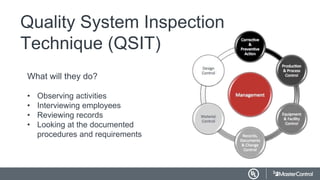
Quality System Inspection
Technique (QSIT)
What will they do?
• Observing activities
• Interviewing employees
• Reviewing records
• Looking at the documented
procedures and requirements
Do’s During the Inspection
DO – Ensure inspector is escorted at all times.
DO – Be courteous, but not talkative
DO – Be truthful – I don’t know but I will get the answer for you is a good response
DO – Understand what FDA is entitled to and what they are not entitled to
• Quality records and documents, yes.
• Identify truly confidential info as such
• Management Reviews, Internal Audits and financial records, no.
Do’s (Cont)
DO – Answer ONLY what is asked. Get
clarification if needed
DO – Have “war room” prepare documents
requested and keep record and copy of what is
provided.
Dont’s During the Inspection
DON’T – Offer information
DON’T – Refer to uncontrolled documents
DON’T – Answer questions for others
DON’T – Air concerns about processes
DON’T – Offer gifts, lunches, gratuity
DON’T – Answer questions when you think you know the answer
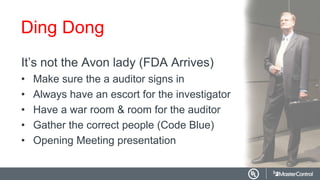
Ding Dong
It’s not the Avon lady (FDA Arrives)
• Make sure the a auditor signs in
• Always have an escort for the investigator
• Have a war room & room for the auditor
• Gather the correct people (Code Blue)
• Opening Meeting presentation
Day of Arrival
• Present Credentials – Badge and Form – Notice of Inspection (Form 482)
• Reception have a contact list
• Have an usher to primary escort
• Opening meeting – set up and room arranged
• Separate room for inspection activities
• “War room” operational
• Tour of facility
Types of Inspections
• Pre-announced
• May receive up to 2 weeks advanced notice or more
• Generally routine inspections
• Directed
• Usually not announced
• For cause
• Follow-up
• Make sure you know which it is
http://www.fda.gov/medicaldevices/deviceregulationandguidance/guidancedocuments/ucm244267.htm
Logistics
• Realize what the inspector is doing during the tour
• Ensure employees are versed in responses – and know
what can go wrong if they don’t do their work correctly
• Be prepared with logs of complaints and CAPA – leave
internal audit and management review actions out
• ASK FDA for an end of day summary
• Have a meeting with team right after to see if you can
correct findings
• Hold “How’d It Go” team debrief
Daily Recaps
• If the auditor does not provide daily
recaps, have them internally
• After the auditor leaves for day, plan for
next day
• If there are going to be findings, try to
make fixes before auditor leaves
http://www.mastercontrol.com/FDA/Link to Videos on this subject >
Points to Ponder
• Differences between notified body auditing
technique (looking at process) and FDA (looking
for product risk).
• FDA audit hierarchy…CAPA, complaints, etc.
• Investigator does not have the final say…it will
go to compliance review
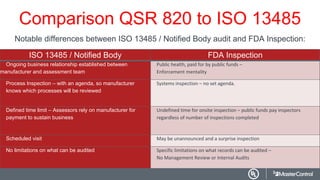
ISO 13485 / Notified Body FDA Inspection
Ongoing business relationship established between
manufacturer and assessment team
Public health, paid for by public funds –
Enforcement mentality
Process Inspection – with an agenda, so manufacturer
knows which processes will be reviewed
Systems inspection – no set agenda.
Defined time limit – Assessors rely on manufacturer for
payment to sustain business
Undefined time for onsite inspection – public funds pay inspectors
regardless of number of inspections completed
Scheduled visit May be unannounced and a surprise inspection
No limitations on what can be audited Specific limitations on what records can be audited –
No Management Review or Internal Audits
Comparison QSR 820 to ISO 13485
Notable differences between ISO 13485 / Notified Body audit and FDA Inspection:
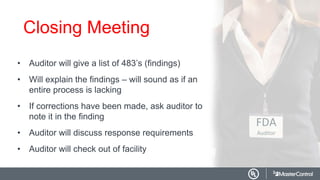
Closing Meeting
• Auditor will give a list of 483’s (findings)
• Will explain the findings – will sound as if an
entire process is lacking
• If corrections have been made, ask auditor to
note it in the finding
• Auditor will discuss response requirements
• Auditor will check out of facility
FDA
Auditor
What’s Next?
• Next steps…respond to 483
within 15 days
• Write to FDA after 30 days to
request your EIR
• Further actions
One More Comment
• Watch for open ended questions
• Don’t spill the beans
• Understand the uses of your information
• Investigations are risk based
Questions
& Answers
Thank you
Linda Chatwin, Esq, RAC
UL Medical Regulatory Advisory Services
T: 1-360-815-5556
E: linda.chatwin@ul.com
W: ulmedicaladvisory.com
Walt Murray
Master Control QCC Services
T: 801-680-3623
E: wmurray@mastercontrol.com
W: www.mastercontrol.com
For more information
on FDA regulations and to view videos
on this subject, visit the link below.
http://www.mastercontrol.com/FDA

The FDA just called, Now What?

  • 1.
    FDA Just Called! NowWhat? Linda Chatwin, Esq. RAC Advisory Services UL LLC and Walt Murray Quality & Compliance Consulting Services MasterControl Inc.
  • 2.
    AGENDA • What todo to be in a constant state of readiness (5 min) • When FDA calls to schedule the inspection (20 Min) • Steps to take • Preparations to make • Training to give • When FDA shows at the door (15 min) • What if they haven’t scheduled the inspection? • Who to call – what to have ready • After the inspection – what is next (10 Min) • Q&A (10 Min)
  • 3.
    Preparing for theInspection • FDA policy and procedure in place • Internal audit - State of the company internal audit history • Previous external audits (Customer, Supplier, FDA) • Major “horizon” items to tackle (e.g., objectives, planning efforts, what’s coming up that will impact your quality system?) • State of your supplier controls, quality agreements • Mock audit to prepare for FDA inspections “The best way to survive an FDA audit is to be prepared!”
  • 4.
    Purpose of Inspection •Checking procedure against practice (“…say you what do”) • Checking practice against procedure (“…do what you say”) • Checking records against procedure (“…prove it”) • Checking to see if the practice is effective, and if it meets QSR requirements • An OPEN BOOK “test” of the system
  • 5.
    Purpose - Continued •A sampling of a process or activity at a point in time • An assessment of a system (and processes of the system) to determine if it is conforming to applicable requirements • An assessment of system effectiveness
  • 6.
    You Just Gotthe Call • Reality Check! What’s your current state? • All hands on deck • Review your “How to Handle an Audit Plan” • Who to pull together (Teams) • Roles and responsibilities need to be defined • Receptionist – Needs to know the people to call • Get the meeting room ready • Go to the room that the inspection takes place • Train the teams and team members
  • 7.
    Inspection Preparation • Knowthe Quality System Requirements and the Quality Policy • Check for and remove unnecessary - uncontrolled posted documents • Beware of informal posted reminders • Be sure charts and graphs are up-to-date and correct • Keep work areas neat • Perform Internal and 3rd party Mock audits • Ensure that processes are documented, and that work is properly recorded
  • 8.
    Let’s Look Great •Prepare an org chart to give to investigator when he/she arrives • Have a short presentation ready to show off the company quality beliefs. • Have a tour route and tour guide(s) planned • Review your manufacturing facility … is it clean, free of cheat sheets, etc.? • Train all who will be involved in the inspection. Don’t forget the manufacturing department … make sure they’re able to articulate what they do, how it relates to the product and what could go wrong. • Do’s and Don’ts checklist • Setup the War Room
  • 9.
    Quality System Inspection Technique(QSIT) What will they do? • Observing activities • Interviewing employees • Reviewing records • Looking at the documented procedures and requirements
  • 10.
    Do’s During theInspection DO – Ensure inspector is escorted at all times. DO – Be courteous, but not talkative DO – Be truthful – I don’t know but I will get the answer for you is a good response DO – Understand what FDA is entitled to and what they are not entitled to • Quality records and documents, yes. • Identify truly confidential info as such • Management Reviews, Internal Audits and financial records, no.
  • 11.
    Do’s (Cont) DO –Answer ONLY what is asked. Get clarification if needed DO – Have “war room” prepare documents requested and keep record and copy of what is provided.
  • 12.
    Dont’s During theInspection DON’T – Offer information DON’T – Refer to uncontrolled documents DON’T – Answer questions for others DON’T – Air concerns about processes DON’T – Offer gifts, lunches, gratuity DON’T – Answer questions when you think you know the answer
  • 13.
    Ding Dong It’s notthe Avon lady (FDA Arrives) • Make sure the a auditor signs in • Always have an escort for the investigator • Have a war room & room for the auditor • Gather the correct people (Code Blue) • Opening Meeting presentation
  • 14.
    Day of Arrival •Present Credentials – Badge and Form – Notice of Inspection (Form 482) • Reception have a contact list • Have an usher to primary escort • Opening meeting – set up and room arranged • Separate room for inspection activities • “War room” operational • Tour of facility
  • 15.
    Types of Inspections •Pre-announced • May receive up to 2 weeks advanced notice or more • Generally routine inspections • Directed • Usually not announced • For cause • Follow-up • Make sure you know which it is http://www.fda.gov/medicaldevices/deviceregulationandguidance/guidancedocuments/ucm244267.htm
  • 16.
    Logistics • Realize whatthe inspector is doing during the tour • Ensure employees are versed in responses – and know what can go wrong if they don’t do their work correctly • Be prepared with logs of complaints and CAPA – leave internal audit and management review actions out • ASK FDA for an end of day summary • Have a meeting with team right after to see if you can correct findings • Hold “How’d It Go” team debrief
  • 17.
    Daily Recaps • Ifthe auditor does not provide daily recaps, have them internally • After the auditor leaves for day, plan for next day • If there are going to be findings, try to make fixes before auditor leaves http://www.mastercontrol.com/FDA/Link to Videos on this subject >
  • 18.
    Points to Ponder •Differences between notified body auditing technique (looking at process) and FDA (looking for product risk). • FDA audit hierarchy…CAPA, complaints, etc. • Investigator does not have the final say…it will go to compliance review
  • 19.
    ISO 13485 /Notified Body FDA Inspection Ongoing business relationship established between manufacturer and assessment team Public health, paid for by public funds – Enforcement mentality Process Inspection – with an agenda, so manufacturer knows which processes will be reviewed Systems inspection – no set agenda. Defined time limit – Assessors rely on manufacturer for payment to sustain business Undefined time for onsite inspection – public funds pay inspectors regardless of number of inspections completed Scheduled visit May be unannounced and a surprise inspection No limitations on what can be audited Specific limitations on what records can be audited – No Management Review or Internal Audits Comparison QSR 820 to ISO 13485 Notable differences between ISO 13485 / Notified Body audit and FDA Inspection:
  • 21.
    Closing Meeting • Auditorwill give a list of 483’s (findings) • Will explain the findings – will sound as if an entire process is lacking • If corrections have been made, ask auditor to note it in the finding • Auditor will discuss response requirements • Auditor will check out of facility FDA Auditor
  • 22.
    What’s Next? • Nextsteps…respond to 483 within 15 days • Write to FDA after 30 days to request your EIR • Further actions
  • 23.
    One More Comment •Watch for open ended questions • Don’t spill the beans • Understand the uses of your information • Investigations are risk based
  • 24.
  • 25.
    Thank you Linda Chatwin,Esq, RAC UL Medical Regulatory Advisory Services T: 1-360-815-5556 E: linda.chatwin@ul.com W: ulmedicaladvisory.com Walt Murray Master Control QCC Services T: 801-680-3623 E: wmurray@mastercontrol.com W: www.mastercontrol.com For more information on FDA regulations and to view videos on this subject, visit the link below. http://www.mastercontrol.com/FDA