Live Webinar
on
FDA Inspection
Readiness – Preparing
for an Inspection
Name of the Presenter.
Charles H Paul, President
C. H. Paul Consulting, Inc.
Topics
2
◼ The mechanics of the readiness process, auditing – who gets audited,
frequency of audits, and the inspection process explained
◼ Types of inspections and their implications
◼ The heart of compliance – doing the right things right
◼ Selecting your subject matter experts
◼ Training your SME’s – what do they need to know and how do you train
◼ Inspection preparedness – what to expect and how to prepare
◼ The readiness inspection from the auditor’s perspective
◼ Responding/interacting with the inspection team – inspection behavior –
how to act – what to say and what not to say
Who does the FDA Inspect?
◼ Federal Food, Drug, and Cosmetics (FD&C) Act, domestic drug
establishments, and Class II and Class III device manufacturers inspected
every two years
◼ Foreign manufacturers
◼ Inspections conducted based on risk
◼ Higher-risk products more likely to be audited
◼ Facilities having historically significant violations
◼ Inspection focus
 Quality and Product Safety
 Facility
 Process
 Data
3
Purpose of Inspections
4
• Compliance with FDA regulations
• Product development
• Quality System (QS) and manufacturing practices
• Controls are in-place and they are effective
• Recalls, enforcement actions, complaints, significant
adverse event reports, surveillance
• Ensure consumer protection
Types of Inspections
5
◼ Pre-Approval Inspections (PAI Post-Approval Inspections
◼ Surveillance Inspections
◼ For-Cause or Triggered Inspections
◼ Compliance Follow-Up Inspections
◼ Foreign Inspections
◼ Focused Inspections
◼ Risk-Based Inspections
◼ Follow-Up or Recurrent Inspections
◼ Adverse Event Inspections
◼ Import Inspections
◼ Bioequivalence and Bioavailability Inspections
Types of Inspections
◼ Pre-Approval Inspections
◼ Post Approval Audit Inspections
◼ Drug Manufacturing Inspections
6
Pre-Approval Inspections
7
◼ FDA approves New Drug Applications, Abbreviated New
Drug Applications, Biologic Licensing Applications
◼ Assure that controls for manufacture, processing,
packing, and testing are adequate
◼ Pre-approval inspection performed to ensure that
manufacturer can manufacture the drug.
Post Approval Audit Inspections
8
◼ Designed to audit for changes in the production and
control practices that occur after approval
◼ Post Approval Audit Inspections confirm that
commitments have been completed or are underway
Drug Manufacturing Inspections
9
To determine whether inspected firms
are operating in compliance with
applicable cGMP requirements
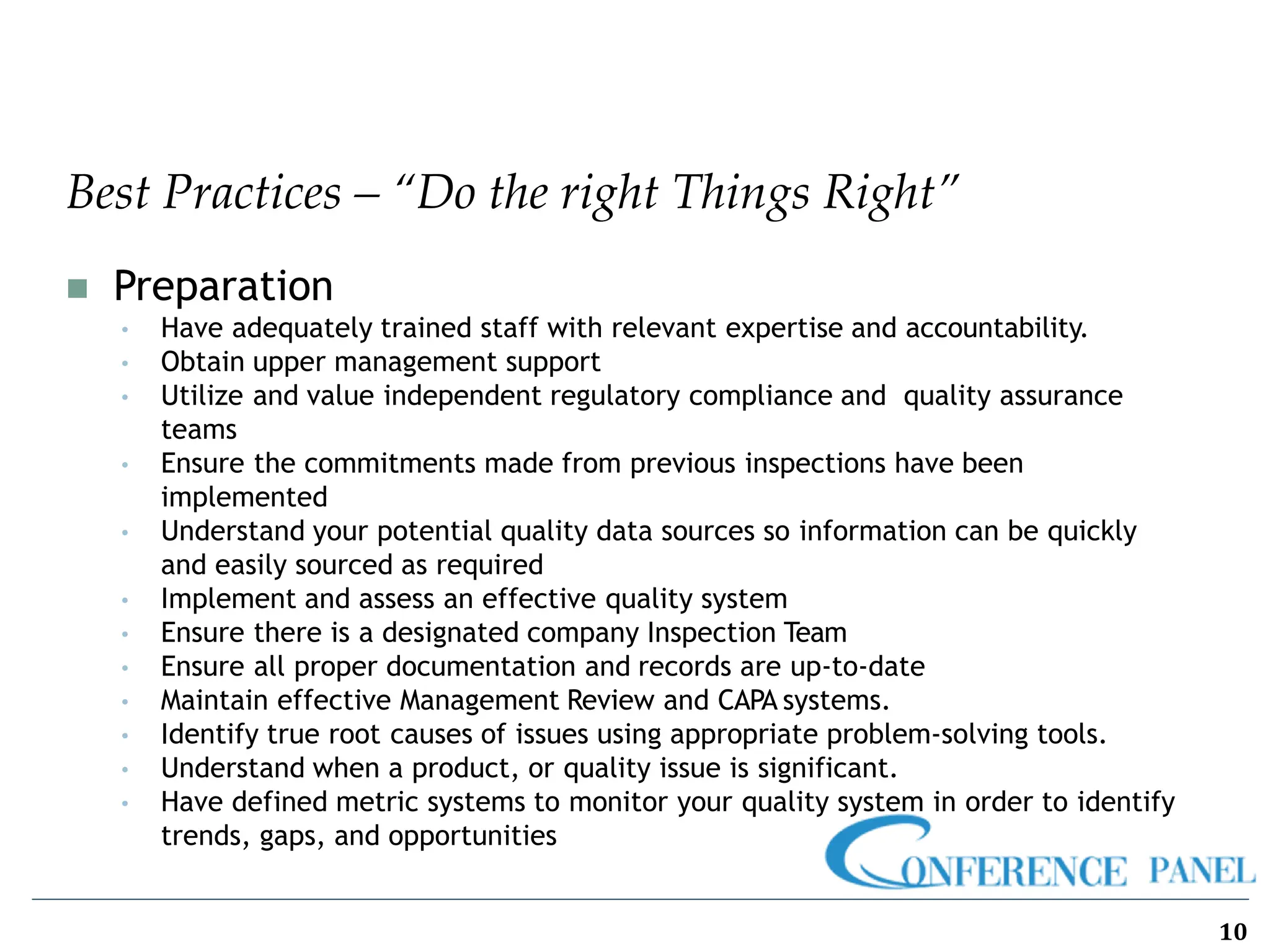
Best Practices – “Do the right Things Right”
10
◼ Preparation
• Have adequately trained staff with relevant expertise and accountability.
• Obtain upper management support
• Utilize and value independent regulatory compliance and quality assurance
teams
• Ensure the commitments made from previous inspections have been
implemented
• Understand your potential quality data sources so information can be quickly
and easily sourced as required
• Implement and assess an effective quality system
• Ensure there is a designated company Inspection Team
• Ensure all proper documentation and records are up-to-date
• Maintain effective Management Review and CAPA systems.
• Identify true root causes of issues using appropriate problem-solving tools.
• Understand when a product, or quality issue is significant.
• Have defined metric systems to monitor your quality system in order to identify
trends, gaps, and opportunities
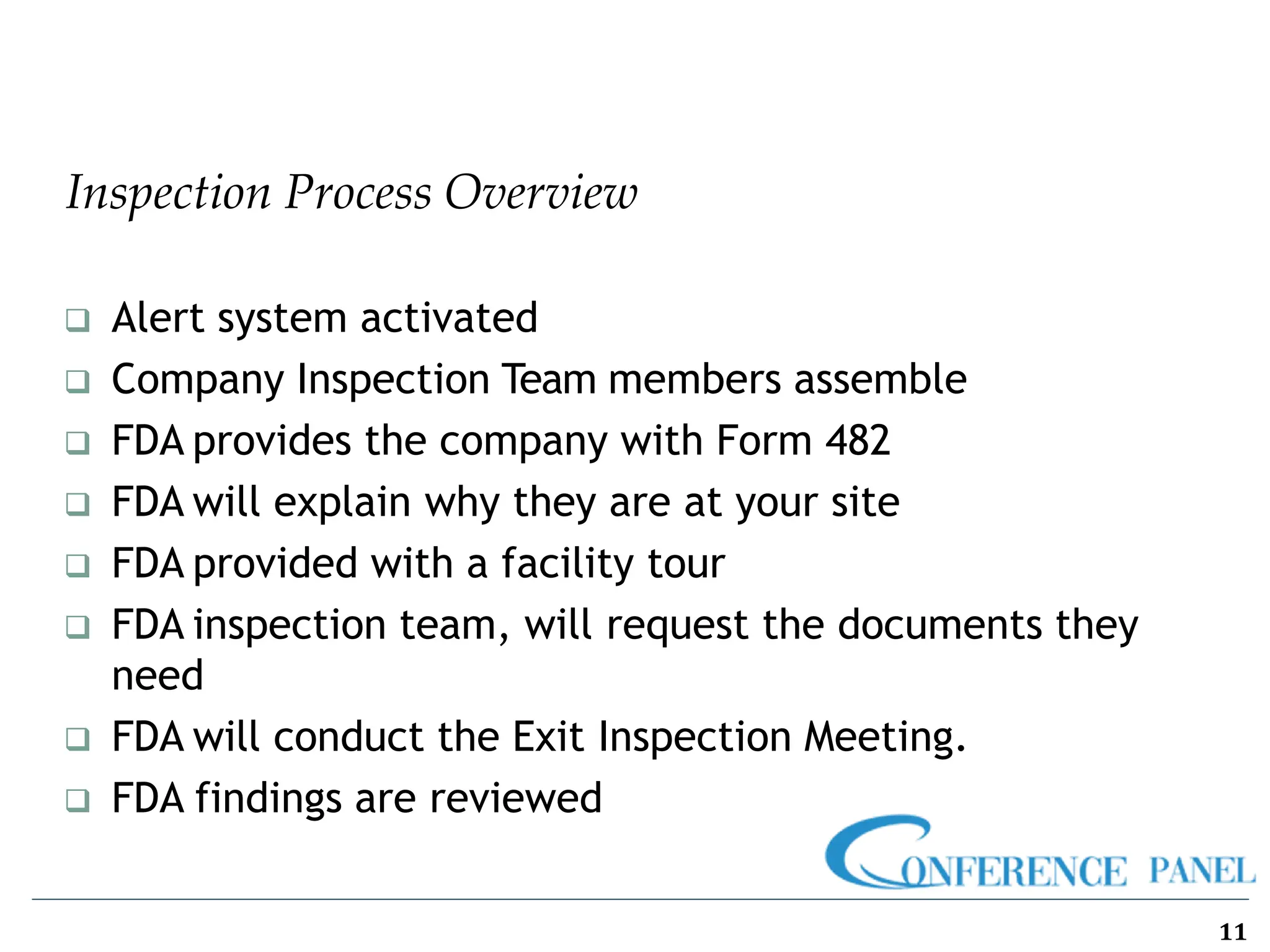
Inspection Process Overview
11
❑ Alert system activated
❑ Company Inspection Team members assemble
❑ FDA provides the company with Form 482
❑ FDA will explain why they are at your site
❑ FDA provided with a facility tour
❑ FDA inspection team, will request the documents they
need
❑ FDA will conduct the Exit Inspection Meeting.
❑ FDA findings are reviewed
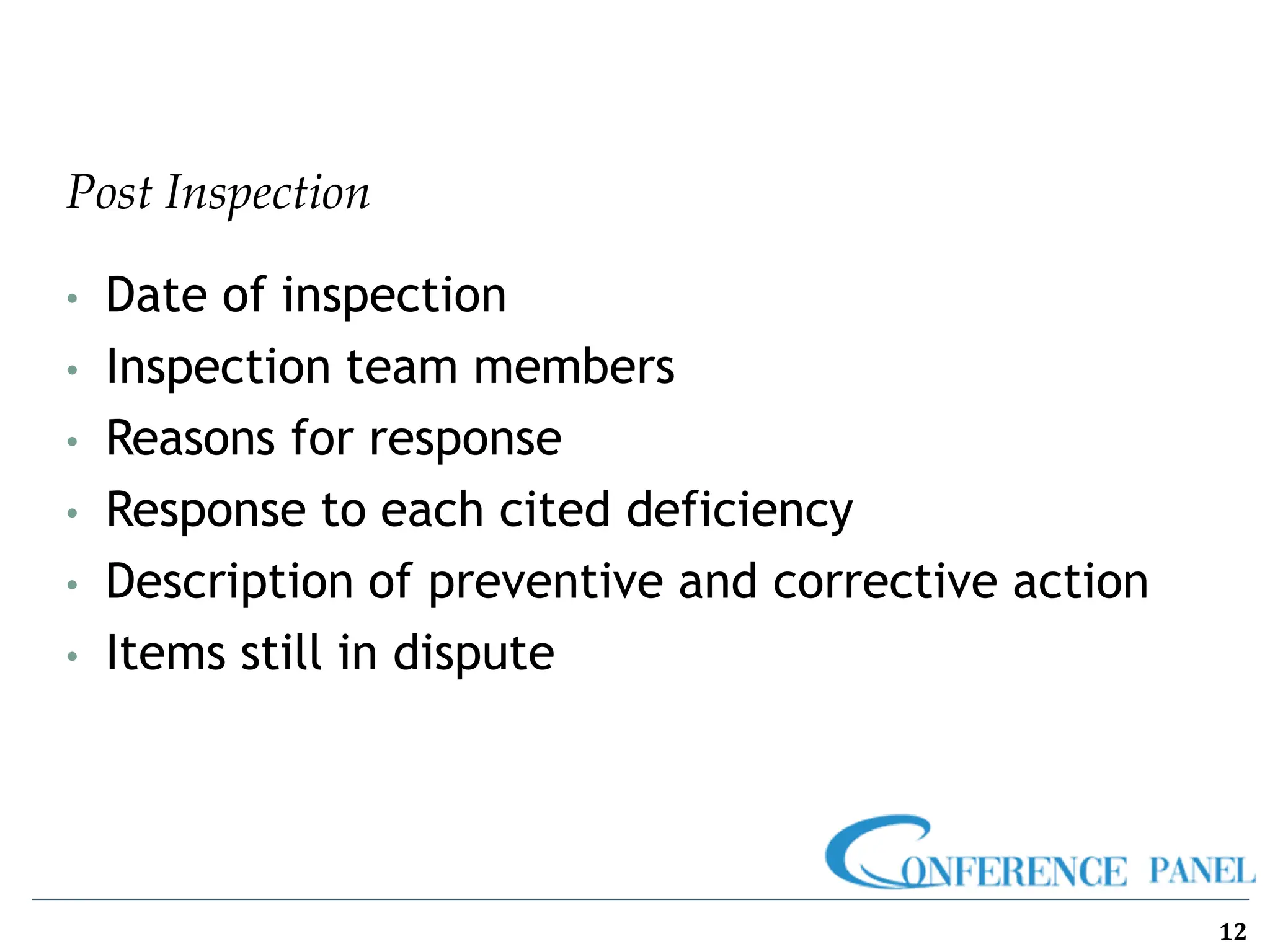
Post Inspection
• Date of inspection
• Inspection team members
• Reasons for response
• Response to each cited deficiency
• Description of preventive and corrective action
• Items still in dispute
12
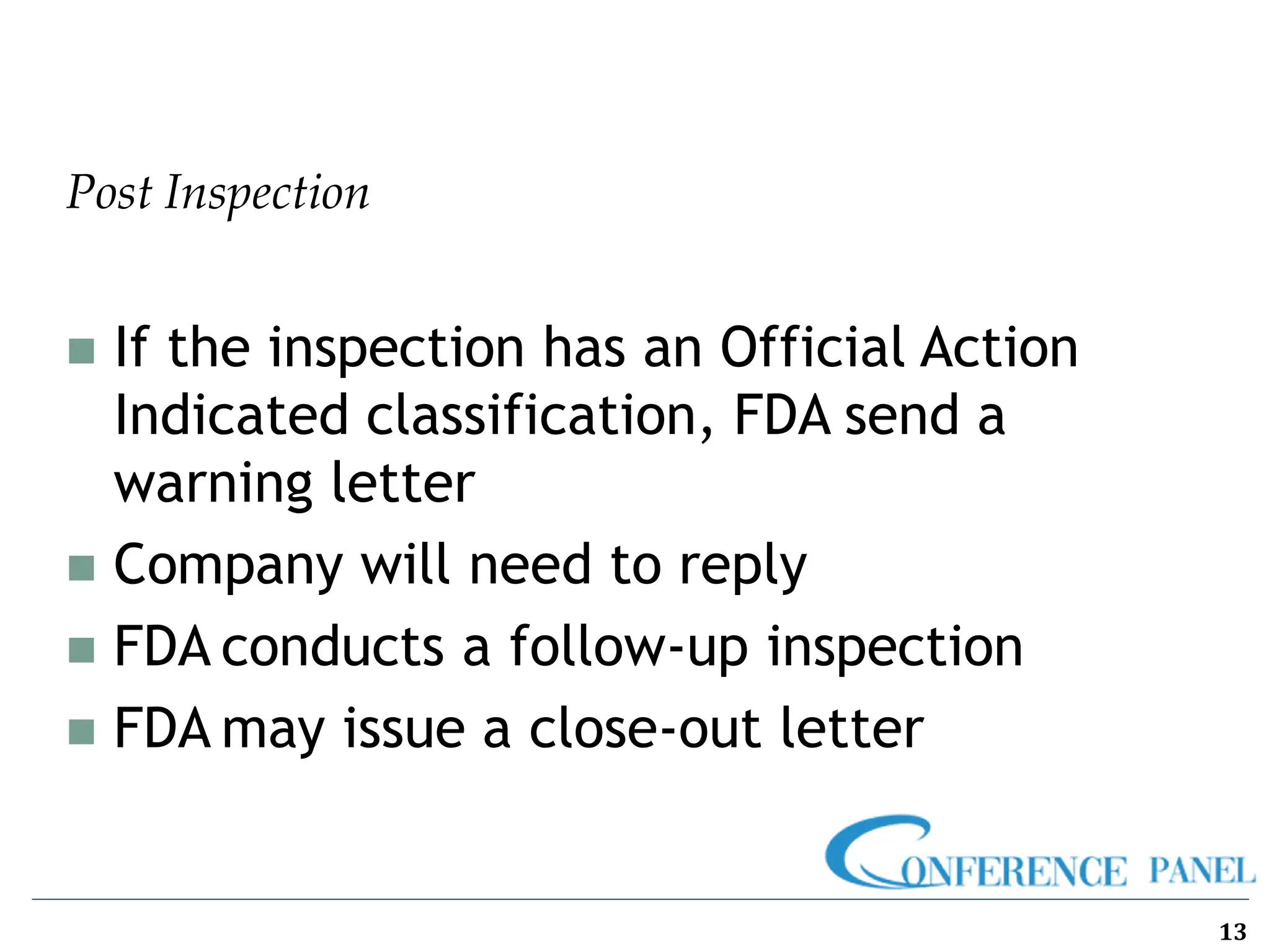
Post Inspection
13
◼ If the inspection has an Official Action
Indicated classification, FDA send a
warning letter
◼ Company will need to reply
◼ FDA conducts a follow-up inspection
◼ FDA may issue a close-out letter
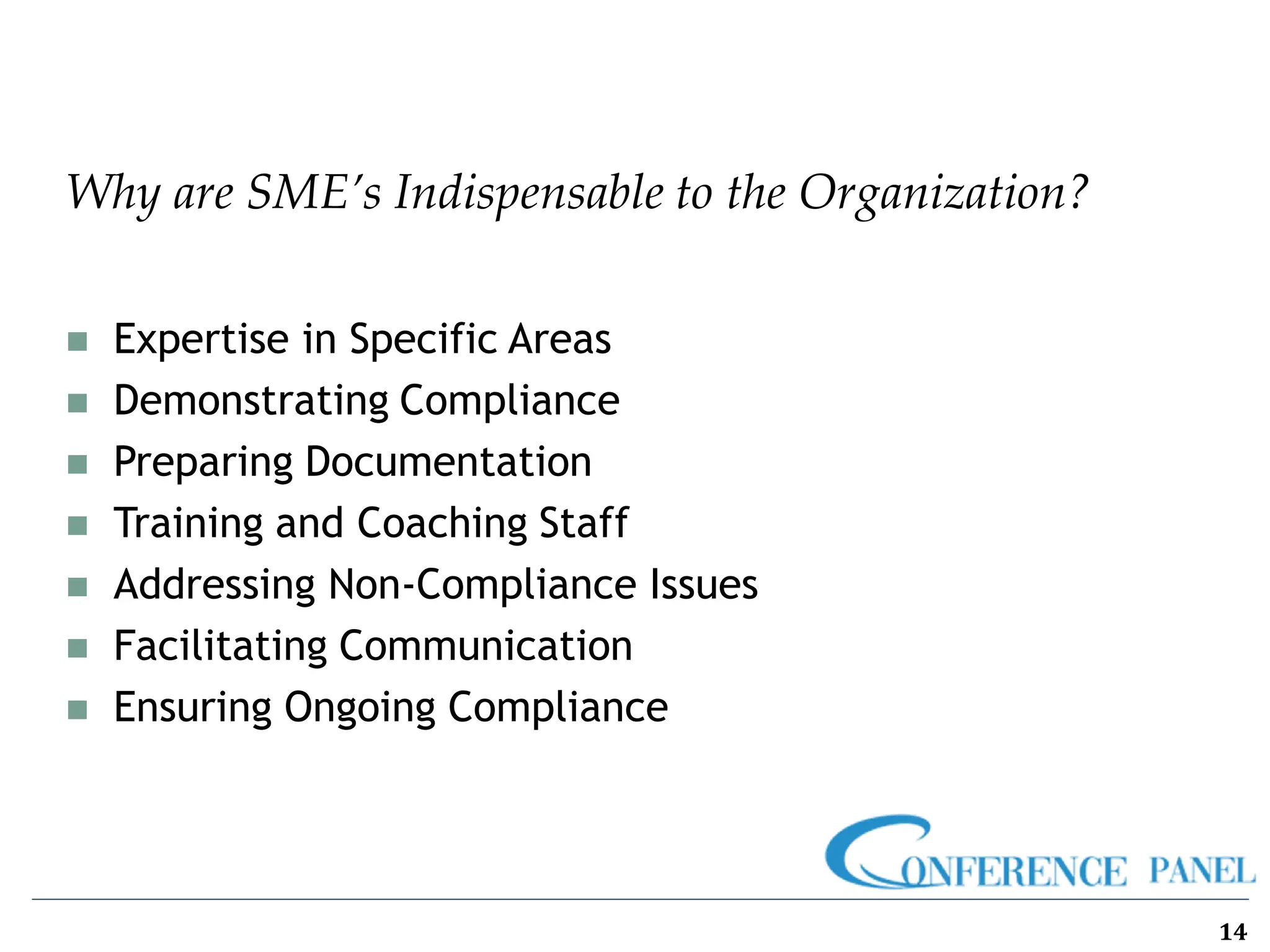
Why are SME’s Indispensable to the Organization?
14
◼ Expertise in Specific Areas
◼ Demonstrating Compliance
◼ Preparing Documentation
◼ Training and Coaching Staff
◼ Addressing Non-Compliance Issues
◼ Facilitating Communication
◼ Ensuring Ongoing Compliance
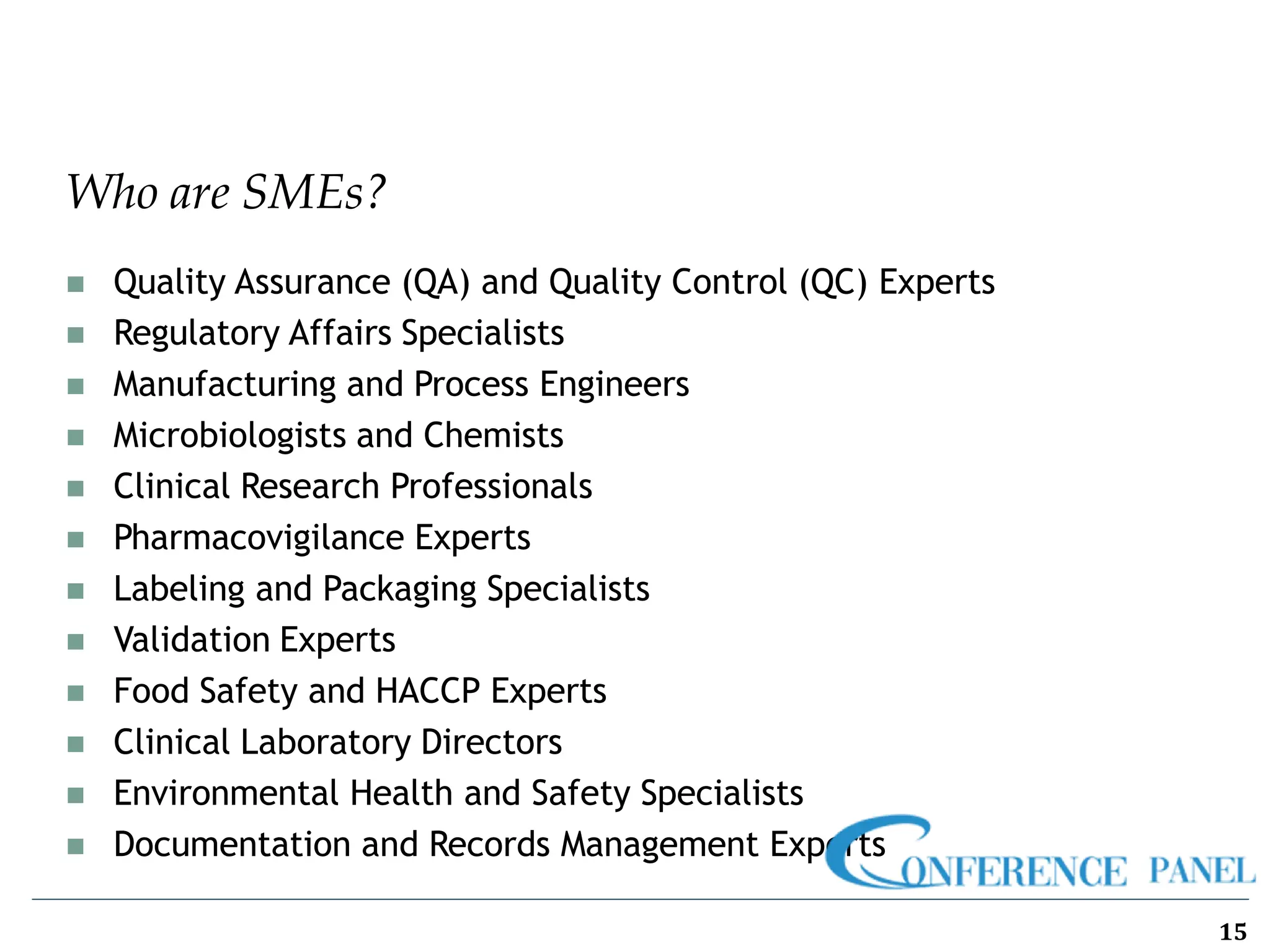
Who are SMEs?
15
◼ Quality Assurance (QA) and Quality Control (QC) Experts
◼ Regulatory Affairs Specialists
◼ Manufacturing and Process Engineers
◼ Microbiologists and Chemists
◼ Clinical Research Professionals
◼ Pharmacovigilance Experts
◼ Labeling and Packaging Specialists
◼ Validation Experts
◼ Food Safety and HACCP Experts
◼ Clinical Laboratory Directors
◼ Environmental Health and Safety Specialists
◼ Documentation and Records Management Experts
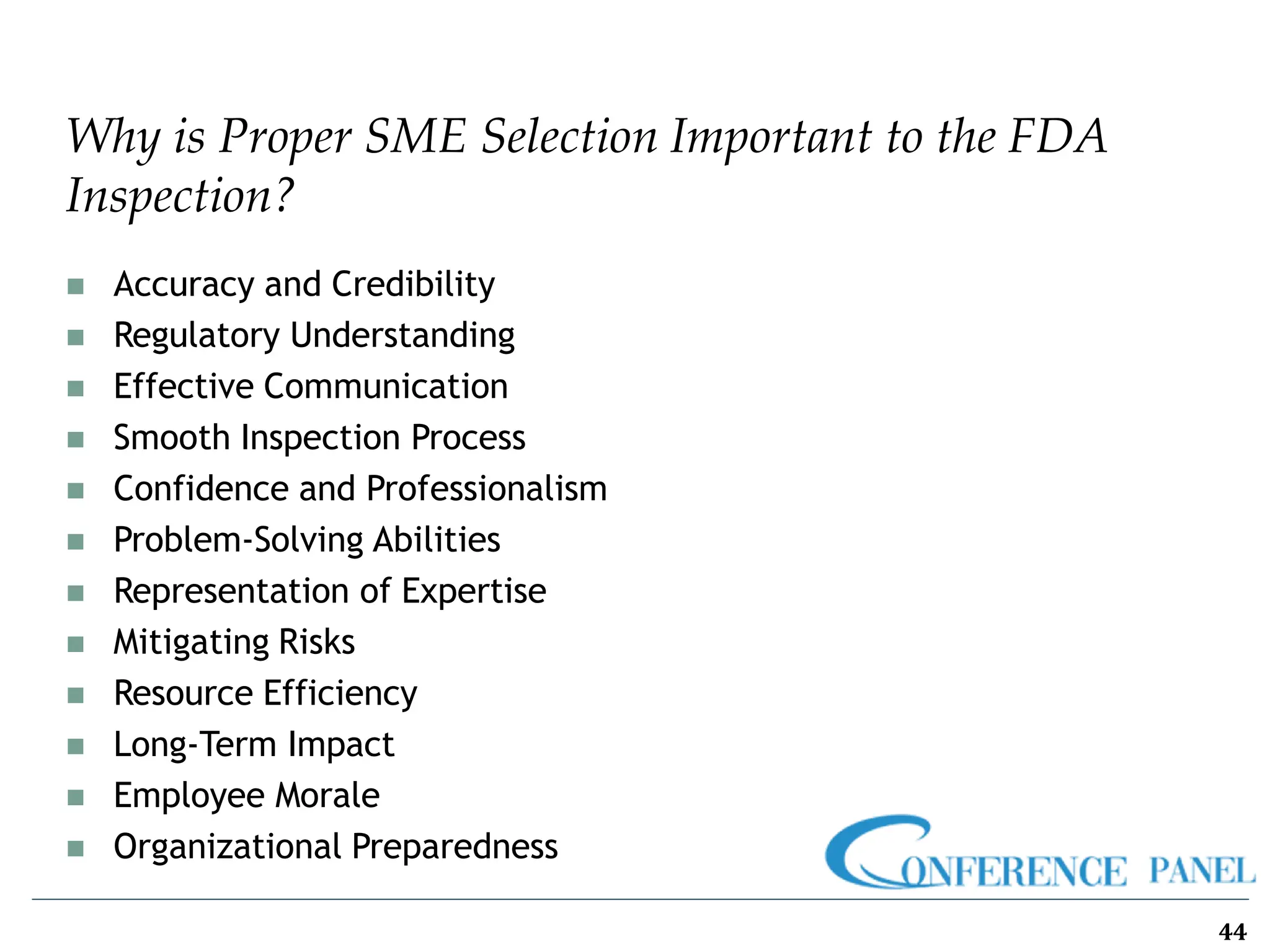
Why is Proper SME Selection Important to the FDA
Inspection?
44
◼ Accuracy and Credibility
◼ Regulatory Understanding
◼ Effective Communication
◼ Smooth Inspection Process
◼ Confidence and Professionalism
◼ Problem-Solving Abilities
◼ Representation of Expertise
◼ Mitigating Risks
◼ Resource Efficiency
◼ Long-Term Impact
◼ Employee Morale
◼ Organizational Preparedness
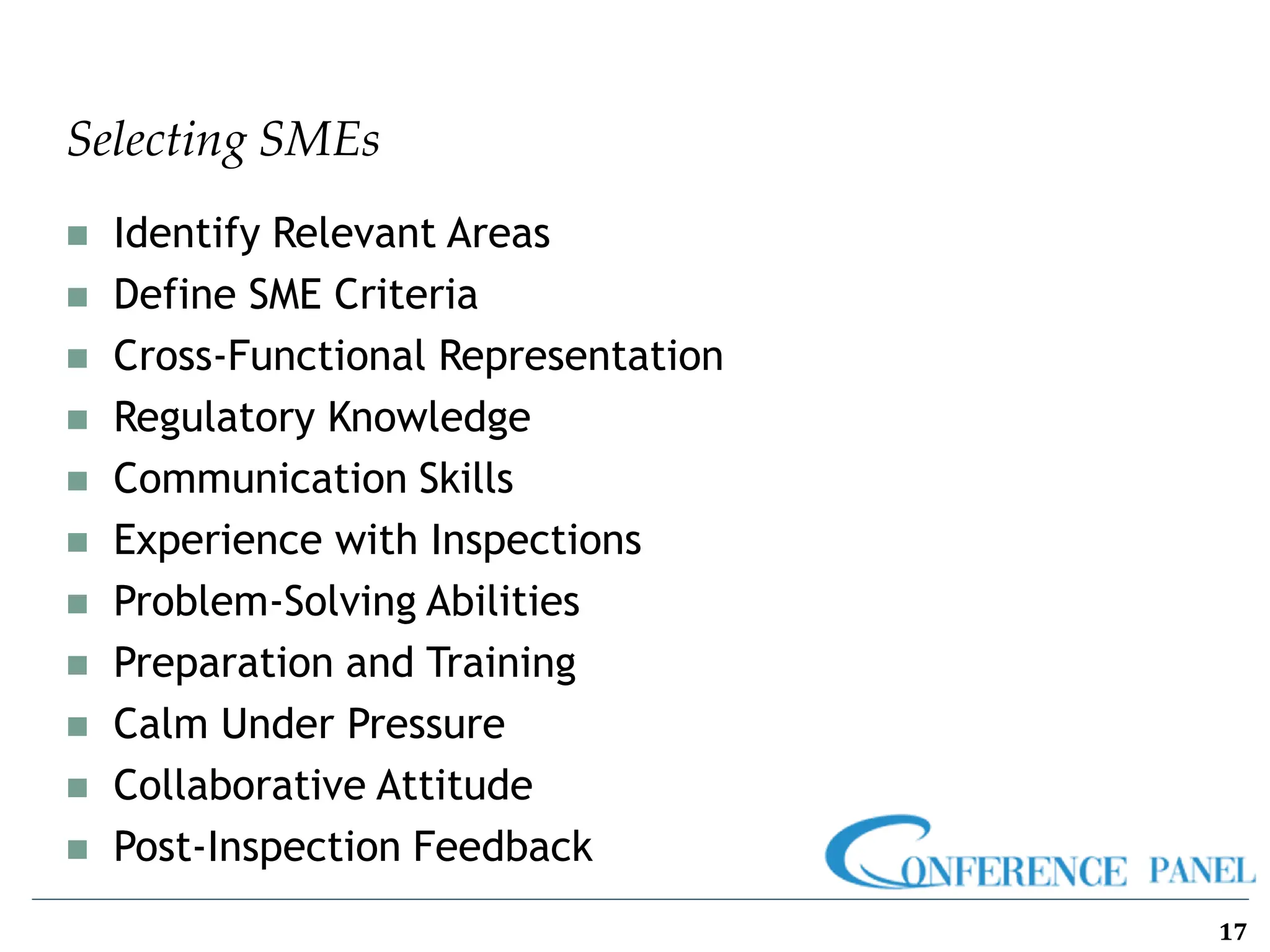
Selecting SMEs
17
◼ Identify Relevant Areas
◼ Define SME Criteria
◼ Cross-Functional Representation
◼ Regulatory Knowledge
◼ Communication Skills
◼ Experience with Inspections
◼ Problem-Solving Abilities
◼ Preparation and Training
◼ Calm Under Pressure
◼ Collaborative Attitude
◼ Post-Inspection Feedback
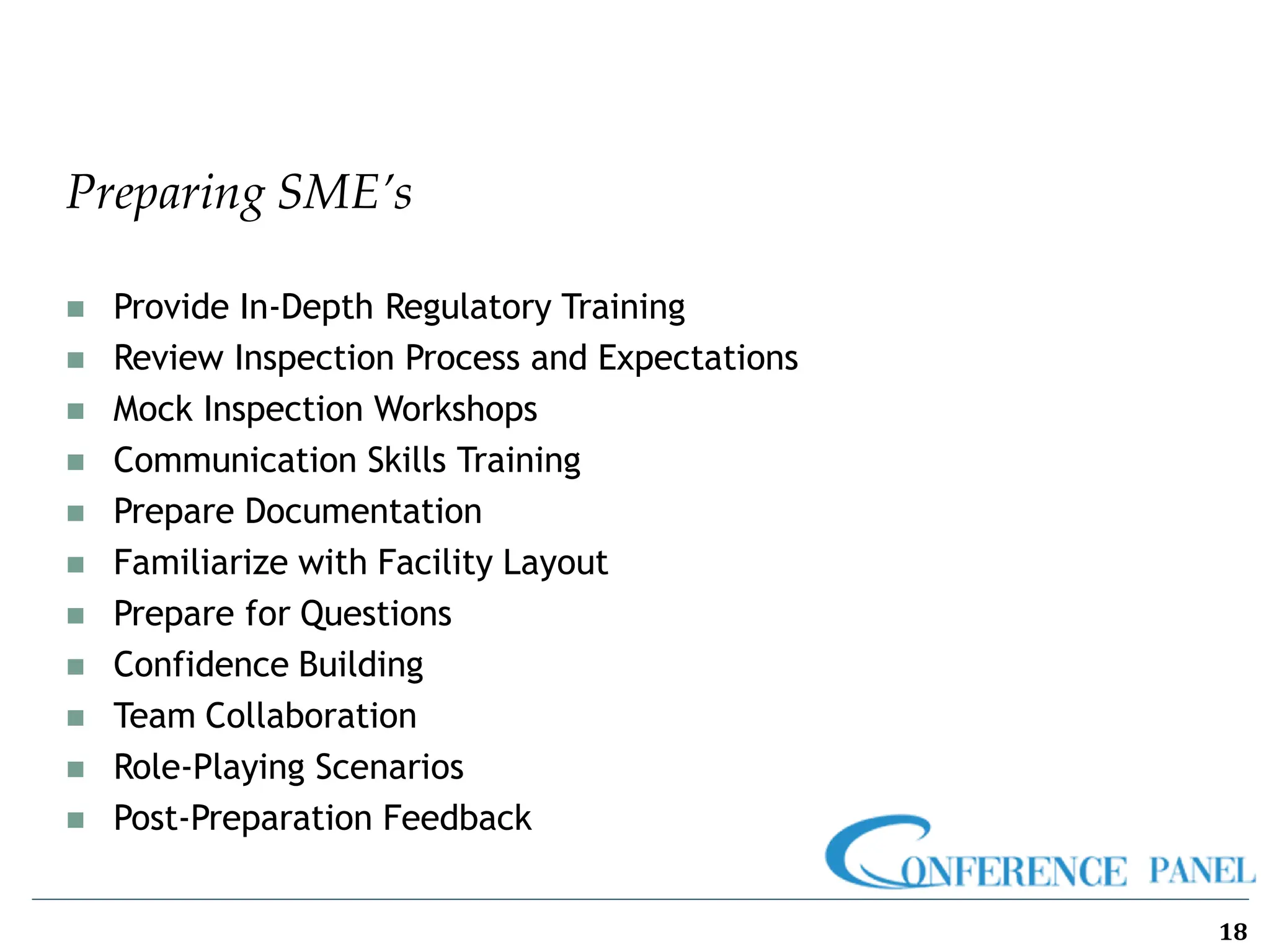
Preparing SME’s
18
◼ Provide In-Depth Regulatory Training
◼ Review Inspection Process and Expectations
◼ Mock Inspection Workshops
◼ Communication Skills Training
◼ Prepare Documentation
◼ Familiarize with Facility Layout
◼ Prepare for Questions
◼ Confidence Building
◼ Team Collaboration
◼ Role-Playing Scenarios
◼ Post-Preparation Feedback
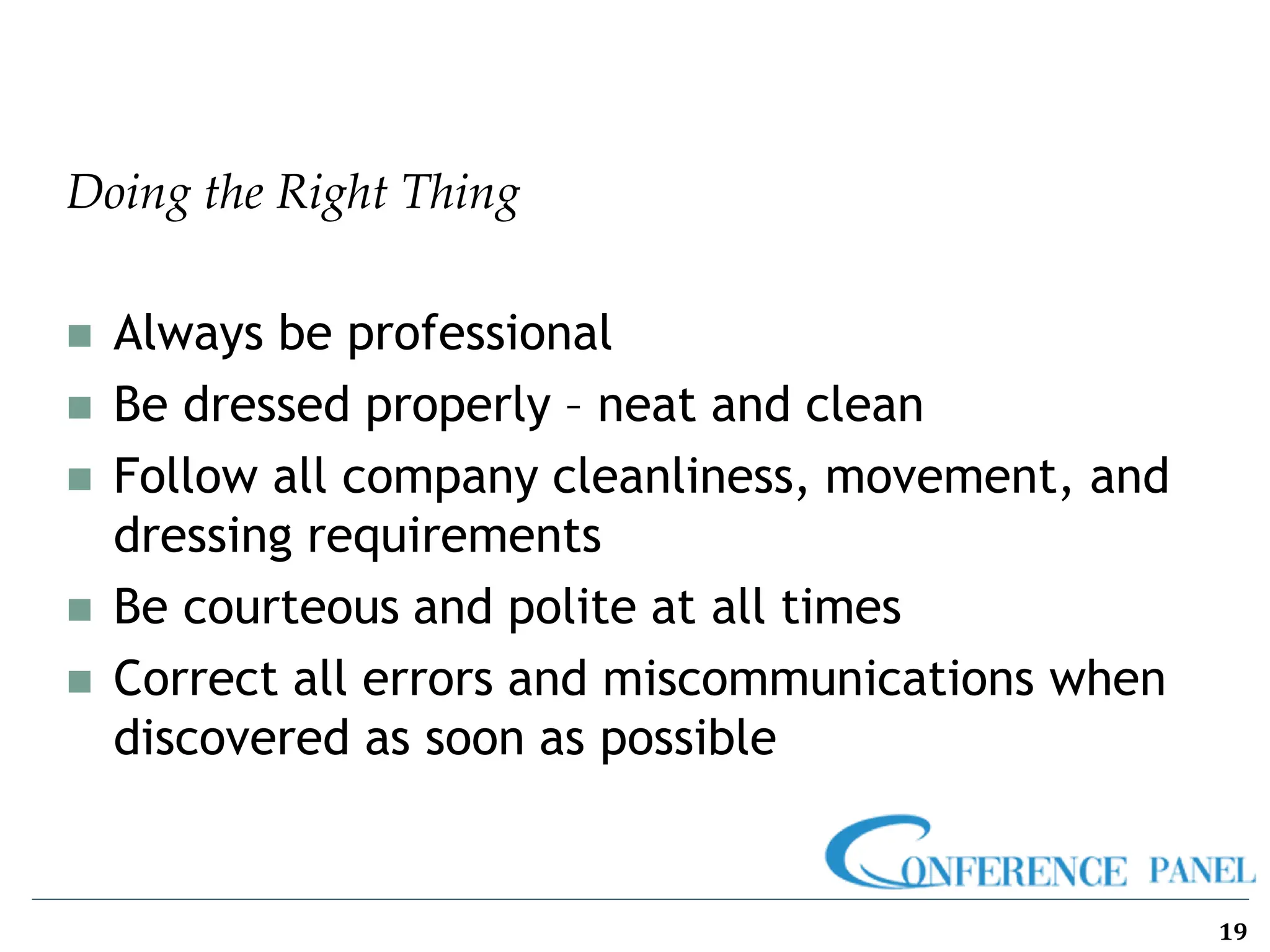
Doing the Right Thing
◼ Always be professional
◼ Be dressed properly – neat and clean
◼ Follow all company cleanliness, movement, and
dressing requirements
◼ Be courteous and polite at all times
◼ Correct all errors and miscommunications when
discovered as soon as possible
19
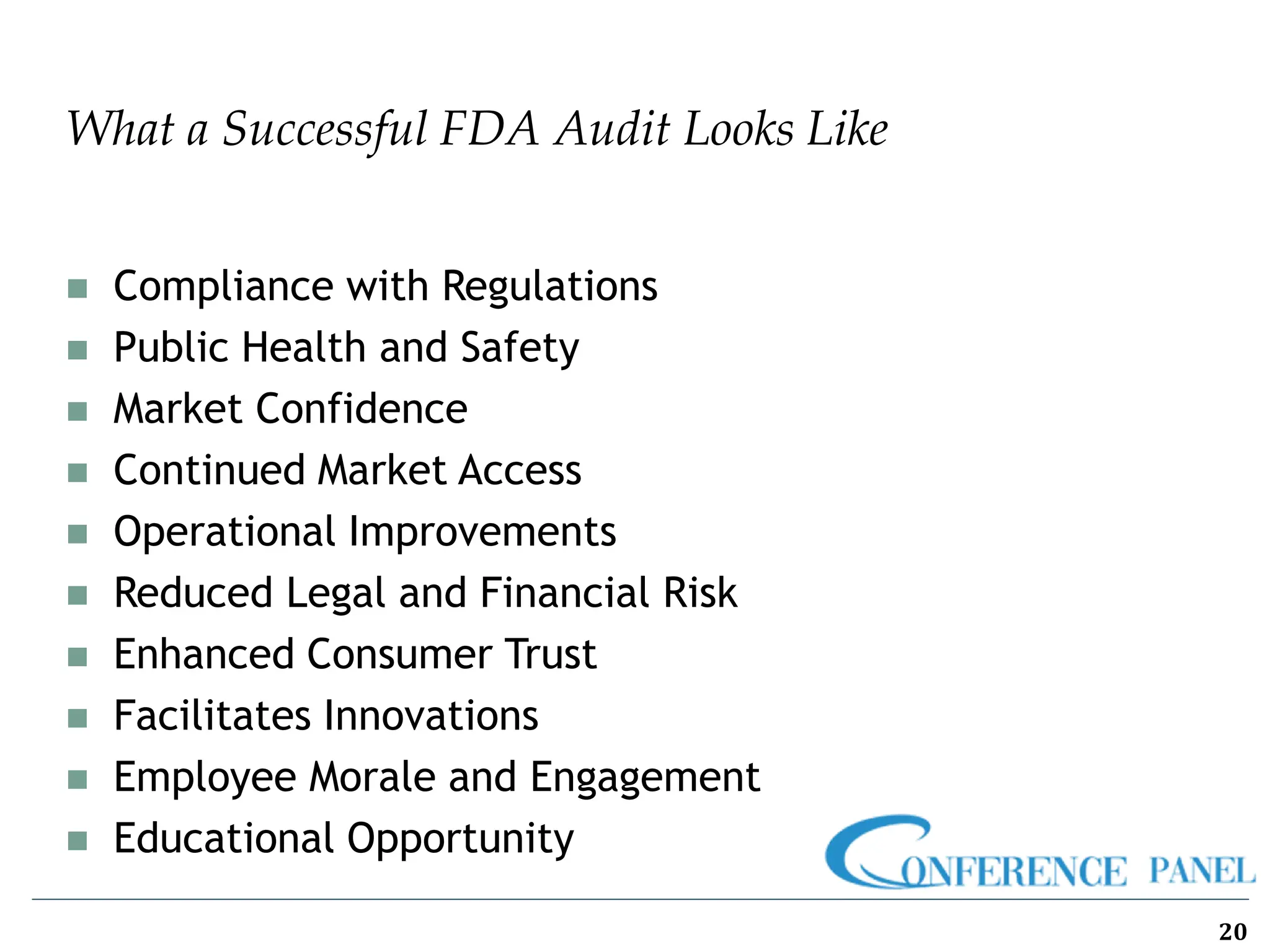
What a Successful FDA Audit Looks Like
20
◼ Compliance with Regulations
◼ Public Health and Safety
◼ Market Confidence
◼ Continued Market Access
◼ Operational Improvements
◼ Reduced Legal and Financial Risk
◼ Enhanced Consumer Trust
◼ Facilitates Innovations
◼ Employee Morale and Engagement
◼ Educational Opportunity
Tips for Doing it Right
21
◼ Understand the Scope and Standards
◼ Maintain Compliance at All Times
◼ Conduct Regular Internal Audits
◼ Prepare Your Team
◼ Organize Documentation
◼ Review Past Inspections
◼ Mock Inspections
◼ Improve Communication Skills
◼ Ensure Facility Readiness
◼ Stay Informed About Industry Changes
◼ Legal and Expert Consultation
◼ Handle Issues Professionally
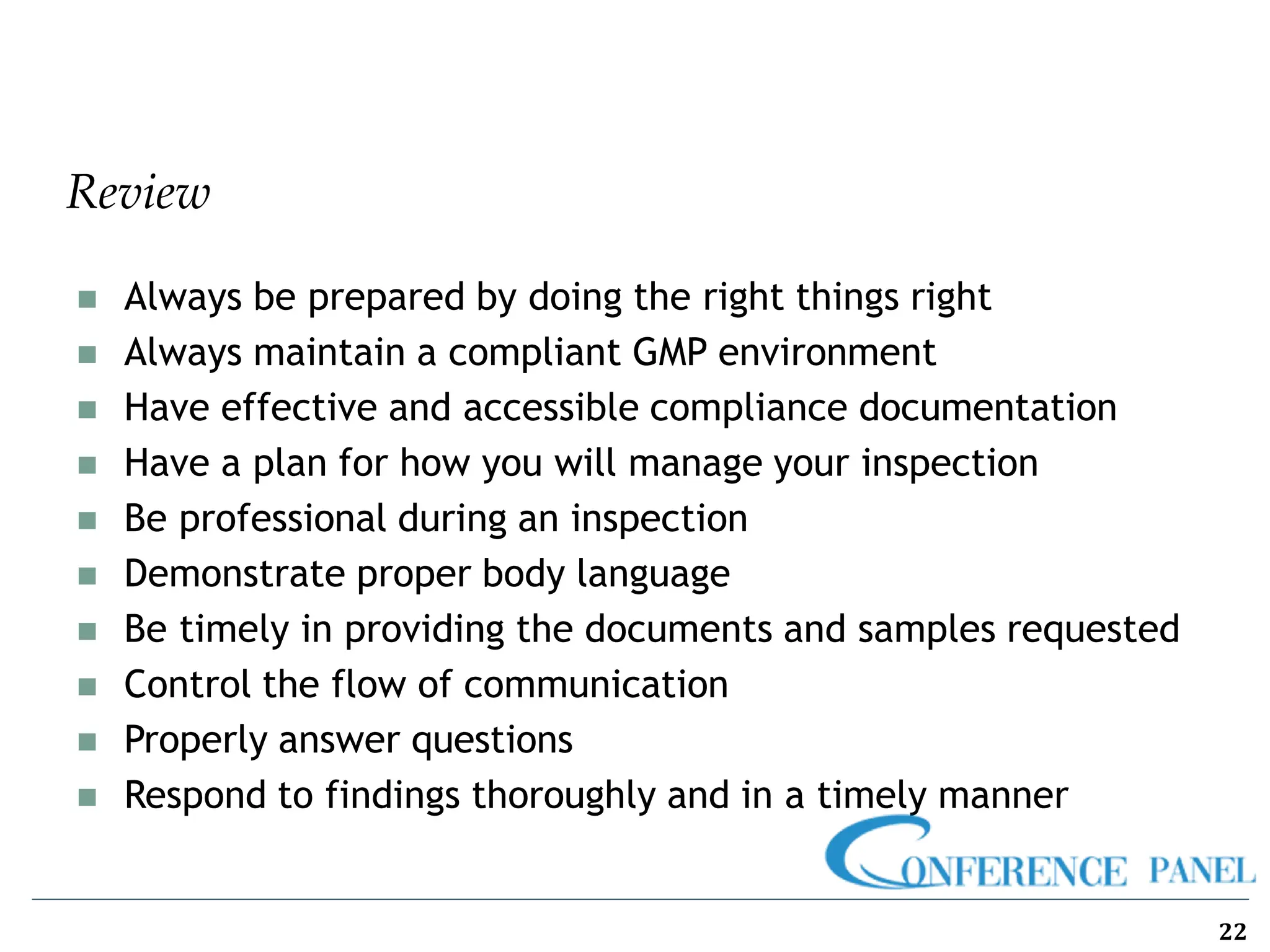
Review
22
◼ Always be prepared by doing the right things right
◼ Always maintain a compliant GMP environment
◼ Have effective and accessible compliance documentation
◼ Have a plan for how you will manage your inspection
◼ Be professional during an inspection
◼ Demonstrate proper body language
◼ Be timely in providing the documents and samples requested
◼ Control the flow of communication
◼ Properly answer questions
◼ Respond to findings thoroughly and in a timely manner
Questions
69
Register Now

FDA Best Audit Practices – Get Ready For The Inspection That Is Coming

  • 1.
    Live Webinar on FDA Inspection Readiness– Preparing for an Inspection Name of the Presenter. Charles H Paul, President C. H. Paul Consulting, Inc.
  • 2.
    Topics 2 ◼ The mechanicsof the readiness process, auditing – who gets audited, frequency of audits, and the inspection process explained ◼ Types of inspections and their implications ◼ The heart of compliance – doing the right things right ◼ Selecting your subject matter experts ◼ Training your SME’s – what do they need to know and how do you train ◼ Inspection preparedness – what to expect and how to prepare ◼ The readiness inspection from the auditor’s perspective ◼ Responding/interacting with the inspection team – inspection behavior – how to act – what to say and what not to say
  • 3.
    Who does theFDA Inspect? ◼ Federal Food, Drug, and Cosmetics (FD&C) Act, domestic drug establishments, and Class II and Class III device manufacturers inspected every two years ◼ Foreign manufacturers ◼ Inspections conducted based on risk ◼ Higher-risk products more likely to be audited ◼ Facilities having historically significant violations ◼ Inspection focus  Quality and Product Safety  Facility  Process  Data 3
  • 4.
    Purpose of Inspections 4 •Compliance with FDA regulations • Product development • Quality System (QS) and manufacturing practices • Controls are in-place and they are effective • Recalls, enforcement actions, complaints, significant adverse event reports, surveillance • Ensure consumer protection
  • 5.
    Types of Inspections 5 ◼Pre-Approval Inspections (PAI Post-Approval Inspections ◼ Surveillance Inspections ◼ For-Cause or Triggered Inspections ◼ Compliance Follow-Up Inspections ◼ Foreign Inspections ◼ Focused Inspections ◼ Risk-Based Inspections ◼ Follow-Up or Recurrent Inspections ◼ Adverse Event Inspections ◼ Import Inspections ◼ Bioequivalence and Bioavailability Inspections
  • 6.
    Types of Inspections ◼Pre-Approval Inspections ◼ Post Approval Audit Inspections ◼ Drug Manufacturing Inspections 6
  • 7.
    Pre-Approval Inspections 7 ◼ FDAapproves New Drug Applications, Abbreviated New Drug Applications, Biologic Licensing Applications ◼ Assure that controls for manufacture, processing, packing, and testing are adequate ◼ Pre-approval inspection performed to ensure that manufacturer can manufacture the drug.
  • 8.
    Post Approval AuditInspections 8 ◼ Designed to audit for changes in the production and control practices that occur after approval ◼ Post Approval Audit Inspections confirm that commitments have been completed or are underway
  • 9.
    Drug Manufacturing Inspections 9 Todetermine whether inspected firms are operating in compliance with applicable cGMP requirements
  • 10.
    Best Practices –“Do the right Things Right” 10 ◼ Preparation • Have adequately trained staff with relevant expertise and accountability. • Obtain upper management support • Utilize and value independent regulatory compliance and quality assurance teams • Ensure the commitments made from previous inspections have been implemented • Understand your potential quality data sources so information can be quickly and easily sourced as required • Implement and assess an effective quality system • Ensure there is a designated company Inspection Team • Ensure all proper documentation and records are up-to-date • Maintain effective Management Review and CAPA systems. • Identify true root causes of issues using appropriate problem-solving tools. • Understand when a product, or quality issue is significant. • Have defined metric systems to monitor your quality system in order to identify trends, gaps, and opportunities
  • 11.
    Inspection Process Overview 11 ❑Alert system activated ❑ Company Inspection Team members assemble ❑ FDA provides the company with Form 482 ❑ FDA will explain why they are at your site ❑ FDA provided with a facility tour ❑ FDA inspection team, will request the documents they need ❑ FDA will conduct the Exit Inspection Meeting. ❑ FDA findings are reviewed
  • 12.
    Post Inspection • Dateof inspection • Inspection team members • Reasons for response • Response to each cited deficiency • Description of preventive and corrective action • Items still in dispute 12
  • 13.
    Post Inspection 13 ◼ Ifthe inspection has an Official Action Indicated classification, FDA send a warning letter ◼ Company will need to reply ◼ FDA conducts a follow-up inspection ◼ FDA may issue a close-out letter
  • 14.
    Why are SME’sIndispensable to the Organization? 14 ◼ Expertise in Specific Areas ◼ Demonstrating Compliance ◼ Preparing Documentation ◼ Training and Coaching Staff ◼ Addressing Non-Compliance Issues ◼ Facilitating Communication ◼ Ensuring Ongoing Compliance
  • 15.
    Who are SMEs? 15 ◼Quality Assurance (QA) and Quality Control (QC) Experts ◼ Regulatory Affairs Specialists ◼ Manufacturing and Process Engineers ◼ Microbiologists and Chemists ◼ Clinical Research Professionals ◼ Pharmacovigilance Experts ◼ Labeling and Packaging Specialists ◼ Validation Experts ◼ Food Safety and HACCP Experts ◼ Clinical Laboratory Directors ◼ Environmental Health and Safety Specialists ◼ Documentation and Records Management Experts
  • 16.
    Why is ProperSME Selection Important to the FDA Inspection? 44 ◼ Accuracy and Credibility ◼ Regulatory Understanding ◼ Effective Communication ◼ Smooth Inspection Process ◼ Confidence and Professionalism ◼ Problem-Solving Abilities ◼ Representation of Expertise ◼ Mitigating Risks ◼ Resource Efficiency ◼ Long-Term Impact ◼ Employee Morale ◼ Organizational Preparedness
  • 17.
    Selecting SMEs 17 ◼ IdentifyRelevant Areas ◼ Define SME Criteria ◼ Cross-Functional Representation ◼ Regulatory Knowledge ◼ Communication Skills ◼ Experience with Inspections ◼ Problem-Solving Abilities ◼ Preparation and Training ◼ Calm Under Pressure ◼ Collaborative Attitude ◼ Post-Inspection Feedback
  • 18.
    Preparing SME’s 18 ◼ ProvideIn-Depth Regulatory Training ◼ Review Inspection Process and Expectations ◼ Mock Inspection Workshops ◼ Communication Skills Training ◼ Prepare Documentation ◼ Familiarize with Facility Layout ◼ Prepare for Questions ◼ Confidence Building ◼ Team Collaboration ◼ Role-Playing Scenarios ◼ Post-Preparation Feedback
  • 19.
    Doing the RightThing ◼ Always be professional ◼ Be dressed properly – neat and clean ◼ Follow all company cleanliness, movement, and dressing requirements ◼ Be courteous and polite at all times ◼ Correct all errors and miscommunications when discovered as soon as possible 19
  • 20.
    What a SuccessfulFDA Audit Looks Like 20 ◼ Compliance with Regulations ◼ Public Health and Safety ◼ Market Confidence ◼ Continued Market Access ◼ Operational Improvements ◼ Reduced Legal and Financial Risk ◼ Enhanced Consumer Trust ◼ Facilitates Innovations ◼ Employee Morale and Engagement ◼ Educational Opportunity
  • 21.
    Tips for Doingit Right 21 ◼ Understand the Scope and Standards ◼ Maintain Compliance at All Times ◼ Conduct Regular Internal Audits ◼ Prepare Your Team ◼ Organize Documentation ◼ Review Past Inspections ◼ Mock Inspections ◼ Improve Communication Skills ◼ Ensure Facility Readiness ◼ Stay Informed About Industry Changes ◼ Legal and Expert Consultation ◼ Handle Issues Professionally
  • 22.
    Review 22 ◼ Always beprepared by doing the right things right ◼ Always maintain a compliant GMP environment ◼ Have effective and accessible compliance documentation ◼ Have a plan for how you will manage your inspection ◼ Be professional during an inspection ◼ Demonstrate proper body language ◼ Be timely in providing the documents and samples requested ◼ Control the flow of communication ◼ Properly answer questions ◼ Respond to findings thoroughly and in a timely manner
  • 23.