Evolution of Books
MAUDE RABIU GWADABE
mrgwadabe.mac@buk.edu.ng
R00M B1-182, FIRST FLOOR, DEPARTMENT OF MASS COMMUNICATION,
BAYERO UNIVERSITY KANO
MAC 2212: INTRODUCTION TO BOOK PUBLISHING
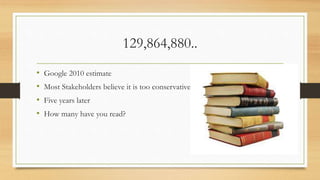
129,864,880..
• Google 2010 estimate
• Most Stakeholders believe it is too conservative
• Five years later
• How many have you read?
Without Books
• History is silent
• Literature is dumb
• Science is crippled
• Thought and Speculation at a standstill
(Tuchman, 1980)
History of Books
• Writing
• Paper
• Binding
• Printing
Writing
• Cave paintings were the first attempt to record information in “written”
form.
• Writing emerged in the earliest civilizations as a means of account keeping.
• Later it features in religious rituals and ceremonies.
• It is carried out by a special group of learned people.
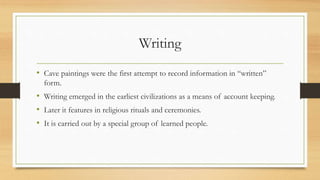
Clay tokens
Earliest forms of writing
were clay tokens for
recording inventory used
between 8000 BCE to 4000
BCE in the Mediterranean
region.
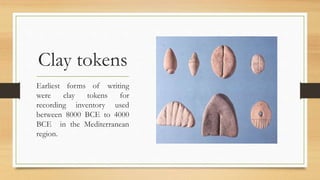
Pictographs
These Clay tablets
from 3200BCE show
early form of Sumer
pictographic writing.
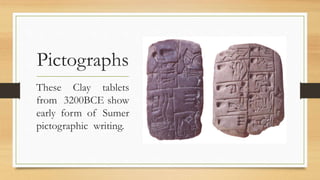
Cuneiform
Wedge-shaped writing
on baked clay tablets
emerged ca. 3000BCE
in Mesopotamia.
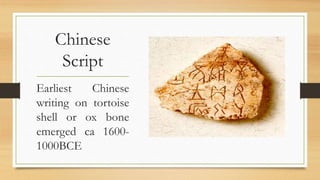
Chinese
Script
Earliest Chinese
writing on tortoise
shell or ox bone
emerged ca 1600-
1000BCE
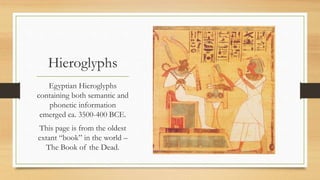
Hieroglyphs
Egyptian Hieroglyphs
containing both semantic and
phonetic information
emerged ca. 3500-400 BCE.
This page is from the oldest
extant “book” in the world –
The Book of the Dead.
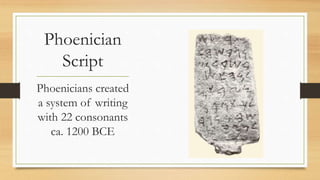
Phoenician
Script
Phoenicians created
a system of writing
with 22 consonants
ca. 1200 BCE
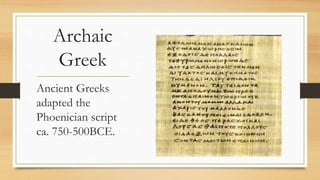
Archaic
Greek
Ancient Greeks
adapted the
Phoenician script
ca. 750-500BCE.
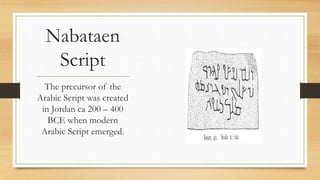
Nabataen
Script
The precursor of the
Arabic Script was created
in Jordan ca 200 – 400
BCE when modern
Arabic Script emerged.
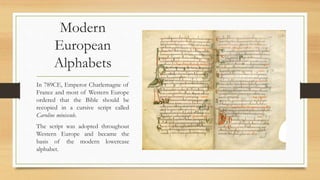
Modern
European
Alphabets
In 789CE, Emperor Charlemagne of
France and most of Western Europe
ordered that the Bible should be
recopied in a cursive script called
Caroline miniscule.
The script was adopted throughout
Western Europe and became the
basis of the modern lowercase
alphabet.
Paper
• Clay tablets, walls, rock surfaces, bones and shells were used for
writing.
• There was a need for more lightweight, inexpensive and user-
friendly material.
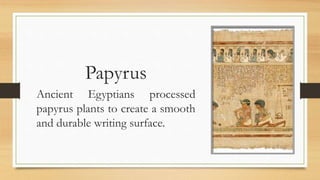
Papyrus
Ancient Egyptians processed
papyrus plants to create a smooth
and durable writing surface.
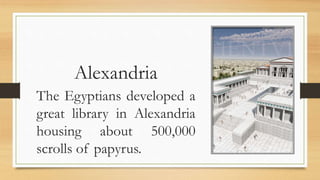
Alexandria
The Egyptians developed a
great library in Alexandria
housing about 500,000
scrolls of papyrus.
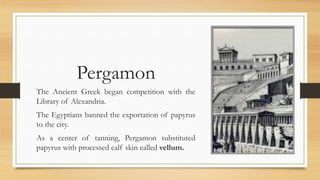
Pergamon
The Ancient Greek began competition with the
Library of Alexandria.
The Egyptians banned the exportation of papyrus
to the city.
As a center of tanning, Pergamon substituted
papyrus with processed calf skin called vellum.
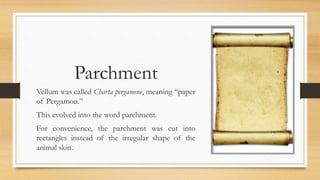
Parchment
Vellum was called Charta pergamene, meaning “paper
of Pergamon.”
This evolved into the word parchment.
For convenience, the parchment was cut into
rectangles instead of the irregular shape of the
animal skin.
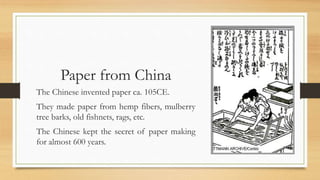
Paper from China
The Chinese invented paper ca. 105CE.
They made paper from hemp fibers, mulberry
tree barks, old fishnets, rags, etc.
The Chinese kept the secret of paper making
for almost 600 years.
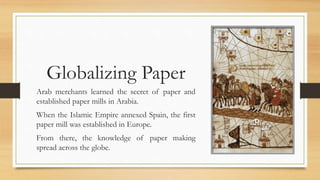
Globalizing Paper
Arab merchants learned the secret of paper and
established paper mills in Arabia.
When the Islamic Empire annexed Spain, the first
paper mill was established in Europe.
From there, the knowledge of paper making
spread across the globe.
Binding
• Clay tokens were strung together or placed in envelopes called bullae.
• Papyrus used to be rolled like mats into scrolls.
• Parchment used to be folded and bound together to make a codex.
• Codex is the beginning of the book as we know it today.
• It led to the emergence of page numbers, footnotes, running heads, table of
contents and indices.
Printing
• The Chinese invented the first printing ink ca. 400CE using soot from lamps
mixed with linseed oil.
• Printing was used to reproduce pictures, playing cards, designs on cloth, etc.
• Pictures or designs were cut into wood, stone, or metal blocks covered with
ink and pressed onto parchment, or cloth.
• This method is known as Block Printing.
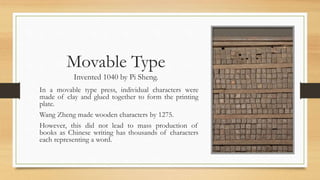
Movable Type
Invented 1040 by Pi Sheng.
In a movable type press, individual characters were
made of clay and glued together to form the printing
plate.
Wang Zheng made wooden characters by 1275.
However, this did not lead to mass production of
books as Chinese writing has thousands of characters
each representing a word.
Gutenberg’s Press
Invented 1452 by Johannes Gutenberg
The characters were made of metal. After
assembling in a frame, they were inked and pressed
on paper.
This led to the mass production of books for the
first time in human history.
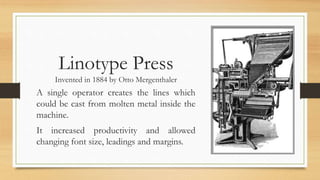
Linotype Press
Invented in 1884 by Otto Mergenthaler
A single operator creates the lines which
could be cast from molten metal inside the
machine.
It increased productivity and allowed
changing font size, leadings and margins.
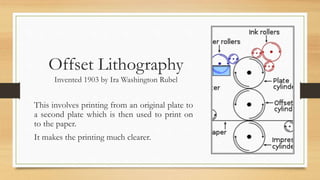
Offset Lithography
Invented 1903 by Ira Washington Rubel
This involves printing from an original plate to
a second plate which is then used to print on
to the paper.
It makes the printing much clearer.
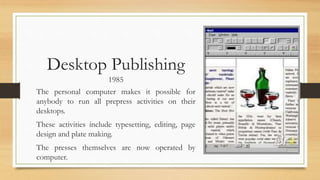
Desktop Publishing
1985
The personal computer makes it possible for
anybody to run all prepress activities on their
desktops.
These activities include typesetting, editing, page
design and plate making.
The presses themselves are now operated by
computer.
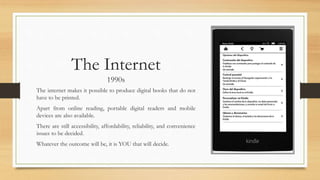
The Internet
1990s
The internet makes it possible to produce digital books that do not
have to be printed.
Apart from online reading, portable digital readers and mobile
devices are also available.
There are still accessibility, affordability, reliability, and convenience
issues to be decided.
Whatever the outcome will be, it is YOU that will decide.
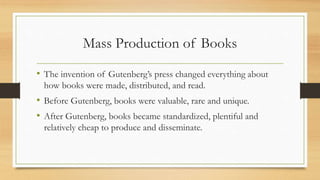
Mass Production of Books
• The invention of Gutenberg’s press changed everything about
how books were made, distributed, and read.
• Before Gutenberg, books were valuable, rare and unique.
• After Gutenberg, books became standardized, plentiful and
relatively cheap to produce and disseminate.
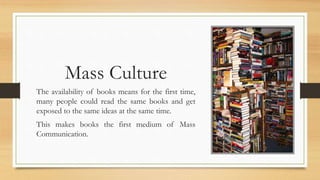
Mass Culture
The availability of books means for the first time,
many people could read the same books and get
exposed to the same ideas at the same time.
This makes books the first medium of Mass
Communication.
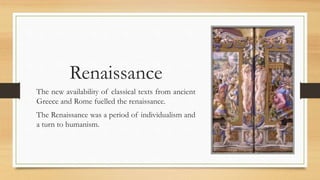
Renaissance
The new availability of classical texts from ancient
Greece and Rome fuelled the renaissance.
The Renaissance was a period of individualism and
a turn to humanism.
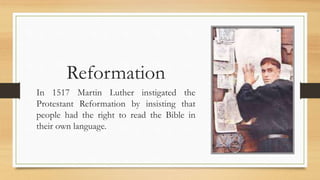
Reformation
In 1517 Martin Luther instigated the
Protestant Reformation by insisting that
people had the right to read the Bible in
their own language.
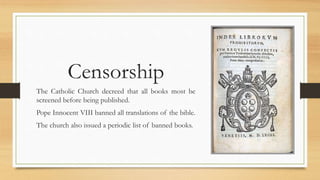
Censorship
The Catholic Church decreed that all books most be
screened before being published.
Pope Innocent VIII banned all translations of the bible.
The church also issued a periodic list of banned books.
Your Turn
• What do books mean to you?
• What are your favorite books?
• Which books do you think have had impact on your own life?

The Evolution of Books

  • 1.
    Evolution of Books MAUDERABIU GWADABE mrgwadabe.mac@buk.edu.ng R00M B1-182, FIRST FLOOR, DEPARTMENT OF MASS COMMUNICATION, BAYERO UNIVERSITY KANO MAC 2212: INTRODUCTION TO BOOK PUBLISHING
  • 2.
    129,864,880.. • Google 2010estimate • Most Stakeholders believe it is too conservative • Five years later • How many have you read?
  • 3.
    Without Books • Historyis silent • Literature is dumb • Science is crippled • Thought and Speculation at a standstill (Tuchman, 1980)
  • 4.
    History of Books •Writing • Paper • Binding • Printing
  • 5.
    Writing • Cave paintingswere the first attempt to record information in “written” form. • Writing emerged in the earliest civilizations as a means of account keeping. • Later it features in religious rituals and ceremonies. • It is carried out by a special group of learned people.
  • 6.
    Clay tokens Earliest formsof writing were clay tokens for recording inventory used between 8000 BCE to 4000 BCE in the Mediterranean region.
  • 7.
    Pictographs These Clay tablets from3200BCE show early form of Sumer pictographic writing.
  • 8.
    Cuneiform Wedge-shaped writing on bakedclay tablets emerged ca. 3000BCE in Mesopotamia.
  • 9.
    Chinese Script Earliest Chinese writing ontortoise shell or ox bone emerged ca 1600- 1000BCE
  • 10.
    Hieroglyphs Egyptian Hieroglyphs containing bothsemantic and phonetic information emerged ca. 3500-400 BCE. This page is from the oldest extant “book” in the world – The Book of the Dead.
  • 11.
    Phoenician Script Phoenicians created a systemof writing with 22 consonants ca. 1200 BCE
  • 12.
  • 13.
    Nabataen Script The precursor ofthe Arabic Script was created in Jordan ca 200 – 400 BCE when modern Arabic Script emerged.
  • 14.
    Modern European Alphabets In 789CE, EmperorCharlemagne of France and most of Western Europe ordered that the Bible should be recopied in a cursive script called Caroline miniscule. The script was adopted throughout Western Europe and became the basis of the modern lowercase alphabet.
  • 15.
    Paper • Clay tablets,walls, rock surfaces, bones and shells were used for writing. • There was a need for more lightweight, inexpensive and user- friendly material.
  • 16.
    Papyrus Ancient Egyptians processed papyrusplants to create a smooth and durable writing surface.
  • 17.
    Alexandria The Egyptians developeda great library in Alexandria housing about 500,000 scrolls of papyrus.
  • 18.
    Pergamon The Ancient Greekbegan competition with the Library of Alexandria. The Egyptians banned the exportation of papyrus to the city. As a center of tanning, Pergamon substituted papyrus with processed calf skin called vellum.
  • 19.
    Parchment Vellum was calledCharta pergamene, meaning “paper of Pergamon.” This evolved into the word parchment. For convenience, the parchment was cut into rectangles instead of the irregular shape of the animal skin.
  • 20.
    Paper from China TheChinese invented paper ca. 105CE. They made paper from hemp fibers, mulberry tree barks, old fishnets, rags, etc. The Chinese kept the secret of paper making for almost 600 years.
  • 21.
    Globalizing Paper Arab merchantslearned the secret of paper and established paper mills in Arabia. When the Islamic Empire annexed Spain, the first paper mill was established in Europe. From there, the knowledge of paper making spread across the globe.
  • 22.
    Binding • Clay tokenswere strung together or placed in envelopes called bullae. • Papyrus used to be rolled like mats into scrolls. • Parchment used to be folded and bound together to make a codex. • Codex is the beginning of the book as we know it today. • It led to the emergence of page numbers, footnotes, running heads, table of contents and indices.
  • 23.
    Printing • The Chineseinvented the first printing ink ca. 400CE using soot from lamps mixed with linseed oil. • Printing was used to reproduce pictures, playing cards, designs on cloth, etc. • Pictures or designs were cut into wood, stone, or metal blocks covered with ink and pressed onto parchment, or cloth. • This method is known as Block Printing.
  • 24.
    Movable Type Invented 1040by Pi Sheng. In a movable type press, individual characters were made of clay and glued together to form the printing plate. Wang Zheng made wooden characters by 1275. However, this did not lead to mass production of books as Chinese writing has thousands of characters each representing a word.
  • 25.
    Gutenberg’s Press Invented 1452by Johannes Gutenberg The characters were made of metal. After assembling in a frame, they were inked and pressed on paper. This led to the mass production of books for the first time in human history.
  • 26.
    Linotype Press Invented in1884 by Otto Mergenthaler A single operator creates the lines which could be cast from molten metal inside the machine. It increased productivity and allowed changing font size, leadings and margins.
  • 27.
    Offset Lithography Invented 1903by Ira Washington Rubel This involves printing from an original plate to a second plate which is then used to print on to the paper. It makes the printing much clearer.
  • 28.
    Desktop Publishing 1985 The personalcomputer makes it possible for anybody to run all prepress activities on their desktops. These activities include typesetting, editing, page design and plate making. The presses themselves are now operated by computer.
  • 29.
    The Internet 1990s The internetmakes it possible to produce digital books that do not have to be printed. Apart from online reading, portable digital readers and mobile devices are also available. There are still accessibility, affordability, reliability, and convenience issues to be decided. Whatever the outcome will be, it is YOU that will decide.
  • 30.
    Mass Production ofBooks • The invention of Gutenberg’s press changed everything about how books were made, distributed, and read. • Before Gutenberg, books were valuable, rare and unique. • After Gutenberg, books became standardized, plentiful and relatively cheap to produce and disseminate.
  • 31.
    Mass Culture The availabilityof books means for the first time, many people could read the same books and get exposed to the same ideas at the same time. This makes books the first medium of Mass Communication.
  • 32.
    Renaissance The new availabilityof classical texts from ancient Greece and Rome fuelled the renaissance. The Renaissance was a period of individualism and a turn to humanism.
  • 33.
    Reformation In 1517 MartinLuther instigated the Protestant Reformation by insisting that people had the right to read the Bible in their own language.
  • 34.
    Censorship The Catholic Churchdecreed that all books most be screened before being published. Pope Innocent VIII banned all translations of the bible. The church also issued a periodic list of banned books.
  • 35.
    Your Turn • Whatdo books mean to you? • What are your favorite books? • Which books do you think have had impact on your own life?