TUESDAY AND WEDNESDAY SEPTEMBER 11TH/12TH
Objectives: Students will gain a greater understanding of how the Penny Press
changed the financial model of newspapers by introducing advertisements to
their pages. Suddenly, reaching a broader audience wasn’t just about spreading
the news; it was about reaching more people to earn more dollars from
advertisers.
1.The Penny Press: Presentation and Discussion
2. AIDA Ad Design Basics Activity and Overview
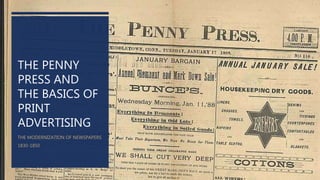
THE PENNY
PRESS AND
THE BASICS OF
PRINT
ADVERTISING
THE MODERNIZATION OF NEWSPAPERS
1830-1850
PRESENTATION SLIDE TOPICS
 The Telegraph: How News Travelled
 The Horse/Railroad: How News Traveled
 Steam Printing/Fourdrinier Process
 Advertising and The Penny Press
 Benjamin Day and the NY Sun
 James Gordon Bennett and the NY Herald
 The Real Newsies
REQUIREMENTS
 Analyze rubric; share or email by end of period; should be at least 3 slides in length, contain 3 images,
and contain at least 3 relevant facts related to the topic(s) and how it/they connect(s) to
history/contemporary journalism.
 Feel free to include other forms of media, like short, classroom appropriate videos, etc.
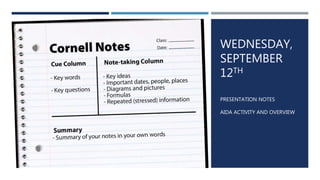
WEDNESDAY,
SEPTEMBER
12TH
PRESENTATION NOTES
AIDA ACTIVITY AND OVERVIEW
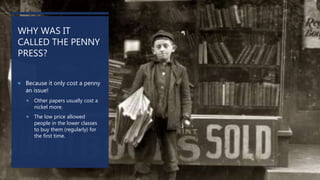
WHY WAS IT
CALLED THE PENNY
PRESS?
 Because it only cost a penny
an issue!
 Other papers usually cost a
nickel more.
 The low price allowed
people in the lower classes
to buy them (regularly) for
the first time.
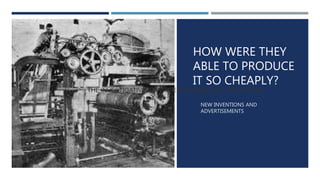
HOW WERE THEY
ABLE TO PRODUCE
IT SO CHEAPLY?
NEW INVENTIONS AND
ADVERTISEMENTS
THE INVESTIGATIVE REPORTER'S HANDBOOK, 5TH EDITIONTHE INVESTIGATIVE REPORTER'S HANDBOOK, 5TH EDITION
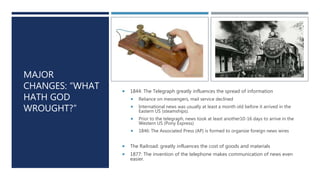
MAJOR
CHANGES: “WHAT
HATH GOD
WROUGHT?”
 1844: The Telegraph greatly influences the spread of information
 Reliance on messengers, mail service declined
 International news was usually at least a month old before it arrived in the
Eastern US (steamships).
 Prior to the telegraph, news took at least another10-16 days to arrive in the
Western US (Pony Express)
 1846: The Associated Press (AP) is formed to organize foreign news wires
 The Railroad: greatly influences the cost of goods and materials
 1877: The invention of the telephone makes communication of news even
easier.
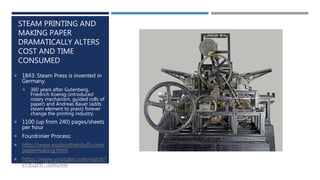
STEAM PRINTING AND
MAKING PAPER
DRAMATICALLY ALTERS
COST AND TIME
CONSUMED
 1843: Steam Press is invented in
Germany.
 360 years after Gutenberg,
Friedrich Koenig (introduced
rotary mechanism, guided rolls of
paper) and Andreas Bauer (adds
steam element to press) forever
change the printing industry.
 1100 (up from 240) pages/sheets
per hour
 Fourdrinier Process:
 http://www.explainthatstuff.com/
papermaking.html
 https://www.youtube.com/watch?
v=e1pm-TuMLAM
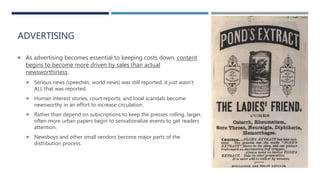
ADVERTISING
 As advertising becomes essential to keeping costs down, content
begins to become more driven by sales than actual
newsworthiness.
 Serious news (speeches, world news) was still reported, it just wasn’t
ALL that was reported.
 Human interest stories, court reports, and local scandals become
newsworthy in an effort to increase circulation.
 Rather than depend on subscriptions to keep the presses rolling, larger,
often more urban papers begin to sensationalize events to get readers
attention.
 Newsboys and other small vendors become major parts of the
distribution process.
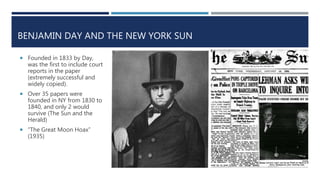
BENJAMIN DAY AND THE NEW YORK SUN
 Founded in 1833 by Day,
was the first to include court
reports in the paper
(extremely successful and
widely copied).
 Over 35 papers were
founded in NY from 1830 to
1840, and only 2 would
survive (The Sun and the
Herald)
 “The Great Moon Hoax”
(1935)
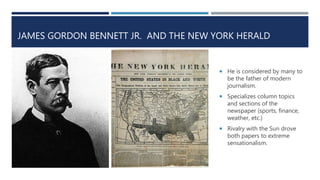
JAMES GORDON BENNETT JR. AND THE NEW YORK HERALD
 He is considered by many to
be the father of modern
journalism.
 Specializes column topics
and sections of the
newspaper (sports, finance,
weather, etc.)
 Rivalry with the Sun drove
both papers to extreme
sensationalism.
ADVERTISEMENT ANALYSIS
 The Capital Journal: Modern Day Ad Analysis
 Identify Paper Price: speculate what percentage of the cost you think is profit
 Elements of Advertising: Study a large ad and identify what catches your attention
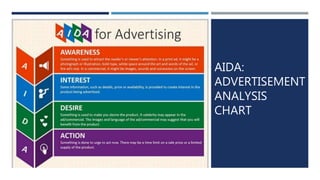
 Fill-in your observations on the AIDA chart (next slide)
 Elements of Advertising: Study a small ad and identify what catches your attention
THURSDAY, SEPTEMBER 13TH
 Objectives: Students will gain a greater understanding of how the Penny Press changed the financial
model of newspapers by introducing advertisements to their pages. Suddenly, reaching a broader
audience wasn’t just about spreading the news; it was about reaching more people to earn more dollars
from advertisers.
 Finish Ad Activity
 Create an Ad using Word or Publisher
AIDA:
ADVERTISEMENT
ANALYSIS
CHART
ADVERTISEMENT DESIGN BASICS
Color
Text &
Position
Content
COLOR
Nothing can decide whether
someone pays attention to your
ad or glances past it more.
•Red, Orange, and Yellow are colors that
feel like they are coming towards you.
•Blue, Green, and Violet are colors that
like they are going away from you (use
them as a background to make colors pop!
01
Photos within ads should also pop,
even if it means adding colored
fonts or borders to them.
02
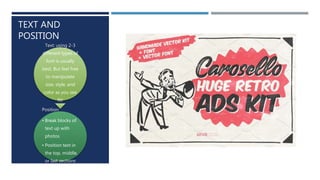
TEXT AND
POSITION
Text: using 2-3
different types of
font is usually
best. But feel free
to manipulate
size, style, and
color as you see
fit!
Position
• Break blocks of
text up with
photos
• Position text in
the top, middle,
or last sections
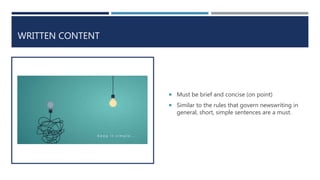
WRITTEN CONTENT
 Must be brief and concise (on point)
 Similar to the rules that govern newswriting in
general, short, simple sentences are a must.
WORD TEMPLATE: FLYER
The type of ad we will be designing will be a flyer.
While it’s not the same as a Penny Press ad, or even a
traditional newspaper or magazine ad, it will give us a
chance to practice using the basic elements of
advertising design in an easy to use template.
01
If you would prefer to design your ad without the
template, as an alternative option, you may create
one using a text box in Word. (FYI: this is a much
more meticulous process)
02
PRINCIPLES AND JOBS OF NEWSPAPER ADVERTISING
Create the best message
possible
Copywriters: get paid by
large papers to compose
language that will appeal to
readers
Artists and Photographers:
get paid by large papers to
develop attractive designs
and photograph layouts
“Desirable Reality”-
Purchase and live a better
life! (more common with
corporate ads)
Often follow the AIDA
formula: Attention, Interest,
Desire, Act
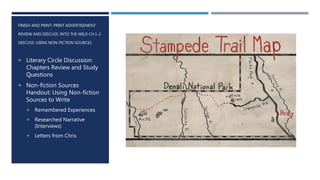
FINISH AND PRINT: PRINT ADVERTISEMENT
REVIEW AND DISCUSS: INTO THE WILD CH.1-2
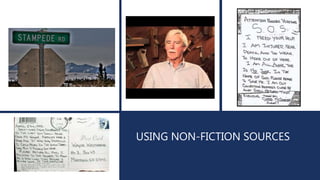
DISCUSS: USING NON-FICTION SOURCES
 Literary Circle Discussion:
Chapters Review and Study
Questions
 Non-fiction Sources
Handout: Using Non-fiction
Sources to Write
 Remembered Experiences
 Researched Narrative
(Interviews)
 Letters from Chris
USING NON-FICTION SOURCES

The Penny Press

  • 1.
    TUESDAY AND WEDNESDAYSEPTEMBER 11TH/12TH Objectives: Students will gain a greater understanding of how the Penny Press changed the financial model of newspapers by introducing advertisements to their pages. Suddenly, reaching a broader audience wasn’t just about spreading the news; it was about reaching more people to earn more dollars from advertisers. 1.The Penny Press: Presentation and Discussion 2. AIDA Ad Design Basics Activity and Overview
  • 2.
    THE PENNY PRESS AND THEBASICS OF PRINT ADVERTISING THE MODERNIZATION OF NEWSPAPERS 1830-1850
  • 3.
    PRESENTATION SLIDE TOPICS The Telegraph: How News Travelled  The Horse/Railroad: How News Traveled  Steam Printing/Fourdrinier Process  Advertising and The Penny Press  Benjamin Day and the NY Sun  James Gordon Bennett and the NY Herald  The Real Newsies REQUIREMENTS  Analyze rubric; share or email by end of period; should be at least 3 slides in length, contain 3 images, and contain at least 3 relevant facts related to the topic(s) and how it/they connect(s) to history/contemporary journalism.  Feel free to include other forms of media, like short, classroom appropriate videos, etc.
  • 4.
  • 5.
    WHY WAS IT CALLEDTHE PENNY PRESS?  Because it only cost a penny an issue!  Other papers usually cost a nickel more.  The low price allowed people in the lower classes to buy them (regularly) for the first time.
  • 6.
    HOW WERE THEY ABLETO PRODUCE IT SO CHEAPLY? NEW INVENTIONS AND ADVERTISEMENTS THE INVESTIGATIVE REPORTER'S HANDBOOK, 5TH EDITIONTHE INVESTIGATIVE REPORTER'S HANDBOOK, 5TH EDITION
  • 7.
    MAJOR CHANGES: “WHAT HATH GOD WROUGHT?” 1844: The Telegraph greatly influences the spread of information  Reliance on messengers, mail service declined  International news was usually at least a month old before it arrived in the Eastern US (steamships).  Prior to the telegraph, news took at least another10-16 days to arrive in the Western US (Pony Express)  1846: The Associated Press (AP) is formed to organize foreign news wires  The Railroad: greatly influences the cost of goods and materials  1877: The invention of the telephone makes communication of news even easier.
  • 8.
    STEAM PRINTING AND MAKINGPAPER DRAMATICALLY ALTERS COST AND TIME CONSUMED  1843: Steam Press is invented in Germany.  360 years after Gutenberg, Friedrich Koenig (introduced rotary mechanism, guided rolls of paper) and Andreas Bauer (adds steam element to press) forever change the printing industry.  1100 (up from 240) pages/sheets per hour  Fourdrinier Process:  http://www.explainthatstuff.com/ papermaking.html  https://www.youtube.com/watch? v=e1pm-TuMLAM
  • 9.
    ADVERTISING  As advertisingbecomes essential to keeping costs down, content begins to become more driven by sales than actual newsworthiness.  Serious news (speeches, world news) was still reported, it just wasn’t ALL that was reported.  Human interest stories, court reports, and local scandals become newsworthy in an effort to increase circulation.  Rather than depend on subscriptions to keep the presses rolling, larger, often more urban papers begin to sensationalize events to get readers attention.  Newsboys and other small vendors become major parts of the distribution process.
  • 10.
    BENJAMIN DAY ANDTHE NEW YORK SUN  Founded in 1833 by Day, was the first to include court reports in the paper (extremely successful and widely copied).  Over 35 papers were founded in NY from 1830 to 1840, and only 2 would survive (The Sun and the Herald)  “The Great Moon Hoax” (1935)
  • 11.
    JAMES GORDON BENNETTJR. AND THE NEW YORK HERALD  He is considered by many to be the father of modern journalism.  Specializes column topics and sections of the newspaper (sports, finance, weather, etc.)  Rivalry with the Sun drove both papers to extreme sensationalism.
  • 12.
    ADVERTISEMENT ANALYSIS  TheCapital Journal: Modern Day Ad Analysis  Identify Paper Price: speculate what percentage of the cost you think is profit  Elements of Advertising: Study a large ad and identify what catches your attention  Fill-in your observations on the AIDA chart (next slide)  Elements of Advertising: Study a small ad and identify what catches your attention
  • 13.
    THURSDAY, SEPTEMBER 13TH Objectives: Students will gain a greater understanding of how the Penny Press changed the financial model of newspapers by introducing advertisements to their pages. Suddenly, reaching a broader audience wasn’t just about spreading the news; it was about reaching more people to earn more dollars from advertisers.  Finish Ad Activity  Create an Ad using Word or Publisher
  • 14.
  • 15.
  • 16.
    COLOR Nothing can decidewhether someone pays attention to your ad or glances past it more. •Red, Orange, and Yellow are colors that feel like they are coming towards you. •Blue, Green, and Violet are colors that like they are going away from you (use them as a background to make colors pop! 01 Photos within ads should also pop, even if it means adding colored fonts or borders to them. 02
  • 17.
    TEXT AND POSITION Text: using2-3 different types of font is usually best. But feel free to manipulate size, style, and color as you see fit! Position • Break blocks of text up with photos • Position text in the top, middle, or last sections
  • 18.
    WRITTEN CONTENT  Mustbe brief and concise (on point)  Similar to the rules that govern newswriting in general, short, simple sentences are a must.
  • 19.
    WORD TEMPLATE: FLYER Thetype of ad we will be designing will be a flyer. While it’s not the same as a Penny Press ad, or even a traditional newspaper or magazine ad, it will give us a chance to practice using the basic elements of advertising design in an easy to use template. 01 If you would prefer to design your ad without the template, as an alternative option, you may create one using a text box in Word. (FYI: this is a much more meticulous process) 02
  • 20.
    PRINCIPLES AND JOBSOF NEWSPAPER ADVERTISING Create the best message possible Copywriters: get paid by large papers to compose language that will appeal to readers Artists and Photographers: get paid by large papers to develop attractive designs and photograph layouts “Desirable Reality”- Purchase and live a better life! (more common with corporate ads) Often follow the AIDA formula: Attention, Interest, Desire, Act
  • 21.
    FINISH AND PRINT:PRINT ADVERTISEMENT REVIEW AND DISCUSS: INTO THE WILD CH.1-2 DISCUSS: USING NON-FICTION SOURCES  Literary Circle Discussion: Chapters Review and Study Questions  Non-fiction Sources Handout: Using Non-fiction Sources to Write  Remembered Experiences  Researched Narrative (Interviews)  Letters from Chris
  • 22.