Comics & Graphic Novels
Characteristics of the Medium
What is Comics?
The word comics refers to the medium itself. Comics is
a medium like print or film.
Comics is a medium used to express narratives or
ideas through images, usually combined with text
Comics have been used to express various content and
messages: fictional, nonfictional, political,
philosophical, etc.
Only in the past few decades has the medium of
comics received critical attention
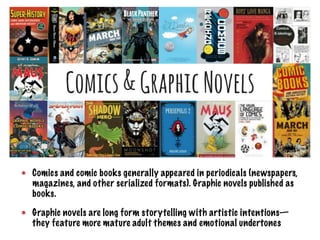
Comics and comic books generally appeared in periodicals (newspapers,
magazines, and other serialized formats). Graphic novels published as
books.
Graphic novels are long form storytelling with artistic intentions—
they feature more mature adult themes and emotional undertones
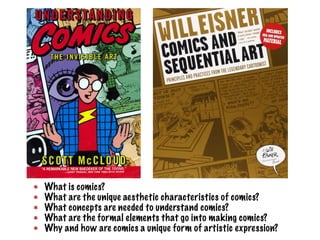
What is comics?
What are the unique aesthetic characteristics of comics?
What concepts are needed to understand comics?
What are the formal elements that go into making comics?
Why and how are comics a unique form of artistic expression?
Words and Pictures
Images from Scott McCloud’s Understanding Comics: The Invisible Art
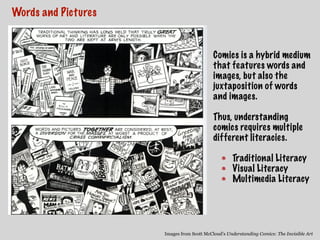
Comics is a hybrid medium
that features words and
images, but also the
juxtaposition of words
and images.
Thus, understanding
comics requires multiple
different literacies.
Traditional Literacy
Visual Literacy
Multimedia Literacy
Words and Pictures
Images from Scott McCloud’s Understanding Comics: The Invisible Art
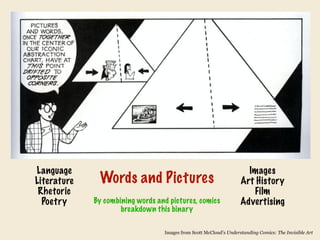
Language
Literature
Rhetoric
Poetry
Images
Art History
Film
Advertising
By combining words and pictures, comics
breakdown this binary
Images from Scott McCloud’s Understanding Comics: The Invisible Art
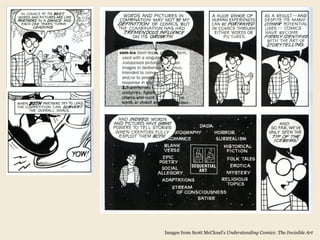
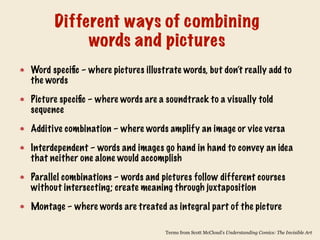
Word specific – where pictures illustrate words, but don’t really add to
the words
Picture specific – where words are a soundtrack to a visually told
sequence
Additive combination – where words amplify an image or vice versa
Interdependent – words and images go hand in hand to convey an idea
that neither one alone would accomplish
Parallel combinations – words and pictures follow different courses
without intersecting; create meaning through juxtaposition
Montage – where words are treated as integral part of the picture
Different ways of combining
words and pictures
Terms from Scott McCloud’s Understanding Comics: The Invisible Art
Images from Scott McCloud’s Understanding Comics: The Invisible Art
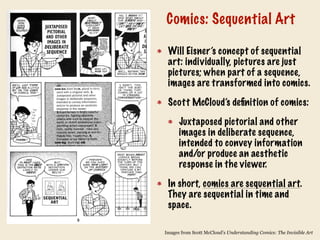
Comics: Sequential Art
Will Eisner’s concept of sequential
art: individually, pictures are just
pictures; when part of a sequence,
images are transformed into comics.
Scott McCloud’s definition of comics:
Juxtaposed pictorial and other
images in deliberate sequence,
intended to convey information
and/or produce an aesthetic
response in the viewer.
In short, comics are sequential art.
They are sequential in time and
space.
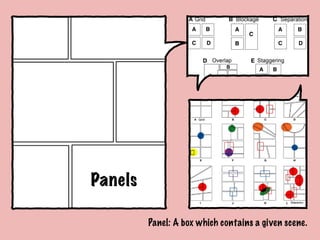
Panels
Panel: A box which contains a given scene.
The Narrative
Grammar of Comics
In comics, the grammar of the
narrative consists of panels, panel
arrangement, the shape and design
of panels, the rendering of elements
within panels, the transitions
between panels, the perspective of
panels, and the association of images
between and across panels
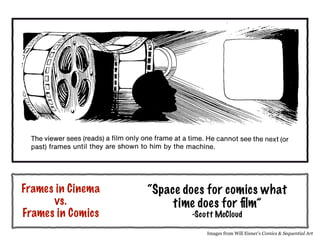
Frames in Cinema
vs.
Frames in Comics
Images from Will Eisner’s Comics & Sequential Art
“Space does for comics what
time does for film”
-Scott McCloud
Images from Will Eisner’s Comics & Sequential Art
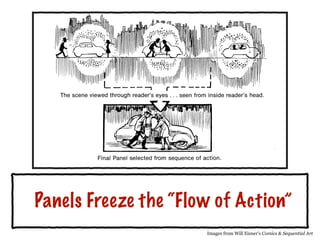
Panels Freeze the “Flow of Action”
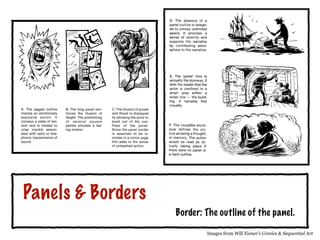
Panels & Borders
Images from Will Eisner’s Comics & Sequential Art
Border: The outline of the panel.
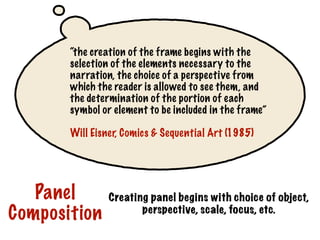
“the creation of the frame begins with the
selection of the elements necessary to the
narration, the choice of a perspective from
which the reader is allowed to see them, and
the determination of the portion of each
symbol or element to be included in the frame”
Will Eisner, Comics & Sequential Art (1985)
Creating panel begins with choice of object,
perspective, scale, focus, etc.
Panel
Composition
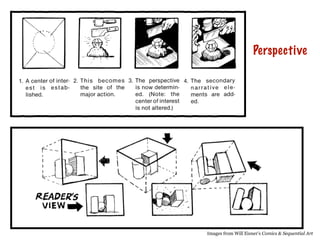
Perspective
Images from Will Eisner’s Comics & Sequential Art
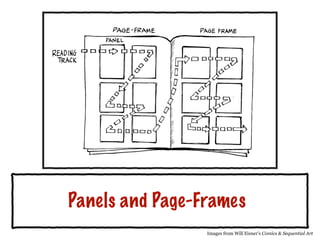
Panels and Page-Frames
Images from Will Eisner’s Comics & Sequential Art
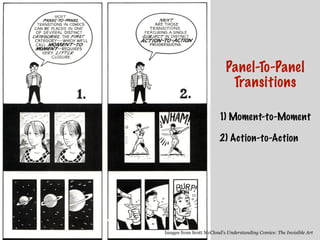
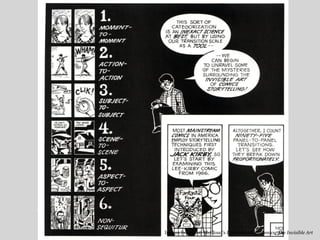
Panel-To-Panel
Transitions
Images from Scott McCloud’s Understanding Comics: The Invisible Art
1) Moment-to-Moment
2) Action-to-Action
Images from Scott McCloud’s Understanding Comics: The Invisible Art
Panel-To-Panel
Transitions
3) Subject-to-Subject
4) Scene-to-Scene
Images from Scott McCloud’s Understanding Comics: The Invisible Art
Panel-To-Panel
Transitions
5) Aspect-to-Aspect
6) Non-Sequitur
Images from Scott McCloud’s Understanding Comics: The Invisible Art
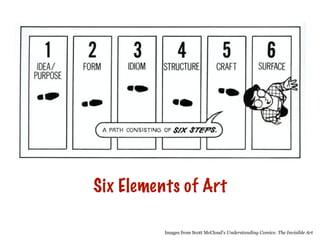
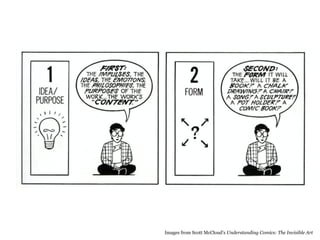
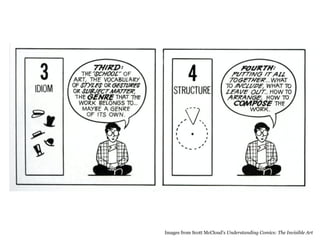
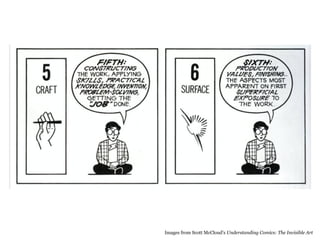
Six Elements of Art
Images from Scott McCloud’s Understanding Comics: The Invisible Art
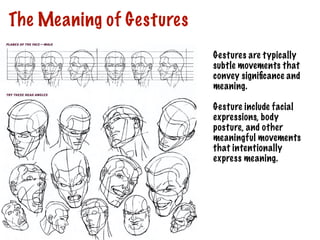
The Meaning of Gestures
Gestures are typically
subtle movements that
convey significance and
meaning.
Gesture include facial
expressions, body
posture, and other
meaningful movements
that intentionally
express meaning.

Comics & Graphic Novels

  • 1.
    Comics & GraphicNovels Characteristics of the Medium
  • 2.
    What is Comics? Theword comics refers to the medium itself. Comics is a medium like print or film. Comics is a medium used to express narratives or ideas through images, usually combined with text Comics have been used to express various content and messages: fictional, nonfictional, political, philosophical, etc. Only in the past few decades has the medium of comics received critical attention
  • 3.
    Comics and comicbooks generally appeared in periodicals (newspapers, magazines, and other serialized formats). Graphic novels published as books. Graphic novels are long form storytelling with artistic intentions— they feature more mature adult themes and emotional undertones
  • 4.
    What is comics? Whatare the unique aesthetic characteristics of comics? What concepts are needed to understand comics? What are the formal elements that go into making comics? Why and how are comics a unique form of artistic expression?
  • 5.
    Words and Pictures Imagesfrom Scott McCloud’s Understanding Comics: The Invisible Art Comics is a hybrid medium that features words and images, but also the juxtaposition of words and images. Thus, understanding comics requires multiple different literacies. Traditional Literacy Visual Literacy Multimedia Literacy
  • 6.
    Words and Pictures Imagesfrom Scott McCloud’s Understanding Comics: The Invisible Art Language Literature Rhetoric Poetry Images Art History Film Advertising By combining words and pictures, comics breakdown this binary
  • 7.
    Images from ScottMcCloud’s Understanding Comics: The Invisible Art
  • 8.
    Word specific –where pictures illustrate words, but don’t really add to the words Picture specific – where words are a soundtrack to a visually told sequence Additive combination – where words amplify an image or vice versa Interdependent – words and images go hand in hand to convey an idea that neither one alone would accomplish Parallel combinations – words and pictures follow different courses without intersecting; create meaning through juxtaposition Montage – where words are treated as integral part of the picture Different ways of combining words and pictures Terms from Scott McCloud’s Understanding Comics: The Invisible Art
  • 9.
    Images from ScottMcCloud’s Understanding Comics: The Invisible Art Comics: Sequential Art Will Eisner’s concept of sequential art: individually, pictures are just pictures; when part of a sequence, images are transformed into comics. Scott McCloud’s definition of comics: Juxtaposed pictorial and other images in deliberate sequence, intended to convey information and/or produce an aesthetic response in the viewer. In short, comics are sequential art. They are sequential in time and space.
  • 10.
    Panels Panel: A boxwhich contains a given scene.
  • 11.
    The Narrative Grammar ofComics In comics, the grammar of the narrative consists of panels, panel arrangement, the shape and design of panels, the rendering of elements within panels, the transitions between panels, the perspective of panels, and the association of images between and across panels
  • 12.
    Frames in Cinema vs. Framesin Comics Images from Will Eisner’s Comics & Sequential Art “Space does for comics what time does for film” -Scott McCloud
  • 13.
    Images from WillEisner’s Comics & Sequential Art Panels Freeze the “Flow of Action”
  • 14.
    Panels & Borders Imagesfrom Will Eisner’s Comics & Sequential Art Border: The outline of the panel.
  • 15.
    “the creation ofthe frame begins with the selection of the elements necessary to the narration, the choice of a perspective from which the reader is allowed to see them, and the determination of the portion of each symbol or element to be included in the frame” Will Eisner, Comics & Sequential Art (1985) Creating panel begins with choice of object, perspective, scale, focus, etc. Panel Composition
  • 16.
    Perspective Images from WillEisner’s Comics & Sequential Art
  • 17.
    Panels and Page-Frames Imagesfrom Will Eisner’s Comics & Sequential Art
  • 18.
    Panel-To-Panel Transitions Images from ScottMcCloud’s Understanding Comics: The Invisible Art 1) Moment-to-Moment 2) Action-to-Action
  • 19.
    Images from ScottMcCloud’s Understanding Comics: The Invisible Art Panel-To-Panel Transitions 3) Subject-to-Subject 4) Scene-to-Scene
  • 20.
    Images from ScottMcCloud’s Understanding Comics: The Invisible Art Panel-To-Panel Transitions 5) Aspect-to-Aspect 6) Non-Sequitur
  • 21.
    Images from ScottMcCloud’s Understanding Comics: The Invisible Art
  • 23.
    Images from ScottMcCloud’s Understanding Comics: The Invisible Art Six Elements of Art
  • 24.
    Images from ScottMcCloud’s Understanding Comics: The Invisible Art
  • 25.
    Images from ScottMcCloud’s Understanding Comics: The Invisible Art
  • 26.
    Images from ScottMcCloud’s Understanding Comics: The Invisible Art
  • 27.
    The Meaning ofGestures Gestures are typically subtle movements that convey significance and meaning. Gesture include facial expressions, body posture, and other meaningful movements that intentionally express meaning.