Chapter 20
International
Banking, Debt,
and Risk
Copyright © 2007 Pearson Addison-Wesley. All rights
reserved. 20-2
Topics to be Covered
• Eurocurrency Market
• Origins of Offshore Banking
• International Banking Facilities
• Offshore Banking Practices
• International Debt
• IMF and IMF Conditionality
• Role of Corruption
• Country Risk Analysis
Copyright © 2007 Pearson Addison-Wesley. All rights
reserved. 20-3
Eurocurrency Market
• Eurocurrency Market—is the deposit
and loan market for foreign currencies.
• Banks that accept deposits and make
loans in the Eurocurrency market are
called Eurobanks.
• The term Eurocurrency or Eurobank is a
misnomer since it refers to offshore
banking and is not limited to Europe.
Copyright © 2007 Pearson Addison-Wesley. All rights
reserved. 20-4
Origins of Offshore Banking
• The Eurodollar market started in the late
1950s when European banks began
accepting deposits in U.S. dollars.
• Why and how did this market get started?
♦ The reserve-currency status of the dollar was an
important factor.
♦ Some communist countries were the earliest
source of dollar deposits held in Europe.
♦ Eurobanks developed as a result of
profit considerations.
Copyright © 2007 Pearson Addison-Wesley. All rights
reserved. 20-5
Offshore Banking (cont.)
• Offshore banking has grown rapidly
over the past decades because
Eurobanks are essentially unregulated.
• Eurobanks can offer narrower spreads
than U.S. banks (the “spread” is the
difference between the deposit and loan
interest rates).
Copyright © 2007 Pearson Addison-Wesley. All rights
reserved. 20-6
Eurobank vs. U.S. Bank Spreads
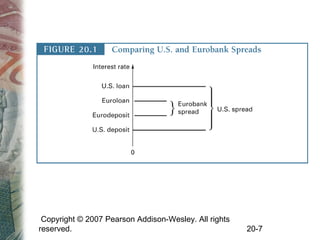
• Refer to Figure 20.1
• Eurobanks are able to offer a lower rate
on dollar loans and a higher rate on
dollar deposits than U.S. banks.
• Eurodollar transactions are considered
riskier to U.S. residents compared to
domestic dollar transactions in the U.S.
Copyright © 2007 Pearson Addison-Wesley. All rights
reserved. 20-7
Copyright © 2007 Pearson Addison-Wesley. All rights
reserved. 20-8
LIBOR
• London Interbank Offered Rate
(LIBOR)—the interest rate at which
large London banks make deposits or
lend to each other.
• In the Eurodollar market, loan interest
rates are quoted as percentage points
above LIBOR.
Copyright © 2007 Pearson Addison-Wesley. All rights
reserved. 20-9
International Banking by Countries
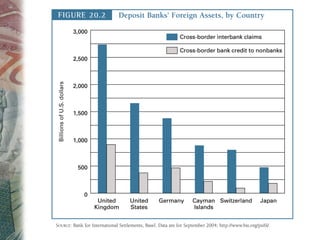
• Refer to Figure 20.2 Foreign assets
held by banks, by country
• The U.K. and U.S. banks account for
the largest shares of foreign assets,
primarily cross-border interbank claims.
• Interbank claims are deposits held in
banks in other countries.
Copyright © 2007 Pearson Addison-Wesley. All rights
reserved. 20-11
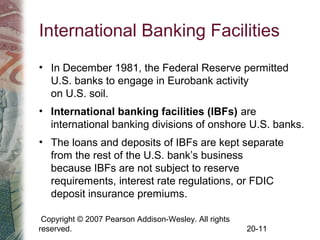
International Banking Facilities
• In December 1981, the Federal Reserve permitted
U.S. banks to engage in Eurobank activity
on U.S. soil.
• International banking facilities (IBFs) are
international banking divisions of onshore U.S. banks.
• The loans and deposits of IBFs are kept separate
from the rest of the U.S. bank’s business
because IBFs are not subject to reserve
requirements, interest rate regulations, or FDIC
deposit insurance premiums.
Copyright © 2007 Pearson Addison-Wesley. All rights
reserved. 20-12
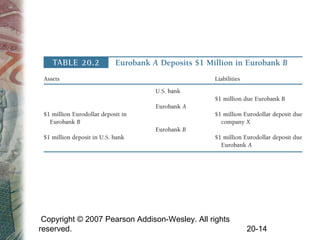
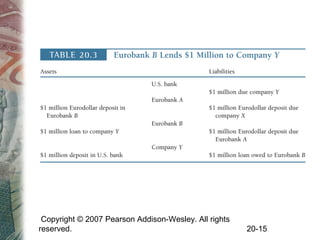
Offshore Banking Practices
• Because of the importance of interbank
transactions, gross deposits at Eurobanks
overstate the actual amount of activity of
these banks in intermediating funds between
nonbank savers and nonbank borrowers.
• To measure the amount of credit actually
extended by Eurobanks, the net size of the
market is determined by subtracting interbank
activity from total deposits.
• Refer to Tables 20.1, 20.2, and 20.3 for
an example.
Copyright © 2007 Pearson Addison-Wesley. All rights
reserved. 20-13
Copyright © 2007 Pearson Addison-Wesley. All rights
reserved. 20-14
Copyright © 2007 Pearson Addison-Wesley. All rights
reserved. 20-15
Copyright © 2007 Pearson Addison-Wesley. All rights
reserved. 20-16
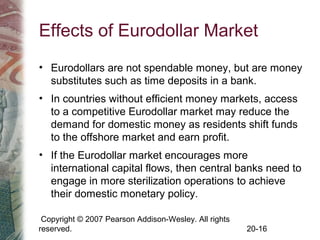
Effects of Eurodollar Market
• Eurodollars are not spendable money, but are money
substitutes such as time deposits in a bank.
• In countries without efficient money markets, access
to a competitive Eurodollar market may reduce the
demand for domestic money as residents shift funds
to the offshore market and earn profit.
• If the Eurodollar market encourages more
international capital flows, then central banks need to
engage in more sterilization operations to achieve
their domestic monetary policy.
Copyright © 2007 Pearson Addison-Wesley. All rights
reserved. 20-17
Characteristics of Eurobanks
• Eurobanks are just like domestic banks
in terms of maximizing spreads and
managing risk.
• Deposits are for fixed terms ranging from
days to years, mostly for less than six months.
Eurocurrency deposits are similar to domestic
banks’ certificates of deposits.
• Eurocurrency loans can range up to 10 years
or more. Large loans are generally made by
syndicates of Eurobanks.
Copyright © 2007 Pearson Addison-Wesley. All rights
reserved. 20-18
International Debt
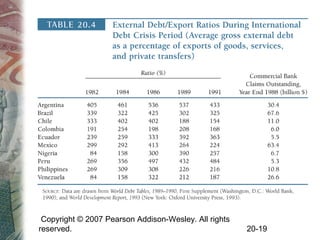
• Petrodollars—are Eurodollar deposits
arising from the trade surpluses of
OPEC nations.
• In turn, the Eurobanks lent these
petrodollars to developing countries.
• Refer to Table 20.4 External debt of
developing countries during the debt
crisis period.
Copyright © 2007 Pearson Addison-Wesley. All rights
reserved. 20-19
Copyright © 2007 Pearson Addison-Wesley. All rights
reserved. 20-20
International Debt (cont.)
• Debtor countries such as Argentina and Brazil
borrowed more to service their outstanding
debt and/or rescheduled or renegotiated the
terms of the loans.
• Paris Club—meetings of creditor
governments (typically Western industrialized
countries) with debtor nations. The debtor
must first apply for a standby credit
arrangement with the IMF before the meeting
is held.
Copyright © 2007 Pearson Addison-Wesley. All rights
reserved. 20-21
Debt/Equity Swap
• Debt/Equity Swap—involves an
exchange of a developing country’s
debt for an ownership or equity position
in a business in the debtor country.
• The use of debt/equity swaps has
stimulated the growth of a secondary
market where creditor commercial
banks may sell their developing
country debt.
Copyright © 2007 Pearson Addison-Wesley. All rights
reserved. 20-22
IMF Conditionality
• The International Monetary Fund (IMF) has
been an important source of funding for
debtor countries with repayment problems.
• IMF Conditionality refers to the IMF
pre-conditions which require borrowers to
adjust their economic policies to reduce
balance of payments deficits and improve the
chance of debt repayment. These conditions
involve macroeconomic targets such as
money supply growth and the budget deficit.
Copyright © 2007 Pearson Addison-Wesley. All rights
reserved. 20-23
IMF
• The IMF is a multinational organization of over
180 countries.
• Its objective is to provide short-term loans to countries
with temporary balance of payments disequilibria
(if the countries agree to certain IMF conditions).
• IMF policy is determined by member countries’ votes.
Voting power is based on a country’s quota or
financial contribution to the IMF.
• The U.S. has the most votes since its quota accounts
for almost 18% of the total fund.
Copyright © 2007 Pearson Addison-Wesley. All rights
reserved. 20-24
The Role of Corruption
• Research shows that there is a negative relationship
between the level of corruption in a country and the
country’s growth and investment.
• Corruption thrives in countries where government
policies create economic distortions or
imperfect markets.
• The more competitive a country’s markets, the fewer
the opportunities for corruption.
• In the late 1990s, both the IMF and World Bank
began including anticorruption policies as part of their
lending process.
Copyright © 2007 Pearson Addison-Wesley. All rights
reserved. 20-25
Country Risk Analysis
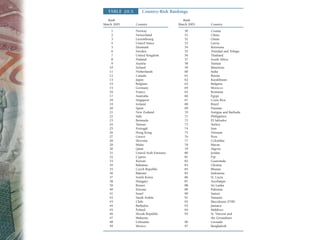
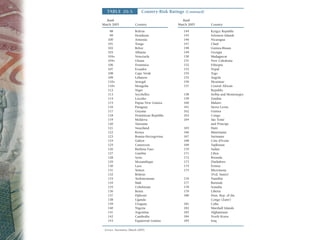
• Country Risk—refers to the overall
political and financial situation in a
country and how these conditions may
affect the ability of the country to repay
its debts.
• Country risk analysis involves the
evaluation of both qualitative and
quantitative factors.
Copyright © 2007 Pearson Addison-Wesley. All rights
reserved. 20-26
Qualitative or Political Risk Factors
• Splits between different language, ethnic, and
religious groups that undermine stability.
• Extreme nationalism and aversion to foreigners that
may lead to preferential treatment of local interests
and nationalization of foreign holdings.
• Unfavorable social conditions, including extremes
of wealth.
• Conflicts in society evidenced by demonstrations,
violence, and guerilla war.
• The strength and organization of radical groups.
Copyright © 2007 Pearson Addison-Wesley. All rights
reserved. 20-27
Quantitative or Economic Factors
• External debt as a % of GDP or exports
• International reserve holdings relative
to imports
• Export level and diversity
• Economic growth
The eurodollar market

The eurodollar market

  • 1.
  • 2.
    Copyright © 2007Pearson Addison-Wesley. All rights reserved. 20-2 Topics to be Covered • Eurocurrency Market • Origins of Offshore Banking • International Banking Facilities • Offshore Banking Practices • International Debt • IMF and IMF Conditionality • Role of Corruption • Country Risk Analysis
  • 3.
    Copyright © 2007Pearson Addison-Wesley. All rights reserved. 20-3 Eurocurrency Market • Eurocurrency Market—is the deposit and loan market for foreign currencies. • Banks that accept deposits and make loans in the Eurocurrency market are called Eurobanks. • The term Eurocurrency or Eurobank is a misnomer since it refers to offshore banking and is not limited to Europe.
  • 4.
    Copyright © 2007Pearson Addison-Wesley. All rights reserved. 20-4 Origins of Offshore Banking • The Eurodollar market started in the late 1950s when European banks began accepting deposits in U.S. dollars. • Why and how did this market get started? ♦ The reserve-currency status of the dollar was an important factor. ♦ Some communist countries were the earliest source of dollar deposits held in Europe. ♦ Eurobanks developed as a result of profit considerations.
  • 5.
    Copyright © 2007Pearson Addison-Wesley. All rights reserved. 20-5 Offshore Banking (cont.) • Offshore banking has grown rapidly over the past decades because Eurobanks are essentially unregulated. • Eurobanks can offer narrower spreads than U.S. banks (the “spread” is the difference between the deposit and loan interest rates).
  • 6.
    Copyright © 2007Pearson Addison-Wesley. All rights reserved. 20-6 Eurobank vs. U.S. Bank Spreads • Refer to Figure 20.1 • Eurobanks are able to offer a lower rate on dollar loans and a higher rate on dollar deposits than U.S. banks. • Eurodollar transactions are considered riskier to U.S. residents compared to domestic dollar transactions in the U.S.
  • 7.
    Copyright © 2007Pearson Addison-Wesley. All rights reserved. 20-7
  • 8.
    Copyright © 2007Pearson Addison-Wesley. All rights reserved. 20-8 LIBOR • London Interbank Offered Rate (LIBOR)—the interest rate at which large London banks make deposits or lend to each other. • In the Eurodollar market, loan interest rates are quoted as percentage points above LIBOR.
  • 9.
    Copyright © 2007Pearson Addison-Wesley. All rights reserved. 20-9 International Banking by Countries • Refer to Figure 20.2 Foreign assets held by banks, by country • The U.K. and U.S. banks account for the largest shares of foreign assets, primarily cross-border interbank claims. • Interbank claims are deposits held in banks in other countries.
  • 11.
    Copyright © 2007Pearson Addison-Wesley. All rights reserved. 20-11 International Banking Facilities • In December 1981, the Federal Reserve permitted U.S. banks to engage in Eurobank activity on U.S. soil. • International banking facilities (IBFs) are international banking divisions of onshore U.S. banks. • The loans and deposits of IBFs are kept separate from the rest of the U.S. bank’s business because IBFs are not subject to reserve requirements, interest rate regulations, or FDIC deposit insurance premiums.
  • 12.
    Copyright © 2007Pearson Addison-Wesley. All rights reserved. 20-12 Offshore Banking Practices • Because of the importance of interbank transactions, gross deposits at Eurobanks overstate the actual amount of activity of these banks in intermediating funds between nonbank savers and nonbank borrowers. • To measure the amount of credit actually extended by Eurobanks, the net size of the market is determined by subtracting interbank activity from total deposits. • Refer to Tables 20.1, 20.2, and 20.3 for an example.
  • 13.
    Copyright © 2007Pearson Addison-Wesley. All rights reserved. 20-13
  • 14.
    Copyright © 2007Pearson Addison-Wesley. All rights reserved. 20-14
  • 15.
    Copyright © 2007Pearson Addison-Wesley. All rights reserved. 20-15
  • 16.
    Copyright © 2007Pearson Addison-Wesley. All rights reserved. 20-16 Effects of Eurodollar Market • Eurodollars are not spendable money, but are money substitutes such as time deposits in a bank. • In countries without efficient money markets, access to a competitive Eurodollar market may reduce the demand for domestic money as residents shift funds to the offshore market and earn profit. • If the Eurodollar market encourages more international capital flows, then central banks need to engage in more sterilization operations to achieve their domestic monetary policy.
  • 17.
    Copyright © 2007Pearson Addison-Wesley. All rights reserved. 20-17 Characteristics of Eurobanks • Eurobanks are just like domestic banks in terms of maximizing spreads and managing risk. • Deposits are for fixed terms ranging from days to years, mostly for less than six months. Eurocurrency deposits are similar to domestic banks’ certificates of deposits. • Eurocurrency loans can range up to 10 years or more. Large loans are generally made by syndicates of Eurobanks.
  • 18.
    Copyright © 2007Pearson Addison-Wesley. All rights reserved. 20-18 International Debt • Petrodollars—are Eurodollar deposits arising from the trade surpluses of OPEC nations. • In turn, the Eurobanks lent these petrodollars to developing countries. • Refer to Table 20.4 External debt of developing countries during the debt crisis period.
  • 19.
    Copyright © 2007Pearson Addison-Wesley. All rights reserved. 20-19
  • 20.
    Copyright © 2007Pearson Addison-Wesley. All rights reserved. 20-20 International Debt (cont.) • Debtor countries such as Argentina and Brazil borrowed more to service their outstanding debt and/or rescheduled or renegotiated the terms of the loans. • Paris Club—meetings of creditor governments (typically Western industrialized countries) with debtor nations. The debtor must first apply for a standby credit arrangement with the IMF before the meeting is held.
  • 21.
    Copyright © 2007Pearson Addison-Wesley. All rights reserved. 20-21 Debt/Equity Swap • Debt/Equity Swap—involves an exchange of a developing country’s debt for an ownership or equity position in a business in the debtor country. • The use of debt/equity swaps has stimulated the growth of a secondary market where creditor commercial banks may sell their developing country debt.
  • 22.
    Copyright © 2007Pearson Addison-Wesley. All rights reserved. 20-22 IMF Conditionality • The International Monetary Fund (IMF) has been an important source of funding for debtor countries with repayment problems. • IMF Conditionality refers to the IMF pre-conditions which require borrowers to adjust their economic policies to reduce balance of payments deficits and improve the chance of debt repayment. These conditions involve macroeconomic targets such as money supply growth and the budget deficit.
  • 23.
    Copyright © 2007Pearson Addison-Wesley. All rights reserved. 20-23 IMF • The IMF is a multinational organization of over 180 countries. • Its objective is to provide short-term loans to countries with temporary balance of payments disequilibria (if the countries agree to certain IMF conditions). • IMF policy is determined by member countries’ votes. Voting power is based on a country’s quota or financial contribution to the IMF. • The U.S. has the most votes since its quota accounts for almost 18% of the total fund.
  • 24.
    Copyright © 2007Pearson Addison-Wesley. All rights reserved. 20-24 The Role of Corruption • Research shows that there is a negative relationship between the level of corruption in a country and the country’s growth and investment. • Corruption thrives in countries where government policies create economic distortions or imperfect markets. • The more competitive a country’s markets, the fewer the opportunities for corruption. • In the late 1990s, both the IMF and World Bank began including anticorruption policies as part of their lending process.
  • 25.
    Copyright © 2007Pearson Addison-Wesley. All rights reserved. 20-25 Country Risk Analysis • Country Risk—refers to the overall political and financial situation in a country and how these conditions may affect the ability of the country to repay its debts. • Country risk analysis involves the evaluation of both qualitative and quantitative factors.
  • 26.
    Copyright © 2007Pearson Addison-Wesley. All rights reserved. 20-26 Qualitative or Political Risk Factors • Splits between different language, ethnic, and religious groups that undermine stability. • Extreme nationalism and aversion to foreigners that may lead to preferential treatment of local interests and nationalization of foreign holdings. • Unfavorable social conditions, including extremes of wealth. • Conflicts in society evidenced by demonstrations, violence, and guerilla war. • The strength and organization of radical groups.
  • 27.
    Copyright © 2007Pearson Addison-Wesley. All rights reserved. 20-27 Quantitative or Economic Factors • External debt as a % of GDP or exports • International reserve holdings relative to imports • Export level and diversity • Economic growth