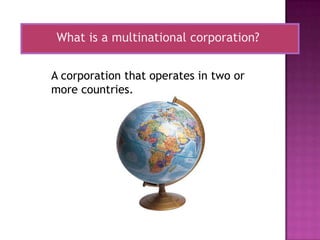
What is a multinational corporation?


A corporation that operates in two or
more countries.
A multinational corporation is a company
engaged in producing and selling goods or
services in more than one country. It
ordinary consists of a parent company
located in home country and at least five
or six foreign subsidiaries.
     The commonly accepted goal of an
    MNC is to maximize shareholder
    wealth. Developing a goal is
    necessary because all decisions
    should    contribute    to      its
    accomplishment.
Difference b/w domestic and multinational financial
management


     1. Different currency denominations.
     2. Economic and legal ramifications.
     3. Language differences.
     4. Cultural differences.
     5. Role of governments.
     6. Political risk.
Why do firms expand into other countries?


 1. To seek new markets.
 2. To seek raw materials.
 3. To seek new technology.
 4. To seek production efficiency.
 5. To avoid political and regulatory hurdles.
 6. To diversify.
Constraints Interfering with the MNC's Goal

When financial managers of MNCs attempt to
maximize their firm's value, they are confronted
with various constraints that can be classified as
:

   Environmental.
   Regulatory.
   Ethical in nature.
Environmental constraints :

 Each  country enforces its own environmental
 constraints. Some countries may enforce more of
 these restrictions on a subsidiary whose parent is
 based in a different country. Building codes,
 disposal of production, waste materials, and
 pollution controls are examples of restrictions
 that force subsidiaries to incur additional costs.
 Many European countries have recently imposed
 rougher antipollution laws as a result of severe
 pollution problems.
Regulatory constraints :
 Each country also enforces its own regulatory
  constraints pertaining to taxes, currency
  convertibility rules, earnings remittance
  restrictions, and other regulations that can
  affect cash flows of a subsidiary established
  there.
  Ethical Constraints :
 There is no consensus standard of business
  conduct that applies to all countries. A business
  practice that is perceived unethical in one
  country may be totally ethical in another.
   International monetary systems are sets of internationally
    agreed rules, conventions and supporting institutions that
    facilitate international trade, cross border investment and
    generally the reallocation of capital between nation states.
   They provide means of payment acceptable between buyers
    and sellers of different nationality, including deferred
    payment.
   To operate successfully, they need to inspire confidence, to
    provide sufficient liquidity for fluctuating levels of trade and
    to provide means by which global imbalances can be
    corrected.
    The systems can grow organically as the collective result of
    numerous individual agreements between international
    economic actors spread over several decades.
   Alternatively, they can arise from a single architectural vision
    as happened at Bretton Woods in 1944
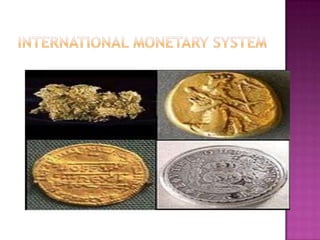
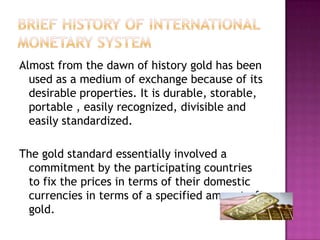
Almost from the dawn of history gold has been
  used as a medium of exchange because of its
  desirable properties. It is durable, storable,
  portable , easily recognized, divisible and
  easily standardized.

The gold standard essentially involved a
 commitment by the participating countries
 to fix the prices in terms of their domestic
 currencies in terms of a specified amount of
 gold.
 Bimetallism:   Before 1875

 Classical   Gold Standard: 1875-1914

 Interwar    Period: 1915-1944

 Bretton   Woods System: 1945-1972

 The   Flexible Exchange Rate Regime: 1973-Present
A “double standard” in the sense that both gold and
 silver were used as money.

 Some  countries were on the gold standard, some on
 the silver standard, some on both.

 Both gold and silver were used as international
 means of payment and the exchange rates among
 currencies were determined by either their gold or
 silver contents.

 Gresham’sLaw implied that it would be the least
 valuable metal that would tend to circulate.
 During   this period in most major countries:
    Gold alone was assured of unrestricted coinage
    There was two-way convertibility between gold and
     national currencies at a stable ratio.
    Gold could be freely exported or imported.
 The
    exchange rate between two country’s currencies
 would be determined by their relative gold contents.
 Exchange  rates fluctuated as countries widely used
  “predatory” depreciations of their currencies as a
  means of gaining advantage in the world export
  market.
 Attempts were made to restore the gold standard,
  but participants lacked the political will to “follow
  the rules of the game”.
 The result for international trade and investment was
  profoundly detrimental.
 Named  for a 1944 meeting of 44 nations at Bretton
  Woods, New Hampshire.
 The purpose was to design a postwar international
  monetary system.
 The goal was exchange rate stability without the gold
  standard.
 The result was the creation of the IMF and the World
  Bank.
 Underthe Bretton Woods system, the U.S. dollar was
 pegged to gold at $35 per ounce and other currencies
 were pegged to the U.S. dollar.

 Eachcountry was responsible for maintaining its
 exchange rate within 1% of the adopted par value
 by buying or selling foreign reserves as necessary.

 TheBretton Woods system was a dollar-based gold
 exchange standard.
   Flexible exchange rates were declared acceptable to the
    IMF members.

   Central banks were allowed to intervene in the exchange
    rate markets to iron out unwarranted volatilities.

   Gold was abandoned as an international reserve asset.

   Non-oil-exporting countries and less-developed countries
    were given greater access to IMF funds.
   Development banks are specialized financial institutions
    which perform the twin function of providing medium
    and long term finance to private entrepreneurs and of
    performing various promotional roles essential for
    economic development.

CHARACTERSTICS:
 Development banks do not accept deposits from public
  as ordinary banks do.
 They are unique financial institution that perform the
  special task of accelerating economic development.
 Development banks are engaged in promotional services
  such as underwriting of new shares, arranging for
  foreign exchange loan , preparation of project reports.
 An agent of development.(sectors like
  industry, agriculture and international
  trade.)
 To accelerate the growth of economy.
 To allocate the resources.
 To foster rapid Industrialization.
 To develop entrepreneurial skills.
 To provide rural development.
 To provide finance.
 Entrepreneurial  role : Development banks
  undertake the role of entrepreneurial gap
  filling .They perform the task of discovering
  investment projects, promotion of industrial
  enterprise, provide technical and managerial
  assistance undertaking technical and
  economic research, conducting surveys.
 Task of Financial Gap filling: Through
  purchase of debentures, bonds of a company.
 Credit guarantee.
 Refinancing.
 Underwriting
 Joint
      financing
 Commercial banking business


Need for development banks:
 Industrialization.
 Capital requirements.
 Promotional activities.
 Aid to small scale units.
The foreign rulers in India do not take much
 interest in the industrial development of the
 country. They were interested to take raw
 materials to England and bring back finished
 goods to India. The government did not show
 any interest for setting up institutions
 needed for industrial financing .

The recommendations for setting up industrial
 financing institutions was made in 1931 by
 central banking enquiry committee.
 1948  the first development bank i.e.. IFCI(INDUSTRIAL
 FINANCE CORPORATION OF INDIA).IFCI was assigned the
 role of a gap filler which implied that it was not expected
 to compete with the existing channels of industrial
 finance . It was expected to provide medium & long term
 credit to industrial concerns only when they could not
 raise sufficient finances .

 1951 parliament passes state financial corporation act
 .Under this act state govt could establish financial
 corporations for their respective region . At present there
 are 18 State Financial Corporations (SFC’s)in India.
   The IFCI AND SFC served only a limited purpose . There was a need for
    dynamic institutions which could operate as true development
    agencies . NIDC (National Industrial development Corporation) was
    established in 1954 with the objective of promoting industries which
    could not serve the ambitious role assigned to it .

   1955 ICICI(Industry Credit Investment Corporation Of India) as a joint
    stock company. ICICI was supported by govt of India , World Bank, and
    other foreign institutions.

   Another institution RCI Refinance corporation for industry was set up
    in 1958 by RBI,LIC and commercial banks . The purpose of RCI was to
    provide refinance to commercial banks and SFC’s against term loans
    granted by them to industrial concerns in private sector.

   1964 IDBI Industry development bank of India was set up as an apex
    institution in the area of Industrial Finance ,RCI was merged with
    ICICI.

   SIDC’s State Industrial development corporation were established in
    the sixties to promote medium scale industrial units. At present there
    are 28 SID’C.
Other financial institutions were:
 UTI UNIT TRUST OF INDIA 1964.
 LIC LIFE INSURANCE CORPORATION OF INDIA 1956.
 GIC (GENERAL INSURANCE CORPORATION OF INDIA)
  1973.
 EXIM BANK(EXPORT IMPORT BANK) 1982.
 NAMBARD 1982(NATIONAL BANK FOR AGRICULTURE
  AND RURAL DEVELOPMENT) :It is responsible for
  short term , medium term and long term financing
  of     agriculture      and       allied     activities.
  The institutions like film finance corporation,
  handloom       finance       corporation,      housing
  development finance corporation also provides
  financial and other facilities in various areas.
FINANCE FUNCTIONS IN A MULTINATIONAL FIRM

 Acquistionof Funds.
 Investment of those funds.


International Flow of Funds:

Mfm unit 1

  • 1.
    What is amultinational corporation? A corporation that operates in two or more countries.
  • 2.
    A multinational corporationis a company engaged in producing and selling goods or services in more than one country. It ordinary consists of a parent company located in home country and at least five or six foreign subsidiaries.
  • 3.
    The commonly accepted goal of an MNC is to maximize shareholder wealth. Developing a goal is necessary because all decisions should contribute to its accomplishment.
  • 4.
    Difference b/w domesticand multinational financial management 1. Different currency denominations. 2. Economic and legal ramifications. 3. Language differences. 4. Cultural differences. 5. Role of governments. 6. Political risk.
  • 5.
    Why do firmsexpand into other countries? 1. To seek new markets. 2. To seek raw materials. 3. To seek new technology. 4. To seek production efficiency. 5. To avoid political and regulatory hurdles. 6. To diversify.
  • 6.
    Constraints Interfering withthe MNC's Goal When financial managers of MNCs attempt to maximize their firm's value, they are confronted with various constraints that can be classified as :  Environmental.  Regulatory.  Ethical in nature.
  • 7.
    Environmental constraints : Each country enforces its own environmental constraints. Some countries may enforce more of these restrictions on a subsidiary whose parent is based in a different country. Building codes, disposal of production, waste materials, and pollution controls are examples of restrictions that force subsidiaries to incur additional costs. Many European countries have recently imposed rougher antipollution laws as a result of severe pollution problems.
  • 8.
    Regulatory constraints : Each country also enforces its own regulatory constraints pertaining to taxes, currency convertibility rules, earnings remittance restrictions, and other regulations that can affect cash flows of a subsidiary established there. Ethical Constraints :  There is no consensus standard of business conduct that applies to all countries. A business practice that is perceived unethical in one country may be totally ethical in another.
  • 10.
    International monetary systems are sets of internationally agreed rules, conventions and supporting institutions that facilitate international trade, cross border investment and generally the reallocation of capital between nation states.  They provide means of payment acceptable between buyers and sellers of different nationality, including deferred payment.  To operate successfully, they need to inspire confidence, to provide sufficient liquidity for fluctuating levels of trade and to provide means by which global imbalances can be corrected.  The systems can grow organically as the collective result of numerous individual agreements between international economic actors spread over several decades.  Alternatively, they can arise from a single architectural vision as happened at Bretton Woods in 1944
  • 11.
    Almost from thedawn of history gold has been used as a medium of exchange because of its desirable properties. It is durable, storable, portable , easily recognized, divisible and easily standardized. The gold standard essentially involved a commitment by the participating countries to fix the prices in terms of their domestic currencies in terms of a specified amount of gold.
  • 12.
     Bimetallism: Before 1875  Classical Gold Standard: 1875-1914  Interwar Period: 1915-1944  Bretton Woods System: 1945-1972  The Flexible Exchange Rate Regime: 1973-Present
  • 13.
    A “double standard”in the sense that both gold and silver were used as money.  Some countries were on the gold standard, some on the silver standard, some on both.  Both gold and silver were used as international means of payment and the exchange rates among currencies were determined by either their gold or silver contents.  Gresham’sLaw implied that it would be the least valuable metal that would tend to circulate.
  • 14.
     During this period in most major countries:  Gold alone was assured of unrestricted coinage  There was two-way convertibility between gold and national currencies at a stable ratio.  Gold could be freely exported or imported.  The exchange rate between two country’s currencies would be determined by their relative gold contents.
  • 15.
     Exchange rates fluctuated as countries widely used “predatory” depreciations of their currencies as a means of gaining advantage in the world export market.  Attempts were made to restore the gold standard, but participants lacked the political will to “follow the rules of the game”.  The result for international trade and investment was profoundly detrimental.
  • 16.
     Named for a 1944 meeting of 44 nations at Bretton Woods, New Hampshire.  The purpose was to design a postwar international monetary system.  The goal was exchange rate stability without the gold standard.  The result was the creation of the IMF and the World Bank.
  • 17.
     Underthe BrettonWoods system, the U.S. dollar was pegged to gold at $35 per ounce and other currencies were pegged to the U.S. dollar.  Eachcountry was responsible for maintaining its exchange rate within 1% of the adopted par value by buying or selling foreign reserves as necessary.  TheBretton Woods system was a dollar-based gold exchange standard.
  • 18.
    Flexible exchange rates were declared acceptable to the IMF members.  Central banks were allowed to intervene in the exchange rate markets to iron out unwarranted volatilities.  Gold was abandoned as an international reserve asset.  Non-oil-exporting countries and less-developed countries were given greater access to IMF funds.
  • 19.
    Development banks are specialized financial institutions which perform the twin function of providing medium and long term finance to private entrepreneurs and of performing various promotional roles essential for economic development. CHARACTERSTICS:  Development banks do not accept deposits from public as ordinary banks do.  They are unique financial institution that perform the special task of accelerating economic development.  Development banks are engaged in promotional services such as underwriting of new shares, arranging for foreign exchange loan , preparation of project reports.
  • 20.
     An agentof development.(sectors like industry, agriculture and international trade.)  To accelerate the growth of economy.  To allocate the resources.  To foster rapid Industrialization.  To develop entrepreneurial skills.  To provide rural development.  To provide finance.
  • 21.
     Entrepreneurial role : Development banks undertake the role of entrepreneurial gap filling .They perform the task of discovering investment projects, promotion of industrial enterprise, provide technical and managerial assistance undertaking technical and economic research, conducting surveys.  Task of Financial Gap filling: Through purchase of debentures, bonds of a company.  Credit guarantee.  Refinancing.
  • 22.
     Underwriting  Joint financing  Commercial banking business Need for development banks:  Industrialization.  Capital requirements.  Promotional activities.  Aid to small scale units.
  • 23.
    The foreign rulersin India do not take much interest in the industrial development of the country. They were interested to take raw materials to England and bring back finished goods to India. The government did not show any interest for setting up institutions needed for industrial financing . The recommendations for setting up industrial financing institutions was made in 1931 by central banking enquiry committee.
  • 24.
     1948 the first development bank i.e.. IFCI(INDUSTRIAL FINANCE CORPORATION OF INDIA).IFCI was assigned the role of a gap filler which implied that it was not expected to compete with the existing channels of industrial finance . It was expected to provide medium & long term credit to industrial concerns only when they could not raise sufficient finances .  1951 parliament passes state financial corporation act .Under this act state govt could establish financial corporations for their respective region . At present there are 18 State Financial Corporations (SFC’s)in India.
  • 25.
    The IFCI AND SFC served only a limited purpose . There was a need for dynamic institutions which could operate as true development agencies . NIDC (National Industrial development Corporation) was established in 1954 with the objective of promoting industries which could not serve the ambitious role assigned to it .  1955 ICICI(Industry Credit Investment Corporation Of India) as a joint stock company. ICICI was supported by govt of India , World Bank, and other foreign institutions.  Another institution RCI Refinance corporation for industry was set up in 1958 by RBI,LIC and commercial banks . The purpose of RCI was to provide refinance to commercial banks and SFC’s against term loans granted by them to industrial concerns in private sector.  1964 IDBI Industry development bank of India was set up as an apex institution in the area of Industrial Finance ,RCI was merged with ICICI.  SIDC’s State Industrial development corporation were established in the sixties to promote medium scale industrial units. At present there are 28 SID’C.
  • 26.
    Other financial institutionswere:  UTI UNIT TRUST OF INDIA 1964.  LIC LIFE INSURANCE CORPORATION OF INDIA 1956.  GIC (GENERAL INSURANCE CORPORATION OF INDIA) 1973.  EXIM BANK(EXPORT IMPORT BANK) 1982.  NAMBARD 1982(NATIONAL BANK FOR AGRICULTURE AND RURAL DEVELOPMENT) :It is responsible for short term , medium term and long term financing of agriculture and allied activities. The institutions like film finance corporation, handloom finance corporation, housing development finance corporation also provides financial and other facilities in various areas.
  • 27.
    FINANCE FUNCTIONS INA MULTINATIONAL FIRM  Acquistionof Funds.  Investment of those funds. International Flow of Funds: