The End of Projects…
and what happens next
(Aka Beyond Projects)
Allan Kelly
allan@softwarestrategy.co.uk
http://www.softwarestrategy.co.uk
Twitter: @allankelly.net
BCS PROMS-G, London, February 2014
Allan Kelly…
 Consulting on software

development & strategy
 Training for Agile
Author
– Changing Software Development: Learning to be
Agile (2008, Wiley)
– Business Patterns for Software Developers
(2012, Wiley - ISBN: 978-1119999249)
– Xanpan: Reflections on agile (work in progress)
https://leanpub.com/xanpan
Chapters in…
• Business Analysis and Leadership, Pullan & Archer 2013
• 97 Things Every Programmer Should Know, Henney, 2010
• Context Encapsulation in Pattern Languages of Program
Design, vol #5, 2006
Audience participation
How many of you …
• Adequately identify & quantify project
benefits?
• Know someone who overstates the
benefits of a project to obtain
funding?
• Think project review & evaluation is
adequate?
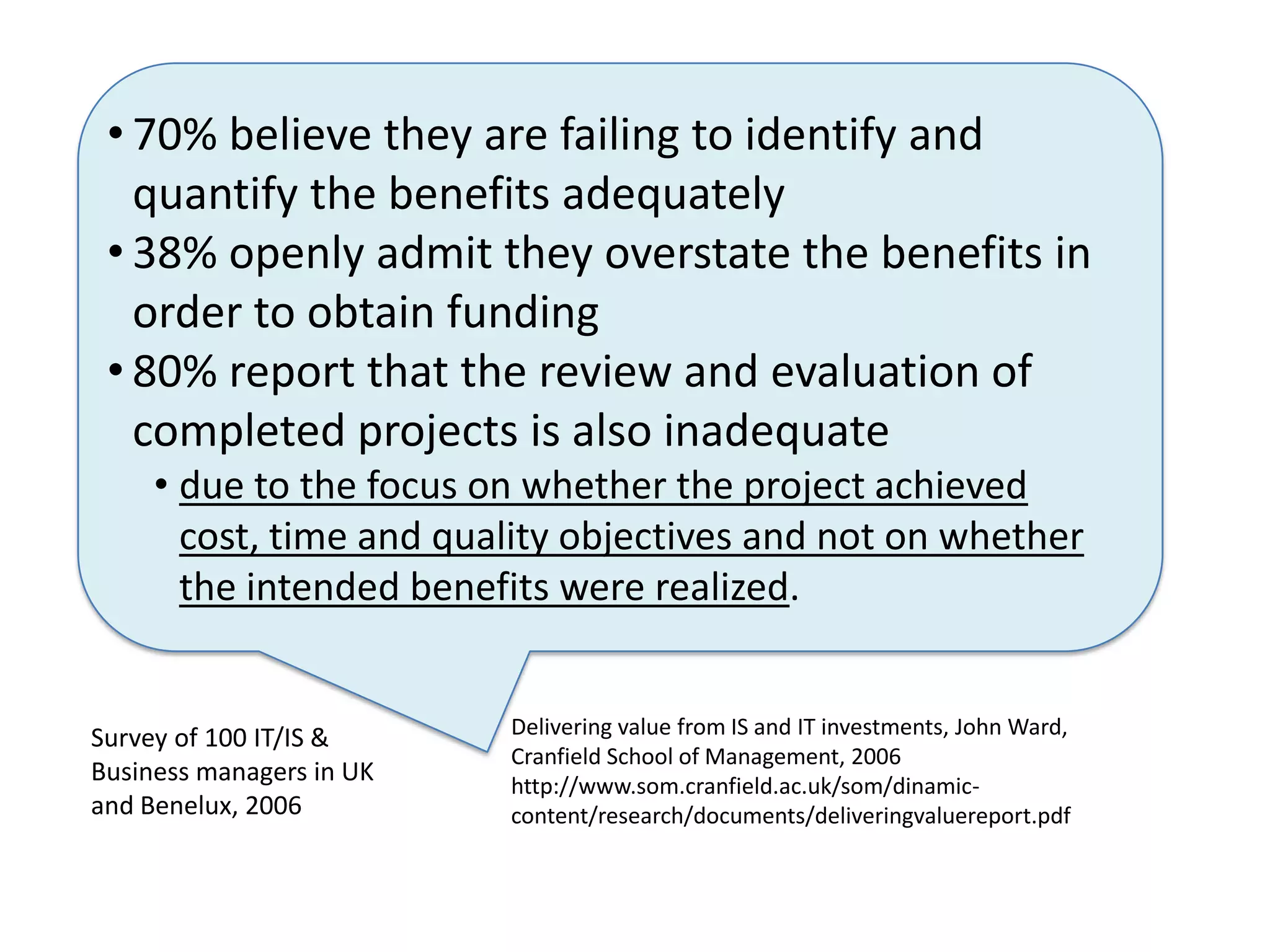
• 70% believe they are failing to identify and
quantify the benefits adequately
• 38% openly admit they overstate the benefits in
order to obtain funding
• 80% report that the review and evaluation of
completed projects is also inadequate
• due to the focus on whether the project achieved
cost, time and quality objectives and not on whether
the intended benefits were realized.

Survey of 100 IT/IS &
Business managers in UK
and Benelux, 2006

Delivering value from IS and IT investments, John Ward,
Cranfield School of Management, 2006
http://www.som.cranfield.ac.uk/som/dinamiccontent/research/documents/deliveringvaluereport.pdf
Successful software doesn’t stop
• Successful software continues to change
• Only dead software has an end-date
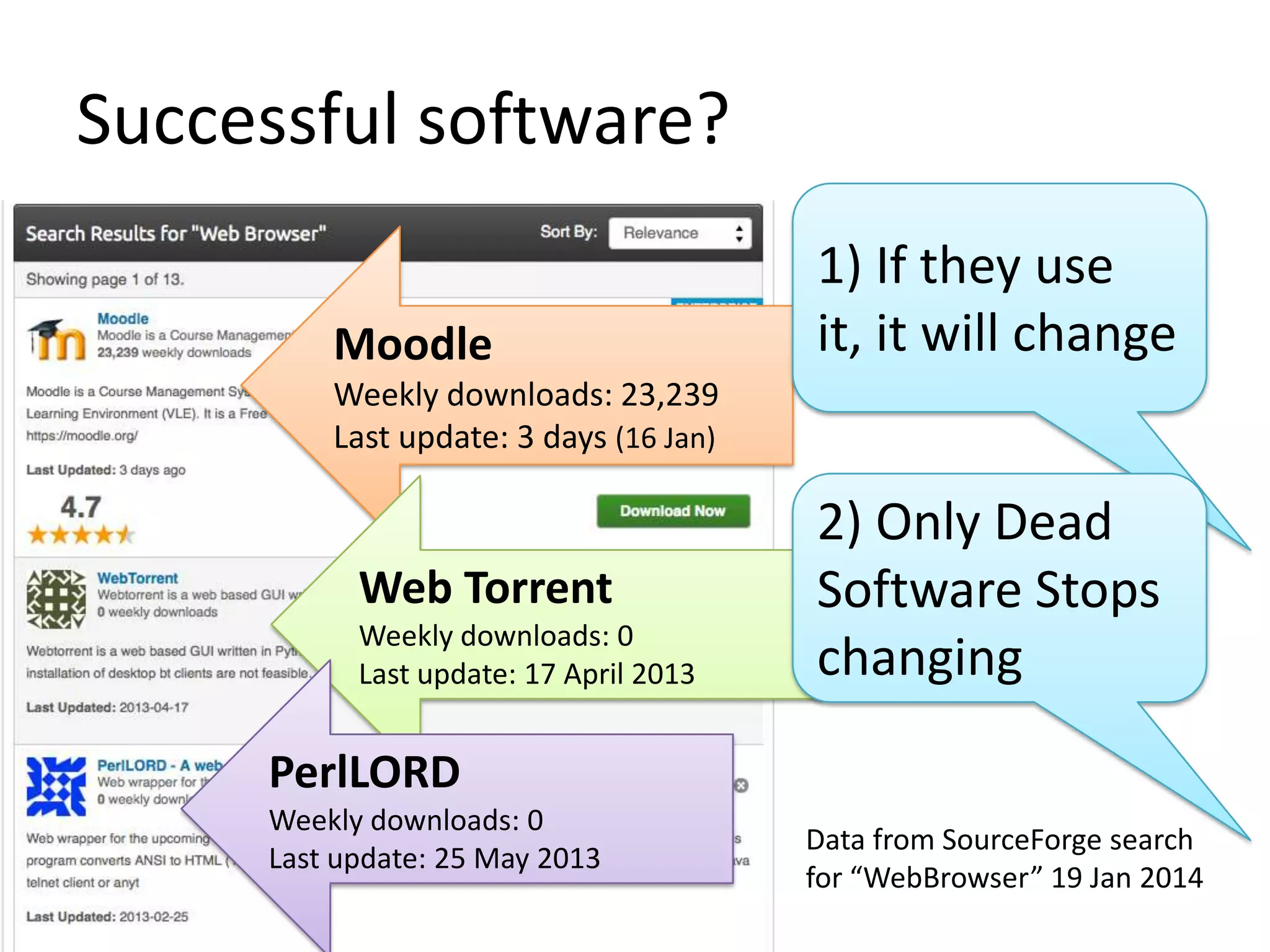
Successful software?
Moodle

1) If they use
it, it will change

Weekly downloads: 23,239
Last update: 3 days (16 Jan)

Web Torrent
Weekly downloads: 0
Last update: 17 April 2013

2) Only Dead
Software Stops
changing

PerlLORD
Weekly downloads: 0
Last update: 25 May 2013

Data from SourceForge search
for “WebBrowser” 19 Jan 2014
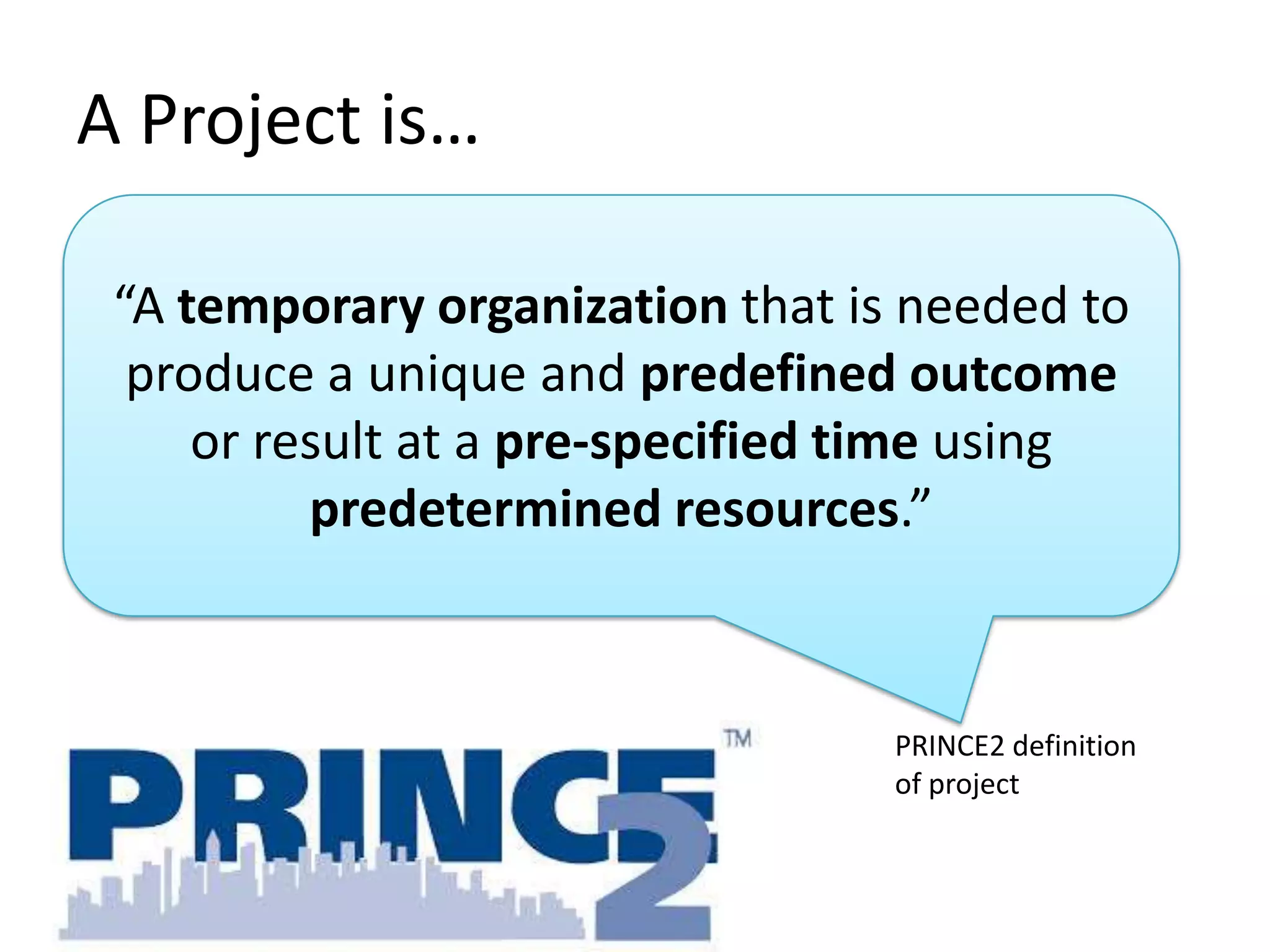
A Project is…
“A temporary organization that is needed to
produce a unique and predefined outcome
or result at a pre-specified time using
predetermined resources.”

PRINCE2 definition
of project
Temporary Organization?
•
•
•
•
•

Storming
Norming
Forming
Performing
Destroying

}

Takes time &
money!
Yes!

Why destroy performing teams?
Why spend that money?
Why loose knowledge?
Corporate Psychopathy
Process by which corporations
disband performing teams and
release staff

•
•
•
•

Stop killing performing teams
Keep the team together
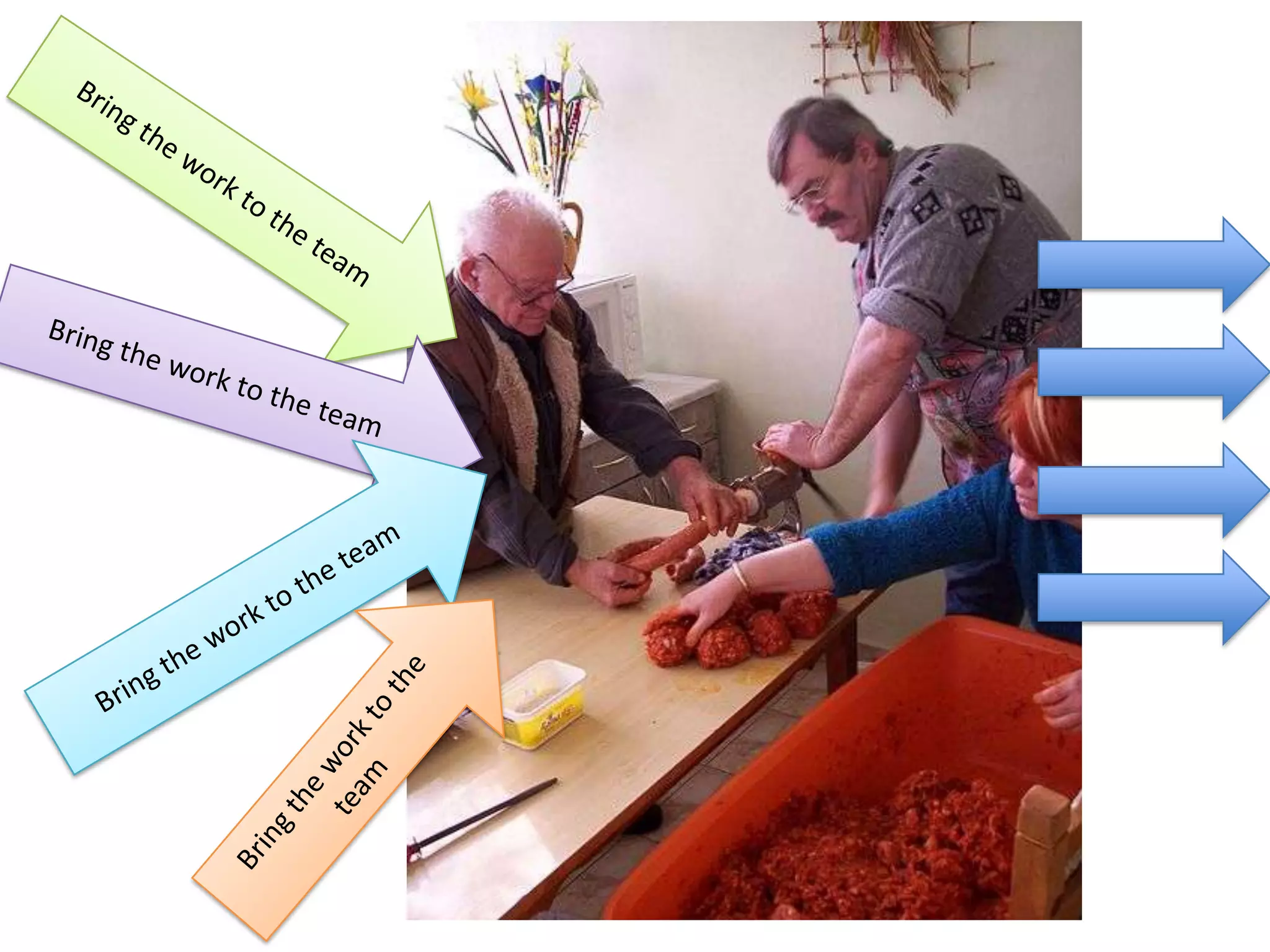
Flow the work to the team
The Team is the Capability
Pre-determined resources?
• In the ideal world…
– You get the resources you ask for?
– They are dedicated to your project? And stay?

• Back in the real world…
– Resourcing allocation is politics

‘Nuff said
Pre-defined outcome?
• Requirements change
• The world changes
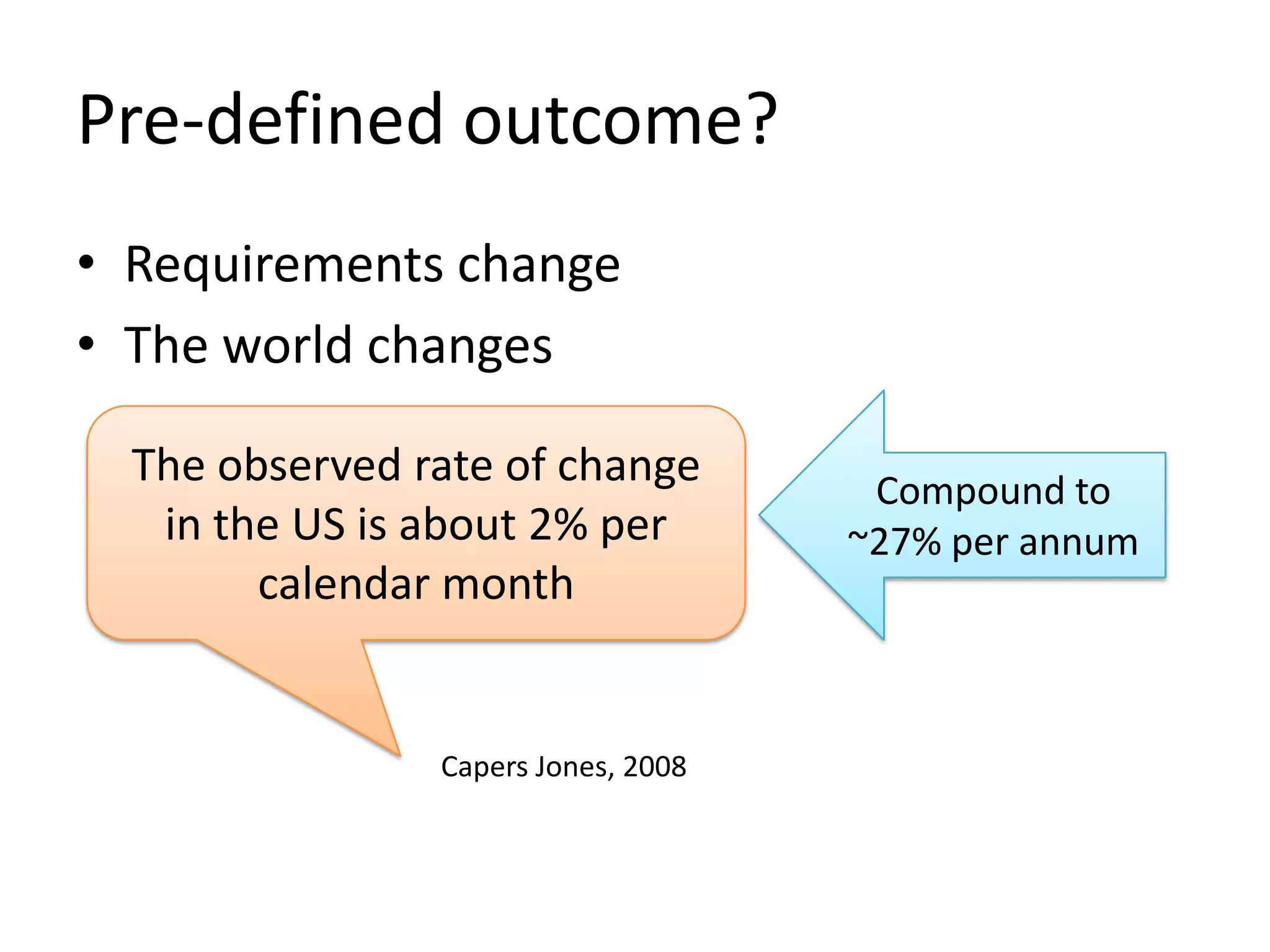
The observed rate of change
in the US is about 2% per
calendar month

Capers Jones, 2008

Compound to
~27% per annum
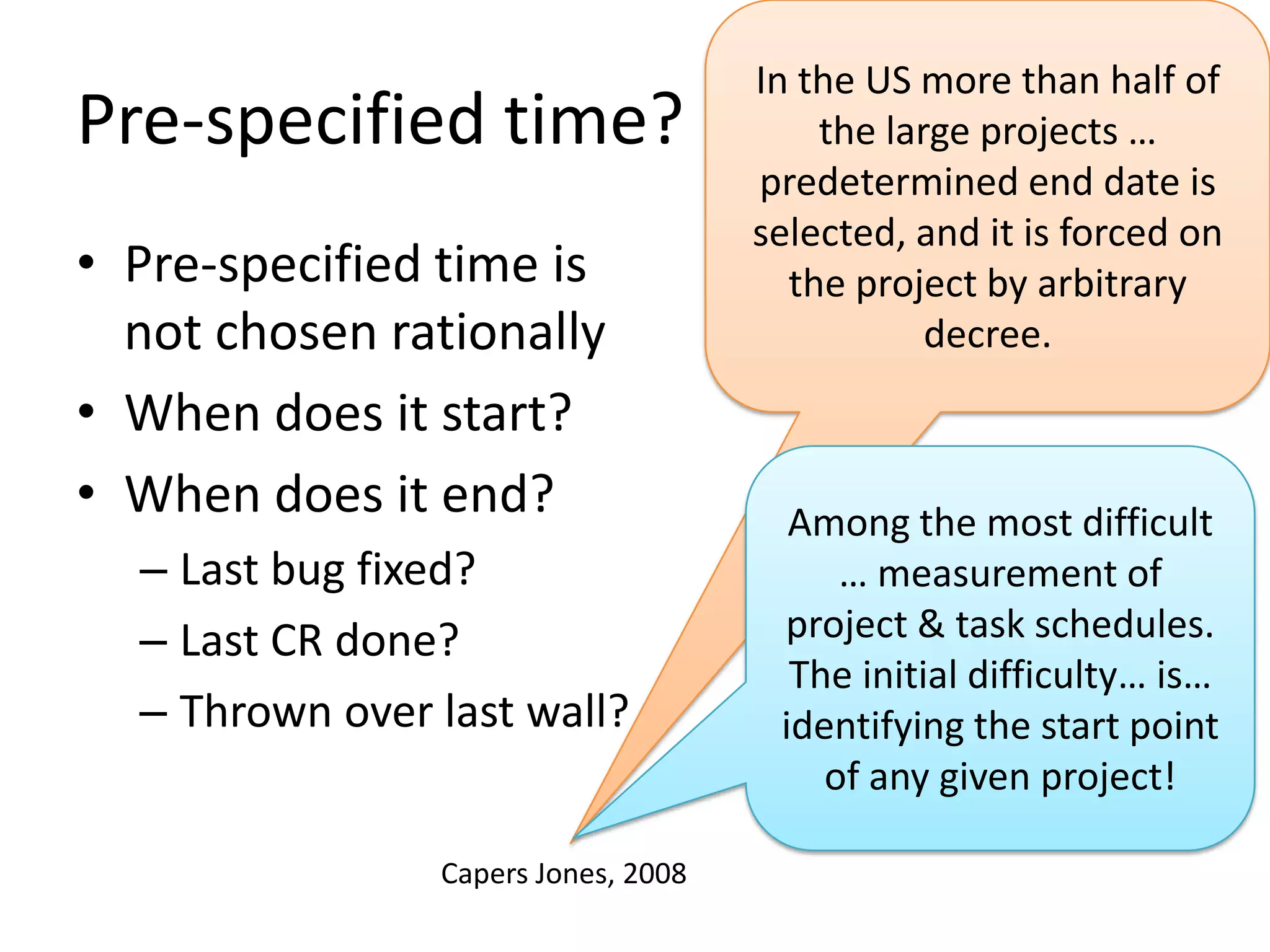
Pre-specified time?
• Pre-specified time is
not chosen rationally
• When does it start?
• When does it end?
– Last bug fixed?
– Last CR done?
– Thrown over last wall?
Capers Jones, 2008

In the US more than half of
the large projects …
predetermined end date is
selected, and it is forced on
the project by arbitrary
decree.

Among the most difficult
… measurement of
project & task schedules.
The initial difficulty… is…
identifying the start point
of any given project!
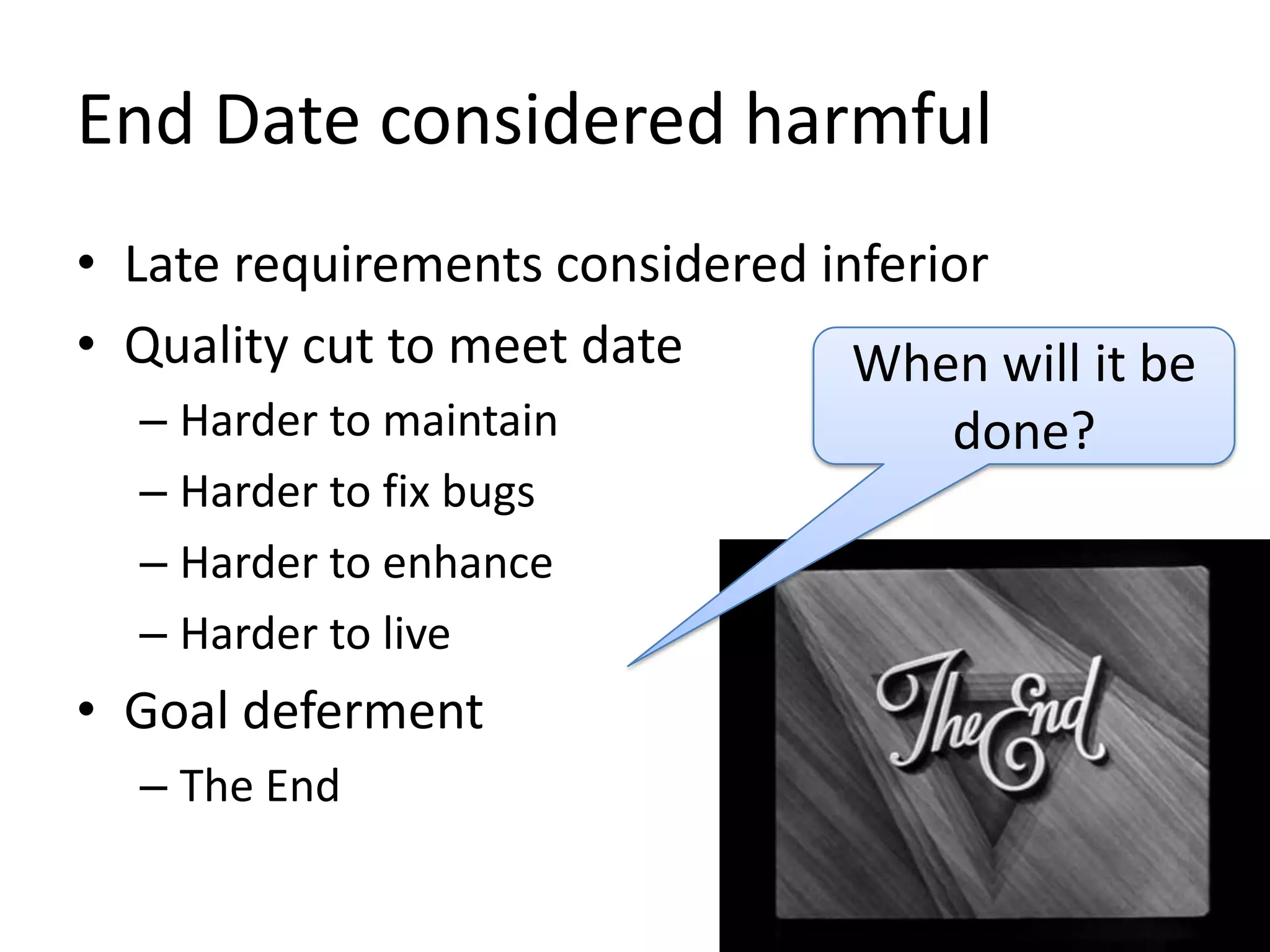
End Date considered harmful
• Late requirements considered inferior
• Quality cut to meet date
When will it be
– Harder to maintain
– Harder to fix bugs
– Harder to enhance
– Harder to live

• Goal deferment
– The End

done?
Work with no end
• Work to short term goal & deadline
– Human’s are good with deadlines
– (Very bad with estimation)

• Work to deliver value
• Work as if this is your last goal
– But: Work to be ready for another round

• Do work you will be proud of
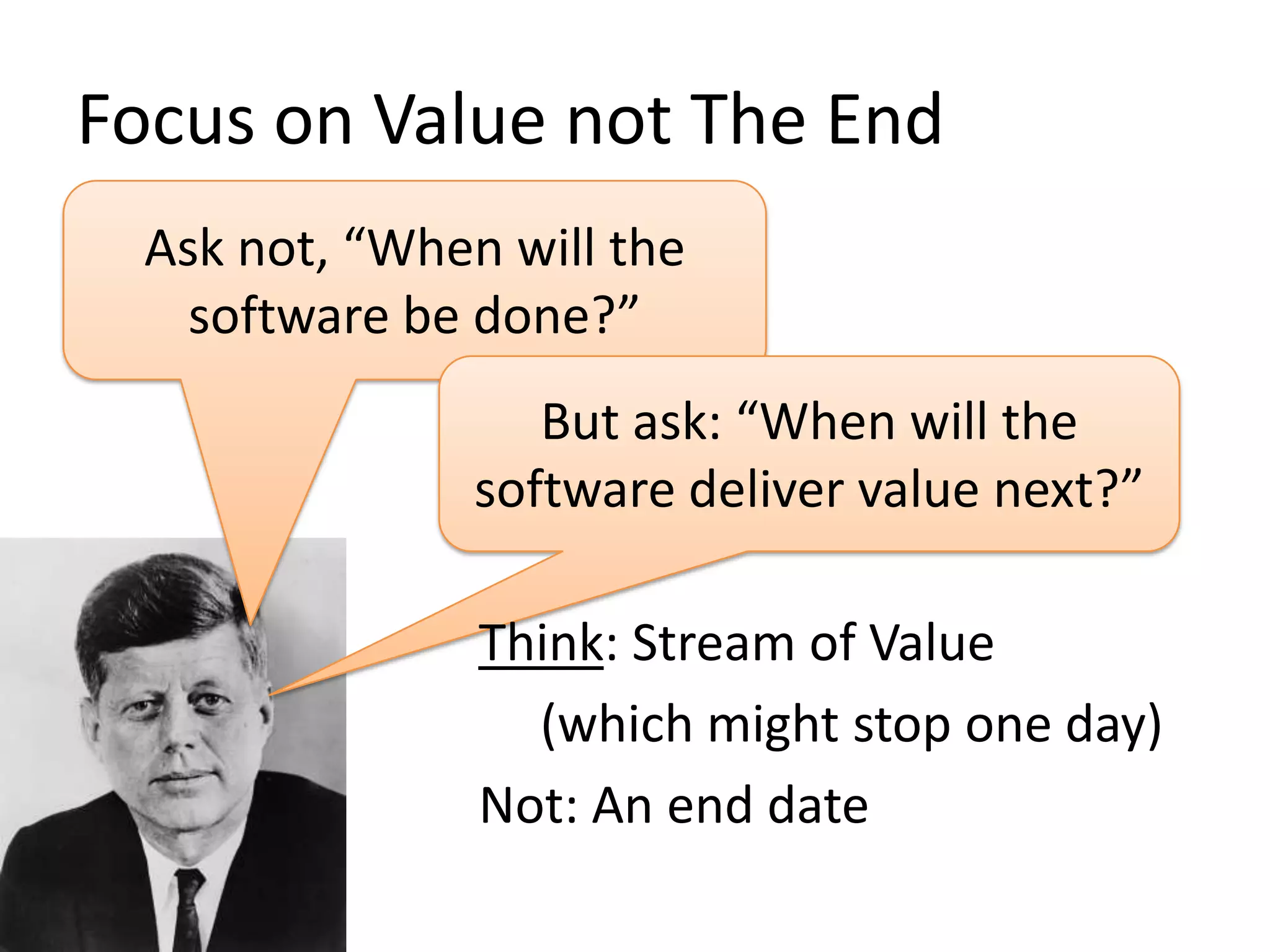
Focus on Value not The End
Ask not, “When will the
software be done?”
But ask: “When will the
software deliver value next?”
Think: Stream of Value
(which might stop one day)
Not: An end date
The End of Projects
• Projects are accounting codes
• Finished Software is Dead Software
– Living software changes
– Living software doesn’t end

• Project thinking kills software
What next?
• Putting the jigsaw together
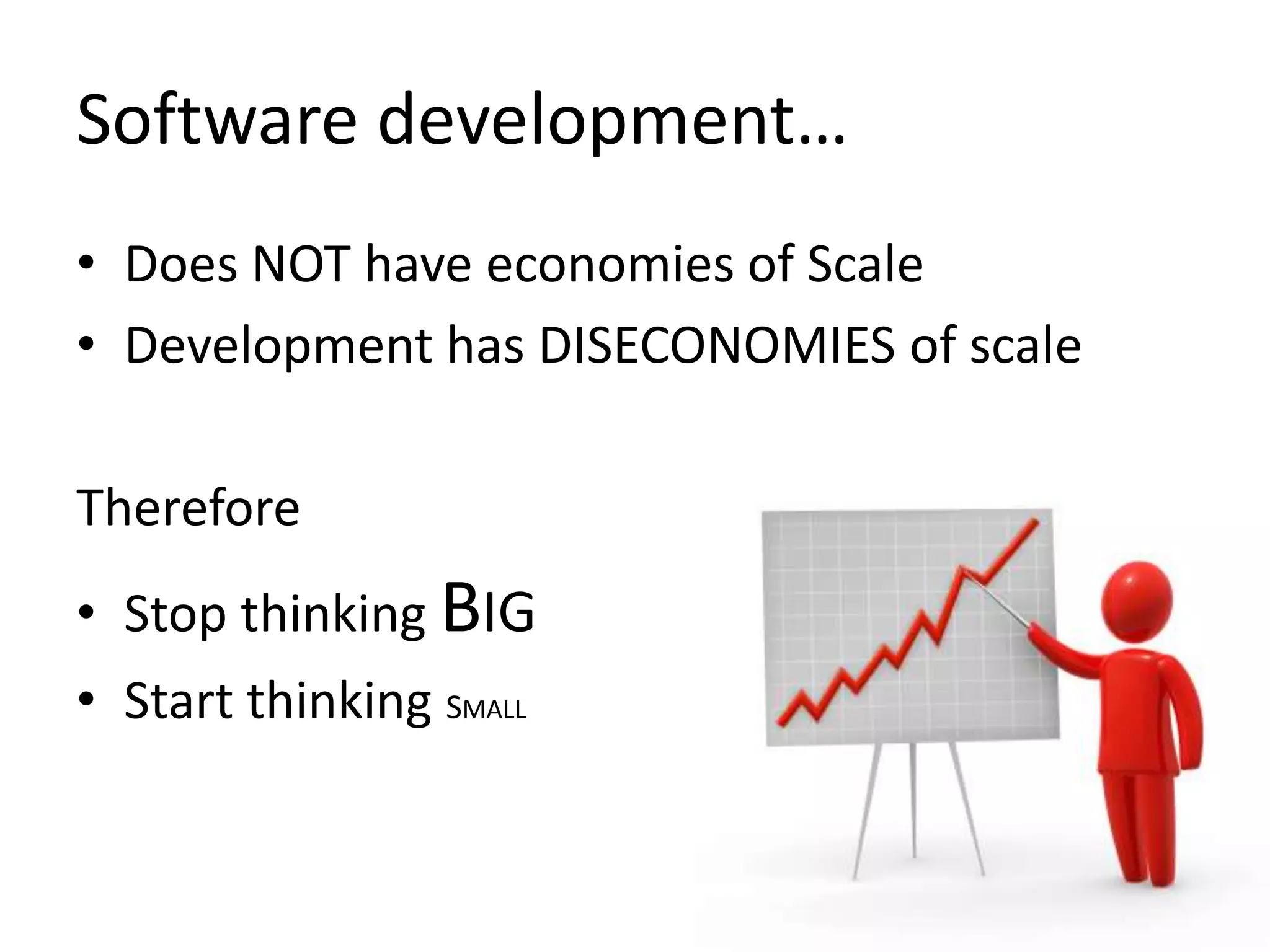
Software development…
• Does NOT have economies of Scale
• Development has DISECONOMIES of scale
Therefore
• Stop thinking BIG
• Start thinking SMALL
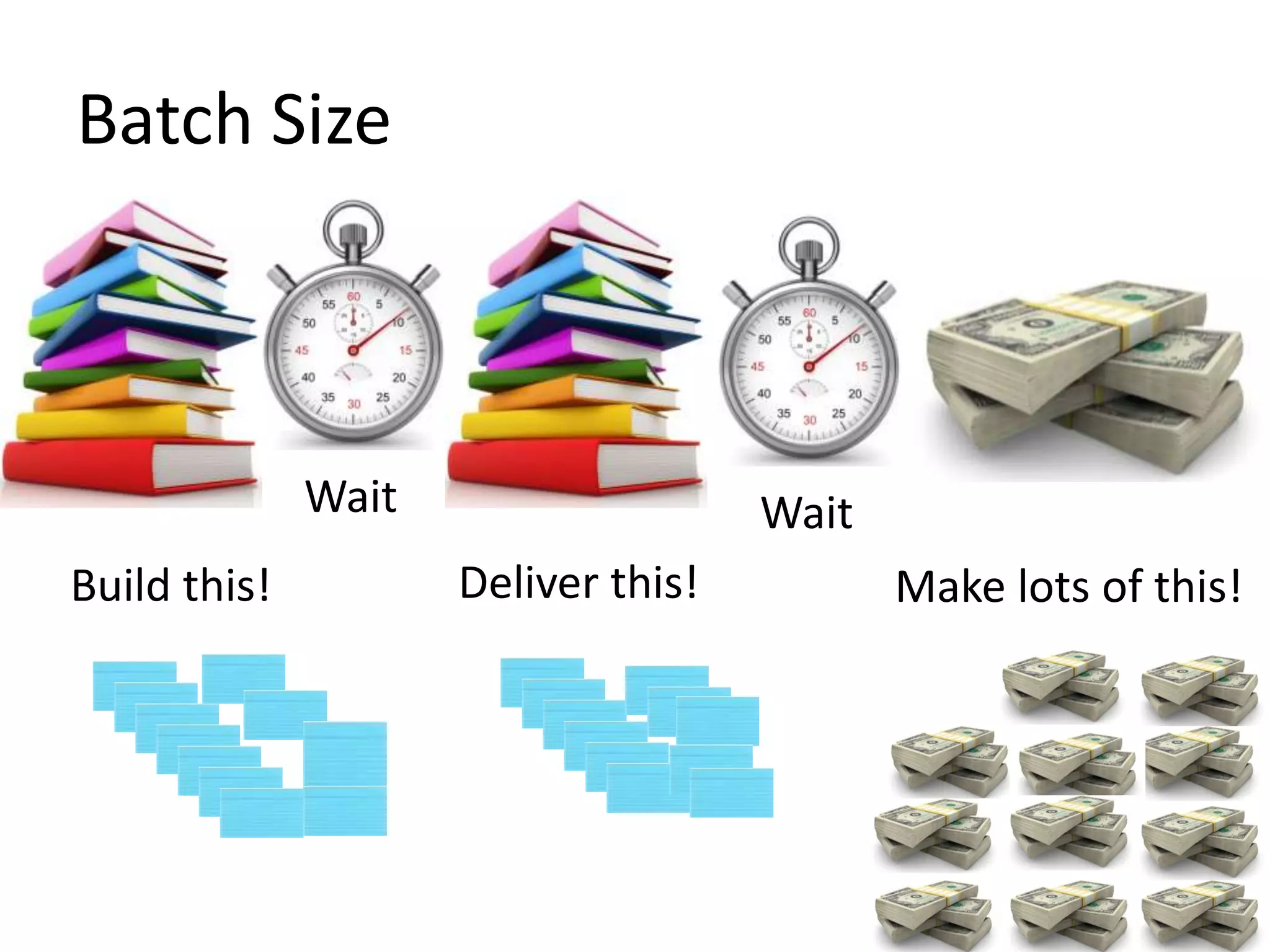
Batch Size

Wait
Build this!

Wait
Deliver this!

Make lots of this!
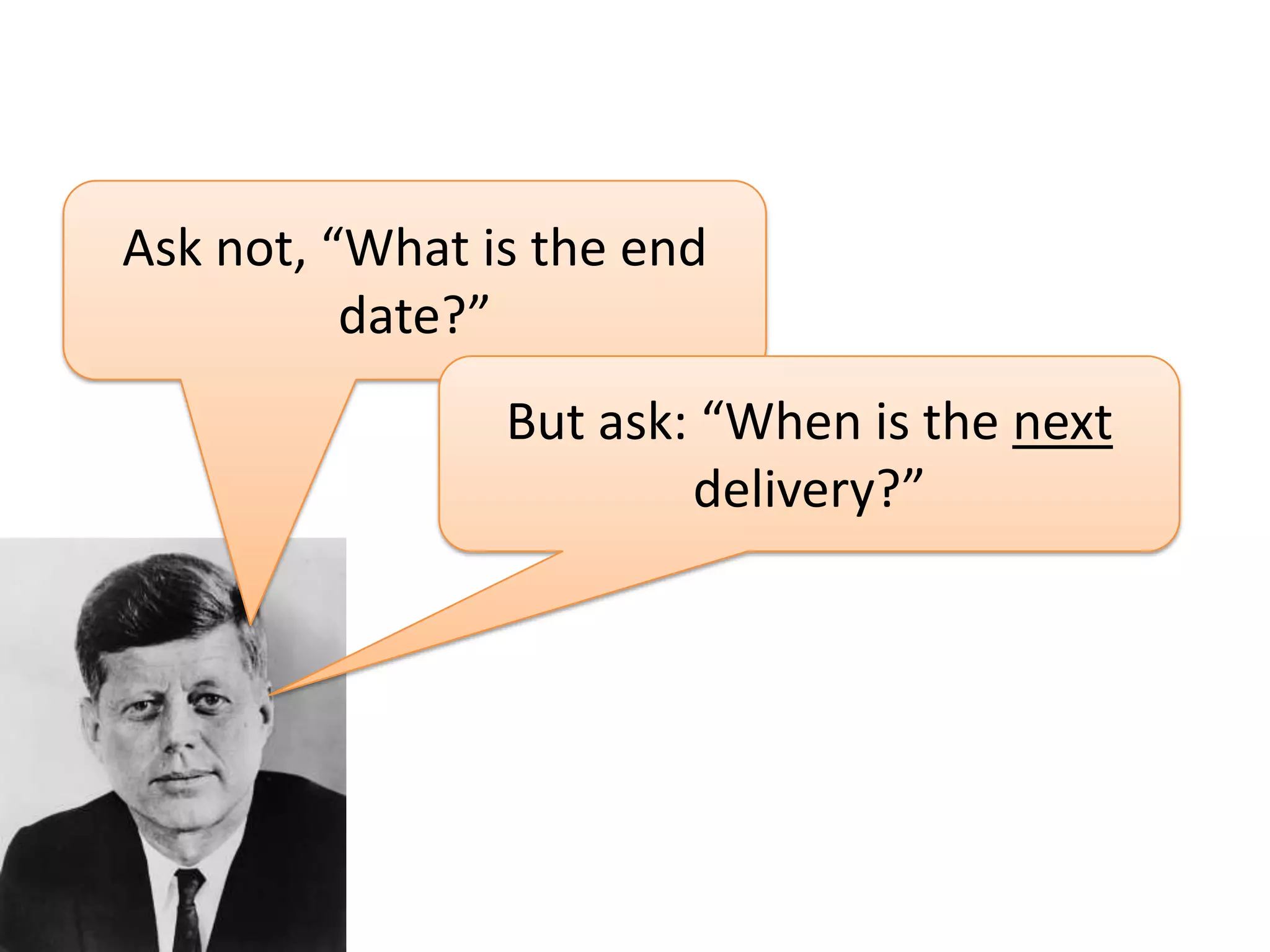
Ask not, “What is the end
date?”
But ask: “When is the next
delivery?”
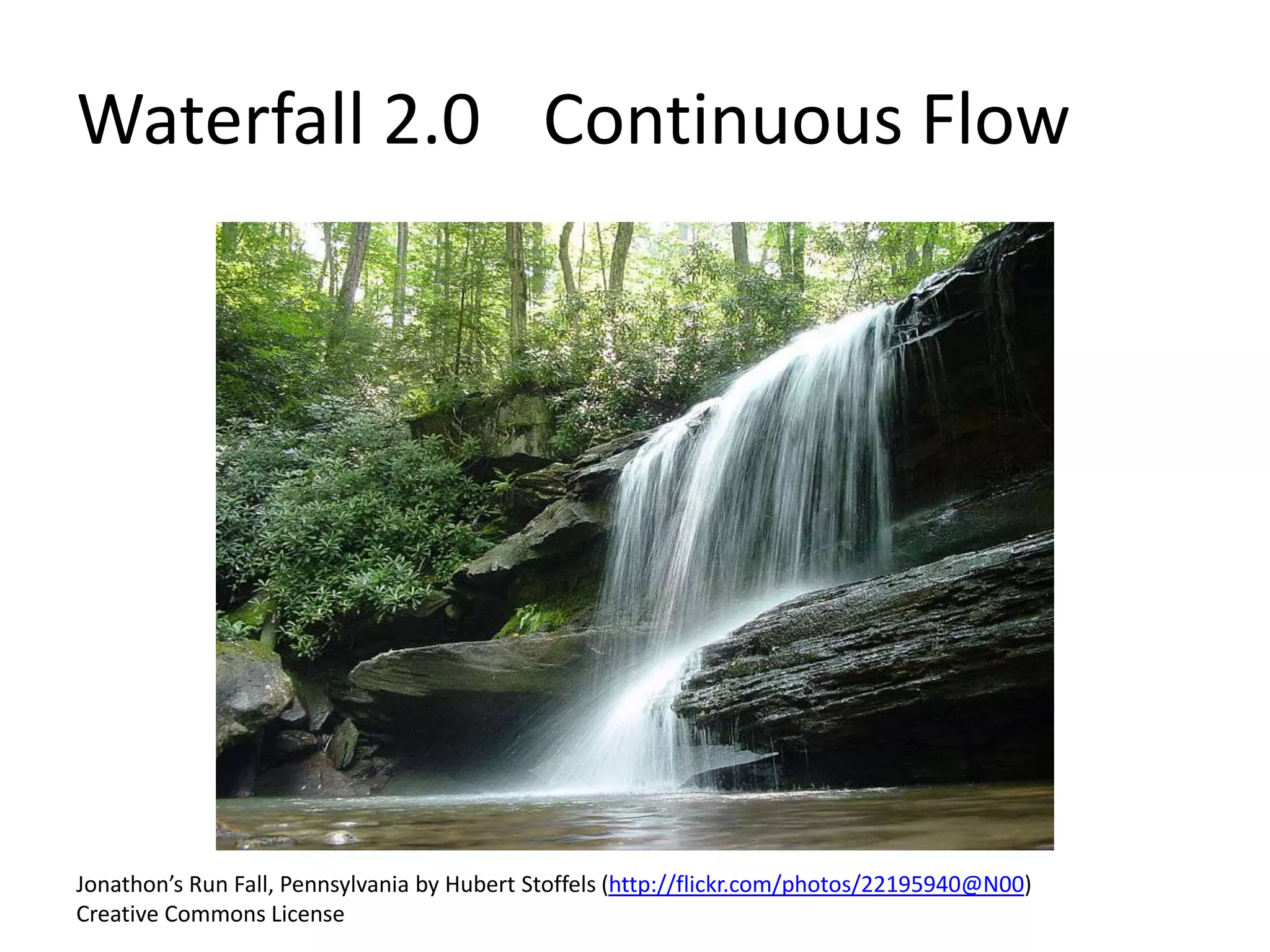
Waterfall 2.0 Continuous Flow

Jonathon’s Run Fall, Pennsylvania by Hubert Stoffels (http://flickr.com/photos/22195940@N00)
Creative Commons License
Continuous flow
• Work in the small
• Get good at doing small things
– Deliver small increments of value
– And evaluate results

• Go fast
• Don’t stop
• Value seeking
What to do about it…
•
•
•
•
•

Keep teams together
Flow work to the teams
Work in the small
Work continually
Demonstrate value
Think Product
• Products go on
– and on
– and on

• Think multiple releases
• Think continuity
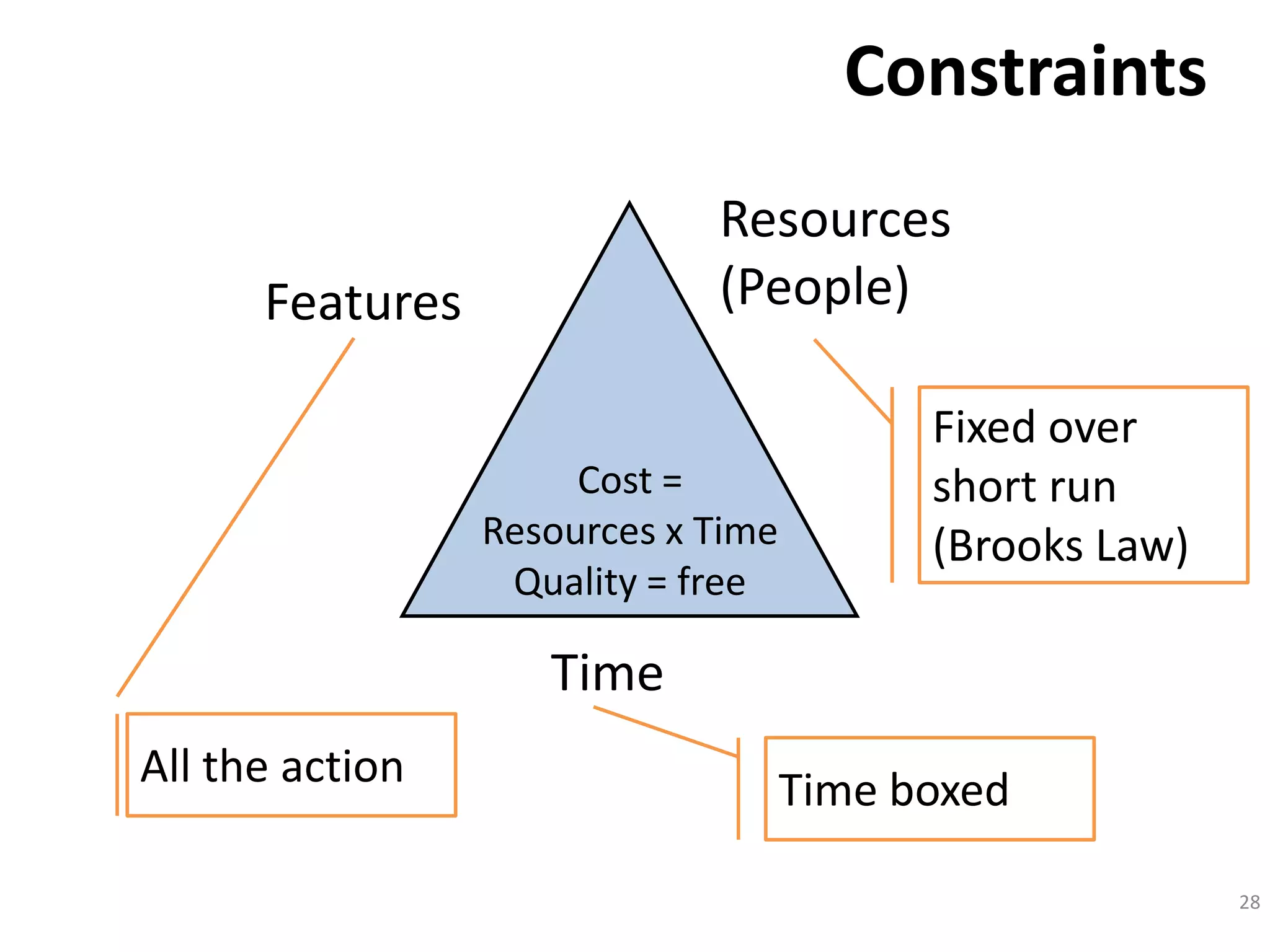
Constraints
Resources
(People)

Features

Cost =
Resources x Time
Quality = free

Fixed over
short run
(Brooks Law)

Time
All the action

Time boxed
28
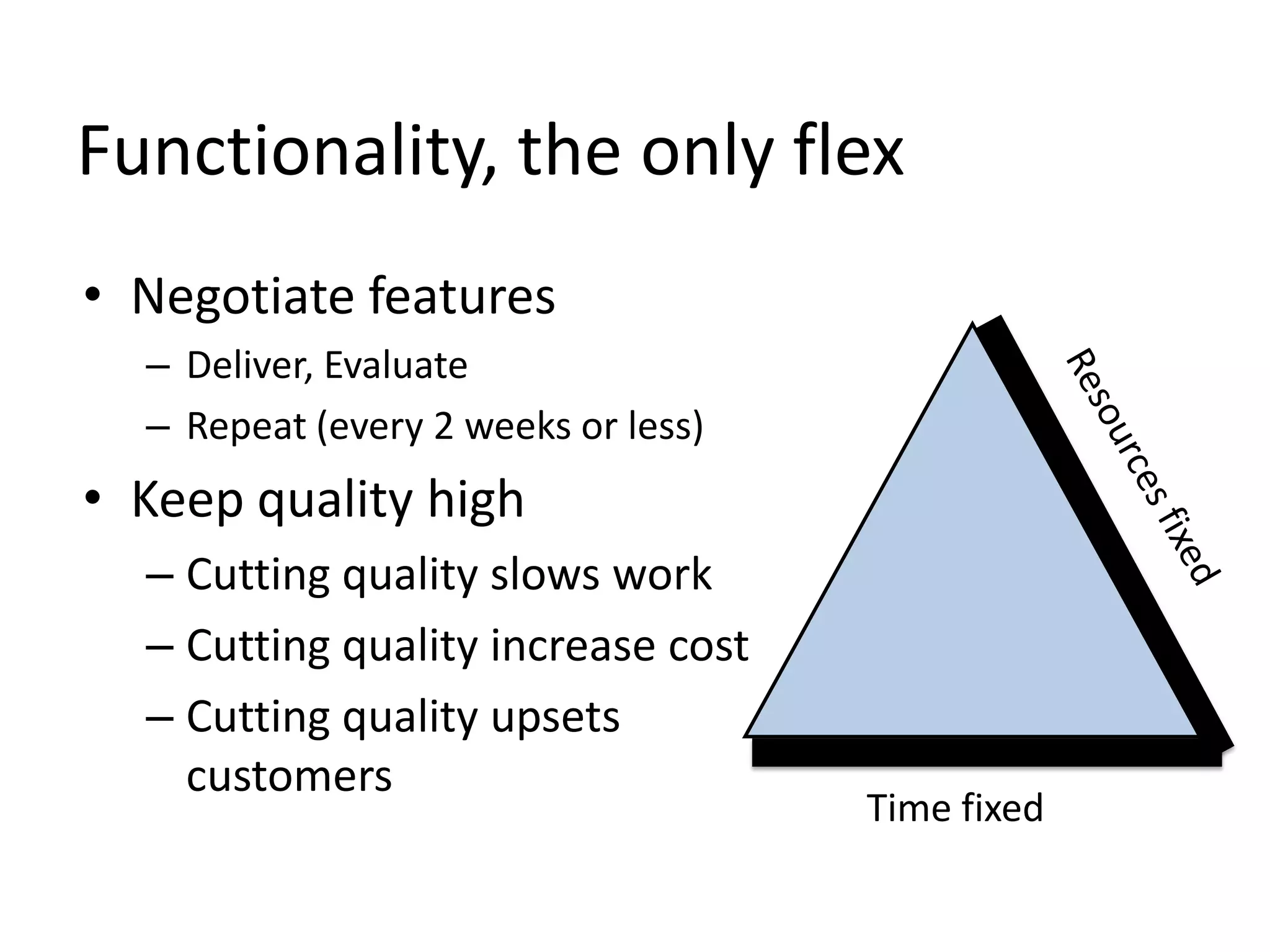
Functionality, the only flex
• Negotiate features
– Deliver, Evaluate
– Repeat (every 2 weeks or less)

• Keep quality high
– Cutting quality slows work
– Cutting quality increase cost
– Cutting quality upsets
customers

Time fixed
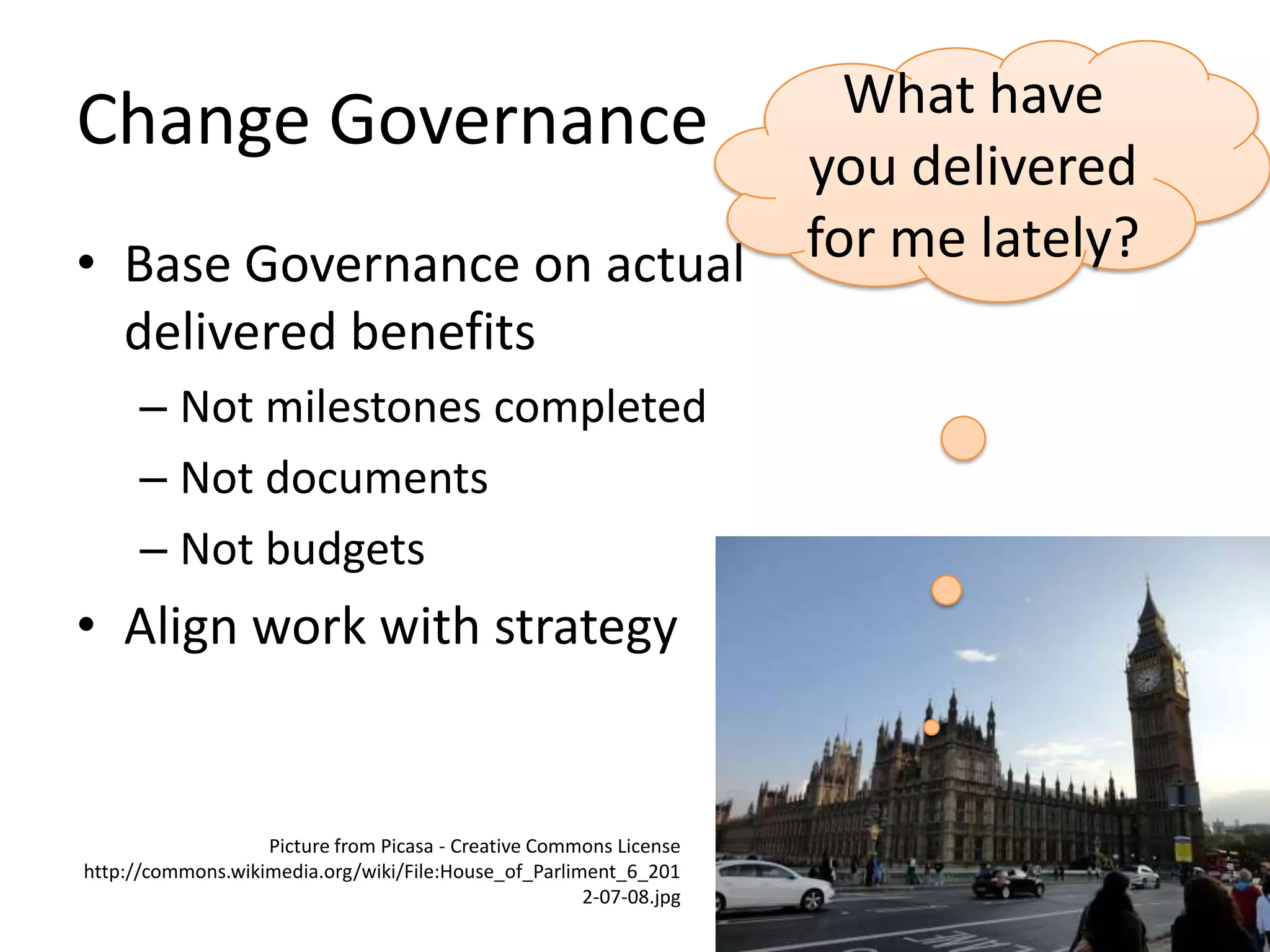
Change Governance
• Base Governance on actual
delivered benefits
– Not milestones completed
– Not documents
– Not budgets

• Align work with strategy

Picture from Picasa - Creative Commons License
http://commons.wikimedia.org/wiki/File:House_of_Parliment_6_201
2-07-08.jpg

What have
you delivered
for me lately?
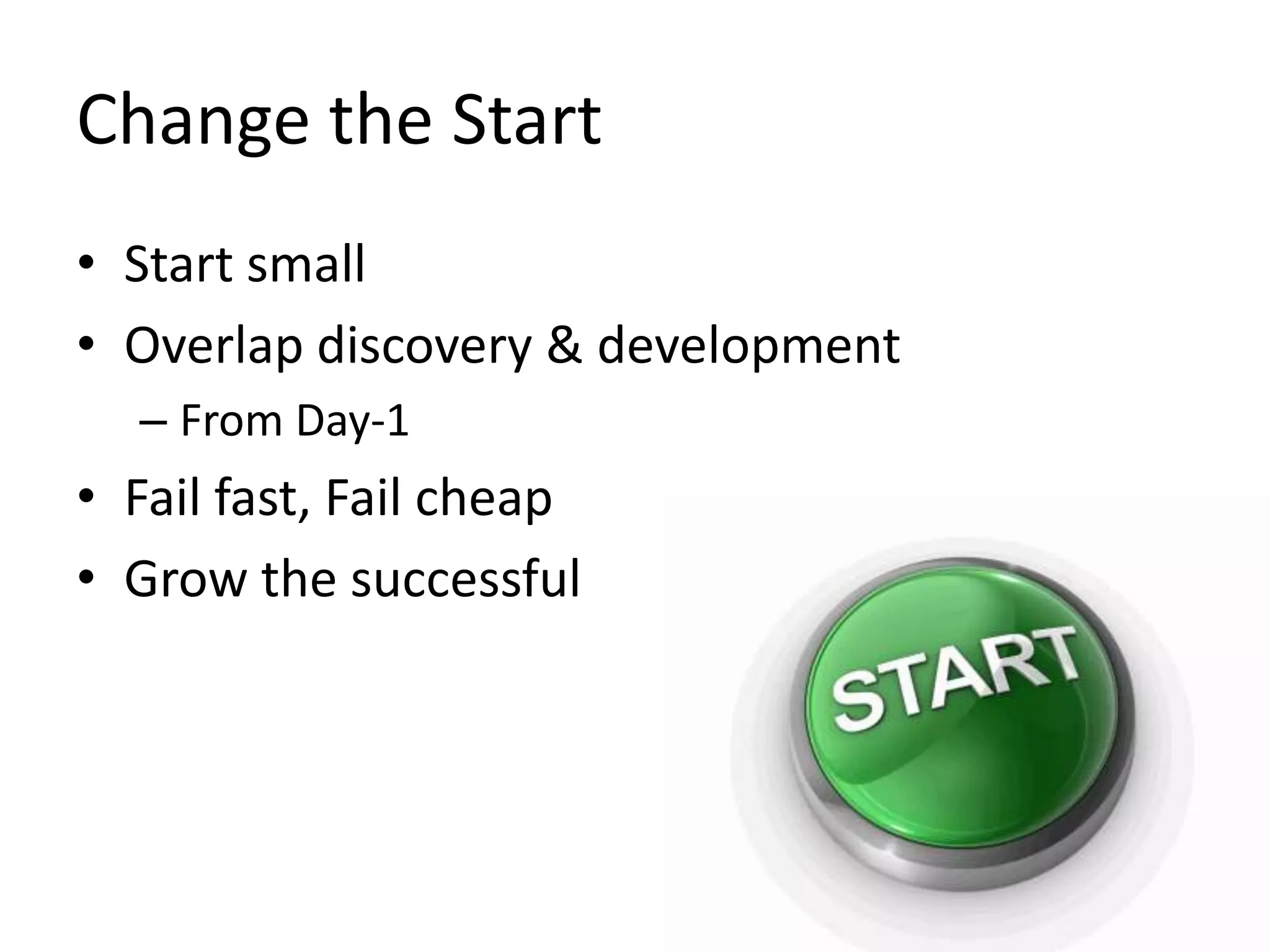
Change the Start
• Start small
• Overlap discovery & development
– From Day-1

• Fail fast, Fail cheap
• Grow the successful
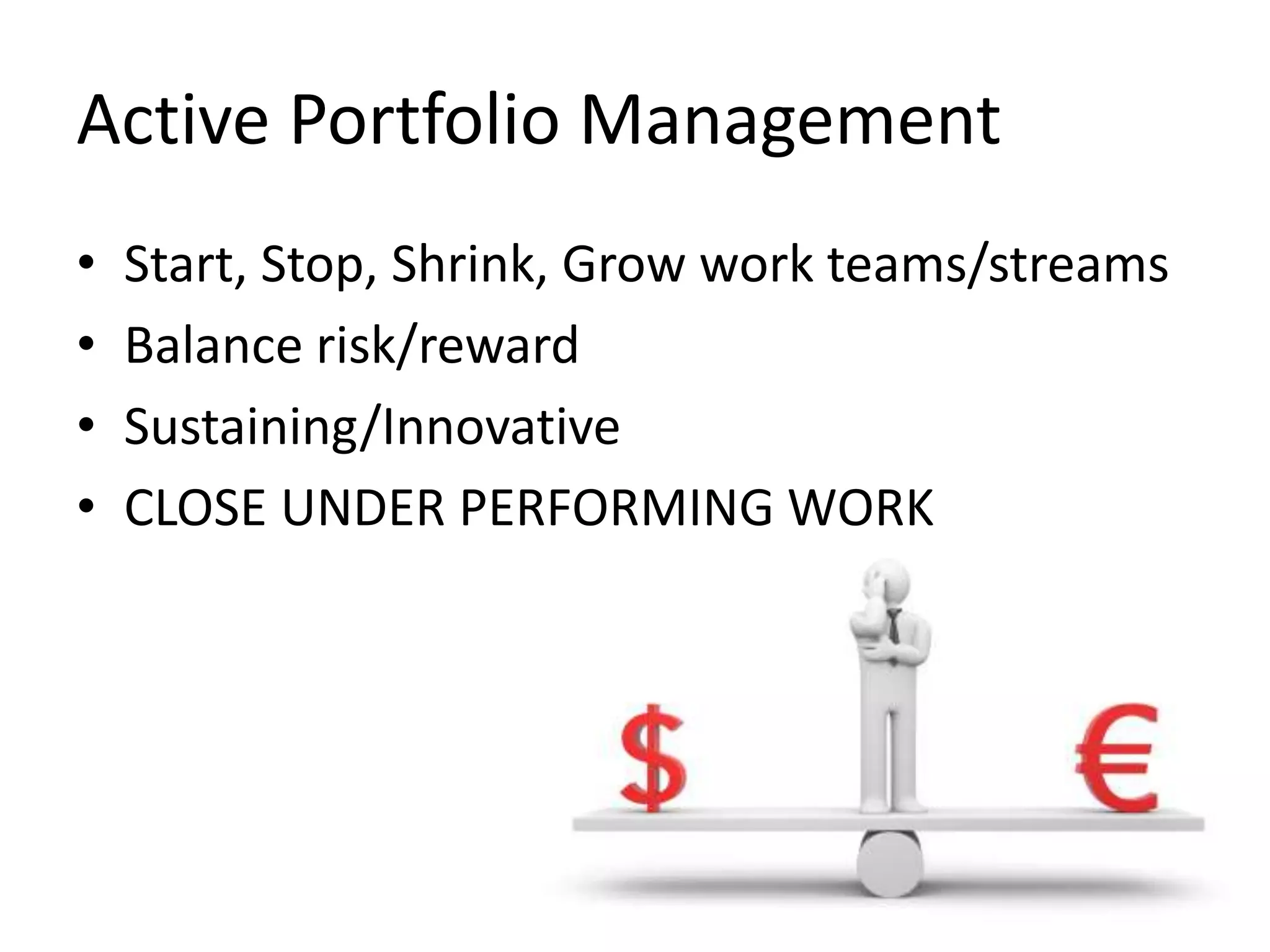
Active Portfolio Management
•
•
•
•

Start, Stop, Shrink, Grow work teams/streams
Balance risk/reward
Sustaining/Innovative
CLOSE UNDER PERFORMING WORK
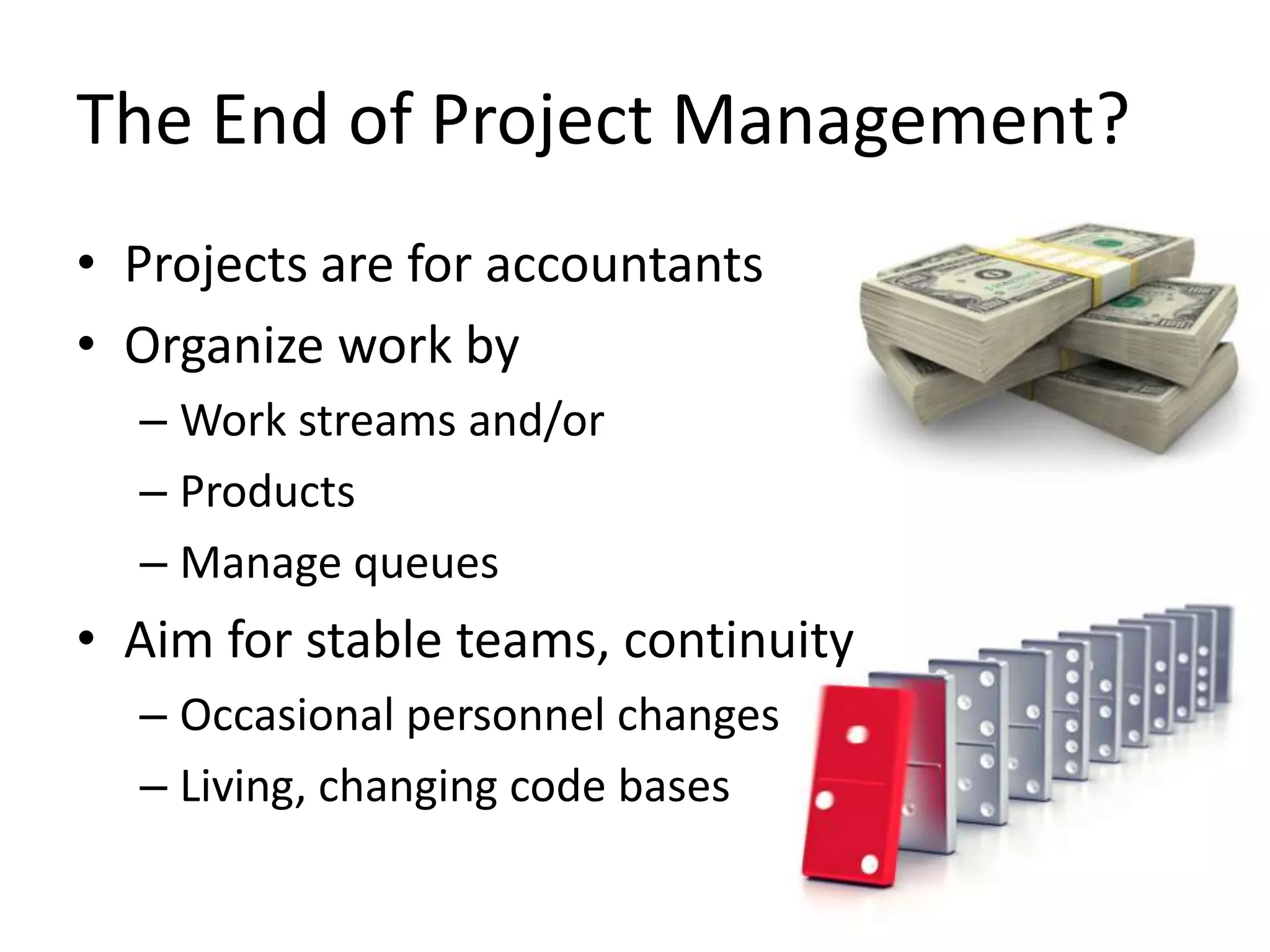
The End of Project Management?
• Projects are for accountants
• Organize work by
– Work streams and/or
– Products
– Manage queues

• Aim for stable teams, continuity
– Occasional personnel changes
– Living, changing code bases
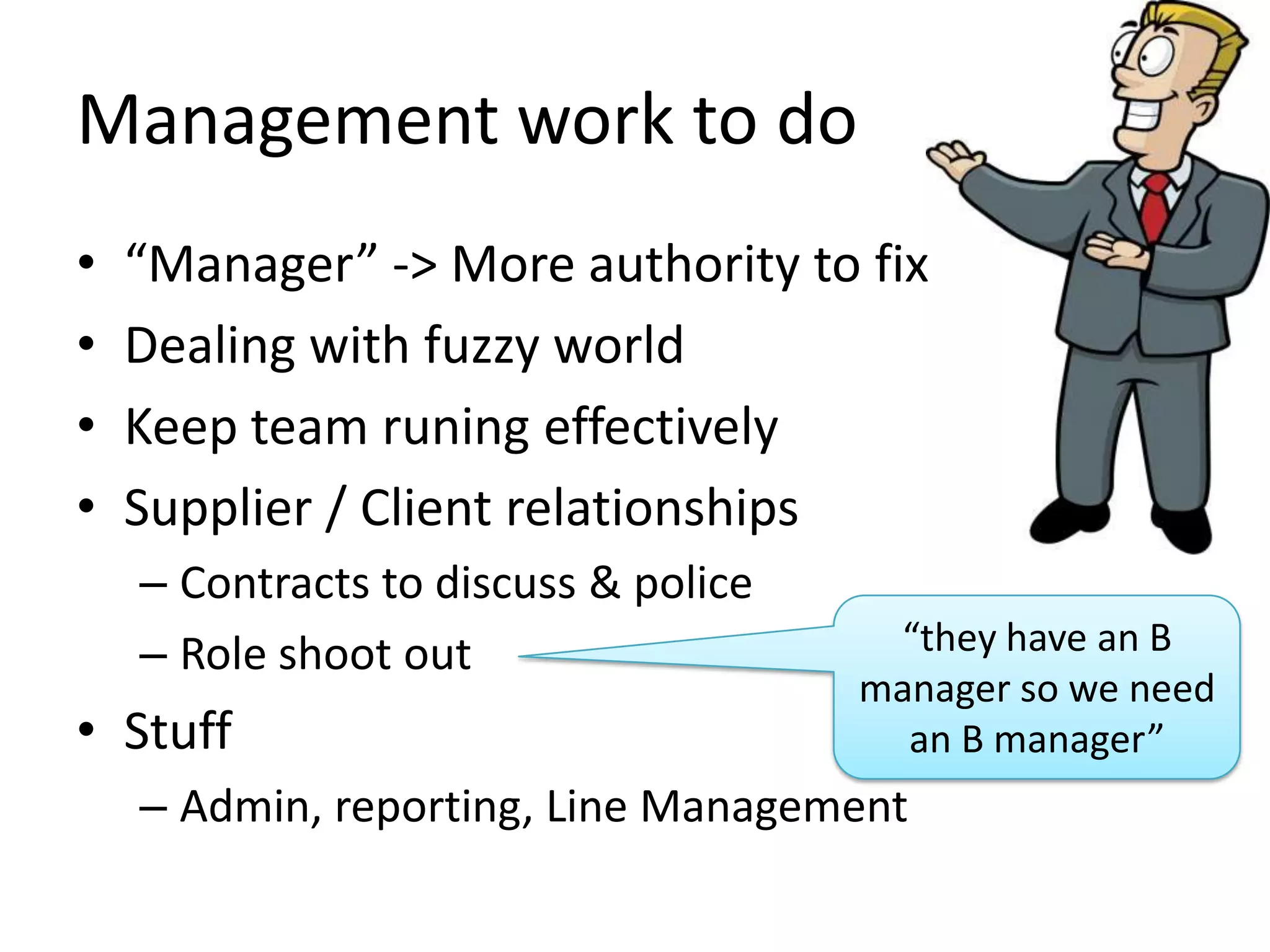
Management work to do
•
•
•
•

“Manager” -> More authority to fix
Dealing with fuzzy world
Keep team runing effectively
Supplier / Client relationships
– Contracts to discuss & police
– Role shoot out

• Stuff

“they have an B
manager so we need
an B manager”

– Admin, reporting, Line Management
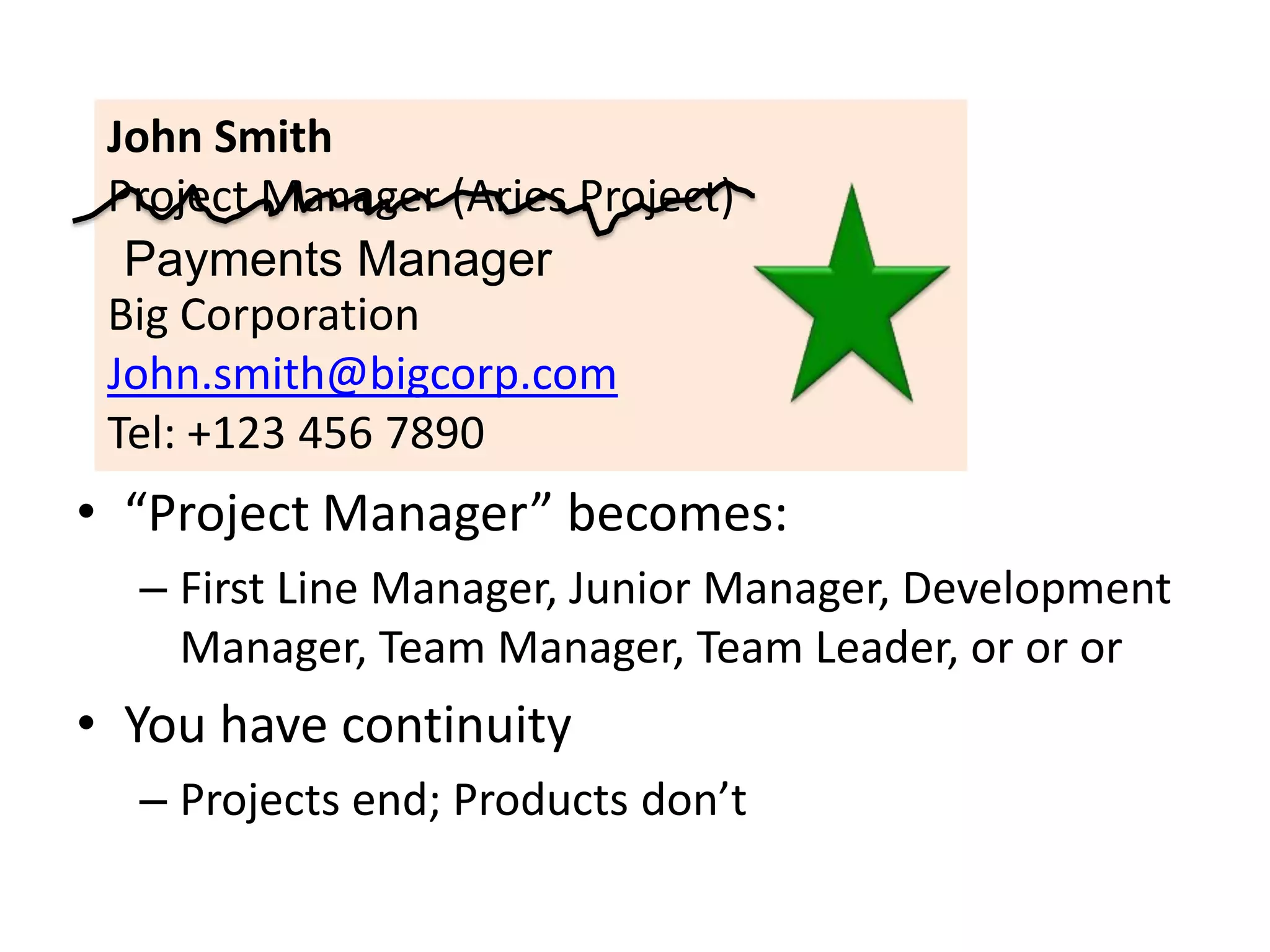
John Smith
Project Manager (Aries Project)
Payments Manager
Big Corporation
John.smith@bigcorp.com
Tel: +123 456 7890

• “Project Manager” becomes:
– First Line Manager, Junior Manager, Development
Manager, Team Manager, Team Leader, or or or

• You have continuity
– Projects end; Products don’t
How do you manage work?
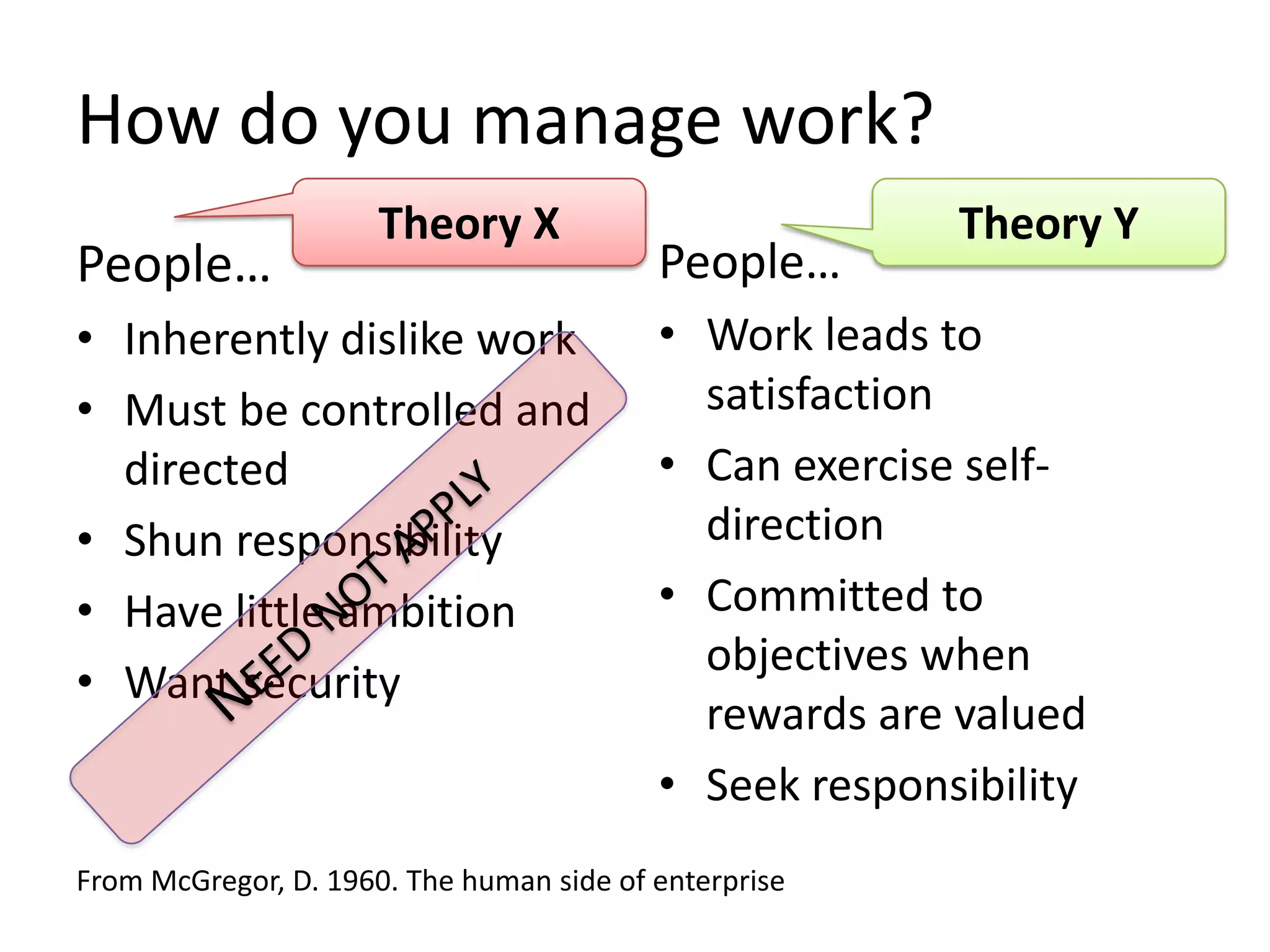
People…

Theory X

• Inherently dislike work
• Must be controlled and
directed
• Shun responsibility
• Have little ambition
• Want security

People…

Theory Y

• Work leads to
satisfaction
• Can exercise selfdirection
• Committed to
objectives when
rewards are valued
• Seek responsibility

From McGregor, D. 1960. The human side of enterprise
Remember
• It ain’t ever over
• BAU is not a dirty work

allan kelly
www.softwarestrategy.co.uk
www.allankelly.net
allan@allankelly.net
Twitter: @allankellynet
http://leanpub.com/xanpan
(c) Allan Kelly

http://www.softwarestrategy.co.uk

39

The End of Projects & what to do about it

  • 1.
    The End ofProjects… and what happens next (Aka Beyond Projects) Allan Kelly allan@softwarestrategy.co.uk http://www.softwarestrategy.co.uk Twitter: @allankelly.net BCS PROMS-G, London, February 2014
  • 2.
    Allan Kelly…  Consultingon software development & strategy  Training for Agile Author – Changing Software Development: Learning to be Agile (2008, Wiley) – Business Patterns for Software Developers (2012, Wiley - ISBN: 978-1119999249) – Xanpan: Reflections on agile (work in progress) https://leanpub.com/xanpan Chapters in… • Business Analysis and Leadership, Pullan & Archer 2013 • 97 Things Every Programmer Should Know, Henney, 2010 • Context Encapsulation in Pattern Languages of Program Design, vol #5, 2006
  • 3.
    Audience participation How manyof you … • Adequately identify & quantify project benefits? • Know someone who overstates the benefits of a project to obtain funding? • Think project review & evaluation is adequate?
  • 4.
    • 70% believethey are failing to identify and quantify the benefits adequately • 38% openly admit they overstate the benefits in order to obtain funding • 80% report that the review and evaluation of completed projects is also inadequate • due to the focus on whether the project achieved cost, time and quality objectives and not on whether the intended benefits were realized. Survey of 100 IT/IS & Business managers in UK and Benelux, 2006 Delivering value from IS and IT investments, John Ward, Cranfield School of Management, 2006 http://www.som.cranfield.ac.uk/som/dinamiccontent/research/documents/deliveringvaluereport.pdf
  • 5.
    Successful software doesn’tstop • Successful software continues to change • Only dead software has an end-date
  • 6.
    Successful software? Moodle 1) Ifthey use it, it will change Weekly downloads: 23,239 Last update: 3 days (16 Jan) Web Torrent Weekly downloads: 0 Last update: 17 April 2013 2) Only Dead Software Stops changing PerlLORD Weekly downloads: 0 Last update: 25 May 2013 Data from SourceForge search for “WebBrowser” 19 Jan 2014
  • 7.
    A Project is… “Atemporary organization that is needed to produce a unique and predefined outcome or result at a pre-specified time using predetermined resources.” PRINCE2 definition of project
  • 8.
    Temporary Organization? • • • • • Storming Norming Forming Performing Destroying } Takes time& money! Yes! Why destroy performing teams? Why spend that money? Why loose knowledge?
  • 9.
    Corporate Psychopathy Process bywhich corporations disband performing teams and release staff • • • • Stop killing performing teams Keep the team together Flow the work to the team The Team is the Capability
  • 11.
    Pre-determined resources? • Inthe ideal world… – You get the resources you ask for? – They are dedicated to your project? And stay? • Back in the real world… – Resourcing allocation is politics ‘Nuff said
  • 12.
    Pre-defined outcome? • Requirementschange • The world changes The observed rate of change in the US is about 2% per calendar month Capers Jones, 2008 Compound to ~27% per annum
  • 13.
    Pre-specified time? • Pre-specifiedtime is not chosen rationally • When does it start? • When does it end? – Last bug fixed? – Last CR done? – Thrown over last wall? Capers Jones, 2008 In the US more than half of the large projects … predetermined end date is selected, and it is forced on the project by arbitrary decree. Among the most difficult … measurement of project & task schedules. The initial difficulty… is… identifying the start point of any given project!
  • 14.
    End Date consideredharmful • Late requirements considered inferior • Quality cut to meet date When will it be – Harder to maintain – Harder to fix bugs – Harder to enhance – Harder to live • Goal deferment – The End done?
  • 15.
    Work with noend • Work to short term goal & deadline – Human’s are good with deadlines – (Very bad with estimation) • Work to deliver value • Work as if this is your last goal – But: Work to be ready for another round • Do work you will be proud of
  • 16.
    Focus on Valuenot The End Ask not, “When will the software be done?” But ask: “When will the software deliver value next?” Think: Stream of Value (which might stop one day) Not: An end date
  • 17.
    The End ofProjects • Projects are accounting codes • Finished Software is Dead Software – Living software changes – Living software doesn’t end • Project thinking kills software
  • 18.
    What next? • Puttingthe jigsaw together
  • 19.
    Software development… • DoesNOT have economies of Scale • Development has DISECONOMIES of scale Therefore • Stop thinking BIG • Start thinking SMALL
  • 20.
  • 21.
    Ask not, “Whatis the end date?” But ask: “When is the next delivery?”
  • 22.
    Waterfall 2.0 ContinuousFlow Jonathon’s Run Fall, Pennsylvania by Hubert Stoffels (http://flickr.com/photos/22195940@N00) Creative Commons License
  • 23.
    Continuous flow • Workin the small • Get good at doing small things – Deliver small increments of value – And evaluate results • Go fast • Don’t stop • Value seeking
  • 24.
    What to doabout it… • • • • • Keep teams together Flow work to the teams Work in the small Work continually Demonstrate value
  • 25.
    Think Product • Productsgo on – and on – and on • Think multiple releases • Think continuity
  • 26.
    Constraints Resources (People) Features Cost = Resources xTime Quality = free Fixed over short run (Brooks Law) Time All the action Time boxed 28
  • 27.
    Functionality, the onlyflex • Negotiate features – Deliver, Evaluate – Repeat (every 2 weeks or less) • Keep quality high – Cutting quality slows work – Cutting quality increase cost – Cutting quality upsets customers Time fixed
  • 28.
    Change Governance • BaseGovernance on actual delivered benefits – Not milestones completed – Not documents – Not budgets • Align work with strategy Picture from Picasa - Creative Commons License http://commons.wikimedia.org/wiki/File:House_of_Parliment_6_201 2-07-08.jpg What have you delivered for me lately?
  • 29.
    Change the Start •Start small • Overlap discovery & development – From Day-1 • Fail fast, Fail cheap • Grow the successful
  • 30.
    Active Portfolio Management • • • • Start,Stop, Shrink, Grow work teams/streams Balance risk/reward Sustaining/Innovative CLOSE UNDER PERFORMING WORK
  • 31.
    The End ofProject Management? • Projects are for accountants • Organize work by – Work streams and/or – Products – Manage queues • Aim for stable teams, continuity – Occasional personnel changes – Living, changing code bases
  • 32.
    Management work todo • • • • “Manager” -> More authority to fix Dealing with fuzzy world Keep team runing effectively Supplier / Client relationships – Contracts to discuss & police – Role shoot out • Stuff “they have an B manager so we need an B manager” – Admin, reporting, Line Management
  • 33.
    John Smith Project Manager(Aries Project) Payments Manager Big Corporation John.smith@bigcorp.com Tel: +123 456 7890 • “Project Manager” becomes: – First Line Manager, Junior Manager, Development Manager, Team Manager, Team Leader, or or or • You have continuity – Projects end; Products don’t
  • 34.
    How do youmanage work? People… Theory X • Inherently dislike work • Must be controlled and directed • Shun responsibility • Have little ambition • Want security People… Theory Y • Work leads to satisfaction • Can exercise selfdirection • Committed to objectives when rewards are valued • Seek responsibility From McGregor, D. 1960. The human side of enterprise
  • 35.
    Remember • It ain’tever over • BAU is not a dirty work allan kelly www.softwarestrategy.co.uk www.allankelly.net allan@allankelly.net Twitter: @allankellynet http://leanpub.com/xanpan (c) Allan Kelly http://www.softwarestrategy.co.uk 39

Editor's Notes

  • #4 Public domain image, http://commons.wikimedia.org/wiki/File:Sausage_making-H-3.JPG