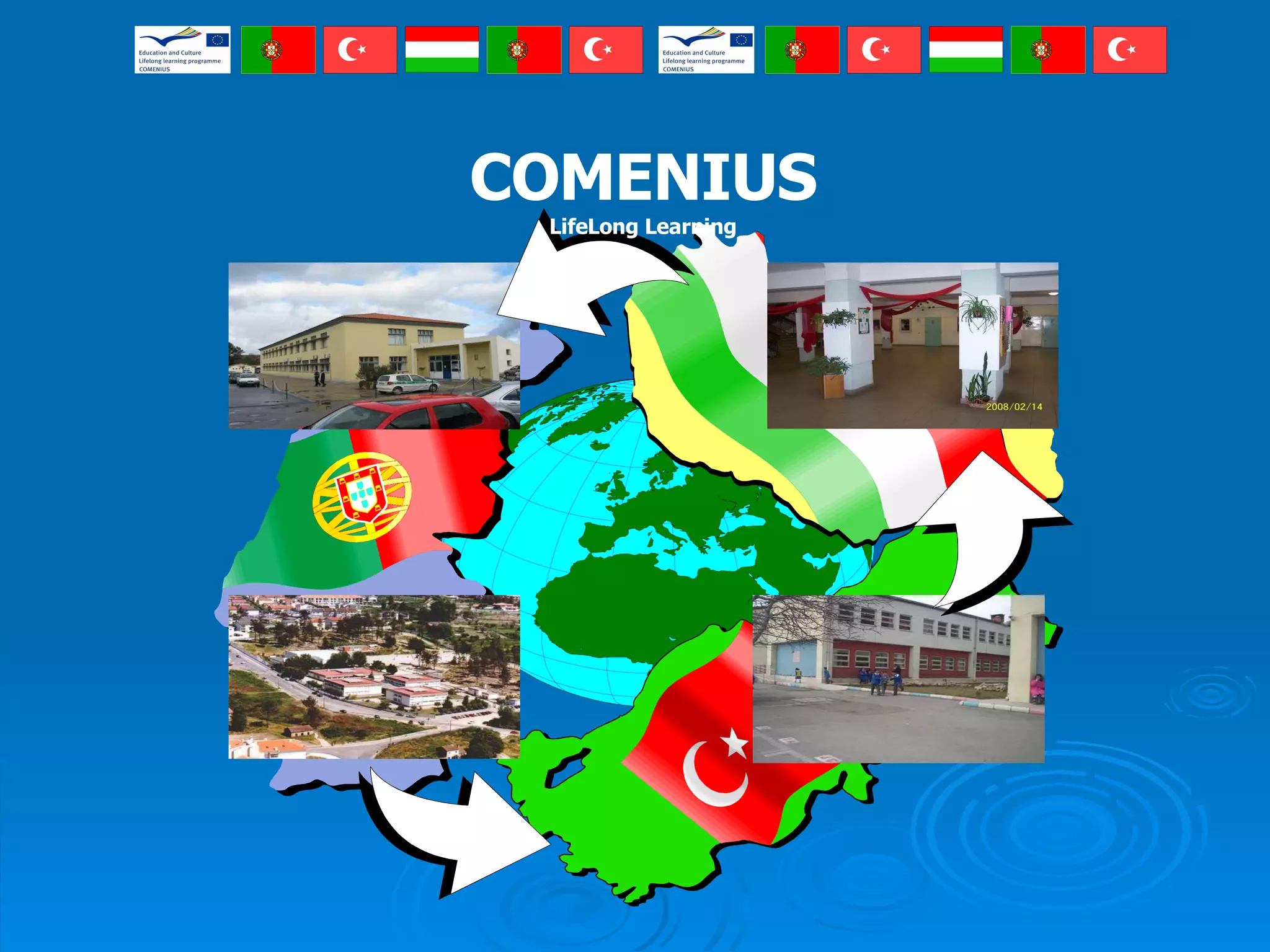
Fortalecer o Desenvolvimento Individual das Crianças e Jovens COMENIUS LifeLong Learning
The Portuguese educational system is structured in four levels Pre-school  - not compulsory and for children from the age of 2 to 5 Basic  - organized in three cycles  1st Cycle - 4 years of schooling 2nd Cycle - 2 years of schooling 3rd Cycle - 3 years of schooling Secondary  - 3 years of schooling Higher Children start school at the age of six years old Minimum schooling of 12 years  - leaving at 17 years old Schooling is universal, compulsory and free Portuguese Educational System
Portuguese Educational System Pre – School Education   from 3 to 5 years old children can attend : public, private or co-operative schools  the attendance is optional
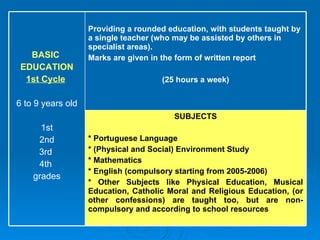
SUBJECTS * Portuguese Language  * (Physical and Social) Environment Study  * Mathematics  * English (compulsory starting from 2005-2006)  * Other Subjects like Physical Education, Musical Education, Catholic Moral and Religious Education, (or other confessions) are taught too, but are non-compulsory and according to school resources Providing a rounded education, with students taught by a single teacher (who may be assisted by others in specialist areas).  Marks are given in the form of written report  (25 hours a week) BASIC  EDUCATION 1st Cycle   6 to 9 years old 1st 2nd 3rd  4th  grades
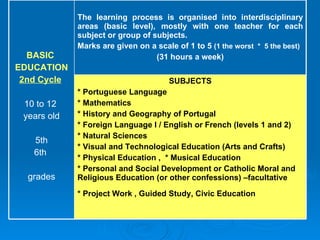
SUBJECTS * Portuguese Language  * Mathematics  * History and Geography of Portugal  * Foreign Language I / English or French (levels 1 and 2)  * Natural Sciences  * Visual and Technological Education (Arts and Crafts)  * Physical Education ,  * Musical Education  * Personal and Social Development or Catholic Moral and Religious Education (or other confessions) –facultative * Project Work , Guided Study, Civic Education   The learning process is organised into interdisciplinary areas (basic level), mostly with one teacher for each subject or group of subjects.  Marks are given on a scale of 1 to 5  (1 the worst  *  5 the best) (31 hours a week) BASIC  EDUCATION 2nd Cycle   10 to 12  years old 5th 6th  grades
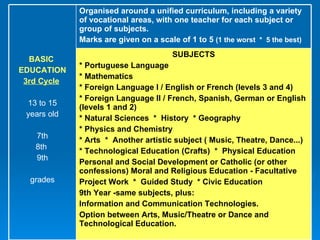
SUBJECTS * Portuguese Language  * Mathematics  * Foreign Language I / English or French (levels 3 and 4)  * Foreign Language II / French, Spanish, German or English (levels 1 and 2)  * Natural Sciences  *  History  * Geography  * Physics and Chemistry  * Arts  *  Another artistic subject ( Music, Theatre, Dance...)  * Technological Education (Crafts)  *  Physical Education  Personal and Social Development or Catholic (or other confessions) Moral and Religious Education - Facultative Project Work  *  Guided Study  * Civic Education  9th Year -same subjects, plus: Information and Communication Technologies.  Option between Arts, Music/Theatre or Dance and Technological Education. Organised around a unified curriculum, including a variety of vocational areas, with one teacher for each subject or group of subjects.  Marks are given on a scale of 1 to 5  (1 the worst  *  5 the best) BASIC  EDUCATION 3rd Cycle   13 to 15 years old 7th 8th  9th grades
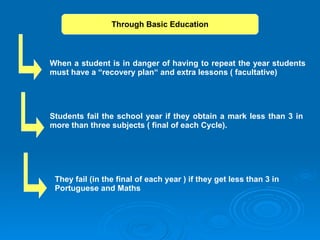
When a student is in danger of having to repeat the year students must have a “recovery plan“ and extra lessons ( facultative) Students fail the school year if they obtain a mark less than 3 in more than three subjects ( final of each Cycle). Through Basic Education They fail (in the final of each year ) if they get less than 3 in Portuguese and Maths
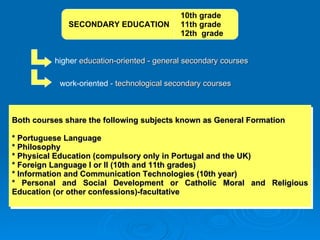
higher  education-oriented - general secondary courses work-oriented  - technological secondary courses Both courses share the following subjects known as General Formation * Portuguese Language  * Philosophy  * Physical Education (compulsory only in Portugal and the UK)  * Foreign Language I or II (10th and 11th grades)  * Information and Communication Technologies (10th year)  * Personal and Social Development or Catholic Moral and Religious Education (or other confessions)-facultative 10th grade SECONDARY EDUCATION  11th grade 12th  grade
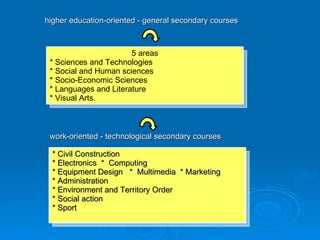
higher education-oriented - general secondary courses work-oriented - technological secondary courses 5 areas * Sciences and Technologies  * Social and Human sciences  * Socio-Economic Sciences  * Languages and Literature  * Visual Arts. * Civil Construction  * Electronics  *  Computing  * Equipment Design  *  Multimedia  * Marketing  * Administration  * Environment and Territory Order  * Social action  * Sport
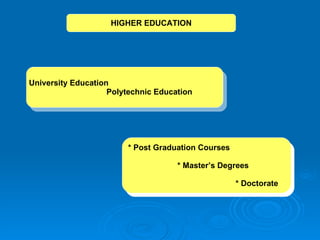
* Post Graduation Courses  * Master’s Degrees  * Doctorate University Education  Polytechnic Education HIGHER EDUCATION
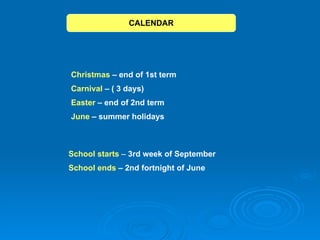
Christmas  – end of 1st term Carnival  – ( 3 days) Easter  – end of 2nd term June  – summer holidays School starts  –  3rd week of September School ends  – 2nd fortnight of June CALENDAR

Sistema Educativo PortuguêS

  • 1.
    Fortalecer o DesenvolvimentoIndividual das Crianças e Jovens COMENIUS LifeLong Learning
  • 2.
    The Portuguese educationalsystem is structured in four levels Pre-school - not compulsory and for children from the age of 2 to 5 Basic - organized in three cycles 1st Cycle - 4 years of schooling 2nd Cycle - 2 years of schooling 3rd Cycle - 3 years of schooling Secondary - 3 years of schooling Higher Children start school at the age of six years old Minimum schooling of 12 years - leaving at 17 years old Schooling is universal, compulsory and free Portuguese Educational System
  • 3.
    Portuguese Educational SystemPre – School Education from 3 to 5 years old children can attend : public, private or co-operative schools the attendance is optional
  • 4.
    SUBJECTS * PortugueseLanguage * (Physical and Social) Environment Study * Mathematics * English (compulsory starting from 2005-2006) * Other Subjects like Physical Education, Musical Education, Catholic Moral and Religious Education, (or other confessions) are taught too, but are non-compulsory and according to school resources Providing a rounded education, with students taught by a single teacher (who may be assisted by others in specialist areas). Marks are given in the form of written report (25 hours a week) BASIC EDUCATION 1st Cycle 6 to 9 years old 1st 2nd 3rd 4th grades
  • 5.
    SUBJECTS * PortugueseLanguage * Mathematics * History and Geography of Portugal * Foreign Language I / English or French (levels 1 and 2) * Natural Sciences * Visual and Technological Education (Arts and Crafts) * Physical Education , * Musical Education * Personal and Social Development or Catholic Moral and Religious Education (or other confessions) –facultative * Project Work , Guided Study, Civic Education The learning process is organised into interdisciplinary areas (basic level), mostly with one teacher for each subject or group of subjects. Marks are given on a scale of 1 to 5 (1 the worst * 5 the best) (31 hours a week) BASIC EDUCATION 2nd Cycle 10 to 12 years old 5th 6th grades
  • 6.
    SUBJECTS * PortugueseLanguage * Mathematics * Foreign Language I / English or French (levels 3 and 4) * Foreign Language II / French, Spanish, German or English (levels 1 and 2) * Natural Sciences * History * Geography * Physics and Chemistry * Arts * Another artistic subject ( Music, Theatre, Dance...) * Technological Education (Crafts) * Physical Education Personal and Social Development or Catholic (or other confessions) Moral and Religious Education - Facultative Project Work * Guided Study * Civic Education 9th Year -same subjects, plus: Information and Communication Technologies. Option between Arts, Music/Theatre or Dance and Technological Education. Organised around a unified curriculum, including a variety of vocational areas, with one teacher for each subject or group of subjects. Marks are given on a scale of 1 to 5 (1 the worst * 5 the best) BASIC EDUCATION 3rd Cycle 13 to 15 years old 7th 8th 9th grades
  • 7.
    When a studentis in danger of having to repeat the year students must have a “recovery plan“ and extra lessons ( facultative) Students fail the school year if they obtain a mark less than 3 in more than three subjects ( final of each Cycle). Through Basic Education They fail (in the final of each year ) if they get less than 3 in Portuguese and Maths
  • 8.
    higher education-oriented- general secondary courses work-oriented - technological secondary courses Both courses share the following subjects known as General Formation * Portuguese Language * Philosophy * Physical Education (compulsory only in Portugal and the UK) * Foreign Language I or II (10th and 11th grades) * Information and Communication Technologies (10th year) * Personal and Social Development or Catholic Moral and Religious Education (or other confessions)-facultative 10th grade SECONDARY EDUCATION 11th grade 12th grade
  • 9.
    higher education-oriented -general secondary courses work-oriented - technological secondary courses 5 areas * Sciences and Technologies * Social and Human sciences * Socio-Economic Sciences * Languages and Literature * Visual Arts. * Civil Construction * Electronics * Computing * Equipment Design * Multimedia * Marketing * Administration * Environment and Territory Order * Social action * Sport
  • 10.
    * Post GraduationCourses * Master’s Degrees * Doctorate University Education Polytechnic Education HIGHER EDUCATION
  • 11.
    Christmas –end of 1st term Carnival – ( 3 days) Easter – end of 2nd term June – summer holidays School starts – 3rd week of September School ends – 2nd fortnight of June CALENDAR