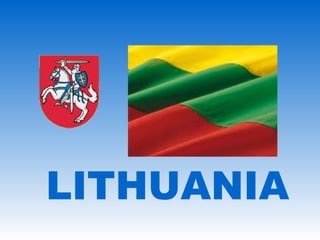
LITHUANIA
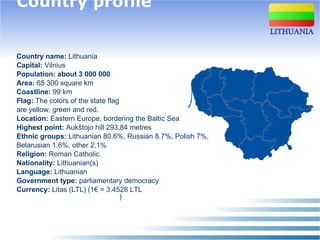
Lithuania on map
Country profile   Country name:  Lithuania  Capital:  Vilnius Population: about 3 000 000 Area:  65 300 square km   Coastline:  99 km   Flag:  The colors of the state flag  are yellow, green and red. Location:  Eastern Europe, bordering the Baltic Sea Highest point:  Auk štojo  hill 29 3,84  metres Ethnic groups:  Lithuanian 80.6%, Russian 8.7%, Polish 7%,  Belarusian 1.6%,   other 2.1% Religion:  Roman Catholic. Nationality:  Lithuanian(s) Language:  Lithuanian Government type:  parliamentary democracy   Currency:  Litas (LTL) (1€ = 3.4528 LTL  )
Economy overview metal-cutting machine tools electric motors television sets refrigerators and freezers petroleum refining, shipbuilding (small ships) furniture making, textiles food processing optical equipment  electronic components  computers amber   Main industries
Economy overview IT sector   Over the last seven years this sector has grown by more than 100 times   Textiles:  Over 80 % of these high quality products are exported to the EU   Germany and Great Britain   are the biggest investors in this field Food industry:  53 % of  Lithuania cheese is exported to the US market   Hi-Tech:  About 60 % of the world market for picosecond and multicolour lasers is designed and produced  in Vilnius Some interesting figures
Economy overview Countries: Biggest investors Companies:
History facts We descended from the Baltic Tribes, that were living by the Baltic Sea about 1000 years BC.
History facts In the 14th-15th centuries Lithuania was the largest and most powerful state  in Central Europe, extending from the Baltic to the Black Sea s
Lithuanian State was established in the 13 th  century. The only King of Lithuania was Mindaugas.
History facts The Polish – Lithuanian Commonwealth, a dualistic state  of Poland and Lithuania, was established in July 1569 (Rzeczpospolita)
History facts Independent between the two World Wars, Lithuania was annexed by the  Soviet  U nion  in 1940
History facts Lithuania was the first of all the former Soviet republics to   break away from the Soviet empire and restore its independence in 1990
History facts Lithuania subsequently restructured its economy for integration into Western European institutions   and  joined both NATO and the EU in the spring of 2004
Vilnius
Vilnius Vilnius  –  capital of Lithuania,  the largest administrative centre
Vilnius VILNIUS   is the largest city in the country.   Now population  of  Vilnius  is about  542   287   A rea of Vilnius is 392 square kilometres.  Buildings cover 20.2 % of the city and the remaining area is prevailed with  the greenery (43.9 %) and waters (2.1 %).
Vilnius Old Vilnius O ne of the largest in Eastern Europe (360 ha). The buildings is a mixture of all European architectural styles   T he Old Town of Vilnius was inscribed on the UNESCO   World   Heritage List in 1994. Vilnius is often called a baroque city,  but  here you will find some buildings of gothic, renaissance and other styles.
Old Town Higher Castle Museum   Palace of the Grand Dukes of Lithuania
Old Town Cathedral
Old Town Grand Duke Gediminas   St. Anne's Church
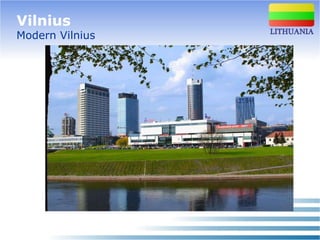
Vilnius Modern Vilnius
Vilnius … by 2020,  Vilnius  is set to become the most modern city in Central and Eastern Europe and an international centre for science, culture, business and politics …   Modern Vilnius
KAUNAS
Kaunas Kaunas is the second biggest city in Lithuania with the population of 415,700 For twenty years Kaunas was a provisional capital of Lithuania   ( 1918 – 1940 ) There are over twenty-four thousand students at the Universities: Vytautas Magnus University, Kaunas University of Technology,  Agricultural University,  Kaunas Branch of Vilnius University, Academy of Physical Training, Lithuanian University of Helth Sciences, Kaunas Branch or Music and theatre Akademy, Kaunas Branch of the Academy of Arts
Kaunas
Kaunas
 
KLAIP Ė DA
KLAIPĖDA The third largest city in Lithuania Population  -  177,823 Ice-free port on the Baltic Sea
Klaipeda
Klaipėda An Old Lighthouse
Seaside The main resort  - PALANGA The length of Palanga bridge – 470 meters.
CURONIAN SPIT few images
Trakai T own on water   The medieval capital of Lithuania is situated just 30 km from Vilnius and  surrounded by a chain of lakes
Valdas Adamkus Vytautas Landsbergis Famous people  (politics)
National Culture Famous people  (music) M.K. Č iurlionis 1875 - 1911 G iedrius  Kuprevičius 1945 Violeta Urmana   - world famous opera singer
Natio nal culture Famous people ( literature ) Justinas Marcinkevi čius 1930 - 2011 Kristijonas Donelaitis 1714 - 1780
National Culture Famous people  (sport) Arvydas Sabonis Žydrūnas Savickas Virgilijus Alekna
Basketball – the second religion in Lithuania
National Culture Food Potato pancakes The cepelinai Cottage cheese
Interesting facts Hill of Crosses Pope Jonas Paulius II visited  Lithuania in 1993
Interesting facts Grut as  park
National Culture Lithuanian songs and dances celebrations from 1920
Amber
The  Crosses  - unique  Lithuanian  art
Interesting facts Geographical centre of Europe The European geographic centre is situated in Vilnius region, 26 km from Vilnius, following the direction of Moletai, near Purnuskiu village, mound Bernotai.
Interesting facts Darius and Girenas flight
Interesting facts Kairys flight Acrobatic flying world champion  and his flight under the bridge.
Nature of Lithuania There are 2830 lakes in Lithuania.
Nature of Lithuania There are 1000  mounds  in Lithuania
Nature of Lithuania Escarpments are very imaginative
Nature of Lithuania We like mushrooms very much . It is the best of them – baravykas ( boletus or borovik).
Thank YOU

This is Luthuania.

  • 1.
  • 2.
  • 3.
    Country profile Country name: Lithuania Capital: Vilnius Population: about 3 000 000 Area: 65 300 square km Coastline: 99 km Flag: The colors of the state flag are yellow, green and red. Location: Eastern Europe, bordering the Baltic Sea Highest point: Auk štojo hill 29 3,84 metres Ethnic groups: Lithuanian 80.6%, Russian 8.7%, Polish 7%, Belarusian 1.6%, other 2.1% Religion: Roman Catholic. Nationality: Lithuanian(s) Language: Lithuanian Government type: parliamentary democracy Currency: Litas (LTL) (1€ = 3.4528 LTL )
  • 4.
    Economy overview metal-cuttingmachine tools electric motors television sets refrigerators and freezers petroleum refining, shipbuilding (small ships) furniture making, textiles food processing optical equipment electronic components computers amber Main industries
  • 5.
    Economy overview ITsector Over the last seven years this sector has grown by more than 100 times Textiles: Over 80 % of these high quality products are exported to the EU Germany and Great Britain are the biggest investors in this field Food industry: 53 % of Lithuania cheese is exported to the US market Hi-Tech: About 60 % of the world market for picosecond and multicolour lasers is designed and produced in Vilnius Some interesting figures
  • 6.
    Economy overview Countries:Biggest investors Companies:
  • 7.
    History facts Wedescended from the Baltic Tribes, that were living by the Baltic Sea about 1000 years BC.
  • 8.
    History facts Inthe 14th-15th centuries Lithuania was the largest and most powerful state in Central Europe, extending from the Baltic to the Black Sea s
  • 9.
    Lithuanian State wasestablished in the 13 th century. The only King of Lithuania was Mindaugas.
  • 10.
    History facts ThePolish – Lithuanian Commonwealth, a dualistic state of Poland and Lithuania, was established in July 1569 (Rzeczpospolita)
  • 11.
    History facts Independentbetween the two World Wars, Lithuania was annexed by the Soviet U nion in 1940
  • 12.
    History facts Lithuaniawas the first of all the former Soviet republics to break away from the Soviet empire and restore its independence in 1990
  • 13.
    History facts Lithuaniasubsequently restructured its economy for integration into Western European institutions and joined both NATO and the EU in the spring of 2004
  • 14.
  • 15.
    Vilnius Vilnius – capital of Lithuania, the largest administrative centre
  • 16.
    Vilnius VILNIUS is the largest city in the country. Now population of Vilnius is about 542 287 A rea of Vilnius is 392 square kilometres. Buildings cover 20.2 % of the city and the remaining area is prevailed with the greenery (43.9 %) and waters (2.1 %).
  • 17.
    Vilnius Old VilniusO ne of the largest in Eastern Europe (360 ha). The buildings is a mixture of all European architectural styles T he Old Town of Vilnius was inscribed on the UNESCO World Heritage List in 1994. Vilnius is often called a baroque city, but here you will find some buildings of gothic, renaissance and other styles.
  • 18.
    Old Town HigherCastle Museum Palace of the Grand Dukes of Lithuania
  • 19.
  • 20.
    Old Town GrandDuke Gediminas St. Anne's Church
  • 21.
  • 22.
    Vilnius … by2020, Vilnius is set to become the most modern city in Central and Eastern Europe and an international centre for science, culture, business and politics …   Modern Vilnius
  • 23.
  • 24.
    Kaunas Kaunas isthe second biggest city in Lithuania with the population of 415,700 For twenty years Kaunas was a provisional capital of Lithuania ( 1918 – 1940 ) There are over twenty-four thousand students at the Universities: Vytautas Magnus University, Kaunas University of Technology, Agricultural University, Kaunas Branch of Vilnius University, Academy of Physical Training, Lithuanian University of Helth Sciences, Kaunas Branch or Music and theatre Akademy, Kaunas Branch of the Academy of Arts
  • 25.
  • 26.
  • 27.
  • 28.
  • 29.
    KLAIPĖDA The thirdlargest city in Lithuania Population - 177,823 Ice-free port on the Baltic Sea
  • 30.
  • 31.
    Klaipėda An OldLighthouse
  • 32.
    Seaside The mainresort - PALANGA The length of Palanga bridge – 470 meters.
  • 33.
  • 34.
    Trakai T ownon water The medieval capital of Lithuania is situated just 30 km from Vilnius and surrounded by a chain of lakes
  • 35.
    Valdas Adamkus VytautasLandsbergis Famous people (politics)
  • 36.
    National Culture Famouspeople (music) M.K. Č iurlionis 1875 - 1911 G iedrius Kuprevičius 1945 Violeta Urmana - world famous opera singer
  • 37.
    Natio nal cultureFamous people ( literature ) Justinas Marcinkevi čius 1930 - 2011 Kristijonas Donelaitis 1714 - 1780
  • 38.
    National Culture Famouspeople (sport) Arvydas Sabonis Žydrūnas Savickas Virgilijus Alekna
  • 39.
    Basketball – thesecond religion in Lithuania
  • 40.
    National Culture FoodPotato pancakes The cepelinai Cottage cheese
  • 41.
    Interesting facts Hillof Crosses Pope Jonas Paulius II visited Lithuania in 1993
  • 42.
  • 43.
    National Culture Lithuaniansongs and dances celebrations from 1920
  • 44.
  • 45.
    The Crosses - unique Lithuanian art
  • 46.
    Interesting facts Geographicalcentre of Europe The European geographic centre is situated in Vilnius region, 26 km from Vilnius, following the direction of Moletai, near Purnuskiu village, mound Bernotai.
  • 47.
    Interesting facts Dariusand Girenas flight
  • 48.
    Interesting facts Kairysflight Acrobatic flying world champion and his flight under the bridge.
  • 49.
    Nature of LithuaniaThere are 2830 lakes in Lithuania.
  • 50.
    Nature of LithuaniaThere are 1000 mounds in Lithuania
  • 51.
    Nature of LithuaniaEscarpments are very imaginative
  • 52.
    Nature of LithuaniaWe like mushrooms very much . It is the best of them – baravykas ( boletus or borovik).
  • 53.