THE
DIGITAL
DECOUPLING
JOURNEY
JOHN KRITER
ACCENTURE TECHNOLOGY
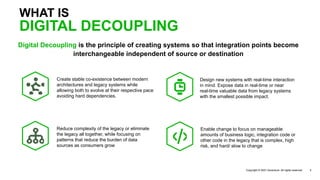
Digital Decoupling is the principle of creating systems so that integration points become
interchangeable independent of source or destination
WHAT IS
Copyright © 2021 Accenture. All rights reserved. 2
Design new systems with real-time interaction
in mind. Expose data in real-time or near
real-time valuable data from legacy systems
with the smallest possible impact.
Enable change to focus on manageable
amounts of business logic, integration code or
other code in the legacy that is complex, high
risk, and hard/ slow to change
DIGITAL DECOUPLING
Reduce complexity of the legacy or eliminate
the legacy all together, while focusing on
patterns that reduce the burden of data
sources as consumers grow
Create stable co-existence between modern
architectures and legacy systems while
allowing both to evolve at their respective pace
avoiding hard dependencies.
WHY CONSIDER DIGITAL DECOUPLING
CLOUD
THE REST
NEW
SERVICE PLATFORM
DATA
EVENTS
INTELLIGENCE
BI/ANALYTICS
ONLINE
AUTOMATION
B2B
REALTIME
INTERACTIONS
ALL CLOUD
CORPORATE FUNCTIONS
BACKBONE
SPECIFIC
”LEGACY”
SPECIFIC
”NEW”
DIFFERENTIATION
SERVICE PLATFORM
DATA
EVENTS
INTELLIGENCE
BI/ANALYTICS
ECO-SYST
EM
ONLINE
AUTOMATION
REALTIME
INTERACTIONS
THE REST
ONLINE FUNCTIONALITY
BI/ANALYTICS
B2B
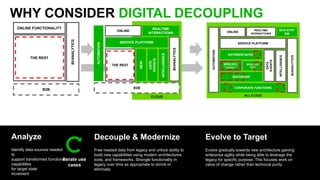
Analyze
Identify data sources needed
to
support transformed functional
capabilities
for target state
increment
Decouple & Modernize
Free needed data from legacy and unlock ability to
build new capabilities using modern architectures,
tools, and frameworks. Strangle functionality in
legacy over time as appropriate to shrink or
eliminate.
Evolve to Target
Evolve gradually towards new architecture gaining
enterprise agility while being able to leverage the
legacy for specific purpose. This focuses work on
value of change rather than technical purity.
Iterate use
cases
Copyright © 2021 Accenture. All rights reserved. 4
HOW EVENT PLATFORMS
IMPACT DIGITAL DECOUPLING
Streaming / Async
Https
Implementation specific or proprietary
(e.g. https, MQ, socket)
Legacy Proxy
Legacy System
CDC
Relational Database
Subsystem
μS
μS
μS
μS
λ
f(x
)
λ
f(x
)
λ
f(x
)
λ
f(x
)
BUSINESS
DOMAIN
μS
μS
μS
μS
λ
f(x
)
λ
f(x
)
λ
f(x
)
λ
f(x
)
API & Streaming Gateways
Event Stream
BUSINESS
DOMAIN
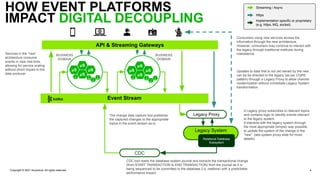
CDC tool reads the database system journal and extracts the transactional change
(from START TRANSACTION to END TRANSACTION) from the journal as it is
being sequenced to be committed to the database (i.e. realtime) with a predictable
performance impact
A Legacy proxy subscribes to relevant topics
and contains logic to identify events relevant
to the legacy system.
It interacts with the legacy system through
the most appropriate (simple) way possible
to update the system of the change in the
”new”. (see system proxy slide for more
details)
The change data capture tool publishes
the captured changes to the appropriate
topics in the event stream as-is.
Services in the “new”
architecture consume
events in near real-time,
allowing for service scaling
without direct impact to the
data producer
Consumers using new services access the
information through the new architecture.
However, consumers may continue to interact with
the legacy through traditional methods during
coexistence.
Updates to data that is not yet owned by the new,
can be be directed to the legacy (as per CQRS
pattern) through a Legacy Proxy to allow channel
modernization without immediate Legacy System
transformation.

The Digital Decoupling Journey | John Kriter, Accenture

  • 1.
  • 2.
    Digital Decoupling isthe principle of creating systems so that integration points become interchangeable independent of source or destination WHAT IS Copyright © 2021 Accenture. All rights reserved. 2 Design new systems with real-time interaction in mind. Expose data in real-time or near real-time valuable data from legacy systems with the smallest possible impact. Enable change to focus on manageable amounts of business logic, integration code or other code in the legacy that is complex, high risk, and hard/ slow to change DIGITAL DECOUPLING Reduce complexity of the legacy or eliminate the legacy all together, while focusing on patterns that reduce the burden of data sources as consumers grow Create stable co-existence between modern architectures and legacy systems while allowing both to evolve at their respective pace avoiding hard dependencies.
  • 3.
    WHY CONSIDER DIGITALDECOUPLING CLOUD THE REST NEW SERVICE PLATFORM DATA EVENTS INTELLIGENCE BI/ANALYTICS ONLINE AUTOMATION B2B REALTIME INTERACTIONS ALL CLOUD CORPORATE FUNCTIONS BACKBONE SPECIFIC ”LEGACY” SPECIFIC ”NEW” DIFFERENTIATION SERVICE PLATFORM DATA EVENTS INTELLIGENCE BI/ANALYTICS ECO-SYST EM ONLINE AUTOMATION REALTIME INTERACTIONS THE REST ONLINE FUNCTIONALITY BI/ANALYTICS B2B Analyze Identify data sources needed to support transformed functional capabilities for target state increment Decouple & Modernize Free needed data from legacy and unlock ability to build new capabilities using modern architectures, tools, and frameworks. Strangle functionality in legacy over time as appropriate to shrink or eliminate. Evolve to Target Evolve gradually towards new architecture gaining enterprise agility while being able to leverage the legacy for specific purpose. This focuses work on value of change rather than technical purity. Iterate use cases
  • 4.
    Copyright © 2021Accenture. All rights reserved. 4 HOW EVENT PLATFORMS IMPACT DIGITAL DECOUPLING Streaming / Async Https Implementation specific or proprietary (e.g. https, MQ, socket) Legacy Proxy Legacy System CDC Relational Database Subsystem μS μS μS μS λ f(x ) λ f(x ) λ f(x ) λ f(x ) BUSINESS DOMAIN μS μS μS μS λ f(x ) λ f(x ) λ f(x ) λ f(x ) API & Streaming Gateways Event Stream BUSINESS DOMAIN CDC tool reads the database system journal and extracts the transactional change (from START TRANSACTION to END TRANSACTION) from the journal as it is being sequenced to be committed to the database (i.e. realtime) with a predictable performance impact A Legacy proxy subscribes to relevant topics and contains logic to identify events relevant to the legacy system. It interacts with the legacy system through the most appropriate (simple) way possible to update the system of the change in the ”new”. (see system proxy slide for more details) The change data capture tool publishes the captured changes to the appropriate topics in the event stream as-is. Services in the “new” architecture consume events in near real-time, allowing for service scaling without direct impact to the data producer Consumers using new services access the information through the new architecture. However, consumers may continue to interact with the legacy through traditional methods during coexistence. Updates to data that is not yet owned by the new, can be be directed to the legacy (as per CQRS pattern) through a Legacy Proxy to allow channel modernization without immediate Legacy System transformation.