The Digital Branch 
Social Media & Digital Outreach in Libraries 
Jez Layman
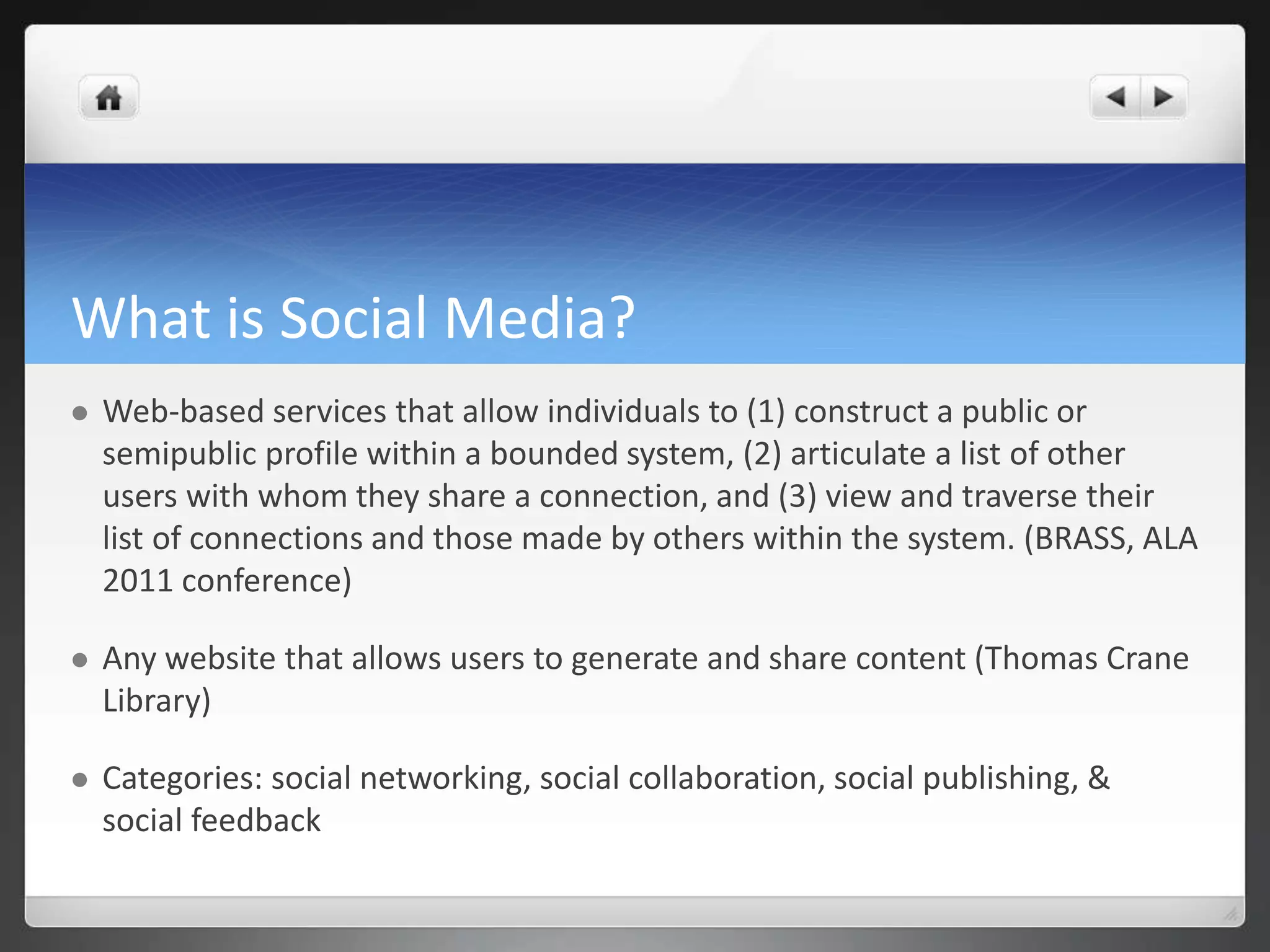
What is Social Media? 
 Web-based services that allow individuals to (1) construct a public or 
semipublic profile within a bounded system, (2) articulate a list of other 
users with whom they share a connection, and (3) view and traverse their 
list of connections and those made by others within the system. (BRASS, ALA 
2011 conference) 
 Any website that allows users to generate and share content (Thomas Crane 
Library) 
 Categories: social networking, social collaboration, social publishing, & 
social feedback
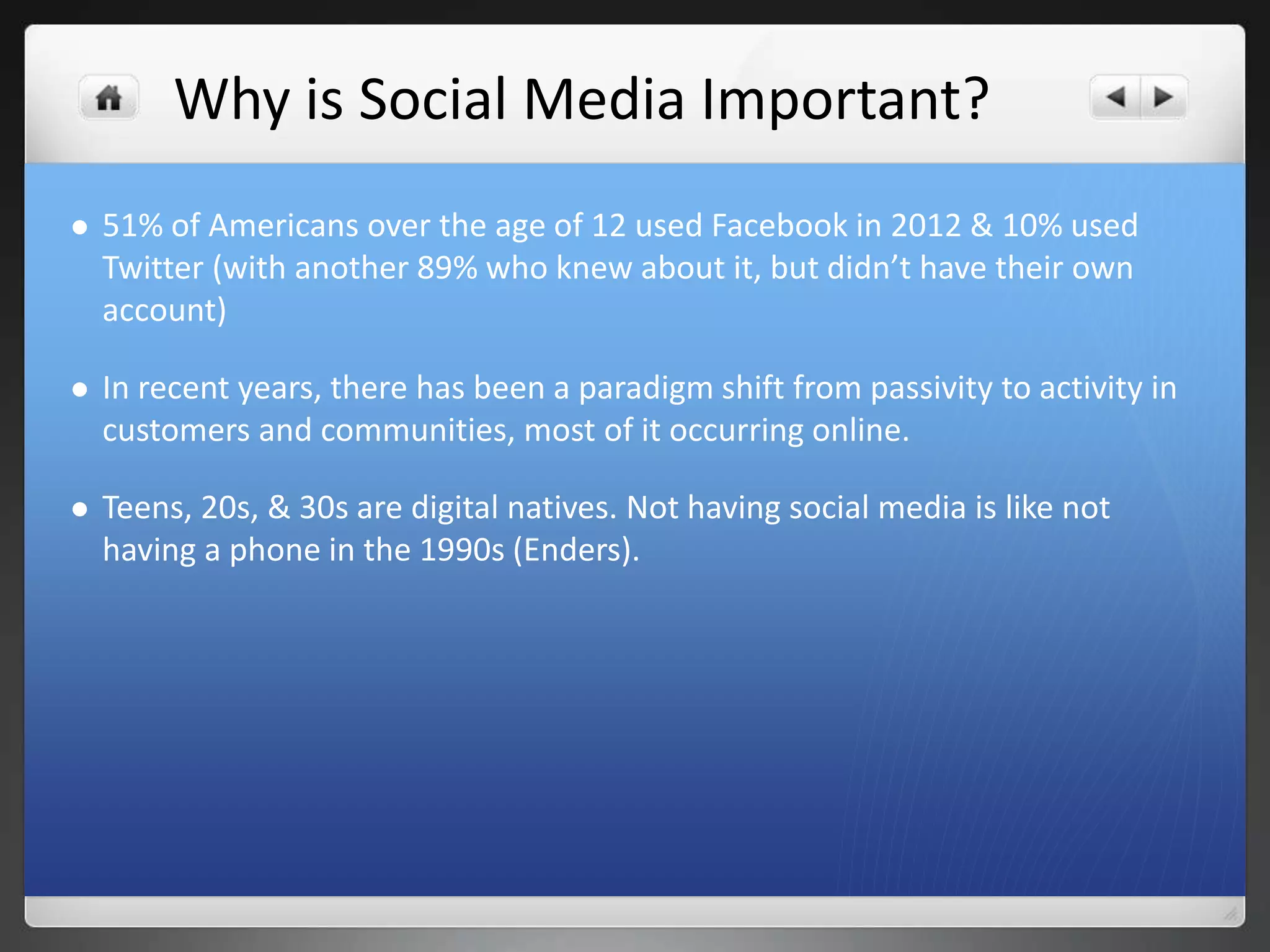
Why is Social Media Important? 
 51% of Americans over the age of 12 used Facebook in 2012 & 10% used 
Twitter (with another 89% who knew about it, but didn’t have their own 
account) 
 In recent years, there has been a paradigm shift from passivity to activity in 
customers and communities, most of it occurring online. 
 Teens, 20s, & 30s are digital natives. Not having social media is like not 
having a phone in the 1990s (Enders).
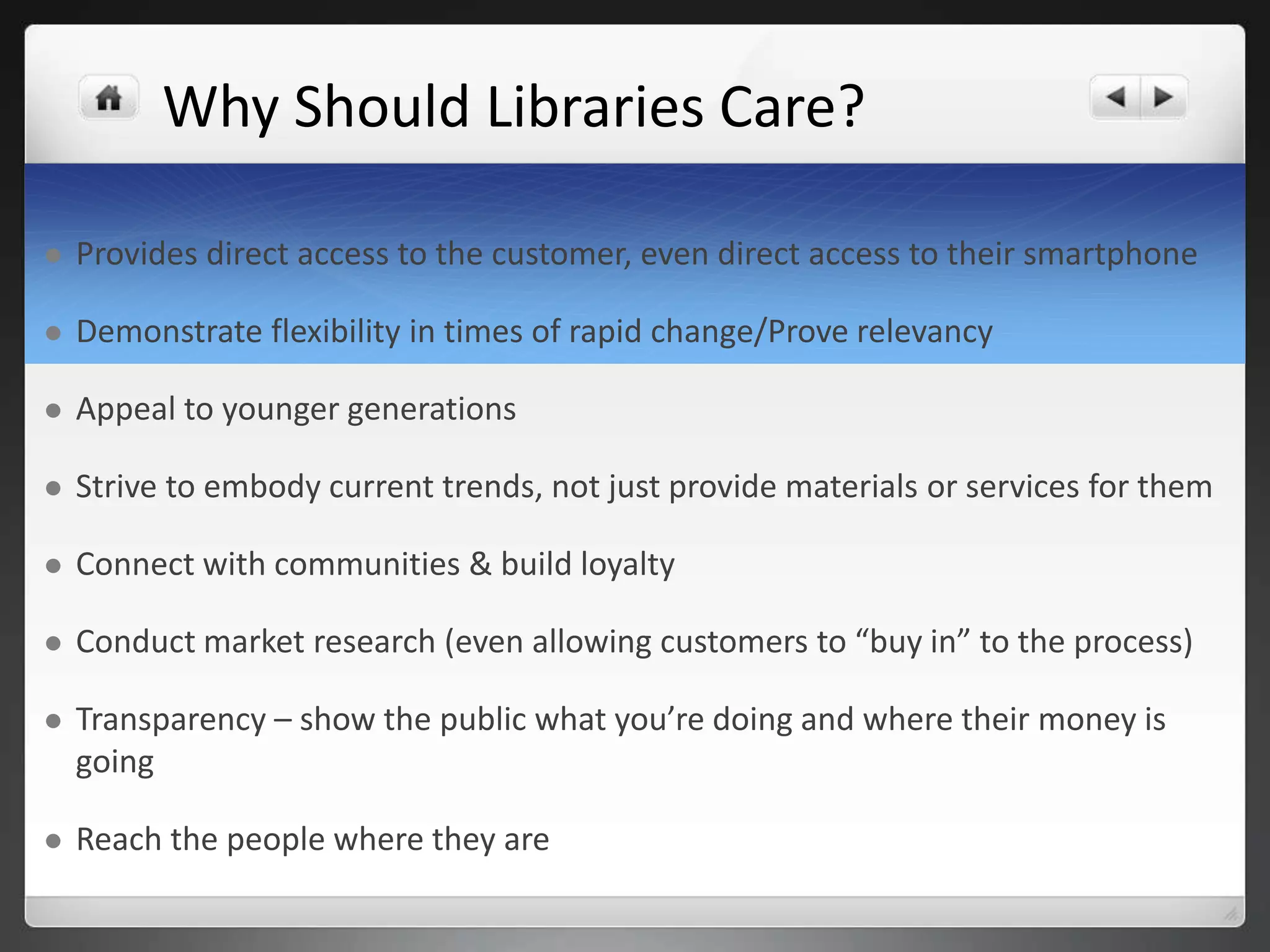
Why Should Libraries Care? 
 Provides direct access to the customer, even direct access to their smartphone 
 Demonstrate flexibility in times of rapid change/Prove relevancy 
 Appeal to younger generations 
 Strive to embody current trends, not just provide materials or services for them 
 Connect with communities & build loyalty 
 Conduct market research (even allowing customers to “buy in” to the process) 
 Transparency – show the public what you’re doing and where their money is 
going 
 Reach the people where they are
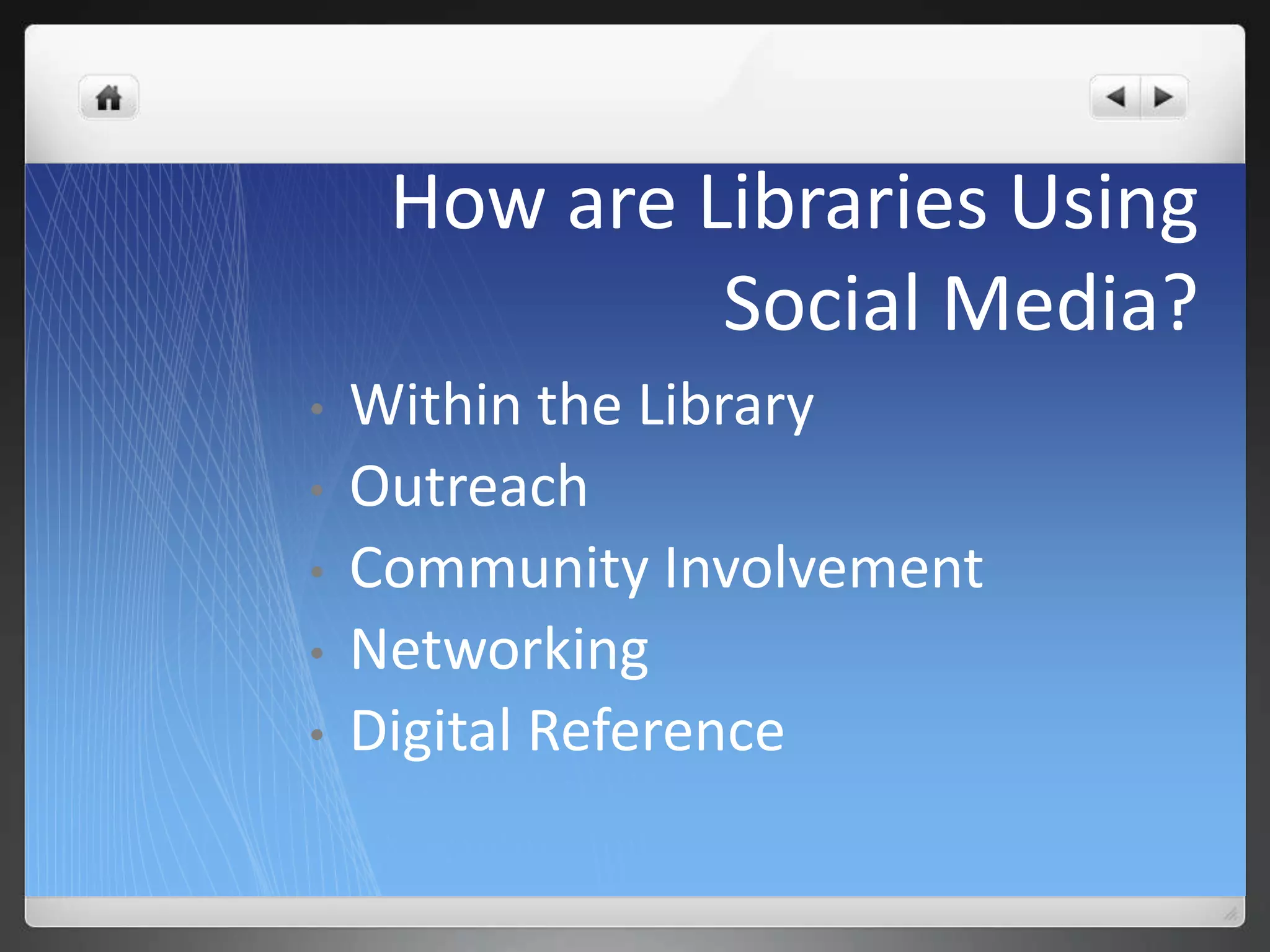
How are Libraries Using 
Social Media? 
• Within the Library 
• Outreach 
• Community Involvement 
• Networking 
• Digital Reference
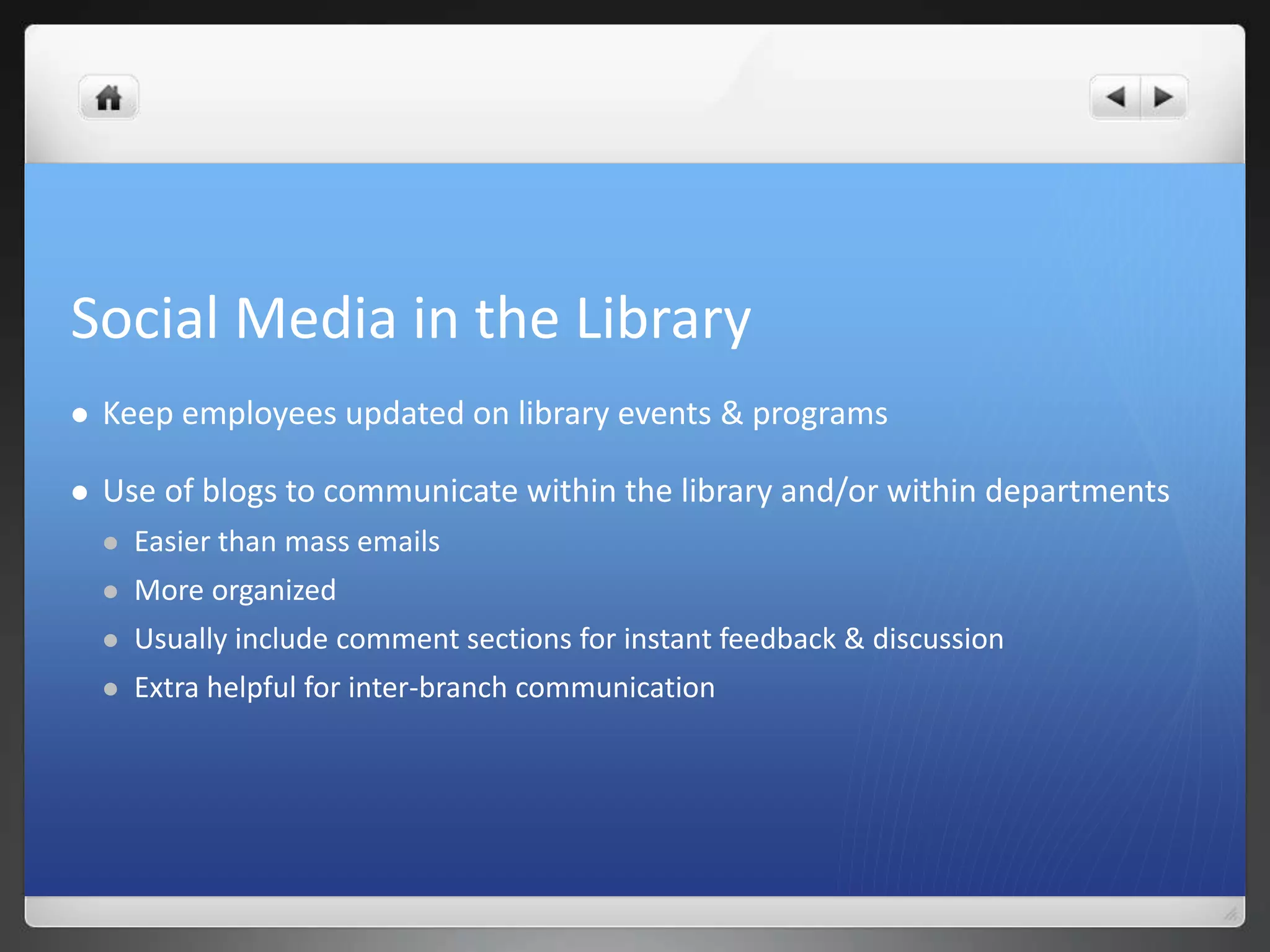
Social Media in the Library 
 Keep employees updated on library events & programs 
 Use of blogs to communicate within the library and/or within departments 
 Easier than mass emails 
 More organized 
 Usually include comment sections for instant feedback & discussion 
 Extra helpful for inter-branch communication
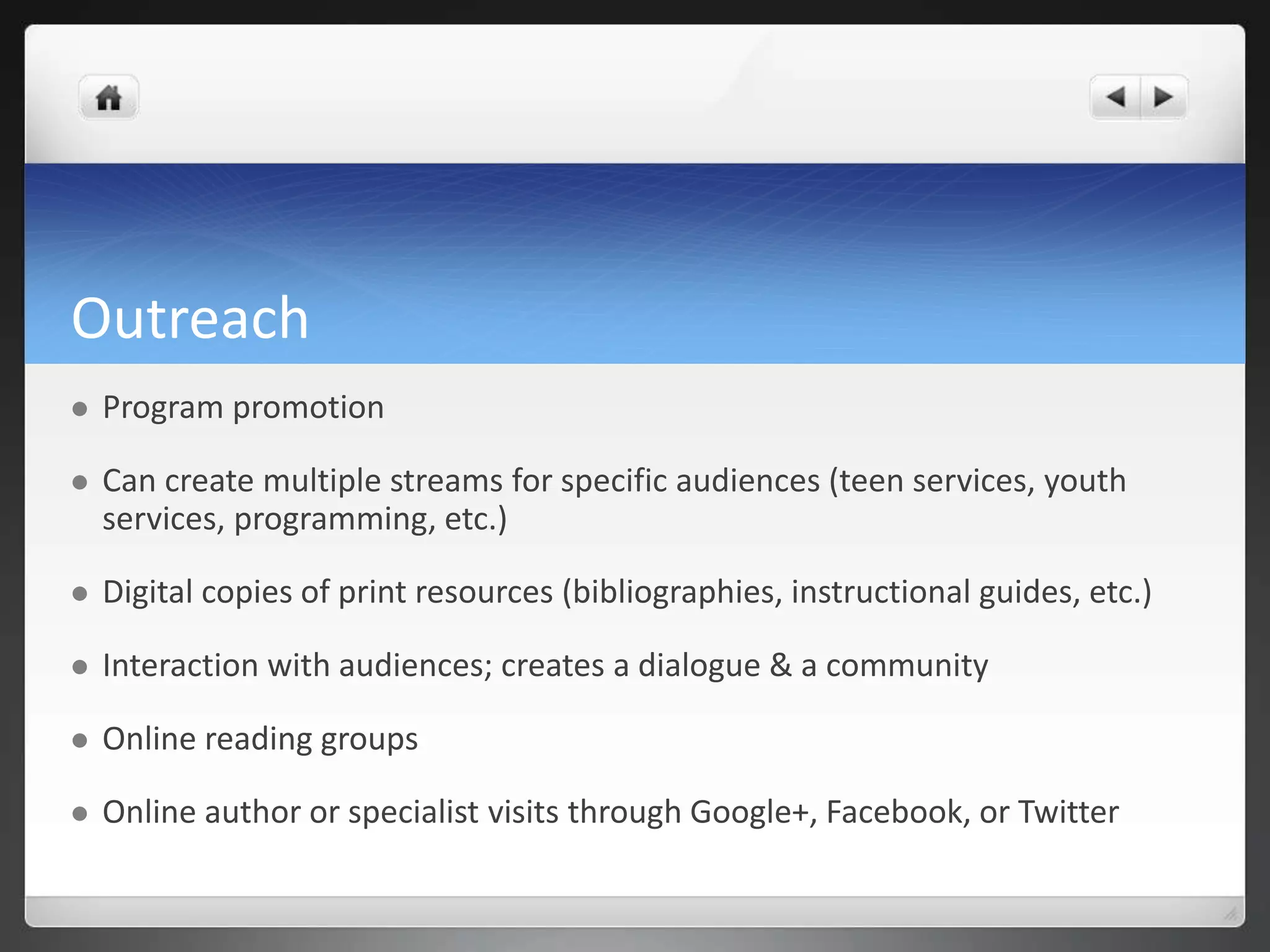
Outreach 
 Program promotion 
 Can create multiple streams for specific audiences (teen services, youth 
services, programming, etc.) 
 Digital copies of print resources (bibliographies, instructional guides, etc.) 
 Interaction with audiences; creates a dialogue & a community 
 Online reading groups 
 Online author or specialist visits through Google+, Facebook, or Twitter
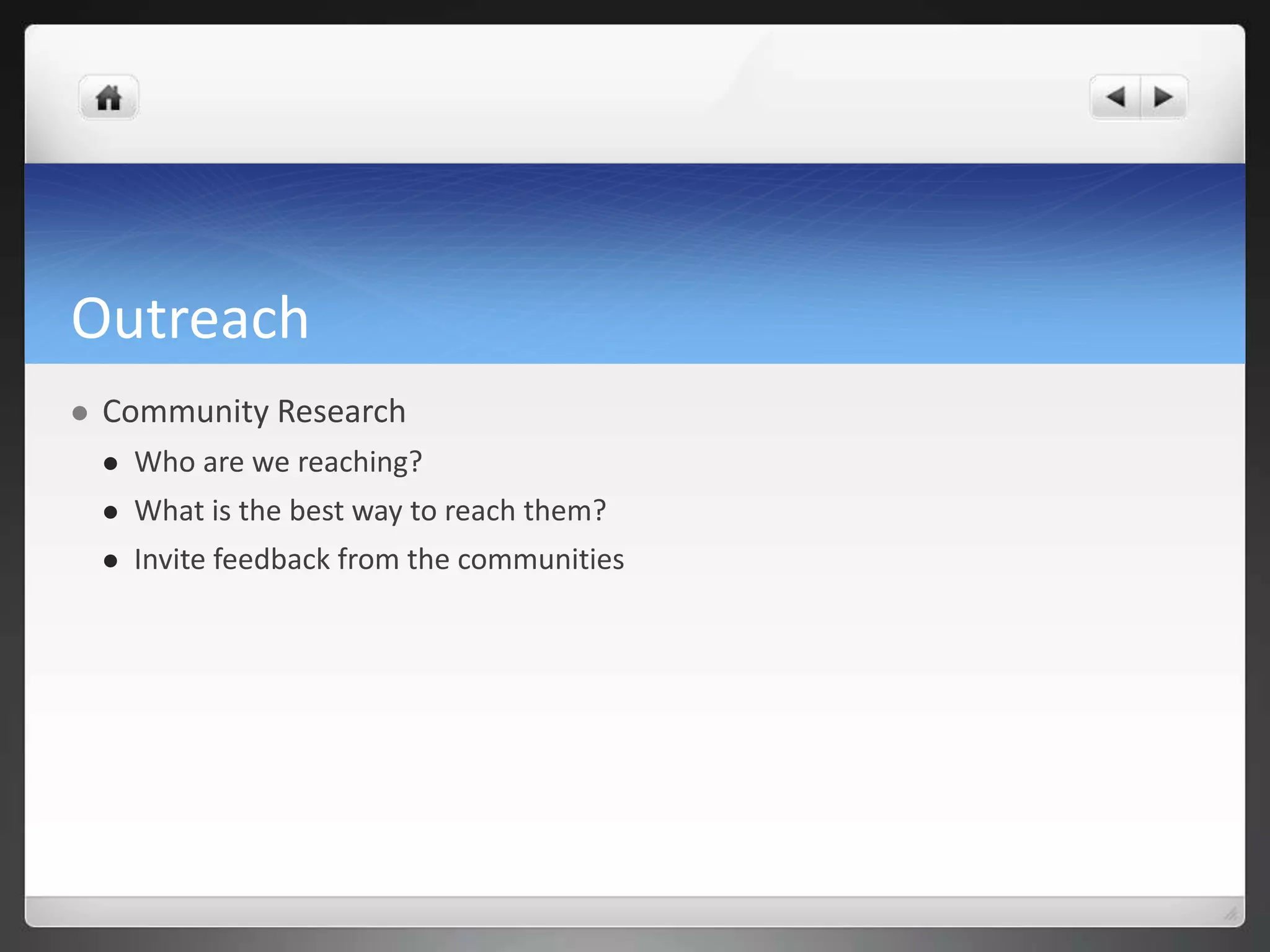
Outreach 
 Community Research 
 Who are we reaching? 
 What is the best way to reach them? 
 Invite feedback from the communities
Community Involvement 
 Partner with local business & organizations 
 Offer deals through contests, facebook “likes,” or follows 
 Easy way to share resources 
 Excellent for students & job seekers 
 Quid Pro Quo – if you promote businesses or services, they are more likely 
to promote the library in return
Networking 
 Follow & communicate with schools, libraries, organizations, & local 
businesses 
 Keep up with current issues & discuss them with other librarians 
 Get ideas from other libraries 
 Liveblogging conferences, seminars, & events
Digital Reference 
 Supplemental to traditional reference duties 
 Ability to reach a larger audience; not restricted to location 
 A way for librarians to stay relevant in the digital age & requires librarians to 
take an active role in the changes 
 “Reverse Reference” – librarians go to the customers 
 Answer questions directly or indirectly 
 University of New Mexico University Library reports three times as many 
questions via their Virtual Service Desk than through traditional means 
(Aguilar)
What are the Challenges of Using Social 
Media in the Library? 
 Requires preparation & a social media policy 
 Requires almost constant attention & careful monitoring 
 Determining who has posting access/who will manage the “Digital Branch” 
 Some technologies may disappear or phase out 
 Can be a target of spam or unwanted connections 
 Security & Privacy Issues 
 Tracking efforts & progress – 48% of libraries are not attempting to track
How Should a Library Prepare for Social 
Media Use? 
 Social Media Plan 
 Which medias? 
 What is the content? 
 Who will run it/have access to it? 
 Employee Training 
 Technology training 
 Social Media or Blog Writing Instruction 
 Social Media Policy
Social Media Policies 
 Necessary BEFORE integrating social media 
 Research first 
 What are other libraries doing? What guidelines/restrictions do they have in 
place? 
 Are we using something similar in another area of the library? 
 Parameters 
 Statement of Purpose 
 Clear definition of social media 
 Tie-in to library or department goals/mission 
 Library to Patron Contact 
 Specify for each type of social media that will be used
Social Media Policies 
Thomas Crane Library Social Media Policy
Tips for Successful Social Media Use 
 Know your audience (may vary depending on platform) 
 Keep it quick & easy; don’t try for depth (possible exception: blog posts) 
 Teamwork approach 
 Be interactive & real – this means following through 
 Ask “how can we be helpful?” rather than “what are we going to get out of 
this?” 
 Content must be timely, relevant, & creative
Tips for Successful Social Media Use 
 Post 1-3 times a day, then adapt from there (King) 
 Shift from broadcasting to conversation 
 Promote programs 
 Trivia & Contests 
 Further reading – background or author stories 
 Book suggestions & read-alikes 
 New book arrival announcements
Examples of Good Social Media Use in 
Libraries 
 Chicago Public Library 
 uses: facebook, twitter, tumblr, & vimeo 
 YouMedia – promotes use of CPL’s creative learning space & showcases patrons 
 Darien, NY Public Library 
 Uses: Facebook, twitter, tumblr, Google+, flickr, & vimeo 
 University of Texas at Austin 
 Rated #1 by Library Science List’s Top 100 Most Social Media Friendly College & 
University Libraries in 2013 
 Uses: Facebook, twitter, YouTube, Google+, Pinterest, & flickr
References 
Aguilar, Paulita, Kathleen Keating, Suzanne Schadl, and Johann Van Reenen. 2011. 
“Reference Outreach: Meeting Users Where They Are.” Journal of Library 
Administration 51, no. 4: 343-358. Library, Information Science & Technology 
Abstracts with Full Text, EBSCOhost (accessed June 1, 2013). 
BRASS. 2011. “The Business of Social Media: How to Plunder the Treasure Trove.” 
Reference & User Services Quarterly 51, no. 2: 127-132. Academic Search Premier, 
EBSCOhost (accessed June 1, 2013). 
Enders, Naulayne R., and Heidi Wineland. 2012. “Writing a Social Media Policy for Your 
Library.” Kentucky Libraries 76, no. 1: 16-19. Library, Information Science & 
Technology Abstracts with Full Text, EBSCOhost (accessed June 1, 2013). 
King, David Lee. 2012. “Social Media.” Library Technology Reports 48, no. 6: 23-27. 
Academic Search Premiere, EBSCOhost (accessed June 1, 2013). 
“Thomas Crane Public Library Social Media Policy.” (Policy, Quincy, MA, June 11, 2012), 
http://thomascranelibrary.org/sites/default/files/Social%20Media%20Policy.pdf 
(accessed June 1, 2013).

The Digital Branch: Social Media and Digital Outreach in the Public Library

  • 1.
    The Digital Branch Social Media & Digital Outreach in Libraries Jez Layman
  • 2.
    What is SocialMedia?  Web-based services that allow individuals to (1) construct a public or semipublic profile within a bounded system, (2) articulate a list of other users with whom they share a connection, and (3) view and traverse their list of connections and those made by others within the system. (BRASS, ALA 2011 conference)  Any website that allows users to generate and share content (Thomas Crane Library)  Categories: social networking, social collaboration, social publishing, & social feedback
  • 3.
    Why is SocialMedia Important?  51% of Americans over the age of 12 used Facebook in 2012 & 10% used Twitter (with another 89% who knew about it, but didn’t have their own account)  In recent years, there has been a paradigm shift from passivity to activity in customers and communities, most of it occurring online.  Teens, 20s, & 30s are digital natives. Not having social media is like not having a phone in the 1990s (Enders).
  • 4.
    Why Should LibrariesCare?  Provides direct access to the customer, even direct access to their smartphone  Demonstrate flexibility in times of rapid change/Prove relevancy  Appeal to younger generations  Strive to embody current trends, not just provide materials or services for them  Connect with communities & build loyalty  Conduct market research (even allowing customers to “buy in” to the process)  Transparency – show the public what you’re doing and where their money is going  Reach the people where they are
  • 5.
    How are LibrariesUsing Social Media? • Within the Library • Outreach • Community Involvement • Networking • Digital Reference
  • 6.
    Social Media inthe Library  Keep employees updated on library events & programs  Use of blogs to communicate within the library and/or within departments  Easier than mass emails  More organized  Usually include comment sections for instant feedback & discussion  Extra helpful for inter-branch communication
  • 7.
    Outreach  Programpromotion  Can create multiple streams for specific audiences (teen services, youth services, programming, etc.)  Digital copies of print resources (bibliographies, instructional guides, etc.)  Interaction with audiences; creates a dialogue & a community  Online reading groups  Online author or specialist visits through Google+, Facebook, or Twitter
  • 8.
    Outreach  CommunityResearch  Who are we reaching?  What is the best way to reach them?  Invite feedback from the communities
  • 9.
    Community Involvement Partner with local business & organizations  Offer deals through contests, facebook “likes,” or follows  Easy way to share resources  Excellent for students & job seekers  Quid Pro Quo – if you promote businesses or services, they are more likely to promote the library in return
  • 10.
    Networking  Follow& communicate with schools, libraries, organizations, & local businesses  Keep up with current issues & discuss them with other librarians  Get ideas from other libraries  Liveblogging conferences, seminars, & events
  • 11.
    Digital Reference Supplemental to traditional reference duties  Ability to reach a larger audience; not restricted to location  A way for librarians to stay relevant in the digital age & requires librarians to take an active role in the changes  “Reverse Reference” – librarians go to the customers  Answer questions directly or indirectly  University of New Mexico University Library reports three times as many questions via their Virtual Service Desk than through traditional means (Aguilar)
  • 12.
    What are theChallenges of Using Social Media in the Library?  Requires preparation & a social media policy  Requires almost constant attention & careful monitoring  Determining who has posting access/who will manage the “Digital Branch”  Some technologies may disappear or phase out  Can be a target of spam or unwanted connections  Security & Privacy Issues  Tracking efforts & progress – 48% of libraries are not attempting to track
  • 13.
    How Should aLibrary Prepare for Social Media Use?  Social Media Plan  Which medias?  What is the content?  Who will run it/have access to it?  Employee Training  Technology training  Social Media or Blog Writing Instruction  Social Media Policy
  • 14.
    Social Media Policies  Necessary BEFORE integrating social media  Research first  What are other libraries doing? What guidelines/restrictions do they have in place?  Are we using something similar in another area of the library?  Parameters  Statement of Purpose  Clear definition of social media  Tie-in to library or department goals/mission  Library to Patron Contact  Specify for each type of social media that will be used
  • 15.
    Social Media Policies Thomas Crane Library Social Media Policy
  • 16.
    Tips for SuccessfulSocial Media Use  Know your audience (may vary depending on platform)  Keep it quick & easy; don’t try for depth (possible exception: blog posts)  Teamwork approach  Be interactive & real – this means following through  Ask “how can we be helpful?” rather than “what are we going to get out of this?”  Content must be timely, relevant, & creative
  • 17.
    Tips for SuccessfulSocial Media Use  Post 1-3 times a day, then adapt from there (King)  Shift from broadcasting to conversation  Promote programs  Trivia & Contests  Further reading – background or author stories  Book suggestions & read-alikes  New book arrival announcements
  • 18.
    Examples of GoodSocial Media Use in Libraries  Chicago Public Library  uses: facebook, twitter, tumblr, & vimeo  YouMedia – promotes use of CPL’s creative learning space & showcases patrons  Darien, NY Public Library  Uses: Facebook, twitter, tumblr, Google+, flickr, & vimeo  University of Texas at Austin  Rated #1 by Library Science List’s Top 100 Most Social Media Friendly College & University Libraries in 2013  Uses: Facebook, twitter, YouTube, Google+, Pinterest, & flickr
  • 19.
    References Aguilar, Paulita,Kathleen Keating, Suzanne Schadl, and Johann Van Reenen. 2011. “Reference Outreach: Meeting Users Where They Are.” Journal of Library Administration 51, no. 4: 343-358. Library, Information Science & Technology Abstracts with Full Text, EBSCOhost (accessed June 1, 2013). BRASS. 2011. “The Business of Social Media: How to Plunder the Treasure Trove.” Reference & User Services Quarterly 51, no. 2: 127-132. Academic Search Premier, EBSCOhost (accessed June 1, 2013). Enders, Naulayne R., and Heidi Wineland. 2012. “Writing a Social Media Policy for Your Library.” Kentucky Libraries 76, no. 1: 16-19. Library, Information Science & Technology Abstracts with Full Text, EBSCOhost (accessed June 1, 2013). King, David Lee. 2012. “Social Media.” Library Technology Reports 48, no. 6: 23-27. Academic Search Premiere, EBSCOhost (accessed June 1, 2013). “Thomas Crane Public Library Social Media Policy.” (Policy, Quincy, MA, June 11, 2012), http://thomascranelibrary.org/sites/default/files/Social%20Media%20Policy.pdf (accessed June 1, 2013).