Does Not Compute:Michigan Libraries and Their Presence Online.http://blog.deweydistriclibrary.comLisa M. Rabeydigital.biblyothekelisa@deweydistrictlibrary.orgKristin LaLondeWayne State Universitykristin@deweydistrictlibrary.org
Why should your library social network?(Why should I do this?)
 Many libraries in Michigan consider having an online presence an option and not a necessity. This however, is quickly becoming a dangerous position for libraries to take.  The time has come where it is no longer optional for Michigan libraries to opt out of an online presence; recent studies illustrate libraries that do not adapt to digital information gathering techniques are dangerously becoming irrelevant to their communities.The Thesis:
According to Pew Internet in 2010, 75% of American adults have access to the Internet in some form and a large percentage of these users are engaging with civic, business or entertainment online communities. Internet usage is growing sharpest for Baby Boomers, not just those under the age of 25. Our presentation will show the growing necessity of a well designed, accessible library website contrasted with the poor quality of many Michigan Public Library websites. The Thesis:
This contrast will illustrate our main argument, that the possession of a content rich website should rank on priority with other established library services, such as a searchable catalog, in order for Michigan Public Libraries to remain relevant to their communities. We argue that the question for libraries should no longer be if the library needs a slick, information rich web portal but rather how the library can get and maintain one affordablyThe Thesis:
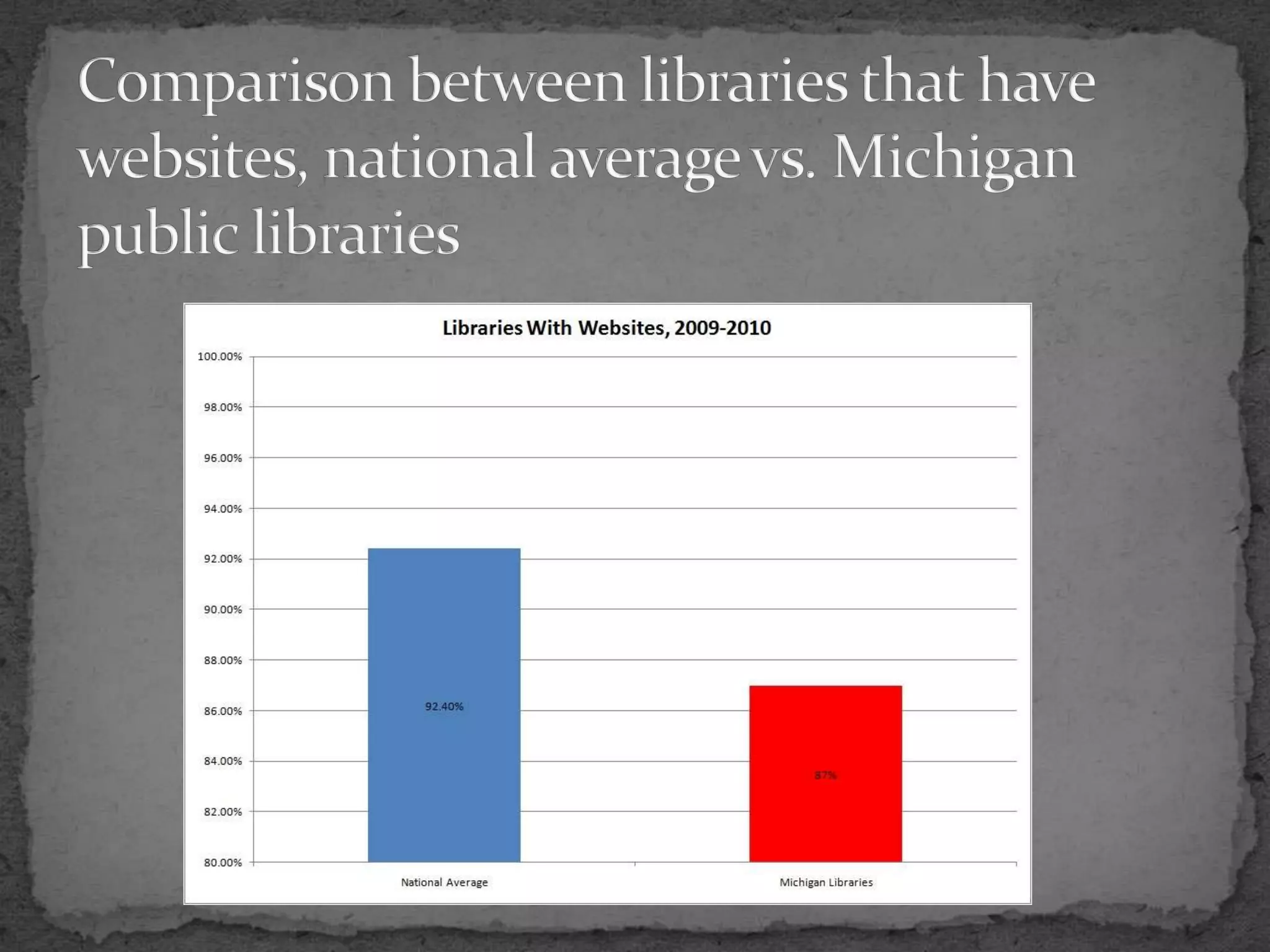
Comparison between libraries that have websites, national average vs. Michigan public libraries
Many Michigan public libraries are not keeping pace with current online information gathering behavior.Lack of structure to content/policy for social media use.Abandoned web projects.No current  or very little contact information.Underutilization of free online tools.No consistency with using same tools for different projects.Content is stagnant or non-existent.Additionally, content not appropriate for social media.No or little access to library services.Usability and accessibility needs are not addressed.Sites are not mobile/smartphone accessible.Problems:
ALA’s State of America’s Libraries Report, 2010:60% renew their materials online.57% access their library’s website on a regular basis.Number of social networking users has doubled in the last 2 years.ALA Statistics:
83% have cell phones or smartphones 35% access the web from their phones 17% own a smartphone74% use the Internet60% have broadband at home46% have a laptop42% Wikipedia8%  Twitter5% ebook reader4% location-based servicesPew Internet Statistics:
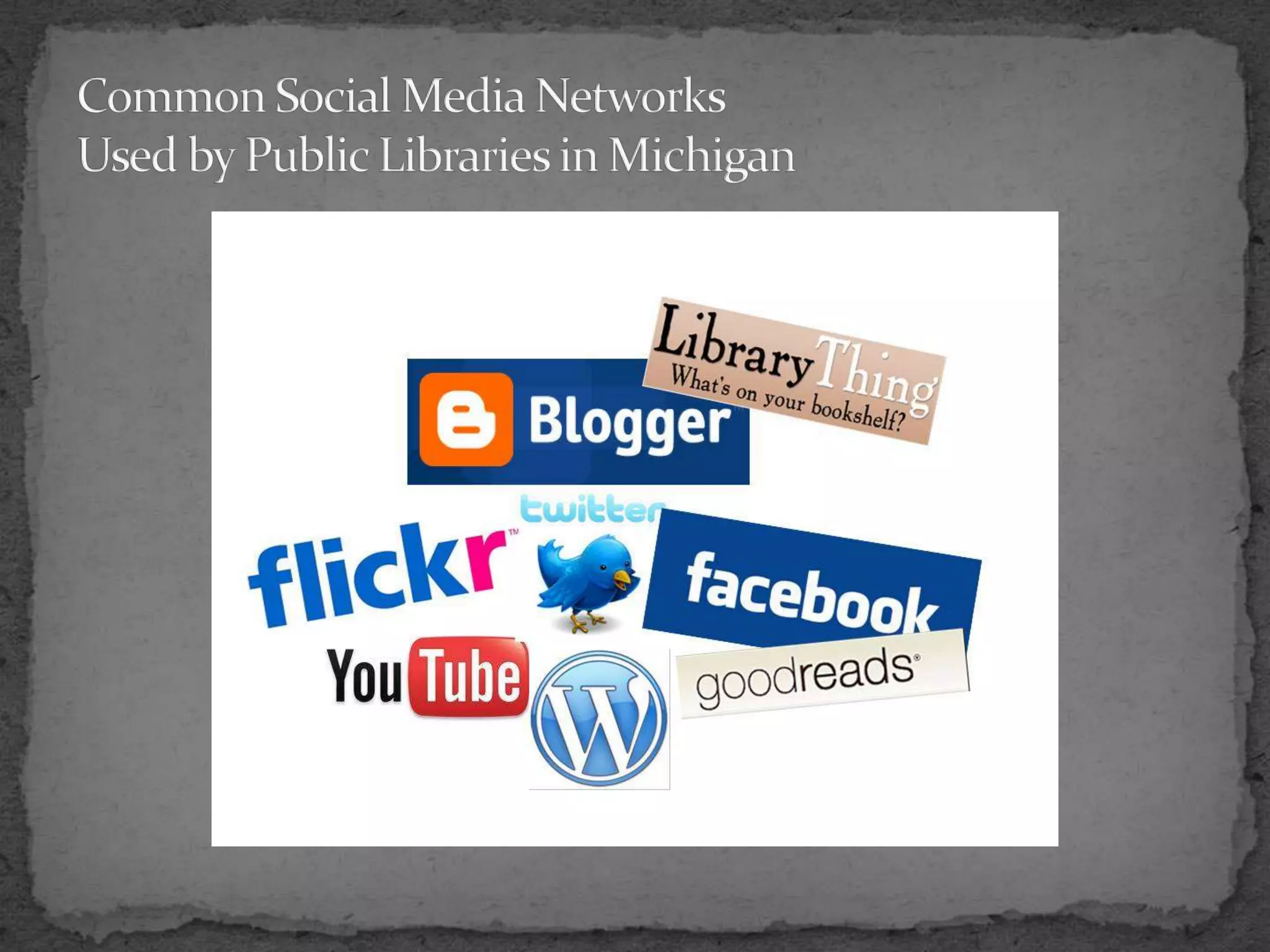
Common Social Media Networks Used by Public Libraries in Michigan
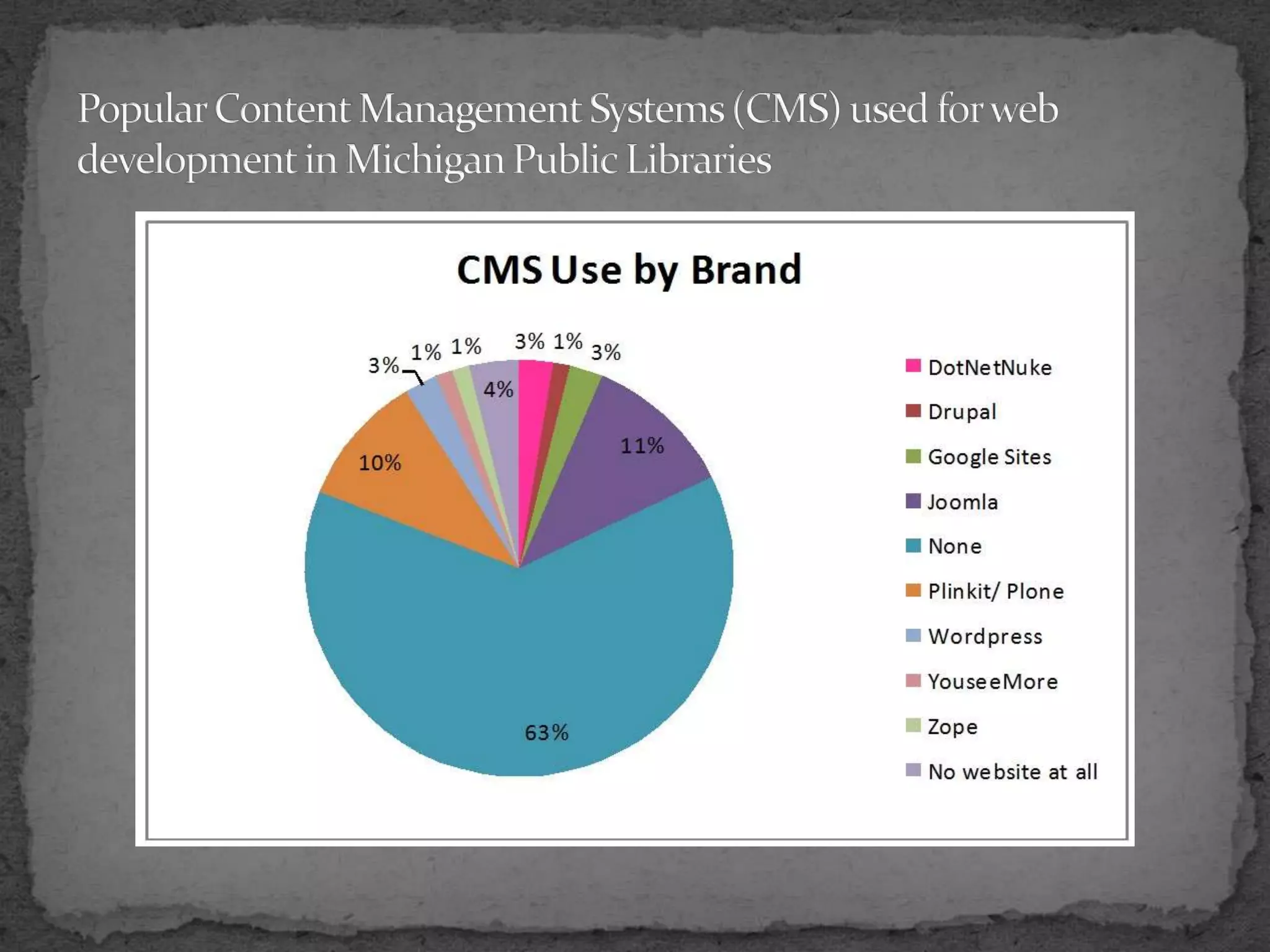
Popular Content Management Systems (CMS) used for web development in Michigan Public Libraries
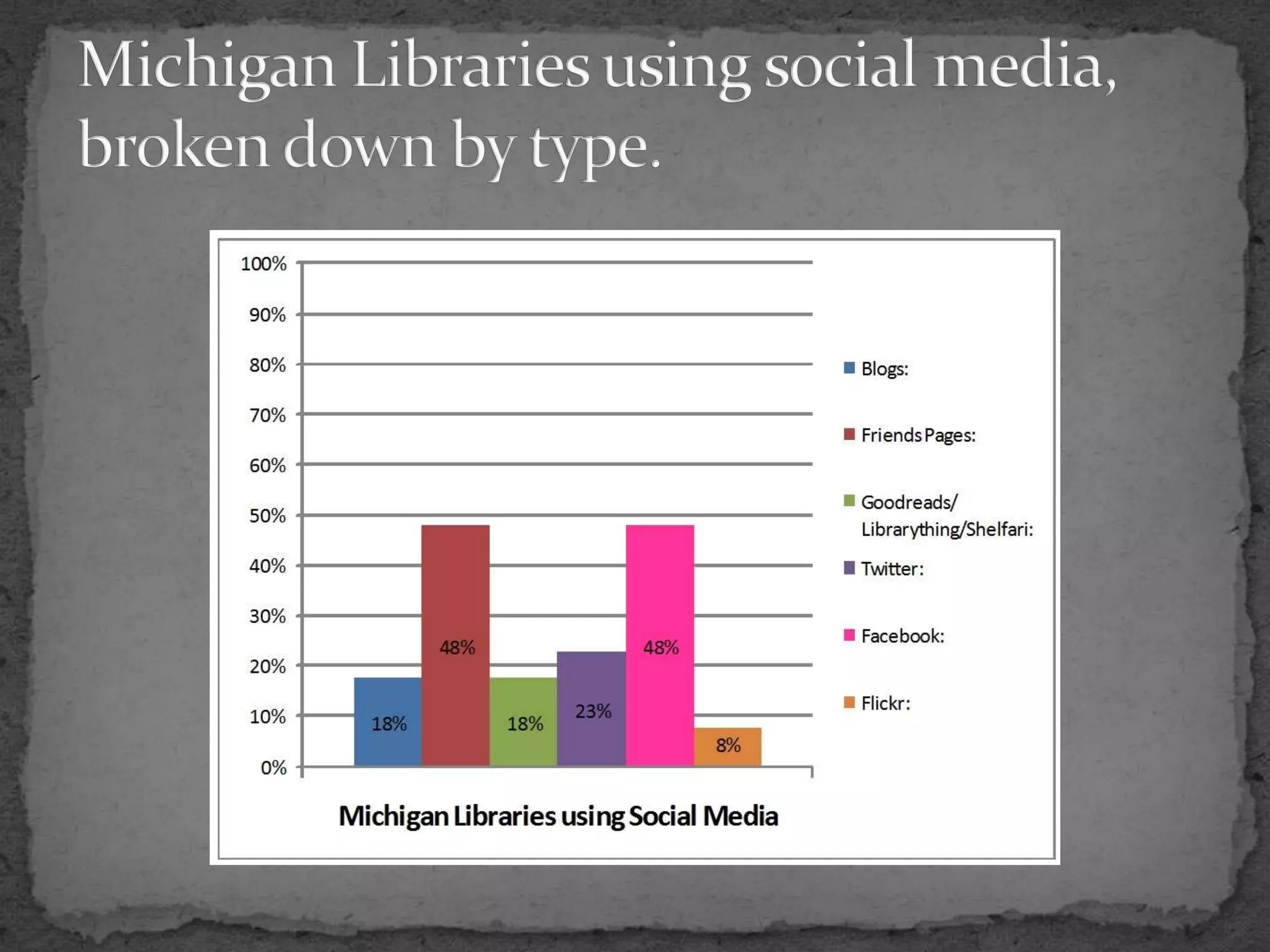
Michigan Libraries using social media, broken down by type.
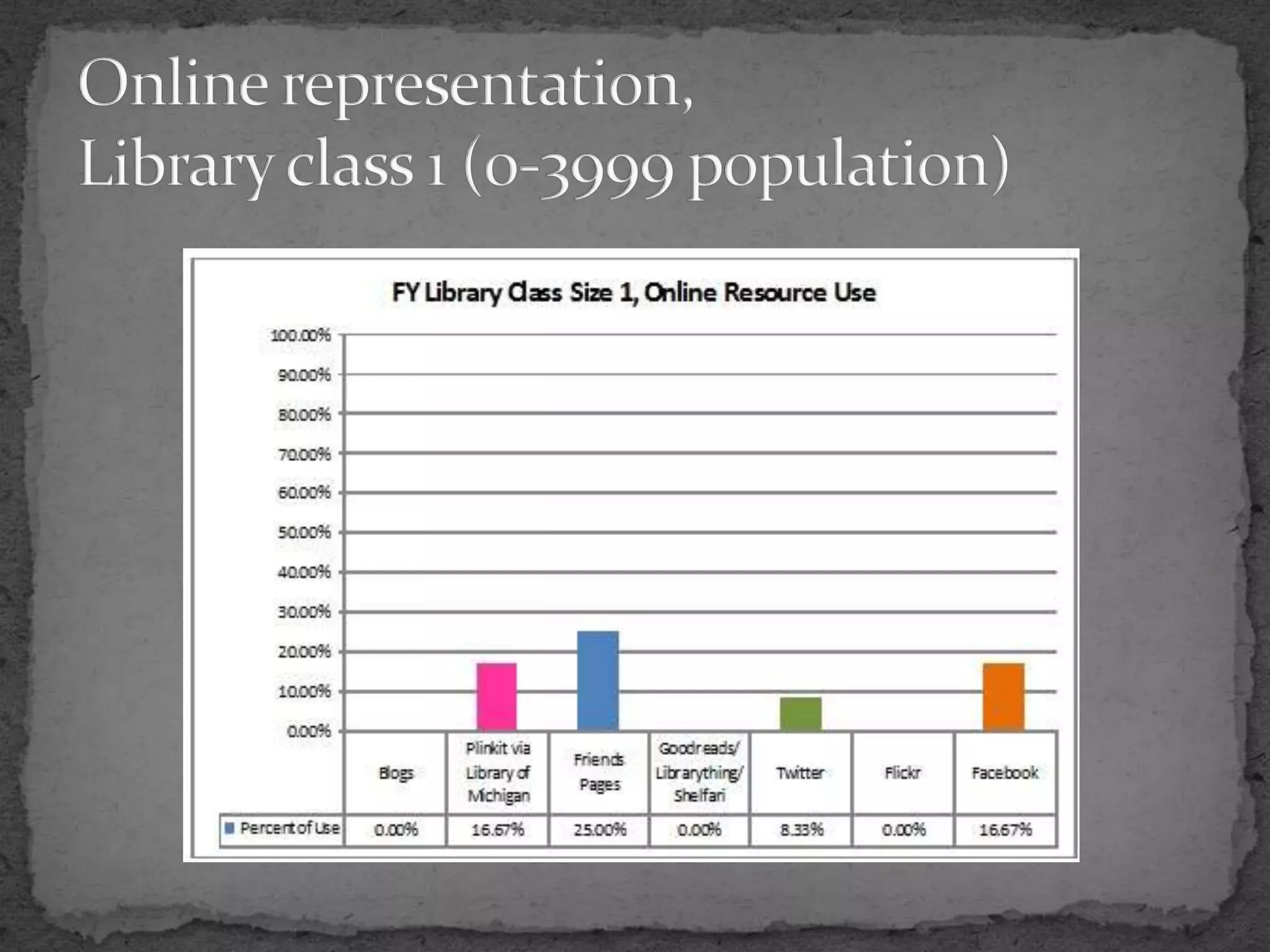
Online representation, Library class 1 (0-3999 population)
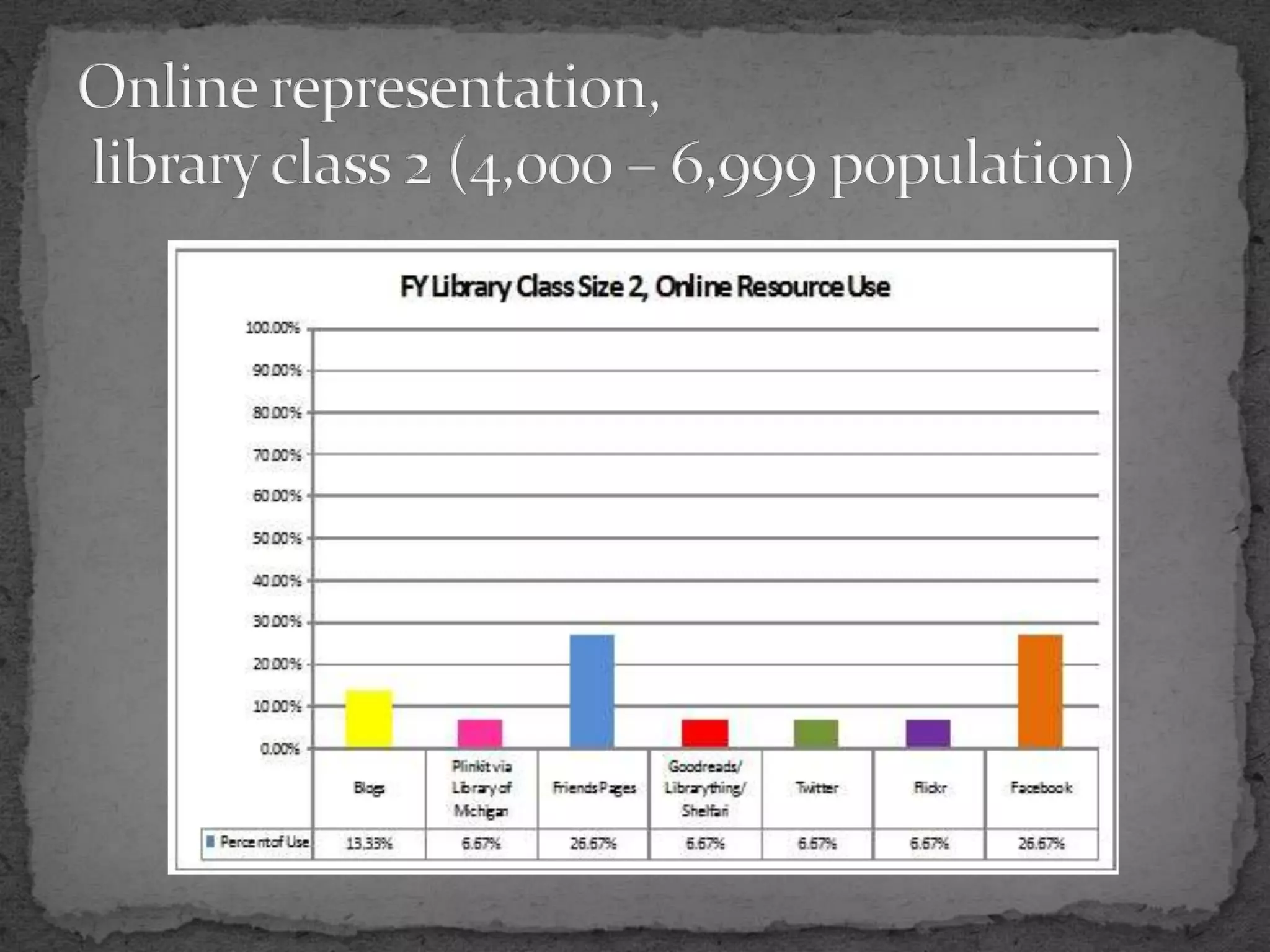
Online representation, library class 2 (4,000 – 6,999 population)
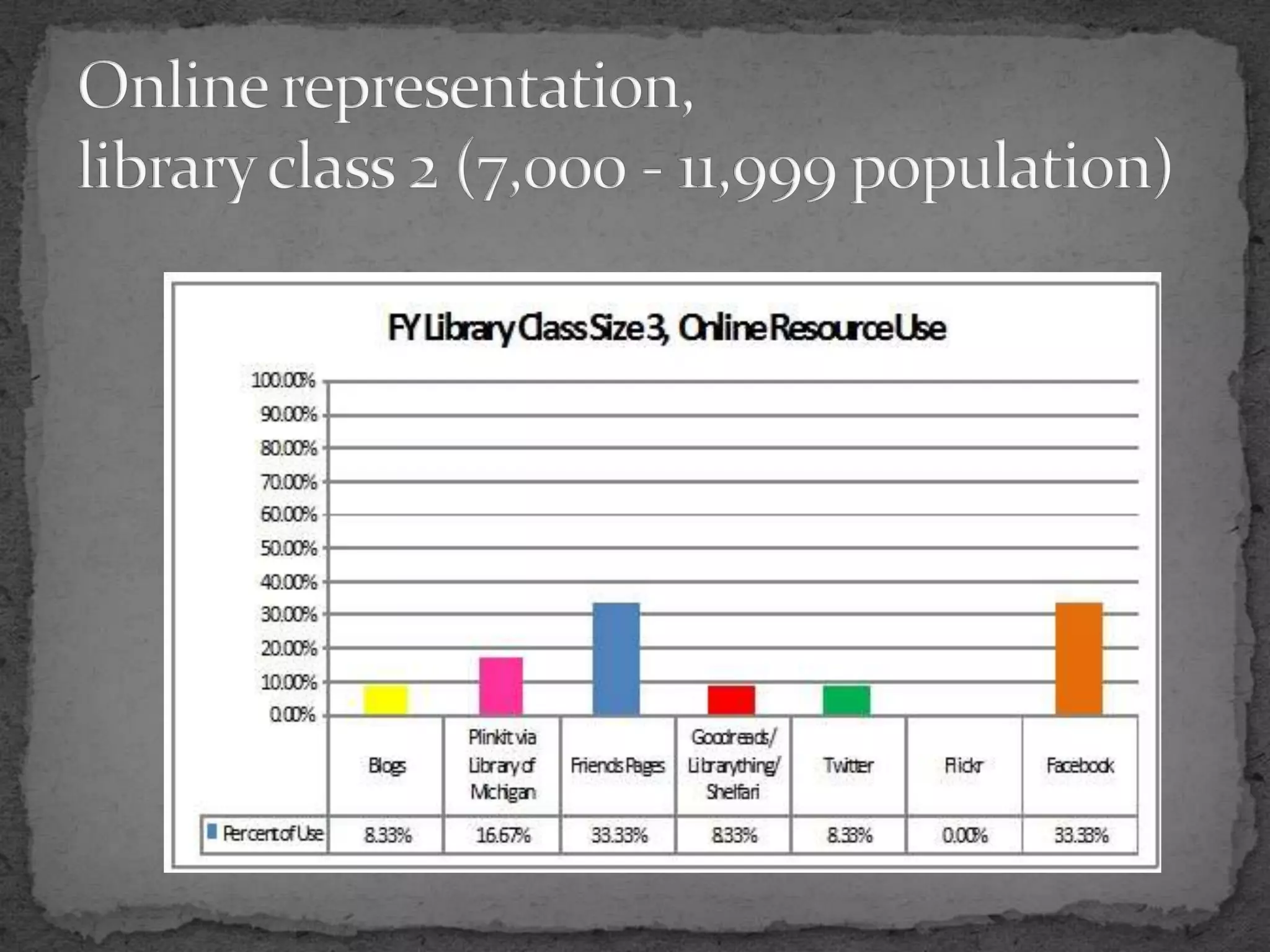
Online representation,library class 2 (7,000 - 11,999 population)
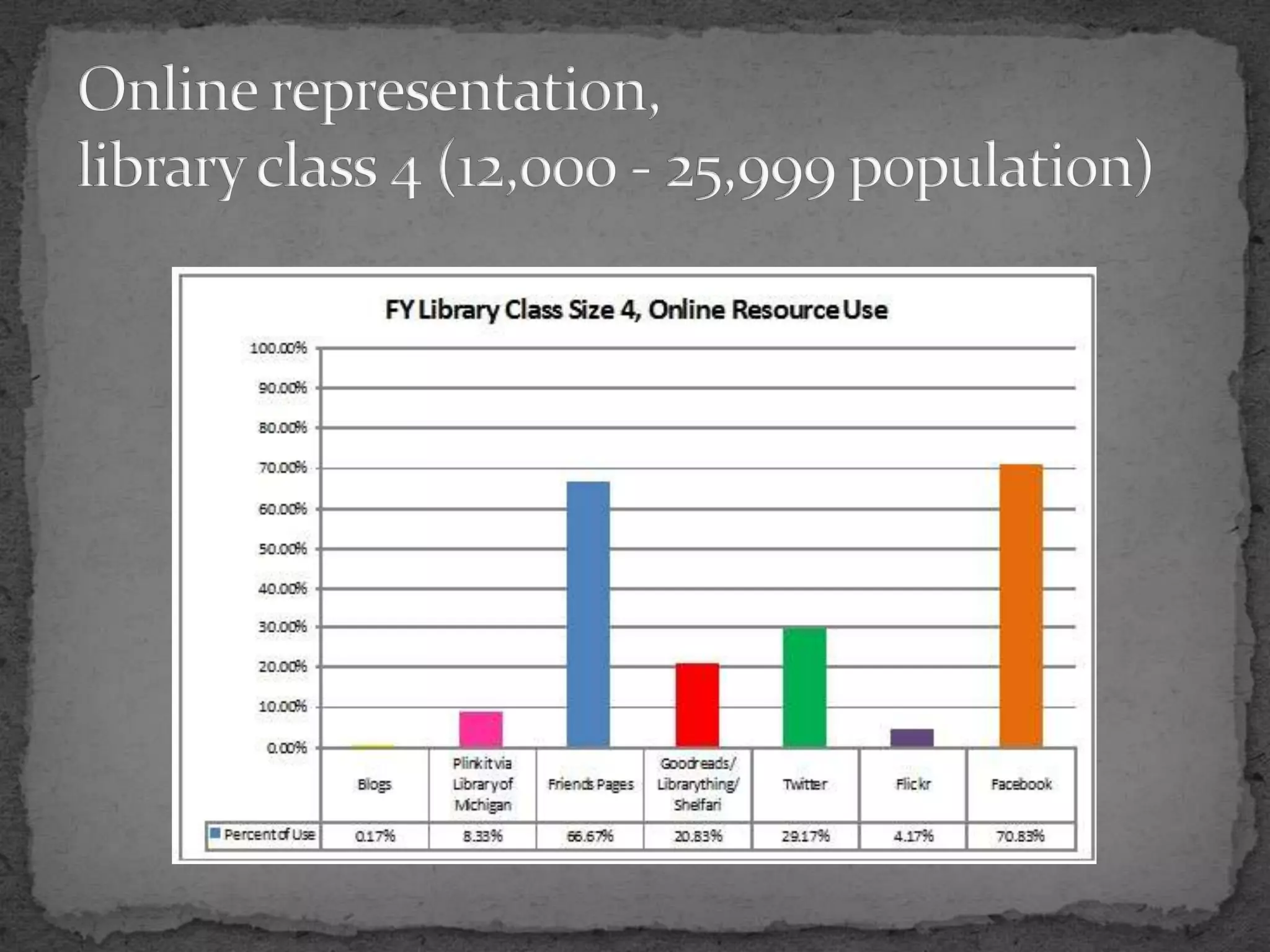
Online representation,library class 4 (12,000 - 25,999 population)
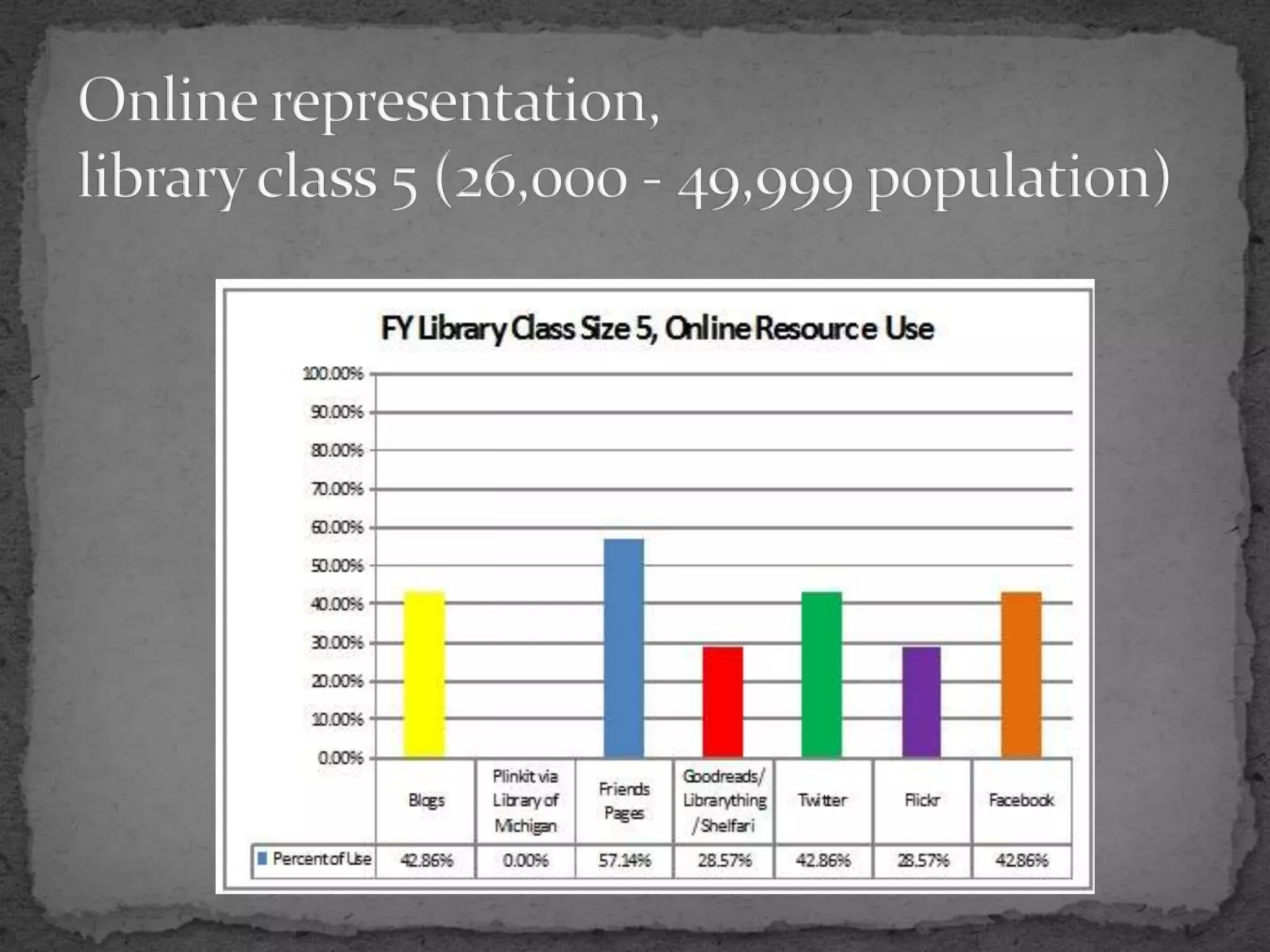
Online representation, library class 5 (26,000 - 49,999 population)
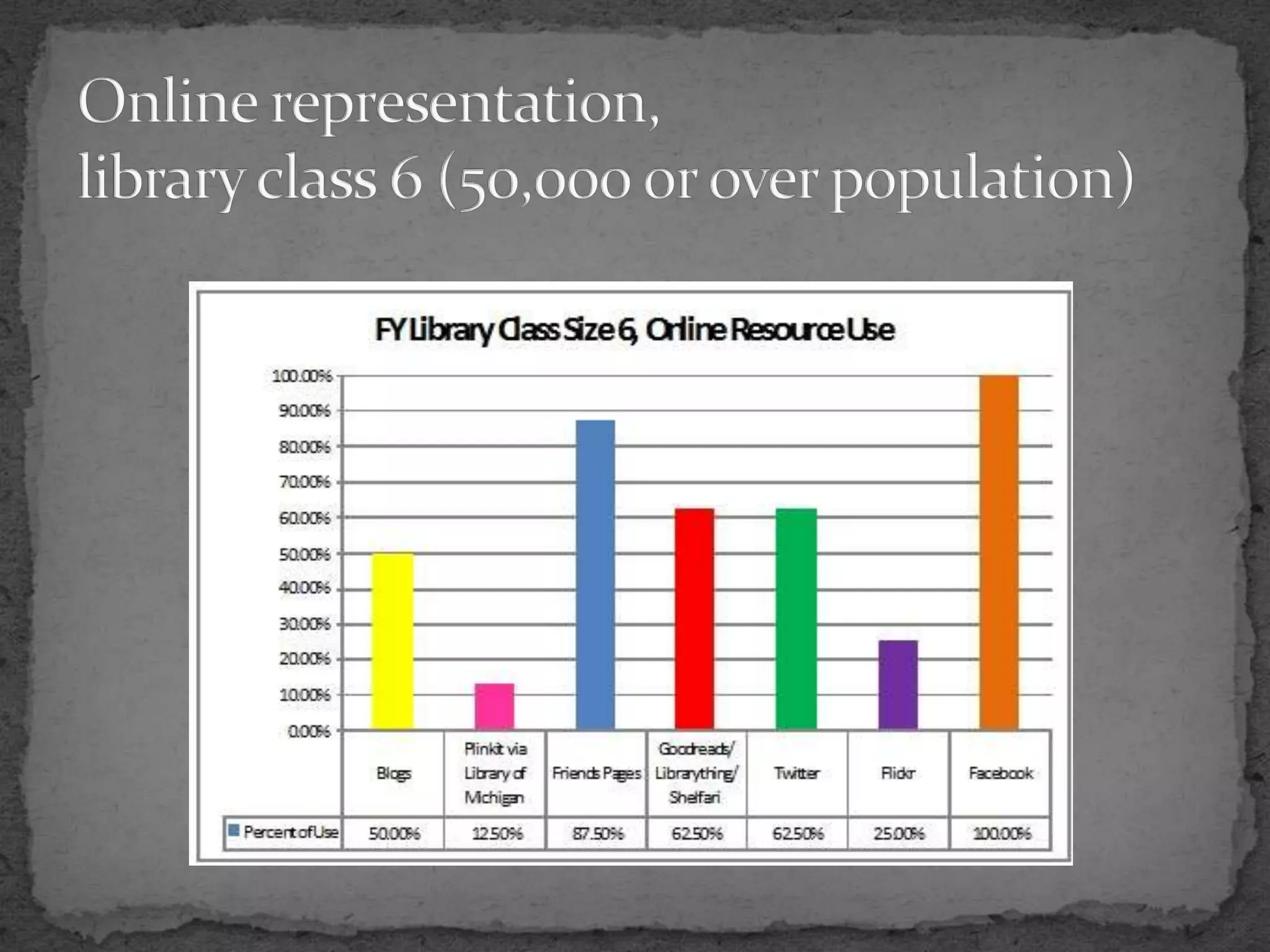
Online representation,library class 6 (50,000 or over population)
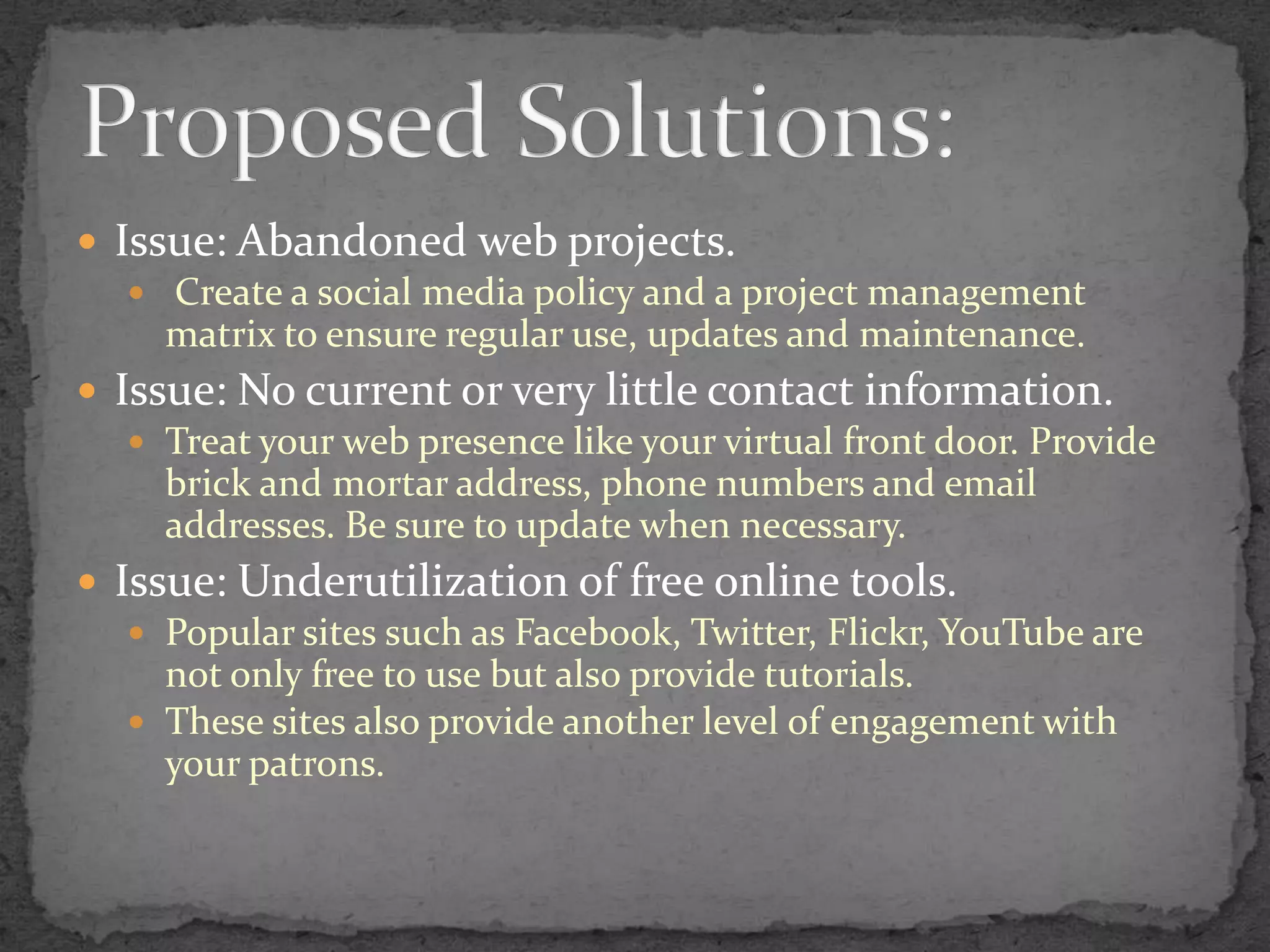
Issue: Abandoned web projects. Create a social media policy and a project management matrix to ensure regular use, updates and maintenance.Issue: No current or very little contact information.Treat your web presence like your virtual front door. Provide brick and mortar address, phone numbers and email addresses. Be sure to update when necessary.Issue: Underutilization of free online tools.Popular sites such as Facebook, Twitter, Flickr, YouTube are not only free to use but also provide tutorials. These sites also provide another level of engagement with your patrons.Proposed Solutions:
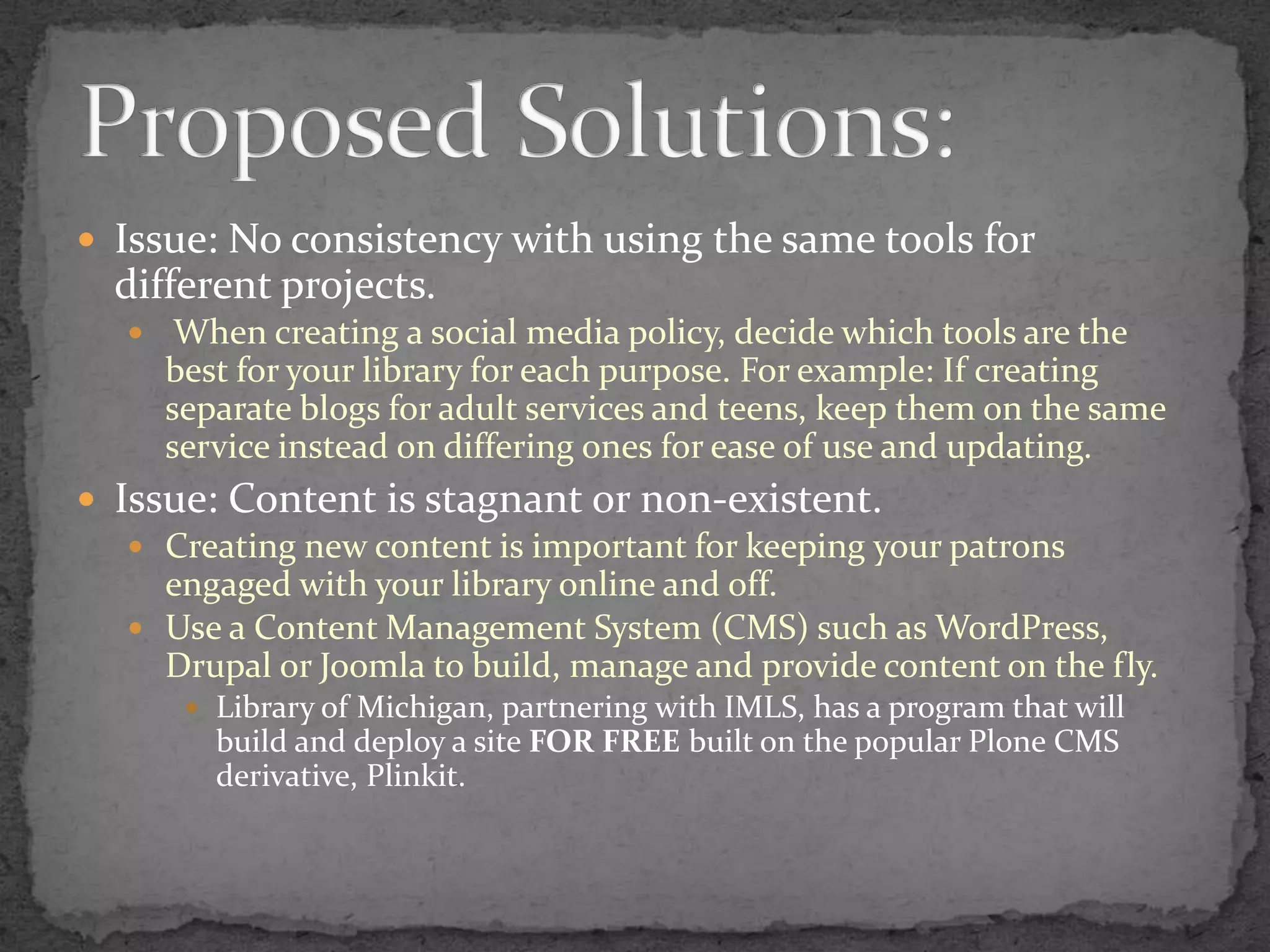
Issue: No consistency with using the same tools for different projects. When creating a social media policy, decide which tools are the best for your library for each purpose. For example: If creating separate blogs for adult services and teens, keep them on the same service instead on differing ones for ease of use and updating.Issue: Content is stagnant or non-existent.Creating new content is important for keeping your patrons engaged with your library online and off.  Use a Content Management System (CMS) such as WordPress, Drupal or Joomla to build, manage and provide content on the fly.Library of Michigan, partnering with IMLS, has a program that will build and deploy a site FOR FREE built on the popular Plone CMS derivative, Plinkit.Proposed Solutions:
Issue: Content is stagnant or non-existent.Services such as Facebook and Twitter make it easy to update new content such as events, news, new services and materials. Even better, these services can also be updated at the same time via free services such as HootSuite.Inappropriate content doesn’t have to mean XXX. But it can mean that library accounts should not be used for discussing personal issues, posting non-library related items or hold any kind of opinion.Issue: No or little access to library services.At this point, it is absolutely imperative to have an OPAC available and to make your collections searchable online.  Many, if not most, consortiums in Michigan provide this service as well as technical support.Proposed Solutions:
Issue: Usability and accessibility needs are not addressed.Websites are created for the end user, not for the designer.  You should attempt to address the needs of your community so that the visually and hearing impaired have the same access to information as the non-impaired. Issue: Sites are not mobile/smartphone accessible. You don’t have to build a new site from scratch for your mobile users. Many popular CMS’s have plugins available to do the work for you.Proposed Solutions:
94% of American’s find presence of libraries in their communities as enriching their lives71% of libraries report they are the only sources of free access to computers and interwebs in their community20% is the percentage of library use increase, as notated by the ALA, since 2009.Statistics you should know
Try it out: Personal before business.Create a blog or Twitter or Facebook accounts.Only begin with one or two technologies. Blog and Twitter, Twitter or Facebook, then expand as needed.Only use technologies your patron will use.Keep the content relevant but personable.All it takes is one person passionate about the technology to make it work.Don’t feel guilty about logging into social networking sites when at work – it can be used professionally!*How to social network
“At the heart of library/archive advocacy is the active pursuit to continue to influence the community at large to the worth and purpose of the local library or archives.” – Lisa RabeyCan be broken down into four simple rules:Engage with your communityCreate a (consistent) brandConnect your networksCreate meaningful contentWhy should your library social network?

Does Not Compute

  • 1.
    Does Not Compute:MichiganLibraries and Their Presence Online.http://blog.deweydistriclibrary.comLisa M. Rabeydigital.biblyothekelisa@deweydistrictlibrary.orgKristin LaLondeWayne State Universitykristin@deweydistrictlibrary.org
  • 2.
    Why should yourlibrary social network?(Why should I do this?)
  • 3.
    Many librariesin Michigan consider having an online presence an option and not a necessity. This however, is quickly becoming a dangerous position for libraries to take. The time has come where it is no longer optional for Michigan libraries to opt out of an online presence; recent studies illustrate libraries that do not adapt to digital information gathering techniques are dangerously becoming irrelevant to their communities.The Thesis:
  • 4.
    According to PewInternet in 2010, 75% of American adults have access to the Internet in some form and a large percentage of these users are engaging with civic, business or entertainment online communities. Internet usage is growing sharpest for Baby Boomers, not just those under the age of 25. Our presentation will show the growing necessity of a well designed, accessible library website contrasted with the poor quality of many Michigan Public Library websites. The Thesis:
  • 5.
    This contrast willillustrate our main argument, that the possession of a content rich website should rank on priority with other established library services, such as a searchable catalog, in order for Michigan Public Libraries to remain relevant to their communities. We argue that the question for libraries should no longer be if the library needs a slick, information rich web portal but rather how the library can get and maintain one affordablyThe Thesis:
  • 6.
    Comparison between librariesthat have websites, national average vs. Michigan public libraries
  • 7.
    Many Michigan publiclibraries are not keeping pace with current online information gathering behavior.Lack of structure to content/policy for social media use.Abandoned web projects.No current or very little contact information.Underutilization of free online tools.No consistency with using same tools for different projects.Content is stagnant or non-existent.Additionally, content not appropriate for social media.No or little access to library services.Usability and accessibility needs are not addressed.Sites are not mobile/smartphone accessible.Problems:
  • 8.
    ALA’s State ofAmerica’s Libraries Report, 2010:60% renew their materials online.57% access their library’s website on a regular basis.Number of social networking users has doubled in the last 2 years.ALA Statistics:
  • 9.
    83% have cellphones or smartphones 35% access the web from their phones 17% own a smartphone74% use the Internet60% have broadband at home46% have a laptop42% Wikipedia8% Twitter5% ebook reader4% location-based servicesPew Internet Statistics:
  • 10.
    Common Social MediaNetworks Used by Public Libraries in Michigan
  • 11.
    Popular Content ManagementSystems (CMS) used for web development in Michigan Public Libraries
  • 12.
    Michigan Libraries usingsocial media, broken down by type.
  • 13.
    Online representation, Libraryclass 1 (0-3999 population)
  • 14.
    Online representation, libraryclass 2 (4,000 – 6,999 population)
  • 15.
    Online representation,library class2 (7,000 - 11,999 population)
  • 16.
    Online representation,library class4 (12,000 - 25,999 population)
  • 17.
    Online representation, libraryclass 5 (26,000 - 49,999 population)
  • 18.
    Online representation,library class6 (50,000 or over population)
  • 19.
    Issue: Abandoned webprojects. Create a social media policy and a project management matrix to ensure regular use, updates and maintenance.Issue: No current or very little contact information.Treat your web presence like your virtual front door. Provide brick and mortar address, phone numbers and email addresses. Be sure to update when necessary.Issue: Underutilization of free online tools.Popular sites such as Facebook, Twitter, Flickr, YouTube are not only free to use but also provide tutorials. These sites also provide another level of engagement with your patrons.Proposed Solutions:
  • 20.
    Issue: No consistencywith using the same tools for different projects. When creating a social media policy, decide which tools are the best for your library for each purpose. For example: If creating separate blogs for adult services and teens, keep them on the same service instead on differing ones for ease of use and updating.Issue: Content is stagnant or non-existent.Creating new content is important for keeping your patrons engaged with your library online and off. Use a Content Management System (CMS) such as WordPress, Drupal or Joomla to build, manage and provide content on the fly.Library of Michigan, partnering with IMLS, has a program that will build and deploy a site FOR FREE built on the popular Plone CMS derivative, Plinkit.Proposed Solutions:
  • 21.
    Issue: Content isstagnant or non-existent.Services such as Facebook and Twitter make it easy to update new content such as events, news, new services and materials. Even better, these services can also be updated at the same time via free services such as HootSuite.Inappropriate content doesn’t have to mean XXX. But it can mean that library accounts should not be used for discussing personal issues, posting non-library related items or hold any kind of opinion.Issue: No or little access to library services.At this point, it is absolutely imperative to have an OPAC available and to make your collections searchable online. Many, if not most, consortiums in Michigan provide this service as well as technical support.Proposed Solutions:
  • 22.
    Issue: Usability andaccessibility needs are not addressed.Websites are created for the end user, not for the designer. You should attempt to address the needs of your community so that the visually and hearing impaired have the same access to information as the non-impaired. Issue: Sites are not mobile/smartphone accessible. You don’t have to build a new site from scratch for your mobile users. Many popular CMS’s have plugins available to do the work for you.Proposed Solutions:
  • 23.
    94% of American’sfind presence of libraries in their communities as enriching their lives71% of libraries report they are the only sources of free access to computers and interwebs in their community20% is the percentage of library use increase, as notated by the ALA, since 2009.Statistics you should know
  • 24.
    Try it out:Personal before business.Create a blog or Twitter or Facebook accounts.Only begin with one or two technologies. Blog and Twitter, Twitter or Facebook, then expand as needed.Only use technologies your patron will use.Keep the content relevant but personable.All it takes is one person passionate about the technology to make it work.Don’t feel guilty about logging into social networking sites when at work – it can be used professionally!*How to social network
  • 25.
    “At the heartof library/archive advocacy is the active pursuit to continue to influence the community at large to the worth and purpose of the local library or archives.” – Lisa RabeyCan be broken down into four simple rules:Engage with your communityCreate a (consistent) brandConnect your networksCreate meaningful contentWhy should your library social network?