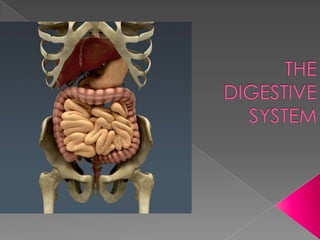
 The

job of your digestive system is
to break down the food that you
eat into useful nutrients. These
nutrients are used to give you
energy, make you grow, and
make your body function
properly.
Do you know any names of the
organs for this system?
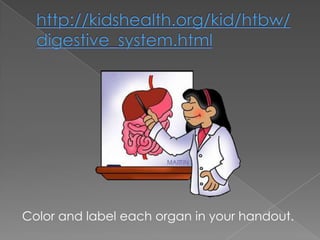
Color and label each organ in your handout.
https://www.youtube.com/w
atch?v=eKaBQrFdNtw
Saliva or spit begins to form in your
mouth. The saliva breaks down the food
a bit, which helps make the food mushy
and easy to swallow. Your tongue helps
out, pushing the food around while you
chew with your teeth. When you're
ready to swallow, the tongue pushes a
tiny bit of mushed-up food called
a bolus toward the back of your throat
and into the opening of your esophagus,
the second part of the digestive tract.



The esophagus is like a
stretchy pipe that's
about 25 centimeters
long. It moves food
from the back of your
throat to your stomach.
Once food has
entered the
esophagus, it doesn't
just drop right into your
stomach. Instead,
muscles in the walls of
the esophagus move
the food through the
esophagus. This takes
about 2 or 3 seconds.


Your stomach, which is attached to the
end of the esophagus, is a stretchy sack
shaped like the letter J. It has three
important jobs:
› to store the food you've eaten

› to break down the food into a liquid mixture
› to slowly empty that liquid mixture into the

small intestine
The stomach is like a mixer. It does this
with help from the strong muscles in the
walls of the stomach and gastric juices
that also come from the stomach's walls.
In addition to breaking down food,
gastric juices also help kill bacteria that
might be in the eaten food.



The small intestine is a long tube that's
about 3.5 to 5 centimeters around, and
it's packed inside you beneath your
stomach. If you stretched out an adult's
small intestine, it would be about 6.7
meters. The small intestine breaks down
the food mixture even more so your
body can absorb all the vitamins,
minerals, proteins, carbohydrates, and
fats. The small intestine can help extract
them with a little help from three friends:
the pancreas, liver, and gallbladder.


Those organs send different juices to the
first part of the small intestine. These
juices help to digest food and allow the
body to absorb nutrients. The pancreas
makes juices that help the body digest
fats and protein. A juice from the liver
called bile helps to absorb fats into the
bloodstream. And the gallbladder serves
as a warehouse for bile, storing it until the
body needs it.


The nutrient-rich blood comes directly to
the liver for processing. The liver filters out
harmful substances or wastes, turning
some of the waste into more bile. The
liver even helps figure out how many
nutrients will go to the rest of the body,
and how many will stay behind in
storage.
About 7 to 10 centimeters, the large
intestine is fatter than the small intestine
and it's almost the last stop on the
digestive tract.
 The large intestine has a tiny tube with a
closed end coming off it called
the appendix. It's part of the digestive
tract, but it doesn't seem to do anything.
 After most of the nutrients are removed
from the food mixture there is waste left
over — stuff your body can't use. This
stuff needs to be passed out of the body.



Before it goes, it passes through the part
of the large intestine called the colon,
which is where the body gets its last
chance to absorb the water and some
minerals into the blood. As the water
leaves the waste product, what's left
gets harder and harder as it keeps
moving along, until it becomes a solid.
Yep, it's poop (also called stool or a
bowel movement).


The large intestine
pushes the poop into
the rectum, the very
last stop on the
digestive tract. The
solid waste stays here
until you are ready to
go to the bathroom.
When you go to the
bathroom, you are
getting rid of this solid
waste by pushing it
through the anus.
Drink lots of water.

Eating a healthy diet (rich in fiber)

Fiber: fruits, vegetables, whole grain.

The digestive system

  • 2.
     The job ofyour digestive system is to break down the food that you eat into useful nutrients. These nutrients are used to give you energy, make you grow, and make your body function properly.
  • 3.
    Do you knowany names of the organs for this system?
  • 4.
    Color and labeleach organ in your handout.
  • 5.
  • 6.
    Saliva or spitbegins to form in your mouth. The saliva breaks down the food a bit, which helps make the food mushy and easy to swallow. Your tongue helps out, pushing the food around while you chew with your teeth. When you're ready to swallow, the tongue pushes a tiny bit of mushed-up food called a bolus toward the back of your throat and into the opening of your esophagus, the second part of the digestive tract. 
  • 7.
     The esophagus islike a stretchy pipe that's about 25 centimeters long. It moves food from the back of your throat to your stomach. Once food has entered the esophagus, it doesn't just drop right into your stomach. Instead, muscles in the walls of the esophagus move the food through the esophagus. This takes about 2 or 3 seconds.
  • 8.
     Your stomach, whichis attached to the end of the esophagus, is a stretchy sack shaped like the letter J. It has three important jobs: › to store the food you've eaten › to break down the food into a liquid mixture › to slowly empty that liquid mixture into the small intestine
  • 9.
    The stomach islike a mixer. It does this with help from the strong muscles in the walls of the stomach and gastric juices that also come from the stomach's walls. In addition to breaking down food, gastric juices also help kill bacteria that might be in the eaten food. 
  • 10.
     The small intestineis a long tube that's about 3.5 to 5 centimeters around, and it's packed inside you beneath your stomach. If you stretched out an adult's small intestine, it would be about 6.7 meters. The small intestine breaks down the food mixture even more so your body can absorb all the vitamins, minerals, proteins, carbohydrates, and fats. The small intestine can help extract them with a little help from three friends: the pancreas, liver, and gallbladder.
  • 11.
     Those organs senddifferent juices to the first part of the small intestine. These juices help to digest food and allow the body to absorb nutrients. The pancreas makes juices that help the body digest fats and protein. A juice from the liver called bile helps to absorb fats into the bloodstream. And the gallbladder serves as a warehouse for bile, storing it until the body needs it.
  • 12.
     The nutrient-rich bloodcomes directly to the liver for processing. The liver filters out harmful substances or wastes, turning some of the waste into more bile. The liver even helps figure out how many nutrients will go to the rest of the body, and how many will stay behind in storage.
  • 13.
    About 7 to10 centimeters, the large intestine is fatter than the small intestine and it's almost the last stop on the digestive tract.  The large intestine has a tiny tube with a closed end coming off it called the appendix. It's part of the digestive tract, but it doesn't seem to do anything.  After most of the nutrients are removed from the food mixture there is waste left over — stuff your body can't use. This stuff needs to be passed out of the body. 
  • 14.
     Before it goes,it passes through the part of the large intestine called the colon, which is where the body gets its last chance to absorb the water and some minerals into the blood. As the water leaves the waste product, what's left gets harder and harder as it keeps moving along, until it becomes a solid. Yep, it's poop (also called stool or a bowel movement).
  • 15.
     The large intestine pushesthe poop into the rectum, the very last stop on the digestive tract. The solid waste stays here until you are ready to go to the bathroom. When you go to the bathroom, you are getting rid of this solid waste by pushing it through the anus.
  • 18.
    Drink lots ofwater. Eating a healthy diet (rich in fiber) Fiber: fruits, vegetables, whole grain.