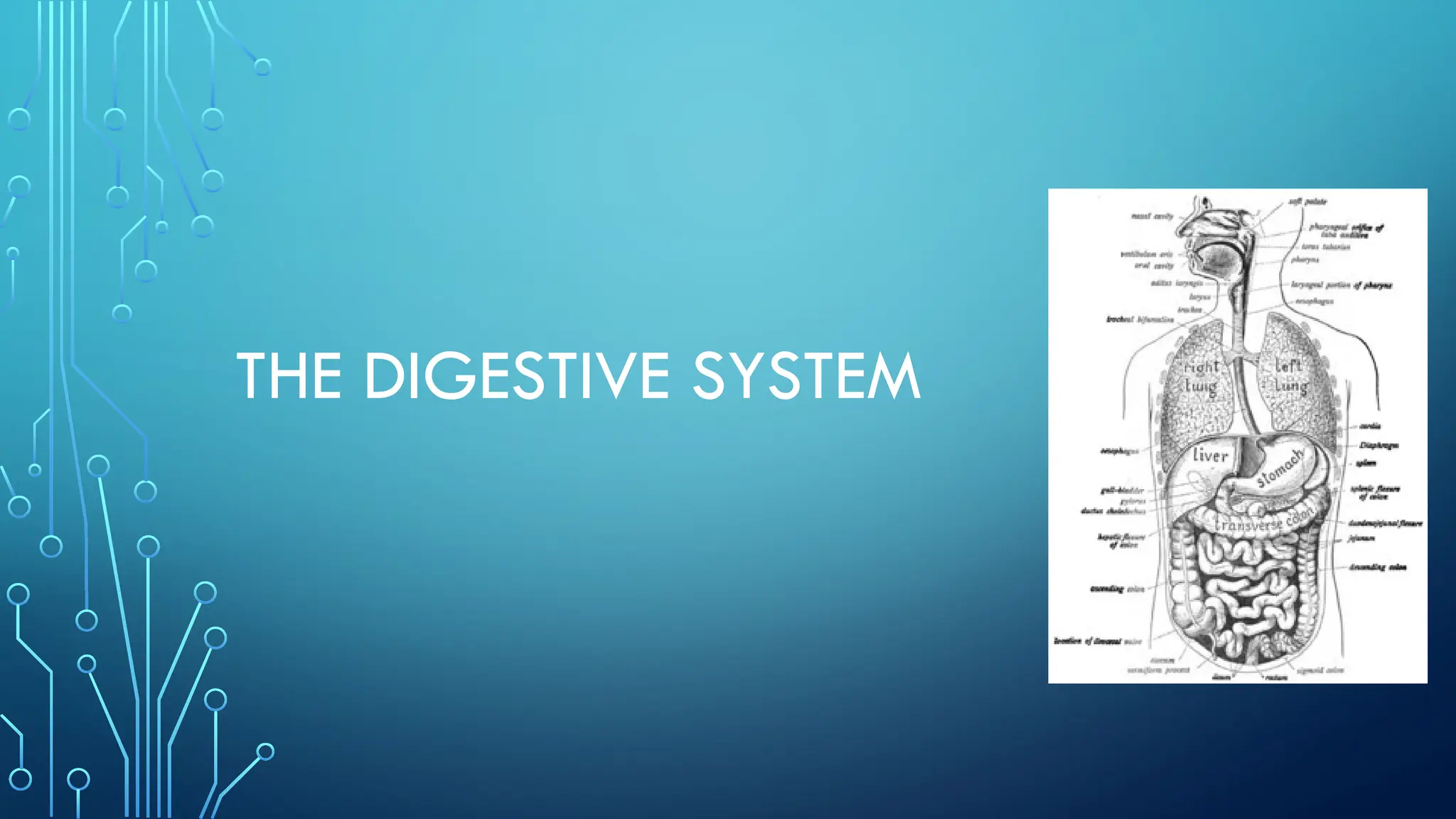
THE DIGESTIVE SYSTEM
PARTS OF THE BODY THAT SUPPORTS THE
DIGESTION SYSTEM
• Mouth, esophagus, stomach, small intestine, large intestine, liver, pancreas, gall
bladder, colon, anus, salivary glands, chemical digestion, mechanical digestion
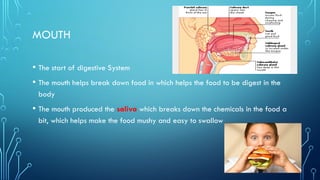
MOUTH
• The start of digestive System
• The mouth helps break down food in which helps the food to be digest in the
body
• The mouth produced the saliva which breaks down the chemicals in the food a
bit, which helps make the food mushy and easy to swallow
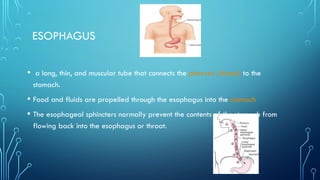
ESOPHAGUS
• a long, thin, and muscular tube that connects the pharynx (throat) to the
stomach.
• Food and fluids are propelled through the esophagus into the stomach
• The esophageal sphincters normally prevent the contents of the stomach from
flowing back into the esophagus or throat.
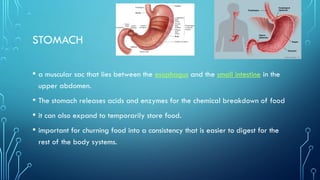
STOMACH
• a muscular sac that lies between the esophagus and the small intestine in the
upper abdomen.
• The stomach releases acids and enzymes for the chemical breakdown of food
• it can also expand to temporarily store food.
• important for churning food into a consistency that is easier to digest for the
rest of the body systems.
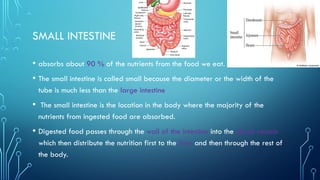
SMALL INTESTINE
• absorbs about 90 % of the nutrients from the food we eat.
• The small intestine is called small because the diameter or the width of the
tube is much less than the large intestine
• The small intestine is the location in the body where the majority of the
nutrients from ingested food are absorbed.
• Digested food passes through the wall of the intestine into the blood vessels
which then distribute the nutrition first to the liver and then through the rest of
the body.
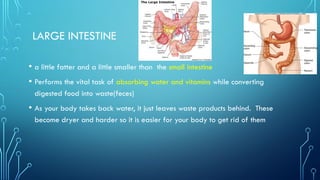
LARGE INTESTINE
• a little fatter and a little smaller than the small intestine
• Performs the vital task of absorbing water and vitamins while converting
digested food into waste(feces)
• As your body takes back water, it just leaves waste products behind. These
become dryer and harder so it is easier for your body to get rid of them
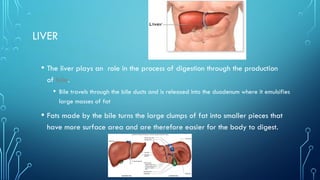
LIVER
• The liver plays an role in the process of digestion through the production
of bile.
• Bile travels through the bile ducts and is released into the duodenum where it emulsifies
large masses of fat
• Fats made by the bile turns the large clumps of fat into smaller pieces that
have more surface area and are therefore easier for the body to digest.
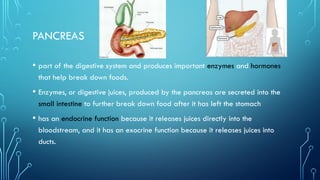
PANCREAS
• part of the digestive system and produces important enzymes and hormones
that help break down foods.
• Enzymes, or digestive juices, produced by the pancreas are secreted into the
small intestine to further break down food after it has left the stomach
• has an endocrine function because it releases juices directly into the
bloodstream, and it has an exocrine function because it releases juices into
ducts.
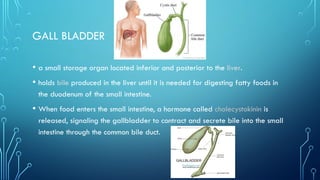
GALL BLADDER
• a small storage organ located inferior and posterior to the liver.
• holds bile produced in the liver until it is needed for digesting fatty foods in
the duodenum of the small intestine.
• When food enters the small intestine, a hormone called cholecystokinin is
released, signaling the gallbladder to contract and secrete bile into the small
intestine through the common bile duct.
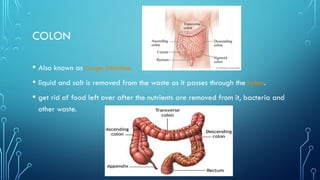
COLON
• Also known as Large Intestine
• liquid and salt is removed from the waste as it passes through the colon.
• get rid of food left over after the nutrients are removed from it, bacteria and
other waste.
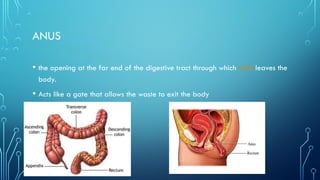
ANUS
• the opening at the far end of the digestive tract through which stool leaves the
body.
• Acts like a gate that allows the waste to exit the body
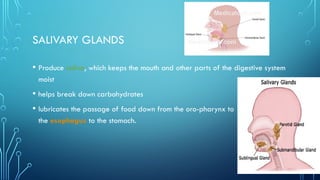
SALIVARY GLANDS
• Produce saliva, which keeps the mouth and other parts of the digestive system
moist
• helps break down carbohydrates
• lubricates the passage of food down from the oro-pharynx to
the esophagus to the stomach.
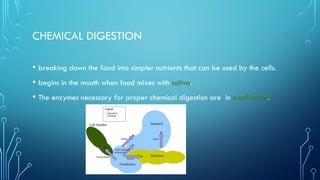
CHEMICAL DIGESTION
• breaking down the food into simpler nutrients that can be used by the cells.
• begins in the mouth when food mixes with saliva.
• The enzymes necessary for proper chemical digestion are in equilibrium.
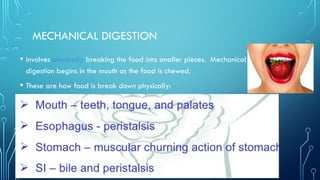
MECHANICAL DIGESTION
• involves physically breaking the food into smaller pieces. Mechanical
digestion begins in the mouth as the food is chewed.
• These are how food is break down physically:
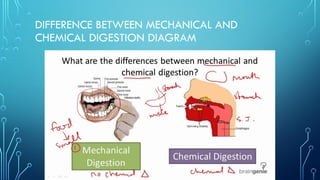
DIFFERENCE BETWEEN MECHANICAL AND
CHEMICAL DIGESTION DIAGRAM
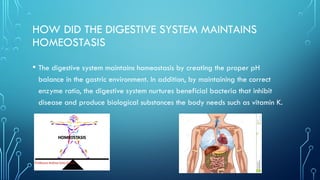
HOW DID THE DIGESTIVE SYSTEM MAINTAINS
HOMEOSTASIS
• The digestive system maintains homeostasis by creating the proper pH
balance in the gastric environment. In addition, by maintaining the correct
enzyme ratio, the digestive system nurtures beneficial bacteria that inhibit
disease and produce biological substances the body needs such as vitamin K.
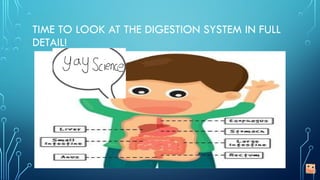
TIME TO LOOK AT THE DIGESTION SYSTEM IN FULL
DETAIL!
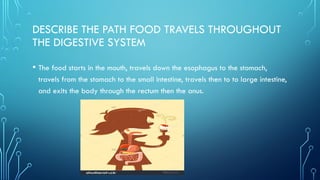
DESCRIBE THE PATH FOOD TRAVELS THROUGHOUT
THE DIGESTIVE SYSTEM
• The food starts in the mouth, travels down the esophagus to the stomach,
travels from the stomach to the small intestine, travels then to to large intestine,
and exits the body through the rectum then the anus.
HOW THE DIGESTION SYSTEM AFFECTS
OTHER BODY SYSTEMS
• The digestion system makes and distribute the nutrients to the rest of the body
systems
• This provides the systems energy to keep on working which is why you have
energy to do daily life activities
• Example
• The digestive system works in parallel with the excretory system. While the digestive
system collects and removes undigested solids, the excretory system filters compounds from
the blood stream and collects them in urine. They are closely connected in controlling the
amount of water in your body.
HOW OTHER BODY SYSTEMS AFFECT THE SYSTEM
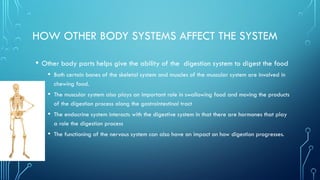
• Other body parts helps give the ability of the digestion system to digest the food
• Both certain bones of the skeletal system and muscles of the muscular system are involved in
chewing food.
• The muscular system also plays an important role in swallowing food and moving the products
of the digestion process along the gastrointestinal tract
• The endocrine system interacts with the digestive system in that there are hormones that play
a role the digestion process
• The functioning of the nervous system can also have an impact on how digestion progresses.
2 DISEASES OF THE SYSTEM
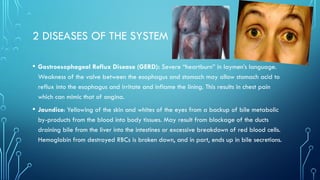
• Gastroesophageal Reflux Disease (GERD): Severe “heartburn” in laymen’s language.
Weakness of the valve between the esophagus and stomach may allow stomach acid to
reflux into the esophagus and irritate and inflame the lining. This results in chest pain
which can mimic that of angina.
• Jaundice: Yellowing of the skin and whites of the eyes from a backup of bile metabolic
by-products from the blood into body tissues. May result from blockage of the ducts
draining bile from the liver into the intestines or excessive breakdown of red blood cells.
Hemoglobin from destroyed RBCs is broken down, and in part, ends up in bile secretions.
EFFECTS OF OUTSIDE/ENVIRONMENTAL FACTORS
ON THE DIGESTION SYSTEM
• Stress have the opposite effect on your digestive tract. For some constitutions, it
can cause food to move too quickly through your system, not leaving enough
time for the nutrients to be absorbed, which leads to nutritional deficiencies.
• The negative effects of drug abuse on the digestive system are due mainly to
the deterioration of the mucous membrane lining that runs through the entire GI
tract. The mucous membrane helps to break down food in a process called
perastalsis. When this lining is damaged, it leaves areas like the intestine and
stomach walls vulnerable to damage and more serious ailments.
• Overeating can slow down the digestive process and the food we eat remains
in the stomach for longer duration of time.
3 FUN FACTS ABOUT THE DIGESTION SYSTEM
• When you eat something, the food doesn't simply fall through your esophagus
and into your stomach. The muscles in your esophagus constrict and relax in a
wavelike manner called peristalsis, pushing the food down through the small
canal and into the stomach.
• Because of peristalsis, even if you were to eat while hanging upside down, the
food would still be able to get to your stomach.
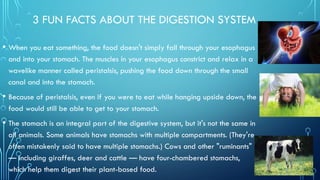
• The stomach is an integral part of the digestive system, but it's not the same in
all animals. Some animals have stomachs with multiple compartments. (They're
often mistakenly said to have multiple stomachs.) Cows and other "ruminants"
— including giraffes, deer and cattle — have four-chambered stomachs,
which help them digest their plant-based food.
CITED SOURCES
• "The Digestive System." WebMD. WebMD, n.d. Web. 29 Mar. 2017.
• "How the Body Works Main Page." KidsHealth. The Nemours Foundation, n.d. Web. 29 Mar. 2017.
• "Interactions of the Digestive System with Other Systems." Interactions of the Digestive System with Other
Systems. N.p., n.d. Web. 29 Mar. 2017.
• "Liver." Merriam-Webster. Merriam-Webster, n.d. Web. 29 Mar. 2017.
• Rubin, E., and J. L. Farber. "Environmental Diseases of the Digestive System." The Medical Clinics of North
America. U.S. National Library of Medicine, Mar. 1990. Web. 29 Mar. 2017.
• Studios, Andrew Rader. "Digestion - Eating and Elimination!" Biology4Kids.com: Animal Systems:
Digestive System. N.p., n.d. Web. 29 Mar. 2017.
• Zimmermann, Kim Ann. "Digestive System: Facts, Function & Diseases." LiveScience. Purch, 11 Mar. 2016.
Web. 29 Mar. 2017.
LINKS TO YOUTUBE VIDEOS ABOUT THE
DIGESTION SYSTEM
• https://m.youtube.com/watch?v=s06XzaKqELk
• https://m.youtube.com/watch?v=_QYwscALNng
• https://m.youtube.com/watch?v=123UsYMdS2o

Biology: Human Digestive System ppt.pptx

  • 1.
  • 2.
    PARTS OF THEBODY THAT SUPPORTS THE DIGESTION SYSTEM • Mouth, esophagus, stomach, small intestine, large intestine, liver, pancreas, gall bladder, colon, anus, salivary glands, chemical digestion, mechanical digestion
  • 3.
    MOUTH • The startof digestive System • The mouth helps break down food in which helps the food to be digest in the body • The mouth produced the saliva which breaks down the chemicals in the food a bit, which helps make the food mushy and easy to swallow
  • 4.
    ESOPHAGUS • a long,thin, and muscular tube that connects the pharynx (throat) to the stomach. • Food and fluids are propelled through the esophagus into the stomach • The esophageal sphincters normally prevent the contents of the stomach from flowing back into the esophagus or throat.
  • 5.
    STOMACH • a muscularsac that lies between the esophagus and the small intestine in the upper abdomen. • The stomach releases acids and enzymes for the chemical breakdown of food • it can also expand to temporarily store food. • important for churning food into a consistency that is easier to digest for the rest of the body systems.
  • 6.
    SMALL INTESTINE • absorbsabout 90 % of the nutrients from the food we eat. • The small intestine is called small because the diameter or the width of the tube is much less than the large intestine • The small intestine is the location in the body where the majority of the nutrients from ingested food are absorbed. • Digested food passes through the wall of the intestine into the blood vessels which then distribute the nutrition first to the liver and then through the rest of the body.
  • 7.
    LARGE INTESTINE • alittle fatter and a little smaller than the small intestine • Performs the vital task of absorbing water and vitamins while converting digested food into waste(feces) • As your body takes back water, it just leaves waste products behind. These become dryer and harder so it is easier for your body to get rid of them
  • 8.
    LIVER • The liverplays an role in the process of digestion through the production of bile. • Bile travels through the bile ducts and is released into the duodenum where it emulsifies large masses of fat • Fats made by the bile turns the large clumps of fat into smaller pieces that have more surface area and are therefore easier for the body to digest.
  • 9.
    PANCREAS • part ofthe digestive system and produces important enzymes and hormones that help break down foods. • Enzymes, or digestive juices, produced by the pancreas are secreted into the small intestine to further break down food after it has left the stomach • has an endocrine function because it releases juices directly into the bloodstream, and it has an exocrine function because it releases juices into ducts.
  • 10.
    GALL BLADDER • asmall storage organ located inferior and posterior to the liver. • holds bile produced in the liver until it is needed for digesting fatty foods in the duodenum of the small intestine. • When food enters the small intestine, a hormone called cholecystokinin is released, signaling the gallbladder to contract and secrete bile into the small intestine through the common bile duct.
  • 11.
    COLON • Also knownas Large Intestine • liquid and salt is removed from the waste as it passes through the colon. • get rid of food left over after the nutrients are removed from it, bacteria and other waste.
  • 12.
    ANUS • the openingat the far end of the digestive tract through which stool leaves the body. • Acts like a gate that allows the waste to exit the body
  • 13.
    SALIVARY GLANDS • Producesaliva, which keeps the mouth and other parts of the digestive system moist • helps break down carbohydrates • lubricates the passage of food down from the oro-pharynx to the esophagus to the stomach.
  • 14.
    CHEMICAL DIGESTION • breakingdown the food into simpler nutrients that can be used by the cells. • begins in the mouth when food mixes with saliva. • The enzymes necessary for proper chemical digestion are in equilibrium.
  • 15.
    MECHANICAL DIGESTION • involvesphysically breaking the food into smaller pieces. Mechanical digestion begins in the mouth as the food is chewed. • These are how food is break down physically:
  • 16.
    DIFFERENCE BETWEEN MECHANICALAND CHEMICAL DIGESTION DIAGRAM
  • 17.
    HOW DID THEDIGESTIVE SYSTEM MAINTAINS HOMEOSTASIS • The digestive system maintains homeostasis by creating the proper pH balance in the gastric environment. In addition, by maintaining the correct enzyme ratio, the digestive system nurtures beneficial bacteria that inhibit disease and produce biological substances the body needs such as vitamin K.
  • 18.
    TIME TO LOOKAT THE DIGESTION SYSTEM IN FULL DETAIL!
  • 19.
    DESCRIBE THE PATHFOOD TRAVELS THROUGHOUT THE DIGESTIVE SYSTEM • The food starts in the mouth, travels down the esophagus to the stomach, travels from the stomach to the small intestine, travels then to to large intestine, and exits the body through the rectum then the anus.
  • 20.
    HOW THE DIGESTIONSYSTEM AFFECTS OTHER BODY SYSTEMS • The digestion system makes and distribute the nutrients to the rest of the body systems • This provides the systems energy to keep on working which is why you have energy to do daily life activities • Example • The digestive system works in parallel with the excretory system. While the digestive system collects and removes undigested solids, the excretory system filters compounds from the blood stream and collects them in urine. They are closely connected in controlling the amount of water in your body.
  • 21.
    HOW OTHER BODYSYSTEMS AFFECT THE SYSTEM • Other body parts helps give the ability of the digestion system to digest the food • Both certain bones of the skeletal system and muscles of the muscular system are involved in chewing food. • The muscular system also plays an important role in swallowing food and moving the products of the digestion process along the gastrointestinal tract • The endocrine system interacts with the digestive system in that there are hormones that play a role the digestion process • The functioning of the nervous system can also have an impact on how digestion progresses.
  • 22.
    2 DISEASES OFTHE SYSTEM • Gastroesophageal Reflux Disease (GERD): Severe “heartburn” in laymen’s language. Weakness of the valve between the esophagus and stomach may allow stomach acid to reflux into the esophagus and irritate and inflame the lining. This results in chest pain which can mimic that of angina. • Jaundice: Yellowing of the skin and whites of the eyes from a backup of bile metabolic by-products from the blood into body tissues. May result from blockage of the ducts draining bile from the liver into the intestines or excessive breakdown of red blood cells. Hemoglobin from destroyed RBCs is broken down, and in part, ends up in bile secretions.
  • 23.
    EFFECTS OF OUTSIDE/ENVIRONMENTALFACTORS ON THE DIGESTION SYSTEM • Stress have the opposite effect on your digestive tract. For some constitutions, it can cause food to move too quickly through your system, not leaving enough time for the nutrients to be absorbed, which leads to nutritional deficiencies. • The negative effects of drug abuse on the digestive system are due mainly to the deterioration of the mucous membrane lining that runs through the entire GI tract. The mucous membrane helps to break down food in a process called perastalsis. When this lining is damaged, it leaves areas like the intestine and stomach walls vulnerable to damage and more serious ailments. • Overeating can slow down the digestive process and the food we eat remains in the stomach for longer duration of time.
  • 24.
    3 FUN FACTSABOUT THE DIGESTION SYSTEM • When you eat something, the food doesn't simply fall through your esophagus and into your stomach. The muscles in your esophagus constrict and relax in a wavelike manner called peristalsis, pushing the food down through the small canal and into the stomach. • Because of peristalsis, even if you were to eat while hanging upside down, the food would still be able to get to your stomach. • The stomach is an integral part of the digestive system, but it's not the same in all animals. Some animals have stomachs with multiple compartments. (They're often mistakenly said to have multiple stomachs.) Cows and other "ruminants" — including giraffes, deer and cattle — have four-chambered stomachs, which help them digest their plant-based food.
  • 25.
    CITED SOURCES • "TheDigestive System." WebMD. WebMD, n.d. Web. 29 Mar. 2017. • "How the Body Works Main Page." KidsHealth. The Nemours Foundation, n.d. Web. 29 Mar. 2017. • "Interactions of the Digestive System with Other Systems." Interactions of the Digestive System with Other Systems. N.p., n.d. Web. 29 Mar. 2017. • "Liver." Merriam-Webster. Merriam-Webster, n.d. Web. 29 Mar. 2017. • Rubin, E., and J. L. Farber. "Environmental Diseases of the Digestive System." The Medical Clinics of North America. U.S. National Library of Medicine, Mar. 1990. Web. 29 Mar. 2017. • Studios, Andrew Rader. "Digestion - Eating and Elimination!" Biology4Kids.com: Animal Systems: Digestive System. N.p., n.d. Web. 29 Mar. 2017. • Zimmermann, Kim Ann. "Digestive System: Facts, Function & Diseases." LiveScience. Purch, 11 Mar. 2016. Web. 29 Mar. 2017.
  • 26.
    LINKS TO YOUTUBEVIDEOS ABOUT THE DIGESTION SYSTEM • https://m.youtube.com/watch?v=s06XzaKqELk • https://m.youtube.com/watch?v=_QYwscALNng • https://m.youtube.com/watch?v=123UsYMdS2o