Fiction: Plot Creative Writing
Three By Three We all know classic story descriptions.  Boy meets girl. Boy loses girl. Boy gets girl.  Stories have a beginning, middle, and end.  Cinderella can’t go. She goes anyway. Cinderella gets Prince.
Three Sentence Plot Break your story idea down into three sentences of three words each.  That will give you a beginning, middle, and end to help you understand the foundation of your story.  By having to choose three verbs, you’ll be forcing yourself to consider three important parts of the action.
Characters & Plot Characters and Plot are closely related.  Get a character in your head. Get to know him/her/it.  Place said character in a situation and see what happens.  Ask yourself  What if?   Decide what the character will do in that situation.
What If? Examples Chalene had a fight with her mom. How would she react? “ Top-ten-of-his-class” Joe dropped out of college to become a mechanic. How would his parents react?  Todd got a girl pregnant.
When to use what if… Stuck? Ask yourself What if?  Come up with five ways to continue the story.  Choose the best one, the one that feels natural.
Let’s try it. Imagine that you’ve started a story… Paul, a young boy, shoplifts with his cousin. The story opens when they take something more expensive than they have ever taken before. This raises the stakes immediately.  After writing 2.5 pages, you get stuck.  Ask yourself what if, and come up with five answers to the question.
5 Answers Paul decides to admit to shoplifting, but hopes not to implicate his cousin.  Paul is excited by shoplifting something more expensive, and talks his cousin into going back again soon.  The store security guard notices their theft and decides to set a trap.  Paul feels brave now and steals something from his stepfather--something Paul has wanted for a long time.  There is a time shift to five years later when Paul commits a major burglary.
Desires Remember, all good characters  want  something.  Think about what your character might do in order to fulfill his/her desires.
Opposing Forces Consider the obstacles your main character will encounter.  These drive plot, too.
Conflict A story without a conflict is boring.  Problems drive stories.  Try magnifying the problem, the tension and shrillness, even to the point of absurdity or hyberbole.  Add stress, between characters and within characters.  Why? I want you to see the need for tension, but I also want you to know what can happen when there is too much.
Try This Exaggerate this conflict.  John and Sue are next door neighbors. Their parents have known each other for years, and they’ve known each other since they were born.  They’re juniors in high school, and they decide to start dating. She gets pregnant.
Story Machine Cards You have ten index cards in front of you.  On the first five, list labels associated with what they do (jobs, activities, etc.) On the second five cards, list a mildly strange or unusual behavior. These  do not  have to be associated with the labels on the other cards. In fact, it would be better if they were not.
Shuffle the Story Machine  Shuffle each pack of cards SEPERATELY.  Now, ask “Why did Card A do Card B?” “ Why did the fashion model pick up the paper on the driveway?” Continue to flip cards until you find a question that’s worth answering. There are many possible pairings. Reshuffle if necessary. The event suggested by the machine may work best at the beginning of the story, but think of what would happen if you placed it at the end or in the middle.
Remember: You’re the Boss! You have the final decision on any story you write.  As peers and teachers, our job is to react and guide you as a writer.
Another strategy for writing: Choose a well-known story and make it your own.  Change something in the original story: even one small change can alter the entire course of the story.  Cinderella could become a man.  The three little pigs could become cats.
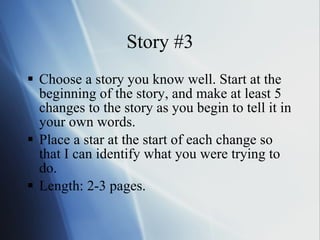
Story #3 Choose a story you know well. Start at the beginning of the story, and make at least 5 changes to the story as you begin to tell it in your own words.  Place a star at the start of each change so that I can identify what you were trying to do. Length: 2-3 pages.

To Kill A Mockingbird (1962

  • 1.
  • 2.
    Three By ThreeWe all know classic story descriptions. Boy meets girl. Boy loses girl. Boy gets girl. Stories have a beginning, middle, and end. Cinderella can’t go. She goes anyway. Cinderella gets Prince.
  • 3.
    Three Sentence PlotBreak your story idea down into three sentences of three words each. That will give you a beginning, middle, and end to help you understand the foundation of your story. By having to choose three verbs, you’ll be forcing yourself to consider three important parts of the action.
  • 4.
    Characters & PlotCharacters and Plot are closely related. Get a character in your head. Get to know him/her/it. Place said character in a situation and see what happens. Ask yourself What if? Decide what the character will do in that situation.
  • 5.
    What If? ExamplesChalene had a fight with her mom. How would she react? “ Top-ten-of-his-class” Joe dropped out of college to become a mechanic. How would his parents react? Todd got a girl pregnant.
  • 6.
    When to usewhat if… Stuck? Ask yourself What if? Come up with five ways to continue the story. Choose the best one, the one that feels natural.
  • 7.
    Let’s try it.Imagine that you’ve started a story… Paul, a young boy, shoplifts with his cousin. The story opens when they take something more expensive than they have ever taken before. This raises the stakes immediately. After writing 2.5 pages, you get stuck. Ask yourself what if, and come up with five answers to the question.
  • 8.
    5 Answers Pauldecides to admit to shoplifting, but hopes not to implicate his cousin. Paul is excited by shoplifting something more expensive, and talks his cousin into going back again soon. The store security guard notices their theft and decides to set a trap. Paul feels brave now and steals something from his stepfather--something Paul has wanted for a long time. There is a time shift to five years later when Paul commits a major burglary.
  • 9.
    Desires Remember, allgood characters want something. Think about what your character might do in order to fulfill his/her desires.
  • 10.
    Opposing Forces Considerthe obstacles your main character will encounter. These drive plot, too.
  • 11.
    Conflict A storywithout a conflict is boring. Problems drive stories. Try magnifying the problem, the tension and shrillness, even to the point of absurdity or hyberbole. Add stress, between characters and within characters. Why? I want you to see the need for tension, but I also want you to know what can happen when there is too much.
  • 12.
    Try This Exaggeratethis conflict. John and Sue are next door neighbors. Their parents have known each other for years, and they’ve known each other since they were born. They’re juniors in high school, and they decide to start dating. She gets pregnant.
  • 13.
    Story Machine CardsYou have ten index cards in front of you. On the first five, list labels associated with what they do (jobs, activities, etc.) On the second five cards, list a mildly strange or unusual behavior. These do not have to be associated with the labels on the other cards. In fact, it would be better if they were not.
  • 14.
    Shuffle the StoryMachine Shuffle each pack of cards SEPERATELY. Now, ask “Why did Card A do Card B?” “ Why did the fashion model pick up the paper on the driveway?” Continue to flip cards until you find a question that’s worth answering. There are many possible pairings. Reshuffle if necessary. The event suggested by the machine may work best at the beginning of the story, but think of what would happen if you placed it at the end or in the middle.
  • 15.
    Remember: You’re theBoss! You have the final decision on any story you write. As peers and teachers, our job is to react and guide you as a writer.
  • 16.
    Another strategy forwriting: Choose a well-known story and make it your own. Change something in the original story: even one small change can alter the entire course of the story. Cinderella could become a man. The three little pigs could become cats.
  • 17.
    Story #3 Choosea story you know well. Start at the beginning of the story, and make at least 5 changes to the story as you begin to tell it in your own words. Place a star at the start of each change so that I can identify what you were trying to do. Length: 2-3 pages.