OPEN AND CLOSED
LOOP SYSTEMS
Understanding Control Mechanisms
A control system is a set of devices or
algorithms that manage, command,
direct, or regulate the behavior of other
devices or systems. Open-loop and
closed-loop systems are two
fundamental concepts used to manage
and regulate processes.
CONTROL SYSTEM
OPEN-LOOP SYSTEM
OPEN-LOOP SYSTEM
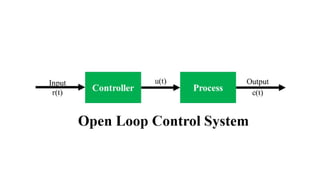
An open-loop system is a type of control system
where the output is not fed back to the input for
comparison or correction. The system operates
on a predefined set of instructions without
considering the actual output.
CHARACTERISTICS
• No Feedback: The system does not monitor or adjust based on
the output. Once the input is set, the system executes the
process without any feedback mechanism.
• Simplicity: Open-loop systems are generally simpler and easier
to design and implement since they do not require feedback
sensors or complex control algorithms.
• Cost-Effective: They tend to be less expensive due to fewer
components and simpler design.
• Predictability: The behavior of the system is predictable as it
follows a set path without deviations.
LIMITATIONS
• Lack of Accuracy: Open-loop systems can be less accurate
because they do not adjust for disturbances or changes in the
environment.
• No Error Correction: If the output deviates from the desired
outcome, the system cannot correct itself.
CLOSED-LOOP
SYSTEM
CLOSED-LOOP SYSTEM
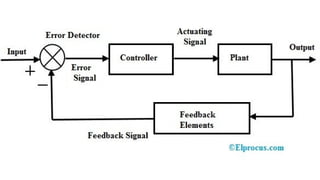
A closed-loop system, also known as a feedback
control system, continuously monitors the
output and adjusts the input based on the
feedback received. This allows the system to
maintain the desired output despite
disturbances.
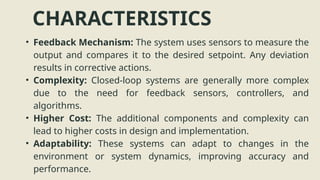
CHARACTERISTICS
• Feedback Mechanism: The system uses sensors to measure the
output and compares it to the desired setpoint. Any deviation
results in corrective actions.
• Complexity: Closed-loop systems are generally more complex
due to the need for feedback sensors, controllers, and
algorithms.
• Higher Cost: The additional components and complexity can
lead to higher costs in design and implementation.
• Adaptability: These systems can adapt to changes in the
environment or system dynamics, improving accuracy and
performance.
LIMITATIONS
• Complexity: The design and tuning of closed-loop systems can
be more complicated.
• Cost: They are typically more expensive due to the additional
components required.
Open-and-Closed-Loop-System in Instrumentation.pptx

Open-and-Closed-Loop-System in Instrumentation.pptx

  • 1.
    OPEN AND CLOSED LOOPSYSTEMS Understanding Control Mechanisms
  • 2.
    A control systemis a set of devices or algorithms that manage, command, direct, or regulate the behavior of other devices or systems. Open-loop and closed-loop systems are two fundamental concepts used to manage and regulate processes. CONTROL SYSTEM
  • 3.
  • 4.
    OPEN-LOOP SYSTEM An open-loopsystem is a type of control system where the output is not fed back to the input for comparison or correction. The system operates on a predefined set of instructions without considering the actual output.
  • 6.
    CHARACTERISTICS • No Feedback:The system does not monitor or adjust based on the output. Once the input is set, the system executes the process without any feedback mechanism. • Simplicity: Open-loop systems are generally simpler and easier to design and implement since they do not require feedback sensors or complex control algorithms. • Cost-Effective: They tend to be less expensive due to fewer components and simpler design. • Predictability: The behavior of the system is predictable as it follows a set path without deviations.
  • 7.
    LIMITATIONS • Lack ofAccuracy: Open-loop systems can be less accurate because they do not adjust for disturbances or changes in the environment. • No Error Correction: If the output deviates from the desired outcome, the system cannot correct itself.
  • 8.
  • 9.
    CLOSED-LOOP SYSTEM A closed-loopsystem, also known as a feedback control system, continuously monitors the output and adjusts the input based on the feedback received. This allows the system to maintain the desired output despite disturbances.
  • 11.
    CHARACTERISTICS • Feedback Mechanism:The system uses sensors to measure the output and compares it to the desired setpoint. Any deviation results in corrective actions. • Complexity: Closed-loop systems are generally more complex due to the need for feedback sensors, controllers, and algorithms. • Higher Cost: The additional components and complexity can lead to higher costs in design and implementation. • Adaptability: These systems can adapt to changes in the environment or system dynamics, improving accuracy and performance.
  • 12.
    LIMITATIONS • Complexity: Thedesign and tuning of closed-loop systems can be more complicated. • Cost: They are typically more expensive due to the additional components required.