From left to right, the square, the cube, and the tesseract. The square
is bounded by 1-dimensional lines, the cube by 2-dimensional areas,
and the tesseract by 3-dimensional volumes. A projection of the cube
is given since it is viewed on a two-dimensional screen. The same
applies to the tesseract, which additionally can only be shown as a
projection even in three-dimensional space.
A diagram showing the first four spatial dimensions. 1-D: Two
points A and B can be connected to a line, giving a new line segment
AB. 2-D: Two parallel line segments AB and CD can be connected
to become a square, with the corners marked as ABCD. 3-D: Two
parallel squares ABCD and EFGH can be connected to become a
cube, with the corners marked as ABCDEFGH. 4-D: Two parallel
cubes ABCDEFGH and IJKLMNOP can be connected to become a
hypercube, with the corners marked as ABCDEFGHIJKLMNOP.
Dimension (mathematics and physics)
From Wikipedia, the free encyclopedia
Not to be confused with Dimension of a physical quantity. For other uses, see Dimension
(disambiguation).
In physics and mathematics, the dimension
of a space or object is informally defined as
the minimum number of coordinates needed
to specify any point within it.[1][2]
Thus a
line has a dimension of one because only one
coordinate is needed to specify a point on it
(for example, the point at 5 on a number
line). A surface such as a plane or the surface
of a cylinder or sphere has a dimension of
two because two coordinates are needed to
specify a point on it (for example, to locate a
point on the surface of a sphere you need
both its latitude and its longitude). The inside
of a cube, a cylinder or a sphere is three-
dimensional because three coordinates are
needed to locate a point within these spaces.
In physical terms, dimension refers to the
constituent structure of all space (cf. volume)
and its position in time (perceived as a scalar
dimension along the t-axis), as well as the
spatial constitution of objects within
—structures that correlate with both particle
and field conceptions, interact according to
relative properties of mass—and are
fundamentally mathematical in description.
These, or other axes, may be referenced to
uniquely identify a point or structure in its
attitude and relationship to other objects and
occurrences. Physical theories that
incorporate time, such as general relativity,
are said to work in 4-dimensional
"spacetime", (defined as a Minkowski space). Modern theories tend to be "higher-dimensional" including
quantum field and string theories. The state-space of quantum mechanics is an infinite-dimensional function
space.
The concept of dimension is not restricted to physical objects. High-dimensional spaces occur in mathematics
and the sciences for many reasons, frequently as configuration spaces such as in Lagrangian or Hamiltonian
mechanics; these are abstract spaces, independent of the physical space we live in.
Contents
1 In mathematics
1.1 Dimension of a vector space
1.2 Manifolds
1.3 Varieties
Dimension (mathematics and physics) - Wikipedia, the free encyclopedia http://en.wikipedia.org/wiki/Dimension_(mathematics_and_physics)
1 of 9 12-10-2013 21:01
1.4 Krull dimension
1.5 Lebesgue covering dimension
1.6 Inductive dimension
1.7 Hausdorff dimension
1.8 Hilbert spaces
2 In physics
2.1 Spatial dimensions
2.2 Time
2.3 Additional dimensions
3 Networks and dimension
4 Literature
5 Philosophy
6 More dimensions
7 See also
7.1 A list of topics indexed by dimension
8 References
9 Further reading
10 External links
In mathematics
In mathematics, the dimension of an object is an intrinsic property independent of the space in which the
object is embedded. For example, a point on the unit circle in the plane can be specified by two Cartesian
coordinates, but one can make do with a single coordinate (the polar coordinate angle), so the circle is
1-dimensional even though it exists in the 2-dimensional plane. This intrinsic notion of dimension is one of the
chief ways the mathematical notion of dimension differs from its common usages.
The dimension of Euclidean n-space En
is n. When trying to generalize to other types of spaces, one is faced
with the question "what makes En
n-dimensional?" One answer is that to cover a fixed ball in En
by small
balls of radius ε, one needs on the order of ε-n
such small balls. This observation leads to the definition of the
Minkowski dimension and its more sophisticated variant, the Hausdorff dimension, but there are also other
answers to that question. For example, the boundary of a ball in En
looks locally like En-1
and this leads to
the notion of the inductive dimension. While these notions agree on En
, they turn out to be different when
one looks at more general spaces.
A tesseract is an example of a four-dimensional object. Whereas outside of mathematics the use of the term
"dimension" is as in: "A tesseract has four dimensions", mathematicians usually express this as: "The tesseract
has dimension 4", or: "The dimension of the tesseract is 4".
Although the notion of higher dimensions goes back to René Descartes, substantial development of a higher-
dimensional geometry only began in the 19th century, via the work of Arthur Cayley, William Rowan
Hamilton, Ludwig Schläfli and Bernhard Riemann. Riemann's 1854 Habilitationsschrift, Schlafi's 1852 Theorie
der vielfachen Kontinuität, Hamilton's 1843 discovery of the quaternions and the construction of the Cayley
Algebra marked the beginning of higher-dimensional geometry.
The rest of this section examines some of the more important mathematical definitions of the dimensions.
Dimension of a vector space
Main article: Dimension (vector space)
The dimension of a vector space is the number of vectors in any basis for the space, i.e. the number of
Dimension (mathematics and physics) - Wikipedia, the free encyclopedia http://en.wikipedia.org/wiki/Dimension_(mathematics_and_physics)
2 of 9 12-10-2013 21:01
coordinates necessary to specify any vector. This notion of dimension (the cardinality of a basis) is often
referred to as the Hamel dimension or algebraic dimension to distinguish it from other notions of dimension.
Manifolds
A connected topological manifold is locally homeomorphic to Euclidean n-space, and the number n is called
the manifold's dimension. One can show that this yields a uniquely defined dimension for every connected
topological manifold.
For connected differentiable manifolds the dimension is also the dimension of the tangent vector space at any
point
The theory of manifolds, in the field of geometric topology, is characterized by the way dimensions 1 and 2 are
relatively elementary, the high-dimensional cases n > 4 are simplified by having extra space in which to
"work"; and the cases n = 3 and 4 are in some senses the most difficult. This state of affairs was highly
marked in the various cases of the Poincaré conjecture, where four different proof methods are applied.
Varieties
Main article: Dimension of an algebraic variety
The dimension of an algebraic variety may be defined in various equivalent ways. The most intuitive way is
probably the dimension of the tangent space at any regular point. Another intuitive way is to define the
dimension as the number of hyperplanes that are needed in order to have an intersection with the variety that
is reduced to a finite number of points (dimension zero). This definition is based on the fact that the
intersection of a variety with a hyperplane reduces the dimension by one unless if the hyperplane contains the
variety.
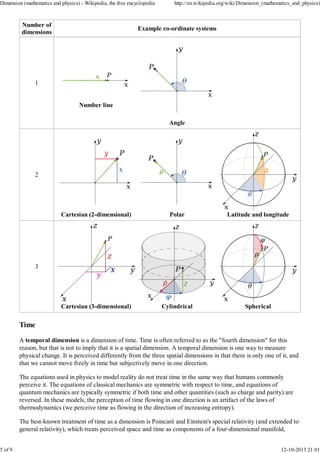
An algebraic set being a finite union of algebraic varieties, its dimension is the maximum of the dimensions of
its components. It is equal to the maximal length of the chains of sub-varieties of the
given algebraic set (the length of such a chain is the number of " ").
Krull dimension
Main article: Krull dimension
The Krull dimension of a commutative ring is the maximal length of chains of prime ideals in it, a chain of
length n being a sequence of prime ideals related by inclusion. It is strongly related
to the dimension of an algebraic variety, because of the natural correspondence between sub-varieties and
prime ideals of the ring of the polynomials on the variety.
For an algebra over a field, the dimension as vector space is finite if and only if its Krull dimension is 0.
Lebesgue covering dimension
Main article: Lebesgue covering dimension
For any normal topological space X, the Lebesgue covering dimension of X is defined to be n if n is the
smallest integer for which the following holds: any open cover has an open refinement (a second open cover
where each element is a subset of an element in the first cover) such that no point is included in more than
n + 1 elements. In this case dim X = n. For X a manifold, this coincides with the dimension mentioned above.
If no such integer n exists, then the dimension of X is said to be infinite, and one writes dim X = ∞. Moreover,
X has dimension −1, i.e. dim X = −1 if and only if X is empty. This definition of covering dimension can be
extended from the class of normal spaces to all Tychonoff spaces merely by replacing the term "open" in the
Dimension (mathematics and physics) - Wikipedia, the free encyclopedia http://en.wikipedia.org/wiki/Dimension_(mathematics_and_physics)
3 of 9 12-10-2013 21:01
definition by the term "functionally open".
Inductive dimension
Main article: Inductive dimension
An inductive definition of dimension can be created as follows. Consider a discrete set of points (such as a
finite collection of points) to be 0-dimensional. By dragging a 0-dimensional object in some direction, one
obtains a 1-dimensional object. By dragging a 1-dimensional object in a new direction, one obtains a
2-dimensional object. In general one obtains an (n + 1)-dimensional object by dragging an n dimensional
object in a new direction.
The inductive dimension of a topological space may refer to the small inductive dimension or the large
inductive dimension, and is based on the analogy that (n + 1)-dimensional balls have n dimensional
boundaries, permitting an inductive definition based on the dimension of the boundaries of open sets.
Hausdorff dimension
Main article: Hausdorff dimension
For structurally complicated sets, especially fractals, the Hausdorff dimension is useful. The Hausdorff
dimension is defined for all metric spaces and, unlike the Hamel dimension, can also attain non-integer real
values.[3]
The box dimension or Minkowski dimension is a variant of the same idea. In general, there exist
more definitions of fractal dimensions that work for highly irregular sets and attain non-integer positive real
values. Fractals have been found useful to describe many natural objects and phenomena.[4][5]
Hilbert spaces
Every Hilbert space admits an orthonormal basis, and any two such bases for a particular space have the same
cardinality. This cardinality is called the dimension of the Hilbert space. This dimension is finite if and only if
the space's Hamel dimension is finite, and in this case the above dimensions coincide.
In physics
Spatial dimensions
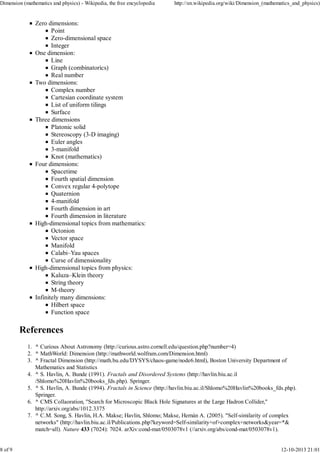
Classical physics theories describe three physical dimensions: from a particular point in space, the basic
directions in which we can move are up/down, left/right, and forward/backward. Movement in any other
direction can be expressed in terms of just these three. Moving down is the same as moving up a negative
distance. Moving diagonally upward and forward is just as the name of the direction implies; i.e., moving in a
linear combination of up and forward. In its simplest form: a line describes one dimension, a plane describes
two dimensions, and a cube describes three dimensions. (See Space and Cartesian coordinate system.)
Dimension (mathematics and physics) - Wikipedia, the free encyclopedia http://en.wikipedia.org/wiki/Dimension_(mathematics_and_physics)
4 of 9 12-10-2013 21:01
Number of
dimensions
Example co-ordinate systems
1
Number line
Angle
2
Cartesian (2-dimensional) Polar Latitude and longitude
3
Cartesian (3-dimensional) Cylindrical Spherical
Time
A temporal dimension is a dimension of time. Time is often referred to as the "fourth dimension" for this
reason, but that is not to imply that it is a spatial dimension. A temporal dimension is one way to measure
physical change. It is perceived differently from the three spatial dimensions in that there is only one of it, and
that we cannot move freely in time but subjectively move in one direction.
The equations used in physics to model reality do not treat time in the same way that humans commonly
perceive it. The equations of classical mechanics are symmetric with respect to time, and equations of
quantum mechanics are typically symmetric if both time and other quantities (such as charge and parity) are
reversed. In these models, the perception of time flowing in one direction is an artifact of the laws of
thermodynamics (we perceive time as flowing in the direction of increasing entropy).
The best-known treatment of time as a dimension is Poincaré and Einstein's special relativity (and extended to
general relativity), which treats perceived space and time as components of a four-dimensional manifold,
Dimension (mathematics and physics) - Wikipedia, the free encyclopedia http://en.wikipedia.org/wiki/Dimension_(mathematics_and_physics)
5 of 9 12-10-2013 21:01
known as spacetime, and in the special, flat case as Minkowski space.
Additional dimensions
In physics, three dimensions of space and one of time is the accepted norm. However, there are theories that
attempt to unify the fundamental forces by introducing more dimensions. Superstring theory, M-theory and
Bosonic string theory posit that physical space has 10, 11 and 26 dimensions, respectively. These extra
dimensions are said to be spatial. However, we perceive only three spatial dimensions and, to date, no
experimental or observational evidence is available to confirm the existence of these extra dimensions. A
possible explanation that has been suggested is that space acts as if it were "curled up" in the extra dimensions
on a subatomic scale, possibly at the quark/string level of scale or below.
An analysis of results from the Large Hadron Collider in December 2010 severely constrains theories with
large extra dimensions.[6]
Other physical theories that have introduced extra dimensions of space are:
Kaluza–Klein theory introduces extra dimensions to explain the fundamental forces other than gravity
(originally only electromagnetism).
Large extra dimension and the Randall–Sundrum model attempt to explain the weakness of gravity. This
is also a feature of brane cosmology.
Universal extra dimension
Networks and dimension
Some complex networks are characterized by fractal dimensions.[7]
The concept of dimension can be
generalized to include networks embedded in space.[8]
The dimension characterize their spatial constraints.
Literature
Main article: Fourth dimension in literature
Perhaps the most basic way the word dimension is used in literature is as a hyperbolic synonym for feature,
attribute, aspect, or magnitude. Frequently the hyperbole is quite literal as in he's so 2-dimensional, meaning
that one can see at a glance what he is. This contrasts with 3-dimensional objects, which have an interior that
is hidden from view, and a back that can only be seen with further examination.
Science fiction texts often mention the concept of dimension, when really referring to parallel universes,
alternate universes, or other planes of existence. This usage is derived from the idea that to travel to
parallel/alternate universes/planes of existence one must travel in a direction/dimension besides the standard
ones. In effect, the other universes/planes are just a small distance away from our own, but the distance is in a
fourth (or higher) spatial (or non-spatial) dimension, not the standard ones.
One of the most heralded science fiction novellas regarding true geometric dimensionality, and often
recommended as a starting point for those just starting to investigate such matters, is the 1884 novel Flatland
by Edwin A. Abbott. Isaac Asimov, in his foreword to the Signet Classics 1984 edition, described Flatland as
"The best introduction one can find into the manner of perceiving dimensions."
The idea of other dimensions was incorporated into many early science fiction stories, appearing prominently,
for example, in Miles J. Breuer's The Appendix and the Spectacles (1928) and Murray Leinster's The Fifth-
Dimension Catapult (1931); and appeared irregularly in science fiction by the 1940s. Classic stories involving
other dimensions include Robert A. Heinlein's —And He Built a Crooked House (1941), in which a California
architect designs a house based on a three-dimensional projection of a tesseract, and Alan E. Nourse's Tiger by
Dimension (mathematics and physics) - Wikipedia, the free encyclopedia http://en.wikipedia.org/wiki/Dimension_(mathematics_and_physics)
6 of 9 12-10-2013 21:01
the Tail and The Universe Between (both 1951). Another reference is Madeleine L'Engle's novel A Wrinkle In
Time (1962), which uses the 5th dimension as a way for "tesseracting the universe" or in a better sense,
"folding" space to move across it quickly. The fourth and fifth dimensions were also a key component of the
book The Boy Who Reversed Himself, by William Sleator.
Philosophy
In 1783, Kant wrote: "That everywhere space (which is not itself the boundary of another space) has three
dimensions and that space in general cannot have more dimensions is based on the proposition that not more
than three lines can intersect at right angles in one point. This proposition cannot at all be shown from
concepts, but rests immediately on intuition and indeed on pure intuition a priori because it is apodictically
(demonstrably) certain."[9]
Space has Four Dimensions is a short story published in 1846 by German philosopher and experimental
psychologist Gustav Fechner (under the pseudonym Dr. Mises). The protagonist in the tale is a shadow who is
aware of, and able to communicate with, other shadows; but is trapped on a two-dimensional surface.
According to Fechner, the shadow-man would conceive of the third dimension as being one of time.[10]
The
story bears a strong similarity to the "Allegory of the Cave", presented in Plato's The Republic written around
380 B.C.
Simon Newcomb wrote an article for the Bulletin of the American Mathematical Society in 1898 entitled "The
Philosophy of Hyperspace".[11]
Linda Dalrymple Henderson coined the term Hyperspace philosophy in her
1983 thesis about the fourth dimension in early-twentieth-century art. It is used to describe those writers that
use higher-dimensions for metaphysical and philosophical exploration.[12]
Charles Howard Hinton (who was
the first to use the word "tesseract" in 1888) and Russian esotericist P. D. Ouspensky are examples of
"hyperspace philosophers".
More dimensions
Degrees of freedom (mechanics)
Degrees of freedom (physics and chemistry)
Degrees of freedom (statistics)
Dimension of an algebraic variety
Exterior dimension
Hurst exponent
Isoperimetric dimension
Kaplan–Yorke dimension
Lebesgue covering dimension
Lyapunov dimension
Metric dimension
Pointwise dimension
Poset dimension
q-dimension; especially:
Information dimension (corresponding to
q = 1)
Correlation dimension (corresponding to
q = 2)
Vector space dimension / Hamel dimension
See also
Dimension (data warehouse) and dimension tables
Dimensional analysis
Fractal dimension
Hyperspace (disambiguation page)
Intrinsic dimension
Multidimensional analysis
Space-filling curve
A list of topics indexed by dimension
Dimension (mathematics and physics) - Wikipedia, the free encyclopedia http://en.wikipedia.org/wiki/Dimension_(mathematics_and_physics)
7 of 9 12-10-2013 21:01
Zero dimensions:
Point
Zero-dimensional space
Integer
One dimension:
Line
Graph (combinatorics)
Real number
Two dimensions:
Complex number
Cartesian coordinate system
List of uniform tilings
Surface
Three dimensions
Platonic solid
Stereoscopy (3-D imaging)
Euler angles
3-manifold
Knot (mathematics)
Four dimensions:
Spacetime
Fourth spatial dimension
Convex regular 4-polytope
Quaternion
4-manifold
Fourth dimension in art
Fourth dimension in literature
High-dimensional topics from mathematics:
Octonion
Vector space
Manifold
Calabi–Yau spaces
Curse of dimensionality
High-dimensional topics from physics:
Kaluza–Klein theory
String theory
M-theory
Infinitely many dimensions:
Hilbert space
Function space
References
^ Curious About Astronomy (http://curious.astro.cornell.edu/question.php?number=4)1.
^ MathWorld: Dimension (http://mathworld.wolfram.com/Dimension.html)2.
^ Fractal Dimension (http://math.bu.edu/DYSYS/chaos-game/node6.html), Boston University Department of
Mathematics and Statistics
3.
^ S. Havlin, A. Bunde (1991). Fractals and Disordered Systems (http://havlin.biu.ac.il
/Shlomo%20Havlin%20books_fds.php). Springer.
4.
^ S. Havlin, A. Bunde (1994). Fractals in Science (http://havlin.biu.ac.il/Shlomo%20Havlin%20books_fds.php).
Springer.
5.
^ CMS Collaoration, "Search for Microscopic Black Hole Signatures at the Large Hadron Collider,"
http://arxiv.org/abs/1012.3375
6.
^ C.M. Song, S. Havlin, H.A. Makse; Havlin, Shlomo; Makse, Hernán A. (2005). "Self-similarity of complex
networks" (http://havlin.biu.ac.il/Publications.php?keyword=Self-similarity+of+complex+networks&year=*&
match=all). Nature 433 (7024): 7024. arXiv:cond-mat/0503078v1 (//arxiv.org/abs/cond-mat/0503078v1).
7.
Dimension (mathematics and physics) - Wikipedia, the free encyclopedia http://en.wikipedia.org/wiki/Dimension_(mathematics_and_physics)
8 of 9 12-10-2013 21:01
Bibcode:2005Natur.433..392S (http://adsabs.harvard.edu/abs/2005Natur.433..392S). doi:10.1038/nature03248
(http://dx.doi.org/10.1038%2Fnature03248).
^ D. Li, K. Kosmidis, A. Bunde, S. Havlin; Kosmidis, Kosmas; Bunde, Armin; Havlin, Shlomo (2011).
"Dimension of spatially embedded networks" (http://havlin.biu.ac.il
/Publications.php?keyword=Dimension+of+spatially+embedded+networks&year=*&match=all). Nature Physics
7 (6): 481. Bibcode:2011NatPh...7..481D (http://adsabs.harvard.edu/abs/2011NatPh...7..481D).
doi:10.1038/nphys1932 (http://dx.doi.org/10.1038%2Fnphys1932).
8.
^ Prolegomena, § 129.
^ Banchoff, Thomas F. (1990). "From Flatland to Hypergraphics: Interacting with Higher Dimensions"
(http://www.geom.uiuc.edu/~banchoff/ISR/ISR.html). Interdisciplinary Science Reviews 15 (4): 364.
doi:10.1179/030801890789797239 (http://dx.doi.org/10.1179%2F030801890789797239).
10.
^ Newcomb, Simon (1898). "The Philosophy of Hyperspace" (http://archive.org/details/cihm_42903). Bulletin of
the American Mathematical Society 4 (5): 187. doi:10.1090/S0002-9904-1898-00478-0 (http://dx.doi.org
/10.1090%2FS0002-9904-1898-00478-0).
11.
^ Kruger, Runette (2007). "Art in the Fourth Dimension: Giving Form to Form – The Abstract Paintings of Piet
Mondrian" (http://ler.letras.up.pt/uploads/ficheiros/4351.pdf). Spaces of Utopia: an Electronic Journal (5): 11.
12.
Further reading
Edwin A. Abbott, (1884) Flatland: A Romance of Many Dimensions, Public Domain. Online version
with ASCII approximation of illustrations (http://www.gutenberg.org/etext/201) at Project Gutenberg.
Thomas Banchoff, (1996) Beyond the Third Dimension: Geometry, Computer Graphics, and Higher
Dimensions, Second Edition, Freeman.
Clifford A. Pickover, (1999) Surfing through Hyperspace: Understanding Higher Universes in Six
Easy Lessons, Oxford University Press.
Rudy Rucker, (1984) The Fourth Dimension, Houghton-Mifflin.
Michio Kaku, (1994) Hyperspace, a Scientific Odyssey Through the 10th Dimension, Oxford University
Press.
External links
Copeland, Ed (2009). "Extra Dimensions" (http://www.sixtysymbols.com/videos/dimensions.htm). Sixty
Symbols. Brady Haran for the University of Nottingham.
Retrieved from "http://en.wikipedia.org/w/index.php?title=Dimension_(mathematics_and_physics)&
oldid=576384538"
Categories: Concepts in physics Dimension Abstract algebra Geometric measurement
Mathematical concepts
This page was last modified on 9 October 2013 at 03:44.
Text is available under the Creative Commons Attribution-ShareAlike License; additional terms may
apply. By using this site, you agree to the Terms of Use and Privacy Policy.
Wikipedia® is a registered trademark of the Wikimedia Foundation, Inc., a non-profit organization.
Dimension (mathematics and physics) - Wikipedia, the free encyclopedia http://en.wikipedia.org/wiki/Dimension_(mathematics_and_physics)
9 of 9 12-10-2013 21:01

Dimension

  • 1.
    From left toright, the square, the cube, and the tesseract. The square is bounded by 1-dimensional lines, the cube by 2-dimensional areas, and the tesseract by 3-dimensional volumes. A projection of the cube is given since it is viewed on a two-dimensional screen. The same applies to the tesseract, which additionally can only be shown as a projection even in three-dimensional space. A diagram showing the first four spatial dimensions. 1-D: Two points A and B can be connected to a line, giving a new line segment AB. 2-D: Two parallel line segments AB and CD can be connected to become a square, with the corners marked as ABCD. 3-D: Two parallel squares ABCD and EFGH can be connected to become a cube, with the corners marked as ABCDEFGH. 4-D: Two parallel cubes ABCDEFGH and IJKLMNOP can be connected to become a hypercube, with the corners marked as ABCDEFGHIJKLMNOP. Dimension (mathematics and physics) From Wikipedia, the free encyclopedia Not to be confused with Dimension of a physical quantity. For other uses, see Dimension (disambiguation). In physics and mathematics, the dimension of a space or object is informally defined as the minimum number of coordinates needed to specify any point within it.[1][2] Thus a line has a dimension of one because only one coordinate is needed to specify a point on it (for example, the point at 5 on a number line). A surface such as a plane or the surface of a cylinder or sphere has a dimension of two because two coordinates are needed to specify a point on it (for example, to locate a point on the surface of a sphere you need both its latitude and its longitude). The inside of a cube, a cylinder or a sphere is three- dimensional because three coordinates are needed to locate a point within these spaces. In physical terms, dimension refers to the constituent structure of all space (cf. volume) and its position in time (perceived as a scalar dimension along the t-axis), as well as the spatial constitution of objects within —structures that correlate with both particle and field conceptions, interact according to relative properties of mass—and are fundamentally mathematical in description. These, or other axes, may be referenced to uniquely identify a point or structure in its attitude and relationship to other objects and occurrences. Physical theories that incorporate time, such as general relativity, are said to work in 4-dimensional "spacetime", (defined as a Minkowski space). Modern theories tend to be "higher-dimensional" including quantum field and string theories. The state-space of quantum mechanics is an infinite-dimensional function space. The concept of dimension is not restricted to physical objects. High-dimensional spaces occur in mathematics and the sciences for many reasons, frequently as configuration spaces such as in Lagrangian or Hamiltonian mechanics; these are abstract spaces, independent of the physical space we live in. Contents 1 In mathematics 1.1 Dimension of a vector space 1.2 Manifolds 1.3 Varieties Dimension (mathematics and physics) - Wikipedia, the free encyclopedia http://en.wikipedia.org/wiki/Dimension_(mathematics_and_physics) 1 of 9 12-10-2013 21:01
  • 2.
    1.4 Krull dimension 1.5Lebesgue covering dimension 1.6 Inductive dimension 1.7 Hausdorff dimension 1.8 Hilbert spaces 2 In physics 2.1 Spatial dimensions 2.2 Time 2.3 Additional dimensions 3 Networks and dimension 4 Literature 5 Philosophy 6 More dimensions 7 See also 7.1 A list of topics indexed by dimension 8 References 9 Further reading 10 External links In mathematics In mathematics, the dimension of an object is an intrinsic property independent of the space in which the object is embedded. For example, a point on the unit circle in the plane can be specified by two Cartesian coordinates, but one can make do with a single coordinate (the polar coordinate angle), so the circle is 1-dimensional even though it exists in the 2-dimensional plane. This intrinsic notion of dimension is one of the chief ways the mathematical notion of dimension differs from its common usages. The dimension of Euclidean n-space En is n. When trying to generalize to other types of spaces, one is faced with the question "what makes En n-dimensional?" One answer is that to cover a fixed ball in En by small balls of radius ε, one needs on the order of ε-n such small balls. This observation leads to the definition of the Minkowski dimension and its more sophisticated variant, the Hausdorff dimension, but there are also other answers to that question. For example, the boundary of a ball in En looks locally like En-1 and this leads to the notion of the inductive dimension. While these notions agree on En , they turn out to be different when one looks at more general spaces. A tesseract is an example of a four-dimensional object. Whereas outside of mathematics the use of the term "dimension" is as in: "A tesseract has four dimensions", mathematicians usually express this as: "The tesseract has dimension 4", or: "The dimension of the tesseract is 4". Although the notion of higher dimensions goes back to René Descartes, substantial development of a higher- dimensional geometry only began in the 19th century, via the work of Arthur Cayley, William Rowan Hamilton, Ludwig Schläfli and Bernhard Riemann. Riemann's 1854 Habilitationsschrift, Schlafi's 1852 Theorie der vielfachen Kontinuität, Hamilton's 1843 discovery of the quaternions and the construction of the Cayley Algebra marked the beginning of higher-dimensional geometry. The rest of this section examines some of the more important mathematical definitions of the dimensions. Dimension of a vector space Main article: Dimension (vector space) The dimension of a vector space is the number of vectors in any basis for the space, i.e. the number of Dimension (mathematics and physics) - Wikipedia, the free encyclopedia http://en.wikipedia.org/wiki/Dimension_(mathematics_and_physics) 2 of 9 12-10-2013 21:01
  • 3.
    coordinates necessary tospecify any vector. This notion of dimension (the cardinality of a basis) is often referred to as the Hamel dimension or algebraic dimension to distinguish it from other notions of dimension. Manifolds A connected topological manifold is locally homeomorphic to Euclidean n-space, and the number n is called the manifold's dimension. One can show that this yields a uniquely defined dimension for every connected topological manifold. For connected differentiable manifolds the dimension is also the dimension of the tangent vector space at any point The theory of manifolds, in the field of geometric topology, is characterized by the way dimensions 1 and 2 are relatively elementary, the high-dimensional cases n > 4 are simplified by having extra space in which to "work"; and the cases n = 3 and 4 are in some senses the most difficult. This state of affairs was highly marked in the various cases of the Poincaré conjecture, where four different proof methods are applied. Varieties Main article: Dimension of an algebraic variety The dimension of an algebraic variety may be defined in various equivalent ways. The most intuitive way is probably the dimension of the tangent space at any regular point. Another intuitive way is to define the dimension as the number of hyperplanes that are needed in order to have an intersection with the variety that is reduced to a finite number of points (dimension zero). This definition is based on the fact that the intersection of a variety with a hyperplane reduces the dimension by one unless if the hyperplane contains the variety. An algebraic set being a finite union of algebraic varieties, its dimension is the maximum of the dimensions of its components. It is equal to the maximal length of the chains of sub-varieties of the given algebraic set (the length of such a chain is the number of " "). Krull dimension Main article: Krull dimension The Krull dimension of a commutative ring is the maximal length of chains of prime ideals in it, a chain of length n being a sequence of prime ideals related by inclusion. It is strongly related to the dimension of an algebraic variety, because of the natural correspondence between sub-varieties and prime ideals of the ring of the polynomials on the variety. For an algebra over a field, the dimension as vector space is finite if and only if its Krull dimension is 0. Lebesgue covering dimension Main article: Lebesgue covering dimension For any normal topological space X, the Lebesgue covering dimension of X is defined to be n if n is the smallest integer for which the following holds: any open cover has an open refinement (a second open cover where each element is a subset of an element in the first cover) such that no point is included in more than n + 1 elements. In this case dim X = n. For X a manifold, this coincides with the dimension mentioned above. If no such integer n exists, then the dimension of X is said to be infinite, and one writes dim X = ∞. Moreover, X has dimension −1, i.e. dim X = −1 if and only if X is empty. This definition of covering dimension can be extended from the class of normal spaces to all Tychonoff spaces merely by replacing the term "open" in the Dimension (mathematics and physics) - Wikipedia, the free encyclopedia http://en.wikipedia.org/wiki/Dimension_(mathematics_and_physics) 3 of 9 12-10-2013 21:01
  • 4.
    definition by theterm "functionally open". Inductive dimension Main article: Inductive dimension An inductive definition of dimension can be created as follows. Consider a discrete set of points (such as a finite collection of points) to be 0-dimensional. By dragging a 0-dimensional object in some direction, one obtains a 1-dimensional object. By dragging a 1-dimensional object in a new direction, one obtains a 2-dimensional object. In general one obtains an (n + 1)-dimensional object by dragging an n dimensional object in a new direction. The inductive dimension of a topological space may refer to the small inductive dimension or the large inductive dimension, and is based on the analogy that (n + 1)-dimensional balls have n dimensional boundaries, permitting an inductive definition based on the dimension of the boundaries of open sets. Hausdorff dimension Main article: Hausdorff dimension For structurally complicated sets, especially fractals, the Hausdorff dimension is useful. The Hausdorff dimension is defined for all metric spaces and, unlike the Hamel dimension, can also attain non-integer real values.[3] The box dimension or Minkowski dimension is a variant of the same idea. In general, there exist more definitions of fractal dimensions that work for highly irregular sets and attain non-integer positive real values. Fractals have been found useful to describe many natural objects and phenomena.[4][5] Hilbert spaces Every Hilbert space admits an orthonormal basis, and any two such bases for a particular space have the same cardinality. This cardinality is called the dimension of the Hilbert space. This dimension is finite if and only if the space's Hamel dimension is finite, and in this case the above dimensions coincide. In physics Spatial dimensions Classical physics theories describe three physical dimensions: from a particular point in space, the basic directions in which we can move are up/down, left/right, and forward/backward. Movement in any other direction can be expressed in terms of just these three. Moving down is the same as moving up a negative distance. Moving diagonally upward and forward is just as the name of the direction implies; i.e., moving in a linear combination of up and forward. In its simplest form: a line describes one dimension, a plane describes two dimensions, and a cube describes three dimensions. (See Space and Cartesian coordinate system.) Dimension (mathematics and physics) - Wikipedia, the free encyclopedia http://en.wikipedia.org/wiki/Dimension_(mathematics_and_physics) 4 of 9 12-10-2013 21:01
  • 5.
    Number of dimensions Example co-ordinatesystems 1 Number line Angle 2 Cartesian (2-dimensional) Polar Latitude and longitude 3 Cartesian (3-dimensional) Cylindrical Spherical Time A temporal dimension is a dimension of time. Time is often referred to as the "fourth dimension" for this reason, but that is not to imply that it is a spatial dimension. A temporal dimension is one way to measure physical change. It is perceived differently from the three spatial dimensions in that there is only one of it, and that we cannot move freely in time but subjectively move in one direction. The equations used in physics to model reality do not treat time in the same way that humans commonly perceive it. The equations of classical mechanics are symmetric with respect to time, and equations of quantum mechanics are typically symmetric if both time and other quantities (such as charge and parity) are reversed. In these models, the perception of time flowing in one direction is an artifact of the laws of thermodynamics (we perceive time as flowing in the direction of increasing entropy). The best-known treatment of time as a dimension is Poincaré and Einstein's special relativity (and extended to general relativity), which treats perceived space and time as components of a four-dimensional manifold, Dimension (mathematics and physics) - Wikipedia, the free encyclopedia http://en.wikipedia.org/wiki/Dimension_(mathematics_and_physics) 5 of 9 12-10-2013 21:01
  • 6.
    known as spacetime,and in the special, flat case as Minkowski space. Additional dimensions In physics, three dimensions of space and one of time is the accepted norm. However, there are theories that attempt to unify the fundamental forces by introducing more dimensions. Superstring theory, M-theory and Bosonic string theory posit that physical space has 10, 11 and 26 dimensions, respectively. These extra dimensions are said to be spatial. However, we perceive only three spatial dimensions and, to date, no experimental or observational evidence is available to confirm the existence of these extra dimensions. A possible explanation that has been suggested is that space acts as if it were "curled up" in the extra dimensions on a subatomic scale, possibly at the quark/string level of scale or below. An analysis of results from the Large Hadron Collider in December 2010 severely constrains theories with large extra dimensions.[6] Other physical theories that have introduced extra dimensions of space are: Kaluza–Klein theory introduces extra dimensions to explain the fundamental forces other than gravity (originally only electromagnetism). Large extra dimension and the Randall–Sundrum model attempt to explain the weakness of gravity. This is also a feature of brane cosmology. Universal extra dimension Networks and dimension Some complex networks are characterized by fractal dimensions.[7] The concept of dimension can be generalized to include networks embedded in space.[8] The dimension characterize their spatial constraints. Literature Main article: Fourth dimension in literature Perhaps the most basic way the word dimension is used in literature is as a hyperbolic synonym for feature, attribute, aspect, or magnitude. Frequently the hyperbole is quite literal as in he's so 2-dimensional, meaning that one can see at a glance what he is. This contrasts with 3-dimensional objects, which have an interior that is hidden from view, and a back that can only be seen with further examination. Science fiction texts often mention the concept of dimension, when really referring to parallel universes, alternate universes, or other planes of existence. This usage is derived from the idea that to travel to parallel/alternate universes/planes of existence one must travel in a direction/dimension besides the standard ones. In effect, the other universes/planes are just a small distance away from our own, but the distance is in a fourth (or higher) spatial (or non-spatial) dimension, not the standard ones. One of the most heralded science fiction novellas regarding true geometric dimensionality, and often recommended as a starting point for those just starting to investigate such matters, is the 1884 novel Flatland by Edwin A. Abbott. Isaac Asimov, in his foreword to the Signet Classics 1984 edition, described Flatland as "The best introduction one can find into the manner of perceiving dimensions." The idea of other dimensions was incorporated into many early science fiction stories, appearing prominently, for example, in Miles J. Breuer's The Appendix and the Spectacles (1928) and Murray Leinster's The Fifth- Dimension Catapult (1931); and appeared irregularly in science fiction by the 1940s. Classic stories involving other dimensions include Robert A. Heinlein's —And He Built a Crooked House (1941), in which a California architect designs a house based on a three-dimensional projection of a tesseract, and Alan E. Nourse's Tiger by Dimension (mathematics and physics) - Wikipedia, the free encyclopedia http://en.wikipedia.org/wiki/Dimension_(mathematics_and_physics) 6 of 9 12-10-2013 21:01
  • 7.
    the Tail andThe Universe Between (both 1951). Another reference is Madeleine L'Engle's novel A Wrinkle In Time (1962), which uses the 5th dimension as a way for "tesseracting the universe" or in a better sense, "folding" space to move across it quickly. The fourth and fifth dimensions were also a key component of the book The Boy Who Reversed Himself, by William Sleator. Philosophy In 1783, Kant wrote: "That everywhere space (which is not itself the boundary of another space) has three dimensions and that space in general cannot have more dimensions is based on the proposition that not more than three lines can intersect at right angles in one point. This proposition cannot at all be shown from concepts, but rests immediately on intuition and indeed on pure intuition a priori because it is apodictically (demonstrably) certain."[9] Space has Four Dimensions is a short story published in 1846 by German philosopher and experimental psychologist Gustav Fechner (under the pseudonym Dr. Mises). The protagonist in the tale is a shadow who is aware of, and able to communicate with, other shadows; but is trapped on a two-dimensional surface. According to Fechner, the shadow-man would conceive of the third dimension as being one of time.[10] The story bears a strong similarity to the "Allegory of the Cave", presented in Plato's The Republic written around 380 B.C. Simon Newcomb wrote an article for the Bulletin of the American Mathematical Society in 1898 entitled "The Philosophy of Hyperspace".[11] Linda Dalrymple Henderson coined the term Hyperspace philosophy in her 1983 thesis about the fourth dimension in early-twentieth-century art. It is used to describe those writers that use higher-dimensions for metaphysical and philosophical exploration.[12] Charles Howard Hinton (who was the first to use the word "tesseract" in 1888) and Russian esotericist P. D. Ouspensky are examples of "hyperspace philosophers". More dimensions Degrees of freedom (mechanics) Degrees of freedom (physics and chemistry) Degrees of freedom (statistics) Dimension of an algebraic variety Exterior dimension Hurst exponent Isoperimetric dimension Kaplan–Yorke dimension Lebesgue covering dimension Lyapunov dimension Metric dimension Pointwise dimension Poset dimension q-dimension; especially: Information dimension (corresponding to q = 1) Correlation dimension (corresponding to q = 2) Vector space dimension / Hamel dimension See also Dimension (data warehouse) and dimension tables Dimensional analysis Fractal dimension Hyperspace (disambiguation page) Intrinsic dimension Multidimensional analysis Space-filling curve A list of topics indexed by dimension Dimension (mathematics and physics) - Wikipedia, the free encyclopedia http://en.wikipedia.org/wiki/Dimension_(mathematics_and_physics) 7 of 9 12-10-2013 21:01
  • 8.
    Zero dimensions: Point Zero-dimensional space Integer Onedimension: Line Graph (combinatorics) Real number Two dimensions: Complex number Cartesian coordinate system List of uniform tilings Surface Three dimensions Platonic solid Stereoscopy (3-D imaging) Euler angles 3-manifold Knot (mathematics) Four dimensions: Spacetime Fourth spatial dimension Convex regular 4-polytope Quaternion 4-manifold Fourth dimension in art Fourth dimension in literature High-dimensional topics from mathematics: Octonion Vector space Manifold Calabi–Yau spaces Curse of dimensionality High-dimensional topics from physics: Kaluza–Klein theory String theory M-theory Infinitely many dimensions: Hilbert space Function space References ^ Curious About Astronomy (http://curious.astro.cornell.edu/question.php?number=4)1. ^ MathWorld: Dimension (http://mathworld.wolfram.com/Dimension.html)2. ^ Fractal Dimension (http://math.bu.edu/DYSYS/chaos-game/node6.html), Boston University Department of Mathematics and Statistics 3. ^ S. Havlin, A. Bunde (1991). Fractals and Disordered Systems (http://havlin.biu.ac.il /Shlomo%20Havlin%20books_fds.php). Springer. 4. ^ S. Havlin, A. Bunde (1994). Fractals in Science (http://havlin.biu.ac.il/Shlomo%20Havlin%20books_fds.php). Springer. 5. ^ CMS Collaoration, "Search for Microscopic Black Hole Signatures at the Large Hadron Collider," http://arxiv.org/abs/1012.3375 6. ^ C.M. Song, S. Havlin, H.A. Makse; Havlin, Shlomo; Makse, Hernán A. (2005). "Self-similarity of complex networks" (http://havlin.biu.ac.il/Publications.php?keyword=Self-similarity+of+complex+networks&year=*& match=all). Nature 433 (7024): 7024. arXiv:cond-mat/0503078v1 (//arxiv.org/abs/cond-mat/0503078v1). 7. Dimension (mathematics and physics) - Wikipedia, the free encyclopedia http://en.wikipedia.org/wiki/Dimension_(mathematics_and_physics) 8 of 9 12-10-2013 21:01
  • 9.
    Bibcode:2005Natur.433..392S (http://adsabs.harvard.edu/abs/2005Natur.433..392S). doi:10.1038/nature03248 (http://dx.doi.org/10.1038%2Fnature03248). ^D. Li, K. Kosmidis, A. Bunde, S. Havlin; Kosmidis, Kosmas; Bunde, Armin; Havlin, Shlomo (2011). "Dimension of spatially embedded networks" (http://havlin.biu.ac.il /Publications.php?keyword=Dimension+of+spatially+embedded+networks&year=*&match=all). Nature Physics 7 (6): 481. Bibcode:2011NatPh...7..481D (http://adsabs.harvard.edu/abs/2011NatPh...7..481D). doi:10.1038/nphys1932 (http://dx.doi.org/10.1038%2Fnphys1932). 8. ^ Prolegomena, § 129. ^ Banchoff, Thomas F. (1990). "From Flatland to Hypergraphics: Interacting with Higher Dimensions" (http://www.geom.uiuc.edu/~banchoff/ISR/ISR.html). Interdisciplinary Science Reviews 15 (4): 364. doi:10.1179/030801890789797239 (http://dx.doi.org/10.1179%2F030801890789797239). 10. ^ Newcomb, Simon (1898). "The Philosophy of Hyperspace" (http://archive.org/details/cihm_42903). Bulletin of the American Mathematical Society 4 (5): 187. doi:10.1090/S0002-9904-1898-00478-0 (http://dx.doi.org /10.1090%2FS0002-9904-1898-00478-0). 11. ^ Kruger, Runette (2007). "Art in the Fourth Dimension: Giving Form to Form – The Abstract Paintings of Piet Mondrian" (http://ler.letras.up.pt/uploads/ficheiros/4351.pdf). Spaces of Utopia: an Electronic Journal (5): 11. 12. Further reading Edwin A. Abbott, (1884) Flatland: A Romance of Many Dimensions, Public Domain. Online version with ASCII approximation of illustrations (http://www.gutenberg.org/etext/201) at Project Gutenberg. Thomas Banchoff, (1996) Beyond the Third Dimension: Geometry, Computer Graphics, and Higher Dimensions, Second Edition, Freeman. Clifford A. Pickover, (1999) Surfing through Hyperspace: Understanding Higher Universes in Six Easy Lessons, Oxford University Press. Rudy Rucker, (1984) The Fourth Dimension, Houghton-Mifflin. Michio Kaku, (1994) Hyperspace, a Scientific Odyssey Through the 10th Dimension, Oxford University Press. External links Copeland, Ed (2009). "Extra Dimensions" (http://www.sixtysymbols.com/videos/dimensions.htm). Sixty Symbols. Brady Haran for the University of Nottingham. Retrieved from "http://en.wikipedia.org/w/index.php?title=Dimension_(mathematics_and_physics)& oldid=576384538" Categories: Concepts in physics Dimension Abstract algebra Geometric measurement Mathematical concepts This page was last modified on 9 October 2013 at 03:44. Text is available under the Creative Commons Attribution-ShareAlike License; additional terms may apply. By using this site, you agree to the Terms of Use and Privacy Policy. Wikipedia® is a registered trademark of the Wikimedia Foundation, Inc., a non-profit organization. Dimension (mathematics and physics) - Wikipedia, the free encyclopedia http://en.wikipedia.org/wiki/Dimension_(mathematics_and_physics) 9 of 9 12-10-2013 21:01