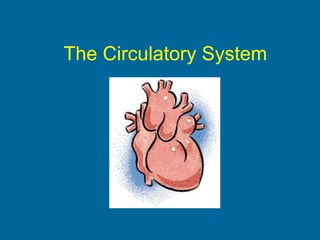
The Circulatory System
Transportation system by which oxygen and nutrients reach the body's cells, and waste materials are carried away.
Also carries substances called hormones, which control body processes, and antibodies to fight invading germs.
www.biosbcc.net/doohan / sample/ htm/heart.htm
Parts of the Circulatory System Divided into three major parts: The Heart  The Blood  The Blood Vessels
The heart, the lungs, and the blood vessels work together to form the  circle  part of the circulatory system.
Circulation Two parts  Heart acts as double pump Blood from the right side pump is dark red and low in oxygen (oxygen-poor)
Circulation Travels through pulmonary arteries to lungs where it gets fresh oxygen and becomes bright red Blood from lungs through pulmonary veins back to the heart's left side pump Pumped out into the body
http://users.tpg.com.au/users/amcgann/body/circulatory.html
3 Kinds of Circulation: Pulmonary circulation Coronary circulation Systemic circulation
Pulmonary Circulation Movement of blood from the heart, to the lungs, and back to the heart again
sln.fi.edu/biosci/systems /  pulmonary.html
Coronary Circulation Movement of blood through the tissues of the heart
http://sln.fi.edu/biosci2/systems/
Systemic Circulation Supplies nourishment to all of the tissue located throughout the body , except for the heart and lungs
http://sln.fi.edu/biosci/systems/systemic.html
Blood Vessels Hollow tubes that circulate your blood
Three Kinds of Blood Vessels  Arteries Veins Capillaries
Arteries Carry blood AWAY from the heart Heart pumps blood  Main artery called the  aorta   Aorta divides and branches  Many smaller arteries  Each region of your body has system of arteries supplying it with fresh, oxygen-rich blood.
Arteries Tough on the outside  Smooth on the inside  Muscular wall helps the heart pump blood
http://hes.ucf.k12.pa.us/gclaypo/circdia.html   Have strong, muscular walls The inner layer is very smooth so that the blood can flow easily
http://sln.fi.edu/biosci/systems/circulation.html
Capillaries Very thin Only one cell thick Connect arteries & veins
Capillaries Food and oxygen released to the body cells  Carbon dioxide and other waste products returned to the bloodstream
http://sln.fi.edu/biosci/systems/circulation.html
w3.uokhsc.edu
 
http://hes.ucf.k12.pa.us/gclaypo/circdia.html   Valves are located inside the veins. The valves only allow blood to move in one direction.
http://users.tpg.com.au/users/amcgann/body/circulatory.html
Veins Carry blood to the heart Receive blood from the capillaries Transport waste-rich/ oxygen-poor blood back to the lungs and heart  Valves are located inside the veins  Allow blood to move in one direction
http://sln.fi.edu/biosci/systems/circulation.html
The Heart Size of your fist  Thick muscular walls  Divided into two pumps  Each pump has two chambers  Upper chamber - atrium receives blood coming in from the veins  Lower chamber - ventricle squeezes blood out into the arteries
http://hes.ucf.k12.pa.us/gclaypo/circdia.html
Close up of heart valve Heart sounds are made by the valves as they open and close http://hes.ucf.k12.pa.us/gclaypo/circdia.html
Blood Pumped by your heart.  Travels through thousands of miles of blood vessels Carries nutrients, water, oxygen and waste products to and from your body cells.  Made up of liquids, solids and small amounts of oxygen and carbon dioxide.
Blood Red blood cells carry oxygen from the lungs to all the cells of the body.  Takes carbon dioxide and transports it back to the lungs About  5,000,000  Red Blood Cells in ONE drop of blood.
http://hes.ucf.k12.pa.us/gclaypo/circdia.html
Blood White blood cells protect the body from germs Attack and destroy germs when they enter the body
scienceu.fsu.edu   www.merck.com/pubs/mmanual_home / illus/167i2.htm
Blood Platelets  are blood cells that help stop bleeding
user.gru.net/clawrence / vccl/chpt7/plate.htm
Blood Plasma  is the liquid part of the blood About half of your blood is made of plasma The plasma carries the blood cells throughout the body Plasma is made in the liver.
http://hes.ucf.k12.pa.us/gclaypo/circdia.html

The circulatory system