Circulator y
The

  System is responsible for
  transporting materials throughout
  the entire body. It transports
  nutrients, water, and oxygen to your
  billions of body cells and carries
  away wastes such as carbon dioxide
  that body cells produce. It is an
  amazing highway that travels
  through your entire body connecting
  all your body cells.
Parts of the Circulatory
             System
    The circulatory System is
    divided into three major
              parts:

•The Heart
•The Blood

•The Blood Vessels
The Heart
The Heart is an amazing
organ. The heart beats
about 3 BILLION times
during an average
lifetime. It is a muscle
about the size of your fist.
The heart is located in
the center of your chest
slightly to the left. It's job
is to pump your blood
and keep the blood
moving throughout your
body.
It is your job to keep your heart healthy
and there are three main things you
need to remember in order to keep your
heart healthy.

3.Exercise on a regular basis. Get
outside          and play. Keep that
body moving (walk, jog, run, bike,
skate, jump, swim).

5.Eat Healthy. Remember the Food
           Pyramid and make sure your
eating your food from the bottom to top.

7.Don't Smoke! Don't Smoke! Don't
Smoke! Don't Smoke! Don't Smoke!
The Blood
The blood is an amazing substance that is
constantly flowing through our bodies.

•Your blood is pumped by your heart.
•Your blood travels through thousands of
miles of blood vessels right within your
own body.
•Your blood carries nutrients, water, oxygen
and waste products to and from your body
cells.
•A young person has about a gallon of
blood. An adult has about 5 quarts.
•Your blood is not just a red liquid but
rather is made up of liquids, solids and
Blood Cells
Red Blood Cells are responsible for
carrying oxygen and carbon dioxide. Red
Blood Cells pick up oxygen in the lungs
and transport it to all the body cells.
After delivering the oxygen to the cells it
gathers up the carbon dioxide(a waste
gas produced as our cells are working)
and transports carbon dioxide back to
the lungs where it is removed from the
body when we exhale(breath out). There
are about 5,000,000 Red Blood Cells in
ONE drop of blood.
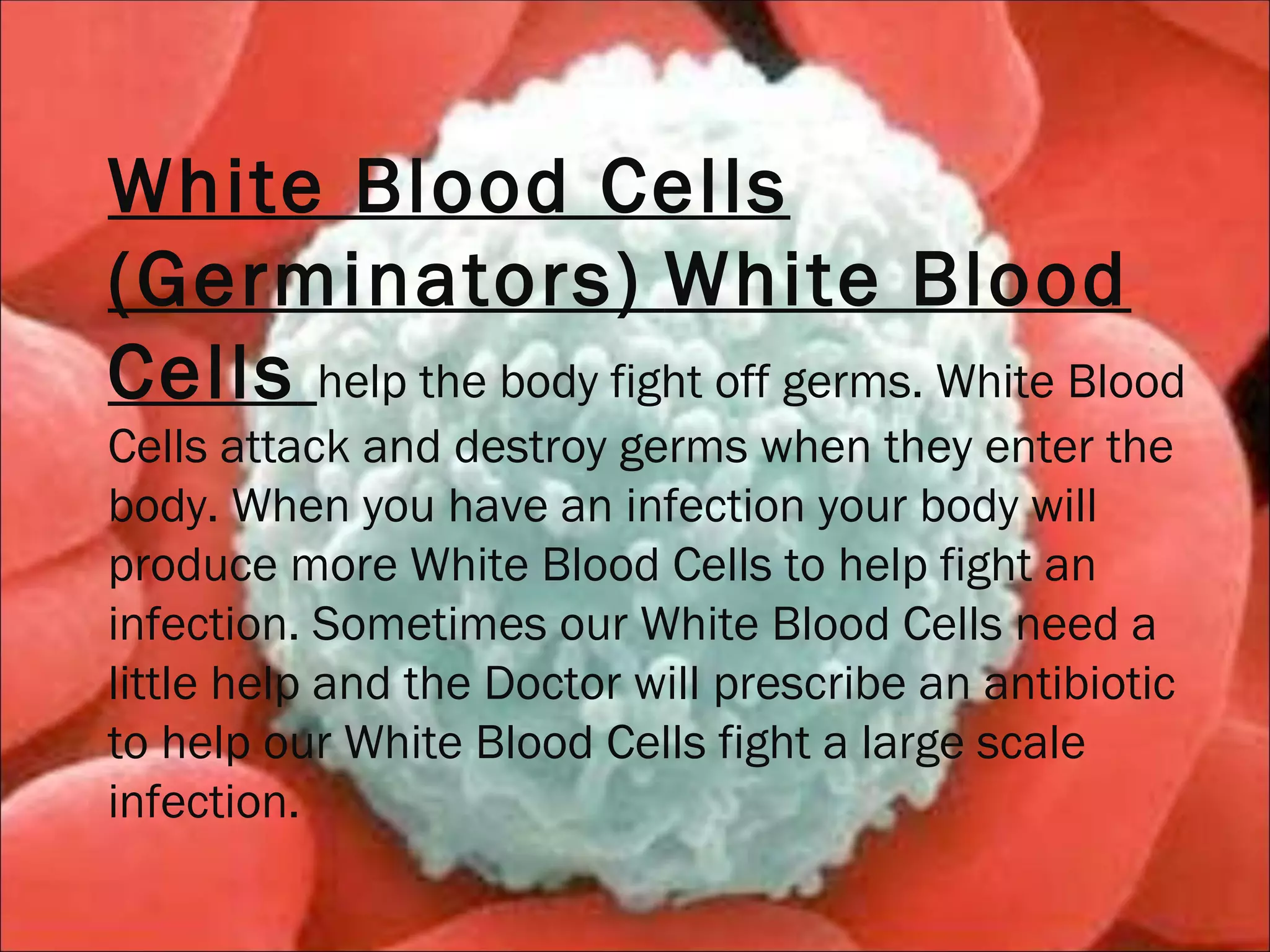
White Blood Cells
(Germinators) White Blood
Cells help the body fight off germs. White Blood
Cells attack and destroy germs when they enter the
body. When you have an infection your body will
produce more White Blood Cells to help fight an
infection. Sometimes our White Blood Cells need a
little help and the Doctor will prescribe an antibiotic
to help our White Blood Cells fight a large scale
infection.
Platelets          are blood cells that help stop
bleeding. When we cut ourselves we have broken
a blood vessel and the blood leaks out. In order
to plug up the holes where the blood is leaking
from the platelets start to stick to the opening of
the damaged blood vessels. As the platelets stick
to the opening of the damaged vessel they attract
more platelets, fibers and other blood cells to
help form a plug to seal the broken blood vessel.
When the platelet plug is completely formed the
wound stops bleeding. We call our platelet plugs
scabs.
Plasma         is the liquid part of the blood.
Approximately half of your blood is made of
plasma. The plasma carries the blood cells and
other components throughout the body. Plasma is
made in the liver.

Where are the blood cells made?
The Red Blood Cells, White Blood Cells and
Platelets are made by the bone marrow. Bone
marrow is a soft tissue inside of our bones that
produces blood cells.
The Blood Vessels
In class we talked about three types of blood
vessels:
             1.Arteries


            2.Capillaries
            3.Veins
Arteries Arteries are blood vessels that carry
oxygen rich blood AWAY from the heart.
Remember, A A Arteries Away, A A Arteries
Away, A A Arteries Away. Capillaries
Capillaries are tiny blood vessels as thin or
thinner than the hairs on your head. Capillaries
connect arteries to veins. Food
substances(nutrients), oxygen and wastes pass
in and out of your blood through the capillary
walls. Veins Veins carry blood back toward
your heart.

The circulatory system

  • 1.
    Circulator y The System is responsible for transporting materials throughout the entire body. It transports nutrients, water, and oxygen to your billions of body cells and carries away wastes such as carbon dioxide that body cells produce. It is an amazing highway that travels through your entire body connecting all your body cells.
  • 2.
    Parts of theCirculatory System The circulatory System is divided into three major parts: •The Heart •The Blood •The Blood Vessels
  • 3.
    The Heart The Heartis an amazing organ. The heart beats about 3 BILLION times during an average lifetime. It is a muscle about the size of your fist. The heart is located in the center of your chest slightly to the left. It's job is to pump your blood and keep the blood moving throughout your body.
  • 4.
    It is yourjob to keep your heart healthy and there are three main things you need to remember in order to keep your heart healthy. 3.Exercise on a regular basis. Get outside and play. Keep that body moving (walk, jog, run, bike, skate, jump, swim). 5.Eat Healthy. Remember the Food Pyramid and make sure your eating your food from the bottom to top. 7.Don't Smoke! Don't Smoke! Don't Smoke! Don't Smoke! Don't Smoke!
  • 5.
    The Blood The bloodis an amazing substance that is constantly flowing through our bodies. •Your blood is pumped by your heart. •Your blood travels through thousands of miles of blood vessels right within your own body. •Your blood carries nutrients, water, oxygen and waste products to and from your body cells. •A young person has about a gallon of blood. An adult has about 5 quarts. •Your blood is not just a red liquid but rather is made up of liquids, solids and
  • 6.
    Blood Cells Red BloodCells are responsible for carrying oxygen and carbon dioxide. Red Blood Cells pick up oxygen in the lungs and transport it to all the body cells. After delivering the oxygen to the cells it gathers up the carbon dioxide(a waste gas produced as our cells are working) and transports carbon dioxide back to the lungs where it is removed from the body when we exhale(breath out). There are about 5,000,000 Red Blood Cells in ONE drop of blood.
  • 7.
    White Blood Cells (Germinators)White Blood Cells help the body fight off germs. White Blood Cells attack and destroy germs when they enter the body. When you have an infection your body will produce more White Blood Cells to help fight an infection. Sometimes our White Blood Cells need a little help and the Doctor will prescribe an antibiotic to help our White Blood Cells fight a large scale infection.
  • 8.
    Platelets are blood cells that help stop bleeding. When we cut ourselves we have broken a blood vessel and the blood leaks out. In order to plug up the holes where the blood is leaking from the platelets start to stick to the opening of the damaged blood vessels. As the platelets stick to the opening of the damaged vessel they attract more platelets, fibers and other blood cells to help form a plug to seal the broken blood vessel. When the platelet plug is completely formed the wound stops bleeding. We call our platelet plugs scabs.
  • 9.
    Plasma is the liquid part of the blood. Approximately half of your blood is made of plasma. The plasma carries the blood cells and other components throughout the body. Plasma is made in the liver. Where are the blood cells made? The Red Blood Cells, White Blood Cells and Platelets are made by the bone marrow. Bone marrow is a soft tissue inside of our bones that produces blood cells.
  • 10.
    The Blood Vessels Inclass we talked about three types of blood vessels: 1.Arteries 2.Capillaries 3.Veins
  • 11.
    Arteries Arteries areblood vessels that carry oxygen rich blood AWAY from the heart. Remember, A A Arteries Away, A A Arteries Away, A A Arteries Away. Capillaries Capillaries are tiny blood vessels as thin or thinner than the hairs on your head. Capillaries connect arteries to veins. Food substances(nutrients), oxygen and wastes pass in and out of your blood through the capillary walls. Veins Veins carry blood back toward your heart.