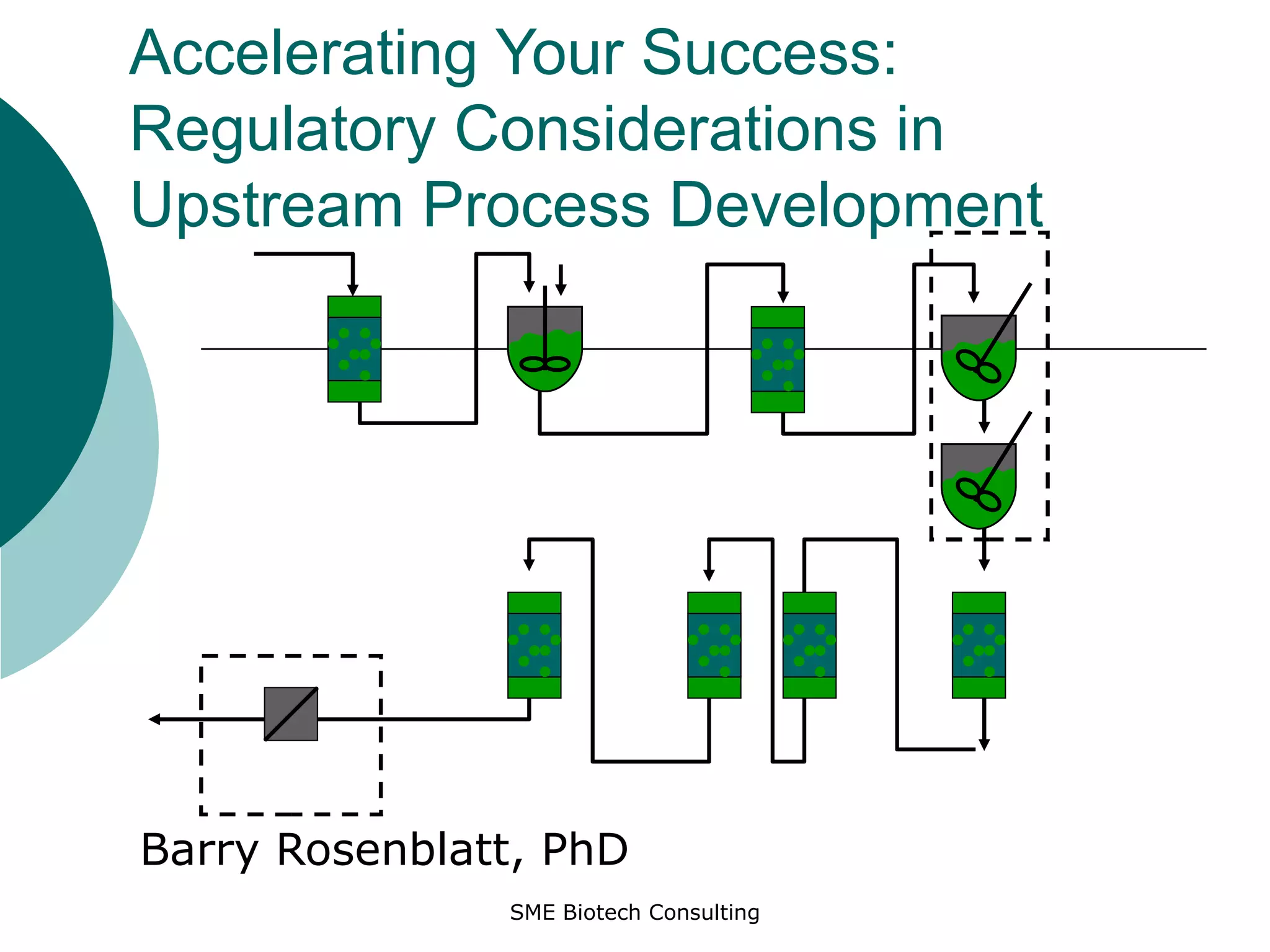
Accelerating Your Success: Regulatory Considerations in Upstream Process Development Barry Rosenblatt, PhD
Biotech Process of Creating a Drug Target Identification Candidate Selection Candidate Optimization Pre-IND Evaluation and Clinical Trials   Time Conc t 1/2 Target Validation 
Characterization of Continuous Cell Lines What do the ICH/EU guidelines and “Points to Consider” suggest? Definitions of cell banks Test descriptions A typical cell testing approach
Guideline Documents ICH: VIRAL SAFETY EVALUATION OF BIOTECHNOLOGY PRODUCTS DERIVED FROM CELL LINES OF HUMAN OR ANIMAL ORIGIN Q5A(Rl) DERIVATION AND CHARACTERISATION OF CELL SUBSTRATES USED FOR PRODUCTION OF BIOTECHNOLOGICAL/BIOLOGICAL PRODUCTS Q5D FDA: Points to Consider in the Characterization of Cell Lines Used to Produce Biologicals (1993) EU: GUIDELINE ON VIRUS SAFETY EVALUATION OF BIOTECHNOLOGICALINVESTIGATIONAL MEDICINAL PRODUCTS Doc. Ref. EMEA/CHMP/BWP/398498/2005 (FEB 2009)
ICH Guidelines And Points To Consider  Cell Lines History & genealogy Cell seed systems (banks) Culture medium Growth  in vitro Time of sampling and testing Production and testing facilities
Master Cell Bank (Definition) The Master Cell Bank (MCB) is a quantity of cells derived from a single tissue and stored frozen at -70°C or below in aliquots, one or more of which would be used for the production of the Working Cell Bank (WCB)
Working Cell Bank (Definition) The Working Cell Bank (WCB) is a quantity of cells derived from one or more of the ampoules of the cell seed and of uniform composition stored as -70°C or below in aliquots, one or more of which would be used for the production of a biological product.
End of Production or Cells at In-Vitro Limit Cells obtained at or several generations past the stage at which crude product was harvested. End of Production Cells (EoP)or “Cells at the Limit of  in vitro  Cell Age Used for Production” (CAL) are typically derived from the expansion of the WCB
Cell Line History & Genealogy Age, sex and species of the donor Individual and family medical history Culture history of the line including methods used for the isolation of the tissues from which the line was derived, split ratio used in passaging, media, etc.
MCB & WCB Storage Stored in liquid or vapor phase of liquid nitrogen Documented location, identity, and inventory of ampoules Stored in multiple locations/sites (minimum of 2)
Culture Medium Raw materials testing, i.e., serum adventitious agents Accurate records on composition and sources Testing for residual amount in final product Absence of antibiotics
Growth Characteristics  In Vitro Stable Pattern and morphological appearance Population doubling time (PDL) to post-production Determine PDL’s through senescence Determine number of generations
Time of Sampling and Testing Tests should be performed on cell suspensions (lysates)/fluids derived from the WCB propagated to or beyond the level at which they are to be used in production.
Production and Testing Facilities Absence of contamination with transmissible agents Cross-contamination with other cell lines i.e., Good Manufacturing Practices  21CFR parts 210-211 ICH Q7
Cell Line Characterization Mammalian (general) Mycoplasma & Sterility In Vivo  adventitious agent detection In Vitro  adventitious agent detection Karyology & Isoenzymes Transmission Electron Microscopy Reverse Transcriptase Activity Tumorigenicity
Test Description Mycoplasma & Sterility Mycoplasma Cultivable and non-cultivable Aerobic and anaerobic Culture and DNA fluorochrome methods Sterility Bacteria and fungi USP, 21 CFR 610.12, EP 2.6.1
Test Description In Vivo  Safety Tests Adult and suckling mice Embryonated hen’s eggs 21 CFR 630.35  Simian cell lines may require Rabbits Guinea pigs
Test Description Presence of Viruses In vitro  cell culture (Cell Line dependant) Cell line being characterized or one from the same species A normal human embryo cell line A monkey kidney cell line Minimum 14 day culture Normal morphology Hemadsorbing viruses
Test Description Karyology/Isoenzyme  Gross abnormalities in chromosome number or morphology Abnormalities intrinsic to original fetal material Exposure to chemical or physical mutagens Mislabeling and/or cross contamination
Test Description Electron Microscopy TEM sections at 50,000 X Pelleted cell supernatant Examine for viruses or other microbial agents
Test Description Specific Tests for Retroviruses Reverse transcriptase conventional PBRT (PCR based reverse transcriptase)  Inoculation of RV-supporting cell lines with supernatants from production cultures
Test Description Tumorigenicity Testing In Vivo Nude Mice Immunosuppressed newborn hamsters, mice or rats Thymectomized and irradiated mice or rats In Vitro Colony formation in soft agarose (Must be shown to be at least as sensitive as  in vivo )
Murine Cell Line Characterization (Master Cell Bank) In vitro  (3 cell line, 28 day) Mouse Antibody Production (MAP) In vivo  (adult & suckling mice, eggs) Transmission Electron Microscopy Mycoplasma Reverse Transcriptase Sterility Extended XC Extended ERV Extended S+L- Karyology & Isoenzymes Bovine & Porcine Viruses (optional)
Murine Cell Line Characterization (Working Cell Bank) Sterility Mycoplasma In vitro   ( 3 cell line, 28 day - optional) Isoenzyme (optional)
Murine Cell Line Characterization   (End of Production Cells) In vitro  (3 cell line, 28 day) In vivo  (adult & suckling mice, eggs) Transmission Electron Microscopy Mycoplasma Reverse Transcriptase Sterility Extended XC Extended ERV Extended S+L- Karyology & Isoenzymes Bovine & Porcine Viruses (optional)
ICH Summary Virus Testing
EU Guidance  (Cell Harvest) *  Where possible, test material should contain cells or cellular fragments in order to detect cell associated viruses. For perfusion cell cultures, manufacturers should determine and justify the most appropriate stage at which to derive samples containing cells for testing. It is also acceptable to derive test material from cells that have been cultured beyond the scale used to generate the batch of product; in these circumstances, the approach taken should be justified. Testing for infectious retroviruses may be omitted when more sensitive tests have shown negative results. § Quantification of retroviruses or retroviral-like particles need only be performed for the first three bulks for a specific stage of development (or less, if less than three bulks are prepared). Yes, once for given scale Yes, once for given scale Yes, all bulks§ All other cell lines No Yes, once for given scale Yes, all bulks§ NS0 and Sp2/0 No No Yes, all bulks§  CHO In vivo  testing* Tests for infectious retroviruses* In vitro  testing
Optimize cell line Media  Subclone Expression system The Cycle
Comparability & Setting Specifications Develop Apply Analyze Specs?
Comparability & Setting Specifications Specs ? Comparability? Comparability? Develop Apply Analyze
Conclusions Cell Line optimization can occur at multiple points during development Media optimization goes hand-in-hand with cell line optimization Customized media may require customized testing Re-testing is required for every new cell line (Establishment of bank) Comparability testing should be planned in advance of cell line/process changes

Accelerating Usp

  • 1.
    Accelerating Your Success:Regulatory Considerations in Upstream Process Development Barry Rosenblatt, PhD
  • 2.
    Biotech Process ofCreating a Drug Target Identification Candidate Selection Candidate Optimization Pre-IND Evaluation and Clinical Trials Time Conc t 1/2 Target Validation 
  • 3.
    Characterization of ContinuousCell Lines What do the ICH/EU guidelines and “Points to Consider” suggest? Definitions of cell banks Test descriptions A typical cell testing approach
  • 4.
    Guideline Documents ICH:VIRAL SAFETY EVALUATION OF BIOTECHNOLOGY PRODUCTS DERIVED FROM CELL LINES OF HUMAN OR ANIMAL ORIGIN Q5A(Rl) DERIVATION AND CHARACTERISATION OF CELL SUBSTRATES USED FOR PRODUCTION OF BIOTECHNOLOGICAL/BIOLOGICAL PRODUCTS Q5D FDA: Points to Consider in the Characterization of Cell Lines Used to Produce Biologicals (1993) EU: GUIDELINE ON VIRUS SAFETY EVALUATION OF BIOTECHNOLOGICALINVESTIGATIONAL MEDICINAL PRODUCTS Doc. Ref. EMEA/CHMP/BWP/398498/2005 (FEB 2009)
  • 5.
    ICH Guidelines AndPoints To Consider Cell Lines History & genealogy Cell seed systems (banks) Culture medium Growth in vitro Time of sampling and testing Production and testing facilities
  • 6.
    Master Cell Bank(Definition) The Master Cell Bank (MCB) is a quantity of cells derived from a single tissue and stored frozen at -70°C or below in aliquots, one or more of which would be used for the production of the Working Cell Bank (WCB)
  • 7.
    Working Cell Bank(Definition) The Working Cell Bank (WCB) is a quantity of cells derived from one or more of the ampoules of the cell seed and of uniform composition stored as -70°C or below in aliquots, one or more of which would be used for the production of a biological product.
  • 8.
    End of Productionor Cells at In-Vitro Limit Cells obtained at or several generations past the stage at which crude product was harvested. End of Production Cells (EoP)or “Cells at the Limit of in vitro Cell Age Used for Production” (CAL) are typically derived from the expansion of the WCB
  • 9.
    Cell Line History& Genealogy Age, sex and species of the donor Individual and family medical history Culture history of the line including methods used for the isolation of the tissues from which the line was derived, split ratio used in passaging, media, etc.
  • 10.
    MCB & WCBStorage Stored in liquid or vapor phase of liquid nitrogen Documented location, identity, and inventory of ampoules Stored in multiple locations/sites (minimum of 2)
  • 11.
    Culture Medium Rawmaterials testing, i.e., serum adventitious agents Accurate records on composition and sources Testing for residual amount in final product Absence of antibiotics
  • 12.
    Growth Characteristics In Vitro Stable Pattern and morphological appearance Population doubling time (PDL) to post-production Determine PDL’s through senescence Determine number of generations
  • 13.
    Time of Samplingand Testing Tests should be performed on cell suspensions (lysates)/fluids derived from the WCB propagated to or beyond the level at which they are to be used in production.
  • 14.
    Production and TestingFacilities Absence of contamination with transmissible agents Cross-contamination with other cell lines i.e., Good Manufacturing Practices 21CFR parts 210-211 ICH Q7
  • 15.
    Cell Line CharacterizationMammalian (general) Mycoplasma & Sterility In Vivo adventitious agent detection In Vitro adventitious agent detection Karyology & Isoenzymes Transmission Electron Microscopy Reverse Transcriptase Activity Tumorigenicity
  • 16.
    Test Description Mycoplasma& Sterility Mycoplasma Cultivable and non-cultivable Aerobic and anaerobic Culture and DNA fluorochrome methods Sterility Bacteria and fungi USP, 21 CFR 610.12, EP 2.6.1
  • 17.
    Test Description InVivo Safety Tests Adult and suckling mice Embryonated hen’s eggs 21 CFR 630.35 Simian cell lines may require Rabbits Guinea pigs
  • 18.
    Test Description Presenceof Viruses In vitro cell culture (Cell Line dependant) Cell line being characterized or one from the same species A normal human embryo cell line A monkey kidney cell line Minimum 14 day culture Normal morphology Hemadsorbing viruses
  • 19.
    Test Description Karyology/Isoenzyme Gross abnormalities in chromosome number or morphology Abnormalities intrinsic to original fetal material Exposure to chemical or physical mutagens Mislabeling and/or cross contamination
  • 20.
    Test Description ElectronMicroscopy TEM sections at 50,000 X Pelleted cell supernatant Examine for viruses or other microbial agents
  • 21.
    Test Description SpecificTests for Retroviruses Reverse transcriptase conventional PBRT (PCR based reverse transcriptase) Inoculation of RV-supporting cell lines with supernatants from production cultures
  • 22.
    Test Description TumorigenicityTesting In Vivo Nude Mice Immunosuppressed newborn hamsters, mice or rats Thymectomized and irradiated mice or rats In Vitro Colony formation in soft agarose (Must be shown to be at least as sensitive as in vivo )
  • 23.
    Murine Cell LineCharacterization (Master Cell Bank) In vitro (3 cell line, 28 day) Mouse Antibody Production (MAP) In vivo (adult & suckling mice, eggs) Transmission Electron Microscopy Mycoplasma Reverse Transcriptase Sterility Extended XC Extended ERV Extended S+L- Karyology & Isoenzymes Bovine & Porcine Viruses (optional)
  • 24.
    Murine Cell LineCharacterization (Working Cell Bank) Sterility Mycoplasma In vitro ( 3 cell line, 28 day - optional) Isoenzyme (optional)
  • 25.
    Murine Cell LineCharacterization (End of Production Cells) In vitro (3 cell line, 28 day) In vivo (adult & suckling mice, eggs) Transmission Electron Microscopy Mycoplasma Reverse Transcriptase Sterility Extended XC Extended ERV Extended S+L- Karyology & Isoenzymes Bovine & Porcine Viruses (optional)
  • 26.
  • 27.
    EU Guidance (Cell Harvest) * Where possible, test material should contain cells or cellular fragments in order to detect cell associated viruses. For perfusion cell cultures, manufacturers should determine and justify the most appropriate stage at which to derive samples containing cells for testing. It is also acceptable to derive test material from cells that have been cultured beyond the scale used to generate the batch of product; in these circumstances, the approach taken should be justified. Testing for infectious retroviruses may be omitted when more sensitive tests have shown negative results. § Quantification of retroviruses or retroviral-like particles need only be performed for the first three bulks for a specific stage of development (or less, if less than three bulks are prepared). Yes, once for given scale Yes, once for given scale Yes, all bulks§ All other cell lines No Yes, once for given scale Yes, all bulks§ NS0 and Sp2/0 No No Yes, all bulks§ CHO In vivo testing* Tests for infectious retroviruses* In vitro testing
  • 28.
    Optimize cell lineMedia Subclone Expression system The Cycle
  • 29.
    Comparability & SettingSpecifications Develop Apply Analyze Specs?
  • 30.
    Comparability & SettingSpecifications Specs ? Comparability? Comparability? Develop Apply Analyze
  • 31.
    Conclusions Cell Lineoptimization can occur at multiple points during development Media optimization goes hand-in-hand with cell line optimization Customized media may require customized testing Re-testing is required for every new cell line (Establishment of bank) Comparability testing should be planned in advance of cell line/process changes