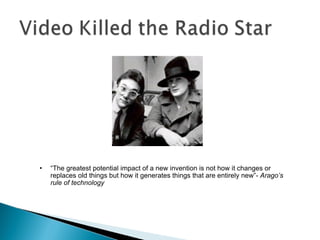



“ The greatest potential impact of a new invention is not how it changes or replaces old things but how it generates things that are entirely new”-  Arago’s rule of technology
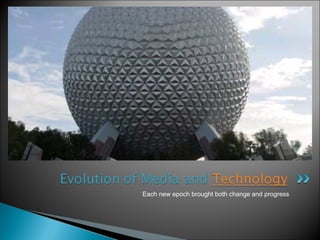
Each new epoch brought both change and progress
Prophet of the Media Deemed phrase:  “ The medium is the message ” Determines the substance of the communication Act of watching television shapes how we think regardless of its content Changes our perception of others and ourselves The dominant medium has become mass communication
McLuhan says media are a force in determining other things States that technology shapes how individuals and society think, feel and act. The dominant media of an era determine the dominant senses and ways we communicate McLuhan spent time analyzing hot and cool media Hot Media reduces our ability or need to participate Cool Media invites interaction and discussion
The Tribal Epoch: Primary communication as face to face Cohesive communities dependent on one another for information The Literate Epoch: Symbols and writing changed the dominance of face to face communication Sight replaced hearing as dominant force
The Print Epoch: Access to print media was restricted to the rich Gutenburg ’ s printing press changed this distinction Mass-produced printing began and no longer did people need to be together to share information The birth of printing marks the birth of mass communication
The Electronic Epoch Began with the telegraph Create the idea of the  “ global village ” No longer were people separated by distance Such is true today with the Internet Creates a sense of immediacy Information at your fingertips  Promotes mulitasking
Also known as the limited-effects model of mass communication Media set agenda for public discussion People talk about what they see and hear in various media outlets Media tell people what to think about not what to think … objectivity
Studied the immediacy that new technologies encourage We expect it quick, news media give it quick and mistakes happen Deadlines are fierce and fact checking is missed Have you ever found an error in a news report? Have you ever felt unsure about the report?
Defined local life Made of diverse content Served as a watchdog Guarding against governmental abuses of power Criticizing the Government John Peter Zenger trial Truth is the defense when criticizing government Convenient packaging First draft of history Newspapers are timely
Where are these styles present today? Yellow Journalism (Sensationalism- if it bleeds it leads) Jazz Journalism (lots of pictures-tabloid style)
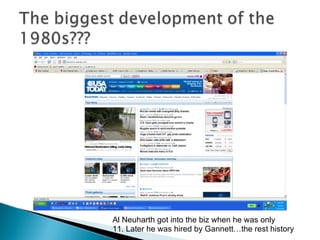
Al Neuharth got into the biz when he was only 11. Later he was hired by Gannett…the rest history
On-line newspapers No newshole limitations Updates continuously Interactive Accompanying video and audio clips New York Times  is the leader  User-generated content Blog posts Crowdsourcing Tips Mobile media
Using more color Changing to shorter writing styles and summary decks More features Free tabloids to young  readers
Circulation which drive advertising revenue Readership  A dying breed—young people find papers cumbersome and unnecessary Competition from other media Transient populations Migration to suburbs Rising costs of printing and distribution The New York Times  is shrinking from 54” to 48” Less competition and loss of diverse opinions Conglomerates account for 68% of all daily papers
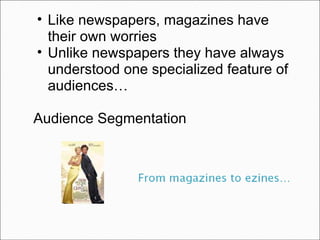
Like newspapers, magazines have their own worries Unlike newspapers they have always understood one specialized feature of audiences… Audience Segmentation
Rely heavily on advertising Internet is having a dramatic effect on readership Most especially teens Finding way to capitalize on the Internet and the mobile media potential Digital newstands My  delicious  account
Magazines were aimed at an intelligent audience Also looked to enhance and influence public opinion  Acted as Muckrakers on big business and bad practices Found it profitable to specialize Leisure time meant sports magazines Scientific advances meant magazines geared towards discovery.
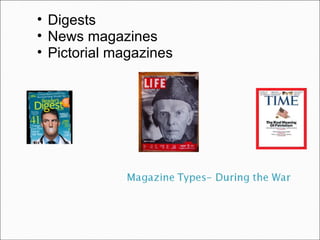
Digests News magazines Pictorial magazines
Consider these issues 17,000 magazines published in US Walmart is selective  Look for the target Cable TV Trends fade- 60% don’t last a year A Few Big Companies Time-Warner Advance Publications Hearst Corp.
Not all technology Magazines are sleek You can roll them up and take them with you Magazines have web presence
General consumer Trade publications Custom magazines Academic journals Newsletters Public relations magazines
What makes a journal  credible ?
http://www.comm.umd.edu/graduate/journals.html Journal of Communication Columbia Journalism Review Journal of Film &  Video
Not always a clear line between advertising and editorial content Product Placement Damaging Credibility
Subscriptions Paid circulation Controlled circulation Single copy sales Primary audience Pass along audience Unique visitors Advertising Rate base Ancillary functions E-commerce
Why? What made you want to read the book? Not everyone feels the same way you do…Just a bunch of slush
 
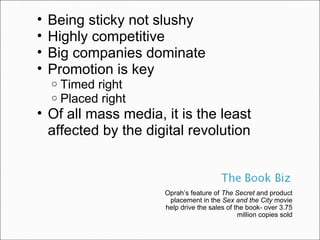
Oprah’s feature of  The Secret  and product placement in the  Sex and the City  movie help drive the sales of the book- over 3.75 million copies sold Being sticky not slushy Highly competitive Big companies dominate Promotion is key Timed right Placed right Of all mass media, it is the least affected by the digital revolution
Oldest form of commercial mass media Began by serving the elite to a form of pop culture… Books caught on… Ben Franklin’s library system of the 1700s Dime novels- paper backs (still a staple today) Specialization- schools, technical and scientific needs and higher education
Uncle Tom’s Cabin,  1852 A threat to the church Disposable income and leisure time drove the book industry Literacy and public education numbers rising Book of the month clubs of the 1920s
Small book shops being gobbled up by the bigs– Barnes and Noble and Borders E-commerce Amazon.com– Jeff Berzos (initial investment of about $300,000 started in his garage) Helped to make point and click behavior the norm Take it with you (mobile media) Functional paperbacks E-books Cell-phone downloads User-generated book  collaboration
Three main channels books get to readers Big Chain Stores (flow from publishers to distributors or wholesalers to retail to consumers) Amazon.com E-books
Agents’ submissions Unsolicited with fingers crossed No Slush! Editors Proposals include: Cover letter, synopsis, justification, audience/target market, outline, and two sample chapters
Unlike other media, books are not reliant on advertising They instead rely on book sales and subsidiary rights Making best-seller lists help to sell books Popularity Promotions

Rider Mass Media Presentation Week 2

  • 1.
    “ The greatestpotential impact of a new invention is not how it changes or replaces old things but how it generates things that are entirely new”- Arago’s rule of technology
  • 2.
    Each new epochbrought both change and progress
  • 3.
    Prophet of theMedia Deemed phrase: “ The medium is the message ” Determines the substance of the communication Act of watching television shapes how we think regardless of its content Changes our perception of others and ourselves The dominant medium has become mass communication
  • 4.
    McLuhan says mediaare a force in determining other things States that technology shapes how individuals and society think, feel and act. The dominant media of an era determine the dominant senses and ways we communicate McLuhan spent time analyzing hot and cool media Hot Media reduces our ability or need to participate Cool Media invites interaction and discussion
  • 5.
    The Tribal Epoch:Primary communication as face to face Cohesive communities dependent on one another for information The Literate Epoch: Symbols and writing changed the dominance of face to face communication Sight replaced hearing as dominant force
  • 6.
    The Print Epoch:Access to print media was restricted to the rich Gutenburg ’ s printing press changed this distinction Mass-produced printing began and no longer did people need to be together to share information The birth of printing marks the birth of mass communication
  • 7.
    The Electronic EpochBegan with the telegraph Create the idea of the “ global village ” No longer were people separated by distance Such is true today with the Internet Creates a sense of immediacy Information at your fingertips Promotes mulitasking
  • 8.
    Also known asthe limited-effects model of mass communication Media set agenda for public discussion People talk about what they see and hear in various media outlets Media tell people what to think about not what to think … objectivity
  • 9.
    Studied the immediacythat new technologies encourage We expect it quick, news media give it quick and mistakes happen Deadlines are fierce and fact checking is missed Have you ever found an error in a news report? Have you ever felt unsure about the report?
  • 10.
    Defined local lifeMade of diverse content Served as a watchdog Guarding against governmental abuses of power Criticizing the Government John Peter Zenger trial Truth is the defense when criticizing government Convenient packaging First draft of history Newspapers are timely
  • 11.
    Where are thesestyles present today? Yellow Journalism (Sensationalism- if it bleeds it leads) Jazz Journalism (lots of pictures-tabloid style)
  • 12.
    Al Neuharth gotinto the biz when he was only 11. Later he was hired by Gannett…the rest history
  • 13.
    On-line newspapers Nonewshole limitations Updates continuously Interactive Accompanying video and audio clips New York Times is the leader User-generated content Blog posts Crowdsourcing Tips Mobile media
  • 14.
    Using more colorChanging to shorter writing styles and summary decks More features Free tabloids to young readers
  • 15.
    Circulation which driveadvertising revenue Readership A dying breed—young people find papers cumbersome and unnecessary Competition from other media Transient populations Migration to suburbs Rising costs of printing and distribution The New York Times is shrinking from 54” to 48” Less competition and loss of diverse opinions Conglomerates account for 68% of all daily papers
  • 16.
    Like newspapers, magazineshave their own worries Unlike newspapers they have always understood one specialized feature of audiences… Audience Segmentation
  • 17.
    Rely heavily onadvertising Internet is having a dramatic effect on readership Most especially teens Finding way to capitalize on the Internet and the mobile media potential Digital newstands My delicious account
  • 18.
    Magazines were aimedat an intelligent audience Also looked to enhance and influence public opinion Acted as Muckrakers on big business and bad practices Found it profitable to specialize Leisure time meant sports magazines Scientific advances meant magazines geared towards discovery.
  • 19.
    Digests News magazinesPictorial magazines
  • 20.
    Consider these issues17,000 magazines published in US Walmart is selective Look for the target Cable TV Trends fade- 60% don’t last a year A Few Big Companies Time-Warner Advance Publications Hearst Corp.
  • 21.
    Not all technologyMagazines are sleek You can roll them up and take them with you Magazines have web presence
  • 22.
    General consumer Tradepublications Custom magazines Academic journals Newsletters Public relations magazines
  • 23.
    What makes ajournal credible ?
  • 24.
    http://www.comm.umd.edu/graduate/journals.html Journal ofCommunication Columbia Journalism Review Journal of Film & Video
  • 25.
    Not always aclear line between advertising and editorial content Product Placement Damaging Credibility
  • 26.
    Subscriptions Paid circulationControlled circulation Single copy sales Primary audience Pass along audience Unique visitors Advertising Rate base Ancillary functions E-commerce
  • 27.
    Why? What madeyou want to read the book? Not everyone feels the same way you do…Just a bunch of slush
  • 28.
  • 29.
    Oprah’s feature of The Secret and product placement in the Sex and the City movie help drive the sales of the book- over 3.75 million copies sold Being sticky not slushy Highly competitive Big companies dominate Promotion is key Timed right Placed right Of all mass media, it is the least affected by the digital revolution
  • 30.
    Oldest form ofcommercial mass media Began by serving the elite to a form of pop culture… Books caught on… Ben Franklin’s library system of the 1700s Dime novels- paper backs (still a staple today) Specialization- schools, technical and scientific needs and higher education
  • 31.
    Uncle Tom’s Cabin, 1852 A threat to the church Disposable income and leisure time drove the book industry Literacy and public education numbers rising Book of the month clubs of the 1920s
  • 32.
    Small book shopsbeing gobbled up by the bigs– Barnes and Noble and Borders E-commerce Amazon.com– Jeff Berzos (initial investment of about $300,000 started in his garage) Helped to make point and click behavior the norm Take it with you (mobile media) Functional paperbacks E-books Cell-phone downloads User-generated book collaboration
  • 33.
    Three main channelsbooks get to readers Big Chain Stores (flow from publishers to distributors or wholesalers to retail to consumers) Amazon.com E-books
  • 34.
    Agents’ submissions Unsolicitedwith fingers crossed No Slush! Editors Proposals include: Cover letter, synopsis, justification, audience/target market, outline, and two sample chapters
  • 35.
    Unlike other media,books are not reliant on advertising They instead rely on book sales and subsidiary rights Making best-seller lists help to sell books Popularity Promotions