Presentation to


Stephanie Aaron | Katie Koch | Russ Maschmeyer
Presentation to


Background
Presentation to


     BACKGROUND


     Filtering
     • Too much news out there
     • Move from “browsing” to “searching”
     • Most E-mailed


We all know there’s too much news & information in the world for people to manage it all
and content usage is changing from the age-old "browsing" model to the modern more interactive "searching" model
On the NY Times Online, The "Most Emailed" articles list is a heavily trafficked feature of the site
part of it’s value is that it sifts through the noise and delivers the “highlights” and the “best” of the day
So it’s clear that there’s value in distilling the "information mountain" thrown at us daily
Presentation to


     BACKGROUND


     Customization
     Netflix, Pandora, Amazon

     vs.
     My Times


Netflix, Pandora, Amazon have all capitalized on the value in customization
These services utilize a passive kind of customization
taking user activity and analyzing it
and in return providing more targeted content
My Times was a great step toward customizing the times
but required active time and effort on the part of the reader to implement
Presentation to


      BACKGROUND


      The Medium
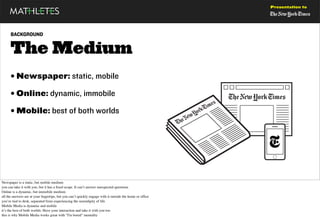
      • Newspaper: static, mobile
      • Online: dynamic, immobile
      • Mobile: best of both worlds


Newspaper is a static, but mobile medium
you can take it with you, but it has a fixed scope. It can’t answer unexpected questions
Online is a dynamic, but immobile medium
all the answers are at your fingertips, but you can’t quickly engage with it outside the home or office
you’re tied to desk, separated from experiencing the serendipity of life
Mobile Media is dynamic and mobile
it’s the best of both worlds: Have your interaction and take it with you too
this is why Mobile Media works great with "I'm bored" mentality
Presentation to


When it comes to content,
It’s hard to discover the great interactive & contextualizing features of NY Times
Presentation to


      BACKGROUND


      Content
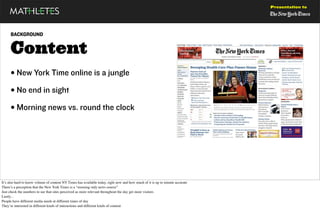
      • New York Time online is a jungle
      • No end in sight
      • Morning news vs. round the clock


It’s also hard to know volume of content NY Times has available today, right now and how much of it is up to minute accurate
There’s a perception that the New York Times is a "morning only news source”
Just check the numbers to see that sites perceived as more relevant throughout the day get more visitors
Lastly...
People have different media needs at different times of day
They’re interested in different kinds of interactions and different kinds of content
Presentation to


The Problem
Presentation to


THE PROBLEM


Keeping up with the news has
become a laborious, negative
experience.
Presentation to


     THE PROBLEM


     • Readers can’t keep up
     • When they lose track they lose context
     • When they lose context they lose interest
     • When they lose interest, you lose readers


 · readers can't keep up with mounting pile of media
· when they lose track of what’s current, they lose context.
· when they lose context, they lose interest.
· when they lose interest, you lose readers.
Presentation to


The Big Idea
Presentation to


THE BIG IDEA

Foster a renewed connection
to news by creating a system that makes
getting relevant NY Times content an
effortless, positive experience.
Presentation to


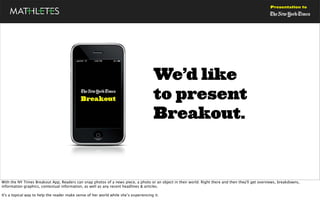
                                                                                       We’d like
                                                                                       to present
                                                                                       Breakout.


With the NY Times Breakout App, Readers can snap photos of a news piece, a photo or an object in their world. Right there and then they'll get overviews, breakdowns,
information graphics, contextual information, as well as any recent headlines & articles.

It's a topical way to help the reader make sense of her world while she’s experiencing it.
Presentation to


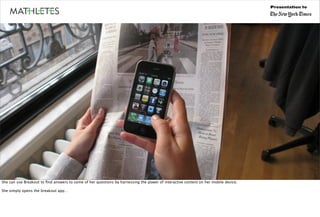
When Kristin reads the New York Times, she may have additional questions about some of the content she reads.
Presentation to


She can use Breakout to find answers to some of her questions by harnessing the power of interactive content on her mobile device.

She simply opens the breakout app…
Presentation to


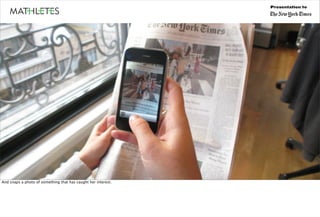
And snaps a photo of something that has caught her interest.
Presentation to


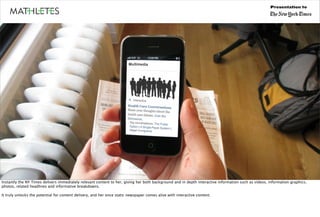
Instantly the NY Times delivers immediately relevant content to her, giving her both background and in depth interactive information such as videos, information graphics,
photos, related headlines and informative breakdowns.

It truly unlocks the potential for content delivery, and her once static newspaper comes alive with interactive content.
Presentation to


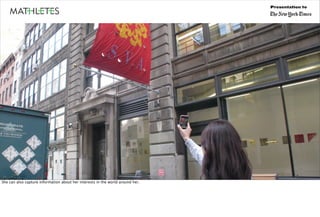
She can also capture information about her interests in the world around her.
Presentation to


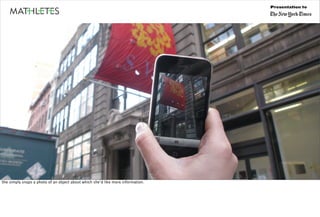
She simply snaps a photo of an object about which she’d like more information.
Presentation to


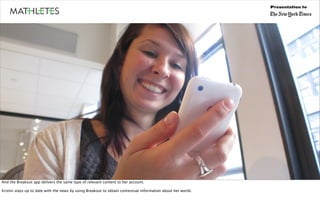
And the Breakout app delivers the same type of relevant content to her account.

Kristin stays up to date with the news by using Breakout to obtain contextual information about her world.
Presentation to


    THE BIG IDEA


    Her real world curiosity enhances
    her New York Times experience.


Because the Breakout app belongs to an ecosystem of customized content delivery,
Kristin’s real world curiosity will enhance her experience of the New York Times
in whatever form she chooses to access it
Presentation to


By using Breakout, a reader can interact with her world, and unlock their printed editions in entirely new ways.
Presentation to


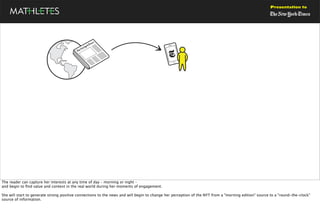
The reader can capture her interests at any time of day – morning or night –
and begin to find value and context in the real world during her moments of engagement.

She will start to generate strong positive connections to the news and will begin to change her perception of the NYT from a "morning edition" source to a "round-the-clock"
source of information.
Presentation to


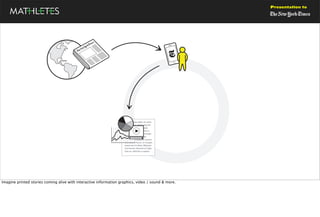
Imagine printed stories coming alive with interactive information graphics, video / sound & more.
Presentation to


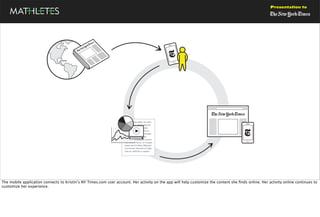
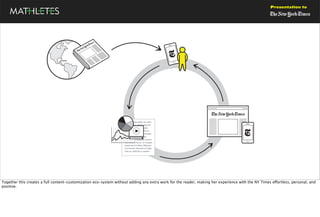
The mobile application connects to Kristin’s NY Times.com user account. Her activity on the app will help customize the content she finds online. Her activity online continues to
customize her experience.
Presentation to


Together this creates a full content-customization eco-system without adding any extra work for the reader, making her experience with the NY Times effortless, personal, and
positive.
Presentation to


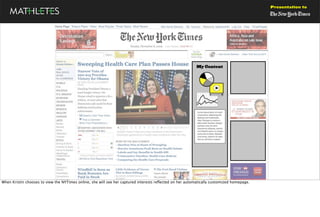
When Kristin chooses to view the NYTimes online, she will see her captured interests reflected on her automatically customized homepage.
Presentation to


Let’s talk business.
Presentation to


      The New York Times will finally
      get to know its users.
      • Active readers provide more clues
      • More clues help solve the user puzzle
      • Continuous analysis of readers’ habits


Readers will be constantly updating their interests via their accounts.
We will know more about our readers through their self-curated content.
User data will be continuously captured and processed.
Presentation to


    Deliver real value to advertisers.
    • Intimate knowledge of readers’ interests
    • Specific connection with individual readers


With an in-depth knowledge of readers on a personal level, The New York Times will be able to offer highly-focused advertising spots to buyers.
Presentation to


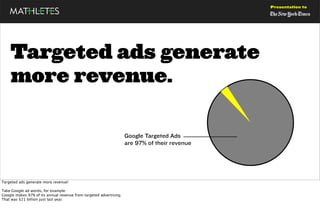
    Targeted ads generate
    more revenue.

                                                                    Google Targeted Ads
                                                                    are 97% of their revenue


Targeted ads generate more revenue!

Take Google ad words, for example:
Google makes 97% of its annual revenue from targeted advertising.
That was $21 billion just last year.
Presentation to


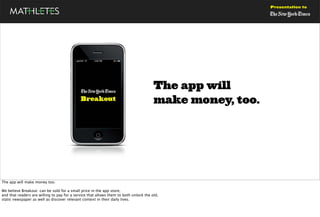
                                                                                       The app will
                                                                                       make money, too.


The app will make money too.

We believe Breakout can be sold for a small price in the app store,
and that readers are willing to pay for a service that allows them to both unlock the old,
static newspaper as well as discover relevant context in their daily lives.
Presentation to


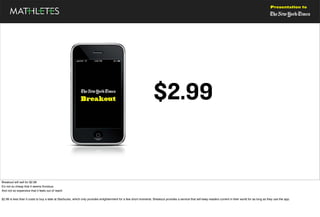
                                                                                                                     $2.99


Breakout will sell for $2.99
Itʼs not so cheap that it seems frivolous
And not so expensive that it feels out of reach

$2.99 is less than it costs to buy a latte at Starbucks, which only provides enlightenment for a few short moments. Breakout provides a service that will keep readers current in their world for as long as they use the app.
Presentation to


Building Connections
Presentation to


     BUILDING CONNECTIONS

     An Ecosystem for Delivering Value
     • Rekindles an interest in staying informed
     • Builds an emotional tie with The New York Times
     • We’ll see a clearer picture of our readers
     • Leverage our insights to provide value to advertisers


Breakout creates an ecosystem that makes reading the news an effortless, positive experience, rekindling an interest in staying informed.
It builds an emotional tie between curiosity & discovery using the NY Times.
And readers will connect relevant NY Times content to their world in profound ways.

Each reader’s enthusiasm for exploring his or her interests helps the New York Times by providing a clearer picture of the reader, which helps us connect our advertisers with
the right customers.
Presentation to


Thank you!

New York Times, Breakout

  • 1.
    Presentation to Stephanie Aaron| Katie Koch | Russ Maschmeyer
  • 2.
  • 3.
    Presentation to BACKGROUND Filtering • Too much news out there • Move from “browsing” to “searching” • Most E-mailed We all know there’s too much news & information in the world for people to manage it all and content usage is changing from the age-old "browsing" model to the modern more interactive "searching" model On the NY Times Online, The "Most Emailed" articles list is a heavily trafficked feature of the site part of it’s value is that it sifts through the noise and delivers the “highlights” and the “best” of the day So it’s clear that there’s value in distilling the "information mountain" thrown at us daily
  • 4.
    Presentation to BACKGROUND Customization Netflix, Pandora, Amazon vs. My Times Netflix, Pandora, Amazon have all capitalized on the value in customization These services utilize a passive kind of customization taking user activity and analyzing it and in return providing more targeted content My Times was a great step toward customizing the times but required active time and effort on the part of the reader to implement
  • 5.
    Presentation to BACKGROUND The Medium • Newspaper: static, mobile • Online: dynamic, immobile • Mobile: best of both worlds Newspaper is a static, but mobile medium you can take it with you, but it has a fixed scope. It can’t answer unexpected questions Online is a dynamic, but immobile medium all the answers are at your fingertips, but you can’t quickly engage with it outside the home or office you’re tied to desk, separated from experiencing the serendipity of life Mobile Media is dynamic and mobile it’s the best of both worlds: Have your interaction and take it with you too this is why Mobile Media works great with "I'm bored" mentality
  • 6.
    Presentation to When itcomes to content, It’s hard to discover the great interactive & contextualizing features of NY Times
  • 7.
    Presentation to BACKGROUND Content • New York Time online is a jungle • No end in sight • Morning news vs. round the clock It’s also hard to know volume of content NY Times has available today, right now and how much of it is up to minute accurate There’s a perception that the New York Times is a "morning only news source” Just check the numbers to see that sites perceived as more relevant throughout the day get more visitors Lastly... People have different media needs at different times of day They’re interested in different kinds of interactions and different kinds of content
  • 8.
  • 9.
    Presentation to THE PROBLEM Keepingup with the news has become a laborious, negative experience.
  • 10.
    Presentation to THE PROBLEM • Readers can’t keep up • When they lose track they lose context • When they lose context they lose interest • When they lose interest, you lose readers · readers can't keep up with mounting pile of media · when they lose track of what’s current, they lose context. · when they lose context, they lose interest. · when they lose interest, you lose readers.
  • 11.
  • 12.
    Presentation to THE BIGIDEA Foster a renewed connection to news by creating a system that makes getting relevant NY Times content an effortless, positive experience.
  • 13.
    Presentation to We’d like to present Breakout. With the NY Times Breakout App, Readers can snap photos of a news piece, a photo or an object in their world. Right there and then they'll get overviews, breakdowns, information graphics, contextual information, as well as any recent headlines & articles. It's a topical way to help the reader make sense of her world while she’s experiencing it.
  • 14.
    Presentation to When Kristinreads the New York Times, she may have additional questions about some of the content she reads.
  • 15.
    Presentation to She canuse Breakout to find answers to some of her questions by harnessing the power of interactive content on her mobile device. She simply opens the breakout app…
  • 16.
    Presentation to And snapsa photo of something that has caught her interest.
  • 17.
    Presentation to Instantly theNY Times delivers immediately relevant content to her, giving her both background and in depth interactive information such as videos, information graphics, photos, related headlines and informative breakdowns. It truly unlocks the potential for content delivery, and her once static newspaper comes alive with interactive content.
  • 18.
    Presentation to She canalso capture information about her interests in the world around her.
  • 19.
    Presentation to She simplysnaps a photo of an object about which she’d like more information.
  • 20.
    Presentation to And theBreakout app delivers the same type of relevant content to her account. Kristin stays up to date with the news by using Breakout to obtain contextual information about her world.
  • 21.
    Presentation to THE BIG IDEA Her real world curiosity enhances her New York Times experience. Because the Breakout app belongs to an ecosystem of customized content delivery, Kristin’s real world curiosity will enhance her experience of the New York Times in whatever form she chooses to access it
  • 22.
    Presentation to By usingBreakout, a reader can interact with her world, and unlock their printed editions in entirely new ways.
  • 23.
    Presentation to The readercan capture her interests at any time of day – morning or night – and begin to find value and context in the real world during her moments of engagement. She will start to generate strong positive connections to the news and will begin to change her perception of the NYT from a "morning edition" source to a "round-the-clock" source of information.
  • 24.
    Presentation to Imagine printedstories coming alive with interactive information graphics, video / sound & more.
  • 25.
    Presentation to The mobileapplication connects to Kristin’s NY Times.com user account. Her activity on the app will help customize the content she finds online. Her activity online continues to customize her experience.
  • 26.
    Presentation to Together thiscreates a full content-customization eco-system without adding any extra work for the reader, making her experience with the NY Times effortless, personal, and positive.
  • 27.
    Presentation to When Kristinchooses to view the NYTimes online, she will see her captured interests reflected on her automatically customized homepage.
  • 28.
  • 29.
    Presentation to The New York Times will finally get to know its users. • Active readers provide more clues • More clues help solve the user puzzle • Continuous analysis of readers’ habits Readers will be constantly updating their interests via their accounts. We will know more about our readers through their self-curated content. User data will be continuously captured and processed.
  • 30.
    Presentation to Deliver real value to advertisers. • Intimate knowledge of readers’ interests • Specific connection with individual readers With an in-depth knowledge of readers on a personal level, The New York Times will be able to offer highly-focused advertising spots to buyers.
  • 31.
    Presentation to Targeted ads generate more revenue. Google Targeted Ads are 97% of their revenue Targeted ads generate more revenue! Take Google ad words, for example: Google makes 97% of its annual revenue from targeted advertising. That was $21 billion just last year.
  • 32.
    Presentation to The app will make money, too. The app will make money too. We believe Breakout can be sold for a small price in the app store, and that readers are willing to pay for a service that allows them to both unlock the old, static newspaper as well as discover relevant context in their daily lives.
  • 33.
    Presentation to $2.99 Breakout will sell for $2.99 Itʼs not so cheap that it seems frivolous And not so expensive that it feels out of reach $2.99 is less than it costs to buy a latte at Starbucks, which only provides enlightenment for a few short moments. Breakout provides a service that will keep readers current in their world for as long as they use the app.
  • 34.
  • 35.
    Presentation to BUILDING CONNECTIONS An Ecosystem for Delivering Value • Rekindles an interest in staying informed • Builds an emotional tie with The New York Times • We’ll see a clearer picture of our readers • Leverage our insights to provide value to advertisers Breakout creates an ecosystem that makes reading the news an effortless, positive experience, rekindling an interest in staying informed. It builds an emotional tie between curiosity & discovery using the NY Times. And readers will connect relevant NY Times content to their world in profound ways. Each reader’s enthusiasm for exploring his or her interests helps the New York Times by providing a clearer picture of the reader, which helps us connect our advertisers with the right customers.
  • 36.