© Men & Mice http://menandmice.com
DNS Certification Authority
Authorization (CAA) 

Resource Record
what will change in September?
1
© Men & Mice http://menandmice.com
Agenda
1. Brief overview on the CAA record
2. How CAA is used
3. CAA mandatory from September 2017
4. Detail look on CAA
1. ISSUE and ISSUEWILD
2. IODEF - Reporting misuse
3. The flags
4. Custom CAA values
5. Hierarchical CAA
5. Deploying CAA
2
© Men & Mice http://menandmice.com
a brief overview of the CAA
record
3
© Men & Mice http://menandmice.com
CAA record
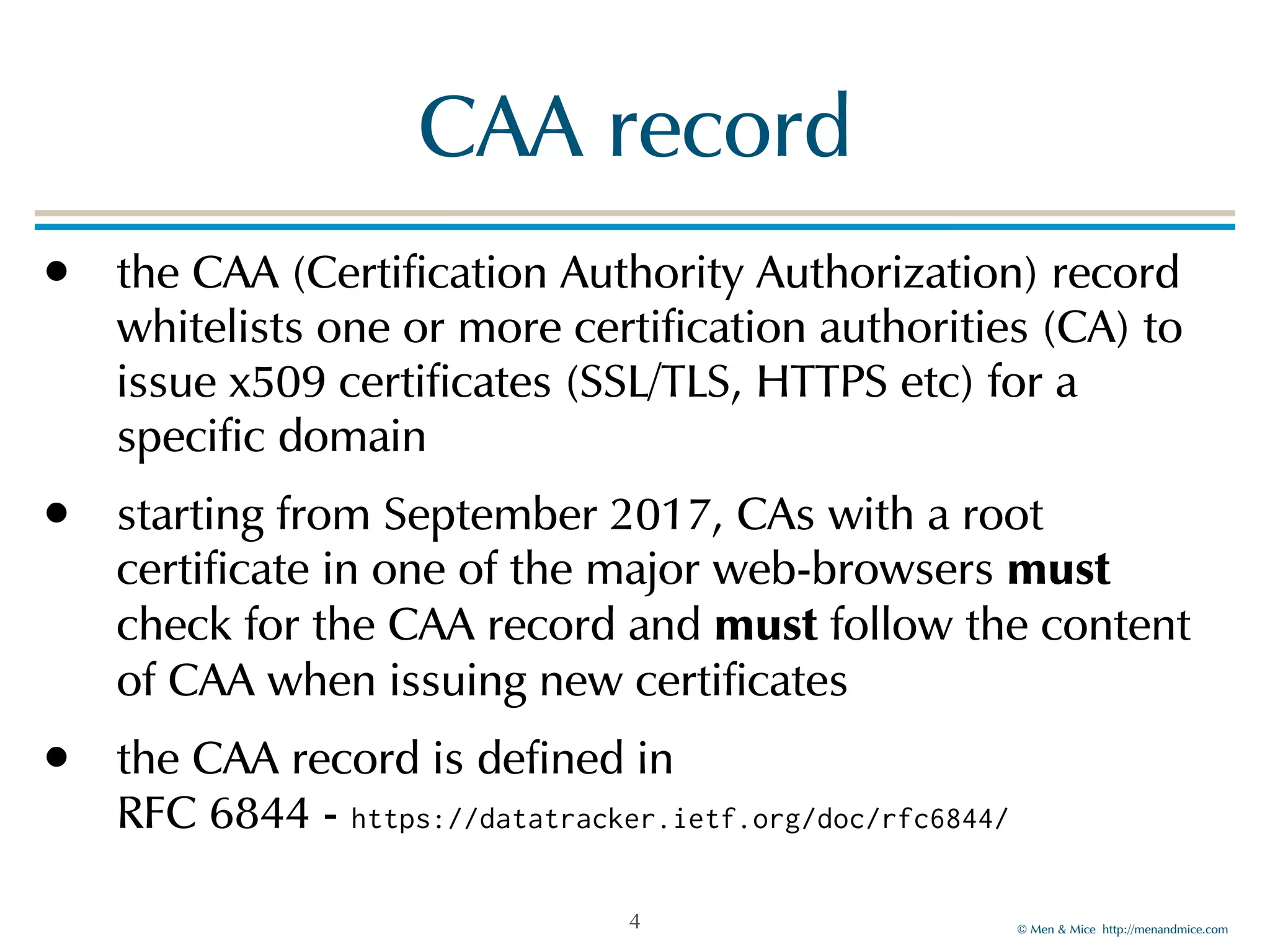
• the CAA (Certification Authority Authorization) record
whitelists one or more certification authorities (CA) to
issue x509 certificates (SSL/TLS, HTTPS etc) for a
specific domain
• starting from September 2017, CAs with a root
certificate in one of the major web-browsers must
check for the CAA record and must follow the content
of CAA when issuing new certificates
• the CAA record is defined in

RFC 6844 - https://datatracker.ietf.org/doc/rfc6844/
4
© Men & Mice http://menandmice.com
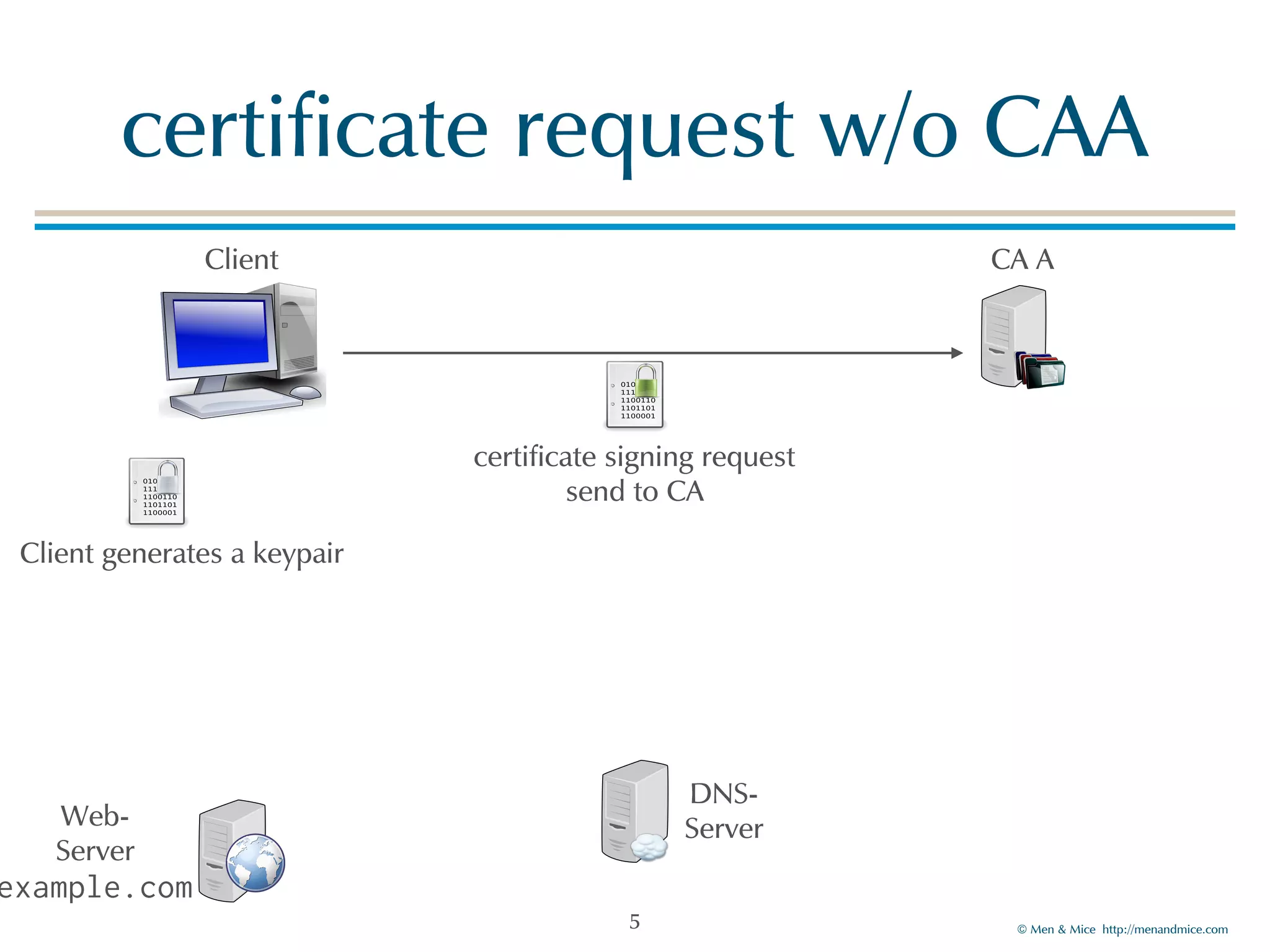
certificate request w/o CAA
5
Client generates a keypair
certificate signing request
send to CA
Client CA A
Web-
Server
example.com
DNS-
Server
© Men & Mice http://menandmice.com
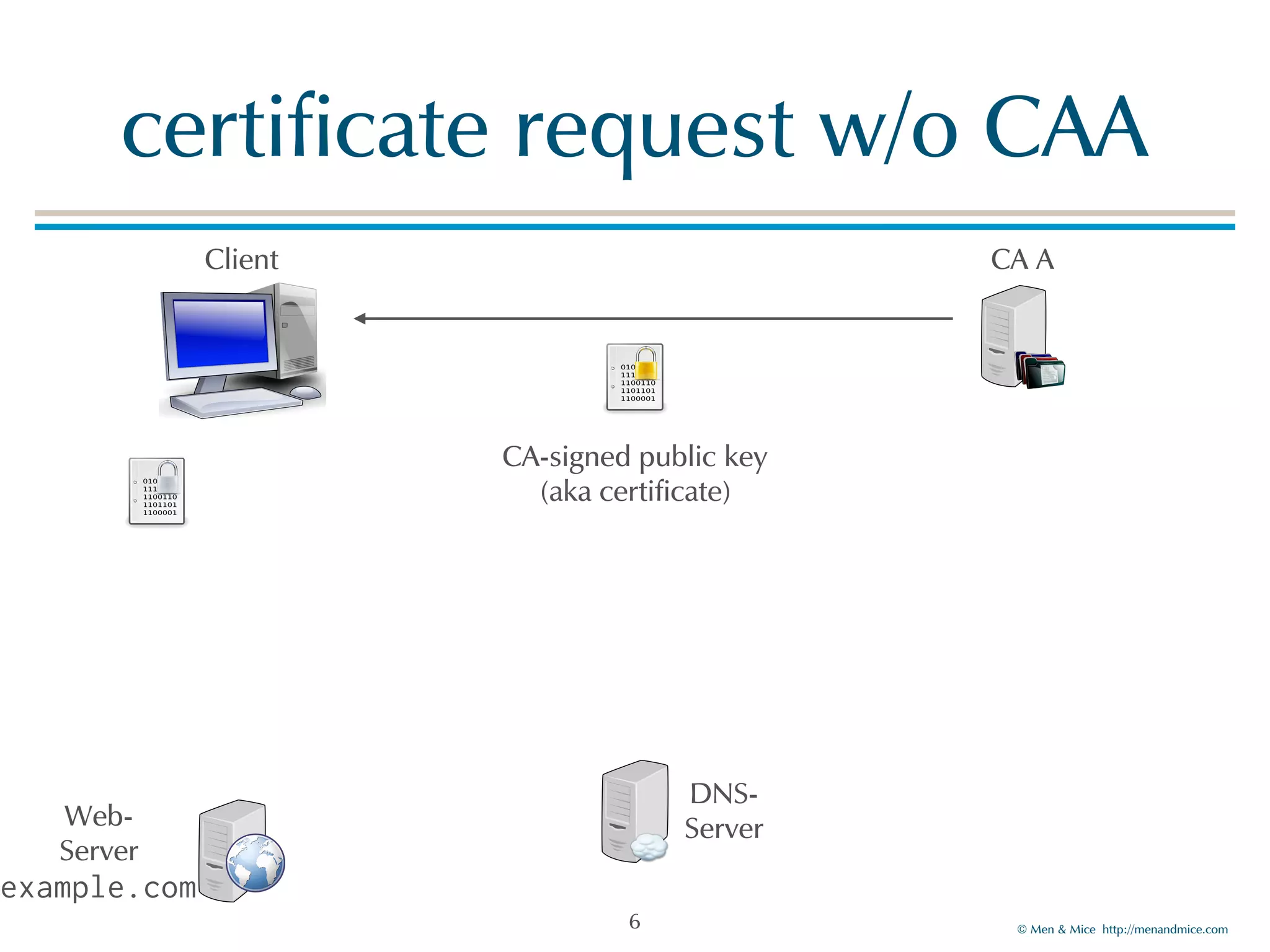
certificate request w/o CAA
6
CA-signed public key
(aka certificate)
Client
Web-
Server
example.com
DNS-
Server
CA A
© Men & Mice http://menandmice.com
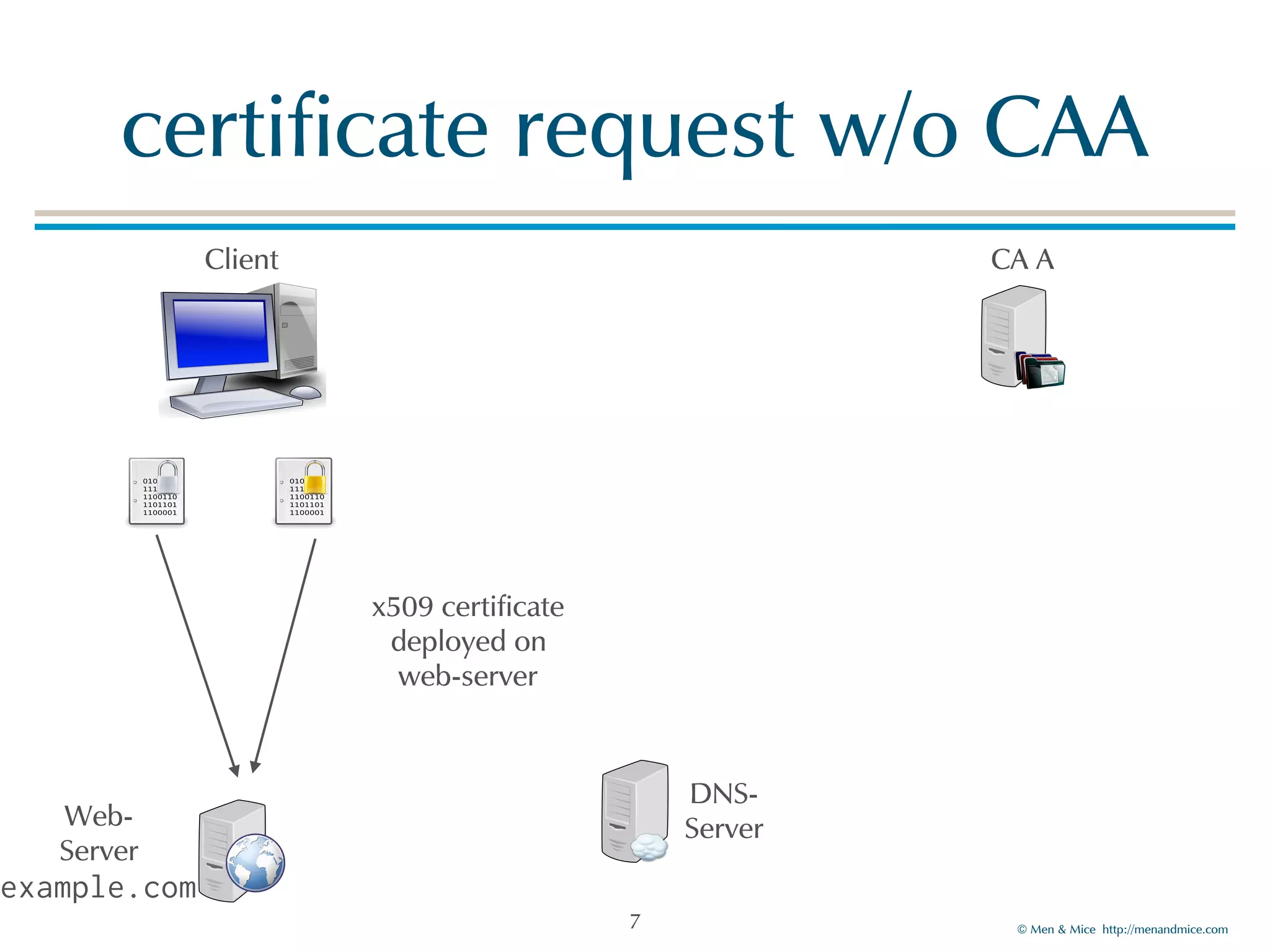
certificate request w/o CAA
7
x509 certificate
deployed on
web-server
Client
Web-
Server
example.com
DNS-
Server
CA A
© Men & Mice http://menandmice.com
certificate mis-issue
8
© Men & Mice http://menandmice.com
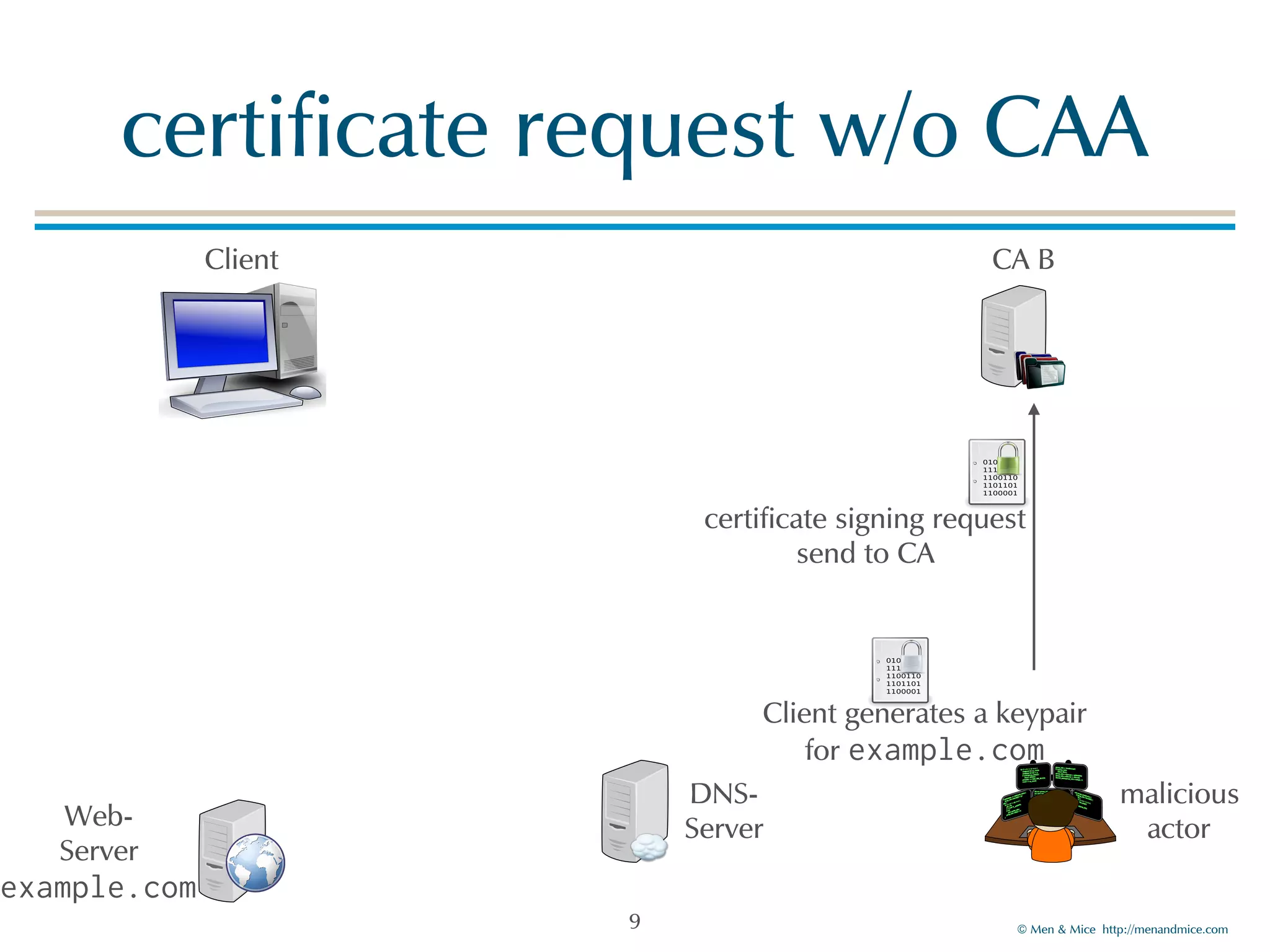
certificate request w/o CAA
9
certificate signing request
send to CA
Client
DNS-
Server
malicious
actorWeb-
Server
example.com
Client generates a keypair
for example.com
CA B
© Men & Mice http://menandmice.com
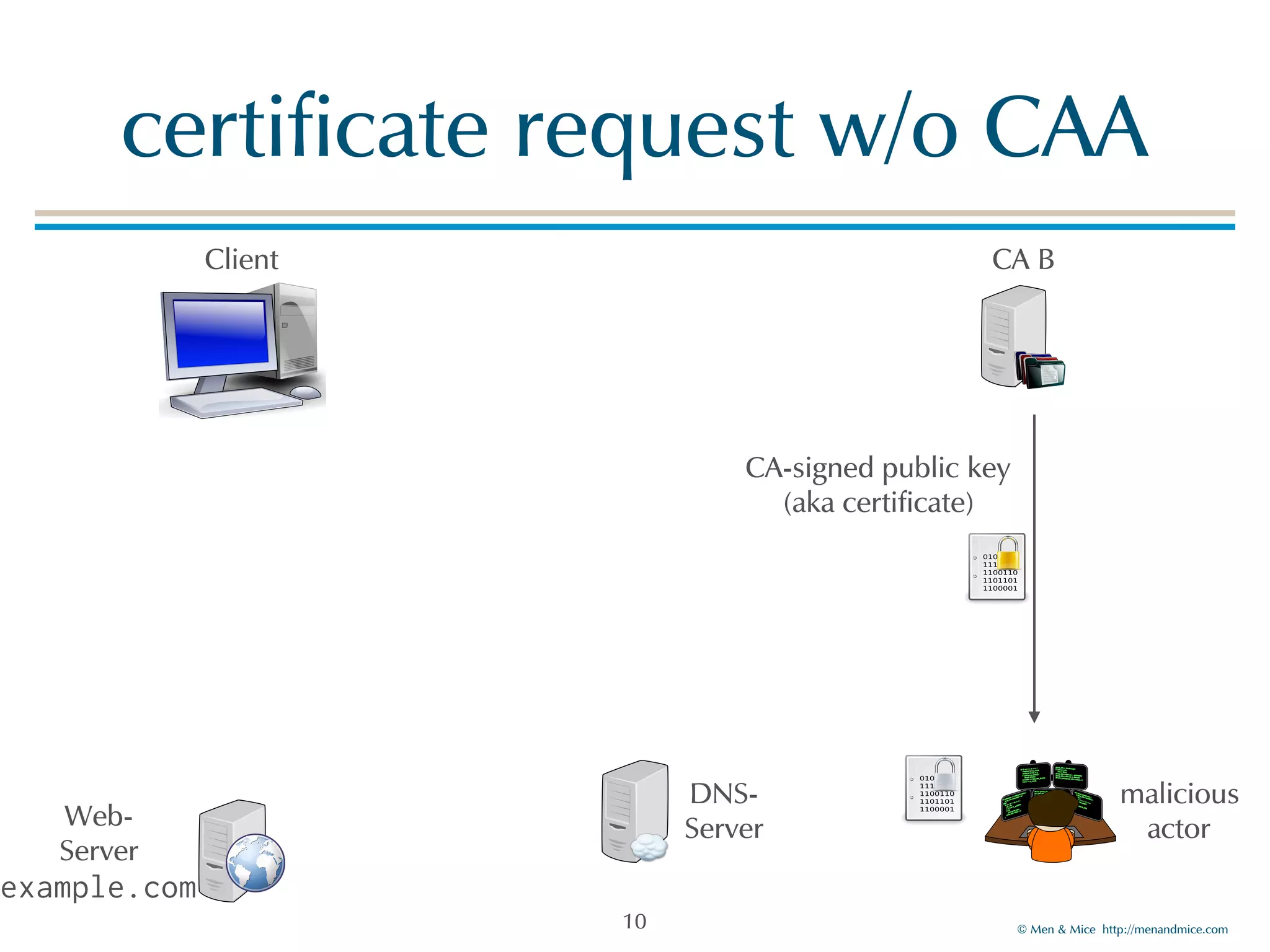
certificate request w/o CAA
10
Client
DNS-
Server
malicious
actorWeb-
Server
example.com
CA-signed public key
(aka certificate)
CA B
© Men & Mice http://menandmice.com
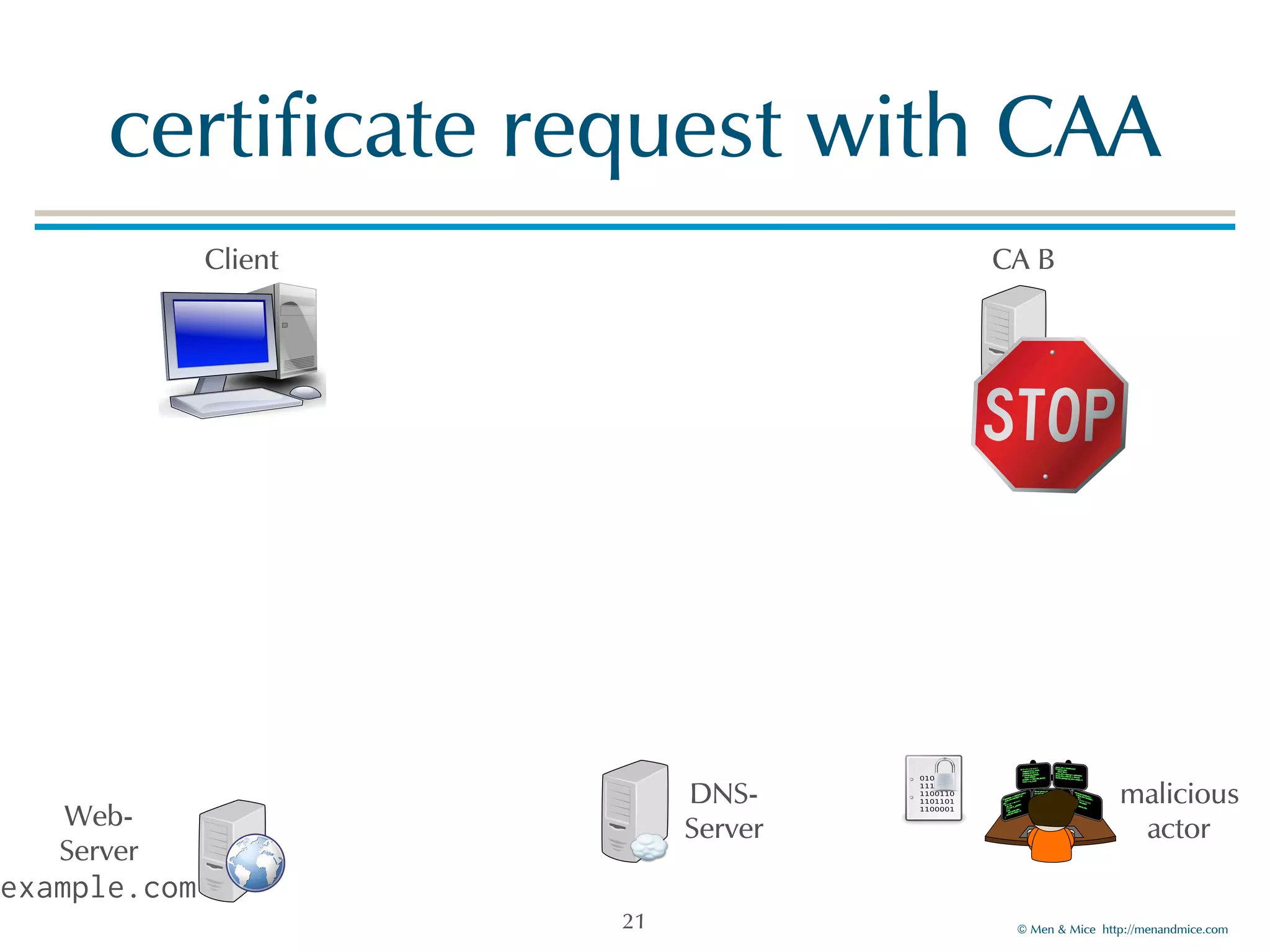
certificate request with CAA
11
© Men & Mice http://menandmice.com
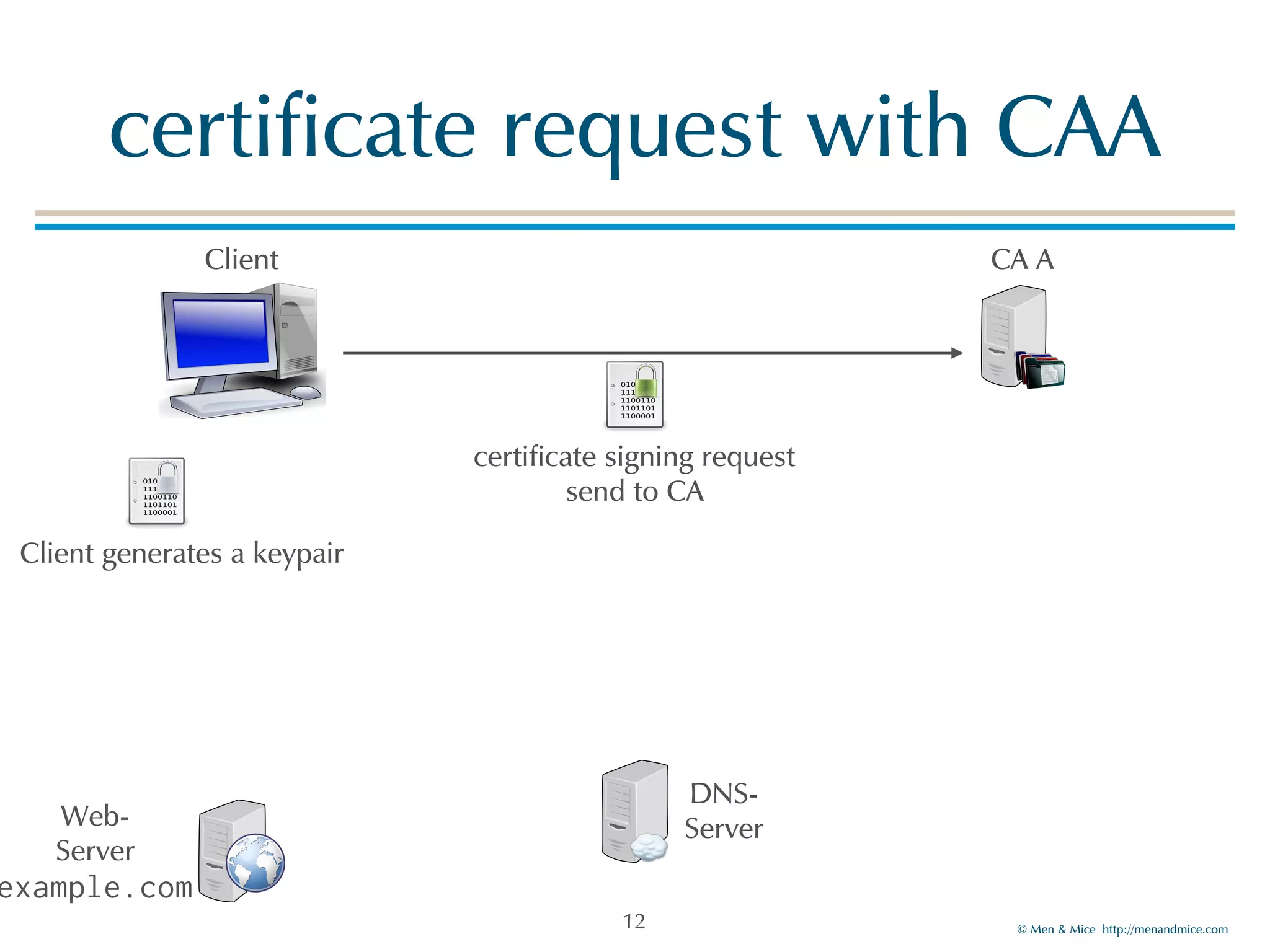
certificate request with CAA
12
Client generates a keypair
certificate signing request
send to CA
Client CA A
Web-
Server
example.com
DNS-
Server
© Men & Mice http://menandmice.com
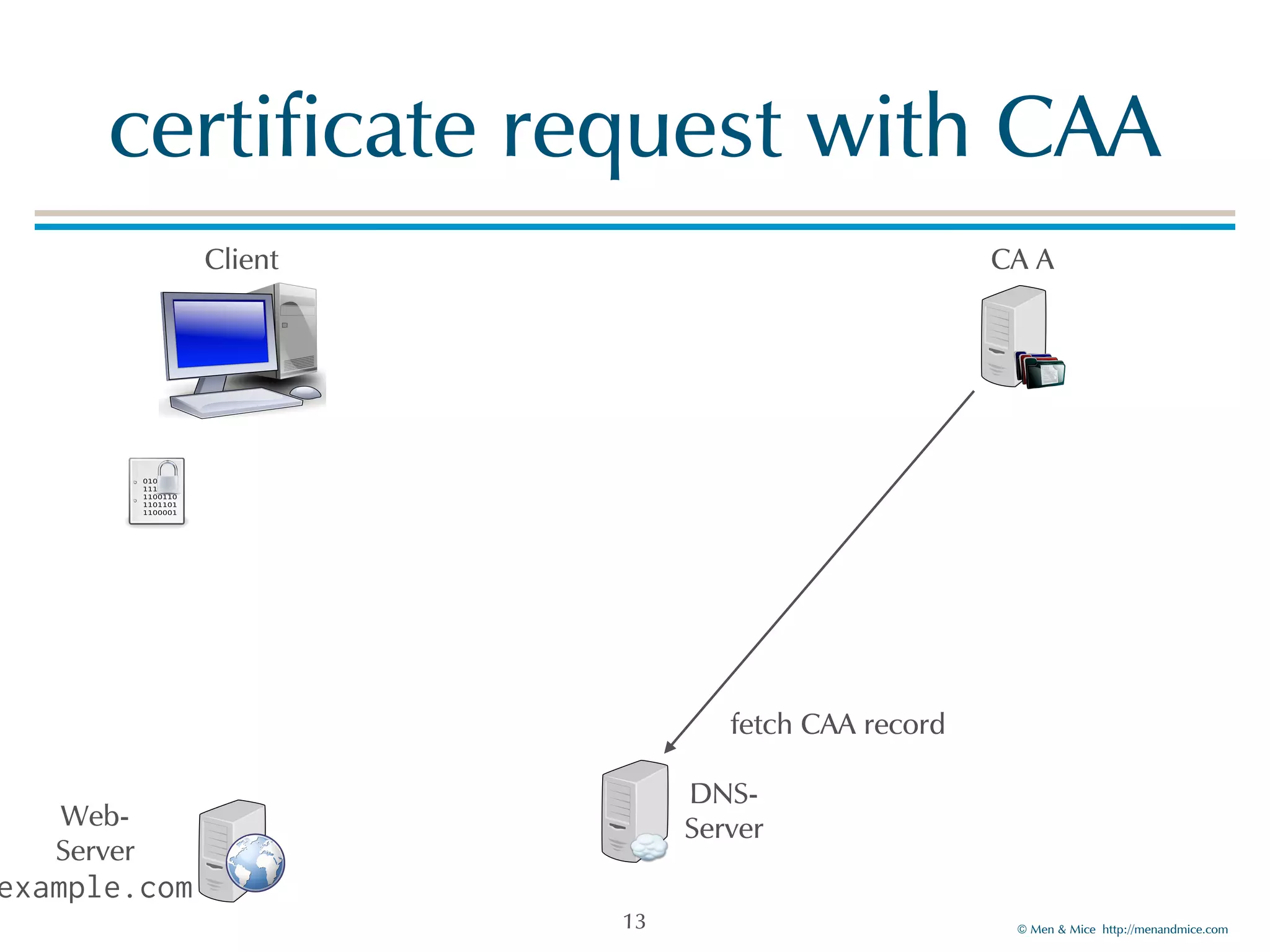
certificate request with CAA
13
fetch CAA record
Client CA A
Web-
Server
example.com
DNS-
Server
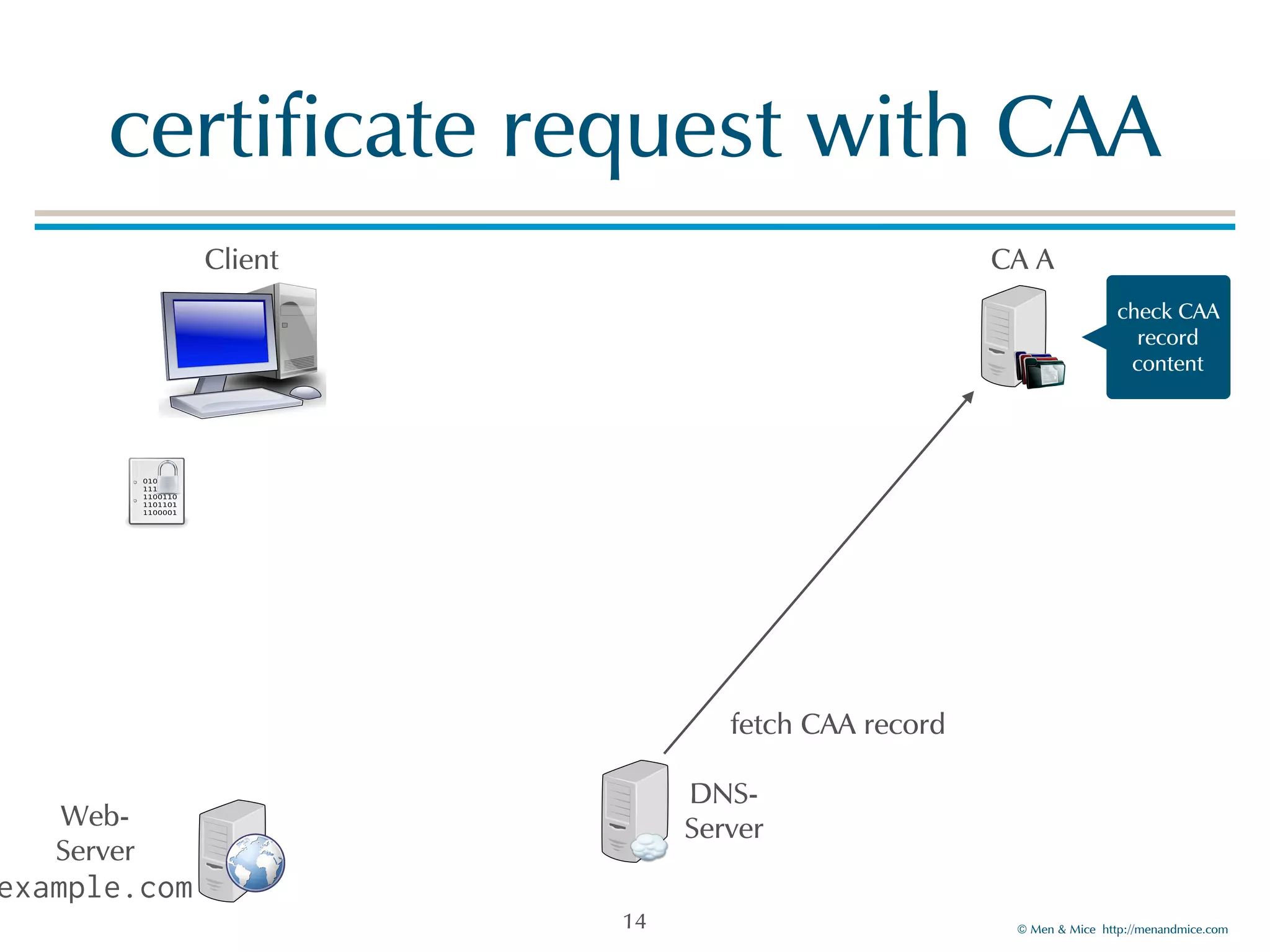
© Men & Mice http://menandmice.com
certificate request with CAA
14
fetch CAA record
Client CA A
Web-
Server
example.com
DNS-
Server
check CAA
record
content
© Men & Mice http://menandmice.com
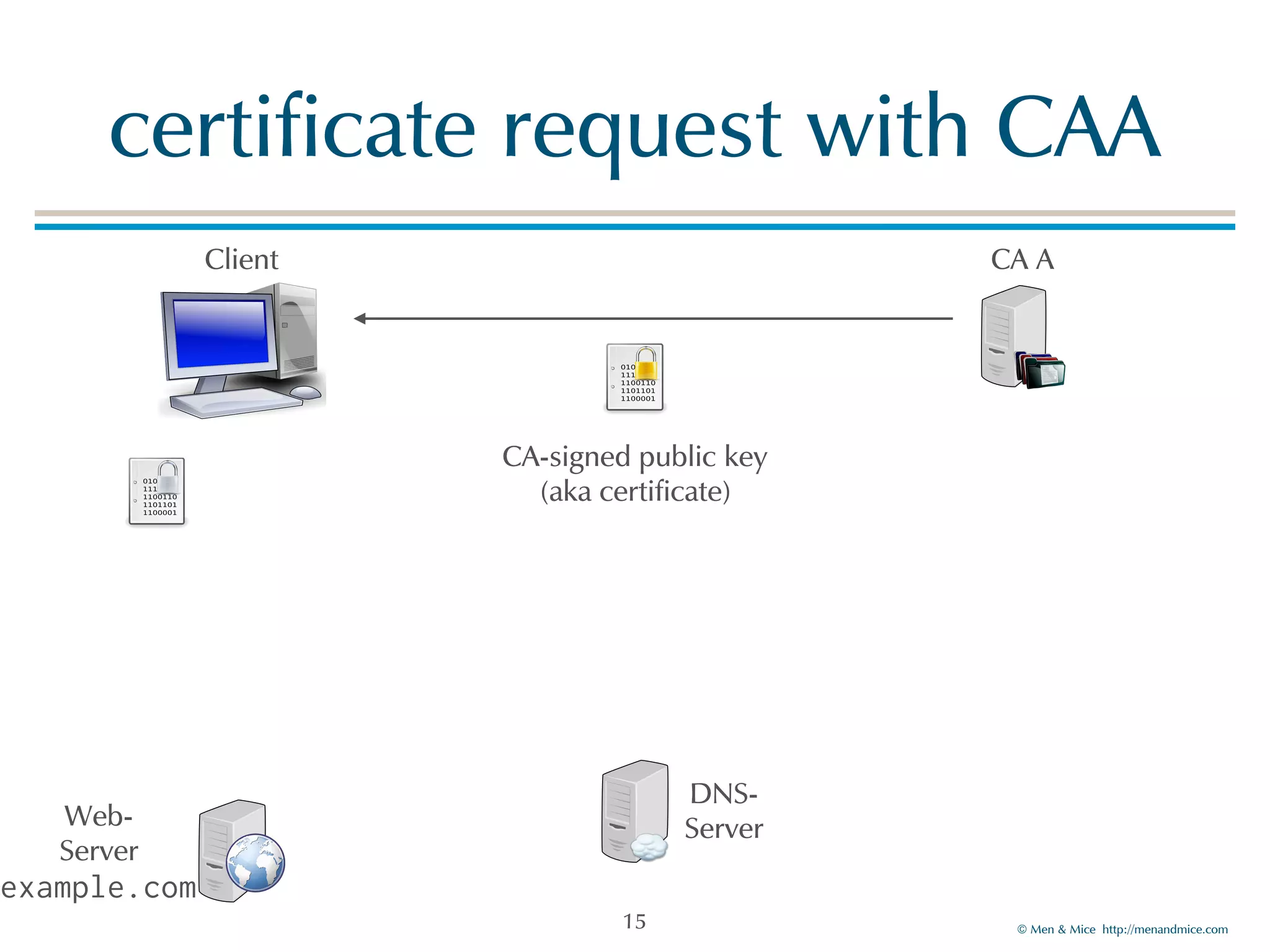
certificate request with CAA
15
CA-signed public key
(aka certificate)
Client CA A
Web-
Server
example.com
DNS-
Server
© Men & Mice http://menandmice.com
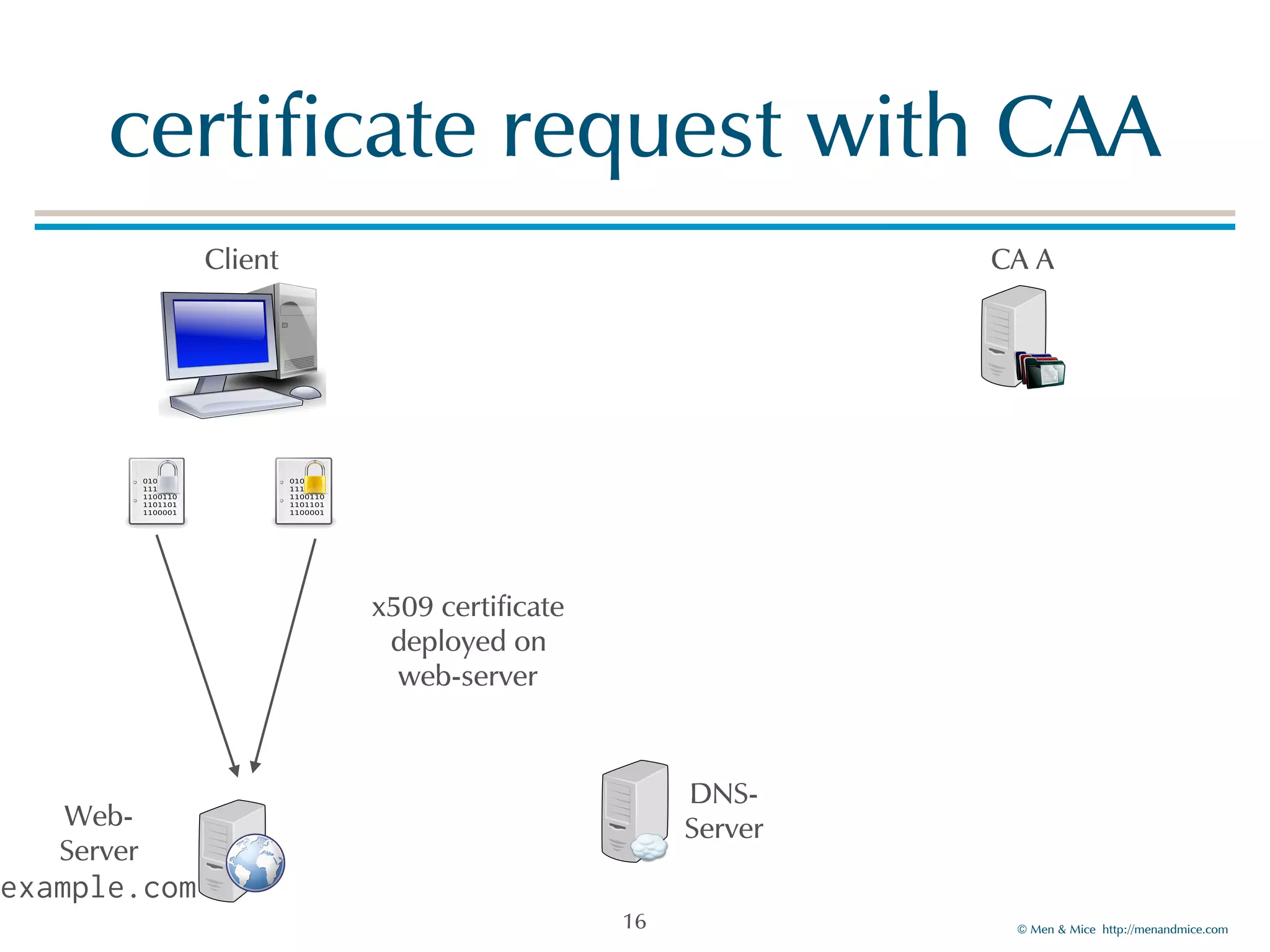
certificate request with CAA
16
x509 certificate
deployed on
web-server
Client CA A
Web-
Server
example.com
DNS-
Server
© Men & Mice http://menandmice.com
certificate mis-issue 

(prevented by CAA)
17
© Men & Mice http://menandmice.com
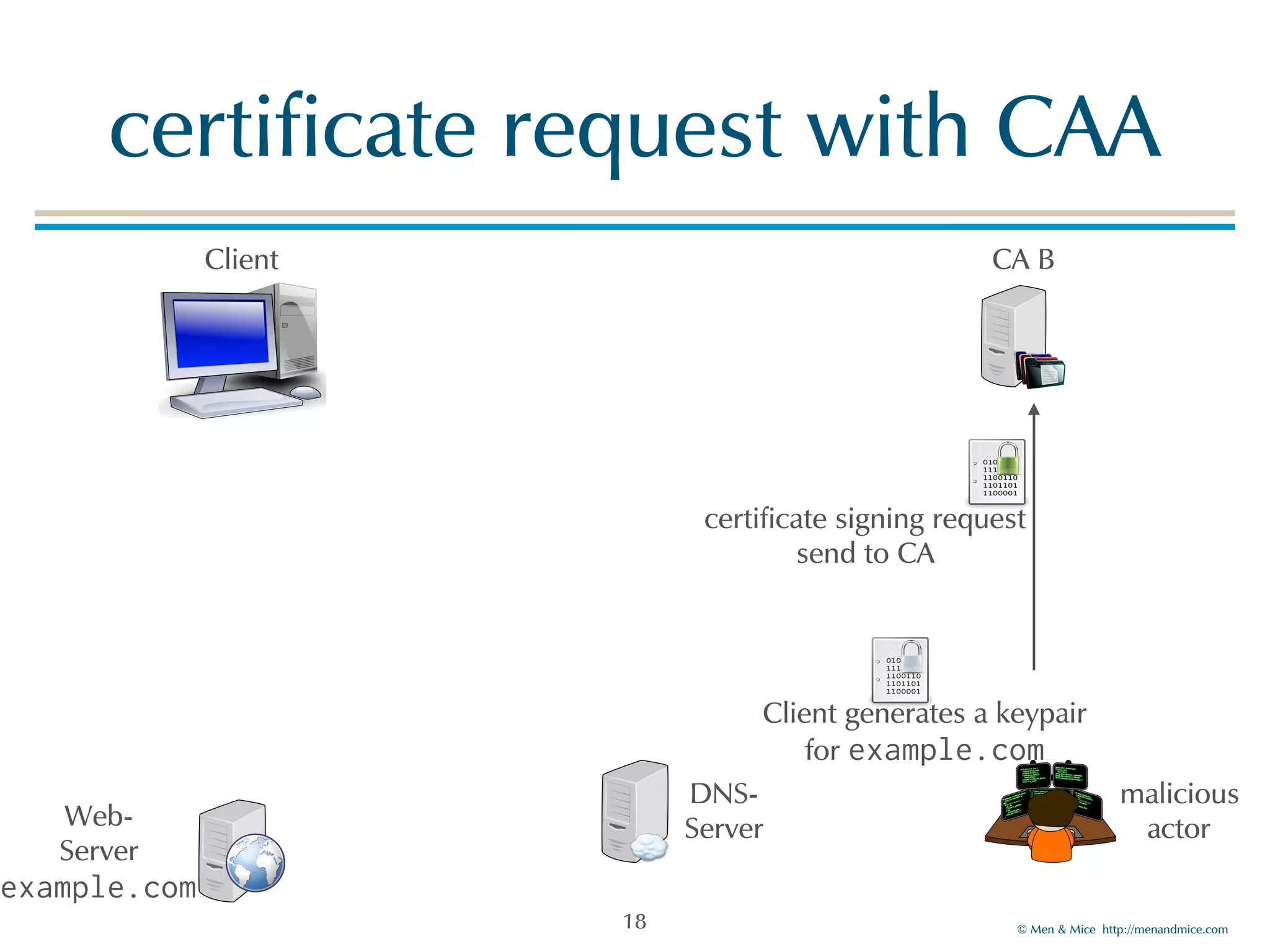
certificate request with CAA
18
certificate signing request
send to CA
Client CA B
DNS-
Server
malicious
actorWeb-
Server
example.com
Client generates a keypair
for example.com
© Men & Mice http://menandmice.com
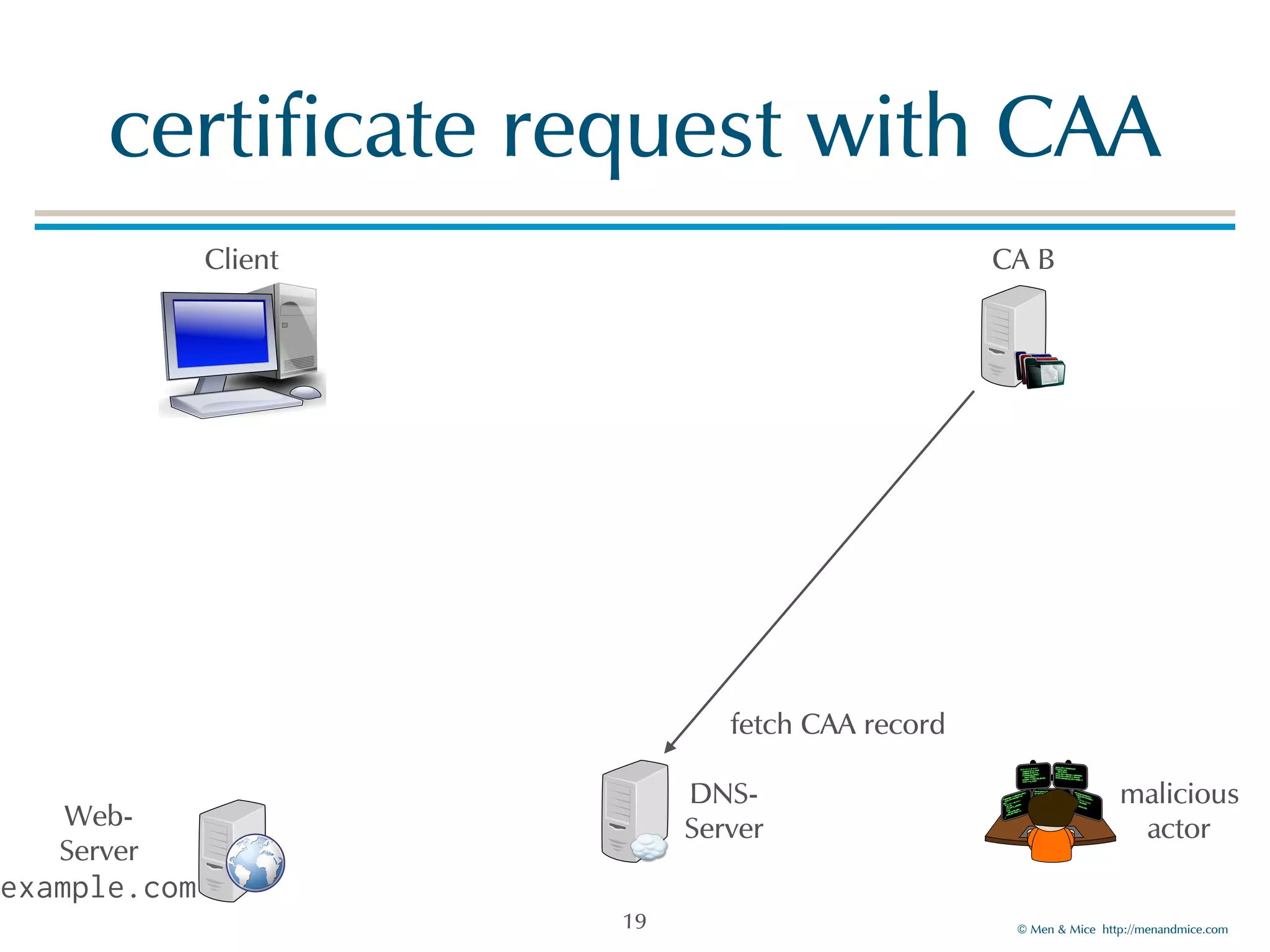
certificate request with CAA
19
Client CA B
DNS-
Server
malicious
actorWeb-
Server
example.com
fetch CAA record
© Men & Mice http://menandmice.com
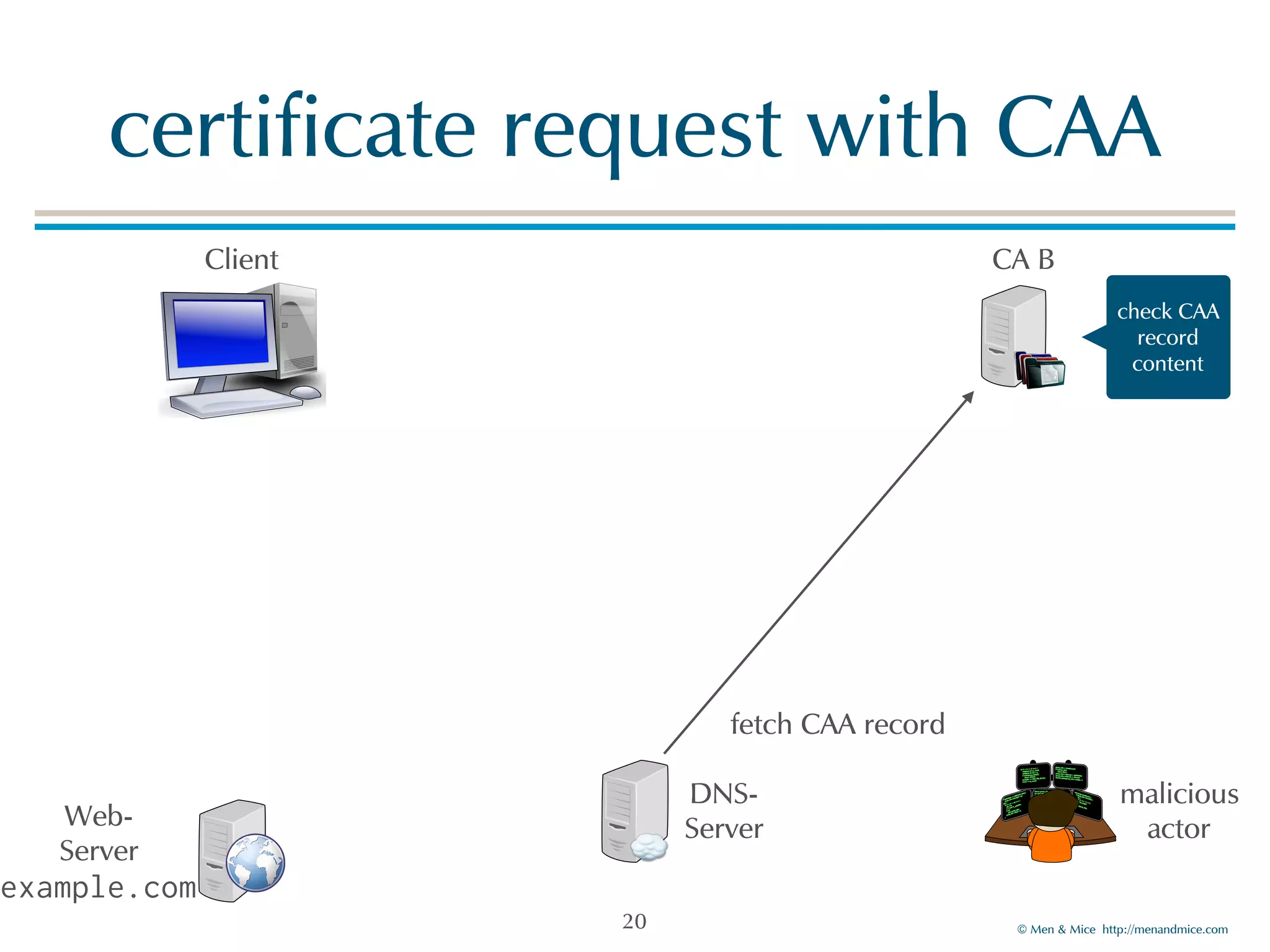
certificate request with CAA
20
Client CA B
DNS-
Server
malicious
actorWeb-
Server
example.com
fetch CAA record
check CAA
record
content
© Men & Mice http://menandmice.com
certificate request with CAA
21
Client CA B
DNS-
Server
malicious
actorWeb-
Server
example.com
© Men & Mice http://menandmice.com
what is changing in
September?
22
© Men & Mice http://menandmice.com
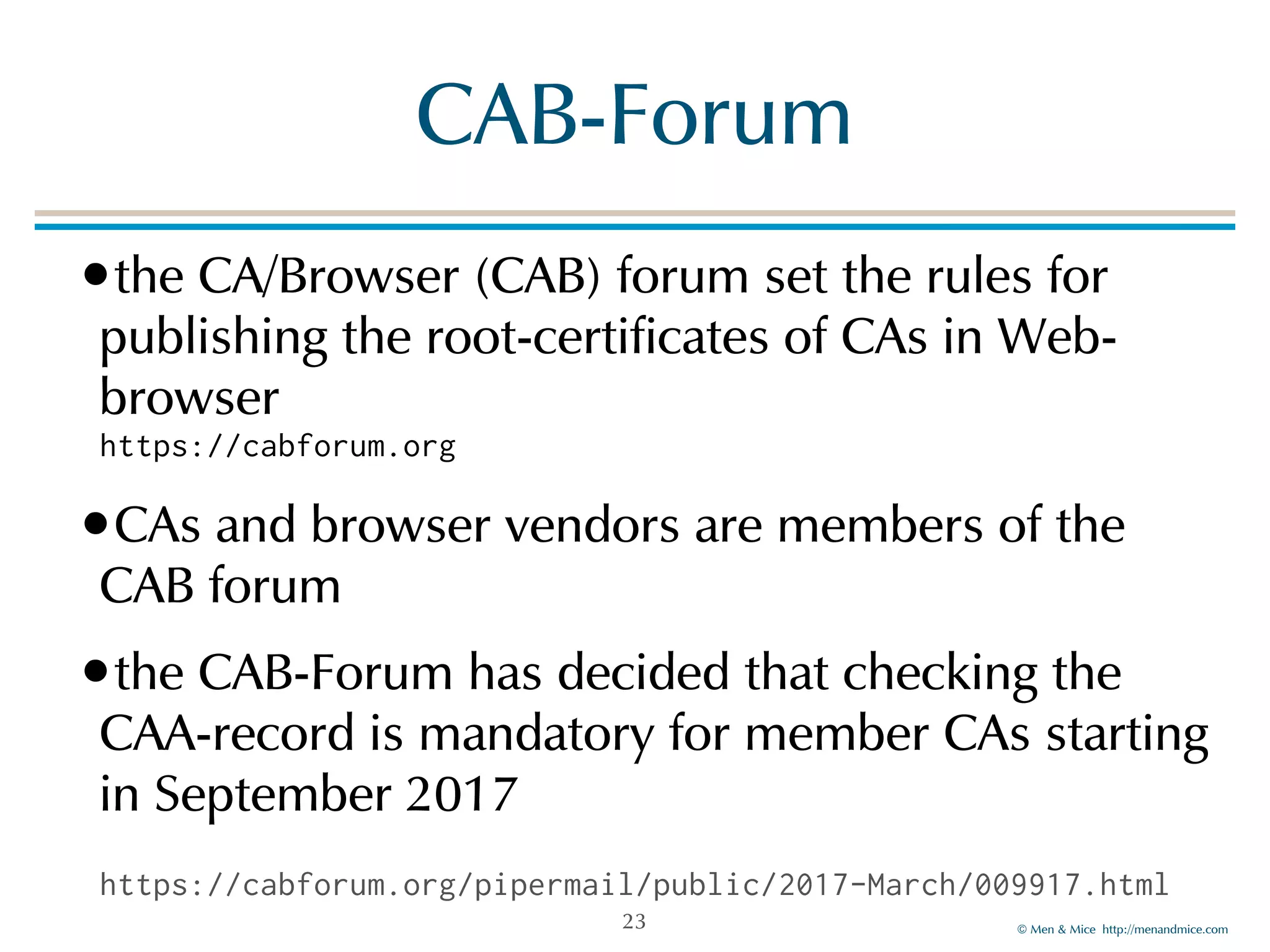
CAB-Forum
•the CA/Browser (CAB) forum set the rules for
publishing the root-certificates of CAs in Web-
browser

https://cabforum.org
•CAs and browser vendors are members of the
CAB forum
•the CAB-Forum has decided that checking the
CAA-record is mandatory for member CAs starting
in September 2017
23
https://cabforum.org/pipermail/public/2017-March/009917.html
© Men & Mice http://menandmice.com
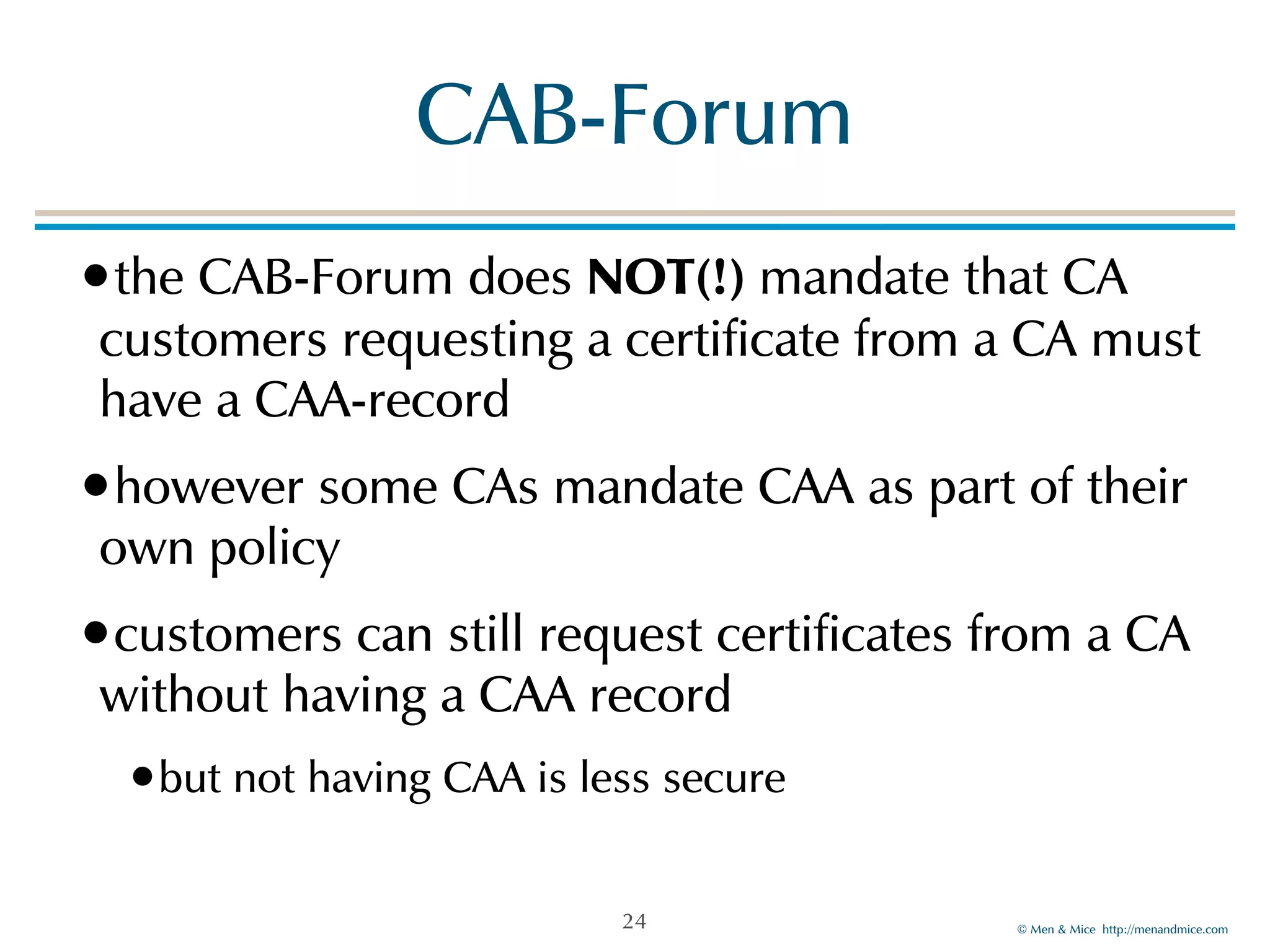
CAB-Forum
•the CAB-Forum does NOT(!) mandate that CA
customers requesting a certificate from a CA must
have a CAA-record
•however some CAs mandate CAA as part of their
own policy
•customers can still request certificates from a CA
without having a CAA record
•but not having CAA is less secure
24
© Men & Mice http://menandmice.com
a detail look at CAA
25
© Men & Mice http://menandmice.com
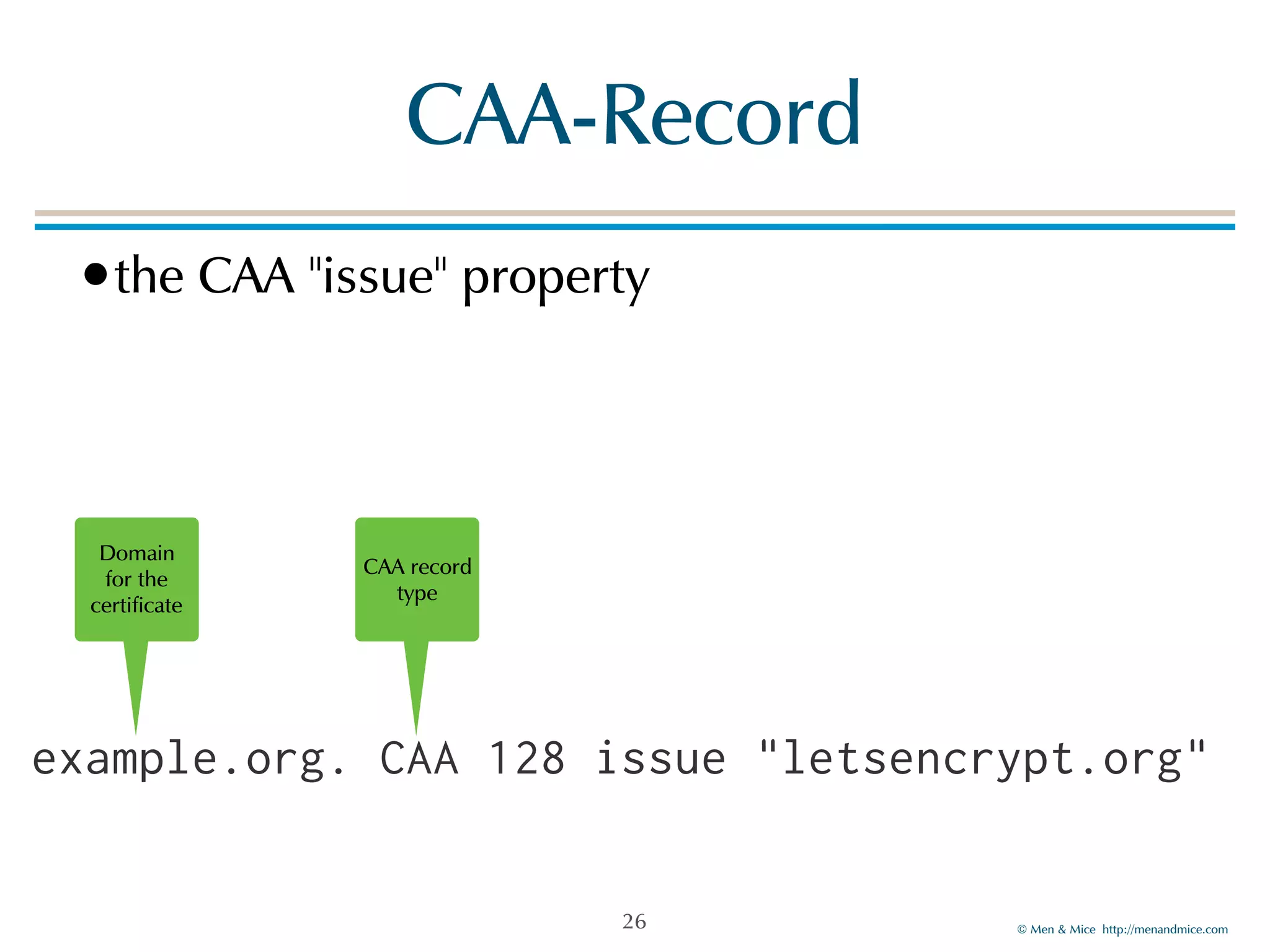
CAA-Record
•the CAA "issue" property
26
example.org. CAA 128 issue "letsencrypt.org"
Domain
for the
certificate
CAA record
type
© Men & Mice http://menandmice.com
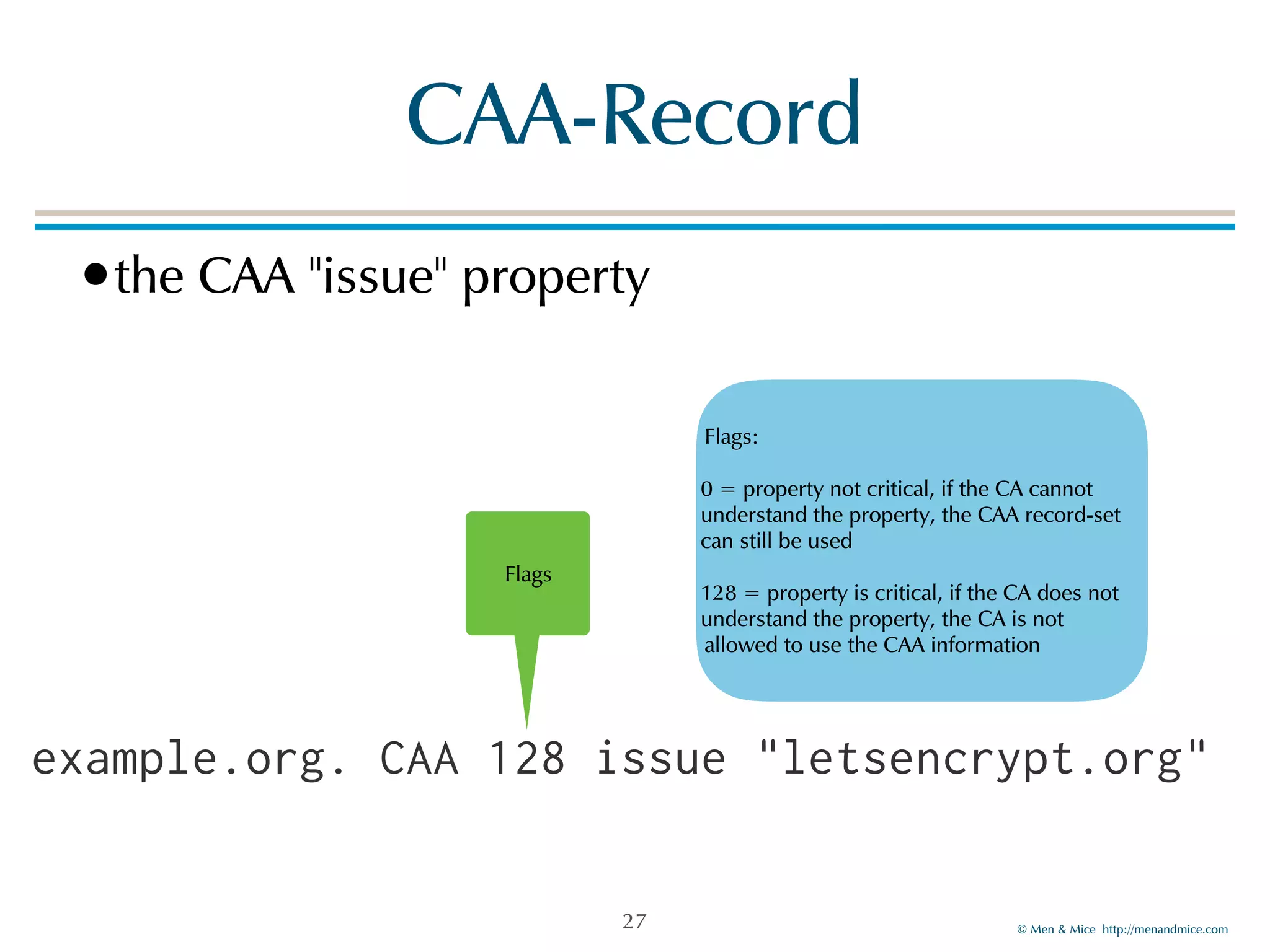
CAA-Record
•the CAA "issue" property
27
example.org. CAA 128 issue "letsencrypt.org"
Flags
Flags:
0 = property not critical, if the CA cannot
understand the property, the CAA record-set
can still be used
128 = property is critical, if the CA does not
understand the property, the CA is not
allowed to use the CAA information
© Men & Mice http://menandmice.com
CAA-Record
•the CAA "issue" property
28
example.org. CAA 128 issue "letsencrypt.org"
property
property: currently defined by RFC 6844
issue: listed CA is permitted to issue a normal
(non wildcard) certificate for the domain
issuewild: listed CA is permitted to issue a
wildcard certificate for the domain
iodef: address to report CAA policy violations
back to the customer
© Men & Mice http://menandmice.com
CAA-Record
•the CAA "issue" property
29
example.org. CAA 128 issue "letsencrypt.org"
value
Value for issue and issuewild: base domain
name of the CA permitted to issue certificate
for this domain
© Men & Mice http://menandmice.com
CAA-Record
•the CAA "issuewild" property
30
example.org. CAA 128 issuewild "letsencrypt.org"
issuewild
property
issuewild: domain name of the CA permitted
to issue a wildcard certificate for this domain
(*.example.com)
© Men & Mice http://menandmice.com
CAA-Record
•the CAA "issue" property
31
example.org. CAA 128 issue ";"
value
a single semicolon ";" prevents any CA from
issuing certificates for this domain
© Men & Mice http://menandmice.com
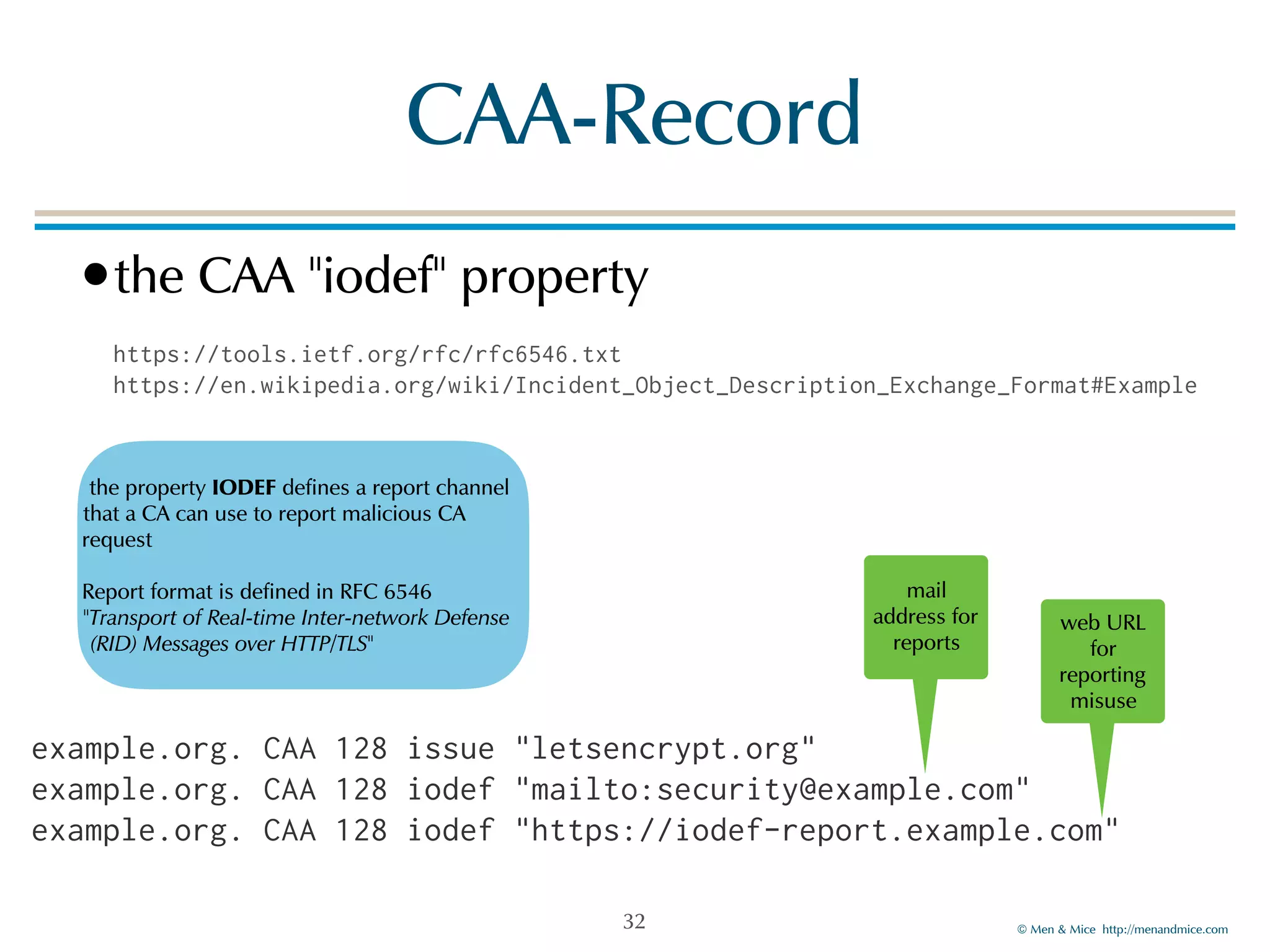
CAA-Record
•the CAA "iodef" property
32
example.org. CAA 128 issue "letsencrypt.org"
example.org. CAA 128 iodef "mailto:security@example.com"
example.org. CAA 128 iodef "https://iodef-report.example.com"
mail
address for
reports
the property IODEF defines a report channel
that a CA can use to report malicious CA
request
Report format is defined in RFC 6546
"Transport of Real-time Inter-network Defense
(RID) Messages over HTTP/TLS"
web URL
for
reporting
misuse
https://tools.ietf.org/rfc/rfc6546.txt
https://en.wikipedia.org/wiki/Incident_Object_Description_Exchange_Format#Example
© Men & Mice http://menandmice.com
CAA-Record
•CA private properties
33
example.org. CAA 128 issue "ca.domain.tld; maxvalidity=360"
standard
value
in addition to the values defined in RFC 6844,
CAs can define private property values.
Different property values are separated by
semicolon ";" extra
property
value
© Men & Mice http://menandmice.com
CAA-Record
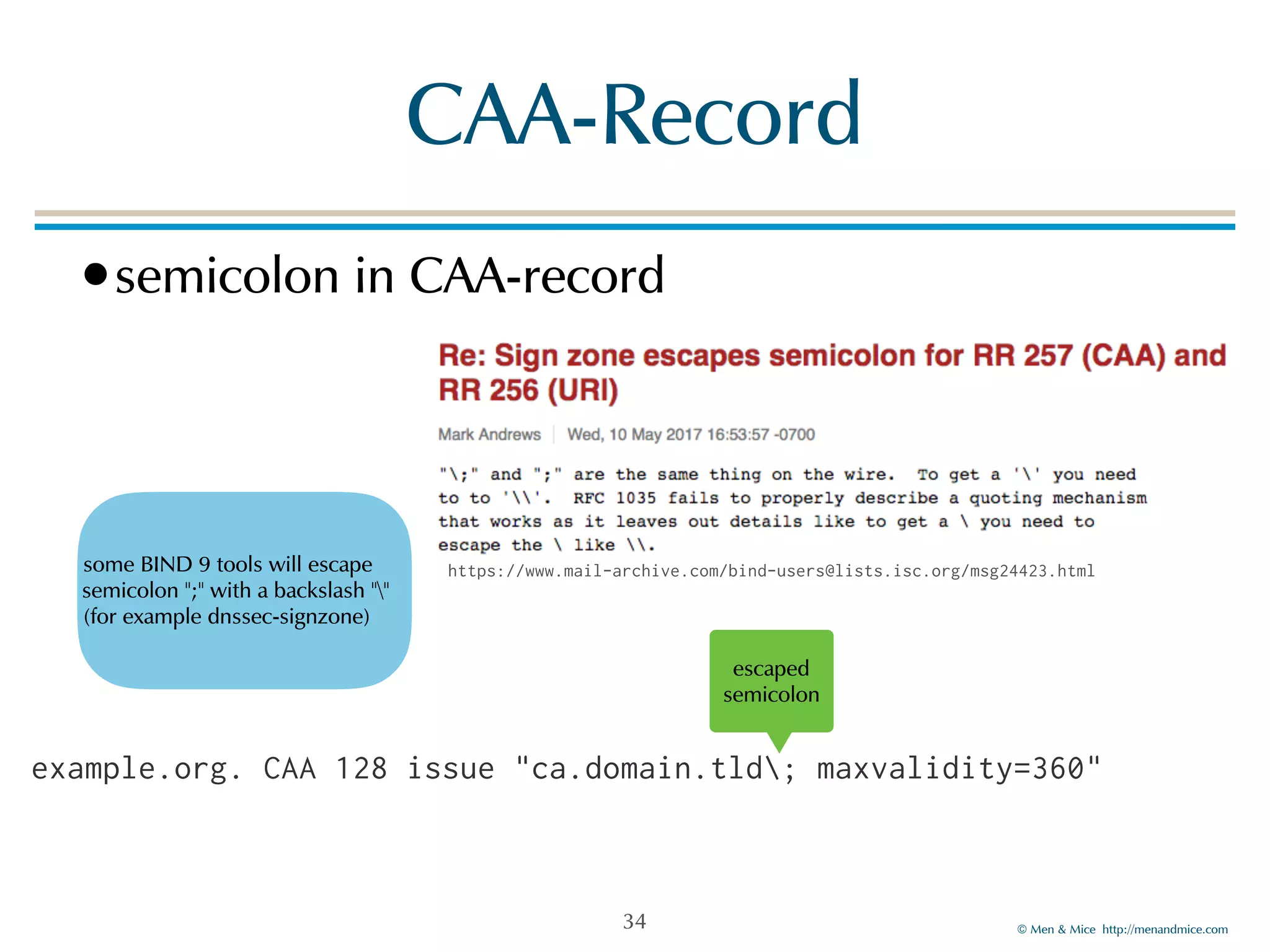
•semicolon in CAA-record
34
example.org. CAA 128 issue "ca.domain.tld; maxvalidity=360"
some BIND 9 tools will escape
semicolon ";" with a backslash "" 

(for example dnssec-signzone)
escaped
semicolon
https://www.mail-archive.com/bind-users@lists.isc.org/msg24423.html
© Men & Mice http://menandmice.com
CAA-Record
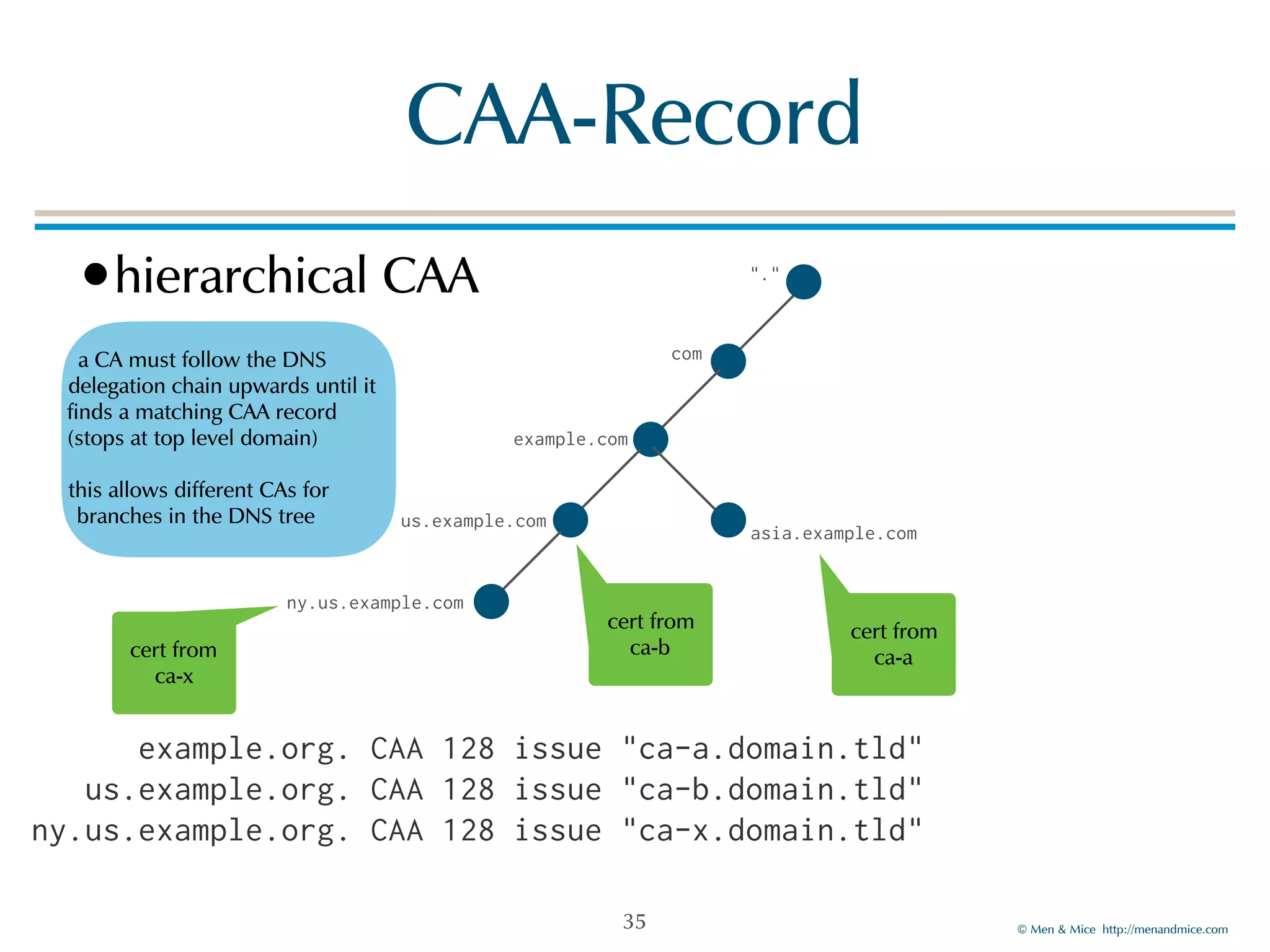
•hierarchical CAA
35
example.org. CAA 128 issue "ca-a.domain.tld"
us.example.org. CAA 128 issue "ca-b.domain.tld"
ny.us.example.org. CAA 128 issue "ca-x.domain.tld"
a CA must follow the DNS
delegation chain upwards until it
finds a matching CAA record
(stops at top level domain)
this allows different CAs for
branches in the DNS tree
ny.us.example.com
us.example.com
example.com
com
"."
asia.example.com
cert from
ca-b
cert from
ca-acert from
ca-x
© Men & Mice http://menandmice.com
deploying CAA
36
© Men & Mice http://menandmice.com
DNS server support
•the CAA record is
supported with newer
versions of popular
DNS servers
•BIND 9.10/9.11
•BIND 10/Bundy-DNS
•LDNS
•NSD
•Knot DNS
•PowerDNS
•Google Cloud DNS
•Unbound
37
© Men & Mice http://menandmice.com
DNS server support
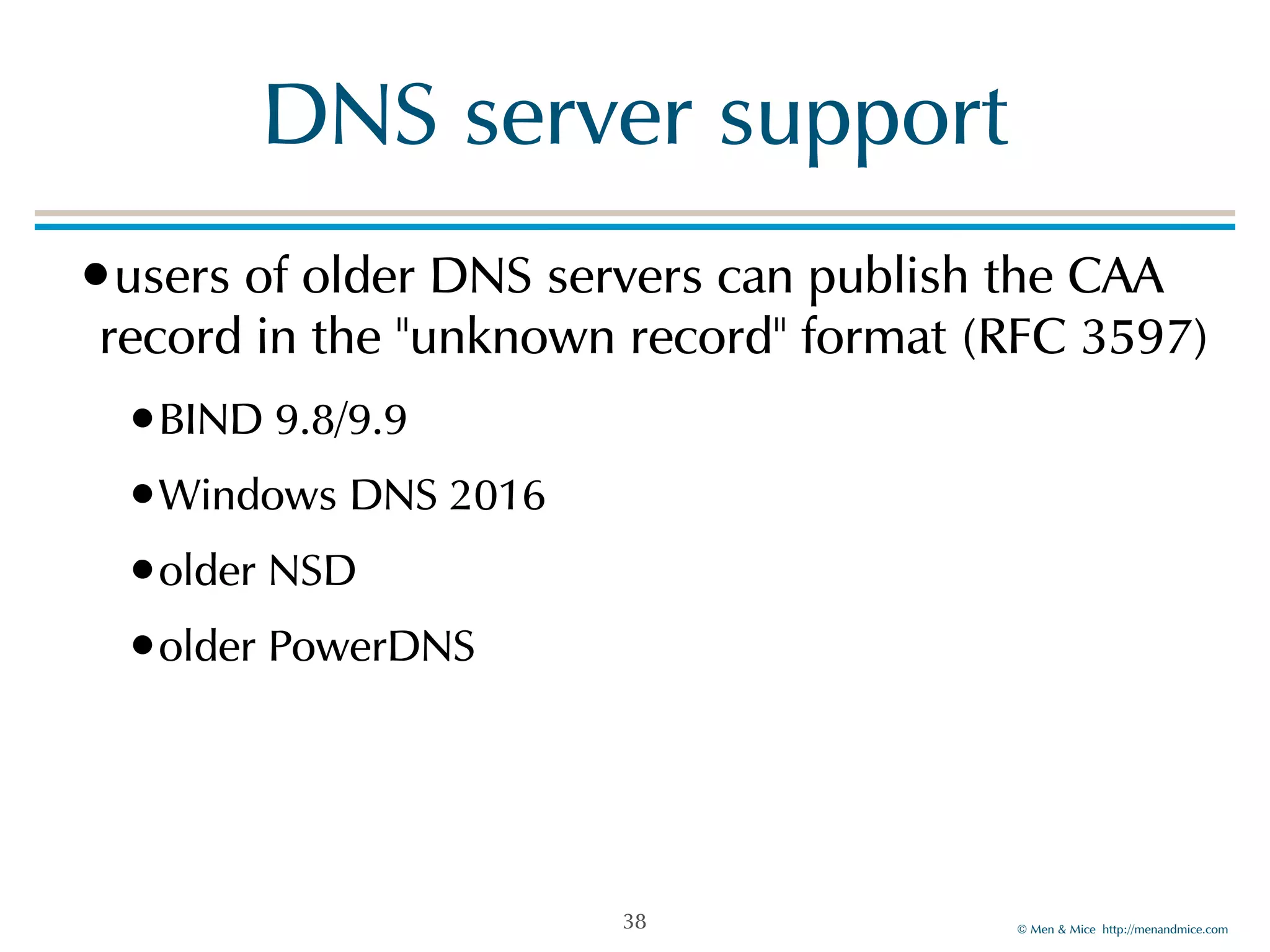
•users of older DNS servers can publish the CAA
record in the "unknown record" format (RFC 3597)
•BIND 9.8/9.9
•Windows DNS 2016
•older NSD
•older PowerDNS
38
© Men & Mice http://menandmice.com
generate a CAA record
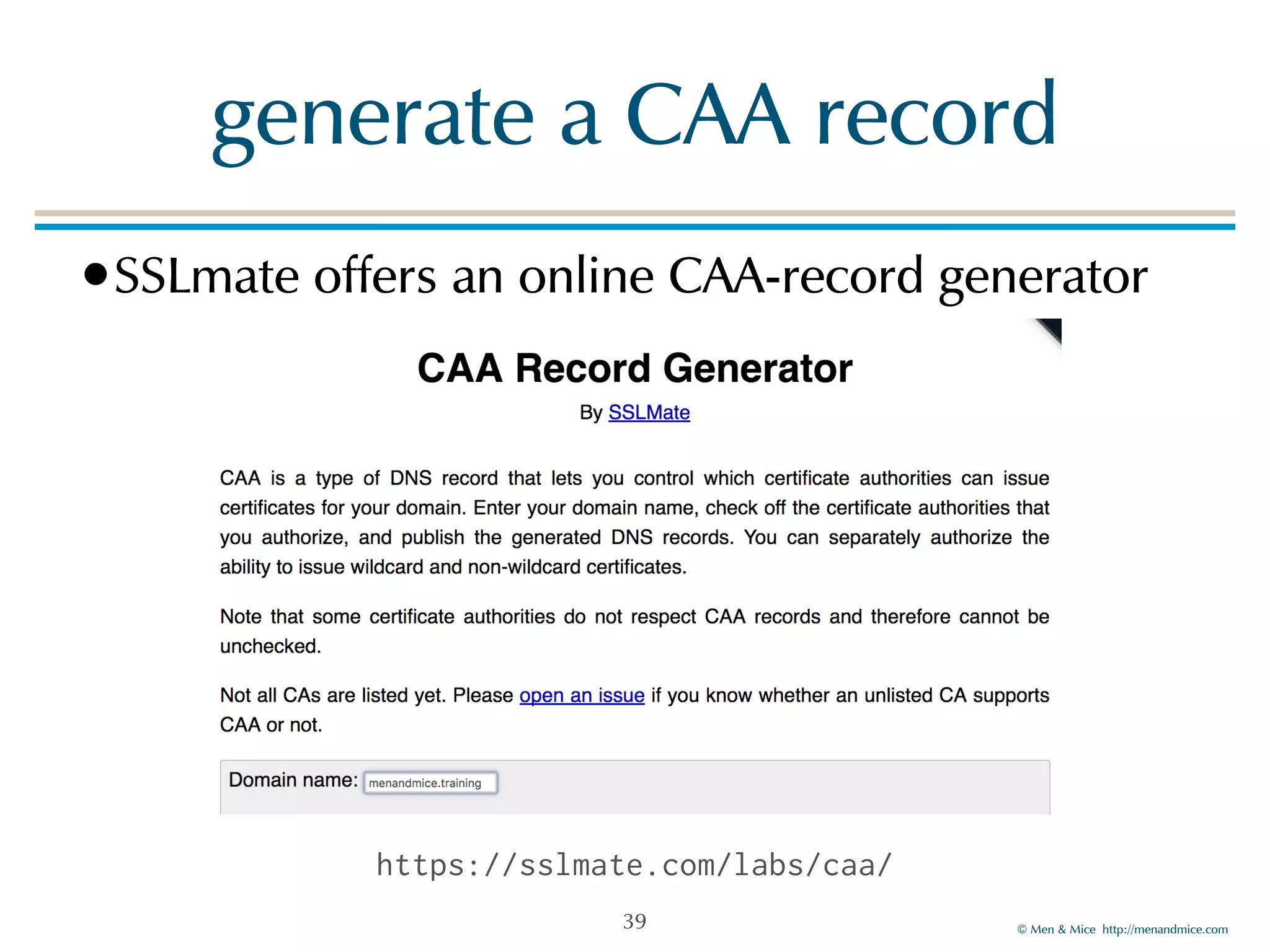
•SSLmate offers an online CAA-record generator
39
https://sslmate.com/labs/caa/
© Men & Mice http://menandmice.com
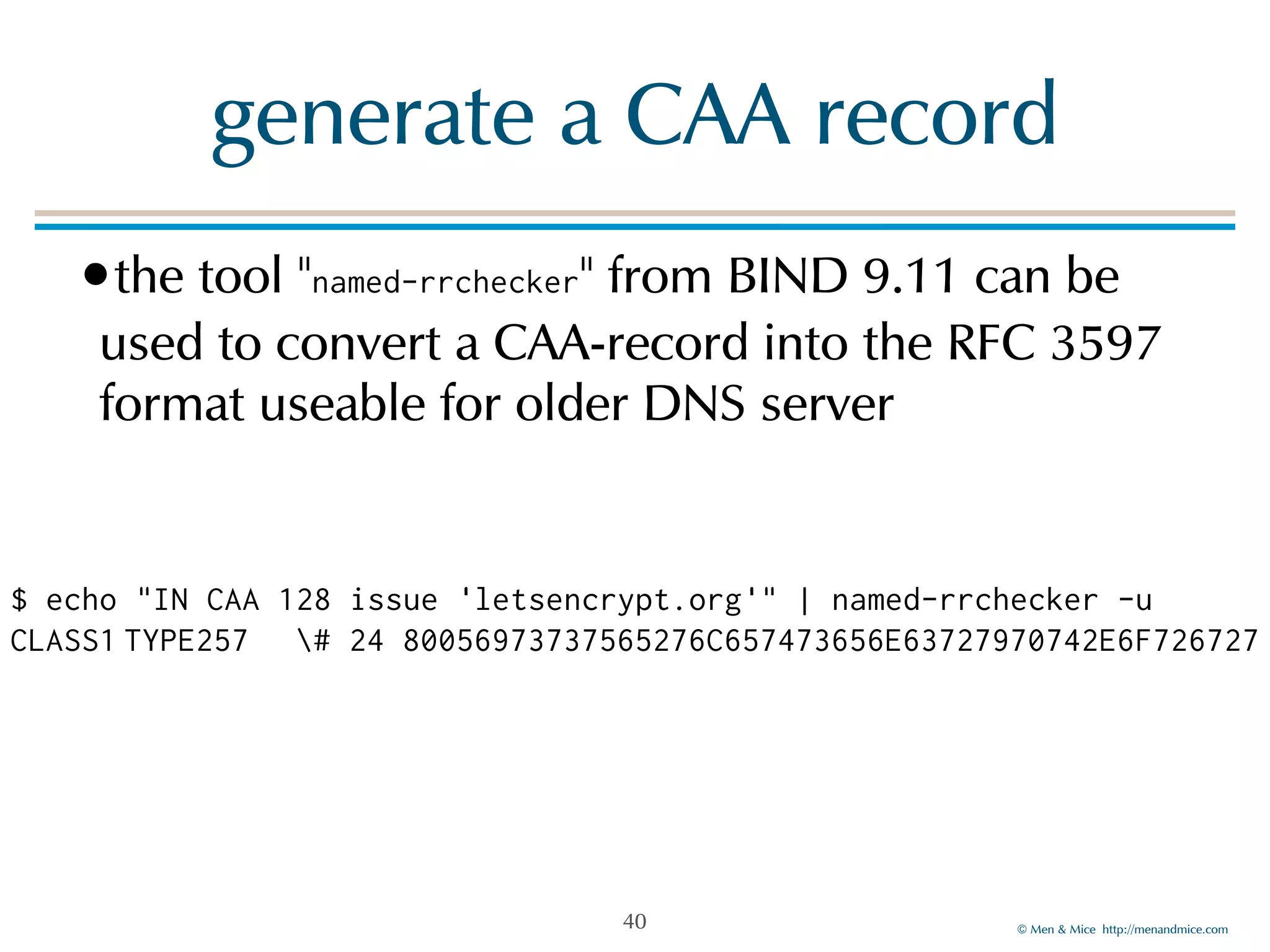
generate a CAA record
•the tool "named-rrchecker" from BIND 9.11 can be
used to convert a CAA-record into the RFC 3597
format useable for older DNS server
40
$ echo "IN CAA 128 issue 'letsencrypt.org'" | named-rrchecker -u
CLASS1 TYPE257 # 24 80056973737565276C657473656E63727970742E6F726727
© Men & Mice http://menandmice.com
CAA security
•without DNSSEC, a malicious actor can spoof the
CAA-check done by the CA to steal a certificate
•while not mandated by the RFC or the CAB-
Forum, it is highly recommended to secure CAA
records with DNSSEC
41
© Men & Mice http://menandmice.com
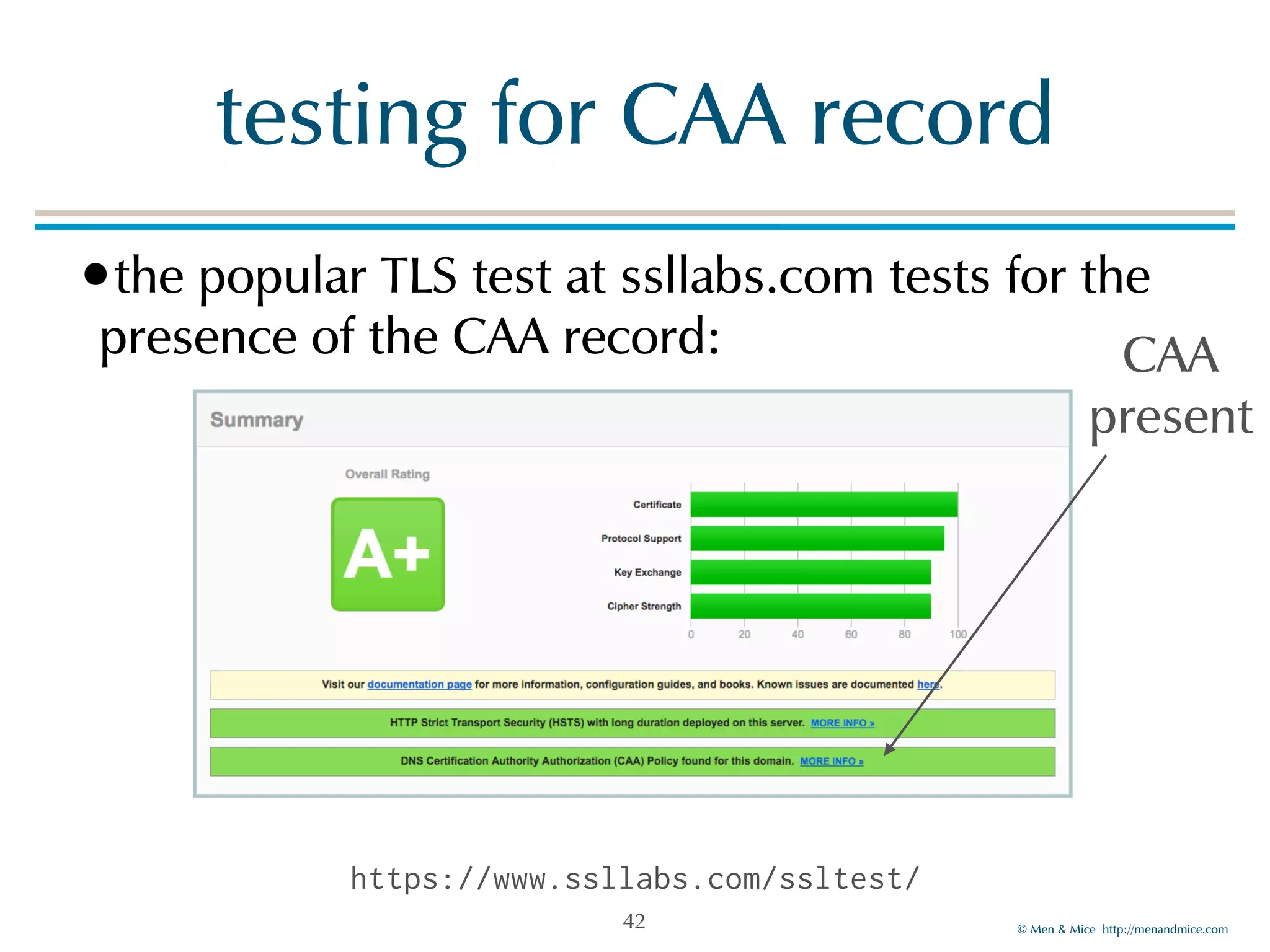
testing for CAA record
•the popular TLS test at ssllabs.com tests for the
presence of the CAA record:
42
https://www.ssllabs.com/ssltest/
CAA

present
© Men & Mice http://menandmice.com
additional information
•HTTPS Certificate Issuance Becomes More Secure Thanks to New
CAA Standard

https://www.bleepingcomputer.com/news/security/https-certificate-issuance-becomes-
more-secure-thanks-to-new-caa-standard/
•An Introduction to Certification Authority Authorization (CAA)

https://www.ssl.com/article/certification-authority-authorization-caa/
•CAA Mandated by CA/Browser Forum

https://blog.qualys.com/ssllabs/2017/03/13/caa-mandated-by-cabrowser-forum
•Thawte - Guide to CAA

https://www.thawte.com/assets/documents/whitepaper/caa.pdf
•DNS Certification Authority Authorization (CAA) Resource Record

https://tools.ietf.org/html/rfc6844
43
© Men & Mice http://menandmice.com
Next
44
© Men & Mice http://menandmice.com
Men & Mice DNS Training
•Introduction to DNS & BIND Hands-On Class
•August 14 – 16, 2017 (Boston (MA), USA)
•September 18 – 20, 2017 (Zurich, Switzerland)
45
https://www.menandmice.com/training/
© Men & Mice http://menandmice.com
Men & Mice DNS Training
•Introduction & Advanced DNS and BIND Topics
Hands-On Class
•August 14 – 18, 2017 (Boston (MA), USA)
•September 18 – 22, 2017 (Zurich, Switzerland)
46
https://www.menandmice.com/training/
© Men & Mice http://menandmice.com
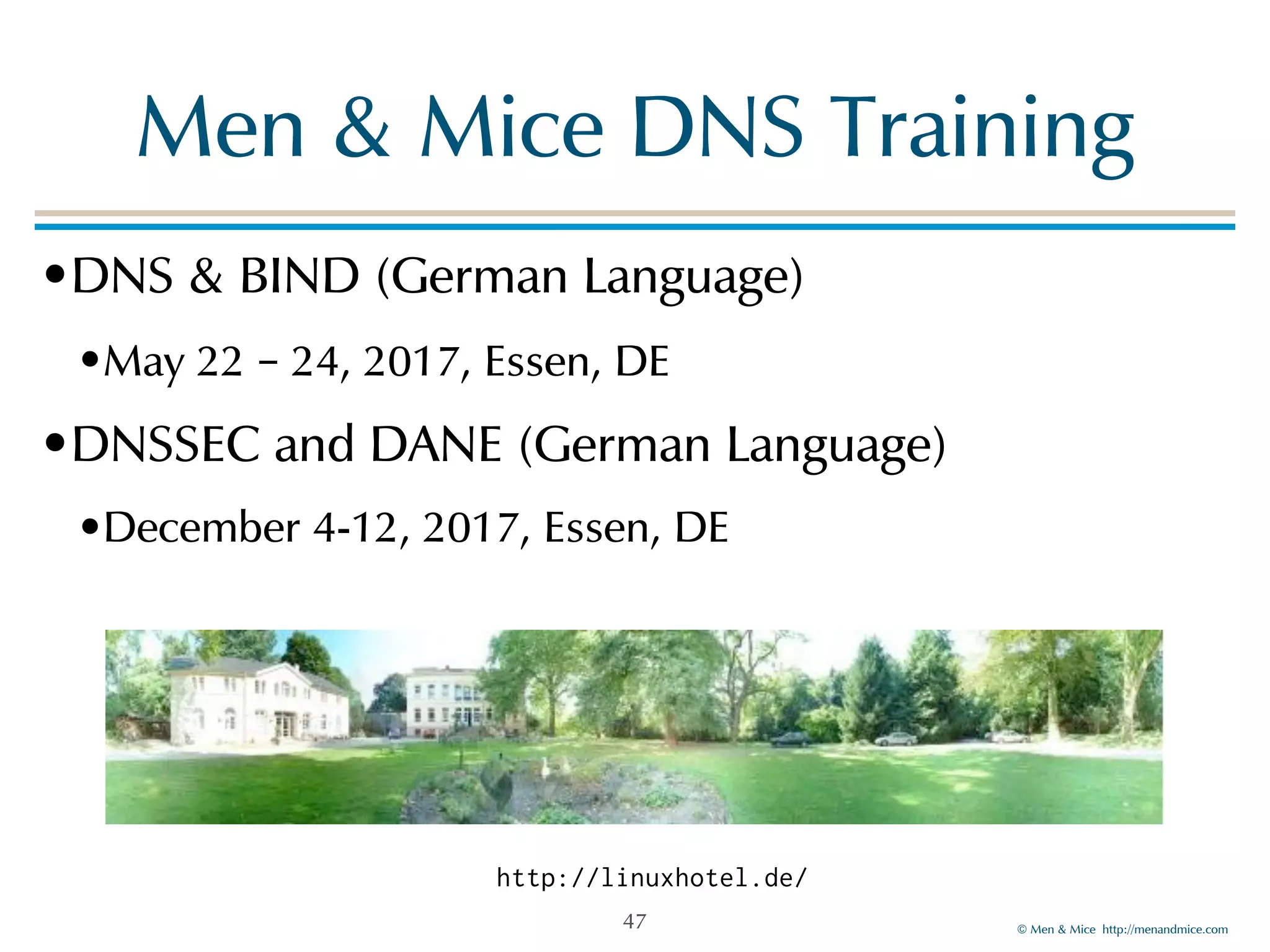
Men & Mice DNS Training
•DNS & BIND (German Language)
•May 22 – 24, 2017, Essen, DE
•DNSSEC and DANE (German Language)
•December 4-12, 2017, Essen, DE
47
http://linuxhotel.de/
© Men & Mice http://menandmice.com
our next webinar 

the DNSSEC KSK of the root rolls
The DNSSEC key signing key (or KSK) of the DNS root zone will be
changed (rolled) this summer. During the time between July and
October, all DNSSEC validating resolvers need to get the new key
material.
In an ideal world, all works automagically.
In this webinar we explain the KSK roll, how DNS resolver will load
the new KSK with the RFC 5011 protocol, how a DNS administrator
can verify that the new KSK is present in the resolvers configuration.
Join us for a 45 minutes webinar with a Q&A session at the end, on
Thursday, June 1st, 2017 at 5:00 PM CEST/ 3:00 PM GMT/ 11:00
AM EDT / 8:00 AM PDT.
48
© Men & Mice http://menandmice.com
Thank you!
Questions? Comments?
49

The CAA-Record for increased encryption security

  • 1.
    © Men &Mice http://menandmice.com DNS Certification Authority Authorization (CAA) 
 Resource Record what will change in September? 1
  • 2.
    © Men &Mice http://menandmice.com Agenda 1. Brief overview on the CAA record 2. How CAA is used 3. CAA mandatory from September 2017 4. Detail look on CAA 1. ISSUE and ISSUEWILD 2. IODEF - Reporting misuse 3. The flags 4. Custom CAA values 5. Hierarchical CAA 5. Deploying CAA 2
  • 3.
    © Men &Mice http://menandmice.com a brief overview of the CAA record 3
  • 4.
    © Men &Mice http://menandmice.com CAA record • the CAA (Certification Authority Authorization) record whitelists one or more certification authorities (CA) to issue x509 certificates (SSL/TLS, HTTPS etc) for a specific domain • starting from September 2017, CAs with a root certificate in one of the major web-browsers must check for the CAA record and must follow the content of CAA when issuing new certificates • the CAA record is defined in
 RFC 6844 - https://datatracker.ietf.org/doc/rfc6844/ 4
  • 5.
    © Men &Mice http://menandmice.com certificate request w/o CAA 5 Client generates a keypair certificate signing request send to CA Client CA A Web- Server example.com DNS- Server
  • 6.
    © Men &Mice http://menandmice.com certificate request w/o CAA 6 CA-signed public key (aka certificate) Client Web- Server example.com DNS- Server CA A
  • 7.
    © Men &Mice http://menandmice.com certificate request w/o CAA 7 x509 certificate deployed on web-server Client Web- Server example.com DNS- Server CA A
  • 8.
    © Men &Mice http://menandmice.com certificate mis-issue 8
  • 9.
    © Men &Mice http://menandmice.com certificate request w/o CAA 9 certificate signing request send to CA Client DNS- Server malicious actorWeb- Server example.com Client generates a keypair for example.com CA B
  • 10.
    © Men &Mice http://menandmice.com certificate request w/o CAA 10 Client DNS- Server malicious actorWeb- Server example.com CA-signed public key (aka certificate) CA B
  • 11.
    © Men &Mice http://menandmice.com certificate request with CAA 11
  • 12.
    © Men &Mice http://menandmice.com certificate request with CAA 12 Client generates a keypair certificate signing request send to CA Client CA A Web- Server example.com DNS- Server
  • 13.
    © Men &Mice http://menandmice.com certificate request with CAA 13 fetch CAA record Client CA A Web- Server example.com DNS- Server
  • 14.
    © Men &Mice http://menandmice.com certificate request with CAA 14 fetch CAA record Client CA A Web- Server example.com DNS- Server check CAA record content
  • 15.
    © Men &Mice http://menandmice.com certificate request with CAA 15 CA-signed public key (aka certificate) Client CA A Web- Server example.com DNS- Server
  • 16.
    © Men &Mice http://menandmice.com certificate request with CAA 16 x509 certificate deployed on web-server Client CA A Web- Server example.com DNS- Server
  • 17.
    © Men &Mice http://menandmice.com certificate mis-issue 
 (prevented by CAA) 17
  • 18.
    © Men &Mice http://menandmice.com certificate request with CAA 18 certificate signing request send to CA Client CA B DNS- Server malicious actorWeb- Server example.com Client generates a keypair for example.com
  • 19.
    © Men &Mice http://menandmice.com certificate request with CAA 19 Client CA B DNS- Server malicious actorWeb- Server example.com fetch CAA record
  • 20.
    © Men &Mice http://menandmice.com certificate request with CAA 20 Client CA B DNS- Server malicious actorWeb- Server example.com fetch CAA record check CAA record content
  • 21.
    © Men &Mice http://menandmice.com certificate request with CAA 21 Client CA B DNS- Server malicious actorWeb- Server example.com
  • 22.
    © Men &Mice http://menandmice.com what is changing in September? 22
  • 23.
    © Men &Mice http://menandmice.com CAB-Forum •the CA/Browser (CAB) forum set the rules for publishing the root-certificates of CAs in Web- browser
 https://cabforum.org •CAs and browser vendors are members of the CAB forum •the CAB-Forum has decided that checking the CAA-record is mandatory for member CAs starting in September 2017 23 https://cabforum.org/pipermail/public/2017-March/009917.html
  • 24.
    © Men &Mice http://menandmice.com CAB-Forum •the CAB-Forum does NOT(!) mandate that CA customers requesting a certificate from a CA must have a CAA-record •however some CAs mandate CAA as part of their own policy •customers can still request certificates from a CA without having a CAA record •but not having CAA is less secure 24
  • 25.
    © Men &Mice http://menandmice.com a detail look at CAA 25
  • 26.
    © Men &Mice http://menandmice.com CAA-Record •the CAA "issue" property 26 example.org. CAA 128 issue "letsencrypt.org" Domain for the certificate CAA record type
  • 27.
    © Men &Mice http://menandmice.com CAA-Record •the CAA "issue" property 27 example.org. CAA 128 issue "letsencrypt.org" Flags Flags: 0 = property not critical, if the CA cannot understand the property, the CAA record-set can still be used 128 = property is critical, if the CA does not understand the property, the CA is not allowed to use the CAA information
  • 28.
    © Men &Mice http://menandmice.com CAA-Record •the CAA "issue" property 28 example.org. CAA 128 issue "letsencrypt.org" property property: currently defined by RFC 6844 issue: listed CA is permitted to issue a normal (non wildcard) certificate for the domain issuewild: listed CA is permitted to issue a wildcard certificate for the domain iodef: address to report CAA policy violations back to the customer
  • 29.
    © Men &Mice http://menandmice.com CAA-Record •the CAA "issue" property 29 example.org. CAA 128 issue "letsencrypt.org" value Value for issue and issuewild: base domain name of the CA permitted to issue certificate for this domain
  • 30.
    © Men &Mice http://menandmice.com CAA-Record •the CAA "issuewild" property 30 example.org. CAA 128 issuewild "letsencrypt.org" issuewild property issuewild: domain name of the CA permitted to issue a wildcard certificate for this domain (*.example.com)
  • 31.
    © Men &Mice http://menandmice.com CAA-Record •the CAA "issue" property 31 example.org. CAA 128 issue ";" value a single semicolon ";" prevents any CA from issuing certificates for this domain
  • 32.
    © Men &Mice http://menandmice.com CAA-Record •the CAA "iodef" property 32 example.org. CAA 128 issue "letsencrypt.org" example.org. CAA 128 iodef "mailto:security@example.com" example.org. CAA 128 iodef "https://iodef-report.example.com" mail address for reports the property IODEF defines a report channel that a CA can use to report malicious CA request Report format is defined in RFC 6546 "Transport of Real-time Inter-network Defense (RID) Messages over HTTP/TLS" web URL for reporting misuse https://tools.ietf.org/rfc/rfc6546.txt https://en.wikipedia.org/wiki/Incident_Object_Description_Exchange_Format#Example
  • 33.
    © Men &Mice http://menandmice.com CAA-Record •CA private properties 33 example.org. CAA 128 issue "ca.domain.tld; maxvalidity=360" standard value in addition to the values defined in RFC 6844, CAs can define private property values. Different property values are separated by semicolon ";" extra property value
  • 34.
    © Men &Mice http://menandmice.com CAA-Record •semicolon in CAA-record 34 example.org. CAA 128 issue "ca.domain.tld; maxvalidity=360" some BIND 9 tools will escape semicolon ";" with a backslash "" 
 (for example dnssec-signzone) escaped semicolon https://www.mail-archive.com/bind-users@lists.isc.org/msg24423.html
  • 35.
    © Men &Mice http://menandmice.com CAA-Record •hierarchical CAA 35 example.org. CAA 128 issue "ca-a.domain.tld" us.example.org. CAA 128 issue "ca-b.domain.tld" ny.us.example.org. CAA 128 issue "ca-x.domain.tld" a CA must follow the DNS delegation chain upwards until it finds a matching CAA record (stops at top level domain) this allows different CAs for branches in the DNS tree ny.us.example.com us.example.com example.com com "." asia.example.com cert from ca-b cert from ca-acert from ca-x
  • 36.
    © Men &Mice http://menandmice.com deploying CAA 36
  • 37.
    © Men &Mice http://menandmice.com DNS server support •the CAA record is supported with newer versions of popular DNS servers •BIND 9.10/9.11 •BIND 10/Bundy-DNS •LDNS •NSD •Knot DNS •PowerDNS •Google Cloud DNS •Unbound 37
  • 38.
    © Men &Mice http://menandmice.com DNS server support •users of older DNS servers can publish the CAA record in the "unknown record" format (RFC 3597) •BIND 9.8/9.9 •Windows DNS 2016 •older NSD •older PowerDNS 38
  • 39.
    © Men &Mice http://menandmice.com generate a CAA record •SSLmate offers an online CAA-record generator 39 https://sslmate.com/labs/caa/
  • 40.
    © Men &Mice http://menandmice.com generate a CAA record •the tool "named-rrchecker" from BIND 9.11 can be used to convert a CAA-record into the RFC 3597 format useable for older DNS server 40 $ echo "IN CAA 128 issue 'letsencrypt.org'" | named-rrchecker -u CLASS1 TYPE257 # 24 80056973737565276C657473656E63727970742E6F726727
  • 41.
    © Men &Mice http://menandmice.com CAA security •without DNSSEC, a malicious actor can spoof the CAA-check done by the CA to steal a certificate •while not mandated by the RFC or the CAB- Forum, it is highly recommended to secure CAA records with DNSSEC 41
  • 42.
    © Men &Mice http://menandmice.com testing for CAA record •the popular TLS test at ssllabs.com tests for the presence of the CAA record: 42 https://www.ssllabs.com/ssltest/ CAA
 present
  • 43.
    © Men &Mice http://menandmice.com additional information •HTTPS Certificate Issuance Becomes More Secure Thanks to New CAA Standard
 https://www.bleepingcomputer.com/news/security/https-certificate-issuance-becomes- more-secure-thanks-to-new-caa-standard/ •An Introduction to Certification Authority Authorization (CAA)
 https://www.ssl.com/article/certification-authority-authorization-caa/ •CAA Mandated by CA/Browser Forum
 https://blog.qualys.com/ssllabs/2017/03/13/caa-mandated-by-cabrowser-forum •Thawte - Guide to CAA
 https://www.thawte.com/assets/documents/whitepaper/caa.pdf •DNS Certification Authority Authorization (CAA) Resource Record
 https://tools.ietf.org/html/rfc6844 43
  • 44.
    © Men &Mice http://menandmice.com Next 44
  • 45.
    © Men &Mice http://menandmice.com Men & Mice DNS Training •Introduction to DNS & BIND Hands-On Class •August 14 – 16, 2017 (Boston (MA), USA) •September 18 – 20, 2017 (Zurich, Switzerland) 45 https://www.menandmice.com/training/
  • 46.
    © Men &Mice http://menandmice.com Men & Mice DNS Training •Introduction & Advanced DNS and BIND Topics Hands-On Class •August 14 – 18, 2017 (Boston (MA), USA) •September 18 – 22, 2017 (Zurich, Switzerland) 46 https://www.menandmice.com/training/
  • 47.
    © Men &Mice http://menandmice.com Men & Mice DNS Training •DNS & BIND (German Language) •May 22 – 24, 2017, Essen, DE •DNSSEC and DANE (German Language) •December 4-12, 2017, Essen, DE 47 http://linuxhotel.de/
  • 48.
    © Men &Mice http://menandmice.com our next webinar 
 the DNSSEC KSK of the root rolls The DNSSEC key signing key (or KSK) of the DNS root zone will be changed (rolled) this summer. During the time between July and October, all DNSSEC validating resolvers need to get the new key material. In an ideal world, all works automagically. In this webinar we explain the KSK roll, how DNS resolver will load the new KSK with the RFC 5011 protocol, how a DNS administrator can verify that the new KSK is present in the resolvers configuration. Join us for a 45 minutes webinar with a Q&A session at the end, on Thursday, June 1st, 2017 at 5:00 PM CEST/ 3:00 PM GMT/ 11:00 AM EDT / 8:00 AM PDT. 48
  • 49.
    © Men &Mice http://menandmice.com Thank you! Questions? Comments? 49