Session ID:
Session Classification:
ALTERNATIVES AND
ENHANCEMENTS
TO CERTIFICATION
AUTHORITIES
FOR A SECURE WEB
Adam Langley
Yngve Pettersen
Quentin Liu
Wayne Thayer
Kirk Hall
TECH-T18
Intermediate
Trend Micro SSL Google Symantec
Opera Software ASA Go Daddy
BACKGROUND:
WHAT IS A
CERTIFICATION
AUTHORITY?
Kirk Hall
Trend Micro
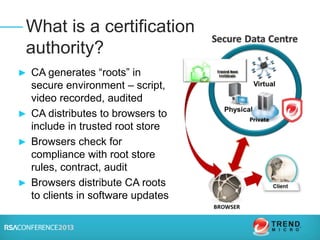
► CA generates “roots” in
secure environment – script,
video recorded, audited
► CA distributes to browsers to
include in trusted root store
► Browsers check for
compliance with root store
rules, contract, audit
► Browsers distribute CA roots
to clients in software updates
What is a certification
authority?
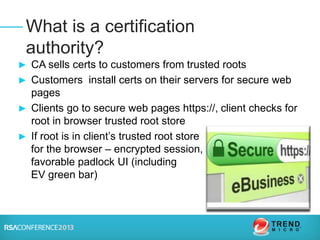
► CA sells certs to customers from trusted roots
► Customers install certs on their servers for secure web
pages
► Clients go to secure web pages https://, client checks for
root in browser trusted root store
► If root is in client’s trusted root store
for the browser – encrypted session,
favorable padlock UI (including
EV green bar)
What is a certification
authority?
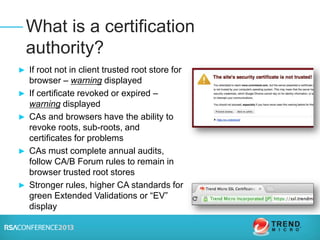
► If root not in client trusted root store for
browser – warning displayed
► If certificate revoked or expired –
warning displayed
► CAs and browsers have the ability to
revoke roots, sub-roots, and
certificates for problems
► CAs must complete annual audits,
follow CA/B Forum rules to remain in
browser trusted root stores
► Stronger rules, higher CA standards for
green Extended Validations or “EV”
display
What is a certification
authority?
RECENT CA
SECURITY ISSUES
AND THEIR
CONSEQUENCES
Kirk Hall
Trend Micro
Problem: Erroneous authentication for code
signing certificate in name of
“Microsoft”
Harm: None detected
Response: Browsers “untrusted” the bad cert,
authentication team member
terminated
(2001)
Problem: CA’s system hacked through external
RA/Reseller portal; 9 fake certs
issued for various top domains
Harm: Unknown. Hacking claims by
“Iranian hacker” never verified
Response: Certs quickly revoked by CA and
“untrusted” by browsers
(2011)
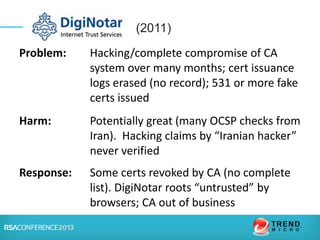
Problem: Hacking/complete compromise of CA
system over many months; cert issuance
logs erased (no record); 531 or more fake
certs issued
Harm: Potentially great (many OCSP checks from
Iran). Hacking claims by “Iranian hacker”
never verified
Response: Some certs revoked by CA (no complete
list). DigiNotar roots “untrusted” by
browsers; CA out of business
(2011)
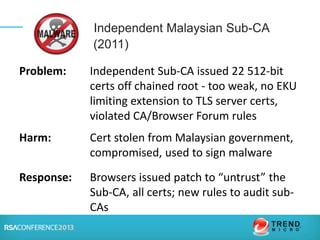
Problem: Independent Sub-CA issued 22 512-bit
certs off chained root - too weak, no EKU
limiting extension to TLS server certs,
violated CA/Browser Forum rules
Harm: Cert stolen from Malaysian government,
compromised, used to sign malware
Response: Browsers issued patch to “untrust” the
Sub-CA, all certs; new rules to audit sub-
CAs
Independent Malaysian Sub-CA
(2011)
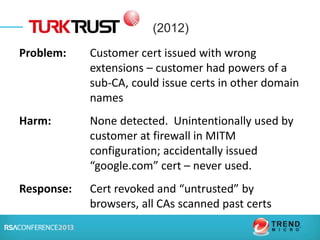
Problem: Customer cert issued with wrong
extensions – customer had powers of a
sub-CA, could issue certs in other domain
names
Harm: None detected. Unintentionally used by
customer at firewall in MITM
configuration; accidentally issued
“google.com” cert – never used.
Response: Cert revoked and “untrusted” by
browsers, all CAs scanned past certs
(2012)
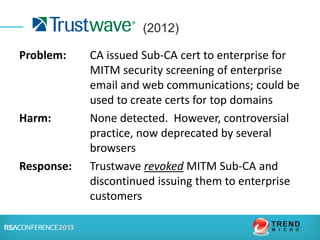
Problem: CA issued Sub-CA cert to enterprise for
MITM security screening of enterprise
email and web communications; could be
used to create certs for top domains
Harm: None detected. However, controversial
practice, now deprecated by several
browsers
Response: Trustwave revoked MITM Sub-CA and
discontinued issuing them to enterprise
customers
(2012)
Alleged Problem:
Myth Busting
Myth: “There are more than 600 trusted CAs in the browsers – too
many to handle, any of these CAs can issue (fake) certs, there
is no regulation of CAs”
Fact: Not true –
Many “CAs” detected by SSL Observatory and others are only
sub-CAs of major CAs, all subject to the same controls by the
parent.
The Mozilla root store has only 65 trusted root holders (with
their various sub-CAs). Plus, some of “600 CAs” in studies are
self-signed only, not trusted in browsers
All CAs in browsers must follow the browser rules,
CA/Browser Forum rules, audit regimes.
► Relatively few CA security issues over 15 years
► Most breaches resulted in no known harm
► Quickly remediated
► Industry practices constantly improved by CAs,
browsers – without government regulation
► Browser root program requirements raise the bar
► CA/Browser Forum (2005 to date) – raised the bar:
► EV Guidelines (2007), Baseline Requirements (2011),
Network and Security Controls (2013)
► WebTrust, ETSI audit requirements (2000 - date)
► New: CA Security Council www.casecurity.org
Summary and Conclusion
► Putting it in perspective:
► Certs issued worldwide: 2,000,000 per year
► Bad certs issued: maybe 1,000 over 11 years (~91
bad certs per year) – mostly DigiNotar incident
► Accuracy ratio for certs issued each year: 99.995%
(Error rate 0.005%) – are Passport Office and state
Departments of Motor Vehicles more accurate? [No]
► Significant harm from bad certs? Only likely in
DigiNotar case (actual harm unknown)
► CAs are continuously improving security, processes
Summary and Conclusion
ALTERNATIVES
AND
ENHANCEMENTS
TO CERTIFICATION
AUTHORITIES FOR
A SECURE WEB
► DANE – DNS based Authentication of Named Entities
(Yngve Pettersen, Opera Software ASA and Quentin Liu,
Symantec)
► CT – Certificate Transparency (Adam Langley, Google)
► CAA – DNS Certification Authority Authorization (Quentin Liu,
Symantec and Yngve Pettersen, Opera Software ASA )
► Public Key Pinning (Wayne Thayer, Go Daddy)
► SSL/TLS Trends Next 5 Years (All)
► Audience Comments/Questions
Alternatives and Enhancements to
Certification Authorities for a Secure
Web
DANE – DNS Based
Authentication of
Named Entities
Yngve Pettersen, Opera
Software ASA
Quentin Liu, Symantec
► DANE is a DNSSEC based protocol defined by
the IETF proposal RFC 6698
► It allows the owner of a domain to signal:
► Which site certificates can be used?
► Which CAs can be used?
► Which public keys can be used?
for a given SSL/TLS server hosted in the domain.
DANE
Benefits
► Similar to HTTP Public Key Pinning, but application
protocol independent
► Independent of the Client Rootstore
► CA limitation is similar to CAA, but checked by the client,
not the CA
DANE
Problems 1
► DNSSEC is not yet widely deployed, in clients or
domains, especially natively
► Trustworthiness of domain registry?
► Security of original domain information?
DANE
Problems 2
► How would fraud and revocation be handled?
► What checks of server certificate keys when no CA is
involved?
► CA-issued certs: Could lead to tighter integration
between CAs, server and DNS hosting.
► Is DANE and DV equal security-wise?
DANE
CT – Certificate
Transparency
Adam Langley, Google
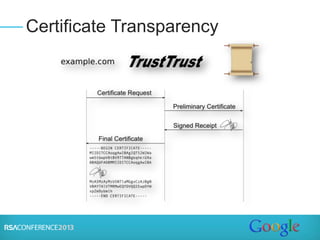
► Certificates should be public record so that you can see
what CAs are asserting about your organization.
Certificate Transparency
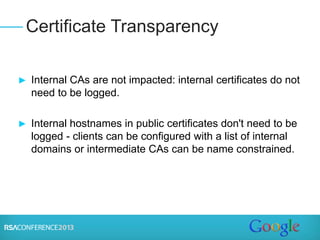
► Internal CAs are not impacted: internal certificates do not
need to be logged.
► Internal hostnames in public certificates don't need to be
logged - clients can be configured with a list of internal
domains or intermediate CAs can be name constrained.
Certificate Transparency
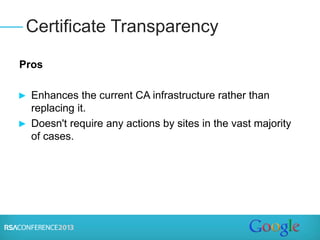
Pros
► Enhances the current CA infrastructure rather than
replacing it.
► Doesn't require any actions by sites in the vast majority
of cases.
Certificate Transparency
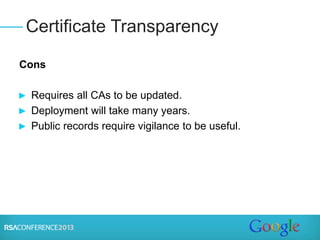
Cons
► Requires all CAs to be updated.
► Deployment will take many years.
► Public records require vigilance to be useful.
Certificate Transparency
CAA – DNS
Certification Authority
Authorization
Quentin Liu, Symantec
Yngve Pettersen, Opera
Software ASA
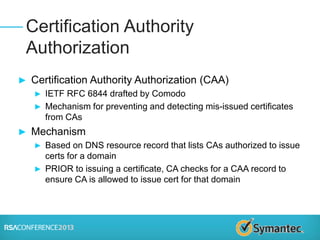
► Certification Authority Authorization (CAA)
► IETF RFC 6844 drafted by Comodo
► Mechanism for preventing and detecting mis-issued certificates
from CAs
► Mechanism
► Based on DNS resource record that lists CAs authorized to issue
certs for a domain
► PRIOR to issuing a certificate, CA checks for a CAA record to
ensure CA is allowed to issue cert for that domain
Certification Authority
Authorization
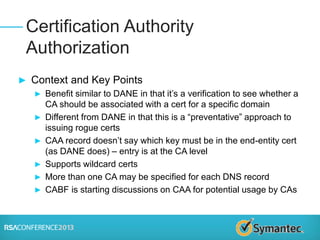
► Context and Key Points
► Benefit similar to DANE in that it’s a verification to see whether a
CA should be associated with a cert for a specific domain
► Different from DANE in that this is a “preventative” approach to
issuing rogue certs
► CAA record doesn’t say which key must be in the end-entity cert
(as DANE does) – entry is at the CA level
► Supports wildcard certs
► More than one CA may be specified for each DNS record
► CABF is starting discussions on CAA for potential usage by CAs
Certification Authority
Authorization
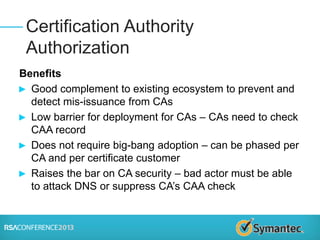
Benefits
► Good complement to existing ecosystem to prevent and
detect mis-issuance from CAs
► Low barrier for deployment for CAs – CAs need to check
CAA record
► Does not require big-bang adoption – can be phased per
CA and per certificate customer
► Raises the bar on CA security – bad actor must be able
to attack DNS or suppress CA’s CAA check
Certification Authority
Authorization
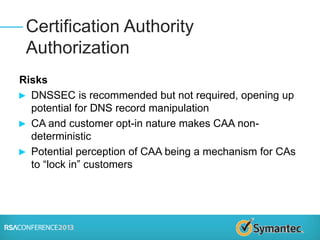
Risks
► DNSSEC is recommended but not required, opening up
potential for DNS record manipulation
► CA and customer opt-in nature makes CAA non-
deterministic
► Potential perception of CAA being a mechanism for CAs
to “lock in” customers
Certification Authority
Authorization
Public Key Pinning
Wayne Thayer
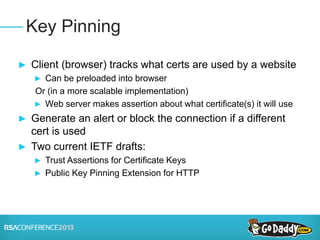
Go Daddy
► Client (browser) tracks what certs are used by a website
► Can be preloaded into browser
Or (in a more scalable implementation)
► Web server makes assertion about what certificate(s) it will use
► Generate an alert or block the connection if a different
cert is used
► Two current IETF drafts:
► Trust Assertions for Certificate Keys
► Public Key Pinning Extension for HTTP
Key Pinning
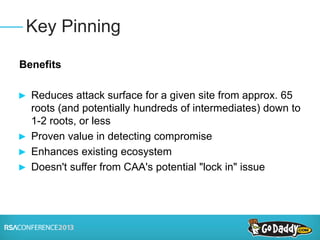
Benefits
► Reduces attack surface for a given site from approx. 65
roots (and potentially hundreds of intermediates) down to
1-2 roots, or less
► Proven value in detecting compromise
► Enhances existing ecosystem
► Doesn't suffer from CAA's potential "lock in" issue
Key Pinning
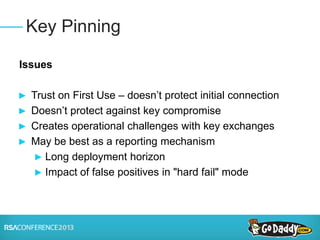
Issues
► Trust on First Use – doesn’t protect initial connection
► Doesn’t protect against key compromise
► Creates operational challenges with key exchanges
► May be best as a reporting mechanism
► Long deployment horizon
► Impact of false positives in "hard fail" mode
Key Pinning
SSL/TLS Trends
for the
Next 5 Years
(Panel Members)
Audience
Comments
and Questions

Tech t18

  • 1.
    Session ID: Session Classification: ALTERNATIVESAND ENHANCEMENTS TO CERTIFICATION AUTHORITIES FOR A SECURE WEB Adam Langley Yngve Pettersen Quentin Liu Wayne Thayer Kirk Hall TECH-T18 Intermediate Trend Micro SSL Google Symantec Opera Software ASA Go Daddy
  • 2.
  • 3.
    ► CA generates“roots” in secure environment – script, video recorded, audited ► CA distributes to browsers to include in trusted root store ► Browsers check for compliance with root store rules, contract, audit ► Browsers distribute CA roots to clients in software updates What is a certification authority?
  • 4.
    ► CA sellscerts to customers from trusted roots ► Customers install certs on their servers for secure web pages ► Clients go to secure web pages https://, client checks for root in browser trusted root store ► If root is in client’s trusted root store for the browser – encrypted session, favorable padlock UI (including EV green bar) What is a certification authority?
  • 5.
    ► If rootnot in client trusted root store for browser – warning displayed ► If certificate revoked or expired – warning displayed ► CAs and browsers have the ability to revoke roots, sub-roots, and certificates for problems ► CAs must complete annual audits, follow CA/B Forum rules to remain in browser trusted root stores ► Stronger rules, higher CA standards for green Extended Validations or “EV” display What is a certification authority?
  • 6.
    RECENT CA SECURITY ISSUES ANDTHEIR CONSEQUENCES Kirk Hall Trend Micro
  • 7.
    Problem: Erroneous authenticationfor code signing certificate in name of “Microsoft” Harm: None detected Response: Browsers “untrusted” the bad cert, authentication team member terminated (2001)
  • 8.
    Problem: CA’s systemhacked through external RA/Reseller portal; 9 fake certs issued for various top domains Harm: Unknown. Hacking claims by “Iranian hacker” never verified Response: Certs quickly revoked by CA and “untrusted” by browsers (2011)
  • 9.
    Problem: Hacking/complete compromiseof CA system over many months; cert issuance logs erased (no record); 531 or more fake certs issued Harm: Potentially great (many OCSP checks from Iran). Hacking claims by “Iranian hacker” never verified Response: Some certs revoked by CA (no complete list). DigiNotar roots “untrusted” by browsers; CA out of business (2011)
  • 10.
    Problem: Independent Sub-CAissued 22 512-bit certs off chained root - too weak, no EKU limiting extension to TLS server certs, violated CA/Browser Forum rules Harm: Cert stolen from Malaysian government, compromised, used to sign malware Response: Browsers issued patch to “untrust” the Sub-CA, all certs; new rules to audit sub- CAs Independent Malaysian Sub-CA (2011)
  • 11.
    Problem: Customer certissued with wrong extensions – customer had powers of a sub-CA, could issue certs in other domain names Harm: None detected. Unintentionally used by customer at firewall in MITM configuration; accidentally issued “google.com” cert – never used. Response: Cert revoked and “untrusted” by browsers, all CAs scanned past certs (2012)
  • 12.
    Problem: CA issuedSub-CA cert to enterprise for MITM security screening of enterprise email and web communications; could be used to create certs for top domains Harm: None detected. However, controversial practice, now deprecated by several browsers Response: Trustwave revoked MITM Sub-CA and discontinued issuing them to enterprise customers (2012)
  • 13.
    Alleged Problem: Myth Busting Myth:“There are more than 600 trusted CAs in the browsers – too many to handle, any of these CAs can issue (fake) certs, there is no regulation of CAs” Fact: Not true – Many “CAs” detected by SSL Observatory and others are only sub-CAs of major CAs, all subject to the same controls by the parent. The Mozilla root store has only 65 trusted root holders (with their various sub-CAs). Plus, some of “600 CAs” in studies are self-signed only, not trusted in browsers All CAs in browsers must follow the browser rules, CA/Browser Forum rules, audit regimes.
  • 14.
    ► Relatively fewCA security issues over 15 years ► Most breaches resulted in no known harm ► Quickly remediated ► Industry practices constantly improved by CAs, browsers – without government regulation ► Browser root program requirements raise the bar ► CA/Browser Forum (2005 to date) – raised the bar: ► EV Guidelines (2007), Baseline Requirements (2011), Network and Security Controls (2013) ► WebTrust, ETSI audit requirements (2000 - date) ► New: CA Security Council www.casecurity.org Summary and Conclusion
  • 15.
    ► Putting itin perspective: ► Certs issued worldwide: 2,000,000 per year ► Bad certs issued: maybe 1,000 over 11 years (~91 bad certs per year) – mostly DigiNotar incident ► Accuracy ratio for certs issued each year: 99.995% (Error rate 0.005%) – are Passport Office and state Departments of Motor Vehicles more accurate? [No] ► Significant harm from bad certs? Only likely in DigiNotar case (actual harm unknown) ► CAs are continuously improving security, processes Summary and Conclusion
  • 16.
  • 17.
    ► DANE –DNS based Authentication of Named Entities (Yngve Pettersen, Opera Software ASA and Quentin Liu, Symantec) ► CT – Certificate Transparency (Adam Langley, Google) ► CAA – DNS Certification Authority Authorization (Quentin Liu, Symantec and Yngve Pettersen, Opera Software ASA ) ► Public Key Pinning (Wayne Thayer, Go Daddy) ► SSL/TLS Trends Next 5 Years (All) ► Audience Comments/Questions Alternatives and Enhancements to Certification Authorities for a Secure Web
  • 18.
    DANE – DNSBased Authentication of Named Entities Yngve Pettersen, Opera Software ASA Quentin Liu, Symantec
  • 19.
    ► DANE isa DNSSEC based protocol defined by the IETF proposal RFC 6698 ► It allows the owner of a domain to signal: ► Which site certificates can be used? ► Which CAs can be used? ► Which public keys can be used? for a given SSL/TLS server hosted in the domain. DANE
  • 20.
    Benefits ► Similar toHTTP Public Key Pinning, but application protocol independent ► Independent of the Client Rootstore ► CA limitation is similar to CAA, but checked by the client, not the CA DANE
  • 21.
    Problems 1 ► DNSSECis not yet widely deployed, in clients or domains, especially natively ► Trustworthiness of domain registry? ► Security of original domain information? DANE
  • 22.
    Problems 2 ► Howwould fraud and revocation be handled? ► What checks of server certificate keys when no CA is involved? ► CA-issued certs: Could lead to tighter integration between CAs, server and DNS hosting. ► Is DANE and DV equal security-wise? DANE
  • 23.
  • 24.
    ► Certificates shouldbe public record so that you can see what CAs are asserting about your organization. Certificate Transparency
  • 25.
  • 26.
    ► Internal CAsare not impacted: internal certificates do not need to be logged. ► Internal hostnames in public certificates don't need to be logged - clients can be configured with a list of internal domains or intermediate CAs can be name constrained. Certificate Transparency
  • 27.
    Pros ► Enhances thecurrent CA infrastructure rather than replacing it. ► Doesn't require any actions by sites in the vast majority of cases. Certificate Transparency
  • 28.
    Cons ► Requires allCAs to be updated. ► Deployment will take many years. ► Public records require vigilance to be useful. Certificate Transparency
  • 29.
    CAA – DNS CertificationAuthority Authorization Quentin Liu, Symantec Yngve Pettersen, Opera Software ASA
  • 30.
    ► Certification AuthorityAuthorization (CAA) ► IETF RFC 6844 drafted by Comodo ► Mechanism for preventing and detecting mis-issued certificates from CAs ► Mechanism ► Based on DNS resource record that lists CAs authorized to issue certs for a domain ► PRIOR to issuing a certificate, CA checks for a CAA record to ensure CA is allowed to issue cert for that domain Certification Authority Authorization
  • 31.
    ► Context andKey Points ► Benefit similar to DANE in that it’s a verification to see whether a CA should be associated with a cert for a specific domain ► Different from DANE in that this is a “preventative” approach to issuing rogue certs ► CAA record doesn’t say which key must be in the end-entity cert (as DANE does) – entry is at the CA level ► Supports wildcard certs ► More than one CA may be specified for each DNS record ► CABF is starting discussions on CAA for potential usage by CAs Certification Authority Authorization
  • 32.
    Benefits ► Good complementto existing ecosystem to prevent and detect mis-issuance from CAs ► Low barrier for deployment for CAs – CAs need to check CAA record ► Does not require big-bang adoption – can be phased per CA and per certificate customer ► Raises the bar on CA security – bad actor must be able to attack DNS or suppress CA’s CAA check Certification Authority Authorization
  • 33.
    Risks ► DNSSEC isrecommended but not required, opening up potential for DNS record manipulation ► CA and customer opt-in nature makes CAA non- deterministic ► Potential perception of CAA being a mechanism for CAs to “lock in” customers Certification Authority Authorization
  • 34.
    Public Key Pinning WayneThayer Go Daddy
  • 35.
    ► Client (browser)tracks what certs are used by a website ► Can be preloaded into browser Or (in a more scalable implementation) ► Web server makes assertion about what certificate(s) it will use ► Generate an alert or block the connection if a different cert is used ► Two current IETF drafts: ► Trust Assertions for Certificate Keys ► Public Key Pinning Extension for HTTP Key Pinning
  • 36.
    Benefits ► Reduces attacksurface for a given site from approx. 65 roots (and potentially hundreds of intermediates) down to 1-2 roots, or less ► Proven value in detecting compromise ► Enhances existing ecosystem ► Doesn't suffer from CAA's potential "lock in" issue Key Pinning
  • 37.
    Issues ► Trust onFirst Use – doesn’t protect initial connection ► Doesn’t protect against key compromise ► Creates operational challenges with key exchanges ► May be best as a reporting mechanism ► Long deployment horizon ► Impact of false positives in "hard fail" mode Key Pinning
  • 38.
    SSL/TLS Trends for the Next5 Years (Panel Members)
  • 39.