The Blueprint for CRM An Approach for  NFP Organisations
What are the key concerns? Research has shown that the most significant concerns in introducing CRM in are:  Getting the specification right Obtaining buy-in Data quality Achieving full implementation Using data effectively Cost There is also often uncertainty as to what CRM is and what it can mean to any specific organisation
What we cover in this presentation… How a modern CRM differs from a legacy membership system  How to determine if your organisation is ready for CRM  Pre-requisites  Business culture Approach  The customer management framework  Promoting 'buy-in'  Creating the business plan
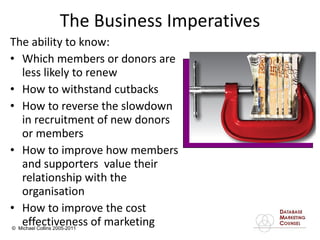
The Business Imperatives The ability to know: Which members or donors are less likely to renew  How to withstand cutbacks  How to reverse the slowdown in recruitment of new donors or members How to improve how members and supporters  value their relationship with the organisation How to improve the cost effectiveness of marketing
The Business Imperatives Member, sponsor and other important stakeholder communication is essential to the success of membership organisations Move to individual conversations – 1 to 1 communications Staff will need to (appear to) have a good level of knowledge of the member to fully engage  Need to capture, organise and disseminate information to/from touchpoints
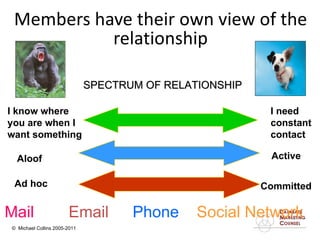
Members have their own view of the relationship SPECTRUM OF RELATIONSHIP I need constant contact I know where you are when I want something Mail Email Phone Social Network Ad hoc Aloof Active Committed
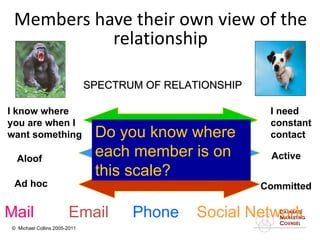
Members have their own view of the relationship SPECTRUM OF RELATIONSHIP I need constant contact I know where you are when I want something Mail Email Phone Social Network Ad hoc Aloof Active Committed Do you know where each member is on this scale?
If you don’t have the insight into your members, donors and supporters how do you hope to manage the relationship?
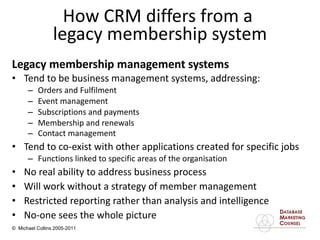
How CRM differs from a  legacy membership system Legacy membership management systems  Tend to be business management systems, addressing: Orders and Fulfilment Event management Subscriptions and payments Membership and renewals Contact management Tend to co-exist with other applications created for specific jobs  Functions linked to specific areas of the organisation No real ability to address business process Will work without a strategy of member management Restricted reporting rather than analysis and intelligence No-one sees the whole picture
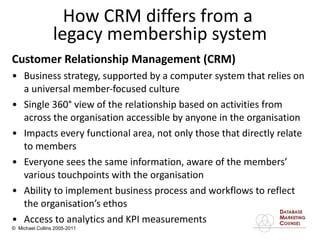
Customer Relationship Management (CRM)  Business strategy, supported by a computer system that relies on a universal member-focused culture  Single 360 °  view of the relationship based on activities from across the organisation accessible by anyone in the organisation Impacts every functional area, not only those that directly relate to members Everyone sees the same information, aware of the members’ various touchpoints with the organisation Ability to implement business process and workflows to reflect the organisation’s ethos Access to analytics and KPI measurements How CRM differs from a  legacy membership system
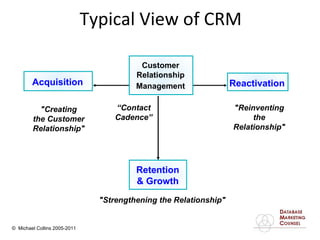
Acquisition Reactivation Customer Relationship Management "Creating the Customer Relationship" "Reinventing the Relationship" Retention & Growth "Strengthening the Relationship" Typical View of CRM “ Contact Cadence”
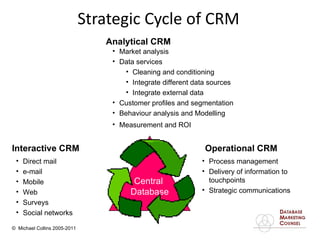
Strategic Cycle of CRM   Analytical CRM Market analysis Data services Cleaning and conditioning Integrate different data sources Integrate external data Customer profiles and segmentation Behaviour analysis and Modelling Measurement and ROI Operational CRM Process management Delivery of information to touchpoints Strategic communications Interactive CRM  Direct mail e-mail Mobile Web Surveys Social networks Central  Database
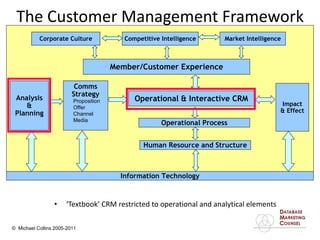
The Customer Management Framework ‘ Textbook’ CRM restricted to operational and analytical elements  Competitive Intelligence Analysis & Planning Comms Strategy Operational Process Human Resource and Structure Information Technology Member/Customer Experience Market Intelligence Impact & Effect Proposition Offer Channel Media Operational & Interactive CRM Corporate Culture
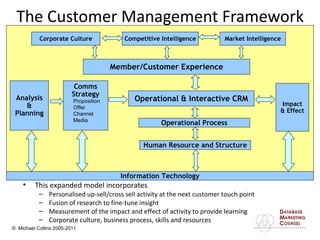
The Customer Management Framework Competitive Intelligence Analysis & Planning Comms Strategy Operational Process Human Resource and Structure Information Technology Member/Customer Experience Market Intelligence Impact & Effect Proposition Offer Channel Media Operational & Interactive CRM Corporate Culture This expanded model incorporates  Personalised up-sell/cross sell activity at the next customer touch point Fusion of research to fine-tune insight Measurement of the impact and effect of activity to provide learning Corporate culture, business process, skills and resources
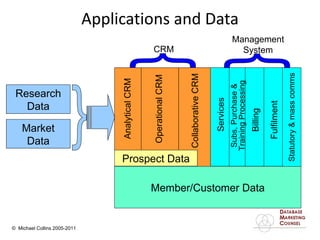
Applications and Data Member/Customer Data Prospect Data Analytical CRM Operational CRM Collaborative CRM Billing Subs, Purchase &   Training Processing Market Data Fulfilment Services Research Data Statutory & mass comms } Management System } CRM }
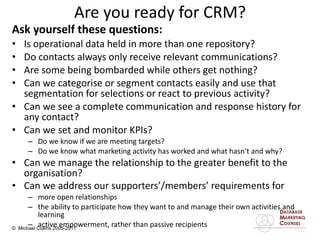
Are you ready for CRM? Ask yourself these questions: Is operational data held in more than one repository? Do contacts always only receive relevant communications? Are some being bombarded while others get nothing? Can we categorise or segment contacts easily and use that segmentation for selections or react to previous activity? Can we see a complete communication and response history for any contact?  Can we set and monitor KPIs? Do we know if we are meeting targets? Do we know what marketing activity has worked and what hasn’t and why? Can we manage the relationship to the greater benefit to the organisation? Can we address our supporters’/members’ requirements for   more open relationships the ability to participate how they want to and manage their own activities and learning active empowerment, rather than passive recipients
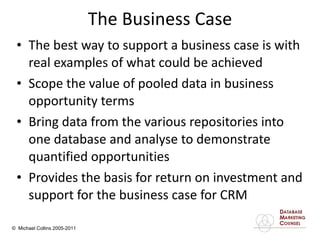
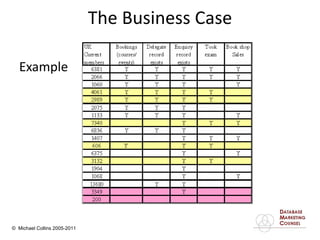
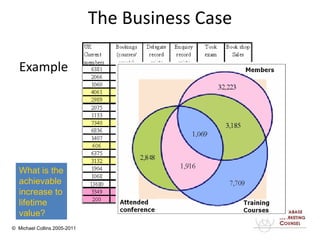
The Business Case The best way to support a business case is with real examples of what could be achieved  Scope the value of pooled data in business opportunity terms  Bring data from the various repositories into one database and analyse to demonstrate quantified opportunities  Provides the basis for return on investment and support for the business case for CRM
The Business Case Example
The Business Case Example What is the achievable increase to lifetime value?
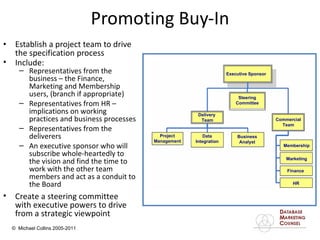
Establish a project team to drive the specification process Promoting Buy-In Create a steering committee with executive powers to drive from a strategic viewpoint Include: Representatives from the business – the Finance, Marketing and Membership users, (branch if appropriate) Representatives from HR – implications on working practices and business processes Representatives from the deliverers An executive sponsor who will subscribe whole-heartedly to the vision and find the time to work with the other team members and act as a conduit to the Board Executive Sponsor Steering Committee Commercial Team Membership Marketing Finance HR Business Analyst Data Integration Project Management Delivery  Team
Promoting Buy-In Don’t take buy-in for granted - good planning is fundamental  Make sure everyone understands what CRM is for your organisation and what can be achieved Aim for an understanding on   why you should proceed  what the challenges will be  what the return is likely to be Build a business case to demonstrate payback  Engage a specialist, experienced CRM consultant to facilitate the initial stages of the process and help build the business case for the investment Keep proceedings at this stage in business terms and in the context of the organisation’s business plan, an approach the executive sponsor can align to
Many CRM initiatives have failed to achieve the expected levels of success Too many organisations have failed to focus on the need for strategy, the business process requirements, the data, commercial and cultural aspects  A properly constructed CRM strategy that is based on a solid, defined business requirement that has been bought into by all stakeholders can deliver the ROI Customer Relationship Management
DMC Can Help Specialist expert consultants and analysts are on hand to  Help you through the pitfalls of implementing CRM Direct you through the management framework Develop your communications strategy Assist you with specifying your requirements Deliver member insight  Help build your business case
www.dmcounsel.co.uk

CRM Blueprint For NFPs

  • 1.
    The Blueprint forCRM An Approach for NFP Organisations
  • 2.
    What are thekey concerns? Research has shown that the most significant concerns in introducing CRM in are: Getting the specification right Obtaining buy-in Data quality Achieving full implementation Using data effectively Cost There is also often uncertainty as to what CRM is and what it can mean to any specific organisation
  • 3.
    What we coverin this presentation… How a modern CRM differs from a legacy membership system How to determine if your organisation is ready for CRM Pre-requisites Business culture Approach The customer management framework Promoting 'buy-in' Creating the business plan
  • 4.
    The Business ImperativesThe ability to know: Which members or donors are less likely to renew How to withstand cutbacks How to reverse the slowdown in recruitment of new donors or members How to improve how members and supporters value their relationship with the organisation How to improve the cost effectiveness of marketing
  • 5.
    The Business ImperativesMember, sponsor and other important stakeholder communication is essential to the success of membership organisations Move to individual conversations – 1 to 1 communications Staff will need to (appear to) have a good level of knowledge of the member to fully engage Need to capture, organise and disseminate information to/from touchpoints
  • 6.
    Members have theirown view of the relationship SPECTRUM OF RELATIONSHIP I need constant contact I know where you are when I want something Mail Email Phone Social Network Ad hoc Aloof Active Committed
  • 7.
    Members have theirown view of the relationship SPECTRUM OF RELATIONSHIP I need constant contact I know where you are when I want something Mail Email Phone Social Network Ad hoc Aloof Active Committed Do you know where each member is on this scale?
  • 8.
    If you don’thave the insight into your members, donors and supporters how do you hope to manage the relationship?
  • 9.
    How CRM differsfrom a legacy membership system Legacy membership management systems Tend to be business management systems, addressing: Orders and Fulfilment Event management Subscriptions and payments Membership and renewals Contact management Tend to co-exist with other applications created for specific jobs Functions linked to specific areas of the organisation No real ability to address business process Will work without a strategy of member management Restricted reporting rather than analysis and intelligence No-one sees the whole picture
  • 10.
    Customer Relationship Management(CRM) Business strategy, supported by a computer system that relies on a universal member-focused culture Single 360 ° view of the relationship based on activities from across the organisation accessible by anyone in the organisation Impacts every functional area, not only those that directly relate to members Everyone sees the same information, aware of the members’ various touchpoints with the organisation Ability to implement business process and workflows to reflect the organisation’s ethos Access to analytics and KPI measurements How CRM differs from a legacy membership system
  • 11.
    Acquisition Reactivation CustomerRelationship Management "Creating the Customer Relationship" "Reinventing the Relationship" Retention & Growth "Strengthening the Relationship" Typical View of CRM “ Contact Cadence”
  • 12.
    Strategic Cycle ofCRM Analytical CRM Market analysis Data services Cleaning and conditioning Integrate different data sources Integrate external data Customer profiles and segmentation Behaviour analysis and Modelling Measurement and ROI Operational CRM Process management Delivery of information to touchpoints Strategic communications Interactive CRM Direct mail e-mail Mobile Web Surveys Social networks Central Database
  • 13.
    The Customer ManagementFramework ‘ Textbook’ CRM restricted to operational and analytical elements Competitive Intelligence Analysis & Planning Comms Strategy Operational Process Human Resource and Structure Information Technology Member/Customer Experience Market Intelligence Impact & Effect Proposition Offer Channel Media Operational & Interactive CRM Corporate Culture
  • 14.
    The Customer ManagementFramework Competitive Intelligence Analysis & Planning Comms Strategy Operational Process Human Resource and Structure Information Technology Member/Customer Experience Market Intelligence Impact & Effect Proposition Offer Channel Media Operational & Interactive CRM Corporate Culture This expanded model incorporates Personalised up-sell/cross sell activity at the next customer touch point Fusion of research to fine-tune insight Measurement of the impact and effect of activity to provide learning Corporate culture, business process, skills and resources
  • 15.
    Applications and DataMember/Customer Data Prospect Data Analytical CRM Operational CRM Collaborative CRM Billing Subs, Purchase & Training Processing Market Data Fulfilment Services Research Data Statutory & mass comms } Management System } CRM }
  • 16.
    Are you readyfor CRM? Ask yourself these questions: Is operational data held in more than one repository? Do contacts always only receive relevant communications? Are some being bombarded while others get nothing? Can we categorise or segment contacts easily and use that segmentation for selections or react to previous activity? Can we see a complete communication and response history for any contact? Can we set and monitor KPIs? Do we know if we are meeting targets? Do we know what marketing activity has worked and what hasn’t and why? Can we manage the relationship to the greater benefit to the organisation? Can we address our supporters’/members’ requirements for more open relationships the ability to participate how they want to and manage their own activities and learning active empowerment, rather than passive recipients
  • 17.
    The Business CaseThe best way to support a business case is with real examples of what could be achieved Scope the value of pooled data in business opportunity terms Bring data from the various repositories into one database and analyse to demonstrate quantified opportunities Provides the basis for return on investment and support for the business case for CRM
  • 18.
  • 19.
    The Business CaseExample What is the achievable increase to lifetime value?
  • 20.
    Establish a projectteam to drive the specification process Promoting Buy-In Create a steering committee with executive powers to drive from a strategic viewpoint Include: Representatives from the business – the Finance, Marketing and Membership users, (branch if appropriate) Representatives from HR – implications on working practices and business processes Representatives from the deliverers An executive sponsor who will subscribe whole-heartedly to the vision and find the time to work with the other team members and act as a conduit to the Board Executive Sponsor Steering Committee Commercial Team Membership Marketing Finance HR Business Analyst Data Integration Project Management Delivery Team
  • 21.
    Promoting Buy-In Don’ttake buy-in for granted - good planning is fundamental Make sure everyone understands what CRM is for your organisation and what can be achieved Aim for an understanding on why you should proceed what the challenges will be what the return is likely to be Build a business case to demonstrate payback Engage a specialist, experienced CRM consultant to facilitate the initial stages of the process and help build the business case for the investment Keep proceedings at this stage in business terms and in the context of the organisation’s business plan, an approach the executive sponsor can align to
  • 22.
    Many CRM initiativeshave failed to achieve the expected levels of success Too many organisations have failed to focus on the need for strategy, the business process requirements, the data, commercial and cultural aspects A properly constructed CRM strategy that is based on a solid, defined business requirement that has been bought into by all stakeholders can deliver the ROI Customer Relationship Management
  • 23.
    DMC Can HelpSpecialist expert consultants and analysts are on hand to Help you through the pitfalls of implementing CRM Direct you through the management framework Develop your communications strategy Assist you with specifying your requirements Deliver member insight Help build your business case
  • 24.

Editor's Notes

  • #13 At this point we might introduce some definitions, although they don’t need to go into the slides
  • #21 The Project Team should comprise: Representatives from the business – the Marketing and Sales users; involve people at the coalface as well as managers and if you have a field sales force and/or branch or distributor channels involve staff from these channels too. If you expect your IT department to deliver a solution for your database strategy then it is wise to involve them from the outset and since there are likely to be implications on working practices and business processes, your HR department should also be represented; not only will they assist in providing some scope to the inter-personal elements, but they will also be useful in helping to manage change in the business once the scheme goes ahead. Ideally involve a board member in your project team. They will become your champion upstairs and will fight your corner when it comes to business case, resources and changes in business processes.