Confidential www.GrayAssociates.com 1Confidential
Academic Program
Selection and Assessment
How to Choose Which Programs
to Start, Stop, Sustain, or Grow
April 2017
Confidential www.GrayAssociates.com 2
Goal for Today’s Session
§  Share an overall approach, and best practices, for
an integrated program portfolio evaluation
process
–  Participants
–  Process
–  Analysis
–  Integration
Confidential www.GrayAssociates.com 3
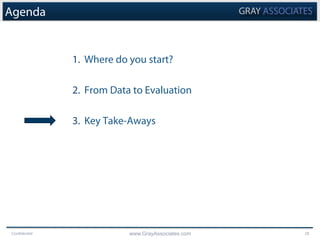
Agenda
1.  Where do you start?
2.  From Data to Evaluation
3.  Key Take-Aways
Confidential www.GrayAssociates.com 4
But first…
Confidential www.GrayAssociates.com 5
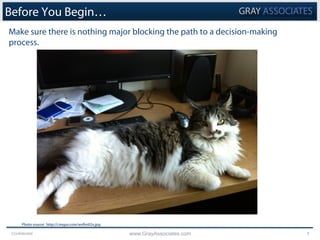
Make sure there is nothing major blocking the path to a decision-making
process.
Before You Begin…
Photo source: http://i.imgur.com/wsRm02x.jpg
Confidential www.GrayAssociates.com 6
Before You Begin…
It is important to understand:
§  Programs have life-cycles
§  You are ready to identify where each of your programs are
§  Doing this once is helpful, doing this systematically creates strength
§  This is not something to be done ‘behind closed doors’
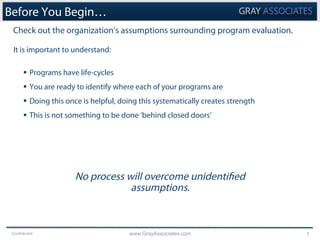
Check out the organization’s assumptions surrounding program evaluation.
No process will overcome unidentified
assumptions.
Confidential www.GrayAssociates.com 7
So, where do you start?
Confidential www.GrayAssociates.com 8
Thousands of Potential Programs…
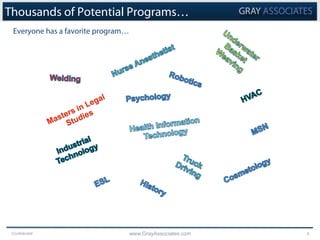
Everyone has a favorite program…
Confidential www.GrayAssociates.com 9
Limitless Possibilities
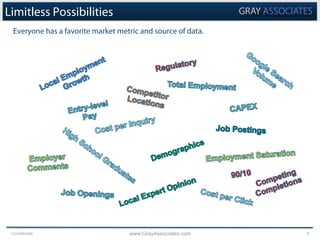
Everyone has a favorite market metric and source of data.
Confidential www.GrayAssociates.com 10
Integrating Data and Knowledge
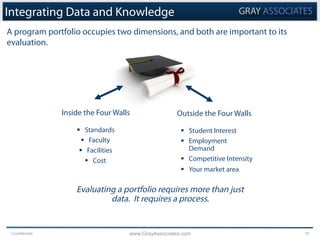
A program portfolio occupies two dimensions, and both are important to its
evaluation.
Inside the Four Walls
§  Standards
§  Faculty
§  Facilities
§  Cost
Outside the Four Walls
§  Student Interest
§  Employment
Demand
§  Competitive Intensity
§  Your market area
Evaluating a portfolio requires more than just
data. It requires a process.
Confidential www.GrayAssociates.com 11
First: Identify the Markets You Serve
Where do your students come from?
Confidential www.GrayAssociates.com 12
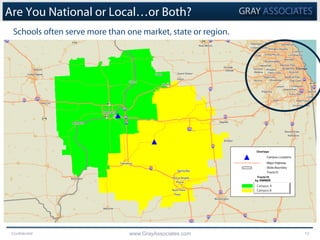
Schools often serve more than one market, state or region.
Are You National or Local…or Both?
Campus A
Campus B
Confidential www.GrayAssociates.com 13
Second: Confirm Strategy
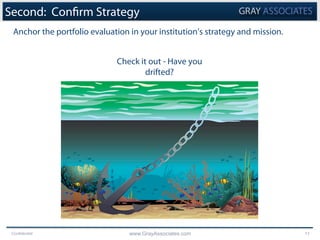
Check it out - Have you
drifted?
Anchor the portfolio evaluation in your institution’s strategy and mission.
Confidential www.GrayAssociates.com 14
Third: Decide What is Important
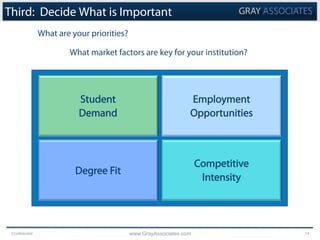
What are your priorities?
What market factors are key for your institution?
Student
Demand
Employment
Opportunities
Degree Fit
Competitive
Intensity
Confidential www.GrayAssociates.com 15
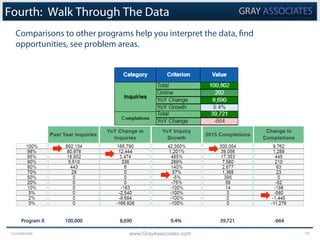
Fourth: Walk Through The Data
Comparisons to other programs help you interpret the data, find
opportunities, see problem areas.
100,000Program X 8,690 9.4% 39,721 -664
Confidential www.GrayAssociates.com 16
Agenda
1.  Where do you start?
2.  From Data to Evaluation
3.  Key Take-Aways
Confidential www.GrayAssociates.com 17
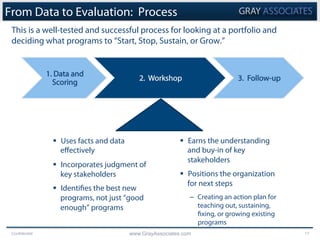
From Data to Evaluation: Process
This is a well-tested and successful process for looking at a portfolio and
deciding what programs to “Start, Stop, Sustain, or Grow.”
1. Data and
Scoring
2. Workshop 3. Follow-up
§  Uses facts and data
effectively
§  Incorporates judgment of
key stakeholders
§  Identifies the best new
programs, not just “good
enough” programs
§  Earns the understanding
and buy-in of key
stakeholders
§  Positions the organization
for next steps
–  Creating an action plan for
teaching out, sustaining,
fixing, or growing existing
programs
Confidential www.GrayAssociates.com 18
From Data to Evaluation: Process
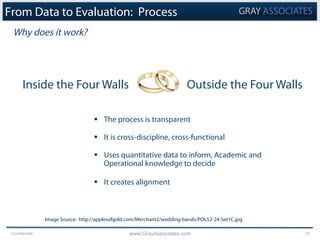
Why does it work?
Inside the Four Walls Outside the Four Walls
Image Source: http://applesofgold.com/Merchant2/wedding-bands/POL52-24-Set1C.jpg
§  The process is transparent
§  It is cross-discipline, cross-functional
§  Uses quantitative data to inform, Academic and
Operational knowledge to decide
§  It creates alignment
Confidential www.GrayAssociates.com 19
Where Do You Want to Spend Your Energy?
Confidential www.GrayAssociates.com 20
Cooperative and Transparent Process
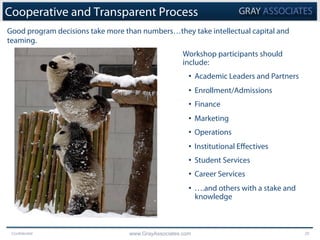
Good program decisions take more than numbers…they take intellectual capital and
teaming.
Workshop participants should
include:
•  Academic Leaders and Partners
•  Enrollment/Admissions
•  Finance
•  Marketing
•  Operations
•  Institutional Effectives
•  Student Services
•  Career Services
•  ….and others with a stake and
knowledge
Confidential www.GrayAssociates.com 21
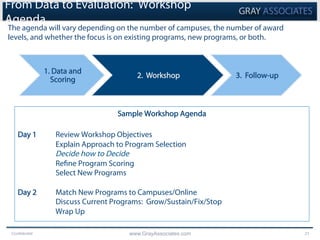
The agenda will vary depending on the number of campuses, the number of award
levels, and whether the focus is on existing programs, new programs, or both.
From Data to Evaluation: Workshop
Agenda
Sample Workshop Agenda
Day 1 Review Workshop Objectives
Explain Approach to Program Selection
Decide how to Decide
Refine Program Scoring
Select New Programs
Day 2 Match New Programs to Campuses/Online
Discuss Current Programs: Grow/Sustain/Fix/Stop
Wrap Up
1. Data and
Scoring
2. Workshop 3. Follow-up
Confidential www.GrayAssociates.com 22
Collaboration and Decision Approach
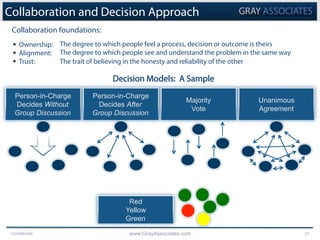
Collaboration foundations:
The degree to which people feel a process, decision or outcome is theirs
The degree to which people see and understand the problem in the same way
The trait of believing in the honesty and reliability of the other
Decision Models: A Sample
Person-in-Charge
Decides Without
Group Discussion
Person-in-Charge
Decides After
Group Discussion
Majority
Vote
Unanimous
Agreement
Red
Yellow
Green
§  Ownership:
§  Alignment:
§  Trust:
Confidential www.GrayAssociates.com 23
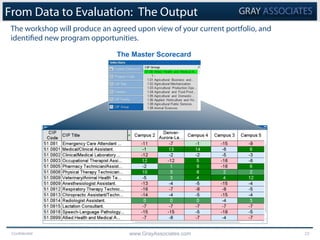
The workshop will produce an agreed upon view of your current portfolio, and
identified new program opportunities.
From Data to Evaluation: The Output
The Master Scorecard
Confidential www.GrayAssociates.com 24
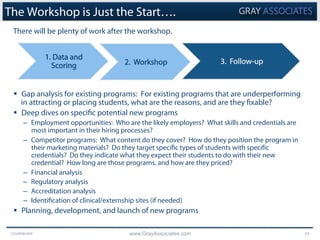
The Workshop is Just the Start….
There will be plenty of work after the workshop.
1. Data and
Scoring 2. Workshop 3. Follow-up
§  Gap analysis for existing programs: For existing programs that are underperforming
in attracting or placing students, what are the reasons, and are they fixable?
§  Deep dives on specific potential new programs
–  Employment opportunities: Who are the likely employers? What skills and credentials are
most important in their hiring processes?
–  Competitor programs: What content do they cover? How do they position the program in
their marketing materials? Do they target specific types of students with specific
credentials? Do they indicate what they expect their students to do with their new
credential? How long are those programs, and how are they priced?
–  Financial analysis
–  Regulatory analysis
–  Accreditation analysis
–  Identification of clinical/externship sites (if needed)
§  Planning, development, and launch of new programs
Confidential www.GrayAssociates.com 25
The Goal: A Vibrant Institution
Confidential www.GrayAssociates.com 26
Agenda
1.  Where do you start?
2.  From Data to Evaluation
3.  Key Take-Aways
Confidential www.GrayAssociates.com 27
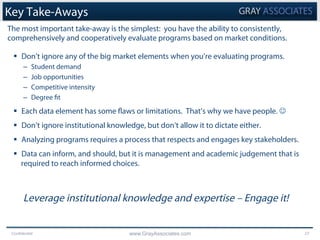
Key Take-Aways
§  Don’t ignore any of the big market elements when you’re evaluating programs.
–  Student demand
–  Job opportunities
–  Competitive intensity
–  Degree fit
§  Each data element has some flaws or limitations. That’s why we have people. J
§  Don’t ignore institutional knowledge, but don’t allow it to dictate either.
§  Analyzing programs requires a process that respects and engages key stakeholders.
§  Data can inform, and should, but it is management and academic judgement that is
required to reach informed choices.
Leverage institutional knowledge and expertise – Engage it!
The most important take-away is the simplest: you have the ability to consistently,
comprehensively and cooperatively evaluate programs based on market conditions.
Confidential www.GrayAssociates.com 28
For More Information…
To contact Gray Associates:
Mary Upchurch
Senior Partner
Gray Associates, Inc.
Mary.Upchurch@GrayAssociates.com
480-390-7230

The Best Practices in Program Portfolio Evaluation - Running an Effective Program Portfolio Evaluation Process

  • 1.
    Confidential www.GrayAssociates.com 1Confidential AcademicProgram Selection and Assessment How to Choose Which Programs to Start, Stop, Sustain, or Grow April 2017
  • 2.
    Confidential www.GrayAssociates.com 2 Goalfor Today’s Session §  Share an overall approach, and best practices, for an integrated program portfolio evaluation process –  Participants –  Process –  Analysis –  Integration
  • 3.
    Confidential www.GrayAssociates.com 3 Agenda 1. Where do you start? 2.  From Data to Evaluation 3.  Key Take-Aways
  • 4.
  • 5.
    Confidential www.GrayAssociates.com 5 Makesure there is nothing major blocking the path to a decision-making process. Before You Begin… Photo source: http://i.imgur.com/wsRm02x.jpg
  • 6.
    Confidential www.GrayAssociates.com 6 BeforeYou Begin… It is important to understand: §  Programs have life-cycles §  You are ready to identify where each of your programs are §  Doing this once is helpful, doing this systematically creates strength §  This is not something to be done ‘behind closed doors’ Check out the organization’s assumptions surrounding program evaluation. No process will overcome unidentified assumptions.
  • 7.
  • 8.
    Confidential www.GrayAssociates.com 8 Thousandsof Potential Programs… Everyone has a favorite program…
  • 9.
    Confidential www.GrayAssociates.com 9 LimitlessPossibilities Everyone has a favorite market metric and source of data.
  • 10.
    Confidential www.GrayAssociates.com 10 IntegratingData and Knowledge A program portfolio occupies two dimensions, and both are important to its evaluation. Inside the Four Walls §  Standards §  Faculty §  Facilities §  Cost Outside the Four Walls §  Student Interest §  Employment Demand §  Competitive Intensity §  Your market area Evaluating a portfolio requires more than just data. It requires a process.
  • 11.
    Confidential www.GrayAssociates.com 11 First:Identify the Markets You Serve Where do your students come from?
  • 12.
    Confidential www.GrayAssociates.com 12 Schoolsoften serve more than one market, state or region. Are You National or Local…or Both? Campus A Campus B
  • 13.
    Confidential www.GrayAssociates.com 13 Second:Confirm Strategy Check it out - Have you drifted? Anchor the portfolio evaluation in your institution’s strategy and mission.
  • 14.
    Confidential www.GrayAssociates.com 14 Third:Decide What is Important What are your priorities? What market factors are key for your institution? Student Demand Employment Opportunities Degree Fit Competitive Intensity
  • 15.
    Confidential www.GrayAssociates.com 15 Fourth:Walk Through The Data Comparisons to other programs help you interpret the data, find opportunities, see problem areas. 100,000Program X 8,690 9.4% 39,721 -664
  • 16.
    Confidential www.GrayAssociates.com 16 Agenda 1. Where do you start? 2.  From Data to Evaluation 3.  Key Take-Aways
  • 17.
    Confidential www.GrayAssociates.com 17 FromData to Evaluation: Process This is a well-tested and successful process for looking at a portfolio and deciding what programs to “Start, Stop, Sustain, or Grow.” 1. Data and Scoring 2. Workshop 3. Follow-up §  Uses facts and data effectively §  Incorporates judgment of key stakeholders §  Identifies the best new programs, not just “good enough” programs §  Earns the understanding and buy-in of key stakeholders §  Positions the organization for next steps –  Creating an action plan for teaching out, sustaining, fixing, or growing existing programs
  • 18.
    Confidential www.GrayAssociates.com 18 FromData to Evaluation: Process Why does it work? Inside the Four Walls Outside the Four Walls Image Source: http://applesofgold.com/Merchant2/wedding-bands/POL52-24-Set1C.jpg §  The process is transparent §  It is cross-discipline, cross-functional §  Uses quantitative data to inform, Academic and Operational knowledge to decide §  It creates alignment
  • 19.
    Confidential www.GrayAssociates.com 19 WhereDo You Want to Spend Your Energy?
  • 20.
    Confidential www.GrayAssociates.com 20 Cooperativeand Transparent Process Good program decisions take more than numbers…they take intellectual capital and teaming. Workshop participants should include: •  Academic Leaders and Partners •  Enrollment/Admissions •  Finance •  Marketing •  Operations •  Institutional Effectives •  Student Services •  Career Services •  ….and others with a stake and knowledge
  • 21.
    Confidential www.GrayAssociates.com 21 Theagenda will vary depending on the number of campuses, the number of award levels, and whether the focus is on existing programs, new programs, or both. From Data to Evaluation: Workshop Agenda Sample Workshop Agenda Day 1 Review Workshop Objectives Explain Approach to Program Selection Decide how to Decide Refine Program Scoring Select New Programs Day 2 Match New Programs to Campuses/Online Discuss Current Programs: Grow/Sustain/Fix/Stop Wrap Up 1. Data and Scoring 2. Workshop 3. Follow-up
  • 22.
    Confidential www.GrayAssociates.com 22 Collaborationand Decision Approach Collaboration foundations: The degree to which people feel a process, decision or outcome is theirs The degree to which people see and understand the problem in the same way The trait of believing in the honesty and reliability of the other Decision Models: A Sample Person-in-Charge Decides Without Group Discussion Person-in-Charge Decides After Group Discussion Majority Vote Unanimous Agreement Red Yellow Green §  Ownership: §  Alignment: §  Trust:
  • 23.
    Confidential www.GrayAssociates.com 23 Theworkshop will produce an agreed upon view of your current portfolio, and identified new program opportunities. From Data to Evaluation: The Output The Master Scorecard
  • 24.
    Confidential www.GrayAssociates.com 24 TheWorkshop is Just the Start…. There will be plenty of work after the workshop. 1. Data and Scoring 2. Workshop 3. Follow-up §  Gap analysis for existing programs: For existing programs that are underperforming in attracting or placing students, what are the reasons, and are they fixable? §  Deep dives on specific potential new programs –  Employment opportunities: Who are the likely employers? What skills and credentials are most important in their hiring processes? –  Competitor programs: What content do they cover? How do they position the program in their marketing materials? Do they target specific types of students with specific credentials? Do they indicate what they expect their students to do with their new credential? How long are those programs, and how are they priced? –  Financial analysis –  Regulatory analysis –  Accreditation analysis –  Identification of clinical/externship sites (if needed) §  Planning, development, and launch of new programs
  • 25.
    Confidential www.GrayAssociates.com 25 TheGoal: A Vibrant Institution
  • 26.
    Confidential www.GrayAssociates.com 26 Agenda 1. Where do you start? 2.  From Data to Evaluation 3.  Key Take-Aways
  • 27.
    Confidential www.GrayAssociates.com 27 KeyTake-Aways §  Don’t ignore any of the big market elements when you’re evaluating programs. –  Student demand –  Job opportunities –  Competitive intensity –  Degree fit §  Each data element has some flaws or limitations. That’s why we have people. J §  Don’t ignore institutional knowledge, but don’t allow it to dictate either. §  Analyzing programs requires a process that respects and engages key stakeholders. §  Data can inform, and should, but it is management and academic judgement that is required to reach informed choices. Leverage institutional knowledge and expertise – Engage it! The most important take-away is the simplest: you have the ability to consistently, comprehensively and cooperatively evaluate programs based on market conditions.
  • 28.
    Confidential www.GrayAssociates.com 28 ForMore Information… To contact Gray Associates: Mary Upchurch Senior Partner Gray Associates, Inc. Mary.Upchurch@GrayAssociates.com 480-390-7230