VII INTERNATIONAL CONGRESS
SPORTTRAUMATOLOGY
“THE BATTLE”
11-12Dicembre
2020
FACULTY
SEGRETERIA ORGANIZZATIVA
E PROVIDER ECM Congredior s.r.l. - Provider ECM n. 737
Corso Amendola n. 45 - 60123 Ancona
tel. 071 2071411 - fax 071 2075629
www.congredior.it • info@congredior.it
spalla
anca
ginocchio
PRESIDENTE
Giuseppe PORCELLINI
Università degli Studi di Modena e Reggio Emilia
COMITATO SCIENTIFICO
COMITATO D’ONORE
F. BORRA, Forlì
F. CATANI, Modena
G. NANNI, Bologna
P. PALADINI, Cattolica (RN)
G. PORCELLINI, Modena
F. RUSSO, Roma
P. M. TONINO, Chicago (USA)
R. ZINI, Cotignola (RA)
E. SANSAVINI, Presidente GruppoVilla Maria
G. MALAGÒ, Presidente Coni
C.A. PORRO, Rettore Università di Modena e Reggio Emilia
N. ALESSANDRI, PresidenteTechnogym
F. PIGOZZI, Presidente Federazione Internazionale
di Medicina dello Sport
M. CASASCO, Presidente Federazione Medico Sportiva Italiana
SPORTEADOLESCENTI:prevenzioneecura
F. ACCADBLED, Francia
G. ADDESSI, Roma
P. ADRAVANTI, Parma
E. ADRIANI, Roma
L. AROSIO, Lissone (MB)
G. BELTRAMI, Parma
P. BENELLI, Pesaro
F. BENAZZO, Pavia
M. BIGONI, Milano
G. N. BISCIOTTI, Qatar
D. BORRA, Forlì
A. CACCHIO, L’Aquila
E. CALVO, Spagna
F. CAMPI, Forlì
M. CAPASSO, Venezuela
A. CASTAGNA, Milano
F. CATANI, Modena
A. COMBI, Pavia
F. COMBI, Milano
D. CRETA, Bologna
F. CUZZOLIN, Cesena
D. DALLARI, Bologna
L. DALLARI, Modena
A. DE CARLI, Roma
F. DELLA VILLA, Bologna
R. DI MICELI, Bologna
F. DI PIETTO, Napoli
R. FABBRICINI, Roma
C. FALDINI, Bologna
C. FANTINI, Cervia
F. FANTON, Roma
G. FIUMANA, Forlì
A. FOGLIA, Civitanova Marche
M. FOGLI, Ferrara
U. GRANACHER, Germania
M. GREGO, Caserta
S. GUMINA, Roma
M. KOCHER, USA
LIOI, Forlì
B. W. KIBLER, USA
F. LIJOI, Forlì
R. LISI, Frosinone
J. W. LOCKHART, USA
G. MEROLLA, Cattolica (RN)
G. MIGLIACCIO, Cagliari
G. MONETTI, Bologna
M. MONZONI, Monza
F. MUSARRA, Pesaro
G. NANNI, Bologna
M. NOVI, Pisa
P. PALADINI, Cattolica
L. PALOMBA, Todi
M. PANASCÌ, Roma
A. PELLEGRINI, Modena
M. PHILIPPON, USA
A. PIERUCCI, Pisa
G. PORCELLINI, Modena
F. RANDELLI, Milano
A. ROMEO, USA
F. RUSSO, Roma
G. RUSSO, Roma
E. SABETTA, Reggio Emilia
A. SACCHI, Fusignano (RA)
A. SALSI, Bologna
N. SANTORI, Roma
G. SEVERINI, Roma
G.B. SISCA, Bologna
N. TADDIO, Padova
L. TARALLO, Modena
M. TARANTINO, Roma
M. TURATI, Monza
J. VELASCO, Bologna
G. VITTI, USA
S. ZAFFAGNINI, Bologna
M. ZANAZZO, Biella
G. A. ZANOLI, Ferrara
R. ZINI, Cotignola (RA)
LIBERA
ASSOCIAZIONE
MEDICI ITALIANI
DEL CALCIO
MEDIA TECH PARTNER
Con il Patrocinio di
EVENTO FAD
LIVE STREAMING
Ancona 2013
San Marino 2014
Roma 2016 Cesena 2017 Cattolica 2018 Cesena 2019
Castrocaro 2020
Castrocaro 2021
VII INTERNATIONAL CONGRESS
SPORTTRAUMATOLOGY
“THE BATTLE”
11-12Dicembre
2020
FACULTY
spalla
anca
PRESIDENTE
Giuseppe PORCELLINI
Università degli Studi di Modena e Reggio Emilia
COMITATO SCIENTIFICO
COMITATO D’ONORE
F. BORRA, Forlì
F. CATANI, Modena
G. NANNI, Bologna
P. PALADINI, Cattolica (RN)
G. PORCELLINI, Modena
F. RUSSO, Roma
P. M. TONINO, Chicago (USA)
R. ZINI, Cotignola (RA)
E. SANSAVINI, Presidente GruppoVilla Maria
G. MALAGÒ, Presidente Coni
C.A. PORRO, Rettore Università di Modena e Reggio Emilia
N. ALESSANDRI, PresidenteTechnogym
F. PIGOZZI, Presidente Federazione Internazionale
di Medicina dello Sport
M. CASASCO, Presidente Federazione Medico Sportiva Italiana
SPORTEADOLESCENTI:prevenzioneecura
F. ACCADBLED, Francia
G. ADDESSI, Roma
P. ADRAVANTI, Parma
E. ADRIANI, Roma
L. AROSIO, Lissone (MB)
G. BELTRAMI, Parma
P. BENELLI, Pesaro
F. BENAZZO, Pavia
M. BIGONI, Milano
G. N. BISCIOTTI, Qatar
D. BORRA, Forlì
A. CACCHIO, L’Aquila
E. CALVO, Spagna
F. CAMPI, Forlì
M. CAPASSO, Venezuela
B. W. KIBLER, USA
F. LIJOI, Forlì
R. LISI, Frosinone
J. W. LOCKHART, USA
G. MEROLLA, Cattolica (RN)
G. MIGLIACCIO, Cagliari
G. MONETTI, Bologna
M. MONZONI, Monza
F. MUSARRA, Pesaro
G. NANNI, Bologna
M. NOVI, Pisa
P. PALADINI, Cattolica
L. PALOMBA, Todi
M. PANASCÌ, Roma
A. PELLEGRINI, Modena
LIBERA
ASSOCIAZIONE
MEDICI ITALIANI
DEL CALCIO
Con il Patrocinio di
EVENTO FAD
LIVE STREAMING
Le tendinopatie posteriori della caviglia.
Caso clinico di Haglund’s Triad:
trattamento conservativo
management evidence based not opinion based
Evidence
Opinion
Background
Tendinopathy: do we get the right picture ?
Unknown factors
Onset of symptoms
Surgery
Risk Factors
Injury ?
Overuse ?
Metabolic disorders ?
Histology
Biochemistry
Molecular Biology
Natural History of Tendinopathy
http://www.nicolamaffulli.com/ N. Maffulli, Corso Nazionale della SICSG, Società Italiana di
Chirurgia della Spalla e del Gomito, S. Patrignano (RN) 2007
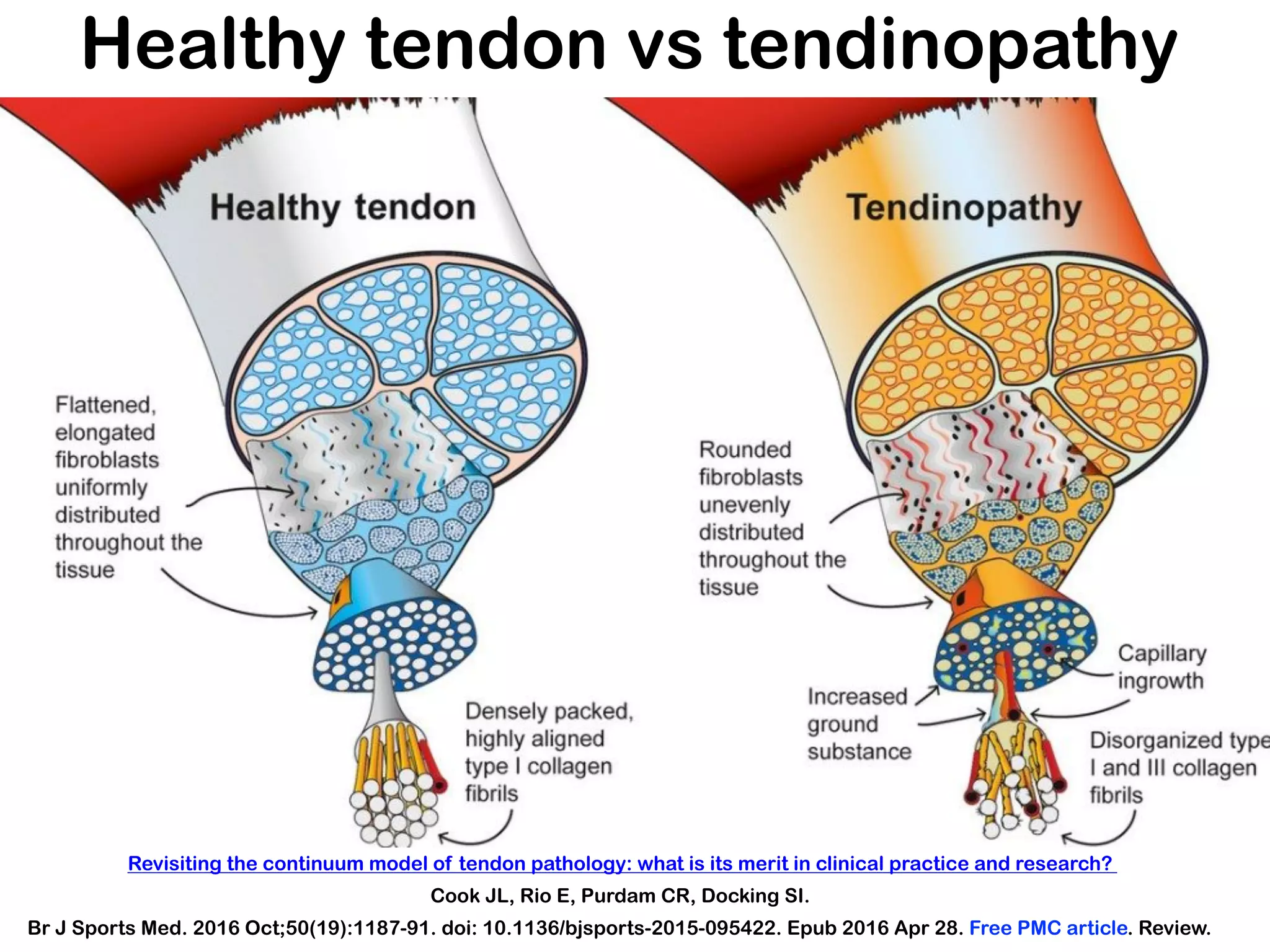
Healthy tendon vs tendinopathy
Revisiting the continuum model of tendon pathology: what is its merit in clinical practice and research?
Cook JL, Rio E, Purdam CR, Docking SI.
Br J Sports Med. 2016 Oct;50(19):1187-91. doi: 10.1136/bjsports-2015-095422. Epub 2016 Apr 28. Free PMC article. Review.
Rescue plan for Achilles: Therapeutics steering the fate and functions of stem cells in tendon
wound healing.
Schneider M, Angele P, Järvinen TAH, Docheva D.
Adv Drug Deliv Rev. 2018 Apr;129:352-375. doi: 10.1016/j.addr.2017.12.016. Epub 2017 Dec 24. Free article. Review.
Tendon Healing Process
Deciphering the pathogenesis of tendinopathy: a three-stages process.
Fu SC, Rolf C, Cheuk YC, Lui PP, Chan KM.
Sports Med Arthrosc Rehabil Ther Technol. 2010 Dec 13;2:30. doi: 10.1186/1758-2555-2-30. Free PMC article.
Failed Healing Response
Biomechanics and pathophysiology of overuse tendon injuries: ideas on insertional tendinopathy.
Maganaris CN, Narici MV, Almekinders LC, Maffulli N.

Sports Med. 2004;34(14):1005-17. doi: 10.2165/00007256-200434140-00005.Review.
Recent biomechanical
studies indicate that strain
patterns in tendons may not
be uniform, as tendons show
stress-shielded areas and
areas subjected to
compressive loading at the
enthesis.
These areas correspond to
the sites where tendinopathic
characteristics are typically
seen.
This indicates that some
tendinopathies may,
paradoxically, be considered
as 'underuse' lesions despite
the common beliefs that they
are overuse injuries. 
Overuse or Underuse Condition
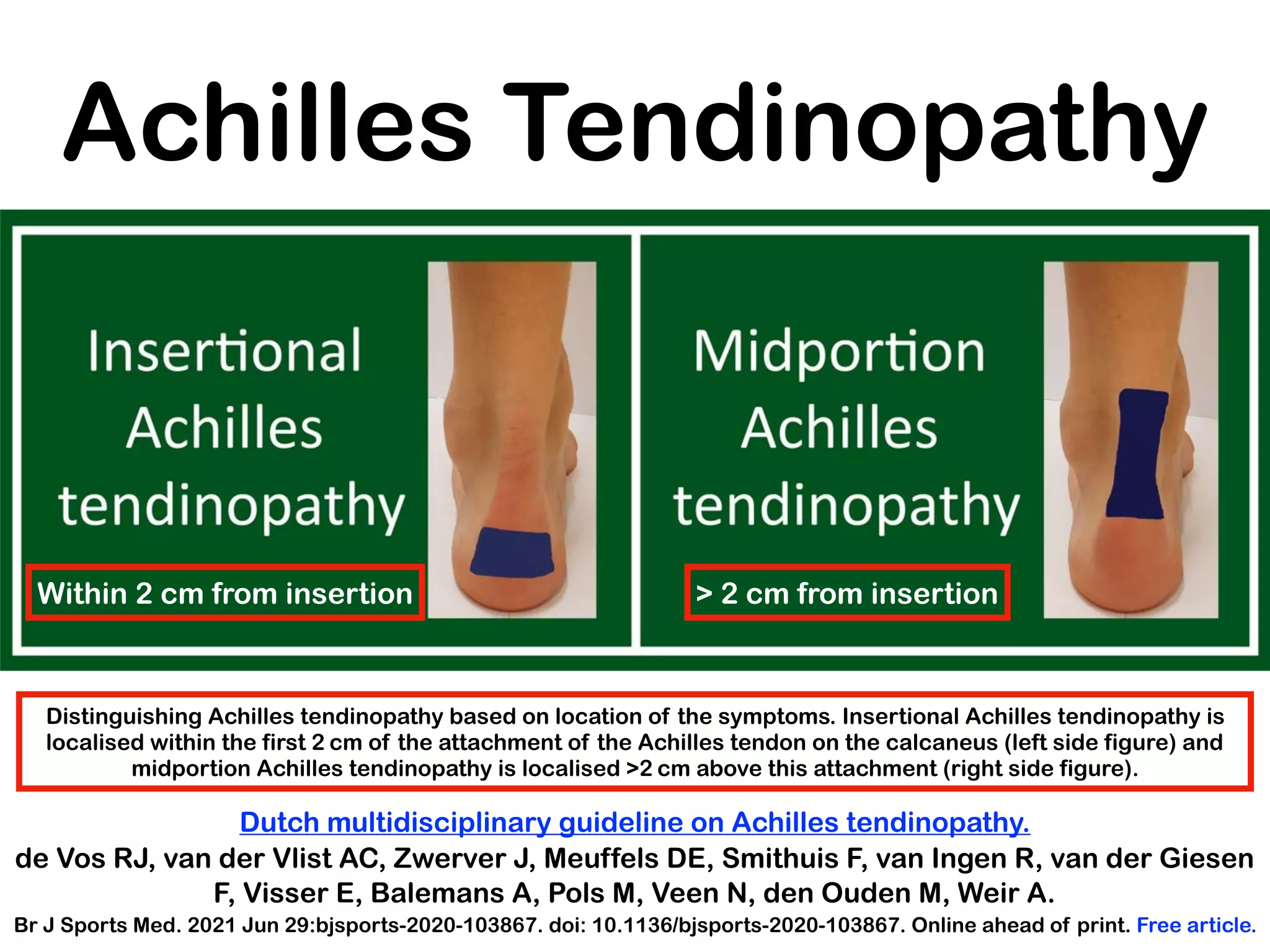
Distinguishing Achilles tendinopathy based on location of the symptoms. Insertional Achilles tendinopathy is
localised within the first 2 cm of the attachment of the Achilles tendon on the calcaneus (left side figure) and
midportion Achilles tendinopathy is localised >2 cm above this attachment (right side figure).
Dutch multidisciplinary guideline on Achilles tendinopathy.
de Vos RJ, van der Vlist AC, Zwerver J, Meuffels DE, Smithuis F, van Ingen R, van der Giesen
F, Visser E, Balemans A, Pols M, Veen N, den Ouden M, Weir A.
Br J Sports Med. 2021 Jun 29:bjsports-2020-103867. doi: 10.1136/bjsports-2020-103867. Online ahead of print. Free article.
Achilles Tendinopathy
Within 2 cm from insertion > 2 cm from insertion
The anatomical footprint of the Achilles tendon: a cadaveric study.
Ballal MS, Walker CR, Molloy AP.
Bone Joint J. 2014 Oct;96-B(10):1344-8. doi: 10.1302/0301-620X.96B10.33771.
Why heel spurs are traction spurs after all.
Zwirner J, Singh A, Templer F, Ondruschka B, Hammer N.

Sci Rep. 2021 Jun 24;11(1):13291. doi: 10.1038/s41598-021-92664-4. Free PMC article.
Different shapes of the posterior calcaneal surface are depicted on museum samples of the Department of Anatomy Dunedin, New
Zealand. The upper row displays the superior (SF), middle (MF) and inferior facet (IF) of the posterior calcaneal surface in a
posterior view. The posteriorly protruding spine separates the MF and the IF (coloured in red). The lower row shows the
corresponding lateral view of the samples shown above. Red arrow, barely protruding spine; black arrow, protruding spine; white
arrow, protruding spine with posterior spurs; a, anterior; i, inferior; l, lateral; m, medial; p, posterior; s, superior.
The posterior calcanear surface
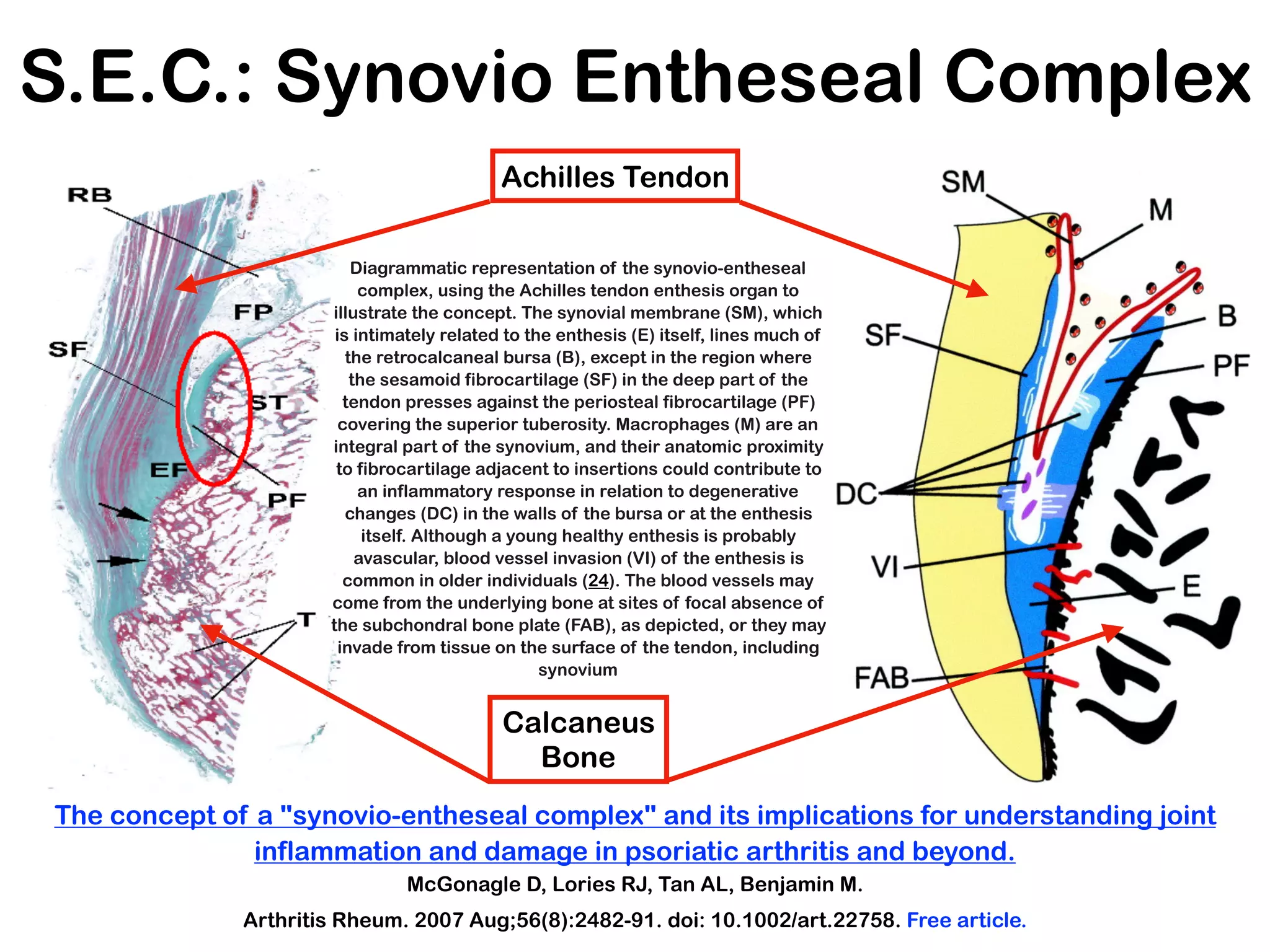
S.E.C.: Synovio Entheseal Complex
The concept of a "synovio-entheseal complex" and its implications for understanding joint
inflammation and damage in psoriatic arthritis and beyond.
McGonagle D, Lories RJ, Tan AL, Benjamin M.
Arthritis Rheum. 2007 Aug;56(8):2482-91. doi: 10.1002/art.22758. Free article. 
Calcaneus
Bone
Achilles Tendon
Diagrammatic representation of the synovio-entheseal
complex, using the Achilles tendon enthesis organ to
illustrate the concept. The synovial membrane (SM), which
is intimately related to the enthesis (E) itself, lines much of
the retrocalcaneal bursa (B), except in the region where
the sesamoid fibrocartilage (SF) in the deep part of the
tendon presses against the periosteal fibrocartilage (PF)
covering the superior tuberosity. Macrophages (M) are an
integral part of the synovium, and their anatomic proximity
to fibrocartilage adjacent to insertions could contribute to
an inflammatory response in relation to degenerative
changes (DC) in the walls of the bursa or at the enthesis
itself. Although a young healthy enthesis is probably
avascular, blood vessel invasion (VI) of the enthesis is
common in older individuals (24). The blood vessels may
come from the underlying bone at sites of focal absence of
the subchondral bone plate (FAB), as depicted, or they may
invade from tissue on the surface of the tendon, including
synovium
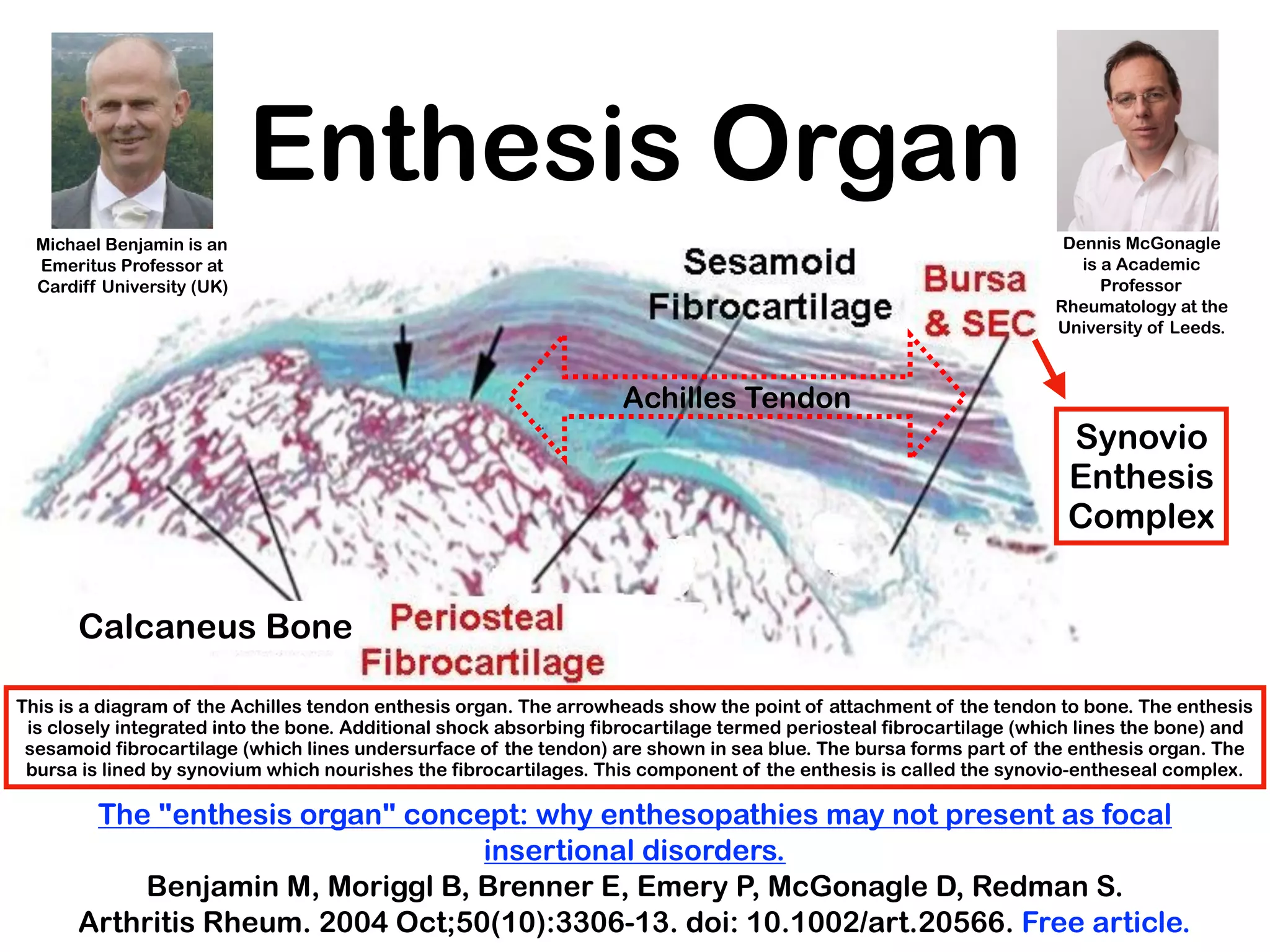
Enthesis Organ
This is a diagram of the Achilles tendon enthesis organ. The arrowheads show the point of attachment of the tendon to bone. The enthesis
is closely integrated into the bone. Additional shock absorbing fibrocartilage termed periosteal fibrocartilage (which lines the bone) and
sesamoid fibrocartilage (which lines undersurface of the tendon) are shown in sea blue. The bursa forms part of the enthesis organ. The
bursa is lined by synovium which nourishes the fibrocartilages. This component of the enthesis is called the synovio-entheseal complex.
The "enthesis organ" concept: why enthesopathies may not present as focal
insertional disorders.
Benjamin M, Moriggl B, Brenner E, Emery P, McGonagle D, Redman S.
Arthritis Rheum. 2004 Oct;50(10):3306-13. doi: 10.1002/art.20566. Free article.
Michael Benjamin is an
Emeritus Professor at
Cardiff University (UK)
Dennis McGonagle
is a Academic
Professor
Rheumatology at the
University of Leeds.
Achilles Tendon
Calcaneus Bone
Synovio
Enthesis
Complex
Kager Fat Pad
The functional anatomy of Kager's fat pad in relation to retrocalcaneal problems and other
hindfoot disorders.
Theobald P, Bydder G, Dent C, Nokes L, Pugh N, Benjamin M.
J Anat. 2006 Jan;208(1):91-7. doi: 10.1111/j.1469-7580.2006.00510.x. Free PMC article.
1. Kager Fat Pad (KFP)
2. Wedge extension of KFP
3. Muscle fibers of gastroc-soleus complex
4. Anterior aspect of tendo Achilles
5. Retrocalcaneal bursal space
Pressure changes in the Kager fat pad at the extremes of ankle motion suggest a potential
role in Achilles tendinopathy.
Malagelada F, Stephen J, Dalmau-Pastor M, Masci L, Yeh M, Vega J, Calder J.
Knee Surg Sports Traumatol Arthrosc. 2020 Jan;28(1):148-154. Epub 2019 Jun 29.
Kager Fat Pad
This study has demonstrated
changes in pressure experienced
by both the retrocalcaneal bursa
and the midportion area of the KFP
in contact with the Achilles tendon.
Significantly increased pressure is found at the extremes of ankle
motion. This finding supports the concept that the KFP acts as a
shock-absorber
and could suggest a proprioceptive or feedback role of the KFP that
should be considered during physiotherapy protocols. The KFP is closely
related to the FHL muscle and the Achilles tendon with the plantaris and
an arterial branch embedded in its substance whenever pre- sent. These
findings and the accurate dynamic description help to understand the
function of the KPF and may have implications in heel pain related
conditions.
Fat Pads and tendinopathy
Fat pads adjacent to tendinopathy: more than a coincidence?
Ward ER, Andersson G, Backman LJ, Gaida JE.
Br J Sports Med. 2016 Dec;50(24):1491-1492. Epub 2016 Aug 23.
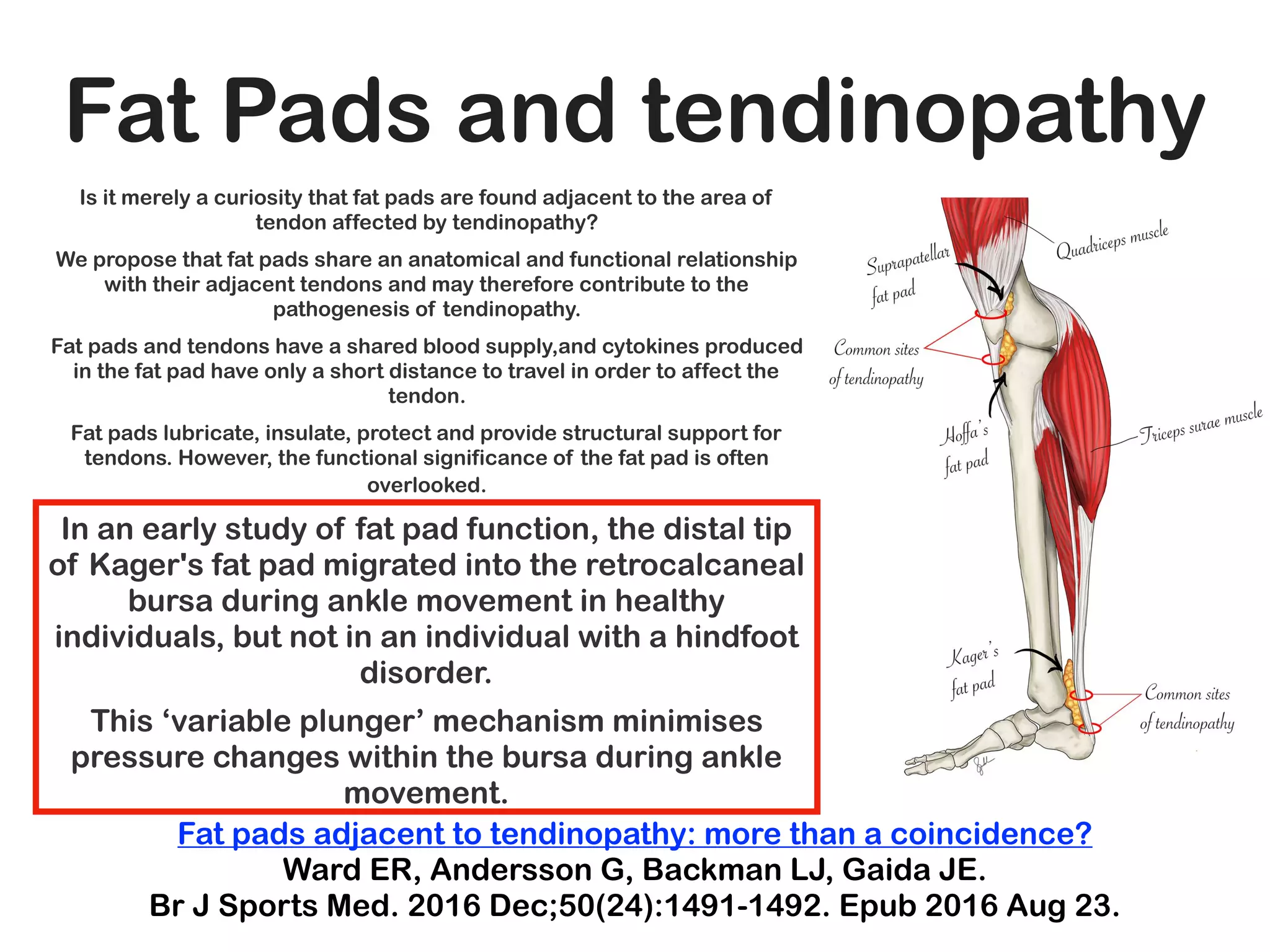
Is it merely a curiosity that fat pads are found adjacent to the area of
tendon affected by tendinopathy?
We propose that fat pads share an anatomical and functional relationship
with their adjacent tendons and may therefore contribute to the
pathogenesis of tendinopathy.
Fat pads and tendons have a shared blood supply,and cytokines produced
in the fat pad have only a short distance to travel in order to affect the
tendon.
Fat pads lubricate, insulate, protect and provide structural support for
tendons. However, the functional significance of the fat pad is often
overlooked.
In an early study of fat pad function, the distal tip
of Kager's fat pad migrated into the retrocalcaneal
bursa during ankle movement in healthy
individuals, but not in an individual with a hindfoot
disorder.
This ‘variable plunger’ mechanism minimises
pressure changes within the bursa during ankle
movement.
management evidence based not opinion based
Evidence
Opinion
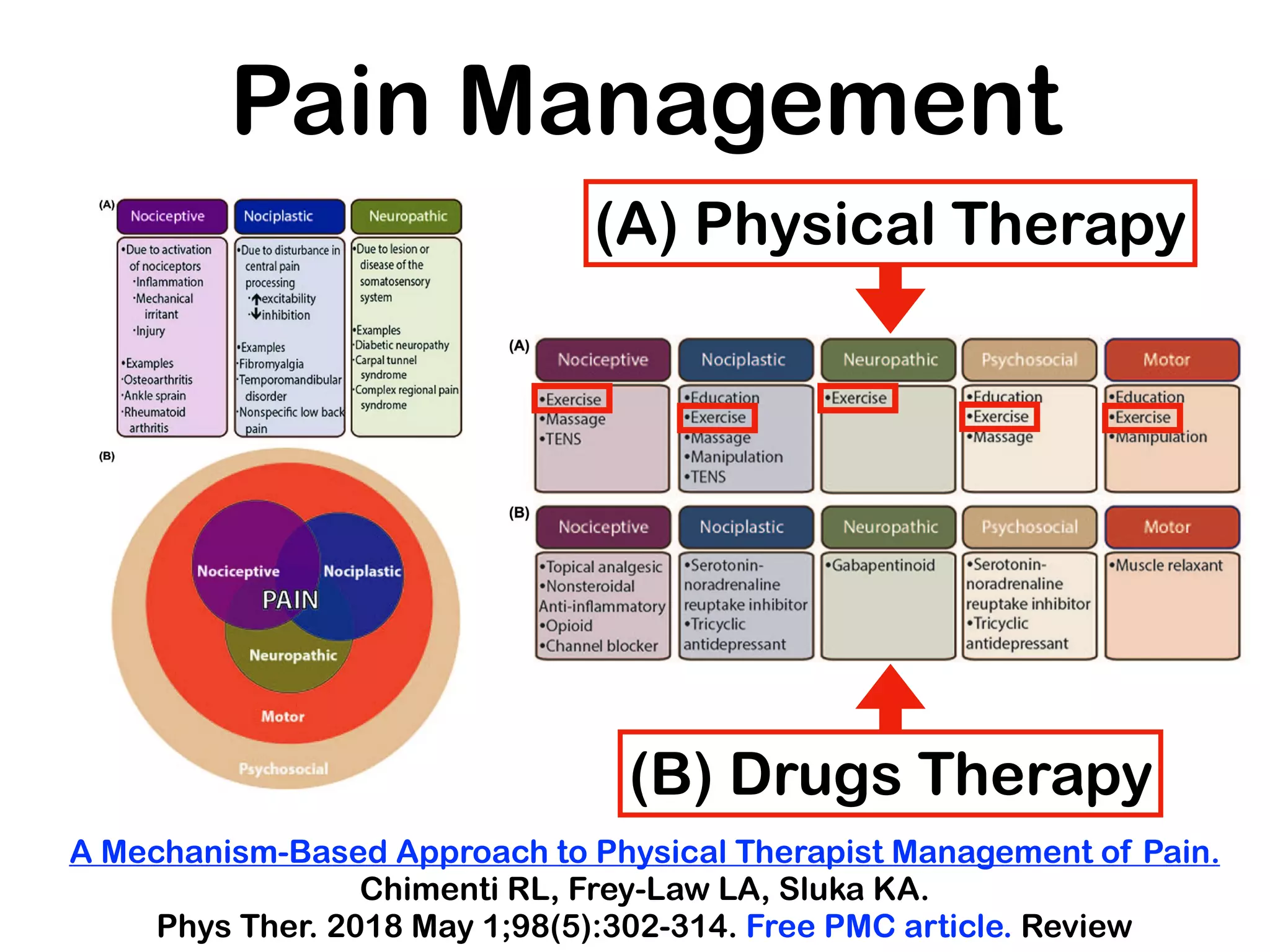
Pain Management
Posterior
syndesmotic
ligaments
Posterior ankle
impingement
Hindfoot Pain
Subtalar Joint
Pathology
Os trigonum,
Retrocalcaneal
bursa
Achilles tendon
F.H.L.
(Flexor Allucis Longus)
Peroneal Tendons
Tarsal Tunnel
Sindrome
Deep portion of
the deltoid
ligament
Haglund’s Triad
The pain of tendinopathy: physiological or pathophysiological?
Rio E, Moseley L, Purdam C, Samiric T, Kidgell D, Pearce AJ, Jaberzadeh S, Cook J.
Sports Med. 2014 Jan;44(1):9-23. doi: 10.1007/s40279-013-0096-z. Review.
Tendon pain remains an enigma …
One Finger Pain …… (J.Cook)
The only thing we know is if the patient
have a pain have a brain …… (L. Moseley)
Morning and pain after rest ….. (C. Purdam)
The most breakages occurs in painless
tendons …… (E. Rio)
Pain monitoring model …… (K. Silbernagel)
Painful Exercise…… (H.Alfredson)
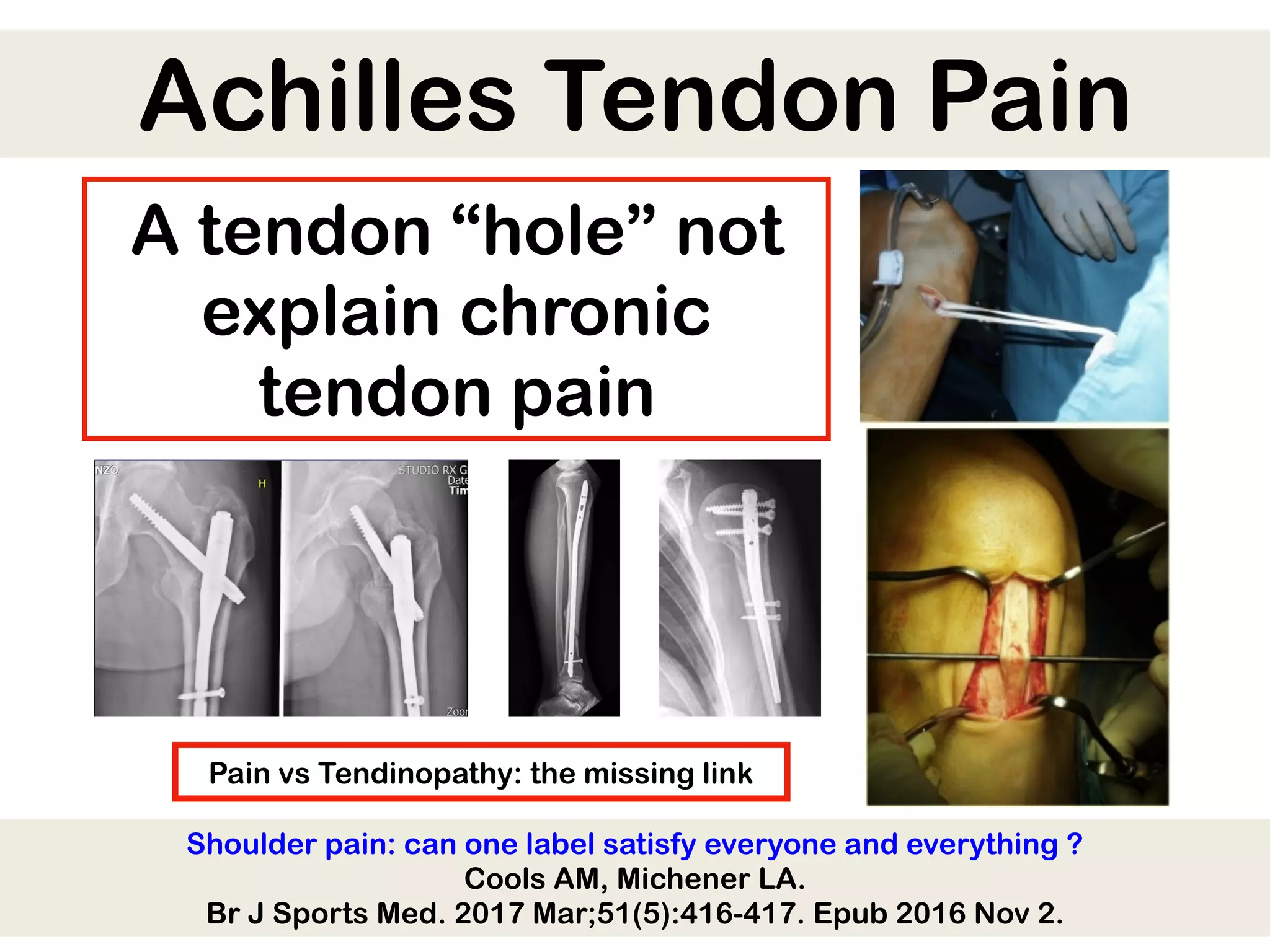
A tendon “hole” not
explain chronic
tendon pain
Shoulder pain: can one label satisfy everyone and everything ?
Cools AM, Michener LA.
Br J Sports Med. 2017 Mar;51(5):416-417. Epub 2016 Nov 2.
Achilles Tendon Pain
Pain vs Tendinopathy: the missing link
A new integrative model of lateral
epicondylalgia.
Coombes BK, Bisset L, Vicenzino B.
Br J Sports Med. 2009 Apr; Review.
Pain Management
(A) Physical Therapy
(B) Drugs Therapy
A Mechanism-Based Approach to Physical Therapist Management of Pain.
Chimenti RL, Frey-Law LA, Sluka KA.
Phys Ther. 2018 May 1;98(5):302-314. Free PMC article. Review
management evidence based not opinion based
Evidence
Opinion
Clinical Biomechanics
Foot & Ankle Function
https://musculoskeletalkey.com/fundamentals-of-human-gait/
Gait Analysis: the gastrocnemius complex
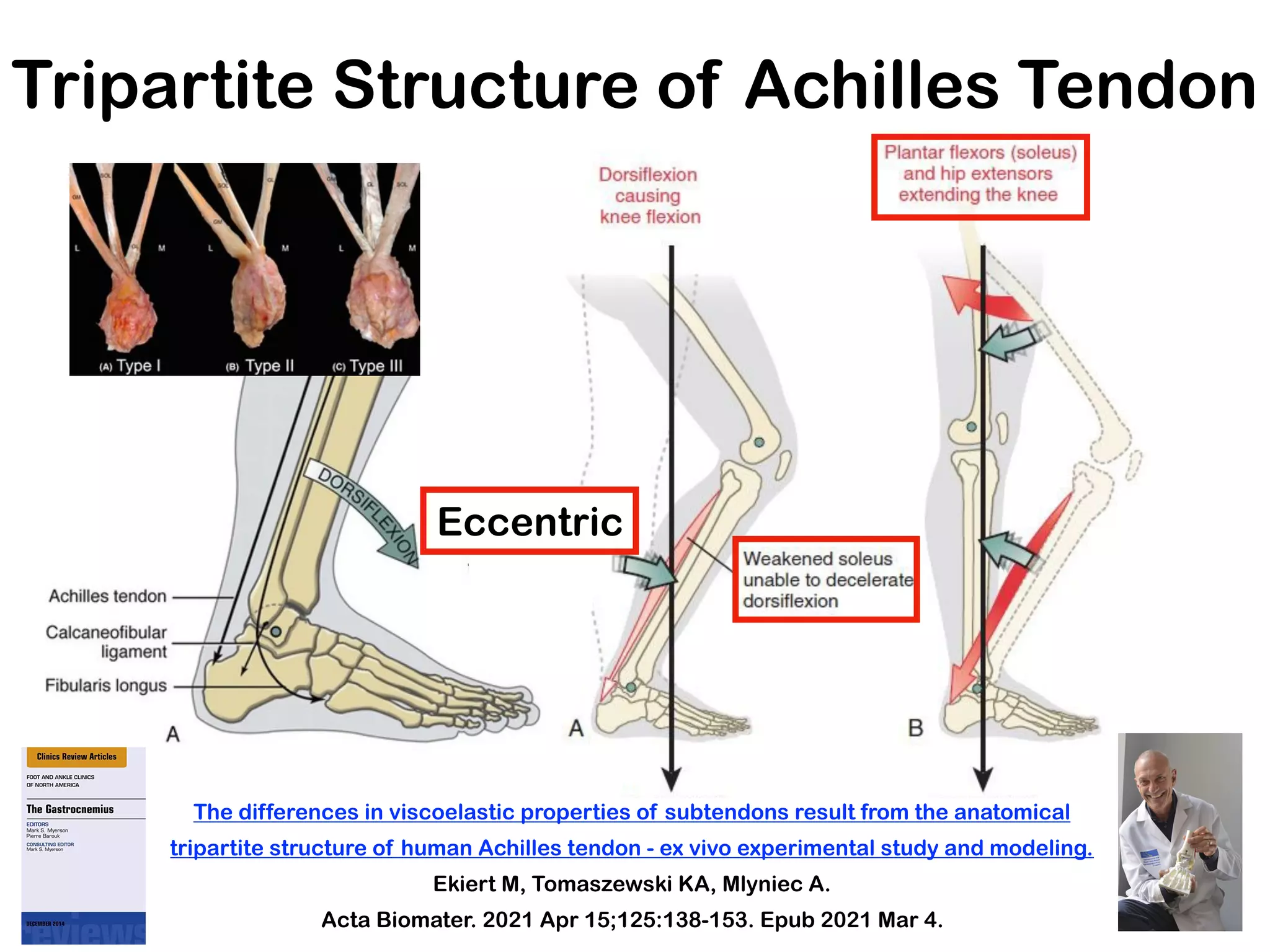
The differences in viscoelastic properties of subtendons result from the anatomical
tripartite structure of human Achilles tendon - ex vivo experimental study and modeling.
Ekiert M, Tomaszewski KA, Mlyniec A.
Acta Biomater. 2021 Apr 15;125:138-153. Epub 2021 Mar 4.
Tripartite Structure of Achilles Tendon
Eccentric
Kinetic Chain Concept
Evidence
Opinion
management evidence based not opinion based
Evidence
Opinion
Exercise Therapy
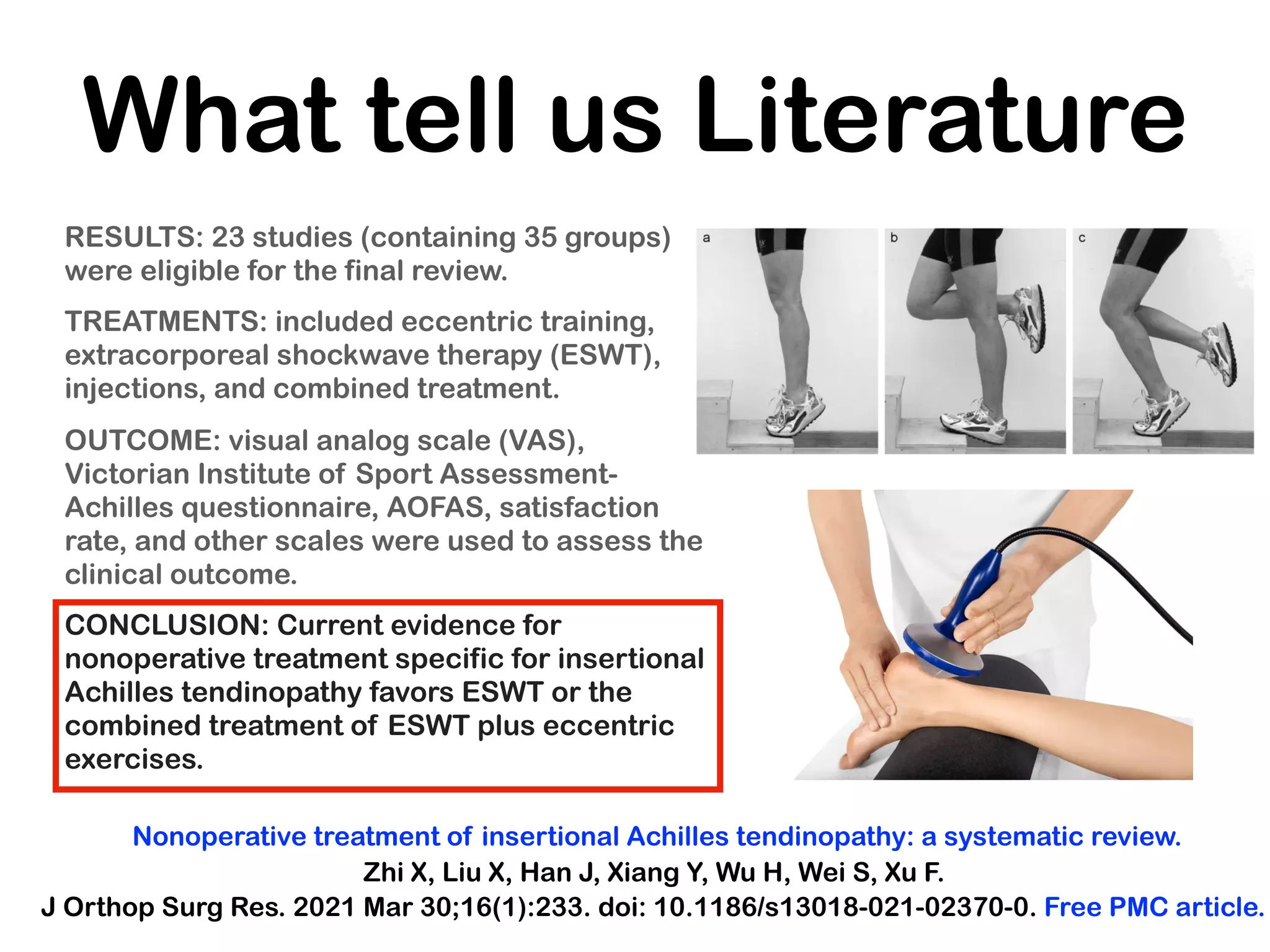
Nonoperative treatment of insertional Achilles tendinopathy: a systematic review.
Zhi X, Liu X, Han J, Xiang Y, Wu H, Wei S, Xu F.

J Orthop Surg Res. 2021 Mar 30;16(1):233. doi: 10.1186/s13018-021-02370-0. Free PMC article.
RESULTS: 23 studies (containing 35 groups)
were eligible for the final review.
TREATMENTS: included eccentric training,
extracorporeal shockwave therapy (ESWT),
injections, and combined treatment.
OUTCOME: visual analog scale (VAS),
Victorian Institute of Sport Assessment-
Achilles questionnaire, AOFAS, satisfaction
rate, and other scales were used to assess the
clinical outcome.
CONCLUSION: Current evidence for
nonoperative treatment specific for insertional
Achilles tendinopathy favors ESWT or the
combined treatment of ESWT plus eccentric
exercises.
What tell us Literature
Functional Outcomes of Insertional Achilles Tendinopathy Treatment: A Systematic Review.
Jarin IJ, Bäcker HC, Vosseller JT.
JBJS Rev. 2021 Jun 14;9(6). doi: 10.2106/JBJS.RVW.20.00110
RESULTS:
• 1,457 abstract were reviewed;
• 54 studies with 2,177 patients met the inclusion
criteria;
• Among the 54 studies, 6 operative techniques and 6
nonoperative treatments
CONCLUSIONS: 
• Eccentric exercises and low-energy extracorporeal
shockwave therapy (ESWT) have the greatest
evidence for the initial management of insertional
Achilles tendinopathy.
• ESWT has been increasingly studied in recent years,
but more high-quality evidence is needed.
• Operative treatment with tenotomy, debridement,
retrocalcaneal bursectomy, and calcaneal
exostectomy is effective. Flexor hallucis longus
tendon transfer may benefit cases of more severe
disease.
• Minimally invasive procedures have a potential role
in the treatment algorithm and require more rigorous
study.
What tell us Literature
Treatment for insertional Achilles tendinopathy: a systematic review.
Wiegerinck JI, Kerkhoffs GM, van Sterkenburg MN, Sierevelt IN, van Dijk CN.
Knee Surg Sports Traumatol Arthrosc. 2013 Jun;21(6):1345-55. Review.
The patient satisfaction is high in all
surgical studies (avg 89%).
It is not possible to draw conclusions
regarding the best surgical treatment for
insertional Achilles tendinopathy.
ESWT seems effective in patients with
non-calcified insertional Achilles
tendinopathy.
Although both eccentric exercises resulted
in a decrease in VAS score, full range of
motion eccentric exercises shows a
low patient satisfaction compared to floor
level exercises and other conservative
treatment modalities.
????
ESWT vs Exercise
Shockwave Therapy Plus Eccentric Exercises Versus Isolated Eccentric Exercises
for Achilles Insertional Tendinopathy: A Double-Blinded Randomized Clinical Trial.
Mansur NSB, Matsunaga FT, Carrazzone OL, Schiefer Dos Santos B, Nunes CG, Aoyama BT, Dias Dos Santos PR, Faloppa F, Tamaoki MJS.
J Bone Joint Surg Am. 2021 Jul 21;103(14):1295-1302. doi: 10.2106/JBJS.20.01826.
Extracorporeal
shockwave therapy
does not potentiate
the effects of
eccentric
strengthening in
the management of
Achilles insertional
tendinopathy.
Which treatment is most effective for patients with Achilles tendinopathy? A living systematic
review with network meta-analysis of 29 randomised controlled trials.
van der Vlist AC, Winters M, Weir A, Ardern CL, Welton NJ, Caldwell DM, Verhaar JAN, de Vos RJ.
Br J Sports Med. 2021 Mar;55(5):249-256. doi: 10.1136/bjsports-2019-101872. Epub 2020 Jun 10.Free PMC article.
Most effective treatment at 3 months
Which treatment is most effective for patients with Achilles tendinopathy? A living systematic
review with network meta-analysis of 29 randomised controlled trials.
van der Vlist AC, Winters M, Weir A, Ardern CL, Welton NJ, Caldwell DM, Verhaar JAN, de Vos RJ.
Br J Sports Med. 2021 Mar;55(5):249-256. doi: 10.1136/bjsports-2019-101872. Epub 2020 Jun 10.Free PMC article.
Most effective treatment at 12 months
https://www.sportsinjurybulletin.com/tendinopathy-new-thinking-on-an-old-problem/
3 tipi di strategie di carico (esercizio) per gestire la tendinopatia
1 3
2
https://www.sportsinjurybulletin.com/tendinopathy-new-thinking-on-an-old-problem/
Tempi e modalità di adattamento del tendine al carico
Current Clinical Concepts: Conservative Management of Achilles Tendinopathy.
Silbernagel KG, Hanlon S, Sprague A.
J Athl Train. 2020 May;55(5):438-447. doi: 10.4085/1062-6050-356-19. Epub 2020 Apr 8.Free PMC article. Review.
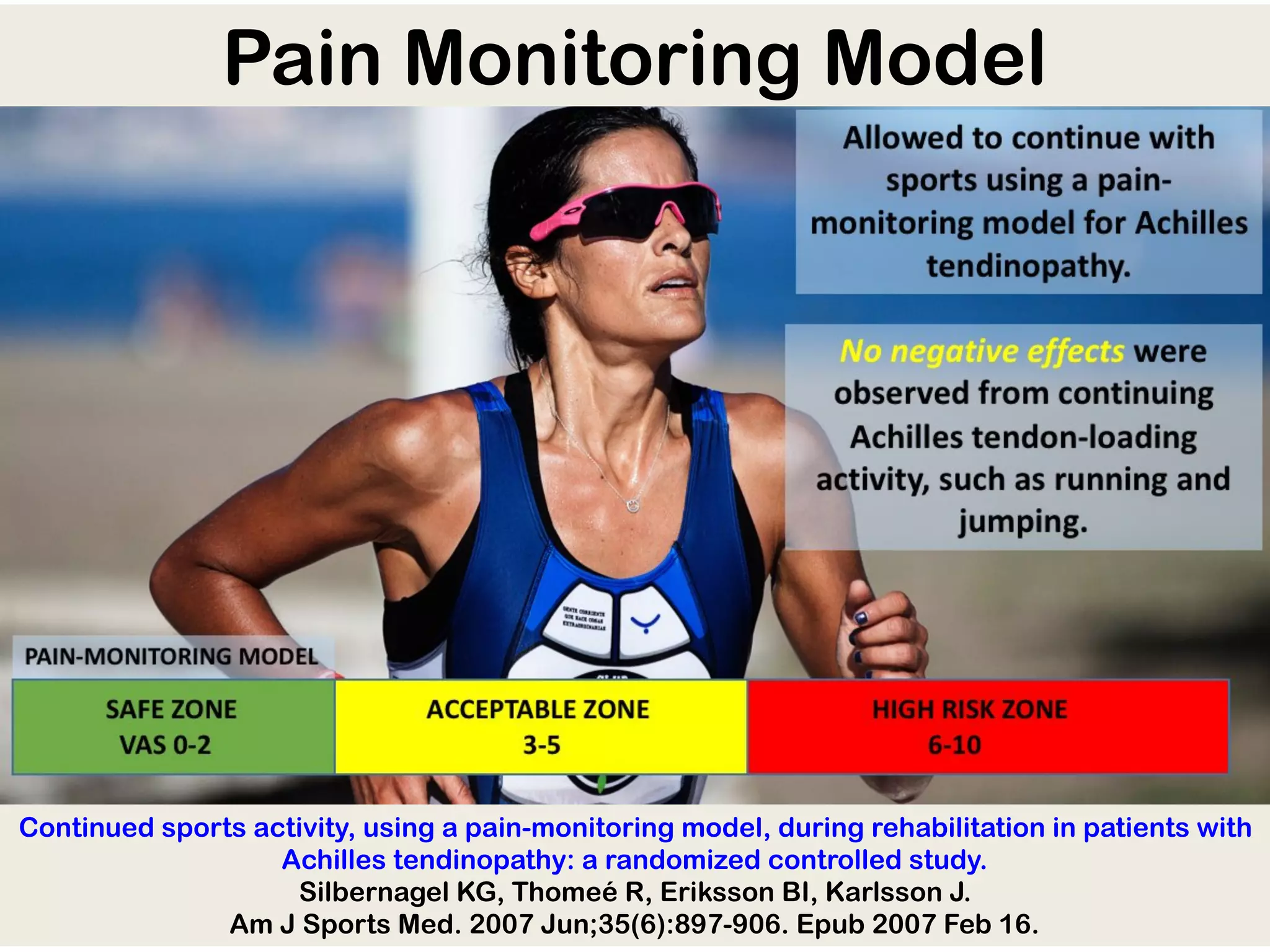
Pain Monitoring Model
Continued sports activity, using a pain-monitoring model, during rehabilitation in patients with
Achilles tendinopathy: a randomized controlled study.
Silbernagel KG, Thomeé R, Eriksson BI, Karlsson J.
Am J Sports Med. 2007 Jun;35(6):897-906. Epub 2007 Feb 16.
Monitorare il dolore
e la risposta al carico
Dolore durante l’ esercizio
0 = Nessun dolore 10 = peggior dolore immaginabile
Monitorare i sintomi per 24-48-72 ore dopo l’ esercizio
Il dolore può presentarsi rapidamente dopo l’ esercizio ma
non deve aumentare di intensità il giorno o i giorni dopo
“It is more important to know what sort of
person has a disease than to know what sort of
disease a person has.” 
(Hippocrates)
Thank you very much for
your kind attention !!!

The Battle 2021 Castrocaro Terme (Italy). Achilles Insertional Tendinopathy and Haglund's Triad: conservative approach

  • 1.
    VII INTERNATIONAL CONGRESS SPORTTRAUMATOLOGY “THEBATTLE” 11-12Dicembre 2020 FACULTY SEGRETERIA ORGANIZZATIVA E PROVIDER ECM Congredior s.r.l. - Provider ECM n. 737 Corso Amendola n. 45 - 60123 Ancona tel. 071 2071411 - fax 071 2075629 www.congredior.it • info@congredior.it spalla anca ginocchio PRESIDENTE Giuseppe PORCELLINI Università degli Studi di Modena e Reggio Emilia COMITATO SCIENTIFICO COMITATO D’ONORE F. BORRA, Forlì F. CATANI, Modena G. NANNI, Bologna P. PALADINI, Cattolica (RN) G. PORCELLINI, Modena F. RUSSO, Roma P. M. TONINO, Chicago (USA) R. ZINI, Cotignola (RA) E. SANSAVINI, Presidente GruppoVilla Maria G. MALAGÒ, Presidente Coni C.A. PORRO, Rettore Università di Modena e Reggio Emilia N. ALESSANDRI, PresidenteTechnogym F. PIGOZZI, Presidente Federazione Internazionale di Medicina dello Sport M. CASASCO, Presidente Federazione Medico Sportiva Italiana SPORTEADOLESCENTI:prevenzioneecura F. ACCADBLED, Francia G. ADDESSI, Roma P. ADRAVANTI, Parma E. ADRIANI, Roma L. AROSIO, Lissone (MB) G. BELTRAMI, Parma P. BENELLI, Pesaro F. BENAZZO, Pavia M. BIGONI, Milano G. N. BISCIOTTI, Qatar D. BORRA, Forlì A. CACCHIO, L’Aquila E. CALVO, Spagna F. CAMPI, Forlì M. CAPASSO, Venezuela A. CASTAGNA, Milano F. CATANI, Modena A. COMBI, Pavia F. COMBI, Milano D. CRETA, Bologna F. CUZZOLIN, Cesena D. DALLARI, Bologna L. DALLARI, Modena A. DE CARLI, Roma F. DELLA VILLA, Bologna R. DI MICELI, Bologna F. DI PIETTO, Napoli R. FABBRICINI, Roma C. FALDINI, Bologna C. FANTINI, Cervia F. FANTON, Roma G. FIUMANA, Forlì A. FOGLIA, Civitanova Marche M. FOGLI, Ferrara U. GRANACHER, Germania M. GREGO, Caserta S. GUMINA, Roma M. KOCHER, USA LIOI, Forlì B. W. KIBLER, USA F. LIJOI, Forlì R. LISI, Frosinone J. W. LOCKHART, USA G. MEROLLA, Cattolica (RN) G. MIGLIACCIO, Cagliari G. MONETTI, Bologna M. MONZONI, Monza F. MUSARRA, Pesaro G. NANNI, Bologna M. NOVI, Pisa P. PALADINI, Cattolica L. PALOMBA, Todi M. PANASCÌ, Roma A. PELLEGRINI, Modena M. PHILIPPON, USA A. PIERUCCI, Pisa G. PORCELLINI, Modena F. RANDELLI, Milano A. ROMEO, USA F. RUSSO, Roma G. RUSSO, Roma E. SABETTA, Reggio Emilia A. SACCHI, Fusignano (RA) A. SALSI, Bologna N. SANTORI, Roma G. SEVERINI, Roma G.B. SISCA, Bologna N. TADDIO, Padova L. TARALLO, Modena M. TARANTINO, Roma M. TURATI, Monza J. VELASCO, Bologna G. VITTI, USA S. ZAFFAGNINI, Bologna M. ZANAZZO, Biella G. A. ZANOLI, Ferrara R. ZINI, Cotignola (RA) LIBERA ASSOCIAZIONE MEDICI ITALIANI DEL CALCIO MEDIA TECH PARTNER Con il Patrocinio di EVENTO FAD LIVE STREAMING Ancona 2013 San Marino 2014 Roma 2016 Cesena 2017 Cattolica 2018 Cesena 2019 Castrocaro 2020 Castrocaro 2021 VII INTERNATIONAL CONGRESS SPORTTRAUMATOLOGY “THE BATTLE” 11-12Dicembre 2020 FACULTY spalla anca PRESIDENTE Giuseppe PORCELLINI Università degli Studi di Modena e Reggio Emilia COMITATO SCIENTIFICO COMITATO D’ONORE F. BORRA, Forlì F. CATANI, Modena G. NANNI, Bologna P. PALADINI, Cattolica (RN) G. PORCELLINI, Modena F. RUSSO, Roma P. M. TONINO, Chicago (USA) R. ZINI, Cotignola (RA) E. SANSAVINI, Presidente GruppoVilla Maria G. MALAGÒ, Presidente Coni C.A. PORRO, Rettore Università di Modena e Reggio Emilia N. ALESSANDRI, PresidenteTechnogym F. PIGOZZI, Presidente Federazione Internazionale di Medicina dello Sport M. CASASCO, Presidente Federazione Medico Sportiva Italiana SPORTEADOLESCENTI:prevenzioneecura F. ACCADBLED, Francia G. ADDESSI, Roma P. ADRAVANTI, Parma E. ADRIANI, Roma L. AROSIO, Lissone (MB) G. BELTRAMI, Parma P. BENELLI, Pesaro F. BENAZZO, Pavia M. BIGONI, Milano G. N. BISCIOTTI, Qatar D. BORRA, Forlì A. CACCHIO, L’Aquila E. CALVO, Spagna F. CAMPI, Forlì M. CAPASSO, Venezuela B. W. KIBLER, USA F. LIJOI, Forlì R. LISI, Frosinone J. W. LOCKHART, USA G. MEROLLA, Cattolica (RN) G. MIGLIACCIO, Cagliari G. MONETTI, Bologna M. MONZONI, Monza F. MUSARRA, Pesaro G. NANNI, Bologna M. NOVI, Pisa P. PALADINI, Cattolica L. PALOMBA, Todi M. PANASCÌ, Roma A. PELLEGRINI, Modena LIBERA ASSOCIAZIONE MEDICI ITALIANI DEL CALCIO Con il Patrocinio di EVENTO FAD LIVE STREAMING
  • 2.
    Le tendinopatie posterioridella caviglia. Caso clinico di Haglund’s Triad: trattamento conservativo
  • 3.
    management evidence basednot opinion based Evidence Opinion Background
  • 4.
    Tendinopathy: do weget the right picture ? Unknown factors Onset of symptoms Surgery Risk Factors Injury ? Overuse ? Metabolic disorders ? Histology Biochemistry Molecular Biology Natural History of Tendinopathy http://www.nicolamaffulli.com/ N. Maffulli, Corso Nazionale della SICSG, Società Italiana di Chirurgia della Spalla e del Gomito, S. Patrignano (RN) 2007
  • 5.
    Healthy tendon vstendinopathy Revisiting the continuum model of tendon pathology: what is its merit in clinical practice and research? Cook JL, Rio E, Purdam CR, Docking SI. Br J Sports Med. 2016 Oct;50(19):1187-91. doi: 10.1136/bjsports-2015-095422. Epub 2016 Apr 28. Free PMC article. Review.
  • 6.
    Rescue plan forAchilles: Therapeutics steering the fate and functions of stem cells in tendon wound healing. Schneider M, Angele P, Järvinen TAH, Docheva D. Adv Drug Deliv Rev. 2018 Apr;129:352-375. doi: 10.1016/j.addr.2017.12.016. Epub 2017 Dec 24. Free article. Review. Tendon Healing Process
  • 7.
    Deciphering the pathogenesisof tendinopathy: a three-stages process. Fu SC, Rolf C, Cheuk YC, Lui PP, Chan KM. Sports Med Arthrosc Rehabil Ther Technol. 2010 Dec 13;2:30. doi: 10.1186/1758-2555-2-30. Free PMC article. Failed Healing Response
  • 8.
    Biomechanics and pathophysiologyof overuse tendon injuries: ideas on insertional tendinopathy. Maganaris CN, Narici MV, Almekinders LC, Maffulli N.
 Sports Med. 2004;34(14):1005-17. doi: 10.2165/00007256-200434140-00005.Review. Recent biomechanical studies indicate that strain patterns in tendons may not be uniform, as tendons show stress-shielded areas and areas subjected to compressive loading at the enthesis. These areas correspond to the sites where tendinopathic characteristics are typically seen. This indicates that some tendinopathies may, paradoxically, be considered as 'underuse' lesions despite the common beliefs that they are overuse injuries.  Overuse or Underuse Condition
  • 9.
    Distinguishing Achilles tendinopathybased on location of the symptoms. Insertional Achilles tendinopathy is localised within the first 2 cm of the attachment of the Achilles tendon on the calcaneus (left side figure) and midportion Achilles tendinopathy is localised >2 cm above this attachment (right side figure). Dutch multidisciplinary guideline on Achilles tendinopathy. de Vos RJ, van der Vlist AC, Zwerver J, Meuffels DE, Smithuis F, van Ingen R, van der Giesen F, Visser E, Balemans A, Pols M, Veen N, den Ouden M, Weir A. Br J Sports Med. 2021 Jun 29:bjsports-2020-103867. doi: 10.1136/bjsports-2020-103867. Online ahead of print. Free article. Achilles Tendinopathy Within 2 cm from insertion > 2 cm from insertion
  • 10.
    The anatomical footprintof the Achilles tendon: a cadaveric study. Ballal MS, Walker CR, Molloy AP. Bone Joint J. 2014 Oct;96-B(10):1344-8. doi: 10.1302/0301-620X.96B10.33771.
  • 11.
    Why heel spursare traction spurs after all. Zwirner J, Singh A, Templer F, Ondruschka B, Hammer N.
 Sci Rep. 2021 Jun 24;11(1):13291. doi: 10.1038/s41598-021-92664-4. Free PMC article. Different shapes of the posterior calcaneal surface are depicted on museum samples of the Department of Anatomy Dunedin, New Zealand. The upper row displays the superior (SF), middle (MF) and inferior facet (IF) of the posterior calcaneal surface in a posterior view. The posteriorly protruding spine separates the MF and the IF (coloured in red). The lower row shows the corresponding lateral view of the samples shown above. Red arrow, barely protruding spine; black arrow, protruding spine; white arrow, protruding spine with posterior spurs; a, anterior; i, inferior; l, lateral; m, medial; p, posterior; s, superior. The posterior calcanear surface
  • 12.
    S.E.C.: Synovio EnthesealComplex The concept of a "synovio-entheseal complex" and its implications for understanding joint inflammation and damage in psoriatic arthritis and beyond. McGonagle D, Lories RJ, Tan AL, Benjamin M. Arthritis Rheum. 2007 Aug;56(8):2482-91. doi: 10.1002/art.22758. Free article.  Calcaneus Bone Achilles Tendon Diagrammatic representation of the synovio-entheseal complex, using the Achilles tendon enthesis organ to illustrate the concept. The synovial membrane (SM), which is intimately related to the enthesis (E) itself, lines much of the retrocalcaneal bursa (B), except in the region where the sesamoid fibrocartilage (SF) in the deep part of the tendon presses against the periosteal fibrocartilage (PF) covering the superior tuberosity. Macrophages (M) are an integral part of the synovium, and their anatomic proximity to fibrocartilage adjacent to insertions could contribute to an inflammatory response in relation to degenerative changes (DC) in the walls of the bursa or at the enthesis itself. Although a young healthy enthesis is probably avascular, blood vessel invasion (VI) of the enthesis is common in older individuals (24). The blood vessels may come from the underlying bone at sites of focal absence of the subchondral bone plate (FAB), as depicted, or they may invade from tissue on the surface of the tendon, including synovium
  • 13.
    Enthesis Organ This isa diagram of the Achilles tendon enthesis organ. The arrowheads show the point of attachment of the tendon to bone. The enthesis is closely integrated into the bone. Additional shock absorbing fibrocartilage termed periosteal fibrocartilage (which lines the bone) and sesamoid fibrocartilage (which lines undersurface of the tendon) are shown in sea blue. The bursa forms part of the enthesis organ. The bursa is lined by synovium which nourishes the fibrocartilages. This component of the enthesis is called the synovio-entheseal complex. The "enthesis organ" concept: why enthesopathies may not present as focal insertional disorders. Benjamin M, Moriggl B, Brenner E, Emery P, McGonagle D, Redman S. Arthritis Rheum. 2004 Oct;50(10):3306-13. doi: 10.1002/art.20566. Free article. Michael Benjamin is an Emeritus Professor at Cardiff University (UK) Dennis McGonagle is a Academic Professor Rheumatology at the University of Leeds. Achilles Tendon Calcaneus Bone Synovio Enthesis Complex
  • 14.
    Kager Fat Pad Thefunctional anatomy of Kager's fat pad in relation to retrocalcaneal problems and other hindfoot disorders. Theobald P, Bydder G, Dent C, Nokes L, Pugh N, Benjamin M. J Anat. 2006 Jan;208(1):91-7. doi: 10.1111/j.1469-7580.2006.00510.x. Free PMC article. 1. Kager Fat Pad (KFP) 2. Wedge extension of KFP 3. Muscle fibers of gastroc-soleus complex 4. Anterior aspect of tendo Achilles 5. Retrocalcaneal bursal space
  • 15.
    Pressure changes inthe Kager fat pad at the extremes of ankle motion suggest a potential role in Achilles tendinopathy. Malagelada F, Stephen J, Dalmau-Pastor M, Masci L, Yeh M, Vega J, Calder J. Knee Surg Sports Traumatol Arthrosc. 2020 Jan;28(1):148-154. Epub 2019 Jun 29. Kager Fat Pad This study has demonstrated changes in pressure experienced by both the retrocalcaneal bursa and the midportion area of the KFP in contact with the Achilles tendon. Significantly increased pressure is found at the extremes of ankle motion. This finding supports the concept that the KFP acts as a shock-absorber and could suggest a proprioceptive or feedback role of the KFP that should be considered during physiotherapy protocols. The KFP is closely related to the FHL muscle and the Achilles tendon with the plantaris and an arterial branch embedded in its substance whenever pre- sent. These findings and the accurate dynamic description help to understand the function of the KPF and may have implications in heel pain related conditions.
  • 16.
    Fat Pads andtendinopathy Fat pads adjacent to tendinopathy: more than a coincidence? Ward ER, Andersson G, Backman LJ, Gaida JE. Br J Sports Med. 2016 Dec;50(24):1491-1492. Epub 2016 Aug 23. Is it merely a curiosity that fat pads are found adjacent to the area of tendon affected by tendinopathy? We propose that fat pads share an anatomical and functional relationship with their adjacent tendons and may therefore contribute to the pathogenesis of tendinopathy. Fat pads and tendons have a shared blood supply,and cytokines produced in the fat pad have only a short distance to travel in order to affect the tendon. Fat pads lubricate, insulate, protect and provide structural support for tendons. However, the functional significance of the fat pad is often overlooked. In an early study of fat pad function, the distal tip of Kager's fat pad migrated into the retrocalcaneal bursa during ankle movement in healthy individuals, but not in an individual with a hindfoot disorder. This ‘variable plunger’ mechanism minimises pressure changes within the bursa during ankle movement.
  • 17.
    management evidence basednot opinion based Evidence Opinion Pain Management
  • 18.
    Posterior syndesmotic ligaments Posterior ankle impingement Hindfoot Pain SubtalarJoint Pathology Os trigonum, Retrocalcaneal bursa Achilles tendon F.H.L. (Flexor Allucis Longus) Peroneal Tendons Tarsal Tunnel Sindrome Deep portion of the deltoid ligament Haglund’s Triad
  • 19.
    The pain oftendinopathy: physiological or pathophysiological? Rio E, Moseley L, Purdam C, Samiric T, Kidgell D, Pearce AJ, Jaberzadeh S, Cook J. Sports Med. 2014 Jan;44(1):9-23. doi: 10.1007/s40279-013-0096-z. Review. Tendon pain remains an enigma … One Finger Pain …… (J.Cook) The only thing we know is if the patient have a pain have a brain …… (L. Moseley) Morning and pain after rest ….. (C. Purdam) The most breakages occurs in painless tendons …… (E. Rio) Pain monitoring model …… (K. Silbernagel) Painful Exercise…… (H.Alfredson)
  • 20.
    A tendon “hole”not explain chronic tendon pain Shoulder pain: can one label satisfy everyone and everything ? Cools AM, Michener LA. Br J Sports Med. 2017 Mar;51(5):416-417. Epub 2016 Nov 2. Achilles Tendon Pain Pain vs Tendinopathy: the missing link
  • 21.
    A new integrativemodel of lateral epicondylalgia. Coombes BK, Bisset L, Vicenzino B. Br J Sports Med. 2009 Apr; Review.
  • 22.
    Pain Management (A) PhysicalTherapy (B) Drugs Therapy A Mechanism-Based Approach to Physical Therapist Management of Pain. Chimenti RL, Frey-Law LA, Sluka KA. Phys Ther. 2018 May 1;98(5):302-314. Free PMC article. Review
  • 23.
    management evidence basednot opinion based Evidence Opinion Clinical Biomechanics
  • 24.
    Foot & AnkleFunction
  • 25.
  • 26.
    The differences inviscoelastic properties of subtendons result from the anatomical tripartite structure of human Achilles tendon - ex vivo experimental study and modeling. Ekiert M, Tomaszewski KA, Mlyniec A. Acta Biomater. 2021 Apr 15;125:138-153. Epub 2021 Mar 4. Tripartite Structure of Achilles Tendon Eccentric
  • 27.
  • 28.
    management evidence basednot opinion based Evidence Opinion Exercise Therapy
  • 29.
    Nonoperative treatment ofinsertional Achilles tendinopathy: a systematic review. Zhi X, Liu X, Han J, Xiang Y, Wu H, Wei S, Xu F.
 J Orthop Surg Res. 2021 Mar 30;16(1):233. doi: 10.1186/s13018-021-02370-0. Free PMC article. RESULTS: 23 studies (containing 35 groups) were eligible for the final review. TREATMENTS: included eccentric training, extracorporeal shockwave therapy (ESWT), injections, and combined treatment. OUTCOME: visual analog scale (VAS), Victorian Institute of Sport Assessment- Achilles questionnaire, AOFAS, satisfaction rate, and other scales were used to assess the clinical outcome. CONCLUSION: Current evidence for nonoperative treatment specific for insertional Achilles tendinopathy favors ESWT or the combined treatment of ESWT plus eccentric exercises. What tell us Literature
  • 30.
    Functional Outcomes of Insertional Achilles Tendinopathy Treatment:A Systematic Review. Jarin IJ, Bäcker HC, Vosseller JT. JBJS Rev. 2021 Jun 14;9(6). doi: 10.2106/JBJS.RVW.20.00110 RESULTS: • 1,457 abstract were reviewed; • 54 studies with 2,177 patients met the inclusion criteria; • Among the 54 studies, 6 operative techniques and 6 nonoperative treatments CONCLUSIONS:  • Eccentric exercises and low-energy extracorporeal shockwave therapy (ESWT) have the greatest evidence for the initial management of insertional Achilles tendinopathy. • ESWT has been increasingly studied in recent years, but more high-quality evidence is needed. • Operative treatment with tenotomy, debridement, retrocalcaneal bursectomy, and calcaneal exostectomy is effective. Flexor hallucis longus tendon transfer may benefit cases of more severe disease. • Minimally invasive procedures have a potential role in the treatment algorithm and require more rigorous study. What tell us Literature
  • 31.
    What tell usLiterature Treatment for insertional Achilles tendinopathy: a systematic review. Wiegerinck JI, Kerkhoffs GM, van Sterkenburg MN, Sierevelt IN, van Dijk CN. Knee Surg Sports Traumatol Arthrosc. 2013 Jun;21(6):1345-55. Review. The patient satisfaction is high in all surgical studies (avg 89%). It is not possible to draw conclusions regarding the best surgical treatment for insertional Achilles tendinopathy. ESWT seems effective in patients with non-calcified insertional Achilles tendinopathy. Although both eccentric exercises resulted in a decrease in VAS score, full range of motion eccentric exercises shows a low patient satisfaction compared to floor level exercises and other conservative treatment modalities. ????
  • 32.
    ESWT vs Exercise ShockwaveTherapy Plus Eccentric Exercises Versus Isolated Eccentric Exercises for Achilles Insertional Tendinopathy: A Double-Blinded Randomized Clinical Trial. Mansur NSB, Matsunaga FT, Carrazzone OL, Schiefer Dos Santos B, Nunes CG, Aoyama BT, Dias Dos Santos PR, Faloppa F, Tamaoki MJS. J Bone Joint Surg Am. 2021 Jul 21;103(14):1295-1302. doi: 10.2106/JBJS.20.01826. Extracorporeal shockwave therapy does not potentiate the effects of eccentric strengthening in the management of Achilles insertional tendinopathy.
  • 33.
    Which treatment ismost effective for patients with Achilles tendinopathy? A living systematic review with network meta-analysis of 29 randomised controlled trials. van der Vlist AC, Winters M, Weir A, Ardern CL, Welton NJ, Caldwell DM, Verhaar JAN, de Vos RJ. Br J Sports Med. 2021 Mar;55(5):249-256. doi: 10.1136/bjsports-2019-101872. Epub 2020 Jun 10.Free PMC article. Most effective treatment at 3 months
  • 34.
    Which treatment ismost effective for patients with Achilles tendinopathy? A living systematic review with network meta-analysis of 29 randomised controlled trials. van der Vlist AC, Winters M, Weir A, Ardern CL, Welton NJ, Caldwell DM, Verhaar JAN, de Vos RJ. Br J Sports Med. 2021 Mar;55(5):249-256. doi: 10.1136/bjsports-2019-101872. Epub 2020 Jun 10.Free PMC article. Most effective treatment at 12 months
  • 35.
    https://www.sportsinjurybulletin.com/tendinopathy-new-thinking-on-an-old-problem/ 3 tipi distrategie di carico (esercizio) per gestire la tendinopatia 1 3 2
  • 36.
  • 37.
    Current Clinical Concepts:Conservative Management of Achilles Tendinopathy. Silbernagel KG, Hanlon S, Sprague A. J Athl Train. 2020 May;55(5):438-447. doi: 10.4085/1062-6050-356-19. Epub 2020 Apr 8.Free PMC article. Review.
  • 38.
    Pain Monitoring Model Continuedsports activity, using a pain-monitoring model, during rehabilitation in patients with Achilles tendinopathy: a randomized controlled study. Silbernagel KG, Thomeé R, Eriksson BI, Karlsson J. Am J Sports Med. 2007 Jun;35(6):897-906. Epub 2007 Feb 16.
  • 39.
    Monitorare il dolore ela risposta al carico Dolore durante l’ esercizio 0 = Nessun dolore 10 = peggior dolore immaginabile Monitorare i sintomi per 24-48-72 ore dopo l’ esercizio Il dolore può presentarsi rapidamente dopo l’ esercizio ma non deve aumentare di intensità il giorno o i giorni dopo
  • 40.
    “It is moreimportant to know what sort of person has a disease than to know what sort of disease a person has.”  (Hippocrates)
  • 41.
    Thank you verymuch for your kind attention !!!