Varicose Veins
Simran Shaw
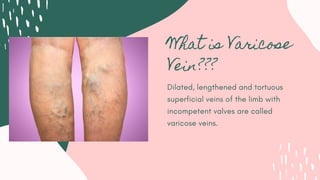
What is Varicose
Vein???
Dilated, lengthened and tortuous
superficial veins of the limb with
incompetent valves are called
varicose veins.
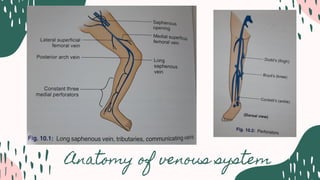
Anatomy of venous system
Predisposing
Factors
Compression of pelvic veins during
pregnancy
Constant standing e.g. shop assistant.
Tight corsets or garters
Age
Genetic Factor also plays role
Basic weakness of vein wall.
Obesity
Therefore depending on the factors, varicose veins are :-
Primary
Secondary
1.
2.
Primary
Varicose Veins
1 . C O N G E N I T A L
W E A K N E S S I N T H E V E I N
Due to defective connective tissue &
smooth muscle.
2 . C O N G E N I T A L
A B S E N C E O F V A L V E S
Klippel-Trenaunay syndrome -
congenital venous abnormality wherein
superficial and deep veins do not have
any valves..
3 . M U S C U L A R
W E A K N E S S
Calf muscles weaken, lose their
pumping action and support for the
veins.
Secondary
varicose veins
1 . P R E G N A N C Y
cause proximal obstruction to the blood
flow.
4 . C O N G E N I T A L
A R T E R I O V E N O U S
F I S T U L A
increases blood flow & increases
venous pressure.
2 . P E L V I C T U M O R S
cause proximal obstruction to the blood
flow.
3 . O R A L
C O N T R A C E P T I V E P I L L S
Alter the viscosity of blood.
5 . S E C O N D A R Y T O D V T
can lead to destruction of valves
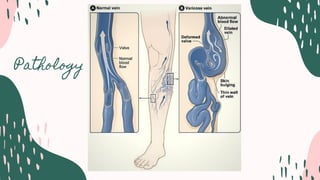
Pathology
D E M O G R A P H I C D A T A
1 .
Name
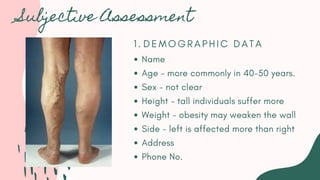
Age - more commonly in 40-50 years.
Sex - not clear
Height - tall individuals suffer more
Weight - obesity may weaken the wall
Side - left is affected more than right
Address
Phone No.
Subjective Assessment
2 . C H I E F C O M P L A I N
Dilated or tortuous veins
Dragging pain or dull ache
Night Cramps (calf muscles)
Fatigue in legs
Difficulty in walking
3 . H I S T O R Y O F P R E S E N T I L L N E S S
Onset of pain
Fever
Oedema
Ulceration
Subjective Assessment
Note :- Pain is relieved on
exercice, while pain due to
arterial disease gets worse on
exercise.
4 . P A S T H I S T O R Y
Pelvic tumors
DVT
Chronic systemic disease
5 . P E R S O N A L H I S T O R Y
Prolonged standing activities
6 . F A M I L Y H I S T O R Y
Genetic abnormality inherited in the FOXC2
gene.
Subjective Assessment
7 . O C C U P A T I O N A L H I S T O R Y
Hotel workers
Policeman
Shopkeepers
Tailors
8 . D R U G H I S T O R Y
Oral contraceptive pills
9 . S O C I O E C O N O M I C H I S T O R Y
Subjective Assessment
INSPECTION
Gait
Body Build
Posture
Dilated Veins or Tortuous Veins
Pigmented Skin
Ankle Flare
Dermatitis, Eczema
Healed Scar
Look for complications
1.
2.
3.
4.
5.
6.
7.
8.
9.
COMPLICATIONS
Bleeding
Venous ulcer
SVT
Oedema
Objective Assessment
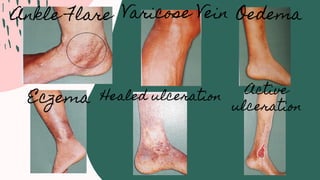
Ankle Flare Varicose Vein Oedema
Eczema Healed ulceration Active
ulceration
Objective Assessment
PALPATION
Hard nodule - thrombosed vein
Tenderness - thrombophlebitis
Whole length of vein is palpated
1.
2.
PERCUSSION (TAP TEST)
1. Place one finger, with a small amount of pressure, onto the
saphenofemoral junction (SFJ) which is located 4cm inferior-lateral
to the pubic tubercle.
2. Tap the varicose vein you are assessing, which should be located
lower down the leg.
Objective Assessment
EXAMINATION
Cough impulse Test (Morrissey's test)
Trendelenburg Test
Multiple Tourniquet Test
Modified Perthes' Test
Examine for DVT & Abdomen
PERCUSSION (TAP TEST)
3. If your finger over the SFJ detects a thrill, this suggests that there is
continuity of the vein due to incompetent venous valves (normally the
venous valves should prevent the thrill transmitting along the entirety
of the vessel)
Cough Impulse Test
(Morrissey's test
Place your hand over the saphenofemoral
junction (2-3cm below and lateral to the pubic
tubercle) and ask the patient to cough.
2. If you feel an impulse over the SFJ this
indicates a saphena varix (dilatation of the
saphenous vein at the SFJ).
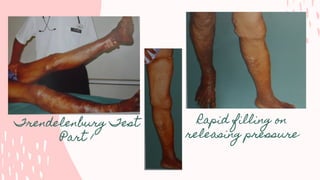
Trendelenburg test
Done in 2 parts.
METHOD. Supine lying. Leg elevated above the level of heart
and the vein emptied. SF junction is occluded with the help of
the thumb ( or a tourniquet) & the patient is asked to stand.
TRENDELENBURG I. Release the thumb or tourniquet
immediately. Rapid gush of blood from above downwards
indicated SF incompetence.
TRENDELENBURG II. The pressure at SF junction is maintained
without releasing the thumb or tourniquet. Patient is then
asked to stand. Slow filling of the long saphenous is seen.
It is due to perforator incompetence.
Trendelenburg Test
Part 1
Rapid filling on
releasing pressure
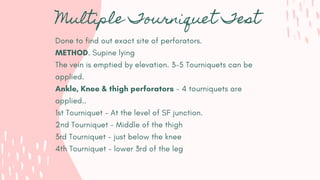
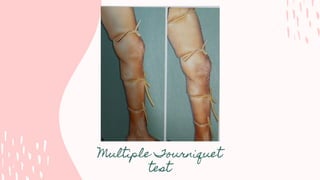
Multiple Tourniquet Test
Done to find out exact site of perforators.
METHOD. Supine lying
The vein is emptied by elevation. 3-5 Tourniquets can be
applied.
Ankle, Knee & thigh perforators - 4 tourniquets are
applied..
1st Tourniquet - At the level of SF junction.
2nd Tourniquet - Middle of the thigh
3rd Tourniquet - just below the knee
4th Tourniquet - lower 3rd of the leg
Multiple Tourniquet
test
Modified Perthes'
test
To rule out DVT
Patient is asked to stand, tourniquet is
applied at SF junction and he is asked to
have a brisk walk.
INFERENCE:- If patient complains of
severe pain in calf region or if superficial
veins become more prominent, it is
indication of DVT.
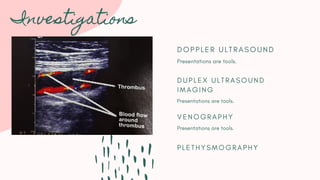
Investigations
D O P P L E R U L T R A S O U N D
Presentations are tools.
D U P L E X U L T R A S O U N D
I M A G I N G
Presentations are tools.
V E N O G R A P H Y
Presentations are tools.
P L E T H Y S M O G R A P H Y
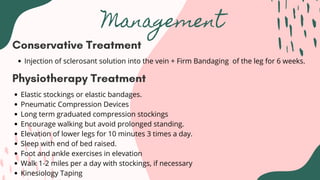
Management
Conservative Treatment
Injection of sclerosant solution into the vein + Firm Bandaging of the leg for 6 weeks.
Physiotherapy Treatment
Elastic stockings or elastic bandages.
Pneumatic Compression Devices
Long term graduated compression stockings
Encourage walking but avoid prolonged standing.
Elevation of lower legs for 10 minutes 3 times a day.
Sleep with end of bed raised.
Foot and ankle exercises in elevation
Walk 1-2 miles per a day with stockings, if necessary
Kinesiology Taping
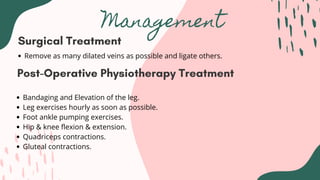
Management
Surgical Treatment
Remove as many dilated veins as possible and ligate others.
Post-Operative Physiotherapy Treatment
Bandaging and Elevation of the leg.
Leg exercises hourly as soon as possible.
Foot ankle pumping exercises.
Hip & knee flexion & extension.
Quadriceps contractions.
Gluteal contractions.
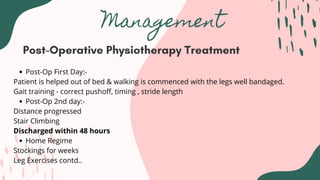
Management
Post-Operative Physiotherapy Treatment
Post-Op First Day:-
Post-Op 2nd day:-
Home Regime
Patient is helped out of bed & walking is commenced with the legs well bandaged.
Gait training - correct pushoff, timing , stride length
Distance progressed
Stair Climbing
Discharged within 48 hours
Stockings for weeks
Leg Exercises contd..
Manipal Manual of
Surgery by K Rajgopal
Shinoy
Tidy's Physiotherapy
(12th edition)
SRB's Manual of
Surgery
Physiopedia
References
Thank You

Varicose vein

  • 1.
  • 2.
    What is Varicose Vein??? Dilated,lengthened and tortuous superficial veins of the limb with incompetent valves are called varicose veins.
  • 3.
  • 4.
    Predisposing Factors Compression of pelvicveins during pregnancy Constant standing e.g. shop assistant. Tight corsets or garters Age Genetic Factor also plays role Basic weakness of vein wall. Obesity Therefore depending on the factors, varicose veins are :- Primary Secondary 1. 2.
  • 5.
    Primary Varicose Veins 1 .C O N G E N I T A L W E A K N E S S I N T H E V E I N Due to defective connective tissue & smooth muscle. 2 . C O N G E N I T A L A B S E N C E O F V A L V E S Klippel-Trenaunay syndrome - congenital venous abnormality wherein superficial and deep veins do not have any valves.. 3 . M U S C U L A R W E A K N E S S Calf muscles weaken, lose their pumping action and support for the veins.
  • 6.
    Secondary varicose veins 1 .P R E G N A N C Y cause proximal obstruction to the blood flow. 4 . C O N G E N I T A L A R T E R I O V E N O U S F I S T U L A increases blood flow & increases venous pressure. 2 . P E L V I C T U M O R S cause proximal obstruction to the blood flow. 3 . O R A L C O N T R A C E P T I V E P I L L S Alter the viscosity of blood. 5 . S E C O N D A R Y T O D V T can lead to destruction of valves
  • 7.
  • 8.
    D E MO G R A P H I C D A T A 1 . Name Age - more commonly in 40-50 years. Sex - not clear Height - tall individuals suffer more Weight - obesity may weaken the wall Side - left is affected more than right Address Phone No. Subjective Assessment
  • 9.
    2 . CH I E F C O M P L A I N Dilated or tortuous veins Dragging pain or dull ache Night Cramps (calf muscles) Fatigue in legs Difficulty in walking 3 . H I S T O R Y O F P R E S E N T I L L N E S S Onset of pain Fever Oedema Ulceration Subjective Assessment Note :- Pain is relieved on exercice, while pain due to arterial disease gets worse on exercise.
  • 10.
    4 . PA S T H I S T O R Y Pelvic tumors DVT Chronic systemic disease 5 . P E R S O N A L H I S T O R Y Prolonged standing activities 6 . F A M I L Y H I S T O R Y Genetic abnormality inherited in the FOXC2 gene. Subjective Assessment
  • 11.
    7 . OC C U P A T I O N A L H I S T O R Y Hotel workers Policeman Shopkeepers Tailors 8 . D R U G H I S T O R Y Oral contraceptive pills 9 . S O C I O E C O N O M I C H I S T O R Y Subjective Assessment
  • 12.
    INSPECTION Gait Body Build Posture Dilated Veinsor Tortuous Veins Pigmented Skin Ankle Flare Dermatitis, Eczema Healed Scar Look for complications 1. 2. 3. 4. 5. 6. 7. 8. 9. COMPLICATIONS Bleeding Venous ulcer SVT Oedema Objective Assessment
  • 13.
    Ankle Flare VaricoseVein Oedema Eczema Healed ulceration Active ulceration
  • 14.
    Objective Assessment PALPATION Hard nodule- thrombosed vein Tenderness - thrombophlebitis Whole length of vein is palpated 1. 2. PERCUSSION (TAP TEST) 1. Place one finger, with a small amount of pressure, onto the saphenofemoral junction (SFJ) which is located 4cm inferior-lateral to the pubic tubercle. 2. Tap the varicose vein you are assessing, which should be located lower down the leg.
  • 15.
    Objective Assessment EXAMINATION Cough impulseTest (Morrissey's test) Trendelenburg Test Multiple Tourniquet Test Modified Perthes' Test Examine for DVT & Abdomen PERCUSSION (TAP TEST) 3. If your finger over the SFJ detects a thrill, this suggests that there is continuity of the vein due to incompetent venous valves (normally the venous valves should prevent the thrill transmitting along the entirety of the vessel)
  • 16.
    Cough Impulse Test (Morrissey'stest Place your hand over the saphenofemoral junction (2-3cm below and lateral to the pubic tubercle) and ask the patient to cough. 2. If you feel an impulse over the SFJ this indicates a saphena varix (dilatation of the saphenous vein at the SFJ).
  • 17.
    Trendelenburg test Done in2 parts. METHOD. Supine lying. Leg elevated above the level of heart and the vein emptied. SF junction is occluded with the help of the thumb ( or a tourniquet) & the patient is asked to stand. TRENDELENBURG I. Release the thumb or tourniquet immediately. Rapid gush of blood from above downwards indicated SF incompetence. TRENDELENBURG II. The pressure at SF junction is maintained without releasing the thumb or tourniquet. Patient is then asked to stand. Slow filling of the long saphenous is seen. It is due to perforator incompetence.
  • 18.
    Trendelenburg Test Part 1 Rapidfilling on releasing pressure
  • 19.
    Multiple Tourniquet Test Doneto find out exact site of perforators. METHOD. Supine lying The vein is emptied by elevation. 3-5 Tourniquets can be applied. Ankle, Knee & thigh perforators - 4 tourniquets are applied.. 1st Tourniquet - At the level of SF junction. 2nd Tourniquet - Middle of the thigh 3rd Tourniquet - just below the knee 4th Tourniquet - lower 3rd of the leg
  • 20.
  • 21.
    Modified Perthes' test To ruleout DVT Patient is asked to stand, tourniquet is applied at SF junction and he is asked to have a brisk walk. INFERENCE:- If patient complains of severe pain in calf region or if superficial veins become more prominent, it is indication of DVT.
  • 22.
    Investigations D O PP L E R U L T R A S O U N D Presentations are tools. D U P L E X U L T R A S O U N D I M A G I N G Presentations are tools. V E N O G R A P H Y Presentations are tools. P L E T H Y S M O G R A P H Y
  • 23.
    Management Conservative Treatment Injection ofsclerosant solution into the vein + Firm Bandaging of the leg for 6 weeks. Physiotherapy Treatment Elastic stockings or elastic bandages. Pneumatic Compression Devices Long term graduated compression stockings Encourage walking but avoid prolonged standing. Elevation of lower legs for 10 minutes 3 times a day. Sleep with end of bed raised. Foot and ankle exercises in elevation Walk 1-2 miles per a day with stockings, if necessary Kinesiology Taping
  • 24.
    Management Surgical Treatment Remove asmany dilated veins as possible and ligate others. Post-Operative Physiotherapy Treatment Bandaging and Elevation of the leg. Leg exercises hourly as soon as possible. Foot ankle pumping exercises. Hip & knee flexion & extension. Quadriceps contractions. Gluteal contractions.
  • 25.
    Management Post-Operative Physiotherapy Treatment Post-OpFirst Day:- Post-Op 2nd day:- Home Regime Patient is helped out of bed & walking is commenced with the legs well bandaged. Gait training - correct pushoff, timing , stride length Distance progressed Stair Climbing Discharged within 48 hours Stockings for weeks Leg Exercises contd..
  • 26.
    Manipal Manual of Surgeryby K Rajgopal Shinoy Tidy's Physiotherapy (12th edition) SRB's Manual of Surgery Physiopedia References
  • 27.