Using Articles
What is an article? Basically, an article is an
adjective. Like adjectives, articles modify nouns.
English has two articles: the and a/an.
The is used to refer to specific or particular nouns;
a/an is used to non-specific or non-particular
nouns.
We call the, the definite article and a/an the
indefinite article.
 the = definite article
 a/an = indefinite article
 For example, if I say, "Let's read the
book," I mean a specific book. If I say,
"Let's read a book," I mean any book
rather than a specific book.
 Let's look at each kind of article a little
more closely.
 Indefinite Articles: a and an
 "A" and "an" signal that the noun is
indefinite, referring to any member of a
group. For example:
 "My daughter really wants a dog for
Christmas." This refers to any dog. We
don't know which dog because we
haven't found the dog yet.
Remember, using a or an depends on the
sound that begins the next word. So...
 a + singular noun beginning with a
consonant: a boy; a car; a bike; a zoo;
a dog
 an + singular noun beginning with a
vowel: an elephant; an egg; an apple;
an idiot; an orphan
 a + singular noun beginning with a
consonant sound: a user (sounds like
'yoo-zer,' i.e. begins with a consonant
'y' sound, so 'a' is used); a university;
a unicorn.
 In some cases where "h" is not
pronounced, such as "hour," use an:
an hour
 The choice between a and an
depends on the initial sound of the
adjective that immediately follows the
article:
 a broken egg
 an unusual problem
 a European country (sounds like 'yer-
o-pi-an,' i.e. begins with consonant 'y'
sound)
 Remember that, in English, the indefinite
articles are used to indicate membership
in a group:
 I am a teacher. (I am a member of a
large group known as teachers.)
 Brian is an Irishman. (Brian is a member
of the people known as Irish.)
 Seiko is a practicing Buddhist. (Seiko is
a member of the group of people known
as Buddhists.)
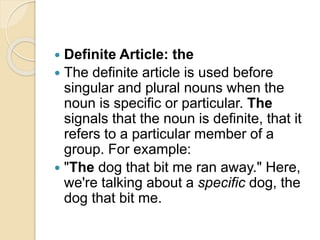
 Definite Article: the
 The definite article is used before
singular and plural nouns when the
noun is specific or particular. The
signals that the noun is definite, that it
refers to a particular member of a
group. For example:
 "The dog that bit me ran away." Here,
we're talking about a specific dog, the
dog that bit me.
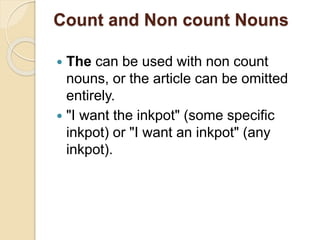
Count and Non count Nouns
 The can be used with non count
nouns, or the article can be omitted
entirely.
 "I want the inkpot" (some specific
inkpot) or "I want an inkpot" (any
inkpot).
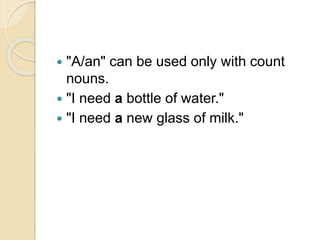
 "A/an" can be used only with count
nouns.
 "I need a bottle of water."
 "I need a new glass of milk."
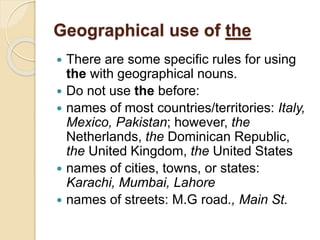
Geographical use of the
 There are some specific rules for using
the with geographical nouns.
 Do not use the before:
 names of most countries/territories: Italy,
Mexico, Pakistan; however, the
Netherlands, the Dominican Republic,
the United Kingdom, the United States
 names of cities, towns, or states:
Karachi, Mumbai, Lahore
 names of streets: M.G road., Main St.
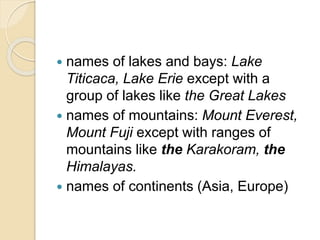
 names of lakes and bays: Lake
Titicaca, Lake Erie except with a
group of lakes like the Great Lakes
 names of mountains: Mount Everest,
Mount Fuji except with ranges of
mountains like the Karakoram, the
Himalayas.
 names of continents (Asia, Europe)
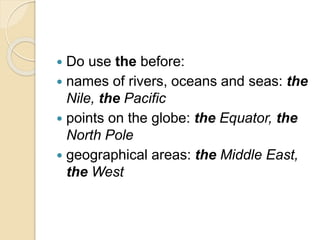
 Do use the before:
 names of rivers, oceans and seas: the
Nile, the Pacific
 points on the globe: the Equator, the
North Pole
 geographical areas: the Middle East,
the West
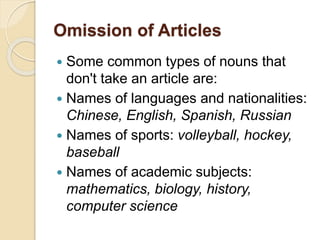
Omission of Articles
 Some common types of nouns that
don't take an article are:
 Names of languages and nationalities:
Chinese, English, Spanish, Russian
 Names of sports: volleyball, hockey,
baseball
 Names of academic subjects:
mathematics, biology, history,
computer science
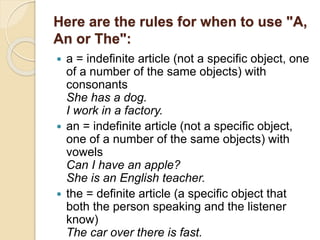
Here are the rules for when to use "A,
An or The":
 a = indefinite article (not a specific object, one
of a number of the same objects) with
consonants
She has a dog.
I work in a factory.
 an = indefinite article (not a specific object,
one of a number of the same objects) with
vowels
Can I have an apple?
She is an English teacher.
 the = definite article (a specific object that
both the person speaking and the listener
know)
The car over there is fast.
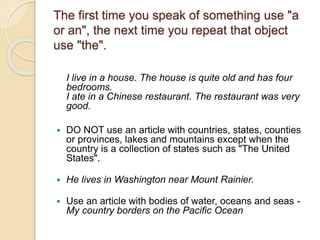
The first time you speak of something use "a
or an", the next time you repeat that object
use "the".
I live in a house. The house is quite old and has four
bedrooms.
I ate in a Chinese restaurant. The restaurant was very
good.
 DO NOT use an article with countries, states, counties
or provinces, lakes and mountains except when the
country is a collection of states such as "The United
States".
 He lives in Washington near Mount Rainier.
 Use an article with bodies of water, oceans and seas -
My country borders on the Pacific Ocean
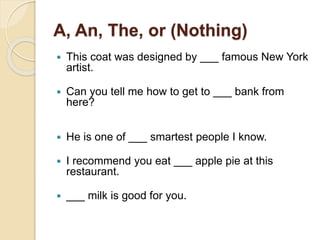
A, An, The, or (Nothing)
 This coat was designed by ___ famous New York
artist.
 Can you tell me how to get to ___ bank from
here?
 He is one of ___ smartest people I know.
 I recommend you eat ___ apple pie at this
restaurant.
 ___ milk is good for you.
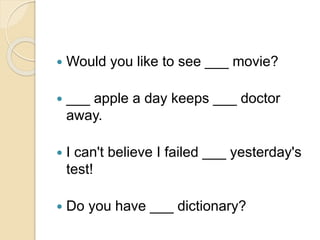
 Would you like to see ___ movie?
 ___ apple a day keeps ___ doctor
away.
 I can't believe I failed ___ yesterday's
test!
 Do you have ___ dictionary?
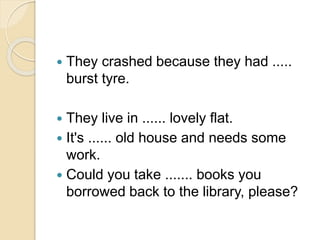
 They crashed because they had .....
burst tyre.
 They live in ...... lovely flat.
 It's ...... old house and needs some
work.
 Could you take ....... books you
borrowed back to the library, please?
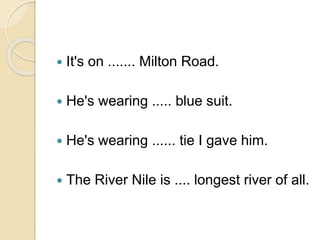
 It's on ....... Milton Road.
 He's wearing ..... blue suit.
 He's wearing ...... tie I gave him.
 The River Nile is .... longest river of all.

using artic

  • 1.
    Using Articles What isan article? Basically, an article is an adjective. Like adjectives, articles modify nouns. English has two articles: the and a/an. The is used to refer to specific or particular nouns; a/an is used to non-specific or non-particular nouns. We call the, the definite article and a/an the indefinite article.
  • 2.
     the =definite article  a/an = indefinite article  For example, if I say, "Let's read the book," I mean a specific book. If I say, "Let's read a book," I mean any book rather than a specific book.
  • 3.
     Let's lookat each kind of article a little more closely.  Indefinite Articles: a and an  "A" and "an" signal that the noun is indefinite, referring to any member of a group. For example:  "My daughter really wants a dog for Christmas." This refers to any dog. We don't know which dog because we haven't found the dog yet.
  • 4.
    Remember, using aor an depends on the sound that begins the next word. So...  a + singular noun beginning with a consonant: a boy; a car; a bike; a zoo; a dog  an + singular noun beginning with a vowel: an elephant; an egg; an apple; an idiot; an orphan
  • 5.
     a +singular noun beginning with a consonant sound: a user (sounds like 'yoo-zer,' i.e. begins with a consonant 'y' sound, so 'a' is used); a university; a unicorn.  In some cases where "h" is not pronounced, such as "hour," use an: an hour
  • 6.
     The choicebetween a and an depends on the initial sound of the adjective that immediately follows the article:  a broken egg  an unusual problem  a European country (sounds like 'yer- o-pi-an,' i.e. begins with consonant 'y' sound)
  • 7.
     Remember that,in English, the indefinite articles are used to indicate membership in a group:  I am a teacher. (I am a member of a large group known as teachers.)  Brian is an Irishman. (Brian is a member of the people known as Irish.)  Seiko is a practicing Buddhist. (Seiko is a member of the group of people known as Buddhists.)
  • 8.
     Definite Article:the  The definite article is used before singular and plural nouns when the noun is specific or particular. The signals that the noun is definite, that it refers to a particular member of a group. For example:  "The dog that bit me ran away." Here, we're talking about a specific dog, the dog that bit me.
  • 9.
    Count and Noncount Nouns  The can be used with non count nouns, or the article can be omitted entirely.  "I want the inkpot" (some specific inkpot) or "I want an inkpot" (any inkpot).
  • 10.
     "A/an" canbe used only with count nouns.  "I need a bottle of water."  "I need a new glass of milk."
  • 11.
    Geographical use ofthe  There are some specific rules for using the with geographical nouns.  Do not use the before:  names of most countries/territories: Italy, Mexico, Pakistan; however, the Netherlands, the Dominican Republic, the United Kingdom, the United States  names of cities, towns, or states: Karachi, Mumbai, Lahore  names of streets: M.G road., Main St.
  • 12.
     names oflakes and bays: Lake Titicaca, Lake Erie except with a group of lakes like the Great Lakes  names of mountains: Mount Everest, Mount Fuji except with ranges of mountains like the Karakoram, the Himalayas.  names of continents (Asia, Europe)
  • 13.
     Do usethe before:  names of rivers, oceans and seas: the Nile, the Pacific  points on the globe: the Equator, the North Pole  geographical areas: the Middle East, the West
  • 14.
    Omission of Articles Some common types of nouns that don't take an article are:  Names of languages and nationalities: Chinese, English, Spanish, Russian  Names of sports: volleyball, hockey, baseball  Names of academic subjects: mathematics, biology, history, computer science
  • 15.
    Here are therules for when to use "A, An or The":  a = indefinite article (not a specific object, one of a number of the same objects) with consonants She has a dog. I work in a factory.  an = indefinite article (not a specific object, one of a number of the same objects) with vowels Can I have an apple? She is an English teacher.  the = definite article (a specific object that both the person speaking and the listener know) The car over there is fast.
  • 16.
    The first timeyou speak of something use "a or an", the next time you repeat that object use "the". I live in a house. The house is quite old and has four bedrooms. I ate in a Chinese restaurant. The restaurant was very good.  DO NOT use an article with countries, states, counties or provinces, lakes and mountains except when the country is a collection of states such as "The United States".  He lives in Washington near Mount Rainier.  Use an article with bodies of water, oceans and seas - My country borders on the Pacific Ocean
  • 17.
    A, An, The,or (Nothing)  This coat was designed by ___ famous New York artist.  Can you tell me how to get to ___ bank from here?  He is one of ___ smartest people I know.  I recommend you eat ___ apple pie at this restaurant.  ___ milk is good for you.
  • 18.
     Would youlike to see ___ movie?  ___ apple a day keeps ___ doctor away.  I can't believe I failed ___ yesterday's test!  Do you have ___ dictionary?
  • 19.
     They crashedbecause they had ..... burst tyre.  They live in ...... lovely flat.  It's ...... old house and needs some work.  Could you take ....... books you borrowed back to the library, please?
  • 20.
     It's on....... Milton Road.  He's wearing ..... blue suit.  He's wearing ...... tie I gave him.  The River Nile is .... longest river of all.