THE FEUDALISMTHE FEUDALISM
What is the feudalism?What is the feudalism?
 Feudalism was theFeudalism was the
medieval model ofmedieval model of
governmentgovernment
whichwhich
characterisedcharacterised
Western Europe.Western Europe.
It developedIt developed
between the 9thbetween the 9th
and 15th centuriesand 15th centuries
FeudalFeudal SystemSystem
 The basic government and society in EuropeThe basic government and society in Europe
during the Middle Ages was based on the feudalduring the Middle Ages was based on the feudal
system. Small communities were formed aroundsystem. Small communities were formed around
the local lord and the manor. The lord ownedthe local lord and the manor. The lord owned
the land and everything there.the land and everything there.
Feudal MonarchyFeudal Monarchy
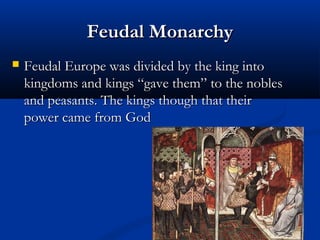
 Feudal Europe was divided by the king intoFeudal Europe was divided by the king into
kingdoms and kings “gave them” to the nobleskingdoms and kings “gave them” to the nobles
and peasants. The kings though that theirand peasants. The kings though that their
power came from Godpower came from God
Feudal economyFeudal economy
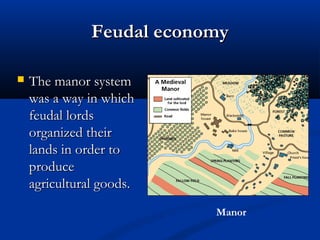
 The manor systemThe manor system
was a way in whichwas a way in which
feudal lordsfeudal lords
organized theirorganized their
lands in order tolands in order to
produceproduce
agricultural goods.agricultural goods.
Manor
PARTS OF THE MANORPARTS OF THE MANOR
 DEMESNE: was the territory exploited directlyDEMESNE: was the territory exploited directly
for the lord.for the lord.
 DEPENDENT HOLDINGS: were small plotsDEPENDENT HOLDINGS: were small plots
of land granted or leased by the lord to theof land granted or leased by the lord to the
peasants.peasants.
Feudal societyFeudal society
Feudal society wasFeudal society was
divided into threedivided into three
estates, they wereestates, they were
named:named:
 The nobilityThe nobility
 The clergyThe clergy
 The commonersThe commoners
THE ENDTHE END
 Silvia Espín Gallego Nº10Silvia Espín Gallego Nº10
 Rocío Lusarreta Naranjo Nº19Rocío Lusarreta Naranjo Nº19

5

  • 1.
  • 2.
    What is thefeudalism?What is the feudalism?  Feudalism was theFeudalism was the medieval model ofmedieval model of governmentgovernment whichwhich characterisedcharacterised Western Europe.Western Europe. It developedIt developed between the 9thbetween the 9th and 15th centuriesand 15th centuries
  • 3.
    FeudalFeudal SystemSystem  Thebasic government and society in EuropeThe basic government and society in Europe during the Middle Ages was based on the feudalduring the Middle Ages was based on the feudal system. Small communities were formed aroundsystem. Small communities were formed around the local lord and the manor. The lord ownedthe local lord and the manor. The lord owned the land and everything there.the land and everything there.
  • 4.
    Feudal MonarchyFeudal Monarchy Feudal Europe was divided by the king intoFeudal Europe was divided by the king into kingdoms and kings “gave them” to the nobleskingdoms and kings “gave them” to the nobles and peasants. The kings though that theirand peasants. The kings though that their power came from Godpower came from God
  • 5.
    Feudal economyFeudal economy The manor systemThe manor system was a way in whichwas a way in which feudal lordsfeudal lords organized theirorganized their lands in order tolands in order to produceproduce agricultural goods.agricultural goods. Manor
  • 6.
    PARTS OF THEMANORPARTS OF THE MANOR  DEMESNE: was the territory exploited directlyDEMESNE: was the territory exploited directly for the lord.for the lord.  DEPENDENT HOLDINGS: were small plotsDEPENDENT HOLDINGS: were small plots of land granted or leased by the lord to theof land granted or leased by the lord to the peasants.peasants.
  • 7.
    Feudal societyFeudal society Feudalsociety wasFeudal society was divided into threedivided into three estates, they wereestates, they were named:named:  The nobilityThe nobility  The clergyThe clergy  The commonersThe commoners
  • 8.
    THE ENDTHE END Silvia Espín Gallego Nº10Silvia Espín Gallego Nº10  Rocío Lusarreta Naranjo Nº19Rocío Lusarreta Naranjo Nº19