THE ACCOUNTING CYCLE
ABDULLAH RAMZAN
WASEEM USMAN
MAHRUKH ALAM
MUHAMMAD AMIR
USAMA CHAUDHRY
OVERVIEW
1. Adjusted Trial Balance
2. Closing Entries
3. Financial Analysis and Decision Making
ABDULLAH RAMZAN
ADJUSTED TRIAL BALANCE
Trial Balance :-
A trial balance is a bookkeeping worksheet in which the balances of all ledgers are
compiled into debit and credit columns. A company prepares a trial balance periodically, usually at the
end of every reporting period. The general purpose of producing a trial balance is to ensure the
entries in a company's bookkeeping system are mathematically correct.
Adjusted Trial Balance :-
An adjusted trial balance is a listing of all the account titles and balances contained
in the general ledger after the adjusting entries for an accounting period have been posted to
the accounts.
OBJECTIVES OF PREPARING TRIAL BALANCE
1. Testing of arithmetic accuracy
2. To help in preparing Financial statements
3. Helps in locating errors
4. Help in comparison
5. Help in making adjustments.
WASEEM USMAN
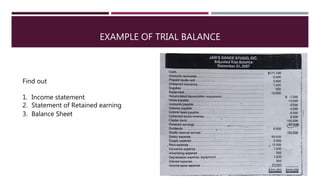
EXAMPLE OF TRIAL BALANCE
Find out
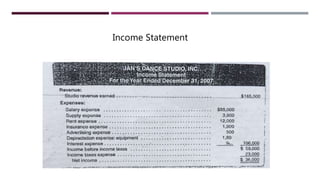
1. Income statement
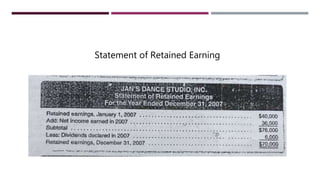
2. Statement of Retained earning
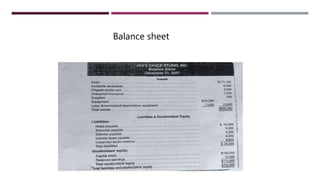
3. Balance Sheet
Income Statement
Statement of Retained Earning
Balance sheet
MAHRUKH ALAM
CLOSING ENTRIES
CLOSING ENTRIES
Closing Entries:-
Closing entries are journal entries made at the end of an accounting period which transfer the
balances of temporary accounts to permanent accounts. Closing entries are based on the account balances
in an adjusted trial balance.
Temporary accounts include:
1.Revenue, Income and Gain Accounts
2.Expense and Loss Accounts
3.Dividend, Drawings or Withdrawals Accounts
4.Income Summary Account
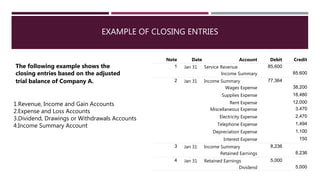
EXAMPLE OF CLOSING ENTRIES
Note Date Account Debit Credit
1 Jan 31 Service Revenue 85,600
Income Summary 85,600
2 Jan 31 Income Summary 77,364
Wages Expense 38,200
Supplies Expense 18,480
Rent Expense 12,000
Miscellaneous Expense 3,470
Electricity Expense 2,470
Telephone Expense 1,494
Depreciation Expense 1,100
Interest Expense 150
3 Jan 31 Income Summary 8,236
Retained Earnings 8,236
4 Jan 31 Retained Earnings 5,000
Dividend 5,000
The following example shows the
closing entries based on the adjusted
trial balance of Company A.
1.Revenue, Income and Gain Accounts
2.Expense and Loss Accounts
3.Dividend, Drawings or Withdrawals Accounts
4.Income Summary Account
MUHAMMAD AMIR
FINANCIAL ANALYSIS AND DECISION MAKING
1.Net Income Percentage
2.Return on Equity
3.Working Capital
4.Current Ratio
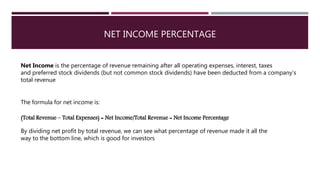
NET INCOME PERCENTAGE
Net Income is the percentage of revenue remaining after all operating expenses, interest, taxes
and preferred stock dividends (but not common stock dividends) have been deducted from a company’s
total revenue
The formula for net income is:
(Total Revenue – Total Expenses) = Net Income/Total Revenue = Net Income Percentage
By dividing net profit by total revenue, we can see what percentage of revenue made it all the
way to the bottom line, which is good for investors
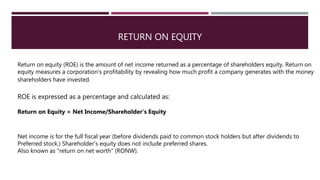
RETURN ON EQUITY
Return on equity (ROE) is the amount of net income returned as a percentage of shareholders equity. Return on
equity measures a corporation's profitability by revealing how much profit a company generates with the money
shareholders have invested.
ROE is expressed as a percentage and calculated as:
Return on Equity = Net Income/Shareholder's Equity
Net income is for the full fiscal year (before dividends paid to common stock holders but after dividends to
Preferred stock.) Shareholder's equity does not include preferred shares.
Also known as "return on net worth" (RONW).
USAMA CHAUDHRY
FINANCIAL ANALYSIS AND DECISION MAKING
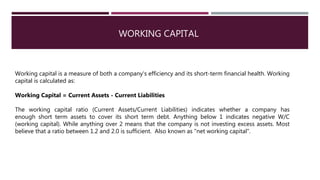
WORKING CAPITAL
Working capital is a measure of both a company's efficiency and its short-term financial health. Working
capital is calculated as:
Working Capital = Current Assets - Current Liabilities
The working capital ratio (Current Assets/Current Liabilities) indicates whether a company has
enough short term assets to cover its short term debt. Anything below 1 indicates negative W/C
(working capital). While anything over 2 means that the company is not investing excess assets. Most
believe that a ratio between 1.2 and 2.0 is sufficient. Also known as "net working capital".
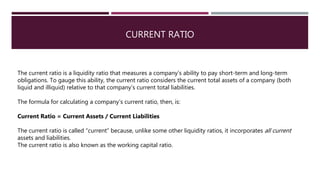
CURRENT RATIO
The current ratio is a liquidity ratio that measures a company's ability to pay short-term and long-term
obligations. To gauge this ability, the current ratio considers the current total assets of a company (both
liquid and illiquid) relative to that company’s current total liabilities.
The formula for calculating a company’s current ratio, then, is:
Current Ratio = Current Assets / Current Liabilities
The current ratio is called “current” because, unlike some other liquidity ratios, it incorporates all current
assets and liabilities.
The current ratio is also known as the working capital ratio.

The accounting cycle

  • 1.
    THE ACCOUNTING CYCLE ABDULLAHRAMZAN WASEEM USMAN MAHRUKH ALAM MUHAMMAD AMIR USAMA CHAUDHRY
  • 2.
    OVERVIEW 1. Adjusted TrialBalance 2. Closing Entries 3. Financial Analysis and Decision Making
  • 3.
  • 4.
    ADJUSTED TRIAL BALANCE TrialBalance :- A trial balance is a bookkeeping worksheet in which the balances of all ledgers are compiled into debit and credit columns. A company prepares a trial balance periodically, usually at the end of every reporting period. The general purpose of producing a trial balance is to ensure the entries in a company's bookkeeping system are mathematically correct. Adjusted Trial Balance :- An adjusted trial balance is a listing of all the account titles and balances contained in the general ledger after the adjusting entries for an accounting period have been posted to the accounts.
  • 5.
    OBJECTIVES OF PREPARINGTRIAL BALANCE 1. Testing of arithmetic accuracy 2. To help in preparing Financial statements 3. Helps in locating errors 4. Help in comparison 5. Help in making adjustments.
  • 6.
  • 7.
    EXAMPLE OF TRIALBALANCE Find out 1. Income statement 2. Statement of Retained earning 3. Balance Sheet
  • 8.
  • 9.
  • 10.
  • 11.
  • 12.
    CLOSING ENTRIES Closing Entries:- Closingentries are journal entries made at the end of an accounting period which transfer the balances of temporary accounts to permanent accounts. Closing entries are based on the account balances in an adjusted trial balance. Temporary accounts include: 1.Revenue, Income and Gain Accounts 2.Expense and Loss Accounts 3.Dividend, Drawings or Withdrawals Accounts 4.Income Summary Account
  • 13.
    EXAMPLE OF CLOSINGENTRIES Note Date Account Debit Credit 1 Jan 31 Service Revenue 85,600 Income Summary 85,600 2 Jan 31 Income Summary 77,364 Wages Expense 38,200 Supplies Expense 18,480 Rent Expense 12,000 Miscellaneous Expense 3,470 Electricity Expense 2,470 Telephone Expense 1,494 Depreciation Expense 1,100 Interest Expense 150 3 Jan 31 Income Summary 8,236 Retained Earnings 8,236 4 Jan 31 Retained Earnings 5,000 Dividend 5,000 The following example shows the closing entries based on the adjusted trial balance of Company A. 1.Revenue, Income and Gain Accounts 2.Expense and Loss Accounts 3.Dividend, Drawings or Withdrawals Accounts 4.Income Summary Account
  • 14.
  • 15.
    FINANCIAL ANALYSIS ANDDECISION MAKING 1.Net Income Percentage 2.Return on Equity 3.Working Capital 4.Current Ratio
  • 16.
    NET INCOME PERCENTAGE NetIncome is the percentage of revenue remaining after all operating expenses, interest, taxes and preferred stock dividends (but not common stock dividends) have been deducted from a company’s total revenue The formula for net income is: (Total Revenue – Total Expenses) = Net Income/Total Revenue = Net Income Percentage By dividing net profit by total revenue, we can see what percentage of revenue made it all the way to the bottom line, which is good for investors
  • 17.
    RETURN ON EQUITY Returnon equity (ROE) is the amount of net income returned as a percentage of shareholders equity. Return on equity measures a corporation's profitability by revealing how much profit a company generates with the money shareholders have invested. ROE is expressed as a percentage and calculated as: Return on Equity = Net Income/Shareholder's Equity Net income is for the full fiscal year (before dividends paid to common stock holders but after dividends to Preferred stock.) Shareholder's equity does not include preferred shares. Also known as "return on net worth" (RONW).
  • 18.
  • 19.
    WORKING CAPITAL Working capitalis a measure of both a company's efficiency and its short-term financial health. Working capital is calculated as: Working Capital = Current Assets - Current Liabilities The working capital ratio (Current Assets/Current Liabilities) indicates whether a company has enough short term assets to cover its short term debt. Anything below 1 indicates negative W/C (working capital). While anything over 2 means that the company is not investing excess assets. Most believe that a ratio between 1.2 and 2.0 is sufficient. Also known as "net working capital".
  • 20.
    CURRENT RATIO The currentratio is a liquidity ratio that measures a company's ability to pay short-term and long-term obligations. To gauge this ability, the current ratio considers the current total assets of a company (both liquid and illiquid) relative to that company’s current total liabilities. The formula for calculating a company’s current ratio, then, is: Current Ratio = Current Assets / Current Liabilities The current ratio is called “current” because, unlike some other liquidity ratios, it incorporates all current assets and liabilities. The current ratio is also known as the working capital ratio.