Accounting cycle
Baqir siddique
(1702365)
Prepared by:
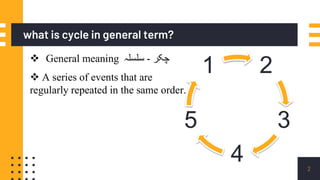
what is cycle in general term?
2
2
3
4
5
1 A series of events that are
regularly repeated in the same order.
 General meaning ‫چکر‬-‫سلسلہ‬
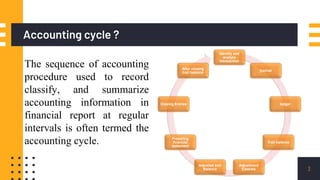
Accounting cycle ?
3
The sequence of accounting
procedure used to record
classify, and summarize
accounting information in
financial report at regular
intervals is often termed the
accounting cycle.
Identify and
analyze
transaction
journal
ledger
Trail balance
Adjustment
Eateries
Adjusted trail
Balance
Preparing
financial
statement
Closing Entries
After closing
trail balance
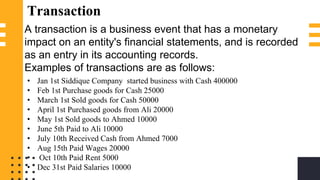
Transaction
A transaction is a business event that has a monetary
impact on an entity's financial statements, and is recorded
as an entry in its accounting records.
Examples of transactions are as follows:
• Jan 1st Siddique Company started business with Cash 400000
• Feb 1st Purchase goods for Cash 25000
• March 1st Sold goods for Cash 50000
• April 1st Purchased goods from Ali 20000
• May 1st Sold goods to Ahmed 10000
• June 5th Paid to Ali 10000
• July 10th Received Cash from Ahmed 7000
• Aug 15th Paid Wages 20000
• Oct 10th Paid Rent 5000
• Dec 31st Paid Salaries 10000
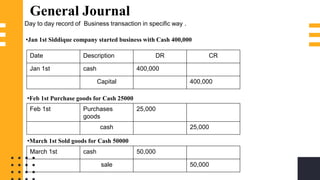
General Journal
Day to day record of Business transaction in specific way .
•Jan 1st Siddique company started business with Cash 400,000
Date Description DR CR
Jan 1st cash 400,000
Capital 400,000
•Feb 1st Purchase goods for Cash 25000
Feb 1st Purchases
goods
25,000
cash 25,000
•March 1st Sold goods for Cash 50000
March 1st cash 50,000
sale 50,000
6
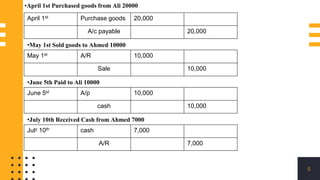
•April 1st Purchased goods from Ali 20000
April 1st Purchase goods 20,000
A/c payable 20,000
•May 1st Sold goods to Ahmed 10000
May 1st A/R 10,000
Sale 10,000
•June 5th Paid to Ali 10000
June 5st A/p 10,000
cash 10,000
•July 10th Received Cash from Ahmed 7000
July 10th cash 7,000
A/R 7,000
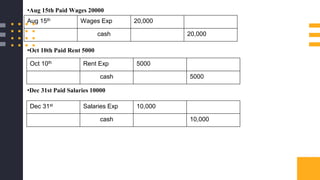
•Aug 15th Paid Wages 20000
Aug 15th Wages Exp 20,000
cash 20,000
•Oct 10th Paid Rent 5000
Dec 31st Salaries Exp 10,000
cash 10,000
Oct 10th Rent Exp 5000
cash 5000
•Dec 31st Paid Salaries 10000
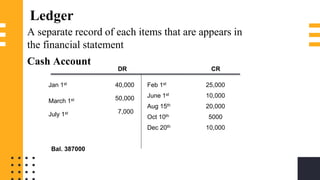
Ledger
A separate record of each items that are appears in
the financial statement
Cash Account
Jan 1st
March 1st
July 1st
40,000
50,000
7,000
Feb 1st 25,000
June 1st 10,000
Aug 15th 20,000
Oct 10th 5000
Dec 20th 10,000
Bal. 387000
DR CR
9
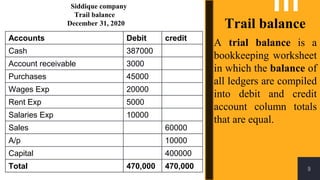
Accounts Debit credit
Cash 387000
Account receivable 3000
Purchases 45000
Wages Exp 20000
Rent Exp 5000
Salaries Exp 10000
Sales 60000
A/p 10000
Capital 400000
Total 470,000 470,000
Siddique company
Trail balance
December 31, 2020 Trail balance
A trial balance is a
bookkeeping worksheet
in which the balance of
all ledgers are compiled
into debit and credit
account column totals
that are equal.
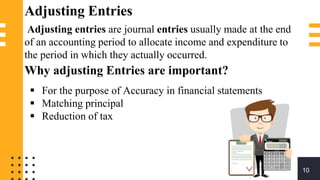
Adjusting Entries
Adjusting entries are journal entries usually made at the end
of an accounting period to allocate income and expenditure to
the period in which they actually occurred.
Why adjusting Entries are important?
 For the purpose of Accuracy in financial statements
 Matching principal
 Reduction of tax
10
11
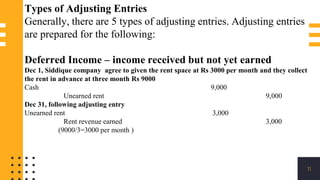
Types of Adjusting Entries
Generally, there are 5 types of adjusting entries. Adjusting entries
are prepared for the following:
Deferred Income – income received but not yet earned
Dec 1, Siddique company agree to given the rent space at Rs 3000 per month and they collect
the rent in advance at three month Rs 9000
Cash 9,000
Unearned rent 9,000
Dec 31, following adjusting entry
Unearned rent 3,000
Rent revenue earned 3,000
(9000/3=3000 per month )
12
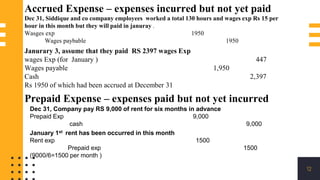
Prepaid Expense – expenses paid but not yet incurred
Accrued Expense – expenses incurred but not yet paid
Dec 31, Siddique and co company employees worked a total 130 hours and wages exp Rs 15 per
hour in this month but they will paid in januray .
Wasges exp 1950
Wages paybable 1950
Janurary 3, assume that they paid RS 2397 wages Exp
wages Exp (for January ) 447
Wages payable 1,950
Cash 2,397
Rs 1950 of which had been accrued at December 31
Dec 31, Company pay RS 9,000 of rent for six months in advance
Prepaid Exp 9,000
cash 9,000
January 1st rent has been occurred in this month
Rent exp 1500
Prepaid exp 1500
(9000/6=1500 per month )
13
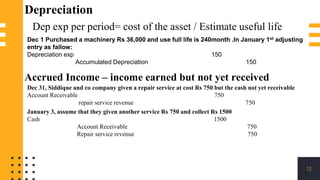
Depreciation
Dep exp per period= cost of the asset / Estimate useful life
Dec 1 Purchased a machinery Rs 36,000 and use full life is 240month .In January 1st adjusting
entry as fallow:
Depreciation exp 150
Accumulated Depreciation 150
Accrued Income – income earned but not yet received
Dec 31, Siddique and co company given a repair service at cost Rs 750 but the cash not yet receivable
Account Receivable 750
repair service revenue 750
January 3, assume that they given another service Rs 750 and collect Rs 1500
Cash 1500
Account Receivable 750
Repair service revenue 750
14
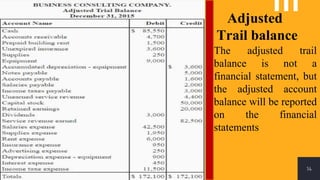
Adjusted
Trail balance
The adjusted trail
balance is not a
financial statement, but
the adjusted account
balance will be reported
on the financial
statements
15
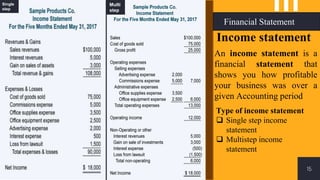
Income statement
An income statement is a
financial statement that
shows you how profitable
your business was over a
given Accounting period
Financial Statement
Type of income statement
 Single step income
statement
 Multistep income
statement
Single
step
Multi
step
16
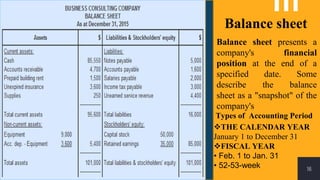
Balance sheet
Balance sheet presents a
company's financial
position at the end of a
specified date. Some
describe the balance
sheet as a "snapshot" of the
company's
THE CALENDAR YEAR
January 1 to December 31
FISCAL YEAR
• Feb. 1 to Jan. 31
• 52-53-week
Types of Accounting Period
Closing Enteries
 The final stage of the accounting cycle is to prepare the
accounts for the next fiscal period.
 A closing entry is a journal entry that is made at the end of
an accounting period to transfer balances from Nominal
account to real account.
17
18
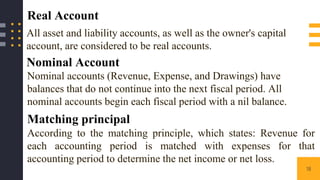
All asset and liability accounts, as well as the owner's capital
account, are considered to be real accounts.
Nominal accounts (Revenue, Expense, and Drawings) have
balances that do not continue into the next fiscal period. All
nominal accounts begin each fiscal period with a nil balance.
According to the matching principle, which states: Revenue for
each accounting period is matched with expenses for that
accounting period to determine the net income or net loss.
Real Account
Nominal Account
Matching principal
.
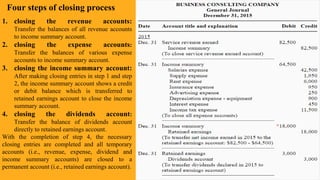
Four steps of closing process
1. closing the revenue accounts:
Transfer the balances of all revenue accounts
to income summary account.
2. closing the expense accounts:
Transfer the balances of various expense
accounts to income summary account.
3. closing the income summary account:
After making closing entries in step 1 and step
2, the income summary account shows a credit
or debit balance which is transferred to
retained earnings account to close the income
summary account.
4. closing the dividends account:
Transfer the balance of dividends account
directly to retained earnings account.
With the completion of step 4, the necessary
closing entries are completed and all temporary
accounts (i.e., revenue, expense, dividend and
income summary accounts) are closed to a
permanent account (i.e., retained earnings account).
I am Jayden Smith
I am here because I love to give
presentations.
You can find me at @username
20
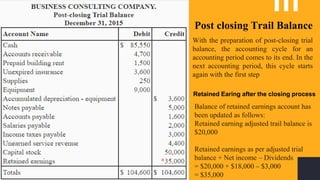
Balance of retained earnings account has
been updated as follows:
Retained earning adjusted trail balance is
$20,000
Retained earnings as per adjusted trial
balance + Net income – Dividends
= $20,000 + $18,000 – $3,000
= $35,000
With the preparation of post-closing trial
balance, the accounting cycle for an
accounting period comes to its end. In the
next accounting period, this cycle starts
again with the first step
Post closing Trail Balance
Retained Earing after the closing process
21
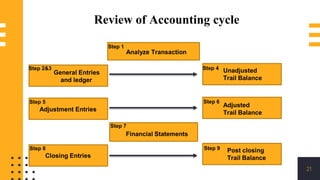
Review of Accounting cycle
General Entries
and ledger
Adjustment Entries
Closing Entries
Unadjusted
Trail Balance
Adjusted
Trail Balance
Post closing
Trail Balance
Financial Statements
Analyze Transaction
Step 1
Step 2&3 Step 4
Step 5 Step 6
Step 8
Step 7
Step 9
22
Thanks!
Any questions?

Accounting cycle by Baqir Siddique

  • 1.
  • 2.
    what is cyclein general term? 2 2 3 4 5 1 A series of events that are regularly repeated in the same order.  General meaning ‫چکر‬-‫سلسلہ‬
  • 3.
    Accounting cycle ? 3 Thesequence of accounting procedure used to record classify, and summarize accounting information in financial report at regular intervals is often termed the accounting cycle. Identify and analyze transaction journal ledger Trail balance Adjustment Eateries Adjusted trail Balance Preparing financial statement Closing Entries After closing trail balance
  • 4.
    Transaction A transaction isa business event that has a monetary impact on an entity's financial statements, and is recorded as an entry in its accounting records. Examples of transactions are as follows: • Jan 1st Siddique Company started business with Cash 400000 • Feb 1st Purchase goods for Cash 25000 • March 1st Sold goods for Cash 50000 • April 1st Purchased goods from Ali 20000 • May 1st Sold goods to Ahmed 10000 • June 5th Paid to Ali 10000 • July 10th Received Cash from Ahmed 7000 • Aug 15th Paid Wages 20000 • Oct 10th Paid Rent 5000 • Dec 31st Paid Salaries 10000
  • 5.
    General Journal Day today record of Business transaction in specific way . •Jan 1st Siddique company started business with Cash 400,000 Date Description DR CR Jan 1st cash 400,000 Capital 400,000 •Feb 1st Purchase goods for Cash 25000 Feb 1st Purchases goods 25,000 cash 25,000 •March 1st Sold goods for Cash 50000 March 1st cash 50,000 sale 50,000
  • 6.
    6 •April 1st Purchasedgoods from Ali 20000 April 1st Purchase goods 20,000 A/c payable 20,000 •May 1st Sold goods to Ahmed 10000 May 1st A/R 10,000 Sale 10,000 •June 5th Paid to Ali 10000 June 5st A/p 10,000 cash 10,000 •July 10th Received Cash from Ahmed 7000 July 10th cash 7,000 A/R 7,000
  • 7.
    •Aug 15th PaidWages 20000 Aug 15th Wages Exp 20,000 cash 20,000 •Oct 10th Paid Rent 5000 Dec 31st Salaries Exp 10,000 cash 10,000 Oct 10th Rent Exp 5000 cash 5000 •Dec 31st Paid Salaries 10000
  • 8.
    Ledger A separate recordof each items that are appears in the financial statement Cash Account Jan 1st March 1st July 1st 40,000 50,000 7,000 Feb 1st 25,000 June 1st 10,000 Aug 15th 20,000 Oct 10th 5000 Dec 20th 10,000 Bal. 387000 DR CR
  • 9.
    9 Accounts Debit credit Cash387000 Account receivable 3000 Purchases 45000 Wages Exp 20000 Rent Exp 5000 Salaries Exp 10000 Sales 60000 A/p 10000 Capital 400000 Total 470,000 470,000 Siddique company Trail balance December 31, 2020 Trail balance A trial balance is a bookkeeping worksheet in which the balance of all ledgers are compiled into debit and credit account column totals that are equal.
  • 10.
    Adjusting Entries Adjusting entriesare journal entries usually made at the end of an accounting period to allocate income and expenditure to the period in which they actually occurred. Why adjusting Entries are important?  For the purpose of Accuracy in financial statements  Matching principal  Reduction of tax 10
  • 11.
    11 Types of AdjustingEntries Generally, there are 5 types of adjusting entries. Adjusting entries are prepared for the following: Deferred Income – income received but not yet earned Dec 1, Siddique company agree to given the rent space at Rs 3000 per month and they collect the rent in advance at three month Rs 9000 Cash 9,000 Unearned rent 9,000 Dec 31, following adjusting entry Unearned rent 3,000 Rent revenue earned 3,000 (9000/3=3000 per month )
  • 12.
    12 Prepaid Expense –expenses paid but not yet incurred Accrued Expense – expenses incurred but not yet paid Dec 31, Siddique and co company employees worked a total 130 hours and wages exp Rs 15 per hour in this month but they will paid in januray . Wasges exp 1950 Wages paybable 1950 Janurary 3, assume that they paid RS 2397 wages Exp wages Exp (for January ) 447 Wages payable 1,950 Cash 2,397 Rs 1950 of which had been accrued at December 31 Dec 31, Company pay RS 9,000 of rent for six months in advance Prepaid Exp 9,000 cash 9,000 January 1st rent has been occurred in this month Rent exp 1500 Prepaid exp 1500 (9000/6=1500 per month )
  • 13.
    13 Depreciation Dep exp perperiod= cost of the asset / Estimate useful life Dec 1 Purchased a machinery Rs 36,000 and use full life is 240month .In January 1st adjusting entry as fallow: Depreciation exp 150 Accumulated Depreciation 150 Accrued Income – income earned but not yet received Dec 31, Siddique and co company given a repair service at cost Rs 750 but the cash not yet receivable Account Receivable 750 repair service revenue 750 January 3, assume that they given another service Rs 750 and collect Rs 1500 Cash 1500 Account Receivable 750 Repair service revenue 750
  • 14.
    14 Adjusted Trail balance The adjustedtrail balance is not a financial statement, but the adjusted account balance will be reported on the financial statements
  • 15.
    15 Income statement An incomestatement is a financial statement that shows you how profitable your business was over a given Accounting period Financial Statement Type of income statement  Single step income statement  Multistep income statement Single step Multi step
  • 16.
    16 Balance sheet Balance sheetpresents a company's financial position at the end of a specified date. Some describe the balance sheet as a "snapshot" of the company's THE CALENDAR YEAR January 1 to December 31 FISCAL YEAR • Feb. 1 to Jan. 31 • 52-53-week Types of Accounting Period
  • 17.
    Closing Enteries  Thefinal stage of the accounting cycle is to prepare the accounts for the next fiscal period.  A closing entry is a journal entry that is made at the end of an accounting period to transfer balances from Nominal account to real account. 17
  • 18.
    18 All asset andliability accounts, as well as the owner's capital account, are considered to be real accounts. Nominal accounts (Revenue, Expense, and Drawings) have balances that do not continue into the next fiscal period. All nominal accounts begin each fiscal period with a nil balance. According to the matching principle, which states: Revenue for each accounting period is matched with expenses for that accounting period to determine the net income or net loss. Real Account Nominal Account Matching principal
  • 19.
    . Four steps ofclosing process 1. closing the revenue accounts: Transfer the balances of all revenue accounts to income summary account. 2. closing the expense accounts: Transfer the balances of various expense accounts to income summary account. 3. closing the income summary account: After making closing entries in step 1 and step 2, the income summary account shows a credit or debit balance which is transferred to retained earnings account to close the income summary account. 4. closing the dividends account: Transfer the balance of dividends account directly to retained earnings account. With the completion of step 4, the necessary closing entries are completed and all temporary accounts (i.e., revenue, expense, dividend and income summary accounts) are closed to a permanent account (i.e., retained earnings account).
  • 20.
    I am JaydenSmith I am here because I love to give presentations. You can find me at @username 20 Balance of retained earnings account has been updated as follows: Retained earning adjusted trail balance is $20,000 Retained earnings as per adjusted trial balance + Net income – Dividends = $20,000 + $18,000 – $3,000 = $35,000 With the preparation of post-closing trial balance, the accounting cycle for an accounting period comes to its end. In the next accounting period, this cycle starts again with the first step Post closing Trail Balance Retained Earing after the closing process
  • 21.
    21 Review of Accountingcycle General Entries and ledger Adjustment Entries Closing Entries Unadjusted Trail Balance Adjusted Trail Balance Post closing Trail Balance Financial Statements Analyze Transaction Step 1 Step 2&3 Step 4 Step 5 Step 6 Step 8 Step 7 Step 9
  • 22.