Rand Fishkin, Wizard of Moz | @randfish | rand@moz.com
2016’s Seven Biggest SEO Trends
And How Marketers Should React
Slides online at
bit.ly/7bigseo
Google’s Still Growing, But
Others Are, Too#7
Via SimilarWeb
Via GS.Statcounter
Don’t believe Comscore’s 65% Google share.
Google’s 85%+ of the North American search
market.
Via GS.Statcounter
Facebook’s on a tear,
too.
via Reuters Institute
US Daily Video Views
(Note: Facebook counts views @ 3s, YouTube @ 30 s)
Via Cohlab
YouTube is the World’s 2nd Largest Search Engine
Via DuckDuckGo
And DuckDuckGo Continues its Rapid Growth
Via Search Engine Land
Amazon vs. Web Search
How Marketers
Can React…
Don’t Ignore Search Channels Just
Because They’re Not Google
See Where Your Competition Gets Their Traffic:
Via SimilarWeb Pro
These are the sites
that sent traffic to
WarbyParker.com in
March, 2016
Apply different tactics
to reach audiences on
different sites
Amazon’s ranking
factors can be
found here.
Conversion rate
plays a big role.
Consider Content for Multiple Engines
Moz first puts videos up on our site, then later uploads
to YouTube to benefit from both classic SEO and video
Google’s Still the
800lb Gorilla
More on how
Google ranks
pages & sites
here.
Google Now Works to
Answer Simple Queries
Directly Rather than Make
Users Click
#6
Google’s minimized
the desktop search
experience to make
it more closely align
with the mobile
experience.
And they’re putting
more and more
“answers” atop the
results to remove
the need to click a
3rd-party site for
information
We expected
answers like these
would siphon away
traffic from our
site… In reality, we
got more!
But some answers really
do remove traffic
(estimates of 50%+
traffic loss to web
results after SERP
How Marketers
Can React…
Consider Click-Through-Rate When
Choosing Keywords
The organic results on
this page probably get
only ~60% of the clicks
from searchers
Consider Click-Through-Rate When
Choosing Keywords
But, the organic results
here are likely getting
100% of the clicks
You can make these estimates yourself when evaluating
keywords for SEO effort:
Or you can use a tool like Keyword Explorer to get the
CTR Opportunity scores
100% CTR
Opportunity
60% CTR
Opportunity
It’s Possible to Use SEO to Get Into Featured Snippets
(and earn big CTR boosts)
They beat out Wikipedia by
phrasing the content to
match the *answer* Google
wanted for this search
query
More on How to Become theAnswer:
Via Dr. Pete (and more Dr. Pete)
Keyword Data is More
Obfuscated, Less Reliable, &
Less Accessible
#5
The Classic Source of Volume Data is GoogleAdWords,
and there’s a Lot of Weirdness There
These numbers actually
represent ranges, even
though they show as
estimated averages
Russ Jones showed how Google’s
volume ranges work in his post
about Keyword Planner’s Dirty
Secrets.
Google Trends (which we’ve
found to be generally more
accurate) tells a different
story?!
AdWords is Now Conflating Volume of Related Keywords in
Frustrating Ways
Via Bill Slawski on Go Fish Digital
Keyword Suggestions inAdWords Hide a Lot of Useful,
High-Volume Queries
Really Keyword
Planner?
Really?!
It sure looks like
Google knows about
some closely related
keywords that have
search volume!
How Marketers
Can React…
Don’t Use Google’s Volume Numbers asAbsolutes,
Only as Relative Comparisons
There are probably
more people searching
for “champagne flutes”
than “toasting flutes”,
but 12,100 and 1,900
almost certainly aren’t
the real quantities.
Google Trends is Good for Volume Comparison
“Champagne flutes” is
likely ~5-10X the
volume of “toasting
flutes”
KW Explorer Uses Clickstream Data and Volume Ranges
that May Give GreaterAccuracy
In our tests, these ranges
contained the true search
volume 95% of the time.
Want the Best DataAbout Volume, Conversions,
and Trends?
You’ll need to buy the
keywords and measure
directly in AdWords.
Don’t Rely Exclusively on KW Planner for Keyword
Suggestions/Ideas
Search Suggest and
Related Searches are smart
additions (and totally free)
7 Kinds of KW Research Expansions to Try:
1) Search
Suggest
2) People Also Search
For…
3) Similar Pages Rank
For…
4) Semantically Connected
Terms
5) Topically-Related Searches
6) Questions Containing these KWs
7) AdWords (Commercial)
Tools that Have These Discovery Options:
1
)
2
)
3
)
4
)
5
)
6
)
(Free & Paid) SEMRush
(Free & Paid) KeywordTool.io
7
)
(Paid) SimilarWeb
(Free & Paid) Moz KW Explorer
(Free) Ubersuggest
(Free) Answer The Public
Twitter Has Replaced
Google+ as Google’s Primary
Social Result
#4
Only a few elements
of Google+ remain
for logged-in
searchers
Twitter (like Justin Trudeau)
Has Taken Over
Twitter dominates many
real-time results in
Google Mobile as well
(often even more so
than in desktop)
According to Mozcast, Twitter shows up in
~6.5% of Google searches, up from 5.9% in
April 2016.
How Marketers
Can React…
PayAttention to How Twitter Influences
the SERPs You CareAbout
Hashtags
PayAttention to How Twitter Influences
the SERPs You CareAbout
Brand Names
PayAttention to How Twitter Influences
the SERPs You CareAbout
News Events
Engagement and Recency Govern Google’s Display
of Tweets, So Use Them!
Personalized
Trends
Localized Trends
via Trendsmap
Bio Search Can Help ID the Influencers in a Given
Niche or Topic
Data Via Followerwonk
(LittleBird is also a great tool for
this)
But, if You Have a G+ Following
ofAny Kind, Keep Sharing There
(it only takes a minute, and
still provides some benefits)
If You Haven’tAlready Invested in Google+, It’s
Probably Not Worthwhile to Start Now
Via Stone Temple
ThereAre More Non-
Traditional Ways to Get Into
Google’s Results Than Ever
Before
#3
18 Unique Types of SERPs that
Show Up in 0.5%+ of Google’s
Results
One of my favorites: the “disaster type”
In our data, only ~3%
of results are the
“classic ten blue links”
kind
SERPs like
these are
far more
common
These types of
results can
dramatically
reduce organic
CTR (in this
case, Moz
estimates only
~24% organic
CTR)
Infuriatingly, Google’s
restricted who can
appear in certain types
of listings (e.g. video is
now YouTube or Vimeo
And on mobile, even
more kinds of searches
are limited to particular
networks (Google Play &
iPhone App Store).
How Marketers
Can React…
Analyze Which Types of SERPsAppear Most in the
Keywords You CareAbout
These show me how
many of each SERP type
appears in the results for
this keyword list (via
Then Determine What Verticals & SERPTypes You
Need to Optimize For
It might pay to
generate some
visual charts in
addition to a
text-only
version…
If certain searches are impossible to target…
Aim to Influence Search
Suggest
More on Whiteboard Friday
Be On the Right Platform For Your SERPs:
Videos:
E-Commerce:
Podcasts:
Local Businesses:
News:
Apps:
YouTube Vimeo Facebook
G Shopping Amazon eBay Etsy
G
Play
iTunes
G
Maps
SoundcloudLibsyn
Apple Maps Bing Maps
G News
iTunes G
Matching Searcher Intent >
Matching Searcher Keywords
#2
Google’s Become Masterful at
Understanding a Searcher’s Intent
Keyword Matching is No Longer a Competitive
Advantage
Via Backlinko
On-Page SEO is No Longer
Satisfied by Raw Keyword Use
Either
These keywords are nearly
as important to use on a
page targeting the query as
the query keywords
themselves
How Marketers
Can React…
It’s Still Wise to Use
Keywords
Matching Your Content to What SearchersAre
Seeking is Critical, Too
Trulia knows searchers want
home prices, by
neighborhood, with trend
data, zipcode filters, and a
zoomable map.
Use of related topics to indicate the content’s
relevance
Serving KWs w/ matching intent together on one page
Thorough answers/solutions to the searcher’s query
Unique value over what other sites in the SERPs
Intelligent keyword use in page title, meta
description, URL, and top few paragraphs (just as
before)
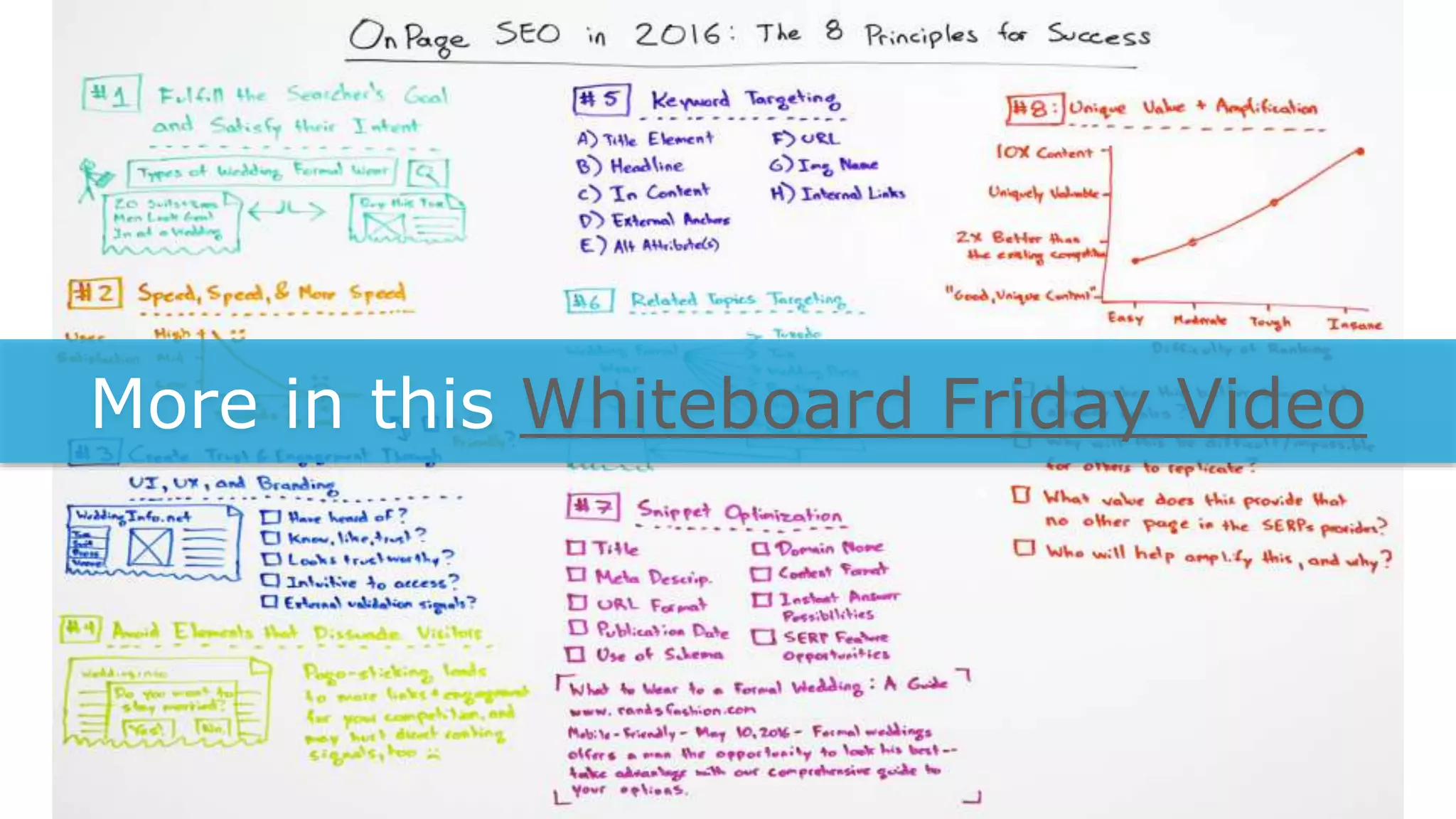
On-Page SEO in 2016 Requires
More in this Whiteboard Friday Video
Machine Learning &
Engagement Are Google’s
Future#1
RankBrain is Only the Most
Obvious of Google’s ML-
Based Ranking Elements
Via Gianluca Fiorelli on Moz
Rankbrain helps
Google know that
results like these
are relevant to
searches like this
And that all of these
queries probably share
intent and should bring
back similar kinds of
Google Uses User, Usage, & Engagement
Data to Determine How to Rank Content
I hate bullet
points, but
this slide from
Google Search
Engineer Paul
Haahr, shows
how clicks are
used to grade
performance
Via How Google Works on Slideshare
This is a good SERP –
searchers rarely bounce, rarely
short-click, and rarely need to
enter other queries or go to
page 2.
This is a bad SERP –
searchers bounce often,
click other results, rarely
long-click, and try other
queries. They’re definitely
not happy.
Someday,Algorithms Built by Machines Will Outperform
those Hand-Selected by Engineers
Potential Ranking
Factors
(e.g. PageRank, TF*IDF,
Topic Modeling, QDF, Clicks,
Entity Association, etc.)
Training Data
(i.e. good search results)
Learning
Process
Best Fit
Algo
Google Leverages Machine Learning Despite Not
Knowing for Sure What It Uses:
Via SERoundtable
We may soon
hear that
algorithmic
elements are no
longer applied
universally.
Rather than one
algorithm, we get
thousands or
millions of them.
Google’s PublicAbout
Their Commitment to ML
Techniques… Won’t Be
Long Now.
Via BackChannel
How Marketers
Can React…
Focus on Signal:Noise Ratio – Don’t Let Bad Pages
Drag Down a Good Site
Quantity of Pages
Earning SERP Visits
Relative Time on Site,
Bounce Rate, Pgs/Visit,
Searcher Satisfaction
Site’s Search
Engagement
Reputation
=
These don’t look so good;
probably worth investigating.
Find Ways to Beat Your Competition’s &
YourAverage Ranking Position’s CTR
If you rank #3, but have a higher-
than-average CTR for that
position, you might get moved up.
Via Philip Petrescu on Moz
Serve Multiple Searcher Intents,
Not Just Your Own Interests
You can’t just try to sell sous
vide cooking devices to the
<1% of searchers who are
ready to buy after performing
this query.
To compete long term,
you’ll need to empathize
with and serve ALL of these
intents with your ranking
Note that NONE of these SERPs
are trying to sell equipment
directly. They’re serving the
*intent* of the widest range of
searchers.
Speed, speed, and more speed
Delivers an easy, enjoyable experience on every device
Compels visitors to engage, share, & return
Avoids features that dissuade or annoy visitors
Authoritative, comprehensive content that’s uniquely
valuable vs. what anyone else in your space provides
Make UX a Cornerstone of Your SEO:
Invest in Content 10X Better Than Your What Your
Competition Can Create
See this list of
10X Content
for examples
and resources
on how to
create it
Rand Fishkin, Wizard of Moz | @randfish | rand@moz.com
Bit.ly/7bigseo

The 7 Biggest Trends in SEO: 2016

  • 1.
    Rand Fishkin, Wizardof Moz | @randfish | rand@moz.com 2016’s Seven Biggest SEO Trends And How Marketers Should React
  • 2.
  • 3.
    Google’s Still Growing,But Others Are, Too#7
  • 4.
  • 5.
    Via GS.Statcounter Don’t believeComscore’s 65% Google share. Google’s 85%+ of the North American search market.
  • 6.
  • 7.
    via Reuters Institute USDaily Video Views (Note: Facebook counts views @ 3s, YouTube @ 30 s)
  • 8.
    Via Cohlab YouTube isthe World’s 2nd Largest Search Engine
  • 9.
    Via DuckDuckGo And DuckDuckGoContinues its Rapid Growth
  • 10.
    Via Search EngineLand Amazon vs. Web Search
  • 11.
  • 12.
    Don’t Ignore SearchChannels Just Because They’re Not Google
  • 13.
    See Where YourCompetition Gets Their Traffic: Via SimilarWeb Pro These are the sites that sent traffic to WarbyParker.com in March, 2016
  • 14.
    Apply different tactics toreach audiences on different sites Amazon’s ranking factors can be found here. Conversion rate plays a big role.
  • 15.
    Consider Content forMultiple Engines Moz first puts videos up on our site, then later uploads to YouTube to benefit from both classic SEO and video
  • 16.
    Google’s Still the 800lbGorilla More on how Google ranks pages & sites here.
  • 17.
    Google Now Worksto Answer Simple Queries Directly Rather than Make Users Click #6
  • 19.
    Google’s minimized the desktopsearch experience to make it more closely align with the mobile experience.
  • 20.
    And they’re putting moreand more “answers” atop the results to remove the need to click a 3rd-party site for information
  • 21.
    We expected answers likethese would siphon away traffic from our site… In reality, we got more!
  • 22.
    But some answersreally do remove traffic (estimates of 50%+ traffic loss to web results after SERP
  • 23.
  • 24.
    Consider Click-Through-Rate When ChoosingKeywords The organic results on this page probably get only ~60% of the clicks from searchers
  • 25.
    Consider Click-Through-Rate When ChoosingKeywords But, the organic results here are likely getting 100% of the clicks
  • 26.
    You can makethese estimates yourself when evaluating keywords for SEO effort:
  • 27.
    Or you canuse a tool like Keyword Explorer to get the CTR Opportunity scores 100% CTR Opportunity 60% CTR Opportunity
  • 28.
    It’s Possible toUse SEO to Get Into Featured Snippets (and earn big CTR boosts) They beat out Wikipedia by phrasing the content to match the *answer* Google wanted for this search query
  • 29.
    More on Howto Become theAnswer: Via Dr. Pete (and more Dr. Pete)
  • 30.
    Keyword Data isMore Obfuscated, Less Reliable, & Less Accessible #5
  • 31.
    The Classic Sourceof Volume Data is GoogleAdWords, and there’s a Lot of Weirdness There
  • 32.
    These numbers actually representranges, even though they show as estimated averages
  • 33.
    Russ Jones showedhow Google’s volume ranges work in his post about Keyword Planner’s Dirty Secrets.
  • 34.
    Google Trends (whichwe’ve found to be generally more accurate) tells a different story?!
  • 35.
    AdWords is NowConflating Volume of Related Keywords in Frustrating Ways Via Bill Slawski on Go Fish Digital
  • 36.
    Keyword Suggestions inAdWordsHide a Lot of Useful, High-Volume Queries Really Keyword Planner? Really?!
  • 37.
    It sure lookslike Google knows about some closely related keywords that have search volume!
  • 38.
  • 39.
    Don’t Use Google’sVolume Numbers asAbsolutes, Only as Relative Comparisons There are probably more people searching for “champagne flutes” than “toasting flutes”, but 12,100 and 1,900 almost certainly aren’t the real quantities.
  • 40.
    Google Trends isGood for Volume Comparison “Champagne flutes” is likely ~5-10X the volume of “toasting flutes”
  • 41.
    KW Explorer UsesClickstream Data and Volume Ranges that May Give GreaterAccuracy In our tests, these ranges contained the true search volume 95% of the time.
  • 42.
    Want the BestDataAbout Volume, Conversions, and Trends? You’ll need to buy the keywords and measure directly in AdWords.
  • 43.
    Don’t Rely Exclusivelyon KW Planner for Keyword Suggestions/Ideas Search Suggest and Related Searches are smart additions (and totally free)
  • 44.
    7 Kinds ofKW Research Expansions to Try: 1) Search Suggest 2) People Also Search For… 3) Similar Pages Rank For… 4) Semantically Connected Terms 5) Topically-Related Searches 6) Questions Containing these KWs 7) AdWords (Commercial)
  • 45.
    Tools that HaveThese Discovery Options: 1 ) 2 ) 3 ) 4 ) 5 ) 6 ) (Free & Paid) SEMRush (Free & Paid) KeywordTool.io 7 ) (Paid) SimilarWeb (Free & Paid) Moz KW Explorer (Free) Ubersuggest (Free) Answer The Public
  • 46.
    Twitter Has Replaced Google+as Google’s Primary Social Result #4
  • 47.
    Only a fewelements of Google+ remain for logged-in searchers
  • 48.
    Twitter (like JustinTrudeau) Has Taken Over
  • 49.
    Twitter dominates many real-timeresults in Google Mobile as well (often even more so than in desktop)
  • 50.
    According to Mozcast,Twitter shows up in ~6.5% of Google searches, up from 5.9% in April 2016.
  • 51.
  • 52.
    PayAttention to HowTwitter Influences the SERPs You CareAbout Hashtags
  • 53.
    PayAttention to HowTwitter Influences the SERPs You CareAbout Brand Names
  • 54.
    PayAttention to HowTwitter Influences the SERPs You CareAbout News Events
  • 55.
    Engagement and RecencyGovern Google’s Display of Tweets, So Use Them! Personalized Trends Localized Trends via Trendsmap
  • 56.
    Bio Search CanHelp ID the Influencers in a Given Niche or Topic Data Via Followerwonk (LittleBird is also a great tool for this)
  • 57.
    But, if YouHave a G+ Following ofAny Kind, Keep Sharing There (it only takes a minute, and still provides some benefits)
  • 58.
    If You Haven’tAlreadyInvested in Google+, It’s Probably Not Worthwhile to Start Now Via Stone Temple
  • 59.
    ThereAre More Non- TraditionalWays to Get Into Google’s Results Than Ever Before #3
  • 60.
    18 Unique Typesof SERPs that Show Up in 0.5%+ of Google’s Results One of my favorites: the “disaster type”
  • 61.
    In our data,only ~3% of results are the “classic ten blue links” kind
  • 62.
  • 63.
    These types of resultscan dramatically reduce organic CTR (in this case, Moz estimates only ~24% organic CTR)
  • 64.
    Infuriatingly, Google’s restricted whocan appear in certain types of listings (e.g. video is now YouTube or Vimeo
  • 65.
    And on mobile,even more kinds of searches are limited to particular networks (Google Play & iPhone App Store).
  • 66.
  • 67.
    Analyze Which Typesof SERPsAppear Most in the Keywords You CareAbout These show me how many of each SERP type appears in the results for this keyword list (via
  • 68.
    Then Determine WhatVerticals & SERPTypes You Need to Optimize For It might pay to generate some visual charts in addition to a text-only version…
  • 69.
    If certain searchesare impossible to target…
  • 70.
    Aim to InfluenceSearch Suggest More on Whiteboard Friday
  • 71.
    Be On theRight Platform For Your SERPs: Videos: E-Commerce: Podcasts: Local Businesses: News: Apps: YouTube Vimeo Facebook G Shopping Amazon eBay Etsy G Play iTunes G Maps SoundcloudLibsyn Apple Maps Bing Maps G News iTunes G
  • 72.
    Matching Searcher Intent> Matching Searcher Keywords #2
  • 73.
    Google’s Become Masterfulat Understanding a Searcher’s Intent
  • 76.
    Keyword Matching isNo Longer a Competitive Advantage Via Backlinko
  • 77.
    On-Page SEO isNo Longer Satisfied by Raw Keyword Use Either These keywords are nearly as important to use on a page targeting the query as the query keywords themselves
  • 78.
  • 79.
    It’s Still Wiseto Use Keywords
  • 80.
    Matching Your Contentto What SearchersAre Seeking is Critical, Too Trulia knows searchers want home prices, by neighborhood, with trend data, zipcode filters, and a zoomable map.
  • 81.
    Use of relatedtopics to indicate the content’s relevance Serving KWs w/ matching intent together on one page Thorough answers/solutions to the searcher’s query Unique value over what other sites in the SERPs Intelligent keyword use in page title, meta description, URL, and top few paragraphs (just as before) On-Page SEO in 2016 Requires
  • 82.
    More in thisWhiteboard Friday Video
  • 83.
    Machine Learning & EngagementAre Google’s Future#1
  • 84.
    RankBrain is Onlythe Most Obvious of Google’s ML- Based Ranking Elements Via Gianluca Fiorelli on Moz
  • 85.
    Rankbrain helps Google knowthat results like these are relevant to searches like this
  • 86.
    And that allof these queries probably share intent and should bring back similar kinds of
  • 87.
    Google Uses User,Usage, & Engagement Data to Determine How to Rank Content I hate bullet points, but this slide from Google Search Engineer Paul Haahr, shows how clicks are used to grade performance Via How Google Works on Slideshare
  • 88.
    This is agood SERP – searchers rarely bounce, rarely short-click, and rarely need to enter other queries or go to page 2.
  • 89.
    This is abad SERP – searchers bounce often, click other results, rarely long-click, and try other queries. They’re definitely not happy.
  • 90.
    Someday,Algorithms Built byMachines Will Outperform those Hand-Selected by Engineers Potential Ranking Factors (e.g. PageRank, TF*IDF, Topic Modeling, QDF, Clicks, Entity Association, etc.) Training Data (i.e. good search results) Learning Process Best Fit Algo
  • 91.
    Google Leverages MachineLearning Despite Not Knowing for Sure What It Uses: Via SERoundtable
  • 92.
    We may soon hearthat algorithmic elements are no longer applied universally. Rather than one algorithm, we get thousands or millions of them.
  • 93.
    Google’s PublicAbout Their Commitmentto ML Techniques… Won’t Be Long Now. Via BackChannel
  • 94.
  • 95.
    Focus on Signal:NoiseRatio – Don’t Let Bad Pages Drag Down a Good Site Quantity of Pages Earning SERP Visits Relative Time on Site, Bounce Rate, Pgs/Visit, Searcher Satisfaction Site’s Search Engagement Reputation =
  • 96.
    These don’t lookso good; probably worth investigating.
  • 97.
    Find Ways toBeat Your Competition’s & YourAverage Ranking Position’s CTR If you rank #3, but have a higher- than-average CTR for that position, you might get moved up. Via Philip Petrescu on Moz
  • 98.
    Serve Multiple SearcherIntents, Not Just Your Own Interests You can’t just try to sell sous vide cooking devices to the <1% of searchers who are ready to buy after performing this query. To compete long term, you’ll need to empathize with and serve ALL of these intents with your ranking
  • 99.
    Note that NONEof these SERPs are trying to sell equipment directly. They’re serving the *intent* of the widest range of searchers.
  • 100.
    Speed, speed, andmore speed Delivers an easy, enjoyable experience on every device Compels visitors to engage, share, & return Avoids features that dissuade or annoy visitors Authoritative, comprehensive content that’s uniquely valuable vs. what anyone else in your space provides Make UX a Cornerstone of Your SEO:
  • 101.
    Invest in Content10X Better Than Your What Your Competition Can Create See this list of 10X Content for examples and resources on how to create it
  • 102.
    Rand Fishkin, Wizardof Moz | @randfish | rand@moz.com Bit.ly/7bigseo