NATIONAL	
  COUNCIL	
  ON	
  INTERPRETING	
  IN	
  HEALTH	
  CARE	
  
WWW.NCIHC.ORG	
  
Thanks	
  for	
  Making	
  
That	
  Mistake!	
  	
  
Using	
  Errors	
  as	
  an	
  Interpreter	
  
Teaching	
  Tool	
  
www.ncihc.org/home-­‐for-­‐trainers	
  
Home	
  for	
  Trainers	
  	
  Interpreter	
  Trainers	
  Webinars	
  Work	
  Group	
  
An	
  ini<a<ve	
  of	
  the	
  Standards	
  and	
  Training	
  CommiAee	
  
Guest	
  Trainer:	
  	
  
Juan	
  Gu<érrez	
  Sanín,	
  M.D.,	
  MPH	


   April	
  9,	
  2015	
  	
  
NATIONAL	
  COUNCIL	
  ON	
  INTERPRETING	
  IN	
  HEALTH	
  CARE	


You	
  can	
  access	
  the	
  recording	
  of	
  the	
  
live	
  webinar	
  presenta<on	
  at	
  	
  
www.ncihc.org/trainerswebinars	


Home	
  for	
  Trainers	
  	
  Interpreter	
  Trainers	
  Webinars	
  Work	
  Group	
  
An	
  ini<a<ve	
  of	
  the	
  Standards	
  and	
  Training	
  CommiAee	
  
www.ncihc.org/home-­‐for-­‐trainers	
  
NATIONAL	
  COUNCIL	
  ON	
  INTERPRETING	
  IN	
  HEALTH	
  CARE	
  
Housekeeping	
  
-­‐ 	
  This	
  session	
  is	
  being	
  recorded	
  
-­‐ 	
  Cer<ficate	
  of	
  AAendance	


  *must	
  aAend	
  full	
  90	
  minutes	


  *trainerswebinars@ncihc.org	
  
-­‐ 	
  Audio	
  and	
  technical	
  problems	


-­‐ 	
  Ques<ons	
  to	
  organizers	
  	
  
-­‐ 	
  Q	
  &	
  A	
  
-­‐ 	
  TwiAer	
  #NCIHCWebinar	


Home	
  for	
  Trainers	
  	
  Interpreter	
  Trainers	
  Webinars	
  Workgroup	
  
An	
  ini<a<ve	
  of	
  the	
  Standards	
  and	
  Training	
  CommiAee	
  
www.ncihc.org/home-­‐for-­‐trainers	
  
NATIONAL	
  COUNCIL	
  ON	
  INTERPRETING	
  IN	
  HEALTH	
  CARE	
  
Welcome!	
  
	
   Guest	
  Trainer:	
  
Juan	
  Gu<érrez	
  Sanín,	
  M.D.,	
  MPH	
  	
  
Backbone	
  
s  Bedrock of interpreter rules is accurate and
complete transmission--across types of interpreting
s  As trainers of medical interpreters, what should we
teach regarding accuracy?
s  Do we care at all about whether the original speech
is accurate, within itself?
s  Do we care if it is completely audible and clear?
s  What if the original is ambiguous?
s  How much does the interpreter need to pay attention
to whether the source content or meaning, makes
sense?
Backbone	
  
s  How do we make the interpreter student
accountable for what s/he actually says?
s  That they must relay the truth from the other party?
s  How do we teach interpreters to be accurate?
s  What kinds of role plays and targeted practice do
we use?
s  What kinds of rubrics should we use?
Magic	
  Wand	
  1	
  -­‐	
  Doctor	
  Vague	
  
If we could visualize a perfect world, every interpreter
would first do a COMPLETE teach-back to the
speaker, before turning to the other party and saying
the same thing in the other language. Lack of clarity
would be exposed and corrected.
s  DOCTOR: Take this three times a day for 2 days,
then go back to normal.
s  INTERPRETER TO DOCTOR: Take this three times
a day for 2 days, then do what? What is normal?
s  DOCTOR: Take this three times a day for 2 days,
then only use it when you have a headache.
s  INTERPRETER TO PATIENT: Take this three times
a day for 2 days, then only use it when you have a
headache.
Magic	
  wand	
  2	
  
Interpreter	
  misunderstood	
  
s  Doctor: Take this 3 X today, 3X tomorrow, then
decrease by one for the rest of the week.
s  Interpreter to doctor: Take this 3X today, 3X
tomorrow, then decrease to one for the rest of the
week.
s  Doctor to interpreter: No. I will say it differently.
Take this 3X today, 3X tomorrow, 2X for the rest
of the week after that. Friday evening is the last
dose.
s  Interpreter: Take this 3X today, 3X tomorrow, 2X
for the rest of the week after that. Friday evening
is the last dose.
Intro	
  to	
  Errors	
  Topic	
  
s  For healthcare providers, it is no longer good
enough to check the box that says “language
support was provided”
s  Patient care outcomes differ widely based on
accuracy of interpretation and translation
s  Hospitals and clinics now being held
accountable for preventable errors
s  Individual interpreters can and will be held
accountable for errors
s  Trained interpreters are better at accuracy, but
what does training actually include and assure?
Training	
  around	
  Accuracy	
  
and	
  Completeness	
  
s  It’s not enough to exhort
interpreters and translators to be
accurate and complete.
s  This is liking telling pilots that they
must not crash the plane.
s  Use evidence from research to:
s  Indicate where interpreters make the
most mistakes
s  Indicate where interpreters make the
most dangerous mistakes for
outcomes
Train	
  to	
  Avoid	
  Mistakes	
  
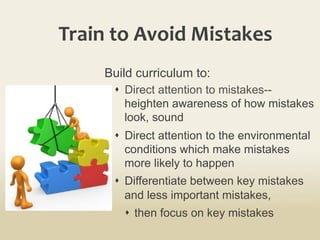
Build curriculum to:
s  Direct attention to mistakes--
heighten awareness of how mistakes
look, sound
s  Direct attention to the environmental
conditions which make mistakes
more likely to happen
s  Differentiate between key mistakes
and less important mistakes,
s  then focus on key mistakes
Train	
  to	
  Avoid	
  Mistakes	
  
Have students practice error
recognition and recovery,
rather than focusing on speed
and cover-up
s  Promulgate techniques like
interpreter teach-back, which
prevent errors from happening
s  Help each student self-assess
constantly on gaps in
knowledge and skill for
ongoing mastery work
Desired	
  Outcomes	
  
1.  Minimizing Diagnostic Errors
Adverse events affecting limited English proficient
patients are more likely to cause serious harm or
death (Divi, Koss et al, 2007)
2.  Minimizing medication errors
50% of patients have at least 1 medication
discrepancy at the time of admission. Over 1/3 of
those discrepancies cause moderate to severe
harm (AHRQ, 2013)
3.  Maximizing self-monitoring and self-correcting
abilities
Key	
  Areas	
  in	
  Error	
  Awareness	
  
s  Intelligibility (Diction, Pronunciation)
s  Volume
s  Fidelity to the Message
s  Illocutionary force (intent)
s  Paralinguistic Elements (speakers’ and own)
s  Additions
Poll	
  
s  How often do you use interpreting
errors for training your students?
s  Never
s  Occasionally
s  Frequently
s  Always
Errors	
  in	
  Interpretation	
  
These underlying causes:
1.  Inadequate Language Proficiency
2.  Inadequate Knowledge of science or health process
3.  Inadequate Literacy
4.  Inadequate Numeracy
Lack of training in human interaction elements lead to
these resulting inaccurate and incomplete interpretations
1.  Literal Translation/ Interpretation
2.  Inadequate Register Conservation
3.  Distortions
4.  Omissions
5.  Additions
6.  Non Conservation of Paralinguistic Elements
Inadequate	
  Language	
  Proficiency	
  
s  The trainer of interpreters must assess for
proficiency, across all areas necessary for
healthcare interpreting
s  The student must make a plan to clearly
target gaps in proficiency
Literal	
  Translations	
  
•  The interpreter focuses on the words rather than the
meaning of the message.
•  Examples:
•  Culture (literal Cultura) = Cultivo
•  Discharge (literal Descarga) = Alta
•  Actually (literal Actualmente) = Realmente
•  Sane (Literal Sano) = Cuerdo
•  Often times confusion is caused by presence of false
cognates.
Literal	
  Translations	
  
Sources for training materials:
•  Gonzalez, R et al. “Fundamentals of Court
Interpretation: Theory, Policy and Practice”. Durham,
NC: Carolina Academic Press
•  Spanish Dict.com: “False Cognates”,
http://www.spanishdict.com/topics/show/111
•  A. Giles, “Interpreter Training Resources”:
http://interpreters.free.fr/simultaneous/
simexercises.htm#reformulation
Errors	
  in	
  Interpretation	
  
3. Register Conservation:
Refers to the lack of ability to preserve the level
of complexity of formal or technical speech.
Also includes the meaning of common
expressions or idioms. 	
  
Errors	
  in	
  Interpretation	
  
4. Distortions:
Deficient language skills, memory skills or
interpreting skills
5. Omissions:
Information is deleted or left out
6. Additions:
Information is inappropriately added
Errors	
  in	
  Interpretation	
  
7. Protocol, Procedure and Ethics:
Issues like confidentiality, impartiality and
professional behavior have a dramatic impact on
the quality of interpretation.
8. Non Conservation of Paralinguistic Elements,
Hedges and Fillers:
Interpreters are supposed to convey repetitions,
ums, uhs, ahs, and sighs as part of the messages
as well as reflect the general tone and nonverbal
expressions. These are part of the meaning of the
message.
	
  
Location	
  of	
  Errors	
  in	
  Interpretation	


s  Where is the error located within the interpreting
process?
s  3 Phases:
s  Comprehension
s  Transfer
s  Reformulation
s  Location often determines the seriousness of
the error.
Location	
  of	
  Errors	
  in	
  Interpretation	
  
s  Comprehension:
s  Errors in this phase tend to be more serious,
as they prevent the the interpreter from
understanding. They indicate lack of linguistic
proficiency in the source language
s  Transfer:
s  Errors in transfer indicate that the interpreter
understood but was unable to appropriately
transfer the message. They may indicate a
weakness in this skill, lack of adequate
proficiency in the target language, or lack of
concentration (fatigue)
Location	
  of	
  Errors	
  in	
  Interpretation	


   s Reformulation:
s  Errors in this phase tend to be less serious
s  The interpreter understood and transferred
the message, but made mistakes in
pronunciation, syntax or something else that
is not likely to affect the content of the
message
Poll	
  
Before this webinar, how familiar
were you with interpretation errors?
s  Not at all familiar
s  Somewhat familiar
s  Familiar
s  Very familiar
Research	
  on	
  Errors	
  
s  Some types of errors are more likely to
have clinical consequences for patients
(Flores et al 2003, 2006, 2012)
s  Study found a median of 33 errors per
encounter within a range of 2 to 246
s  Errors considered were:
s  Omissions, additions, substitutions,
editorializations, and false fluency
(inadequate proficiency)
Research	
  on	
  Errors	
  
s  Ad-hoc interpreters and insufficiently bilingual
providers make more omissions and false
fluency errors (Comprehension)
s  Interpreters with 100 hours or more of training
made significantly less mistakes (-20)
s  Less of these errors are false-fluency,
substitutions or editorializations
s  Less of the errors (2% v 12%) made by
interpreters with 100 or more hours of training
have clinical consequences	
  
Avoiding	
  and	
  Correcting	
  Errors	
  
s  Self-Monitoring and Correcting:
s  Monitor yourself for:
s  Intelligibility in the target language, paying
particular attention to
s  Diction
s  Pronunciation
s  Enunciation
s  Volume
Avoiding	
  and	
  Correcting	
  Errors	
  
s  Message Accuracy
s  Illocutionary force
(intent)
s  Fillers and repetitions
(both the speakers’ and your own)
s  Additions
(comments on your own interpretation)
Avoiding	
  and	
  Correcting	
  Errors	
  
s  Repair:
s  This means providing a corrected interpretation
immediately after detecting an error
s  Self-correction relies heavily on memory
s  You must accurately remember the source
message
Avoiding	
  and	
  Correcting	
  Errors	
  
s  Being keenly aware of the factors listed
previously will improve your ability monitor
the quality of your production in real time,
and enable you to correct errors when they
happen
Poll	
  
After this webinar, how likely is it for
you to add a session on interpretation
errors to your curriculum?
s  Not likely at all
s  Somewhat likely
s  Likely
s  Very likely
THANK	
  YOU	
  
s  Stay	
  in	
  	
  touch!	
  
s  Check	
  out	
  our	
  website:	
  www.nicnc.org	
  
s  Call	
  us	
  at:	
  (302)	
  404.0140	
  
s  Email	
  us	
  with	
  your	
  questions	
  or	
  comments	
  :	
  
info@nichc.org	
  
NATIONAL	
  COUNCIL	
  ON	
  INTERPRETING	
  IN	
  HEALTH	
  CARE	


•  Upcoming	
  webinar:	
  June	
  25,	
  
2015	
  at	
  11:00	
  AM	
  Central	
  
•  Session	
  Evalua<on	
  
•  Follow	
  up	
  via	
  email:	
  
TrainersWebinars@ncihc.org	
  
	
   Home	
  for	
  Trainers	
  	
  Interpreter	
  Trainers	
  Webinars	
  Work	
  Group	
  
An	
  ini<a<ve	
  of	
  the	
  Standards	
  and	
  Training	
  CommiAee	
  
www.ncihc.org/home-­‐for-­‐trainers	
  
Announcements	
  
NATIONAL	
  COUNCIL	
  ON	
  INTERPRETING	
  IN	
  HEALTH	
  CARE	
  
WWW.NCIHC.ORG	
  www.ncihc.org/home-­‐for-­‐trainers	
  
Home	
  for	
  Trainers	
  	
  Interpreter	
  Trainers	
  Webinars	
  Work	
  Group	
  
An	
  ini<a<ve	
  of	
  the	
  Standards	
  and	
  Training	
  CommiAee	
  
Thank	
  you!	
  
July	
  24,	
  2014	
  
Thanks	
  for	
  Making	
  
That	
  Mistake!	
  	
  
Using	
  Errors	
  as	
  an	
  Interpreter	
  
Teaching	
  Tool	
  
Guest	
  Trainer:	
  	
  
Juan	
  Gu<érrez	
  Sanín,	
  M.D.,	
  MPH	


NATIONAL	
  COUNCIL	
  ON	
  INTERPRETING	
  IN	
  HEALTH	
  CARE	


You	
  can	
  access	
  the	
  recording	
  of	
  the	
  
live	
  webinar	
  presenta<on	
  at	
  	
  
www.ncihc.org/trainerswebinars	


Home	
  for	
  Trainers	
  	
  Interpreter	
  Trainers	
  Webinars	
  Work	
  Group	
  
An	
  ini<a<ve	
  of	
  the	
  Standards	
  and	
  Training	
  CommiAee	
  
www.ncihc.org/home-­‐for-­‐trainers	
  

Thanks for Making That Mistake! Using Errors as an Interpreter Teaching Tool

  • 1.
    NATIONAL  COUNCIL  ON  INTERPRETING  IN  HEALTH  CARE   WWW.NCIHC.ORG   Thanks  for  Making   That  Mistake!     Using  Errors  as  an  Interpreter   Teaching  Tool   www.ncihc.org/home-­‐for-­‐trainers   Home  for  Trainers    Interpreter  Trainers  Webinars  Work  Group   An  ini<a<ve  of  the  Standards  and  Training  CommiAee   Guest  Trainer:     Juan  Gu<érrez  Sanín,  M.D.,  MPH         April  9,  2015    
  • 2.
    NATIONAL  COUNCIL  ON  INTERPRETING  IN  HEALTH  CARE     You  can  access  the  recording  of  the   live  webinar  presenta<on  at     www.ncihc.org/trainerswebinars     Home  for  Trainers    Interpreter  Trainers  Webinars  Work  Group   An  ini<a<ve  of  the  Standards  and  Training  CommiAee   www.ncihc.org/home-­‐for-­‐trainers  
  • 3.
    NATIONAL  COUNCIL  ON  INTERPRETING  IN  HEALTH  CARE   Housekeeping   -­‐   This  session  is  being  recorded   -­‐   Cer<ficate  of  AAendance          *must  aAend  full  90  minutes          *trainerswebinars@ncihc.org   -­‐   Audio  and  technical  problems       -­‐   Ques<ons  to  organizers     -­‐   Q  &  A   -­‐   TwiAer  #NCIHCWebinar     Home  for  Trainers    Interpreter  Trainers  Webinars  Workgroup   An  ini<a<ve  of  the  Standards  and  Training  CommiAee   www.ncihc.org/home-­‐for-­‐trainers  
  • 4.
    NATIONAL  COUNCIL  ON  INTERPRETING  IN  HEALTH  CARE   Welcome!     Guest  Trainer:   Juan  Gu<érrez  Sanín,  M.D.,  MPH    
  • 6.
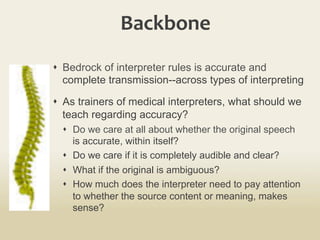
    Backbone   s  Bedrockof interpreter rules is accurate and complete transmission--across types of interpreting s  As trainers of medical interpreters, what should we teach regarding accuracy? s  Do we care at all about whether the original speech is accurate, within itself? s  Do we care if it is completely audible and clear? s  What if the original is ambiguous? s  How much does the interpreter need to pay attention to whether the source content or meaning, makes sense?
  • 7.
    Backbone   s  Howdo we make the interpreter student accountable for what s/he actually says? s  That they must relay the truth from the other party? s  How do we teach interpreters to be accurate? s  What kinds of role plays and targeted practice do we use? s  What kinds of rubrics should we use?
  • 8.
    Magic  Wand  1  -­‐  Doctor  Vague   If we could visualize a perfect world, every interpreter would first do a COMPLETE teach-back to the speaker, before turning to the other party and saying the same thing in the other language. Lack of clarity would be exposed and corrected. s  DOCTOR: Take this three times a day for 2 days, then go back to normal. s  INTERPRETER TO DOCTOR: Take this three times a day for 2 days, then do what? What is normal? s  DOCTOR: Take this three times a day for 2 days, then only use it when you have a headache. s  INTERPRETER TO PATIENT: Take this three times a day for 2 days, then only use it when you have a headache.
  • 9.
    Magic  wand  2   Interpreter  misunderstood   s  Doctor: Take this 3 X today, 3X tomorrow, then decrease by one for the rest of the week. s  Interpreter to doctor: Take this 3X today, 3X tomorrow, then decrease to one for the rest of the week. s  Doctor to interpreter: No. I will say it differently. Take this 3X today, 3X tomorrow, 2X for the rest of the week after that. Friday evening is the last dose. s  Interpreter: Take this 3X today, 3X tomorrow, 2X for the rest of the week after that. Friday evening is the last dose.
  • 10.
    Intro  to  Errors  Topic   s  For healthcare providers, it is no longer good enough to check the box that says “language support was provided” s  Patient care outcomes differ widely based on accuracy of interpretation and translation s  Hospitals and clinics now being held accountable for preventable errors s  Individual interpreters can and will be held accountable for errors s  Trained interpreters are better at accuracy, but what does training actually include and assure?
  • 11.
    Training  around  Accuracy   and  Completeness   s  It’s not enough to exhort interpreters and translators to be accurate and complete. s  This is liking telling pilots that they must not crash the plane. s  Use evidence from research to: s  Indicate where interpreters make the most mistakes s  Indicate where interpreters make the most dangerous mistakes for outcomes
  • 12.
    Train  to  Avoid  Mistakes   Build curriculum to: s  Direct attention to mistakes-- heighten awareness of how mistakes look, sound s  Direct attention to the environmental conditions which make mistakes more likely to happen s  Differentiate between key mistakes and less important mistakes, s  then focus on key mistakes
  • 13.
    Train  to  Avoid  Mistakes   Have students practice error recognition and recovery, rather than focusing on speed and cover-up s  Promulgate techniques like interpreter teach-back, which prevent errors from happening s  Help each student self-assess constantly on gaps in knowledge and skill for ongoing mastery work
  • 14.
    Desired  Outcomes   1. Minimizing Diagnostic Errors Adverse events affecting limited English proficient patients are more likely to cause serious harm or death (Divi, Koss et al, 2007) 2.  Minimizing medication errors 50% of patients have at least 1 medication discrepancy at the time of admission. Over 1/3 of those discrepancies cause moderate to severe harm (AHRQ, 2013) 3.  Maximizing self-monitoring and self-correcting abilities
  • 15.
    Key  Areas  in  Error  Awareness   s  Intelligibility (Diction, Pronunciation) s  Volume s  Fidelity to the Message s  Illocutionary force (intent) s  Paralinguistic Elements (speakers’ and own) s  Additions
  • 16.
    Poll   s  Howoften do you use interpreting errors for training your students? s  Never s  Occasionally s  Frequently s  Always
  • 17.
    Errors  in  Interpretation   These underlying causes: 1.  Inadequate Language Proficiency 2.  Inadequate Knowledge of science or health process 3.  Inadequate Literacy 4.  Inadequate Numeracy Lack of training in human interaction elements lead to these resulting inaccurate and incomplete interpretations 1.  Literal Translation/ Interpretation 2.  Inadequate Register Conservation 3.  Distortions 4.  Omissions 5.  Additions 6.  Non Conservation of Paralinguistic Elements
  • 18.
    Inadequate  Language  Proficiency   s  The trainer of interpreters must assess for proficiency, across all areas necessary for healthcare interpreting s  The student must make a plan to clearly target gaps in proficiency
  • 19.
    Literal  Translations   • The interpreter focuses on the words rather than the meaning of the message. •  Examples: •  Culture (literal Cultura) = Cultivo •  Discharge (literal Descarga) = Alta •  Actually (literal Actualmente) = Realmente •  Sane (Literal Sano) = Cuerdo •  Often times confusion is caused by presence of false cognates.
  • 20.
    Literal  Translations   Sourcesfor training materials: •  Gonzalez, R et al. “Fundamentals of Court Interpretation: Theory, Policy and Practice”. Durham, NC: Carolina Academic Press •  Spanish Dict.com: “False Cognates”, http://www.spanishdict.com/topics/show/111 •  A. Giles, “Interpreter Training Resources”: http://interpreters.free.fr/simultaneous/ simexercises.htm#reformulation
  • 21.
    Errors  in  Interpretation   3. Register Conservation: Refers to the lack of ability to preserve the level of complexity of formal or technical speech. Also includes the meaning of common expressions or idioms.  
  • 22.
    Errors  in  Interpretation   4. Distortions: Deficient language skills, memory skills or interpreting skills 5. Omissions: Information is deleted or left out 6. Additions: Information is inappropriately added
  • 23.
    Errors  in  Interpretation   7. Protocol, Procedure and Ethics: Issues like confidentiality, impartiality and professional behavior have a dramatic impact on the quality of interpretation. 8. Non Conservation of Paralinguistic Elements, Hedges and Fillers: Interpreters are supposed to convey repetitions, ums, uhs, ahs, and sighs as part of the messages as well as reflect the general tone and nonverbal expressions. These are part of the meaning of the message.  
  • 24.
    Location  of  Errors  in  Interpretation       s  Where is the error located within the interpreting process? s  3 Phases: s  Comprehension s  Transfer s  Reformulation s  Location often determines the seriousness of the error.
  • 25.
    Location  of  Errors  in  Interpretation   s  Comprehension: s  Errors in this phase tend to be more serious, as they prevent the the interpreter from understanding. They indicate lack of linguistic proficiency in the source language s  Transfer: s  Errors in transfer indicate that the interpreter understood but was unable to appropriately transfer the message. They may indicate a weakness in this skill, lack of adequate proficiency in the target language, or lack of concentration (fatigue)
  • 26.
    Location  of  Errors  in  Interpretation       s Reformulation: s  Errors in this phase tend to be less serious s  The interpreter understood and transferred the message, but made mistakes in pronunciation, syntax or something else that is not likely to affect the content of the message
  • 27.
    Poll   Before thiswebinar, how familiar were you with interpretation errors? s  Not at all familiar s  Somewhat familiar s  Familiar s  Very familiar
  • 28.
    Research  on  Errors   s  Some types of errors are more likely to have clinical consequences for patients (Flores et al 2003, 2006, 2012) s  Study found a median of 33 errors per encounter within a range of 2 to 246 s  Errors considered were: s  Omissions, additions, substitutions, editorializations, and false fluency (inadequate proficiency)
  • 29.
    Research  on  Errors   s  Ad-hoc interpreters and insufficiently bilingual providers make more omissions and false fluency errors (Comprehension) s  Interpreters with 100 hours or more of training made significantly less mistakes (-20) s  Less of these errors are false-fluency, substitutions or editorializations s  Less of the errors (2% v 12%) made by interpreters with 100 or more hours of training have clinical consequences  
  • 30.
    Avoiding  and  Correcting  Errors   s  Self-Monitoring and Correcting: s  Monitor yourself for: s  Intelligibility in the target language, paying particular attention to s  Diction s  Pronunciation s  Enunciation s  Volume
  • 31.
    Avoiding  and  Correcting  Errors   s  Message Accuracy s  Illocutionary force (intent) s  Fillers and repetitions (both the speakers’ and your own) s  Additions (comments on your own interpretation)
  • 32.
    Avoiding  and  Correcting  Errors   s  Repair: s  This means providing a corrected interpretation immediately after detecting an error s  Self-correction relies heavily on memory s  You must accurately remember the source message
  • 33.
    Avoiding  and  Correcting  Errors   s  Being keenly aware of the factors listed previously will improve your ability monitor the quality of your production in real time, and enable you to correct errors when they happen
  • 34.
    Poll   After thiswebinar, how likely is it for you to add a session on interpretation errors to your curriculum? s  Not likely at all s  Somewhat likely s  Likely s  Very likely
  • 35.
    THANK  YOU   s Stay  in    touch!   s  Check  out  our  website:  www.nicnc.org   s  Call  us  at:  (302)  404.0140   s  Email  us  with  your  questions  or  comments  :   info@nichc.org  
  • 36.
    NATIONAL  COUNCIL  ON  INTERPRETING  IN  HEALTH  CARE     •  Upcoming  webinar:  June  25,   2015  at  11:00  AM  Central   •  Session  Evalua<on   •  Follow  up  via  email:   TrainersWebinars@ncihc.org     Home  for  Trainers    Interpreter  Trainers  Webinars  Work  Group   An  ini<a<ve  of  the  Standards  and  Training  CommiAee   www.ncihc.org/home-­‐for-­‐trainers   Announcements  
  • 37.
    NATIONAL  COUNCIL  ON  INTERPRETING  IN  HEALTH  CARE   WWW.NCIHC.ORG  www.ncihc.org/home-­‐for-­‐trainers   Home  for  Trainers    Interpreter  Trainers  Webinars  Work  Group   An  ini<a<ve  of  the  Standards  and  Training  CommiAee   Thank  you!   July  24,  2014   Thanks  for  Making   That  Mistake!     Using  Errors  as  an  Interpreter   Teaching  Tool   Guest  Trainer:     Juan  Gu<érrez  Sanín,  M.D.,  MPH        
  • 38.
    NATIONAL  COUNCIL  ON  INTERPRETING  IN  HEALTH  CARE     You  can  access  the  recording  of  the   live  webinar  presenta<on  at     www.ncihc.org/trainerswebinars     Home  for  Trainers    Interpreter  Trainers  Webinars  Work  Group   An  ini<a<ve  of  the  Standards  and  Training  CommiAee   www.ncihc.org/home-­‐for-­‐trainers