NATIONAL	
  COUNCIL	
  ON	
  INTERPRETING	
  IN	
  HEALTH	
  CARE	
  
WWW.NCIHC.ORG	
  Thank	
  you	
  for	
  a,ending!	
  
NATIONAL	
  COUNCIL	
  ON	
  INTERPRETING	
  IN	
  HEALTH	
  CARE	


You	
  can	
  access	
  the	
  recording	
  of	
  the	
  
live	
  webinar	
  presenta;on	
  at	
  	
  
www.ncihc.org/trainerswebinars	


Home	
  for	
  Trainers	
  	
  Interpreter	
  Trainers	
  Webinars	
  Work	
  Group	
  
An	
  ini;a;ve	
  of	
  the	
  Standards	
  and	
  Training	
  Commi,ee	
  
www.ncihc.org/home-­‐for-­‐trainers	
  
NATIONAL	
  COUNCIL	
  ON	
  INTERPRETING	
  IN	
  HEALTH	
  CARE	
  
WWW.NCIHC.ORG	
  
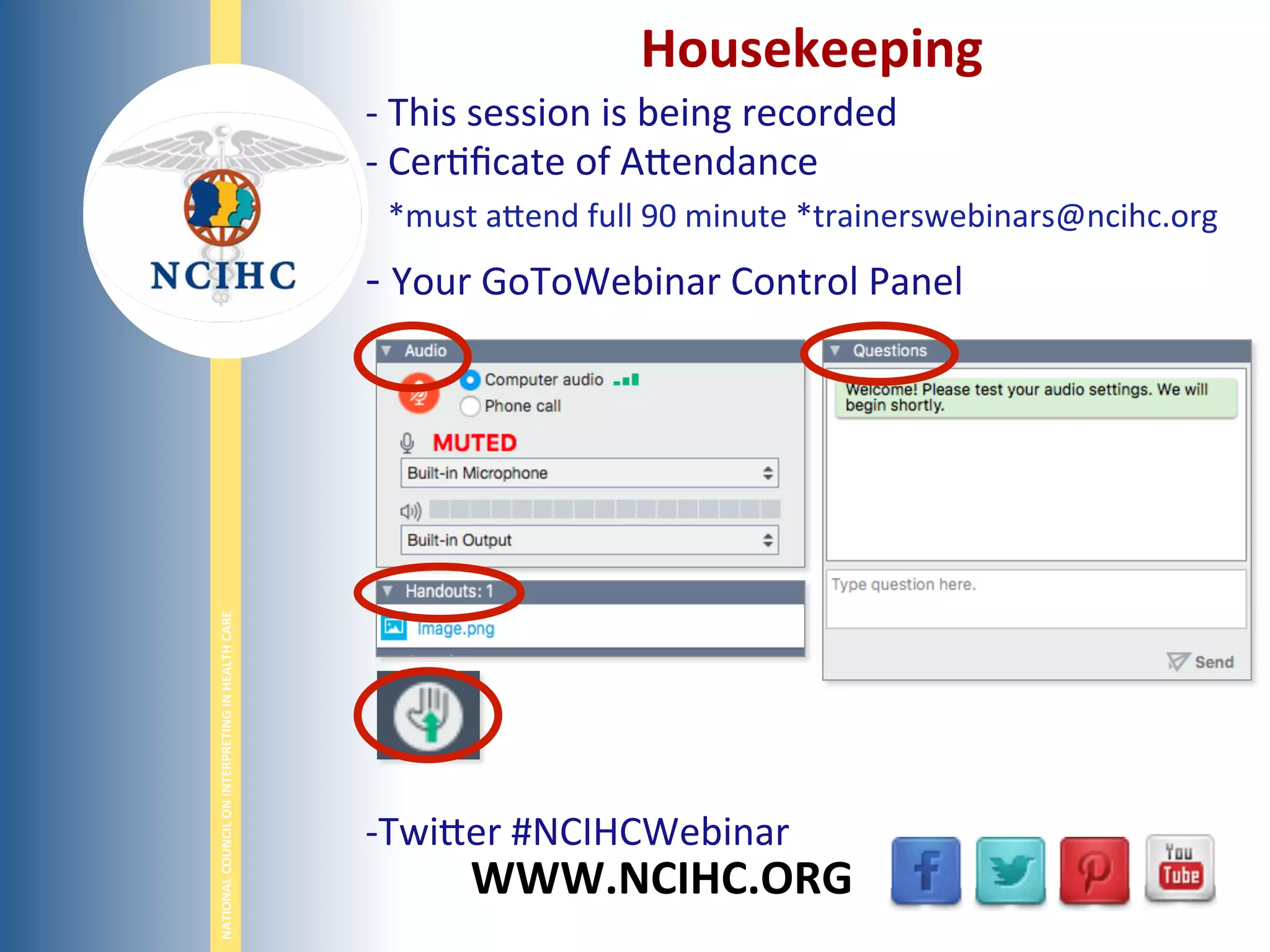
Housekeeping	
  
-­‐ 	
  This	
  session	
  is	
  being	
  recorded	
  
-­‐ 	
  Cer;ficate	
  of	
  A,endance	


  *must	
  a,end	
  full	
  90	
  minute	
  *trainerswebinars@ncihc.org	
  
-­‐ 	
  Your	
  GoToWebinar	
  Control	
  Panel	


-­‐ Twi,er	
  #NCIHCWebinar	


NATIONAL	
  COUNCIL	
  ON	
  INTERPRETING	
  IN	
  HEALTH	
  CARE	
  
WWW.NCIHC.ORG	
  Thank	
  you	
  for	
  a,ending!	
  
Sponsored	
  by	


www.Cer;fiedLanguages.com	
  
NATIONAL	
  COUNCIL	
  ON	
  INTERPRETING	
  IN	
  HEALTH	
  CARE	
  
WWW.NCIHC.ORG	


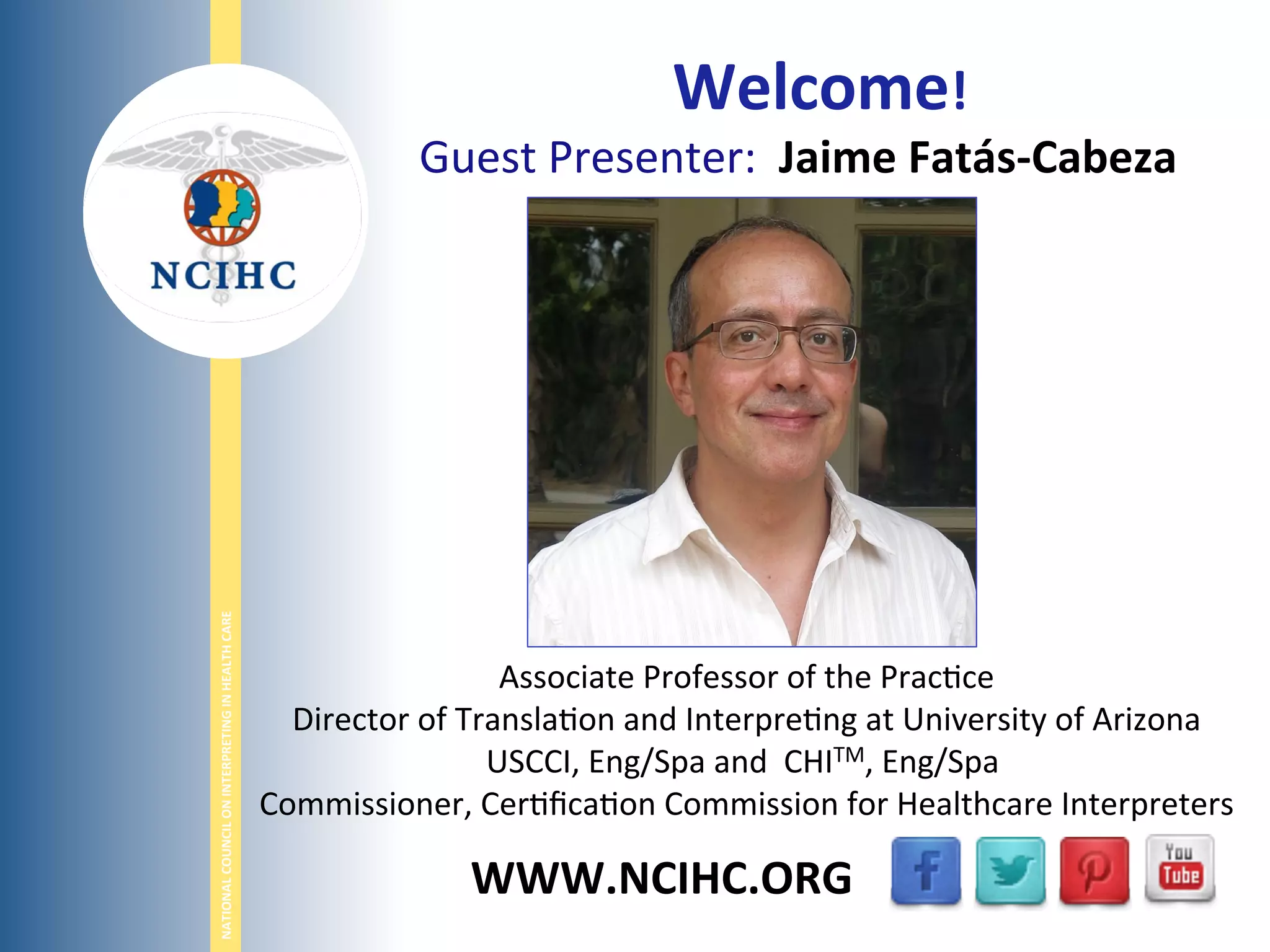
  Welcome!	
  	
  
Guest	
  Presenter:	
  	
  Jaime	
  Fatás-­‐Cabeza	


Associate	
  Professor	
  of	
  the	
  Prac;ce	
  
Director	
  of	
  Transla;on	
  and	
  Interpre;ng	
  at	
  University	
  of	
  Arizona	
  
USCCI,	
  Eng/Spa	
  and	
  	
  CHITM,	
  Eng/Spa	
  	
  
Commissioner,	
  Cer;fica;on	
  Commission	
  for	
  Healthcare	
  Interpreters	
  
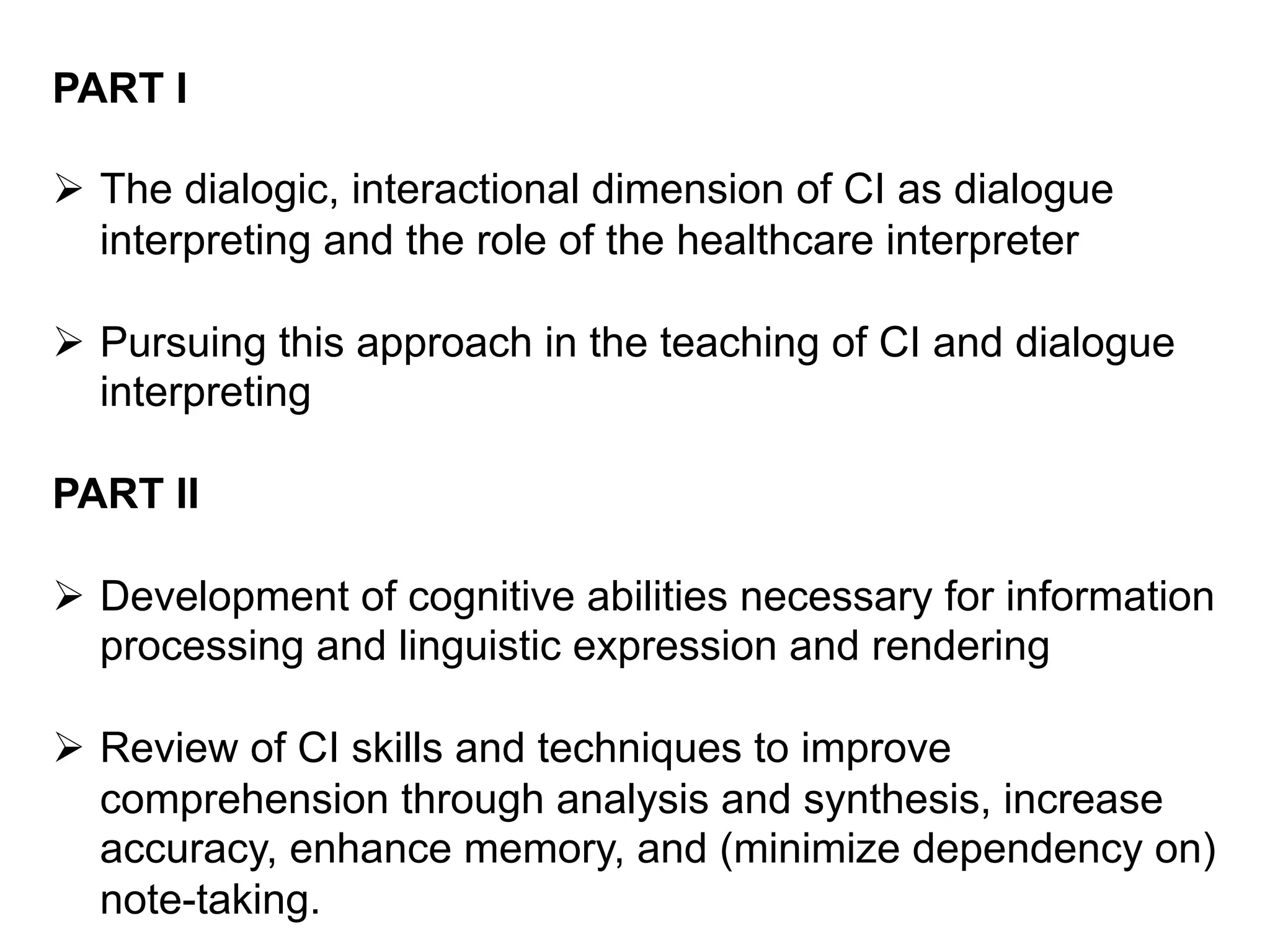
PART I
Ø  The dialogic, interactional dimension of CI as dialogue
interpreting and the role of the healthcare interpreter
Ø  Pursuing this approach in the teaching of CI and dialogue
interpreting
PART II
Ø  Development of cognitive abilities necessary for information
processing and linguistic expression and rendering
Ø  Review of CI skills and techniques to improve
comprehension through analysis and synthesis, increase
accuracy, enhance memory, and (minimize dependency on)
note-taking.
 
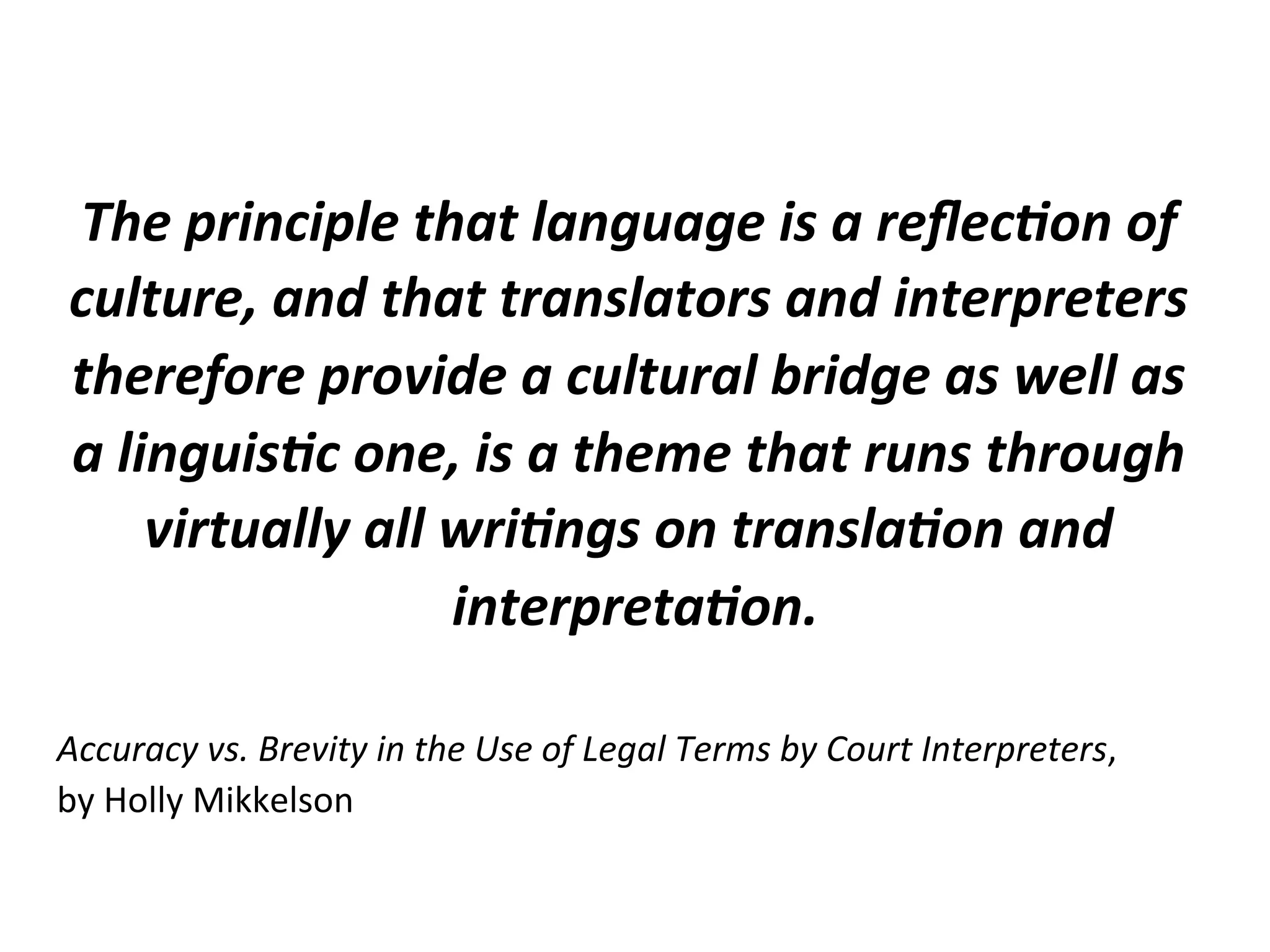
The	
  principle	
  that	
  language	
  is	
  a	
  reflec1on	
  of	
  
culture,	
  and	
  that	
  translators	
  and	
  interpreters	
  
therefore	
  provide	
  a	
  cultural	
  bridge	
  as	
  well	
  as	
  
a	
  linguis1c	
  one,	
  is	
  a	
  theme	
  that	
  runs	
  through	
  
virtually	
  all	
  wri1ngs	
  on	
  transla1on	
  and	
  
interpreta1on.	


Accuracy	
  vs.	
  Brevity	
  in	
  the	
  Use	
  of	
  Legal	
  Terms	
  by	
  Court	
  Interpreters,	
  	
  
by	
  Holly	
  Mikkelson	
  
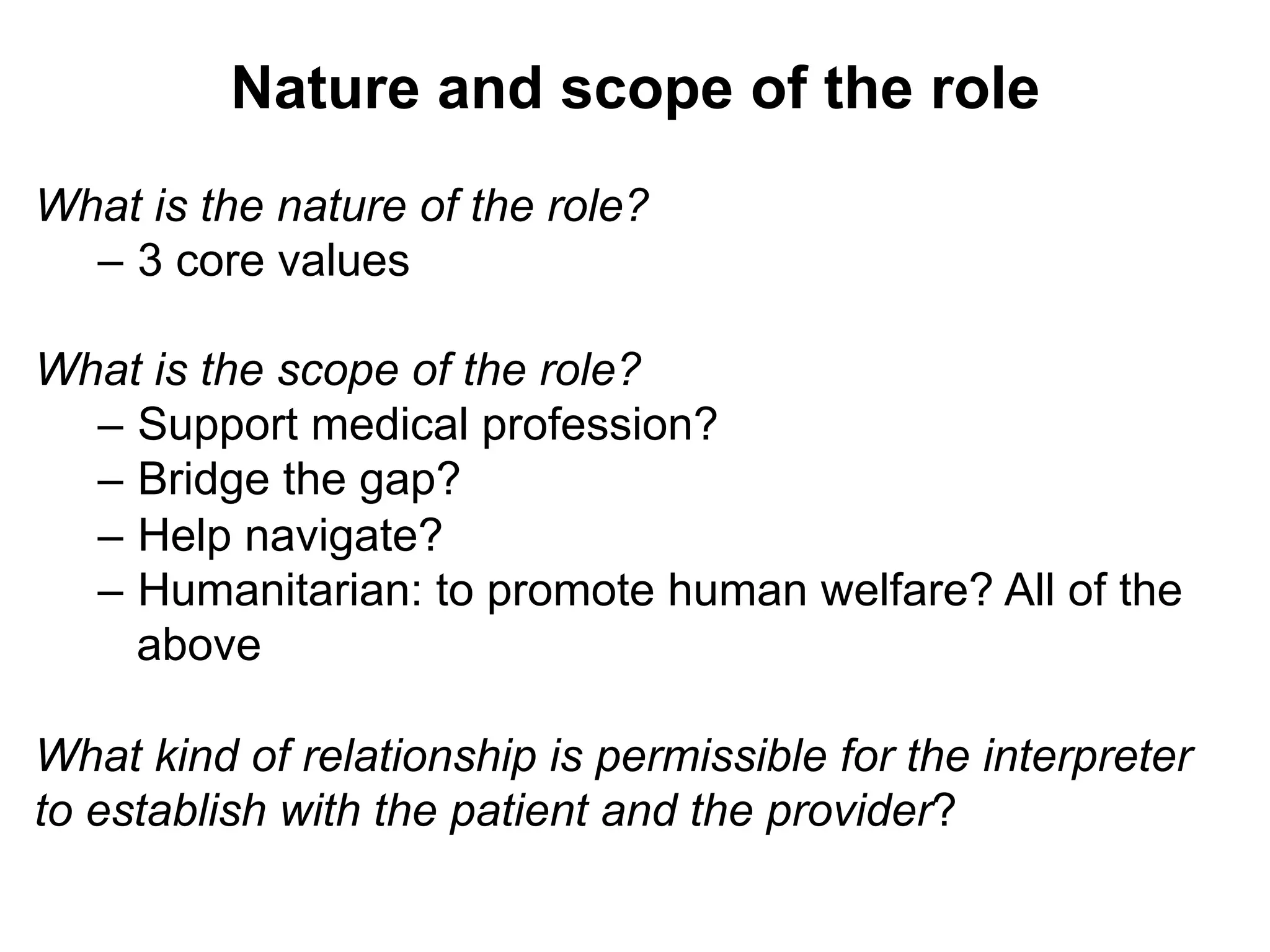
Nature and scope of the role
What is the nature of the role?
–  3 core values
What is the scope of the role?
–  Support medical profession?
–  Bridge the gap?
–  Help navigate?
–  Humanitarian: to promote human welfare? All of the
above
What kind of relationship is permissible for the interpreter
to establish with the patient and the provider?
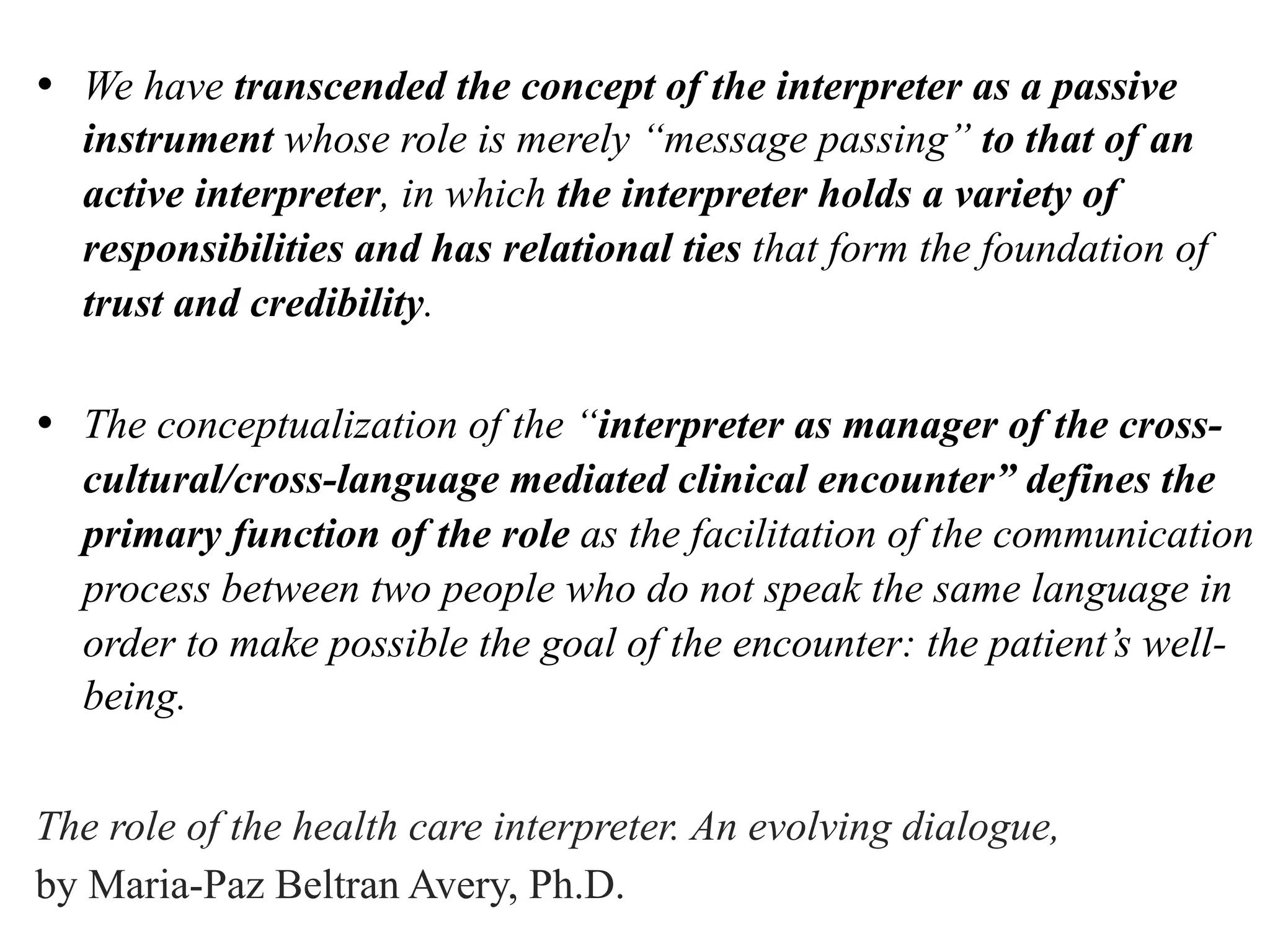
•  We have transcended the concept of the interpreter as a passive
instrument whose role is merely “message passing” to that of an
active interpreter, in which the interpreter holds a variety of
responsibilities and has relational ties that form the foundation of
trust and credibility.
•  The conceptualization of the “interpreter as manager of the cross-
cultural/cross-language mediated clinical encounter” defines the
primary function of the role as the facilitation of the communication
process between two people who do not speak the same language in
order to make possible the goal of the encounter: the patient’s well-
being.
The role of the health care interpreter. An evolving dialogue,
by Maria-Paz Beltran Avery, Ph.D.
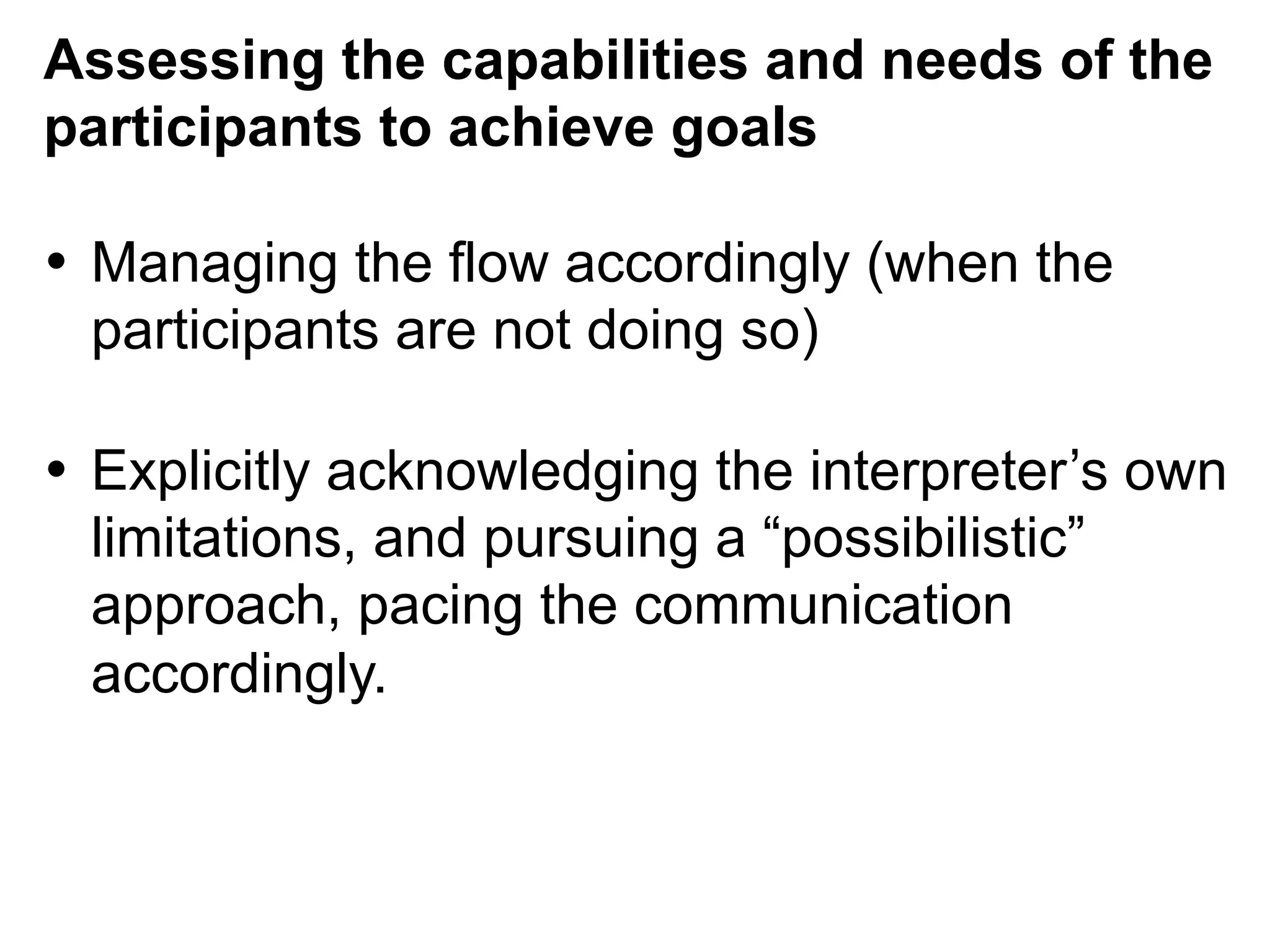
Assessing the capabilities and needs of the
participants to achieve goals
•  Managing the flow accordingly (when the
participants are not doing so)
•  Explicitly acknowledging the interpreter’s own
limitations, and pursuing a “possibilistic”
approach, pacing the communication
accordingly.
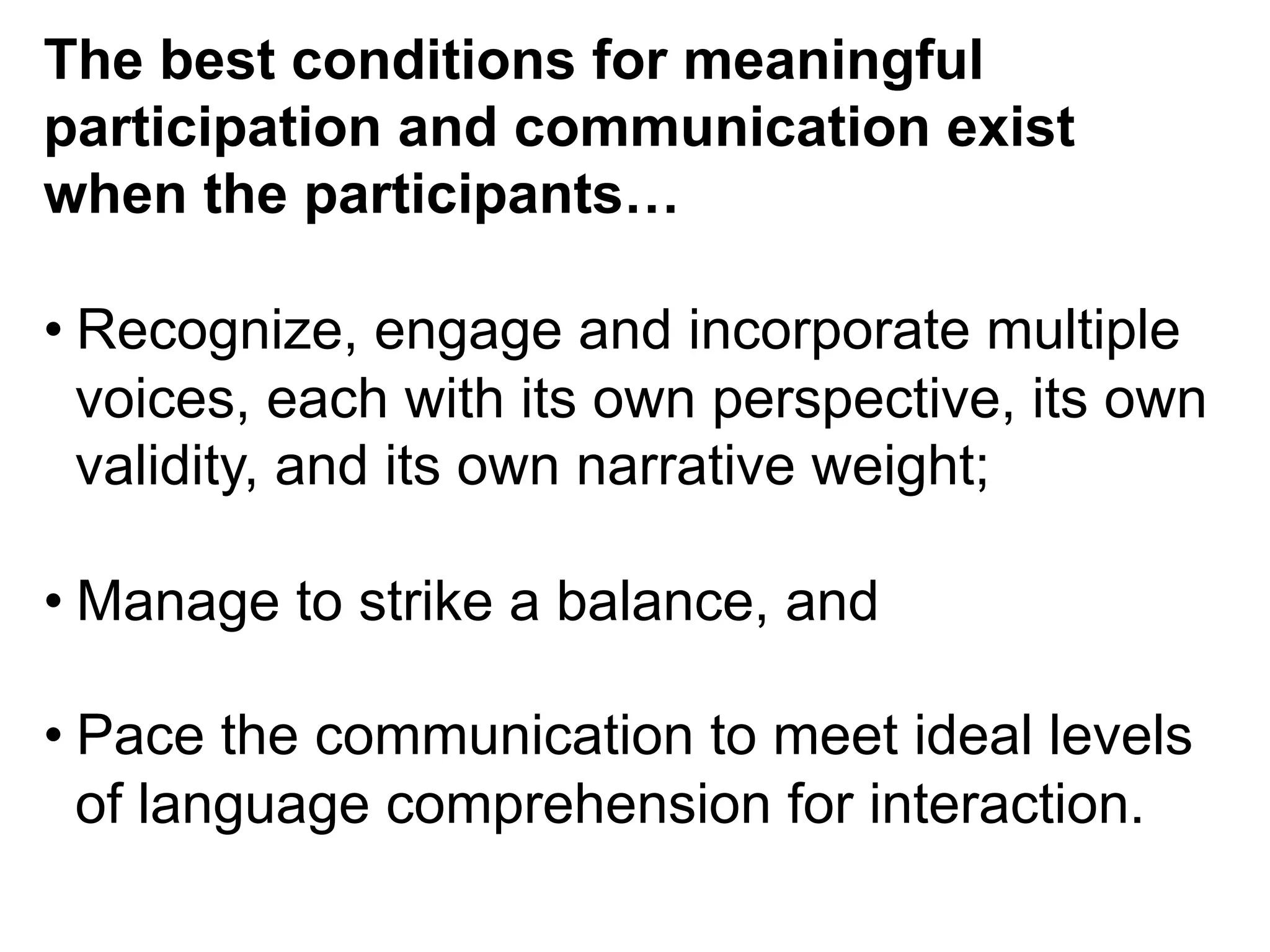
The best conditions for meaningful
participation and communication exist
when the participants…
• Recognize, engage and incorporate multiple
voices, each with its own perspective, its own
validity, and its own narrative weight;
• Manage to strike a balance, and
• Pace the communication to meet ideal levels
of language comprehension for interaction.
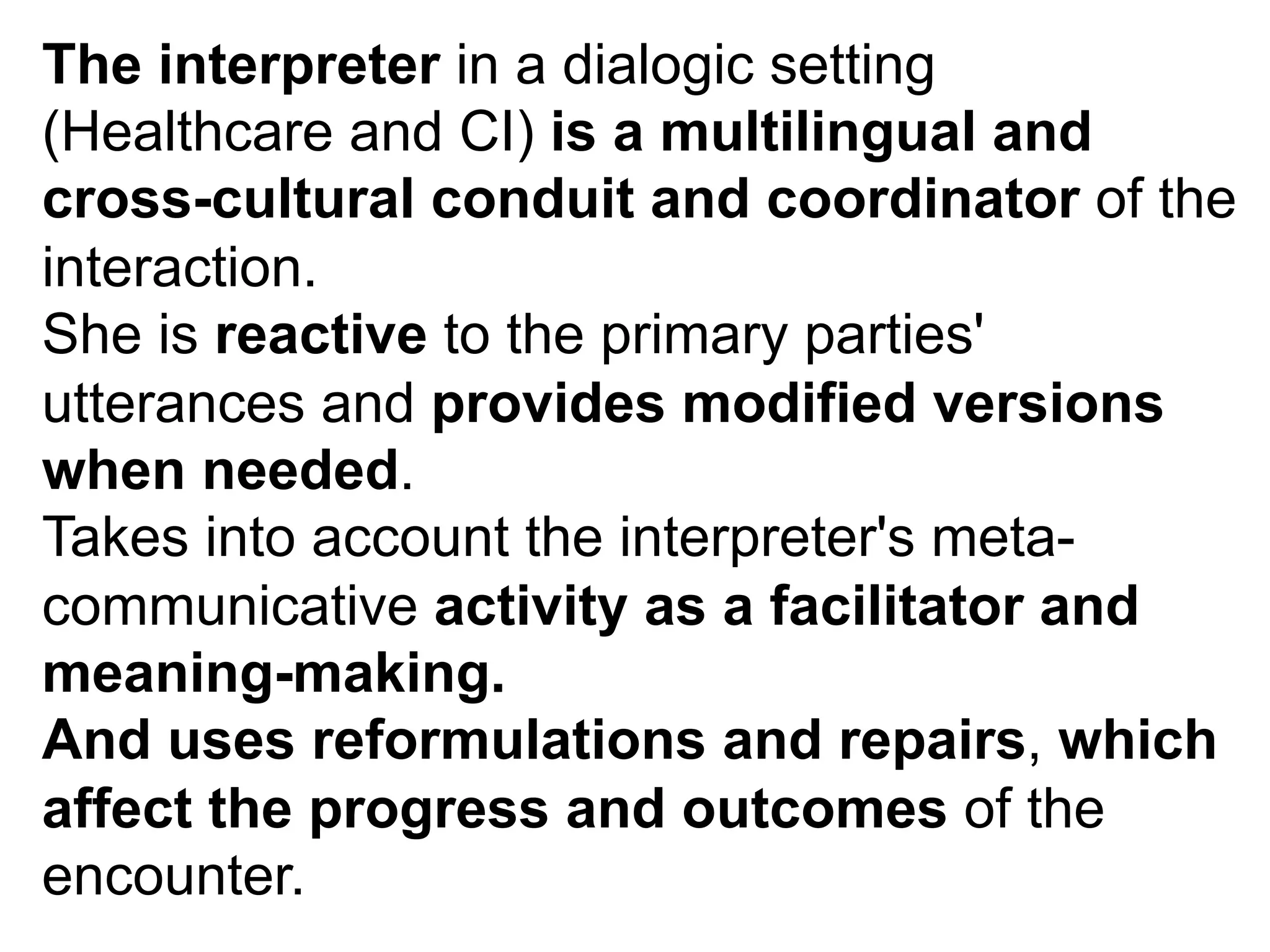
The interpreter in a dialogic setting
(Healthcare and CI) is a multilingual and
cross-cultural conduit and coordinator of the
interaction.
She is reactive to the primary parties'
utterances and provides modified versions
when needed.
Takes into account the interpreter's meta-
communicative activity as a facilitator and
meaning-making.
And uses reformulations and repairs, which
affect the progress and outcomes of the
encounter.
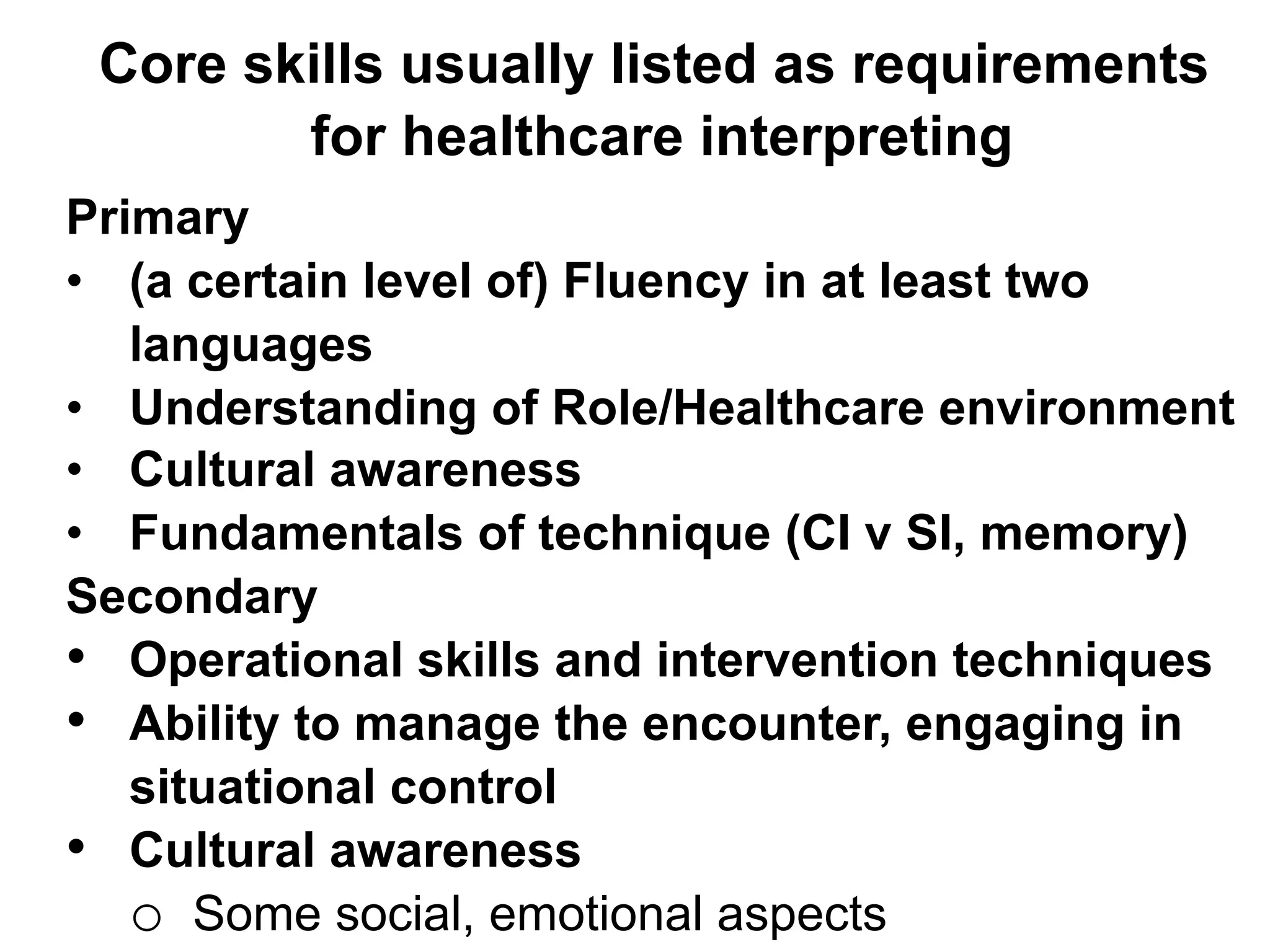
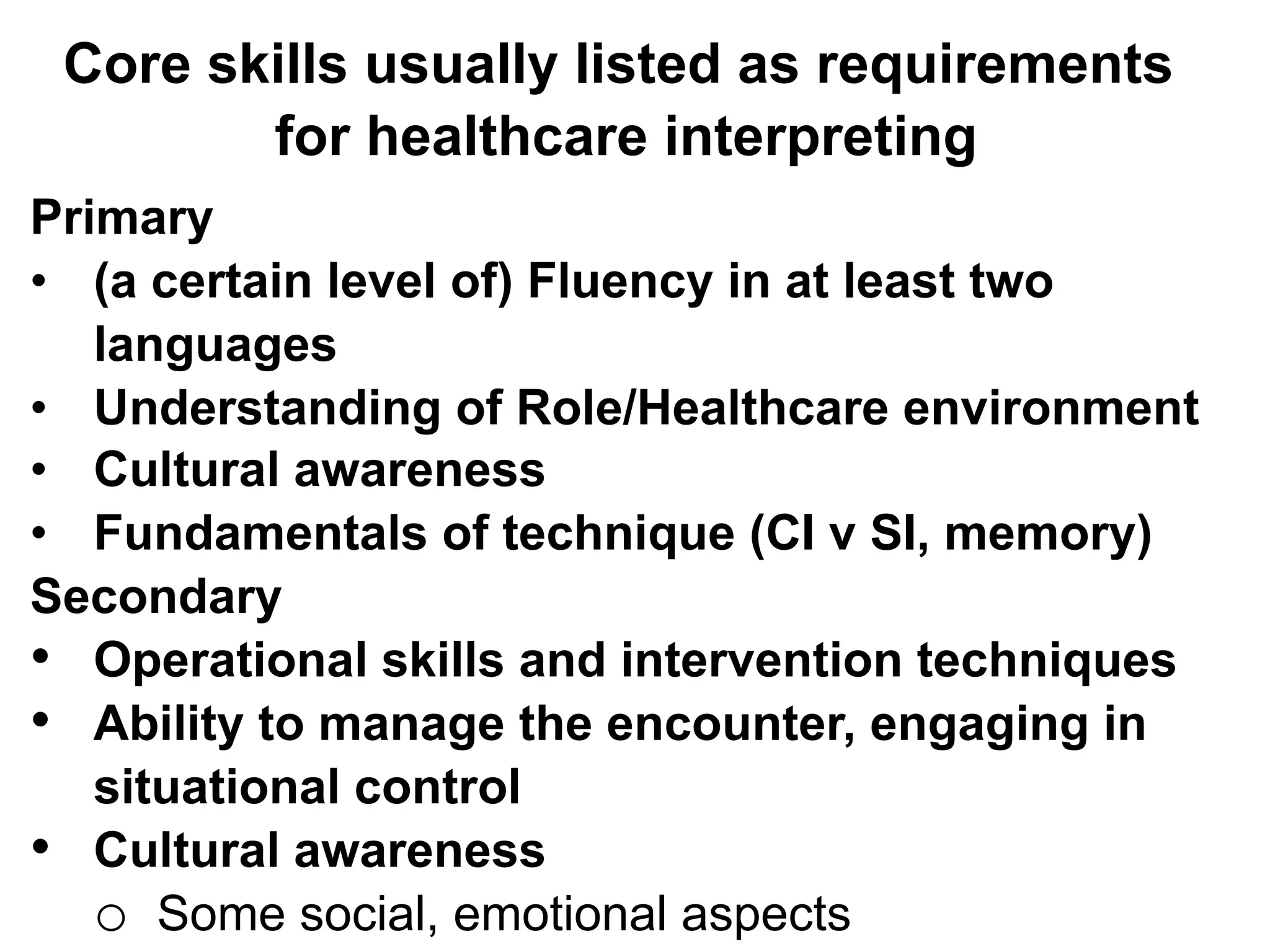
Core skills usually listed as requirements
for healthcare interpreting
Primary
•  (a certain level of) Fluency in at least two
languages
•  Understanding of Role/Healthcare environment
•  Cultural awareness
•  Fundamentals of technique (CI v SI, memory)
Secondary
•  Operational skills and intervention techniques
•  Ability to manage the encounter, engaging in
situational control
•  Cultural awareness
o  Some social, emotional aspects
Pursuing a “possibilistic” approach
• Achieving the best possible results may require an
explicit acknowledgement of the interpreter’s own
substantial limitations.
• If limitations are substantial, interpreters should
explain the need to pace the communication to meet
their own level of language comprehension and
fluency in both languages with minimal interference.
• In many instances, interpreters with skills that do not
conform with a standard set constitute an
indispensable resource.
• Frequently, they show great potential when needs are
addressed and nurtured carefully.
Other socioeconomic factors
• Status, power differential, and balance of
power
• Socioeconomic implications: Poverty
• Cultural shock: cultural differences, the
culture of biomedicine v. folk culture
• Ethnic, racial, otherness, exclusion, gender
orientation, disability
INTERVENTIONS OF THE UTMOST
IMPORTANCE!!!
• Education of healthcare personnel
• Protocols
• Health literacy
Teaching CI: a possibilistic approach
A good way to teach CI and dialogue interpreting
is to follow a possibilistic approach: assess the
circumstances, preparedness, and possibilities of
a trainee, and then proceed customizing
conceptual and technical training and education
incrementally.
It is a common mistake to push trainees who don’t
have the required basic skills into scenarios that
greatly surpass their performance level. This is a
costly pedagogical mistake that usually leads to
frustration and deception.
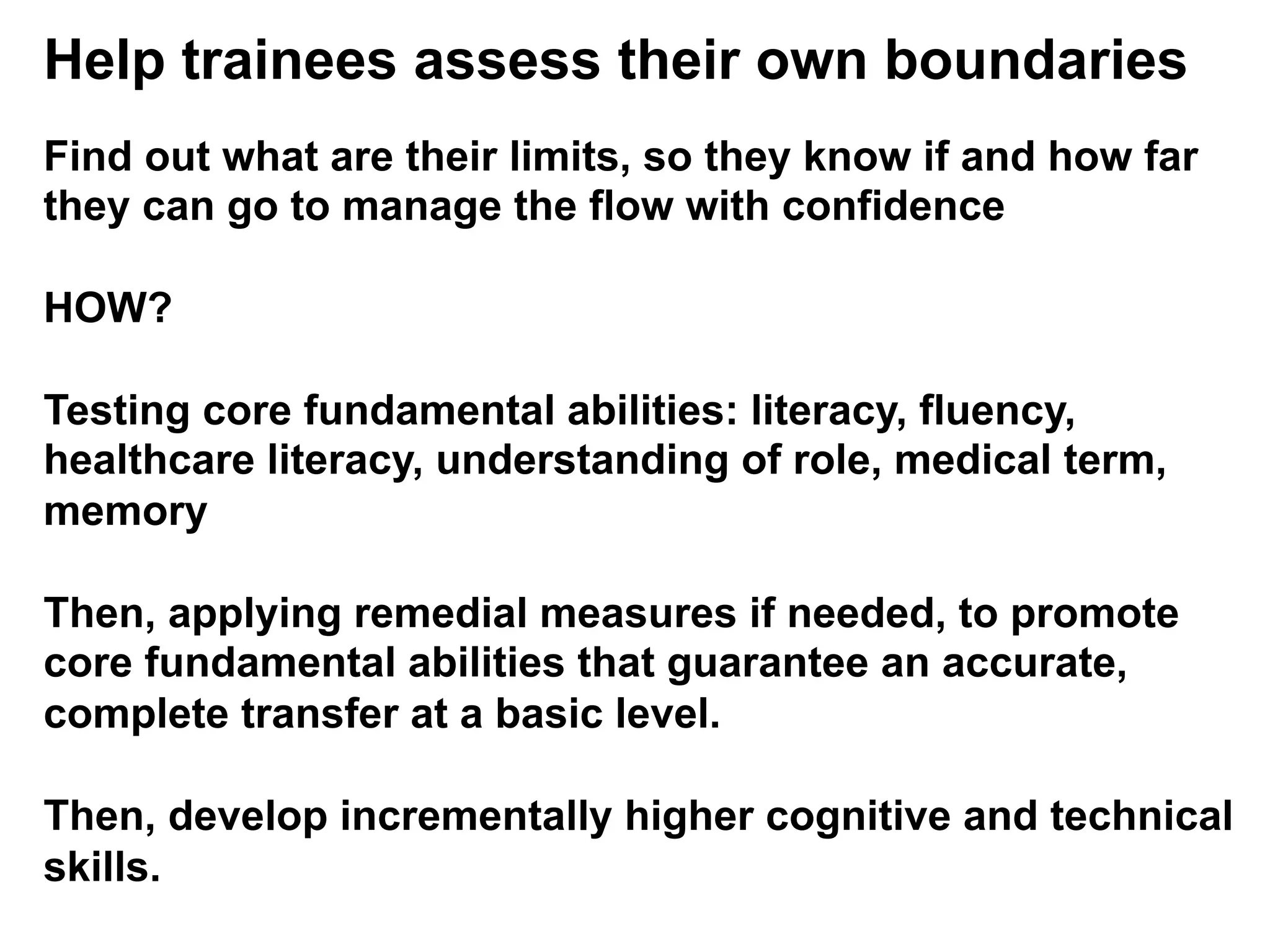
Help trainees assess their own boundaries
Find out what are their limits, so they know if and how far
they can go to manage the flow with confidence
HOW?
Testing core fundamental abilities: literacy, fluency,
healthcare literacy, understanding of role, medical term,
memory
Then, applying remedial measures if needed, to promote
core fundamental abilities that guarantee an accurate,
complete transfer at a basic level.
Then, develop incrementally higher cognitive and technical
skills.
Core skills usually listed as requirements
for healthcare interpreting
Primary
•  (a certain level of) Fluency in at least two
languages
•  Understanding of Role/Healthcare environment
•  Cultural awareness
•  Fundamentals of technique (CI v SI, memory)
Secondary
•  Operational skills and intervention techniques
•  Ability to manage the encounter, engaging in
situational control
•  Cultural awareness
o  Some social, emotional aspects
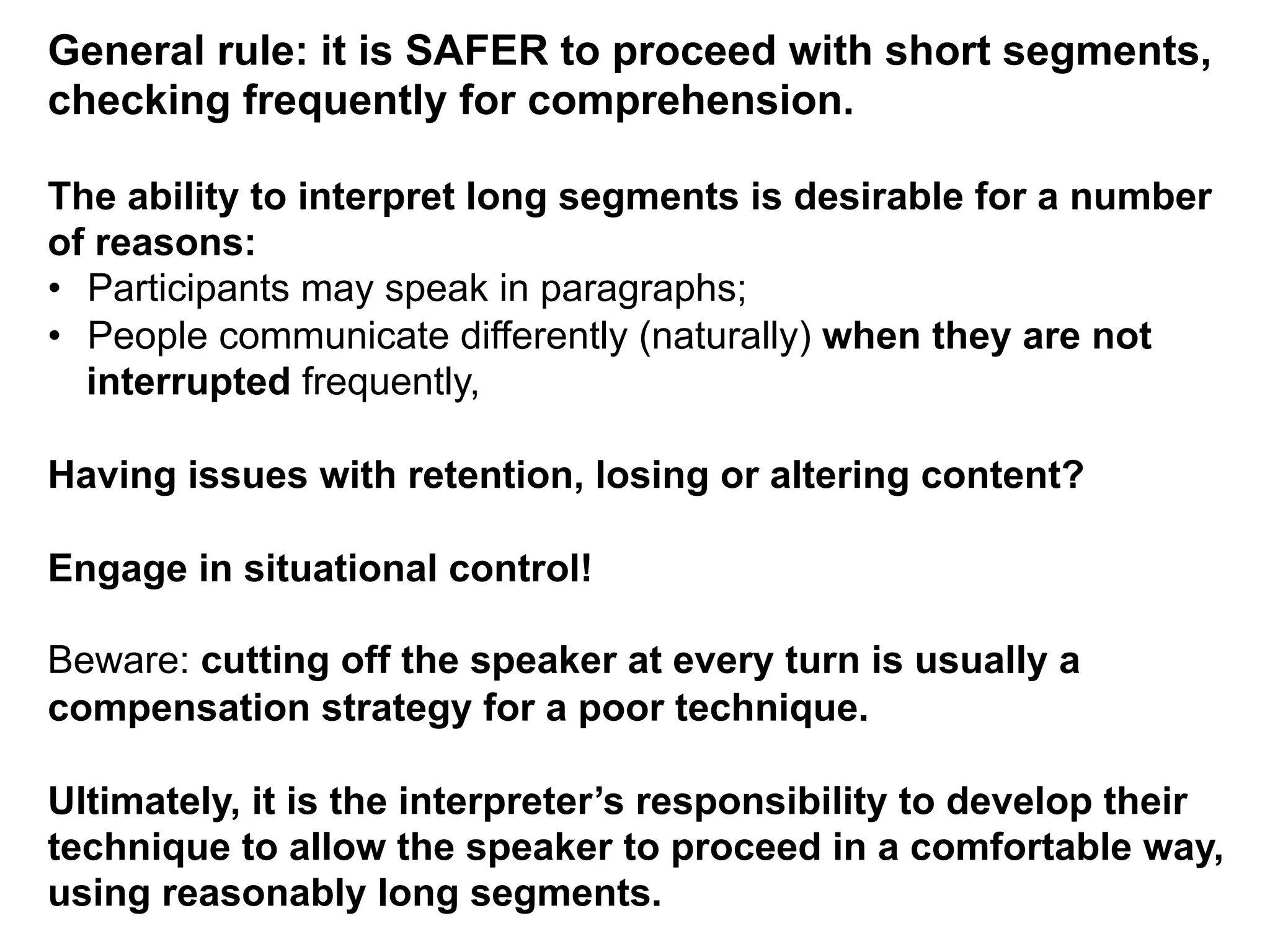
General rule: it is SAFER to proceed with short segments,
checking frequently for comprehension.
The ability to interpret long segments is desirable for a number
of reasons:
•  Participants may speak in paragraphs;
•  People communicate differently (naturally) when they are not
interrupted frequently,
Having issues with retention, losing or altering content?
Engage in situational control!
Beware: cutting off the speaker at every turn is usually a
compensation strategy for a poor technique.
Ultimately, it is the interpreter’s responsibility to develop their
technique to allow the speaker to proceed in a comfortable way,
using reasonably long segments.
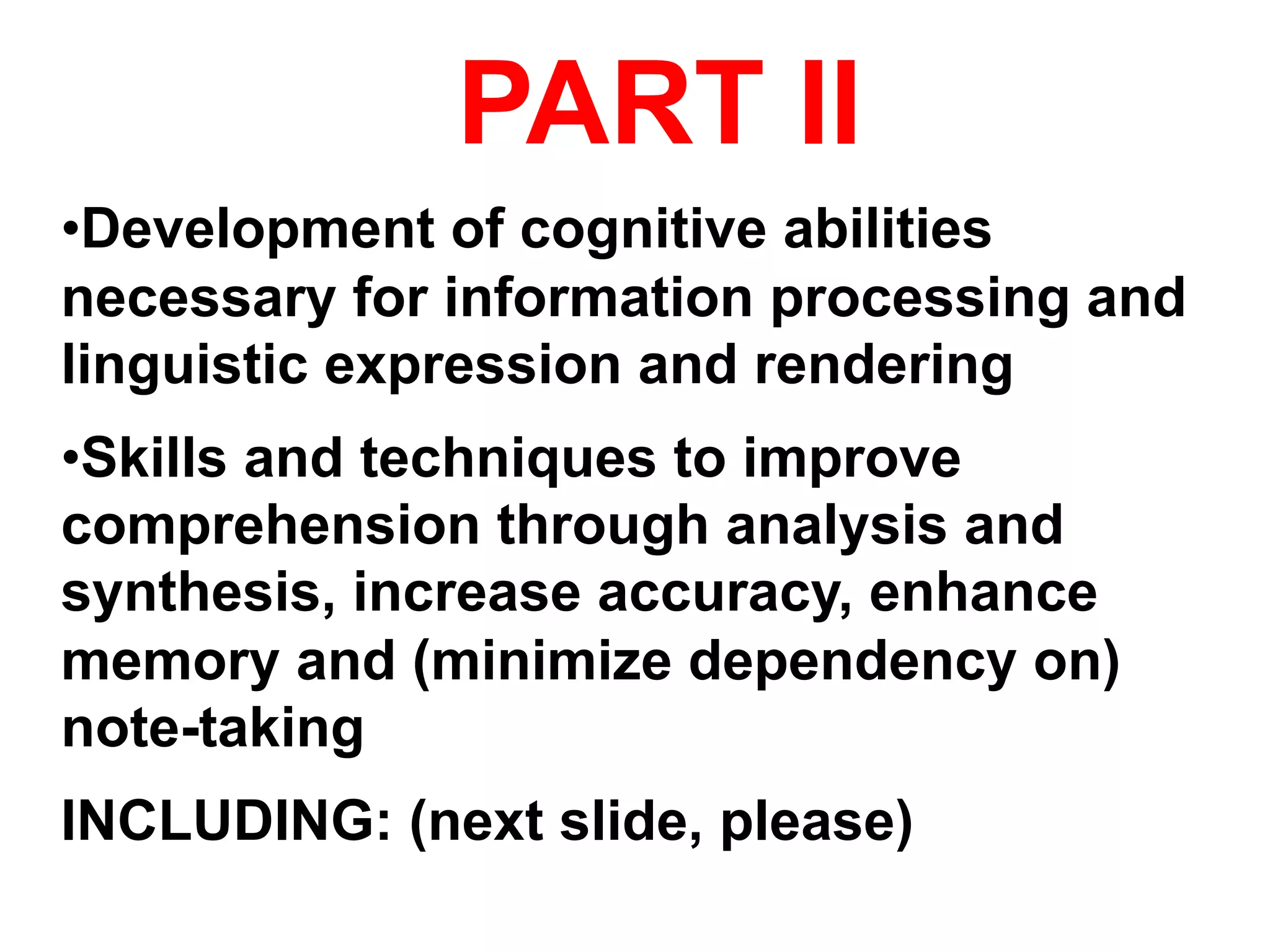
PART II
• Development of cognitive abilities
necessary for information processing and
linguistic expression and rendering
• Skills and techniques to improve
comprehension through analysis and
synthesis, increase accuracy, enhance
memory and (minimize dependency on)
note-taking
INCLUDING: (next slide, please)
•  Overall importance of basic understanding of how the brain
and memory work
•  Gile’s Effort Model of interpreting and implications of
automatic processes
•  Discourse analysis applied to cross-cultural communication
•  CI: skills and techniques
•  Anticipation/Prediction
•  Attentive listening
•  Motor skills
•  Memory: developing and strengthening memory HANDOUT
» Sensorial perception
» Types of memory
» Executive function
» Memory consolidation:
» awareness, repetition, manipulation
•  Memory techniques
•  Note-taking HANDOUT
Overall importance of basic understanding
of how the brain and memory work (1)
•  Basic understanding of how the brain and
memory work is a must for cognitive and motor
integration and intellectual growth.
•  Vision as dominant sense (exploit the power of
visualization)
•  Using sensorial input from all senses can enrich
and reinforce perception and retention
(memory)
•  What's memory and how it works, and
particularly, its functional aspects so we can
exploit them to enhance our memory.
Overall importance of basic understanding of
how the brain and memory work (2)
Other interesting aspects:
•  Plasticity of the adult brain allows for
enhancing cognition through sustained mental
or physical activities even in old age
•  Fighting memory elusiveness
•  How language influences memory
•  Susceptibility of modifying memory by
addition, omission, distortion
•  Relativity of meaning
•  Collective and Personal nature of meaning
•  Experience shapes meaning
Gile’s Effort Model of interpreting and
implications of automatic processes
• Interpreting (processing information, manipulating
difficult or unusual concepts or syntax, retrieving items
from memory) requires mental energy available only
in limited supply
• When there is an overload (too much information, too
difficult, technical problems) interpreting deteriorates.
Errors increase.
• Controlling the flow of information and good
technique help to streamline these processes,
minimize error, and reduce consumption of energy
and effort
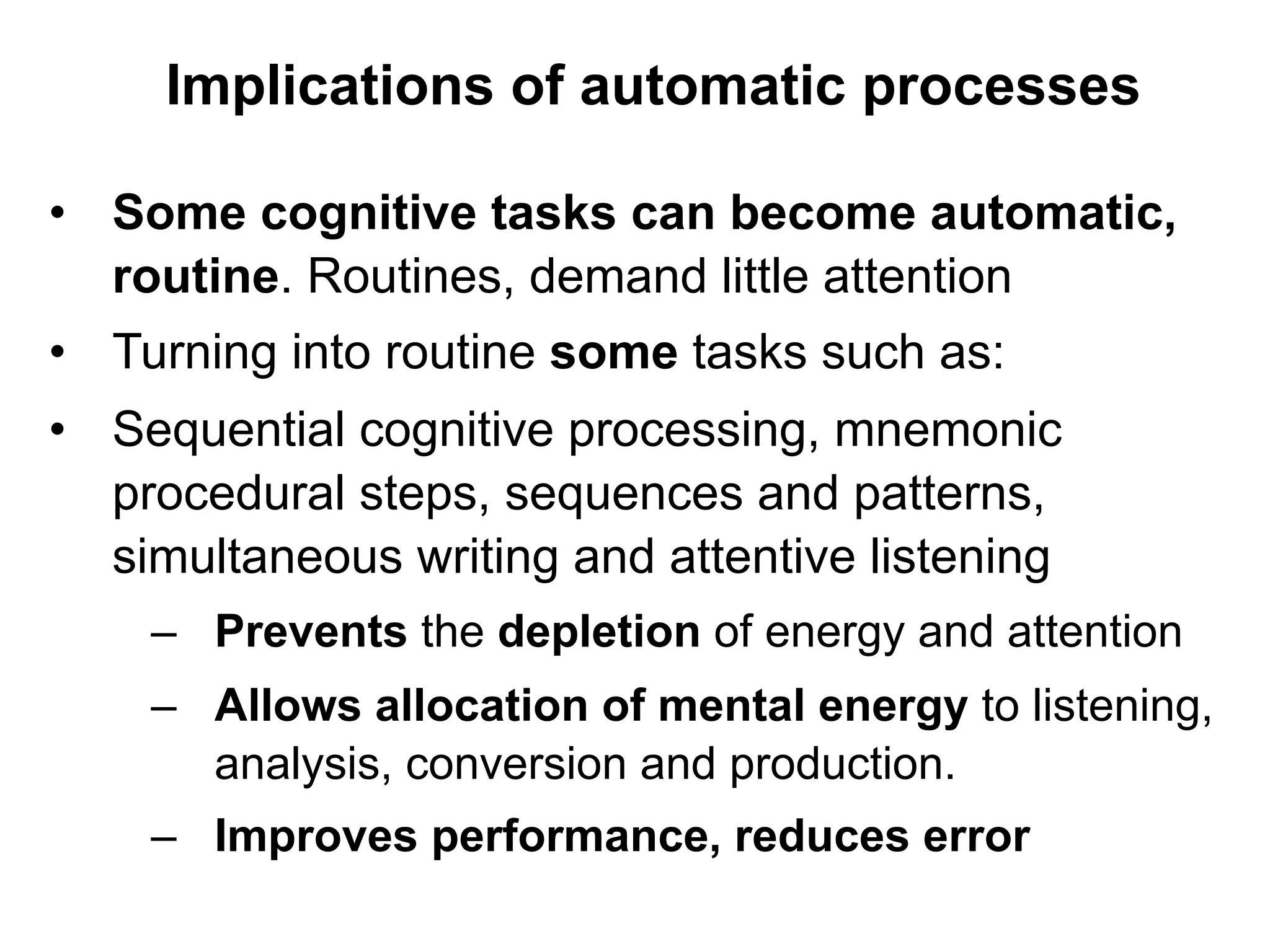
Implications of automatic processes
•  Some cognitive tasks can become automatic,
routine. Routines, demand little attention
•  Turning into routine some tasks such as:
•  Sequential cognitive processing, mnemonic
procedural steps, sequences and patterns,
simultaneous writing and attentive listening
–  Prevents the depletion of energy and attention
–  Allows allocation of mental energy to listening,
analysis, conversion and production.
–  Improves performance, reduces error
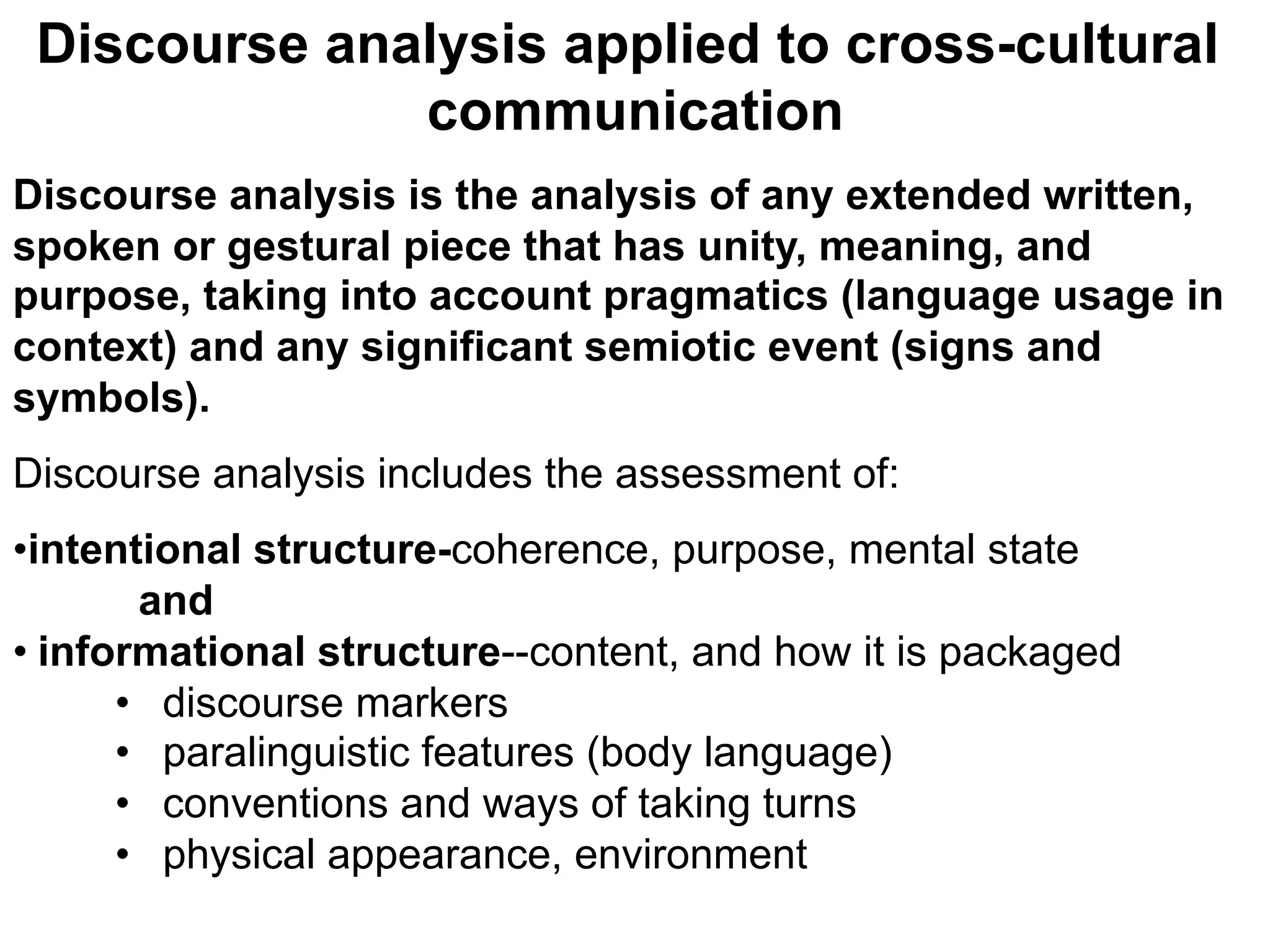
Discourse analysis applied to cross-cultural
communication
Discourse analysis is the analysis of any extended written,
spoken or gestural piece that has unity, meaning, and
purpose, taking into account pragmatics (language usage in
context) and any significant semiotic event (signs and
symbols).
Discourse analysis includes the assessment of:
• intentional structure-coherence, purpose, mental state
and
• informational structure--content, and how it is packaged
•  discourse markers
•  paralinguistic features (body language)
•  conventions and ways of taking turns
•  physical appearance, environment
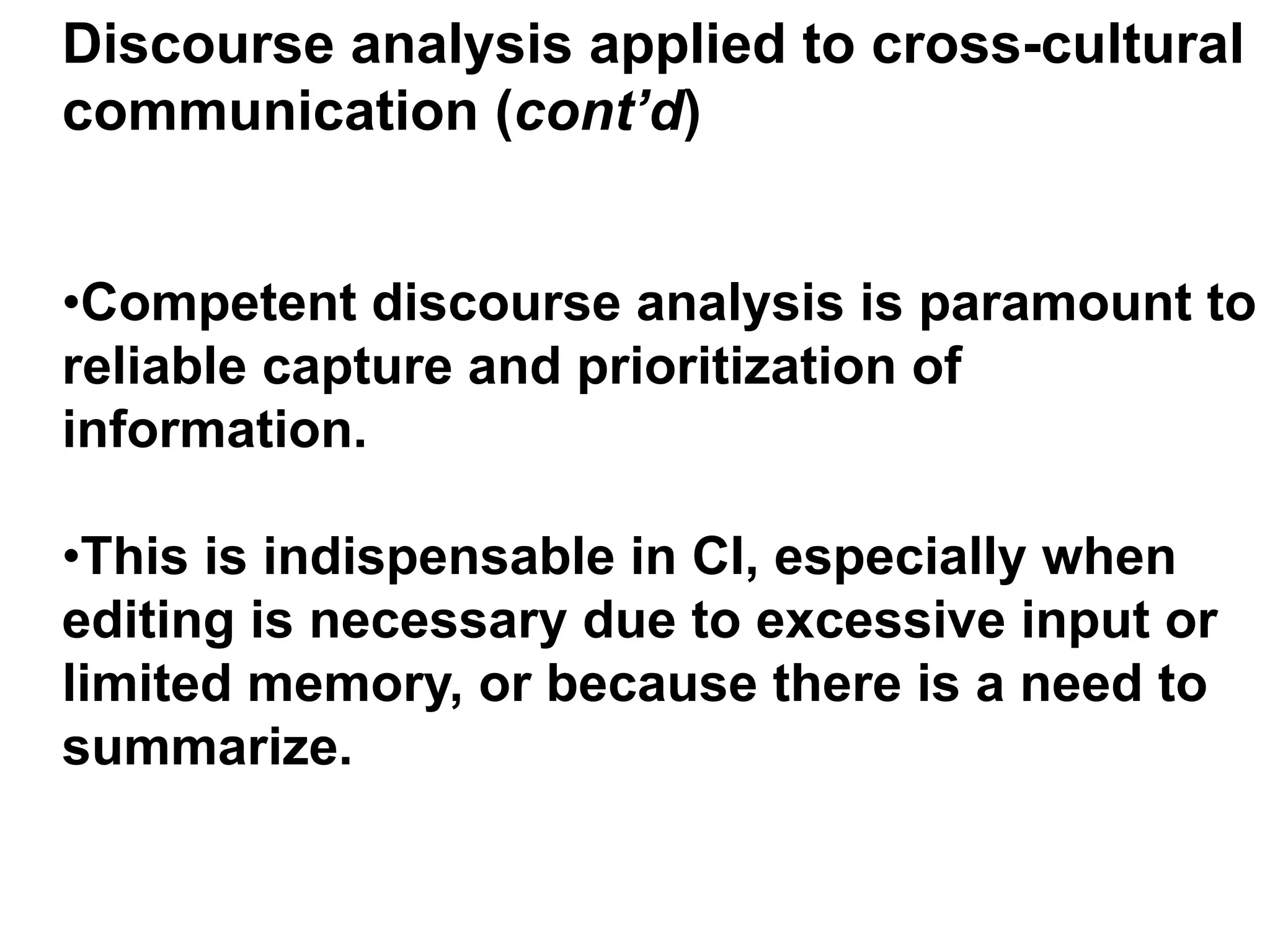
Discourse analysis applied to cross-cultural
communication (cont’d)
• Competent discourse analysis is paramount to
reliable capture and prioritization of
information.
• This is indispensable in CI, especially when
editing is necessary due to excessive input or
limited memory, or because there is a need to
summarize.
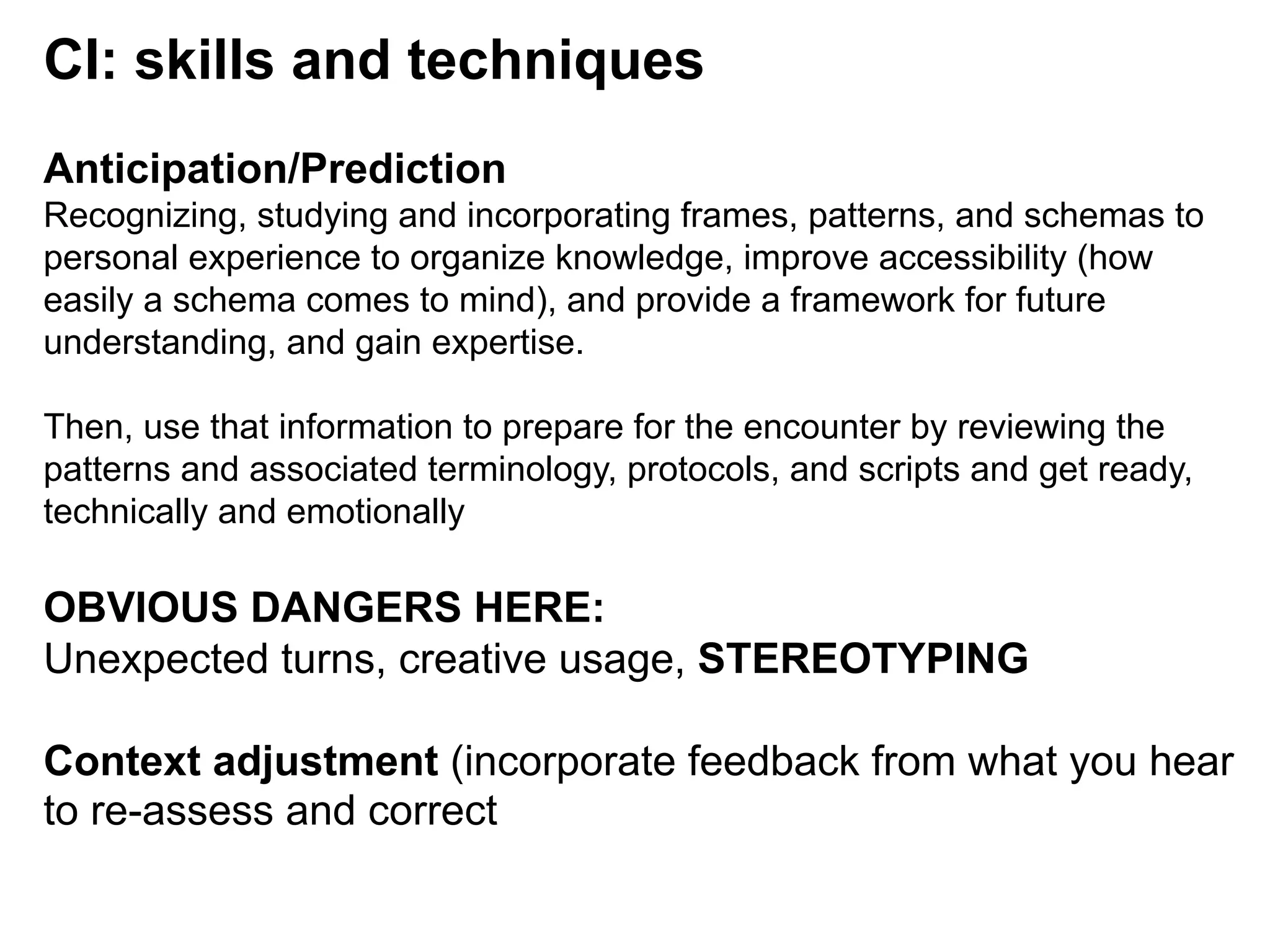
CI: skills and techniques
Anticipation/Prediction
Recognizing, studying and incorporating frames, patterns, and schemas to
personal experience to organize knowledge, improve accessibility (how
easily a schema comes to mind), and provide a framework for future
understanding, and gain expertise.
Then, use that information to prepare for the encounter by reviewing the
patterns and associated terminology, protocols, and scripts and get ready,
technically and emotionally
OBVIOUS DANGERS HERE:
Unexpected turns, creative usage, STEREOTYPING
Context adjustment (incorporate feedback from what you hear
to re-assess and correct
Attentive listening and observation
To be able to process the SL message accurately, the
interpreter must be able to listen effectively,
attending to meaning.
“Attending” is the most alert, deliberate form of
listening.
It is indispensable for SL content processing,
analysis and synthesis, the hallmarks of good
chunking/segmentation
Motor skills
Understanding and speaking a language are
two interrelated but distinctive skills
• Locate problematic phonemes and syllabic
combinations
• Practice pronunciation, diction, prosody
• Shadow native speakers
Understanding, developing, and strengthening memory
YOU CAN IMPROVE YOUR
MEMORY IF YOU WORK AT IT!
The plasticity of the brain is
amazing!
It has myriads of overall beneficial
side effects;
Makes you smarter!
Fences-off aging!
Understanding, developing, and
strengthening memory
OPEN HANDOUT
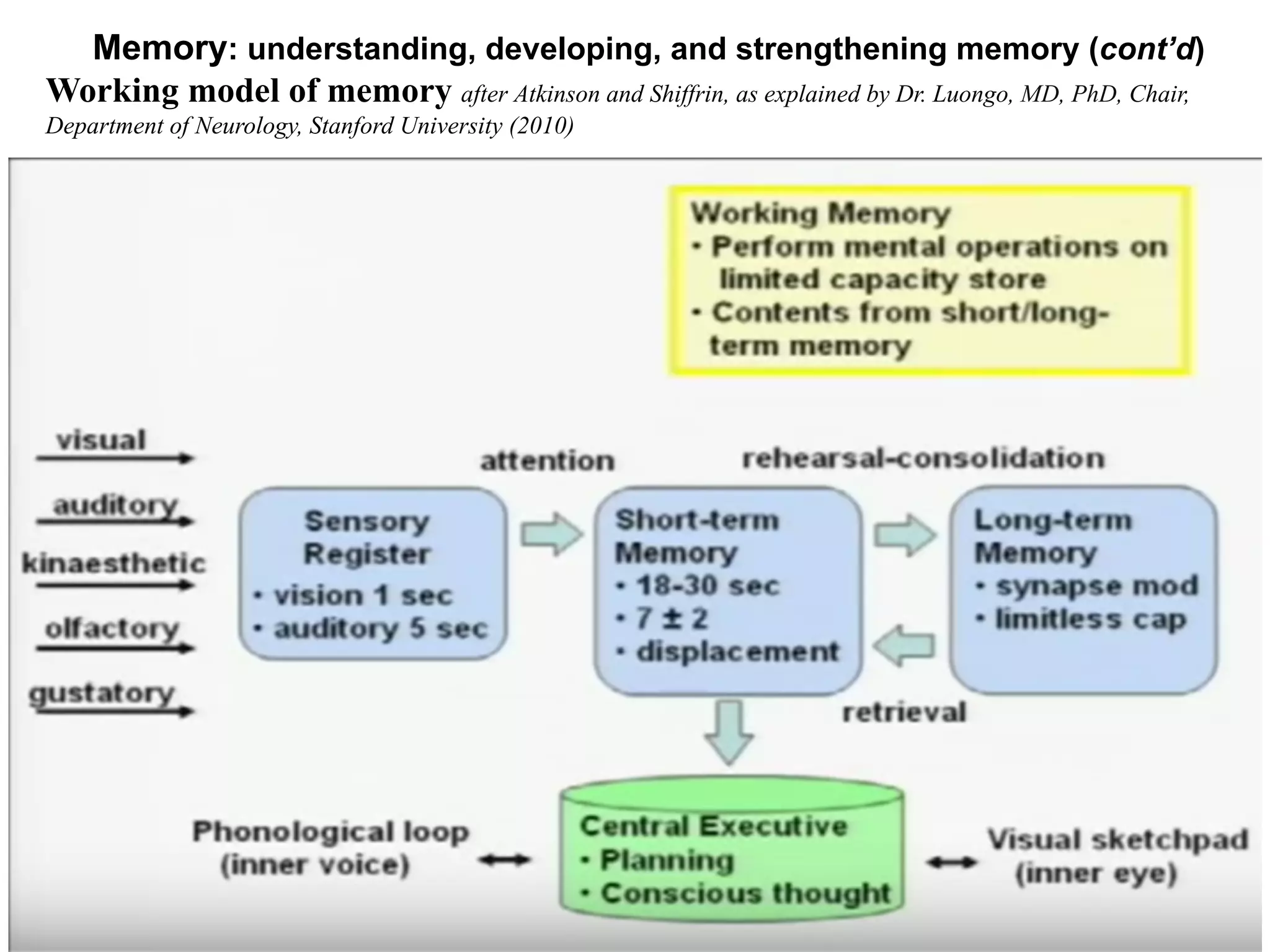
Memory: understanding, developing, and strengthening memory (cont’d)
Working model of memory after Atkinson and Shiffrin, as explained by Dr. Luongo, MD, PhD, Chair,
Department of Neurology, Stanford University (2010)
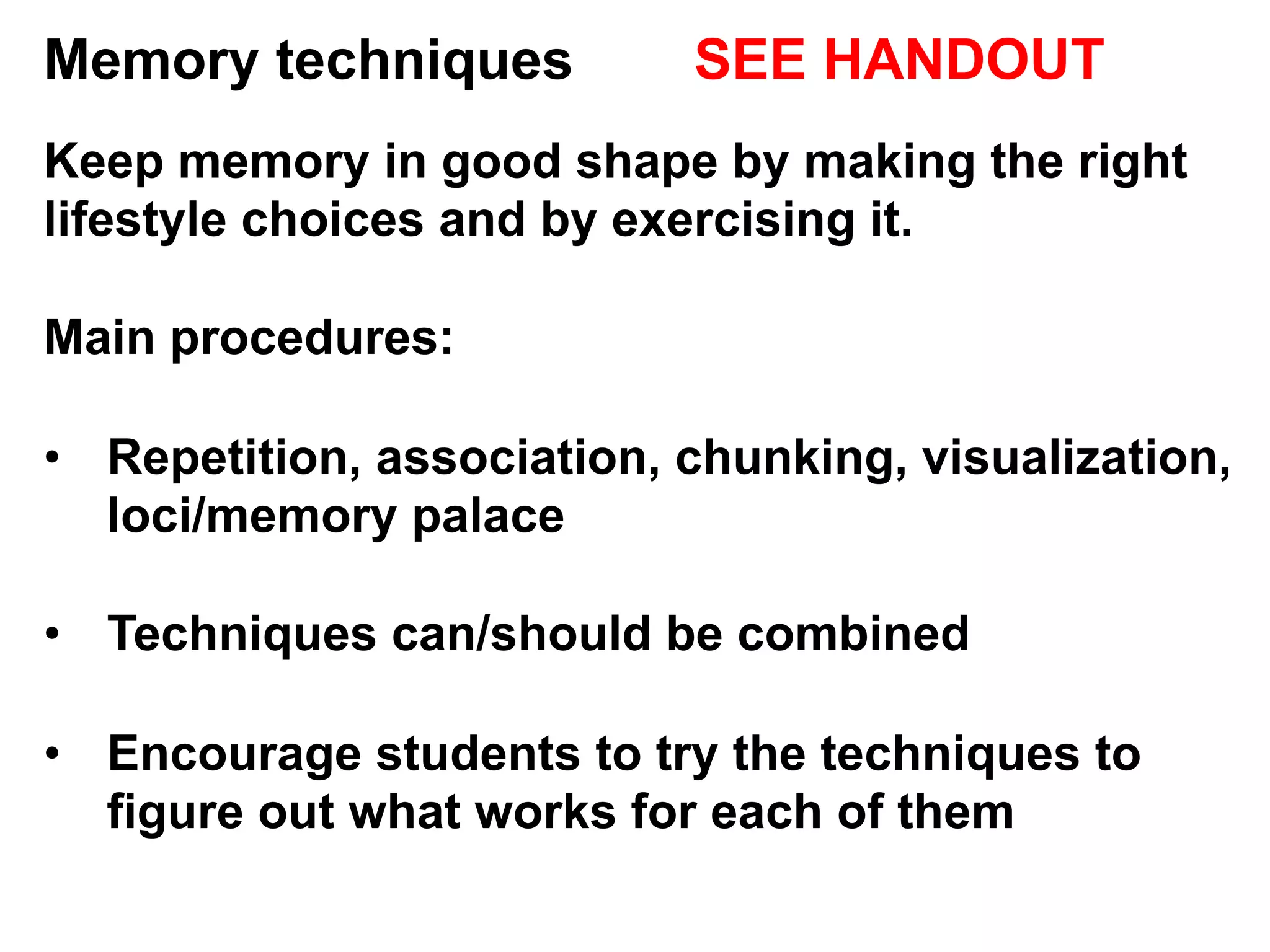
Memory techniques SEE HANDOUT
Keep memory in good shape by making the right
lifestyle choices and by exercising it.
Main procedures:
•  Repetition, association, chunking, visualization,
loci/memory palace
•  Techniques can/should be combined
•  Encourage students to try the techniques to
figure out what works for each of them
Note-taking (NT)
HANDOUT
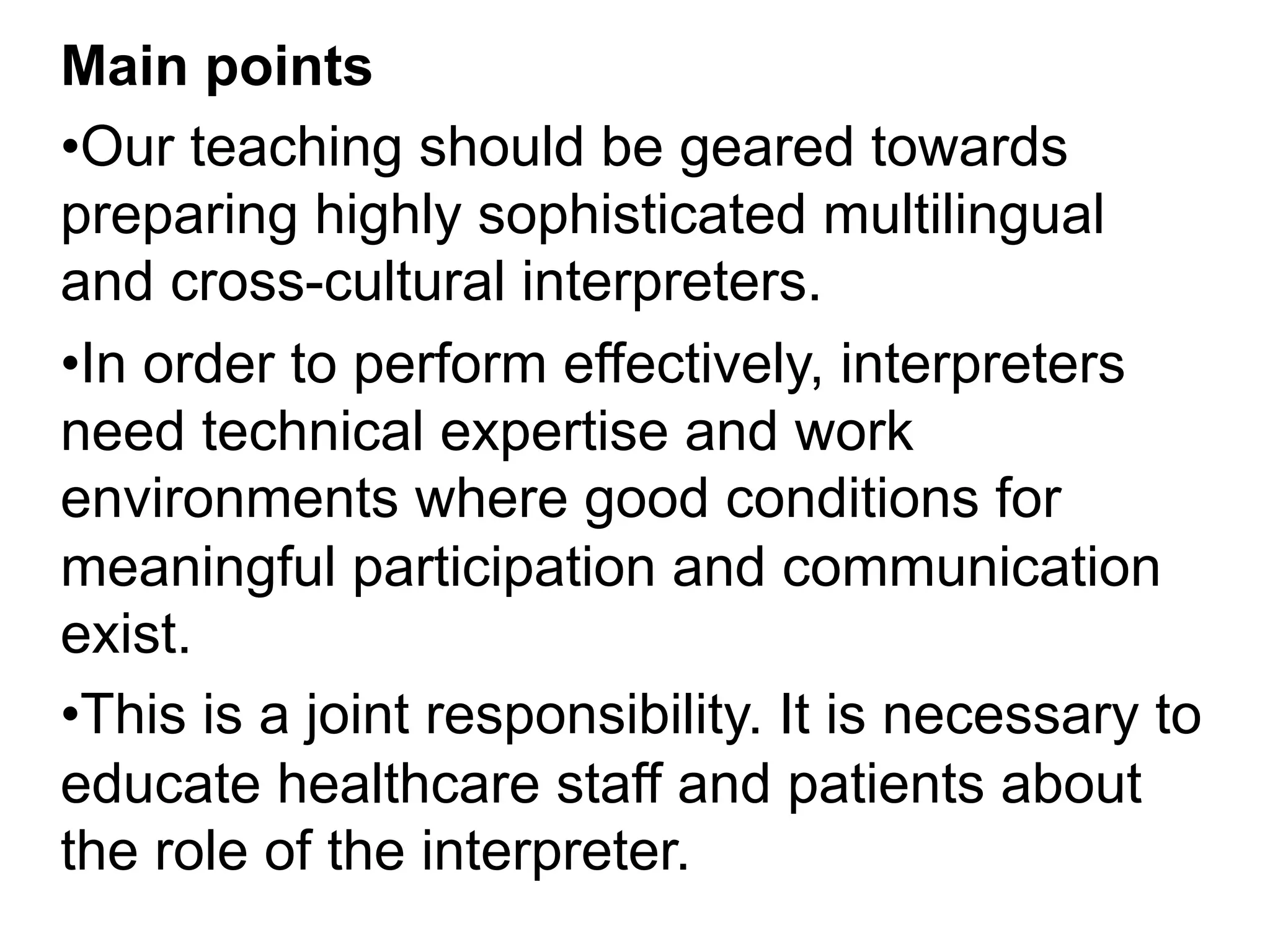
Main points
• Our teaching should be geared towards
preparing highly sophisticated multilingual
and cross-cultural interpreters.
• In order to perform effectively, interpreters
need technical expertise and work
environments where good conditions for
meaningful participation and communication
exist.
• This is a joint responsibility. It is necessary to
educate healthcare staff and patients about
the role of the interpreter.
Main points
• Frequently, interpreters with a non-standard
set of skills constitute an indispensable
resource. Their needs should be addressed.
When limitations are substantial, interpreters
should explicitly acknowledge them.
• In order to accommodate all levels and meet
all needs, the teaching of CI should pursue a
possibilistic approach, customizing education
and training according to the level and
possibilities of the trainee, to promote core
abilities that guarantee accuracy, and good
basis for future development.
Main points
• However, the ability to interpret long
segments is desirable. This requires superior
cognitive and technical competence, including
great memory function and note-taking skills.
• Ultimately, it is our responsibility to help
interpreters develop their technique to reach
their highest potential.
Resources and Bibliography (1)
Cirillo and Niemants. Teaching Dialogue Interpreting. Research-based proposals for higher
education. 2017. https://benjamins.com/catalog/btl.138
Damasio, A. Self Comes to Mind: Constructing the Conscious Brain. Chapter 6, An architecture of
memory. Pantheon Books. 2010
Eagleman, D. The Brain: The Story of You, Vintage, 2017
European Masters in Conference Interpreting. On line lectures:
http://www.emcinterpreting.org/?q=node/197 Note-taking in Consecutive Interpreting, by Zsuzsa G.
Láng, PhD, ELTE, from the University of Budapest
Gillies, A. Note-taking for Consecutive Interpreting. A Short Course, 2nd Edition.
https://www.routledge.com/Note-taking-for-Consecutive-Interpreting-A-Short-Course-2nd-Edition/
Gillies-Washbourne/p/book/9781138123205
Gonzalez, R. Vasquez, V and Mikkelson, H. Fundamentals of Court Interpretation. Theory, Policy, and
Practice (Second Edition). Chapter 35: Consecutive Interpretation.
https://redshelf.com/book/507879/fundamentals-of-court-interpretation-507879-9781531002428-roseann-
d-gonzalez-victoria-f-vasquez-and-holly-mikkelson
Luongo, F. Learning and Memory: How it Works and When it Fails. Stanford University (2010).
https://www.youtube.com/watch?v=a_HfSnQqeyY&t=891s
Resources and Bibliography (2)
Note-taking examples (2-column page layout): https://m.youtube.com/watch?v=fBMhJDjkS2c;
https://m.youtube.com/watch?v=Ni34Am19XFA
Ohio State University. Department of Linguistics. Language Files. Materials for an
Introduction to Language and Linguistics, 12th Edition. Department of Linguistics. Ohio State
University. 2016. https://ohiostatepress.org/books/titles/9780814252703.html
Robinson, A. Bakhtin Dialogism, Polyphony and Heteroglossia..
https://ceasefiremagazine.co.uk/in-theory-bakhtin-1/
Rozan, J. F. La prise de notes dans l'interpretation consecutive/Note-taking in Consecutive
Interpreting, (1956 Geneve, Georg), 2005 Tertium, Cracow.
Tipton and Furmanek. Dialogue-Interpreting-A-Guide-to-Interpreting-in-Public-Services. 2016
https://www.routledge.com/Dialogue-Interpreting-A-Guide-to-Interpreting-in-Public-
Services-and-the/Tipton-Furmanek/p/book/9781138784628
Valencia, V. Note-taking Manual: A Study Guide for Interpreters and Everyone Who Takes Notes.
https://www.interpretrain.com/products/note-taking-manual
THANK YOU VERY MUCH!
Jaime
NATIONAL	
  COUNCIL	
  ON	
  INTERPRETING	
  IN	
  HEALTH	
  CARE	


• New	
  topics	
  coming	
  soon!	
  
• Please	
  complete	
  evalua;on	
  
• Follow	
  up	
  via	
  email:	
  
TrainersWebinars@ncihc.org	


Home	
  for	
  Trainers	
  	
  Interpreter	
  Trainers	
  Webinars	
  Work	
  Group	
  
An	
  ini;a;ve	
  of	
  the	
  Standards	
  and	
  Training	
  Commi,ee	
  
www.ncihc.org/home-­‐for-­‐trainers	
  
Announcements	
  
Webinar	
  sponsored	
  by	
  
NATIONAL	
  COUNCIL	
  ON	
  INTERPRETING	
  IN	
  HEALTH	
  CARE	


You	
  can	
  access	
  the	
  recording	
  of	
  the	
  
live	
  webinar	
  presenta;on	
  at	
  	
  
www.ncihc.org/trainerswebinars	


Home	
  for	
  Trainers	
  	
  Interpreter	
  Trainers	
  Webinars	
  Work	
  Group	
  
An	
  ini;a;ve	
  of	
  the	
  Standards	
  and	
  Training	
  Commi,ee	
  
www.ncihc.org/home-­‐for-­‐trainers	
  
NATIONAL	
  COUNCIL	
  ON	
  INTERPRETING	
  IN	
  HEALTH	
  CARE	
  
Thank	
  you	
  for	
  a,ending!	
  

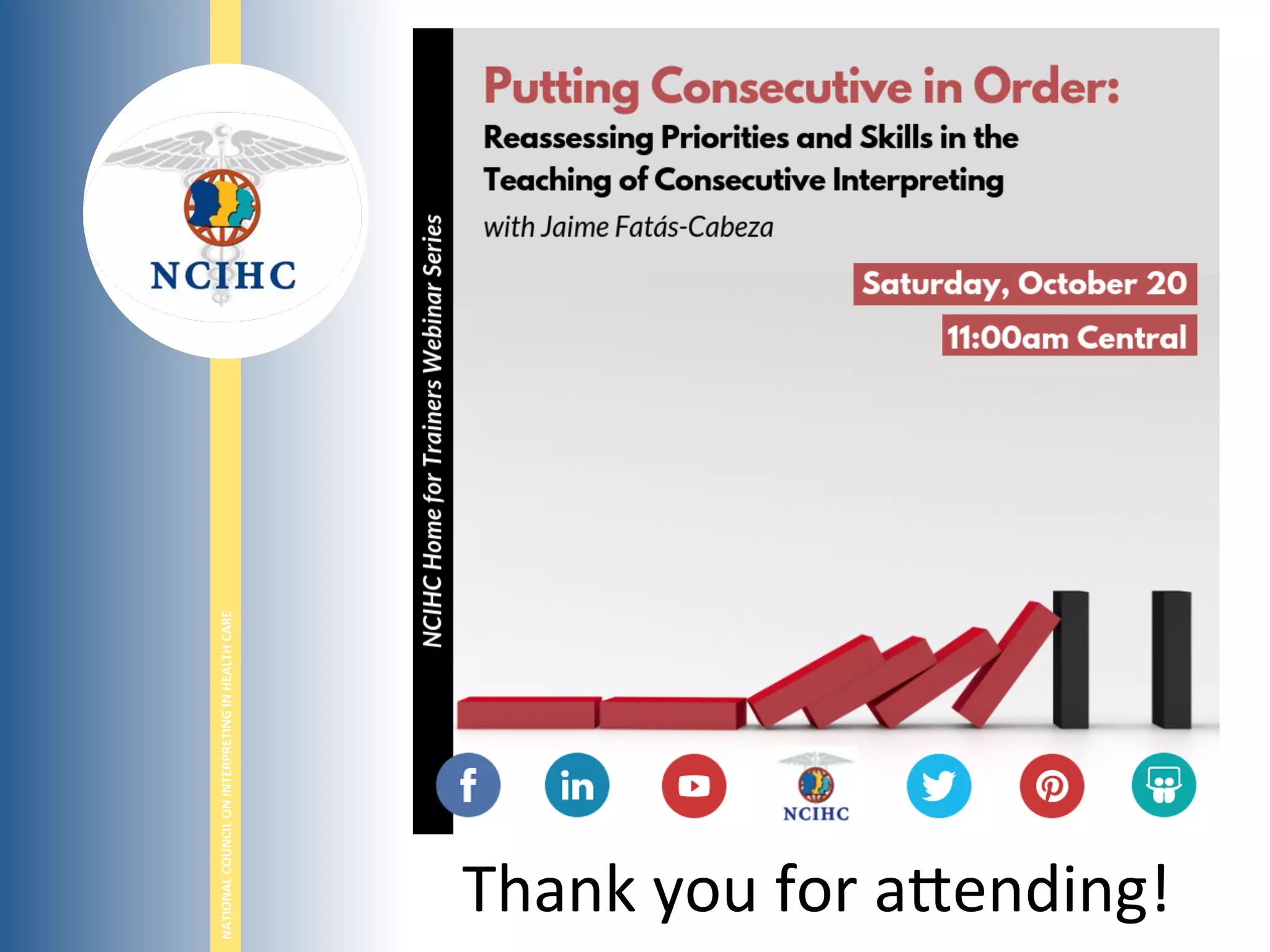
Putting Consecutive in Order: Reassessing Priorities and Skills in the Teaching of Consecutive Interpreting

  • 1.
    NATIONAL  COUNCIL  ON  INTERPRETING  IN  HEALTH  CARE   WWW.NCIHC.ORG  Thank  you  for  a,ending!  
  • 2.
    NATIONAL  COUNCIL  ON  INTERPRETING  IN  HEALTH  CARE     You  can  access  the  recording  of  the   live  webinar  presenta;on  at     www.ncihc.org/trainerswebinars     Home  for  Trainers    Interpreter  Trainers  Webinars  Work  Group   An  ini;a;ve  of  the  Standards  and  Training  Commi,ee   www.ncihc.org/home-­‐for-­‐trainers  
  • 3.
    NATIONAL  COUNCIL  ON  INTERPRETING  IN  HEALTH  CARE   WWW.NCIHC.ORG   Housekeeping   -­‐   This  session  is  being  recorded   -­‐   Cer;ficate  of  A,endance      *must  a,end  full  90  minute  *trainerswebinars@ncihc.org   -­‐   Your  GoToWebinar  Control  Panel           -­‐ Twi,er  #NCIHCWebinar    
  • 4.
    NATIONAL  COUNCIL  ON  INTERPRETING  IN  HEALTH  CARE   WWW.NCIHC.ORG  Thank  you  for  a,ending!   Sponsored  by                       www.Cer;fiedLanguages.com  
  • 5.
    NATIONAL  COUNCIL  ON  INTERPRETING  IN  HEALTH  CARE   WWW.NCIHC.ORG      Welcome!     Guest  Presenter:    Jaime  Fatás-­‐Cabeza             Associate  Professor  of  the  Prac;ce   Director  of  Transla;on  and  Interpre;ng  at  University  of  Arizona   USCCI,  Eng/Spa  and    CHITM,  Eng/Spa     Commissioner,  Cer;fica;on  Commission  for  Healthcare  Interpreters  
  • 6.
    PART I Ø  Thedialogic, interactional dimension of CI as dialogue interpreting and the role of the healthcare interpreter Ø  Pursuing this approach in the teaching of CI and dialogue interpreting PART II Ø  Development of cognitive abilities necessary for information processing and linguistic expression and rendering Ø  Review of CI skills and techniques to improve comprehension through analysis and synthesis, increase accuracy, enhance memory, and (minimize dependency on) note-taking.
  • 7.
      The  principle  that  language  is  a  reflec1on  of   culture,  and  that  translators  and  interpreters   therefore  provide  a  cultural  bridge  as  well  as   a  linguis1c  one,  is  a  theme  that  runs  through   virtually  all  wri1ngs  on  transla1on  and   interpreta1on.     Accuracy  vs.  Brevity  in  the  Use  of  Legal  Terms  by  Court  Interpreters,     by  Holly  Mikkelson  
  • 8.
    Nature and scopeof the role What is the nature of the role? –  3 core values What is the scope of the role? –  Support medical profession? –  Bridge the gap? –  Help navigate? –  Humanitarian: to promote human welfare? All of the above What kind of relationship is permissible for the interpreter to establish with the patient and the provider?
  • 9.
    •  We havetranscended the concept of the interpreter as a passive instrument whose role is merely “message passing” to that of an active interpreter, in which the interpreter holds a variety of responsibilities and has relational ties that form the foundation of trust and credibility. •  The conceptualization of the “interpreter as manager of the cross- cultural/cross-language mediated clinical encounter” defines the primary function of the role as the facilitation of the communication process between two people who do not speak the same language in order to make possible the goal of the encounter: the patient’s well- being. The role of the health care interpreter. An evolving dialogue, by Maria-Paz Beltran Avery, Ph.D.
  • 10.
    Assessing the capabilitiesand needs of the participants to achieve goals •  Managing the flow accordingly (when the participants are not doing so) •  Explicitly acknowledging the interpreter’s own limitations, and pursuing a “possibilistic” approach, pacing the communication accordingly.
  • 11.
    The best conditionsfor meaningful participation and communication exist when the participants… • Recognize, engage and incorporate multiple voices, each with its own perspective, its own validity, and its own narrative weight; • Manage to strike a balance, and • Pace the communication to meet ideal levels of language comprehension for interaction.
  • 12.
    The interpreter ina dialogic setting (Healthcare and CI) is a multilingual and cross-cultural conduit and coordinator of the interaction. She is reactive to the primary parties' utterances and provides modified versions when needed. Takes into account the interpreter's meta- communicative activity as a facilitator and meaning-making. And uses reformulations and repairs, which affect the progress and outcomes of the encounter.
  • 13.
    Core skills usuallylisted as requirements for healthcare interpreting Primary •  (a certain level of) Fluency in at least two languages •  Understanding of Role/Healthcare environment •  Cultural awareness •  Fundamentals of technique (CI v SI, memory) Secondary •  Operational skills and intervention techniques •  Ability to manage the encounter, engaging in situational control •  Cultural awareness o  Some social, emotional aspects
  • 14.
    Pursuing a “possibilistic”approach • Achieving the best possible results may require an explicit acknowledgement of the interpreter’s own substantial limitations. • If limitations are substantial, interpreters should explain the need to pace the communication to meet their own level of language comprehension and fluency in both languages with minimal interference. • In many instances, interpreters with skills that do not conform with a standard set constitute an indispensable resource. • Frequently, they show great potential when needs are addressed and nurtured carefully.
  • 15.
    Other socioeconomic factors • Status,power differential, and balance of power • Socioeconomic implications: Poverty • Cultural shock: cultural differences, the culture of biomedicine v. folk culture • Ethnic, racial, otherness, exclusion, gender orientation, disability
  • 16.
    INTERVENTIONS OF THEUTMOST IMPORTANCE!!! • Education of healthcare personnel • Protocols • Health literacy
  • 17.
    Teaching CI: apossibilistic approach A good way to teach CI and dialogue interpreting is to follow a possibilistic approach: assess the circumstances, preparedness, and possibilities of a trainee, and then proceed customizing conceptual and technical training and education incrementally. It is a common mistake to push trainees who don’t have the required basic skills into scenarios that greatly surpass their performance level. This is a costly pedagogical mistake that usually leads to frustration and deception.
  • 18.
    Help trainees assesstheir own boundaries Find out what are their limits, so they know if and how far they can go to manage the flow with confidence HOW? Testing core fundamental abilities: literacy, fluency, healthcare literacy, understanding of role, medical term, memory Then, applying remedial measures if needed, to promote core fundamental abilities that guarantee an accurate, complete transfer at a basic level. Then, develop incrementally higher cognitive and technical skills.
  • 19.
    Core skills usuallylisted as requirements for healthcare interpreting Primary •  (a certain level of) Fluency in at least two languages •  Understanding of Role/Healthcare environment •  Cultural awareness •  Fundamentals of technique (CI v SI, memory) Secondary •  Operational skills and intervention techniques •  Ability to manage the encounter, engaging in situational control •  Cultural awareness o  Some social, emotional aspects
  • 20.
    General rule: itis SAFER to proceed with short segments, checking frequently for comprehension. The ability to interpret long segments is desirable for a number of reasons: •  Participants may speak in paragraphs; •  People communicate differently (naturally) when they are not interrupted frequently, Having issues with retention, losing or altering content? Engage in situational control! Beware: cutting off the speaker at every turn is usually a compensation strategy for a poor technique. Ultimately, it is the interpreter’s responsibility to develop their technique to allow the speaker to proceed in a comfortable way, using reasonably long segments.
  • 21.
    PART II • Development ofcognitive abilities necessary for information processing and linguistic expression and rendering • Skills and techniques to improve comprehension through analysis and synthesis, increase accuracy, enhance memory and (minimize dependency on) note-taking INCLUDING: (next slide, please)
  • 22.
    •  Overall importanceof basic understanding of how the brain and memory work •  Gile’s Effort Model of interpreting and implications of automatic processes •  Discourse analysis applied to cross-cultural communication •  CI: skills and techniques •  Anticipation/Prediction •  Attentive listening •  Motor skills •  Memory: developing and strengthening memory HANDOUT » Sensorial perception » Types of memory » Executive function » Memory consolidation: » awareness, repetition, manipulation •  Memory techniques •  Note-taking HANDOUT
  • 23.
    Overall importance ofbasic understanding of how the brain and memory work (1) •  Basic understanding of how the brain and memory work is a must for cognitive and motor integration and intellectual growth. •  Vision as dominant sense (exploit the power of visualization) •  Using sensorial input from all senses can enrich and reinforce perception and retention (memory) •  What's memory and how it works, and particularly, its functional aspects so we can exploit them to enhance our memory.
  • 24.
    Overall importance ofbasic understanding of how the brain and memory work (2) Other interesting aspects: •  Plasticity of the adult brain allows for enhancing cognition through sustained mental or physical activities even in old age •  Fighting memory elusiveness •  How language influences memory •  Susceptibility of modifying memory by addition, omission, distortion •  Relativity of meaning •  Collective and Personal nature of meaning •  Experience shapes meaning
  • 25.
    Gile’s Effort Modelof interpreting and implications of automatic processes • Interpreting (processing information, manipulating difficult or unusual concepts or syntax, retrieving items from memory) requires mental energy available only in limited supply • When there is an overload (too much information, too difficult, technical problems) interpreting deteriorates. Errors increase. • Controlling the flow of information and good technique help to streamline these processes, minimize error, and reduce consumption of energy and effort
  • 26.
    Implications of automaticprocesses •  Some cognitive tasks can become automatic, routine. Routines, demand little attention •  Turning into routine some tasks such as: •  Sequential cognitive processing, mnemonic procedural steps, sequences and patterns, simultaneous writing and attentive listening –  Prevents the depletion of energy and attention –  Allows allocation of mental energy to listening, analysis, conversion and production. –  Improves performance, reduces error
  • 27.
    Discourse analysis appliedto cross-cultural communication Discourse analysis is the analysis of any extended written, spoken or gestural piece that has unity, meaning, and purpose, taking into account pragmatics (language usage in context) and any significant semiotic event (signs and symbols). Discourse analysis includes the assessment of: • intentional structure-coherence, purpose, mental state and • informational structure--content, and how it is packaged •  discourse markers •  paralinguistic features (body language) •  conventions and ways of taking turns •  physical appearance, environment
  • 28.
    Discourse analysis appliedto cross-cultural communication (cont’d) • Competent discourse analysis is paramount to reliable capture and prioritization of information. • This is indispensable in CI, especially when editing is necessary due to excessive input or limited memory, or because there is a need to summarize.
  • 29.
    CI: skills andtechniques Anticipation/Prediction Recognizing, studying and incorporating frames, patterns, and schemas to personal experience to organize knowledge, improve accessibility (how easily a schema comes to mind), and provide a framework for future understanding, and gain expertise. Then, use that information to prepare for the encounter by reviewing the patterns and associated terminology, protocols, and scripts and get ready, technically and emotionally OBVIOUS DANGERS HERE: Unexpected turns, creative usage, STEREOTYPING Context adjustment (incorporate feedback from what you hear to re-assess and correct
  • 30.
    Attentive listening andobservation To be able to process the SL message accurately, the interpreter must be able to listen effectively, attending to meaning. “Attending” is the most alert, deliberate form of listening. It is indispensable for SL content processing, analysis and synthesis, the hallmarks of good chunking/segmentation
  • 31.
    Motor skills Understanding andspeaking a language are two interrelated but distinctive skills • Locate problematic phonemes and syllabic combinations • Practice pronunciation, diction, prosody • Shadow native speakers
  • 32.
    Understanding, developing, andstrengthening memory YOU CAN IMPROVE YOUR MEMORY IF YOU WORK AT IT! The plasticity of the brain is amazing! It has myriads of overall beneficial side effects; Makes you smarter! Fences-off aging!
  • 33.
  • 34.
    Memory: understanding, developing,and strengthening memory (cont’d) Working model of memory after Atkinson and Shiffrin, as explained by Dr. Luongo, MD, PhD, Chair, Department of Neurology, Stanford University (2010)
  • 35.
    Memory techniques SEEHANDOUT Keep memory in good shape by making the right lifestyle choices and by exercising it. Main procedures: •  Repetition, association, chunking, visualization, loci/memory palace •  Techniques can/should be combined •  Encourage students to try the techniques to figure out what works for each of them
  • 36.
  • 37.
    Main points • Our teachingshould be geared towards preparing highly sophisticated multilingual and cross-cultural interpreters. • In order to perform effectively, interpreters need technical expertise and work environments where good conditions for meaningful participation and communication exist. • This is a joint responsibility. It is necessary to educate healthcare staff and patients about the role of the interpreter.
  • 38.
    Main points • Frequently, interpreterswith a non-standard set of skills constitute an indispensable resource. Their needs should be addressed. When limitations are substantial, interpreters should explicitly acknowledge them. • In order to accommodate all levels and meet all needs, the teaching of CI should pursue a possibilistic approach, customizing education and training according to the level and possibilities of the trainee, to promote core abilities that guarantee accuracy, and good basis for future development.
  • 39.
    Main points • However, theability to interpret long segments is desirable. This requires superior cognitive and technical competence, including great memory function and note-taking skills. • Ultimately, it is our responsibility to help interpreters develop their technique to reach their highest potential.
  • 40.
    Resources and Bibliography(1) Cirillo and Niemants. Teaching Dialogue Interpreting. Research-based proposals for higher education. 2017. https://benjamins.com/catalog/btl.138 Damasio, A. Self Comes to Mind: Constructing the Conscious Brain. Chapter 6, An architecture of memory. Pantheon Books. 2010 Eagleman, D. The Brain: The Story of You, Vintage, 2017 European Masters in Conference Interpreting. On line lectures: http://www.emcinterpreting.org/?q=node/197 Note-taking in Consecutive Interpreting, by Zsuzsa G. Láng, PhD, ELTE, from the University of Budapest Gillies, A. Note-taking for Consecutive Interpreting. A Short Course, 2nd Edition. https://www.routledge.com/Note-taking-for-Consecutive-Interpreting-A-Short-Course-2nd-Edition/ Gillies-Washbourne/p/book/9781138123205 Gonzalez, R. Vasquez, V and Mikkelson, H. Fundamentals of Court Interpretation. Theory, Policy, and Practice (Second Edition). Chapter 35: Consecutive Interpretation. https://redshelf.com/book/507879/fundamentals-of-court-interpretation-507879-9781531002428-roseann- d-gonzalez-victoria-f-vasquez-and-holly-mikkelson Luongo, F. Learning and Memory: How it Works and When it Fails. Stanford University (2010). https://www.youtube.com/watch?v=a_HfSnQqeyY&t=891s
  • 41.
    Resources and Bibliography(2) Note-taking examples (2-column page layout): https://m.youtube.com/watch?v=fBMhJDjkS2c; https://m.youtube.com/watch?v=Ni34Am19XFA Ohio State University. Department of Linguistics. Language Files. Materials for an Introduction to Language and Linguistics, 12th Edition. Department of Linguistics. Ohio State University. 2016. https://ohiostatepress.org/books/titles/9780814252703.html Robinson, A. Bakhtin Dialogism, Polyphony and Heteroglossia.. https://ceasefiremagazine.co.uk/in-theory-bakhtin-1/ Rozan, J. F. La prise de notes dans l'interpretation consecutive/Note-taking in Consecutive Interpreting, (1956 Geneve, Georg), 2005 Tertium, Cracow. Tipton and Furmanek. Dialogue-Interpreting-A-Guide-to-Interpreting-in-Public-Services. 2016 https://www.routledge.com/Dialogue-Interpreting-A-Guide-to-Interpreting-in-Public- Services-and-the/Tipton-Furmanek/p/book/9781138784628 Valencia, V. Note-taking Manual: A Study Guide for Interpreters and Everyone Who Takes Notes. https://www.interpretrain.com/products/note-taking-manual
  • 42.
    THANK YOU VERYMUCH! Jaime
  • 43.
    NATIONAL  COUNCIL  ON  INTERPRETING  IN  HEALTH  CARE     • New  topics  coming  soon!   • Please  complete  evalua;on   • Follow  up  via  email:   TrainersWebinars@ncihc.org     Home  for  Trainers    Interpreter  Trainers  Webinars  Work  Group   An  ini;a;ve  of  the  Standards  and  Training  Commi,ee   www.ncihc.org/home-­‐for-­‐trainers   Announcements   Webinar  sponsored  by  
  • 44.
    NATIONAL  COUNCIL  ON  INTERPRETING  IN  HEALTH  CARE     You  can  access  the  recording  of  the   live  webinar  presenta;on  at     www.ncihc.org/trainerswebinars     Home  for  Trainers    Interpreter  Trainers  Webinars  Work  Group   An  ini;a;ve  of  the  Standards  and  Training  Commi,ee   www.ncihc.org/home-­‐for-­‐trainers  
  • 45.
    NATIONAL  COUNCIL  ON  INTERPRETING  IN  HEALTH  CARE   Thank  you  for  a,ending!