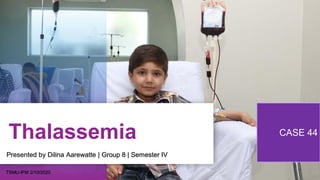
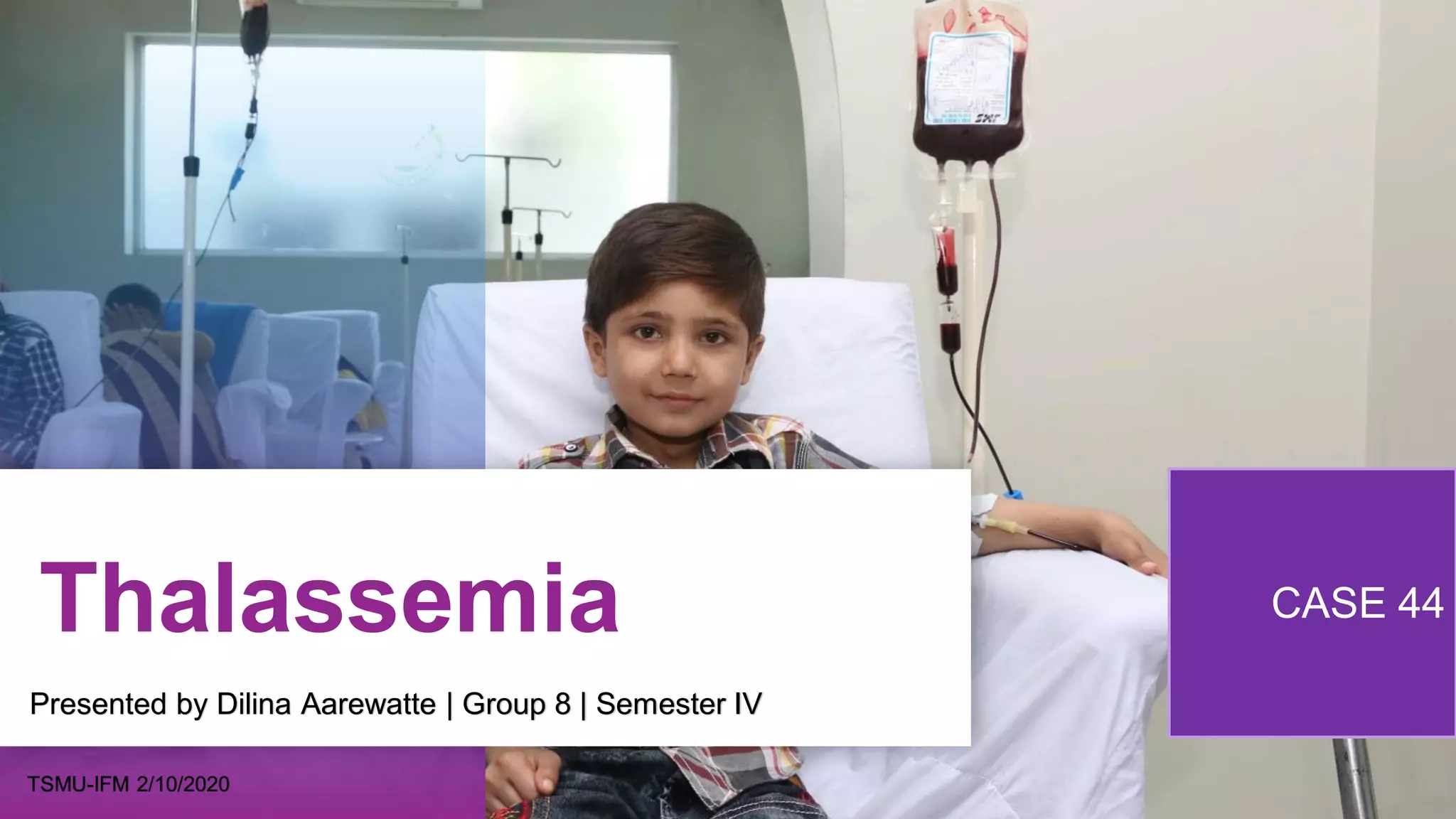
Thalassemia CASE 44
Presented by Dilina Aarewatte | Group 8 | Semester IV
TSMU-IFM 2/10/2020
The Case
▫ A 25 year old Healthy Canadian woman, presented to her
obstetrician for routine prenatal care.
▫ Results of her complete blood count showed signs of a mild
microcytic anemia
▫ Hemoglobin 98 g/L [ref.  121-151 g/L]
▫ Mean Corpuscular Volume 75 µm³ [ref.  87 ± 5]
History
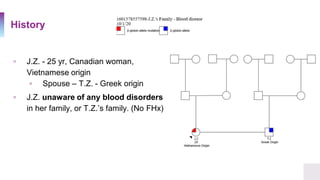
▫ J.Z. - 25 yr, Canadian woman,
Vietnamese origin
▫ Spouse – T.Z. - Greek origin
▫ J.Z. unaware of any blood disorders
in her family, or T.Z.’s family. (No FHx)
Investigations
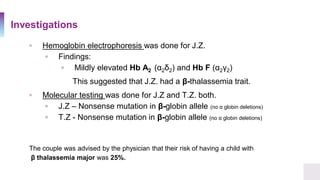
▫ Hemoglobin electrophoresis was done for J.Z.
▫ Findings:
▫ Mildly elevated Hb A2 (α2δ2) and Hb F (α2γ2)
This suggested that J.Z. had a β-thalassemia trait.
▫ Molecular testing was done for J.Z and T.Z. both.
▫ J.Z – Nonsense mutation in β-globin allele (no α globin deletions)
▫ T.Z - Nonsense mutation in β-globin allele (no α globin deletions)
The couple was advised by the physician that their risk of having a child with
β thalassemia major was 25%.
Etiology & Incidence
▫ Autosomal recessive disorder.
▫ Caused by the relative deficiency of α or β globin.
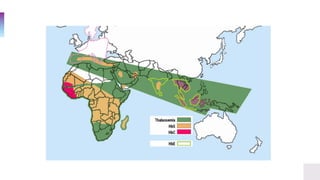
▫ Most common among Mediterranean, African, Middle
eastern, Indian, Chinese, and South-east Asian populations.
▫ Heterozygous advantage gives resistance to malaria.
Pathogenesis of Thalassemia
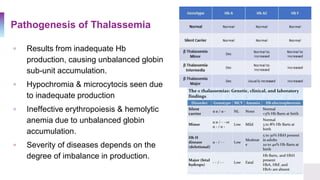
▫ Results from inadequate Hb
production, causing unbalanced globin
sub-unit accumulation.
▫ Hypochromia & microcytocis seen due
to inadequate production
▫ Ineffective erythropoiesis & hemolytic
anemia due to unbalanced globin
accumulation.
▫ Severity of diseases depends on the
degree of imbalance in production.
“▫ Although there are more than 200 different
mutations that can cause thalassemia, a few
mutations are seen in majority of the cases:
Deletion of α- globin genes – 80% of α-thalassemia
▫ 15 mutations cause 90% of β-thalassemia cases.
▫ These high frequencies are said to be due to selection.
Clinical Symptoms & Diagnosis
▫ In a population, the α-globin mutations are reflected by the
phenotypes observed in the population.
▫ Clinical symptoms
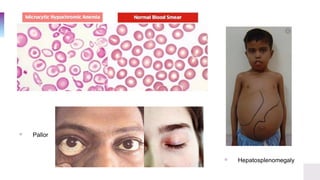
▫ Anemia [hypochromic
microcytic]
▫ Pallor
▫ Fatigue
▫ Hepatosplenomegaly
▫ Pallor
▫ In β thalassemia,
▫ Growth retardation,
▫ Mild bone marrow erythroid hyperplasia is foumd.
▫ Patients with β-thalassemia major present with severe
hemolytic anemia when postnatal decrease of Hb F occurs.
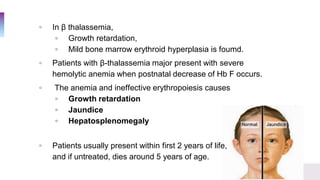
▫ The anemia and ineffective erythropoiesis causes
▫ Growth retardation
▫ Jaundice
▫ Hepatosplenomegaly
▫ Patients usually present within first 2 years of life,
and if untreated, dies around 5 years of age.
Newborn screening
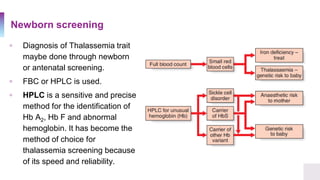
▫ Diagnosis of Thalassemia trait
maybe done through newborn
or antenatal screening.
▫ FBC or HPLC is used.
▫ HPLC is a sensitive and precise
method for the identification of
Hb A2, Hb F and abnormal
hemoglobin. It has become the
method of choice for
thalassemia screening because
of its speed and reliability.
Genetic methods of diagnosis
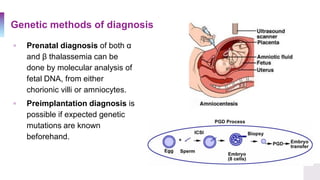
▫ Prenatal diagnosis of both α
and β thalassemia can be
done by molecular analysis of
fetal DNA, from either
chorionic villi or amniocytes.
▫ Preimplantation diagnosis is
possible if expected genetic
mutations are known
beforehand.
Treatment & management
▫ If increased levels of Hb A2 is found and iron deficiency
is ruled out, β thalassemia trait is confirmed. Treatment
for it includes
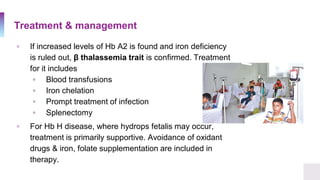
▫ Blood transfusions
▫ Iron chelation
▫ Prompt treatment of infection
▫ Splenectomy
▫ For Hb H disease, where hydrops fetalis may occur,
treatment is primarily supportive. Avoidance of oxidant
drugs & iron, folate supplementation are included in
therapy.
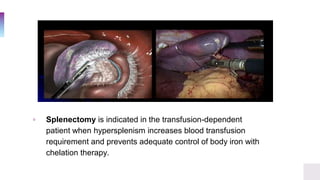
▫ Splenectomy is indicated in the transfusion-dependent
patient when hypersplenism increases blood transfusion
requirement and prevents adequate control of body iron with
chelation therapy.
Gene Therapy of Beta Thalassemia Using a Self-inactivating
Lentiviral Vector
▫ Currently, the only cure for thalassemia is bone marrow
transplantation from a related, compatible donor, which has,
however, the significant risk of transplant related mortality, graft
versus host disease and limited source.
▫ Therefore, gene transfer, achieved by transplantation of the
patient's own stem cells that have been genetically-modified with
the corrected gene, could potentially cure thalassemia.
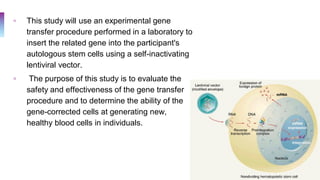
▫ This study will use an experimental gene
transfer procedure performed in a laboratory to
insert the related gene into the participant's
autologous stem cells using a self-inactivating
lentiviral vector.
▫ The purpose of this study is to evaluate the
safety and effectiveness of the gene transfer
procedure and to determine the ability of the
gene-corrected cells at generating new,
healthy blood cells in individuals.
Thank you!

Thalassemia Case Presentation

  • 1.
    Thalassemia CASE 44 Presentedby Dilina Aarewatte | Group 8 | Semester IV TSMU-IFM 2/10/2020
  • 2.
    The Case ▫ A25 year old Healthy Canadian woman, presented to her obstetrician for routine prenatal care. ▫ Results of her complete blood count showed signs of a mild microcytic anemia ▫ Hemoglobin 98 g/L [ref.  121-151 g/L] ▫ Mean Corpuscular Volume 75 µm³ [ref.  87 ± 5]
  • 3.
    History ▫ J.Z. -25 yr, Canadian woman, Vietnamese origin ▫ Spouse – T.Z. - Greek origin ▫ J.Z. unaware of any blood disorders in her family, or T.Z.’s family. (No FHx)
  • 4.
    Investigations ▫ Hemoglobin electrophoresiswas done for J.Z. ▫ Findings: ▫ Mildly elevated Hb A2 (α2δ2) and Hb F (α2γ2) This suggested that J.Z. had a β-thalassemia trait. ▫ Molecular testing was done for J.Z and T.Z. both. ▫ J.Z – Nonsense mutation in β-globin allele (no α globin deletions) ▫ T.Z - Nonsense mutation in β-globin allele (no α globin deletions) The couple was advised by the physician that their risk of having a child with β thalassemia major was 25%.
  • 5.
    Etiology & Incidence ▫Autosomal recessive disorder. ▫ Caused by the relative deficiency of α or β globin. ▫ Most common among Mediterranean, African, Middle eastern, Indian, Chinese, and South-east Asian populations. ▫ Heterozygous advantage gives resistance to malaria.
  • 7.
    Pathogenesis of Thalassemia ▫Results from inadequate Hb production, causing unbalanced globin sub-unit accumulation. ▫ Hypochromia & microcytocis seen due to inadequate production ▫ Ineffective erythropoiesis & hemolytic anemia due to unbalanced globin accumulation. ▫ Severity of diseases depends on the degree of imbalance in production.
  • 8.
    “▫ Although thereare more than 200 different mutations that can cause thalassemia, a few mutations are seen in majority of the cases: Deletion of α- globin genes – 80% of α-thalassemia ▫ 15 mutations cause 90% of β-thalassemia cases. ▫ These high frequencies are said to be due to selection.
  • 9.
    Clinical Symptoms &Diagnosis ▫ In a population, the α-globin mutations are reflected by the phenotypes observed in the population. ▫ Clinical symptoms ▫ Anemia [hypochromic microcytic] ▫ Pallor ▫ Fatigue ▫ Hepatosplenomegaly
  • 10.
  • 11.
    ▫ In βthalassemia, ▫ Growth retardation, ▫ Mild bone marrow erythroid hyperplasia is foumd. ▫ Patients with β-thalassemia major present with severe hemolytic anemia when postnatal decrease of Hb F occurs. ▫ The anemia and ineffective erythropoiesis causes ▫ Growth retardation ▫ Jaundice ▫ Hepatosplenomegaly ▫ Patients usually present within first 2 years of life, and if untreated, dies around 5 years of age.
  • 12.
    Newborn screening ▫ Diagnosisof Thalassemia trait maybe done through newborn or antenatal screening. ▫ FBC or HPLC is used. ▫ HPLC is a sensitive and precise method for the identification of Hb A2, Hb F and abnormal hemoglobin. It has become the method of choice for thalassemia screening because of its speed and reliability.
  • 13.
    Genetic methods ofdiagnosis ▫ Prenatal diagnosis of both α and β thalassemia can be done by molecular analysis of fetal DNA, from either chorionic villi or amniocytes. ▫ Preimplantation diagnosis is possible if expected genetic mutations are known beforehand.
  • 14.
    Treatment & management ▫If increased levels of Hb A2 is found and iron deficiency is ruled out, β thalassemia trait is confirmed. Treatment for it includes ▫ Blood transfusions ▫ Iron chelation ▫ Prompt treatment of infection ▫ Splenectomy ▫ For Hb H disease, where hydrops fetalis may occur, treatment is primarily supportive. Avoidance of oxidant drugs & iron, folate supplementation are included in therapy.
  • 15.
    ▫ Splenectomy isindicated in the transfusion-dependent patient when hypersplenism increases blood transfusion requirement and prevents adequate control of body iron with chelation therapy.
  • 16.
    Gene Therapy ofBeta Thalassemia Using a Self-inactivating Lentiviral Vector ▫ Currently, the only cure for thalassemia is bone marrow transplantation from a related, compatible donor, which has, however, the significant risk of transplant related mortality, graft versus host disease and limited source. ▫ Therefore, gene transfer, achieved by transplantation of the patient's own stem cells that have been genetically-modified with the corrected gene, could potentially cure thalassemia.
  • 17.
    ▫ This studywill use an experimental gene transfer procedure performed in a laboratory to insert the related gene into the participant's autologous stem cells using a self-inactivating lentiviral vector. ▫ The purpose of this study is to evaluate the safety and effectiveness of the gene transfer procedure and to determine the ability of the gene-corrected cells at generating new, healthy blood cells in individuals.
  • 18.