Contents
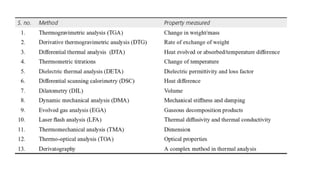
Thermogravimetry (TG),
Differential ThermalAnalysis(DTA)
Differential Scanning Calorimetry(DSC)
Thermometric Titrations.
Measurement of alpha, beta, and gamma radiations,
neutron activation analysis and its applications.
Principle and applications of isotope dilution methods.
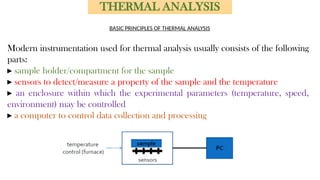
Modern instrumentation usedfor thermal analysis usually consists of the following
parts:
▸ sample holder/compartment for the sample
▸ sensors to detect/measure a property of the sample and the temperature
▸ an enclosure within which the experimental parameters (temperature, speed,
environment) may be controlled
▸ a computer to control data collection and processing
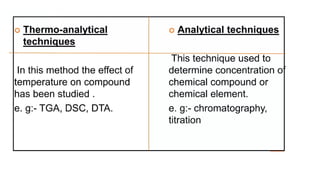
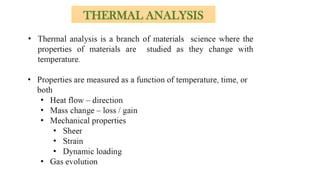
THERMAL ANALYSIS
BASIC PRINCIPLES OF THERMAL ANALYSIS
8.
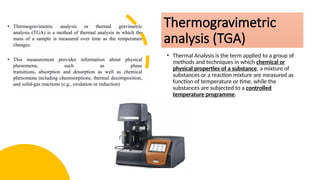
Thermogravimetric
analysis (TGA)
• ThermalAnalysis is the term applied to a group of
methods and techniques in which chemical or
physical properties of a substance, a mixture of
substances or a reaction mixture are measured as
function of temperature or time, while the
substances are subjected to a controlled
temperature programme.
10.
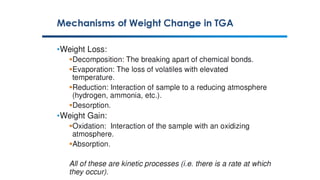
In thermo-gravimetricanalysis, the sample is heated in a given
environment (air, N2, CO2, He, Ar, etc.) at controlled rate. The change in
the weight of the substance is recorded as a function of temperature or
time.
The temperature is increased at a constant rate for a known initial weight
of the substance and the changes in weights are recorded as a function
of temperature at different time interval.
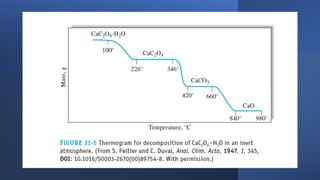
This plot of weight change against temperature is called thermo-
gravimetric curve or thermo-gram, this is the basic principle of TGA.
PRINCIPLE:
11.
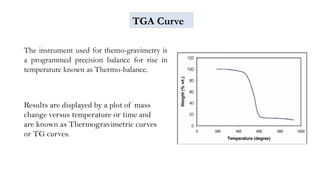
The instrument usedfor themo-gravimetry is
a programmed precision balance for rise in
temperature known as Thermo-balance.
TGA Curve
Results are displayed by a plot of mass
change versus temperature or time and
are known as Thermogravimetric curves
or TG curves.
12.
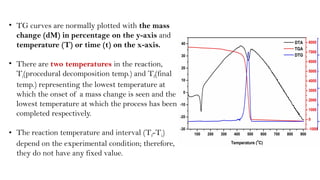
• TG curvesare normally plotted with the mass
change (dM) in percentage on the y-axis and
temperature (T) or time (t) on the x-axis.
• There are two temperatures in the reaction,
Ti(procedural decomposition temp.) and Tf(final
temp.) representing the lowest temperature at
which the onset of a mass change is seen and the
lowest temperature at which the process has been
completed respectively.
• The reaction temperature and interval (Tf-Ti)
depend on the experimental condition; therefore,
they do not have any fixed value.
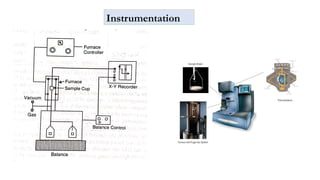
Weight Measurement: Thermobalance.
Weighing mechanism in TGA may be a modification of a
single or double pan balance, an electronically self-
balancing device, a torsion balance or a simple spring balance
depending upon the requirement.
For the preliminary work in the laboratory, a precision
torsion balance may be easily adopted for use as a
thermobalance.
The balance should have the following characteristics:
a. It should be simple to operate,
b. It should have an adjustable range of weight
change,
c. It should be able to respond rapidly to changes in
weight and
d. It should be rugged, accurate, very sensitive and
mechanically stable.
16.
b. Heating andtemperature measurement:
• The furnace design and control have taken various forms depending on the degree
of sophistication of the instrument.
• The main requirement is that the heating rate be smooth so that it can maintain
either a linear heating programme (10°-500°C per hr.) or a fixed temperature
• The simplest temperature programme is a variable transformer
• Platinum and tungsten windings are commonly used, the nichrome windings
permit a maximum temperature of 1100°C; a Pt-Rh, up to 1450°C, at least one
commercial instrument is capable of reaching about 1600°C.
• The size of the furnace is also very important. Small furnace cools very quickly
and it is difficult to control linear heating rate. Although large furnaces maintain
isothermal temperature and are suitable to maintain linear heating rate, but they
attain the required temperature very late
• The usual rate of heating is 4-5°C per minute
17.
The sample cups:
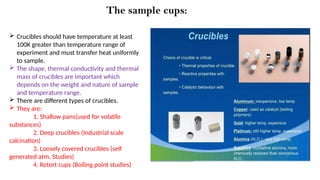
Crucibles should have temperature at least
100K greater than temperature range of
experiment and must transfer heat uniformly
to sample.
The shape, thermal conductivity and thermal
mass of crucibles are important which
depends on the weight and nature of sample
and temperature range.
There are different types of crucibles.
They are:
1. Shallow pans(used for volatile
substances)
2. Deep crucibles (Industrial scale
calcination)
3. Loosely covered crucibles (self
generated atm. Studies)
4. Retort cups (Boiling point studies)
18.
Atmosphere Control
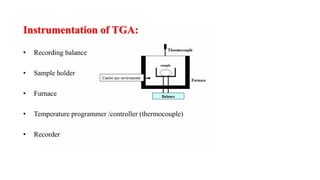
The recordingsystems are mainly of 2 types:
Time-base potentiometric strip chart recorder.
X-Y recorder- we get curves having plot of weights directly against temperatures
In some instruments, light beam galvanometer, photographic paper recorders or one
recorder with two or more pens are also used.
Recorder
The test samples are generally heated in the presence of an inert gas, in order to remove the gases
formed during sample heating and also to prevent the occurrence of any undesirable reactions.
The common atmospheres involved in thermogravimetry are as follows:‣
1. Static air: In this type air from atmosphere is allowed to flow through the furnace.
2. Dynamic air: In this type compressed air from a cylinder is allowed to pass through the furnace at a
measured flow rate.
3. Inert atmosphere: Nitrogen gas (oxygen free) is used as inert environment.
19.
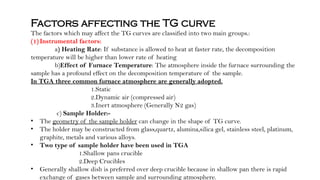
Factors affecting theTG curve
The factors which may affect the TG curves are classified into two main groups.:
(1) Instrumental factors:
a) Heating Rate: If substance is allowed to heat at faster rate, the decomposition
temperature will be higher than lower rate of heating
b)Effect of Furnace Temperature: The atmosphere inside the furnace surrounding the
sample has a profound effect on the decomposition temperature of the sample.
In TGA three common furnace atmosphere are generally adopted.
1.Static
2.Dynamic air (compressed air)
3.Inert atmosphere (Generally N2 gas)
c) Sample Holder:-
• The geometry of the sample holder can change in the shape of TG curve.
• The holder may be constructed from glass,quartz, alumina,silica gel, stainless steel, platinum,
graphite, metals and various alloys.
• Two type of sample holder have been used in TGA
1.Shallow pans crucible
2.Deep Crucibles
• Generally shallow dish is preferred over deep crucible because in shallow pan there is rapid
exchange of gases between sample and surrounding atmosphere.
20.
(11) Characteristics ofsample
1. Weight of sample : Large sample create a deviation from linearity in the temperature
rise, especially in fast exothermic reaction
2. Particle size of the sample: The rate of reaction is altered by using different particle
size and thus shape of TG curve is altered with particle size
3. Heat of reaction: Heat of reaction alter the difference between the sample temperature
and furnace temperature, therefore TG curve will change (Exothermic and endothermic)
4. Sample packing: A compressed sample will decompose at higher temperature than loose
sample
5. Nature of Sample packing: Magnesium hydroxide [ Mg(OH)2 ] prepared by
precipitation has a difference temperature of decomposition than that for the naturally
occurring Magnesium hydroxide [Mg(OH)2] material
23.
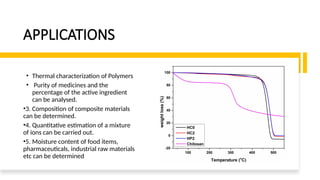
APPLICATIONS
• Thermal characterizationof Polymers
• Purity of medicines and the
percentage of the active ingredient
can be analysed.
•3. Composition of composite materials
can be determined.
•4. Quantitative estimation of a mixture
of ions can be carried out.
•5. Moisture content of food items,
pharmaceuticals, industrial raw materials
etc can be determined
24.
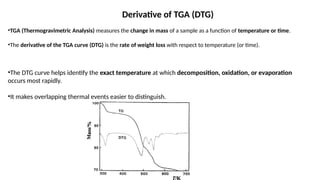
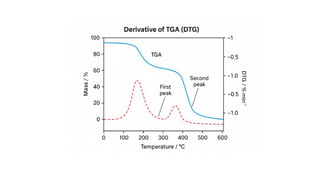
Derivative of TGA(DTG)
•TGA (Thermogravimetric Analysis) measures the change in mass of a sample as a function of temperature or time.
•The derivative of the TGA curve (DTG) is the rate of weight loss with respect to temperature (or time).
•The DTG curve helps identify the exact temperature at which decomposition, oxidation, or evaporation
occurs most rapidly.
•It makes overlapping thermal events easier to distinguish.
25.
Typical Features
•The TGAcurve shows gradual weight loss.
•The DTG curve shows peaks, each corresponding to a distinct thermal event:
• A sharp peak → rapid mass loss.
• A broad peak → slow or overlapping processes.
Example
•When analyzing a polymer composite:
• The first DTG peak (around 100°C) may indicate moisture loss.
• The second peak (around 300°C) may indicate polymer decomposition.
• A third peak (around 500°C) may represent chitosan or filler degradation.
Use in Materials Characterization
•DTG helps determine:
• Thermal stability
• Decomposition temperature
• Kinetic parameters
• Number of degradation steps
![(11) Characteristics of sample
1. Weight of sample : Large sample create a deviation from linearity in the temperature
rise, especially in fast exothermic reaction
2. Particle size of the sample: The rate of reaction is altered by using different particle
size and thus shape of TG curve is altered with particle size
3. Heat of reaction: Heat of reaction alter the difference between the sample temperature
and furnace temperature, therefore TG curve will change (Exothermic and endothermic)
4. Sample packing: A compressed sample will decompose at higher temperature than loose
sample
5. Nature of Sample packing: Magnesium hydroxide [ Mg(OH)2 ] prepared by
precipitation has a difference temperature of decomposition than that for the naturally
occurring Magnesium hydroxide [Mg(OH)2] material](https://image.slidesharecdn.com/tga-260119012733-d9d1190a/85/TGA-application-uses-theory-figure-structure-pptx-20-320.jpg)