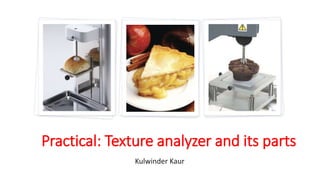
Practical: Texture analyzer and its parts
Kulwinder Kaur
Texture analyzer
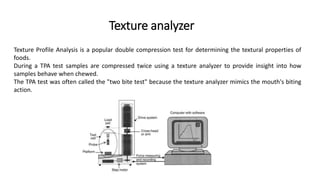
Texture Profile Analysis is a popular double compression test for determining the textural properties of
foods.
During a TPA test samples are compressed twice using a texture analyzer to provide insight into how
samples behave when chewed.
The TPA test was often called the "two bite test" because the texture analyzer mimics the mouth's biting
action.
Output of texture analyzer
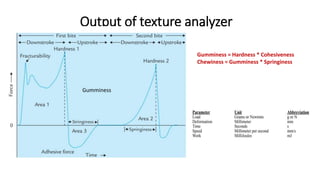
Gumminess
Gumminess = Hardness * Cohesiveness
Chewiness = Gumminess * Springiness
Mechanism of texture analyzer
• The principle of a texture measurement system is physically deforming a
test sample in a controlled manner and measuring its response.
• Characteristics of the force response are the result of the sample's
mechanical properties, that correlate to specific sensory texture attributes.
• Forces created during this movement are manipulated to recreate
consumer interactions. For example, the conditions that foods are exposed
to when eaten or processed.
• There are some fundamental test methods designed to deform samples in
ways that simulate complex human interactions and replicate such
conditions. We have a wide range of standard and customized fixtures for
such test types.
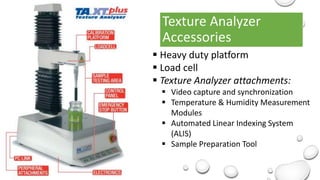
Texture Analyzer
Accessories
 Heavy duty platform
 Load cell
 Texture Analyzer attachments:
 Video capture and synchronization
 Temperature & Humidity Measurement
Modules
 Automated Linear Indexing System
(ALIS)
 Sample Preparation Tool
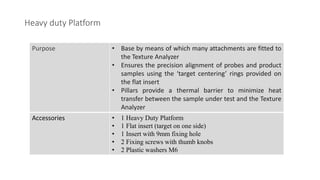
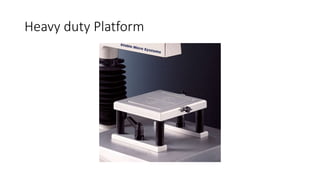
Heavy duty Platform
Purpose • Base by means of which many attachments are fitted to
the Texture Analyzer
• Ensures the precision alignment of probes and product
samples using the ‘target centering’ rings provided on
the flat insert
• Pillars provide a thermal barrier to minimize heat
transfer between the sample under test and the Texture
Analyzer
Accessories • 1 Heavy Duty Platform
• 1 Flat insert (target on one side)
• 1 Insert with 9mm fixing hole
• 2 Fixing screws with thumb knobs
• 2 Plastic washers M6
Heavy duty Platform
Load cells
• Texture Analyzer can be used with the following capacity load cells:
500 grams, 5 kilos, 10 kilos, 30 kilos or 50 kilos.
• load cells are calibrated with forces that are closer to the expected
target force.
Type of tests performed (Objective test)
• Penetration Test
• Compression Test
• Cutting/Shearing Test
• Extrusion Test
• Bending Test
• Fracturbility test
• Tension test
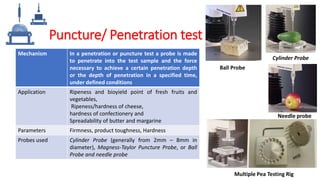
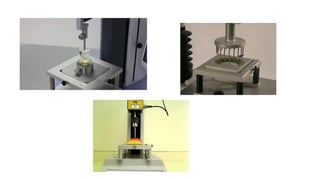
Puncture/ Penetration test
Mechanism In a penetration or puncture test a probe is made
to penetrate into the test sample and the force
necessary to achieve a certain penetration depth
or the depth of penetration in a specified time,
under defined conditions
Application Ripeness and bioyield point of fresh fruits and
vegetables,
Ripeness/hardness of cheese,
hardness of confectionery and
Spreadability of butter and margarine
Parameters Firmness, product toughness, Hardness
Probes used Cylinder Probe (generally from 2mm – 8mm in
diameter), Magness-Taylor Puncture Probe, or Ball
Probe and needle probe
Cylinder Probe
Ball Probe
Needle probe
Multiple Pea Testing Rig
Compression Test
Mechanism sample is placed on a flat base/surface and a flat
probe/platen is lowered onto the sample to a
given force or distance (or the sample is
compressed to a percentage of its original height).
Application Fruit and vegetables, puffed cereals, cakes and
biscuits, confectionery and pharmaceuticals
Parameters Compressibility, compactability, springiness, stress
relaxation, creep compliance, crush strength,
firmness, elastic recovery
Probes used Cylindrical probe or a flat plate/platen
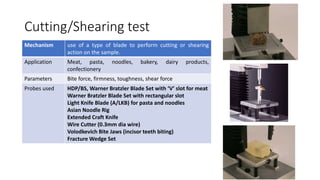
Cutting/Shearing test
Mechanism use of a type of blade to perform cutting or shearing
action on the sample.
Application Meat, pasta, noodles, bakery, dairy products,
confectionery
Parameters Bite force, firmness, toughness, shear force
Probes used HDP/BS, Warner Bratzler Blade Set with ‘V’ slot for meat
Warner Bratzler Blade Set with rectangular slot
Light Knife Blade (A/LKB) for pasta and noodles
Asian Noodle Rig
Extended Craft Knife
Wire Cutter (0.3mm dia wire)
Volodkevich Bite Jaws (incisor teeth biting)
Fracture Wedge Set
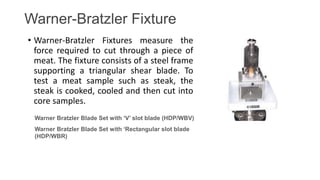
Warner-Bratzler Fixture
• Warner-Bratzler Fixtures measure the
force required to cut through a piece of
meat. The fixture consists of a steel frame
supporting a triangular shear blade. To
test a meat sample such as steak, the
steak is cooked, cooled and then cut into
core samples.
Warner Bratzler Blade Set with ‘Rectangular slot blade
(HDP/WBR)
Warner Bratzler Blade Set with ‘V’ slot blade (HDP/WBV)
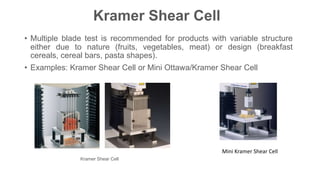
Kramer Shear Cell
• Multiple blade test is recommended for products with variable structure
either due to nature (fruits, vegetables, meat) or design (breakfast
cereals, cereal bars, pasta shapes).
• Examples: Kramer Shear Cell or Mini Ottawa/Kramer Shear Cell
Kramer Shear Cell
Mini Kramer Shear Cell
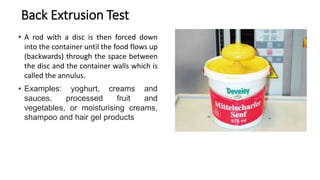
Back Extrusion Test
• A rod with a disc is then forced down
into the container until the food flows up
(backwards) through the space between
the disc and the container walls which is
called the annulus.
• Examples: yoghurt, creams and
sauces, processed fruit and
vegetables, or moisturising creams,
shampoo and hair gel products
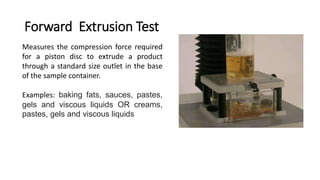
Forward Extrusion Test
Measures the compression force required
for a piston disc to extrude a product
through a standard size outlet in the base
of the sample container.
Examples: baking fats, sauces, pastes,
gels and viscous liquids OR creams,
pastes, gels and viscous liquids
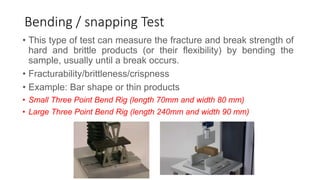
Bending / snapping Test
• This type of test can measure the fracture and break strength of
hard and brittle products (or their flexibility) by bending the
sample, usually until a break occurs.
• Fracturability/brittleness/crispness
• Example: Bar shape or thin products
• Small Three Point Bend Rig (length 70mm and width 80 mm)
• Large Three Point Bend Rig (length 240mm and width 90 mm)
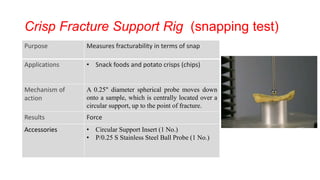
Crisp Fracture Support Rig (snapping test)
Purpose Measures fracturability in terms of snap
Applications • Snack foods and potato crisps (chips)
Mechanism of
action
A 0.25" diameter spherical probe moves down
onto a sample, which is centrally located over a
circular support, up to the point of fracture.
Results Force
Accessories • Circular Support Insert (1 No.)
• P/0.25 S Stainless Steel Ball Probe (1 No.)
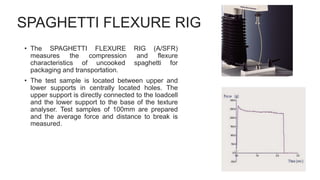
SPAGHETTI FLEXURE RIG
• The SPAGHETTI FLEXURE RIG (A/SFR)
measures the compression and flexure
characteristics of uncooked spaghetti for
packaging and transportation.
• The test sample is located between upper and
lower supports in centrally located holes. The
upper support is directly connected to the loadcell
and the lower support to the base of the texture
analyser. Test samples of 100mm are prepared
and the average force and distance to break is
measured.
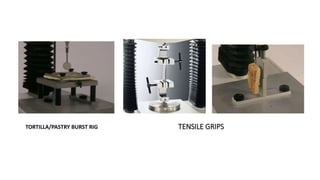
Tension test
• A tensile test pulls or stretches a sample and as a result the extensibility/elongation and tensile
strength properties are measured in terms of force required to stretch and distance or time upto
which something can be stretched to.
• The specimen is gripped at either end and stretched until it breaks. This is uniaxial tension.
• Another approach is to perform a bi-axial tensile test where the sample is held like a circular drum
skin and stretched in all directions by forcing a ball probe through the centre. This type of testing is
popular for testing films and certain foods e.g. tortillas where the measurement of burst strength is
required.
• e.g. films, dough, gels, spaghetti, confectionery , packaging materials and adhesives
TENSILE GRIPSTORTILLA/PASTRY BURST RIG
THANKYOU

texture analyzer and its accessories

  • 1.
    Practical: Texture analyzerand its parts Kulwinder Kaur
  • 2.
    Texture analyzer Texture ProfileAnalysis is a popular double compression test for determining the textural properties of foods. During a TPA test samples are compressed twice using a texture analyzer to provide insight into how samples behave when chewed. The TPA test was often called the "two bite test" because the texture analyzer mimics the mouth's biting action.
  • 3.
    Output of textureanalyzer Gumminess Gumminess = Hardness * Cohesiveness Chewiness = Gumminess * Springiness
  • 4.
    Mechanism of textureanalyzer • The principle of a texture measurement system is physically deforming a test sample in a controlled manner and measuring its response. • Characteristics of the force response are the result of the sample's mechanical properties, that correlate to specific sensory texture attributes. • Forces created during this movement are manipulated to recreate consumer interactions. For example, the conditions that foods are exposed to when eaten or processed. • There are some fundamental test methods designed to deform samples in ways that simulate complex human interactions and replicate such conditions. We have a wide range of standard and customized fixtures for such test types.
  • 5.
    Texture Analyzer Accessories  Heavyduty platform  Load cell  Texture Analyzer attachments:  Video capture and synchronization  Temperature & Humidity Measurement Modules  Automated Linear Indexing System (ALIS)  Sample Preparation Tool
  • 6.
    Heavy duty Platform Purpose• Base by means of which many attachments are fitted to the Texture Analyzer • Ensures the precision alignment of probes and product samples using the ‘target centering’ rings provided on the flat insert • Pillars provide a thermal barrier to minimize heat transfer between the sample under test and the Texture Analyzer Accessories • 1 Heavy Duty Platform • 1 Flat insert (target on one side) • 1 Insert with 9mm fixing hole • 2 Fixing screws with thumb knobs • 2 Plastic washers M6
  • 7.
  • 8.
    Load cells • TextureAnalyzer can be used with the following capacity load cells: 500 grams, 5 kilos, 10 kilos, 30 kilos or 50 kilos. • load cells are calibrated with forces that are closer to the expected target force.
  • 9.
    Type of testsperformed (Objective test) • Penetration Test • Compression Test • Cutting/Shearing Test • Extrusion Test • Bending Test • Fracturbility test • Tension test
  • 10.
    Puncture/ Penetration test MechanismIn a penetration or puncture test a probe is made to penetrate into the test sample and the force necessary to achieve a certain penetration depth or the depth of penetration in a specified time, under defined conditions Application Ripeness and bioyield point of fresh fruits and vegetables, Ripeness/hardness of cheese, hardness of confectionery and Spreadability of butter and margarine Parameters Firmness, product toughness, Hardness Probes used Cylinder Probe (generally from 2mm – 8mm in diameter), Magness-Taylor Puncture Probe, or Ball Probe and needle probe Cylinder Probe Ball Probe Needle probe Multiple Pea Testing Rig
  • 12.
    Compression Test Mechanism sampleis placed on a flat base/surface and a flat probe/platen is lowered onto the sample to a given force or distance (or the sample is compressed to a percentage of its original height). Application Fruit and vegetables, puffed cereals, cakes and biscuits, confectionery and pharmaceuticals Parameters Compressibility, compactability, springiness, stress relaxation, creep compliance, crush strength, firmness, elastic recovery Probes used Cylindrical probe or a flat plate/platen
  • 13.
    Cutting/Shearing test Mechanism useof a type of blade to perform cutting or shearing action on the sample. Application Meat, pasta, noodles, bakery, dairy products, confectionery Parameters Bite force, firmness, toughness, shear force Probes used HDP/BS, Warner Bratzler Blade Set with ‘V’ slot for meat Warner Bratzler Blade Set with rectangular slot Light Knife Blade (A/LKB) for pasta and noodles Asian Noodle Rig Extended Craft Knife Wire Cutter (0.3mm dia wire) Volodkevich Bite Jaws (incisor teeth biting) Fracture Wedge Set
  • 14.
    Warner-Bratzler Fixture • Warner-BratzlerFixtures measure the force required to cut through a piece of meat. The fixture consists of a steel frame supporting a triangular shear blade. To test a meat sample such as steak, the steak is cooked, cooled and then cut into core samples. Warner Bratzler Blade Set with ‘Rectangular slot blade (HDP/WBR) Warner Bratzler Blade Set with ‘V’ slot blade (HDP/WBV)
  • 15.
    Kramer Shear Cell •Multiple blade test is recommended for products with variable structure either due to nature (fruits, vegetables, meat) or design (breakfast cereals, cereal bars, pasta shapes). • Examples: Kramer Shear Cell or Mini Ottawa/Kramer Shear Cell Kramer Shear Cell Mini Kramer Shear Cell
  • 16.
    Back Extrusion Test •A rod with a disc is then forced down into the container until the food flows up (backwards) through the space between the disc and the container walls which is called the annulus. • Examples: yoghurt, creams and sauces, processed fruit and vegetables, or moisturising creams, shampoo and hair gel products
  • 17.
    Forward Extrusion Test Measuresthe compression force required for a piston disc to extrude a product through a standard size outlet in the base of the sample container. Examples: baking fats, sauces, pastes, gels and viscous liquids OR creams, pastes, gels and viscous liquids
  • 18.
    Bending / snappingTest • This type of test can measure the fracture and break strength of hard and brittle products (or their flexibility) by bending the sample, usually until a break occurs. • Fracturability/brittleness/crispness • Example: Bar shape or thin products • Small Three Point Bend Rig (length 70mm and width 80 mm) • Large Three Point Bend Rig (length 240mm and width 90 mm)
  • 19.
    Crisp Fracture SupportRig (snapping test) Purpose Measures fracturability in terms of snap Applications • Snack foods and potato crisps (chips) Mechanism of action A 0.25" diameter spherical probe moves down onto a sample, which is centrally located over a circular support, up to the point of fracture. Results Force Accessories • Circular Support Insert (1 No.) • P/0.25 S Stainless Steel Ball Probe (1 No.)
  • 20.
    SPAGHETTI FLEXURE RIG •The SPAGHETTI FLEXURE RIG (A/SFR) measures the compression and flexure characteristics of uncooked spaghetti for packaging and transportation. • The test sample is located between upper and lower supports in centrally located holes. The upper support is directly connected to the loadcell and the lower support to the base of the texture analyser. Test samples of 100mm are prepared and the average force and distance to break is measured.
  • 21.
    Tension test • Atensile test pulls or stretches a sample and as a result the extensibility/elongation and tensile strength properties are measured in terms of force required to stretch and distance or time upto which something can be stretched to. • The specimen is gripped at either end and stretched until it breaks. This is uniaxial tension. • Another approach is to perform a bi-axial tensile test where the sample is held like a circular drum skin and stretched in all directions by forcing a ball probe through the centre. This type of testing is popular for testing films and certain foods e.g. tortillas where the measurement of burst strength is required. • e.g. films, dough, gels, spaghetti, confectionery , packaging materials and adhesives
  • 22.
  • 23.

Editor's Notes