SRI KRISHNA ARTS AND SCIENCE COLLEGE
DEPARTMENT OF COSTUME DESIGN AND
FASHION
TEXTILE WET PROCESSING
Faculty: V.A.Rinsey Antony
TEXTILE WET PROCESSING
 Color is one of the most significant
factors in the appeal and
marketability of textile products.
 Color can be added to textile
objects by either dyes or pigments.
 Most colored textiles is achieved by
dye or pigment mixtures rather than
a single dye or pigment.
Unit 1 - Introduction 3
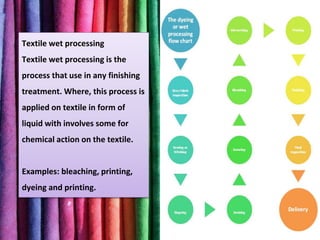
Textile wet processing
Textile wet processing is the
process that use in any finishing
treatment. Where, this process is
applied on textile in form of
liquid with involves some for
chemical action on the textile.
Examples: bleaching, printing,
dyeing and printing.
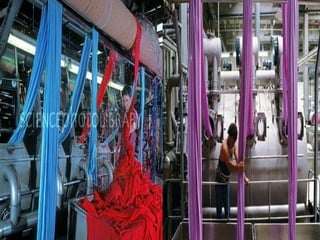
Dyeing
 Dyeing is a method which imparts beauty to the
fabric by applying various colors and their
shades.
 Dyeing operations are used at various stages of
production to add color and intricacy to textiles
and increase product value.
 It chemically changes a substance so that the
reflecting light appears coloured .
 The property of color fastness depends upon
two factors- selection of proper dye and
selection of the method for dyeing the fiber,
yarn or fabric.
 Dyes are used for coloring the fabrics.
 Dyes are molecules which absorb and reflect light at specific
wavelengths to give human eyes the sense of color.
 There are two major types of dyes - natural and synthetic
dyes.
 The natural dyes are extracted from natural substances such
as plants, animals, or minerals.
 Synthetic dyes are made in a laboratory. Chemicals are
synthesized for making synthetic dyes. Some of the synthetic
dyes contain metals too.
 Dyeing processes may take place at any of several stages of
the manufacturing process (fibers, yarn, piece-dyeing). Stock
dyeing is used to dye fibers.
 Top dyeing is used to dye combed wool sliver.
Batik
 resist dyeing process- designs - made with
wax on a fabric which is subsequently
immersed in a dye to absorb the colour on
the un-waxed portions - batik dyeing.
 done notably in India, Japan and Indonesia.
 patterns - geometric, moral, bird or animal
motifs.
 melted wax mixed with resin - traced on the
areas not to dyed with a tjanting- small
instrument - short, straight reed handle -
attached a small, funnel shaped copper cub
with one or more spouts.
 After application of wax, the fabric is dipped
into dye - particular colour desired.
 After dye - fixed - material dried- cloth is boiled
and rinsed - remove the wax.
 Any traces of wax remaining - scraped off.
 primary colours used -red, yellow, blue /blacks
and white.
 light and dark shades - brown, green, violet,
orange and pink - also used.
 method light colours - applied first followed by
the wax; the deeper shades are then built in.
Kalamkari
 The finest of Indian art textiles all over the world - exquisiteness
almost to a point of magic - category of cotton fabrics.
 term kalamkari originates - Persian Words Kalam or pen brush
and Kari or workmanship literally implying pen-work.
 Kalamkari - wax resists process in which dyeing printing and
painting with a pen brush .
 process of kalamkari - elaborate and intricate.
 kalam - nothing but a bunch of soft wires tied to a wooden piece
to act as a handle.
 Painting - application of dye material to the surface of the fabric.
 depicted sporting scenes, moral sprays, tree panels, birds,
animals and floriated rides.
 Colours used were lustrous red, black, indigo, green, yellow, dusty
pink and purple, brown and off white.
Tie and Dye
 fabric - tie and dyed keeping in mind the
design, created Bandhani and bandha are
the Sanskrit words meaning ‘to tie”.
 Rajasthan and Gujarat - famed -
production of the Bandhani.
 Knots that are tied in the cloth before it is
immersed in the dye bath resist the dye.
 The material used is cotton, silk and
georgette.
Patola
 the loveliest contributions of the Indian craftsmen to the
domain of world art fabric is the Patola.
 It originated in Gujarat around 4th century B.C. in Patola,
the material - silk - colorful and intricately ornamented.
 also called as lkat.
 process of resist dyeing - sequence of tying and dyeing
sections of bundled yarn - predetermined colour schemes
before weaving. Both warp and weft threads- tied and
dyed with precision
 dye penetrates - exposed sections - tied sections remain
undyed.
 patterns formed - on the yarn are then woven into fabric.
 characterized by their bold, grid based patterns with
intricate geometrical, moral and figurative motifs.
 Ikat - spreads at Pochampalli of Andhra Pradesh and Orissa.
Printing
 Textile printing is the process of applying colour to fabric in
definite patterns or designs.
 In properly printed fabrics the colour is bonded with the
fiber, so as to resist washing and friction.
 Textile printing is related to dyeing but, whereas in dyeing
proper the whole fabric is uniformly covered with one
colour, in printing one or more colours are applied to it in
certain parts only, and in sharply defined patterns.
 In printing, wooden blocks, stencils, engraved plates, rollers,
or silkscreens can be used to place colours on the fabric.
 Colourants used in printing contain dyes thickened to
prevent the colour from spreading by capillary attraction
beyond the limits of the pattern or design.
Styles of Printing
 Direct printing, - colourants containing dyes, thickeners, and
the mordants or substances necessary for fixing the colour
on the cloth are printed in the desired pattern.
 Mordant printing - printing of a mordant in the desired
pattern prior to dyeing cloth; the color adheres only where
the mordant was printed.
 Resist dyeing - wax or other substance is printed onto fabric
which is subsequently dyed. The waxed areas do not accept
the dye, leaving uncoloured patterns against a coloured
ground.
 Discharge printing, - bleaching agent is printed onto
previously dyed fabrics to remove some or all of the colour.
Types of Printing
Printing Methods
Block Printing
 oldest method - printing designs on fabric is
block printing by hand.
 found chiefly in decorative pieces for the home
of inexpensive linens for upholstery purposes.
 design - first carved - wooden or metal block.
 dyestuff - applied - paste form to the design on
the surface of the block.
 block - pressed firmly by hand on selected
portions of the surface of the fabric, imprinting
the carved designs as many times as desired on
a specific length of cloth.
 variation of colour - same design as many
additional blocks - carved as there will be
nd Block Printing
Hand block printing is one
such technique, which
involves carving a
desired pattern or
design on a wooden
block, covering this
block with ink or dye
and then stamping it on
the fabric. While blocks
can be made up of stone;
but for better results they
are more commonly made
from wood.
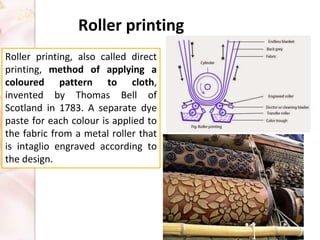
Roller printing, also called direct
printing, method of applying a
coloured pattern to cloth,
invented by Thomas Bell of
Scotland in 1783. A separate dye
paste for each colour is applied to
the fabric from a metal roller that
is intaglio engraved according to
the design.
Roller printing
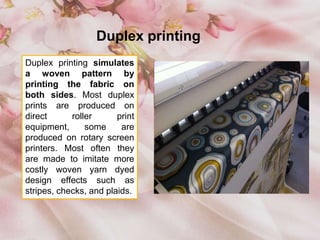
Duplex printing simulates
a woven pattern by
printing the fabric on
both sides. Most duplex
prints are produced on
direct roller print
equipment, some are
produced on rotary screen
printers. Most often they
are made to imitate more
costly woven yarn dyed
design effects such as
stripes, checks, and plaids.
Duplex printing
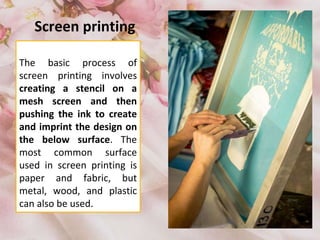
The basic process of
screen printing involves
creating a stencil on a
mesh screen and then
pushing the ink to create
and imprint the design on
the below surface. The
most common surface
used in screen printing is
paper and fabric, but
metal, wood, and plastic
can also be used.
Screen printing
Stencil Printing
 originated in Japan.
 Its high cost limit in use.
 In stencil printing, the design must
first be cut in cardboard wood or
metal.
 stencil - fine, delicate design/ large
spaces -great amount - colour -
applied.
 multiple colours - individual stencil
-prepared.
Difference between dyeing and
printing
DYEING
 Dyeing is the process when the fabric
absorbs the dye
 Uniform application on both sides
of the fabric surface with single color
only.
 Dyes are applied in dilute form
 In fabric preparation, Half bleaching
is enough.
 Color penetrates through the fabric.
 More time is required in batch
application.
 Fabric need not be in dry condition
 Requires single machine and the
process is simple
 Dyeing consumes more water
PRINTING
 Printing is basically a stamp on the
fabric.
 Single or multicolor application on
one side of the fabric at selected
portions only.
 Dyes are applied in paste form
 Full-bleaching with optical whitener
is necessary
 Color is applied only on the surface.
 Not applied in batch process. Applied
only by continuous process alone.
Therefore requires less time
 Fabric should be in dry state
 Requires complex machinery and the
process is also complex.
 Printing consumes less water
 Thank you………………….

TEXTILE WET PROCESSING.pptx

  • 1.
    SRI KRISHNA ARTSAND SCIENCE COLLEGE DEPARTMENT OF COSTUME DESIGN AND FASHION TEXTILE WET PROCESSING Faculty: V.A.Rinsey Antony
  • 2.
    TEXTILE WET PROCESSING Color is one of the most significant factors in the appeal and marketability of textile products.  Color can be added to textile objects by either dyes or pigments.  Most colored textiles is achieved by dye or pigment mixtures rather than a single dye or pigment.
  • 3.
    Unit 1 -Introduction 3 Textile wet processing Textile wet processing is the process that use in any finishing treatment. Where, this process is applied on textile in form of liquid with involves some for chemical action on the textile. Examples: bleaching, printing, dyeing and printing.
  • 4.
    Dyeing  Dyeing isa method which imparts beauty to the fabric by applying various colors and their shades.  Dyeing operations are used at various stages of production to add color and intricacy to textiles and increase product value.  It chemically changes a substance so that the reflecting light appears coloured .  The property of color fastness depends upon two factors- selection of proper dye and selection of the method for dyeing the fiber, yarn or fabric.
  • 5.
     Dyes areused for coloring the fabrics.  Dyes are molecules which absorb and reflect light at specific wavelengths to give human eyes the sense of color.  There are two major types of dyes - natural and synthetic dyes.  The natural dyes are extracted from natural substances such as plants, animals, or minerals.  Synthetic dyes are made in a laboratory. Chemicals are synthesized for making synthetic dyes. Some of the synthetic dyes contain metals too.  Dyeing processes may take place at any of several stages of the manufacturing process (fibers, yarn, piece-dyeing). Stock dyeing is used to dye fibers.  Top dyeing is used to dye combed wool sliver.
  • 7.
    Batik  resist dyeingprocess- designs - made with wax on a fabric which is subsequently immersed in a dye to absorb the colour on the un-waxed portions - batik dyeing.  done notably in India, Japan and Indonesia.  patterns - geometric, moral, bird or animal motifs.  melted wax mixed with resin - traced on the areas not to dyed with a tjanting- small instrument - short, straight reed handle - attached a small, funnel shaped copper cub with one or more spouts.
  • 8.
     After applicationof wax, the fabric is dipped into dye - particular colour desired.  After dye - fixed - material dried- cloth is boiled and rinsed - remove the wax.  Any traces of wax remaining - scraped off.  primary colours used -red, yellow, blue /blacks and white.  light and dark shades - brown, green, violet, orange and pink - also used.  method light colours - applied first followed by the wax; the deeper shades are then built in.
  • 10.
    Kalamkari  The finestof Indian art textiles all over the world - exquisiteness almost to a point of magic - category of cotton fabrics.  term kalamkari originates - Persian Words Kalam or pen brush and Kari or workmanship literally implying pen-work.  Kalamkari - wax resists process in which dyeing printing and painting with a pen brush .  process of kalamkari - elaborate and intricate.  kalam - nothing but a bunch of soft wires tied to a wooden piece to act as a handle.  Painting - application of dye material to the surface of the fabric.  depicted sporting scenes, moral sprays, tree panels, birds, animals and floriated rides.  Colours used were lustrous red, black, indigo, green, yellow, dusty pink and purple, brown and off white.
  • 12.
    Tie and Dye fabric - tie and dyed keeping in mind the design, created Bandhani and bandha are the Sanskrit words meaning ‘to tie”.  Rajasthan and Gujarat - famed - production of the Bandhani.  Knots that are tied in the cloth before it is immersed in the dye bath resist the dye.  The material used is cotton, silk and georgette.
  • 14.
    Patola  the loveliestcontributions of the Indian craftsmen to the domain of world art fabric is the Patola.  It originated in Gujarat around 4th century B.C. in Patola, the material - silk - colorful and intricately ornamented.  also called as lkat.  process of resist dyeing - sequence of tying and dyeing sections of bundled yarn - predetermined colour schemes before weaving. Both warp and weft threads- tied and dyed with precision  dye penetrates - exposed sections - tied sections remain undyed.  patterns formed - on the yarn are then woven into fabric.  characterized by their bold, grid based patterns with intricate geometrical, moral and figurative motifs.  Ikat - spreads at Pochampalli of Andhra Pradesh and Orissa.
  • 15.
    Printing  Textile printingis the process of applying colour to fabric in definite patterns or designs.  In properly printed fabrics the colour is bonded with the fiber, so as to resist washing and friction.  Textile printing is related to dyeing but, whereas in dyeing proper the whole fabric is uniformly covered with one colour, in printing one or more colours are applied to it in certain parts only, and in sharply defined patterns.  In printing, wooden blocks, stencils, engraved plates, rollers, or silkscreens can be used to place colours on the fabric.  Colourants used in printing contain dyes thickened to prevent the colour from spreading by capillary attraction beyond the limits of the pattern or design.
  • 16.
    Styles of Printing Direct printing, - colourants containing dyes, thickeners, and the mordants or substances necessary for fixing the colour on the cloth are printed in the desired pattern.  Mordant printing - printing of a mordant in the desired pattern prior to dyeing cloth; the color adheres only where the mordant was printed.  Resist dyeing - wax or other substance is printed onto fabric which is subsequently dyed. The waxed areas do not accept the dye, leaving uncoloured patterns against a coloured ground.  Discharge printing, - bleaching agent is printed onto previously dyed fabrics to remove some or all of the colour.
  • 17.
  • 18.
    Block Printing  oldestmethod - printing designs on fabric is block printing by hand.  found chiefly in decorative pieces for the home of inexpensive linens for upholstery purposes.  design - first carved - wooden or metal block.  dyestuff - applied - paste form to the design on the surface of the block.  block - pressed firmly by hand on selected portions of the surface of the fabric, imprinting the carved designs as many times as desired on a specific length of cloth.  variation of colour - same design as many additional blocks - carved as there will be
  • 19.
    nd Block Printing Handblock printing is one such technique, which involves carving a desired pattern or design on a wooden block, covering this block with ink or dye and then stamping it on the fabric. While blocks can be made up of stone; but for better results they are more commonly made from wood.
  • 20.
    Roller printing, alsocalled direct printing, method of applying a coloured pattern to cloth, invented by Thomas Bell of Scotland in 1783. A separate dye paste for each colour is applied to the fabric from a metal roller that is intaglio engraved according to the design. Roller printing
  • 21.
    Duplex printing simulates awoven pattern by printing the fabric on both sides. Most duplex prints are produced on direct roller print equipment, some are produced on rotary screen printers. Most often they are made to imitate more costly woven yarn dyed design effects such as stripes, checks, and plaids. Duplex printing
  • 22.
    The basic processof screen printing involves creating a stencil on a mesh screen and then pushing the ink to create and imprint the design on the below surface. The most common surface used in screen printing is paper and fabric, but metal, wood, and plastic can also be used. Screen printing
  • 23.
    Stencil Printing  originatedin Japan.  Its high cost limit in use.  In stencil printing, the design must first be cut in cardboard wood or metal.  stencil - fine, delicate design/ large spaces -great amount - colour - applied.  multiple colours - individual stencil -prepared.
  • 25.
    Difference between dyeingand printing DYEING  Dyeing is the process when the fabric absorbs the dye  Uniform application on both sides of the fabric surface with single color only.  Dyes are applied in dilute form  In fabric preparation, Half bleaching is enough.  Color penetrates through the fabric.  More time is required in batch application.  Fabric need not be in dry condition  Requires single machine and the process is simple  Dyeing consumes more water PRINTING  Printing is basically a stamp on the fabric.  Single or multicolor application on one side of the fabric at selected portions only.  Dyes are applied in paste form  Full-bleaching with optical whitener is necessary  Color is applied only on the surface.  Not applied in batch process. Applied only by continuous process alone. Therefore requires less time  Fabric should be in dry state  Requires complex machinery and the process is also complex.  Printing consumes less water
  • 26.