
Chapter 3: Textile Plant Layout
3.1. Basic concepts of plant layout
 Definition
 Need of plant layout
 Factors affecting plant layout
 Objectives of good plant layout
 Principles of plant layout
3.2. Types of plant layout
 Product or Line
 Process or Functional
 Combination type
 Fixed Position
3.3. General flow patterns
3.4. Plant layout and factory building
3.1. Basic concepts of plant layout
Definition
Plant Layout: is the most effective physical arrangement
either existing or in plans of industrial facilities i.e.
arrangement of machines, processing equipment and
service departments to achieve greatest coordination
and efficiency of 4M’s (men, materials, machines and
methods) in a plant.
Layout problems are fundamental to every type of
organization/enterprise and are experienced in all kinds
of concerns.
It is an important pre-requisite for efficient operations
and also has a great deal in common with many
problems.
Once the site of the plant has been decided, the next
step is to plan suitable layout.
Need of plant layout (when it is necessary?)
Two plants having similar operations may not
have identical layouts. This may be due to;
Size of the plant
Nature of the process, and
Management desire
The necessity of plant layout may be felt when:
 There is an expansion of the enterprise
 There is proposed variation in the size of the dep’ts
 Some new product is to be added to the existing line.
 New dep’t to be added, reallocation of the existing
 A new plant is to be set up
Factors affecting plant layout
The weight, volume or mobility of the product
e.g. ship building companies, locomotive industries
Complexity of the final product
e.g. automobile industry
The length of the process in relation to handling time
e.g. steam turbine industry
The extent to which the process tends towards mass
production
Objectives of good plant layout
Should provide overall satisfaction to all
concerned.
Material handling and internal transportation is
minimized and efficiently controlled.
Should utilize the space most effectively
Should lead to increased productivity and better
quality of the product with reduced capital cost
Should provide easy supervision
Should provide space for future expansion of the
plant
Should provide proper lighting and ventilation of
the areas of work stations
Principles of plant layout
There are six basic principles of best layout
1. Principle of overall integration
The best layout is one which integrates the men,
materials, machinery, supporting activities
and any other similar factors that results in
the best compromise.
2. Principle of Minimum distance
• The movements of men and materials should
be minimized.
3 Principle of Smooth and Continuous Flow
• Bottlenecks, congestions and backtracking
should be removed by proper line balancing
techniques.
4 Principle of Cubic Space Utilization
• The best layout utilizes cubic space i.e. Space
available both in vertical and horizontal
directions. ( overhead material handling
equipments)
5. Principle of Safety and health
• Best layout is one which provides satisfaction
and safety to all workers concerned
• Safe; well-ventilated; free from dust, noise,
fumes, odours etc.,
6. Principle of flexibility
• Layout should be flexible to allow changes
with minimum cost and least inconvenience
e.g. Automotive industries
3.2. Types of plant lay-out
Keeping in view the type of industry and volume of
production, the type of layout to be selected is to
be decided from the ff:
1. Product or Line
2. Process or Functional
3. Fixed Position
4. Combination type
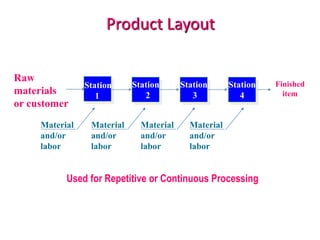
3.2.1. Product or Line
If all the processing equipment and machines
are arranged according to the sequence of
operations of a product.
Only one product or one type of product is
produced in an operating area.
The raw material is supplied at one end of the
line and goes from one operation to the next
quite rapidly with a minimum work in process,
storage and material handling.
E.g spinning and weaving sections
Raw
materials
or customer
Finished
item
Station
2
Station
3
Station
4
Material
and/or
labor
Station
1
Material
and/or
labor
Material
and/or
labor
Material
and/or
labor
Used for Repetitive or Continuous Processing
Product Layout
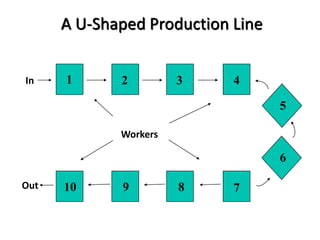
1 2 3 4
5
6
7
8
9
10
In
Out
Workers
A U-Shaped Production Line
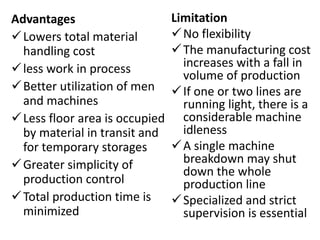
Advantages
Lowers total material
handling cost
less work in process
Better utilization of men
and machines
Less floor area is occupied
by material in transit and
for temporary storages
Greater simplicity of
production control
Total production time is
minimized
Limitation
No flexibility
The manufacturing cost
increases with a fall in
volume of production
If one or two lines are
running light, there is a
considerable machine
idleness
A single machine
breakdown may shut
down the whole
production line
Specialized and strict
supervision is essential
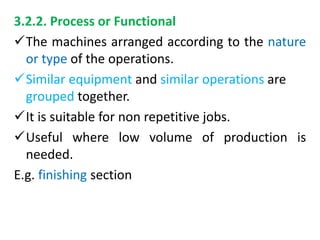
3.2.2. Process or Functional
The machines arranged according to the nature
or type of the operations.
Similar equipment and similar operations are
grouped together.
It is suitable for non repetitive jobs.
Useful where low volume of production is
needed.
E.g. finishing section
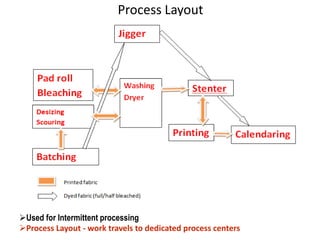
Process Layout
Used for Intermittent processing
Process Layout - work travels to dedicated process centers
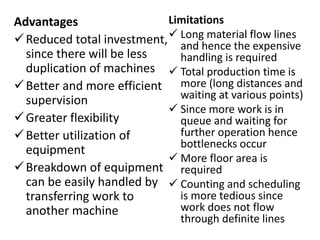
Advantages
Reduced total investment,
since there will be less
duplication of machines
Better and more efficient
supervision
Greater flexibility
Better utilization of
equipment
Breakdown of equipment
can be easily handled by
transferring work to
another machine
Limitations
 Long material flow lines
and hence the expensive
handling is required
 Total production time is
more (long distances and
waiting at various points)
 Since more work is in
queue and waiting for
further operation hence
bottlenecks occur
 More floor area is
required
 Counting and scheduling
is more tedious since
work does not flow
through definite lines
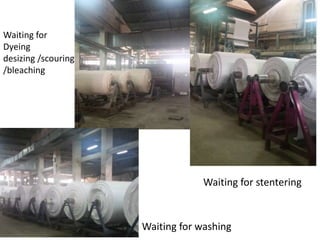
Waiting for
Dyeing
desizing /scouring
/bleaching
Waiting for stentering
Waiting for washing
3.2.3. Mixed or Combined Layout
• The combination of Process and Product
Layout is used frequently depending on the
type of work.
3.2.4. Static Layout
The product or project remains stationary, and
workers, materials, and equipment are moved as
needed to the location, because of its size and/or
weight, remains in one location and processes
are brought to it.
E.g. Employed in large project type organisation,
construction of DAMS, Helicopter, ships
Advantages of fixed Layouts
• Material movement is reduced,
• Highly flexible, can accommodate changes in
product design, product mix and production
volume.
Limitations
Highly skilled man power is required
Movement of machines and equipment may be
time consuming
3.3. General flow patterns
• "Flow Pattern" means the system to be adopted for the
movement of raw materials, from the beginning to the
end of manufacturing.
• Objective : to plan for the economical movement of the
raw materials throughout the plant.
• layout design starts with the flow system and building
designs are modified accordingly.
• sometimes the flow must be adopted to existing
buildings.
• Flow systems can be :
1. Horizontal flow : adopted on a shop floor
2. Vertical flow: adopted where material has to move in a
multi-storey building.
There are five basic types of horizontal flow line:
I-Flow, L-Flow, U-Flow, S-Flow, O-Flow.
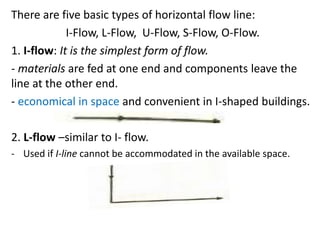
1. I-flow: It is the simplest form of flow.
- materials are fed at one end and components leave the
line at the other end.
- economical in space and convenient in I-shaped buildings.
2. L-flow –similar to I- flow.
- Used if I-line cannot be accommodated in the available space.
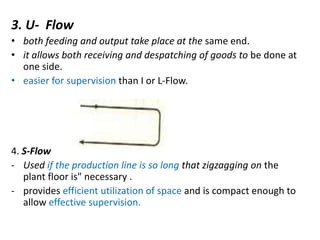
3. U- Flow
• both feeding and output take place at the same end.
• it allows both receiving and despatching of goods to be done at
one side.
• easier for supervision than I or L-Flow.
4. S-Flow
- Used if the production line is so long that zigzagging on the
plant floor is" necessary .
- provides efficient utilization of space and is compact enough to
allow effective supervision.
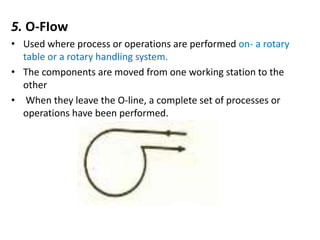
5. O-FIow
• Used where process or operations are performed on- a rotary
table or a rotary handling system.
• The components are moved from one working station to the
other
• When they leave the O-line, a complete set of processes or
operations have been performed.
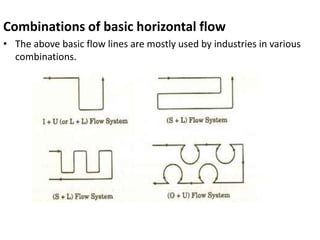
Combinations of basic horizontal flow
• The above basic flow lines are mostly used by industries in various
combinations.
Unidirectional and RetractionFlow
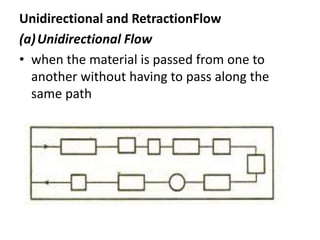
(a)Unidirectional Flow
• when the material is passed from one to
another without having to pass along the
same path
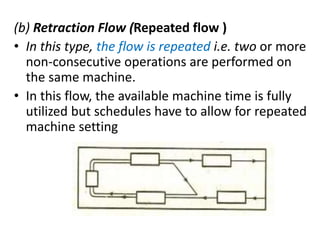
(b) Retraction Flow (Repeated flow )
• In this type, the flow is repeated i.e. two or more
non-consecutive operations are performed on
the same machine.
• In this flow, the available machine time is fully
utilized but schedules have to allow for repeated
machine setting
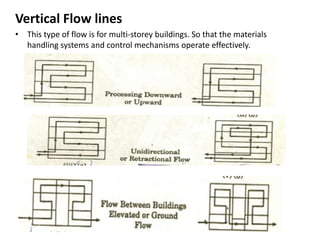
Vertical Flow lines
• This type of flow is for multi-storey buildings. So that the materials
handling systems and control mechanisms operate effectively.
3.4. Plant Layout and Factory Building
Factory design comprises of building design and layout of the
factory.
A factory building must possess the ff characteristics,
1. Functional: consider the production processes intended to
be performed in the factory; Spinning, Weaving, Finishing,
2. Constructional: consider the safety and durability of the
building.
3. Architectural: mainly concerned with the beautification of
the factory building.
Factors affecting factory building:
1. Type of manufacturing process
- Weight and height of machines used
Eg. Spg and wvg m/cs: heavy and medium height, fng m/cs: tall
and heavy, garment m/cs: very light
• Thus, each type of process would require building
characteristics in terms of floor, walls, height, column
spacing etc.
2. Plant Location- Land scape and land cost
- Different Land scape may have different buildings.
- A plant in a busy urban area and in a suburban area require different types of
buildings (considering land cost).
3. Material Handling
- material handling equipment decide the characteristics of building.
4. Factory Layout
The factory buildings should be designed considering production departments,
administrative offices and so on.
5. Provision of facilities
The building should consider:
- Lighting
- Air conditioning
- Ventilation
- Fire escapes
- Fire fighting equipment
- Other personnel facilities like toilets, canteens etc.
6. Future Expansion
• The design should be flexible to allow future expansion.
• If there is a possibility of future vertical expansion, strong foundations, supporters,
columns must be provided.
7. Safety and Security
• Protection against fire hazards, earthquakes should be in build in the design.
• Fences, flood lighting and security arrangements should be provided.
• Flammable materials (e.g. petroleum products) and dangerous chemicals should
be stored in locations away from the main buildings.
• The factory should be surrendered by boundary walls all around.
8. Employee facilities
• The building plan should include facilities like lunch rooms, cafeteria, locker
rooms and parking facilities.
• Toilets, washing, dressing facilities should also be provided.
9. Flexibility
The design of the building should be flexible to allow different types of processes.
This is achieved by large spans unobstructed by pillars, columns etc.
10. Appearance
• The buildings should provide a pleasant work environment with all the
necessary facilities designed aesthetically.
• Well designed landscapes around buildings immensely add to the aesthetics.
• This aspect is given a lot of attention at the present time, as it boosts the morale
of the workers.
Types of factory building
1. Single-storey buildings
2. Multi-storey buildings
Single storey factory buildings are used when;
Land is relatively cheap
Heavy machinery is required for processing
Growth of factory is expected
Advantages
-Greater flexibility in lay-out
-Cheaper and efficient material handling
-Efficient supervision
-Flexible for expansion
-Effective utilisation of floor space (no staircases etc)
-Reduced fire hazards
-Use of natural lighting and ventilation
-Low cost and quick construction
-Suitable for heavy plants
-Vibration free
Disadvantages
-High cost of land
-Not suitable for gravitational flow
Multi-storey factory buildings are used:
Where cost of land is relatively high.
 In process industries such as refineries, chemicals, fertilizers,
floor mills etc
Advantages
-Use of Gravity flow
-Low Land Cost
-Compact layout (for some types of processes)
-Upper stores free from noise
Disadvantages:
-High cost of construction
-wastage of floor space (due to staircases etc.,)
-Poor natural lighting
-Rigid layout
-High cost of supervision
-Difficulty in material handling
-Difficulty in expansion
Types of construction
1. Wood frame construction- cheap, quick to construct, flexible; highly
flammable.
2. Brick construction- More durable than wood frame; Walls and columns
may create obstructions.
3. Steel construction- construction cost is greater than brick construction
but lower than RCC. It is quite flexible to make changes.
4. RCC (Reinforced Concrete Construction) - steel encased in concrete.
- It is fire proof. Expensive, less maintenance, heavy load bearing capacity.
- highly suitable for multi-storey buildings.
- Long construction time.
- Less flexible.
5. Pre-cast concrete construction - very speedy construction and
economical.
- Sections are precast on the ground itself.
- then tilted vertically up by cranes to form the wall, roof and floor, etc.
End !!!

Textile plant layout.pptx

  • 1.
    Chapter 3: TextilePlant Layout 3.1. Basic concepts of plant layout  Definition  Need of plant layout  Factors affecting plant layout  Objectives of good plant layout  Principles of plant layout 3.2. Types of plant layout  Product or Line  Process or Functional  Combination type  Fixed Position 3.3. General flow patterns 3.4. Plant layout and factory building
  • 2.
    3.1. Basic conceptsof plant layout Definition Plant Layout: is the most effective physical arrangement either existing or in plans of industrial facilities i.e. arrangement of machines, processing equipment and service departments to achieve greatest coordination and efficiency of 4M’s (men, materials, machines and methods) in a plant. Layout problems are fundamental to every type of organization/enterprise and are experienced in all kinds of concerns. It is an important pre-requisite for efficient operations and also has a great deal in common with many problems. Once the site of the plant has been decided, the next step is to plan suitable layout.
  • 3.
    Need of plantlayout (when it is necessary?) Two plants having similar operations may not have identical layouts. This may be due to; Size of the plant Nature of the process, and Management desire The necessity of plant layout may be felt when:  There is an expansion of the enterprise  There is proposed variation in the size of the dep’ts  Some new product is to be added to the existing line.  New dep’t to be added, reallocation of the existing  A new plant is to be set up
  • 4.
    Factors affecting plantlayout The weight, volume or mobility of the product e.g. ship building companies, locomotive industries Complexity of the final product e.g. automobile industry The length of the process in relation to handling time e.g. steam turbine industry The extent to which the process tends towards mass production
  • 5.
    Objectives of goodplant layout Should provide overall satisfaction to all concerned. Material handling and internal transportation is minimized and efficiently controlled. Should utilize the space most effectively Should lead to increased productivity and better quality of the product with reduced capital cost Should provide easy supervision Should provide space for future expansion of the plant Should provide proper lighting and ventilation of the areas of work stations
  • 6.
    Principles of plantlayout There are six basic principles of best layout 1. Principle of overall integration The best layout is one which integrates the men, materials, machinery, supporting activities and any other similar factors that results in the best compromise. 2. Principle of Minimum distance • The movements of men and materials should be minimized.
  • 7.
    3 Principle ofSmooth and Continuous Flow • Bottlenecks, congestions and backtracking should be removed by proper line balancing techniques. 4 Principle of Cubic Space Utilization • The best layout utilizes cubic space i.e. Space available both in vertical and horizontal directions. ( overhead material handling equipments)
  • 8.
    5. Principle ofSafety and health • Best layout is one which provides satisfaction and safety to all workers concerned • Safe; well-ventilated; free from dust, noise, fumes, odours etc., 6. Principle of flexibility • Layout should be flexible to allow changes with minimum cost and least inconvenience e.g. Automotive industries
  • 9.
    3.2. Types ofplant lay-out Keeping in view the type of industry and volume of production, the type of layout to be selected is to be decided from the ff: 1. Product or Line 2. Process or Functional 3. Fixed Position 4. Combination type
  • 10.
    3.2.1. Product orLine If all the processing equipment and machines are arranged according to the sequence of operations of a product. Only one product or one type of product is produced in an operating area. The raw material is supplied at one end of the line and goes from one operation to the next quite rapidly with a minimum work in process, storage and material handling. E.g spinning and weaving sections
  • 11.
  • 12.
    1 2 34 5 6 7 8 9 10 In Out Workers A U-Shaped Production Line
  • 13.
    Advantages Lowers total material handlingcost less work in process Better utilization of men and machines Less floor area is occupied by material in transit and for temporary storages Greater simplicity of production control Total production time is minimized Limitation No flexibility The manufacturing cost increases with a fall in volume of production If one or two lines are running light, there is a considerable machine idleness A single machine breakdown may shut down the whole production line Specialized and strict supervision is essential
  • 14.
    3.2.2. Process orFunctional The machines arranged according to the nature or type of the operations. Similar equipment and similar operations are grouped together. It is suitable for non repetitive jobs. Useful where low volume of production is needed. E.g. finishing section
  • 15.
    Process Layout Used forIntermittent processing Process Layout - work travels to dedicated process centers
  • 16.
    Advantages Reduced total investment, sincethere will be less duplication of machines Better and more efficient supervision Greater flexibility Better utilization of equipment Breakdown of equipment can be easily handled by transferring work to another machine Limitations  Long material flow lines and hence the expensive handling is required  Total production time is more (long distances and waiting at various points)  Since more work is in queue and waiting for further operation hence bottlenecks occur  More floor area is required  Counting and scheduling is more tedious since work does not flow through definite lines
  • 17.
  • 18.
    3.2.3. Mixed orCombined Layout • The combination of Process and Product Layout is used frequently depending on the type of work.
  • 19.
    3.2.4. Static Layout Theproduct or project remains stationary, and workers, materials, and equipment are moved as needed to the location, because of its size and/or weight, remains in one location and processes are brought to it. E.g. Employed in large project type organisation, construction of DAMS, Helicopter, ships
  • 20.
    Advantages of fixedLayouts • Material movement is reduced, • Highly flexible, can accommodate changes in product design, product mix and production volume. Limitations Highly skilled man power is required Movement of machines and equipment may be time consuming
  • 21.
    3.3. General flowpatterns • "Flow Pattern" means the system to be adopted for the movement of raw materials, from the beginning to the end of manufacturing. • Objective : to plan for the economical movement of the raw materials throughout the plant. • layout design starts with the flow system and building designs are modified accordingly. • sometimes the flow must be adopted to existing buildings. • Flow systems can be : 1. Horizontal flow : adopted on a shop floor 2. Vertical flow: adopted where material has to move in a multi-storey building.
  • 22.
    There are fivebasic types of horizontal flow line: I-Flow, L-Flow, U-Flow, S-Flow, O-Flow. 1. I-flow: It is the simplest form of flow. - materials are fed at one end and components leave the line at the other end. - economical in space and convenient in I-shaped buildings. 2. L-flow –similar to I- flow. - Used if I-line cannot be accommodated in the available space.
  • 23.
    3. U- Flow •both feeding and output take place at the same end. • it allows both receiving and despatching of goods to be done at one side. • easier for supervision than I or L-Flow. 4. S-Flow - Used if the production line is so long that zigzagging on the plant floor is" necessary . - provides efficient utilization of space and is compact enough to allow effective supervision.
  • 24.
    5. O-FIow • Usedwhere process or operations are performed on- a rotary table or a rotary handling system. • The components are moved from one working station to the other • When they leave the O-line, a complete set of processes or operations have been performed.
  • 25.
    Combinations of basichorizontal flow • The above basic flow lines are mostly used by industries in various combinations.
  • 26.
    Unidirectional and RetractionFlow (a)UnidirectionalFlow • when the material is passed from one to another without having to pass along the same path
  • 27.
    (b) Retraction Flow(Repeated flow ) • In this type, the flow is repeated i.e. two or more non-consecutive operations are performed on the same machine. • In this flow, the available machine time is fully utilized but schedules have to allow for repeated machine setting
  • 28.
    Vertical Flow lines •This type of flow is for multi-storey buildings. So that the materials handling systems and control mechanisms operate effectively.
  • 29.
    3.4. Plant Layoutand Factory Building Factory design comprises of building design and layout of the factory. A factory building must possess the ff characteristics, 1. Functional: consider the production processes intended to be performed in the factory; Spinning, Weaving, Finishing, 2. Constructional: consider the safety and durability of the building. 3. Architectural: mainly concerned with the beautification of the factory building. Factors affecting factory building: 1. Type of manufacturing process - Weight and height of machines used Eg. Spg and wvg m/cs: heavy and medium height, fng m/cs: tall and heavy, garment m/cs: very light • Thus, each type of process would require building characteristics in terms of floor, walls, height, column spacing etc.
  • 30.
    2. Plant Location-Land scape and land cost - Different Land scape may have different buildings. - A plant in a busy urban area and in a suburban area require different types of buildings (considering land cost). 3. Material Handling - material handling equipment decide the characteristics of building. 4. Factory Layout The factory buildings should be designed considering production departments, administrative offices and so on. 5. Provision of facilities The building should consider: - Lighting - Air conditioning - Ventilation - Fire escapes - Fire fighting equipment - Other personnel facilities like toilets, canteens etc. 6. Future Expansion • The design should be flexible to allow future expansion. • If there is a possibility of future vertical expansion, strong foundations, supporters, columns must be provided.
  • 31.
    7. Safety andSecurity • Protection against fire hazards, earthquakes should be in build in the design. • Fences, flood lighting and security arrangements should be provided. • Flammable materials (e.g. petroleum products) and dangerous chemicals should be stored in locations away from the main buildings. • The factory should be surrendered by boundary walls all around. 8. Employee facilities • The building plan should include facilities like lunch rooms, cafeteria, locker rooms and parking facilities. • Toilets, washing, dressing facilities should also be provided. 9. Flexibility The design of the building should be flexible to allow different types of processes. This is achieved by large spans unobstructed by pillars, columns etc. 10. Appearance • The buildings should provide a pleasant work environment with all the necessary facilities designed aesthetically. • Well designed landscapes around buildings immensely add to the aesthetics. • This aspect is given a lot of attention at the present time, as it boosts the morale of the workers.
  • 32.
    Types of factorybuilding 1. Single-storey buildings 2. Multi-storey buildings Single storey factory buildings are used when; Land is relatively cheap Heavy machinery is required for processing Growth of factory is expected Advantages -Greater flexibility in lay-out -Cheaper and efficient material handling -Efficient supervision -Flexible for expansion -Effective utilisation of floor space (no staircases etc) -Reduced fire hazards -Use of natural lighting and ventilation -Low cost and quick construction -Suitable for heavy plants -Vibration free Disadvantages -High cost of land -Not suitable for gravitational flow
  • 33.
    Multi-storey factory buildingsare used: Where cost of land is relatively high.  In process industries such as refineries, chemicals, fertilizers, floor mills etc Advantages -Use of Gravity flow -Low Land Cost -Compact layout (for some types of processes) -Upper stores free from noise Disadvantages: -High cost of construction -wastage of floor space (due to staircases etc.,) -Poor natural lighting -Rigid layout -High cost of supervision -Difficulty in material handling -Difficulty in expansion
  • 34.
    Types of construction 1.Wood frame construction- cheap, quick to construct, flexible; highly flammable. 2. Brick construction- More durable than wood frame; Walls and columns may create obstructions. 3. Steel construction- construction cost is greater than brick construction but lower than RCC. It is quite flexible to make changes. 4. RCC (Reinforced Concrete Construction) - steel encased in concrete. - It is fire proof. Expensive, less maintenance, heavy load bearing capacity. - highly suitable for multi-storey buildings. - Long construction time. - Less flexible. 5. Pre-cast concrete construction - very speedy construction and economical. - Sections are precast on the ground itself. - then tilted vertically up by cranes to form the wall, roof and floor, etc.
  • 35.